
Journal of Inorganic Materials ›› 2026, Vol. 41 ›› Issue (7): 883-898.DOI: 10.15541/jim20250429
• REVIEW • Previous Articles Next Articles
QIN Shanli1( ), GUO Jiawen1, CHEN Yanmeng4, JU An’an1, WEI Yi1, HUANG Kelin1, HOU Xianghua1, LÜ Sishi5, WEN Zhipeng1(), WU Lian2,3()
Received:2025-10-28
Revised:2025-12-11
Published:2026-07-20
Online:2025-12-19
Contact:
WU Lian, associate professor. E-mail: wulian@gdcri.com;About author:QIN Shanli (1989-), female, senior engineer. E-mail: qinshanli2024@163.com
Supported by:CLC Number:
QIN Shanli, GUO Jiawen, CHEN Yanmeng, JU An’an, WEI Yi, HUANG Kelin, HOU Xianghua, LÜ Sishi, WEN Zhipeng, WU Lian. Recent Advances in Constructing Oriented Ion Transport Channels with Two-dimensional Layered Materials for Electrochemical Energy Storage[J]. Journal of Inorganic Materials, 2026, 41(7): 883-898.
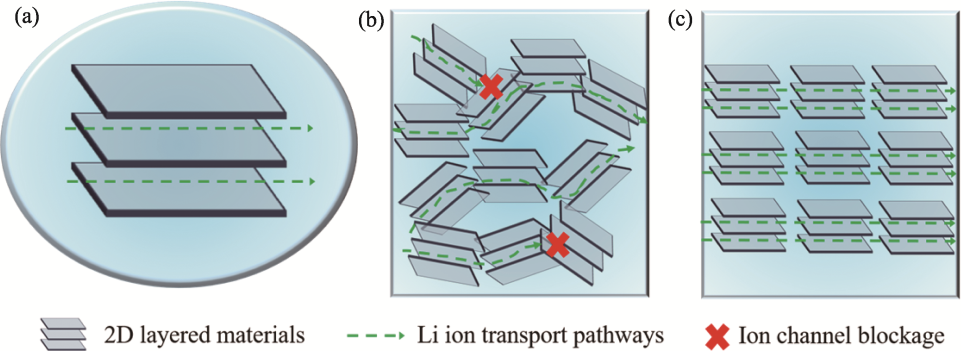
Fig. 1 Schematic diagrams of constructing directional ion transport channels using 2D layered materials (a) Microscopic ion transport channel structure between 2D layered materials; (b) Microscopically disordered ion transport pathways; (c) Microscopically ordered and vertically arranged ion transport pathways
| Method | Advantage | Disadvantage |
|---|---|---|
| Self-assembly | Simplified procedure; being free complex equipment; low cost & scalable | Dependence on specific surface groups; limited self-organization control |
| External field-assisted orientation arrangement | Precise tuning of orientation & order; adjustable field parameters; high-alignment performance | High operational precision; expensive equipment |
| Template-assisted method | Tailorable template design; accurate morphology/ size/orientation control; high alignment accuracy | Complex template fabrication; structure damage during removal; residual impurities lowering purity |
| Freeze-drying | Mild physical process; wide material compatibility; preserved intrinsic properties | Strict thermal control; high equipment cost; uneven ice growth inducing defects |
Table 1 Advantages and disadvantages of the method for constructing ion transport channels via the oriented arrangement of 2D layered materials[30,34,40 -41]
| Method | Advantage | Disadvantage |
|---|---|---|
| Self-assembly | Simplified procedure; being free complex equipment; low cost & scalable | Dependence on specific surface groups; limited self-organization control |
| External field-assisted orientation arrangement | Precise tuning of orientation & order; adjustable field parameters; high-alignment performance | High operational precision; expensive equipment |
| Template-assisted method | Tailorable template design; accurate morphology/ size/orientation control; high alignment accuracy | Complex template fabrication; structure damage during removal; residual impurities lowering purity |
| Freeze-drying | Mild physical process; wide material compatibility; preserved intrinsic properties | Strict thermal control; high equipment cost; uneven ice growth inducing defects |
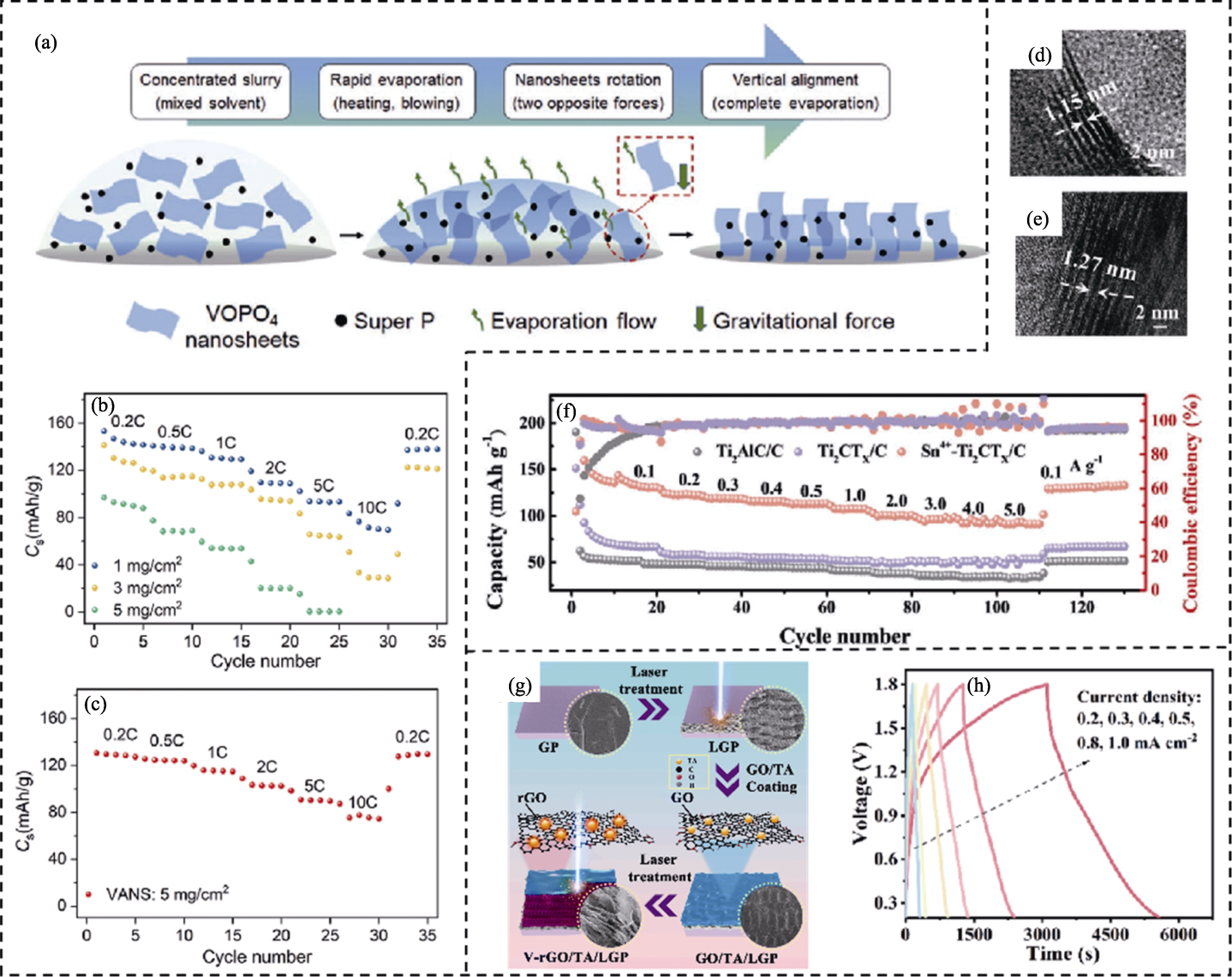
Fig. 2 Application of 2D layered materials in constructing directional ion channels in electrode materials[42,45,50] (a) Schematic diagram of vertical alignment of VOPO4 nanosheets induced by solvent evaporation[42]; (b) Rate capability of conventional electrodes as a function of mass loading[42]; (c) Rate capability of vertically aligned nanosheets (VANS) electrode at 5 mg·cm−2[42]; (d, e) HRTEM images of Ti2CTx/C (d) before and (e) after Sn4+ intercalation[45]; (f) Rate performance of Ti2AlC/C, Ti2CTx/C, and Sn4+-Ti2CTx/C electrodes[45]; (g) Schematic fabrication of flexible V-rGO/tannic acid (TA)/laser-pretreated graphite paper (LGP) electrodes via laser assistance[50]; (h) Galvanostatic charge-discharge curves of the quasi-solid-state aqueous zinc-ion hybrid capacitors[50]
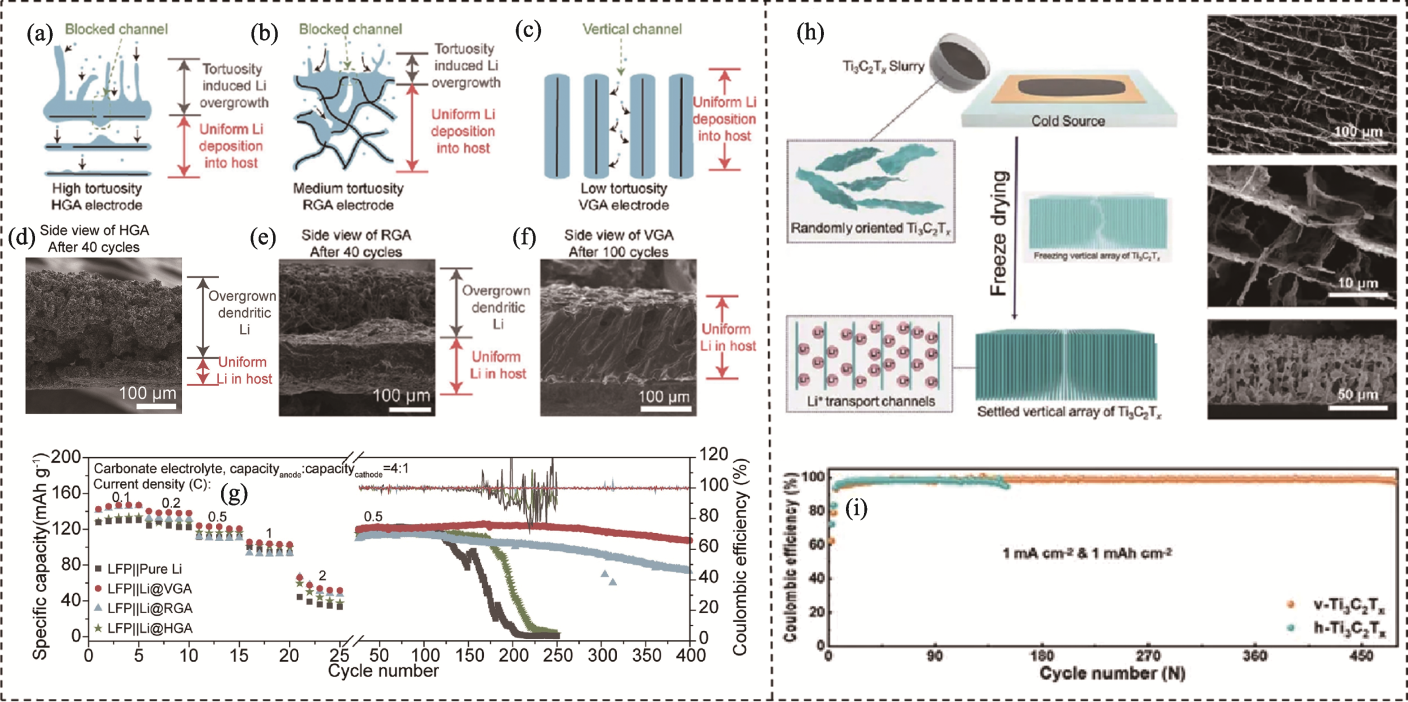
Fig. 3 Influence of the arrangement of 2D layered materials on the uniformity of lithium deposition and cycle life[52,54] (a-c) Schematics of Li deposition in (a) horizontally aligned rGO aerogel (HGA), (b) randomly arranged rGO aerogel (RGA), and (c) vertically aligned rGO aerogel (VGA)[52]; (d-f) Cross-sectional scanning electron microscope (SEM) images of (d) HGA and (e) RGA after 40 cycles, and (f) VGA after 100 cycles (cycling current density: 3 mA·cm-2, capacity: 3 mAh·cm-2, carbonate electrolyte)[52]; (g) Rate capability and long-term cycling performances of LFP||Li cells[52]; (h) Synthesis and SEM images of v-Ti3C2Tx electrodes[54]; (i) Coulombic efficiencies of V-Ti3C2Tx and H-Ti3C2Tx electrodes at 1.0 mAh·cm-2[54]
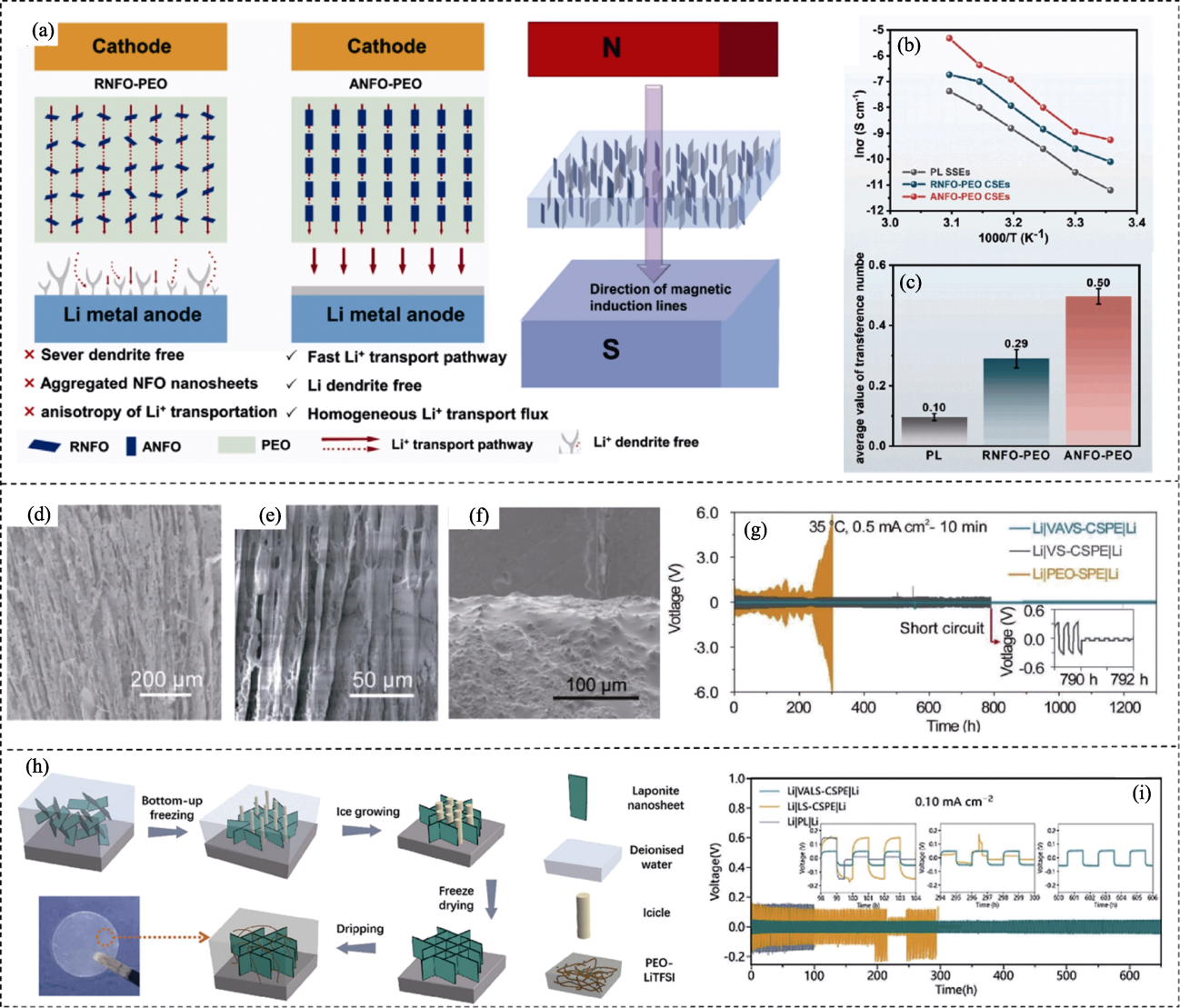
Fig. 4 Application of 2D layered materials in constructing directional ion channels in SPEs[64,68,70] (a) Schematic illustration of the synthesis of composite solid-state electrolytes (CSEs) with NFO nanosheets and a rational mechanism for ion transport in CSEs applied in lithium metal batteries[64]; (b) Arrhenius curves of CSEs with vertically aligned NFO-PEO (ANFO-PEO), random aligned NFO-PEO (RNFO-PEO), and PEO-LiTFSI (PL)[64]; (c) Average values of transference number along with their standard errors[64]; (d-f) Cross-sectional SEM images of (d) VAVS and (e) VAVS-CSPE (UV etched), (f) Li electrode surface after test for about half-month with VAVS-CSPE electrolytes[68]; (g) Galvanostatic cycling performance of Li/SPE/Li symmetric cells measured at 35 ℃ with 0.5 mA·cm-2 current density[68]; (h) Schematic illustration of the preparation of VALS-CSPE[70]; (i) Galvanostatic tests of Li|Li cells at 0.10 mA·cm−2[70]
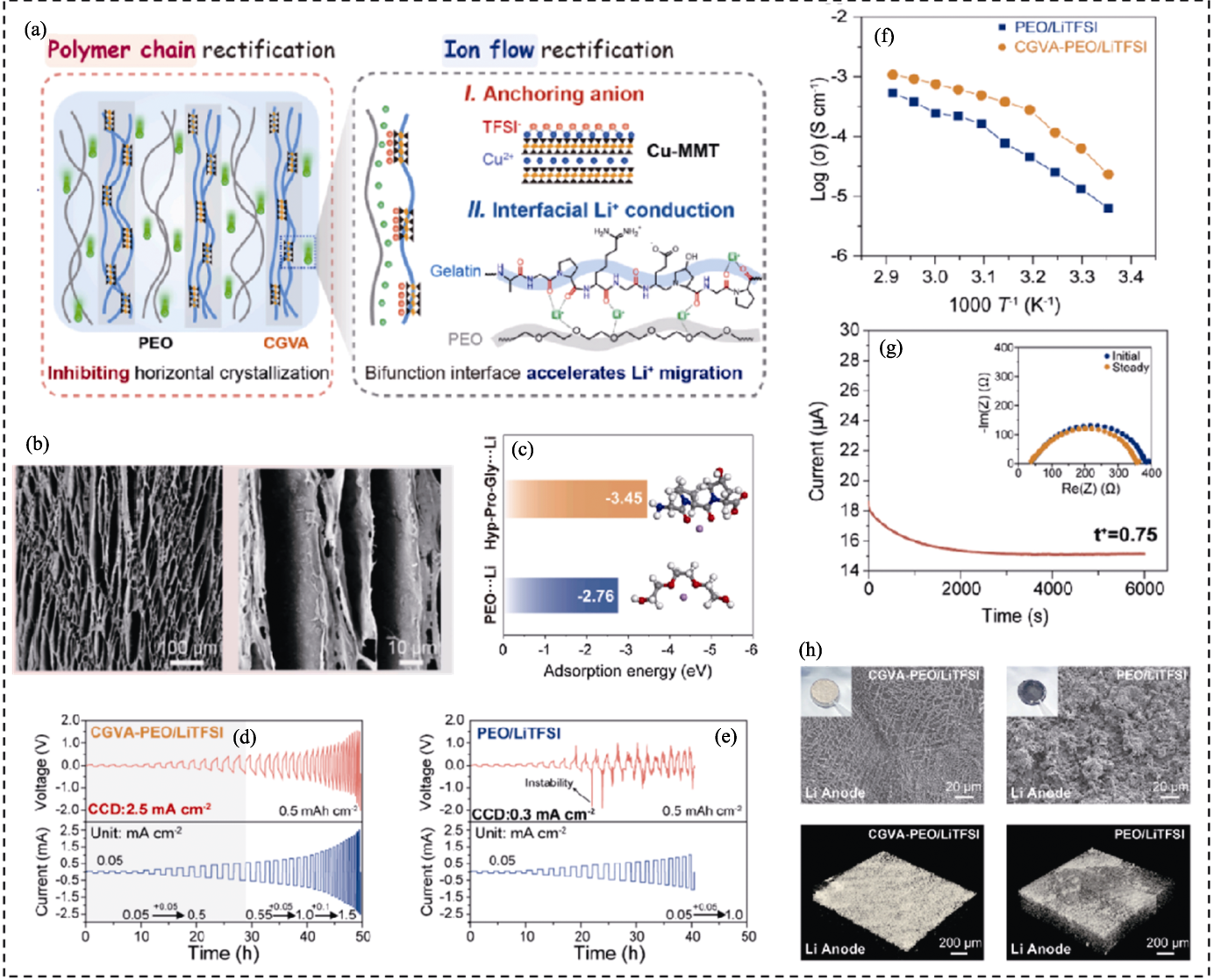
Fig. 5 High critical current density and dendrite free lithium deposition of PEO-based solid electrolyte by Cu-MMT/gelatin vertical array[72] (a) Cross-scale synergistic rectification strategy through the ion rectifier; (b) Top view SEM images of ion rectifier of the vertical channel surface; (c) Chemical structure and electron density distribution of tripeptide (hydroxyproline-proline-glycine, Hyp-Pro-Gly) abundantly present in gelatin (top), binding energies of Hyp-Pro-Gly and PEO chain segments with Li+, respectively (bottom); (d, e) Critical current density tests of (d) CGVA-PEO/LiTFSI and (e) PEO/LiTFSI; (f) Ionic conductivity−temperature curves of different electrolytes; (g) Current variation with polarization of Li//CGVA-PEO/LiTFSI//Li symmetrical cell with an applied potential of 10 mV with inset showing electrochemical impedance spectroscopy (EIS) plots before and after polarization; (h) Top-view SEM images (top) and corresponding X-ray computed tomography (X-CT) images (bottom) of Li anodes with different electrolyte membranes after 20 cycles at 0.1 mA·cm−2 and 0.1 mAh·cm−2
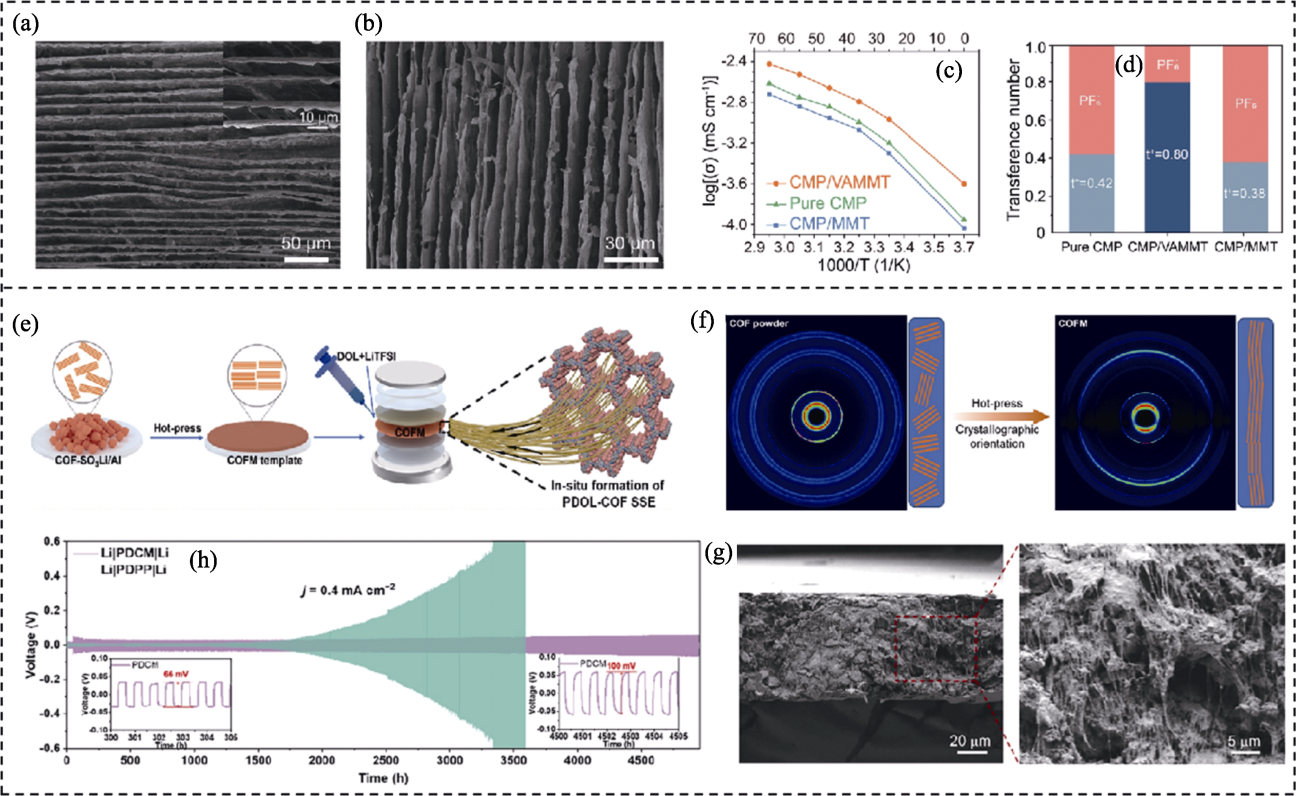
Fig. 6 Application of 2D layered materials in constructing directional ion channels in GPEs[22,79] (a) Top-view SEM image of VAMMT[22]; (b) Cross-sectional SEM image of VAMMT[22]; (c) Arrhenius ionic conductivity (σ) plots of CMP/VAMMT, CMP/MMT and pure CMP[22]; (d) Li+ transference numbers of different electrolytes[22]; (e) Schematic illustration for the in situ polymerization of COF-templated method (PDCM)[79]; (f) 2D wide-angle X-ray scattering (WAXS) patterns of COF powder and COF membrane (COFM)[79]; (g) SEM images of the fracture surface for PDCM[79]; (h) Galvanostatic cycling curves of the Li||Li symmetric cells assembled with PDCM and PDOL@PP (PDPP)[79]
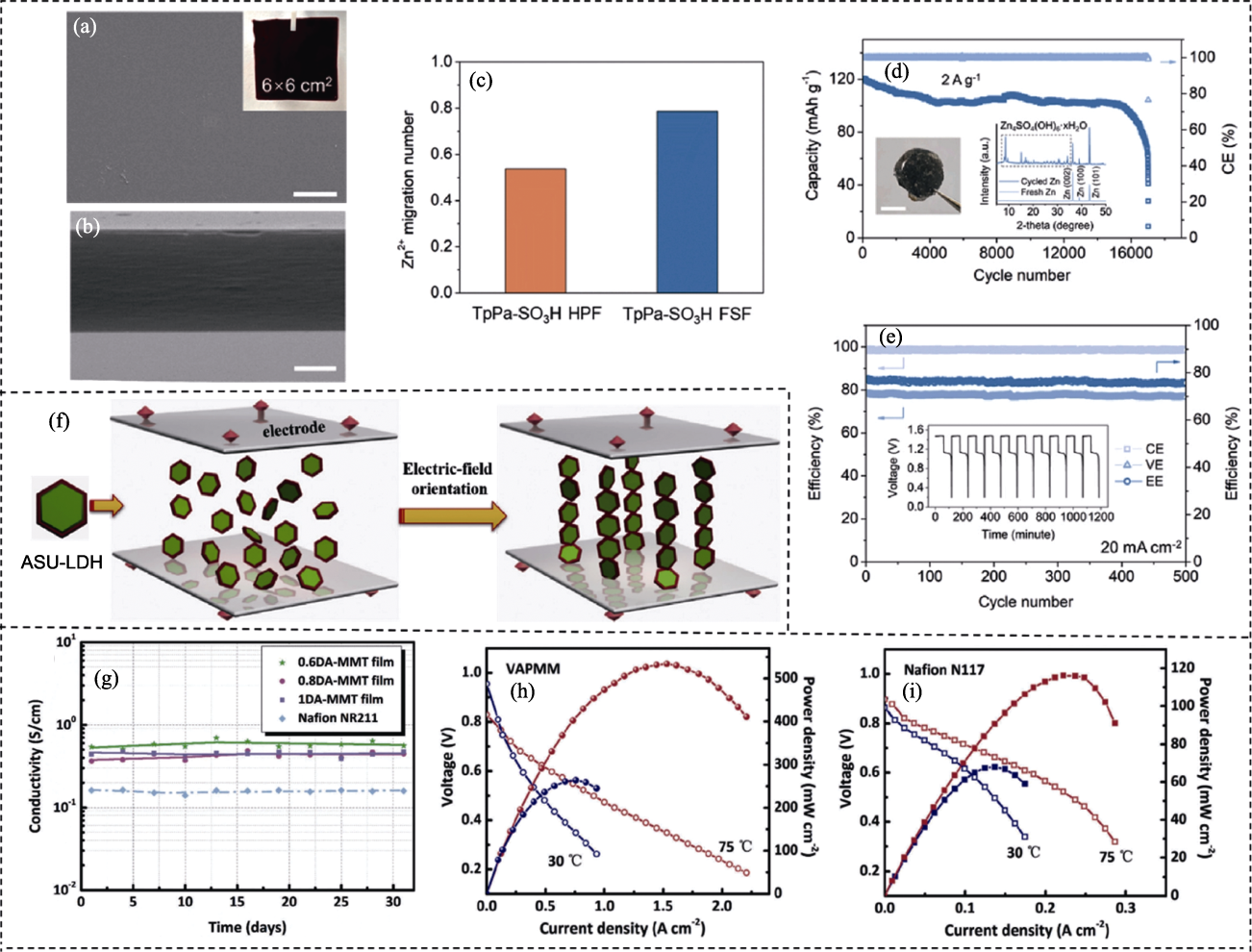
Fig. 7 Application of 2D layered materials in constructing directional ion channels in separator[82-83,85] (a) SEM morphologies of homogeneous membrane synthesized by low-temperature crystallization method (LTCM) (scale bar: 5 μm) with inset showing the optical image with the dimensions of 6 cm×6 cm[82]; (b) Cross-sectional SEM morphologies of TpPa-SO3H FSF (Tp: 1,3,5-triformylphloroglucinol; Pa-SO3H: 2,5-diaminobenzenesulfonic acid; FSF: free-standing form) homogeneous membrane (scale bar: 10 μm)[82]; (c) Migration number results of TpPa-SO3H HPF (HPF: high-pressure form) and TpPa-SO3H FSF in Zn-Zn symmetric batteries[82]; (d) Long cycling performance of zinc-iodine batteries using TpPa-SO3H FSF separator under the condition of 2 A·g−1 with an active mass loading of 5 mg·cm−2 with insets showing the photo of Zn anode foil after cycling (scale bar: 8 mm) and the corresponding XRD patterns[82]; (e) Coulombic efficiency (CE), voltage efficiency (VE), and energy efficiency (EE) during the charge-discharge cycling of zinc-iodine flow battery (20 mA·cm−2) using TpPa-SO3H FSF separator with inset showing the first 10 charge-discharge curves[82]; (f) Schematic of aligned ASU-LDH nanosheets under applied-electric field[83]; (g) Durability test of σ values of xDA-MMT films and Nafion NR211 film with a 25.4 μm thickness[85]; (h, i) Single-cell performances of (h) vertically aligned polydopamine-intercalated montmorillonite membrane (VAPMM)-based and (i) N117-based membrane electrode assembly from 30 to 75 ℃ with 100% relative humidity (RH)[85]
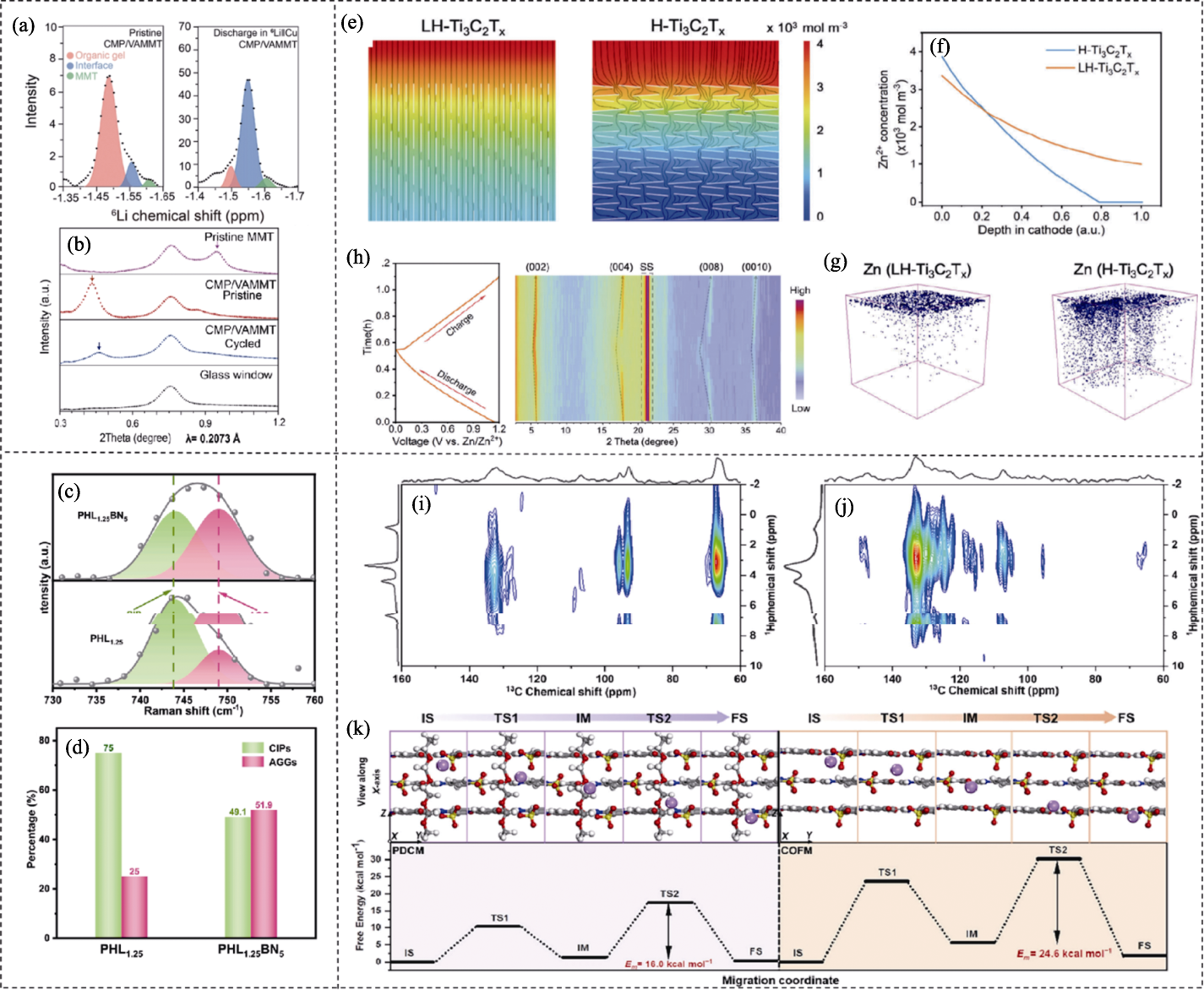
Fig. 8 Ionic transport mechanisms of 2D layered materials promoting electrochemical energy storage process[22,46,61,79] (a) 6Li solid state nuclear magnetic resonance (SSNMR) spectra of CMP/VAMMT before (left) and after (right) discharge in the 6Li‖Cu cell[22]; (b) Synchrotron radiation X-ray diffraction (λ=0.2073 Å) patterns of pristine MMT, pristine CMP/VAMMT, cycled CMP/VAMMT, and the glass window[22]; (c) Raman spectra and fitting curves of PHL1.25 and PHL1.25BN5 electrolytes in 730-760 cm−1 (CIP: contact ion pair; AGG: aggregated ion pair)[61]; (d) Quantitative analysis of CIPs and AGGs of PHL1.25 and PHL1.25BN5 electrolytes[61]; (e) COMSOL multiphysics simulation results of the Zn2+ ions distribution behaviors of LH-Ti3C2Tx and H-Ti3C2Tx[46]; (f) Zn2+ ions concentration distribution versus diffusion depth through the cathode of LH-Ti3C2Tx and H-Ti3C2Tx[46]; (g) Distribution profiles of CF3SO32− detected by time-of-flight secondary ion mass spectrometer (TOF-SIMS) from the cycled Zn anodes in Zn||LH-Ti3C2Tx and Zn||H-Ti3C2Tx[46]; (h) 2D contour plots of the in situ XRD test results within one charge/discharge cycle of Zn||LH-Ti3C2Tx ZHCs[46]; (i, j) 1H-13C cross polarization-heteronuclear correlation nuclear magnetic resonance (CP-HETCOR NMR) spectra of (i) PDOL-COF physical mixture and (j) PDCM composite[79]; (k) Theoretical elucidation of Li+ migration behaviors in PDCM and COFM (initial, intermediate, transition, and final states are abbreviated as IS, IM, TS, and FS, respectively)[79]
| [1] |
QUILTY C D, WU D, LI W, et al. Electron and ion transport in lithium and lithium-ion battery negative and positive composite electrodes. Chemical Reviews, 2023, 123(4): 1327.
DOI URL |
| [2] |
WU L, HONG L, GAO S, et al. Cu2-xSe@montmorillonite heterostructured electrocatalyst for high-performance lithium- sulfur batteries. Journal of Energy Storage, 2024, 101: 113800.
DOI URL |
| [3] |
WU L, ZHAO Y, YU Y, et al. FeS2 intercalated montmorillonite as a multifunctional separator coating for high-performance lithium-sulfur batteries. Inorganic Chemistry Frontiers, 2023, 10(2): 651.
DOI URL |
| [4] | EDIGAR M, MOMBESHORA E T, MUIVA C M, et al. Lithium-ion batteries: recent progress in improving the cycling and rate performances of transition metal oxide anodes by incorporating graphene-based materials. Journal of Energy Storage, 2023, 73B: 109013. |
| [5] |
CHENG Y, XIE Y, YAN S, et al. Maximizing the ion accessibility and high mechanical strength in nanoscale ion channel MXene electrodes for high-capacity zinc-ion energy storage. Science Bulletin, 2022, 67(21): 2216.
DOI PMID |
| [6] | WROGEMANN J M, LÜTHER M J, BÄRMANN P, et al. Overcoming diffusion limitation of Faradaic processes: property- performance relationships of 2D conductive metal-organic framework Cu3(HHTP)2 for reversible lithium-ion storage. Angewandte Chemie International Edition, 2023, 62(26): e202303111. |
| [7] |
PETTINARI C, TOMBESI A. MOFs for electrochemical energy conversion and storage. Inorganics, 2023, 11(2): 65.
DOI URL |
| [8] |
OTGONBAYAR Z, YANG S, KIM I J, et al. Recent advances in 2D MXene and solid state electrolyte for energy storage applications: comprehensive review. Chemical Engineering Journal, 2023, 472: 144801.
DOI URL |
| [9] |
PHILIP A, KUMAR A R. Recent advancements and developments employing 2D-materials in enhancing the performance of electrochemical supercapacitors: a review. Renewable and Sustainable Energy Reviews, 2023, 182: 113423.
DOI URL |
| [10] |
HE Y, SHEN X, ZHANG Y. Layered 2D materials in batteries. ACS Applied Nano Materials, 2024, 7(24): 27907.
DOI URL |
| [11] |
CHEN Z, ZHI C. MXene based zinc ion batteries: recent development and prospects. Journal of Inorganic Materials, 2024, 39(2): 204.
DOI URL |
| [12] |
RUIZ-HITZKY E, ARANDA P. Polymer-salt intercalation complexes in layer silicates. Advanced Materials, 1990, 2(11): 545.
DOI URL |
| [13] |
WEN Z P, WEI Y, HOU X H, et al. Research progress of bentonite-based functional materials in electrochemical energy storage. Journal of Inorganic Materials, 2024, 39(12): 1301.
DOI URL |
| [14] | YANG Y, LI Z, YANG Z, et al. Ultrafast lithium-ion transport engineered by nanoconfinement effect. Advanced Materials, 2025, 37(8): e2416266. |
| [15] | LIU Y T, ZHU P, SUN N, et al. Self-assembly of transition metal oxide nanostructures on MXene nanosheets for fast and stable lithium storage. Advanced Materials, 2018, 30(23): e1707334. |
| [16] |
LIAN H, MOMEN R, XIAO Y, et al. High ionic conductivity motivated by multiple ion-transport channels in 2D MOF-based lithium solid state battery. Advanced Functional Materials, 2023, 33(49): 2306060.
DOI URL |
| [17] | HE M, GUAN M, ZHAN R, et al. Two-dimensional materials applied in membranes of redox flow battery. Chemistry-An Asian Journal, 2023, 18(3): e202201152. |
| [18] |
VIJAYAKUMAR V, GHOSH M, ASOKAN K, et al. 2D layered nanomaterials as fillers in polymer composite electrolytes for lithium batteries. Advanced Energy Materials, 2023, 13(15): 2203326.
DOI URL |
| [19] |
YANG Y, DONG R, CHENG H, et al. 2D layered materials for fast-charging lithium-ion battery anodes. Small, 2023, 19(34): 2301574.
DOI URL |
| [20] |
JIANG D, WANG X, YIN S, et al. Solid-state electrolytes with vertically aligned Li+ transport channels for lithium batteries: a comprehensive review. Energy Storage Materials, 2025, 74: 103986.
DOI URL |
| [21] |
XIA Y, MATHIS T S, ZHAO M Q, et al. Thickness-independent capacitance of vertically aligned liquid-crystalline MXenes. Nature, 2018, 557(7705): 409.
DOI |
| [22] |
LI X, WANG Y, XI K, et al. Quasi-solid-state ion-conducting arrays composite electrolytes with fast ion transport vertical-aligned interfaces for all-weather practical lithium-metal batteries. Nano-Micro Letters, 2022, 14(1): 210.
DOI PMID |
| [23] | JU Z, KING S T, XU X, et al. Vertically assembled nanosheet networks for high-density thick battery electrodes. Proceedings of the National Academy of Sciences, 2022, 119(40): e2212777119. |
| [24] |
NAGUIB M, COME J, DYATKIN B, et al. MXene: a promising transition metal carbide anode for lithium-ion batteries. Electrochemistry Communications, 2012, 16(1): 61.
DOI URL |
| [25] |
XU M, WEI M. Layered double hydroxide-based catalysts: recent advances in preparation, structure, and applications. Advanced Functional Materials, 2018, 28(47): 1802943.
DOI URL |
| [26] | 胡朔. NiAl LDHs电极材料的制备及超级电容器性能研究. 郑州: 郑州轻工业大学硕士学位论文, 2025. |
| [27] | XIONG D, DENG X, CAO Z, et al. 2D metal-organic frameworks for electrochemical energy storage. Energy & Environmental Materials, 2023, 6(6): e12521. |
| [28] | TAKAAKI T, FURUKAWA S, TAKASHIMA Y, et al. Nanoporous nanorods fabricated by coordination modulation and oriented attachment growth. Angewandte Chemie International Edition, 2009, 121(26): 4833. |
| [29] |
SHEBERLA D, BACHMAN J C, ELIAS J S, et al. Conductive MOF electrodes for stable supercapacitors with high areal capacitance. Nature Materials, 2017, 16(2): 220.
DOI PMID |
| [30] |
NIU L, WU T, CHEN M, et al. Conductive metal-organic frameworks for supercapacitors. Advanced Materials, 2022, 34(52): 2200999.
DOI URL |
| [31] |
KHALIL I E, FONSECA J, REITHOFER M R, et al. Tackling orientation of metal-organic frameworks (MOFs): the quest to enhance MOF performance. Coordination Chemistry Reviews, 2023, 481: 215043.
DOI URL |
| [32] | 张秩远, 陈浩彤, 李妍, 等. 插层结构过渡金属氢氧化物的制备及其能源应用研究进展. 化学通报, 2024, 87(8): 913. |
| [33] | RADICH J G, MCGINN P J, KAMAT P V. Graphene-based composites for electrochemical energy storage. Electrochemical Society Interface, 2011, 20(1): 63. |
| [34] |
WU Z, WANG E, ZHANG G, et al. Recent progress of vertical graphene: preparation, structure engineering, and emerging energy applications. Small, 2024, 20(15): 2307923.
DOI URL |
| [35] | 何明亮. 垂直石墨烯自支撑电极的可控制备与超级电容器应用研究. 南昌: 江西师范大学博士学位论文, 2024. |
| [36] |
LIMA K A L, LARANJEIRA J A S, MARTINS N F, et al. Petal-graphyne: a novel 2D carbon allotrope for high-performance Li and Na ion storage. Journal of Energy Storage, 2025, 130: 117235.
DOI URL |
| [37] | LIAN W, XIN H, YIFANG Z, et al. Montmorillonite-based materials for electrochemical energy storage. Green Chemistry, 2024(2): 26. |
| [38] | LV R, KOU W, GUO S, et al. Preparing two-dimensional ordered Li0.33La0.557TiO3 crystal in interlayer channel of thin laminar inorganic solid-state electrolyte towards ultrafast Li+ transfer. Angewandte Chemie International Edition, 2022, 134(7): e202114220. |
| [39] |
ZHANG Y, HUANG J, LIU H, et al. Lamellar ionic liquid composite electrolyte for wide-temperature solid-state lithium-metal battery. Advanced Energy Materials, 2023, 13(23): 2300156.
DOI URL |
| [40] |
GASA J V, WEISS R, SHAW M T. Structured polymer electrolyte blends based on sulfonated polyetherketoneketone (SPEKK) and a poly(ether imide) (PEI). Journal of Membrane Science, 2008, 320(1/2): 215.
DOI URL |
| [41] |
吴代琼, 苏琼, 陈磊, 等. 石墨烯在复合材料中的定向排布及其应用进展. 机械工程学报, 2023, 59(18): 144.
DOI |
| [42] |
ZHU Y, JU Z, ZHANG X, et al. Evaporation-induced vertical alignment enabling directional ion transport in a 2D-nanosheet-based battery electrode. Advanced Materials, 2020, 32(10): 1907941.
DOI URL |
| [43] |
WANG Y, LI J, LI X, et al. Metal-organic-framework derived Co@CN modified horizontally aligned graphene oxide array as free-standing anode for lithium-ion batteries. Journal of Materials Chemistry A, 2022, 10(2): 699.
DOI URL |
| [44] |
HUANG X, HUANG J, YANG D, et al. A multi-scale structural engineering strategy for high-performance MXene hydrogel supercapacitor electrode. Advanced Science, 2021, 8(18): 2101664.
DOI URL |
| [45] |
LI X, LI M, YANG Q, et al. Vertically aligned Sn4+ preintercalated Ti2CTX MXene sphere with enhanced Zn ion transportation and superior cycle lifespan. Advanced Energy Materials, 2020, 10(35): 2001394.
DOI URL |
| [46] |
LIN C, ZHANG Y, LIEU W Y, et al. Boosting zinc-ion storage capability in longitudinally aligned MXene arrays with microchannel architecture. Advanced Functional Materials, 2025, 35(3): 2413613.
DOI URL |
| [47] | OWUSU K A, WANG Z, SAAD A, et al. Room temperature synthesis of vertically aligned amorphous ultrathin NiCo-LDH nanosheets bifunctional flexible supercapacitor electrodes. Energy & Environmental Materials, 2024, 7(2): e12545. |
| [48] |
TANG L B, LI P Y, CUI R D, et al. Adjusting crystal orientation to promote sodium-ion transport in V5S8@graphene anode materials for high-performance sodium-ion batteries. Small Methods, 2023, 7(2): 2201387.
DOI URL |
| [49] |
DAI H, ZHAO X, XU H, et al. Design of vertically aligned two-dimensional heterostructures of rigid Ti3C2Tx MXene and pliable vanadium pentoxide for efficient lithium ion storage. ACS Nano, 2022, 16(4): 5556.
DOI URL |
| [50] |
CHEN Y, XIAO L, LI Y, et al. Laser-assisted preparation of vertically aligned reduced graphene oxide/tannic acid arrays for flexible aqueous zinc-ion hybrid capacitors. Applied Surface Science, 2024, 665: 160230.
DOI URL |
| [51] |
JIANG X, ZHANG Y, TANG C, et al. Printing 3D array of electrodes made of graphene/carbon black for microsupercapacitors. ACS Applied Nano Materials, 2025, 8(21): 10956.
DOI URL |
| [52] |
CHEN H, PEI A, WAN J, et al. Tortuosity effects in lithium-metal host anodes. Joule, 2020, 4(4): 938.
DOI URL |
| [53] |
MU Y, CHEN Y, WU B, et al. Dual vertically aligned electrode- inspired high-capacity lithium batteries. Advanced Science, 2022, 9(30): 2203321.
DOI URL |
| [54] |
CHEN Q, WEI Y, ZHANG X, et al. Vertically aligned MXene nanosheet arrays for high-rate lithium metal anodes. Advanced Energy Materials, 2022, 12(18): 2200072.
DOI URL |
| [55] |
TANG L, LIAO C, LI T, et al. In situ vertically aligned MoS2 arrays electrodes for complexing agent-free bromine-based flow batteries with high power density and long lifespan. Advanced Energy Materials, 2024, 14(1): 2303282.
DOI URL |
| [56] |
LI W, LI X, ZHANG X, et al. Flexible poly(vinyl alcohol)-polyaniline hydrogel film with vertically aligned channels for an integrated and self-healable supercapacitor. ACS Applied Energy Materials, 2020, 3(9): 9408.
DOI URL |
| [57] |
ZHAO T, YANG D, LI B X, et al. A supercapacitor architecture for extreme low-temperature operation featuring MXene/carbon nanotube electrodes with vertically aligned channels and a novel freeze-resistant electrolyte. Advanced Functional Materials, 2024, 34(24): 2314825.
DOI URL |
| [58] |
ZHU L, YANG H, XU T, et al. Engineered nanochannels in MXene heterogeneous proton exchange membranes mediated by cellulose nanofiber/sodium alginate dual crosslinked networks. Advanced Functional Materials, 2025, 35(19): 2419334.
DOI URL |
| [59] |
ZHENG Y, YAO Y, OU J, et al. A review of composite solid-state electrolytes for lithium batteries: fundamentals, key materials and advanced structures. Chemical Society Reviews, 2020, 49(23): 8790.
DOI PMID |
| [60] |
LAN X, LUO N, LI Z, et al. Status and prospect of two- dimensional materials in electrolytes for all-solid-state lithium batteries. ACS nano, 2024, 18(13): 9285.
DOI URL |
| [61] |
WANG Y, TU H, SUN A, et al. Dual Li+ transport enabled by BN-assisted solid-polymer-electrolyte for high-performance lithium batteries. Chemical Engineering Journal, 2023, 475: 146414.
DOI URL |
| [62] |
HUANG Y, LEE M, YANG M, et al. Montmorillonite particle alignment and crystallization and ion-conducting behavior of montmorillonite/poly(ethylene oxide) nanocomposites. Applied Clay Science, 2010, 49(3): 163.
DOI URL |
| [63] |
LI F, ZHOU B, HE J, et al. Polyethylene oxide-based solid electrolytes with fast Li-ion transport channels constructed from 2D montmorillonite for solid-state lithium-metal batteries. Chemical Engineering Journal, 2024, 488: 150700.
DOI URL |
| [64] | SHI J, GUI F, HUANG K, et al. Magnetic field-assisted vertically aligned NiFe2O4 nanosheets in composite solid polymer electrolytes for advanced all solid-state lithium metal batteries. Journal of Colloid and Interface Science, 2025, 678: 583. |
| [65] |
XU L, XIAO X, TU H, et al. Engineering functionalized 2D metal-organic frameworks nanosheets with fast Li+ conduction for advanced solid Li batteries. Advanced Materials, 2023, 35(38): 2303193.
DOI URL |
| [66] |
MENG J, YIN M, GUO K, et al. In situ polymerization in COF boosts Li-ion conduction in solid polymer electrolytes for Li metal batteries. Nano-Micro Letters, 2025, 17(1): 248.
DOI |
| [67] | ZHAO Y, LI L, ZHOU D, et al. Opening and constructing stable lithium-ion channels within polymer electrolytes. Angewandte Chemie International Edition, 2024, 136(31): e202404728. |
| [68] |
TANG W, TANG S, GUAN X, et al. High-performance solid polymer electrolytes filled with vertically aligned 2D materials. Advanced Functional Materials, 2019, 29(16): 1900648.
DOI URL |
| [69] |
WANG Y, LI X, QIN Y, et al. Local electric field effect of montmorillonite in solid polymer electrolytes for lithium metal batteries. Nano Energy, 2021, 90: 106490.
DOI URL |
| [70] |
MIAO X, HONG J, HUANG S, et al. Vertically-aligned card-house structure for composite solid polymer electrolyte with fast and stable ion transport channels. Small, 2024, 20(31): 2310912.
DOI URL |
| [71] |
WANG L, YI S, LIU Q, et al. Bifunctional lithium-montmorillonite enabling solid electrolyte with superhigh ionic conductivity for high-performanced lithium metal batteries. Energy Storage Materials, 2023, 63: 102961.
DOI URL |
| [72] |
LI X, FENG J, LI Y, et al. Regulating Li+ transport behavior by cross-scale synergistic rectification strategy for dendrite-free and high area capacity polymeric all-solid-state lithium batteries. Energy Storage Materials, 2024, 72: 103759.
DOI URL |
| [73] | 杨舢, 吴朝军, 陈业红. 锂离子电池中凝胶聚合物电解质研究进展. 中国造纸, 2024, 43(11): 116. |
| [74] |
ZUO J, DANG Y, ZHAI P, et al. Fast lithium ion transport pathways constructed by two-dimensional boron nitride nanoflakes in quasi-solid-state polymer electrolyte. Nano Letters, 2023, 23(17): 8106.
DOI URL |
| [75] |
DU K, SUN C, XUAN Y. Functionalized fillers as “ions relay stations” enabling Li+ ordered transport in quasi-solid electrolytes for high-stability lithium metal batteries. Journal of Energy Chemistry, 2025, 102: 84.
DOI URL |
| [76] |
WEI X, CAI M, YUAN F, et al. The surface functional modification of Ti3C2Tx MXene by phosphorus doping and its application in quasi-solid state flexible supercapacitor. Applied Surface Science, 2022, 606: 154817.
DOI URL |
| [77] |
KAIBARTA B, DASMAHAPATRA A K. Carbon-based hierarchical mesoporous polyaniline/montmorillonite nanocomposites for high energy density supercapacitors. Journal of Energy Storage, 2024, 83: 110703.
DOI URL |
| [78] |
YANG Y, XIAO R, SUN X, et al. Constructing two dimensional composite nanosheets with montmorillonite and graphene-like carbon: towards high-rate-performance PVA based gel polymer electrolytes for quasi-solid-state supercapacitors. Materials Chemistry and Physics, 2022, 287: 126333.
DOI URL |
| [79] | BU R, ZHANG B, LI D, et al. Recyclable covalent organic framework templated polymer entanglement for quasi-solid-state lithium-metal batteries. Advanced Functional Materials, 2025, 36(7): e12777. |
| [80] |
孙文浩, 刘娜, 张锟, 等. 高安全锂离子电池用耐高温隔膜的研究进展. 材料工程, 2025, 53(7): 104.
DOI |
| [81] |
MENG X, PENG Q, PENG L, et al. In situgrowth of covalent organic framework on graphene oxide nanosheet enable proton-selective transport in flow battery membrane. Journal of Power Sources, 2024, 609: 234690.
DOI URL |
| [82] |
LI L, BU R, ZHONG W, et al. Densely packed and vertically oriented covalent organic framework membrane enabled efficient ion sieving for zinc iodine battery. Nano Energy, 2025, 138: 110886.
DOI URL |
| [83] |
WANG D, CHEN N, LONG C, et al. Electric-field-aligned functionalized-layered double hydroxide/polyphenyl ether composite membrane for ion transport. International Journal of Hydrogen Energy, 2019, 44(26): 13852.
DOI URL |
| [84] |
FANG F, LIU L, MIN L, et al. Enhanced proton conductivity of Nafion membrane with electrically aligned sulfonated graphene nanoplates. International Journal of Hydrogen Energy, 2021, 46(34): 17784.
DOI URL |
| [85] |
GAO Y, QIAO Z, ZHANG L, et al. High-performance proton exchange membrane with vertically aligned montmorillonite nanochannels. Small, 2025, 21(7): 2409192.
DOI URL |
| [1] | YU Feiyu, WANG Wenqing, ZHANG Xueqin, HE Rujie. Additively Manufactured Ceramic Lattice-based Interpenetrating Phase Composites: Progress and Challenges [J]. Journal of Inorganic Materials, 2026, 41(7): 849-866. |
| [2] | ZHOU Cui, LI Jie, SUN Luchao, SU Haijun, WANG Jingyang. Alumina-based Directionally Solidified Eutectic Ceramics: Microstructure, Control Strategies and Environmental Stability [J]. Journal of Inorganic Materials, 2026, 41(7): 899-914. |
| [3] | SHEN Xuesong, XIE Kaifeng, XUE Qiang, ZHENG Guozhu, XIAO Guoping, CHEN Ting, CHEN Wenmiao, WANG Shaorong. High-efficiency Construction and Performance Optimization of Surface-modified LSCF-GDC Multiphase Composite Air Electrodes [J]. Journal of Inorganic Materials, 2026, 41(7): 965-973. |
| [4] | FEI Wenlong, WANG Yakun, LIAO Liangsheng. Research Progress on Controllable Synthesis of Blue-emitting ZnSeTe Quantum Dots and Quantum-dot Light-emitting Diode Devices [J]. Journal of Inorganic Materials, 2026, 41(7): 867-882. |
| [5] | CHEN Mingjun, MIAO Hongkang, XIAO Yingjun, DENG Jianbo, ZHANG Xiang, ZHAO Jiupeng, LI Yao. Photo- and Thermo-chromic Dual-responsive Materials: A Review on Design Strategies and Applications in Smart Windows [J]. Journal of Inorganic Materials, 2026, 41(6): 723-738. |
| [6] | SONG Kunjie, XIE Rongjun. Research Advances on Machine Learning-driven Development of Novel Luminescent Materials [J]. Journal of Inorganic Materials, 2026, 41(6): 689-703. |
| [7] | HU Yuqing, ZHU Yixin, LE Xianhao, WAN Qing. Lithium Tantalate Wafer: Advances in Thinning Technology and Application in Pyroelectric Infrared Detectors [J]. Journal of Inorganic Materials, 2026, 41(6): 764-774. |
| [8] | LIU Chunfan, CHEN Ke, GE Fangfang, HUANG Qing. Research Progress on Lead-bismuth Eutectic Corrosion Resistant Coatings [J]. Journal of Inorganic Materials, 2026, 41(6): 775-786. |
| [9] | HU Yang, XIE Min, ZHANG Xiaoyi, LI Xiang, GUO Xinwei, JIANG Nan, ZHOU Wenhan, ZHANG Shengli, ZENG Haibo. Research Progress on Computational and Data-driven Environmental-friendly Luminescent Materials [J]. Journal of Inorganic Materials, 2026, 41(6): 704-722. |
| [10] | WANG Junbu, HUANG Zeai, YANG Mingkai, MENG Ying, ZHOU Mingwei, ZHOU Ying. Research Progress on Anti-coking Catalytic Materials for Methane Conversion [J]. Journal of Inorganic Materials, 2026, 41(6): 739-750. |
| [11] | WANG Jinwen, YANG Zhen, ZHOU Huan, XIA Dan, YANG Lei. Biomedical Applications of Injectable Inorganic Biomaterials [J]. Journal of Inorganic Materials, 2026, 41(6): 751-763. |
| [12] | LI Hantao, SHEN Qiang, LUO Guoqiang, WANG Xuefei, GAO Ming, CHEN Chen. Research Progress on Structure and Performance Regulation of Silicon-based Anode Materials via Mechanical Ball Milling [J]. Journal of Inorganic Materials, 2026, 41(5): 561-572. |
| [13] | XIE Chenyi, MIAO Huaming, ZHANG Weiran, LIU Rongjun, WANG Yanfei, LI Duan. Research Progress on Theoretical Calculation in the Field of High-entropy Ceramics [J]. Journal of Inorganic Materials, 2026, 41(5): 545-560. |
| [14] | LI Xuan, YE Kuicai, FENG Jiayin, QIU Jiajun, QIAN Wenhao, XING Min. Surface Modification of Titanium-based Dental Implants for Soft Tissue Sealing: A Review [J]. Journal of Inorganic Materials, 2026, 41(4): 432-444. |
| [15] | JIANG Shengnan, ZHENG Zhong, HE Weiyi, LIU Tao, PAN Xiuhong, CHEN Kun, GUO Hui, GAO Pan, LIU Chunjun, LIU Xuechao. Preparation and Performance Optimization of Boron-gallium Co-doped Zinc Oxide Transparent Electrodes [J]. Journal of Inorganic Materials, 2026, 41(4): 479-485. |
| Viewed | ||||||
|
Full text |
|
|||||
|
Abstract |
|
|||||
