
Journal of Inorganic Materials ›› 2026, Vol. 41 ›› Issue (8): 1036-1048.DOI: 10.15541/jim20250397
• REVIEW • Previous Articles Next Articles
ZHONG Hong( ), ZHANG Yuhao, SHAN Qingsong(), HU Tianjun, ZENG Haibo()
Received:2025-10-11
Revised:2025-11-13
Published:2026-08-20
Online:2025-12-11
Contact:
SHAN Qingsong, associate professor. E-mail: shanqingsong@njust.edu.cn;About author:ZHONG Hong (2001-), male, Master candidate. E-mail: zhonghong@njust.edu.cn
Supported by:CLC Number:
ZHONG Hong, ZHANG Yuhao, SHAN Qingsong, HU Tianjun, ZENG Haibo. Research Progress on Tandem Quantum-dot Light-emitting Diodes[J]. Journal of Inorganic Materials, 2026, 41(8): 1036-1048.
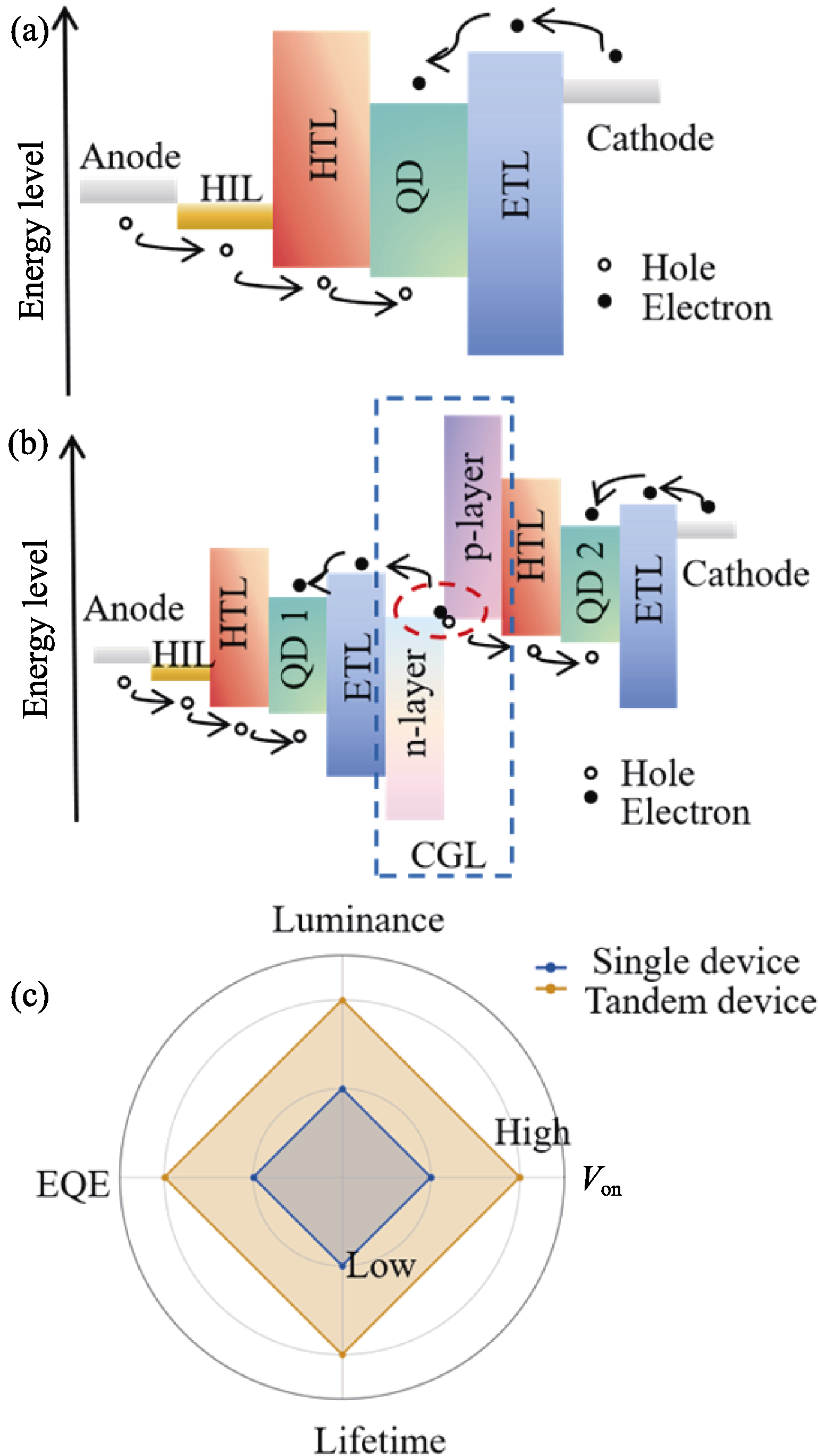
Fig. 1 Comparison of working principles and parameters between conventional single-layer QLED and two-layer TQLED (a) Single emissive layer device; (b) Tandem device with two emissive layers; (c) Comparison of core parameters between two types of light-emitting devices. HTL: hole transport layer; ETL: electron transport layer
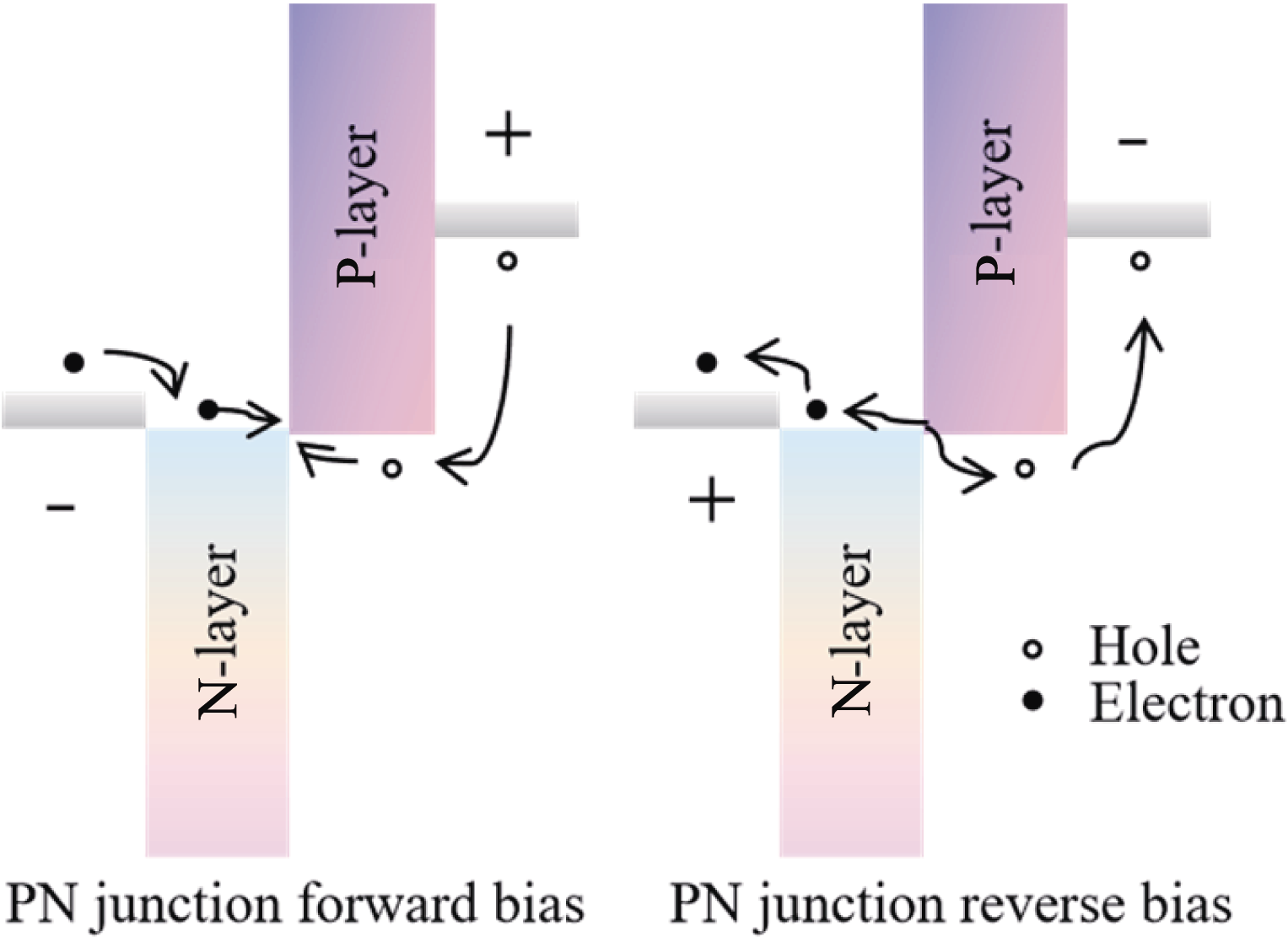
Fig. 2 Schematic diagram of CGL working principle
| Processing method | Material | Type |
|---|---|---|
| Vacuum deposition | FeCl3:NPB | P type |
| Li:Alq | N type | |
| HATCN, MoO3 | Electron acceptor | |
| IZO, Ag, Al | Ultra thin conductive layer | |
| Solution method | PEDOT:PSS | P type |
| ZnO, ZnMgO | N type |
Table 1 Common materials for charge generation layer
| Processing method | Material | Type |
|---|---|---|
| Vacuum deposition | FeCl3:NPB | P type |
| Li:Alq | N type | |
| HATCN, MoO3 | Electron acceptor | |
| IZO, Ag, Al | Ultra thin conductive layer | |
| Solution method | PEDOT:PSS | P type |
| ZnO, ZnMgO | N type |
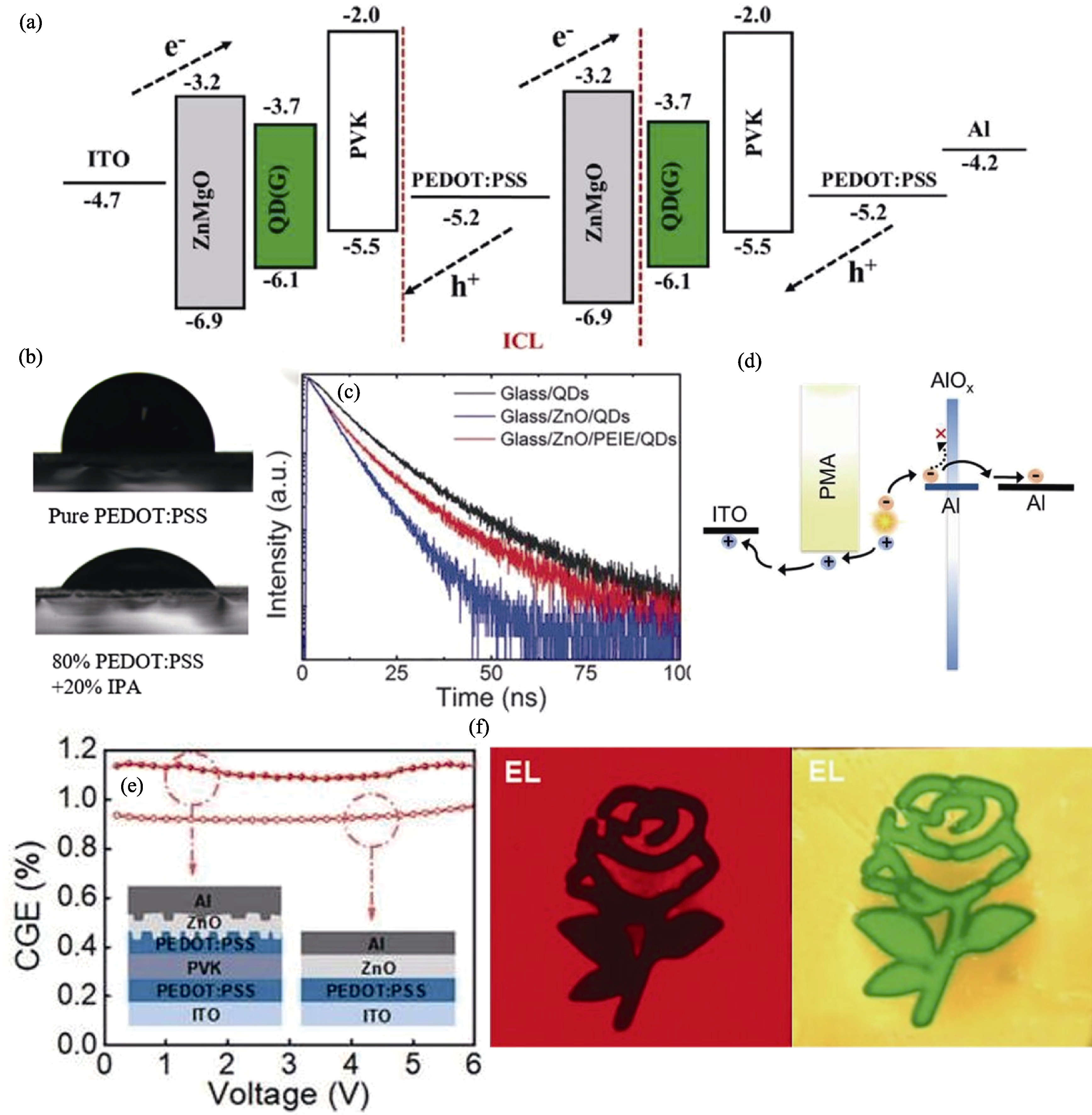
Fig. 3 Structure and optimization effects of inverted tandem devices[54,58 -59,66,68] (a) Schematic diagram of energy level arrangement of inverted TQLED device[58]; (b) Wetting angle change before and after IPA addition[66]; (c) Photoluminescence (PL) decay curves of red quantum dots on different functional layer thin films[68]; (d) Energy level structure and electric field induced charge generation of semiconductor-metal-dielectric material CGL[54]; (e) Charge generation efficiency of CGL with and without microstructure[59]; (f) Electroluminescence photos of green and red tandem anti-counterfeiting devices under 8 V (left) and 13 V (right) driving voltages[59]
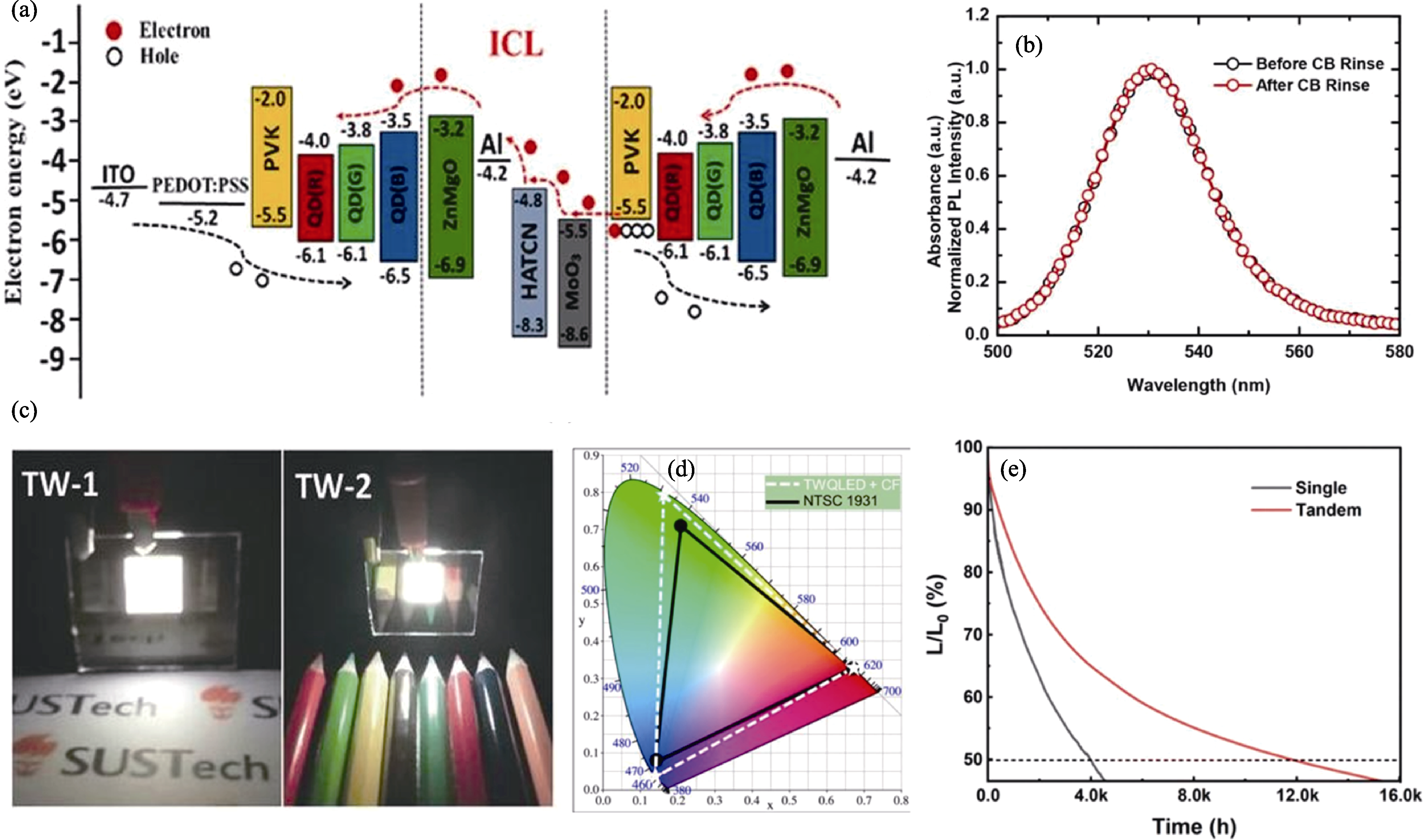
Fig. 4 Structure and optimization effects of conventional tandem devices[43,48,52,72] (a) Conventional TQLED energy level structure[48]; (b) PL spectra of green quantum dots covered with ZnMgO/Al/HATCN/MoO3 before and after chlorobenzene rinsing[48]; (c) White TQLED working diagram[52]; (d) Color gamut diagram[72]; (e) Comparison of lifetime between tandem and single-layer devices[43]
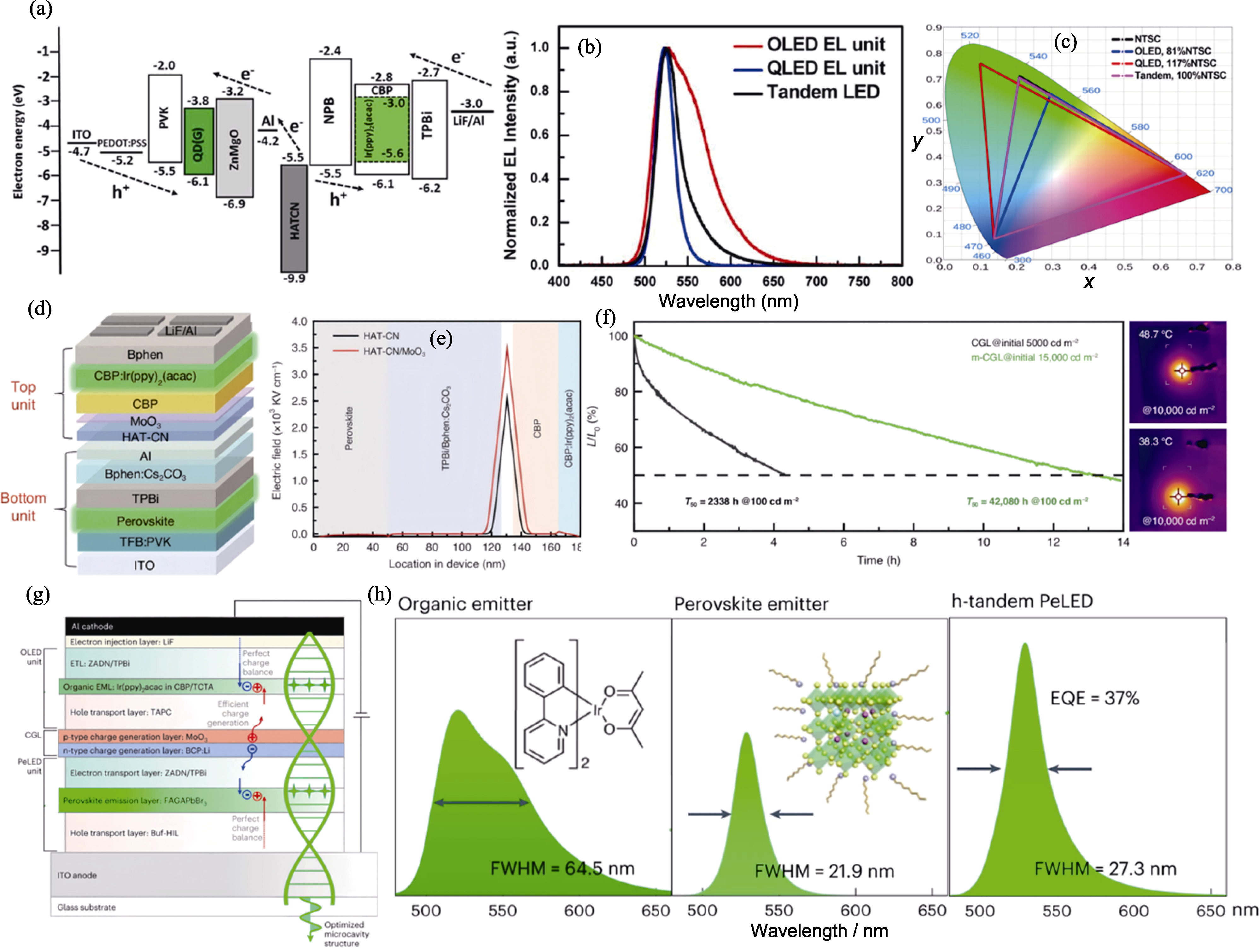
Fig. 5 Structure and optimization effects of multi luminescent materials tandem devices[57,75 -76] (a) Device structure, (b) electroluminescence (EL) spectra and (c) color gamut of cadmium-based/organic tandem device[57]; (d) Device structure, (e) simulated electric field before and after inserting MoO3 and (f) working lifetime and surface temperature comparison of perovskite/organic tandem device[75]; (g) Tandem device structure with optical microcavity and (h) EL spectra of organic, perovskite, and tandem devices[76]
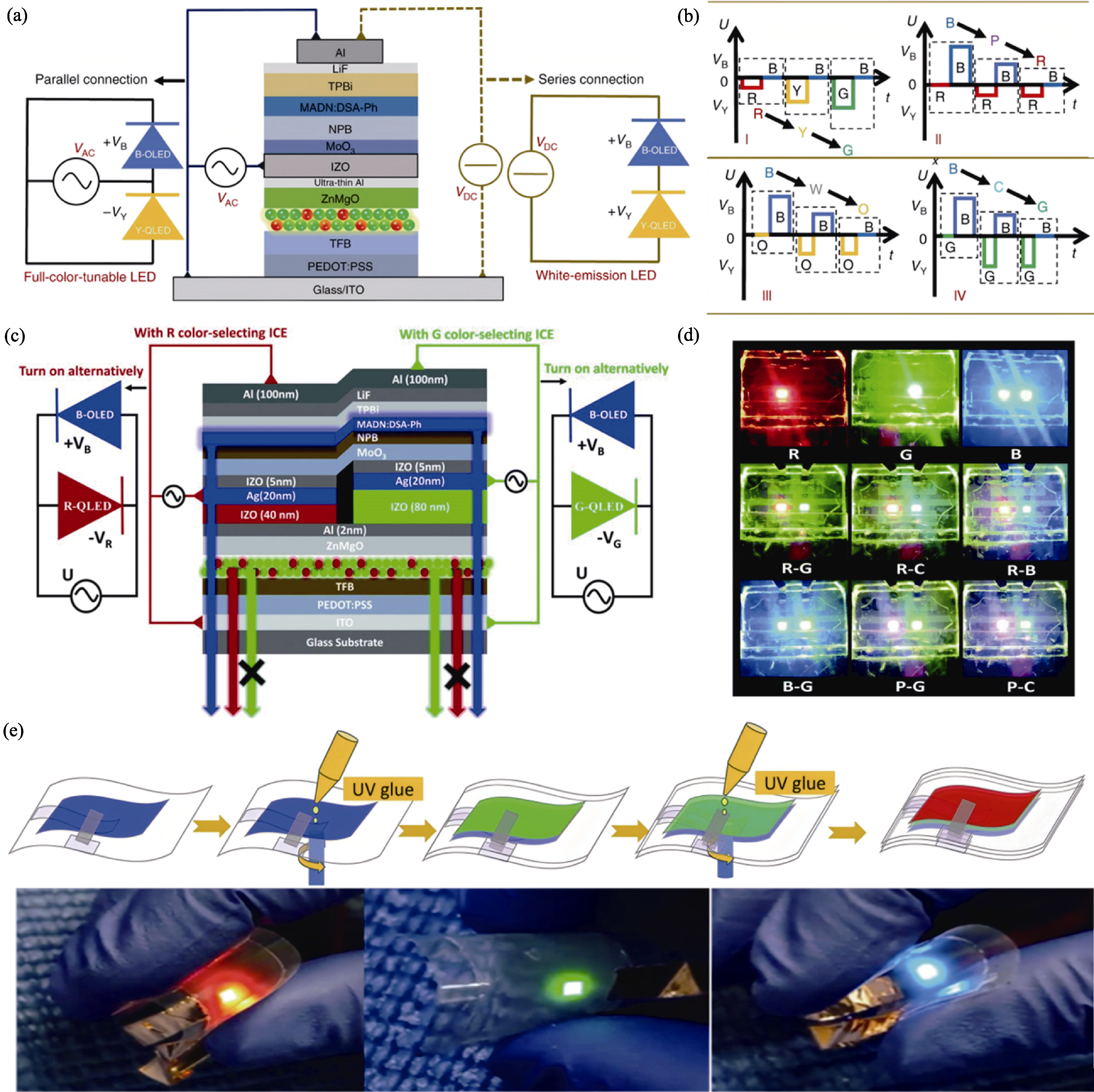
Fig. 6 Structure and optimization effects of other innovative tandem devices[78,80 -81] (a) Device structure and (b) AC signal controlled output color of the AC-driven TQLED[78]; (c) Device structure and (d) full-color pixel working diagram of the light output control device[80]; (e) Flexible TQLED assembly processes and working diagram[81]
| Color | CGL | Effect | EQE/% | Lifetime/h | Ref. |
|---|---|---|---|---|---|
| Red | TCTA/MoO3/IZO/ZnMgO | 1. Energy level matching 2. Potential barrier reduction | 49.01 | >50000 (T95*@1000 cd/m2) | [ |
| Green | PMA/Al:AlOx | 1. Achieved charge injection balance 2. Suppressed current leakage 3. Prevention of solvent damage to the lower layer | 50.3 | 19000 (T50@100 mA/cm2) | [ |
| Blue | 24 | - | |||
| White | PEDOT:PSS/ZnO/PEIE | 1. Improved charge injection balance 2. Inhibition of quenching | 28 | - | [ |
| Red | ZnMgO/PEDOT:PSS | 1. Improved CGL acid resistance 2. Inhibition of quenching | 35 | 12000 (T50@1000 cd/m2) | [ |
| Red | ZnMgO/Al/HATCN/MoO3 | - | 34.4 | - | [ |
| Green | ZnMgO/Al/HATCN/MoO3 | 1. Reduced solvent damage 2. Implementing a matching energy level arrangement 3. Improved balance of carrier injection | 27.6 | 53808 (T50@100 cd/m2) | [ |
| Blue | 21.4 | 107 (T50@100 cd/m2) | |||
| White | ZnO/PMA | 1. Reduced solvent damage 2. Improved charge injection and transfer capability 3. High transmittance to reduce parasitic light absorption | 27.3 | - | [ |
| Green | Bphen:Cs2CO3/Al/HATCN/ MoO3/CBP | - | 40 | 42080 (T50@100 cd/m2) | [ |
| White | Bphen:Yb/HATCN/TAPC | - | 23.9 | - | [ |
| Red | - | 1. Prevention of solvent damage to the lower layer 2. High-efficiency interconnection | 60.7 | ≈30000 (T95@1000 cd/m2) | [ |
| Red | ITO | 1. Improved balance of carrier injection 2. Optimized optical external coupling | 51.2 | ≈31383 (T95@1000 cd/m2) | [ |
| Red | ZnMgO/PMA/AMA | 1. Improved balance of carrier injection 2. Improved CGL acid resistance 3. Improved morphology of thin films | - | - | [ |
Table 2 Structure and performance of TQLED devices in recent years
| Color | CGL | Effect | EQE/% | Lifetime/h | Ref. |
|---|---|---|---|---|---|
| Red | TCTA/MoO3/IZO/ZnMgO | 1. Energy level matching 2. Potential barrier reduction | 49.01 | >50000 (T95*@1000 cd/m2) | [ |
| Green | PMA/Al:AlOx | 1. Achieved charge injection balance 2. Suppressed current leakage 3. Prevention of solvent damage to the lower layer | 50.3 | 19000 (T50@100 mA/cm2) | [ |
| Blue | 24 | - | |||
| White | PEDOT:PSS/ZnO/PEIE | 1. Improved charge injection balance 2. Inhibition of quenching | 28 | - | [ |
| Red | ZnMgO/PEDOT:PSS | 1. Improved CGL acid resistance 2. Inhibition of quenching | 35 | 12000 (T50@1000 cd/m2) | [ |
| Red | ZnMgO/Al/HATCN/MoO3 | - | 34.4 | - | [ |
| Green | ZnMgO/Al/HATCN/MoO3 | 1. Reduced solvent damage 2. Implementing a matching energy level arrangement 3. Improved balance of carrier injection | 27.6 | 53808 (T50@100 cd/m2) | [ |
| Blue | 21.4 | 107 (T50@100 cd/m2) | |||
| White | ZnO/PMA | 1. Reduced solvent damage 2. Improved charge injection and transfer capability 3. High transmittance to reduce parasitic light absorption | 27.3 | - | [ |
| Green | Bphen:Cs2CO3/Al/HATCN/ MoO3/CBP | - | 40 | 42080 (T50@100 cd/m2) | [ |
| White | Bphen:Yb/HATCN/TAPC | - | 23.9 | - | [ |
| Red | - | 1. Prevention of solvent damage to the lower layer 2. High-efficiency interconnection | 60.7 | ≈30000 (T95@1000 cd/m2) | [ |
| Red | ITO | 1. Improved balance of carrier injection 2. Optimized optical external coupling | 51.2 | ≈31383 (T95@1000 cd/m2) | [ |
| Red | ZnMgO/PMA/AMA | 1. Improved balance of carrier injection 2. Improved CGL acid resistance 3. Improved morphology of thin films | - | - | [ |
| [1] | DE ARQUER F P G, TALAPIN D V, KLIMOV V I, et al. Semiconductor quantum dots: technological progress and future challenges. Science, 2021, 373(6555): 8541. |
| [2] | POULSEN F, HANSEN T. Band gap energy of gradient core-shell quantum dots. The Journal of Physical Chemistry C, 2017, 121(25): 13655. |
| [3] | ZHANG G, MEI S, WEI X, et al. Dual-emissive and color-tunable Mn-doped InP/ZnS quantum dots via a growth-doping method. Nanoscale Research Letters, 2018, 13(1): 170. |
| [4] | BI Y, CAO S, YU P, et al. Reducing emission linewidth of pure- blue ZnSeTe quantum dots through shell engineering toward high color purity light-emitting diodes. Small, 2023, 19(45): 2303247. |
| [5] | VALLÉS-PELARDA M, GUALDRÓN-REYES A F, FELIP-LEÓN C, et al. High optical performance of cyan-emissive CsPbBr3 perovskite quantum dots embedded in molecular organogels. Advanced Optical Materials, 2021, 9(18): 2001786. |
| [6] | BJELICA M, WITZIGMANN B. Optimization of 1.55 μm quantum dot edge-emitting lasers for narrow spectral linewidth. Optical and Quantum Electronics, 2016, 48(2): 110. |
| [7] | CHEN C, ZHANG P, GAO G, et al. Near-infrared-emitting two- dimensional codes based on lattice-strained core/(doped) shell quantum dots with long fluorescence lifetime. Advanced Materials, 2014, 26(36): 6313. |
| [8] | EKIMOV A I, EFROS A L, ONUSHCHENKO A A. Quantum size effect in semiconductor microcrystals. Solid State Communications, 1985, 56(11): 921. |
| [9] | ROSSETTI R, NAKAHARA S, BRUS L E. Quantum size effects in the redox potentials, resonance Raman spectra, and electronic spectra of CdS crystallites in aqueous solution. The Journal of Chemical Physics, 1983, 79(2): 1086. |
| [10] | ALIVISATOS A P, HARRIS A L, LEVINOS N J, et al. Electronic states of semiconductor clusters: homogeneous and inhomogeneous broadening of the optical spectrum. The Journal of Chemical Physics, 1988, 89(7): 4001. |
| [11] | JIN X, XIE K, ZHANG T, et al. Cation exchange assisted synthesis of ZnCdSe/ZnSe quantum dots with narrow emission line widths and near-unity photoluminescence quantum yields. Chemical Communications, 2020, 56(45): 6130. |
| [12] | MOON H, LEE C, LEE W, et al. Stability of quantum dots, quantum dot films, and quantum dot light-emitting diodes for display applications. Advanced Materials, 2019, 31(34): e1804294. |
| [13] | SUN Y, JIANG Y, SUN X W, et al. Beyond OLED: efficient quantum dot light-emitting diodes for display and lighting application. Chemical Record, 2019, 19(8): 1729. |
| [14] | SHEN Z, ZHANG F, SHEN H, et al. Green emissive electroluminescent devices based on colloidal quantum dots. Advanced Functional Materials, 2025, 35(39): 2422093. |
| [15] | ZHANG Q, YANG K, LUO C, et al. Nanosecond response perovskite quantum dot light-emitting diodes with ultra-high resolution for active display application. Light: Science & Applications, 2025, 14(1): 285. |
| [16] | SHAN Q, DONG Y, XIANG H, et al. Perovskite quantum dots for the next-generation displays: progress and prospect. Advanced Functional Materials, 2024, 34(36): 2401284. |
| [17] | HUANG Q, SUN S, LIU M, et al. Colloidal quantum dot electroluminescent diodes for display applications: progress and challenges. Chinese Journal of Luminescence, 2023, 44(5): 739. |
| [18] | CHEN S, ZHONG H, WANG X, et al. Hybrid-size quantum dots in hole transport layer depress dark current density of short-wave infrared photodetectors. ACS Photonics, 2025, 12(2): 879. |
| [19] |
WANG S, WEN J, FENG L, et al. High temperature resistance and wide-spectrum detection flexible photodetectors based on PbS quantum dots/Bi2S3 nanorods. Materials Science in Semiconductor Processing, 2025, 198: 109738.
DOI URL |
| [20] | SHAN Q, WEI C, JIANG Y, et al. Perovskite light-emitting/ detecting bifunctional fibres for wearable LiFi communication. Light: Science & Applications, 2020, 9: 163. |
| [21] |
XUE J, LIU J, MAO S, et al. Recent progress in synthetic methods and applications in solar cells of Ag2S quantum dots. Materials Research Bulletin, 2018, 106: 113.
DOI URL |
| [22] | JI K, YUAN J, LI F, et al. High-efficiency perovskite quantum dot solar cells benefiting from a conjugated polymer-quantum dot bulk heterojunction connecting layer. Journal of Materials Chemistry A, 2020, 8(16): 8104. |
| [23] | MCDONALD C, PADMANABAN D B, MCGLYNN R, et al. Improved performance and stability of perovskite solar cells by incorporating silicon quantum dots within the FAPbI3 active layer. Advanced Energy Materials, 2025, 15(36): e02864. |
| [24] | SHI Y, WANG J, SONG X, et al. Six-angle polarized snowflake- like carbon quantum dots via electrostatic reversion for low-cost and high-efficiency solar cells. Joule, 2025, 9(8): 102013. |
| [25] | ZHANG Z, WANG W, RAO H, et al. Boosting the efficiency of quantum dot-sensitized solar cells over 17% via sequential deposition of water-and oil-soluble quantum dots. Advanced Functional Materials, 2025, 35(26): 2501241. |
| [26] | ZENG H, HAN B, ZHANG F. Perovskite quantum dot photovoltaic and luminescent concentrator cells: current status and challenges. Journal of Inorganic Materials, 2022, 37(2): 117. |
| [27] | ZHANG Y, LIU B, LIU Z, et al. Research progress in the synthesis and biological application of quantum dots. New Journal of Chemistry, 2022, 46(43): 20515. |
| [28] | BRUCHEZ M, MORONNE M, GIN P, et al. Semiconductor nanocrystals as fluorescent biological labels. Science, 1998, 281(5385): 2013. |
| [29] | ZHANG Y, LV Y, LI L S, et al. Aminophosphate precursors for the synthesis of near-unity emitting InP quantum dots and their application in liver cancer diagnosis. Exploration, 2022, 2(4): 20220082. |
| [30] | WANG B, CAI H, WATERHOUSE G I N, et al. Carbon dots in bioimaging, biosensing and therapeutics: a comprehensive review. Small Science, 2022, 2(6): 2200012. |
| [31] | PROTESESCU L, YAKUNIN S, BODNARCHUK M I, et al. Nanocrystals of cesium lead halide perovskites (CsPbX3, X = Cl, Br, and I): novel optoelectronic materials showing bright emission with wide color gamut. Nano Letters, 2015, 15(6): 3692. |
| [32] | JIANG J, ZHANG S, SHAN Q, et al. High-color-rendition white QLEDs by balancing red, green and blue centres in eco-friendly ZnCuGaS:In@ZnS quantum dots. Advanced Materials, 2024, 36(21): e2304772. |
| [33] | ZENG H, LIU Y, SHAN Q, et al. High-brightness and monodisperse quaternary CuInZnS@ZnS quantum dots with tunable and long- lived emission. Journal of Inorganic Materials, 2025, 40(4): 433. |
| [34] |
YANG Z, GAO M, WU W, et al. Recent advances in quantum dot-based light-emitting devices: challenges and possible solutions. Materials Today, 2019, 24: 69.
DOI URL |
| [35] |
YUAN Q, WANG T, YU P, et al. A review on the electroluminescence properties of quantum-dot light-emitting diodes. Organic Electronics, 2021, 90: 106086.
DOI URL |
| [36] | SHIRASAKI Y, SUPRAN G J, BAWENDI M G, et al. Emergence of colloidal quantum-dot light-emitting technologies. Nature Photonics, 2012, 7(1): 13. |
| [37] | BAE W K, BROVELLI S, KLIMOV V I. Spectroscopic insights into the performance of quantum dot light-emitting diodes. MRS Bulletin, 2013, 38(9): 721. |
| [38] | DAI X, DENG Y, PENG X, et al. Quantum-dot light-emitting diodes for large-area displays: towards the dawn of commercialization. Advanced Materials, 2017, 29(14): 1607022. |
| [39] |
XU L, LI J, CAI B, et al. A bilateral interfacial passivation strategy promoting efficiency and stability of perovskite quantum dot light-emitting diodes. Nature Communications, 2020, 11: 3092.
DOI |
| [40] | CUI Z, YANG D, QIN S, et al. Advances, challenges, and perspectives for heavy-metal-free blue-emitting indium phosphide quantum dot light-emitting diodes. Advanced Optical Materials, 2022, 11(4): 2202036. |
| [41] | WANG F, HUA Q, LIN Q, et al. High-performance blue quantum- dot light-emitting diodes by alleviating electron trapping. Advanced Optical Materials, 2022, 10(13): 2200319. |
| [42] | LIM E L, CHEN X, WEI Z. The rise of tandem perovskite light- emitting diode. Small, 2024, 20(51): 2405933. |
| [43] | SUN Y, HAN C, LI R, et al. Fully solution-processed red tandem quantum dot light-emitting diodes with an EQE exceeding 35%. Journal of Materials Chemistry C, 2024, 12(27): 10053. |
| [44] | MATSUMOTO T, NAKADA T, ENDO J, et al. 27.5L: late-news paper:multiphoton organic EL device having charge generation layer. SID Symposium Digest of Technical Papers, 2012, 34(1): 979. |
| [45] | LEE S, SHIN H, KIM J J. High-efficiency orange and tandem white organic light-emitting diodes using phosphorescent dyes with horizontally oriented emitting dipoles. Advanced Materials, 2014, 26(33): 5864. |
| [46] | SHEN H, LIN Q, CAO W, et al. Efficient and long-lifetime full- color light-emitting diodes using high luminescence quantum yield thick-shell quantum dots. Nanoscale, 2017, 9(36): 13583. |
| [47] | FU Y, LIU H, YANG D, et al. Boosting external quantum efficiency to 38.6% of sky-blue delayed fluorescence molecules by optimizing horizontal dipole orientation. Science Advances, 2021, 7(43): eabj2504. |
| [48] | ZHANG H, CHEN S, SUN X W. Efficient red/green/blue tandem quantum-dot light-emitting diodes with external quantum efficiency exceeding 21. ACS Nano, 2018, 12(1): 697. |
| [49] | CAO W, XIANG C, YANG Y, et al. Highly stable QLEDs with improved hole injection via quantum dot structure tailoring. Nature Communications, 2018, 9(1): 2608. |
| [50] | SHEN H, GAO Q, ZHANG Y, et al. Visible quantum dot light- emitting diodes with simultaneous high brightness and efficiency. Nature Photonics, 2019, 13(3): 192. |
| [51] | FUNG M K, LI Y Q, LIAO L S. Tandem organic light-emitting diodes. Advanced Materials, 2016, 28(47): 10381. |
| [52] | ZHANG H, SU Q, SUN Y, et al. Efficient and color stable white quantum-dot light-emitting diodes with external quantum efficiency over 23%. Advanced Optical Materials, 2018, 6(16): 1800354. |
| [53] | MENG S G, ZHU X Z, ZHOU D Y, et al. Recent progresses in solution-processed tandem organic and quantum dots light- emitting diodes. Molecules, 2022, 28(1): 134. |
| [54] | WU Q, GONG X, ZHAO D, et al. Efficient tandem quantum-dot LEDs enabled by an inorganic semiconductor-metal-dielectric interconnecting layer stack. Advanced Materials, 2021, 34(4): 2108150. |
| [55] | DAI X, ZHANG Z, JIN Y, et al. Solution-processed, high- performance light-emitting diodes based on quantum dots. Nature, 2014, 515(7525): 96. |
| [56] | KRÖGER M, HAMWI S, MEYER J, et al. Temperature- independent field-induced charge separation at doped organic/ organic interfaces: experimental modeling of electrical properties. Physical Review B, 2007, 75(23): 235321. |
| [57] | ZHANG H, FENG Y, CHEN S. Improved efficiency and enhanced color quality of light-emitting diodes with quantum dot and organic hybrid tandem structure. ACS Applied Materials & Interfaces, 2016, 8(40): 26982. |
| [58] | ZHANG H, SUN X, CHEN S. Over 100 cd·A-1 efficient quantum dot light-emitting diodes with inverted tandem structure. Advanced Functional Materials, 2017, 27(21): 1700610. |
| [59] | ZHOU T, WANG T, BAI J, et al. High-performance tandem quantum- dot light-emitting diodes based on bulk-heterojunction-like charge- generation layers. Advanced Materials, 2024, 36(25): 2313888. |
| [60] | ZHAN S, LIU J T, ZHANG H Z, et al. Quantum-dot light-emitting diodes based on inorganic charge-generation layer. Chinese Journal of Luminescence, 2022, 43(10): 1469. |
| [61] | MEI K, HUO S, YU R, et al. Quantum-dot light-emitting diodes based on MoO3/ZnO inorganic charge-generation layer. Chinese Journal of Luminescence, 2023, 44(11): 1885. |
| [62] | LEE H, PARK I, KWAK J, et al. Improvement of electron injection in inverted bottom-emission blue phosphorescent organic light emitting diodes using zinc oxide nanoparticles. Applied Physics Letters, 2010, 96(15): 153306. |
| [63] | DOBBERTIN T, KROEGER M, HEITHECKER D, et al. Inverted top-emitting organic light-emitting diodes using sputter-deposited anodes. Applied Physics Letters, 2003, 82(2): 284. |
| [64] | LEE T, HAHM D, KIM K, et al. Highly efficient and bright inverted top-emitting InP quantum dot light-emitting diodes introducing a hole-suppressing interlayer. Small, 2019, 15(50): 1905162. |
| [65] | KIM H M, LEE J, HWANG E, et al. P-95:inverted tandem architecture of quantum-dot light emitting diodes with solution processed charge generation layers. SID Symposium Digest of Technical Papers, 2016, 47(1): 1480. |
| [66] |
WU J, XIA J, LEI W. Investigation on the wetting issues in solution processed quantum dot light-emitting diodes with inverted tandem structure. Organic Electronics, 2019, 67: 116.
DOI URL |
| [67] | SHANSHAN Y A N, SHEN W, WENCHENG L, et al. Time- resolved electroluminescence of charge carrier dynamics in multiple-emitting-layer white QLEDs with polyethyleneimine interlayers. Chinese Journal of Luminescence, 2025, 46(10): 1851. |
| [68] | CAO F, ZHAO D, SHEN P, et al. High-efficiency, solution- processed white quantum dot light-emitting diodes with serially stacked red/green/blue units. Advanced Optical Materials, 2018, 6(20): 1800652. |
| [69] | KWON O, KIM D, KIM M, et al. High-performance tandem CdSe/ZnS quantum-dot light-emitting diodes with a double-layer interconnecting layer composed of thermally evaporated and sputtered metal oxides. Journal of Information Display, 2022, 23(3): 213. |
| [70] | MENG S G, SHEN W S, LIU W Z, et al. Solution-processed tandem quantum-dot light-emitting diodes with dual charge generation interfaces: achieving over threefold efficiency enhancement. Advanced Materials Interfaces, 2024, 11(26): 2400098. |
| [71] | ZHANG H, WANG S, SUN X, et al. All solution-processed white quantum-dot light-emitting diodes with three-unit tandem structure. Journal of the Society for Information Display, 2017, 25(3): 143. |
| [72] | JIANG C, ZOU J, LIU Y, et al. Fully solution-processed tandem white quantum-dot light-emitting diode with an external quantum efficiency exceeding 25%. ACS Nano, 2018, 12(6): 6040. |
| [73] | CHEN J, CHEN S, LIU X, et al. Molecule-induced ripening control in perovskite quantum dots for efficient and stable light-emitting diodes. Science Advances, 2025, 11(11): eads7159. |
| [74] | SUN S Q, CAI Y, ZHU M, et al. Highly efficient hybrid perovskite/organic tandem white light emitting-diodes with external quantum efficiency exceeding 20%. Advanced Functional Materials, 2023, 33(51): 2306549. |
| [75] | KONG L, LUO Y, WU Q, et al. Efficient and stable hybrid perovskite-organic light-emitting diodes with external quantum efficiency exceeding 40 per cent. Light: Science & Applications, 2024, 13(1): 1364. |
| [76] | LEE H D, WOO S J, KIM S, et al. Valley-centre tandem perovskite light-emitting diodes. Nature Nanotechnology, 2024, 19(5): 624. |
| [77] | XIA F, SUN X W, CHEN S. Alternating-current driven quantum- dot light-emitting diodes with high brightness. Nanoscale, 2019, 11(12): 5231. |
| [78] |
ZHANG H, SU Q, CHEN S. Quantum-dot and organic hybrid tandem light-emitting diodes with multi-functionality of full-color- tunability and white-light-emission. Nature Communications, 2020, 11: 2826.
DOI |
| [79] | ZHANG H, WANG J, CHEN S. 220 V/50 Hz compatible bipolar quantum-dot light-emitting diodes. Advanced Materials, 2024, 36(16): 2312334. |
| [80] | ZHANG H, CHEN L, CHEN S. Quantum-dot and organic hybrid tandem light-emitting diodes with color-selecting intermediate electrodes for full-color displays. Nanoscale, 2021, 13(39): 16781. |
| [81] | SU Q, ZHANG H, CHEN S. Flexible and tandem quantum-dot light-emitting diodes with individually addressable red/green/blue emission. npj Flexible Electronics, 2021, 5(1): 8. |
| [82] | YOO J I, KIM H B, KO Y J, et al. All-solution-processed dual- color QLED with hole-only-injection and n-p-n intermediate connecting layer. ACS Applied Electronic Materials, 2025, 7(2): 679. |
| [83] | YUAN C, CHEN Z, TIAN F, et al. Very stable and efficient tandem quantum-dot light-emitting diodes enabled by IZO-based interconnecting layers. Nano Letters, 2024, 24(24): 7541. |
| [84] | SU Q, ZHANG H, XIA F, et al. 73-4: tandem red quantum-dot light-emitting diodes with external quantum efficiency over 34%. SID Symposium Digest of Technical Papers, 2018, 49(1): 977. |
| [85] | LI H, WANG J, CHEN S. Face-to-face integrated tandem quantum- dot LEDs with high performance and multifunctionality. Light: Science & Applications, 2025, 14(1): 171. |
| [86] | YANG D, WANG Y, XIE J, et al. Regular tandem quantum dot light-emitting diodes with over 51% external quantum efficiency for next-generation displays. Advanced Materials, 2025, 37(44): e08173. |
| [87] | MENG S G, WANG Y, XU J Z, et al. Dipole engineering in charge generation interface for fully solution-processed and PEDOT:PSS- free tandem quantum-dot light-emitting diodes. Advanced Electronic Materials, 2025, 11(14): 2500180. |
| [1] | CAO Bingqiang, LI Xingmu, WEI Haoming, SHAN Yansu. Research Advances in the Preparation of Halide Perovskite Thin Films by Pulsed Laser Deposition [J]. Journal of Inorganic Materials, 2026, 41(9): 1178-1192. |
| [2] | HUANG Gan, XUE Jiaxiang, TAN Caiwang, LIU Yang, ZHANG Guoliang, YANG Zhengmao, CHEN Zhaoke. Multi-scale Methods for Investigating Mechanical Damage in Nuclear SiC Composite Cladding: A Review [J]. Journal of Inorganic Materials, 2026, 41(9): 1157-1177. |
| [3] | MA Zhitong, LI Zhongshao, CAO Xun. Dynamic Radiative Thermal Management Technologies: From Principles and Materials to Synergistic Optimization of Materials and Structures [J]. Journal of Inorganic Materials, 2026, 41(8): 1021-1035. |
| [4] | SI Huichen, LIANG Fei, YU Haohai, ZHANG Huaijin. Research Progress on Yellow-orange Laser Crystals and Their All-solid-state Laser Devices [J]. Journal of Inorganic Materials, 2026, 41(8): 1049-1068. |
| [5] | QIN Shanli, GUO Jiawen, CHEN Yanmeng, JU An’an, WEI Yi, HUANG Kelin, HOU Xianghua, LÜ Sishi, WEN Zhipeng, WU Lian. Recent Advances in Constructing Oriented Ion Transport Channels with Two-dimensional Layered Materials for Electrochemical Energy Storage [J]. Journal of Inorganic Materials, 2026, 41(7): 883-898. |
| [6] | YU Feiyu, WANG Wenqing, ZHANG Xueqin, HE Rujie. Additively Manufactured Ceramic Lattice-based Interpenetrating Phase Composites: Progress and Challenges [J]. Journal of Inorganic Materials, 2026, 41(7): 849-866. |
| [7] | ZHOU Cui, LI Jie, SUN Luchao, SU Haijun, WANG Jingyang. Alumina-based Directionally Solidified Eutectic Ceramics: Microstructure, Control Strategies and Environmental Stability [J]. Journal of Inorganic Materials, 2026, 41(7): 899-914. |
| [8] | FEI Wenlong, WANG Yakun, LIAO Liangsheng. Research Progress on Controllable Synthesis of Blue-emitting ZnSeTe Quantum Dots and Quantum-dot Light-emitting Diode Devices [J]. Journal of Inorganic Materials, 2026, 41(7): 867-882. |
| [9] | CHEN Mingjun, MIAO Hongkang, XIAO Yingjun, DENG Jianbo, ZHANG Xiang, ZHAO Jiupeng, LI Yao. Photo- and Thermo-chromic Dual-responsive Materials: A Review on Design Strategies and Applications in Smart Windows [J]. Journal of Inorganic Materials, 2026, 41(6): 723-738. |
| [10] | SONG Kunjie, XIE Rongjun. Research Advances on Machine Learning-driven Development of Novel Luminescent Materials [J]. Journal of Inorganic Materials, 2026, 41(6): 689-703. |
| [11] | HU Yuqing, ZHU Yixin, LE Xianhao, WAN Qing. Lithium Tantalate Wafer: Advances in Thinning Technology and Application in Pyroelectric Infrared Detectors [J]. Journal of Inorganic Materials, 2026, 41(6): 764-774. |
| [12] | LIU Chunfan, CHEN Ke, GE Fangfang, HUANG Qing. Research Progress on Lead-bismuth Eutectic Corrosion Resistant Coatings [J]. Journal of Inorganic Materials, 2026, 41(6): 775-786. |
| [13] | HU Yang, XIE Min, ZHANG Xiaoyi, LI Xiang, GUO Xinwei, JIANG Nan, ZHOU Wenhan, ZHANG Shengli, ZENG Haibo. Research Progress on Computational and Data-driven Environmental-friendly Luminescent Materials [J]. Journal of Inorganic Materials, 2026, 41(6): 704-722. |
| [14] | WANG Junbu, HUANG Zeai, YANG Mingkai, MENG Ying, ZHOU Mingwei, ZHOU Ying. Research Progress on Anti-coking Catalytic Materials for Methane Conversion [J]. Journal of Inorganic Materials, 2026, 41(6): 739-750. |
| [15] | WANG Jinwen, YANG Zhen, ZHOU Huan, XIA Dan, YANG Lei. Biomedical Applications of Injectable Inorganic Biomaterials [J]. Journal of Inorganic Materials, 2026, 41(6): 751-763. |
| Viewed | ||||||
|
Full text |
|
|||||
|
Abstract |
|
|||||
