
Journal of Inorganic Materials ›› 2026, Vol. 41 ›› Issue (7): 947-954.DOI: 10.15541/jim20250410
• RESEARCH ARTICLE • Previous Articles Next Articles
PENG Yuchao1( ), DONG Yuan1, DONG Shun1(), XIA Liansen1, HU Peitao1, ZHANG Xinghong1, ZHOU Yanchun2
Received:2025-10-21
Revised:2025-12-17
Published:2026-07-20
Online:2025-12-19
Contact:
DONG Shun, professor. E-mail: dongshun@hit.edu.cnAbout author:PENG Yuchao (1999-), male, PhD candidate. E-mail: pycuchao@stu.hit.edu.cn
Supported by:CLC Number:
PENG Yuchao, DONG Yuan, DONG Shun, XIA Liansen, HU Peitao, ZHANG Xinghong, ZHOU Yanchun. Effect of SiC Particle Content on Mechanical Properties and Ablation Resistance of (Ti,Zr,Hf,Ta,Cr)(C,N)-SiC Ceramics[J]. Journal of Inorganic Materials, 2026, 41(7): 947-954.
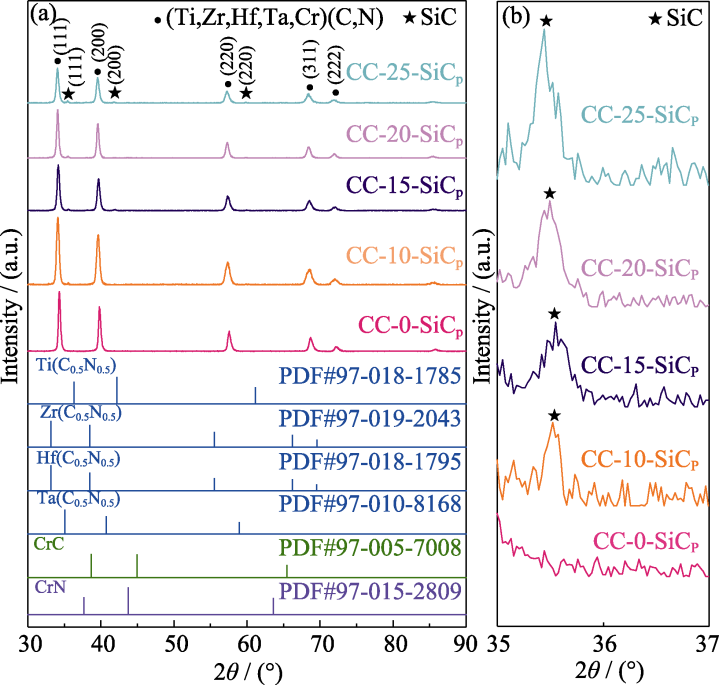
Fig. 1 XRD patterns of (Ti,Zr,Hf,Ta,Cr)(C,N)-SiC ceramics with various SiCp contents (a) Overall XRD patterns; (b) Enlarged view in the range of 2θ=35o-37o
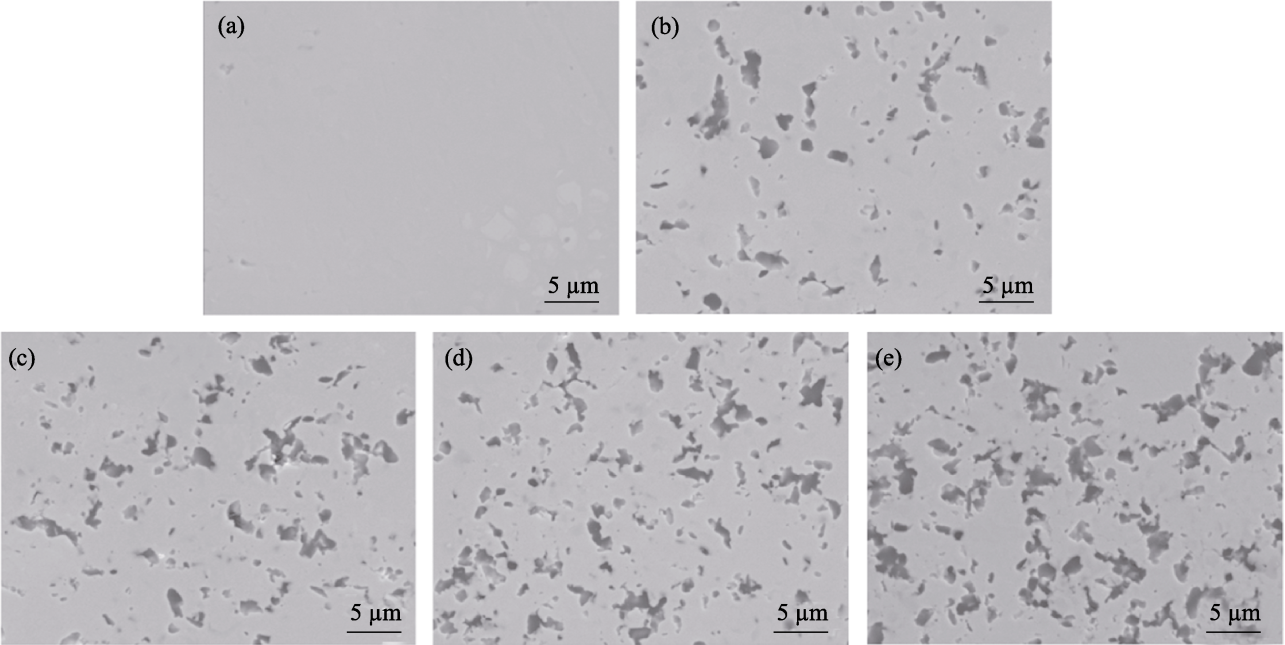
Fig. 2 SEM images of the polished surfaces of (Ti,Zr,Hf,Ta,Cr)(C,N)-SiC ceramics with various SiCp contents (a) CC-0-SiCp; (b) CC-10-SiCp; (c) CC-15-SiCp; (d) CC-20-SiCp; (e) CC-25-SiCp
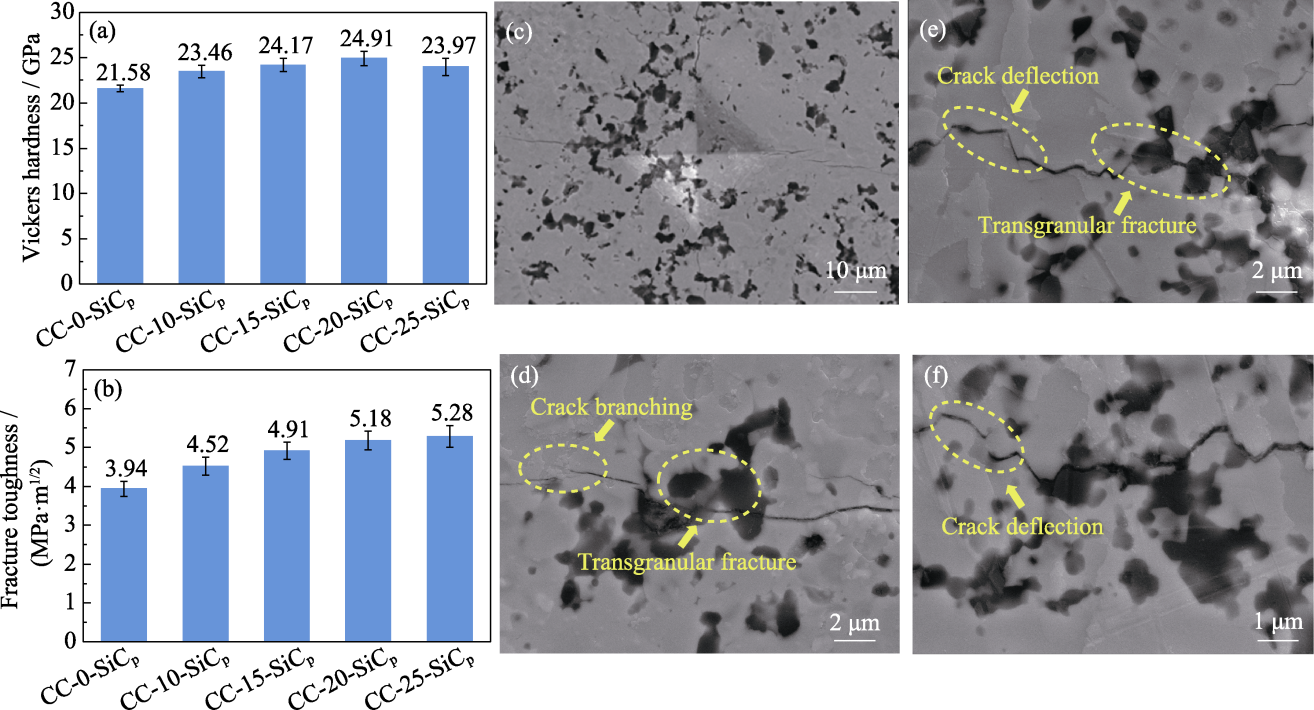
Fig. 3 Mechanical properties of (Ti,Zr,Hf,Ta,Cr)(C,N)-SiC ceramics with various SiCp contents and SEM images of indentation morphology and crack propagation in CC-20-SiCp (a) Vickers hardness; (b) Fracture toughness; (c) Indentation morphology; (d-f) Crack propagation paths
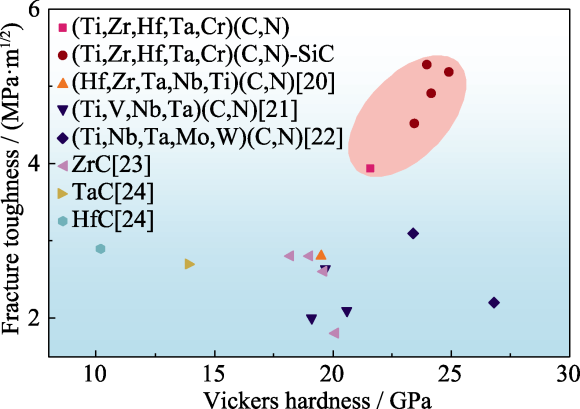
Fig. 4 Comparison of mechanical properties of the UHTCs between this work and selected references[20-24]
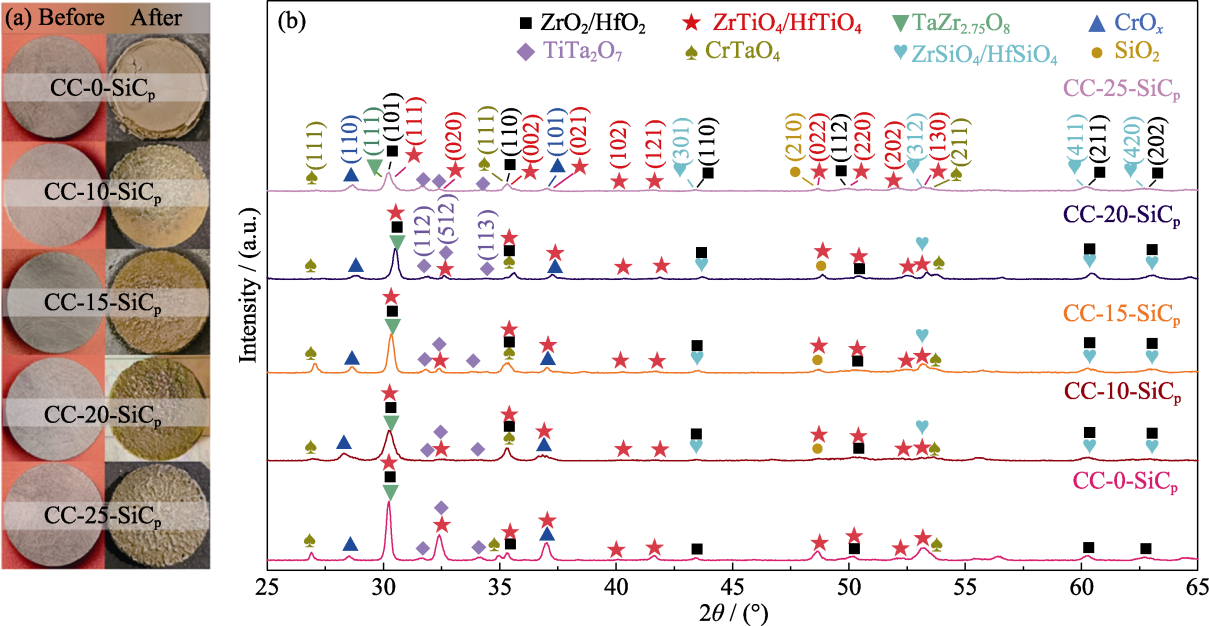
Fig. 5 (a) Macroscopic morphologies before and after ablation tests and (b) XRD patterns after ablation tests of (Ti,Zr,Hf,Ta,Cr)(C,N)-SiC ceramics with various SiCp contents
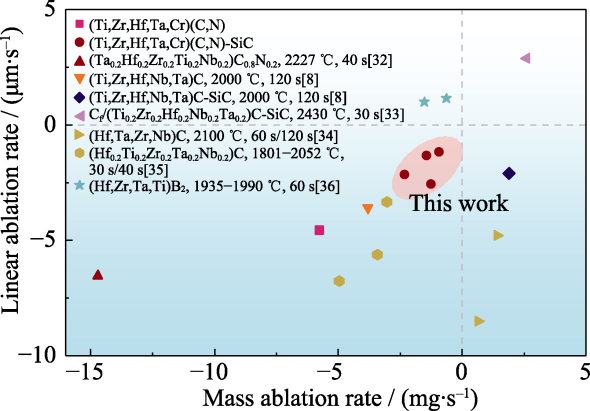
Fig. 6 Comparison of ablation performance of the UHTCs between this work and selected references[8,32 -36]
| Sample | Measured density/(g·cm-3) | Theoretical density/(g·cm-3) | Relative density/% |
|---|---|---|---|
| CC-0-SiCp | 8.67 | 8.92 | 97.2 |
| CC-10-SiCp | 8.17 | 8.35 | 97.8 |
| CC-15-SiCp | 7.92 | 8.06 | 98.3 |
| CC-20-SiCp | 7.69 | 7.78 | 98.8 |
| CC-25-SiCp | 7.30 | 7.49 | 97.5 |
Table S1 Measured densities, theoretical densities, and relative densities of (Ti,Zr,Hf,Ta,Cr)(C,N)-SiC ceramics with various SiCp contents
| Sample | Measured density/(g·cm-3) | Theoretical density/(g·cm-3) | Relative density/% |
|---|---|---|---|
| CC-0-SiCp | 8.67 | 8.92 | 97.2 |
| CC-10-SiCp | 8.17 | 8.35 | 97.8 |
| CC-15-SiCp | 7.92 | 8.06 | 98.3 |
| CC-20-SiCp | 7.69 | 7.78 | 98.8 |
| CC-25-SiCp | 7.30 | 7.49 | 97.5 |
| Material system | Fracture toughness/(MPa·m1/2) | Vickers hardness/GPa | Reference |
|---|---|---|---|
| (Hf,Zr,Ta,Nb,Ti)(C,N) | 2.8 | 19.5 | [ |
| (Ti,V,Nb,Ta)(C,N) | 2.64 | 19.7 | [ |
| (Ti,V,Nb,Ta)(C,N) | 2.1 | 20.6 | [ |
| (Ti,V,Nb,Ta)(C,N) | 2 | 19.1 | [ |
| (Ti,Nb,Ta,Mo,W)(C,N) | 3.1 | 23.4 | [ |
| (Ti,Nb,Ta,Mo,W)(C,N) | 2.2 | 26.8 | [ |
| ZrC | 2.8 | 18.2 | [ |
| ZrC | 2.8 | 19 | [ |
| ZrC | 2.6 | 19.6 | [ |
| ZrC | 1.8 | 20.1 | [ |
| TaC | 2.7 | 13.9 | [ |
| HfC | 2.9 | 10.2 | [ |
Table S2 Summary of the mechanical properties data of the UHTCs in this work and those reported in selected references
| Material system | Fracture toughness/(MPa·m1/2) | Vickers hardness/GPa | Reference |
|---|---|---|---|
| (Hf,Zr,Ta,Nb,Ti)(C,N) | 2.8 | 19.5 | [ |
| (Ti,V,Nb,Ta)(C,N) | 2.64 | 19.7 | [ |
| (Ti,V,Nb,Ta)(C,N) | 2.1 | 20.6 | [ |
| (Ti,V,Nb,Ta)(C,N) | 2 | 19.1 | [ |
| (Ti,Nb,Ta,Mo,W)(C,N) | 3.1 | 23.4 | [ |
| (Ti,Nb,Ta,Mo,W)(C,N) | 2.2 | 26.8 | [ |
| ZrC | 2.8 | 18.2 | [ |
| ZrC | 2.8 | 19 | [ |
| ZrC | 2.6 | 19.6 | [ |
| ZrC | 1.8 | 20.1 | [ |
| TaC | 2.7 | 13.9 | [ |
| HfC | 2.9 | 10.2 | [ |
| Sample | Mass ablation rate/(mg·s-1) | Linear ablative rate/(μm·s-1) |
|---|---|---|
| CC-0-SiCp | -5.75 | -4.58 |
| CC-10-SiCp | -2.33 | -2.17 |
| CC-15-SiCp | -1.42 | -1.33 |
| CC-20-SiCp | -0.92 | -1.17 |
| CC-25-SiCp | -1.25 | -2.58 |
Table S3 Mass ablation rates and linear ablative rates of (Ti,Zr,Hf,Ta,Cr)(C,N)-SiC ceramics with various SiCp contents
| Sample | Mass ablation rate/(mg·s-1) | Linear ablative rate/(μm·s-1) |
|---|---|---|
| CC-0-SiCp | -5.75 | -4.58 |
| CC-10-SiCp | -2.33 | -2.17 |
| CC-15-SiCp | -1.42 | -1.33 |
| CC-20-SiCp | -0.92 | -1.17 |
| CC-25-SiCp | -1.25 | -2.58 |
| Material system | Temperature/℃ | Time/s | Mass ablation rate/(mg·s-1) | Linear ablative rate/(μm·s-1) | Reference |
|---|---|---|---|---|---|
| (Ta0.2Hf0.2Zr0.2Ti0.2Nb0.2)C0.8N0.2 | 2227 | 40 | -14.7 | -6.54 | [ |
| (Ti,Zr,Hf,Nb,Ta)C | 2000 | 120 | -3.8 | -3.6 | [ |
| (Ti,Zr,Hf,Nb,Ta)C-SiC | 2000 | 120 | 1.9 | -2.1 | [ |
| Cf/(Ti0.2Zr0.2Hf0.2Nb0.2Ta0.2)C-SiC | 2430 | 30 | 2.6 | 2.89 | [ |
| (Hf,Ta,Zr,Nb)C | 2100 | 60 | 0.66 | -8.5 | [ |
| (Hf,Ta,Zr,Nb)C | 2100 | 120 | 1.41 | -4.8 | [ |
| (Hf0.2Ti0.2Zr0.2Ta0.2Nb0.2)C | 1801 | 30 | -3.03 | -3.33 | [ |
| (Hf0.2Ti0.2Zr0.2Ta0.2Nb0.2)C | 1952 | 30 | -3.4 | -5.63 | [ |
| (Hf0.2Ti0.2Zr0.2Ta0.2Nb0.2)C | 2052 | 40 | -4.95 | -6.75 | [ |
| (Hf,Zr,Ta,Ti)B2 | 1935 | 30 | -1.52 | 0.96 | [ |
| (Hf,Zr,Ta,Ti)B2 | 1990 | 60 | -0.63 | 1.14 | [ |
Table S4 Summary of the ablation performance data of the UHTCs in this work and those reported in selected references
| Material system | Temperature/℃ | Time/s | Mass ablation rate/(mg·s-1) | Linear ablative rate/(μm·s-1) | Reference |
|---|---|---|---|---|---|
| (Ta0.2Hf0.2Zr0.2Ti0.2Nb0.2)C0.8N0.2 | 2227 | 40 | -14.7 | -6.54 | [ |
| (Ti,Zr,Hf,Nb,Ta)C | 2000 | 120 | -3.8 | -3.6 | [ |
| (Ti,Zr,Hf,Nb,Ta)C-SiC | 2000 | 120 | 1.9 | -2.1 | [ |
| Cf/(Ti0.2Zr0.2Hf0.2Nb0.2Ta0.2)C-SiC | 2430 | 30 | 2.6 | 2.89 | [ |
| (Hf,Ta,Zr,Nb)C | 2100 | 60 | 0.66 | -8.5 | [ |
| (Hf,Ta,Zr,Nb)C | 2100 | 120 | 1.41 | -4.8 | [ |
| (Hf0.2Ti0.2Zr0.2Ta0.2Nb0.2)C | 1801 | 30 | -3.03 | -3.33 | [ |
| (Hf0.2Ti0.2Zr0.2Ta0.2Nb0.2)C | 1952 | 30 | -3.4 | -5.63 | [ |
| (Hf0.2Ti0.2Zr0.2Ta0.2Nb0.2)C | 2052 | 40 | -4.95 | -6.75 | [ |
| (Hf,Zr,Ta,Ti)B2 | 1935 | 30 | -1.52 | 0.96 | [ |
| (Hf,Zr,Ta,Ti)B2 | 1990 | 60 | -0.63 | 1.14 | [ |
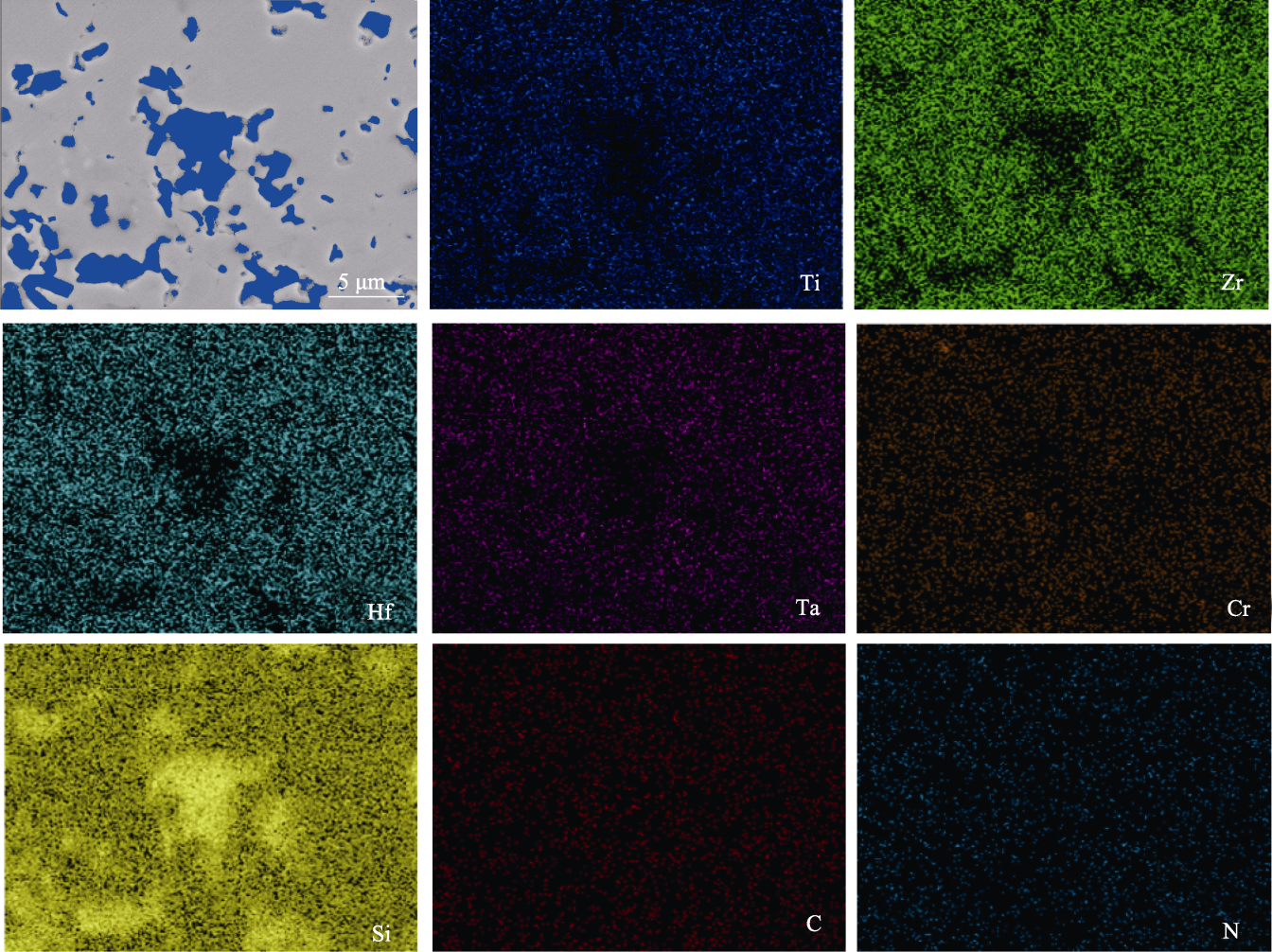
Fig. S1 SEM image and corresponding EDS element mappings of the polished surfaces for CC-20-SiCp
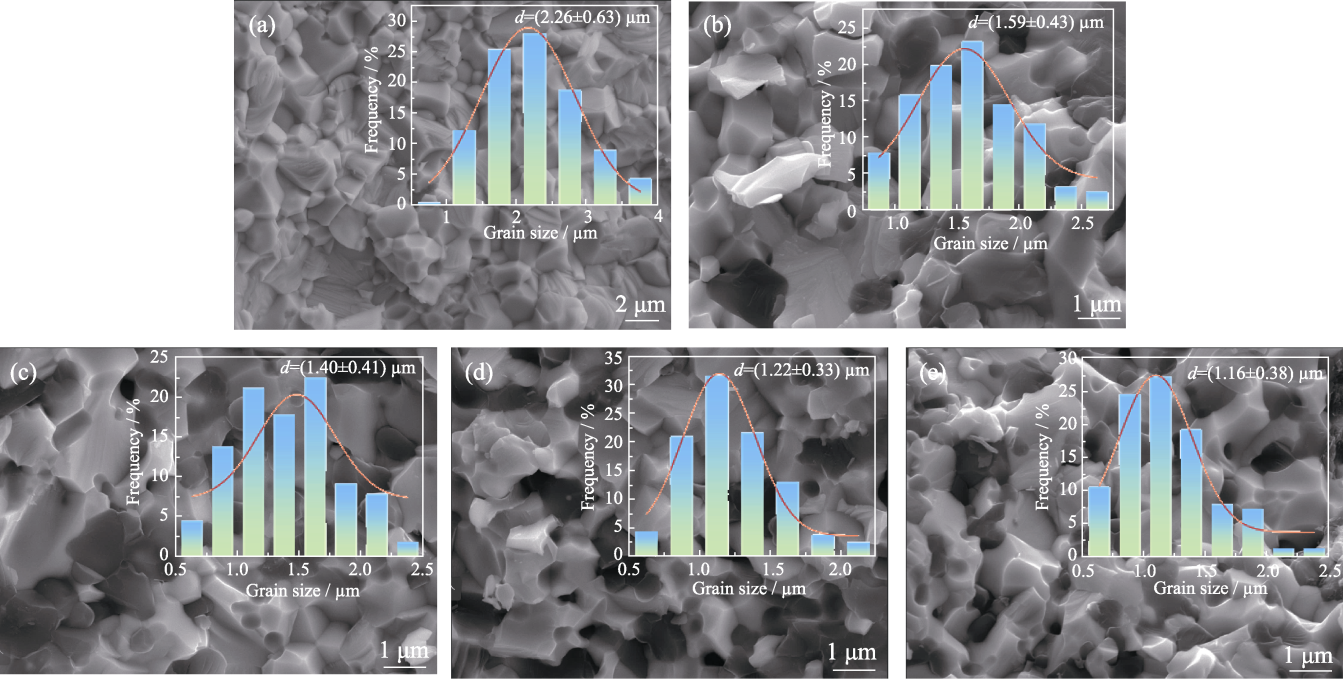
Fig. S2 SEM images of fractured surfaces and grain size distributions of (Ti,Zr,Hf,Ta,Cr)(C,N)-SiC ceramics with various SiCp contents (a) CC-0-SiCp; (b) CC-10-SiCp; (c) CC-15-SiCp; (d) CC-20-SiCp; (e) CC-25-SiCp
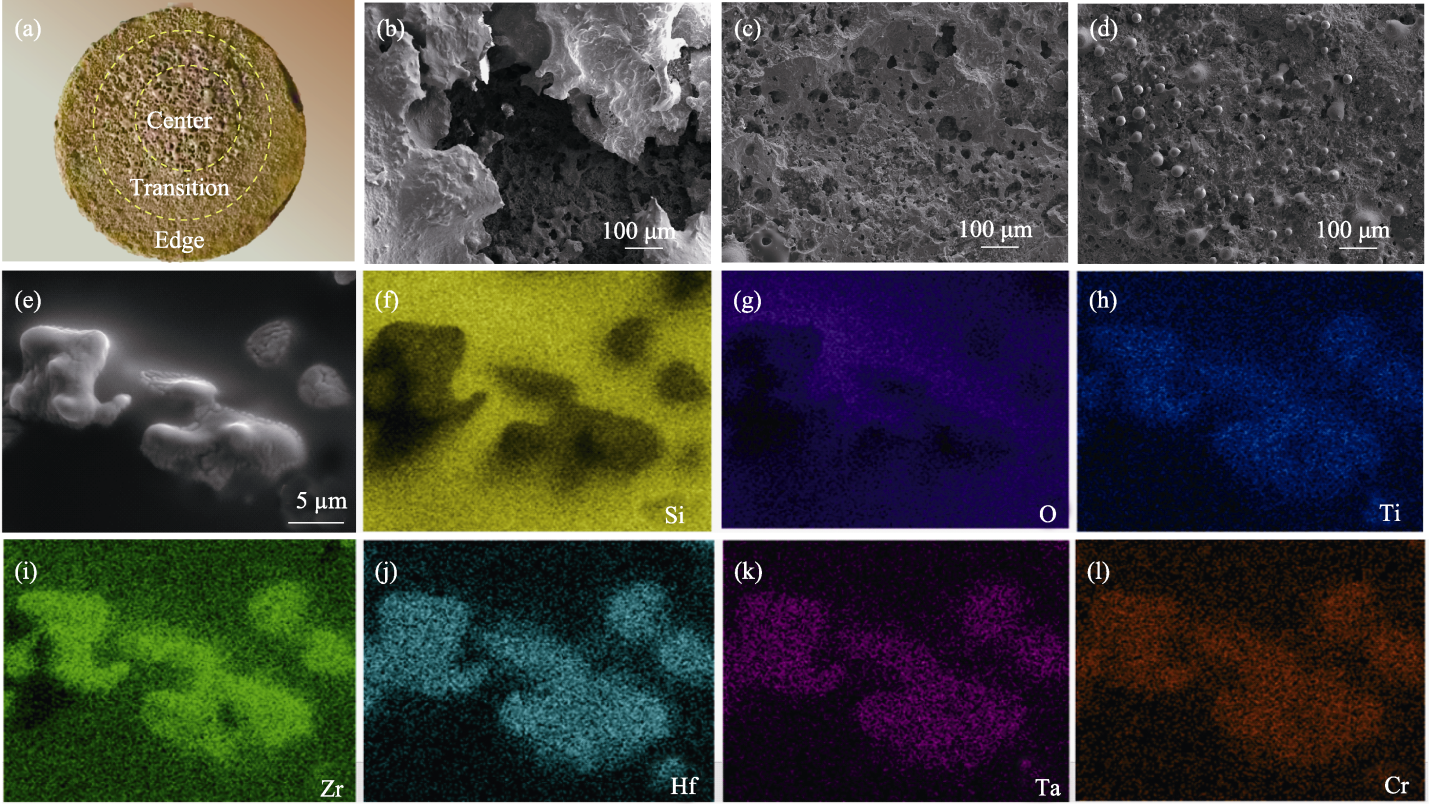
Fig. S3 Macroscopic morphology, SEM images and corresponding EDS element mappings of the surface microstructure for CC-20-SiCp after ablation tests (a) Macroscopic morphology; (b-d) SEM images of (b) central region, (c) transitional region, and (d) edge region;(e) Magnified SEM image of transitional region; (f-l) EDS element mappings
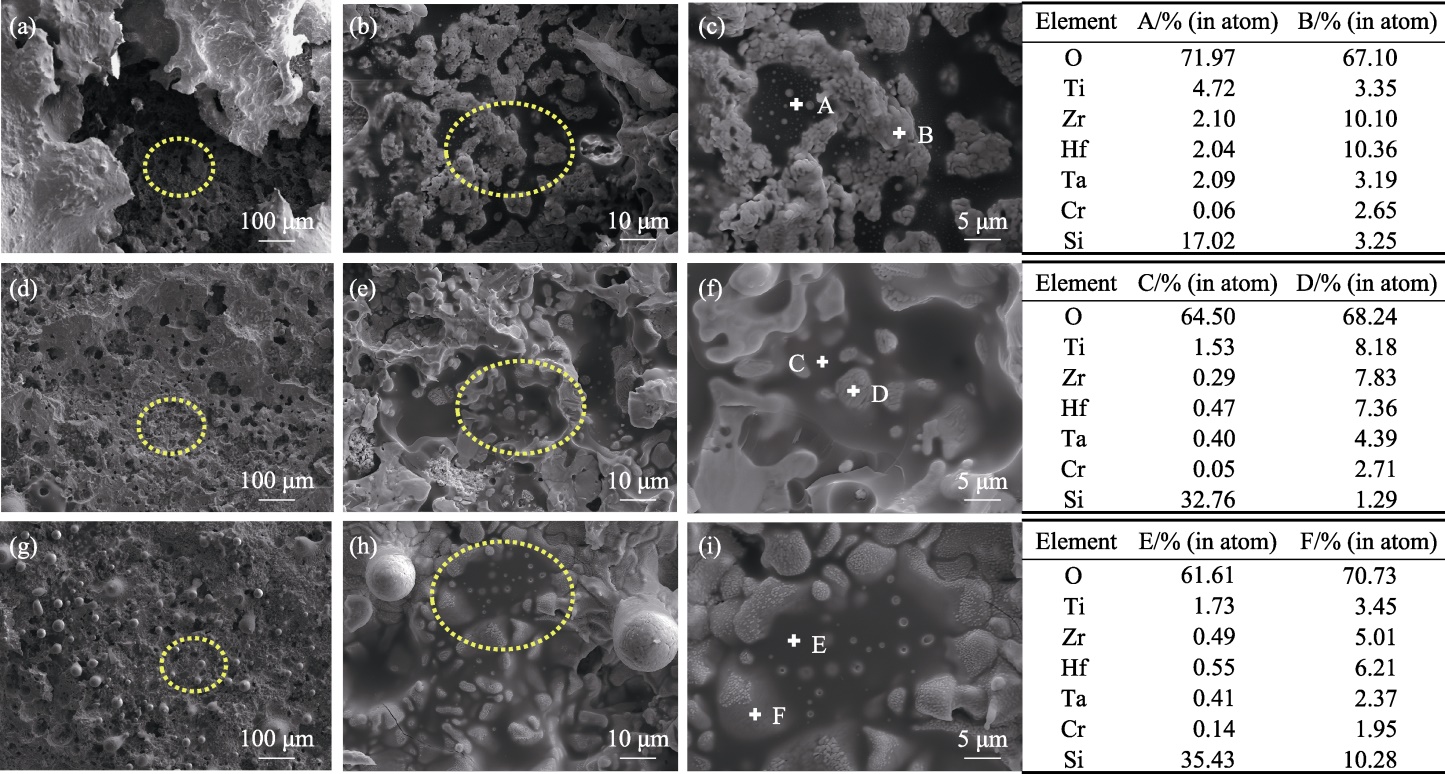
Fig. S4 SEM images and EDS point analysis results of various surface regions on CC-20-SiCp after oxyacetylene ablation testing at 2100 ℃ for 120 s (a-c) Central region; (d-f) Transitional region; (g-i) Edge region
| [1] |
XIANG H M, XING Y, DAI F Z, et al. High-entropy ceramics: present status, challenges, and a look forward. Journal of Advanced Ceramics, 2021, 10(3): 385.
DOI |
| [2] |
OSES C, TOHER C, CURTAROLO S. High-entropy ceramics. Nature Reviews Materials, 2020, 5(4): 295.
DOI |
| [3] | LIU G A, FANG C, LI M L, et al. Breaking conventional understanding: superior oxidation resistance of a novel Ta and Mo containing high-entropy transition metal diboride. Journal of Materials Science & Technology, 2026, 252: 313. |
| [4] |
ZHANG P, LIU X J, HE G Y, et al. Novel high-entropy ultra-high temperature ceramics with enhanced ablation resistance. Rare Metals, 2024, 43(12): 6559.
DOI URL |
| [5] |
CHEN S, WANG T, WANG X L, et al. Structural origin of enhanced storage energy performance and robust mechanical property in A-site disordered high-entropy ceramics. Rare Metals, 2025, 44(1): 551.
DOI URL |
| [6] | CAO Z N, SUN J L, MENG L T, et al. Progress in densification and toughening of high entropy carbide ceramics. Journal of Materials Science & Technology, 2023, 161: 10. |
| [7] |
LU K, LIU J X, WEI X F, et al. Microstructures and mechanical properties of high-entropy (Ti0.2Zr0.2Hf0.2Nb0.2Ta0.2)C ceramics with the addition of SiC secondary phase. Journal of the European Ceramic Society, 2020, 40(5): 1839.
DOI URL |
| [8] |
GUO W J, HU J, YE Y C, et al. Ablation behavior of (TiZrHfNbTa)C high-entropy ceramics with the addition of SiC secondary under an oxyacetylene flame. Ceramics International, 2022, 48(9): 12790.
DOI URL |
| [9] | 杜百合. ZrB2基超高温陶瓷的力学性能与热响应行为研究. 哈尔滨: 哈尔滨工业大学博士学位论文, 2021. |
| [10] | 罗嗣春. (Ti0.2Zr0.2Nb0.2Ta0.2Mo0.2)Cx基高熵碳化物陶瓷的制备与性能研究. 广州: 广东工业大学博士学位论文, 2022. |
| [11] |
EVANS A G, CHARLES E A. Fracture toughness determinations by indentation. Journal of the American Ceramic Society, 1976, 59(7/8): 371.
DOI URL |
| [12] |
LI J C, ZHANG Y L, ZHAO Y X, et al. A novel (Hf1/3Zr1/3Ti1/3)C medium-entropy carbide coating with excellent long-life ablation resistance applied above 2100 ℃. Composites Part B: Engineering, 2023, 251: 110467.
DOI URL |
| [13] |
XIE F, YIN J, XIONG X, et al. High-temperature oxidation and ablation behavior of (Zr1/3Hf1/3Ti1/3)C ceramic. Journal of the European Ceramic Society, 2024, 44(16): 116784.
DOI URL |
| [14] | 王皓轩. 高熵碳化物基陶瓷的抗氧化和抗烧蚀性能研究. 西安: 西北工业大学博士学位论文, 2021. |
| [15] | 吕学文. 碳化硅纳米颗粒增韧碳化硅陶瓷的制备及力学性能研究. 哈尔滨: 哈尔滨工业大学硕士学位论文, 2021. |
| [16] |
SONG W Y, LU Y J, YANG L T, et al. Enhancement of densification and mechanical property of (Hf0.2Zr0.2Ti0.2Nb0.2Ta0.2)N high-entropy bulk ceramic via silicon carbide addition. Journal of Advanced Ceramics, 2025, 14(1): 9221004.
DOI URL |
| [17] | 魏红康, 张玉军, 邓翔宇. SiCp/B4C复合陶瓷的热压烧结及组织性能. 中国陶瓷, 2010, 46(9): 14. |
| [18] |
LIU J X, HUANG X, ZHANG G J. Pressureless sintering of hafnium carbide-silicon carbide ceramics. Journal of the American Ceramic Society, 2013, 96(6): 1751.
DOI URL |
| [19] |
GOGOTSI Y G. Particulate silicon nitride-based composites. Journal of Materials Science, 1994, 29(10): 2541.
DOI URL |
| [20] |
WEN T Q, YE B L, NGUYEN M C, et al. Thermophysical and mechanical properties of novel high-entropy metal nitride-carbides. Journal of the American Ceramic Society, 2020, 103(11): 6475.
DOI URL |
| [21] |
HAN X Q, LIN N, LI A Q, et al. Microstructure and characterization of (Ti, V, Nb, Ta)(C, N) high-entropy ceramic. Ceramics International, 2021, 47(24): 35105.
DOI URL |
| [22] |
ZHOU Y Z, LUO S C, GUO W M, et al. Preparation of high-entropy (Ti, Nb, Ta, Mo, W)(C, N) ceramics via carbothermal reduction nitridation using different carbon source. Journal of the European Ceramic Society, 2024, 44(3): 1404.
DOI URL |
| [23] | 项铭禹. ZrC陶瓷及其复合材料的制备过程与机理研究. 武汉: 武汉理工大学博士学位论文, 2018. |
| [24] |
CEDILLOS-BARRAZA O, GRASSO S, AL NASIRI N, et al. Sintering behaviour, solid solution formation and characterisation of TaC, HfC and TaC-HfC fabricated by spark plasma sintering. Journal of the European Ceramic Society, 2016, 36(7): 1539.
DOI URL |
| [25] |
ZHANG S, WANG X H, ZHANG C, et al. Microstructure, elastic/mechanical and thermal properties of CrTaO4: a new thermal barrier material? Journal of Advanced Ceramics, 2024, 13(3): 373.
DOI URL |
| [26] |
YE Z M, ZENG Y, XIONG X, et al. Elucidating the role of preferential oxidation during ablation: insights on the design and optimization of multicomponent ultra-high temperature ceramics. Journal of Advanced Ceramics, 2022, 11(12): 1956.
DOI |
| [27] | 彭峥. 超高温碳氮化铪陶瓷及其复合材料设计制备与抗烧蚀性能. 长沙: 中南大学博士学位论文, 2022. |
| [28] | 谢冯旻煜. 多元超高温碳化物陶瓷氧化和烧蚀性能研究. 长沙: 中南大学硕士学位论文, 2023. |
| [29] |
YANG L Y, DONG S, CUI T Y, et al. Novel gradient ZrB2- MoSi2-SiC dense layer with enhanced emissivity and long-term oxidation resistance at ultra-high temperatures. Rare Metals, 2025, 44(3): 2043.
DOI URL |
| [30] | 李夏菲. 防隔热一体化C/C-SiCO多孔陶瓷复合材料的制备与性能研究. 长沙: 国防科技大学博士学位论文, 2019. |
| [31] | 伦惠林. 多元单相碳化物与含硼碳化物陶瓷的制备和抗氧化性能. 长沙: 中南大学博士学位论文, 2022. |
| [32] |
WANG Y C, WANG X C, LI S W, et al. Improved oxidation resistance of (Zr-Nb-Hf-Ta)(C,N) high entropy carbonitrides. Corrosion Science, 2023, 225: 111583.
DOI URL |
| [33] |
CAI F Y, NI D W, CHEN B W, et al. Fabrication and properties of Cf/(Ti0.2Zr0.2Hf0.2Nb0.2Ta0.2)C-SiC high-entropy ceramic matrix composites via precursor infiltration and pyrolysis. Journal of the European Ceramic Society, 2021, 41(12): 5863.
DOI URL |
| [34] | WANG Y C, ZHANG B H, ZHANG C Y, et al. Ablation behaviour of (Hf-Ta-Zr-Nb)C high entropy carbide ceramic at temperatures above 2100 ℃. Journal of Materials Science & Technology, 2022, 113: 40. |
| [35] |
CHEN Z Z, WANG H X, LI C R, et al. Oxyacetylene ablation of (Hf0.2Ti0.2Zr0.2Ta0.2Nb0.2)C at 1350-2050 ℃. Journal of the European Ceramic Society, 2023, 43(6): 2700.
DOI URL |
| [36] |
LV J S, LI W, LI T, et al. Ablation behavior of high-entropy boride (Hf-Zr-Ta-Ti)B2 coating fabricated via supersonic atmospheric plasma spraying for carbon/carbon composites. Composites Part B: Engineering, 2024, 270: 111137.
DOI URL |
| [1] | YU Feiyu, WANG Wenqing, ZHANG Xueqin, HE Rujie. Additively Manufactured Ceramic Lattice-based Interpenetrating Phase Composites: Progress and Challenges [J]. Journal of Inorganic Materials, 2026, 41(7): 849-866. |
| [2] | HUANG Kuisui, WANG Kexin, LUO Wanhao, LI Fei, GE Yiyao, GAO Yixuan, CHEN Kexin. Regulation of Electronic Properties of Novel Two-dimensional SixCy under External Strain [J]. Journal of Inorganic Materials, 2026, 41(7): 993-1000. |
| [3] | GAO Kefeng, HE Xinxin, LIU Zengqian, ZHANG Zhefeng. Bioinspired Nacre-like Ceramic-polymer Composites with Multiscale Layered and Gradient Structures [J]. Journal of Inorganic Materials, 2026, 41(5): 573-582. |
| [4] | ZHAO Tongtong, DAI Jixiang, SU Cheng, SHI Yan, SHA Jianjun. Microstructure and Ablation Resistance of C/C Composites Modified by Hf-Si-based Coating-matrix Integrated Structure Fabricated by Reactive Melt Infiltration [J]. Journal of Inorganic Materials, 2026, 41(5): 583-594. |
| [5] | SHI Jinyu, LEI Yiming, WANG Chenxu, ZHANG Jie, WANG Jingyang. Ion Irradiation Damage Behavior in Titanium Carbide with Different Stoichiometry [J]. Journal of Inorganic Materials, 2026, 41(3): 322-330. |
| [6] | ZHENG Chen, WANG Xiangning, YUAN Henan, YANG Jiawei, LI Chuanjian, WANG Huadong. Mechanical Property Failure of Alumina Fiber Reinforced Silica Composite [J]. Journal of Inorganic Materials, 2026, 41(3): 331-339. |
| [7] | ZHANG Yunbo, WANG Bing, LI Wei, SONG Quzhi, DU Yi’ang, WANG Yingde. Size Effect of Nanosheet on BN Fibers Derived from BNNS/Polyborazine Hybrid Precursor [J]. Journal of Inorganic Materials, 2026, 41(3): 359-369. |
| [8] | YUAN Wang, HU Jianbao, ZHOU Liang, KAN Yanmei, ZHANG Xiangyu, DONG Shaoming. Effect of Argon Atmosphere Heat Treatment on Mechanical Properties and Microstructural Evolution of Shicolon-II SiC Fibers [J]. Journal of Inorganic Materials, 2026, 41(1): 119-128. |
| [9] | ZHANG Yongheng, CHEN Jixin. Preparation and Properties of Ytterbium Aluminosilicate Glass and SiC Modified h-BN-based Composites [J]. Journal of Inorganic Materials, 2026, 41(1): 37-44. |
| [10] | SUN Yuxuan, WANG Zheng, SHI Xue, SHI Ying, DU Wentong, MAN Zhenyong, ZHENG Liaoying, LI Guorong. Defect Dipole Thermal-stability to the Electro-mechanical Properties of Fe Doped PZT Ceramics [J]. Journal of Inorganic Materials, 2025, 40(5): 545-551. |
| [11] | CHEN Yi, QIU Haipeng, CHEN Mingwei, XU Hao, CUI Heng. SiC/SiC Composite: Matrix Boron Modification and Mechanical Properties [J]. Journal of Inorganic Materials, 2025, 40(5): 504-510. |
| [12] | CUI Ning, ZHANG Yuxin, WANG Lujie, LI Tongyang, YU Yuan, TANG Huaguo, QIAO Zhuhui. Single-phase Formation Process and Carbon Vacancy Regulation of (TiVNbMoW)Cx High-entropy Ceramics [J]. Journal of Inorganic Materials, 2025, 40(5): 511-520. |
| [13] | LI Ziwei, GONG Weilu, CUI Haifeng, YE Li, HAN Weijian, ZHAO Tong. (Zr, Hf, Nb, Ta, W)C-SiC Composite Ceramics: Preparation via Precursor Route and Properties [J]. Journal of Inorganic Materials, 2025, 40(3): 271-280. |
| [14] | GAO Chenguang, SUN Xiaoliang, CHEN Jun, LI Daxin, CHEN Qingqing, JIA Dechang, ZHOU Yu. SiBCN-rGO Ceramic Fibers Based on Wet Spinning Technology: Microstructure, Mechanical and Microwave-absorbing Properties [J]. Journal of Inorganic Materials, 2025, 40(3): 290-296. |
| [15] | MU Haojie, ZHANG Yuanjiang, YU Bin, FU Xiumei, ZHOU Shibin, LI Xiaodong. Preparation and Properties of ZrO2 Doped Y2O3-MgO Nanocomposite Ceramics [J]. Journal of Inorganic Materials, 2025, 40(3): 281-289. |
| Viewed | ||||||
|
Full text |
|
|||||
|
Abstract |
|
|||||
