
Journal of Inorganic Materials ›› 2026, Vol. 41 ›› Issue (6): 764-774.DOI: 10.15541/jim20250381
Special Issue: 【信息功能】介电、铁电、压电材料(202606)
• REVIEW • Previous Articles Next Articles
HU Yuqing1,2( ), ZHU Yixin1,2, LE Xianhao1, WAN Qing1()
Received:2025-09-28
Revised:2025-11-20
Published:2026-06-20
Online:2025-12-11
Contact:
WAN Qing, professor. E-mail: qing-wan@ylab.ac.cnAbout author:HU Yuqing (1995-), female, PhD. E-mail: yuqing-hu@ylab.ac.cn
Supported by:CLC Number:
HU Yuqing, ZHU Yixin, LE Xianhao, WAN Qing. Lithium Tantalate Wafer: Advances in Thinning Technology and Application in Pyroelectric Infrared Detectors[J]. Journal of Inorganic Materials, 2026, 41(6): 764-774.
| Type | Material | p/(µC·m-2·K-1) | Tc/℃ | Fv/(m2·C-1) |
|---|---|---|---|---|
| Single crystal | LiTaO3 | 230 | 630 | 0.170 |
| LiNbO3 | 83 | 1210 | 0.103 | |
| Triglycine sulfate (TGS) | 550 | 50 | 0.43 | |
| Deuterated triglycine sulfate (DTGS) | 264 | 61 | 0.48 | |
| Pb(Zr0.55Ti0.45)O3 | 330 | 340 | 0.02 | |
| 0.41Pb(In1/2Nb1/2)O3-0.17Pb[(Mg1/3Nb2/3)xTi1−x]O3-0.42PbTiO3 (001) | 570 | 253 | 0.05 | |
| Ceramic | 0.75Pb(Mg1/3Nb2/3)O3-0.25PbTiO3 | 746 | 130 | 0.016 |
| BaTiO3 | 200 | 120 | 0.005 | |
| Sr0.5Ba0.5Nb2O6 | 205 | 90 | 0.018 | |
| 0.8(Bi0.5Na0.5)TiO3-0.2BaTiO3 | 242 | 209 | 0.027 |
Table 1 Comparison of performance between LiTaO3 and common pyroelectric materials[1-2,4 -5]
| Type | Material | p/(µC·m-2·K-1) | Tc/℃ | Fv/(m2·C-1) |
|---|---|---|---|---|
| Single crystal | LiTaO3 | 230 | 630 | 0.170 |
| LiNbO3 | 83 | 1210 | 0.103 | |
| Triglycine sulfate (TGS) | 550 | 50 | 0.43 | |
| Deuterated triglycine sulfate (DTGS) | 264 | 61 | 0.48 | |
| Pb(Zr0.55Ti0.45)O3 | 330 | 340 | 0.02 | |
| 0.41Pb(In1/2Nb1/2)O3-0.17Pb[(Mg1/3Nb2/3)xTi1−x]O3-0.42PbTiO3 (001) | 570 | 253 | 0.05 | |
| Ceramic | 0.75Pb(Mg1/3Nb2/3)O3-0.25PbTiO3 | 746 | 130 | 0.016 |
| BaTiO3 | 200 | 120 | 0.005 | |
| Sr0.5Ba0.5Nb2O6 | 205 | 90 | 0.018 | |
| 0.8(Bi0.5Na0.5)TiO3-0.2BaTiO3 | 242 | 209 | 0.027 |
| Technology | Process principle | Technical feature | Mainstream wafer size | Achievable thickness |
|---|---|---|---|---|
| Mechanical thinning | Material removal from a bulk substrate via grinding and polishing | Low cost, high efficiency, straightforward process | 4-12 inch | Tens to hundreds of micrometers |
| Smart-Cut | Transfer of a single-crystal layer via steps like ion implantation, bonding, and exfoliation | Enabling ultra-thin single- crystal transfer with low crystal defect density and high quality | 4/6 inch (mature), advancing toward 8 inch | Sub-micrometer to nanometer scale |
Table 2 Comparison between mechanical thinning and Smart-Cut techniques[21-23]
| Technology | Process principle | Technical feature | Mainstream wafer size | Achievable thickness |
|---|---|---|---|---|
| Mechanical thinning | Material removal from a bulk substrate via grinding and polishing | Low cost, high efficiency, straightforward process | 4-12 inch | Tens to hundreds of micrometers |
| Smart-Cut | Transfer of a single-crystal layer via steps like ion implantation, bonding, and exfoliation | Enabling ultra-thin single- crystal transfer with low crystal defect density and high quality | 4/6 inch (mature), advancing toward 8 inch | Sub-micrometer to nanometer scale |
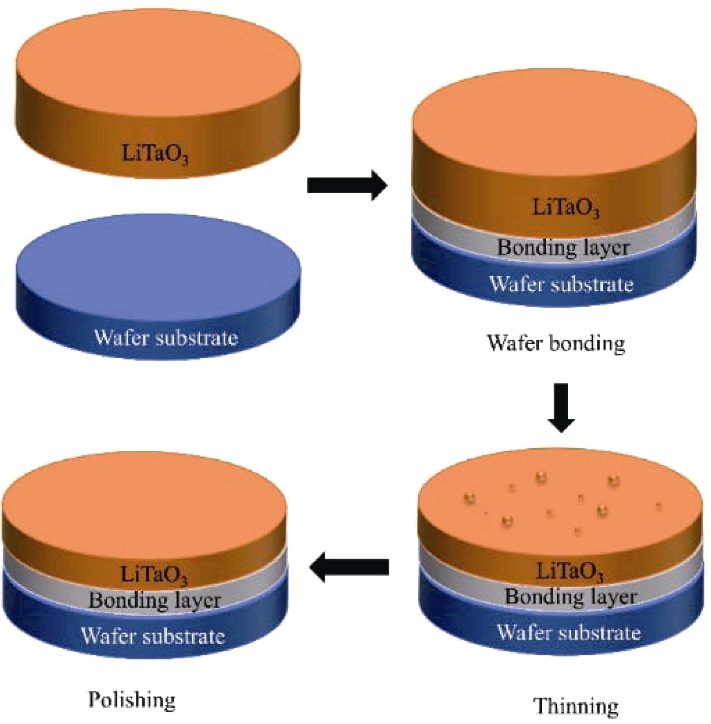
Fig. 1 Schematic diagram of mechanical thinning process steps
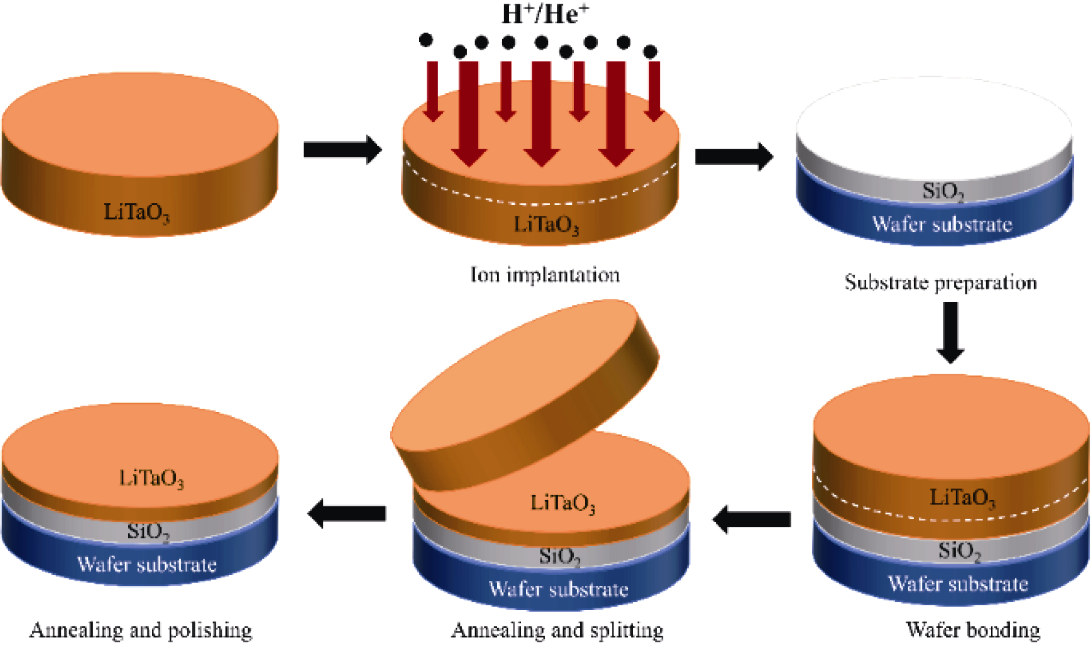
Fig. 2 Schematic diagram of Smart-Cut process steps
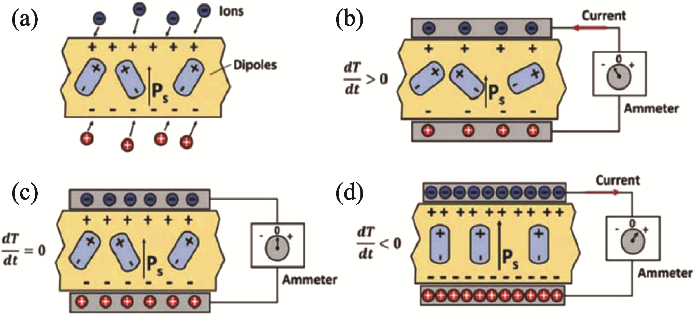
Fig. 3 Working mechanism diagrams of pyroelectric effect[52] (a) Spontaneous polarization of pyroelectric materials induced by internal electric dipoles; (b) Decreased spontaneous polarization with dT/dt>0 which drives the migration of electrons in the external circuit; (c) Internal electric field with dT/dt=0 caused by spontaneous polarization in pyroelectric material and the induced external electric field in two electrodes, reaching equilibrium; (d) dT/dt<0, enhancing the spontaneous polarization and breaking the electrical balance again, and then causing reverse electrons migration
| Thickness/μm | RV/(V·W-1) | D*/(cm·Hz1/2·W-1) | NEP/(W·Hz-1/2) | Operating frequency/Hz | Ref. |
|---|---|---|---|---|---|
| 500 | 1.80×10³ | 9.97×10⁶ | 5.02×10⁻⁸ | 10 | [ |
| 3.33×10² | 9.92×10⁶ | 5.01×10⁻⁸ | 70 | ||
| 75 | 2.2×10³ | 2.3×10⁷ | / | 5.3 | [ |
| 1.12×10³ | 3.2×10⁷ | / | 26.3 | ||
| 12 | 1.54×10⁴ | 3.8×10⁷ | / | 12.3 | [ |
| 1.02×10⁴ | 8.34×10⁷ | / | 53.8 | ||
| 9 | 8×10⁵ | 2×10⁹ | / | / | [ |
| 0.770 | 2.9×10³ | 2.8×10⁷ | / | 10 | [ |
| 6.3×10³ | 2.49×10⁸ | / | 200 |
Table 3 Performance of detectors based on LiTaO3 single crystals with different thicknesses[15,29,41,58 -59]
| Thickness/μm | RV/(V·W-1) | D*/(cm·Hz1/2·W-1) | NEP/(W·Hz-1/2) | Operating frequency/Hz | Ref. |
|---|---|---|---|---|---|
| 500 | 1.80×10³ | 9.97×10⁶ | 5.02×10⁻⁸ | 10 | [ |
| 3.33×10² | 9.92×10⁶ | 5.01×10⁻⁸ | 70 | ||
| 75 | 2.2×10³ | 2.3×10⁷ | / | 5.3 | [ |
| 1.12×10³ | 3.2×10⁷ | / | 26.3 | ||
| 12 | 1.54×10⁴ | 3.8×10⁷ | / | 12.3 | [ |
| 1.02×10⁴ | 8.34×10⁷ | / | 53.8 | ||
| 9 | 8×10⁵ | 2×10⁹ | / | / | [ |
| 0.770 | 2.9×10³ | 2.8×10⁷ | / | 10 | [ |
| 6.3×10³ | 2.49×10⁸ | / | 200 |
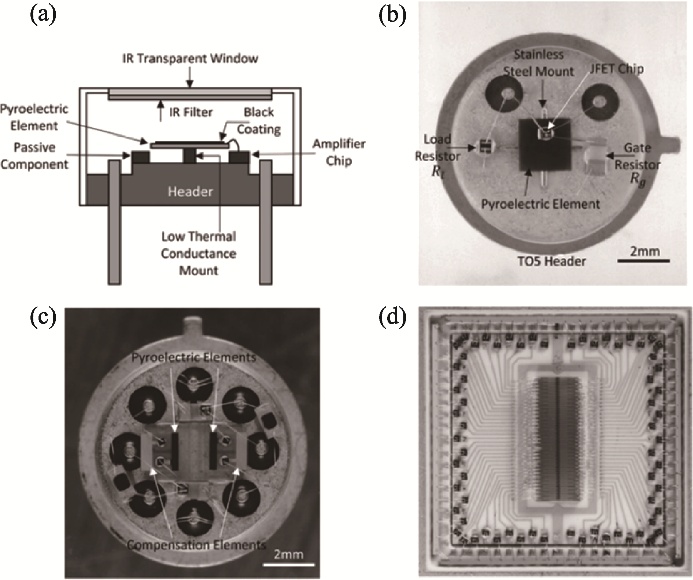
Fig. 4 Different types of pyroelectric detector structures[1] (a) Schematic diagram of a single-element pyroelectric detector; (b) Image of a pyroelectric detector using a 2mm×2mm LT element; (c) Pyroelectric detector consisting of two compensated active elements and sensitive element; (d) Linear array using LT element and compensation element
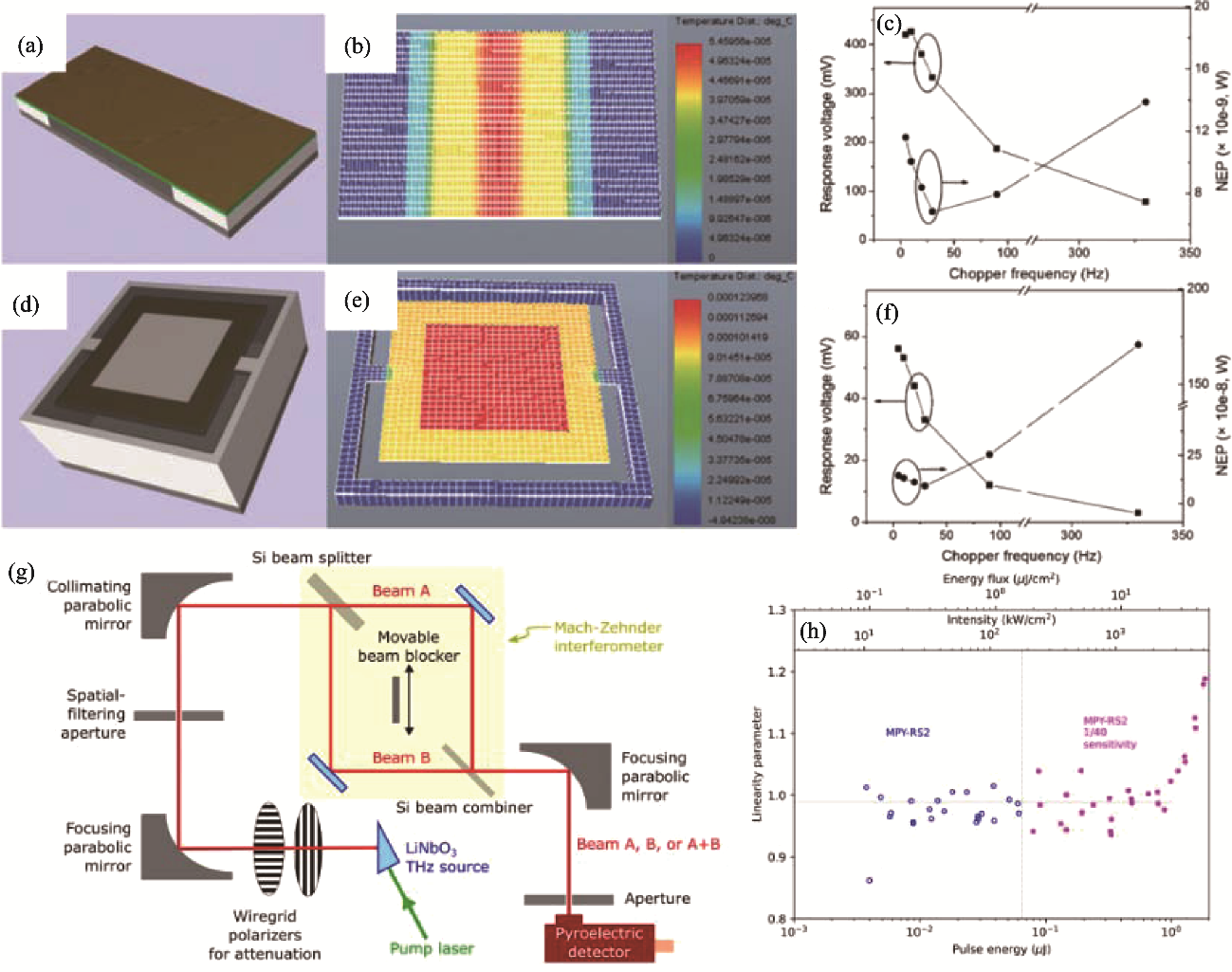
Fig. 5 Application of pyroelectric detector based on LT single crystal[67-68] (a-c) Device basing on LT crystal slice[67]: (a) three dimension device structures, (b) simulation result of the temperature changing, and (c) response voltage and NEP parameters at different chopper frequencies; (d-f) Device basing on LT thin film[67]: (d) three dimension device structures, (e) simulation result of the temperature changing, and (f) response voltage and NEP parameters at different chopper frequencies; (g) Schematic of the experimental setup[68]; (h) Linear response of detector under terahertz high-energy pulses (the empty blue circle and red square represent the test results of standard detector and sensitivity-reduced detector, respectively)[68]
| [1] | WHATMORE R W, WARD S J. Pyroelectric infrared detectors and materials—a critical perspective. Journal of Applied Physics, 2023, 133(8): 080902. |
| [2] | SI J S, XIAO X F, ZHANG Y, et al. Pyroelectric properties and applications of lithium tantalate crystals. Crystals, 2024, 14(7): 579. |
| [3] | XIAO X F, XU Q Y, LIANG S J, et al. Preparation and defect structure analysis of near-stoichiometric lithium tantalate wafers. RSC Advances, 2022, 12(30): 19091. |
| [4] | MONDAL R, HASAN M A M, BAIK J M, et al. Advanced pyroelectric materials for energy harvesting and sensing applications. Materials Today, 2023, 66: 273. |
| [5] | LIU Z, LU T, DONG X L, et al. Ferroelectric ceramics for pyroelectric detection applications: a review. IEEE Transactions on Ultrasonics, Ferroelectrics, and Frequency Control, 2021, 68(2): 242. |
| [6] | ROUNDY C B, BYER R L. Sensitive LiTaO3 pyroelectric detector. Journal of Applied Physics, 1973, 44(2): 929. |
| [7] | ZHU Y X, WAN Q. Lithium niobate/lithium tantalate single-crystal thin films for post-Moore era chip applications. Moore and More, 2024, 1(1): 6. |
| [8] | XIAO X F, LIANG S J, SI J S, et al. Performance of LiTaO3 crystals and thin films and their application. Crystals, 2023, 13(8): 1233. |
| [9] | PARK S H, PARK C S, KANG K M, et al. Highly stable all-sputtered solid-state electrochromic devices with co-sputtered LiTaO3 electrolyte films for smart windows. Advanced Materials Technologies, 2025, 10(20): e00286. |
| [10] | ZHANG R T, JIN Y H, LI Y M, et al. Bi3+/Sm3+ co-doped LiTaO3 photochromic perovskites: an ultrafast erasable optical information storage medium. Inorganic Chemistry Frontiers, 2023, 10(16): 4869. |
| [11] | 张德银, 黄大贵, 李金华, 等. ITO衬底上LiTaO3薄膜的制备与介电特性. 红外与毫米波学报, 2007, 26(3): 170. |
| [12] | FAN W, SHUAI Y, PAN X Q, et al. Influence of annealing ambience on structural and piezoelectric properties of single crystal LiTaO3 thin film. Materials Express, 2023, 13(2): 345. |
| [13] | SHEN J Y, YAO W F, WORKIE T B, et al. Suppressed transverse mode generation in TF-SAW resonators based on LiTaO3/ sapphire. IEEE Electron Device Letters, 2024, 45(11): 2241. |
| [14] | LOUISET A, SCHAMM-CHARDON S, KONONCHUK O, et al. Reconstruction of depth resolved strain tensor in off-axis single crystals: application to H+ ions implanted LiTaO3. Applied Physics Letters, 2021, 118(8): 082903. |
| [15] | STENGER V, SHNIDER M, SRIRAM S, et al. Thin film lithium tantalate (TFLT) pyroelectric detectors. Terahertz Technology and Applications V, San Francisco, 2012: 174-182. |
| [16] | YU J Y, RUAN Z L, XUE Y, et al. Tunable and stable micro-ring resonator based on thin-film lithium tantalate. APL Photonics, 2024, 9(3): 036115. |
| [17] | XIAO X F, SI J S, LIANG S J, et al. Preparation, properties, and applications of near stoichiometric lithium tantalate crystals. Crystals, 2023, 13(7): 1031. |
| [18] | WANG C L, LI Z H, RIEMENSBERGER J, et al. Lithium tantalate photonic integrated circuits for volume manufacturing. Nature, 2024, 629(8013): 784. |
| [19] | HE Y W, WONG Y P, LIANG Q, et al. Double busbar structure for transverse energy leakage and resonance suppression in surface acoustic wave resonators using 42°YX-lithium tantalate thin plate. IEEE Transactions on Ultrasonics, Ferroelectrics, and Frequency Control, 2022, 69(3): 1112. |
| [20] | WANG C L, FANG D Y, ZHANG J Y, et al. Ultrabroadband thin-film lithium tantalate modulator for high-speed communications. Optica, 2024, 11(12): 1614. |
| [21] | GORISSE M, DROUIN A, SINQUIN Y, et al. Oriented single- crystal LiTaO3 thin film on silicon for high performances SAW components. 2018 IEEE International Ultrasonics Symposium (IUS), Glasgow, 2018: 1-4. |
| [22] | JIA Y C, WANG L, CHEN F. Ion-cut lithium niobate on insulator technology: recent advances and perspectives. Applied Physics Reviews, 2021, 8: 011307. |
| [23] | WU Z L, WU S X, QIAN H Y, et al. Comparative study of SH-mode surface acoustic wave resonators on lithium tantalate with silicon and silicon carbide substrates. IEEE Transactions on Electron Devices, 2024, 71(11): 7022. |
| [24] | WANG H H, CUI A, CHEN B, et al. Thin-film lithium tantalate modulator operating at high optical power. ACS Photonics, 2025, 12(10): 5345. |
| [25] | FANG M H, XIE Y N, XUE F Q, et al. Optical colorimetric LiTaO3 wafers for high-precision lithography on frequency control of SAW devices. Photonics Research, 2024, 12(2): 341. |
| [26] | HANG W, WEI L Q, DEBELA T T, et al. Crystallographic orientation effect on the polishing behavior of LiTaO3 single crystal and its correlation with strain rate sensitivity. Ceramics International, 2022, 48(6): 7766. |
| [27] | WANG M, WU R B, LIN J T, et al. Chemo-mechanical polish lithography: a pathway to low loss large-scale photonic integration on lithium niobate on insulator. Quantum Engineering, 2019, 1(1): e9. |
| [28] | GENG W P, YANG X Y, XUE G, et al. Integration technology for wafer-level LiNbO3 single-crystal thin film on silicon by polyimide adhesive bonding and chemical mechanical polishing. Nanomaterials, 2021, 11(10): 2554. |
| [29] | KANE S R, WHATMORE R W, SINGH M N, et al. Characterizing pyroelectric detectors for quantitative synchrotron radiation measurements. Sensors and Actuators A: Physical, 2025, 387: 116406. |
| [30] | PRAFUL P, BAILEY C. Warpage in wafer-level packaging: a review of causes, modelling, and mitigation strategies. Frontiers in Electronics, 2025, 5: 1515860. |
| [31] | 刘宾, 苗卫朋, 杨威, 等. 钽酸锂晶圆减薄用超细金刚石陶瓷砂轮的制备与表征. 超硬材料工程, 2025, 37(2): 1. |
| [32] | LIANG Z Q, LI S B, LIU Z J, et al. High responsivity of pyroelectric infrared detector based on ultra-thin (10 μm) LiTaO3. Journal of Materials Science: Materials in Electronics, 2015, 26: 5400. |
| [33] | SCHOSSIG M, NORKUS V, GERLACH G. Dielectric and pyroelectric properties of ultrathin, monocrystalline lithium tantalate. Infrared Physics & Technology, 2014, 63: 35. |
| [34] | ZHANG J. High precision wafer thinning using ultra-low-TTV glass carrier and novel temporary bonding. 2023 IEEE 25th Electronics Packaging Technology Conference (EPTC), Singapore, 2023: 580-583. |
| [35] | ZHU Y X, YU Z K, WAN Q. Large-size functional wafer temporary bonding and thinning. Journal of Inorganic Materials, 2025, 40(12): 1443. |
| [36] | BRUEL M. Silicon on insulator material technology. Electronics Letters, 1995, 31(14): 1201. |
| [37] | BRUEL M. Application of hydrogen ion beams to silicon on insulator material technology. Nuclear Instruments and Methods in Physics Research Section B: Beam Interactions with Materials and Atoms, 1996, 108(3): 313. |
| [38] | BRUEL M. The history, physics, and applications of the Smart-Cut® process. MRS Bulletin, 1998, 23(12): 35. |
| [39] | WAN Q, WANG L W, LIU W L, et al. Investigation of H+ and B+/H+ implantation in LiTaO3 single-crystals. Nuclear Instruments and Methods in Physics Research Section B: Beam Interactions with Materials and Atoms, 2001, 184(4): 531. |
| [40] | MORICEAU H, MAZEN F, BRALEY C, et al. Smart Cut™: review on an attractive process for innovative substrate elaboration. Nuclear Instruments and Methods in Physics Research Section B: Beam Interactions with Materials and Atoms, 2012, 277: 84. |
| [41] | LUO J R, LUO W B, ZHANG K S, et al. High specific detectivity infrared detector using crystal ion slicing transferred LiTaO3 single-crystal thin films. Sensors and Actuators A: Physical, 2019, 300: 111650. |
| [42] | TAUZIN A, DECHAMP J, MADEIRA F, et al. 3-inch single-crystal LiTaO3 films onto metallic electrode using Smart Cut™ technology. Electronics Letters, 2008, 44(13): 822. |
| [43] | LIU W L, ZHAN D, MA X B, et al. Fabrication of single- crystalline LiTaO3 film on silicon substrate using thin film transfer technology. Journal of Vacuum Science & Technology B: Microelectronics and Nanometer Structures Processing, Measurement, and Phenomena, 2008, 26(1): 206. |
| [44] | WAN L M, WU C Y, YUAN Y, et al. Enhanced surface blistering efficiency of H+ implanted lithium tantalate by chemical reduction modification. Applied Surface Science, 2023, 622: 156978. |
| [45] | ZHANG K S, LUO W B, HUANG S T, et al. Effects of rapid thermal annealing parameters on crystal ion slicing-fabricated LiTaO3 thin film. Applied Physics A, 2021, 127(6): 468. |
| [46] | PANG L L, WANG Z G, SUN J R, et al. Evolution of optical absorption and strain in LiTaO3 crystal implanted by energetic He-ion. Nuclear Instruments and Methods in Physics Research Section B: Beam Interactions with Materials and Atoms, 2015, 354: 301. |
| [47] | PANG L L, WANG Z G, JIN Y F, et al. The modification of LiTaO3 crystal by low-energy He-ion implantation. Nuclear Instruments and Methods in Physics Research Section B: Beam Interactions with Materials and Atoms, 2012, 290: 54. |
| [48] | MA C D, LU F, XU B, et al. Visualized strain profile in the process of crystal ion slicing of LiTaO3. Journal of Physics D: Applied Physics, 2016, 49(20): 205301. |
| [49] | 陈哲明, 丁雨憧, 邹少红, 等. 硅基钽酸锂异质晶圆键合工艺研究. 人工晶体学报, 2024, 53(4): 634. |
| [50] | YAN Y Q, HUANG K, ZHOU H Y, et al. Wafer-scale fabrication of 42° rotated Y-cut LiTaO3-on-insulator (LTOI) substrate for a SAW resonator. ACS Applied Electronic Materials, 2019, 1(8): 1660. |
| [51] | LI M, XIA X, LI K P, et al. High performance SAW resonators using LiTaO3/SiO2/4H-SiC multilayer substrate. IEEE Electron Device Letters, 2022, 43(10): 1772. |
| [52] | ZHANG D, WU H T, BOWEN C R, et al. Recent advances in pyroelectric materials and applications. Small, 2021, 17(51): 2103960. |
| [53] | WHATMORE R W. Pyroelectric devices and materials. Reports on Progress in Physics, 1986, 49(12): 1335. |
| [54] | LI X Y, LU S G, CHEN X Z, et al. Pyroelectric and electrocaloric materials. Journal of Materials Chemistry C, 2013, 1(1): 23. |
| [55] | LIANG T, LIN S J, LI Y, et al. Research on the effect of mechanical processing on lithium tantalate crystal pyroelectric coefficient. Advanced Materials Research, 2013, 834/835/836: 880. |
| [56] | NORKUS V. Pyroelectric infrared detectors based on lithium tantalate: state of art and prospects. Detectors and Associated Signal Processing, 2004, 5251: 121. |
| [57] | SOKOLL T, NORKUS V, GERLACH G. Ion beam etching of lithium tantalate and its application for pyroelectric linear arrays. Surface and Coatings Technology, 1997, 97(1/2/3): 469. |
| [58] | ZHANG K S, LUO W B, HUANG S T, et al. Wavelength-selective infrared detector fabricated by integrating LiTaO3 with a metamaterial perfect absorber. Sensors and Actuators A: Physical, 2020, 313: 112186. |
| [59] | ZENG X H, LUO W B, ZHANG K S, et al. Wafer-scale fabrication of silicon-based LiTaO3 pyroelectric infrared detectors by bonding and thinning technology. IEEE Sensors Journal, 2022, 22(18): 17721. |
| [60] | ALEKSANDROVA M, JAGTAP C, KADAM V, et al. An overview of microelectronic infrared pyroelectric detector. Engineered Science, 2021, 16: 82. |
| [61] | TIAN J L. An overview of pyroelectric photodetector: photoresponse mechanisms and applications. AIP Advances, 2023, 13(5): 050701. |
| [62] | NORKUS V, CHVEDOV D, GERLACH G, et al. Performance improvements for pyroelectric infrared detectors. Infrared Technology and Applications XXXII, Orlando, 2006, 6206: 974-984. |
| [63] | ZHANG W D, TAN Q L, LIU J, et al. Two-channel IR gas sensor with two detectors based on LiTaO3 single-crystal wafer. Optics & Laser Technology, 2010, 42(8): 1223. |
| [64] | NORKUS V, GERLACH G, HOFMANN G. High-resolution pyroelectric linear arrays based on LiTaO3. Infrared Technology and Applications XXVII, Orlando, 2001, 4369: 322-331. |
| [65] | NORKUS V, HOFMANN G, MOEHLING S, et al. Pyroelectric IR single-element detectors and arrays based on LiNbO3 and LiTaO3. Infrared Detectors and Focal Plane Arrays II, Orlando, 1992, 1685: 155-163. |
| [66] | HOLDEN A J. Applications of pyroelectric materials in array- based detectors. IEEE Transactions on Ultrasonics, Ferroelectrics, and Frequency Control, 2011, 58(9): 1981. |
| [67] | WANG J, GOU J, LI W Z. Preparation of room temperature terahertz detector with lithium tantalate crystal and thin film. AIP Advances, 2014, 4(2): 027106. |
| [68] | SHARMA A, GUPTA V, SON J G, et al. Linearity of fast and highly sensitive LiTaO3 pyroelectric detectors in the terahertz range. IEEE Transactions on Terahertz Science and Technology, 2024, 14(6): 823. |
| [69] | MITMIT C, GOLDENBERG E, TAN E M M. Infrared wavelength-specific gas sensing with pyroelectricity at room temperature. Sensors and Actuators A: Physical, 2023, 351: 114164. |
| [70] | FAN K B, STENGER V, PADILLA W J. Pyroelectric metamaterial millimeter-wave detector. Applied Physics Letters, 2022, 121(2): 021701. |
| [1] | QIN Shanli, GUO Jiawen, CHEN Yanmeng, JU An’an, WEI Yi, HUANG Kelin, HOU Xianghua, LÜ Sishi, WEN Zhipeng, WU Lian. Recent Advances in Constructing Oriented Ion Transport Channels with Two-dimensional Layered Materials for Electrochemical Energy Storage [J]. Journal of Inorganic Materials, 2026, 41(7): 883-898. |
| [2] | YU Feiyu, WANG Wenqing, ZHANG Xueqin, HE Rujie. Additively Manufactured Ceramic Lattice-based Interpenetrating Phase Composites: Progress and Challenges [J]. Journal of Inorganic Materials, 2026, 41(7): 849-866. |
| [3] | ZHOU Cui, LI Jie, SUN Luchao, SU Haijun, WANG Jingyang. Alumina-based Directionally Solidified Eutectic Ceramics: Microstructure, Control Strategies and Environmental Stability [J]. Journal of Inorganic Materials, 2026, 41(7): 899-914. |
| [4] | FEI Wenlong, WANG Yakun, LIAO Liangsheng. Research Progress on Controllable Synthesis of Blue-emitting ZnSeTe Quantum Dots and Quantum-dot Light-emitting Diode Devices [J]. Journal of Inorganic Materials, 2026, 41(7): 867-882. |
| [5] | CHEN Mingjun, MIAO Hongkang, XIAO Yingjun, DENG Jianbo, ZHANG Xiang, ZHAO Jiupeng, LI Yao. Photo- and Thermo-chromic Dual-responsive Materials: A Review on Design Strategies and Applications in Smart Windows [J]. Journal of Inorganic Materials, 2026, 41(6): 723-738. |
| [6] | SONG Kunjie, XIE Rongjun. Research Advances on Machine Learning-driven Development of Novel Luminescent Materials [J]. Journal of Inorganic Materials, 2026, 41(6): 689-703. |
| [7] | LIU Chunfan, CHEN Ke, GE Fangfang, HUANG Qing. Research Progress on Lead-bismuth Eutectic Corrosion Resistant Coatings [J]. Journal of Inorganic Materials, 2026, 41(6): 775-786. |
| [8] | HU Yang, XIE Min, ZHANG Xiaoyi, LI Xiang, GUO Xinwei, JIANG Nan, ZHOU Wenhan, ZHANG Shengli, ZENG Haibo. Research Progress on Computational and Data-driven Environmental-friendly Luminescent Materials [J]. Journal of Inorganic Materials, 2026, 41(6): 704-722. |
| [9] | WANG Junbu, HUANG Zeai, YANG Mingkai, MENG Ying, ZHOU Mingwei, ZHOU Ying. Research Progress on Anti-coking Catalytic Materials for Methane Conversion [J]. Journal of Inorganic Materials, 2026, 41(6): 739-750. |
| [10] | WANG Jinwen, YANG Zhen, ZHOU Huan, XIA Dan, YANG Lei. Biomedical Applications of Injectable Inorganic Biomaterials [J]. Journal of Inorganic Materials, 2026, 41(6): 751-763. |
| [11] | LI Hantao, SHEN Qiang, LUO Guoqiang, WANG Xuefei, GAO Ming, CHEN Chen. Research Progress on Structure and Performance Regulation of Silicon-based Anode Materials via Mechanical Ball Milling [J]. Journal of Inorganic Materials, 2026, 41(5): 561-572. |
| [12] | XIE Chenyi, MIAO Huaming, ZHANG Weiran, LIU Rongjun, WANG Yanfei, LI Duan. Research Progress on Theoretical Calculation in the Field of High-entropy Ceramics [J]. Journal of Inorganic Materials, 2026, 41(5): 545-560. |
| [13] | LI Xuan, YE Kuicai, FENG Jiayin, QIU Jiajun, QIAN Wenhao, XING Min. Surface Modification of Titanium-based Dental Implants for Soft Tissue Sealing: A Review [J]. Journal of Inorganic Materials, 2026, 41(4): 432-444. |
| [14] | PENG Dezhao, LI Rui, WANG Wenhong, WANG Zirui, ZHANG Zhizhen. Research Progress on Sodium Chloride Solid Electrolytes [J]. Journal of Inorganic Materials, 2026, 41(4): 409-420. |
| [15] | CHEN Kun, JIANG Yonggang, FENG Junzong, LI Liangjun, HU Yijie, FENG Jian. Research Progress on Lanthanum Zirconate Porous Materials for Thermal Insulation [J]. Journal of Inorganic Materials, 2026, 41(4): 421-431. |
| Viewed | ||||||
|
Full text |
|
|||||
|
Abstract |
|
|||||
