
Journal of Inorganic Materials ›› 2026, Vol. 41 ›› Issue (8): 1021-1035.DOI: 10.15541/jim20250411
• REVIEW • Next Articles
MA Zhitong1( ), LI Zhongshao1, CAO Xun1,2()
Received:2025-10-21
Revised:2026-02-03
Published:2026-08-20
Online:2026-02-05
Contact:
CAO Xun, professor. E-mail: cxun@mail.sic.ac.cnAbout author:MA Zhitong (2002-), female, Master candidate. E-mail: mazhitong24@mails.ucas.ac.cn
Supported by:CLC Number:
MA Zhitong, LI Zhongshao, CAO Xun. Dynamic Radiative Thermal Management Technologies: From Principles and Materials to Synergistic Optimization of Materials and Structures[J]. Journal of Inorganic Materials, 2026, 41(8): 1021-1035.
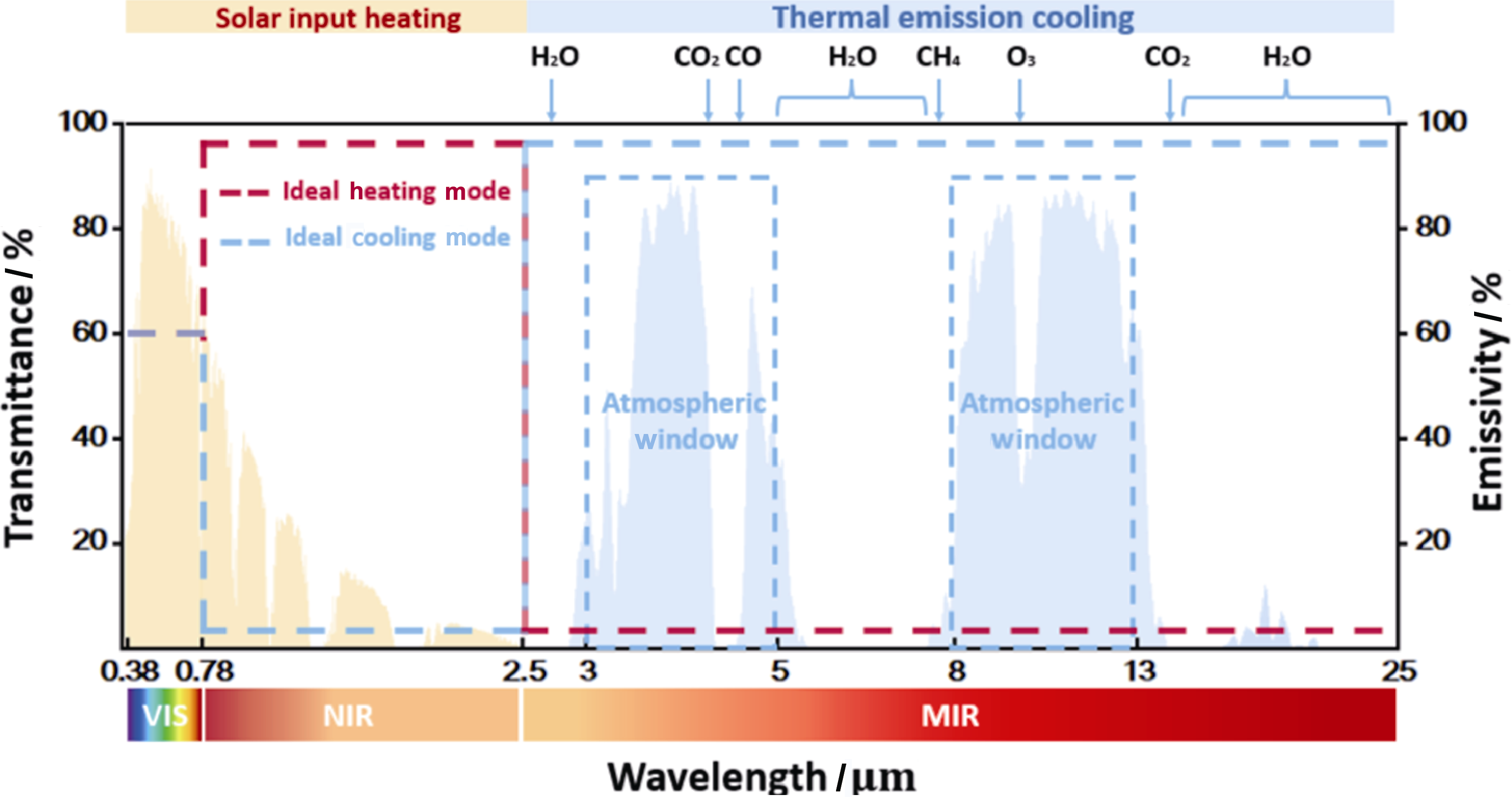
Fig. 1 Ideal spectrum and schematic for dynamic radiative thermal management
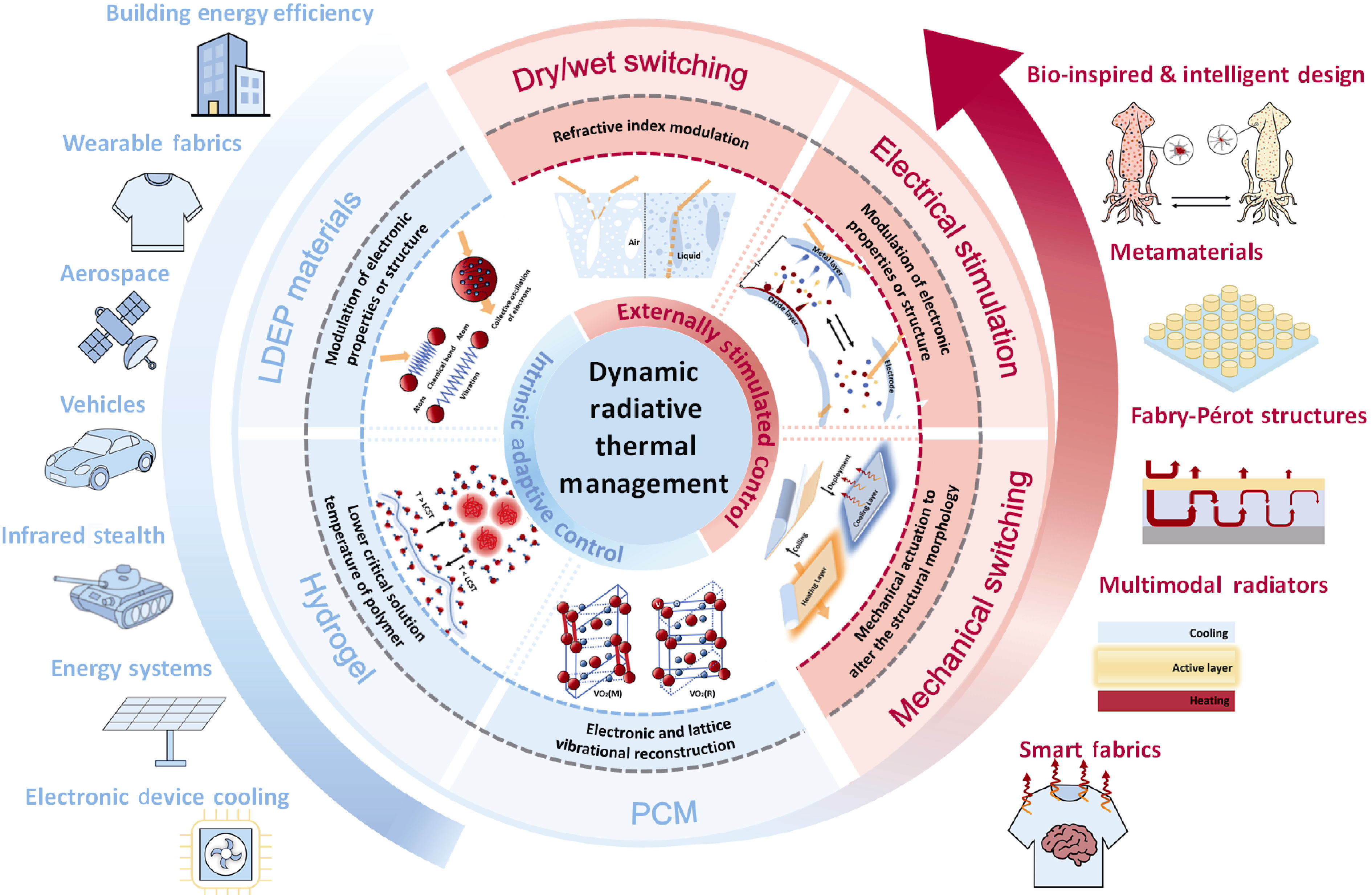
Fig. 2 Classification, applications, and future trends of DRTM[9-12] Three DRTM categories are shown: externally stimulated control, intrinsic adaptive control, and synergistic optimization of materials and structures; The third builds on the first two by coupling tunable material responses with structural design (adapted from references)
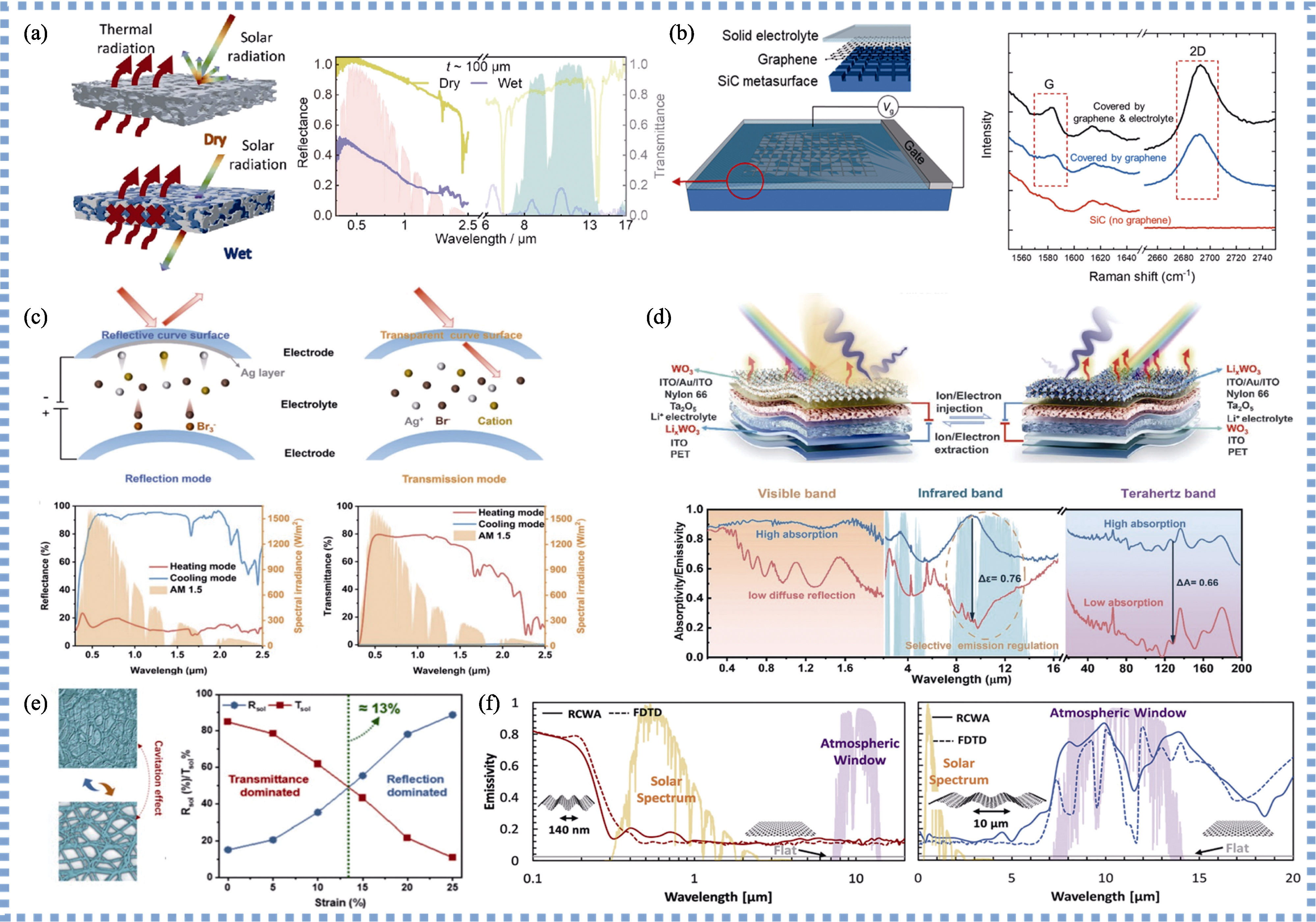
Fig. 3 Externally stimulated control[9,14,16,21,29 -30] (a) Schematic of a structured PE film and its reflectance and transmittance spectra in both dry and wet states[14]; (b) Schematic of a tunable graphene-SiC metasurface and the Raman spectra of graphene in different states[16]; (c) Working principle of a reversible metal electrodeposition device[9]; (d) Working principle and actual multispectral modulation performance of a flexible device[21]; (e) Schematic of a mechanosensitive stacking structure and its transmittance and reflectance spectra under different strains[29]; (f) Selective emission spectra of crumpled graphene with different crumpling pitches[30]
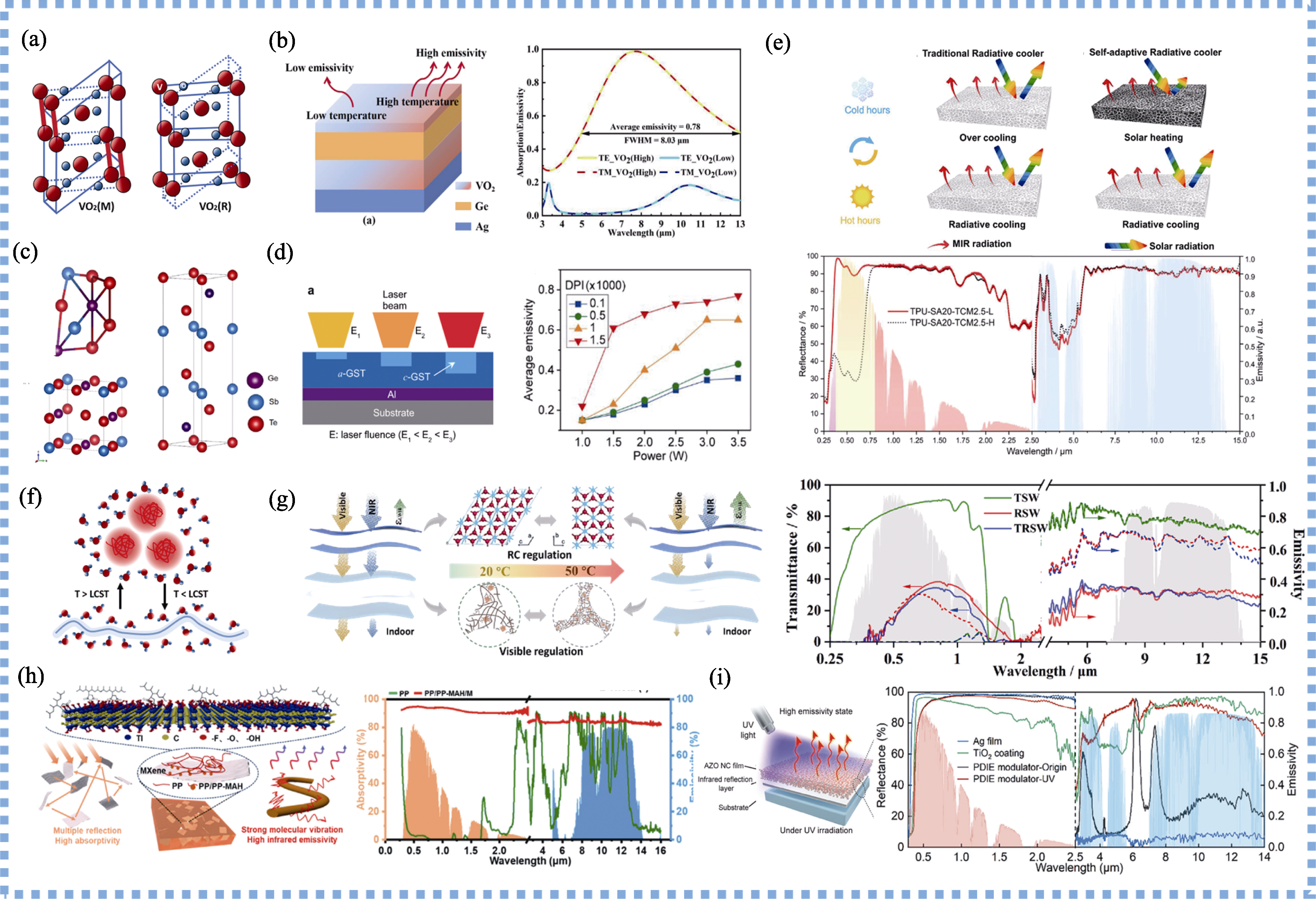
Fig. 4 Intrinsically adaptive control[10,35 -36,42,48,56,60,65 -66] (a) Crystal structures of VO2 in its metallic and insulating phases, with vanadium atoms shown as red spheres and oxygen atoms as blue spheres[35]; (b) Structure of an Ag/Ge/VO2 multilayer film and its absorption spectra at high and low temperatures[36]; (c) Amorphous, metastable, and stable crystalline structures of GST[42]; (d) Laser-induced dynamic emissivity control and the structure’s emissivity spectra[48]; (e) Color and temperature-adaptive film’s emissivity and reflectance spectra[56]; (f) Schematic of the reversible solid-liquid phase transition of a hydrogel in water[10]; (g) Mechanism of integrated thermochromic and radiative cooling technologies before and after the phase transition[60]; (h) Schematic and spectrum of MXene-modified PP nanocomposites[65]; (i) Working principle and emissivity modulation mechanism of a photo-induced dynamic modulator[66]
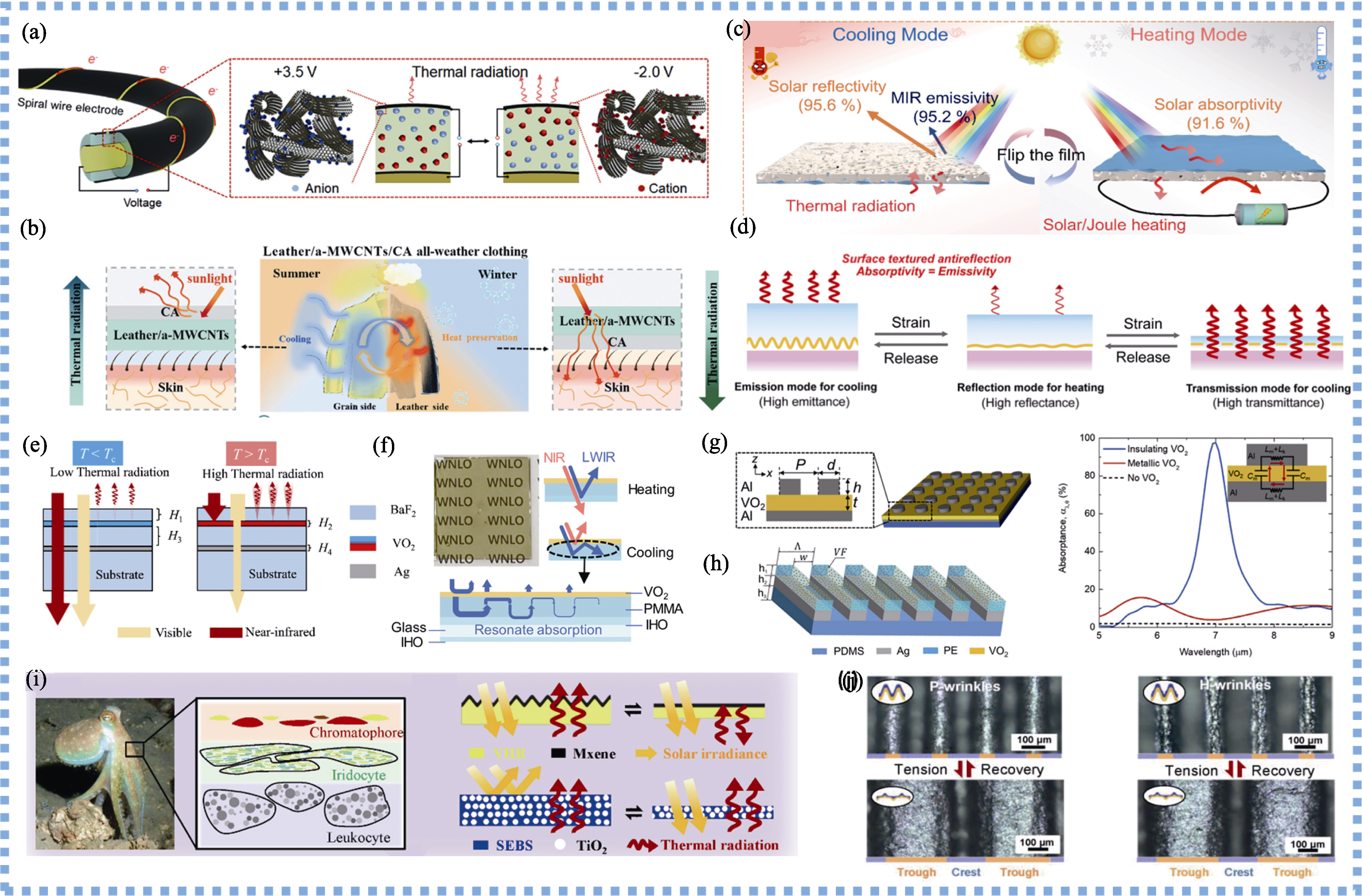
Fig. 5 Material-structure synergistic design[11,72,77,84 -85,90,94,96,103 -104] (a) Emissivity control principle of electrochromic fabric fibers[72]; (b) Schematic of the cooling and heating modes of a leather/a-MWCNTs/CA all-weather fabric[77]; (c) Schematic illustrating how mechanical strain reconstructs the material’s microstructure to achieve both cooling and heating[84]; (d) Reversible switching of a film between emission, reflection and transmission modes[85]; (e) Structural diagram of a full-spectrum smart window that combines an F-P cavity with the phase-change properties of VO2[90]; (f) Working principle of a W-VO2-based F-P cavity[11]; (g) Material combining VO2 phase-change material with a submicron aluminum disk array metasurface, along with its absorption spectrum[94]; (h) Schematic of a bilateral photonic metamaterial[96]; (i) Optical image of a cuttlefish and schematic of a composite film inspired by the multi-layer skin of a cephalopod[103]; (j) Optical microscope images of a bio-inspired hierarchical wrinkled structure before and after mechanical actuation[104]
| Category | Material | Synergistic optimization design | Device structure | Ref. | Wavelength/μm | Performance | Advantage | |
|---|---|---|---|---|---|---|---|---|
| Electrical stimulation | Graphene | / | Multilayer graphene modulators | [ | 5-8 8-14 | Δε=13% Δε=4% | Theoretical modeling of graphene thermal modulators | |
| / | Electrochromic device | [ | 0.2-20 | Δα=27% Δε=74% | Flexible ultra-wideband transparent electrode | |||
| Smart fabrics | Electrochromic smart fabrics | [ | 4-15 | Δε=35% | Superior thermal regulation with visual color change | |||
| Metamaterials | Graphene-metal hybrid metasurface | [ | 8-14 | Δε=40% | Novel image encoding for IR encryption and anti-counterfeiting | |||
| Category | Material | Synergistic optimization design | Device structure | Ref. | Wavelength/μm | Performance | Advantage | |
| Mechanical stress | CNTs | / | CNTs on stretchable gel | [ | 0.4-25 | Δε=23% | Flexible broadband spectroscopic device | |
| / | SH/RC device with SWCNTs media | [ | 0.3-20 | Δα=80% ε=90% | Sustained human thermoregulation | |||
| Smart fabrics | Leather/ a-MWCNTs/ CA fabric | [ | 0.3-15 | α=98% ε=90.2% R=92% | Electromagnetic interference shielding effectiveness | |||
| Graphene | / | Crumpled graphene | [ | 0.2-0.3 7-19 | Δε=80% Δε=60% | High modulation contrast | ||
| Smart fabrics | VG/GGEF/PAN | [ | 0.3-20 | ε=92% R=98.4% | Facilitating practical large-area application and industrialization potential | |||
| MXene | / | PP/MXene | [ | 0.3-16 | α=93.2% ε=84.2% | Coupled with commercial thermoelectric for thermoelectric power generation | ||
| Multimodal radiators | BaSO4 BC/MXene | [ | 0.3-15 | α=91.6% ε=95.2% R=95.6% | Suitable for use in outdoor environments with variable weather conditions | |||
| Bio-inspired design | MXene-SEBS/TiO2 | [ | 0.4-14 | ΔR=28% Δε=21% | Novel solar-infrared dual-band thermal regulation design | |||
| Material stacking | / | PTFE film with PDMS infiltration | [ | 0.3-2.5 | τ=86% R=88% | Durability, scalability, and self- cleaning ability | ||
| Smart fabrics | Novel multienergy Janus thermal textile | [ | 0.3-16 | R=60% α=98.5% | Pleasant sweat/moisture permeability and multienergy-coupled heating | |||
| Thermal stimulation | VO2 | / | Ag/Ge/VO2 | [ | 3-13 | Δε=68% | Simulations show that a simple structure is critical for radiative modulation | |
| / | Al2O3/VO2/ Al2O3/Al | [ | 0.3-25 | α>80% ε=75% | It reaches 170 ℃ above ambient in heating mode and 20 ℃ below ambient in cooling mode | |||
| F-P | VO2/Si/Al | [ | 0-20 | R=85% ε=60% | Providing an innovative solution for spacecraft thermal control | |||
| BaF2/VO2/BaF2/ Ag/BaF2 | [ | 0-2.5 8-13 | τ=72.8% ε=83.8% | Simulations proved the application potential and commercial viability of VO2 smart windows | ||||
| Metamaterials | VO2 film/ submicron aluminum disks | [ | 4-8 | αmax=1 | Innovatively utilizing the magnetic polariton resonance modulation mechanism | |||
| VO2/Fe/SiO2 | [ | 3-5 | Δα=68% | Promising applications include advanced solar absorption panels | ||||
| Phase change energy storage material | / | CNTs@PDMS/PCM | [ | 0.3-16 | Δα=60% ε=96% | Maintaining vivid color while preserving thermal functionality | ||
| Multimodal radiators | Ni-Ti memory alloy/PCM | [ | 0.3-17 | R=95% α=92% Δε=92.5% | Saving 68%-90% of annual energy consumption compared to conventional roofs | |||
Table 1 Summary of DRTM materials, performance and advantages[17,19,27,29 -30,36 -37,55,64 -65,72,77 -79,84,86,89 -90,94 -95,97,103]
| Category | Material | Synergistic optimization design | Device structure | Ref. | Wavelength/μm | Performance | Advantage | |
|---|---|---|---|---|---|---|---|---|
| Electrical stimulation | Graphene | / | Multilayer graphene modulators | [ | 5-8 8-14 | Δε=13% Δε=4% | Theoretical modeling of graphene thermal modulators | |
| / | Electrochromic device | [ | 0.2-20 | Δα=27% Δε=74% | Flexible ultra-wideband transparent electrode | |||
| Smart fabrics | Electrochromic smart fabrics | [ | 4-15 | Δε=35% | Superior thermal regulation with visual color change | |||
| Metamaterials | Graphene-metal hybrid metasurface | [ | 8-14 | Δε=40% | Novel image encoding for IR encryption and anti-counterfeiting | |||
| Category | Material | Synergistic optimization design | Device structure | Ref. | Wavelength/μm | Performance | Advantage | |
| Mechanical stress | CNTs | / | CNTs on stretchable gel | [ | 0.4-25 | Δε=23% | Flexible broadband spectroscopic device | |
| / | SH/RC device with SWCNTs media | [ | 0.3-20 | Δα=80% ε=90% | Sustained human thermoregulation | |||
| Smart fabrics | Leather/ a-MWCNTs/ CA fabric | [ | 0.3-15 | α=98% ε=90.2% R=92% | Electromagnetic interference shielding effectiveness | |||
| Graphene | / | Crumpled graphene | [ | 0.2-0.3 7-19 | Δε=80% Δε=60% | High modulation contrast | ||
| Smart fabrics | VG/GGEF/PAN | [ | 0.3-20 | ε=92% R=98.4% | Facilitating practical large-area application and industrialization potential | |||
| MXene | / | PP/MXene | [ | 0.3-16 | α=93.2% ε=84.2% | Coupled with commercial thermoelectric for thermoelectric power generation | ||
| Multimodal radiators | BaSO4 BC/MXene | [ | 0.3-15 | α=91.6% ε=95.2% R=95.6% | Suitable for use in outdoor environments with variable weather conditions | |||
| Bio-inspired design | MXene-SEBS/TiO2 | [ | 0.4-14 | ΔR=28% Δε=21% | Novel solar-infrared dual-band thermal regulation design | |||
| Material stacking | / | PTFE film with PDMS infiltration | [ | 0.3-2.5 | τ=86% R=88% | Durability, scalability, and self- cleaning ability | ||
| Smart fabrics | Novel multienergy Janus thermal textile | [ | 0.3-16 | R=60% α=98.5% | Pleasant sweat/moisture permeability and multienergy-coupled heating | |||
| Thermal stimulation | VO2 | / | Ag/Ge/VO2 | [ | 3-13 | Δε=68% | Simulations show that a simple structure is critical for radiative modulation | |
| / | Al2O3/VO2/ Al2O3/Al | [ | 0.3-25 | α>80% ε=75% | It reaches 170 ℃ above ambient in heating mode and 20 ℃ below ambient in cooling mode | |||
| F-P | VO2/Si/Al | [ | 0-20 | R=85% ε=60% | Providing an innovative solution for spacecraft thermal control | |||
| BaF2/VO2/BaF2/ Ag/BaF2 | [ | 0-2.5 8-13 | τ=72.8% ε=83.8% | Simulations proved the application potential and commercial viability of VO2 smart windows | ||||
| Metamaterials | VO2 film/ submicron aluminum disks | [ | 4-8 | αmax=1 | Innovatively utilizing the magnetic polariton resonance modulation mechanism | |||
| VO2/Fe/SiO2 | [ | 3-5 | Δα=68% | Promising applications include advanced solar absorption panels | ||||
| Phase change energy storage material | / | CNTs@PDMS/PCM | [ | 0.3-16 | Δα=60% ε=96% | Maintaining vivid color while preserving thermal functionality | ||
| Multimodal radiators | Ni-Ti memory alloy/PCM | [ | 0.3-17 | R=95% α=92% Δε=92.5% | Saving 68%-90% of annual energy consumption compared to conventional roofs | |||
| [1] |
YANG L, YAN H Y, LAM J C. Thermal comfort and building energy consumption implications-a review. Applied Energy, 2014, 115: 164.
DOI URL |
| [2] | CHEUNG C K, FULLER R J, LUTHER M B. Energy-efficient envelope design for high-rise apartments. Energy and Buildings, 2005, 37(1): 37. |
| [3] | SYNNEFA A, SANTAMOURIS M, AKBARI H. Estimating the effect of using cool coatings on energy loads and thermal comfort in residential buildings in various climatic conditions. Energy and Buildings, 2007, 39(11): 1167. |
| [4] |
ULPIANI G, RANZI G, SHAH K W, et al. On the energy modulation of daytime radiative coolers: a review on infrared emissivity dynamic switch against overcooling. Solar Energy, 2020, 209: 278.
DOI URL |
| [5] |
GAO Y F, XU J M, YANG S C, et al. Cool roofs in China: policy review, building simulations, and proof-of-concept experiments. Energy Policy, 2014, 74: 190.
DOI URL |
| [6] | XU X D, GU J X, ZHAO H P, et al. Passive and dynamic phase-change-based radiative cooling in outdoor weather. ACS Applied Materials & Interfaces, 2022, 14(12): 14313. |
| [7] | 程守洙, 江之永. 普通物理学, 第八版. 北京: 高等教育出版社, 2023: 219-225. |
| [8] | QIN B, ZHU H Z, ZHU R X, et al. Space-to-ground infrared camouflage with radiative heat dissipation. Light: Science & Applications, 2025, 14: 137. |
| [9] | ZHAO X Y, SHENG M F, TANG H J, et al. A flexible electrochromic device for all-season thermal regulation on curved transparent building envelopes. ACS Applied Materials & Interfaces, 2024, 16(32): 42481. |
| [10] | DE LA ROSA V R, WOISEL P, HOOGENBOOM R. Supramolecular control over thermoresponsive polymers. Materials Today, 2016, 19(1): 44. |
| [11] |
LI S J, YANG E Q, LI Y Y, et al. Self-adaptive energy-efficient windows with enhanced synergistic regulation of broadband infrared thermal radiation. Nano Energy, 2024, 129: 110023.
DOI URL |
| [12] | AKINOGLU G E, WU S Y, JI Y X, et al. Adaptive radiative thermal management using transparent, flexible Ag nanowire networks. ACS Applied Materials & Interfaces, 2025, 17(2): 3238. |
| [13] | MANDAL J, JIA M X, OVERVIG A, et al. Porous polymers with switchable optical transmittance for optical and thermal regulation. Joule, 2019, 3(12): 3088. |
| [14] | GUO N, YU L, SHI C M, et al. A facile and effective design for dynamic thermal management based on synchronous solar and thermal radiation regulation. Nano Letters, 2024, 24(4): 1447. |
| [15] |
BRAR V W, SHERROTT M C, JANG M S, et al. Electronic modulation of infrared radiation in graphene plasmonic resonators. Nature Communications, 2015, 6: 7032.
DOI PMID |
| [16] | LONG L S, YING X Y, YANG Y, et al. Tuning the infrared absorption of SiC metasurfaces by electrically gating monolayer graphene with solid polymer electrolyte for dynamic radiative thermal management and sensing applications. ACS Applied Nano Materials, 2019, 2(8): 4810. |
| [17] | DING P, WANG P, SU J C, et al. Multilayer graphene-based radiation modulator for adaptive infrared camouflage with thermal management. Journal of Physics D: Applied Physics, 2022, 55(34): 345103. |
| [18] |
WANG J H, LV Y, ZHOU Y P, et al. Electrolyte design for reversible metal electrodeposition-based electrochromic energy- saving devices. APL Energy, 2024, 2: 011501.
DOI URL |
| [19] | RAO Y F, DAI J Y, SUI C X, et al. Ultra-wideband transparent conductive electrode for electrochromic synergistic solar and radiative heat management. ACS Energy Letters, 2021, 6(11): 3906. |
| [20] | LI M Y, LIU D Q, CHENG H F, et al. Manipulating metals for adaptive thermal camouflage. Science Advances, 2020, 6(22): eaba3494. |
| [21] | DING Y L, MEI Z Y, WU X K, et al. Integrated multispectral modulator with efficient radiative cooling for innovative thermal camouflage. Advanced Functional Materials, 2025, 35(30): 2500122. |
| [22] | FENG K, MA Y F, ZHANG L N, et al. Electrically controlled smart window for seasonally adaptive thermal management in buildings. Small, 2025, 21(5): e2407033. |
| [23] | DARRIN A G, OSIANDER R, CHAMPION J, et al. Variable emissivity through MEMS technology. The Seventh Intersociety Conference on Thermal and Thermomechanical Phenomena in Electronic Systems, Las Vegas, 2000: 264. |
| [24] | NAJEEB M F A, PRICE J, WARBURTON D, et al. The variation of radiative heat loss as a function of actuation angle for an isothermal square twist origami radiator. ASME 2024 Heat Transfer Summer Conference, Anaheim, 2024: HT 2024-131111. |
| [25] |
HUISMAN F, SIMSEK E, GALY T, et al. Reversible sequin fabrics as variable emittance surfaces. International Journal of Heat and Mass Transfer, 2022, 183: 122167.
DOI URL |
| [26] | MULFORD R B, JONES M R, IVERSON B D. Dynamic control of radiative surface properties with origami-inspired design. Journal of Heat Transfer, 2016, 138(3): 032701. |
| [27] | NIE X, KRISHNA A, JEONG M, et al. Stretchable selective emitters based on carbon nanotube films for adaptive thermal control. The 18th IEEE Intersociety Conference on Thermal and Thermomechanical Phenomena in Electronic Systems, Las Vegas, 2019: 204. |
| [28] | PYUN K R, JEONG S, YOO M J, et al. Tunable radiative cooling by mechanochromic electrospun micro-nanofiber matrix. Small, 2024, 20(20): 2308572. |
| [29] | LUO R C, SONG B Q, JIAO H X, et al. Mechanosensitive stacking structure with continuous solar controllability for real-time thermal management. Materials Horizons, 2025, 12(7): 2279. |
| [30] | KRISHNA A, KIM J M, LEEM J, et al. Dynamic radiative thermal management by crumpled graphene. The 18th IEEE Intersociety Conference on Thermal and Thermomechanical Phenomena in Electronic Systems, Las Vegas, 2019: 797. |
| [31] | KRISHNA A, KIM J M, LEEM J, et al. Ultraviolet to mid-infrared emissivity control by mechanically reconfigurable graphene. Nano Letters, 2019, 19(8): 5086. |
| [32] | ZHANG Y T, SUN J H, WANG Y F, et al. Radiative cooling hierarchically porous fluoropolymer film by ambient humidity-induced phase separation. Macromolecules, 2025, 58(8): 4309. |
| [33] |
YANG G J, SUN P, ZHU T, et al. Fabrication, microstructure and optical properties of 〈110〉 textured CVD polycrystalline diamond infrared materials. Diamond and Related Materials, 2024, 141: 110600.
DOI URL |
| [34] | LIU K, LEE S, YANG S, et al. Recent progresses on physics and applications of vanadium dioxide. Materials Today, 2018, 21(8): 875. |
| [35] | WEGKAMP D, STÄHLER J. Ultrafast dynamics during the photoinduced phase transition in VO2. Progress in Surface Science, 2015, 90(4): 464. |
| [36] |
LIANG S R, XU F, LI W X, et al. Tunable smart mid infrared thermal control emitter based on phase change material VO2 thin film. Applied Thermal Engineering, 2023, 232: 121074.
DOI URL |
| [37] | AO X Z, LI B W, ZHAO B, et al. Self-adaptive integration of photothermal and radiative cooling for continuous energy harvesting from the sun and outer space. Proceedings of the National Academy of Sciences of the United States of America, 2022, 119(17): e2120557119. |
| [38] |
LONG L S, YE H. Dual-intelligent windows regulating both solar and long-wave radiations dynamically. Solar Energy Materials and Solar Cells, 2017, 169: 145.
DOI URL |
| [39] |
LI X S, LIU M L, ZHANG W S, et al. Smart window with dynamic emissivity regulation for continuous indoor cooling. Applied Surface Science, 2025, 695: 162895.
DOI URL |
| [40] | WU H L, SHANG D, ZHANG H, et al. Phase-transition materials derived photonic metamaterials for passively dynamic solar thermal and coldness harvesting. Heliyon, 2024, 10(2): e23986. |
| [41] |
YAN C Q, WANG Z G, QU J H, et al. Scalable and dynamically passive thermal regulation over solar wavelengths enabled by phase-transition metamaterials. Solar Energy, 2023, 257: 257.
DOI URL |
| [42] | TAO W W, WU Y, ZHAO F F, et al. Research progress in metamaterials and metasurfaces based on the phase change material Ge2Sb2Te5. Optics & Laser Technology, 2024, 177: 111064. |
| [43] |
BURTSEV A A, ELISEEV N N, MIKHALEVSKY V A, et al. Physical properties’ temperature dynamics of GeTe, Ge2Sb2Te5 and Ge2Sb2Se4Te1 phase change materials. Materials Science in Semiconductor Processing, 2022, 150: 106907.
DOI URL |
| [44] | ARYANA K, KIM H J, ISLAM M R, et al. Optical and thermal properties of Ge2Sb2Te5, Sb2Se3, and Sb2S3 for reconfigurable photonic devices. Optical Materials Express, 2023, 13(11): 3277. |
| [45] | DU K K, LI Q, LYU Y B, et al. Control over emissivity of zero-static-power thermal emitters based on phase-changing material GST. Light: Science & Applications, 2017, 6(1): e16194. |
| [46] | KIM Y, KIM C, LEE M. Parallel laser printing of a thermal emission pattern in a phase-change thin film cavity for infrared camouflage and security. Laser & Photonics Reviews, 2022, 16(3): 2100545. |
| [47] | KANG D, KIM Y, KIM C, et al. Highly flexible infrared emitter with spatially controlled emissivity for optical security. Advanced Materials Technologies, 2023, 8(4): 2200808. |
| [48] | KANG D, KIM Y, LEE M. Laser dynamic control of the thermal emissivity of a planar cavity structure based on a phase-change material. ACS Applied Materials & Interfaces, 2024, 16(4): 4925. |
| [49] |
XU G Q, KANG Q L, ZHANG X Z, et al. Inverse-design laser-infrared compatible stealth with thermal management enabled by wavelength-selective thermal emitter. Applied Thermal Engineering, 2024, 255: 124063.
DOI URL |
| [50] | NONG J, LI N, JIANG X P, et al. Multifunctional emitter based on inverse design for infrared stealth, thermal imaging and radiative cooling. Optics Express, 2024, 32(3): 3379. |
| [51] |
AL-YASIRI Q, SZABÓ M. Paraffin as a phase change material to improve building performance: an overview of applications and thermal conductivity enhancement techniques. Renewable Energy and Environmental Sustainability, 2021, 6: 38.
DOI URL |
| [52] | YU Z L, WANG F, HE W Q, et al. Phase-change material-integrated dual-mode thermal management Janus films with enhanced radiative cooling and solar heating. ACS Applied Polymer Materials, 2025, 7(6): 3555. |
| [53] | ZHOU Y C, DUAN R. Leak-proof reversible thermochromic microcapsule phase change materials with high latent thermal storage for thermal management. ACS Applied Energy Materials, 2024, 7(14): 5944. |
| [54] | LIU B X, MAZO A R, GURR P A, et al. Reversible nontoxic thermochromic microcapsules. ACS Applied Materials & Interfaces, 2020, 12(8): 9782. |
| [55] | YIN Y Y, SUN P C, ZENG Y J, et al. A colored temperature-adaptive cloak for year-round building energy saving. Advanced Energy Materials, 2024, 14(37): 2402202. |
| [56] |
HU X, ZHANG Y B, CAI W, et al. Colorful and temperature- adaptive radiative coolers for all-season thermal management applications. Renewable Energy, 2025, 242: 122447.
DOI URL |
| [57] | DESHMUKH S, MOONEY D A, MCDERMOTT T, et al. Molecular modeling of thermo-responsive hydrogels: observation of lower critical solution temperature. Soft Matter, 2009, 5(7): 1514. |
| [58] |
XIN F F, LU Q L, LIU B X, et al. Metal-ion-mediated hydrogels with thermo-responsiveness for smart windows. European Polymer Journal, 2018, 99: 65.
DOI URL |
| [59] | ZHOU Y, DONG X X, MI Y Y, et al. Hydrogel smart windows. Journal of Materials Chemistry A, 2020, 8(20): 10007. |
| [60] |
ZHANG R, LI R Z, XU P, et al. Thermochromic smart window utilizing passive radiative cooling for self-adaptive thermoregulation. Chemical Engineering Journal, 2023, 471: 144527.
DOI URL |
| [61] |
ZHAO B, LU K G, ZHANG W S, et al. Thermo-responsive hydrogel-based building envelopes for building energy-saving. Solar Energy, 2025, 288: 113306.
DOI URL |
| [62] |
HUANG M C, XUE C H, BAI Z X, et al. Bioinspired smart dual-layer hydrogels system with synchronous solar and thermal radiation modulation for energy-saving all-season temperature regulation. Journal of Energy Chemistry, 2025, 101: 175.
DOI URL |
| [63] | ZHONG S J, LU B H, WANG D C, et al. Passive isothermal flexible sensor enabled by smart thermal-regulating aerogels. Advanced Materials, 2025, 37(8): 2415386. |
| [64] |
ZHAO B, HU M K, XUAN Q D, et al. Tunable thermal management based on solar heating and radiative cooling. Solar Energy Materials and Solar Cells, 2022, 235: 111457.
DOI URL |
| [65] | LI X X, ZHANG Z P, ZHANG X T, et al. A polymer nanocomposite with strong full-spectrum solar absorption and infrared emission for all-day thermal energy management and conversion. Advanced Science, 2024, 11(15): 2308200. |
| [66] | JIA Y, LIU D Q, CHEN D S, et al. Realizing sunlight-induced efficiently dynamic infrared emissivity modulation based on aluminum-doped zinc oxide nanocrystals. Advanced Science, 2024, 11(36): 2405962. |
| [67] |
CHEN Y, GAO F, ZHAN X L, et al. Hierarchical textiles with optical design and fiber nanomanufacturing: breakthrough innovation in personal thermal management. Chemical Synthesis, 2025, 5: 21.
DOI |
| [68] | ZHANG X P, WANG F, GUO H Y, et al. Advanced cooling textiles: mechanisms, applications, and perspectives. Advanced Science, 2024, 11(10): 2305228. |
| [69] | BOUTGHATIN M, PENNEC Y, ASSAF S, et al. Dynamic thermoregulatory photonic crystal fabric for personal thermal management. 2021 IEEE Sensors, Sydney, 2021: 1. |
| [70] | ABEBE M G, ROSOLEN G, KHOUSAKOUN E, et al. Dynamic thermal-regulating textiles with metallic fibers based on a switchable transmittance. Physical Review Applied, 2020, 14(4): 044030. |
| [71] | ABEBE M G, CORTE A D, ROSOLEN G, et al. Dual-mode photonic textiles for radiative heat management. Photonics for Solar Energy Systems IX, Strasbourg, 2022: 27-31. |
| [72] | FAN Q C, FAN H W, HAN H Z, et al. Dynamic thermoregulatory textiles woven from scalable-manufactured radiative electrochromic fibers. Advanced Functional Materials, 2024, 34(16): 2310858. |
| [73] | SHI M K, SONG Z F, NI J H, et al. Dual-mode porous polymeric films with coral-like hierarchical structure for all-day radiative cooling and heating. ACS Nano, 2023, 17(3): 2029. |
| [74] | ZHANG Y L, PIAN S J, WANG Z N, et al. Protocol to fabricate colored dual-mode Janus fabric for dynamic thermal management. STAR Protocols, 2025, 6(1): 103683. |
| [75] |
XUE T, CHEN X, WANG C X, et al. Dual-mode cellulose acetate@Al2O3/MWCNTs Janus fabric with radiative cooling and solar heating for personal thermal management. Chemical Engineering Journal, 2024, 500: 156713.
DOI URL |
| [76] |
WANG Y X, SHOU D H, SHANG S M, et al. Development of ZrC/T-shaped ZnO whisker coated dual-mode Janus fabric for thermal management. Solar Energy, 2022, 233: 196.
DOI URL |
| [77] | MO C Q, LEI X J, TANG X L, et al. Nanoengineering natural leather for dynamic thermal management and electromagnetic interference shielding. Small, 2023, 19(42): e2303368. |
| [78] | DU P B, WANG J, ZHAN X W, et al. Asymmetric multienergy-coupled radiative warming textiles for personal thermal-moisture management. ACS Applied Materials & Interfaces, 2023, 15(34): 41180. |
| [79] | YUAN H, LIU R J, CHENG S T, et al. Scalable fabrication of dual-function fabric for zero-energy thermal environmental management through multiband, synergistic, and asymmetric optical modulations. Advanced Materials, 2023, 35(18): 2209897. |
| [80] | LI X S, LIU M L, CHEN K, et al. Adaptive fabric with emissivity regulation for thermal management of humans. Nanophotonics, 2024, 13(17): 3067. |
| [81] | TAO S, HAN J T, XU Y, et al. Mechanically switchable multifunctional device for regulating passive radiative cooling and solar heating. ACS Applied Materials & Interfaces, 2023, 15(13): 17123. |
| [82] |
BAI Y F, JIA X H, YANG J, et al. Three birds with one stone strategy: a tri-modal radiator based on the cooling-compensation-heating effect. Nano Energy, 2024, 127: 109770.
DOI URL |
| [83] | YANG Z B, JIA Y, ZHANG J. Hierarchical-morphology metal/ polymer heterostructure for scalable multimodal thermal management. ACS Applied Materials & Interfaces, 2022, 14(21): 24755. |
| [84] |
DING Y, WU L D, LU X, et al. A sustainable and robust Janus film Inspired by the bird’s nest structure for efficient year-round outdoor thermal management. Chemical Engineering Journal, 2024, 500: 156918.
DOI URL |
| [85] | FANG H M, XIE W R, LI X Q, et al. A triple-mode midinfrared modulator for radiative heat management of objects with various emissivity. Nano Letters, 2021, 21(9): 4106. |
| [86] | YE Q, GUO N, CHEN M J. Reversible solar heating and radiative cooling coupled with latent heat for self-adaptive thermoregulation. Applied Physics Letters, 2025, 126(11): 113903. |
| [87] |
XUAN Q D, YANG N, KAI M F, et al. Combined daytime radiative cooling and solar photovoltaic/thermal hybrid system for year-round energy saving in buildings. Energy, 2024, 304: 132178.
DOI URL |
| [88] |
TAYLOR S, YANG Y, WANG L P. Vanadium dioxide based Fabry-Perot emitter for dynamic radiative cooling applications. Journal of Quantitative Spectroscopy and Radiative Transfer, 2017, 197: 76.
DOI URL |
| [89] | TAYLOR S. Dynamic radiative thermal management and optical force modulation with tunable nanophotonic structures based on thermochromic vanadium dioxide. Tempe: Arizona State University PhD Thesis, 2020. |
| [90] |
HU L C, ZHU H J, LU K, et al. Theoretical investigation of VO2 smart window with large-scale dynamic infrared emittance adjustment for adaptive thermal management. Solar Energy, 2024, 277: 112734.
DOI URL |
| [91] | NAN H F, GUO Z G, YANG T B, et al. Symmetric and asymmetric Fabry-Pérot cavity design for a dual-mode thermal management photonic film with high-purity color. Industrial & Engineering Chemistry Research, 2024, 63(10): 4430. |
| [92] | ZADPOOR A A. Mechanical meta-materials. Materials Horizons, 2016, 3(5): 371. |
| [93] | SUN S, TAN W, WEI S H. Emergent micro- and nanomaterials for optical, infrared, and terahertz applications. Boca Raton: CRC Press, 2022: 179-181. |
| [94] |
LONG L S, TAYLOR S, YING X Y, et al. Thermally-switchable spectrally-selective infrared metamaterial absorber/emitter by tuning magnetic polariton with a phase-change VO2 layer. Materials Today Energy, 2019, 13: 214.
DOI URL |
| [95] |
PARVEEN A, TYAGI D, LAXMI V, et al. Tunable mid-infrared broadband absorption in the atmospheric window of wavelength in 3-5 μm using VO2 phase transition in a three-layer metamaterial. Optical Materials, 2024, 153: 115590.
DOI URL |
| [96] |
LI B Y, ZENG S C. Bilateral passive thermal management for dynamical temperature regulation. Scientific Reports, 2024, 14: 2875.
DOI |
| [97] |
WANG P, SU J C, DING P, et al. Graphene-metal based tunable radiative metasurface for information encryption and anticounterfeiting. Diamond and Related Materials, 2023, 131: 109548.
DOI URL |
| [98] | ZHANG H W, LY K C S, LIU X H, et al. Biologically inspired flexible photonic films for efficient passive radiative cooling. Proceedings of the National Academy of Sciences of the United States of America, 2020, 117(26): 14657. |
| [99] | ARAQUE K, PALACIOS P, MORA D, et al. Biomimicry-based strategies for urban heat island mitigation: a numerical case study under tropical climate. Biomimetics, 2021, 6(3): 48. |
| [100] |
YAN J B, HAN M Y, ZHU L B, et al. Bionic hierarchical metalized thermally responsive dynamic daytime passive radiative cooling nanocomposites. Composites Science and Technology, 2024, 250: 110518.
DOI URL |
| [101] | SUN X R, ALI M, JALALI S, et al. The thermal ‘Buddha Board’-application of microstructured polyolefin films for variable thermal infrared transparency materials. Interface Focus, 2024, 14(3): 20230073. |
| [102] | GUO N, SHI C M, SHELDON B W, et al. A mechanical-optical coupling design on solar and thermal radiation modulation for thermo-regulation. Journal of Materials Chemistry A, 2024, 12(28): 17520. |
| [103] |
ZHAO Y C, FANG F. Cephalopod-inspired MXene-SEBS/TiO2 composite film for synergistic solar and infrared radiative heat management. Surfaces and Interfaces, 2024, 51: 104565.
DOI URL |
| [104] |
ZHAO Y C, FANG F. Bio-inspired hierarchical wrinkles for tunable infrared reflectance. Surfaces and Interfaces, 2024, 45: 103832.
DOI URL |
| [105] |
SU W, DING Z P, LUO Y L, et al. Machine learning-enabled design of metasurface based near-perfect daytime radiative cooler. Solar Energy Materials and Solar Cells, 2023, 260: 112488.
DOI URL |
| [106] | DING Z M, LI X, JI Q X, et al. Machine-learning-assisted design of a robust biomimetic radiative cooling metamaterial. ACS Materials Letters, 2024, 6(6): 2416. |
| [107] | JUNG Y, KO S H. Radiative cooling technology with artificial intelligence. iScience, 2024, 27(12): 111325. |
| [108] |
QIAN C, KAMINER I, CHEN H S. A guidance to intelligent metamaterials and metamaterials intelligence. Nature Communications, 2025, 16: 1154.
DOI |
| [1] | ZHONG Hong, ZHANG Yuhao, SHAN Qingsong, HU Tianjun, ZENG Haibo. Research Progress on Tandem Quantum-dot Light-emitting Diodes [J]. Journal of Inorganic Materials, 2026, 41(8): 1036-1048. |
| [2] | SI Huichen, LIANG Fei, YU Haohai, ZHANG Huaijin. Research Progress on Yellow-orange Laser Crystals and Their All-solid-state Laser Devices [J]. Journal of Inorganic Materials, 2026, 41(8): 1049-1068. |
| [3] | QIN Shanli, GUO Jiawen, CHEN Yanmeng, JU An’an, WEI Yi, HUANG Kelin, HOU Xianghua, LÜ Sishi, WEN Zhipeng, WU Lian. Recent Advances in Constructing Oriented Ion Transport Channels with Two-dimensional Layered Materials for Electrochemical Energy Storage [J]. Journal of Inorganic Materials, 2026, 41(7): 883-898. |
| [4] | YU Feiyu, WANG Wenqing, ZHANG Xueqin, HE Rujie. Additively Manufactured Ceramic Lattice-based Interpenetrating Phase Composites: Progress and Challenges [J]. Journal of Inorganic Materials, 2026, 41(7): 849-866. |
| [5] | ZHOU Cui, LI Jie, SUN Luchao, SU Haijun, WANG Jingyang. Alumina-based Directionally Solidified Eutectic Ceramics: Microstructure, Control Strategies and Environmental Stability [J]. Journal of Inorganic Materials, 2026, 41(7): 899-914. |
| [6] | FEI Wenlong, WANG Yakun, LIAO Liangsheng. Research Progress on Controllable Synthesis of Blue-emitting ZnSeTe Quantum Dots and Quantum-dot Light-emitting Diode Devices [J]. Journal of Inorganic Materials, 2026, 41(7): 867-882. |
| [7] | CHEN Mingjun, MIAO Hongkang, XIAO Yingjun, DENG Jianbo, ZHANG Xiang, ZHAO Jiupeng, LI Yao. Photo- and Thermo-chromic Dual-responsive Materials: A Review on Design Strategies and Applications in Smart Windows [J]. Journal of Inorganic Materials, 2026, 41(6): 723-738. |
| [8] | SONG Kunjie, XIE Rongjun. Research Advances on Machine Learning-driven Development of Novel Luminescent Materials [J]. Journal of Inorganic Materials, 2026, 41(6): 689-703. |
| [9] | HU Yuqing, ZHU Yixin, LE Xianhao, WAN Qing. Lithium Tantalate Wafer: Advances in Thinning Technology and Application in Pyroelectric Infrared Detectors [J]. Journal of Inorganic Materials, 2026, 41(6): 764-774. |
| [10] | LIU Chunfan, CHEN Ke, GE Fangfang, HUANG Qing. Research Progress on Lead-bismuth Eutectic Corrosion Resistant Coatings [J]. Journal of Inorganic Materials, 2026, 41(6): 775-786. |
| [11] | HU Yang, XIE Min, ZHANG Xiaoyi, LI Xiang, GUO Xinwei, JIANG Nan, ZHOU Wenhan, ZHANG Shengli, ZENG Haibo. Research Progress on Computational and Data-driven Environmental-friendly Luminescent Materials [J]. Journal of Inorganic Materials, 2026, 41(6): 704-722. |
| [12] | WANG Junbu, HUANG Zeai, YANG Mingkai, MENG Ying, ZHOU Mingwei, ZHOU Ying. Research Progress on Anti-coking Catalytic Materials for Methane Conversion [J]. Journal of Inorganic Materials, 2026, 41(6): 739-750. |
| [13] | WANG Jinwen, YANG Zhen, ZHOU Huan, XIA Dan, YANG Lei. Biomedical Applications of Injectable Inorganic Biomaterials [J]. Journal of Inorganic Materials, 2026, 41(6): 751-763. |
| [14] | LI Hantao, SHEN Qiang, LUO Guoqiang, WANG Xuefei, GAO Ming, CHEN Chen. Research Progress on Structure and Performance Regulation of Silicon-based Anode Materials via Mechanical Ball Milling [J]. Journal of Inorganic Materials, 2026, 41(5): 561-572. |
| [15] | XIE Chenyi, MIAO Huaming, ZHANG Weiran, LIU Rongjun, WANG Yanfei, LI Duan. Research Progress on Theoretical Calculation in the Field of High-entropy Ceramics [J]. Journal of Inorganic Materials, 2026, 41(5): 545-560. |
| Viewed | ||||||
|
Full text |
|
|||||
|
Abstract |
|
|||||
