
Journal of Inorganic Materials ›› 2026, Vol. 41 ›› Issue (7): 993-1000.DOI: 10.15541/jim20250420
• DATA PAPER • Previous Articles Next Articles
HUANG Kuisui( ), WANG Kexin, LUO Wanhao, LI Fei, GE Yiyao, GAO Yixuan(), CHEN Kexin
Received:2025-10-26
Revised:2026-01-15
Published:2026-07-20
Online:2026-02-06
Contact:
GAO Yixuan, associate professor. E-mail: gaoyixuan@ustb.edu.cnAbout author:HUANG Kuisui (2001-), female, Master candidate. E-mail: m202511244@xs.ustb.edu.cn
Supported by:CLC Number:
HUANG Kuisui, WANG Kexin, LUO Wanhao, LI Fei, GE Yiyao, GAO Yixuan, CHEN Kexin. Regulation of Electronic Properties of Novel Two-dimensional SixCy under External Strain[J]. Journal of Inorganic Materials, 2026, 41(7): 993-1000.
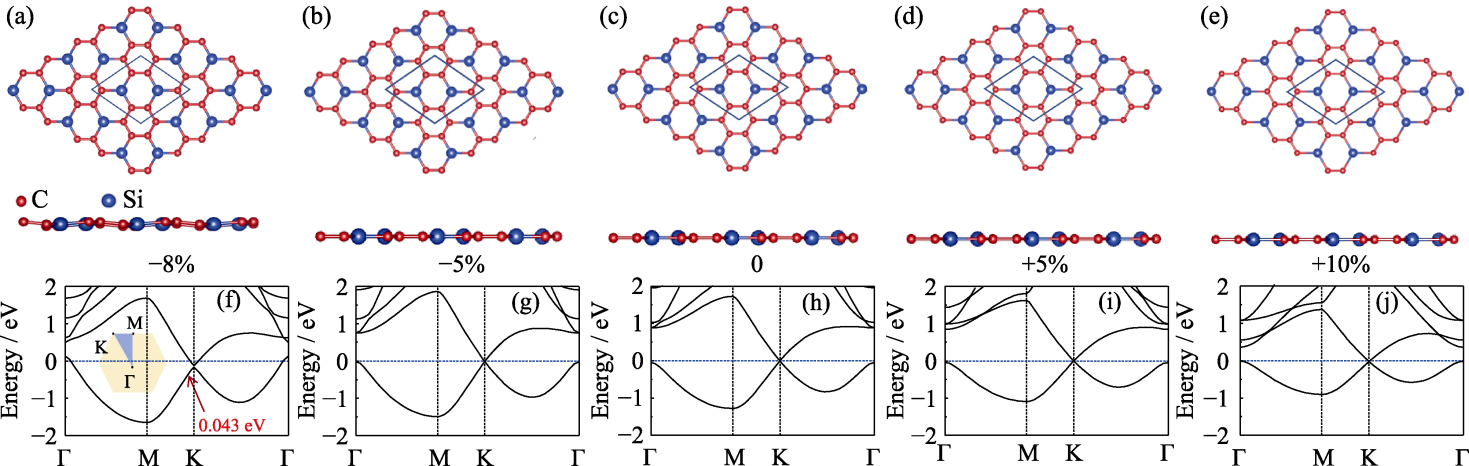
Fig. 1 (a-e) Optimized atomic structures and (f-j) band structures of 2D Si2C6 under −8%, −5%, 0, +5%, and +10% biaxial strains
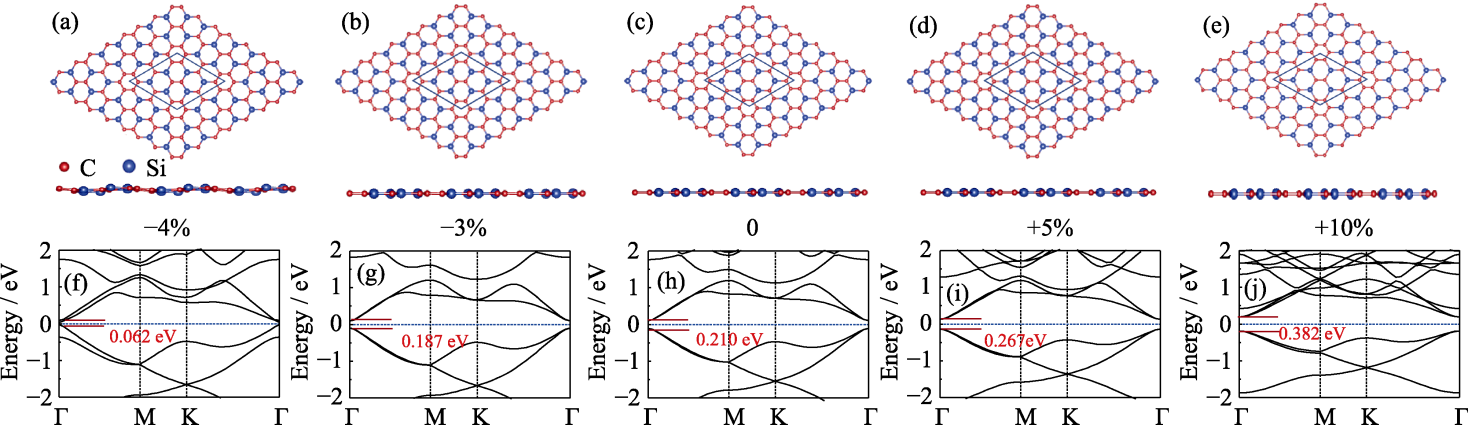
Fig. 2 (a-e) Optimized atomic structures and (f-j) band structures of 2D Si6C12 under −4%, −3%, 0, +5%, and +10% biaxial strains
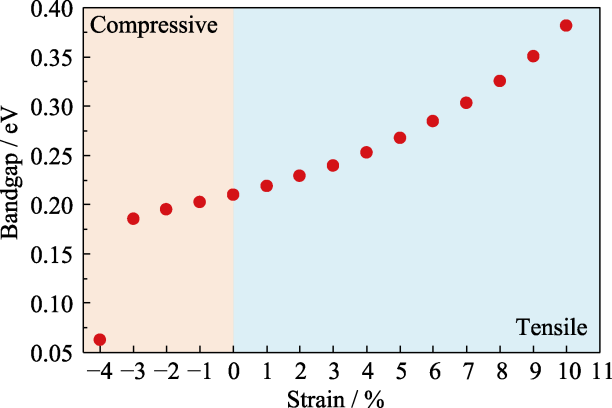
Fig. 3 Bandgap evolution of Si6C12 with external strain
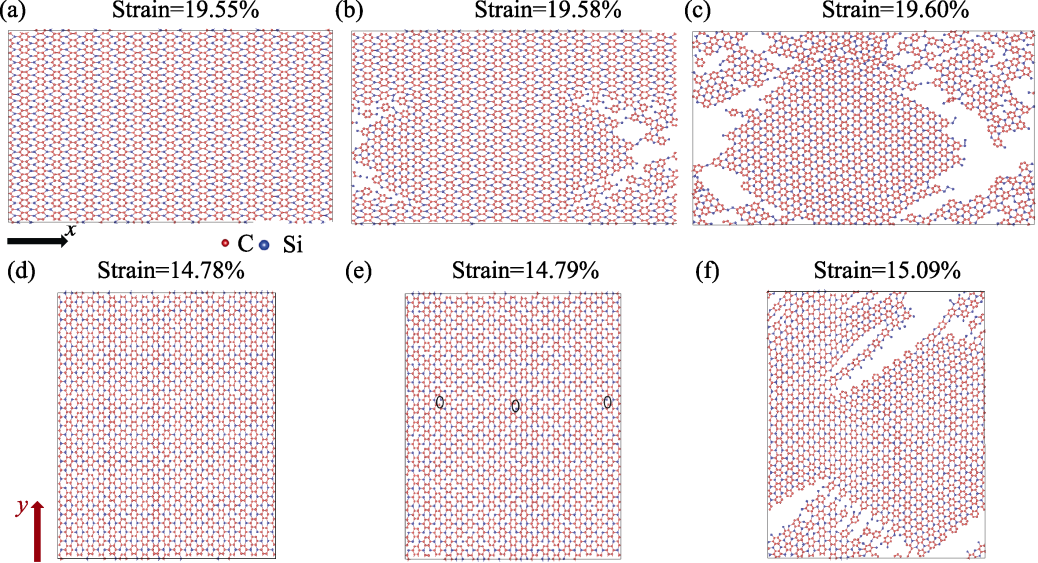
Fig. 4 Structural evolution of Si2C6 under uniaxial tensile along (a-c) x and (d-f) y directions in MD simulations
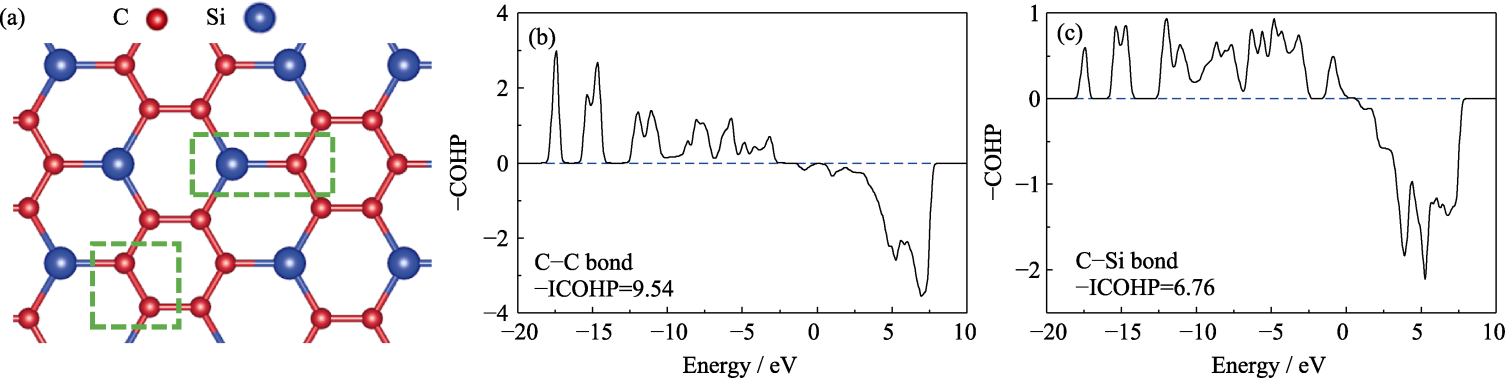
Fig. 5 COHP of C-C and C-Si bonds in Si2C6 (a) Schematic of selected C-C and C-Si bonds in Si2C6; (b, c) COHP of (b) C-C and (c) C-Si bonds
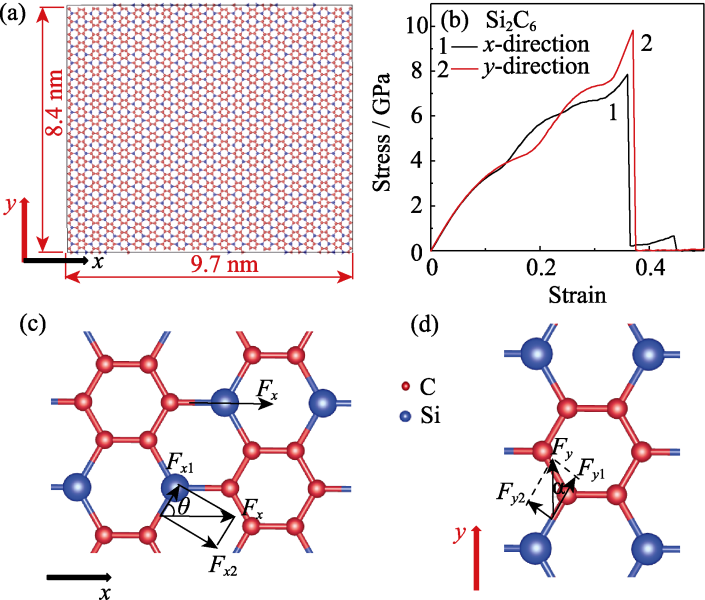
Fig. 6 Tensile curves and stress analysis diagrams of Si2C6 (a) Atomic structure of Si2C6; (b) Stress-strain curves of Si2C6 stretched along x and y directions, respectively; (c, d) Force analysis diagrams for tensile loading along (c) x and (d) y directions
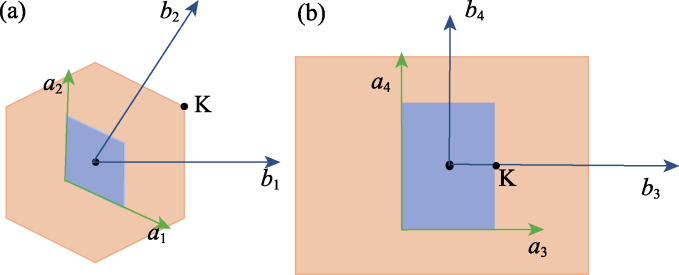
Fig. S1 Schematic of coordinate transformation (a) Real space (blue) and reciprocal space (orange) of the hexagonal unit cell; (b) Real space (blue) and reciprocal space (orange) of the orthorhombic unit cell
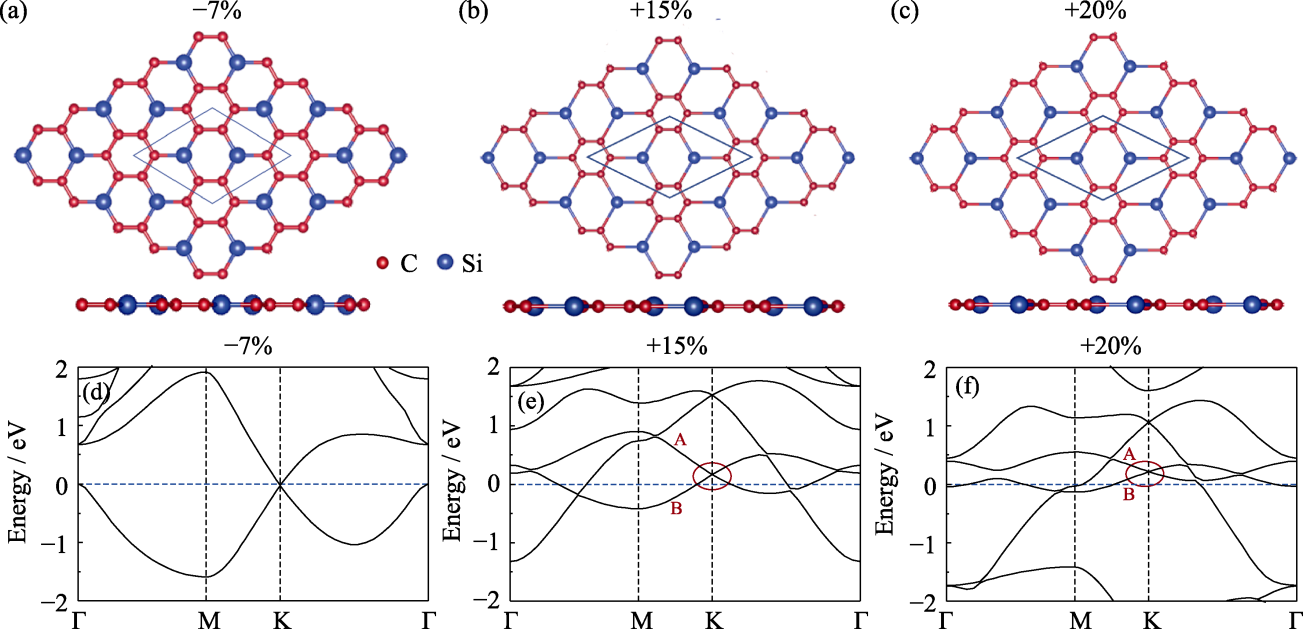
Fig. S2 (a-c) Optimized atomic structures and (d-f) band structures of 2D Si2C6 under -7%, +15% and +20% biaxial strains
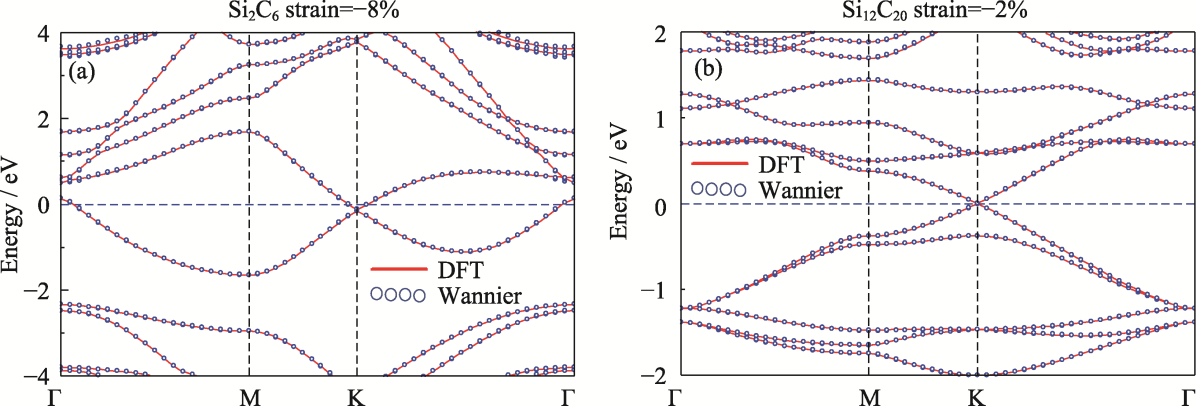
Fig. S3 Band structures calculated by first-principles (red lines) and Wannier (blue circles) for (a) Si2C6 at -8% biaxial strain and (b) Si12C20 at -2% biaxial strain
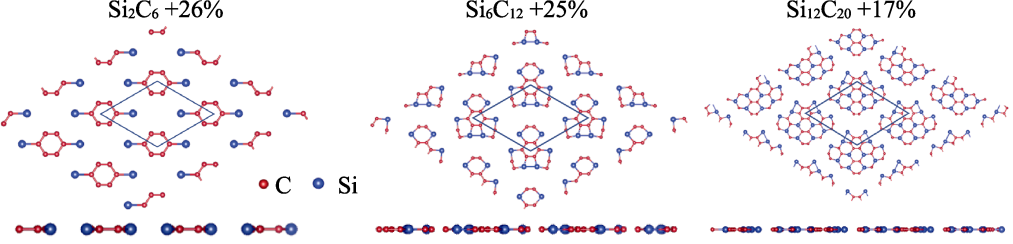
Fig. S4 Optimized atomic structures of Si2C6, Si6C12, and Si12C20 at biaxial strains of (a) +26%, (b) +25%, and (c) +17%, respectively, showing structural failure
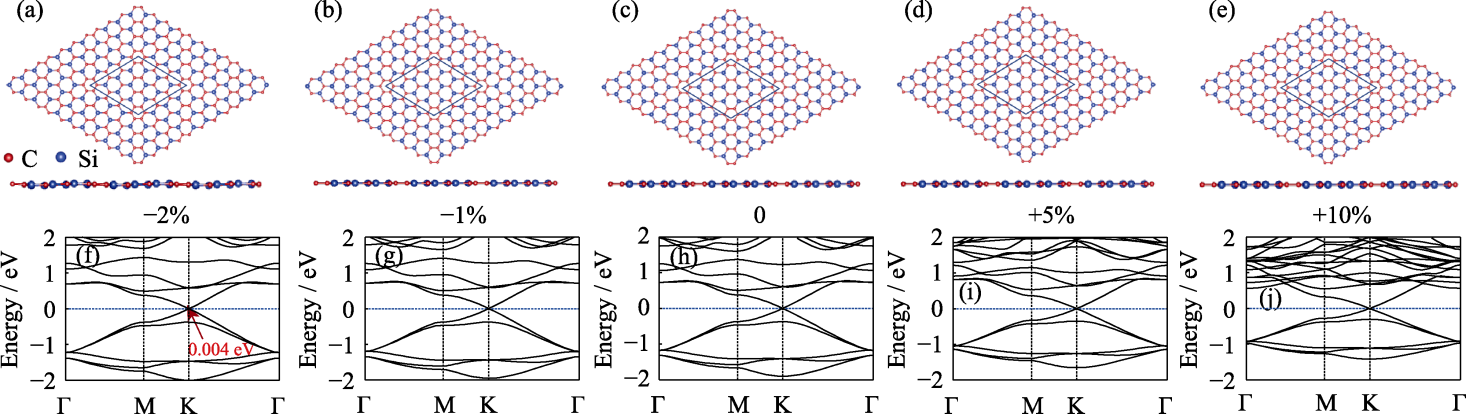
Fig. S5 (a-e) Optimized atomic structures and (f-j) band structures of 2D Si12C20 under −2%, −1%, 0, +5%, and +10% biaxial strains
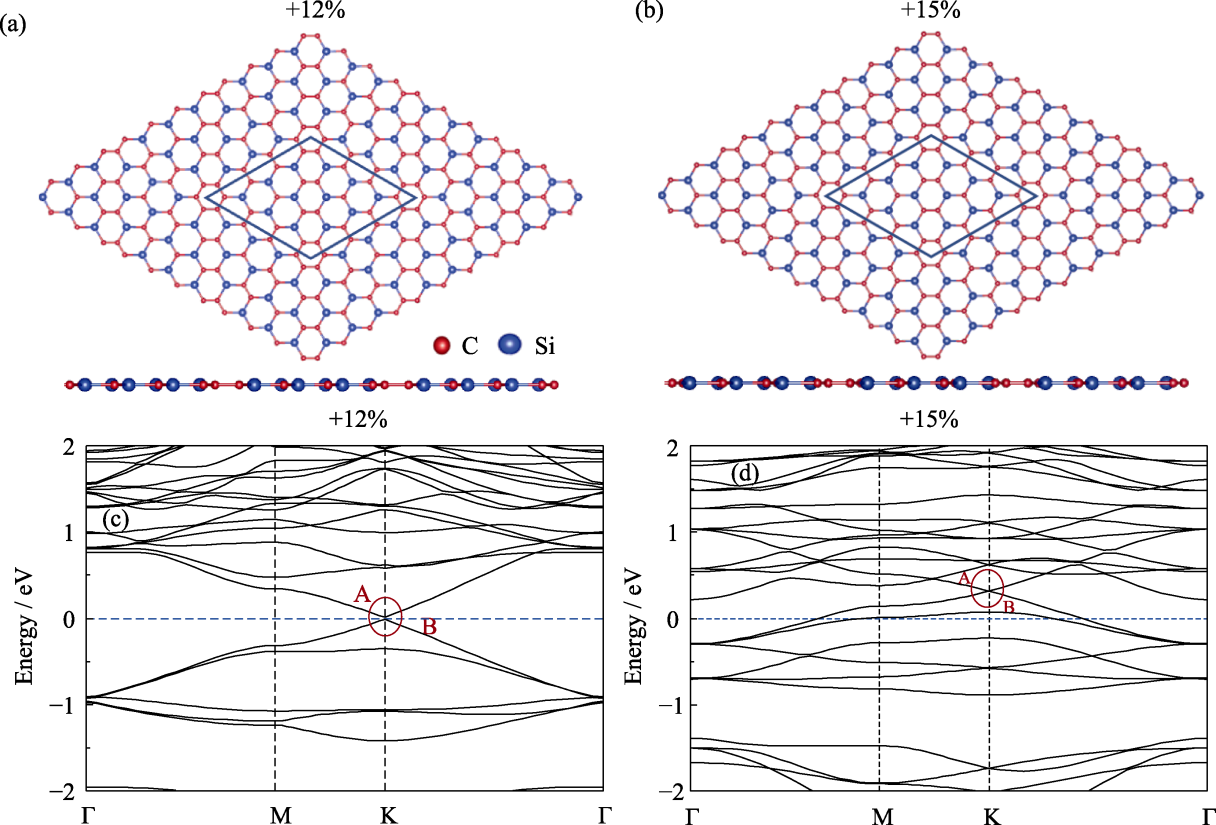
Fig. S6 (a, b) Optimized atomic structures and (c, d) band structures of 2D Si12C20 under +12% and +15% biaxial strains
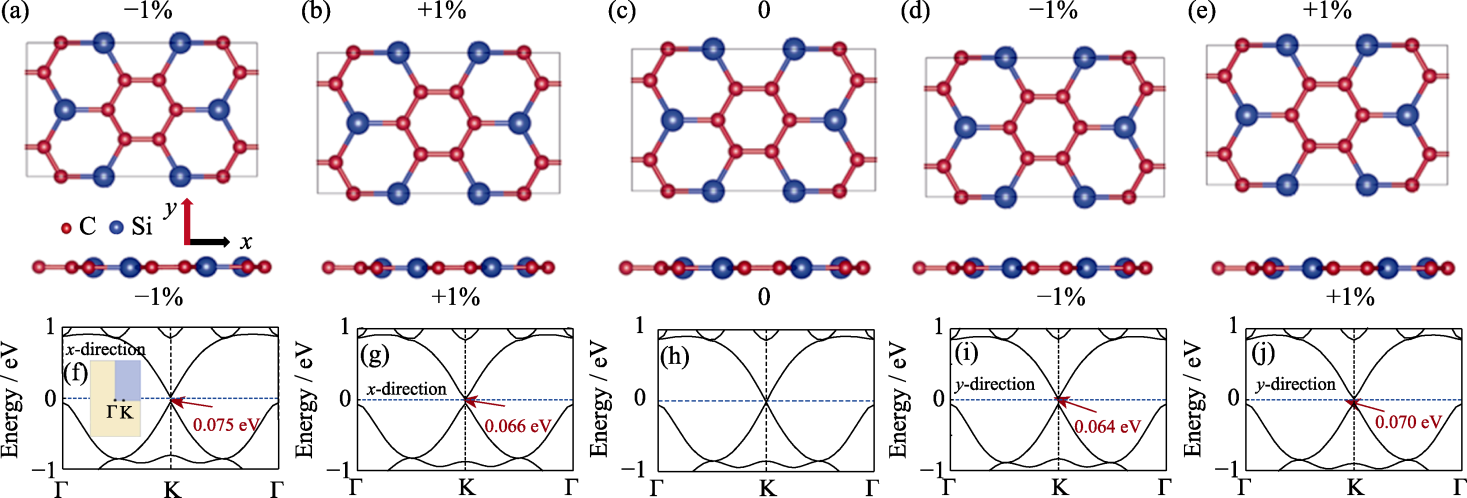
Fig. S7 (a-e) Optimized atomic structures and (f-j) band structure of Si2C6 under -1%, 0, and +1% uniaxial strains along x and y directions (a, b) Optimized atomic structures and (f, g) band structures of Si2C6 under -1% and +1% uniaxial strains along x direction; (c) Optimized atomic structure and (h) band structure of unstrained Si2C6; (d, e) Optimized atomic structures and (i, j) band structures of Si2C6 under -1% and +1% uniaxial strains along y direction
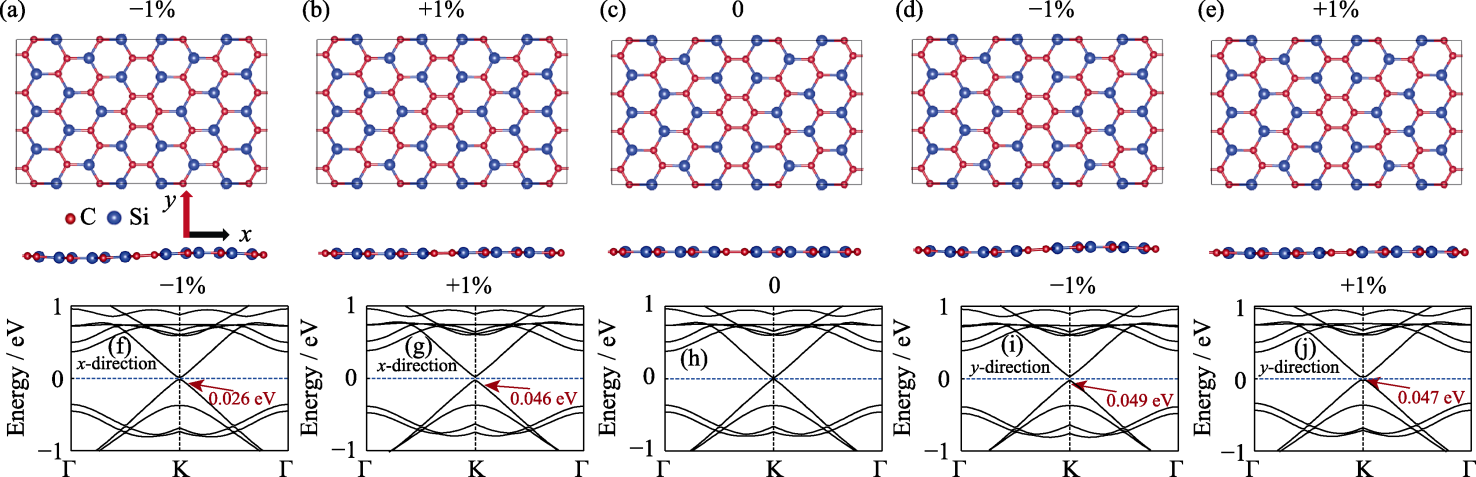
Fig. S8 (a-e) Optimized atomic structures and (f-j) band structure of Si12C20 under -1%, 0, and +1% uniaxial strains along x and y directions (a, b) Optimized atomic structures and (f, g) band structures of Si12C20 under -1% and +1% uniaxial strains along x direction; (c) Optimized atomic structure and (h) band structure of unstrained Si12C20; (d, e) Optimized atomic structures and (i, j) band structures of Si12C20 under -1% and +1% uniaxial strains along y direction

Fig. S9 Band structures of 2D Si6C12 under -4%, -3%, 0, +5%, and +10% biaxial strains based on the HSE06 hybrid functional
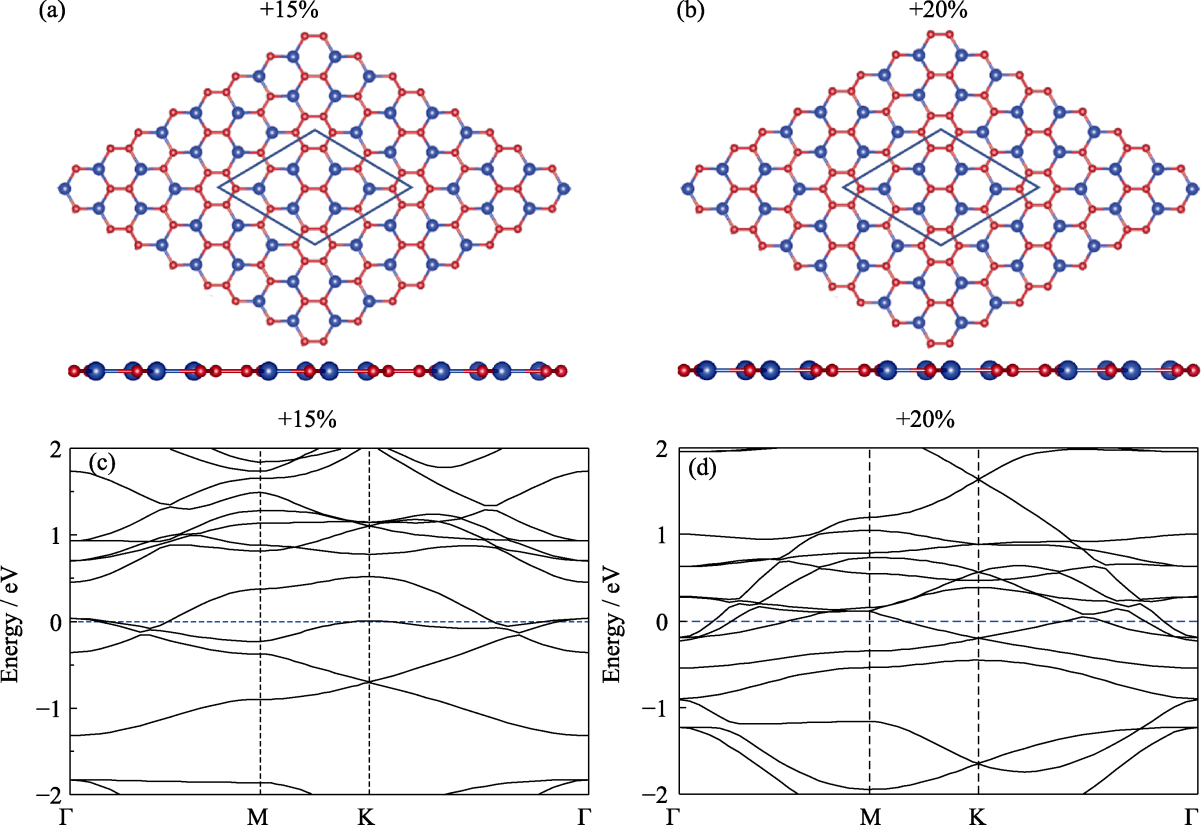
Fig. S10 (a, b) Optimized atomic structures and (c, d) band structures of 2D Si6C12 under +15% and +20% biaxial strains
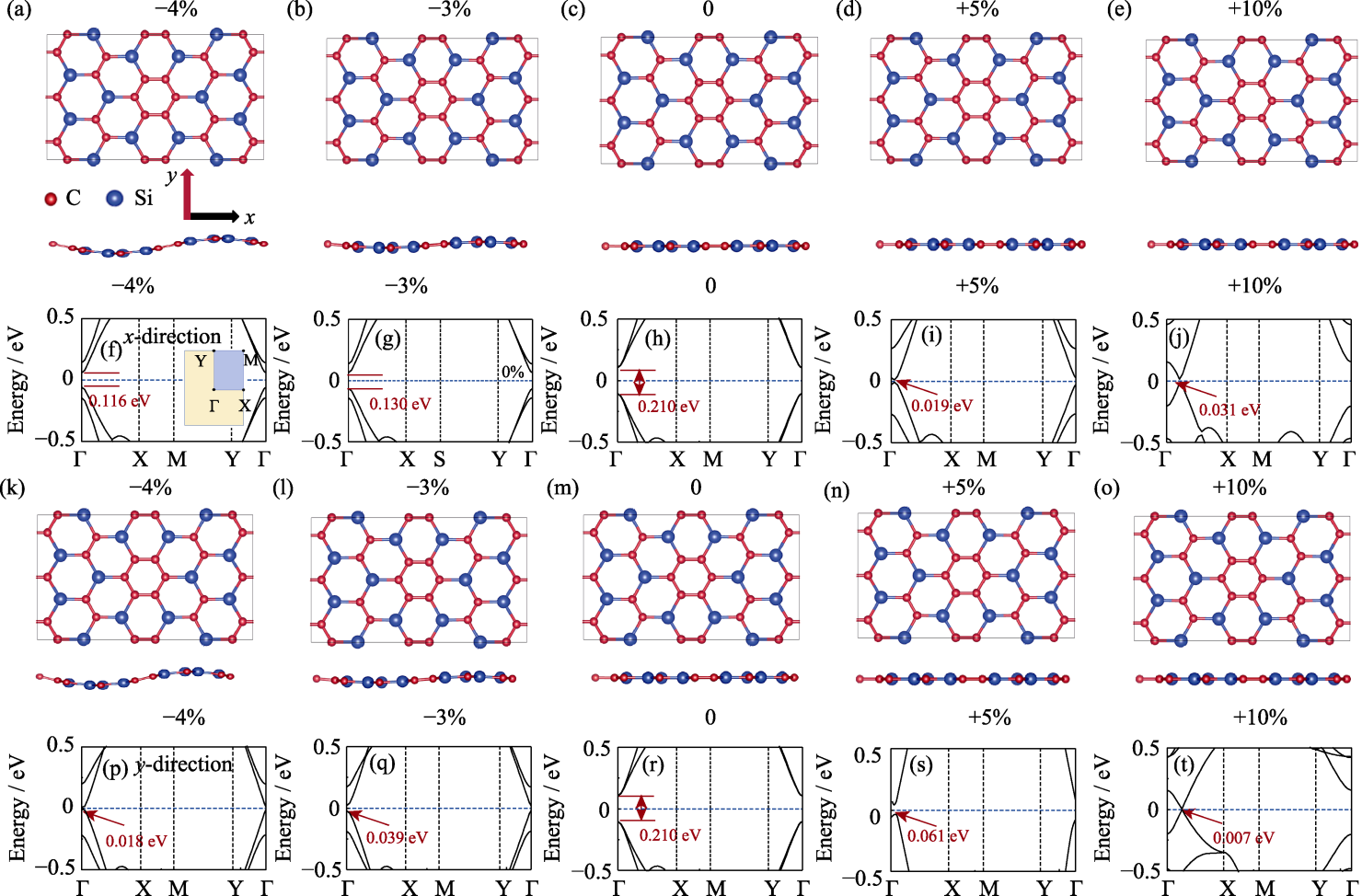
Fig. S11 (a-e), (k-o) Optimized atomic structures and (f-j), (p-t) band structures of Si6C12 under -4%, -3%, 0, +5% and +10% uniaxial strains along x and y directions (a-e) Optimized atomic structures and (f-j) band structures of Si6C12 under -4%, -3%, 0, +5% and +10% uniaxial strains along x direction;(k-o) Optimized atomic structures and (p-t) band structures of Si6C12 under -4%, -3%, 0, +5% and +10% uniaxial strains along y direction
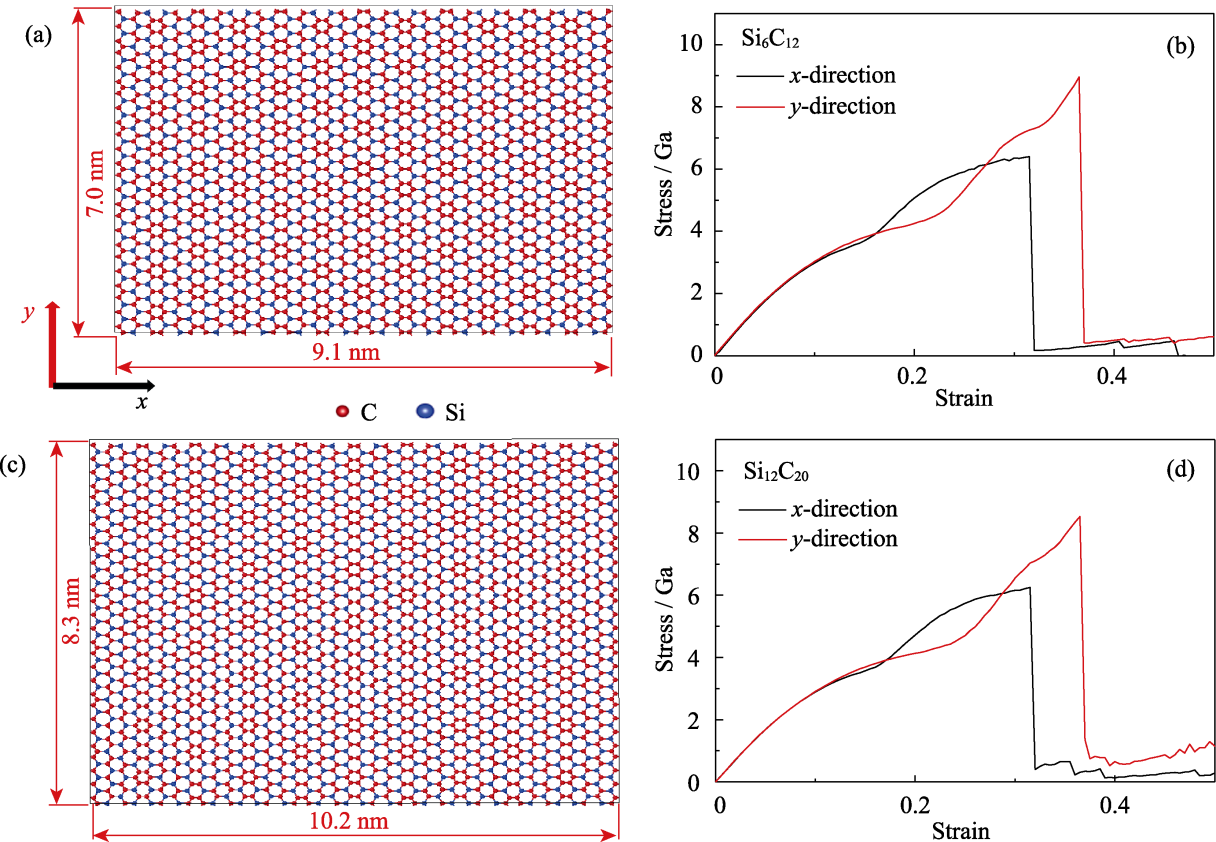
Fig. S12 (a, c) Atomic structural models and (b, d) stress-strain curves of (a, b) Si6C12 and (c, d) Si12C20 during tensile loading
| [1] |
NOVOSELOV K S, GEIM A K, MOROZOV S V, et al. Electric field effect in atomically thin carbon films. Science, 2004, 306(5696): 666.
DOI PMID |
| [2] | MUÑOZ H, ESCAMILLA R O, CERVANTES J M, et al. Theoretical study on the structural, electronic, mechanical, vibrational, thermodynamical, and optical properties of the two- dimensional PbC nanomaterials. Physica Scripta, 2024, 99(1): 18. |
| [3] | CHEN P F, LI N, CHEN X Z, et al. The rising star of 2D black phosphorus beyond graphene: synthesis, properties and electronic applications. 2D Materials, 2018, 5(1): 21. |
| [4] | GUO Z K, TIAN Y, GAN H B, et al. Preparation, structure configuration, physical properties and applications of borophene and two-dimensional alkaline-earth metal boride nanomaterials. Acta Physica Sinica, 2017, 66(21): 13. |
| [5] |
SONG L, LI H, ZHANG Y, et al. Recent progress of two- dimensional metallic transition metal dichalcogenides: syntheses, physical properties, and applications. Journal of Applied Physics, 2022, 131(6): 060902.
DOI URL |
| [6] |
SHI J, HONG M, ZHANG Z, et al. Physical properties and potential applications of two-dimensional metallic transition metal dichalcogenides. Coordination Chemistry Reviews, 2018, 376: 1.
DOI URL |
| [7] |
ZHOU J, LI J, ZHANG J. Intrinsic auxeticity and mechanical anisotropy of Si9C15 siligraphene. Nanoscale, 2023, 15(27): 11714.
DOI URL |
| [8] |
SHU H, GUO J. Enhanced stability and tunable optoelectronic properties of silicon-carbon monolayers by strain and surface functionalization. Journal of Materials Chemistry C, 2024, 12(16): 5916.
DOI URL |
| [9] |
ZHENG J, LI E, CUI Z, et al. Electronic properties of two-dimensional G/GaN (SiC) van der Waals heterostructures. Physica E: Low-dimensional Systems and Nanostructures, 2020, 124: 114277.
DOI URL |
| [10] |
CHO K, YANG J, LU Y. Phosphorene: an emerging 2D material. Journal of Materials Research, 2017, 32(15): 2839.
DOI URL |
| [11] |
WANG H, ZHAO Y, XIE Y, et al. Recent progress in synthesis of two-dimensional hexagonal boron nitride. Journal of Semiconductors, 2017, 38(3): 031003.
DOI URL |
| [12] |
WANG Y, LIU L, MA T, et al. 2D graphitic carbon nitride for energy conversion and storage. Advanced Functional Materials, 2021, 31(34): 2102540.
DOI URL |
| [13] |
POLLEY C, FEDDERWITZ H, BALASUBRAMANIAN T, et al. Bottom-up growth of monolayer honeycomb SiC. Physical Review Letters, 2023, 130(7): 076203.
DOI URL |
| [14] |
GAO Z Y, XU W, GAO Y, et al. Experimental realization of atomic monolayer Si9C15. Advanced Materials, 2022, 34(35): 2204779.
DOI URL |
| [15] |
GAO Y, ZHANG L, ZHANG Y Y, et al. Intrinsic second-order topological insulators produced by triangular Kekulé distortion in honeycomb lattices. Physical Review B, 2024, 110(12): 125103.
DOI URL |
| [16] |
DING Y, WANG Y. Geometric and electronic structures of two- dimensional SiC3 compound. The Journal of Physical Chemistry C, 2014, 118(8): 4509.
DOI URL |
| [17] |
ZHAO M, ZHANG R. Two-dimensional topological insulators with binary honeycomb lattices: SiC3 siligraphene and its analogs. Physical Review B, 2014, 89(19): 195427.
DOI URL |
| [18] |
LIU H, HUANG Z, QIAO H, et al. Characteristics and performance of layered two-dimensional materials under doping engineering. Physical Chemistry Chemical Physics, 2024, 26(25): 17423.
DOI PMID |
| [19] | 冼婧如, 黄煜军, 李昱霖, 等. 单/双轴应变对二维MoSi2N4电子结构与光学性质的影响. 原子与分子物理学报, 2026, 43(4): 159. |
| [20] |
SHARMA N K, SAHOO S, SAHU M C, et al. Electronic bandstructure modulation of MoX2/ZnO (X: S, Se) heterostructure by applying external electric field. Surfaces and Interfaces, 2022, 29: 101817.
DOI URL |
| [21] |
KRESSE G, FURTHMÜLLER J. Efficient iterative schemes for ab initio total-energy calculations using a plane-wave basis set. Physical Review B, 1996, 54(16): 11169.
DOI PMID |
| [22] |
PERDEW J P, BURKE K, ERNZERHOF M. Generalized gradient approximation made simple. Physical Review Letters, 1996, 77(18): 3865.
DOI PMID |
| [23] |
MONKHORST H J, PACK J D. Special points for Brillouin-zone integrations. Physical review B, 1976, 13(12): 5188.
DOI URL |
| [24] | PLIMPTON S. Fast parallel algorithms for short-range molecular dynamics. Journal of Computational Physics, 1995, 117(1): 1. |
| [25] |
ERHART P, ALBE K. Analytical potential for atomistic simulations of silicon, carbon, and silicon carbide. Physical Review B, 2005, 71(3): 035211.
DOI URL |
| [26] |
ISLAM A J, ISLAM M S, FERDOUS N, et al. Anomalous temperature dependent thermal conductivity of two-dimensional silicon carbide. Nanotechnology, 2019, 30(44): 445707.
DOI |
| [27] |
LOPEZ-BEZANILLA A, MARTIN I, LITTLEWOOD P B. Heptagraphene: tunable Dirac cones in a graphitic structure. Scientific Reports, 2016, 6: 33220.
DOI |
| [28] |
ADHIDEWATA J M, KOMALIG R W, UKHTARY M S, et al. Trigonal warping effects on optical properties of anomalous Hall materials. Physical Review B, 2023, 107(15): 155415.
DOI URL |
| [29] |
GOMES Y, RAMOS R O. Tilted Dirac cone effects and chiral symmetry breaking in a planar four-fermion model. Physical Review B, 2021, 104(24): 245111.
DOI URL |
| [30] |
MOSTOFI A A, YATES J R, LEE Y S, et al. Wannier90: a tool for obtaining maximally-localised Wannier functions. Computer Physics Communications, 2008, 178(9): 685.
DOI URL |
| [31] |
WU Q, ZHANG S, SONG H F, et al. WannierTools: an open-source software package for novel topological materials. Computer Physics Communications, 2018, 224: 405.
DOI URL |
| [32] |
WEI X P, ZHANG Y L, SUN X W, et al. Exchange interactions and Curie temperatures in Fe2NiZ compounds. Journal of Alloys and Compounds, 2017, 694: 1254.
DOI URL |
| [33] |
IBRAGIMOVA R, GANCHENKOVA M, KARAZHANOV S, et al. First-principles study of SnS electronic properties using LDA, PBE and HSE 06 functionals. Philosophical Magazine, 2018, 98(8): 710.
DOI URL |
| [34] |
YU M, XIAO X, XIONG Z, et al. Structural, electronic and optical properties of CdGeAs2 with hybrid density functional (HSE06). Materials Today Communications, 2022, 31: 103276.
DOI URL |
| [35] |
ABDULLAH N R, AZEEZ Y H, PIROT B R, et al. High thermal energy storage of the two-dimensional Al2Te3 semiconductor: DFT study of stability, electronic, phonon, thermal, and optical properties based on GGA and HSE06. Physics Letters A, 2024, 528: 130052.
DOI URL |
| [36] |
CHEN M, QUEK S, SHA Z, et al. Effects of grain size, temperature and strain rate on the mechanical properties of polycrystalline graphene-a molecular dynamics study. Carbon, 2015, 85: 135.
DOI URL |
| [37] |
MORTAZAVI B, CUNIBERTI G. Mechanical properties of polycrystalline boron-nitride nanosheets. RSC Advances, 2014, 4(37): 19137.
DOI URL |
| [1] | PENG Yuchao, DONG Yuan, DONG Shun, XIA Liansen, HU Peitao, ZHANG Xinghong, ZHOU Yanchun. Effect of SiC Particle Content on Mechanical Properties and Ablation Resistance of (Ti,Zr,Hf,Ta,Cr)(C,N)-SiC Ceramics [J]. Journal of Inorganic Materials, 2026, 41(7): 947-954. |
| [2] | YU Feiyu, WANG Wenqing, ZHANG Xueqin, HE Rujie. Additively Manufactured Ceramic Lattice-based Interpenetrating Phase Composites: Progress and Challenges [J]. Journal of Inorganic Materials, 2026, 41(7): 849-866. |
| [3] | GAO Kefeng, HE Xinxin, LIU Zengqian, ZHANG Zhefeng. Bioinspired Nacre-like Ceramic-polymer Composites with Multiscale Layered and Gradient Structures [J]. Journal of Inorganic Materials, 2026, 41(5): 573-582. |
| [4] | SHI Jinyu, LEI Yiming, WANG Chenxu, ZHANG Jie, WANG Jingyang. Ion Irradiation Damage Behavior in Titanium Carbide with Different Stoichiometry [J]. Journal of Inorganic Materials, 2026, 41(3): 322-330. |
| [5] | ZHENG Chen, WANG Xiangning, YUAN Henan, YANG Jiawei, LI Chuanjian, WANG Huadong. Mechanical Property Failure of Alumina Fiber Reinforced Silica Composite [J]. Journal of Inorganic Materials, 2026, 41(3): 331-339. |
| [6] | ZHANG Yunbo, WANG Bing, LI Wei, SONG Quzhi, DU Yi’ang, WANG Yingde. Size Effect of Nanosheet on BN Fibers Derived from BNNS/Polyborazine Hybrid Precursor [J]. Journal of Inorganic Materials, 2026, 41(3): 359-369. |
| [7] | YUAN Wang, HU Jianbao, ZHOU Liang, KAN Yanmei, ZHANG Xiangyu, DONG Shaoming. Effect of Argon Atmosphere Heat Treatment on Mechanical Properties and Microstructural Evolution of Shicolon-II SiC Fibers [J]. Journal of Inorganic Materials, 2026, 41(1): 119-128. |
| [8] | ZHANG Yongheng, CHEN Jixin. Preparation and Properties of Ytterbium Aluminosilicate Glass and SiC Modified h-BN-based Composites [J]. Journal of Inorganic Materials, 2026, 41(1): 37-44. |
| [9] | SUN Yuxuan, WANG Zheng, SHI Xue, SHI Ying, DU Wentong, MAN Zhenyong, ZHENG Liaoying, LI Guorong. Defect Dipole Thermal-stability to the Electro-mechanical Properties of Fe Doped PZT Ceramics [J]. Journal of Inorganic Materials, 2025, 40(5): 545-551. |
| [10] | CHEN Yi, QIU Haipeng, CHEN Mingwei, XU Hao, CUI Heng. SiC/SiC Composite: Matrix Boron Modification and Mechanical Properties [J]. Journal of Inorganic Materials, 2025, 40(5): 504-510. |
| [11] | CUI Ning, ZHANG Yuxin, WANG Lujie, LI Tongyang, YU Yuan, TANG Huaguo, QIAO Zhuhui. Single-phase Formation Process and Carbon Vacancy Regulation of (TiVNbMoW)Cx High-entropy Ceramics [J]. Journal of Inorganic Materials, 2025, 40(5): 511-520. |
| [12] | LI Ziwei, GONG Weilu, CUI Haifeng, YE Li, HAN Weijian, ZHAO Tong. (Zr, Hf, Nb, Ta, W)C-SiC Composite Ceramics: Preparation via Precursor Route and Properties [J]. Journal of Inorganic Materials, 2025, 40(3): 271-280. |
| [13] | GAO Chenguang, SUN Xiaoliang, CHEN Jun, LI Daxin, CHEN Qingqing, JIA Dechang, ZHOU Yu. SiBCN-rGO Ceramic Fibers Based on Wet Spinning Technology: Microstructure, Mechanical and Microwave-absorbing Properties [J]. Journal of Inorganic Materials, 2025, 40(3): 290-296. |
| [14] | MU Haojie, ZHANG Yuanjiang, YU Bin, FU Xiumei, ZHOU Shibin, LI Xiaodong. Preparation and Properties of ZrO2 Doped Y2O3-MgO Nanocomposite Ceramics [J]. Journal of Inorganic Materials, 2025, 40(3): 281-289. |
| [15] | WANG Yueyue, HUANG Jiahui, KONG Hongxing, LI Huaizhu, YAO Xiaohong. Silver Loaded Radial Mesoporous Silica: Preparation and Application in Dental Resins [J]. Journal of Inorganic Materials, 2025, 40(1): 77-83. |
| Viewed | ||||||
|
Full text |
|
|||||
|
Abstract |
|
|||||
