
Journal of Inorganic Materials ›› 2026, Vol. 41 ›› Issue (8): 1103-1109.DOI: 10.15541/jim20250386
• RESEARCH ARTICLE • Previous Articles Next Articles
XU Mingyi1( ), XIONG Ying2, WANG Bo2, ZHANG Yixin2, CHEN Wenbo3(), CAO Xueqiang3
Received:2025-10-02
Revised:2025-12-04
Published:2026-08-20
Online:2025-12-11
Contact:
CHEN Wenbo, professor. E-mail: wchen@whut.edu.cnAbout author:XU Mingyi (1996-), male, PhD candidate. E-mail: xumingyi96925@163.com
Supported by:CLC Number:
XU Mingyi, XIONG Ying, WANG Bo, ZHANG Yixin, CHEN Wenbo, CAO Xueqiang. Fabrication and Properties of Magnetoplumbite-type Rare-earth Hexaaluminate Thermal Barrier Coating Materials[J]. Journal of Inorganic Materials, 2026, 41(8): 1103-1109.
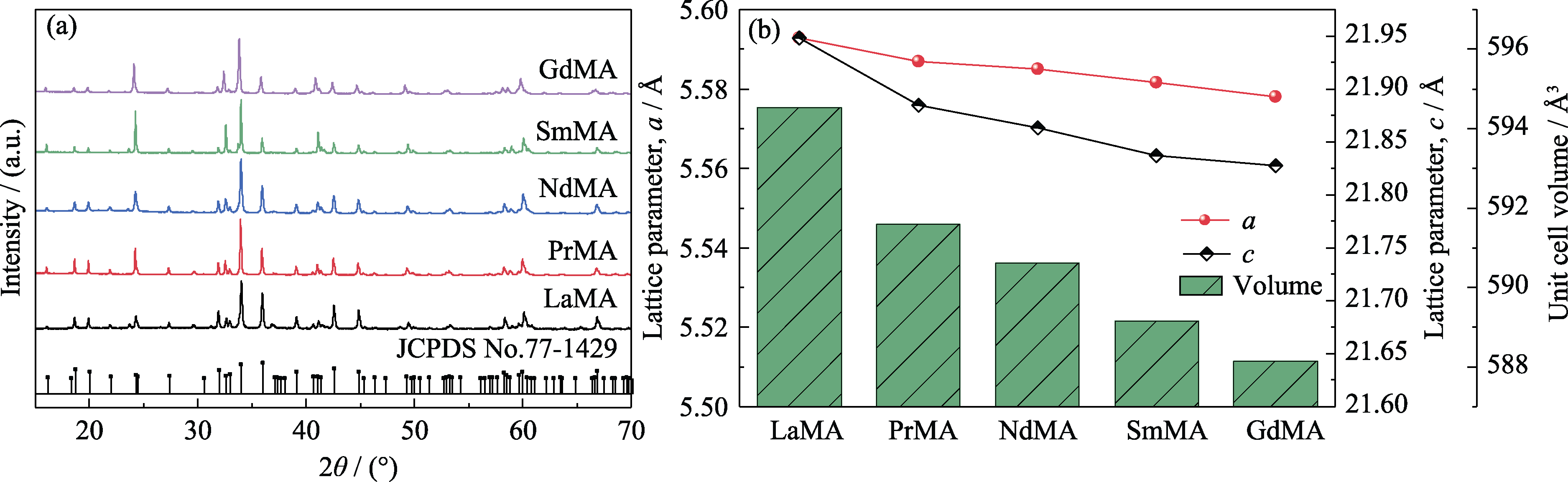
Fig. 1 (a) XRD patterns and (b) lattice parameters of RMA ceramic bulks
| Sample | Theoretical density/(g·cm-3) | Archimedes’ density/(g·cm-3) | Relative density/% | Sample | Theoretical density/(g·cm-3) | Archimedes’ density/(g·cm-3) | Relative density/% |
|---|---|---|---|---|---|---|---|
| LaMA | 4.268 | 4.063 | 95.20 | SmMA | 4.371 | 4.039 | 92.40 |
| PrMA | 4.300 | 4.295 | 99.88 | GdMA | 4.418 | 4.106 | 92.94 |
| NdMA | 4.326 | 4.183 | 96.69 |
Table 1 Density and relative density of RMA ceramic bulks
| Sample | Theoretical density/(g·cm-3) | Archimedes’ density/(g·cm-3) | Relative density/% | Sample | Theoretical density/(g·cm-3) | Archimedes’ density/(g·cm-3) | Relative density/% |
|---|---|---|---|---|---|---|---|
| LaMA | 4.268 | 4.063 | 95.20 | SmMA | 4.371 | 4.039 | 92.40 |
| PrMA | 4.300 | 4.295 | 99.88 | GdMA | 4.418 | 4.106 | 92.94 |
| NdMA | 4.326 | 4.183 | 96.69 |
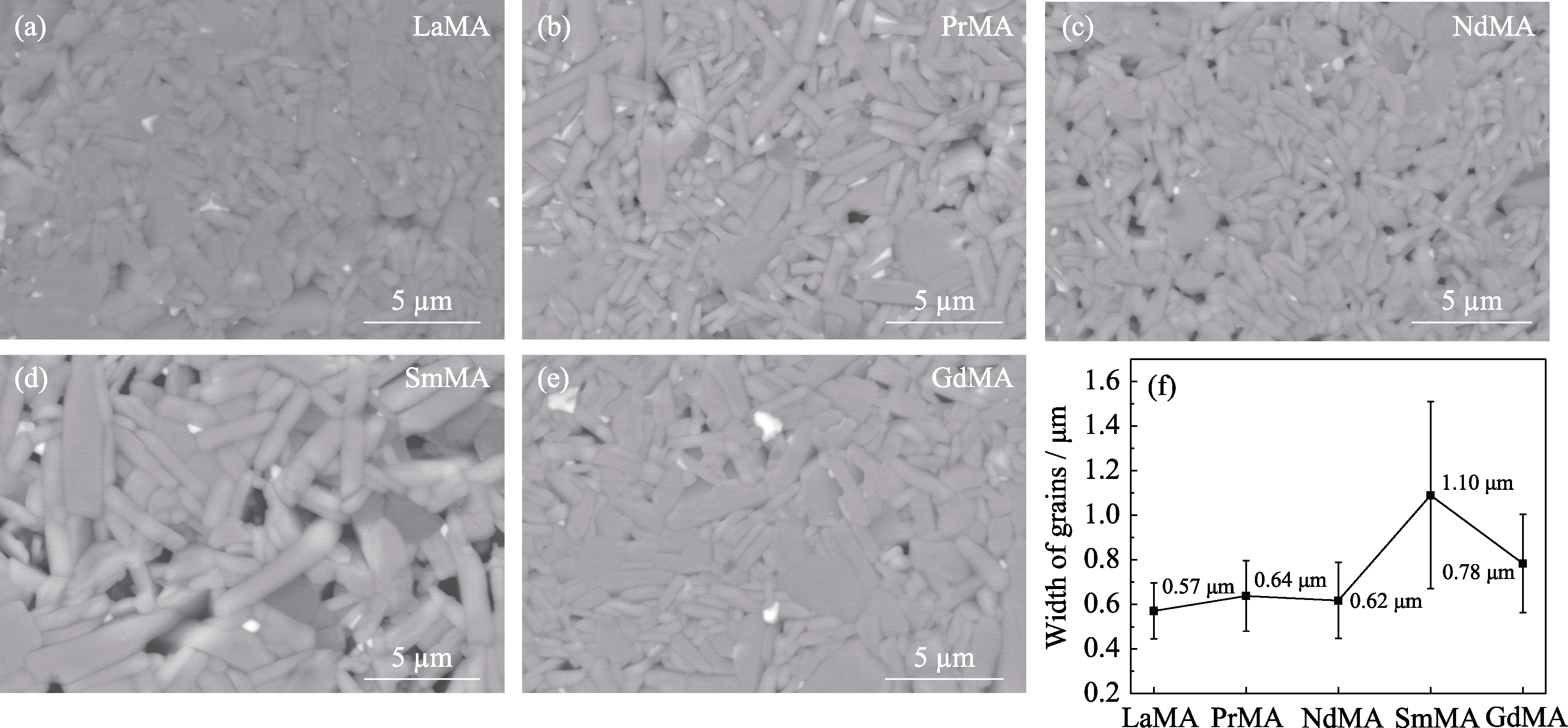
Fig. 2 Surface morphologies of (a) LaMA, (b) PrMA, (c) NdMA, (d) SmMA, (e) GdMA ceramics and corresponding (f) average width of grains after thermal etching
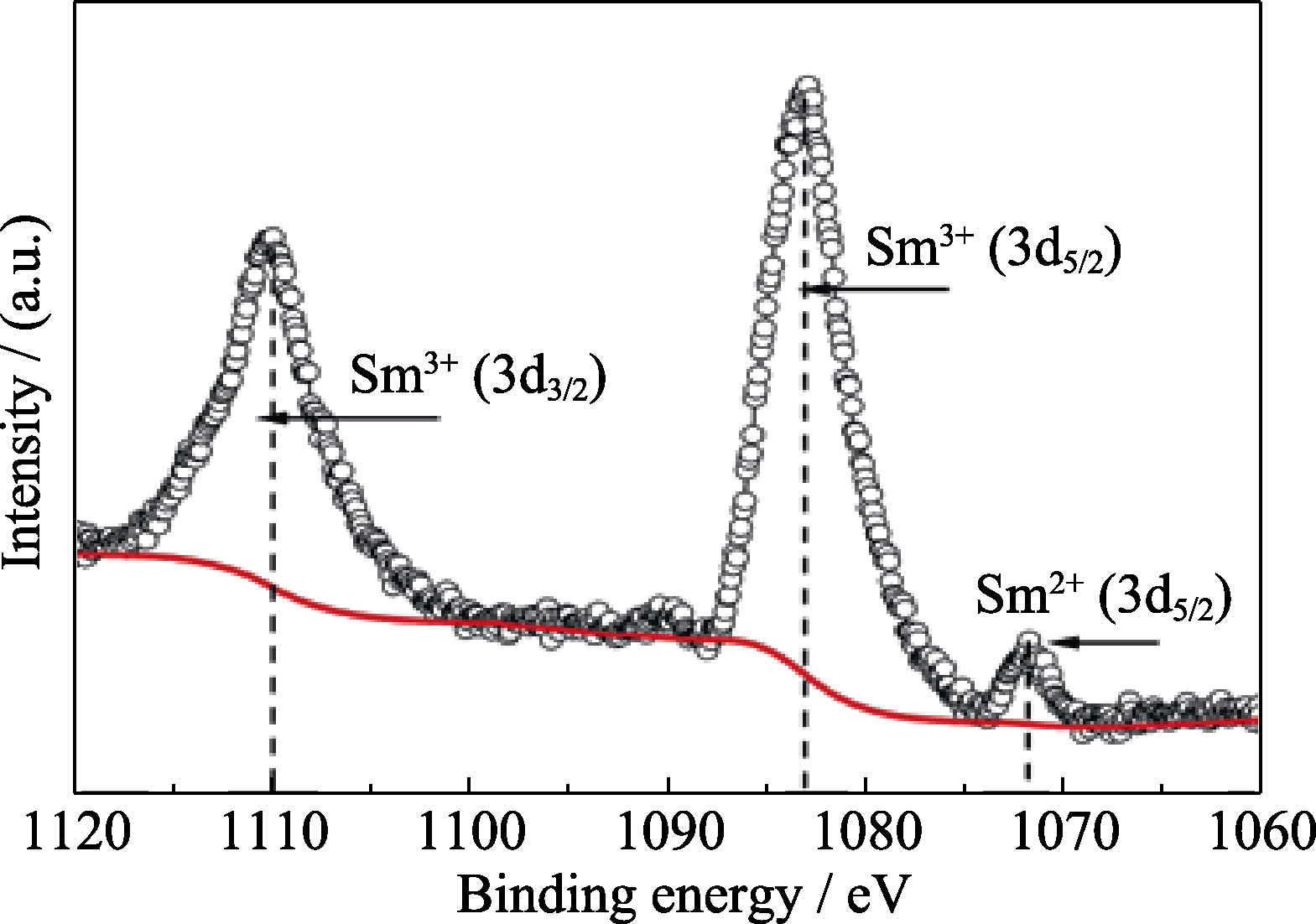
Fig. 3 Sm3d XPS spectra of SmMA ceramic
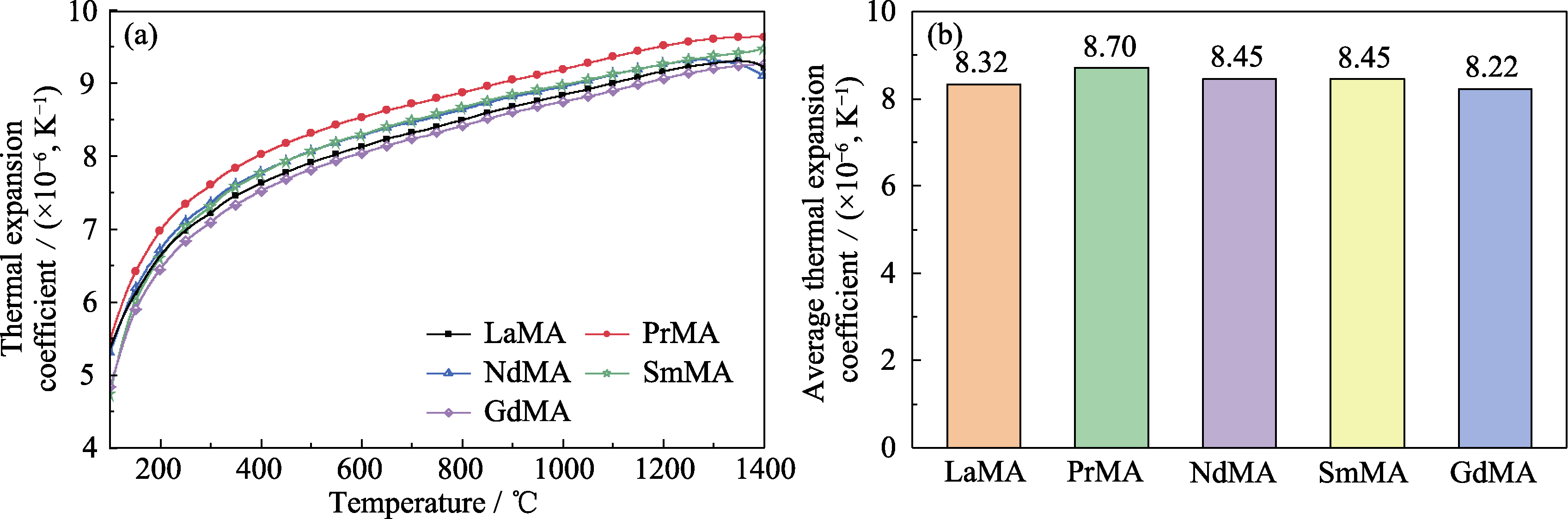
Fig. 4 (a) Temperature-dependent thermal expansion coefficients and (b) average thermal expansion coefficients of RMA ceramics
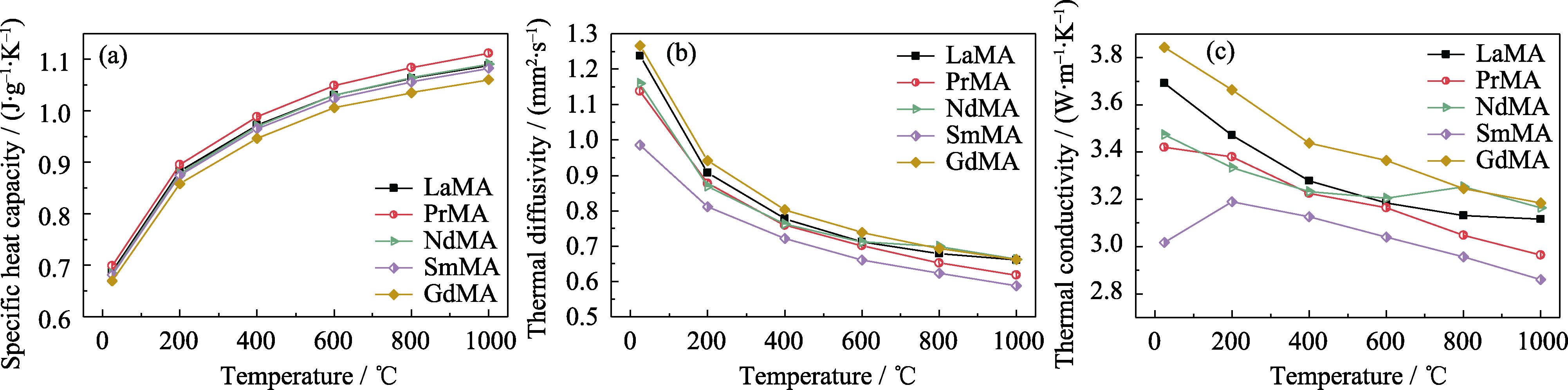
Fig. 5 Temperature-dependent (a) heat capacity, (b) thermal diffusivity and (c) thermal conductivity of RMA ceramics
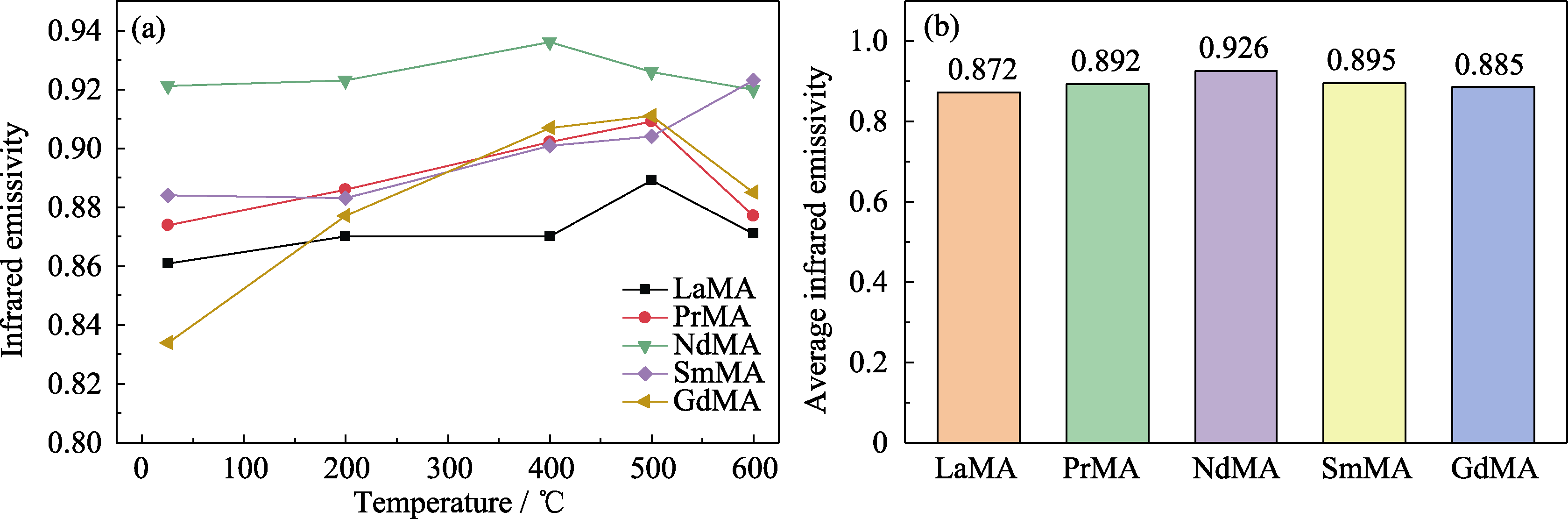
Fig. 6 (a) Temperature-dependent infrared emissivity and (b) average emissivity in the range of 8-14 μm of RMA ceramics
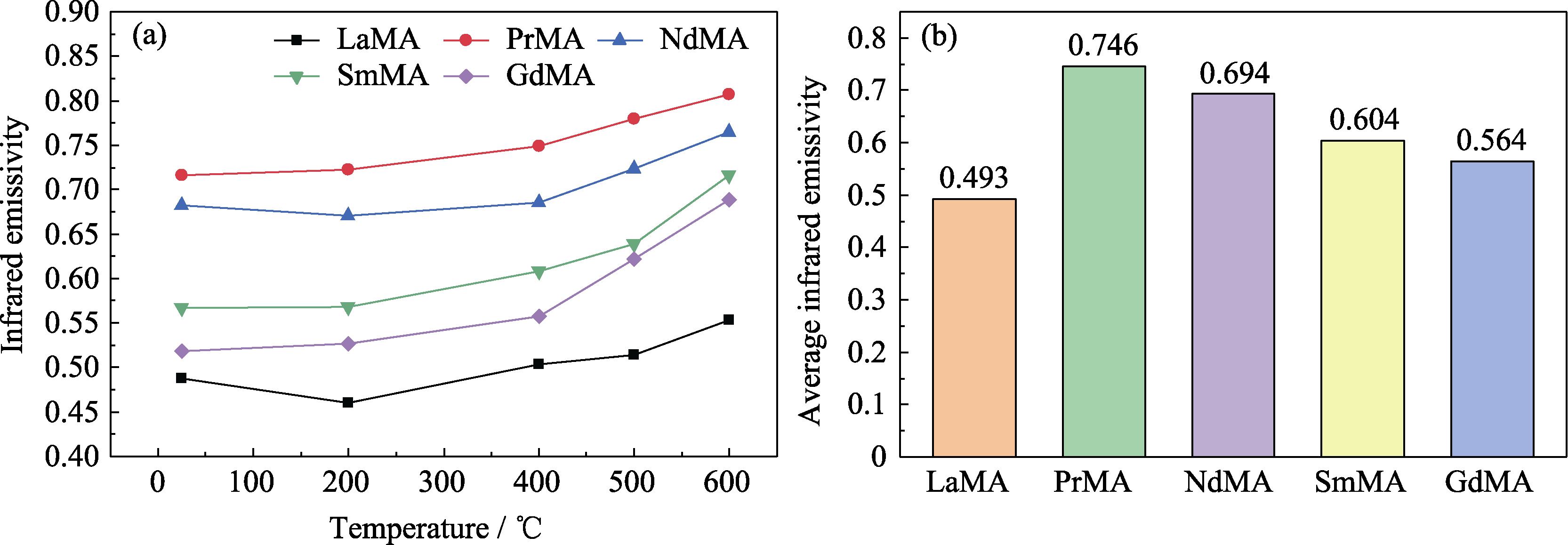
Fig. 7 (a) Temperature-dependent infrared emissivity and (b) average emissivity in the range of 3-5 μm of RMA ceramics
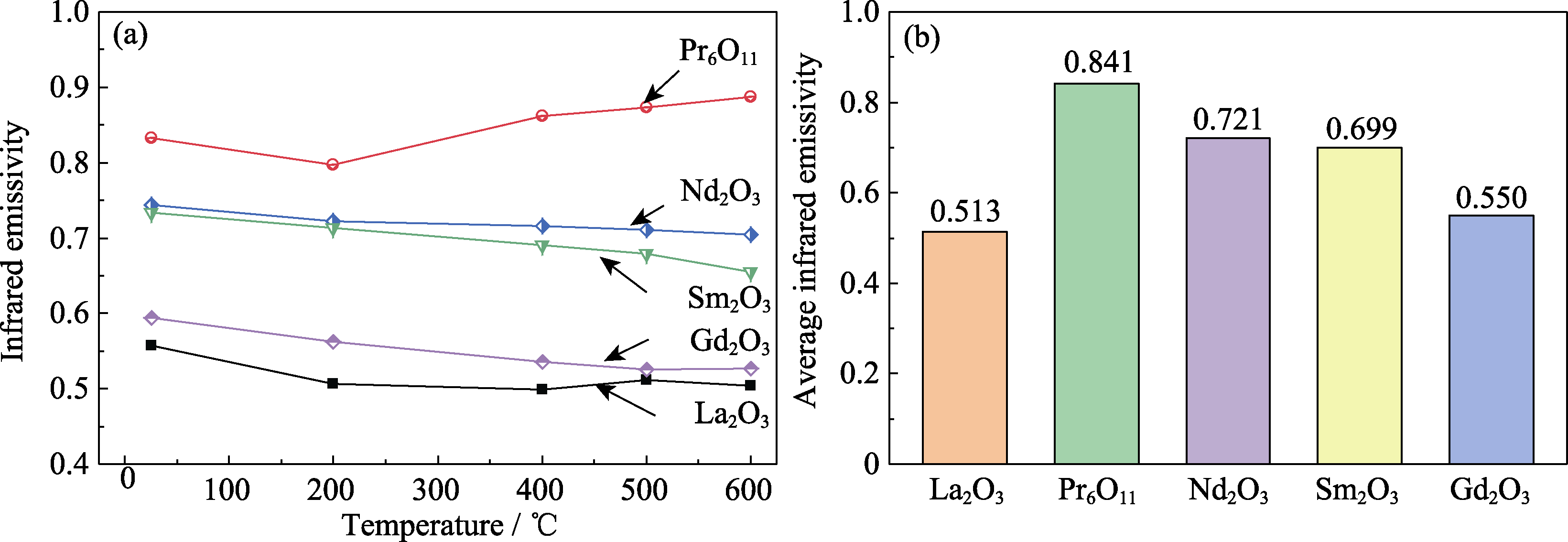
Fig. 8 (a) Temperature-dependent infrared emissivity and (b) average emissivity in the range of 3-5 μm of rare-earth oxides
| [1] |
XU M Y, CHEN W B, LU X R, et al. Effect of high-temperature infrared emissivity on thermal cycling performance of magnetoplumbite- type thermal barrier coatings under thermal gradient condition. Journal of the European Ceramic Society, 2024, 44: 448.
DOI URL |
| [2] |
PURWAR A, BASU B. Thermo-structural design of ZrB2-SiC-based thermal protection system for hypersonic space vehicles. Journal of the American Ceramic Society, 2017, 100: 1618.
DOI URL |
| [3] |
SZIROCZAK D, SMITH H. A review of design issues specific to hypersonic flight vehicles. Progress in Aerospace Sciences, 2016, 84: 1
DOI URL |
| [4] | TAN W, PETORAK C A, TRICE R W. Rare-earth modified zirconium diboride high emissivity coatings for hypersonic applications. Journal of the European Ceramic Society, 2014, 34(1): 1. |
| [5] | VAN WIE D M, DREWRY D G, KING D E, et al. The hypersonic environment: required operating conditions and design challenges. Journal of Materials Science, 2004, 39(19): 5915. |
| [6] | WANG G Y, SANG S B, WANG Q H, et al. Infrared radiation property and enhancement mechanism of MgCr2O4 doped with NiO prepared at different temperature. Ceramics International, 2024, 50(1, Part A): 9. |
| [7] | MANDAL J, FU Y, OVERVIG A C, et al. Hierarchically porous polymer coatings for highly efficient passive daytime radiative cooling. Science, 2018, 362(6412): 315. |
| [8] | MU Y, YAN L W, LIU P S, et al. High-temperature-resistant ZrO2 coating with SiC-whisker-enhanced interfacial bonding strength and improved emissivity for flexible silica fibre fabric. Ceramics International, 2023, 49(4): 6825. |
| [9] |
SHAO G F, WU X D, CUI S, et al. High emissivity MoSi2- TaSi2-borosilicate glass porous coating for fibrous ZrO2 ceramic by a rapid sintering method. Journal of Alloys and Compounds, 2017, 690: 63.
DOI URL |
| [10] |
GADOW R, LISCHKA M. Lanthanum hexaaluminate—novel thermal barrier coatings for gas turbine applications—materials and process development. Surface and Coatings Technology, 2002, 151/152: 392.
DOI URL |
| [11] |
RAM Y N V S, TARASASANKA C, PRABAKARAN J. Preparation and characterization of lanthanum hexa aluminate powders for high temperature applications. Materials Today: Proceedings, 2021, 39: 1472.
DOI URL |
| [12] | LU X R, YUAN J Y, XU M Y, et al. Improvement on thermophysical and mechanincal properties of LaMgAl11O19 magnetoplumbite by Nd2O3 and Sc2O3 co-doping. Ceramics International, 2021, 47(20): 28892. |
| [13] | XU M Y, YUAN J Y, LU X R, et al. Infrared radiation and thermal cyclic performance of a high-entropy rare-earth hexaaluminate coating prepared by atmospheric plasma spraying. Ceramics International, 2022, 48(18): 26003. |
| [14] | 牛璐玥. 稀土及过渡金属离子掺杂氧化物发光玻璃的制备及性能研究. 济南: 齐鲁工业大学硕士学位论文, 2019. |
| [15] |
HUANG Y, DONG S J, LÜ K Y, et al. Compatibility of low thermal conductivity and high infrared emissivity of plasma-sprayed Sm2Hf2O7 and Pr2Hf2O7 coatings. Surface and Coatings Technology, 2023, 457: 129312.
DOI URL |
| [16] |
YIN J H, ZHOU T, ZHANG M, et al. Exploring the mechanism of infrared emissivity control in YSZ-based ceramics doped with Yb2O3. Optical Materials, 2024, 157: 116107.
DOI URL |
| [17] | CHEN X L, ZHANG Y F, ZHONG X H, et al. Thermal cycling behaviors of the plasma sprayed thermal barrier coatings of hexaluminates with magnetoplumbite structure. Journal of the European Ceramic Society, 2010, 30(7): 1649. |
| [18] | 陈小龙. 磁铅石型稀土六铝酸盐热障涂层材料. 长春: 中国科学院长春应用化学研究所博士学位论文, 2012. |
| [19] |
BRUNCKOVA H, KANUCHOVA M, KOLEV H, et al. XPS characterization of SmNbO4 and SmTaO4 precursors prepared by Sol-Gel method. Applied Surface Science, 2019, 473: 1.
DOI URL |
| [20] | ZHANG J F, ZHONG X H, CHENG Y L, et al. Thermal-shock resistance of LnMgAl11O19 (Ln = La, Nd, Sm, Gd) with magnetoplumbite structure. Journal of Alloys and Compounds, 2009, 482(1/2): 376. |
| [21] | CHEN S G, YIN Y S, WANG D P, et al. Reduced activation energy and crystalline size for yttria-stabilized zirconia nano-crystals. Journal of Crystal Growth, 2004, 267(1/2): 100. |
| [22] |
SHUKLA S S S, RASHMI V, SRI B. Reduced activation energy for grain growth in nanocrystalline yttria-stabilized zirconia. Nano Letters, 2003, 3: 397.
DOI URL |
| [23] | LEITNER J, VOŇKA P, SEDMIDUBSKÝ D, et al. Application of Neumann-Kopp rule for the estimation of heat capacity of mixed oxides. Thermochimica Acta, 2010, 497(1/2): 7. |
| [24] | ZHOU X, SONG W J, YUAN J Y, et al. Thermophysical properties and cyclic lifetime of plasma sprayed SrAl12O19 for thermal barrier coating applications. Journal of the American Ceramic Society, 2020, 103(10): 5599. |
| [25] |
LIU H Z, LIU Z G, OUYANG J H, et al. Influences of lattice vibration and electron transition on thermal emissivity of Nd3+ doped LaMgAl11O19hexaaluminates for metallic thermal protection system. Applied Physics Letters, 2012, 101: 161903.
DOI URL |
| [26] | DONG S J, ZHANG F N, LI N, et al. Thermal radiation and cycling properties of (Ca, Fe) or (Sr, Mn) co-doped La2Ce2O7 coatings. Journal of the European Ceramic Society, 2020, 40(5): 2020. |
| [27] | BELANÇON M P, MARCONI J D, ANDO M F, et al. Near-IR emission in Pr3+single doped and tunable near-IR emission in Pr3+/Yb3+ codoped tellurite tungstate glasses for broadband optical amplifiers. Optical Materials, 2014, 36(6): 1020. |
| [28] | LIU S P, MA Z, LIU Y B, et al. Infrared radiative performance and ablation resistance of coatings sprayed with Pr6O11 core-shell-structured ZrB2-SiC powders. Ceramics International, 2025, 51(3): 3879. |
| [1] | WANG Yuhe, LUO Yixiu, GUO Huiming, ZHANG Guangheng, ZHANG Siyan, SUN Luchao, WANG Jiemin, WANG Jingyang. First-principles Investigation of Elastic and Thermophysical Properties of High-entropy Rare-earth Oxide Thermal Barrier Coating Materials [J]. Journal of Inorganic Materials, 2026, 41(4): 445-454. |
| [2] | AN Wenran, HUANG Jingqi, LU Xiangrong, JIANG Jianing, DENG Longhui, CAO Xueqiang. Effect of Heat-treatment Temperature on Thermal and Mechanical Properties of LaMgAl11O19 Coating [J]. Journal of Inorganic Materials, 2022, 37(9): 925-932. |
| [3] | WEI Hailang, CAO Xueqiang, DENG Longhui, JIANG Jianing. Thermodynamic Properties and Thermal Cycling Lifetimes of LaMeAl11O19/YSZ Thermal Barrier Coatings [J]. Journal of Inorganic Materials, 2022, 37(12): 1259-1266. |
| [4] | ZHU Jiatong, LOU Zhihao, ZHANG Ping, ZHAO Jia, MENG Xuanyu, XU Jie, GAO Feng. Preparation and Thermal Properties of Rare Earth Tantalates (RETaO4) High-Entropy Ceramics [J]. Journal of Inorganic Materials, 2021, 36(4): 411-417. |
| [5] | JI Xiaojuan,YU Yueguang,LU Xiaoliang. Effects of Impurities on Properties of YSZ Thermal Barrier Coatings [J]. Journal of Inorganic Materials, 2020, 35(6): 669-674. |
| [6] | LIU Yufeng, FENG Xiang, WANG Jinming, XU Zhenghui, LI Tongqi, JIAO Xingjian, WANG Yalei, XIONG Xiang. Preparation and Properties of High-performance Needled C/C Composites [J]. Journal of Inorganic Materials, 2020, 35(10): 1105-1111. |
| [7] | Bo-Le MA, Wen MA, Wei HUANG, Yu BAI, Rui-Ling JIA, Hong-Ying DONG. Thermophysical Property of Single-phase Strontium Zirconate Co-doped with Double Rare-earth Oxides as a Thermal Barrier Coating Material [J]. Journal of Inorganic Materials, 2019, 34(4): 394-400. |
| [8] | WANG Lin, DING Kun-Ying, LIN Xiao-Ping, LI Ze, ZHENG Run-Guo, YANG Lian-Wei. Defect Evolution and Microcracks of 8YSZ Double-layer Thermal Barrier Coatings by Water Immersion Ultrasound Macroscopic Detection [J]. Journal of Inorganic Materials, 2019, 34(12): 1265-1271. |
| [9] | FENG Sheng, SHAN Zhi-Tao, PAN Rui-Kun, XU Bo, ZU Cheng-Kui, TAO Hai-Zheng. Thermo-physical Property of YAG Melt Measured by Aerodynamic Levitation Technique [J]. Journal of Inorganic Materials, 2018, 33(12): 1297-1302. |
| [10] | ZHANG Xiao-Feng, ZHOU Ke-Song, LIU Min, DENG Chun-Ming, DENG Chang-Guang, CHEN Huan-Tao. Thermal Shock Analysis of Surface Al-modified 7YSZ Nano-thermal Barrier Coatin [J]. Journal of Inorganic Materials, 2017, 32(9): 973-979. |
| [11] | LI Da-Chuan, ZHAO Hua-Yu, ZHONG Xing-Hua, TAO Shun-Yan. Research Progresses of Atmospheric Plasma Sprayed Splat [J]. Journal of Inorganic Materials, 2017, 32(6): 571-580. |
| [12] | SUN Xu-Xuan, CHEN Hong-Fei, YANG Guang, LIU Bin, GAO Yan-Feng. YSZ- Ti3AlC2 Thermal Barrier Coating and Its Self-healing Behavior under High Temperatures [J]. Journal of Inorganic Materials, 2017, 32(12): 1269-1274. |
| [13] | MA Rong-Bin, CHENG Xu-Dong, ZOU Jun, LI Qing-Yu, HUANG Xia. Toughness and Thermal Shock of SiC Fiber/Yttria-stabilized-zirconia Composite Thick Thermal Barrier Coatings [J]. Journal of Inorganic Materials, 2016, 31(2): 190-194. |
| [14] | ZHANG Xiao-Feng, ZHOU Ke-Song, ZHANG Ji-Fu, HAN Tao, Song Jin-Bing, LIU-Min. Erosion Failure Mechanism and Model Establishment of Thermal Barrier Coatings Based on Roughness [J]. Journal of Inorganic Materials, 2014, 29(3): 294-300. |
| [15] | YANG Bin, LI Lin-Yan, FAN Min-Guang, LI Bin, XU Sheng-Ming, WANG Jian-Long, LIN Xu-Ping. Synthesis and Thermophysical Properties of (La1-xMgx)2Ce2O7-x [J]. Journal of Inorganic Materials, 2014, 29(12): 1301-1305. |
| Viewed | ||||||
|
Full text |
|
|||||
|
Abstract |
|
|||||
