
Journal of Inorganic Materials ›› 2026, Vol. 41 ›› Issue (5): 561-572.DOI: 10.15541/jim20250304
• REVIEW • Previous Articles Next Articles
LI Hantao1,2( ), SHEN Qiang1,2(), LUO Guoqiang1,2, WANG Xuefei3, GAO Ming4, CHEN Chen1,2,4
Received:2025-07-18
Revised:2025-09-19
Published:2026-05-20
Online:2025-11-11
Contact:
SHEN Qiang, professor. E-mail: sqqf@263.netAbout author:LI Hantao (1998-), male, PhD candidate. E-mail: lihantao0319@163.com
Supported by:CLC Number:
LI Hantao, SHEN Qiang, LUO Guoqiang, WANG Xuefei, GAO Ming, CHEN Chen. Research Progress on Structure and Performance Regulation of Silicon-based Anode Materials via Mechanical Ball Milling[J]. Journal of Inorganic Materials, 2026, 41(5): 561-572.
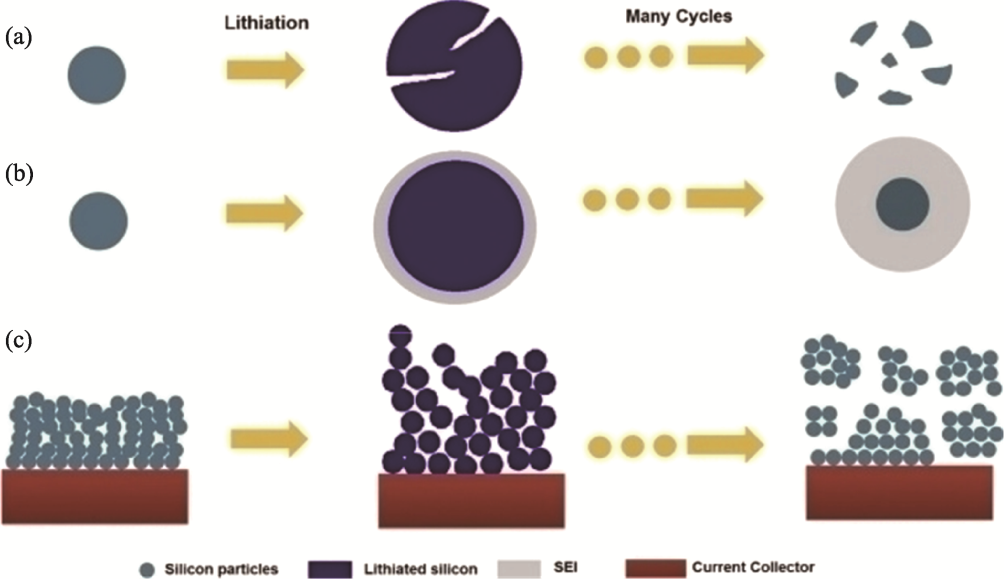
Fig. 1 Si electrode failure mechanisms[8] (a) Material pulverization; (b) Continuous SEI growth; (c) Morphology and volume change of the entire Si electrode
| Method | Representative feature and advantage | Issue and limitation | Applicability/industrialization potential | Ref. |
|---|---|---|---|---|
| Chemical vapor deposition | Constructing high-quality core- shell structures; ensuring good film uniformity | Expensive equipment; complex process; low yield; high energy consumption | Commonly used in laboratory research; limited industrialization | [ |
| Spray drying | Enabling batch synthesis of spherical particles; suitable for composite material fabrication | High raw material requirements; uneven particle size distribution; complex structural control | Having pilot-scale potential, but precision is limited | [ |
| Sol-Gel method | Allowing fine control of material structure and composition; suitable for porous or composite materials | Organic precursors are complex, highly sensitive to environment; heat treatment may cause composition changes | Suitable for laboratory use; difficult to scale up | [ |
| High-temperature carbothermal reduction | Relatively low cost; suitable for synthesizing metal silicides | High processing temperature; poor structural control; limited product purity | Having limited application scope | [ |
| Mechanical milling | Simple equipment; low cost; enabling nanosizing; in situ compositing; easy mass production | Slightly inferior control over particle morphology; requiring prevention of agglomeration and over-grinding; some contamination must be controlled | Highest industrialization potential and broad process applicability | [ |
Table 1 Comparison of common preparation methods for silicon-based anode materials[12-21]
| Method | Representative feature and advantage | Issue and limitation | Applicability/industrialization potential | Ref. |
|---|---|---|---|---|
| Chemical vapor deposition | Constructing high-quality core- shell structures; ensuring good film uniformity | Expensive equipment; complex process; low yield; high energy consumption | Commonly used in laboratory research; limited industrialization | [ |
| Spray drying | Enabling batch synthesis of spherical particles; suitable for composite material fabrication | High raw material requirements; uneven particle size distribution; complex structural control | Having pilot-scale potential, but precision is limited | [ |
| Sol-Gel method | Allowing fine control of material structure and composition; suitable for porous or composite materials | Organic precursors are complex, highly sensitive to environment; heat treatment may cause composition changes | Suitable for laboratory use; difficult to scale up | [ |
| High-temperature carbothermal reduction | Relatively low cost; suitable for synthesizing metal silicides | High processing temperature; poor structural control; limited product purity | Having limited application scope | [ |
| Mechanical milling | Simple equipment; low cost; enabling nanosizing; in situ compositing; easy mass production | Slightly inferior control over particle morphology; requiring prevention of agglomeration and over-grinding; some contamination must be controlled | Highest industrialization potential and broad process applicability | [ |
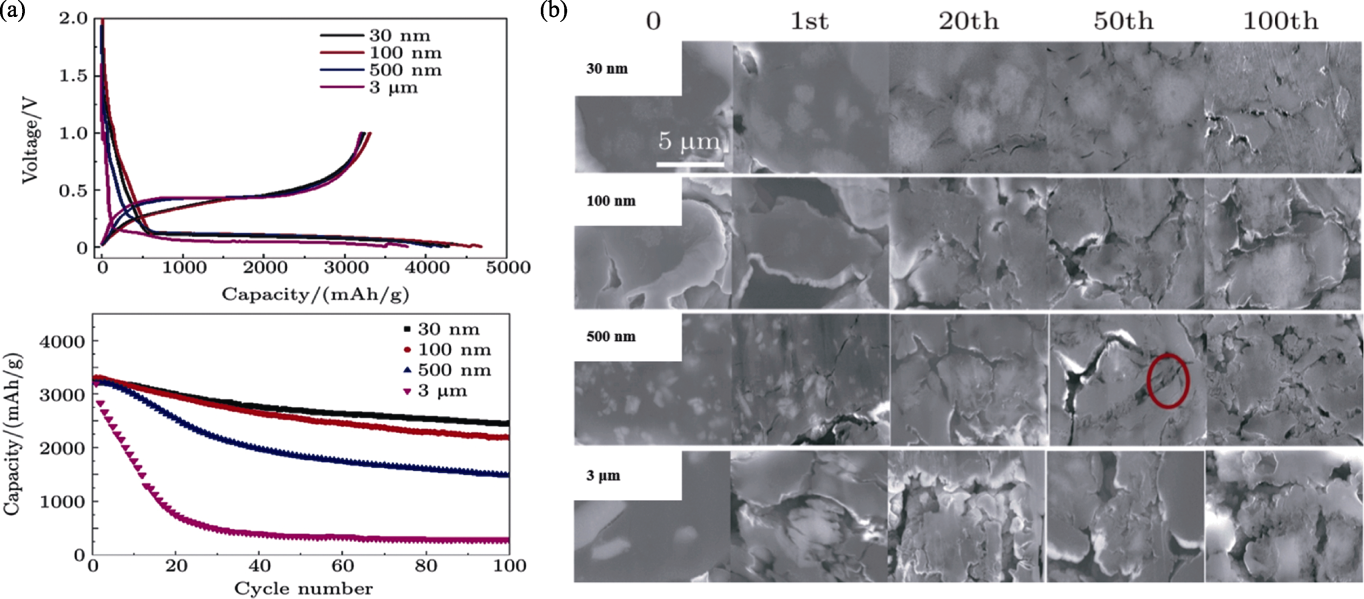
Fig. 2 Electrochemical performance of silicon anodes prepared with silicon powders of various particle sizes[35] (a) Electrochemical performance of silicon powders with different particle sizes; (b) Scanning electron microscope (SEM) images of the fabricated anode electrode after different cycles
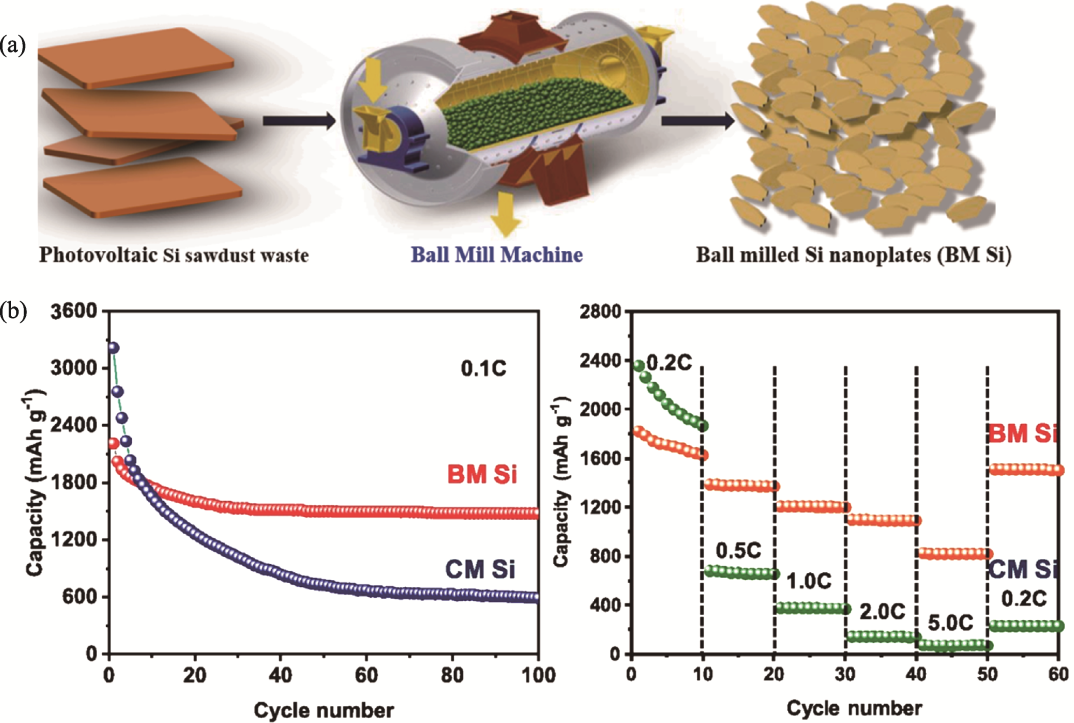
Fig. 3 Preparation of nanosilicon powders from silicon wafers by wet ball milling[38] (a) Schematic of the wet ball milling process; (b) Electrochemical performance of the resulting nanosilicon powders
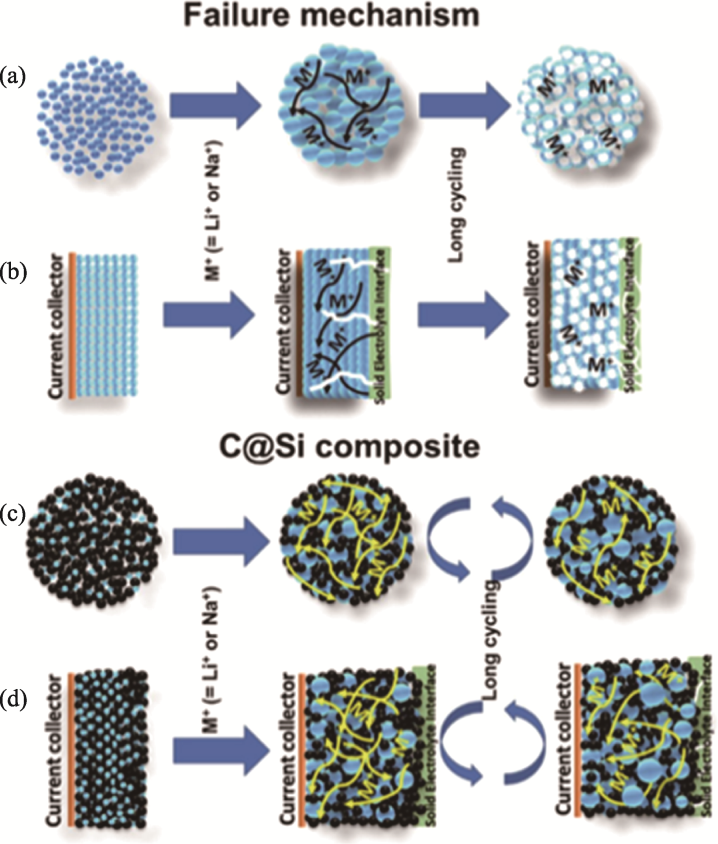
Fig. 4 Two important failure mechanisms of Si electrode and positive effect of compositing Si with carbon materials (C@Si)[45] (a) Pulverization of silicon particles; (b) Collapse of the entire sole silicon electrode; (c) Reduction of pulverization and increasing of cycling life in C@Si; (d) Possible healing mechanism in C@Si and a more stable contact with current collector
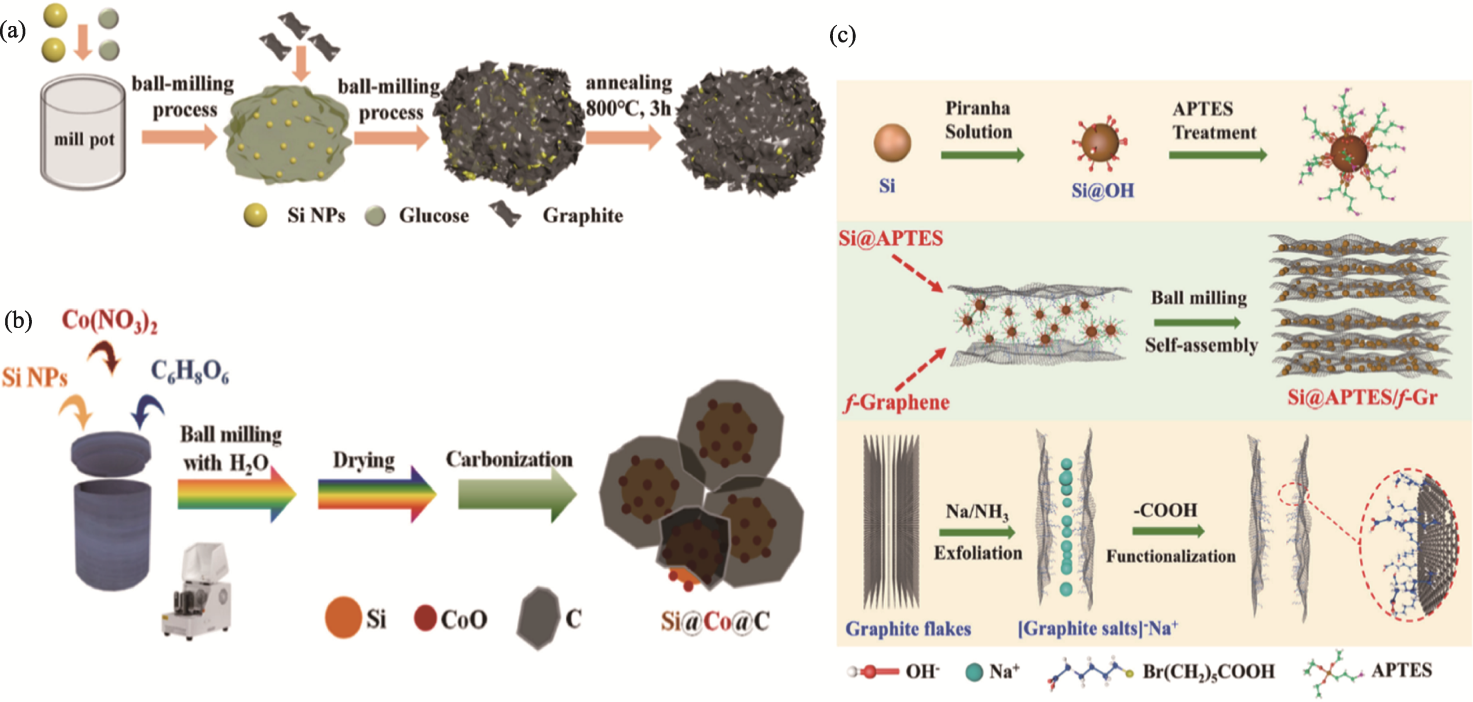
Fig. 5 Preparation processes of various silicon-carbon composites by mechanical ball milling[47,49 -50] (a) Schematic representation of the preparation process of Si/C composite[47]; (b) Constructing schematic diagram of the Si@Co@C[49]; (c) Schematic of the fabrication process of the present Si@APTES/f-Gr composite[50]
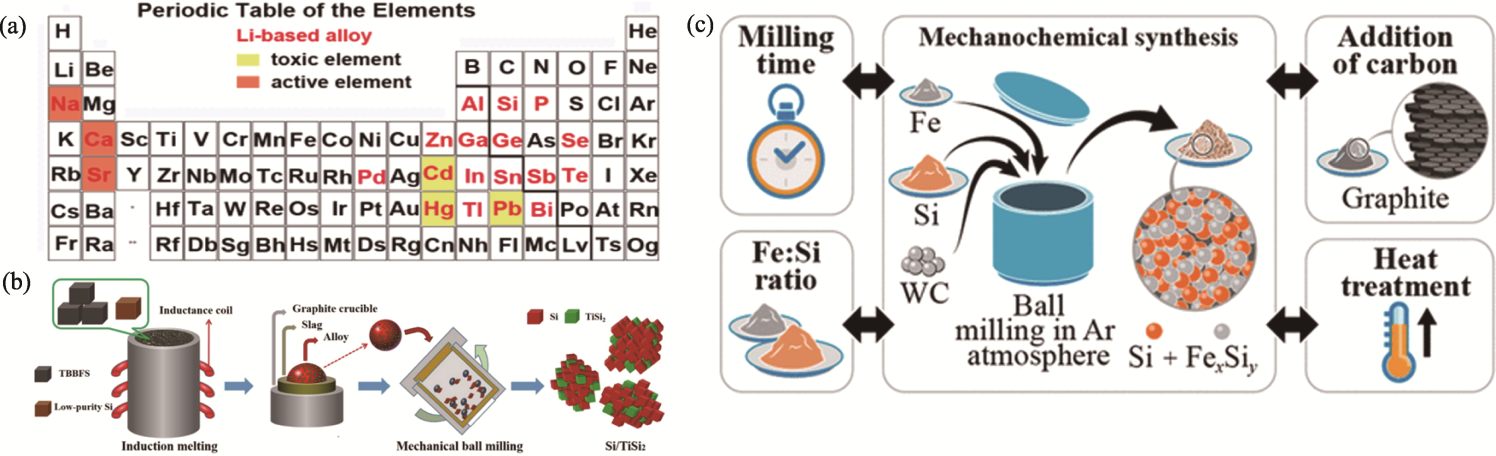
Fig. 6 Schematic illustration of lithiation-active elements and process flow diagrams of various silicon-metal composites prepared by mechanical milling[62-64] (a) Schematic diagram of elements with lithium intercalation activity[62]; (b) Schematic of fabrication process of the Si/TiSi2 composite[63]; (c) Preparation process of Si/FeₓSiᵧ composite powder by mechanical ball milling[64]
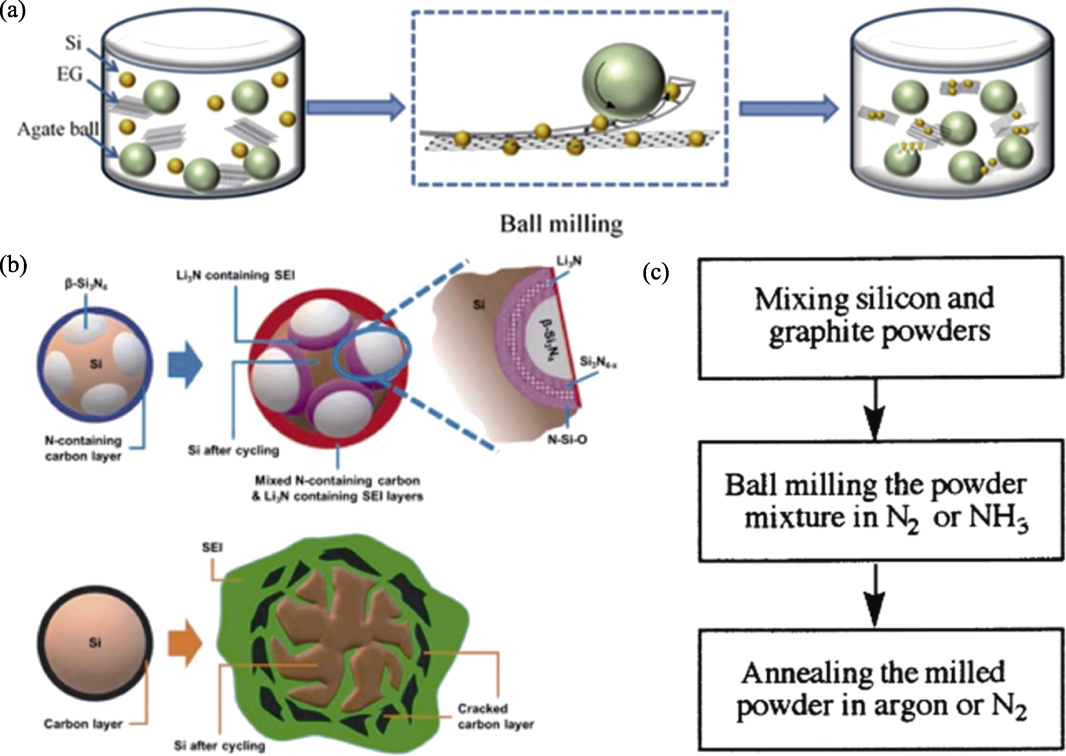
Fig. 7 Schematic illustration of the construction of inorganic coatings on silicon surfaces via mechanical milling and the structural evolution of two coating materials (Si3N4 and carbon) after lithiation-delithiation cycles[78,80,89] (a) Flowchart for preparing Si@SiOx/GNS anode materials by ball milling[78]; (b) Schematic diagram of the structural evolution of Si3N4 and carbon-coated materials after lithiation-delithiation cycles[80]; (c) Flowchart for preparing silicon nitride compounds by ball milling[89]
| [1] |
BRANDT K. Historical development of secondary lithium batteries. Solid State Ionics, 1994, 69(3/4): 173.
DOI URL |
| [2] |
SELVARAJ V, VAIRAVASUNDARAM I. A comprehensive review of state of charge estimation in lithium-ion batteries used in electric vehicles. Journal of Energy Storage, 2023, 72: 108777.
DOI URL |
| [3] |
ZHANG Y, LIU H, XIE Z, et al. Progress and perspectives of lithium aluminum germanium phosphate-based solid electrolytes for lithium batteries. Advanced Functional Materials, 2023, 33(32): 2300973.
DOI URL |
| [4] |
LI P, KIM H, MYUNG S T, et al. Diverting exploration of silicon anode into practical way: a review focused on silicon-graphite composite for lithium ion batteries. Energy Storage Materials, 2021, 35: 550.
DOI URL |
| [5] |
ZHANG X, WANG D, QIU X, et al. Stable high-capacity and high- rate silicon-based lithium battery anodes upon two-dimensional covalent encapsulation. Nature Communications, 2020, 11: 3826.
DOI |
| [6] |
HE S, HUANG S, WANG S, et al. Considering critical factors of silicon/graphite anode materials for practical high-energy lithium-ion battery applications. Energy & Fuels, 2021, 35(2): 944.
DOI URL |
| [7] |
STODDART A. Lithium-ion batteries: stress relief for silicon. Nature Reviews Materials, 2017, 2: 17057.
DOI URL |
| [8] |
WU H, CUI Y. Designing nanostructured Si anodes for high energy lithium ion batteries. Nano Today, 2012, 7(5): 414.
DOI URL |
| [9] |
HAN M, LIN Z, JI X, et al. Growth of flexible and porous surface layers of vertical graphene sheets for accommodating huge volume change of silicon in lithium-ion battery anodes. Materials Today Energy, 2020, 17: 100445.
DOI URL |
| [10] |
KIM S Y, KIM C H, YANG C M. Binder-free silicon anodes wrapped in multiple graphene shells for high-performance lithium- ion batteries. Journal of Power Sources, 2021, 486: 229350.
DOI URL |
| [11] |
CHOU S L, WANG J Z, CHOUCAIR M, et al. Enhanced reversible lithium storage in a nanosize silicon/graphene composite. Electrochemistry Communications, 2010, 12(2): 303.
DOI URL |
| [12] |
DENG T, ZHOU H, LIU Y, et al. Research progress in the preparation of silicon-carbons anode by chemical vapor deposition. Energy Storage Science and Technology, 2025, 14(9): 3354.
DOI |
| [13] | XIAO Z X, WU H J, QUAN L J, et al. Micro-sized CVD-derived Si-C anodes: challenges, strategies, and prospects for next-generation high-energy lithium-ion batteries. Energy & Environmental Science, 2025, 18: 4037. |
| [14] |
JUNG D, HWANG T, PARK S, et al. Spray drying method for large-scale and high-performance silicon negative electrodes in Li-ion batteries. Nano Letters, 2013, 13(5): 2092.
DOI PMID |
| [15] | SHIH J Y, CHEN Y R, LI Y J J, et al. Suppressed volume change of a spray-dried 3D spherical-like Si/graphite composite anode for high-rate and long-term lithium-ion batteries. ACS Sustainable Chemistry & Engineering, 2022, 10(38): 12706. |
| [16] |
HUANG B, TSUI L, RAMKI S, et al. Synthesizing Si/SiOC composites through different Sol-Gel reaction routes for lithium-ion battery anode materials. Heliyon, 2024, 10(13): e33612.
DOI URL |
| [17] |
HUANG H, HUANG B, HSU H, et al. Synthesis of silicon oxycarbide beads from alkoxysilane as anode materials for lithium-ion batteries. ACS Omega, 2023, 8(4): 4165.
DOI URL |
| [18] |
YAN M, MARTELL S, PATWARDHAN S V, et al. Key developments in magnesiothermic reduction of silica: insights into reactivity and future prospects. Chemical Science, 2024, 15(39): 15954.
DOI URL |
| [19] |
HOOVER H, BELL R, RIPPY K. Emerging technologies for decarbonizing silicon production. Journal of Sustainable Metallurgy, 2024, 10: 1921.
DOI |
| [20] |
CETINKAYA T, CEVHER O, TOCOGLU U, et al. Electrochemical characterization of the powder silicon anodes reinforced with graphite using planetary ball milling. Acta Physica Polonica A, 2013, 123(2): 393.
DOI URL |
| [21] |
KORAAG P, FIRDAUS A, HAWARI N, et al. Covalently bonded ball-milled silicon/CNT nanocomposite as lithium-ion battery anode material. Batteries, 2022, 8(10): 165.
DOI URL |
| [22] |
SPEIGHT I R, ARDILA-FIERRO K J, HERNÁNDEZ J G, et al. Ball milling for mechanochemical reactions. Nature Reviews Methods Primers, 2025, 5: 29.
DOI |
| [23] |
GE M, CAO C, BIESOLD G M, et al. Recent advances in silicon- based electrodes: from fundamental research toward practical applications. Advanced Materials, 2021, 33(16): 2004577.
DOI URL |
| [24] |
ZHAO X, LEHTO V P. Challenges and prospects of nanosized silicon anodes in lithium-ion batteries. Nanotechnology, 2021, 32(4): 042002.
DOI |
| [25] |
ZHANG Q, YANG Y, WANG D, et al. A silicon/carbon/reduced- graphene composite of honeycomb structure for high-performance lithium-ion batteries. Journal of Alloys and Compounds, 2023, 944: 169185.
DOI URL |
| [26] |
ROBERTS G A, CAIRNS E J, REIMER J A. Magnesium silicide as a negative electrode material for lithium-ion batteries. Journal of Power Sources, 2002, 110(2): 424.
DOI URL |
| [27] | B-science.net. Li-ion battery high-energy silicon anode innovation & patent review. (2025-02-03)[2025-11-03]. https://www.b-science.net/Core/BinaryFileStorage/GetPDF?type=preview&ID=Li-Ion-Battery-High-Energy-Anode-Innovation-Patent-Review-b-science.net-Preview. |
| [28] |
BURMEISTER C F, KWADE A. Process engineering with planetary ball mills. Chemical Society Reviews, 2013, 42(18): 7660.
DOI PMID |
| [29] | GAUTHIER M, MAZOUZI D, REYTER D, et al. A low-cost and high performance ball-milled Si-based negative electrode for high-energy Li-ion batteries. Energy & Environmental Science, 2013, 6(7): 2145. |
| [30] |
PAN W, CAI X, YANG C, et al. Amorphous Si/TiC/graphite composite fabricated by high-energy ball-milling as an anode for lithium- ion batteries. Journal of Electronic Materials, 2021, 50(5): 2584.
DOI |
| [31] |
ZHANG L, HUANG S, DING Y, et al. Research progress in the preparation of sodium-ion battery anode materials using ball milling. RSC Advances, 2025, 15(8): 6324.
DOI PMID |
| [32] |
GOYAL A, DEMMENIE M, HUANG C C, et al. Photophysical properties of ball milled silicon nanostructures. Faraday Discussions, 2020, 222: 96.
DOI PMID |
| [33] |
CAO Y, DUNLAP R A, OBROVAC M N. Electrochemistry and thermal behavior of SiOx made by reactive gas milling. Journal of the Electrochemical Society, 2020, 167(11): 110501.
DOI |
| [34] | CAO Y, BENNETT J C, DUNLAP R A, et al. Li insertion in ball milled Si-Mn alloys. Journal of the Electrochemical Society, 2018, 165(9): A1734. |
| [35] |
LIU B, LU H, CHU G, et al. Size effect of Si particles on the electrochemical performances of Si/C composite anodes. Chinese Physics B, 2018, 27(8): 088201.
DOI URL |
| [36] |
LIU X H, ZHONG L, HUANG S, et al. Size-dependent fracture of silicon nanoparticles during lithiation. ACS Nano, 2012, 6(2): 1522.
DOI PMID |
| [37] |
ZHU B, JIN Y, TAN Y, et al. Scalable production of Si nanoparticles directly from low grade sources for lithium-ion battery anode. Nano Letters, 2015, 15(9): 5750.
DOI PMID |
| [38] |
ZHANG Y, MA H, YU C, et al. Si nanoplates prepared by ball milling photovoltaic silicon sawdust waste as lithium-ion batteries anode material. Materials Letters, 2023, 331: 133469.
DOI URL |
| [39] |
XU B, CHEN Q, QIU B, et al. Effect of process control agents on preparation of nano-silicon powders by ball milling. Journal of Functional Materials, 2018, 49(12): 12205.
DOI |
| [40] | HE S, SHUAI Y, WANG Z, et al. Surface modification and electrochemical performance of amorphous silicon matrix composites by wet ball milling. Shandong Chemical Industry, 2022, 51(8): 32. |
| [41] | HU J, MENG Y S, HU Q R. Synthesis of nickel phosphide/ nitrogen phosphorus co-doped carbon and its application in lithium ion batteries. Journal of Electrochemistry, 2021, 27(5): 540. |
| [42] |
MA C, WANG Z, ZHAO Y, et al. A novel raspberry-like yolk-shell structured Si/C micro/nano-spheres as high-performance anode materials for lithium-ion batteries. Journal of Alloys and Compounds, 2020, 844: 156201.
DOI URL |
| [43] |
WANG F, SONG C, ZHAO B, et al. One-pot solution synthesis of carbon-coated silicon nanoparticles as an anode material for lithium-ion batteries. Chemical Communications, 2020, 56(7): 1109.
DOI PMID |
| [44] |
ZHANG Y, ZHOU Q, ZHU J, et al. Nanostructured metal chalcogenides for energy storage and electrocatalysis. Advanced Functional Materials, 2017, 27(35): 1702317.
DOI URL |
| [45] |
DOS REIS G S, MOLAIYAN P, SUBRAMANIYAM C M, et al. Biomass-derived carbon-silicon composites (C@Si) as anodes for lithium-ion and sodium-ion batteries: a promising strategy towards long-term cycling stability: a mini review. Electrochemistry Communications, 2023, 153: 107536.
DOI URL |
| [46] |
SUN J, LUO B, LI H. A review on the conventional capacitors, supercapacitors, and emerging hybrid ion capacitors: past, present, and future. Advanced Energy and Sustainability Research, 2022, 3(6): 2100191.
DOI URL |
| [47] |
DU Y, YANG Z, YANG Y, et al. Mussel-pearl-inspired design of Si/C composite for ultrastable lithium storage anodes. Journal of Alloys and Compounds, 2021, 872: 159717.
DOI URL |
| [48] |
HAN J, ZHAO C, WANG L, et al. Simple ball milling-assisted method enabling N-doped carbon embedded Si for high performance lithium-ion battery anode. Journal of Alloys and Compounds, 2023, 966: 171668.
DOI URL |
| [49] |
YANG D, LV T, SONG J, et al. Enabling stable high-performance CoO-assisted Si@C anode via ball milling strategy. Journal of Physics and Chemistry of Solids, 2024, 189: 111956.
DOI URL |
| [50] |
ZHANG Y, CHENG Y, SONG J, et al. Functionalization-assistant ball milling towards Si/graphene anodes in high performance Li-ion batteries. Carbon, 2021, 181: 300.
DOI URL |
| [51] | DING B, CAI Z, AHSAN Z, et al. A review of metal silicides for lithium-ion battery anode application. Acta Metallurgica Sinica, 2021, 34: 291. |
| [52] |
ZHAO W, DU N, XIAO C, et al. Large-scale synthesis of Ag-Si core-shell nanowall arrays as high-performance anode materials of Li-ion batteries. Journal of Materials Chemistry A, 2014, 2(34): 13949.
DOI URL |
| [53] |
KIM H, SON Y, PARK C, et al. Germanium silicon alloy anode material capable of tunable overpotential by nanoscale Si segregation. Nano Letters, 2015, 15(6): 4135.
DOI PMID |
| [54] |
LIU K, GUO D, LI Y, et al. Preparation of Si/Sn@C composite anodes through in-situ self-formed templating for enhanced lithium storage. Journal of Electroanalytical Chemistry, 2025, 978: 118879.
DOI URL |
| [55] |
MORIGA T, WATANABE K, TSUJI D, et al. Reaction mechanism of metal silicide Mg2Si for Li insertion. Journal of Solid State Chemistry, 2000, 153(2): 386.
DOI URL |
| [56] |
CHEN Z, WANG X, JIAN T, et al. One-step mild fabrication of branch-like multimodal porous Si/Zn composites as high performance anodes for Li-ion batteries. Solid State Ionics, 2020, 354: 115406.
DOI URL |
| [57] | LIU W R, WU N L, SHIEH D T, et al. Synthesis and characterization of nanoporous NiSi-Si composite anode for lithium-ion batteries. Journal of the Electrochemical Society, 2006, 154(2): A97. |
| [58] | ZHANG K, MAO H, GU X, et al. ZIF-derived cobalt-containing N-doped carbon-coated SiOx nanoparticles for superior lithium storage. ACS Applied Materials & Interfaces, 2020, 12(6): 7206. |
| [59] | XI F, ZHANG Z, WAN X, et al. High-performance porous silicon/nanosilver anodes from industrial low-grade silicon for lithium-ion batteries. ACS Applied Materials & Interfaces, 2020, 12(43): 49080. |
| [60] |
KUMAR P, BERHAUT C L, ZAPATA DOMINGUEZ D, et al. Nano-architectured composite anode enabling long-term cycling stability for high-capacity lithium-ion batteries. Small, 2020, 16(11): 1906812.
DOI URL |
| [61] |
LIN L, MA Y, XIE Q, et al. Copper-nanoparticle-induced porous Si/Cu composite films as an anode for lithium ion batteries. ACS Nano, 2017, 11(7): 6893.
DOI PMID |
| [62] | 赵静. 高熵锂/钠离子电池负极材料的设计及性能研究. 长春: 吉林大学博士学位论文, 2022. |
| [63] |
ZHANG Y, CHEN M, CHEN Z, et al. Constructing cycle-stable Si/TiSi2 composites as anode materials for lithium ion batteries through direct utilization of low-purity Si and Ti-bearing blast furnace slag. Journal of Alloys and Compounds, 2021, 876: 160125.
DOI URL |
| [64] | RUTTERT M, SIOZIOS V, WINTER M, et al. Mechanochemical synthesis of iron silicon alloys and their electrochemical characterization as high energy anode materials. The Electrochemical Society, 2019(1): 19. |
| [65] | 冯志远.锂离子电池硅合金负极材料的制备及其储锂性能研究. 长沙: 中南大学硕士学位论文, 2022. |
| [66] | LI W, LI X, LIAO J, et al. A new family of cation-disordered Zn(Cu)-Si-P compounds as high-performance anodes for next- generation Li-ion batteries. Energy & Environmental Science, 2019, 12(7): 2286. |
| [67] |
ZHAO T, ZHU D, LI W, et al. Novel design and synthesis of carbon- coated porous silicon particles as high-performance lithium-ion battery anodes. Journal of Power Sources, 2019, 439: 227027.
DOI URL |
| [68] |
LI W, TANG Y, KANG W, et al. Core-shell Si/C nanospheres embedded in bubble sheet-like carbon film with enhanced performance as lithium ion battery anodes. Small, 2015, 11(11): 1345.
DOI PMID |
| [69] | SOURICE J, QUINSAC A, LECONTE Y, et al. One-step synthesis of Si@C nanoparticles by laser pyrolysis: high-capacity anode material for lithium-ion batteries. ACS Applied Materials & Interfaces, 2015, 7(12): 6637. |
| [70] |
SHI J, GAO H, HU G, et al. Core-shell structured Si@C nanocomposite for high-performance Li-ion batteries with a highly viscous gel as precursor. Journal of Power Sources, 2019, 438: 227001.
DOI URL |
| [71] |
SUNG J, KIM N, MA J, et al. Subnano-sized silicon anode via crystal growth inhibition mechanism and its application in a prototype battery pack. Nature Energy, 2021, 6(12): 1164.
DOI |
| [72] |
YU C, LIN X, CHEN X, et al. Suppressing the side reaction by a selective blocking layer to enhance the performance of Si-based anodes. Nano Letters, 2020, 20(7): 5176.
DOI PMID |
| [73] |
AI Q, FANG Q, LIANG J, et al. Lithium-conducting covalent- organic-frameworks as artificial solid-electrolyte-interphase on silicon anode for high performance lithium ion batteries. Nano Energy, 2020, 72: 104657.
DOI URL |
| [74] |
LI L, FANG C, WEI W, et al. Nano-ordered structure regulation in delithiated Si anode triggered by homogeneous and stable Li-ion diffusion at the interface. Nano Energy, 2020, 72: 104651.
DOI URL |
| [75] |
SI Q, HANAI K, ICHIKAWA T, et al. Improvement of cyclic behavior of a ball-milled SiO and carbon nanofiber composite anode for lithium-ion batteries. Journal of Power Sources, 2011, 196(22): 9774.
DOI URL |
| [76] |
GUO B, SHU J, WANG Z, et al. Electrochemical reduction of nano-SiO2 in hard carbon as anode material for lithium ion batteries. Electrochemistry Communications, 2008, 10(12): 1876.
DOI URL |
| [77] |
LIU Z, YU Q, ZHAO Y, et al. Silicon oxides: a promising family of anode materials for lithium-ion batteries. Chemical Society Reviews, 2019, 48(1): 285.
DOI PMID |
| [78] |
TIE X, HAN Q, LIANG C, et al. Si@SiOx/graphene nanosheets composite: ball milling synthesis and enhanced lithium storage performance. Frontiers in Materials, 2018, 4: 47.
DOI URL |
| [79] |
WANG D, GAO M, PAN H, et al. High performance amorphous- Si@SiOx/C composite anode materials for Li-ion batteries derived from ball-milling and in situ carbonization. Journal of Power Sources, 2014, 256: 190.
DOI URL |
| [80] |
HERNANDHA R F H, UMESH B, RATH P C, et al. N-containing carbon-coated β-Si3N4 enhances Si anodes for high-performance Li-ion batteries. Advanced Science, 2023, 10(21): 2301218.
DOI URL |
| [81] |
MARTÍN-GIL M, RABANAL M E, VÁREZ A, et al. Mechanical grinding of Si3N4 to be used as an electrode in lithium batteries. Materials Letters, 2003, 57(20): 3063.
DOI URL |
| [82] |
YANG J, TAKEDA Y, IMANISHI N, et al. Novel composite anodes based on nano-oxides and Li2.6Co0.4N for lithium ion batteries. Electrochimica Acta, 2001, 46(17): 2659.
DOI URL |
| [83] |
SUZUKI N, CERVERA R B, OHNISHI T, et al. Silicon nitride thin film electrode for lithium-ion batteries. Journal of Power Sources, 2013, 231: 186.
DOI URL |
| [84] |
AHN D, KIM C, LEE J G, et al. The effect of nitrogen on the cycling performance in thin-film Si1-xNx anode. Journal of Solid State Chemistry, 2008, 181(9): 2139.
DOI URL |
| [85] |
SHAW L L, YANG Z G, REN R M. Synthesis of nanostructured Si3N4/SiC composite powders through high energy reaction milling. Materials Science and Engineering: A, 1998, 244(1): 113.
DOI URL |
| [86] |
XIAO Z, LEI C, YU C, et al. Si@Si3N4@C composite with egg-like structure as high-performance anode material for lithium ion batteries. Energy Storage Materials, 2020, 24: 565.
DOI URL |
| [87] |
DE GUZMAN R C, YANG J, CHENG M M C, et al. High capacity silicon nitride-based composite anodes for lithium ion batteries. Journal of Materials Chemistry A, 2014, 2(35): 14577.
DOI URL |
| [88] |
MEI S, GUO S, XIANG B, et al. Enhanced ion conductivity and electrode-electrolyte interphase stability of porous Si anodes enabled by silicon nitride nanocoating for high-performance Li-ion batteries. Journal of Energy Chemistry, 2022, 69: 616.
DOI |
| [89] | CALKA A, WILLIAMS J S. Synthesis of nitrides by mechanical alloying. Materials Science Forum, 1992, 88/89/90: 787. |
| [1] | LIU Leimin, LUO Hongxin, HE Yumei, JIN Limin, LI Yongjie, LIU Jingwen, WEI Yuquan, SUN Anle, CHEN Zhongming, LIU Xuejian, YIN Jie, HUANG Zhengren. Performance of Silicon Carbide Mirrors for Advanced Light Source Devices [J]. Journal of Inorganic Materials, 2026, 41(6): 805-813. |
| [2] | CHEN Mingjun, MIAO Hongkang, XIAO Yingjun, DENG Jianbo, ZHANG Xiang, ZHAO Jiupeng, LI Yao. Photo- and Thermo-chromic Dual-responsive Materials: A Review on Design Strategies and Applications in Smart Windows [J]. Journal of Inorganic Materials, 2026, 41(6): 723-738. |
| [3] | SONG Kunjie, XIE Rongjun. Research Advances on Machine Learning-driven Development of Novel Luminescent Materials [J]. Journal of Inorganic Materials, 2026, 41(6): 689-703. |
| [4] | HU Yuqing, ZHU Yixin, LE Xianhao, WAN Qing. Lithium Tantalate Wafer: Advances in Thinning Technology and Application in Pyroelectric Infrared Detectors [J]. Journal of Inorganic Materials, 2026, 41(6): 764-774. |
| [5] | LIU Chunfan, CHEN Ke, GE Fangfang, HUANG Qing. Research Progress on Lead-bismuth Eutectic Corrosion Resistant Coatings [J]. Journal of Inorganic Materials, 2026, 41(6): 775-786. |
| [6] | HU Yang, XIE Min, ZHANG Xiaoyi, LI Xiang, GUO Xinwei, JIANG Nan, ZHOU Wenhan, ZHANG Shengli, ZENG Haibo. Research Progress on Computational and Data-driven Environmental-friendly Luminescent Materials [J]. Journal of Inorganic Materials, 2026, 41(6): 704-722. |
| [7] | WANG Junbu, HUANG Zeai, YANG Mingkai, MENG Ying, ZHOU Mingwei, ZHOU Ying. Research Progress on Anti-coking Catalytic Materials for Methane Conversion [J]. Journal of Inorganic Materials, 2026, 41(6): 739-750. |
| [8] | WANG Jinwen, YANG Zhen, ZHOU Huan, XIA Dan, YANG Lei. Biomedical Applications of Injectable Inorganic Biomaterials [J]. Journal of Inorganic Materials, 2026, 41(6): 751-763. |
| [9] | XIE Chenyi, MIAO Huaming, ZHANG Weiran, LIU Rongjun, WANG Yanfei, LI Duan. Research Progress on Theoretical Calculation in the Field of High-entropy Ceramics [J]. Journal of Inorganic Materials, 2026, 41(5): 545-560. |
| [10] | LI Xuan, YE Kuicai, FENG Jiayin, QIU Jiajun, QIAN Wenhao, XING Min. Surface Modification of Titanium-based Dental Implants for Soft Tissue Sealing: A Review [J]. Journal of Inorganic Materials, 2026, 41(4): 432-444. |
| [11] | MA Xiaojia, GENG Xinyu, ZHANG Weike. Boron and Nitrogen Co-doped Biomass Carbon Sphere Anode Material: Preparation and Sodium Storage Properties for Sodium-ion Batteries [J]. Journal of Inorganic Materials, 2026, 41(4): 469-478. |
| [12] | JIANG Shengnan, ZHENG Zhong, HE Weiyi, LIU Tao, PAN Xiuhong, CHEN Kun, GUO Hui, GAO Pan, LIU Chunjun, LIU Xuechao. Preparation and Performance Optimization of Boron-gallium Co-doped Zinc Oxide Transparent Electrodes [J]. Journal of Inorganic Materials, 2026, 41(4): 479-485. |
| [13] | PENG Dezhao, LI Rui, WANG Wenhong, WANG Zirui, ZHANG Zhizhen. Research Progress on Sodium Chloride Solid Electrolytes [J]. Journal of Inorganic Materials, 2026, 41(4): 409-420. |
| [14] | CHEN Kun, JIANG Yonggang, FENG Junzong, LI Liangjun, HU Yijie, FENG Jian. Research Progress on Lanthanum Zirconate Porous Materials for Thermal Insulation [J]. Journal of Inorganic Materials, 2026, 41(4): 421-431. |
| [15] | WEI Lianjin, QI Zhijie, WANG Xin, ZHU Junwu, FU Yongsheng. Modification of Nanodiamond and Its Application in Electrocatalytic Oxygen Reduction Reaction [J]. Journal of Inorganic Materials, 2026, 41(3): 273-288. |
| Viewed | ||||||
|
Full text |
|
|||||
|
Abstract |
|
|||||
