
Journal of Inorganic Materials ›› 2026, Vol. 41 ›› Issue (6): 681-688.DOI: 10.15541/jim20250437
• PERSPECTIVE • Previous Articles Next Articles
FENG Hengyang1( ), WEI Tianran1(), QIU Pengfei2, SHI Xun2()
Received:2025-10-31
Revised:2025-12-17
Published:2026-06-20
Online:2025-12-22
Contact:
WEI Tianran, professor. E-mail: tianran_wei@sjtu.edu.cn;About author:FENG Hengyang (2000-), male, PhD candidate. E-mail: dajingfhy@sjtu.edu.cn
Supported by:CLC Number:
FENG Hengyang, WEI Tianran, QIU Pengfei, SHI Xun. Ultra-large Macroscopic Plastic Deformation and Metalworking in Inorganic Semiconductors[J]. Journal of Inorganic Materials, 2026, 41(6): 681-688.
| Material | Band gap/eV | Elongation/% | |
|---|---|---|---|
| Ag2S | 1.0[ | 4.2[ | |
| Ag2S0.3Te0.7 | ~0.11[ | 107[ | |
| Ag2S0.4Te0.6 | ~0.11[ | 75[ | |
| Ag2S0.5Te0.5 | ~0.12[ | 52[ | |
| Ag2S0.5Se0.5 | 0.28[ | 25[ | |
| Ag2S1/3Se1/3Te1/3 | ~0.30[ | 97[ | |
| InSe | 1.2[ | 12[ | |
| GaSe | 2.1[ | 11[ | |
| MoS2 | 1.3[ | 9[ | |
| SnSe2 | 0.90[ | 6[ | |
| Defective Bi2Te3 | 0.15[ | 8[ | |
| CrSiTe3 | 0.4[ | 12[ | |
| Mg3Sb2 | 0.41[ | 7.4[ | |
| Mg3Bi2 | 0[ | 100[ | |
| AgCl | 3.2[ | 34[ | |
| AgBr | 2.7[ | 52[ | |
Table 1 Room-temperature elongation versus band gap of ductile inorganic semiconductors in the macroscopic bulk form[6,8,12 -13,15 -18,28,30 -38]
| Material | Band gap/eV | Elongation/% | |
|---|---|---|---|
| Ag2S | 1.0[ | 4.2[ | |
| Ag2S0.3Te0.7 | ~0.11[ | 107[ | |
| Ag2S0.4Te0.6 | ~0.11[ | 75[ | |
| Ag2S0.5Te0.5 | ~0.12[ | 52[ | |
| Ag2S0.5Se0.5 | 0.28[ | 25[ | |
| Ag2S1/3Se1/3Te1/3 | ~0.30[ | 97[ | |
| InSe | 1.2[ | 12[ | |
| GaSe | 2.1[ | 11[ | |
| MoS2 | 1.3[ | 9[ | |
| SnSe2 | 0.90[ | 6[ | |
| Defective Bi2Te3 | 0.15[ | 8[ | |
| CrSiTe3 | 0.4[ | 12[ | |
| Mg3Sb2 | 0.41[ | 7.4[ | |
| Mg3Bi2 | 0[ | 100[ | |
| AgCl | 3.2[ | 34[ | |
| AgBr | 2.7[ | 52[ | |
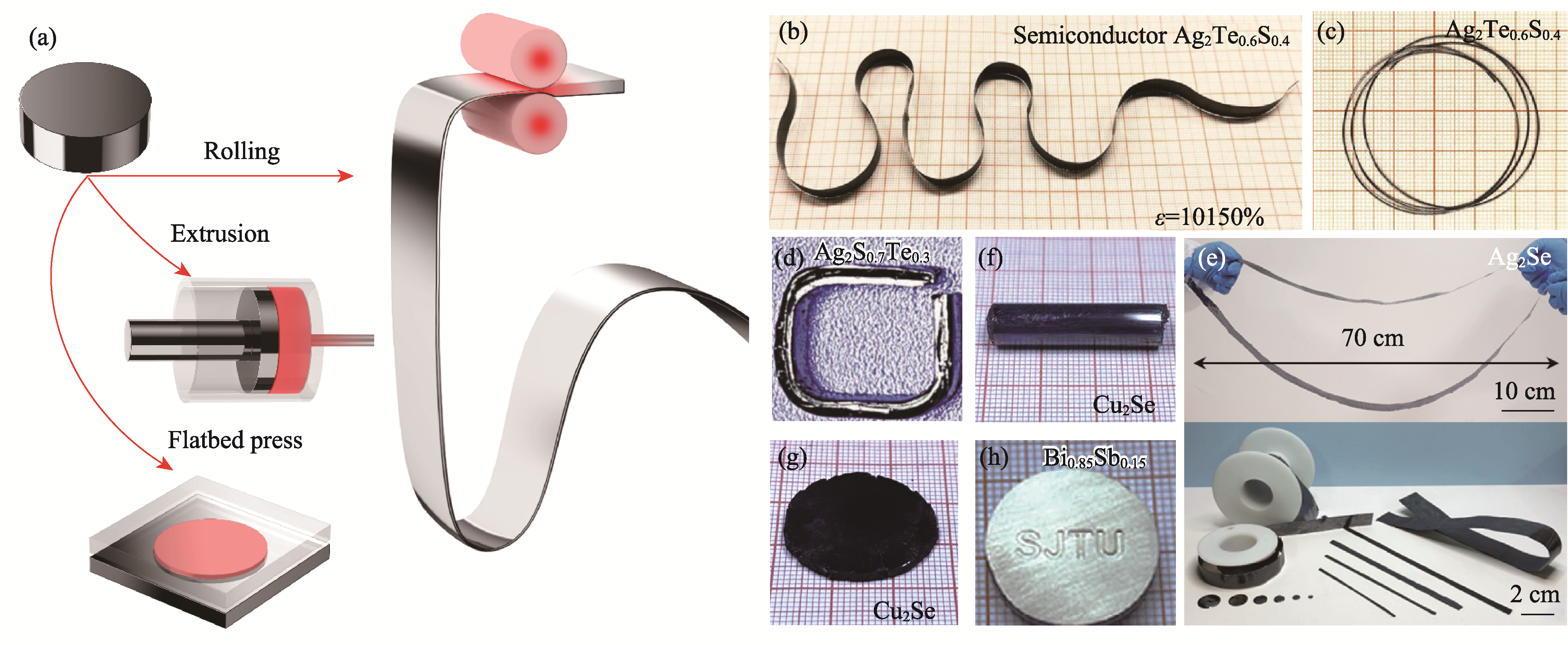
Fig. 1 Metal-like plastic processing of inorganic semiconductors[10,42,52,59] (a) Schematic diagram of processing, including rolling, extrusion and flatbed press[52]; (b, c) Iterative rolling and drawing of Ag2Te0.6S0.4[42]; (d) Room temperature twisted deformation of Ag2S0.7Te0.3[10]; (e) Warm rolling of Ag2Se film[52]; (f, g) Warm extrusion and flatbed processing of Cu2Se[52]; (h) Warm stamping of Bi0.85Sb0.15[59]
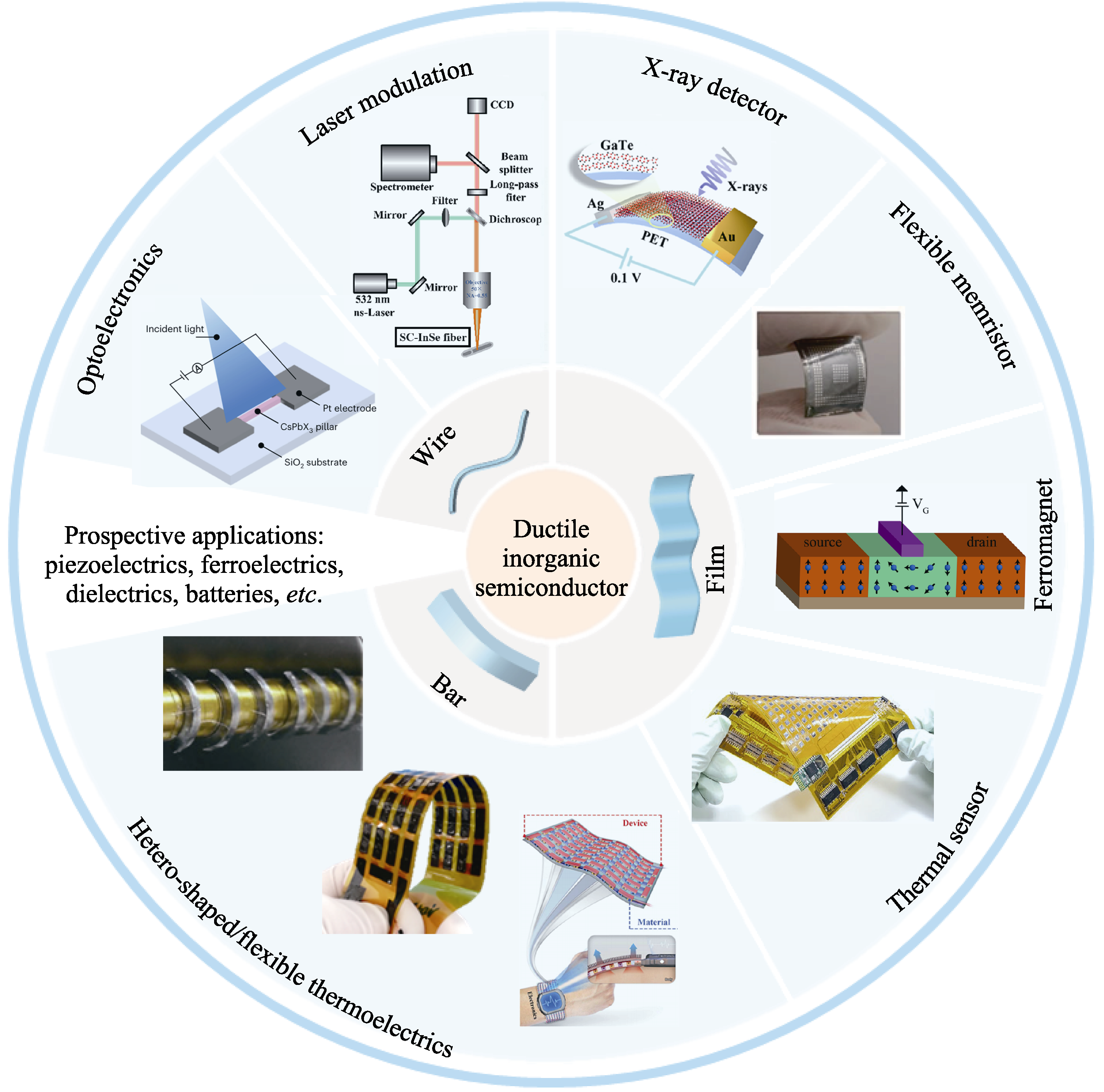
Fig. 2 Multiple functional applications of multiform ductile inorganic semiconductors[10,24,30,54 -56,58,62 -63]
| [22] | LIANG X, CHEN C. Ductile inorganic amorphous/crystalline composite Ag4TeS with phonon-glass electron-crystal transport behavior and excellent stability of high thermoelectric performance on plastic deformation. Acta Materialia, 2021, 218: 117231. |
| [23] | PENG L M, YANG S Q, WEI T R, et al. Phase-modulated mechanical and thermoelectric properties of Ag2S1-xTex ductile semiconductors. Journal of Materiomics, 2022, 8(3): 656. |
| [24] | YANG Q Y, YANG S Q, QIU P F, et al. Flexible thermoelectrics based on ductile semiconductors. Science, 2022, 377(6608): 854. |
| [25] | LIANG J S, LIU J, QIU P F, et al. Modulation of the morphotropic phase boundary for high-performance ductile thermoelectric materials. Nature Communications, 2023, 14: 8442. |
| [26] | WU H, SHI X L, MAO Y Q, et al. Optimized thermoelectric performance and plasticity of ductile semiconductor Ag2S0.5Se0.5 via dual-phase engineering. Advanced Energy Materials, 2023, 13(43): 2302551. |
| [27] | LI N H, SHI X L, LIU S Q, et al. Strategic vacancy engineering advances record-high ductile AgCu(Te, Se, S) thermoelectrics. Nature Communications, 2025, 16: 2812. |
| [28] | HU H P, WANG Y C, FU C G, et al. Achieving metal-like malleability and ductility in Ag2Te1-xSx inorganic thermoelectric semiconductors with high mobility. The Innovation, 2022, 3(6): 100341. |
| [29] | DENG T T, GAO Z Q, QIU P F, et al. Plastic/ductile bulk 2D van der Waals single-crystalline SnSe2 for flexible thermoelectrics. Advanced Science, 2022, 9(29): 2203436. |
| [30] | LUO J, CHEN J, GAO Z Q, et al. Ductile inorganic ferromagnetic semiconductor. Advanced Materials, 2026, 38(4): e14083. |
| [31] | HUANG H R, CHEN H Y, GAO Z Q, et al. Room-temperature wide-gap inorganic materials with excellent plasticity. Advanced Functional Materials, 2023, 33(43): 2306042. |
| [32] | ALEKPEROVA S M, AKHMEDOV I A, GADZHIEVA G S, et al. Giant magnetoresistance and kinetic phenomena in n-Ag4SSe in the vicinity of a phase transition. Physics of the Solid State, 2007, 49(3): 512. |
| [33] | REN S H, CHEN H Y, FU H L, et al. The structural origin of extraordinary plasticity in polycrystalline semiconductors with low symmetry. Science Advances, 2025, 11(27): eadu9205. |
| [34] | MA Y P, HUANG H R, LIU Y F, et al. Remarkable plasticity and softness of polymorphic InSe van der Waals crystals. Journal of Materiomics, 2023, 9(4): 709. |
| [35] | Springer materials. (update 2025)[2025-10-30]. https://materials.springer.com/periodictable#. |
| [36] | 陈立东, 刘睿恒, 史迅. 热电材料与器件. 北京: 科学出版社, 2018: 66-70. |
| [37] | CASTO L D, CLUNE A J, YOKOSUK M O, et al. Strong spin- lattice coupling in CrSiTe3. APL Materials, 2015, 3(4): 041515. |
| [38] | IMAI Y, WATANABE A. Electronic structures of Mg3Pn2 (Pn=N, P, As, Sb and Bi) and Ca3N2 calculated by a first-principle pseudopotential method. Journal of Materials Science, 2006, 41(8): 2435. |
| [39] | MEYERS M, CHAWLA K. Mechanical behavior of materials. Cambridge: Cambridge University Press, 2008: 404-420. |
| [40] | MA H Q, HUANG H G, LU Z T, et al. Origin of shear induced ‘catching bonds’ on half Heusler thermoelectric compounds XFeSb (X = Nb, Ta) and SnNiY (Y = Ti, Zr, Hf). npj Computational Materials, 2024, 10: 61. |
| [41] | ZHANG J, LIU G H, CUI W, et al. Plastic deformation in silicon nitride ceramics via bond switching at coherent interfaces. Science, 2022, 378(6618): 371. |
| [42] | WANG Y C, LI A R, HONG Y R, et al. Iterative sublattice amorphization facilitates exceptional processability in inorganic semiconductors. Nature Materials, 2025, 24: 1545. |
| [43] | HU M Y, YANG J M, WANG Y, et al. Helical dislocation-driven plasticity and flexible high-performance thermoelectric generator in α-Mg3Bi2 single crystals. Nature Communications, 2025, 16: 128. |
| [44] | SUN Y D, MA Y P, ZHANG J Y, et al. Van der Waals semiconductor InSe plastifies by martensitic transformation. Science Advances, 2024, 10(42): eado9593. |
| [45] | WONG L W, YANG K, HAN W, et al. Deciphering the ultra-high plasticity in metal monochalcogenides. Nature Materials, 2024, 23(2): 196. |
| [46] | GE B Z, LI C, LU W Q, et al. Dynamic phase transition leading to extraordinary plastic deformability of thermoelectric SnSe2 single crystal. Advanced Energy Materials, 2023, 13(27): 2300965. |
| [47] | RICE J R, THOMSON R. Ductile versus brittle behavior of crystals. Philosophical Magazine, 1974, 29(1): 73. |
| [48] | WU Y J, ZHANG Y, WANG X Y, et al. Twisted-layer boron nitride ceramic with high deformability and strength. Nature, 2024, 626(8000): 779. |
| [49] | CANTOS-PRIETO F, FALIN A, ALLIATI M, et al. Layer-dependent mechanical properties and enhanced plasticity in the van der Waals chromium trihalide magnets. Nano Letters, 2021, 21(8): 3379. |
| [50] | REN Q, LUN Y Z, LI Y H, et al. High-throughput screening of deformable inorganic layered semiconductors. The Journal of Physical Chemistry C, 2023, 127(16): 7870. |
| [51] | TAN J L, ZHANG H Y, WANG X Z, et al. Deformable monoclinic gallium telluride with high in-plane structural anisotropy. Materials Today, 2024, 80: 250. |
| [52] | GAO Z Q, YANG S Q, MA Y P, et al. Warm metalworking for plastic manufacturing in brittle semiconductors. Nature Materials, 2025, 24: 1538. |
| [53] | NAKAMURA A, LI Y. Plastic processing of bulk semiconductors. Nature Materials, 2025, 24(10): 1505. |
| [54] | LIANG J, ZHANG X F, WAN C L. From brittle to ductile: a scalable and tailorable all-inorganic semiconductor foil through a rolling process toward flexible thermoelectric modules. ACS Applied Materials & Interfaces, 2022, 14(46): 52017. |
| [55] | ZHU Y, LIANG J S, MATHAYAN V, et al. High performance full-inorganic flexible memristor with combined resistance- switching. ACS Applied Materials & Interfaces, 2022, 14(18): 21173. |
| [56] | ZHAO X F, YANG S Q, WEN X H, et al. A fully flexible intelligent thermal touch panel based on intrinsically plastic Ag2S semiconductor. Advanced Materials, 2022, 34(13): 2107479. |
| [57] | WANG X D, TAN J L, OUYANG J, et al. Designing inorganic semiconductors with cold-rolling processability. Advanced Science, 2022, 9(30): 2203776. |
| [58] | WANG Q, WAN C L, WU Y, et al. Plastic inorganic van der Waals semiconductors for flexible X-ray detectors. ACS Applied Electronic Materials, 2025, 7(5): 1764. |
| [59] | FU L, MA Y P, PAN Z Y, et al. Warm metalworking for brittle liquid-nitrogen-temperature thermoelectric materials. Advanced Energy Materials, 2025, 15(42): e03241. |
| [60] | DING W J, SHEN X Y, JIN M, et al. Robust bendable thermoelectric generators enabled by elasticity strengthening. Nature Communications, 2024, 15: 9767. |
| [61] | FU Y Q, KANG S L, GU H, et al. Superflexible inorganic Ag2Te0.6S0.4 fiber with high thermoelectric performance. Advanced Science, 2023, 10(13): 2207642. |
| [62] | XIN L T, HE H Y, WANG X H, et al. Single-crystalline indium selenide fibers by laser-induced recrystallization and their tunable whispering-gallery-mode lasing by pressure-modulating. Journal of the American Ceramic Society, 2024, 107(9): 5801. |
| [63] | LI X C, MENG Y, LI W P, et al. Multislip-enabled morphing of all-inorganic perovskites. Nature Materials, 2023, 22(10): 1175. |
| [64] | DONG L R, ZHANG J, LI Y Z, et al. Borrowed dislocations for ductility in ceramics. Science, 2024, 385(6707): 422. |
| [1] | 谢建新. 材料加工新技术与新工艺. 北京: 冶金工业出版社, 2004: 1-13. |
| [2] | GREEN D J. An introduction to the mechanical properties of ceramics. Cambridge: Cambridge University Press, 1998: 210-217. |
| [3] | DONG S M, WANG J Y, NI D W. Structural ceramics—the cornerstone of human civilization. Journal of Inorganic Materials, 2024, 39(6): 569. |
| [4] | JOSHUA P. Mechanical properties of semiconductors. Cham: Springer Nature Switzerland AG, 2024: 271-272. |
| [5] | 吴汉明. 集成电路制造大生产工艺技术. 杭州: 浙江大学出版社, 2023: 63-198. |
| [6] | SHI X, CHEN H Y, HAO F, et al. Room-temperature ductile inorganic semiconductor. Nature Materials, 2018, 17(5): 421. |
| [7] | LIANG J S, WANG T, QIU P F, et al. Flexible thermoelectrics: from silver chalcogenides to full-inorganic devices. Energy & Environmental Science, 2019, 12(10): 2983. |
| [8] | HE S Y, LI Y B, LIU L, et al. Semiconductor glass with superior flexibility and high room temperature thermoelectric performance. Science Advances, 2020, 6(15): eaaz8423. |
| [9] | GAO Z Q, YANG Q Y, QIU P F, et al. p-Type plastic inorganic thermoelectric materials. Advanced Energy Materials, 2021, 11(23): 2100883. |
| [10] | YANG S Q, GAO Z Q, QIU P F, et al. Ductile Ag20S7Te3 with excellent shape-conformability and high thermoelectric performance. Advanced Materials, 2021, 33(10): 2007681. |
| [11] | WEI T R, QIU P F, ZHAO K P, et al. Ag2Q-based (Q=S, Se, Te) silver chalcogenide thermoelectric materials. Advanced Materials, 2023, 35(1): 2110236. |
| [12] | CHEN H Y, SHAO C L, HUANG S J, et al. High-entropy cubic pseudo-ternary Ag2(S, Se, Te) materials with excellent ductility and thermoelectric performance. Advanced Energy Materials, 2024, 14(10): 2303473. |
| [13] | WEI T R, JIN M, WANG Y C, et al. Exceptional plasticity in the bulk single-crystalline van der Waals semiconductor InSe. Science, 2020, 369(6503): 542. |
| [14] | HAN X D. Ductile van der Waals materials. Science, 2020, 369(6503): 509. |
| [15] | GAO Z Q, WEI T R, DENG T T, et al. High-throughput screening of 2D van der Waals crystals with plastic deformability. Nature Communications, 2022, 13: 7491. |
| [16] | DENG T T, GAO Z Q, LI Z, et al. Room-temperature exceptional plasticity in defective Bi2Te3-based bulk thermoelectric crystals. Science, 2024, 386(6726): 1112. |
| [17] | ZHAO P, XUE W H, ZHANG Y, et al. Plasticity in single- crystalline Mg3Bi2 thermoelectric material. Nature, 2024, 631(8022): 777. |
| [18] | LI A R, WANG Y C, LI Y Z, et al. High performance magnesium-based plastic semiconductors for flexible thermoelectrics. Nature Communications, 2024, 15: 5108. |
| [19] | “中国学科及前沿领域发展战略研究(2021--2035)”项目组. 中国材料科学2035发展战略. 北京: 科学出版社, 2023: 494-495. |
| [20] | OSHIMA Y, NAKAMURA A, MATSUNAGA K. Extraordinary plasticity of an inorganic semiconductor in darkness. Science, 2018, 360(6390): 772. |
| [21] | LIANG J S, QIU P F, ZHU Y, et al. Crystalline structure-dependent mechanical and thermoelectric performance in Ag2Se1-xSx system. Research, 2020, 2020: 6591981. |
| [1] | FEI Ling, LEI Lei, WANG Degao. Progress of Two-dimensional MXene in New-type Thin-film Solar Cells [J]. Journal of Inorganic Materials, 2024, 39(2): 215-224. |
| [2] | WAN Hujie, XIAO Xu. Terahertz Electromagnetic Shielding and Absorbing of MXenes and Their Composites [J]. Journal of Inorganic Materials, 2024, 39(2): 129-144. |
| [3] | DING Haoming, CHEN Ke, LI Mian, LI Youbing, CHAI Zhifang, HUANG Qing. Chemical Scissor-mediated Structural Editing of Inorganic Materials [J]. Journal of Inorganic Materials, 2024, 39(2): 115-128. |
| [4] | CHEN Ze, ZHI Chunyi. MXene Based Zinc Ion Batteries: Recent Development and Prospects [J]. Journal of Inorganic Materials, 2024, 39(2): 204-214. |
| [5] | DENG Shungui, ZHANG Chuanfang. MXene Multifunctional Inks: a New Perspective toward Printable Energy-related Electronic Devices [J]. Journal of Inorganic Materials, 2024, 39(2): 195-203. |
| [6] | LIU Yanyan, XIE Xi, LIU Zengqian, ZHANG Zhefeng. Metal Matrix Composites Reinforced by MAX Phase Ceramics: Fabrication, Properties and Bioinspired Designs [J]. Journal of Inorganic Materials, 2024, 39(2): 145-152. |
| [7] | YIN Jianyu, LIU Nishuang, GAO Yihua. Recent Progress of MXene in Pressure Sensing [J]. Journal of Inorganic Materials, 2024, 39(2): 179-185. |
| [8] | BA Kun, WANG Jianlu, HAN Meikang. Perspectives for Infrared Properties and Applications of MXene [J]. Journal of Inorganic Materials, 2024, 39(2): 162-170. |
| [9] | LI La, SHEN Guozhen. 2D MXenes Based Flexible Photodetectors: Progress and Prospects [J]. Journal of Inorganic Materials, 2024, 39(2): 186-194. |
| [10] | XU Xiangming, Husam N ALSHAREEF. Perspective of MXetronics [J]. Journal of Inorganic Materials, 2024, 39(2): 171-178. |
| [11] | LI Lei, CHENG Qunfeng. Recent Advances in the High Performance MXenes Nanocomposites [J]. Journal of Inorganic Materials, 2024, 39(2): 153-161. |
| [12] | TAO Shunyan, YANG Jiasheng, SHAO Fang, WU Yingchen, ZHAO Huayu, DONG Shaoming, ZHANG Xiangyu, XIONG Ying. Thermal Spray Coatings for Aircraft CMC Hot-end Components: Opportunities and Challenges [J]. Journal of Inorganic Materials, 2024, 39(10): 1077-1083. |
| [13] | ZHENG Jiaqian, LU Xiao, LU Yajie, WANG Yingjun, WANG Zhen, LU Jianxi. Functional Bioadaptability in Medical Bioceramics: Biological Mechanism and Application [J]. Journal of Inorganic Materials, 2024, 39(1): 1-16. |
| [14] | ZHANG Kai-Feng,CHEN Guo-Qing,WANG Guo-Feng. Superplasticity in Ceramics [J]. Journal of Inorganic Materials, 2003, 18(4): 705-715. |
| Viewed | ||||||
|
Full text |
|
|||||
|
Abstract |
|
|||||
