
Journal of Inorganic Materials ›› 2026, Vol. 41 ›› Issue (6): 704-722.DOI: 10.15541/jim20250425
Special Issue: 【信息功能】发光材料与器件(202606); 【AI4材料】Al4材料(202606)
• REVIEW • Previous Articles Next Articles
HU Yang( ), XIE Min, ZHANG Xiaoyi, LI Xiang, GUO Xinwei, JIANG Nan, ZHOU Wenhan, ZHANG Shengli(), ZENG Haibo()
Received:2025-10-27
Revised:2026-01-07
Published:2026-06-20
Online:2026-01-22
Contact:
ZHANG Shengli, professor. E-mail: zhangslvip@njust.edu.cn;About author:HU Yang (1996-), female, PhD. E-mail: hudfyang@njust.edu.cn
Supported by:CLC Number:
HU Yang, XIE Min, ZHANG Xiaoyi, LI Xiang, GUO Xinwei, JIANG Nan, ZHOU Wenhan, ZHANG Shengli, ZENG Haibo. Research Progress on Computational and Data-driven Environmental-friendly Luminescent Materials[J]. Journal of Inorganic Materials, 2026, 41(6): 704-722.
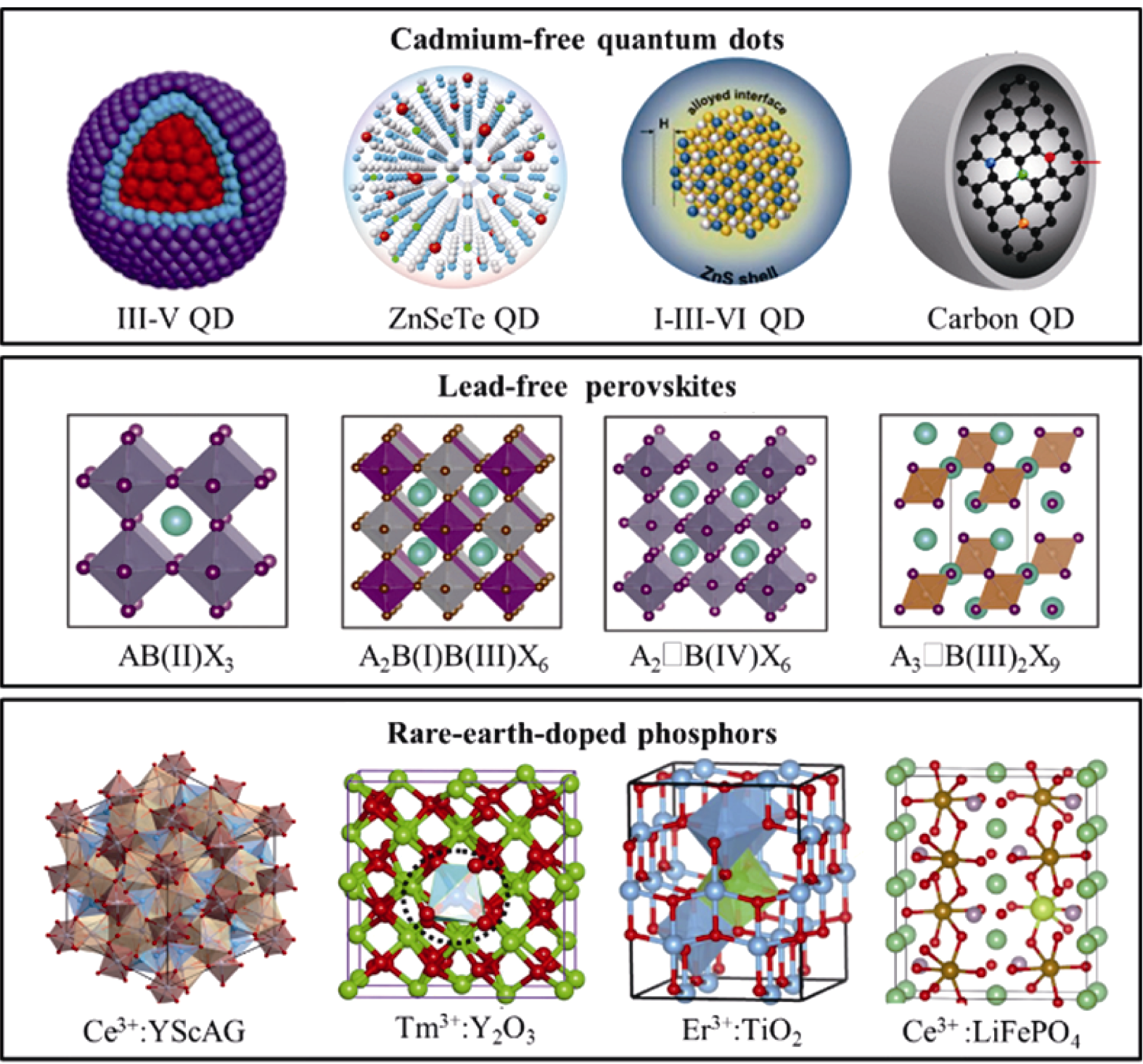
Fig. 1 Overview of environmental-friendly luminescent materials QD: quantum dot
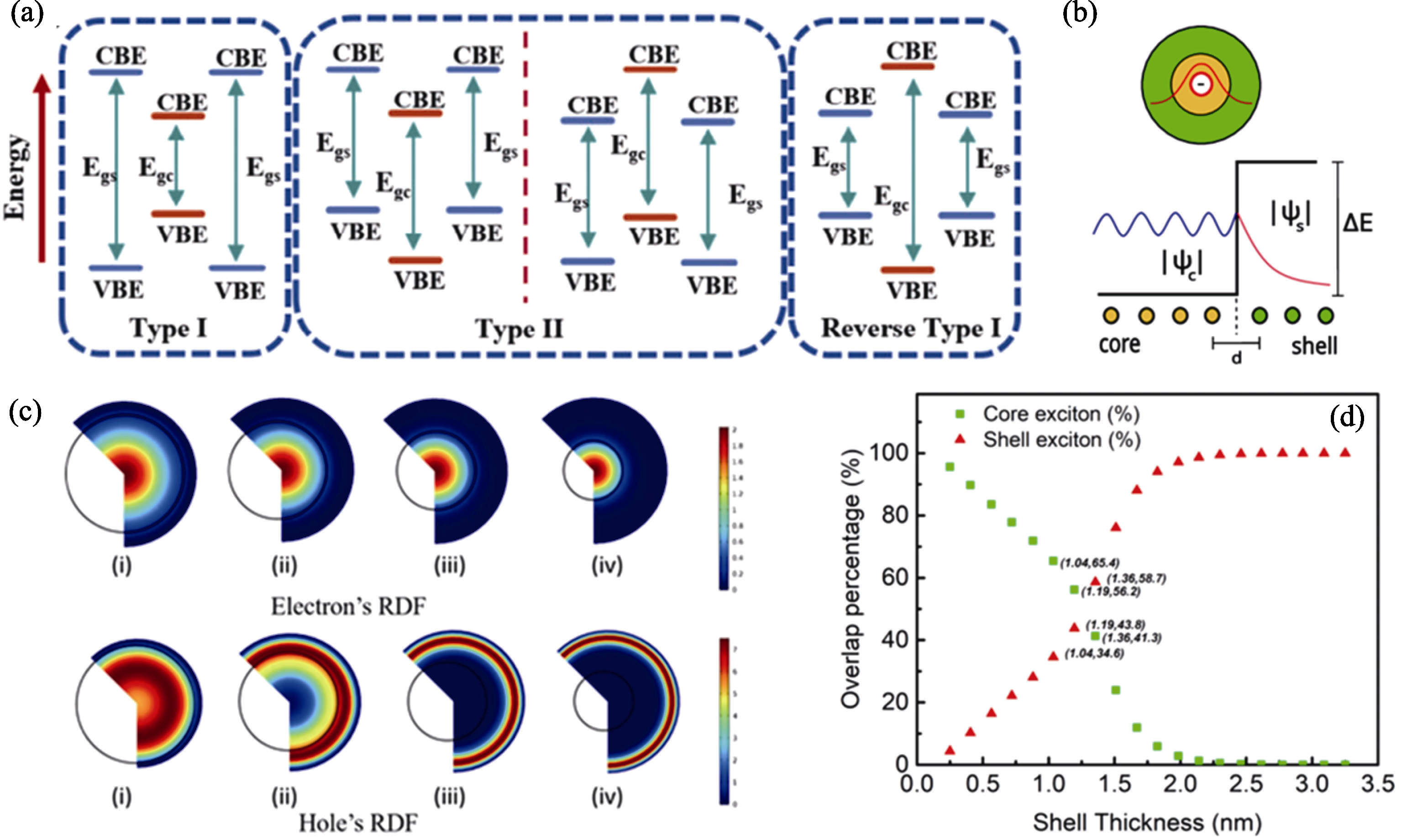
Fig. 2 Band alignment types and shell-thickness-dependent exciton distribution characteristics in core/shell quantum dots[3,73 -74] (a) Type I, type II and reverse type I band alignment (CBE: conduction band edge, VBE: valence band edge, Egc: energy band gap of core, Egs: energy band gap of shell)[3]; (b) Schematic diagram of the wave function tunneling probability estimation method[73]; (c) Electron-hole radial distribution function (RDF) of 1.75 nm CdSe core with different shell thicknesses; (d) Single exciton probability distribution vs. shell thickness (with core/shell exciton coverage)[74]
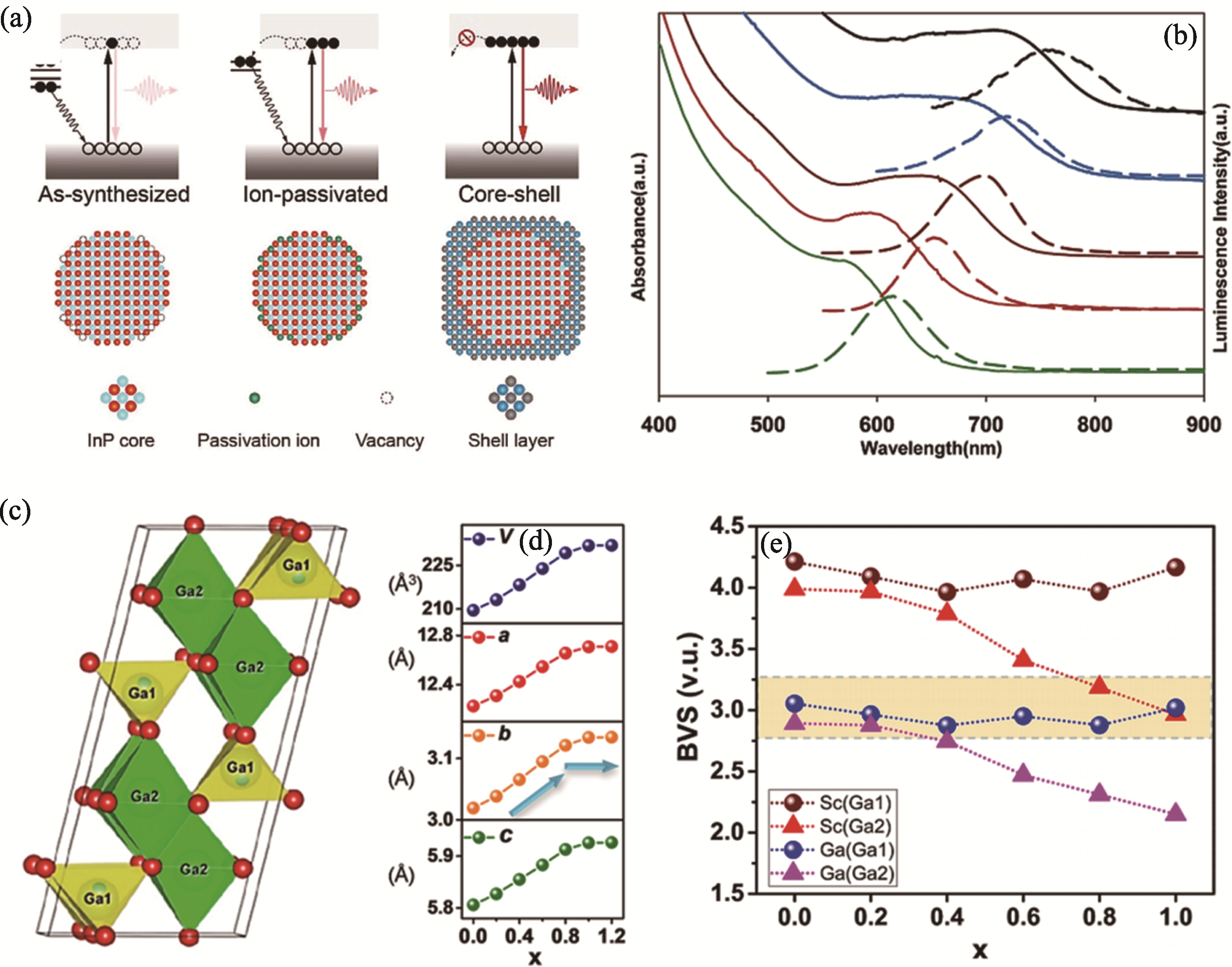
Fig. 3 Surface chemistry effects and optical properties of InP QDs and crystal structure characteristics of Ga2O3[34,76 -78] (a) Influence of different surface chemistries on carrier trapping in InP QDs[76]; (b) Absorbance and emission spectra of QDs with different compositions[77]; (c) Crystal structure of Ga2O3[34]; (d) Refined lattice parameters[78]; (e) BVS[78]
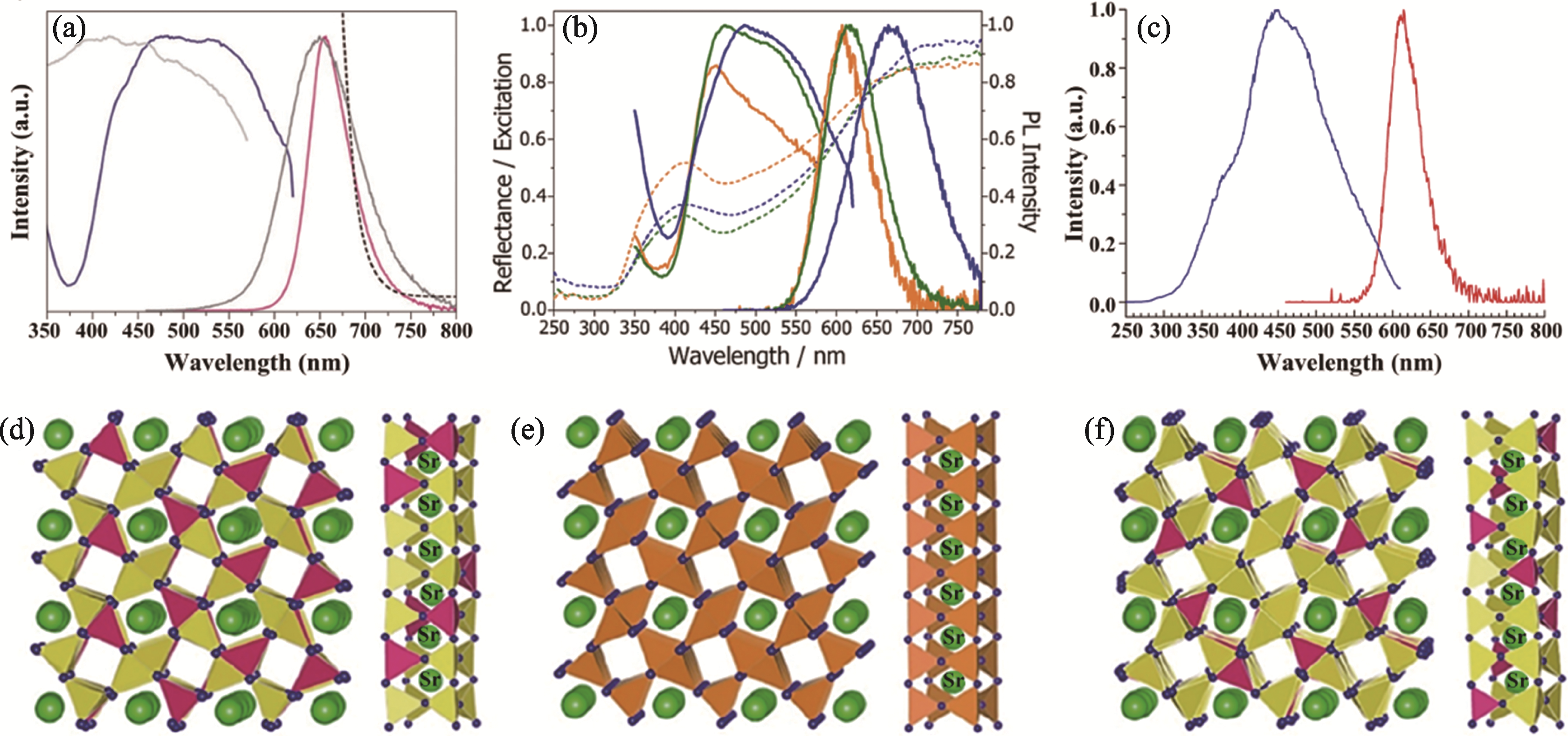
Fig. 4 Crystal structures and luminescence properties of several nitride phosphors[34,80 -82] (a) Excitation/emission spectra of SLA and CaAlSiN3:Eu2+[80]; (b) Excitation, reflectance and emission spectra of M[Mg2Al2N4]:Eu2+ (M=Ca, Sr, Ba)[81]; (c) Excitation/emission spectra of Sr[Mg3SiN4]:Eu2+[82]; (d-f) Crystal structures of (d) SrLiAl3N4, (e) SrMg2Al2N4, and (f) SrMg3SiN4[34]
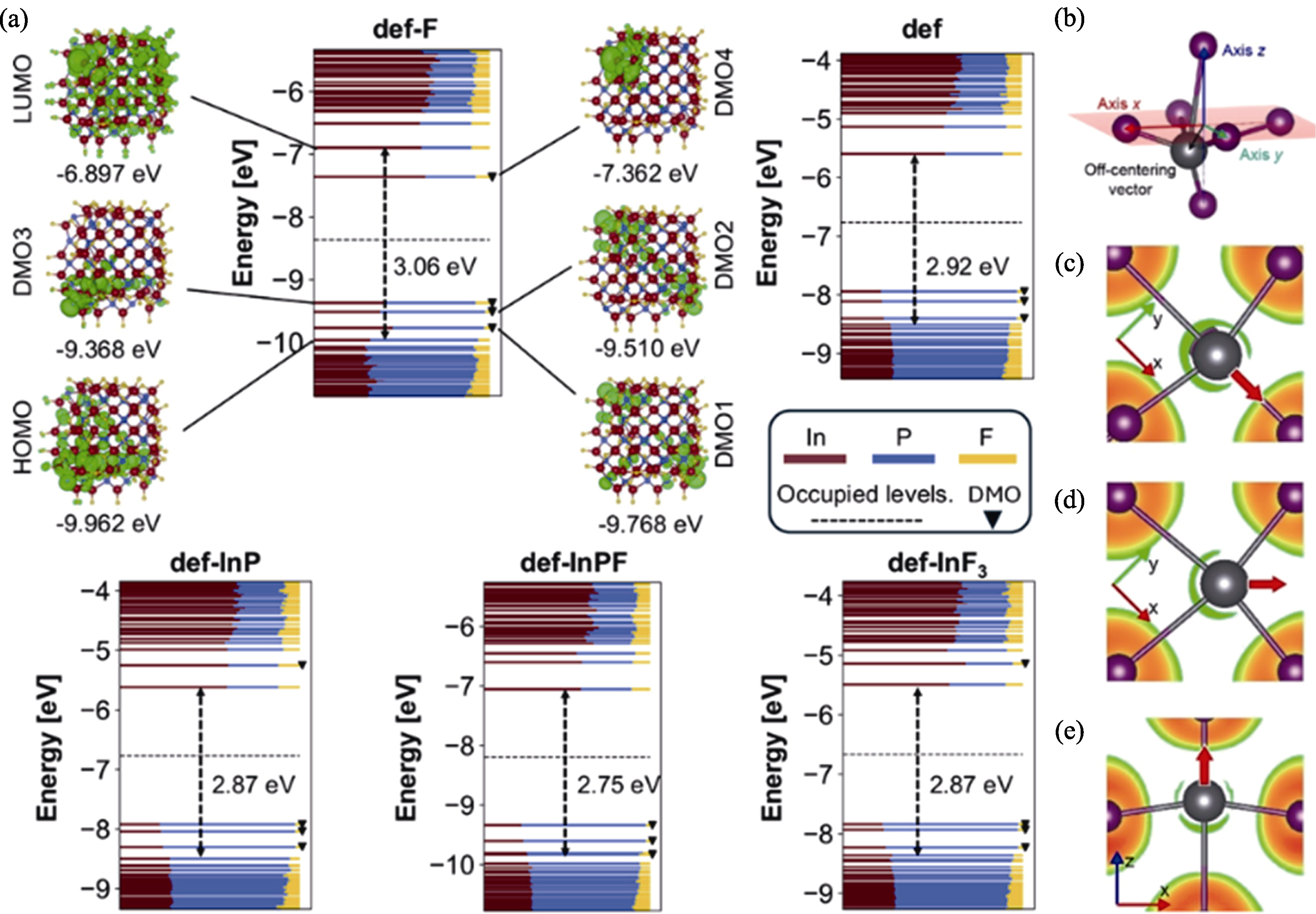
Fig. 5 Electronic structure calculations of InP QDs and structural distortion with electron localization analysis of 2D perovskites[83-84] (a) Molecular orbital energy and electron density of InP QDs in the screened configuration interaction singles (SCIS) calculations[83]; (b) Schematic of octahedral coordinate system and off-centering vector[84]; (c-e) Electron localization function contour plots under different stretchings[84]
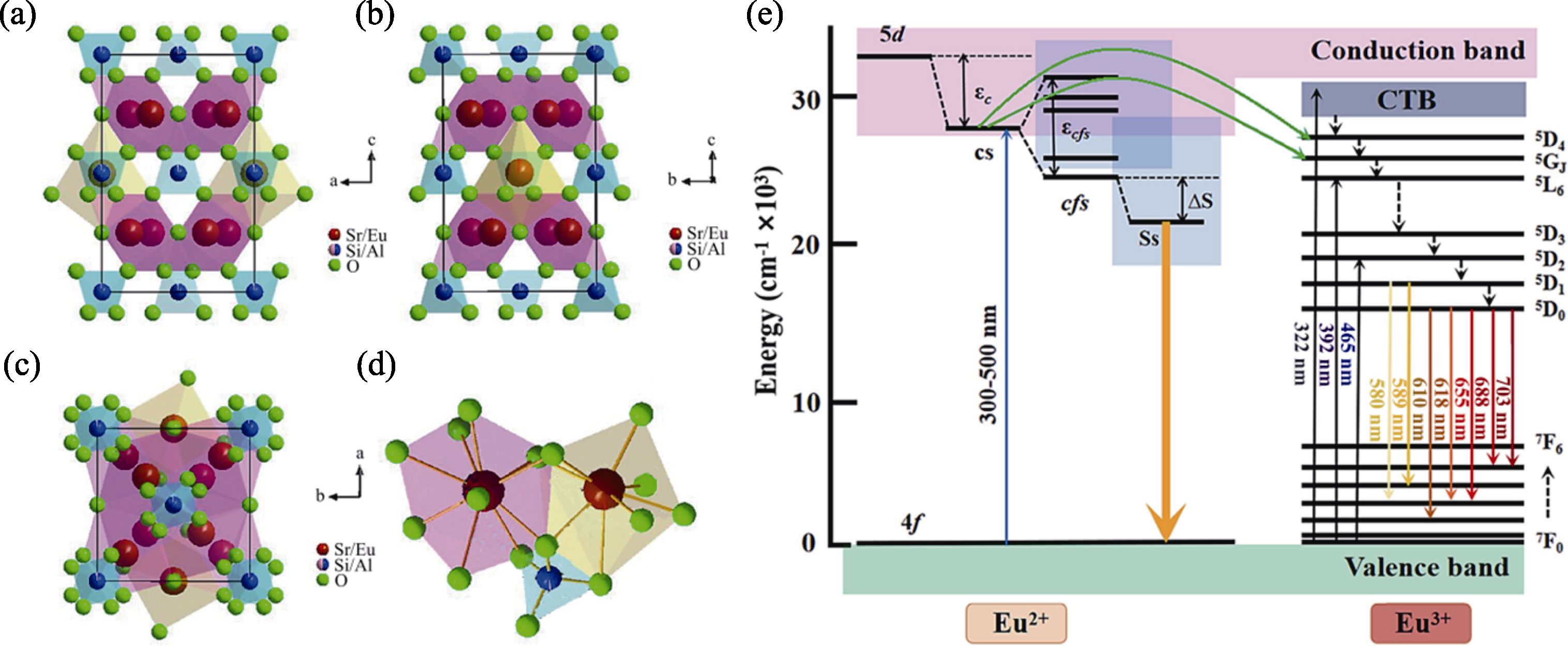
Fig. 6 Crystal structural characteristics of Sr2.945Al0.025Si0.975O5:0.03Eu2+ and energy transfer mechanism of La1-xSr2+xAl1-xSixO5:Eu phosphors[88] (a-c) Crystal structure of Sr2.945Al0.025Si0.975O5:0.03Eu2+ (different views); (d) Corresponding coordination polyhedra; (e) Schematic of Eu ion transition and energy transfer in La1-xSr2+xAl1-xSixO5:Eu
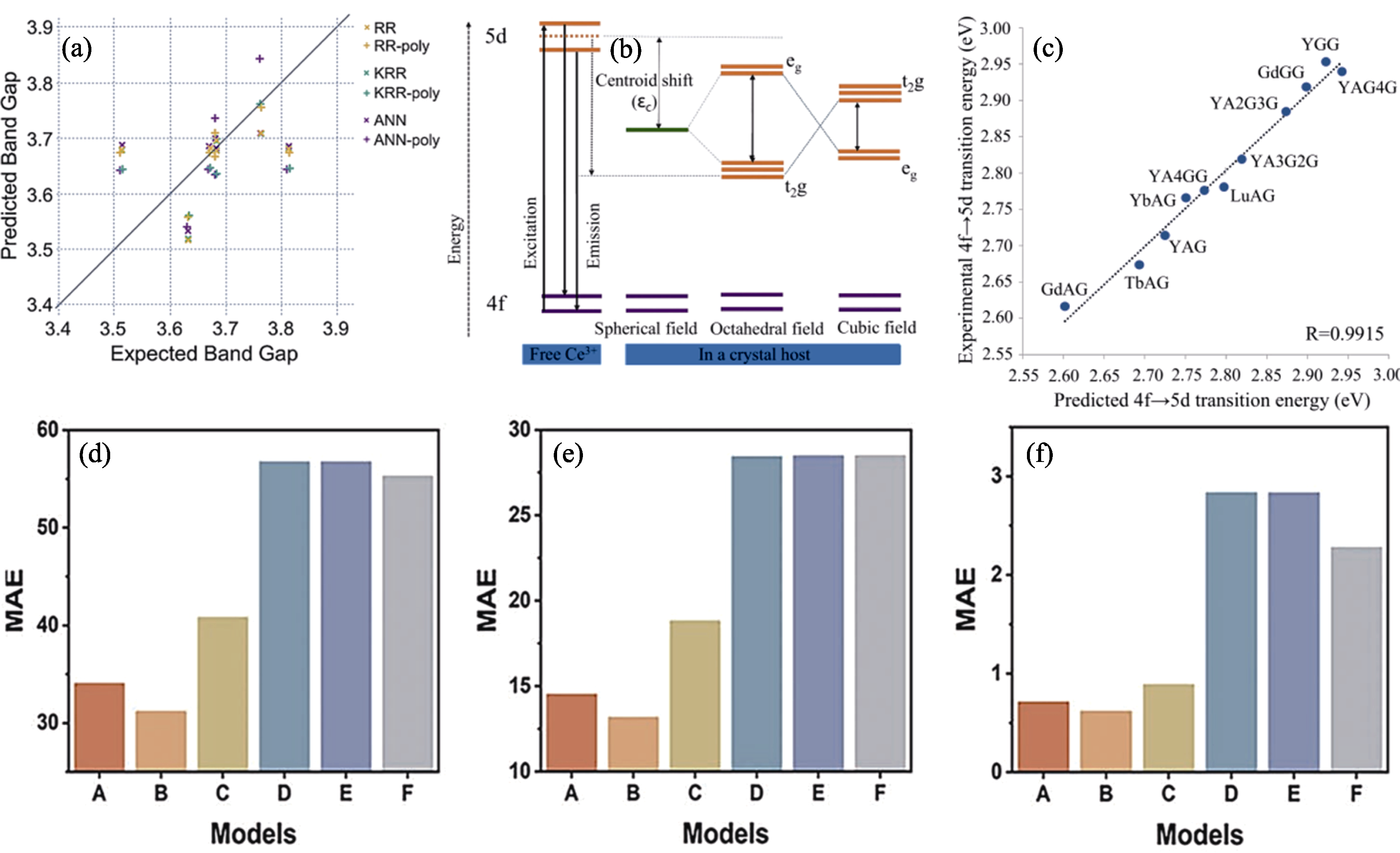
Fig. 7 Machine learning applications in band gap prediction, optical properties of Ce3+-doped crystals, and luminescence performance prediction of carbon dots[107,115,117] (a) Band gap prediction comparison of different machine learning models[107]; (b) 4f-5d energy level diagram of Ce3+ in crystals[115]; (c) Correlation between predicted and experimental Ce3+ 4f-5d transition energy[115]; (d-f) Mean absolute error (MAE) optimization of emission wavelength, quantum yield (QY) and Stokes shift by different models[117]
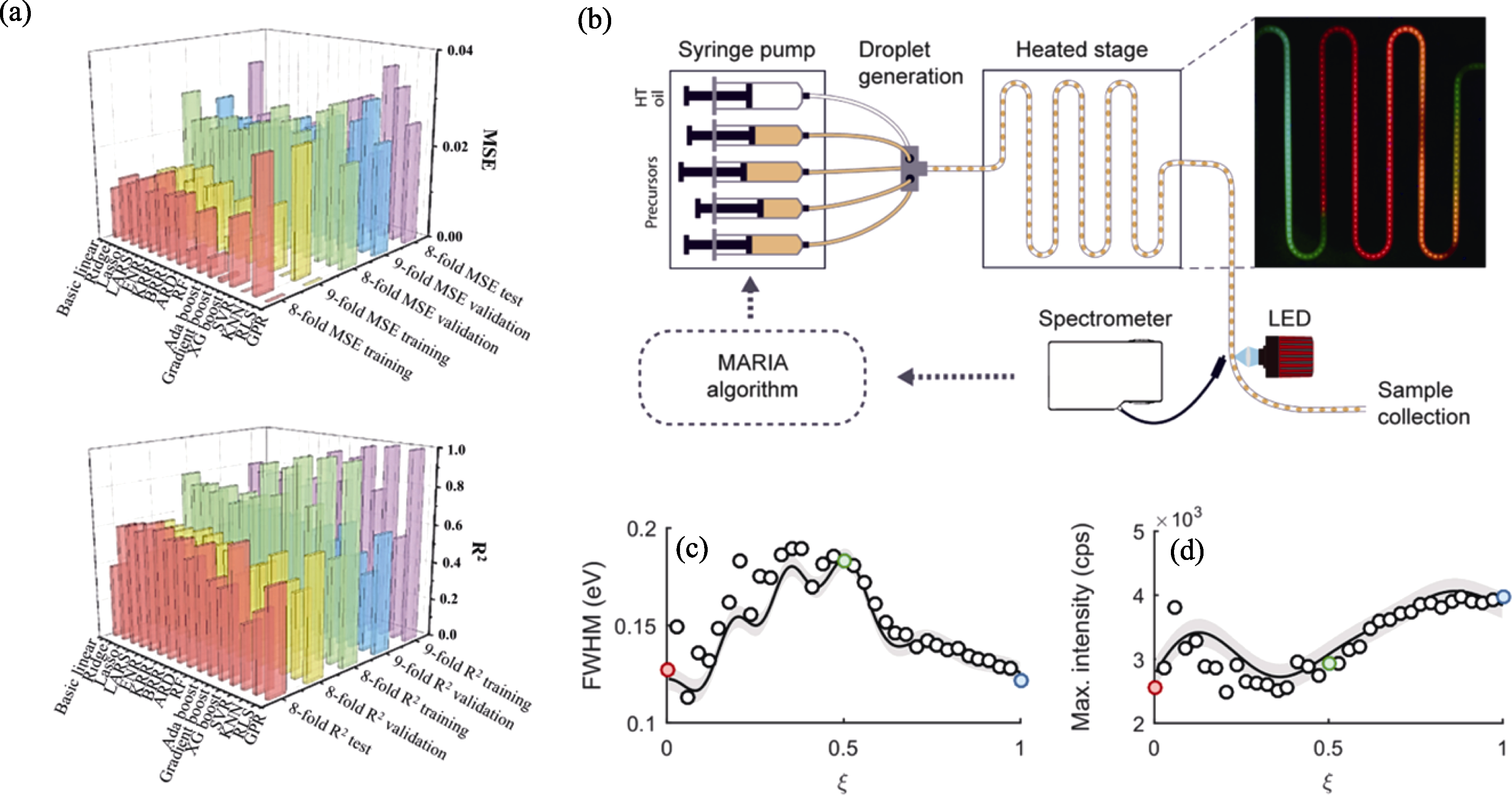
Fig. 8 Machine learning for emission wavelength prediction of Eu2+-activated phosphors and adaptive synthesis optimization of perovskite nanocrystals[118-119] (a) Training, validation and test results of peak emission wavelength (PEW) prediction[118]; (b) Synthesis setup and adaptive sampling of (Cs/FA)Pb(I/Br)3 NCs[119]; (c, d) Full width at half maximum (FWHM) and maximum intensity prediction under 680 nm emission[119]
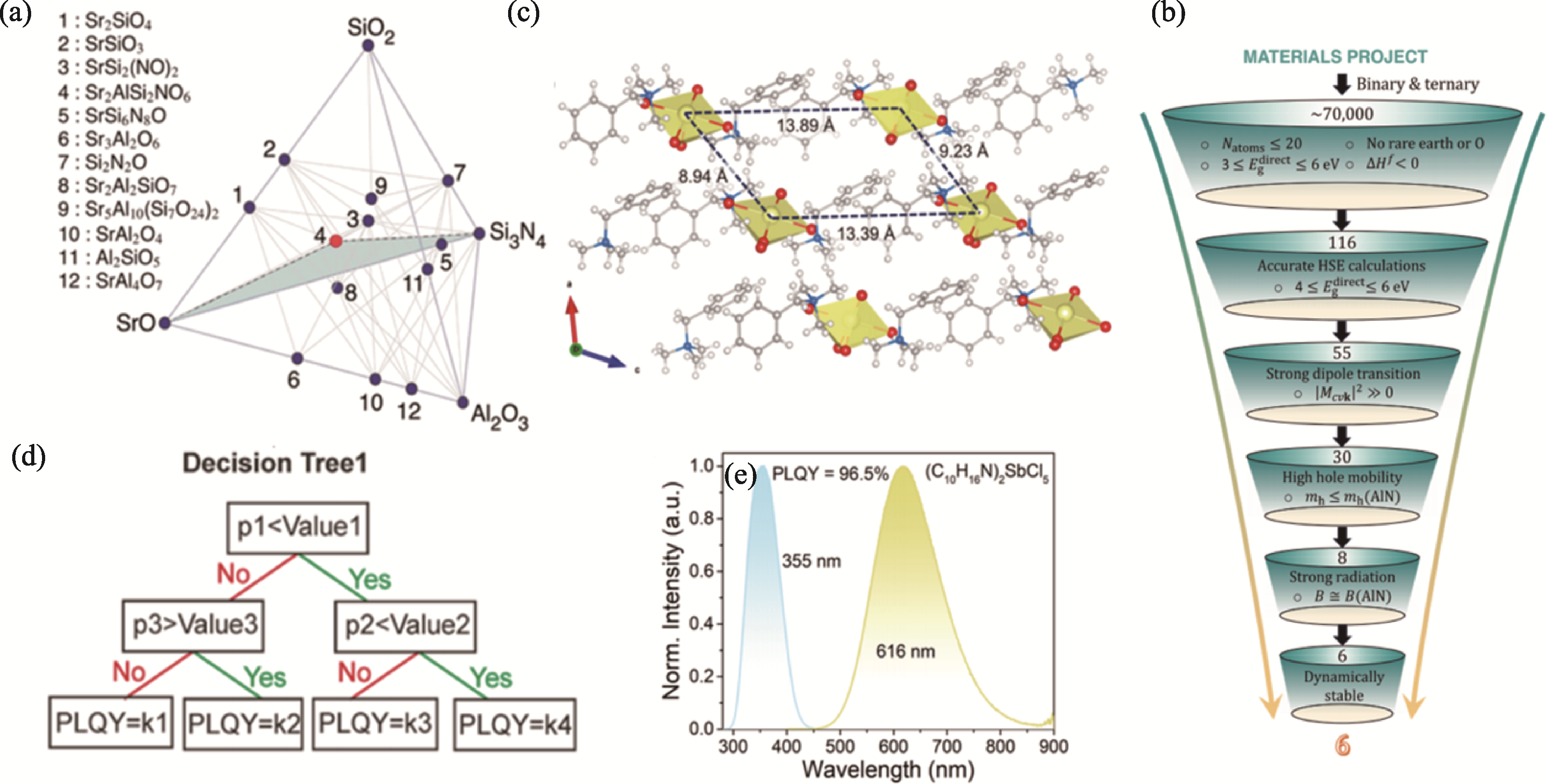
Fig. 9 Phase diagram analysis, crystal structure characterization, and computational screening strategies for novel luminescent materials[125-127] (a) 3D phase diagram of SrO-SiO2-Si3N4-Al2O3 (with new phase Sr2AlSi2O6N)[125]; (b) Computational screening workflow of deep-ultraviolet light emitters[126]; (c) Crystal structure of (C10H16N)2SbCl5[127]; (d) Schematic of random forest algorithm[127]; (e) Photoluminescence excitation (PLE) and PL spectrum of (C10H16N)2SbCl5[127]
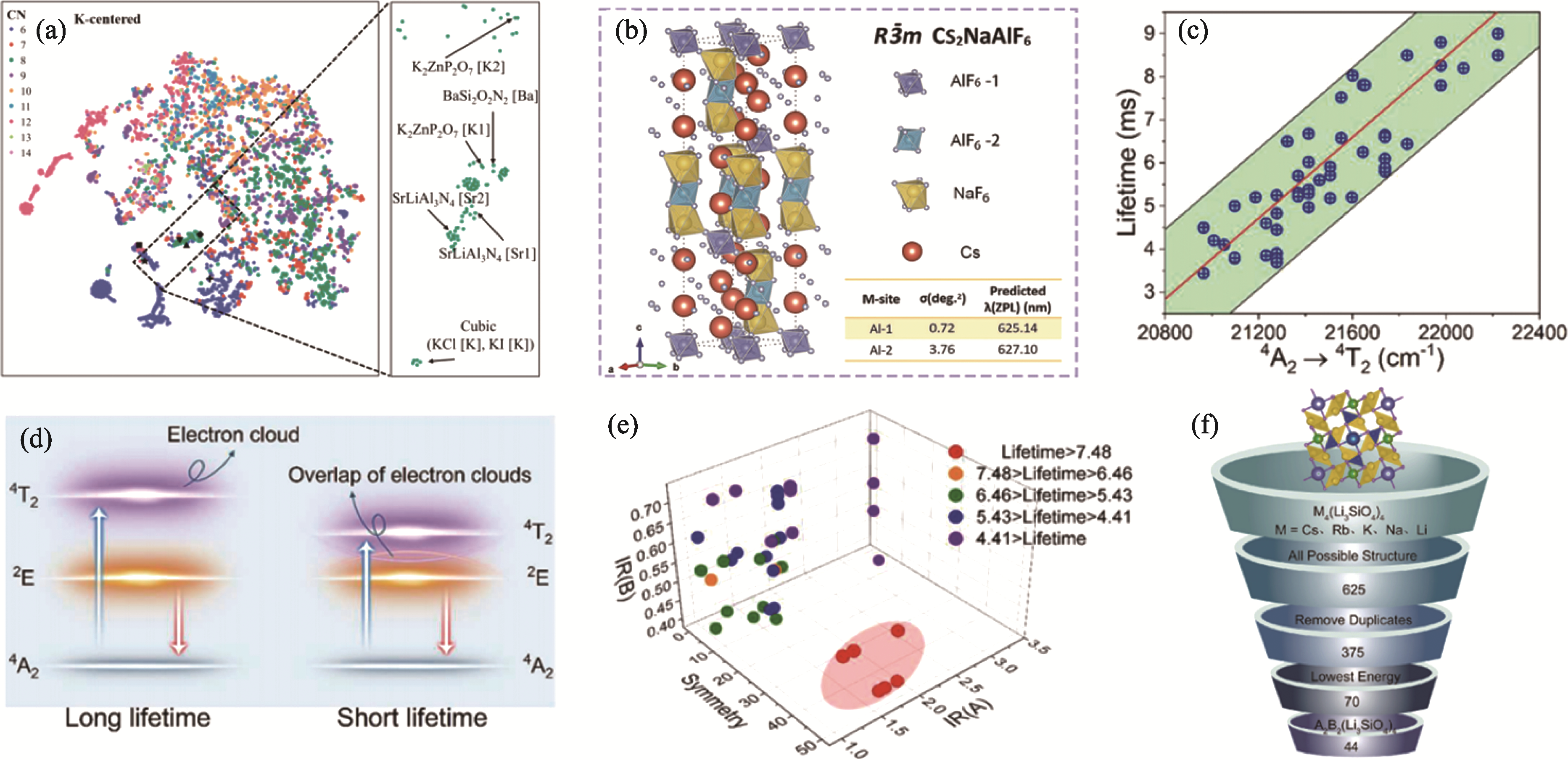
Fig. 10 Data-driven structural screening and property analysis of Eu2+-doped and Mn4+-doped phosphors[129,131,134,137] (a) 2D t-SNE plots of K-centered local structures[129]; (b) Lattice structure of the candidate CNAF[131]; (c) ESL vs. 4A2→4T2 transition energy of Mn4+-doped fluorides[134]; (d) Energy level diagram of Mn4+-activated systems (long/short ESL)[134]; (e) 3D feature space distribution of high-lifetime samples[134]; (f) Schematic of ML-based screening for narrow-band green emission candidates[137]
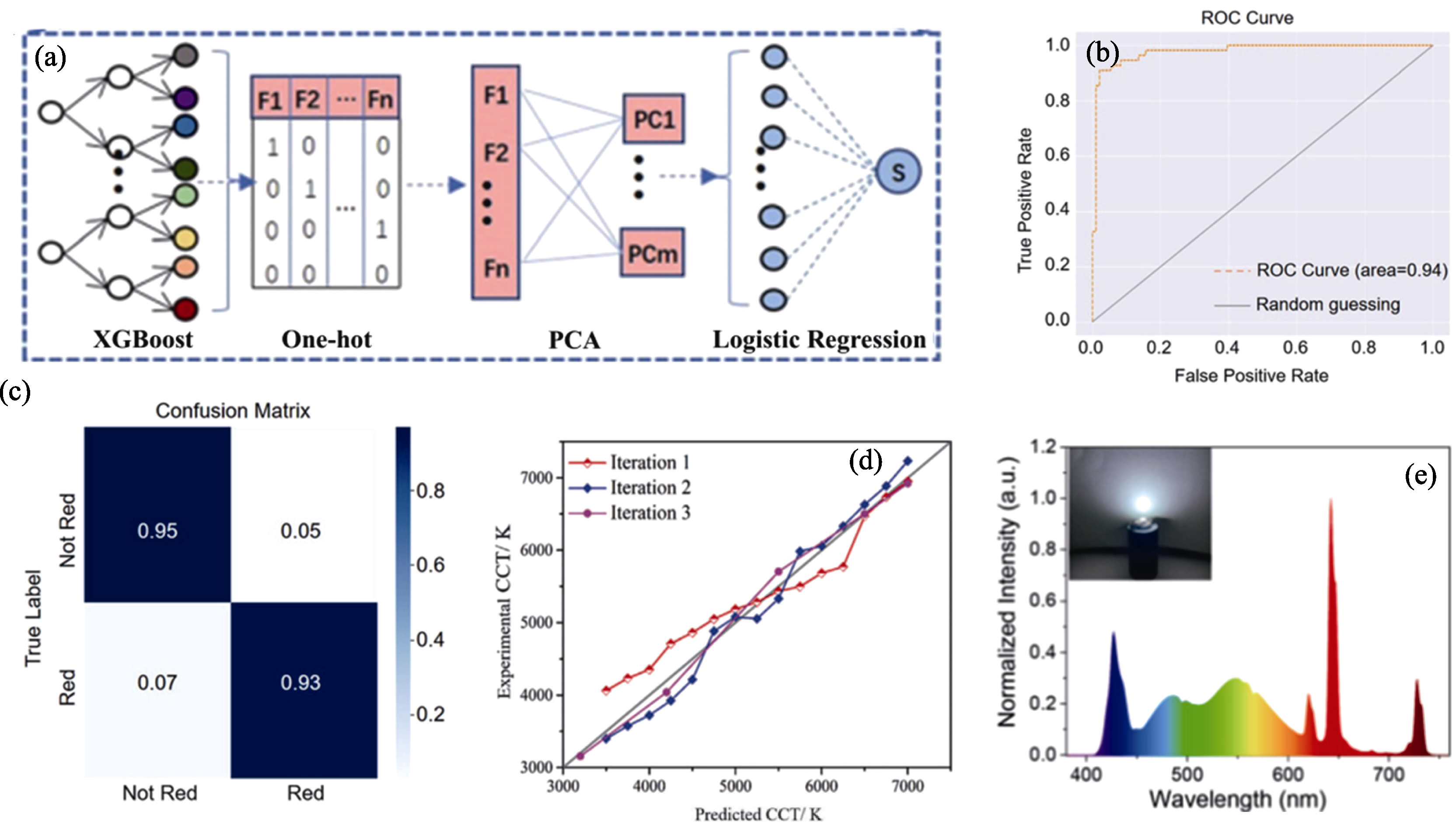
Fig. 11 Evaluation of machine learning models in property prediction of luminescent materials and LED device optimization[138,141 -142] (a) Data processing pipeline of ML model[138]; (b) Receiver operating characteristic (ROC) curve and area under the curve (AUC) of logistic regression classifier[138]; (c) Confusion matrix of the model on cross-validation[138]; (d) Comparison of predicted and experimental CCT[141]; (e) Structure and luminescence photo of white phosphor-converted light-emitting diode (pc-LED)[142]
| [1] | SHAN Q, DONG Y, XIANG H, et al. Perovskite quantum dots for the next-generation displays: progress and prospect. Advanced Functional Materials, 2024, 34(36): 2401284. |
| [2] | CHEN F, ZHENG J, XING C, et al. Applications of liquid crystal planer optical elements based on photoalignment technology in display and photonic devices. Displays, 2024, 82: 102632. |
| [3] | FAN J, HAN C, YANG G, et al. Recent progress of quantum dots light-emitting diodes: materials, device structures, and display applications. Advanced Materials, 2024, 36(37): 2312948. |
| [4] | AHMED T, SETH S, SAMANTA A. Boosting the photoluminescence of CsPbX3 (X=Cl, Br, I) perovskite nanocrystals covering a wide wavelength range by postsynthetic treatment with tetrafluoroborate salts. Chemistry of Materials, 2018, 30(11): 3633. |
| [5] | YIN J, ZHANG J, PAN W, et al. Fully aqua-mediated ripening of perovskite quantum dots with 98% PLQY and self-assembly into bioimaging nanoparticles. Advanced Functional Materials, 2026, 36(7): e14590. |
| [6] | VARNAKAVI N, VELPUGONDA J L, LEE N, et al. In situ synthesis of Br-rich CsPbBr3 nanoplatelets: enhanced stability and high PLQY for wide color gamut displays. Advanced Functional Materials, 2025, 35(3): 2413320. |
| [7] | AFTABUZZAMAN M, BHOYAR T, JEONG S, et al. Near-unity PLQY in lead-free halide perovskites and perovskite-inspired halides for light-emitting diode applications. ACS Energy Letters, 2025, 10(9): 4439. |
| [8] | WANG P J, MORALES-MÁRQUEZ R, CERVÁS G, et al. The role of temperature in the photoluminescence quantum yield (PLQY) of Ag2S-based nanocrystals. Materials Horizons, 2024, 11(23): 6158. |
| [9] | YUAN G, LI M, YU M, et al. , In situ synthesis enhanced luminescence and application in dye sensitized solar cells of Y2O3/Y2O2S:Eu3+ nanocomposites by reduction of Y2O3:Eu3+. Scientific Reports, 2016, 6: 37133. |
| [10] | HOU L, HU S, ZHANG B, et al. Spacing controlled quantum resonance in colloidal CdSe quantum dot superlattices. The Journal of Physical Chemistry Letters, 2025, 16(32): 8290. |
| [11] | NGUYEN H A, HAMMEL B F, SHARP D, et al. Colossal core/shell CdSe/CdS quantum dot emitters. ACS Nano, 2024, 18(31): 20726. |
| [12] | DOU W, GONG Y, HUANG X, et al. CdSe quantum dots enable high thermoelectric performance in solution-processed polycrystalline SnSe. Small, 2024, 20(28): 2311153. |
| [13] | YANG Z, YAO J, XU L, et al. Designer bright and fast CsPbBr3 perovskite nanocrystal scintillators for high-speed X-ray imaging. Nature Communications, 2024, 15: 8870. |
| [14] | MEHRA S, PANDEY R, MADAN J, et al. Experimental and theoretical investigations of MAPbX3-based perovskites (X=Cl, Br, I) for photovoltaic applications. ChemistryOpen, 2024, 13(2): e202300055. |
| [15] | TORRENCE C E, LIBBY C S, NIE W, et al. Environmental and health risks of perovskite solar modules: case for better test standards and risk mitigation solutions. iScience, 2022, 26(1): 105807. |
| [16] | HE H, DENG S, LIU Y. Environmentally friendly synthesis of quantum dots and their applications in diverse fields from the perspective of environmental compliance: a review. Discover Nano, 2025, 20(1): 132. |
| [17] | MEI L, XIE R, ZHU S, et al. Neurotoxicity study of lead-based perovskite nanoparticles. Nano Today, 2023, 50: 101830. |
| [18] | FAUSIA K H, NHARANGATT B, VINAYAKAN R N, et al. Probing the structural degradation of CsPbBr3 perovskite nanocrystals in the presence of H2O and H2S: how weak interactions and HSAB matter. ACS Omega, 2024, 9(7): 8417. |
| [19] | KALNAITYTĖ-VENGELIENĖ A, MONTVYDIENĖ D, JANUŠKAITĖ E, et al. The effects of CdSe/ZnS quantum dots on autofluorescence properties and growth of algae Desmodesmus communis: dependence on cultivation medium. Environmental Science: Nano, 2024, 11(4): 1701. |
| [20] | HU L, ZHONG H, HE Z. Toxicity evaluation of cadmium- containing quantum dots: a review of optimizing physicochemical properties to diminish toxicity. Colloids and Surfaces B: Biointerfaces, 2021, 200: 111609. |
| [21] | YUE Z, GUO H, CHENG Y. Toxicity of perovskite solar cells. Energies, 2023, 16(10): 4007. |
| [22] | SABAHI N, SHAHROOSVAND H. Shedding light on the environmental impact of the decomposition of perovskite solar cell. Scientific Reports, 2023, 13: 18004. |
| [23] | GIROUX M S, ZAHRA Z, SALAWU O A, et al. Assessing the environmental effects related to quantum dot structure, function, synthesis and exposure. Environmental Science: Nano, 2022, 9(3): 867. |
| [24] | DOWNIE D H, ELING C J, CHARLTON B K, et al. Recycling self-assembled colloidal quantum dot supraparticle lasers. Optical Materials Express, 2024, 14(12): 2982. |
| [25] | JANG E, JANG H. Review: quantum dot light-emitting diodes. Chemical Reviews, 2023, 123(8): 4663. |
| [26] | PAN Y Y, PAN J L, WANG Y K, et al. III-V quantum dots: a multidimensional exploration from eco-friendly materials to near infrared optoelectronic applications. Materials Today, 2025, 85: 171. |
| [27] | CHEN T, CHEN Y, LI Y, et al. A review on multiple I-III-VI quantum dots: preparation and enhanced luminescence properties. Materials, 2023, 16(14): 5039. |
| [28] | JIN L, SELOPAL G S, TONG X, et al. Heavy-metal-free colloidal quantum dots: progress and opportunities in solar technologies. Advanced Materials, 2024, 36(33): 2402912. |
| [29] | JAIN S, BHARTI S, BHULLAR G K, et al. I-III-VI core/shell QDs: synthesis, characterizations and applications. Journal of Luminescence, 2020, 219: 116912. |
| [30] | TEKIN A, KALPAR M, TEKIN E. Exploring the potential of Sn-Ge based hybrid organic-inorganic perovskites: a density functional theory based computational screening study. The Journal of Chemical Physics, 2024, 161(7): 074703. |
| [31] | JI Y, LIN P, REN X, et al. Geometric and electronic structures of Cs2BB′X6 double perovskites: the importance of exact exchange. Physical Review Research, 2024, 6(3): 033172. |
| [32] | LI X, DU X, ZHANG P, et al. Lead-free halide perovskite Cs3Bi2Br9 single crystals for high-performance X-ray detection. Science China Materials, 2021, 64(6): 1427. |
| [33] | MENG X, JIANG J, YANG X, et al. Organic-inorganic hybrid cuprous-based metal halides with unique two-dimensional crystal structure for white light-emitting diodes. Angewandte Chemie International Edition, 2024, 63(43): e202411047. |
| [34] | FANG M H, BAO Z, HUANG W T, et al. Evolutionary generation of phosphor materials and their progress in future applications for light-emitting diodes. Chemical Reviews, 2022, 122(13): 11474. |
| [35] | MAI H, WEN X, LI X, et al. Data driven high quantum yield halide perovskite phosphors design and fabrication. Materials Today, 2024, 74: 12. |
| [36] | KUMAR U, KIM H W, SINGH S, et al. Designing Pr-based advanced photoluminescent materials using machine learning and density functional theory. Journal of Materials Science, 2024, 59: 1433. |
| [37] | XIONG Z, WANG Z, JIANG J, et al. Exploration of double perovskite luminescent materials accelerated by explainable machine learning. Physical Review Applied, 2025, 24: 014050. |
| [38] | HAN P, ZHOU W, ZHENG D, et al. Lead-free all-inorganic indium chloride perovskite variant nanocrystals for efficient luminescence. Advanced Optical Materials, 2022, 10(1): 2101344. |
| [39] | LI H, ZHANG W, BIAN Y, et al. ZnF2-assisted synthesis of highly luminescent InP/ZnSe/ZnS quantum dots for efficient and stable electroluminescence. Nano Letters, 2022, 22(10): 4067. |
| [40] | GAO M, YANG H, SHEN H, et al. Bulk-like ZnSe quantum dots enabling efficient ultranarrow blue light-emitting diodes. Nano Letters, 2021, 21(17): 7252. |
| [41] | WU Z, LIU P, ZHANG W, et al. Development of InP quantum dot-based light-emitting diodes. ACS Energy Letters, 2020, 5(4): 1095. |
| [42] | WU Q, CAO F, YU W, et al. Homogeneous ZnSeTeS quantum dots for efficient and stable pure-blue LEDs. Nature, 2025, 639(8055): 633. |
| [43] | JIANG C, TOZAWA M, AKIYOSHI K, et al. Development of Cu-In-Ga-S quantum dots with a narrow emission peak for red electroluminescence. The Journal of Chemical Physics, 2023, 158(16): 164708. |
| [44] | KIM T, KIM K H, KIM S, et al. Efficient and stable blue quantum dot light-emitting diode. Nature, 2020, 586(7829): 385. |
| [45] | WANG S, WANG C, WANG Y, et al. Local lattice softening in semiconductor quantum dots for efficient white light-emitting diodes. Nature Photonics, 2025, 19(9): 952. |
| [46] | HUANG Y, HSIANG E L, DENG M Y, et al. Mini-LED, micro-LED and OLED displays: present status and future perspectives. Light: Science & Applications, 2020, 9(1): 105. |
| [47] | LIN J Y, JIANG H X. Development of microLED. Applied Physics Letters, 2020, 116(10): 100502. |
| [48] | HSIANG E L, YANG Z, YANG Q, et al. Prospects and challenges of mini-LED, OLED, and micro-LED displays. Journal of the Society for Information Display, 2021, 29(6): 446. |
| [49] | TANG X, WENG S, HAO W, et al. Aqueous synthesis of ultrastable dual-color-emitting lead-free double-perovskite Cs2SnI6 with a wide emission span enabled by the size effect. ACS Sustainable Chemistry & Engineering, 2023, 11(24): 9121. |
| [50] | JIA H, SHI H, YU R, et al. Biuret induced tin-anchoring and crystallization-regulating for efficient lead-free tin halide perovskite light-emitting diodes. Small, 2022, 18(17): 2200036. |
| [51] | LIN H, TALEBI S, MACSWAIN W, et al. Tailoring substitutional sites for efficient lanthanide doping in lead-free perovskite nanocrystals with enhanced near-infrared photoluminescence. ACS Nano, 2025, 19(15): 14941. |
| [52] | LENG M, YANG Y, ZENG K, et al. All-inorganic bismuth-based perovskite quantum dots with bright blue photoluminescence and excellent stability. Advanced Functional Materials, 2018, 28(1): 1704446. |
| [53] | ZENG X, YIN Q, PAN L, et al. Hole delayed-release effect of inorganic interfacial dipole layer on charge balance for boosting CsCu2I3 light-emitting diodes. ACS Nano, 2025, 19(12): 11878. |
| [54] | YUAN X R, ZHANG X S, ZHAO X Y, et al. Achieving high quantum efficiency in Cs3Cu2I5 nanocrystals by the A-site ion substitution for flexible blue electroluminescence devices and enhanced photovoltaic cells. ACS Applied Nano Materials, 2024, 7(19): 23214. |
| [55] | LIU S, LIU H, ZHOU G, et al. Water-induced crystal phase transformation of stable lead-free Cu-based perovskite nanocrystals prepared by one-pot method. Chemical Engineering Journal, 2022, 427: 131430. |
| [56] | GAO F, ZHU X, FENG Q, et al. Deep-blue emissive Cs3Cu2I5 perovskites nanocrystals with 96.6% quantum yield via InI3-assisted synthesis for light-emitting device and fluorescent ink applications. Nano Energy, 2022, 98: 107270. |
| [57] | MA Z, JI X, WANG M, et al. Carbazole-containing polymer- assisted trap passivation and hole-injection promotion for efficient and stable CsCu2I3-based yellow LEDs. Advanced Science, 2022, 9(27): 2202408. |
| [58] | DING H, LIU Z, HU P, et al. High efficiency green-emitting LuAG:Ce ceramic phosphors for laser diode lighting. Advanced Optical Materials, 2021, 9(8): 2002141. |
| [59] | LI Y, LUO Z, LIU Y, et al. Ce:YScAG phosphor-converted transparent ceramics with high thermal saturation and weak concentration quenching for LED and LD white lighting. Ceramics International, 2023, 49(2): 2051. |
| [60] | INFANTE I, MANNA L. Are there good alternatives to lead halide perovskite nanocrystals? Nano Letters, 2021, 21(1): 6. |
| [61] | DE FRANCO M, ZHU D X, ASAITHAMBI A, et al. Near-infrared light-emitting diodes based on RoHS-compliant InAs/ZnSe colloidal quantum dots. ACS Energy Letters, 2022, 7(11): 3788. |
| [62] | JALALI H B, DE TRIZIO L, MANNA L, et al. Indium arsenide quantum dots: an alternative to lead-based infrared emitting nanomaterials. Chemical Society Reviews, 2022, 51(24): 9861. |
| [63] | PAN Q Y, ZHAO Q, WEI P X, et al. Surface ligands for perovskite quantum dots. ChemSusChem, 2025, 18(4): e202401875. |
| [64] | LIU J H, YANG Z X, YE B Q, et al. A review of stability- enhanced luminescent materials: fabrication and optoelectronic applications. Journal of Materials Chemistry C, 2019, 7(17): 4934. |
| [65] | LI M, ZHANG X, YANG P. Controlling the growth of a SiO2 coating on hydrophobic CsPbBr3 nanocrystals towards aqueous transfer and high luminescence. Nanoscale, 2021, 13(8): 3860. |
| [66] | WANG Q Q, ZHANG X Y, QIAN L, et al. Improving perovskite green quantum dot light-emitting diode performance by hole interface buffer layers. ACS Applied Materials & Interfaces, 2023, 15(23): 28833. |
| [67] | WANG Z T, CHEN C, LIAN K, et al. Double-matrix encapsulation of cyan perovskite nanomaterials for high-efficiency full-spectrum white light-emitting diodes. ACS Applied Nano Materials, 2024, 7(23): 27154. |
| [68] | XUAN T T, HUANG J J, LIU H, et al. Super-hydrophobic cesium lead halide perovskite quantum dot-polymer composites with high stability and luminescent efficiency for wide color gamut white light-emitting diodes. Chemistry of Materials, 2019, 31(3): 1042. |
| [69] | GUO T H, WANG H, HAN W H, et al. Designed p-type graphene quantum dots to heal interface charge transfer in Sn-Pb perovskite solar cells. Nano Energy, 2022, 98: 107298. |
| [70] | ZHANG W D, DUAN X J, TAN Y Z, et al. Giant pyramidal near-infrared InP/ZnS quantum dots with size over 15 nm for cell imaging. Laser & Photonics Reviews, 2024, 18(10): 2400367. |
| [71] | WANG J F, BA G H, MENG J, et al. Transition layer assisted synthesis of defect free amine-phosphine based InP QDs. Nano Letters, 2024, 24(29): 8894. |
| [72] | IVANOV S A, PIRYATINSKI A, NANDA J, et al. Type-II core/shell CdS/ZnSe nanocrystals: synthesis, electronic structures, and spectroscopic properties. Journal of the American Chemical Society, 2007, 129(38): 11708. |
| [73] | KICK M, ALEXANDER E, VAN VOORHIS T. Band alignment in core-shell nanocrystals by estimating wave function tunneling probabilities. Nano Letters, 2025, 25(42): 15272. |
| [74] | NANDAN Y, MEHATA M S. Wavefunction engineering of type-I/type-II excitons of CdSe/CdS core-shell quantum dots. Scientific Reports, 2019, 9: 2. |
| [75] | CAO Y W, BANIN U. Growth and properties of semiconductor core/shell nanocrystals with InAs cores. Journal of the American Chemical Society, 2000, 122(40): 9692. |
| [76] | CHEN B, LI D Y, WANG F. InP quantum dots: synthesis and lighting applications. Small, 2020, 16(32): 2002454. |
| [77] | KIM S W, ZIMMER J P, OHNISHI S, et al. Engineering InAsxP1-x/InP/ZnSe III-V alloyed core/shell quantum dots for the near-infrared. Journal of the American Chemical Society, 2005, 127(30): 10526. |
| [78] | FANG M H, CHEN K C, MAJEWSKA N, et al. Hidden structural evolution and bond valence control in near-infrared phosphors for light-emitting diodes. ACS Energy Letters, 2021, 6(1): 109. |
| [79] | KIMOTO K, XIE R J, MATSUI Y, et al. Direct observation of single dopant atom in light-emitting phosphor of β-SiAlON:Eu2+. Applied Physics Letters, 2009, 94(4): 041908. |
| [80] | PUST P, WEILER V, HECHT C, et al. Narrow-band red-emitting Sr[LiAl3N4]:Eu2+ as a next-generation LED-phosphor material. Nature Materials, 2014, 13: 891. |
| [81] | PUST P, HINTZE F, HECHT C, et al. Group (III) nitrides M[Mg2Al2N4] (M=Ca, Sr, Ba, Eu) and Ba[Mg2Ga2N4]—structural relation and nontypical luminescence properties of Eu2+ doped samples. Chemistry of Materials, 2014, 26(21): 6113. |
| [82] | SCHMIECHEN S, SCHNEIDER H, WAGATHA P, et al. Toward new phosphors for application in illumination-grade white pc-LEDs: the nitridomagnesosilicates Ca[Mg3SiN4]:Ce3+Sr[Mg3SiN4]:Eu2+and Eu[Mg3SiN4]. Chemistry of Materials, 2014, 26(8): 2712. |
| [83] | KUMAR S, COCCHI C, STEENBOCK T. Surface defects and symmetry breaking impact on the photoluminescence of InP quantum dots. Nano Letters, 2025, 25(26): 10588. |
| [84] | GU J Z, TAO Y, FU T H, et al. Correlating photophysical properties with stereochemical expression of 6s2 lone pairs in two-dimensional lead halide perovskites. Angewandte Chemie International Edition, 2023, 62(30): e202304515. |
| [85] | XU N, QI X, SHEN Z, et al. Point defects in metal halide perovskites. Nature Reviews Physics, 2025, 7: 554. |
| [86] | ZOU Y, YUAN Z, BAI S, et al. Recent progress toward perovskite light-emitting diodes with enhanced spectral and operational stability. Materials Today Nano, 2019, 5: 100028. |
| [87] | TSAI Y T, CHIANG C Y, ZHOU W, et al. Structural ordering and charge variation induced by cation substitution in (Sr,Ca)AlSiN3:Eu phosphor. Journal of the American Chemical Society, 2015, 137(28): 8936. |
| [88] | MAO A, GUO Y, ZHOU W, et al. Crystal field engineering inducing transformation from narrow band of Eu3+ to broadband of Eu2+. Inorganic Chemistry, 2024, 63(35): 16134. |
| [89] | XU L L, LIU G Y, XIANG H Y, et al. Charge-carrier dynamics and regulation strategies in perovskite light-emitting diodes: from materials to devices. Applied Physics Reviews, 2022, 9(2): 021308. |
| [90] | BOGO N, STEIN C J. Benchmarking DFT-based excited-state methods for intermolecular charge-transfer excitations. Physical Chemistry Chemical Physics, 2024, 26(32): 21575. |
| [91] | BERTONI A I, SÁNCHEZ C G. Data-driven approach for benchmarking DFTB-approximate excited state methods. Physical Chemistry Chemical Physics, 2023, 25(5): 3789. |
| [92] | DE WERGIFOSSE M. Computing excited states of very large systems with range-separated hybrid functionals and the exact integral simplified time-dependent density functional theory (XsTD-DFT). The Journal of Physical Chemistry Letters, 2024, 15(51): 12628. |
| [93] | LEE S, PARK W, CHOI C H. Expanding horizons in quantum chemical studies: the versatile power of MRSF-TDDFT. Accounts of Chemical Research, 2025, 58(2): 208. |
| [94] | SINYAVSKIY A, MALIŠ M, LUBER S. Bridging the gap between variational and perturbational DFT-based methods for calculating excited states. Journal of Chemical Theory and Computation, 2025, 21(15): 7430. |
| [95] | CASTRO A, MARQUES M A L, RUBIO A. Propagators for the time-dependent Kohn-Sham equations. The Journal of Chemical Physics, 2004, 121(8): 3425. |
| [96] | GROSS E K U, KOHN W. Time-dependent density-functional theory. Advances in Quantum Chemistry, 1990, 21: 255. |
| [97] | ZHU Y F, PENG J W, XU C, et al. Unsupervised machine learning in the analysis of nonadiabatic molecular dynamics simulation. The Journal of Physical Chemistry Letters, 2024, 15(38): 9601. |
| [98] | KÜHNE T D, IANNUZZI M, DEL BEN M, et al. CP2K: an electronic structure and molecular dynamics software package- quickstep: efficient and accurate electronic structure calculations. The Journal of Chemical Physics, 2020, 152(19): 194103. |
| [99] | JIA W L, CAO Z Y, WANG L, et al. The analysis of a plane wave pseudopotential density functional theory code on a GPU machine. Computer Physics Communications, 2013, 184(1): 9. |
| [100] | HAN P P, MIN J J, ZENG Z P, et al. Excitonic characteristics of blue-emitting quantum dot materials in group II-VI using hybrid time-dependent density functional theory. Physical Review B, 2021, 104(4): 045404. |
| [101] | ZHANG B F, ZHANG H, LIN J H, et al. A time-dependent density functional study on optical response in all-inorganic lead-halide perovskite nanostructures. International Journal of Quantum Chemistry, 2020, 120(13): e26232. |
| [102] | GRIMME S, BANNWARTH C. Ultra-fast computation of electronic spectra for large systems by tight-binding based simplified Tamm-Dancoff approximation (sTDA-xTB). The Journal of Chemical Physics, 2016, 145(5): 054103. |
| [103] | AKKERMAN Q A, BLADT E, PETRALANDA U, et al. Fully inorganic Ruddlesden-Popper double Cl-I and triple Cl-Br-I lead halide perovskite nanocrystals. Chemistry of Materials, 2019, 31(6): 2182. |
| [104] | FILATOV M, HUIX-ROTLLANT M. Assessment of density functional theory based ΔSCF (self-consistent field) and linear response methods for longest wavelength excited states of extended π-conjugated molecular systems. The Journal of Chemical Physics, 2014, 141(2): 024112. |
| [105] | HEAD-GORDON M, RICO R J, OUMI M, et al. A doubles correction to electronic excited states from configuration interaction in the space of single substitutions. Chemical Physics Letters, 1994, 219(1/2): 21. |
| [106] | JI Z M, SONG Z G. Exciton radiative lifetime in CdSe quantum dots. Journal of Semiconductors, 2023, 44(3): 032702. |
| [107] | REGONIA P R, PELICANO C M, TANI R, et al. Predicting the band gap of ZnO quantum dots via supervised machine learning models. Optik, 2020, 207: 164469. |
| [108] | JIANG L, JIANG X, ZHANG Y, et al. Multiobjective machine learning-assisted discovery of a novel cyan-green garnet: Ce phosphors with excellent thermal stability. ACS Applied Materials & Interfaces, 2022, 14(13): 15426. |
| [109] | WANG X, WANG B, WANG H S, et al. Carbon-dot-based white-light-emitting diodes with adjustable correlated color temperature guided by machine learning. Angewandte Chemie International Edition, 2021, 60(22): 12585. |
| [110] | SETYAWAN W, GAUME R M, LAM S, et al. High-throughput combinatorial database of electronic band structures for inorganic scintillator materials. ACS Combinatorial Science, 2011, 13(4): 382. |
| [111] | MARCHENKO E I, FATEEV S A, PETROV A A, et al. Database of two-dimensional hybrid perovskite materials: open-access collection of crystal structures, band gaps, and atomic partial charges predicted by machine learning. Chemistry of Materials, 2020, 32(17): 7383. |
| [112] | SIVONXAY E, ATTIA L, SPOTTE-SMITH E W C, et al. Gradient-based optimization of complex nanoparticle heterostructures enabled by deep learning on heterogeneous graphs. Nature Computational Science, 2026, 6: 83. |
| [113] | DRAXL C, SCHEFFLER M. NOMAD: the FAIR concept for big data-driven materials science. MRS Bulletin, 2018, 43(9): 676. |
| [114] | KIRKLIN S, SAAL J E, MEREDIG B, et al. The open quantum materials database (OQMD): assessing the accuracy of DFT formation energies. npj Computational Materials, 2015, 1: 15010. |
| [115] | MOHD R N I B, NOVITA M, OGASAWARA K. Two-step model for predicting 4f→5d transition energies of Ce3+ in garnet-type oxides based on first-principles calculations and machine learning. Optical Materials, 2025, 159: 116653. |
| [116] | ZHUO Y, HARIYANI S, YOU S, et al. Machine learning 5d-level centroid shift of Ce3+ inorganic phosphors. Journal of Applied Physics, 2020, 128(1): 013104. |
| [117] | CHEN J, LUO J B, HU M Y, et al. Controlled synthesis of multicolor carbon dots assisted by machine learning. Advanced Functional Materials, 2023, 33(2): 2210095. |
| [118] | PARK C, LEE J W, KIM M, et al. A data-driven approach to predicting band gap, excitation, and emission energies for Eu2+- activated phosphors. Inorganic Chemistry Frontiers, 2021, 8(21): 4610. |
| [119] | BEZINGE L, MACEICZYK R M, LIGNOS I, et al. Pick a color MARIA: adaptive sampling enables the rapid identification of complex perovskite nanocrystal compositions with defined emission characteristics. ACS Applied Materials & Interfaces, 2018, 10(22): 18869. |
| [120] | WANG X, WANG B, WANG H, et al. Carbon-dot-based white- light-emitting diodes with adjustable correlated color temperature guided by machine learning. Angewandte Chemie International Edition, 2021, 60(22): 12585. |
| [121] | KRUGLOV I A, BEREZNIKOVA L A, XIE C, et al. Graph neural network guided design of novel deep-ultraviolet optical materials with high birefringence. Science China Materials, 2024, 67(12): 3941. |
| [122] | TAN Z, LI Y, WU X, et al. De novo creation of fluorescent molecules via adversarial generative modeling. RSC Advances, 2023, 13(2): 1031. |
| [123] | XIE A L, ZHANG Z Q, GUAN J H, et al. Self-supervised learning with chemistry-aware fragmentation for effective molecular property prediction. Briefings in Bioinformatics, 2023, 24(5): bbad296. |
| [124] | MOORE G J, BARDAGOT O, BANERJI N. Deep transfer learning: a fast and accurate tool to predict the energy levels of donor molecules for organic photovoltaics. Advanced Theory and Simulations, 2022, 5(5): 2100511. |
| [125] | LI S, XIA Y, AMACHRAA M, et al. Data-driven discovery of full-visible-spectrum phosphor. Chemistry of Materials, 2019, 31(16): 6286. |
| [126] | XU X, LIANG H P, HUANG Q S, et al. Computational screening of promising deep-ultraviolet light emitters. Journal of the American Chemical Society, 2024, 146(18): 12864. |
| [127] | MOLOKEEV M S, SU B, ALEKSANDROVSKY A S, et al. Machine learning analysis and discovery of zero-dimensional ns2 metal halides toward enhanced photoluminescence quantum yield. Chemistry of Materials, 2022, 34(2): 537. |
| [128] | ZHUO Y, TEHRANI A M, OLIYNYK A O, et al. Identifying an efficient, thermally robust inorganic phosphor host via machine learning. Nature Communications, 2018, 9: 4377. |
| [129] | TAKEMURA S, KOYAMA Y, NAKANISHI T, et al. Narrow-band phosphor K2ZnP2O7:Eu2+ discovered using local structure similarity. Scripta Materialia, 2022, 215: 114686. |
| [130] | TAKEMURA S, KOYAMA Y, NAKANISHI T, et al. Narrow- band emitting phosphor Na2Cs2Sr(B9O15)2:Eu2+ discovered from local structure similarity with sulfate phosphor. The Journal of Physical Chemistry Letters, 2022, 13(51): 11878. |
| [131] | WANG Y, TANG W, ZHANG C, et al. Structure-based machine learning enables discovery of Mn4+-activated red-light fluorides for ultrawide-gamut mini-light-emitting diodes. Advanced Functional Materials, 2024, 34(14): 2313490. |
| [132] | KOYAMA Y, IKENO H, HARADA M, et al. Rapid discovery of new Eu2+-activated phosphors with a designed luminescence color using a data-driven approach. Materials Advances, 2023, 4(1): 231. |
| [133] | DING C, LI Z, ZHANG W, et al. Machine learning the peak emission wavelength of Mn4+-activated inorganic phosphors. New Journal of Chemistry, 2023, 47(22): 10875. |
| [134] | MING H, ZHOU Y, MOLOKEEV M S, et al. Machine- learning-driven discovery of Mn4+-doped red-emitting fluorides with short excited-state lifetime and high efficiency for mini light- emitting diode displays. ACS Materials Letters, 2024, 6(5): 1790. |
| [135] | JIANG L, JIANG X, YANG M, et al. Developing and optimizing novel Cr3+-activated inorganic NIR phosphors by combining triple-objective optimization and crystal field engineering. Inorganic Chemistry Frontiers, 2024, 11(2): 487. |
| [136] | BI H, JIANG J, CHEN J, et al. Machine learning prediction of quantum yields and wavelengths of aggregation-induced emission molecules. Materials, 2024, 17(7): 1664. |
| [137] | LIU S, SONG K, LI S, et al. Machine learning-driven discovery of efficient narrow-band green phosphor for wide-color-gamut backlight displays. Chemical Engineering Journal, 2025, 520: 165719. |
| [138] | LUO J B, CHEN J, LIU H, et al. High-efficiency synthesis of red carbon dots using machine learning. Chemical Communications, 2022, 58(64): 9014. |
| [139] | HAN Y, TANG B, WANG L, et al. Machine-learning-driven synthesis of carbon dots with enhanced quantum yields. ACS Nano, 2020, 14(11): 14761. |
| [140] | MUYASSIROH D A M, PERMATASARI F A, HIRANO T, et al. Machine learning-guided synthesis of room-temperature phosphorescent carbon dots for enhanced phosphorescence lifetime and information encryption. ACS Applied Nano Materials, 2024, 7(5): 5465. |
| [141] | YUAN H L, QI L Y, PARIS M, et al. Machine learning guided design of single-phase hybrid lead halide white phosphors. Advanced Science, 2021, 8(19): 2101407. |
| [142] | ZHANG S, LV Y, LI Z, et al. Explainable machine learning- enabled discovery for high-efficiency red-emitting phosphor under data constraints. Chemical Engineering Journal, 2025, 522: 167046. |
| [1] | QIN Shanli, GUO Jiawen, CHEN Yanmeng, JU An’an, WEI Yi, HUANG Kelin, HOU Xianghua, LÜ Sishi, WEN Zhipeng, WU Lian. Recent Advances in Constructing Oriented Ion Transport Channels with Two-dimensional Layered Materials for Electrochemical Energy Storage [J]. Journal of Inorganic Materials, 2026, 41(7): 883-898. |
| [2] | YU Feiyu, WANG Wenqing, ZHANG Xueqin, HE Rujie. Additively Manufactured Ceramic Lattice-based Interpenetrating Phase Composites: Progress and Challenges [J]. Journal of Inorganic Materials, 2026, 41(7): 849-866. |
| [3] | ZHOU Cui, LI Jie, SUN Luchao, SU Haijun, WANG Jingyang. Alumina-based Directionally Solidified Eutectic Ceramics: Microstructure, Control Strategies and Environmental Stability [J]. Journal of Inorganic Materials, 2026, 41(7): 899-914. |
| [4] | ZUO Zhiping, GUO Chun, ZHOU Zhiyong. Machine Learning-assisted Design of High-temperature BSPT-based Piezoelectric Ceramics with Enhanced Dual Properties [J]. Journal of Inorganic Materials, 2026, 41(7): 1001-1010. |
| [5] | FEI Wenlong, WANG Yakun, LIAO Liangsheng. Research Progress on Controllable Synthesis of Blue-emitting ZnSeTe Quantum Dots and Quantum-dot Light-emitting Diode Devices [J]. Journal of Inorganic Materials, 2026, 41(7): 867-882. |
| [6] | CHEN Mingjun, MIAO Hongkang, XIAO Yingjun, DENG Jianbo, ZHANG Xiang, ZHAO Jiupeng, LI Yao. Photo- and Thermo-chromic Dual-responsive Materials: A Review on Design Strategies and Applications in Smart Windows [J]. Journal of Inorganic Materials, 2026, 41(6): 723-738. |
| [7] | SONG Kunjie, XIE Rongjun. Research Advances on Machine Learning-driven Development of Novel Luminescent Materials [J]. Journal of Inorganic Materials, 2026, 41(6): 689-703. |
| [8] | HU Yuqing, ZHU Yixin, LE Xianhao, WAN Qing. Lithium Tantalate Wafer: Advances in Thinning Technology and Application in Pyroelectric Infrared Detectors [J]. Journal of Inorganic Materials, 2026, 41(6): 764-774. |
| [9] | LIU Chunfan, CHEN Ke, GE Fangfang, HUANG Qing. Research Progress on Lead-bismuth Eutectic Corrosion Resistant Coatings [J]. Journal of Inorganic Materials, 2026, 41(6): 775-786. |
| [10] | WANG Junbu, HUANG Zeai, YANG Mingkai, MENG Ying, ZHOU Mingwei, ZHOU Ying. Research Progress on Anti-coking Catalytic Materials for Methane Conversion [J]. Journal of Inorganic Materials, 2026, 41(6): 739-750. |
| [11] | WANG Jinwen, YANG Zhen, ZHOU Huan, XIA Dan, YANG Lei. Biomedical Applications of Injectable Inorganic Biomaterials [J]. Journal of Inorganic Materials, 2026, 41(6): 751-763. |
| [12] | LI Hantao, SHEN Qiang, LUO Guoqiang, WANG Xuefei, GAO Ming, CHEN Chen. Research Progress on Structure and Performance Regulation of Silicon-based Anode Materials via Mechanical Ball Milling [J]. Journal of Inorganic Materials, 2026, 41(5): 561-572. |
| [13] | XIE Chenyi, MIAO Huaming, ZHANG Weiran, LIU Rongjun, WANG Yanfei, LI Duan. Research Progress on Theoretical Calculation in the Field of High-entropy Ceramics [J]. Journal of Inorganic Materials, 2026, 41(5): 545-560. |
| [14] | LI Xuan, YE Kuicai, FENG Jiayin, QIU Jiajun, QIAN Wenhao, XING Min. Surface Modification of Titanium-based Dental Implants for Soft Tissue Sealing: A Review [J]. Journal of Inorganic Materials, 2026, 41(4): 432-444. |
| [15] | PENG Dezhao, LI Rui, WANG Wenhong, WANG Zirui, ZHANG Zhizhen. Research Progress on Sodium Chloride Solid Electrolytes [J]. Journal of Inorganic Materials, 2026, 41(4): 409-420. |
| Viewed | ||||||
|
Full text |
|
|||||
|
Abstract |
|
|||||
