
Journal of Inorganic Materials ›› 2026, Vol. 41 ›› Issue (6): 739-750.DOI: 10.15541/jim20250439
Special Issue: 【能源环境】化工催化(202606)
• REVIEW • Previous Articles Next Articles
WANG Junbu1,2( ), HUANG Zeai1,2(), YANG Mingkai2, MENG Ying2, ZHOU Mingwei2, ZHOU Ying1,2()
Received:2025-10-31
Revised:2025-12-10
Published:2026-06-20
Online:2026-01-22
Contact:
HUANG Zeai, associate professor. E-mail: zeai.Huang@swpu.edu.cn;About author:WANG Junbu (1996-), female, PhD candidate. E-mail: wangjb0401@163.com
Supported by:CLC Number:
WANG Junbu, HUANG Zeai, YANG Mingkai, MENG Ying, ZHOU Mingwei, ZHOU Ying. Research Progress on Anti-coking Catalytic Materials for Methane Conversion[J]. Journal of Inorganic Materials, 2026, 41(6): 739-750.
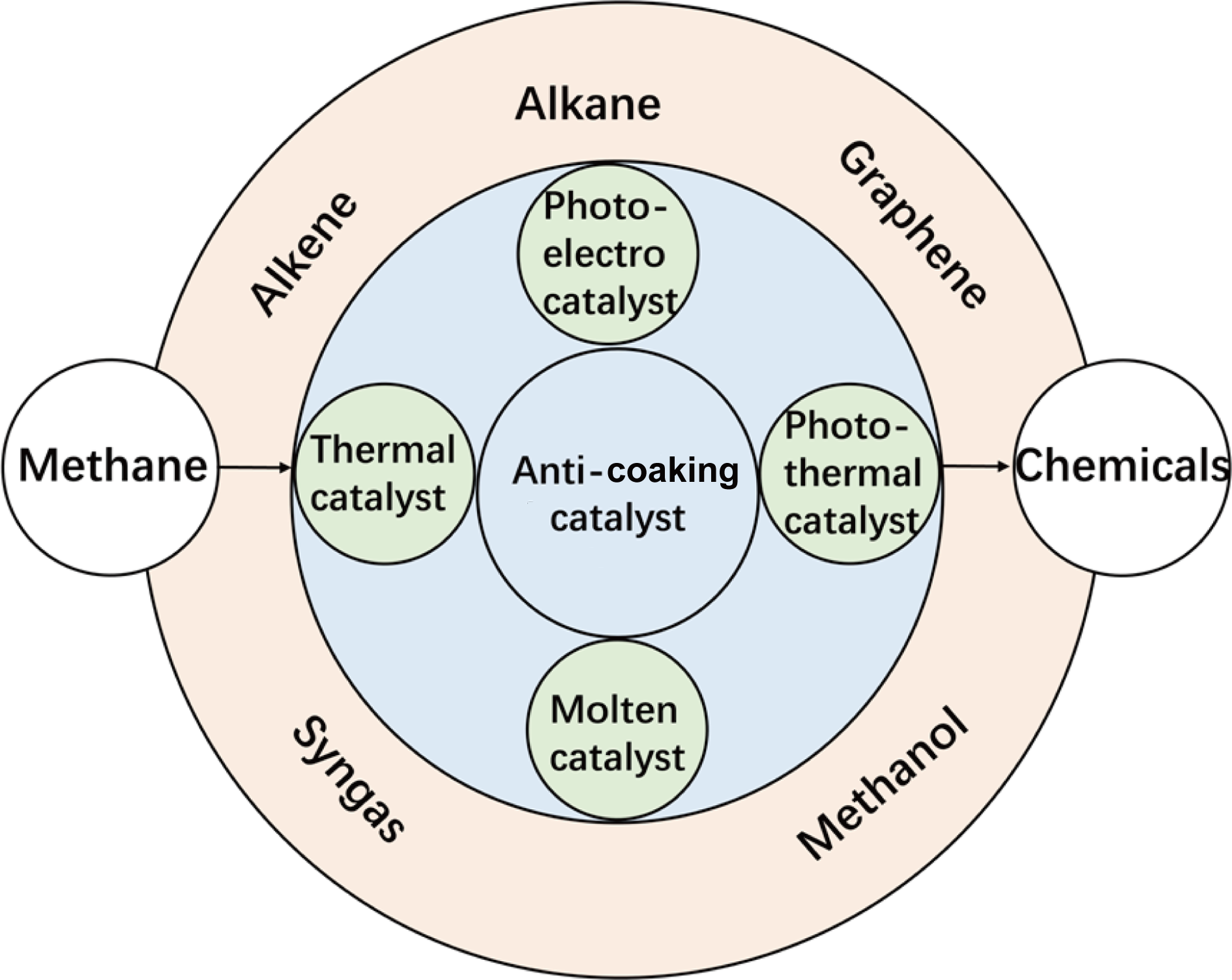
Fig. 1 Classification of anti-coking catalysts for methane conversion to value-added products
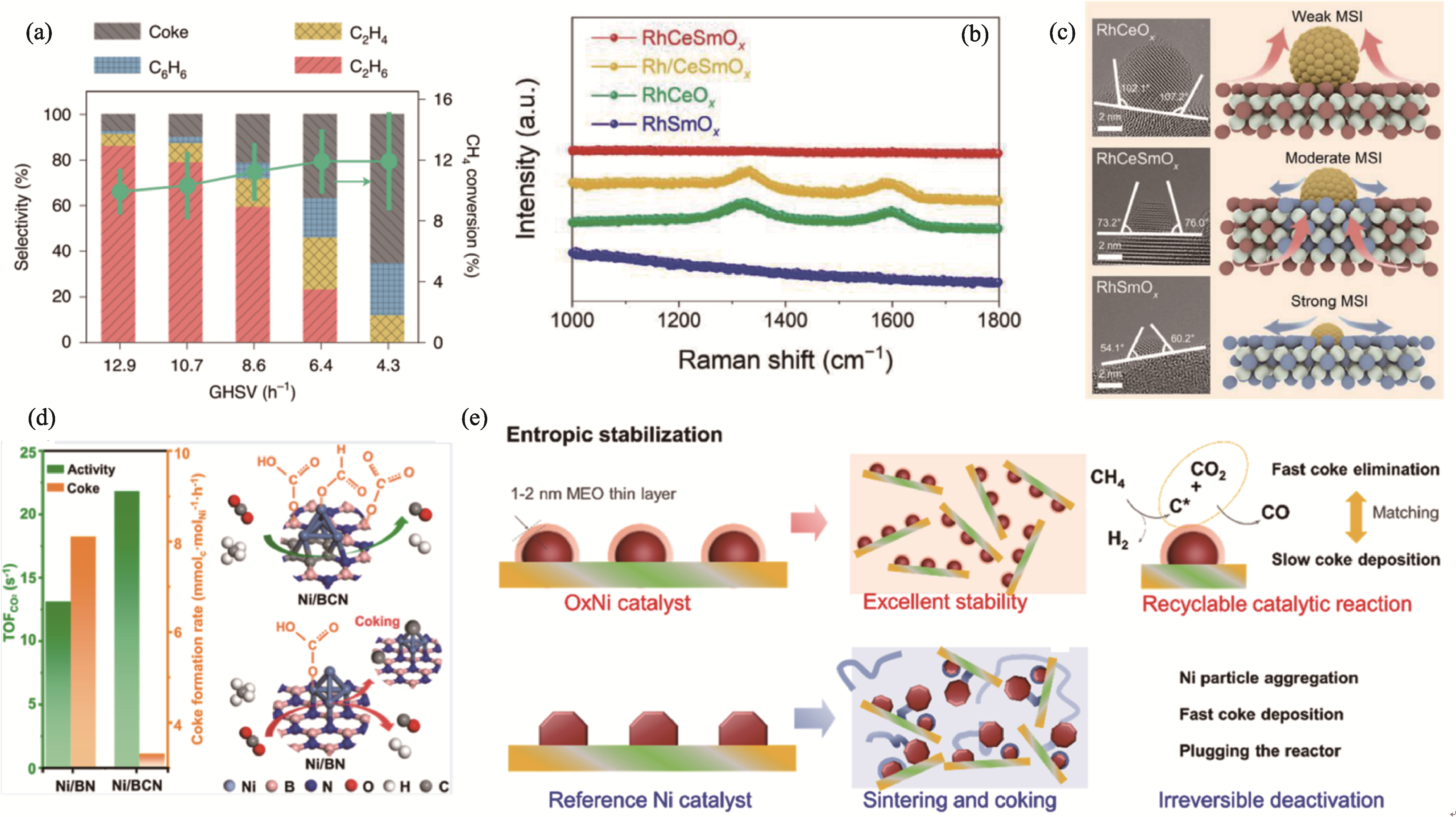
Fig. 2 Carbon deposition performance and schematic of anti-coking of different thermocatalysts[15,24,26,32] (a) Catalytic performance of 2% (in mass) Pt/Mo2TiC2Tx for non-oxidative coupling of methane[15]; (b) Raman spectra of the catalysts after the DRM stability test[24]; (c) High resolution transmission electron microscopy (HR-TEM) images and corresponding contact angles with a schematic diagram of the different metal-support interaction (MSI) exsolution catalysts[24]; (d) Carbon deposition rate and catalyst schematic diagram of Ni/BCN[26]; (e) Schematic diagram of multielement oxide (MEO) thin layer constrained stable nickel catalyst[32]
| Catalyst | Reaction condition | Stability | Ref. |
|---|---|---|---|
| Ni/CeO2 | CH4/CO2/Ar=1/1/3, 20 mL·min−1, 25 mg, 2.4 W·cm-2 | 230 h | [ |
| Ni/Pr5-CeO2 | CH4/CO2/Ar=1/1/3, 20 mL·min−1, 25 mg, 2.4 W·cm-2 | 110 h | [ |
| NiMo/MgO | CH4/CO2/Ar=1/1/3, 20 mL·min−1, 25 mg, 2.4 W·cm-2 | 60 h | [ |
| Pd-Bi/Ga2O3 | CH4/Ar=1/9, 30 mL·min−1, 800 mg, 20 W·cm-2 | 100 h | [ |
| Ni/CeO2(100) | CH4/CO2=1/1, 10 mL·min−1, 200 mg, 6.8 W·cm-2 | 800 h | [ |
| Cu-Ru/MgO-Al2O3 | CH4/CO2=1/1, 16 mL·min-1, 1.5 mg, 19.2 W·cm-2 | 50h | [ |
| (Ni/CeO2)@SiO2 | CH4/CO2/N2=3/3/4, 50 mL·min-1, 25 mg, 300 W Xe lamp | 40 h | [ |
| Pd-Ni/Al2O3 | CH4/CO2/Ar=3/3/4, 89.6 mL·min-1, 8 mg, 80.3 kW·cm-2 | 50 h | [ |
Table 1 Comparison of the stability of photothermal catalysts[38-45]
| Catalyst | Reaction condition | Stability | Ref. |
|---|---|---|---|
| Ni/CeO2 | CH4/CO2/Ar=1/1/3, 20 mL·min−1, 25 mg, 2.4 W·cm-2 | 230 h | [ |
| Ni/Pr5-CeO2 | CH4/CO2/Ar=1/1/3, 20 mL·min−1, 25 mg, 2.4 W·cm-2 | 110 h | [ |
| NiMo/MgO | CH4/CO2/Ar=1/1/3, 20 mL·min−1, 25 mg, 2.4 W·cm-2 | 60 h | [ |
| Pd-Bi/Ga2O3 | CH4/Ar=1/9, 30 mL·min−1, 800 mg, 20 W·cm-2 | 100 h | [ |
| Ni/CeO2(100) | CH4/CO2=1/1, 10 mL·min−1, 200 mg, 6.8 W·cm-2 | 800 h | [ |
| Cu-Ru/MgO-Al2O3 | CH4/CO2=1/1, 16 mL·min-1, 1.5 mg, 19.2 W·cm-2 | 50h | [ |
| (Ni/CeO2)@SiO2 | CH4/CO2/N2=3/3/4, 50 mL·min-1, 25 mg, 300 W Xe lamp | 40 h | [ |
| Pd-Ni/Al2O3 | CH4/CO2/Ar=3/3/4, 89.6 mL·min-1, 8 mg, 80.3 kW·cm-2 | 50 h | [ |
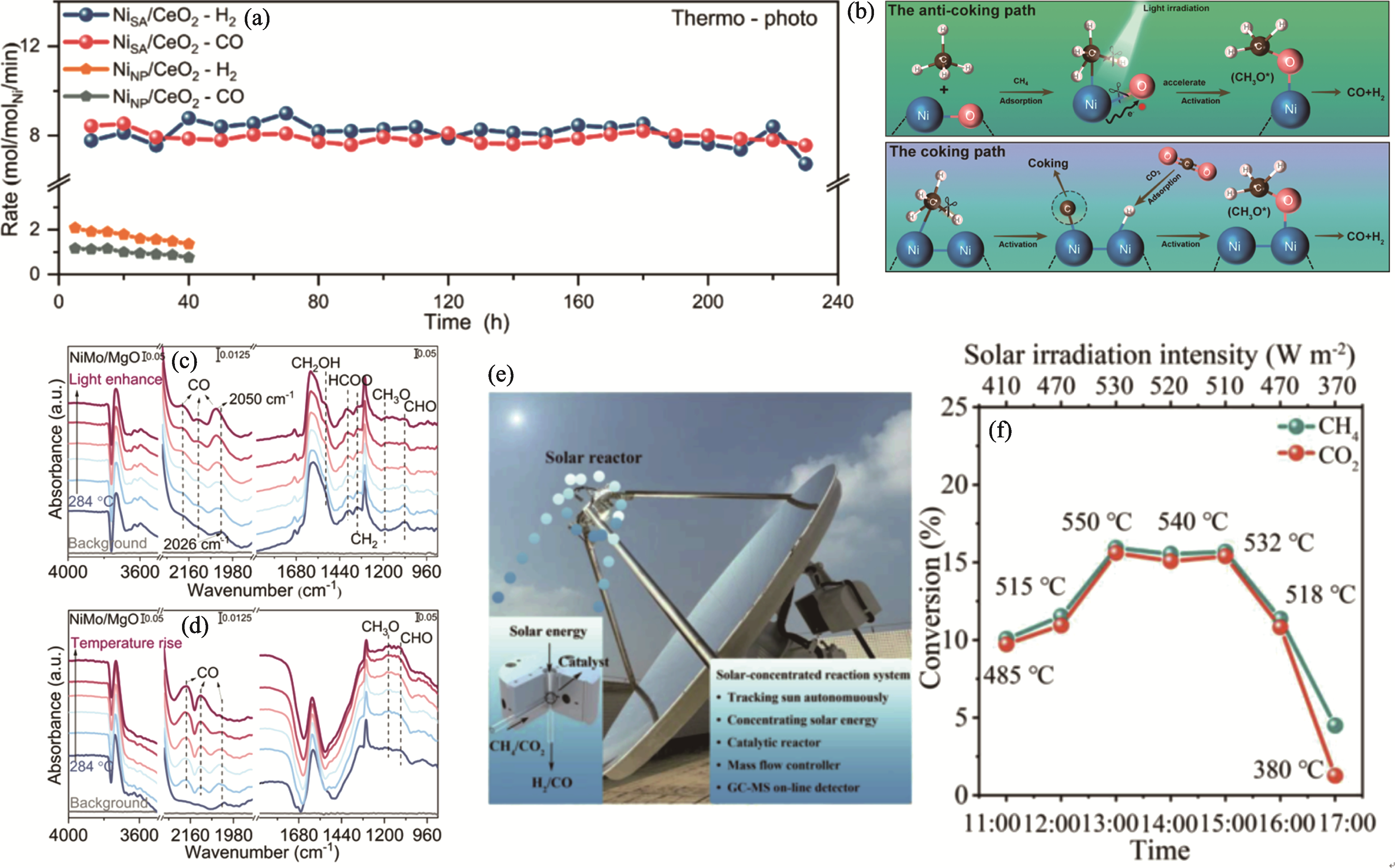
Fig. 3 Mechanism and anti-coking performance of photothermal catalysts[38,40,42] (a) Long-term stability of the thermo-photo catalytic DRM reaction over NiSA/CeO2 and NiNP/CeO2 catalysts at 472 ℃[38]; (b) Comparison of the anti-coking mechanism and coking mechanism of Ni single-atom sites under synergistic photothermal catalysis[38];(c, d) In situ DRIFTS spectra over NiMo/MgO under (c) photothermal and (d) thermal conditions[40]; (e) Solar-concentrating catalytic system[42]; (f) Solar-concentrated catalytic DRM performance by using sunlight over Ni/CeO2(100) catalyst (the test was performed on November 16, 2022, at 104°11'15.0936'' E and 30°49'56.82'' N)[42]
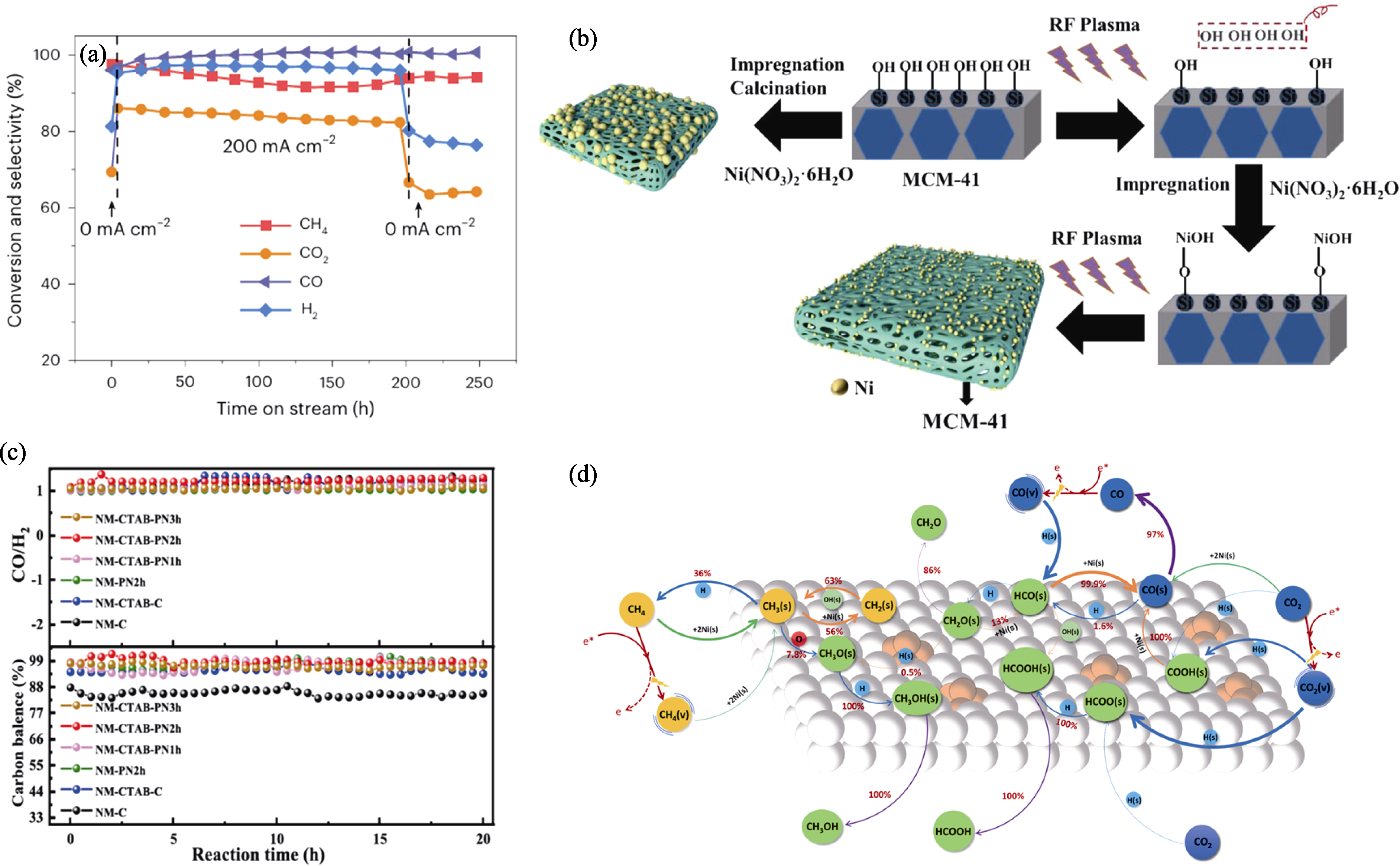
Fig. 4 Diagrams of the synthesis mechanism of the catalyst under electric field regulation, carbon deposition performance, and anti-coking illustration[53-55,57] (a) Time-on-stream stability at 800 ℃ and 200mA·cm-2 using a CO2/CH4 feed ratio of two[53]; (b) Schematic diagram of the catalyst preparation[54]; (c) CO2 conversion[55]; (d) Network of surface reaction pathways for plasma-catalytic CH4/CO2 reforming over Ni-based catalyst[57]
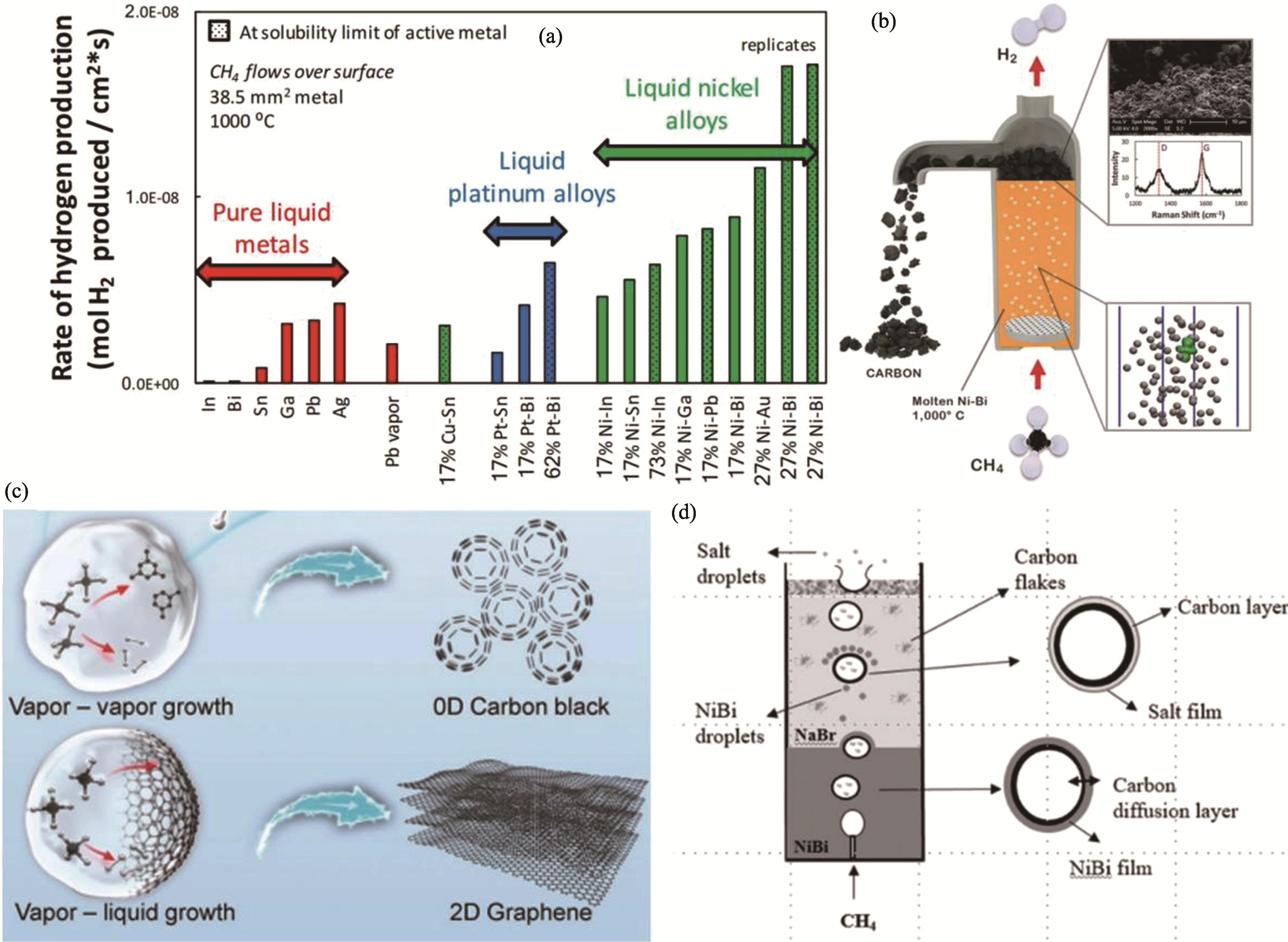
Fig. 5 Catalytic activity and reaction mechanism diagrams for different types of molten media[61,68 -69] (a) Catalytic activity of various mono-metallic and alloy systems for methane pyrolysis under molten conditions[61]; (b) Mechanistic schematic of methane decomposition over molten metals/alloys[61]; (c) Molten salts[68]; (d) Molten salt-metal composite catalysts[69]
| [1] | NI Y W, TIAN J Q, HAN Z, et al. Catalysis in sustainable energy resources: overview studies of hydrogen, methane, biomass and plastics. Industrial Chemistry & Materials, 2025, 3(3): 257. |
| [2] | ZHANG H, BOLSHAKOV A, MEENA R, et al. Revealing active sites and reaction pathways in methane non-oxidative coupling over iron-containing zeolites. Angewandte Chemie International Edition, 2023, 62(32): e202306196. |
| [3] | BUELENS L C, GALVITA V V, POELMAN H, et al. Super-dry reforming of methane intensifies CO2 utilization via Le Chatelier’s principle. Science, 2016, 354(6311): 449. |
| [4] | ZHU Z Z, GUO W Y, ZHANG Y, et al. Research progress on methane conversion coupling photocatalysis and thermocatalysis. Carbon Energy, 2021, 3(4): 519. |
| [5] | LE SACHÉ E, REINA T R. Analysis of dry reforming as direct route for gas phase CO2 conversion. The past, the present and future of catalytic DRM technologies. Progress in Energy and Combustion Science, 2022, 89: 100970. |
| [6] | LI Q, OUYANG Y X, LI H L, et al. Photocatalytic conversion of methane: recent advancements and prospects. Angewandte Chemie International Edition, 2022, 61(2): e202108069. |
| [7] | SONG H, MENG X G, WANG Z J, et al. Solar-energy-mediated methane conversion. Joule, 2019, 3(7): 1606. |
| [8] | SHAH M S A S, OH C, PARK H, et al. Catalytic oxidation of methane to oxygenated products: recent advancements and prospects for electrocatalytic and photocatalytic conversion at low temperatures. Advanced Science, 2020, 7(23): 2001946. |
| [9] | VOGT C, WECKHUYSEN B M. The concept of active site in heterogeneous catalysis. Nature Reviews. Chemistry, 2022, 6(2): 89. |
| [10] | VAN DEELEN T W, MEJÍA C H, DE JONG K P. Control of metal-support interactions in heterogeneous catalysts to enhance activity and selectivity. Nature Catalysis, 2019, 2: 955. |
| [11] | ZENG L, CHENG Z, FAN J A, et al. Metal oxide redox chemistry for chemical looping processes. Nature Reviews Chemistry, 2018, 2: 349. |
| [12] | GUO X G, FANG G Z, LI G, et al. Direct, nonoxidative conversion of methane to ethylene, aromatics, and hydrogen. Science, 2014, 344(6184): 616. |
| [13] | HE D D, ZHANG Y M, LI T, et al. Designing ultra-stable and surface-exposed Ni nanoparticles with dually confined microenvironment for high-temperature methane dry reforming. Advanced Functional Materials, 2025, 35(2): 2412895. |
| [14] | TIAN J S, KONG R, WANG Z, et al. Enhancing methane combustion activity by modulating the local environment of Pd single atoms in Pd1/CeO2 catalysts. ACS Catalysis, 2024, 14(1): 183. |
| [15] | LI Z, XIAO Y, CHOWDHURY P R, et al. Direct methane activation by atomically thin platinum nanolayers on two-dimensional metal carbides. Nature Catalysis, 2021, 4: 882. |
| [16] | HUANG X, EGGART D, QIN G Q, et al. Methyl radical chemistry in non-oxidative methane activation over metal single sites. Nature Communications, 2023, 14: 5716. |
| [17] | PETERS S, RIEG C, BARTLING S, et al. Accessibility of reactants and neighborhood of Mo species during methane aromatization uncovered by operando NAP-XPS and MAS NMR. ACS Catalysis, 2023, 13(19): 13056. |
| [18] | ZHANG Y N, CAO N, WANG K, et al. Atomically dispersed Rh-O-V pairs promote methane dry reforming with sustained catalytic activity. ACS Catalysis, 2025, 15(11): 8833. |
| [19] | ZHAO X Y, YIN H B, LIN H F, et al. The importance of Si-ONa-Al moieties in Fe/ZSM-5 zeolite catalysts for selective oxidation of methane to acetic acid. Angewandte Chemie International Edition, 2025, 64(40): e202511056. |
| [20] | ZHANG H X, WEI L H, SUN Y W, et al. Brønsted acid site catalytic role in methane dehydroaromatization over Mo/HZSM-5. ACS Catalysis, 2024, 14(15): 11591. |
| [21] | JEONG Y, JUNE H, ROH J, et al. Enhanced structural stability of Mo/ZSM-5 for regenerability improvement in shale gas aromatization: the effect of external acidity and defect density. Applied Catalysis B: Environment and Energy, 2025, 379: 125655. |
| [22] | YU J Q, LE T E, JING D P, et al. Balancing elementary steps enables coke-free dry reforming of methane. Nature Communications, 2023, 14: 7514. |
| [23] | PHAM-NGOC N, JAMSAZ A, LEE Y, et al. Homogeneous formation of a disordered NiAl2O4 structure in three-dimensional macroporous Ni/Al2O3 catalysts for dry reforming of methane and coke-resistant catalytic behavior on its Ni-oxygen vacancy interface. Chemical Engineering Journal, 2025, 510: 161545. |
| [24] | YE Y J, LEI H F, QIN Y B, et al. Harmonizing nanoparticle exsolution from Ce-Sm oxide matrix for stable methane dry reforming. Angewandte Chemie International Edition, 2025, 64(31): e202503997. |
| [25] | CHENG Q P, YAO X L, OU L F, et al. Highly efficient and stable methane dry reforming enabled by a single-site cationic Ni catalyst. Journal of the American Chemical Society, 2023, 145(46): 25109. |
| [26] | ZHANG X Y, DENG J, LAN T W, et al. Promoting methane dry reforming over Ni catalysts via modulating surface electronic structures of BN supports by doping carbon. ACS Catalysis, 2022, 12(22): 14152. |
| [27] | WANG H, CUI G Q, LU H, et al. Facilitating the dry reforming of methane with interfacial synergistic catalysis in an Ir@CeO2-x catalyst. Nature Communications, 2024, 15: 3765. |
| [28] | FAN J, LI W C, HE L, et al. Generating cationic nickel clusters over oxygen-functionalized boron nitride to boost methane dry reforming. ACS Catalysis, 2024, 14(23): 17748. |
| [29] | WANG J Y, FU Y, KONG W B, et al. Investigation of atom-level reaction kinetics of carbon-resistant bimetallic NiCo-reforming catalysts: combining microkinetic modeling and density functional theory. ACS Catalysis, 2022, 12(8): 4382. |
| [30] | ZHANG X Y, DENG J, PUPUCEVSKI M, et al. High- performance binary Mo-Ni catalysts for efficient carbon removal during carbon dioxide reforming of methane. ACS Catalysis, 2021, 11(19): 12087. |
| [31] | JOHNSON O, HE Y, RICHTER J, et al. Stabilizing catalytic performance in dry reforming of methane via surface-engineered intermetallic carbide nanoparticles. Journal of the American Chemical Society, 2025, 147(20): 16786. |
| [32] | HE L, LI M R, LI W C, et al. Robust and coke-free Ni catalyst stabilized by 1-2 nm-thick multielement oxide for methane dry reforming. ACS Catalysis, 2021, 11(20): 12409. |
| [33] | KIM S, LAUTERBACH J, SASMAZ E. Yolk-shell Pt-NiCe@SiO2 single-atom-alloy catalysts for low-temperature dry reforming of methane. ACS Catalysis, 2021, 11(13): 8247. |
| [34] | GUO D, LI M S, LU Y, et al. Enhanced thermocatalytic stability by coupling nickel step sites with nitrogen heteroatoms for dry reforming of methane. ACS Catalysis, 2022, 12(1): 316. |
| [35] | KIM H, LEE S, SEO B, et al. Surface interactive assembly of ruthenium based Janus bimetallic nanoparticles with active dual-function sites for efficient use in CO2 utilization. Advanced Functional Materials, 2025, 35(27): 2418874. |
| [36] | LIU C Y, QIAN B, XIAO T C, et al. Illustrating the fate of methyl radical in photocatalytic methane oxidation over Ag-ZnO by in situ synchrotron radiation photoionization mass spectrometry. Angewandte Chemie International Edition, 2023, 62(32): e202304352. |
| [37] | MING L Y, WANG C L, HU Y H. CePMo12O40/TiO2 catalysts for photocatalytic oxidation of methane to value-added organic oxygenates. International Journal of Energy Research, 2021, 45(9): 12996. |
| [38] | RAO Z Q, WANG K W, CAO Y H, et al. Light-reinforced key intermediate for anticoking to boost highly durable methane dry reforming over single atom Ni active sites on CeO2. Journal of the American Chemical Society, 2023, 145(45): 24625. |
| [39] | RAO Z Q, HUANG Z A, CHEN G X, et al. Atomically dispersed praseodymium-modified Ni active sites boost the direct cleavage of carbonate intermediates for photothermal CO2 conversion. ACS Nano, 2025, 19(28): 25904. |
| [40] | WANG J B, HUANG Z A, HU W, et al. Constructing molybdenum- stabilized nickel-oxo sites for boosting low-temperature dry reforming of methane. ACS Catalysis, 2025, 15(22): 18944. |
| [41] | SINGH S P, YAMAMOTO A, FUDO E, et al. A Pd-Bi dual-cocatalyst-loaded gallium oxide photocatalyst for selective and stable nonoxidative coupling of methane. ACS Catalysis, 2021, 11(22): 13768. |
| [42] | RAO Z Q, HUANG Z A, ZHANG K K, et al. Concentrated-solar catalytic methane dry reforming with ultrahigh conversion and durability. Nature Communications, 2025, 16: 9605. |
| [43] | ZHOU L N, MARTIREZ J M P, FINZEL J, et al. Light-driven methane dry reforming with single atomic site antenna-reactor plasmonic photocatalysts. Nature Energy, 2020, 5: 61. |
| [44] | HAN K H, WANG Y, WANG S, et al. Narrowing band gap energy of CeO2 in (Ni/CeO2)@SiO2 catalyst for photothermal methane dry reforming. Chemical Engineering Journal, 2021, 421: 129989. |
| [45] | JI L, LI Y Z, WU J C, et al. Light-promoted synergistic effect significantly enhances the performance of photothermocatalytic dry reforming of methane on low-loading Pd-Ni/Al2O3. Chemical Engineering Journal, 2025, 519: 165227. |
| [46] | XIE J, JIANG Y, LI S, et al. Stable photocatalytic coupling of methane to ethane with water vapor using TiO2 supported ultralow loading AuPd nanoparticles. Acta Physico-Chimica Sinica, 2023, 39(10): 2306037. |
| [47] | AWAZU K, FUJIMAKI M, ROCKSTUHL C, et al. A plasmonic photocatalyst consisting of silver nanoparticles embedded in titanium dioxide. Journal of the American Chemical Society, 2008, 130(5): 1676. |
| [48] | WANG M Y, YE M D, IOCOZZIA J, et al. Plasmon-mediated solar energy conversion via photocatalysis in noble metal/ semiconductor composites. Advanced Science, 2016, 3(6): 1600024. |
| [49] | XIAO Q H, ZHOU Y, MIAO X C, et al. Study on the as-cast microstructure and mechanical properties of 35CrMo steel based on electric field control. Materials Research Express, 2024, 11(4): 046512. |
| [50] | ZHENG M, GUAN P F. Electric field control of photoluminescence response in lanthanide doped ferroelectric materials: a brief review. Ferroelectrics, 2022, 598(1): 152. |
| [51] | LEE K X, HU B X, DUBEY P K, et al. High-entropy alloy anode for direct internal steam reforming of methane in SOFC. International Journal of Hydrogen Energy, 2022, 47(90): 38372. |
| [52] | JIAO H, WANG G C. Mechanistic study of a coke-resistance Ni/ZrO2 catalyst for dry reforming of methane under external electric fields: a combined first-principles and microkinetic modeling study. Catalysis Science & Technology, 2024, 14(14): 4045. |
| [53] | LV H F, DONG X, LI R T, et al. Super-dry reforming of methane using a tandem electro-thermocatalytic system. Nature Chemistry, 2025, 17(5): 695. |
| [54] | GUO F, CAO W Y, WANG L, et al. High activity and strong coke resistance of nickel CO2-CH4 reforming catalyst promoted by different plasma treated modes. Molecular Catalysis, 2023, 535: 112821. |
| [55] | GUO F, ZHANG R H, CAO W Y, et al. CTAB-assisted radio frequency discharge plasma treatment enhances catalytic activity at sustained coking resistance of nickel-based catalysts for CO2/CH4 reforming reaction. Molecular Catalysis, 2024, 569: 114557. |
| [56] | XU W C, BUELENS L C, GALVITA V V, et al. Improving the performance of gliding arc plasma-catalytic dry reforming via a new post-plasma tubular catalyst bed. Journal of CO2 Utilization, 2024, 83: 102820. |
| [57] | SUN J T, CHEN Q, QIN W Y, et al. Plasma-catalytic dry reforming of CH4: effects of plasma-generated species on the surface chemistry. Chemical Engineering Journal, 2024, 498: 155847. |
| [58] | NOZAKI T, TSUKIJIHARA H, FUKUI W, et al. Kinetic analysis of the catalyst and nonthermal plasma hybrid reaction for methane steam reforming. Energy & Fuels, 2007, 21(5): 2525. |
| [59] | NOZAKI T, OKAZAKI K. Non-thermal plasma catalysis of methane: principles, energy efficiency, and applications. Catalysis Today, 2013, 211: 29. |
| [60] | CHEN Y X, ZHU T H, QI C H, et al. Plasma-assisted chemical- looping dry reforming of methane for hydrogen generation at room temperature. Fuel, 2025, 400: 135664. |
| [61] | UPHAM D C, AGARWAL V, KHECHFE A, et al. Catalytic molten metals for the direct conversion of methane to hydrogen and separable carbon. Science, 2017, 358(6365): 917. |
| [62] | PALMER C, TARAZKAR M, KRISTOFFERSEN H H, et al. Methane pyrolysis with a molten Cu-Bi alloy catalyst. ACS Catalysis, 2019, 9(9): 8337. |
| [63] | ZAGHLOUL N, KODAMA S, SEKIGUCHI H. Hydrogen production by methane pyrolysis in a molten-metal bubble column. Chemical Engineering & Technology, 2021, 44(11): 1986. |
| [64] | CHEN L N, SONG Z G, ZHANG S C, et al. Ternary NiMo-Bi liquid alloy catalyst for efficient hydrogen production from methane pyrolysis. Science, 2023, 381(6660): 857. |
| [65] | CAI G P, MIEDERHOFF N, D’ENTREMONT S, et al. Production of carbon fibers using a molten Cu-In catalyst for methane pyrolysis. ACS Applied Materials & Interfaces, 2024, 16(49): 67674. |
| [66] | PARKINSON B, PATZSCHKE C F, NIKOLIS D, et al. Methane pyrolysis in monovalent alkali halide salts: kinetics and pyrolytic carbon properties. International Journal of Hydrogen Energy, 2021, 46(9): 6225. |
| [67] | KANG D, RAHIMI N, GORDON M J, et al. Catalytic methane pyrolysis in molten MnCl2-KCl. Applied Catalysis B: Environmental, 2019, 254: 659. |
| [68] | ZHAO Y F, SHI Z Y, ZHU Y L, et al. Mechanism for one-pot synthesis of 0D-2D carbon materials in the bubbles inside molten salts. Advanced Functional Materials, 2022, 32(42): 2202381. |
| [69] | RAHIMI N, KANG D, GELINAS J, et al. Solid carbon production and recovery from high temperature methane pyrolysis in bubble columns containing molten metals and molten salts. Carbon, 2019, 151: 181. |
| [70] | PATZSCHKE C F, PARKINSON B, WILLIS J J, et al. Co-Mn catalysts for H2 production via methane pyrolysis in molten salts. Chemical Engineering Journal, 2021, 414: 128730. |
| [71] | NOH Y G, LEE Y J, KIM J, et al. Enhanced efficiency in CO2-free hydrogen production from methane in a molten liquid alloy bubble column reactor with zirconia beads. Chemical Engineering Journal, 2022, 428: 131095. |
| [72] | TYRER D. Production of hydrogen: US1803221A. 1931-04-28. |
| [73] | STEINBERG M. Fossil fuel decarbonization technology for mitigating global warming. International Journal of Hydrogen Energy, 1999, 24(8): 771. |
| [74] | WI T G, PARK Y J, LEE U, et al. Methane pyrolysis rate measurement using electromagnetic levitation techniques for turquoise hydrogen production: liquid In, Ga, Bi, Sn, and Cu as catalysts. Chemical Engineering Journal, 2023, 460: 141558. |
| [75] | ERBASAN A, USTUNEL H, TOFFOLI D, et al. Insights into reaction mechanisms in liquid metals from density functional theory: CH4 pyrolysis in BiNiX (X = Cu, Al) molten metals as a case study. ACS Applied Energy Materials, 2024, 7(8): 3220. |
| [76] | GEIßLER T, ABÁNADES A, HEINZEL A, et al. Hydrogen production via methane pyrolysis in a liquid metal bubble column reactor with a packed bed. Chemical Engineering Journal, 2016, 299: 192. |
| [77] | YANG M K, HUANG Z A, ZHOU Y X, et al. Co-production of few-layer graphene and hydrogen from methane pyrolysis based on Cu and metal oxide-KCl molten medium. Journal of Inorganic Materials, 2025, 40(5): 473. |
| [78] | YANG M K, HUANG Z A, HE Y D, et al. Directed growth of multilayer graphene via methane pyrolysis using Cu/ZrO2 in molten KCl. International Journal of Hydrogen Energy, 2025, 157: 150369. |
| [1] | QIN Shanli, GUO Jiawen, CHEN Yanmeng, JU An’an, WEI Yi, HUANG Kelin, HOU Xianghua, LÜ Sishi, WEN Zhipeng, WU Lian. Recent Advances in Constructing Oriented Ion Transport Channels with Two-dimensional Layered Materials for Electrochemical Energy Storage [J]. Journal of Inorganic Materials, 2026, 41(7): 883-898. |
| [2] | YU Feiyu, WANG Wenqing, ZHANG Xueqin, HE Rujie. Additively Manufactured Ceramic Lattice-based Interpenetrating Phase Composites: Progress and Challenges [J]. Journal of Inorganic Materials, 2026, 41(7): 849-866. |
| [3] | ZHOU Cui, LI Jie, SUN Luchao, SU Haijun, WANG Jingyang. Alumina-based Directionally Solidified Eutectic Ceramics: Microstructure, Control Strategies and Environmental Stability [J]. Journal of Inorganic Materials, 2026, 41(7): 899-914. |
| [4] | SHEN Xuesong, XIE Kaifeng, XUE Qiang, ZHENG Guozhu, XIAO Guoping, CHEN Ting, CHEN Wenmiao, WANG Shaorong. High-efficiency Construction and Performance Optimization of Surface-modified LSCF-GDC Multiphase Composite Air Electrodes [J]. Journal of Inorganic Materials, 2026, 41(7): 965-973. |
| [5] | FEI Wenlong, WANG Yakun, LIAO Liangsheng. Research Progress on Controllable Synthesis of Blue-emitting ZnSeTe Quantum Dots and Quantum-dot Light-emitting Diode Devices [J]. Journal of Inorganic Materials, 2026, 41(7): 867-882. |
| [6] | CHEN Mingjun, MIAO Hongkang, XIAO Yingjun, DENG Jianbo, ZHANG Xiang, ZHAO Jiupeng, LI Yao. Photo- and Thermo-chromic Dual-responsive Materials: A Review on Design Strategies and Applications in Smart Windows [J]. Journal of Inorganic Materials, 2026, 41(6): 723-738. |
| [7] | SONG Kunjie, XIE Rongjun. Research Advances on Machine Learning-driven Development of Novel Luminescent Materials [J]. Journal of Inorganic Materials, 2026, 41(6): 689-703. |
| [8] | HU Yuqing, ZHU Yixin, LE Xianhao, WAN Qing. Lithium Tantalate Wafer: Advances in Thinning Technology and Application in Pyroelectric Infrared Detectors [J]. Journal of Inorganic Materials, 2026, 41(6): 764-774. |
| [9] | LIU Chunfan, CHEN Ke, GE Fangfang, HUANG Qing. Research Progress on Lead-bismuth Eutectic Corrosion Resistant Coatings [J]. Journal of Inorganic Materials, 2026, 41(6): 775-786. |
| [10] | HU Yang, XIE Min, ZHANG Xiaoyi, LI Xiang, GUO Xinwei, JIANG Nan, ZHOU Wenhan, ZHANG Shengli, ZENG Haibo. Research Progress on Computational and Data-driven Environmental-friendly Luminescent Materials [J]. Journal of Inorganic Materials, 2026, 41(6): 704-722. |
| [11] | WANG Jinwen, YANG Zhen, ZHOU Huan, XIA Dan, YANG Lei. Biomedical Applications of Injectable Inorganic Biomaterials [J]. Journal of Inorganic Materials, 2026, 41(6): 751-763. |
| [12] | LI Hantao, SHEN Qiang, LUO Guoqiang, WANG Xuefei, GAO Ming, CHEN Chen. Research Progress on Structure and Performance Regulation of Silicon-based Anode Materials via Mechanical Ball Milling [J]. Journal of Inorganic Materials, 2026, 41(5): 561-572. |
| [13] | XIE Chenyi, MIAO Huaming, ZHANG Weiran, LIU Rongjun, WANG Yanfei, LI Duan. Research Progress on Theoretical Calculation in the Field of High-entropy Ceramics [J]. Journal of Inorganic Materials, 2026, 41(5): 545-560. |
| [14] | LI Na, WEI Jin, CAO Ruixiao, LIU Yu, HUANG Guiwen, XIAO Hongmei. Self-developed Ortho-para Hydrogen Conversion Catalyst: Catalytic Testing and Optimization of Batch Preparation Process [J]. Journal of Inorganic Materials, 2026, 41(5): 645-652. |
| [15] | LI Xuan, YE Kuicai, FENG Jiayin, QIU Jiajun, QIAN Wenhao, XING Min. Surface Modification of Titanium-based Dental Implants for Soft Tissue Sealing: A Review [J]. Journal of Inorganic Materials, 2026, 41(4): 432-444. |
| Viewed | ||||||
|
Full text |
|
|||||
|
Abstract |
|
|||||
