无机材料学报 ›› 2026, Vol. 41 ›› Issue (8): 1036-1048.DOI: 10.15541/jim20250397
钟鸿( ), 张宇豪, 单青松(), 胡天鋆, 曾海波()
收稿日期:2025-10-11
修回日期:2025-11-13
出版日期:2026-08-20
网络出版日期:2025-12-11
通讯作者:
单青松, 副研究员. E-mail: shanqingsong@njust.edu.cn;作者简介:钟 鸿(2001-), 男, 硕士研究生. E-mail: zhonghong@njust.edu.cn
基金资助:
ZHONG Hong(), ZHANG Yuhao, SHAN Qingsong(), HU Tianjun, ZENG Haibo()
Received:2025-10-11
Revised:2025-11-13
Published:2026-08-20
Online:2025-12-11
Contact:
SHAN Qingsong, associate professor. E-mail: shanqingsong@njust.edu.cn;About author:ZHONG Hong (2001-), male, Master candidate. E-mail: zhonghong@njust.edu.cn
Supported by:摘要:
叠层量子点发光二极管(Tandem Quantum-dot Light-emitting Diode, TQLED)作为量子点发光二极管(Quantum-dot Light-emitting Diode, QLED)技术的重要延伸, 通过引入多发光单元与电荷产生层结构, 实现了外量子效率、亮度及寿命的显著提升, 成为新一代高性能显示器件的研究热点。尽管TQLED的研究已经取得了巨大进展, 其仍面临着电荷注入不平衡、溶液工艺兼容性差、材料环保性及器件长期工作下稳定性不足等问题。本文首先介绍了TQLED的基本结构与工作原理, 对比了其相对于普通单层QLED存在的优势, 并详细介绍了电荷产生层的工作原理及其在多发光单元协同工作中发挥的关键作用。随后, 围绕倒置、正置、多发光材料以及其他创新叠层器件结构, 系统分析了不同材料体系、加工工艺以及结构设计在提升器件性能方面的研究进展, 总结了TQLED在效率、亮度及稳定性等方面实现的突破。最后, 指出了当前TQLED面临的挑战, 并从材料创新、结构优化和工艺革新等方面提出了未来可能的发展路径与研究重点, 特别强调了开发环境友好型量子点材料、创新溶液加工工艺以及构建稳定的界面结构的重要性。本文旨在为TQLED的后续技术开发提供理论指导和技术参考, 推动其从实验室研究向产业化应用加速迈进。
中图分类号:
钟鸿, 张宇豪, 单青松, 胡天鋆, 曾海波. 叠层量子点发光二极管的研究进展[J]. 无机材料学报, 2026, 41(8): 1036-1048.
ZHONG Hong, ZHANG Yuhao, SHAN Qingsong, HU Tianjun, ZENG Haibo. Research Progress on Tandem Quantum-dot Light-emitting Diodes[J]. Journal of Inorganic Materials, 2026, 41(8): 1036-1048.
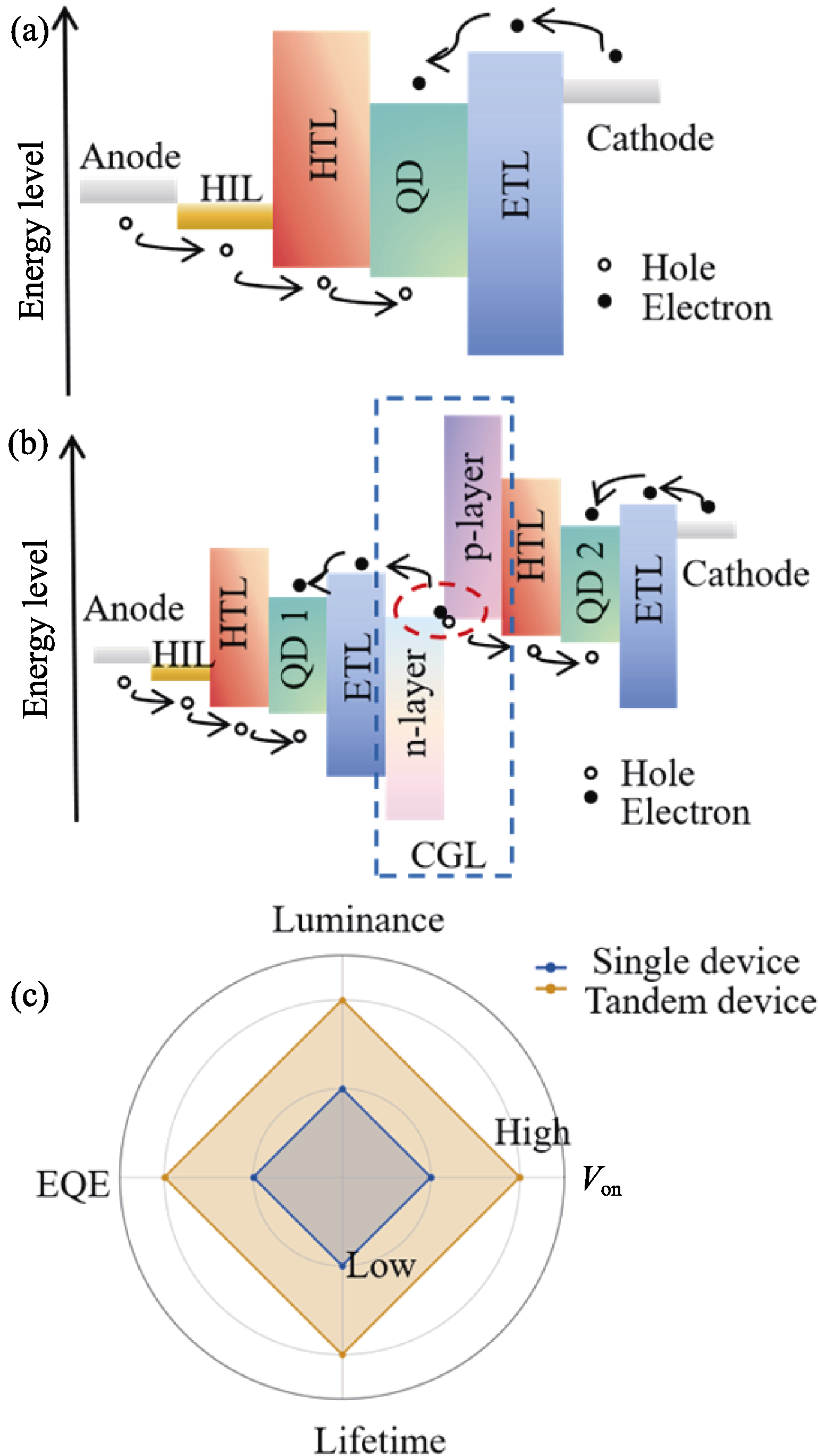
图1 普通单层QLED与双层TQLED工作原理及参数对比
Fig. 1 Comparison of working principles and parameters between conventional single-layer QLED and two-layer TQLED (a) Single emissive layer device; (b) Tandem device with two emissive layers; (c) Comparison of core parameters between two types of light-emitting devices. HTL: hole transport layer; ETL: electron transport layer
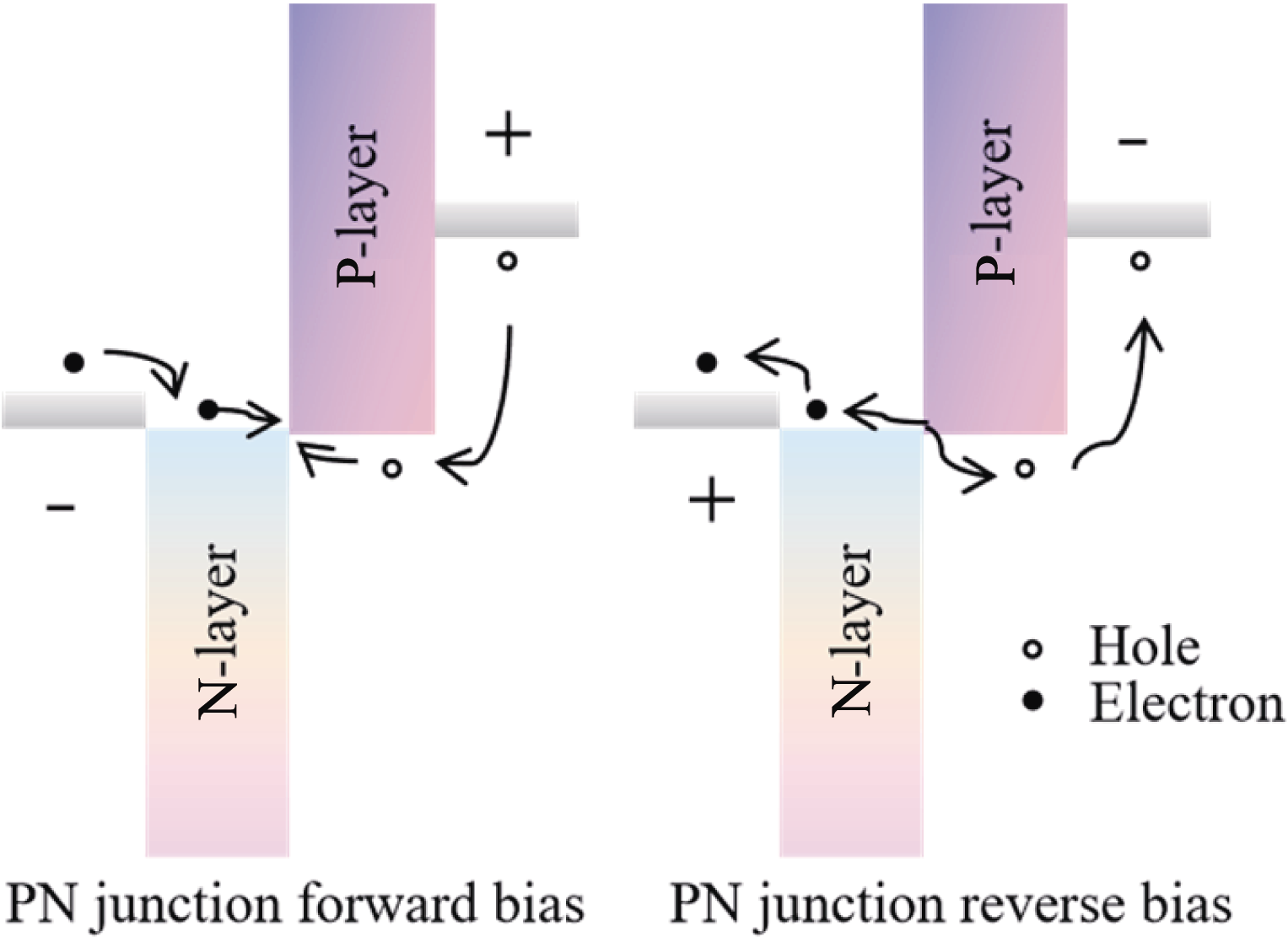
图2 CGL工作原理示意图
Fig. 2 Schematic diagram of CGL working principle
| Processing method | Material | Type |
|---|---|---|
| Vacuum deposition | FeCl3:NPB | P type |
| Li:Alq | N type | |
| HATCN, MoO3 | Electron acceptor | |
| IZO, Ag, Al | Ultra thin conductive layer | |
| Solution method | PEDOT:PSS | P type |
| ZnO, ZnMgO | N type |
表1 电荷产生层常用材料
Table 1 Common materials for charge generation layer
| Processing method | Material | Type |
|---|---|---|
| Vacuum deposition | FeCl3:NPB | P type |
| Li:Alq | N type | |
| HATCN, MoO3 | Electron acceptor | |
| IZO, Ag, Al | Ultra thin conductive layer | |
| Solution method | PEDOT:PSS | P type |
| ZnO, ZnMgO | N type |
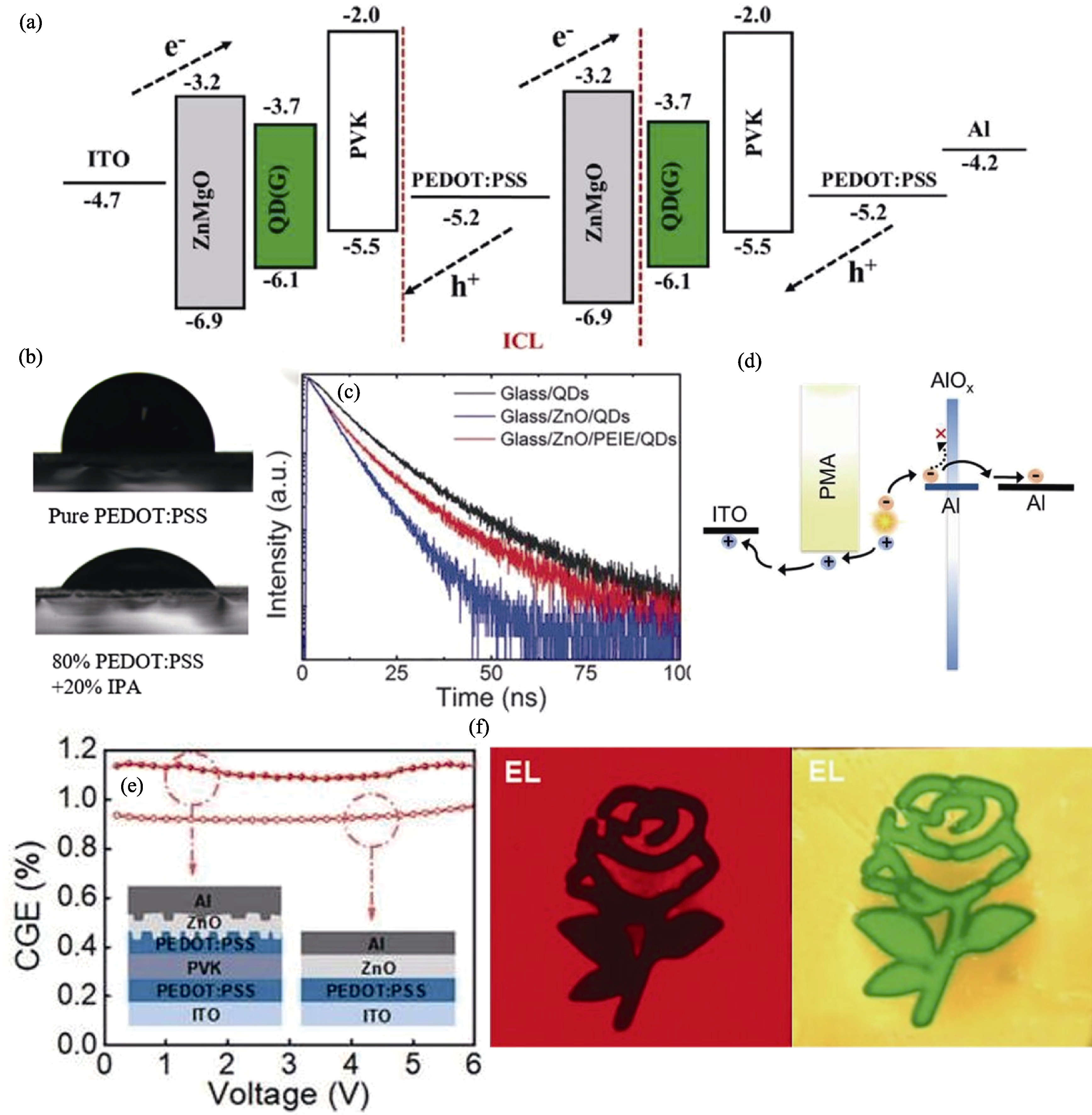
图3 倒置叠层器件结构及优化效果[54,58 -59,66,68]
Fig. 3 Structure and optimization effects of inverted tandem devices[54,58 -59,66,68] (a) Schematic diagram of energy level arrangement of inverted TQLED device[58]; (b) Wetting angle change before and after IPA addition[66]; (c) Photoluminescence (PL) decay curves of red quantum dots on different functional layer thin films[68]; (d) Energy level structure and electric field induced charge generation of semiconductor-metal-dielectric material CGL[54]; (e) Charge generation efficiency of CGL with and without microstructure[59]; (f) Electroluminescence photos of green and red tandem anti-counterfeiting devices under 8 V (left) and 13 V (right) driving voltages[59]
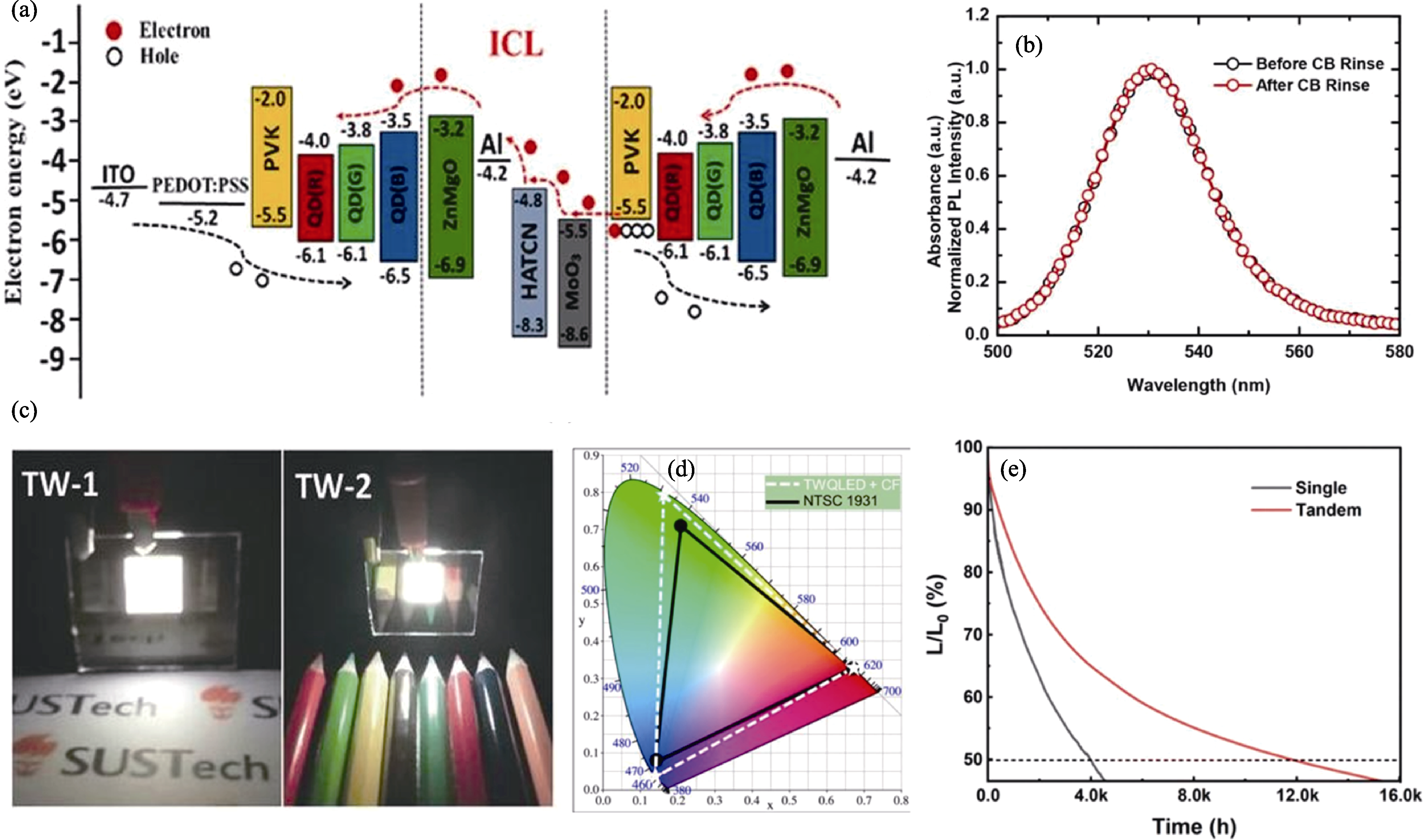
图4 正置叠层器件结构及优化效果[43,48,52,72]
Fig. 4 Structure and optimization effects of conventional tandem devices[43,48,52,72] (a) Conventional TQLED energy level structure[48]; (b) PL spectra of green quantum dots covered with ZnMgO/Al/HATCN/MoO3 before and after chlorobenzene rinsing[48]; (c) White TQLED working diagram[52]; (d) Color gamut diagram[72]; (e) Comparison of lifetime between tandem and single-layer devices[43]
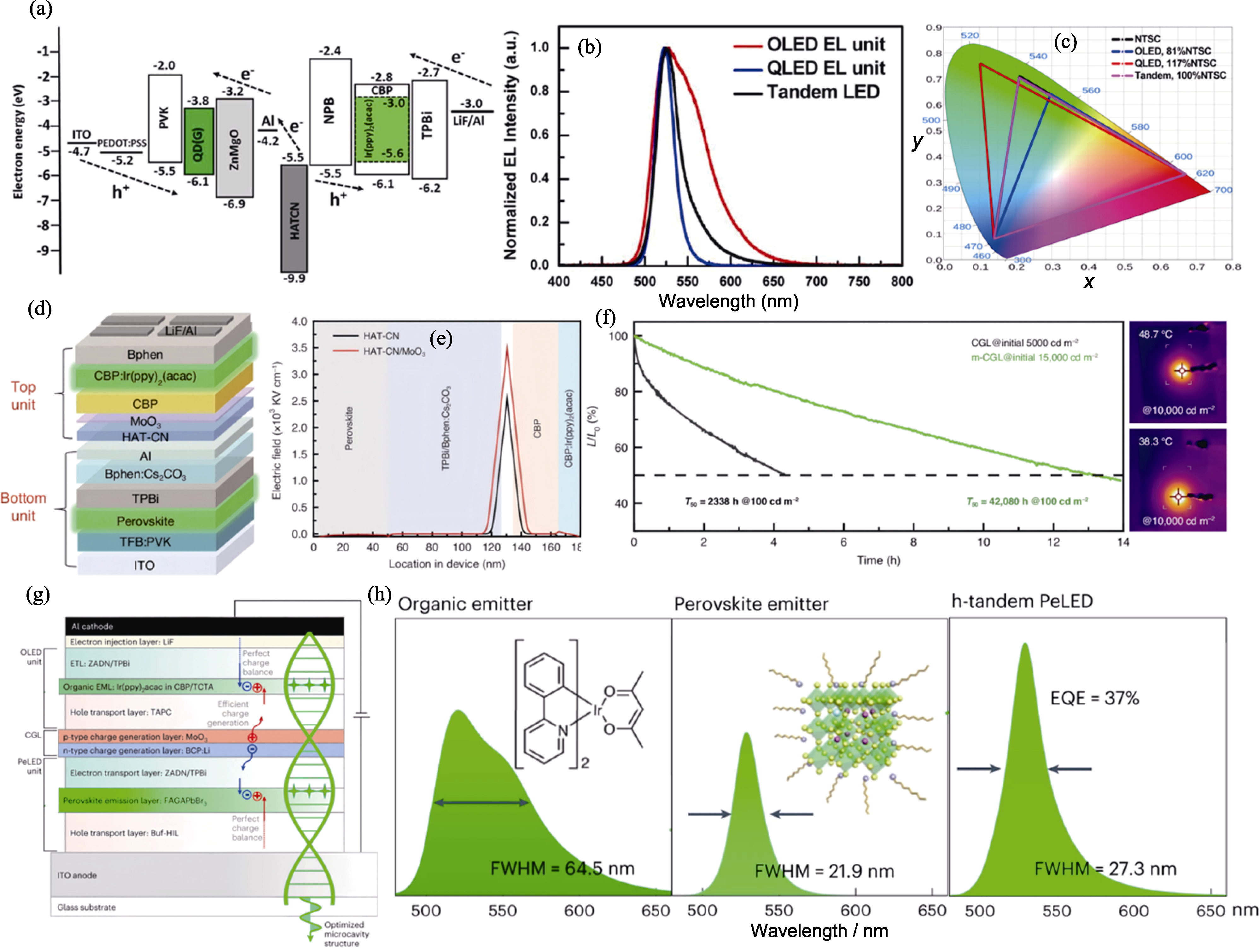
图5 多发光材料叠层器件结构及优化效果[57,75 -76]
Fig. 5 Structure and optimization effects of multi luminescent materials tandem devices[57,75 -76] (a) Device structure, (b) electroluminescence (EL) spectra and (c) color gamut of cadmium-based/organic tandem device[57]; (d) Device structure, (e) simulated electric field before and after inserting MoO3 and (f) working lifetime and surface temperature comparison of perovskite/organic tandem device[75]; (g) Tandem device structure with optical microcavity and (h) EL spectra of organic, perovskite, and tandem devices[76]
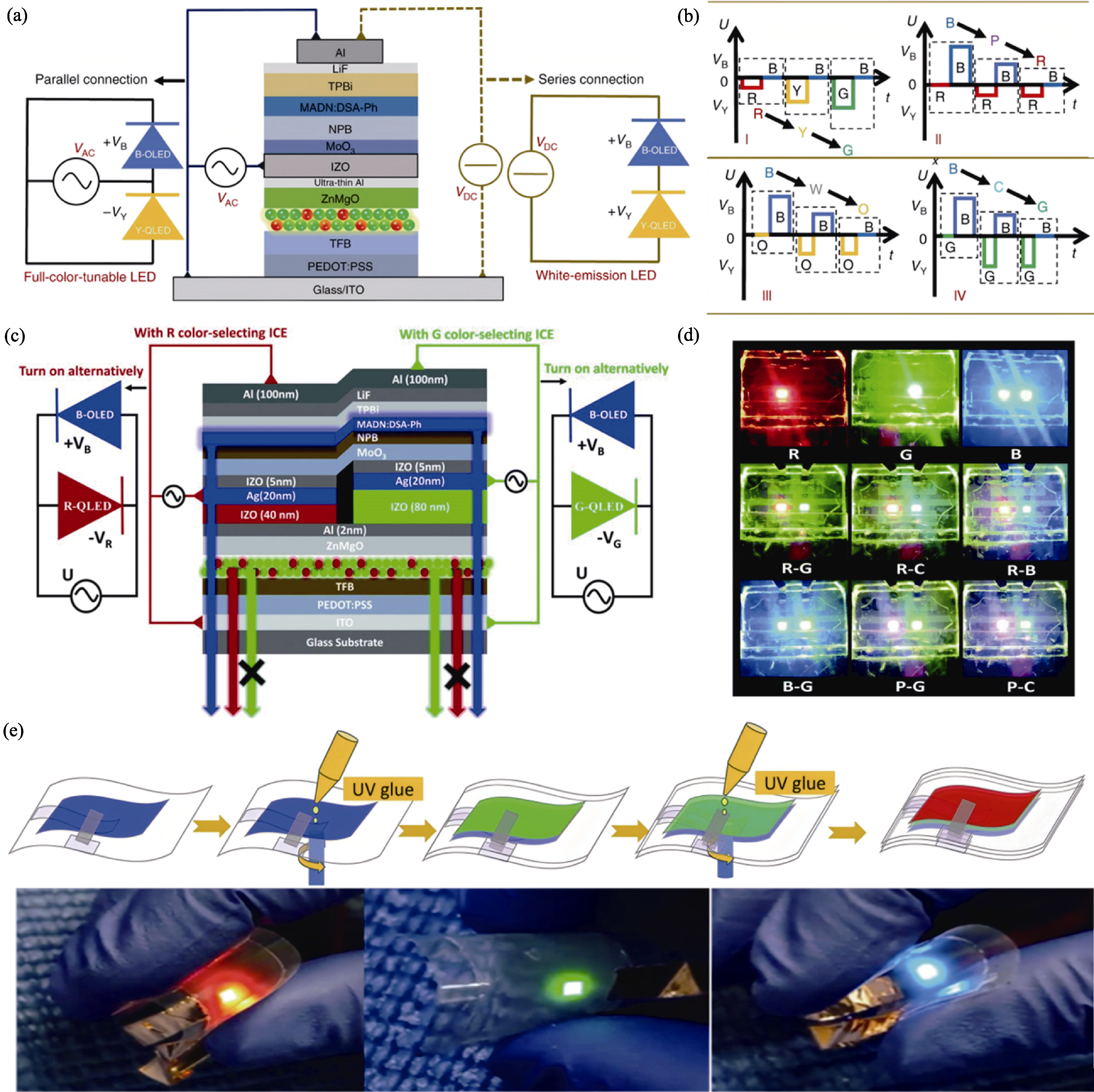
图6 其他创新叠层器件结构及效果[78,80 -81]
Fig. 6 Structure and optimization effects of other innovative tandem devices[78,80 -81] (a) Device structure and (b) AC signal controlled output color of the AC-driven TQLED[78]; (c) Device structure and (d) full-color pixel working diagram of the light output control device[80]; (e) Flexible TQLED assembly processes and working diagram[81]
| Color | CGL | Effect | EQE/% | Lifetime/h | Ref. |
|---|---|---|---|---|---|
| Red | TCTA/MoO3/IZO/ZnMgO | 1. Energy level matching 2. Potential barrier reduction | 49.01 | >50000 (T95*@1000 cd/m2) | [ |
| Green | PMA/Al:AlOx | 1. Achieved charge injection balance 2. Suppressed current leakage 3. Prevention of solvent damage to the lower layer | 50.3 | 19000 (T50@100 mA/cm2) | [ |
| Blue | 24 | - | |||
| White | PEDOT:PSS/ZnO/PEIE | 1. Improved charge injection balance 2. Inhibition of quenching | 28 | - | [ |
| Red | ZnMgO/PEDOT:PSS | 1. Improved CGL acid resistance 2. Inhibition of quenching | 35 | 12000 (T50@1000 cd/m2) | [ |
| Red | ZnMgO/Al/HATCN/MoO3 | - | 34.4 | - | [ |
| Green | ZnMgO/Al/HATCN/MoO3 | 1. Reduced solvent damage 2. Implementing a matching energy level arrangement 3. Improved balance of carrier injection | 27.6 | 53808 (T50@100 cd/m2) | [ |
| Blue | 21.4 | 107 (T50@100 cd/m2) | |||
| White | ZnO/PMA | 1. Reduced solvent damage 2. Improved charge injection and transfer capability 3. High transmittance to reduce parasitic light absorption | 27.3 | - | [ |
| Green | Bphen:Cs2CO3/Al/HATCN/ MoO3/CBP | - | 40 | 42080 (T50@100 cd/m2) | [ |
| White | Bphen:Yb/HATCN/TAPC | - | 23.9 | - | [ |
| Red | - | 1. Prevention of solvent damage to the lower layer 2. High-efficiency interconnection | 60.7 | ≈30000 (T95@1000 cd/m2) | [ |
| Red | ITO | 1. Improved balance of carrier injection 2. Optimized optical external coupling | 51.2 | ≈31383 (T95@1000 cd/m2) | [ |
| Red | ZnMgO/PMA/AMA | 1. Improved balance of carrier injection 2. Improved CGL acid resistance 3. Improved morphology of thin films | - | - | [ |
表2 近年来TQLED器件结构及性能
Table 2 Structure and performance of TQLED devices in recent years
| Color | CGL | Effect | EQE/% | Lifetime/h | Ref. |
|---|---|---|---|---|---|
| Red | TCTA/MoO3/IZO/ZnMgO | 1. Energy level matching 2. Potential barrier reduction | 49.01 | >50000 (T95*@1000 cd/m2) | [ |
| Green | PMA/Al:AlOx | 1. Achieved charge injection balance 2. Suppressed current leakage 3. Prevention of solvent damage to the lower layer | 50.3 | 19000 (T50@100 mA/cm2) | [ |
| Blue | 24 | - | |||
| White | PEDOT:PSS/ZnO/PEIE | 1. Improved charge injection balance 2. Inhibition of quenching | 28 | - | [ |
| Red | ZnMgO/PEDOT:PSS | 1. Improved CGL acid resistance 2. Inhibition of quenching | 35 | 12000 (T50@1000 cd/m2) | [ |
| Red | ZnMgO/Al/HATCN/MoO3 | - | 34.4 | - | [ |
| Green | ZnMgO/Al/HATCN/MoO3 | 1. Reduced solvent damage 2. Implementing a matching energy level arrangement 3. Improved balance of carrier injection | 27.6 | 53808 (T50@100 cd/m2) | [ |
| Blue | 21.4 | 107 (T50@100 cd/m2) | |||
| White | ZnO/PMA | 1. Reduced solvent damage 2. Improved charge injection and transfer capability 3. High transmittance to reduce parasitic light absorption | 27.3 | - | [ |
| Green | Bphen:Cs2CO3/Al/HATCN/ MoO3/CBP | - | 40 | 42080 (T50@100 cd/m2) | [ |
| White | Bphen:Yb/HATCN/TAPC | - | 23.9 | - | [ |
| Red | - | 1. Prevention of solvent damage to the lower layer 2. High-efficiency interconnection | 60.7 | ≈30000 (T95@1000 cd/m2) | [ |
| Red | ITO | 1. Improved balance of carrier injection 2. Optimized optical external coupling | 51.2 | ≈31383 (T95@1000 cd/m2) | [ |
| Red | ZnMgO/PMA/AMA | 1. Improved balance of carrier injection 2. Improved CGL acid resistance 3. Improved morphology of thin films | - | - | [ |
| [1] | DE ARQUER F P G, TALAPIN D V, KLIMOV V I, et al. Semiconductor quantum dots: technological progress and future challenges. Science, 2021, 373(6555): 8541. |
| [2] | POULSEN F, HANSEN T. Band gap energy of gradient core-shell quantum dots. The Journal of Physical Chemistry C, 2017, 121(25): 13655. |
| [3] | ZHANG G, MEI S, WEI X, et al. Dual-emissive and color-tunable Mn-doped InP/ZnS quantum dots via a growth-doping method. Nanoscale Research Letters, 2018, 13(1): 170. |
| [4] | BI Y, CAO S, YU P, et al. Reducing emission linewidth of pure- blue ZnSeTe quantum dots through shell engineering toward high color purity light-emitting diodes. Small, 2023, 19(45): 2303247. |
| [5] | VALLÉS-PELARDA M, GUALDRÓN-REYES A F, FELIP-LEÓN C, et al. High optical performance of cyan-emissive CsPbBr3 perovskite quantum dots embedded in molecular organogels. Advanced Optical Materials, 2021, 9(18): 2001786. |
| [6] | BJELICA M, WITZIGMANN B. Optimization of 1.55 μm quantum dot edge-emitting lasers for narrow spectral linewidth. Optical and Quantum Electronics, 2016, 48(2): 110. |
| [7] | CHEN C, ZHANG P, GAO G, et al. Near-infrared-emitting two- dimensional codes based on lattice-strained core/(doped) shell quantum dots with long fluorescence lifetime. Advanced Materials, 2014, 26(36): 6313. |
| [8] | EKIMOV A I, EFROS A L, ONUSHCHENKO A A. Quantum size effect in semiconductor microcrystals. Solid State Communications, 1985, 56(11): 921. |
| [9] | ROSSETTI R, NAKAHARA S, BRUS L E. Quantum size effects in the redox potentials, resonance Raman spectra, and electronic spectra of CdS crystallites in aqueous solution. The Journal of Chemical Physics, 1983, 79(2): 1086. |
| [10] | ALIVISATOS A P, HARRIS A L, LEVINOS N J, et al. Electronic states of semiconductor clusters: homogeneous and inhomogeneous broadening of the optical spectrum. The Journal of Chemical Physics, 1988, 89(7): 4001. |
| [11] | JIN X, XIE K, ZHANG T, et al. Cation exchange assisted synthesis of ZnCdSe/ZnSe quantum dots with narrow emission line widths and near-unity photoluminescence quantum yields. Chemical Communications, 2020, 56(45): 6130. |
| [12] | MOON H, LEE C, LEE W, et al. Stability of quantum dots, quantum dot films, and quantum dot light-emitting diodes for display applications. Advanced Materials, 2019, 31(34): e1804294. |
| [13] | SUN Y, JIANG Y, SUN X W, et al. Beyond OLED: efficient quantum dot light-emitting diodes for display and lighting application. Chemical Record, 2019, 19(8): 1729. |
| [14] | SHEN Z, ZHANG F, SHEN H, et al. Green emissive electroluminescent devices based on colloidal quantum dots. Advanced Functional Materials, 2025, 35(39): 2422093. |
| [15] | ZHANG Q, YANG K, LUO C, et al. Nanosecond response perovskite quantum dot light-emitting diodes with ultra-high resolution for active display application. Light: Science & Applications, 2025, 14(1): 285. |
| [16] | SHAN Q, DONG Y, XIANG H, et al. Perovskite quantum dots for the next-generation displays: progress and prospect. Advanced Functional Materials, 2024, 34(36): 2401284. |
| [17] | HUANG Q, SUN S, LIU M, et al. Colloidal quantum dot electroluminescent diodes for display applications: progress and challenges. Chinese Journal of Luminescence, 2023, 44(5): 739. |
| [18] | CHEN S, ZHONG H, WANG X, et al. Hybrid-size quantum dots in hole transport layer depress dark current density of short-wave infrared photodetectors. ACS Photonics, 2025, 12(2): 879. |
| [19] |
WANG S, WEN J, FENG L, et al. High temperature resistance and wide-spectrum detection flexible photodetectors based on PbS quantum dots/Bi2S3 nanorods. Materials Science in Semiconductor Processing, 2025, 198: 109738.
DOI URL |
| [20] | SHAN Q, WEI C, JIANG Y, et al. Perovskite light-emitting/ detecting bifunctional fibres for wearable LiFi communication. Light: Science & Applications, 2020, 9: 163. |
| [21] |
XUE J, LIU J, MAO S, et al. Recent progress in synthetic methods and applications in solar cells of Ag2S quantum dots. Materials Research Bulletin, 2018, 106: 113.
DOI URL |
| [22] | JI K, YUAN J, LI F, et al. High-efficiency perovskite quantum dot solar cells benefiting from a conjugated polymer-quantum dot bulk heterojunction connecting layer. Journal of Materials Chemistry A, 2020, 8(16): 8104. |
| [23] | MCDONALD C, PADMANABAN D B, MCGLYNN R, et al. Improved performance and stability of perovskite solar cells by incorporating silicon quantum dots within the FAPbI3 active layer. Advanced Energy Materials, 2025, 15(36): e02864. |
| [24] | SHI Y, WANG J, SONG X, et al. Six-angle polarized snowflake- like carbon quantum dots via electrostatic reversion for low-cost and high-efficiency solar cells. Joule, 2025, 9(8): 102013. |
| [25] | ZHANG Z, WANG W, RAO H, et al. Boosting the efficiency of quantum dot-sensitized solar cells over 17% via sequential deposition of water-and oil-soluble quantum dots. Advanced Functional Materials, 2025, 35(26): 2501241. |
| [26] | ZENG H, HAN B, ZHANG F. Perovskite quantum dot photovoltaic and luminescent concentrator cells: current status and challenges. Journal of Inorganic Materials, 2022, 37(2): 117. |
| [27] | ZHANG Y, LIU B, LIU Z, et al. Research progress in the synthesis and biological application of quantum dots. New Journal of Chemistry, 2022, 46(43): 20515. |
| [28] | BRUCHEZ M, MORONNE M, GIN P, et al. Semiconductor nanocrystals as fluorescent biological labels. Science, 1998, 281(5385): 2013. |
| [29] | ZHANG Y, LV Y, LI L S, et al. Aminophosphate precursors for the synthesis of near-unity emitting InP quantum dots and their application in liver cancer diagnosis. Exploration, 2022, 2(4): 20220082. |
| [30] | WANG B, CAI H, WATERHOUSE G I N, et al. Carbon dots in bioimaging, biosensing and therapeutics: a comprehensive review. Small Science, 2022, 2(6): 2200012. |
| [31] | PROTESESCU L, YAKUNIN S, BODNARCHUK M I, et al. Nanocrystals of cesium lead halide perovskites (CsPbX3, X = Cl, Br, and I): novel optoelectronic materials showing bright emission with wide color gamut. Nano Letters, 2015, 15(6): 3692. |
| [32] | JIANG J, ZHANG S, SHAN Q, et al. High-color-rendition white QLEDs by balancing red, green and blue centres in eco-friendly ZnCuGaS:In@ZnS quantum dots. Advanced Materials, 2024, 36(21): e2304772. |
| [33] | ZENG H, LIU Y, SHAN Q, et al. High-brightness and monodisperse quaternary CuInZnS@ZnS quantum dots with tunable and long- lived emission. Journal of Inorganic Materials, 2025, 40(4): 433. |
| [34] |
YANG Z, GAO M, WU W, et al. Recent advances in quantum dot-based light-emitting devices: challenges and possible solutions. Materials Today, 2019, 24: 69.
DOI URL |
| [35] |
YUAN Q, WANG T, YU P, et al. A review on the electroluminescence properties of quantum-dot light-emitting diodes. Organic Electronics, 2021, 90: 106086.
DOI URL |
| [36] | SHIRASAKI Y, SUPRAN G J, BAWENDI M G, et al. Emergence of colloidal quantum-dot light-emitting technologies. Nature Photonics, 2012, 7(1): 13. |
| [37] | BAE W K, BROVELLI S, KLIMOV V I. Spectroscopic insights into the performance of quantum dot light-emitting diodes. MRS Bulletin, 2013, 38(9): 721. |
| [38] | DAI X, DENG Y, PENG X, et al. Quantum-dot light-emitting diodes for large-area displays: towards the dawn of commercialization. Advanced Materials, 2017, 29(14): 1607022. |
| [39] |
XU L, LI J, CAI B, et al. A bilateral interfacial passivation strategy promoting efficiency and stability of perovskite quantum dot light-emitting diodes. Nature Communications, 2020, 11: 3092.
DOI |
| [40] | CUI Z, YANG D, QIN S, et al. Advances, challenges, and perspectives for heavy-metal-free blue-emitting indium phosphide quantum dot light-emitting diodes. Advanced Optical Materials, 2022, 11(4): 2202036. |
| [41] | WANG F, HUA Q, LIN Q, et al. High-performance blue quantum- dot light-emitting diodes by alleviating electron trapping. Advanced Optical Materials, 2022, 10(13): 2200319. |
| [42] | LIM E L, CHEN X, WEI Z. The rise of tandem perovskite light- emitting diode. Small, 2024, 20(51): 2405933. |
| [43] | SUN Y, HAN C, LI R, et al. Fully solution-processed red tandem quantum dot light-emitting diodes with an EQE exceeding 35%. Journal of Materials Chemistry C, 2024, 12(27): 10053. |
| [44] | MATSUMOTO T, NAKADA T, ENDO J, et al. 27.5L: late-news paper:multiphoton organic EL device having charge generation layer. SID Symposium Digest of Technical Papers, 2012, 34(1): 979. |
| [45] | LEE S, SHIN H, KIM J J. High-efficiency orange and tandem white organic light-emitting diodes using phosphorescent dyes with horizontally oriented emitting dipoles. Advanced Materials, 2014, 26(33): 5864. |
| [46] | SHEN H, LIN Q, CAO W, et al. Efficient and long-lifetime full- color light-emitting diodes using high luminescence quantum yield thick-shell quantum dots. Nanoscale, 2017, 9(36): 13583. |
| [47] | FU Y, LIU H, YANG D, et al. Boosting external quantum efficiency to 38.6% of sky-blue delayed fluorescence molecules by optimizing horizontal dipole orientation. Science Advances, 2021, 7(43): eabj2504. |
| [48] | ZHANG H, CHEN S, SUN X W. Efficient red/green/blue tandem quantum-dot light-emitting diodes with external quantum efficiency exceeding 21. ACS Nano, 2018, 12(1): 697. |
| [49] | CAO W, XIANG C, YANG Y, et al. Highly stable QLEDs with improved hole injection via quantum dot structure tailoring. Nature Communications, 2018, 9(1): 2608. |
| [50] | SHEN H, GAO Q, ZHANG Y, et al. Visible quantum dot light- emitting diodes with simultaneous high brightness and efficiency. Nature Photonics, 2019, 13(3): 192. |
| [51] | FUNG M K, LI Y Q, LIAO L S. Tandem organic light-emitting diodes. Advanced Materials, 2016, 28(47): 10381. |
| [52] | ZHANG H, SU Q, SUN Y, et al. Efficient and color stable white quantum-dot light-emitting diodes with external quantum efficiency over 23%. Advanced Optical Materials, 2018, 6(16): 1800354. |
| [53] | MENG S G, ZHU X Z, ZHOU D Y, et al. Recent progresses in solution-processed tandem organic and quantum dots light- emitting diodes. Molecules, 2022, 28(1): 134. |
| [54] | WU Q, GONG X, ZHAO D, et al. Efficient tandem quantum-dot LEDs enabled by an inorganic semiconductor-metal-dielectric interconnecting layer stack. Advanced Materials, 2021, 34(4): 2108150. |
| [55] | DAI X, ZHANG Z, JIN Y, et al. Solution-processed, high- performance light-emitting diodes based on quantum dots. Nature, 2014, 515(7525): 96. |
| [56] | KRÖGER M, HAMWI S, MEYER J, et al. Temperature- independent field-induced charge separation at doped organic/ organic interfaces: experimental modeling of electrical properties. Physical Review B, 2007, 75(23): 235321. |
| [57] | ZHANG H, FENG Y, CHEN S. Improved efficiency and enhanced color quality of light-emitting diodes with quantum dot and organic hybrid tandem structure. ACS Applied Materials & Interfaces, 2016, 8(40): 26982. |
| [58] | ZHANG H, SUN X, CHEN S. Over 100 cd·A-1 efficient quantum dot light-emitting diodes with inverted tandem structure. Advanced Functional Materials, 2017, 27(21): 1700610. |
| [59] | ZHOU T, WANG T, BAI J, et al. High-performance tandem quantum- dot light-emitting diodes based on bulk-heterojunction-like charge- generation layers. Advanced Materials, 2024, 36(25): 2313888. |
| [60] | ZHAN S, LIU J T, ZHANG H Z, et al. Quantum-dot light-emitting diodes based on inorganic charge-generation layer. Chinese Journal of Luminescence, 2022, 43(10): 1469. |
| [61] | MEI K, HUO S, YU R, et al. Quantum-dot light-emitting diodes based on MoO3/ZnO inorganic charge-generation layer. Chinese Journal of Luminescence, 2023, 44(11): 1885. |
| [62] | LEE H, PARK I, KWAK J, et al. Improvement of electron injection in inverted bottom-emission blue phosphorescent organic light emitting diodes using zinc oxide nanoparticles. Applied Physics Letters, 2010, 96(15): 153306. |
| [63] | DOBBERTIN T, KROEGER M, HEITHECKER D, et al. Inverted top-emitting organic light-emitting diodes using sputter-deposited anodes. Applied Physics Letters, 2003, 82(2): 284. |
| [64] | LEE T, HAHM D, KIM K, et al. Highly efficient and bright inverted top-emitting InP quantum dot light-emitting diodes introducing a hole-suppressing interlayer. Small, 2019, 15(50): 1905162. |
| [65] | KIM H M, LEE J, HWANG E, et al. P-95:inverted tandem architecture of quantum-dot light emitting diodes with solution processed charge generation layers. SID Symposium Digest of Technical Papers, 2016, 47(1): 1480. |
| [66] |
WU J, XIA J, LEI W. Investigation on the wetting issues in solution processed quantum dot light-emitting diodes with inverted tandem structure. Organic Electronics, 2019, 67: 116.
DOI URL |
| [67] | SHANSHAN Y A N, SHEN W, WENCHENG L, et al. Time- resolved electroluminescence of charge carrier dynamics in multiple-emitting-layer white QLEDs with polyethyleneimine interlayers. Chinese Journal of Luminescence, 2025, 46(10): 1851. |
| [68] | CAO F, ZHAO D, SHEN P, et al. High-efficiency, solution- processed white quantum dot light-emitting diodes with serially stacked red/green/blue units. Advanced Optical Materials, 2018, 6(20): 1800652. |
| [69] | KWON O, KIM D, KIM M, et al. High-performance tandem CdSe/ZnS quantum-dot light-emitting diodes with a double-layer interconnecting layer composed of thermally evaporated and sputtered metal oxides. Journal of Information Display, 2022, 23(3): 213. |
| [70] | MENG S G, SHEN W S, LIU W Z, et al. Solution-processed tandem quantum-dot light-emitting diodes with dual charge generation interfaces: achieving over threefold efficiency enhancement. Advanced Materials Interfaces, 2024, 11(26): 2400098. |
| [71] | ZHANG H, WANG S, SUN X, et al. All solution-processed white quantum-dot light-emitting diodes with three-unit tandem structure. Journal of the Society for Information Display, 2017, 25(3): 143. |
| [72] | JIANG C, ZOU J, LIU Y, et al. Fully solution-processed tandem white quantum-dot light-emitting diode with an external quantum efficiency exceeding 25%. ACS Nano, 2018, 12(6): 6040. |
| [73] | CHEN J, CHEN S, LIU X, et al. Molecule-induced ripening control in perovskite quantum dots for efficient and stable light-emitting diodes. Science Advances, 2025, 11(11): eads7159. |
| [74] | SUN S Q, CAI Y, ZHU M, et al. Highly efficient hybrid perovskite/organic tandem white light emitting-diodes with external quantum efficiency exceeding 20%. Advanced Functional Materials, 2023, 33(51): 2306549. |
| [75] | KONG L, LUO Y, WU Q, et al. Efficient and stable hybrid perovskite-organic light-emitting diodes with external quantum efficiency exceeding 40 per cent. Light: Science & Applications, 2024, 13(1): 1364. |
| [76] | LEE H D, WOO S J, KIM S, et al. Valley-centre tandem perovskite light-emitting diodes. Nature Nanotechnology, 2024, 19(5): 624. |
| [77] | XIA F, SUN X W, CHEN S. Alternating-current driven quantum- dot light-emitting diodes with high brightness. Nanoscale, 2019, 11(12): 5231. |
| [78] |
ZHANG H, SU Q, CHEN S. Quantum-dot and organic hybrid tandem light-emitting diodes with multi-functionality of full-color- tunability and white-light-emission. Nature Communications, 2020, 11: 2826.
DOI |
| [79] | ZHANG H, WANG J, CHEN S. 220 V/50 Hz compatible bipolar quantum-dot light-emitting diodes. Advanced Materials, 2024, 36(16): 2312334. |
| [80] | ZHANG H, CHEN L, CHEN S. Quantum-dot and organic hybrid tandem light-emitting diodes with color-selecting intermediate electrodes for full-color displays. Nanoscale, 2021, 13(39): 16781. |
| [81] | SU Q, ZHANG H, CHEN S. Flexible and tandem quantum-dot light-emitting diodes with individually addressable red/green/blue emission. npj Flexible Electronics, 2021, 5(1): 8. |
| [82] | YOO J I, KIM H B, KO Y J, et al. All-solution-processed dual- color QLED with hole-only-injection and n-p-n intermediate connecting layer. ACS Applied Electronic Materials, 2025, 7(2): 679. |
| [83] | YUAN C, CHEN Z, TIAN F, et al. Very stable and efficient tandem quantum-dot light-emitting diodes enabled by IZO-based interconnecting layers. Nano Letters, 2024, 24(24): 7541. |
| [84] | SU Q, ZHANG H, XIA F, et al. 73-4: tandem red quantum-dot light-emitting diodes with external quantum efficiency over 34%. SID Symposium Digest of Technical Papers, 2018, 49(1): 977. |
| [85] | LI H, WANG J, CHEN S. Face-to-face integrated tandem quantum- dot LEDs with high performance and multifunctionality. Light: Science & Applications, 2025, 14(1): 171. |
| [86] | YANG D, WANG Y, XIE J, et al. Regular tandem quantum dot light-emitting diodes with over 51% external quantum efficiency for next-generation displays. Advanced Materials, 2025, 37(44): e08173. |
| [87] | MENG S G, WANG Y, XU J Z, et al. Dipole engineering in charge generation interface for fully solution-processed and PEDOT:PSS- free tandem quantum-dot light-emitting diodes. Advanced Electronic Materials, 2025, 11(14): 2500180. |
| [1] | 曹丙强, 李兴牧, 魏浩铭, 单衍苏. 脉冲激光沉积制备卤化物钙钛矿薄膜研究进展[J]. 无机材料学报, 2026, 41(9): 1178-1192. |
| [2] | 黄淦, 薛佳祥, 檀财旺, 刘洋, 张国梁, 杨正茂, 陈招科. 核用SiC复合包壳多尺度力学损伤研究方法评述[J]. 无机材料学报, 2026, 41(9): 1157-1177. |
| [3] | 马稚童, 李众少, 曹逊. 动态辐射热管理技术: 从原理、材料到协同优化设计[J]. 无机材料学报, 2026, 41(8): 1021-1035. |
| [4] | 司会晨, 梁飞, 于浩海, 张怀金. 黄橙激光晶体材料与全固态激光器件研究进展[J]. 无机材料学报, 2026, 41(8): 1049-1068. |
| [5] | 覃善丽, 郭佳文, 陈燕萌, 聚安安, 韦毅, 黄科林, 侯向华, 吕思师, 文志朋, 吴炼. 二维层状材料构筑电化学储能定向离子传输通道的研究进展[J]. 无机材料学报, 2026, 41(7): 883-898. |
| [6] | 余飞宇, 王文清, 张学勤, 何汝杰. 基于增材制造陶瓷点阵的双相网络互穿复合材料的研究进展与挑战[J]. 无机材料学报, 2026, 41(7): 849-866. |
| [7] | 周翠, 李捷, 孙鲁超, 苏海军, 王京阳. 氧化铝基定向凝固共晶陶瓷的组织特性、调控方法及环境稳定性[J]. 无机材料学报, 2026, 41(7): 899-914. |
| [8] | 费文龙, 王亚坤, 廖良生. 蓝光ZnSeTe量子点的可控制备及其量子点发光二极管器件研究进展[J]. 无机材料学报, 2026, 41(7): 867-882. |
| [9] | 陈明俊, 缪洪康, 肖英俊, 邓建波, 张翔, 赵九蓬, 李垚. 光-热双响应材料研究进展: 从设计策略到智能窗应用[J]. 无机材料学报, 2026, 41(6): 723-738. |
| [10] | 宋坤洁, 解荣军. 机器学习驱动新型发光材料的研究进展[J]. 无机材料学报, 2026, 41(6): 689-703. |
| [11] | 胡钰晴, 朱一新, 乐先浩, 万青. 钽酸锂晶圆减薄技术及其热释电红外探测器应用进展[J]. 无机材料学报, 2026, 41(6): 764-774. |
| [12] | 刘春帆, 陈科, 葛芳芳, 黄庆. 核用耐铅铋腐蚀涂层的研究进展[J]. 无机材料学报, 2026, 41(6): 775-786. |
| [13] | 胡扬, 谢敏, 张筱怡, 李想, 郭新伟, 姜南, 周文瀚, 张胜利, 曾海波. 计算与数据驱动环保型发光材料的研究进展[J]. 无机材料学报, 2026, 41(6): 704-722. |
| [14] | 王俊卜, 黄泽皑, 杨茗凯, 蒙颖, 周明炜, 周莹. 甲烷转化用抗积碳催化材料研究进展[J]. 无机材料学报, 2026, 41(6): 739-750. |
| [15] | 王金文, 杨振, 周欢, 夏丹, 杨磊. 可注射无机材料及其生物医学应用[J]. 无机材料学报, 2026, 41(6): 751-763. |
| 阅读次数 | ||||||
|
全文 |
|
|||||
|
摘要 |
|
|||||