无机材料学报 ›› 2026, Vol. 41 ›› Issue (6): 689-703.DOI: 10.15541/jim20250368 CSTR: 32189.14.10.15541/jim20250368
所属专题: 【信息功能】发光材料与器件(202606); 【AI4材料】Al4材料(202606)
宋坤洁( ), 解荣军()
收稿日期:2025-09-23
修回日期:2025-11-27
出版日期:2026-06-20
网络出版日期:2025-12-11
通讯作者:
解荣军, 教授. E-mail: rjxie@xmu.edu.cn作者简介:宋坤洁(2000-), 男, 博士研究生. E-mail: songkj@stu.xmu.edu.cn
基金资助:
SONG Kunjie(), XIE Rongjun()
Received:2025-09-23
Revised:2025-11-27
Published:2026-06-20
Online:2025-12-11
Contact:
XIE Rongjun, professor. E-mail: rjxie@xmu.edu.cnAbout author:SONG Kunjie (2000-), male, PhD candidate. E-mail: songkj@stu.xmu.edu.cn
Supported by:摘要:
发光材料是一类重要的战略性先进电子材料, 在新型显示、固态照明、生物医学和传感探测等领域展现出广阔的应用前景。然而, 实际应用对材料性能提出多维度严格要求, 依赖经验与试错的传统研发模式周期长、成本高, 严重制约高性能新材料的开发进程。近年来, 机器学习(Machine learning, ML)的快速发展为该领域瓶颈问题提供了新的解决途径。ML通过构建“组成-结构-性能”之间的复杂映射关系, 实现对候选材料的高通量虚拟筛选, 进而提升研发效率。此外, ML的特征重要性分析, 揭示了影响发光性能的关键物理化学因素, 为理解材料构效关系提供了新的理论支持。本文系统阐述了ML驱动发光材料研发的流程框架, 重点包括数据准备、特征工程、模型选择、模型评估与模型应用等关键环节, 并深入探讨了各阶段在发光材料研究中的特殊考量与应对策略。在此基础上, 本文还综述了ML在荧光粉关键性能预测方面的最新研究进展, 包括发射波长、半峰全宽(FWHM)、热稳定性、荧光寿命、质心位移及工艺优化等关键指标。最后, 对当前研究存在的挑战, 如可靠数据匮乏、材料性质复杂及参数难量化等问题进行了梳理, 并展望了未来人工智能(Artificial intelligence, AI)技术在发光材料研究中深度融合的发展趋势, 以期为推动荧光粉材料领域“AI for Science”新范式的建立提供有益参考。
中图分类号:
宋坤洁, 解荣军. 机器学习驱动新型发光材料的研究进展[J]. 无机材料学报, 2026, 41(6): 689-703.
SONG Kunjie, XIE Rongjun. Research Advances on Machine Learning-driven Development of Novel Luminescent Materials[J]. Journal of Inorganic Materials, 2026, 41(6): 689-703.
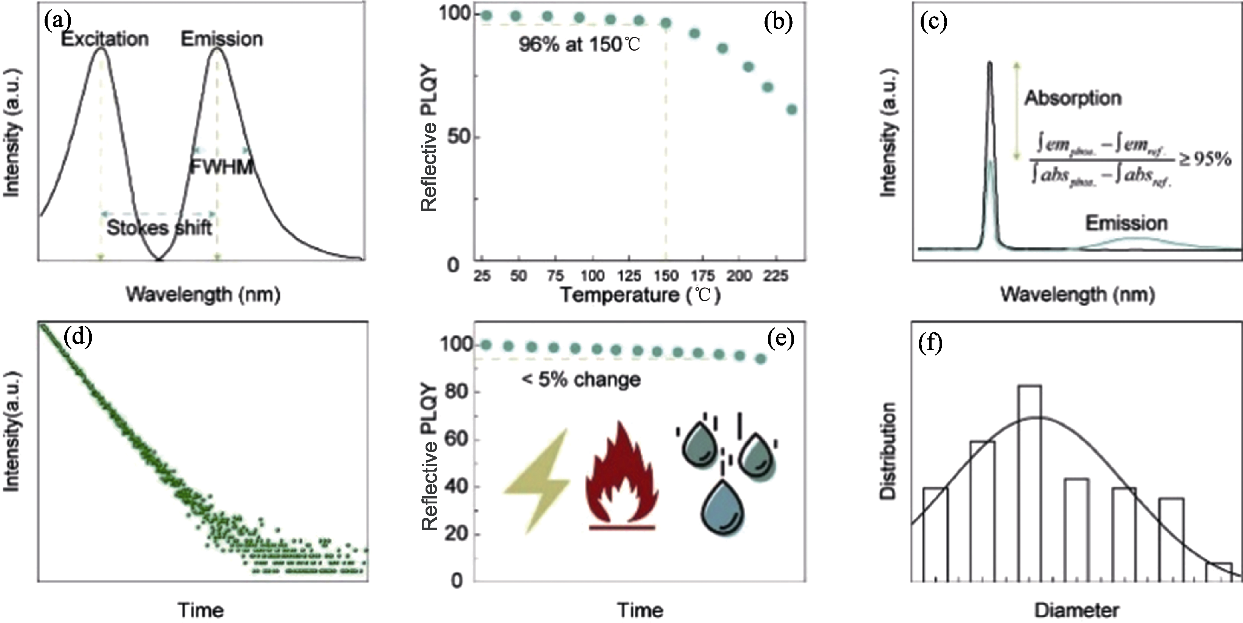
图1 荧光粉的关键性能指标
Fig. 1 Key properties for phosphors (a) Fluorescence spectrum (including excitation wavelength, emission wavelength, FWHM, Stokes shift); (b) Thermal stability of materials; (c) Quantum efficiency of phosphor; (d) Decay time; (e) Chemical stability; (f) Particle size distribution
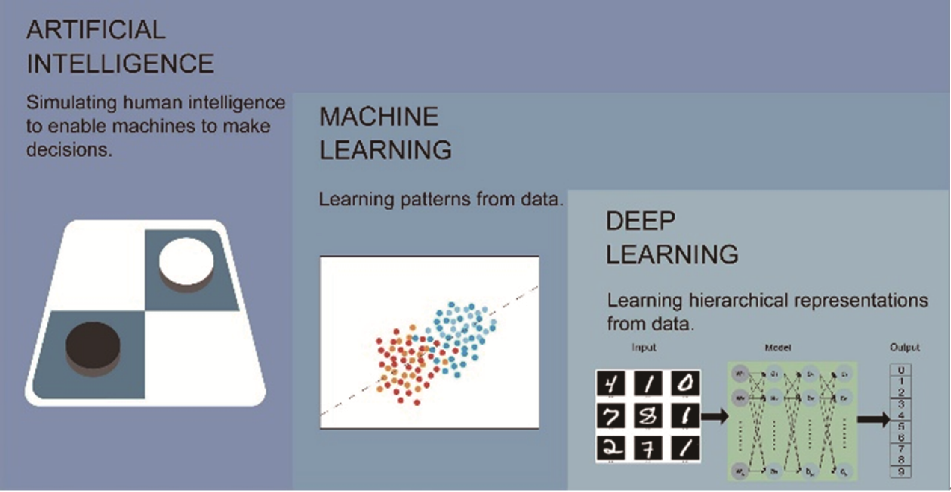
图2 人工智能、机器学习与深度学习之间的关系示意图
Fig. 2 Conceptual framework of hierarchical relationship among artificial intelligence, machine learning, and deep learning
| Library | Website | Ref. | Database | Website | Ref. |
|---|---|---|---|---|---|
| Matminer | https://hackingmaterials.lbl.gov/matminer/ | [ | MP | https://materialsproject.org/ | [ |
| DScribe | https://singroup.github.io/dscribe/ | [ | AFLOW | https://www.aflowlib.org/ | [ |
| ChemTools | https://www.chemistrytools.org/ | [ | NOMAD | https://nomad-lab.eu/nomad-lab/ | [ |
| RDKit | https://www.rdkit.org/ | [ | ICSD | https://icsd.nist.gov/ | [ |
| Pymatgen | https://pymatgen.org/ | [ | COD | https://www.crystallography.net/cod/ | [ |
| …… | …… | ||||
表1
Table 1 Major external libraries and databases[34-43]
| Library | Website | Ref. | Database | Website | Ref. |
|---|---|---|---|---|---|
| Matminer | https://hackingmaterials.lbl.gov/matminer/ | [ | MP | https://materialsproject.org/ | [ |
| DScribe | https://singroup.github.io/dscribe/ | [ | AFLOW | https://www.aflowlib.org/ | [ |
| ChemTools | https://www.chemistrytools.org/ | [ | NOMAD | https://nomad-lab.eu/nomad-lab/ | [ |
| RDKit | https://www.rdkit.org/ | [ | ICSD | https://icsd.nist.gov/ | [ |
| Pymatgen | https://pymatgen.org/ | [ | COD | https://www.crystallography.net/cod/ | [ |
| …… | …… | ||||
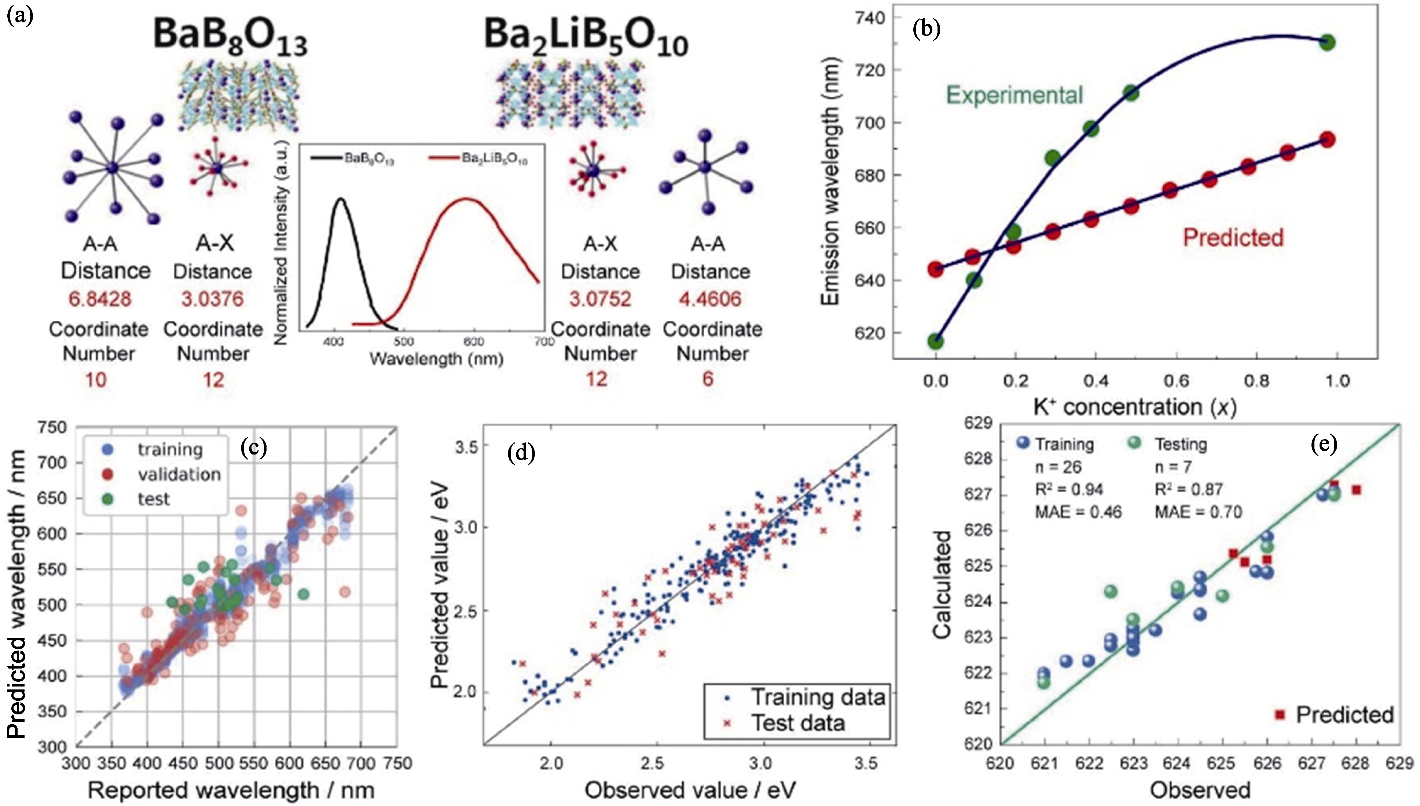
图3 ML模型用于发射波长预测的应用[26,54,69,72,74]
Fig. 3 Application of ML models for emission wavelength prediction[26,54,69,72,74] (a) Emission spectra and A-X and A-A local structures for Ba2LiB5O10:Eu2+ and BaB8O13:Eu2+[69]; (b) Theoretically predicted and experimentally observed emission wavelengths of R1-xKxLSO:0.01Eu2+ (0≤x≤1) phosphors[54]; (c) Performance of the best model on the dataset[72]; (d) Comparison diagram between model predicted values and experimentally observed values[74]; (e) Comparative plots of the experimentally observed and model predicted values[26]
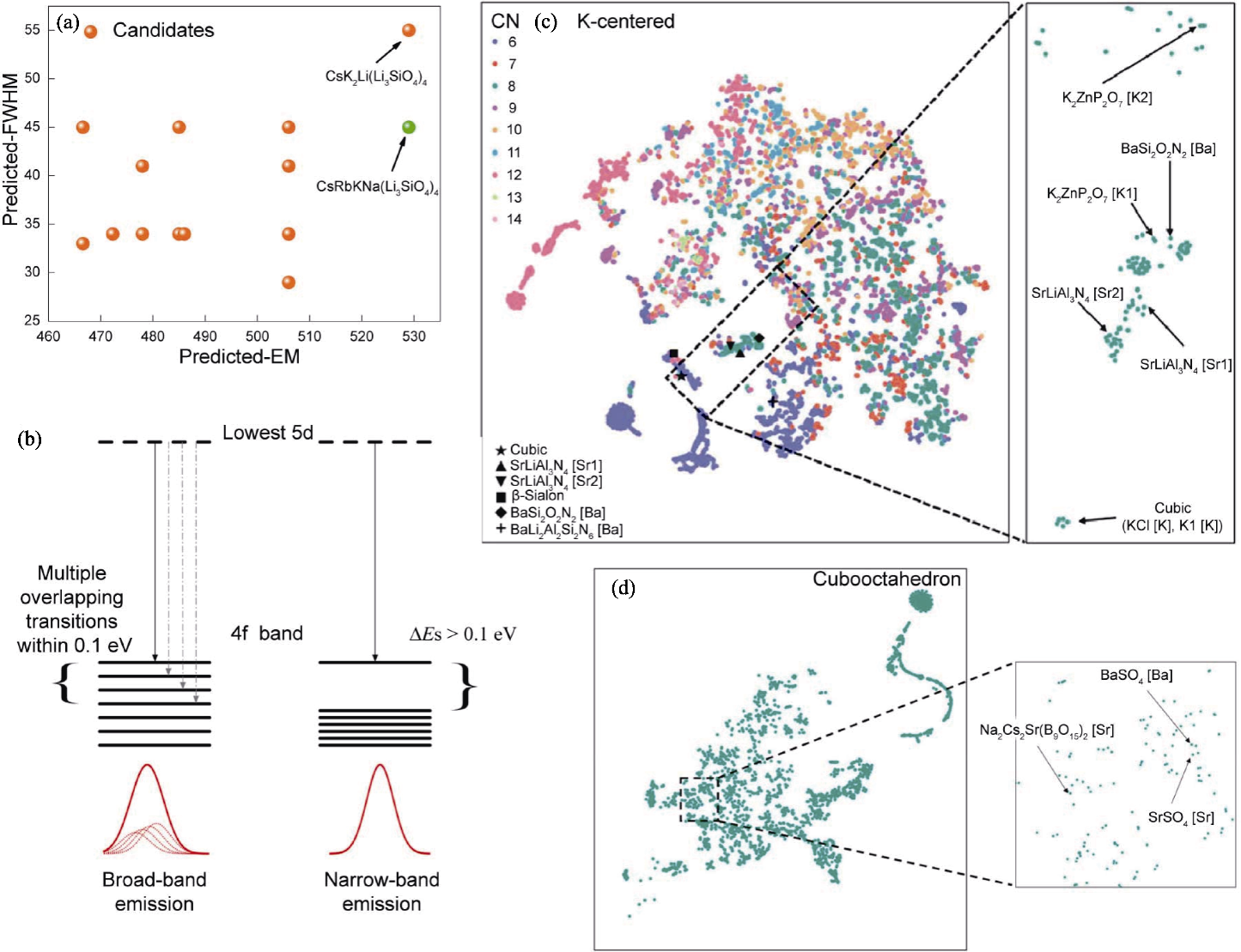
图4 ML模型用于发射FWHM预测的应用[80-81,83 -84]
Fig. 4 Application of ML models for emission FWHM prediction[80-81,83 -84] (a) Predicted emission wavelengths and FWHM of candidates[80]; (b) Relationship between emission bandwidth and Eu2+4f band levels. When there are multiple Eu2+4f levels within 0.1 eV from the highest band (left), overlapping emissions result in a broad bandwidth. Conversely, a large energy splitting between the two highest 4f bands (right) results in narrow-band emission[81]; (c) 2D t-SNE plots of the local structures, and enlarged image showing phosphors with similar local structures within the black region[83]; (d) 2D t-SNE plots of local structures[84]
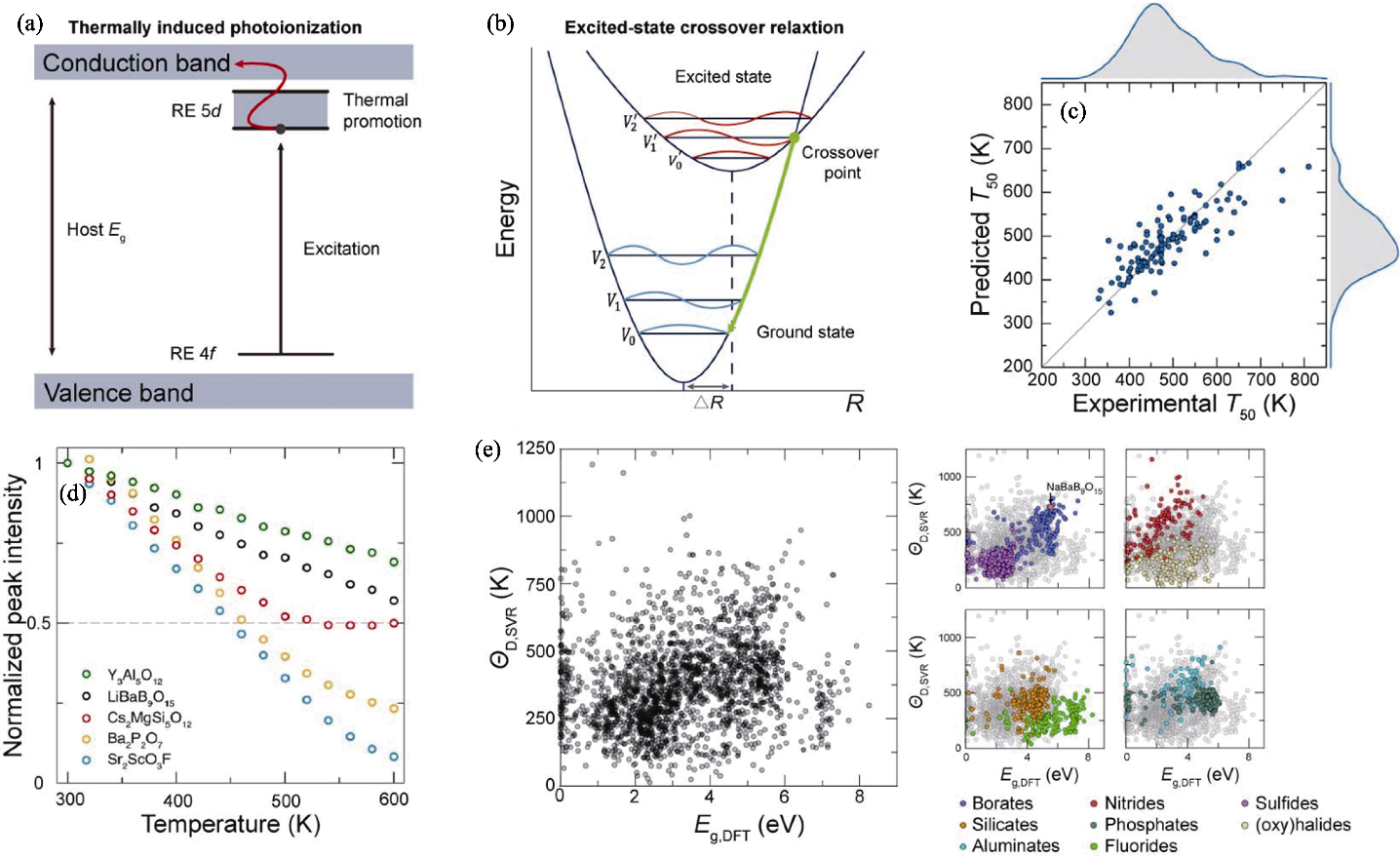
图5 ML模型用于热稳定性预测的应用[11,25,89]
Fig. 5 Application of ML models for thermal stability prediction[11,25,89] (a) Schematic of thermally induced photoionization in phosphors that undergo 4fn-15d1→4fn5d0 transitions[11]; (b) Schematic of the crossover mechanism in which thermally induced non-radiative relaxation occurs at the intersection (crossover) point between the ground and excited state parabolas[11]; (c) Predicted T50 by model versus experimental results[89]; (d) Thermal quenching curves of normalized emission intensity for five candidate structures[89]; (e) Distribution of 2071 candidate structures with axes representing the model-predicted Deybe temperature and the DFT-calculated bandgap[25]
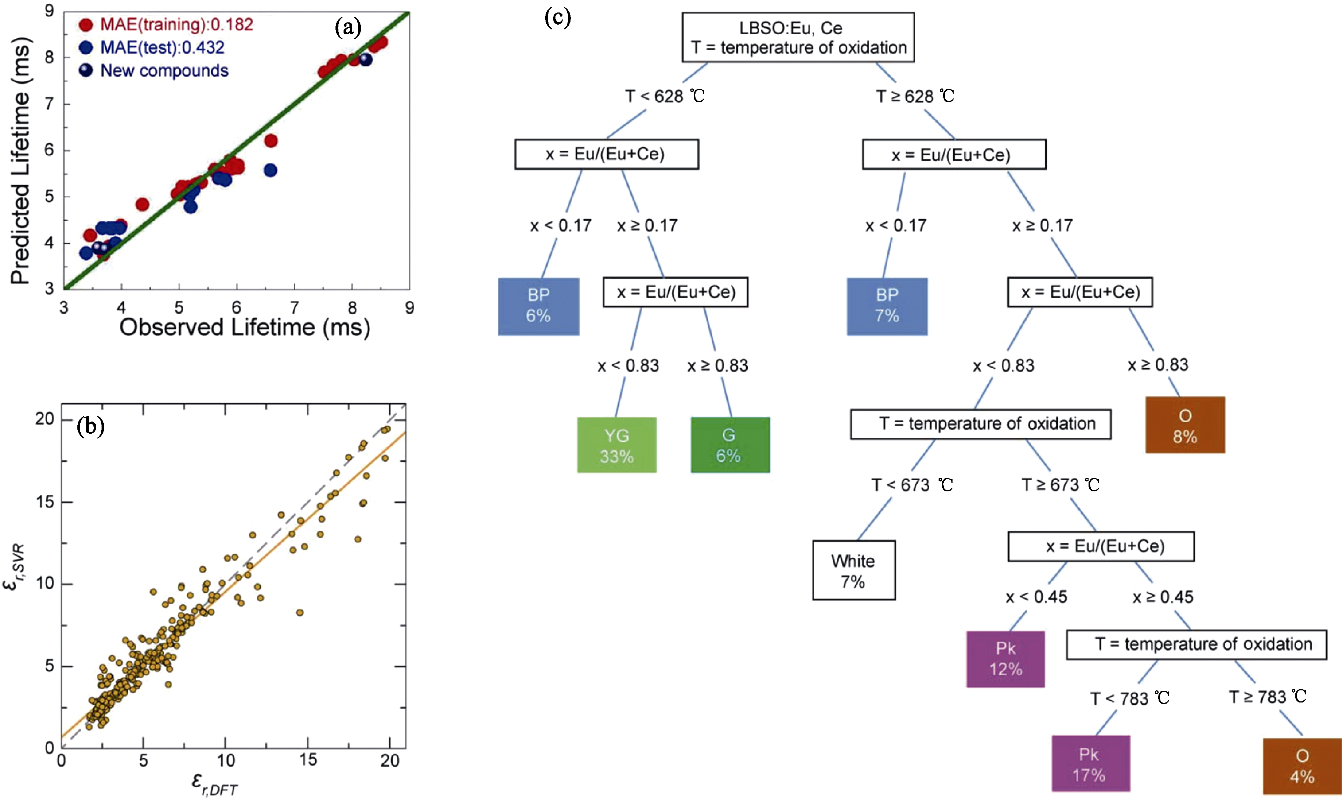
图6 ML模型用于其他性质预测的应用[24,97 -98]
Fig. 6 Application of ML models for other properties prediction[24,97 -98] (a) Experimental versus predicted fluorescence lifetime from ML model[24]; (b) Comparison of ML-predicted versus DFT-calculated dielectric constants for the validation set[97]; (c) Decision tree classification model for emission colors[98]
| [1] | XIE R J, HIROSAKI N. Silicon-based oxynitride and nitride phosphors for white LEDs—a review. Science and Technology of Advanced Materials, 2007, 8(7/8): 588. |
| [2] | XIE R J, HIROSAKI N, SAKUMA K, et al. Eu2+-doped Ca-α-SiAlON: a yellow phosphor for white light-emitting diodes. Applied Physics Letters, 2004, 84(26): 5404. |
| [3] | WANG P, WANG Y, LI Z, et al. Enhanced stability and brightness through co-substitution: promoting plant growth with green-excited deep red phosphor Ca1-zSrzLi1-xMg2xAl3-xN4:yEu2+. Advanced Materials, 2025, 37(4): 2414578. |
| [4] | LIU S, LI L, QIN X, et al. Achieving ultra-broadband sunlight-like emission in single-phase phosphors: the interplay of structure and luminescence. Advanced Materials, 2024, 36(38): 2406164. |
| [5] | LIU S, YANG X, DU R, et al. Single-grain high-efficiency full- visible-spectrum white emitters. Angewandte Chemie International Edition, 2025, 64(19): e202502100. |
| [6] | LI S, XIA Y, AMACHRAA M, et al. Data-driven discovery of full-visible-spectrum phosphor. Chemistry of Materials, 2019, 31(16): 6286. |
| [7] | PUST P, WEILER V, HECHT C, et al. Narrow-band red-emitting Sr[LiAl3N4]:Eu2+ as a next-generation LED-phosphor material. Nature Materials, 2014, 13(9): 891. |
| [8] | PUST P, SCHMIDT P J, SCHNICK W. A revolution in lighting. Nature Materials, 2015, 14(5): 454. |
| [9] | GEORGE N C, DENAULT K A, SESHADRI R. Phosphors for solid-state white lighting. Annual Review of Materials Research, 2013, 43(1): 481. |
| [10] | MORGAN P, MONICA H, NORMAN B, et al. 2022 Solid-state lighting R&D opportunities. US Department of Energy Office of Scientific and Technical Information. (2022-02-02)[2025-11-26]. https://doi.org/10.2172/1862626. |
| [11] | HARIYANI S, SÓJKA M, SETLUR A, et al. A guide to comprehensive phosphor discovery for solid-state lighting. Nature Reviews Materials, 2023, 8(11): 759. |
| [12] | TAKEDA T, KOYAMA Y, IKENO H, et al. Exploring new useful phosphors by combining experiments with machine learning. Science and Technology of Advanced Materials, 2024, 25(1): 2421761. |
| [13] | WANG X J, WANG L, TAKEDA T, et al. Blue-emitting Sr3Si8-xAlxO7+xN8-x:Eu2+ discovered by a single-particle-diagnosis approach: crystal structure, luminescence, scale-up synthesis, and its abnormal thermal quenching behavior. Chemistry of Materials, 2015, 27(22): 7689. |
| [14] | PARK W B, SINGH S P, KIM M, et al. Combinatorial screening of luminescent and structural properties in a Ce3+-doped Ln-Al-Si-O-N (Ln = Y, La, Gd, Lu) system: the discovery of a novel Gd3Al3+xSi3-xO12+xN2-x:Ce3+ phosphor. Inorganic Chemistry, 2015, 54(4): 1829. |
| [15] | PARK W B, SINGH S P, SOHN K S. Discovery of a phosphor for light emitting diode applications and its structural determination, Ba(Si,Al)5(O,N)8:Eu2+. Journal of the American Chemical Society, 2014, 136(6): 2363. |
| [16] | ZHAO M, LIAO H, MOLOKEEV M S, et al. Emerging ultra-narrow-band cyan-emitting phosphor for white LEDs with enhanced color rendition. Light: Science & Applications, 2019, 8: 38. |
| [17] | WANG Z, HA J, KIM Y H, et al. Mining unexplored chemistries for phosphors for high-color-quality white-light-emitting diodes. Joule, 2018, 2(5): 914. |
| [18] | LI S, AMACHRAA M, CHEN C, et al. Efficient near-infrared phosphors discovered by parametrizing the Eu(II) 5d-to-4f energy gap. Matter, 2022, 5(6): 1924. |
| [19] | BUTLER K T, DAVIES D W, CARTWRIGHT H, et al. Machine learning for molecular and materials science. Nature, 2018, 559: 547. |
| [20] | XIE T, GROSSMAN J C. Crystal graph convolutional neural networks for an accurate and interpretable prediction of material properties. Physical Review Letters, 2018, 120(14): 145301. |
| [21] | AGRAWAL A, CHOUDHARY A. Perspective: materials informatics and big data: realization of the “fourth paradigm” of science in materials science. APL Materials, 2016, 4(5): 053208. |
| [22] | PARK C, LEE J W, KIM M, et al. A data-driven approach to predicting band gap, excitation, and emission energies for Eu2+-activated phosphors. Inorganic Chemistry Frontiers, 2021, 8(21): 4610. |
| [23] | MOLOKEEV M S, SU B, ALEKSANDROVSKY A S, et al. Machine learning analysis and discovery of zero-dimensional ns2 metal halides toward enhanced photoluminescence quantum yield. Chemistry of Materials, 2022, 34(2): 537. |
| [24] | MING H, ZHOU Y, MOLOKEEV M S, et al. Machine- learning-driven discovery of Mn4+-doped red-emitting fluorides with short excited-state lifetime and high efficiency for mini light- emitting diode displays. ACS Materials Letters, 2024, 6(5): 1790. |
| [25] | ZHUO Y, TEHRANI A, OLIYNYK A, et al. Identifying an efficient, thermally robust inorganic phosphor host via machine learning. Nature Communications, 2018, 9: 4377. |
| [26] | WANG Y, TANG W, ZHANG C, et al. Structure-based machine learning enables discovery of Mn4+-activated red-light fluorides for ultrawide-gamut mini-light-emitting diodes. Advanced Functional Materials, 2024, 34(14): 2313490. |
| [27] | BI H, JIANG J, CHEN J, et al. Machine learning prediction of quantum yields and wavelengths of aggregation-induced emission molecules. Materials, 2024, 17(7): 1664. |
| [28] | PILANIA G, GUBERNATIS J E, LOOKMAN T. Multi-fidelity machine learning models for accurate bandgap predictions of solids. Computational Materials Science, 2017, 129: 156. |
| [29] | YUAN H, QI L, PARIS M, et al. Machine learning guided design of single-phase hybrid lead halide white phosphors. Advanced Science, 2021, 8(19): 2101407. |
| [30] | LI H, ZHENG H, YUE T, et al. Machine learning-accelerated discovery of heat-resistant polysulfates for electrostatic energy storage. Nature Energy, 2025, 10: 90. |
| [31] | YANG S, ZANG B, XIANG M, et al. Designing Fe-based amorphous alloys with both ultra-high magnetization and ultra-low coercivity through artificial intelligence. Advanced Functional Materials, 2025, 35(30): 2425588. |
| [32] | JIA X, DENG Y, BAO X, et al. Unsupervised machine learning for discovery of promising half-Heusler thermoelectric materials. npj Computational Materials, 2022, 8: 34. |
| [33] | ISAYEV O, OSES C, TOHER C, et al. Universal fragment descriptors for predicting properties of inorganic crystals. Nature Communications, 2017, 8: 15679. |
| [34] | WARD L, DUNN A, FAGHANINIA A, et al. Matminer: an open source toolkit for materials data mining. Computational Materials Science, 2018, 152: 60. |
| [35] | HIMANEN L, JÄGER M O J, MOROOKA E V, et al. DScribe: library of descriptors for machine learning in materials science. Computer Physics Communications, 2020, 247: 106949. |
| [36] | HEIDAR-ZADEH F, RICHER M, FIAS S, et al. An explicit approach to conceptual density functional theory descriptors of arbitrary order. Chemical Physics Letters, 2016, 660: 307. |
| [37] | BENTO A P, HERSEY A, FÉLIX E, et al. An open source chemical structure curation pipeline using RDKit. Journal of Cheminformatics, 2020, 12: 51. |
| [38] | ONG S P, RICHARDS W D, JAIN A, et al. Python Materials Genomics (pymatgen): a robust, open-source Python library for materials analysis. Computational Materials Science, 2013, 68: 314. |
| [39] | JAIN A, ONG S P, HAUTIER G, et al. Commentary: the materials project: a materials genome approach to accelerating materials innovation. APL Materials, 2013, 1: 011002. |
| [40] | CURTAROLO S, SETYAWAN W, HART G L W, et al. AFLOW: an automatic framework for high-throughput materials discovery. Computational Materials Science, 2012, 58: 218. |
| [41] | DRAXL C, SCHEFFLER M. The NOMAD laboratory: from data sharing to artificial intelligence. Journal of Physics: Materials, 2019, 2(3): 036001. |
| [42] | HELLENBRANDT M. The inorganic crystal structure database (ICSD)—present and future. Crystallography Reviews, 2004, 10(1): 17. |
| [43] | GRAŽULIS S, DAŠKEVIČ A, MERKYS A, et al. Crystallography open database (COD): an open-access collection of crystal structures and platform for world-wide collaboration. Nucleic Acids Research, 2012, 40(D1): D420. |
| [44] | MORGAN D, JACOBS R. Opportunities and challenges for machine learning in materials science. Annual Review of Materials Research, 2020, 50(1): 71. |
| [45] | LIU Y, YANG Z, ZOU X, et al. Data quantity governance for machine learning in materials science. National Science Review, 2023, 10(7): nwad125. |
| [46] | HAGHIGHATLARI M, LI J, HEIDAR-ZADEH F, et al. Learning to make chemical predictions: the interplay of feature representation, data, and machine learning methods. Chem, 2020, 6(7): 1527. |
| [47] | GHIRINGHELLI L M, VYBIRAL J, LEVCHENKO S V, et al. Big data of materials science: critical role of the descriptor. Physical Review Letters, 2015, 114(10): 105503. |
| [48] | HE J, LI J, LIU C, et al. Machine learning identified materials descriptors for ferroelectricity. Acta Materialia, 2021, 209: 116815. |
| [49] | YILMAZ B, YILDIRIM R. Critical review of machine learning applications in perovskite solar research. Nano Energy, 2021, 80: 105546. |
| [50] | JO B, CHEN W, JUNG H S. Comprehensive review of advances in machine-learning-driven optimization and characterization of perovskite materials for photovoltaic devices. Journal of Energy Chemistry, 2025, 101: 298. |
| [51] | PEARSON K. Mathematical contributions to the theory of evolution: on a form of spurious correlation which may arise when indices are used in the measurement of organs. Proceedings of the Royal Society, 1897, 60: 489. |
| [52] | WANG A Y T, MURDOCK R J, KAUWE S K, et al. Machine learning for materials scientists: an introductory guide toward best practices. Chemistry of Materials, 2020, 32(12): 4954. |
| [53] | LI C, HAO H, XU B, et al. Improved physics-based structural descriptors of perovskite materials enable higher accuracy of machine learning. Computational Materials Science, 2021, 198: 110714. |
| [54] | LAI S, ZHAO M, QIAO J, et al. Data-driven photoluminescence tuning in Eu2+-doped phosphors. The Journal of Physical Chemistry Letters, 2020, 11(14): 5680. |
| [55] | KARPOVICH C, PAN E, OLIVETTI E A. Deep reinforcement learning for inverse inorganic materials design. npj Computational Materials, 2024, 10: 287. |
| [56] | HE Z, THÜRER M, ZHOU W. The use of reinforcement learning for material flow control: an assessment by simulation. International Journal of Production Economics, 2024, 274: 109312. |
| [57] | SHEN Z H, LIU H X, SHEN Y, et al. Machine learning in energy storage materials. Interdisciplinary Materials, 2022, 1(2): 175. |
| [58] | JIANG X, FU H, BAI Y, et al. Interpretable machine learning applications: a promising prospect of AI for materials. Advanced Functional Materials, 2025, 35(41): 2507734. |
| [59] | SHI Y, ZHANG Y, WEN J, et al. Interpretable machine learning for stability and electronic structure prediction of Janus III-VI van der Waals heterostructures. Materials Genome Engineering Advances, 2024, 2(4): e76. |
| [60] | YAO Y, HAN D, SPOONER K B, et al. Adapting explainable machine learning to study mechanical properties of 2D hybrid halide perovskites. Advanced Functional Materials, 2025, 35(1): 2411652. |
| [61] | DUAN X, LI Y, ZHAO J, et al. Machine learning accelerated discovery of entropy-stabilized oxide catalysts for catalytic oxidation. Journal of the American Chemical Society, 2025, 147(1): 651. |
| [62] | HAN Z, XIA S, CHEN Z, et al. Facilitated the discovery of new γ/γ′ Co-based superalloys by combining first-principles and machine learning. npj Computational Materials, 2024, 10: 259. |
| [63] | WU J, TORRESI L, HU M, et al. Inverse design workflow discovers hole-transport materials tailored for perovskite solar cells. Science, 2024, 386(6727): 1256. |
| [64] | CUI C X, SHEN Y, HE J R, et al. Quantitative insight into the electric field effect on CO2 electrocatalysis via machine learning spectroscopy. Journal of the American Chemical Society, 2024, 146(50): 34551. |
| [65] | WANG L, XIE R J, SUEHIRO T, et al. Down-conversion nitride materials for solid state lighting: recent advances and perspectives. Chemical Reviews, 2018, 118(4): 1951. |
| [66] | XIE R J, HINTZEN H T. Optical properties of (oxy)nitride materials: a review. Journal of the American Ceramic Society, 2013, 96(3): 665. |
| [67] | XIE R J, HIROSAKI N, SUEHIRO T, et al. A simple, efficient synthetic route to Sr2Si5N8:Eu2+-based red phosphors for white light-emitting diodes. Chemistry of Materials, 2006, 18(23): 5578. |
| [68] | LI Y, HIROSAKI N, XIE R J, et al. Yellow-orange-emitting CaAlSiN3:Ce3+ phosphor: structure, photoluminescence, and application in white LEDs. Chemistry of Materials, 2008, 20(21): 6704. |
| [69] | PARK W B, SINGH S P, KIM M, et al. Phosphor informatics based on confirmatory factor analysis. ACS Combinatorial Science, 2015, 17(5): 317. |
| [70] | QIAO J, AMACHRAA M, MOLOKEEV M, et al. Engineering of K3YSi2O7 to tune photoluminescence with selected activators and site occupancy. Chemistry of Materials, 2019, 31(18): 7770. |
| [71] | QIAO J, ZHOU G, ZHOU Y, et al. Divalent europium-doped near-infrared-emitting phosphor for light-emitting diodes. Nature Communications, 2019, 10: 5267. |
| [72] | KOYAMA Y, IKENO H, HARADA M, et al. Rapid discovery of new Eu2+-activated phosphors with a designed luminescence color using a data-driven approach. Materials Advances, 2023, 4(1): 231. |
| [73] | XU Y, YAMAZAKI M, VILLARS P. Inorganic materials database for exploring the nature of material. Japanese Journal of Applied Physics, 2011, 50(11S): 11RH02. |
| [74] | NAKANO H, TANAKA K, MIYAO T, et al. Practical models for predicting the emission peak wavelengths of inorganic phosphors based on stoichiometric information. Chemistry Letters, 2017, 46(10): 1482. |
| [75] | DING C, LI Z F, ZHANG W J, et al. Machine learning the peak emission wavelength of Mn4+-activated inorganic phosphors. New Journal of Chemistry, 2023, 47(22): 10875. |
| [76] | TIAN R, ZHOU T, XIE R J. Spectrally tunable dual-phosphor ceramics for laser lighting. Laser & Photonics Reviews, 2025, 19(13): 2402144. |
| [77] | HIROSAKI N, XIE R, KIMOTO K, et al. Characterization and properties of green-emitting β-SiAlON:Eu2+ powder phosphors for white light-emitting diodes. Applied Physics Letters, 2005, 86(21): 211905. |
| [78] | ZHAO M, YANG Z, NING L, et al. Tailoring of white luminescence in a NaLi3SiO4:Eu2+ phosphor containing broad-band defect-induced charge-transfer emission. Advanced Materials, 2021, 33(29): 2101428. |
| [79] | ZHAO M, LIAO H, NING L, et al. Next-generation narrow-band green-emitting RbLi(Li3SiO4)2:Eu2+ phosphor for backlight display application. Advanced Materials, 2018, 30(38): 1802489. |
| [80] | LIU S, SONG K, LI S, et al. Machine learning-driven discovery of efficient narrow-band green phosphor for wide-color-gamut backlight displays. Chemical Engineering Journal, 2025, 520: 165719. |
| [81] | WANG Z, CHU I H, ZHOU F, et al. Electronic structure descriptor for the discovery of narrow-band red-emitting phosphors. Chemistry of Materials, 2016, 28(11): 4024. |
| [82] | KIM M, SINGH S P, LEE J W, et al. Identification of a narrow band red light-emitting phosphor using computational screening of ICSD: its synthesis and optical characterization. Journal of Alloys and Compounds, 2019, 774: 338. |
| [83] | TAKEMURA S, KOYAMA Y, NAKANISHI T, et al. Narrow-band phosphor K2ZnP2O7:Eu2+ discovered using local structure similarity. Scripta Materialia, 2022, 215(1): 114686. |
| [84] | TAKEMURA S, KOYAMA Y, NAKANISHI T, et al. Narrow-band emitting phosphor Na2Cs2Sr(B9O15)2:Eu2+ discovered from local structure similarity with sulfate phosphor. The Journal of Physical Chemistry Letters, 2022, 13(51): 11878. |
| [85] | AMACHRAA M, WANG Z, CHEN C, et al. Predicting thermal quenching in inorganic phosphors. Chemistry of Materials, 2020, 32(14): 6256. |
| [86] | KIM Y H, ARUNKUMAR P, KIM B Y, et al. A zero-thermal- quenching phosphor. Nature Materials, 2017, 16(5): 543. |
| [87] | ZHENG P, LI S, WANG L, et al. Unique color converter architecture enabling phosphor-in-glass (PiG) films suitable for high-power and high-luminance laser-driven white lighting. ACS Applied Materials & Interfaces, 2018, 10(17): 14930. |
| [88] | JIANG L, JIANG X, ZHANG Y, et al. Multiobjective machine learning-assisted discovery of a novel cyan-green garnet: Ce phosphors with excellent thermal stability. ACS Applied Materials & Interfaces, 2022, 14(13): 15426. |
| [89] | ZHUO Y, HARIYANI S, ARMIJO E, et al. Evaluating thermal quenching temperature in Eu3+-substituted oxide phosphors via machine learning. ACS Applied Materials & Interfaces, 2020, 12(5): 5244. |
| [90] | ZHANG S, LV Y, LI Z, et al. Explainable machine learning- enabled discovery for high-efficiency red-emitting phosphor under data constraints. Chemical Engineering Journal, 2025, 522: 167046. |
| [91] | JIANG L, JIANG X, YANG M, et al. Developing and optimizing novel Cr3+-activated inorganic NIR phosphors by combining triple-objective optimization and crystal field engineering. Inorganic Chemistry Frontiers, 2024, 11(2): 487. |
| [92] | HUANG L, LOU S, CAO L, et al. Surfactant- and HF-free cation exchange synthesis of highly-efficient nanoscale K2SiF6:Mn4+ and potential usage for high-resolution micro-LED display. ACS Materials Letters, 2022, 4(9): 1716. |
| [93] | DORENBOS P. 5d-level energies of Ce3+ and the crystalline environment. I. Fluoride compounds. Physical Review B, 2000, 62(23): 15640. |
| [94] | DORENBOS P. 5d-level energies of Ce3+ and the crystalline environment. II. Chloride, bromide, and iodide compounds. Physical Review B, 2000, 62(23): 15650. |
| [95] | DORENBOS P. 5d-level energies of Ce3+ and the crystalline environment. III. Oxides containing ionic complexes. Physical Review B, 2001, 64(12): 125117. |
| [96] | DORENBOS P. Relation between Eu2+ and Ce3+ f ↔ d-transition energies in inorganic compounds. Journal of Physics: Condensed Matter, 2003, 15(27): 4797. |
| [97] | ZHUO Y, HARIYANI S, YOU S, et al. Machine learning 5d-level centroid shift of Ce3+ inorganic phosphors. Journal of Applied Physics, 2020, 128: 013104. |
| [98] | YUAN H, GÉNOIS R, GLAIS E, et al. Machine learning identification of experimental conditions for the synthesis of single-phase white phosphors. Matter, 2021, 4(12): 3967. |
| [99] | YUAN W, CHEN G, WANG Z, et al. Empowering generalist material intelligence with large language models. Advanced Materials, 2025, 37(32): 2502771. |
| [100] | XU P, MA Y, LU W, et al. Multi-objective optimization in machine learning assisted materials design and discovery. Journal of Materials Informatics, 2025, 5(2): 26. |
| [101] | ZHU Q, ZHANG F, HUANG Y, et al. An all-round AI-Chemist with a scientific mind. National Science Review, 2022, 9(10): nwac190. |
| [102] | MALYI O I, SOPIHA K V, PERSSON C, et al. Energy, phonon, and dynamic stability criteria of two-dimensional materials. ACS Applied Materials & Interfaces, 2019, 11(28): 24876. |
| [1] | 覃善丽, 郭佳文, 陈燕萌, 聚安安, 韦毅, 黄科林, 侯向华, 吕思师, 文志朋, 吴炼. 二维层状材料构筑电化学储能定向离子传输通道的研究进展[J]. 无机材料学报, 2026, 41(7): 883-898. |
| [2] | 余飞宇, 王文清, 张学勤, 何汝杰. 基于增材制造陶瓷点阵的双相网络互穿复合材料的研究进展与挑战[J]. 无机材料学报, 2026, 41(7): 849-866. |
| [3] | 周翠, 李捷, 孙鲁超, 苏海军, 王京阳. 氧化铝基定向凝固共晶陶瓷的组织特性、调控方法及环境稳定性[J]. 无机材料学报, 2026, 41(7): 899-914. |
| [4] | 左致平, 郭春, 周志勇. 基于机器学习的高温BSPT基压电陶瓷双重性能协同增强[J]. 无机材料学报, 2026, 41(7): 1001-1010. |
| [5] | 费文龙, 王亚坤, 廖良生. 蓝光ZnSeTe量子点的可控制备及其量子点发光二极管器件研究进展[J]. 无机材料学报, 2026, 41(7): 867-882. |
| [6] | 陈明俊, 缪洪康, 肖英俊, 邓建波, 张翔, 赵九蓬, 李垚. 光-热双响应材料研究进展: 从设计策略到智能窗应用[J]. 无机材料学报, 2026, 41(6): 723-738. |
| [7] | 胡钰晴, 朱一新, 乐先浩, 万青. 钽酸锂晶圆减薄技术及其热释电红外探测器应用进展[J]. 无机材料学报, 2026, 41(6): 764-774. |
| [8] | 刘春帆, 陈科, 葛芳芳, 黄庆. 核用耐铅铋腐蚀涂层的研究进展[J]. 无机材料学报, 2026, 41(6): 775-786. |
| [9] | 胡扬, 谢敏, 张筱怡, 李想, 郭新伟, 姜南, 周文瀚, 张胜利, 曾海波. 计算与数据驱动环保型发光材料的研究进展[J]. 无机材料学报, 2026, 41(6): 704-722. |
| [10] | 王俊卜, 黄泽皑, 杨茗凯, 蒙颖, 周明炜, 周莹. 甲烷转化用抗积碳催化材料研究进展[J]. 无机材料学报, 2026, 41(6): 739-750. |
| [11] | 王金文, 杨振, 周欢, 夏丹, 杨磊. 可注射无机材料及其生物医学应用[J]. 无机材料学报, 2026, 41(6): 751-763. |
| [12] | 李涵涛, 沈强, 罗国强, 王雪飞, 高明, 陈晨. 机械球磨法调控硅基负极材料结构与性能的研究进展[J]. 无机材料学报, 2026, 41(5): 561-572. |
| [13] | 解陈一, 缪花明, 张蔚然, 刘荣军, 王衍飞, 李端. 理论计算在高熵陶瓷领域的研究进展[J]. 无机材料学报, 2026, 41(5): 545-560. |
| [14] | 董浪平, 李施璇, 杨少星, 侯京山, 林燕丹, 周鹏程, 孙雪娇, 孙宜阳, 陈大钦, 房永征. 一种可被紫光激发的红色荧光粉RbZnF3:Eu3+ 中的异常热猝灭现象[J]. 无机材料学报, 2026, 41(5): 673-680. |
| [15] | 李璇, 叶奎材, 冯佳音, 邱家军, 钱文昊, 邢敏. 钛基牙种植体表面改性促进软组织封闭的研究进展[J]. 无机材料学报, 2026, 41(4): 432-444. |
| 阅读次数 | ||||||
|
全文 |
|
|||||
|
摘要 |
|
|||||