无机材料学报 ›› 2026, Vol. 41 ›› Issue (7): 899-914.DOI: 10.15541/jim20250440 CSTR: 32189.14.10.15541/jim20250440
周翠1( ), 李捷2, 孙鲁超2(), 苏海军3(), 王京阳2
收稿日期:2025-10-31
修回日期:2025-12-26
出版日期:2026-07-20
网络出版日期:2026-01-06
通讯作者:
孙鲁超, 研究员. E-mail: lcsun@imr.ac.cn;作者简介:周 翠(1997-), 女, 博士. E-mail: zhouc@lam.ln.cn
基金资助:
ZHOU Cui1(), LI Jie2, SUN Luchao2(), SU Haijun3(), WANG Jingyang2
Received:2025-10-31
Revised:2025-12-26
Published:2026-07-20
Online:2026-01-06
Contact:
SUN Luchao, professor. E-mail: lcsun@imr.ac.cn;About author:ZHOU Cui (1997-), female, PhD. E-mail: zhouc@lam.ln.cn
Supported by:摘要:
随着航空工业的快速发展, 航空发动机所采用的高温结构材料正面临着日益严苛的服役环境与性能挑战。为满足未来先进航空动力系统的需求, 推重比超过10的先进航空发动机的进气口温度将突破1500 ℃。氧化铝基定向凝固共晶陶瓷凭借其超过1700 ℃的极高熔点、优异的高温组织稳定性、高温力学性能稳定性以及本征抗氧化性能, 展现出在高温氧化环境中长期稳定运行的巨大潜力, 被视为下一代极端工况下理想的关键候选材料。本文首先综述了该类陶瓷材料的微观组织特征, 涵盖典型组织形貌、晶体学取向关系及界面结构特性; 重点探讨了微观组织的调控方法, 包括工艺参数的优化调控、共晶组分优选以及高熵化设计等创新策略; 随后深入分析了材料在典型服役环境下(高温、氧化及化学腐蚀介质)的稳定性表现。在此基础之上, 凝练总结并揭示了当前研究领域中所面临的关键科学问题与核心技术瓶颈, 接着对未来研究方向提出了前瞻性展望, 旨在为该类陶瓷材料在先进航空动力系统中的工程化应用提供理论依据与技术支撑。
中图分类号:
周翠, 李捷, 孙鲁超, 苏海军, 王京阳. 氧化铝基定向凝固共晶陶瓷的组织特性、调控方法及环境稳定性[J]. 无机材料学报, 2026, 41(7): 899-914.
ZHOU Cui, LI Jie, SUN Luchao, SU Haijun, WANG Jingyang. Alumina-based Directionally Solidified Eutectic Ceramics: Microstructure, Control Strategies and Environmental Stability[J]. Journal of Inorganic Materials, 2026, 41(7): 899-914.
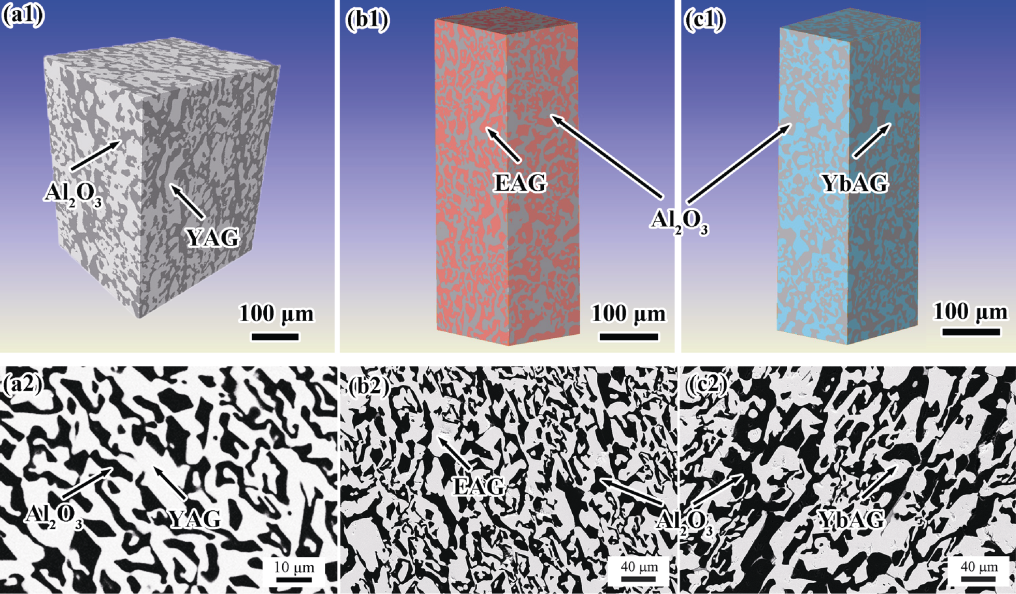
图1 氧化铝基定向凝固共晶陶瓷的典型微观组织[28-30]
Fig. 1 Typical microstructure of Al2O3-based directionally solidified eutectic ceramics[28-30] (a1-c1) Three-dimensional network structure of (a1) YAG/Al2O3[28-29], (b1) Er3Al5O12 (EAG)/Al2O3[30] and (c1) Yb3Al5O12 (YbAG)/Al2O3[30]; (a2-c2) SEM morphologies of transverse section of (a2) YAG/Al2O3[28-29], (b2) EAG/Al2O3[30] and (c2) YbAG/Al2O3[30]
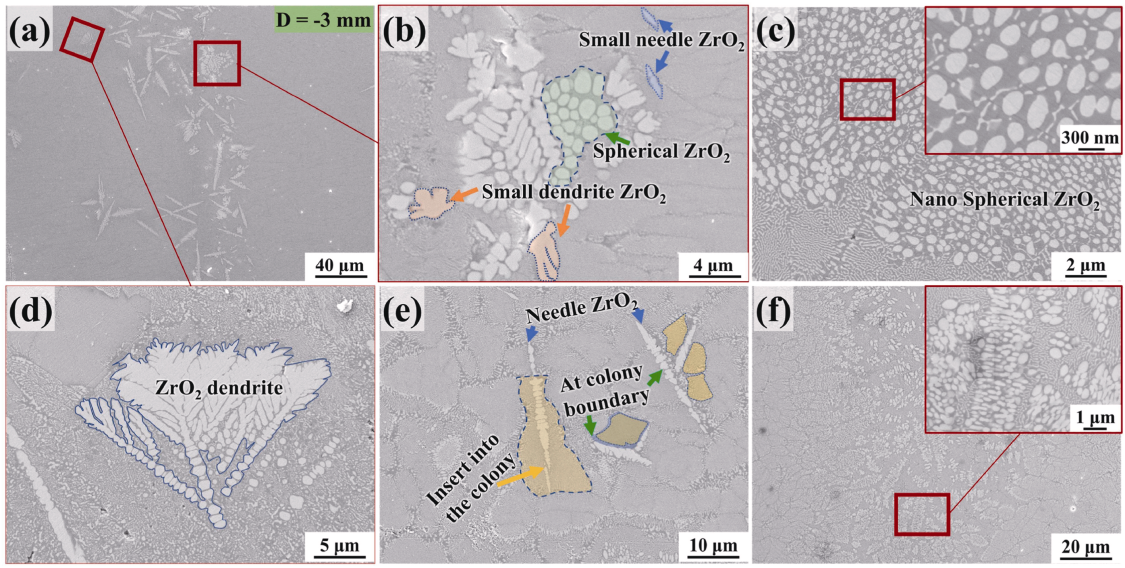
图2 采用LPBF技术制造的样品顶部表面微观组织[38]
Fig. 2 Microstructure of top surface of LPBF-fabricated sample[38] (a) Needle-like ZrO2 settlement in the center of the molten pool; (b) Imperfectly needle-like ZrO2; (c) Colony eutectic with nano spherical ZrO2 structure; (d) Dendritic ZrO2 located in colony eutectic structure; (e) Needle-like structure ZrO2 located in colony eutectic structure; (f) Aggregation, growth, and elongation of nano spherical ZrO2
| Eutectic system | Preparation method | Crystallographic relationship | |
|---|---|---|---|
| Growth direction | Interface relationship | ||
| YAG/Al2O3[ | MLSPM | < | (121) YAG // (0001) Al2O3 |
| YAG/Al2O3[ | OFZM | <011> YAG // < | ( |
| YAG/Al2O3[ | LFZM | <111> YAG // < | ( |
| YAG/Al2O3[ | Bridgman | <101> YAG // < | ( |
| YAG/Al2O3[ | Bridgman | <110> YAG // < | ( |
| REAG/Al2O3[ | OFZM | <110> or < | (121) REAG// (0001) Al2O3 (RE=Y, Yb, Er, Dy) |
| YAG:Ce3+/Al2O3[ | LFZM | < | (220) YAG:Ce3+ // ( |
| YAG/Al2O3/ZrO2[ | OFZM | <001> YAG // < | (001) YAG // (0001) Al2O3 // (100) ZrO2 |
| YAG/Al2O3/ZrO2[ | OFZM | <001> YAG // < | (001) YAG // ( |
| YAG/Al2O3/ZrO2[ | μ-PD | <100> YAG // < | ( |
| ZrO2/Al2O3[ | CZ/OFZM | <010>/<001> ZrO2 // <0001>/< | (100) ZrO2 // ( |
| ZrO2/Al2O3[ | CZ/OFZM | <001> ZrO2 // < | (100)/(010) ZrO2 // ( |
| ZrO2/Al2O3[ | LHFZ | <011> ZrO2 // <0001> Al2O3 | (200) ZrO2 // ( |
表1 采用不同制备技术获得的氧化铝基定向凝固共晶陶瓷的晶体学关系[21,25,44 -53]
Table 1 Crystallographic relationships in Al2O3-based directionally solidified eutectic ceramics fabricated via various methods[21,25,44 -53]
| Eutectic system | Preparation method | Crystallographic relationship | |
|---|---|---|---|
| Growth direction | Interface relationship | ||
| YAG/Al2O3[ | MLSPM | < | (121) YAG // (0001) Al2O3 |
| YAG/Al2O3[ | OFZM | <011> YAG // < | ( |
| YAG/Al2O3[ | LFZM | <111> YAG // < | ( |
| YAG/Al2O3[ | Bridgman | <101> YAG // < | ( |
| YAG/Al2O3[ | Bridgman | <110> YAG // < | ( |
| REAG/Al2O3[ | OFZM | <110> or < | (121) REAG// (0001) Al2O3 (RE=Y, Yb, Er, Dy) |
| YAG:Ce3+/Al2O3[ | LFZM | < | (220) YAG:Ce3+ // ( |
| YAG/Al2O3/ZrO2[ | OFZM | <001> YAG // < | (001) YAG // (0001) Al2O3 // (100) ZrO2 |
| YAG/Al2O3/ZrO2[ | OFZM | <001> YAG // < | (001) YAG // ( |
| YAG/Al2O3/ZrO2[ | μ-PD | <100> YAG // < | ( |
| ZrO2/Al2O3[ | CZ/OFZM | <010>/<001> ZrO2 // <0001>/< | (100) ZrO2 // ( |
| ZrO2/Al2O3[ | CZ/OFZM | <001> ZrO2 // < | (100)/(010) ZrO2 // ( |
| ZrO2/Al2O3[ | LHFZ | <011> ZrO2 // <0001> Al2O3 | (200) ZrO2 // ( |
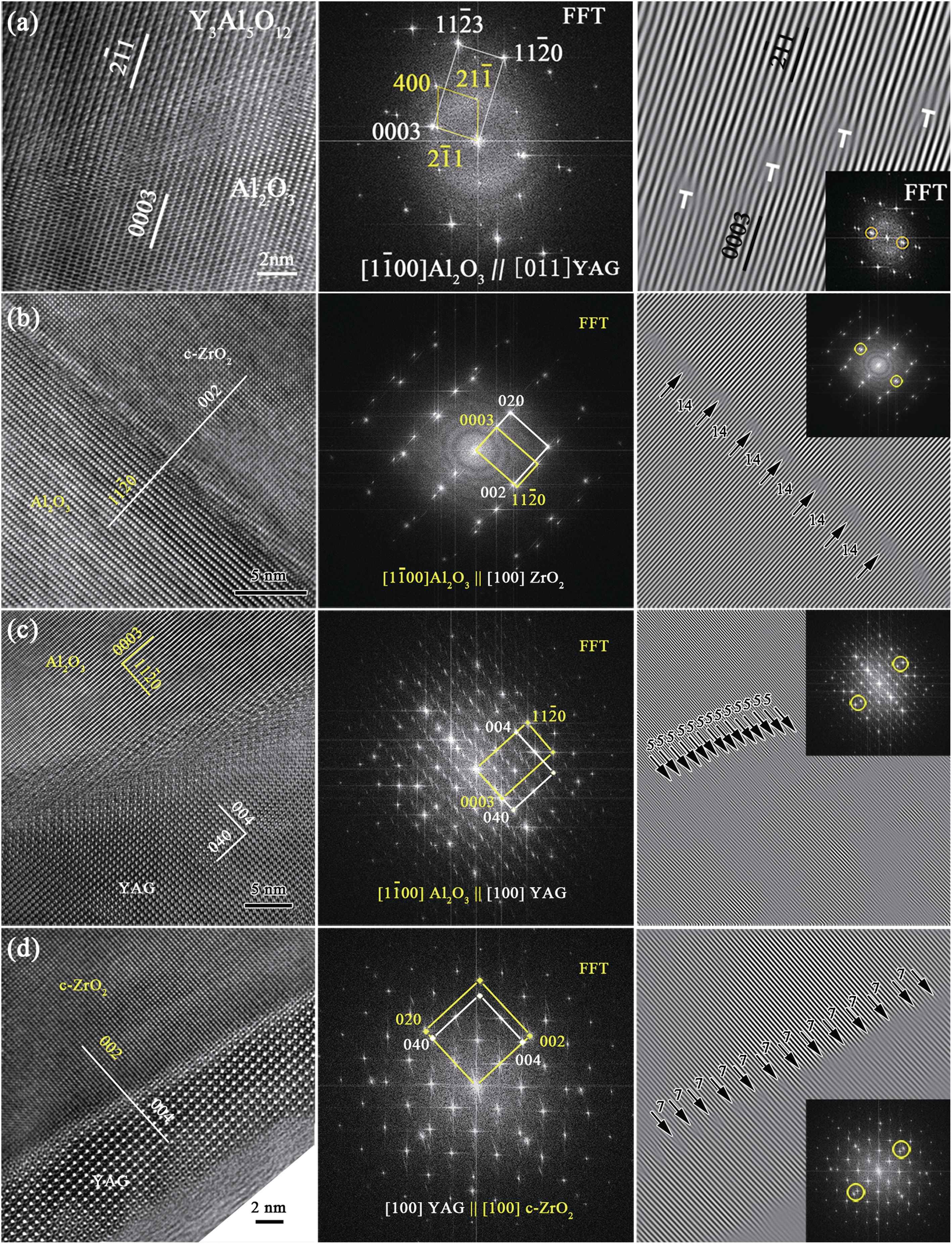
图3 氧化铝基定向凝固共晶陶瓷界面的高分辨率透射电子显微镜图像[25,50]
Fig. 3 High-resolution transmission electron microscope images of interface in Al2O3-based directionally solidified eutectic ceramics[25,50] (a) YAG/Al2O3[25]; (b-d) YAG/Al2O3/ZrO2[50]
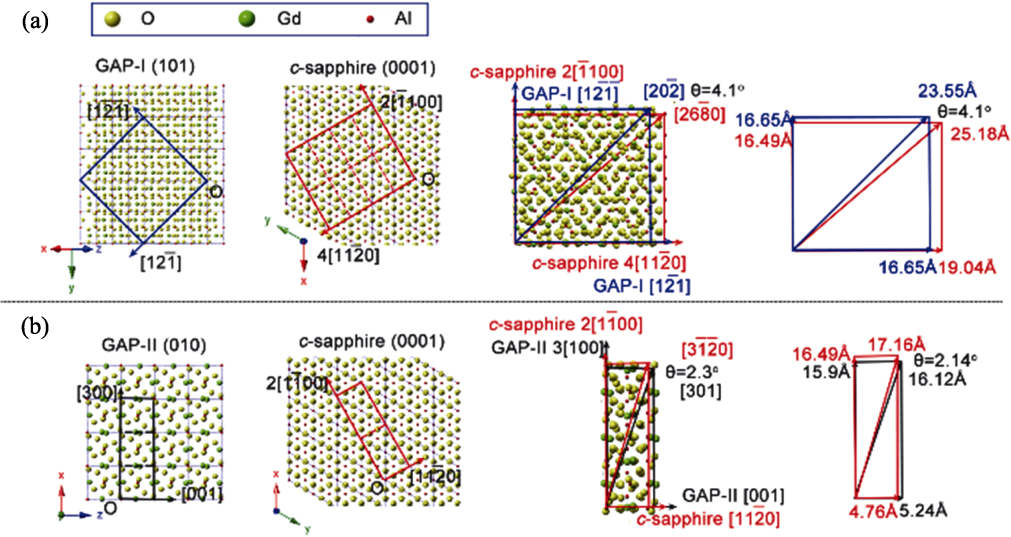
图4 GAP/Al2O3定向凝固共晶陶瓷的晶格错配示意图[42]
Fig. 4 Schematic illustrations of lattice mismatch in GAP/Al2O3 directionally solidified eutectic ceramics[42] (a) (101) GAP // (0001) Al2O3; (b) (010) GAP // (0001) Al2O3
| Eutectic system | Preparation method | C=λ·v1/2/(μm1.5·s-0.5) | Microstructure |
|---|---|---|---|
| YAG/Al2O3[ | OFZM | 11.6 | Chinese script |
| YAG/Al2O3[ | Bridgman | 44.7 | Chinese script/Cellular structure |
| YAG/Al2O3[ | EBFZM | 6.7 | Chinese script/Lamellar structure |
| YAG/Al2O3[ | LHFZ | 10 | Chinese script |
| YAG/Al2O3[ | μ-PD | 10 | Chinese script |
| YbAG/Al2O3[ | LFZM | 11.5 | Chinese script |
| EAG/Al2O3[ | LHFZ | 11.6 | Chinese script |
| Al2O3/YAG:Ce3+[ | LFZM | 22.0 | Chinese script/Cellular structure |
| YAG/Al2O3/ZrO2[ | μ-PD | 8 | Chinese script/Geometric structure |
| YAG/Al2O3/ZrO2[ | μ-PD | 8 | Chinese script |
| YAG/Al2O3/ZrO2[ | LFZM | 12.4 | Chinese script/Cellular structure |
| YAG/Al2O3/ZrO2[ | LFZM | 14.7 | Chinese script/Cellular structure |
| YAG/Al2O3/ZrO2[ | μ-PD | 6.5 | Chinese script |
| YAG/Al2O3/ZrO2[ | EBFZM | 5.3 | Chinese script/Cellular structure |
| ZrO2/Al2O3[ | Laser 3D printing | 1 | Chinese script/Cellular structure |
表2
Table 2 Eutectic systems, preparation methods, λv1/2 and microstructures of some Al2O3-based eutectic ceramics[10,19 -20,22,46,49,61 -68]
| Eutectic system | Preparation method | C=λ·v1/2/(μm1.5·s-0.5) | Microstructure |
|---|---|---|---|
| YAG/Al2O3[ | OFZM | 11.6 | Chinese script |
| YAG/Al2O3[ | Bridgman | 44.7 | Chinese script/Cellular structure |
| YAG/Al2O3[ | EBFZM | 6.7 | Chinese script/Lamellar structure |
| YAG/Al2O3[ | LHFZ | 10 | Chinese script |
| YAG/Al2O3[ | μ-PD | 10 | Chinese script |
| YbAG/Al2O3[ | LFZM | 11.5 | Chinese script |
| EAG/Al2O3[ | LHFZ | 11.6 | Chinese script |
| Al2O3/YAG:Ce3+[ | LFZM | 22.0 | Chinese script/Cellular structure |
| YAG/Al2O3/ZrO2[ | μ-PD | 8 | Chinese script/Geometric structure |
| YAG/Al2O3/ZrO2[ | μ-PD | 8 | Chinese script |
| YAG/Al2O3/ZrO2[ | LFZM | 12.4 | Chinese script/Cellular structure |
| YAG/Al2O3/ZrO2[ | LFZM | 14.7 | Chinese script/Cellular structure |
| YAG/Al2O3/ZrO2[ | μ-PD | 6.5 | Chinese script |
| YAG/Al2O3/ZrO2[ | EBFZM | 5.3 | Chinese script/Cellular structure |
| ZrO2/Al2O3[ | Laser 3D printing | 1 | Chinese script/Cellular structure |
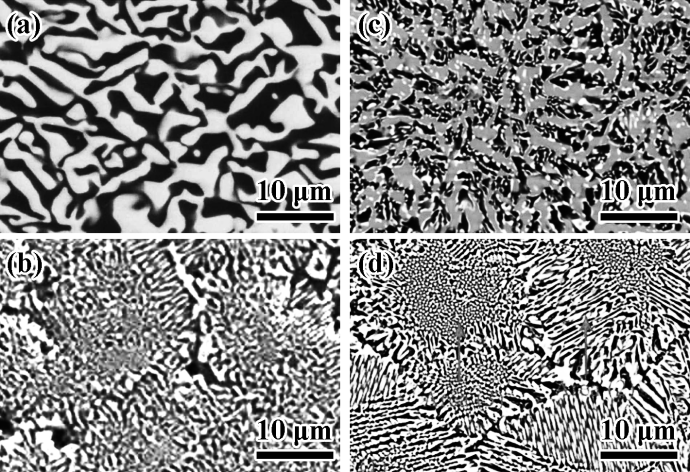
图5 激光区熔法制备的氧化铝基定向凝固共晶陶瓷的横截面形貌[75]
Fig. 5 Transversal sections of Al2O3-based directionally solidified eutectic ceramics fabricated via laser zone melting method[75]
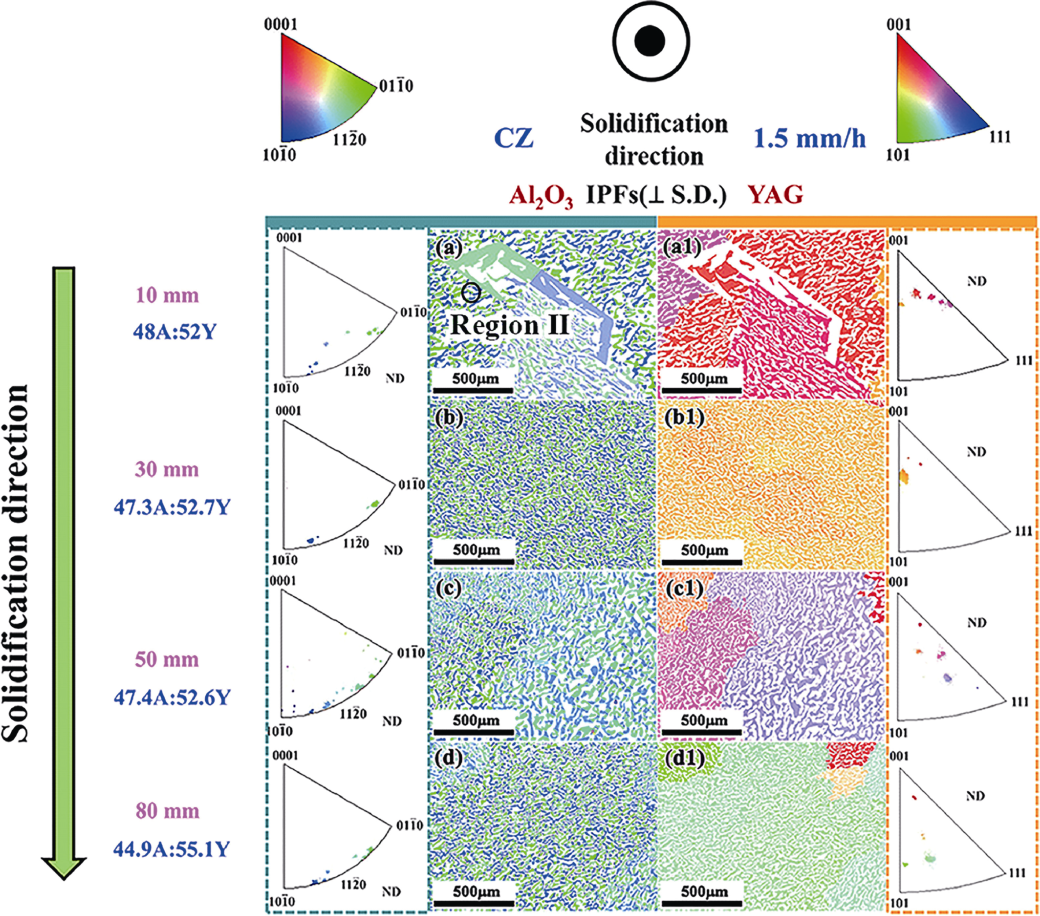
图6 距离多晶氧化铝籽晶不同位置处YAG/Al2O3共晶陶瓷的晶体学取向电子背散射衍射(EBSD)图像及其对应的反极图[77]
Fig. 6 Crystallographic orientation electron back scatter diffraction (EBSD) images and corresponding inverse pole figures of YAG/Al2O3 eutectic ceramics obtained at various distances from polycrystalline Al2O3 seed[77] (a-d) Al2O3 phase; (a1-d1) YAG phase
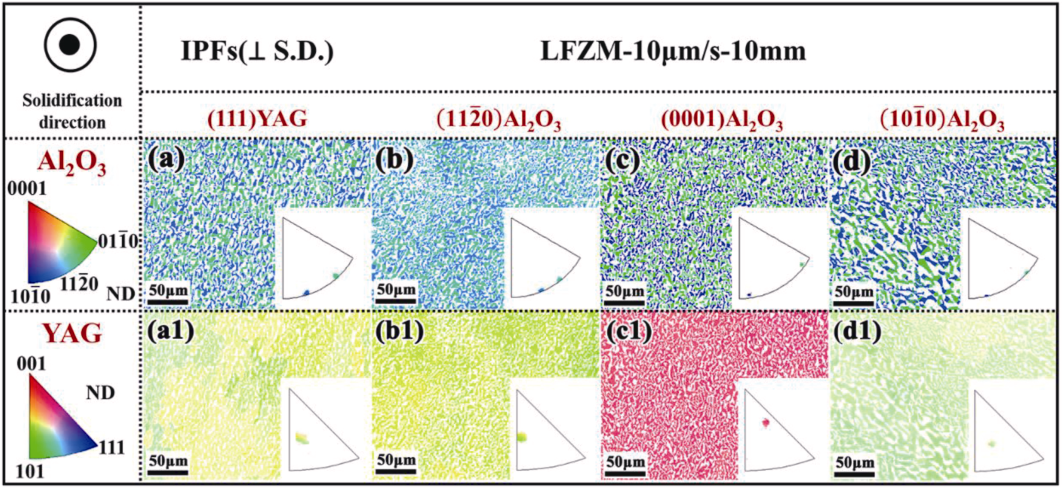
图7 在不同单晶籽晶的诱导作用下生长10 mm后YAG/Al2O3共晶陶瓷的EBSD图像及其对应的反极图[79]
Fig. 7 EBSD images and corresponding inverse pole figures of YAG/Al2O3 eutectic ceramics after growing 10 mm induced by different single crystal seeds[79] (a-d) Al2O3 phase; (a1-d1) YAG phase
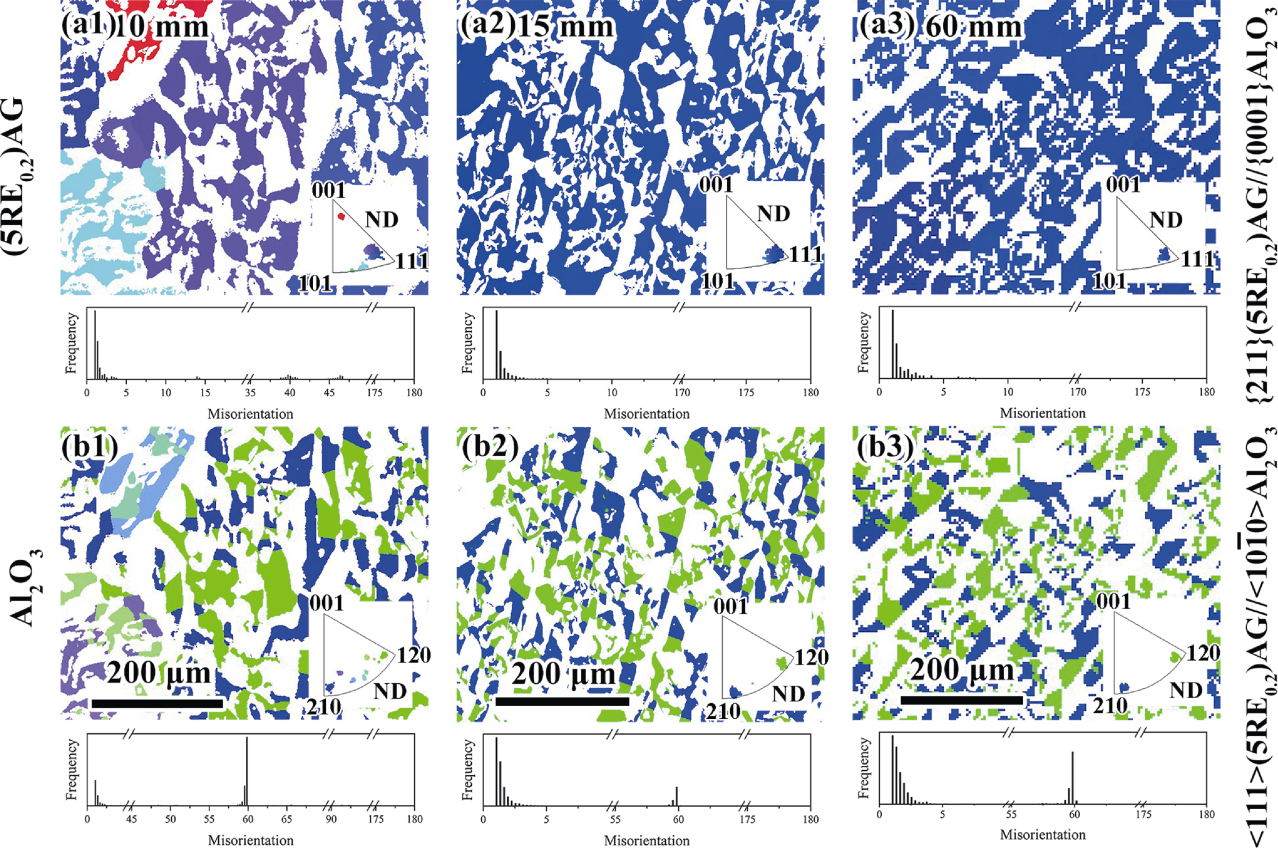
图8 距离籽晶不同位置处(Y0.2Gd0.2Ho0.2Er0.2Yb0.2)3Al5O12/Al2O3共晶陶瓷的典型EBSD图像及其对应的反极图[88]
Fig. 8 Typical EBSD images and corresponding inverse pole figures of (Y0.2Gd0.2Ho0.2Er0.2Yb0.2)3Al5O12/Al2O3 eutectic ceramics at different positions from seed crystal[88]
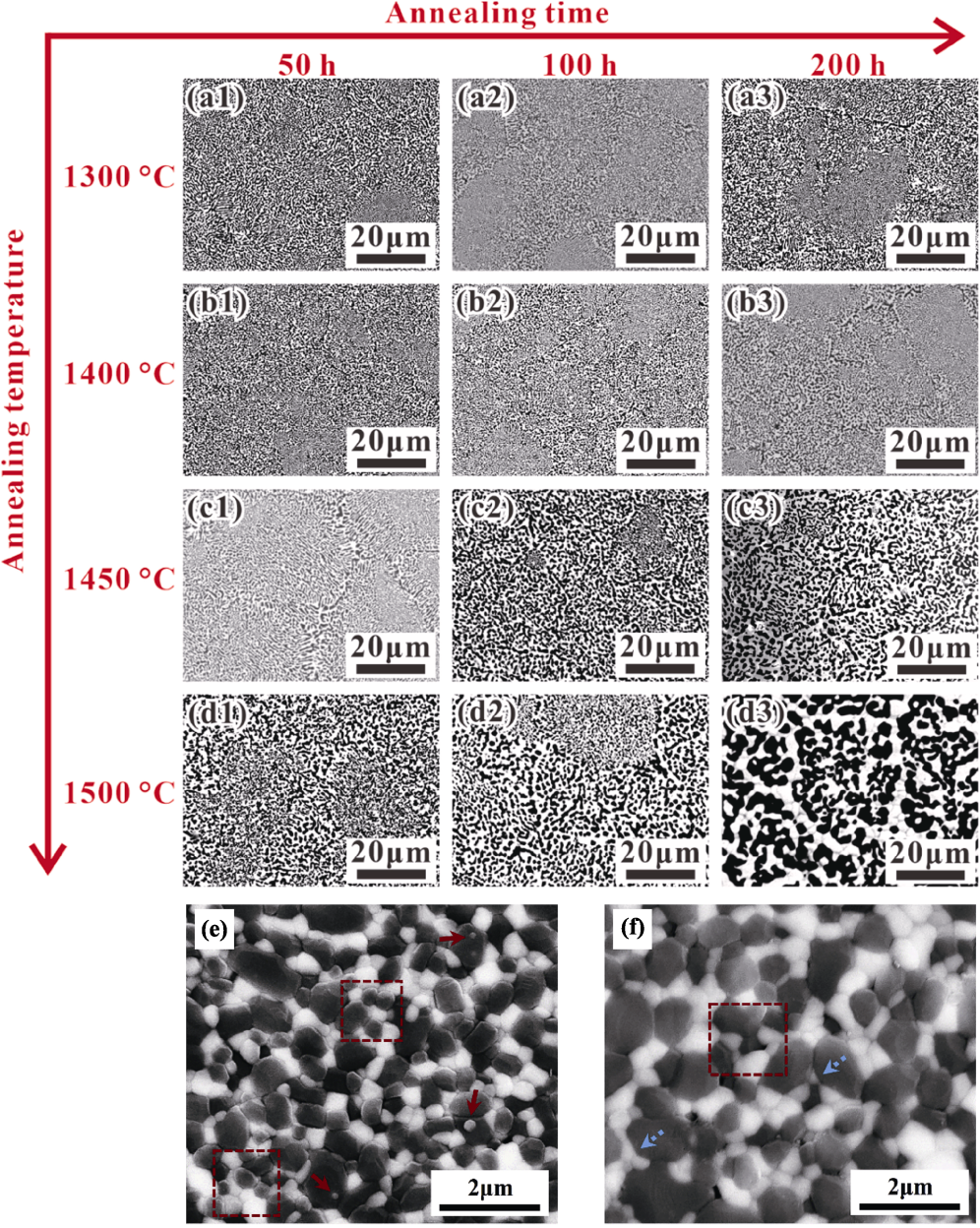
图9 (a1~d3)经不同温度与时间热处理的氧化铝基定向凝固共晶陶瓷的表面扫描电子显微镜(SEM)照片[93]; (e, f)氧化铝基共晶陶瓷在(e) 1450和(f) 1500 ℃下烧结后的表面SEM照片[94]
Fig. 9 (a1-d3) Surface scanning electron microscope (SEM) images of Al2O3-based directionally solidified eutectic ceramics subjected to various heat treatment temperatures and durations[93]; (e, f) Surface SEM images of Al2O3-based eutectic ceramics sintered at (e) 1450 and (f) 1500 ℃[94]
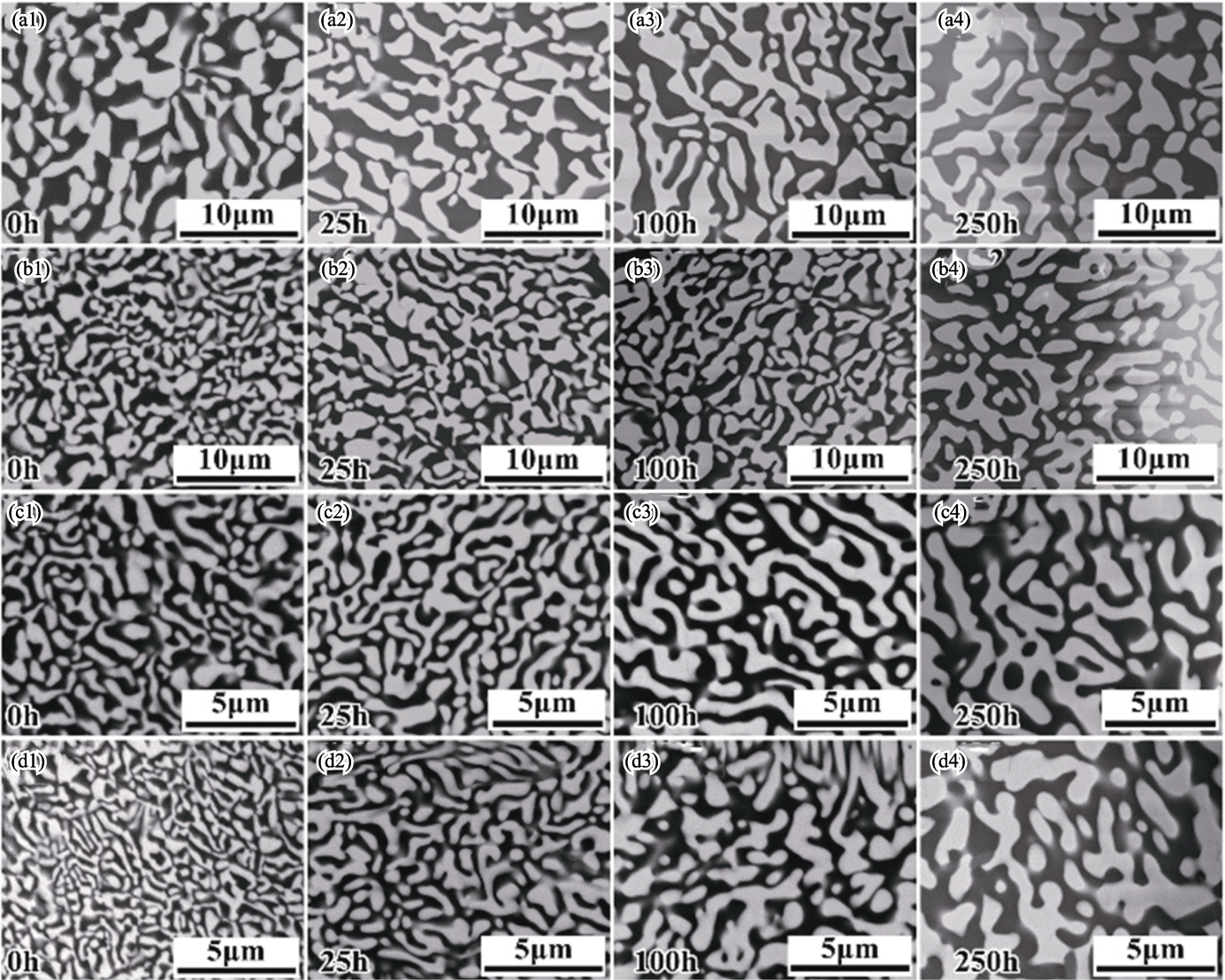
图10 采用不同凝固速率制备的GAP/Al2O3共晶陶瓷在1773 K热处理前后的微观组织演变[96]
Fig. 10 Microstructural evolution of GAP/Al2O3 eutectic ceramics fabricated under various growth rates before and after heat treatment at 1773 K[96] (a1-a4) 2 μm/s; (b1-b4) 16 μm/s; (c1-c4) 50 μm/s; (d1-d4) 100 μm/s
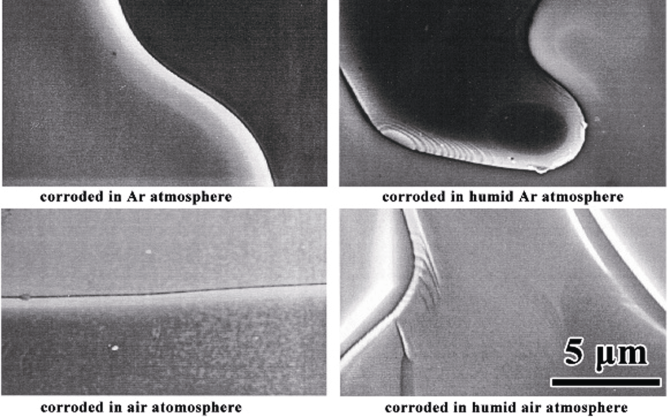
图11 不同气氛下于1800 ℃保温10 h后YAG/Al2O3界面的SEM照片[100]
Fig. 11 SEM images of the YAG/Al2O3 interface after 10 h of corrosion at 1800 ℃ in different atmospheres[100]
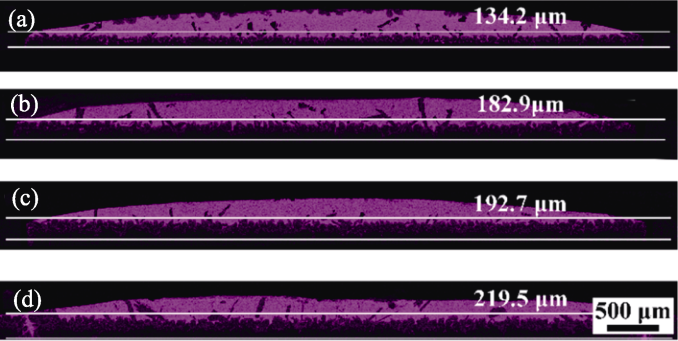
图12 (Y0.2Gd0.2Ho0.2Er0.2Yb0.2)3Al5O12/Al2O3共晶陶瓷在1500 ℃经CMAS腐蚀不同时间后的Ca元素分布情况[102]
Fig. 12 Ca elemental mappings of the cross-section of (Y0.2Gd0.2Ho0.2Er0.2Yb0.2)3Al5O12/Al2O3 eutectic ceramics after CMAS corrosion at 1500 ℃ for different durations[102] (a) 4 h; (b) 50 h; (c) 100 h; (d) 200 h
| [1] | 杜昆, 陈麒好, 孟宪龙, 等. 陶瓷基复合材料在航空发动机热端部件应用及热分析研究进展. 推进技术, 2022, 43(2): 113. |
| [2] | 林左鸣. 战斗机发动机的研制现状和发展趋势. 航空发动机, 2006, 32(1): 1. |
| [3] |
PEREPEZKO J H. The hotter the engine, the better. Science, 2009, 326(5956): 1068.
DOI URL |
| [4] |
PADTURE N P. Advanced structural ceramics in aerospace propulsion. Nature Materials, 2016, 15(8): 804.
DOI PMID |
| [5] | 杨金华, 董禹飞, 杨瑞, 等. 航空发动机用陶瓷基复合材料研究进展. 航空动力, 2021, 5: 56. |
| [6] |
WAKU Y, NAKAGAWA N, WAKAMOTO T, et al. A ductile ceramic eutectic composite with high strength at 1873 K. Nature, 1997, 389(6646): 49.
DOI |
| [7] |
WAKU Y, NAKAGAWA N, OHTSUBO H, et al. Fracture and deformation behaviour of melt growth composites at very high temperatures. Journal of Materials Science, 2001, 36(7): 1585.
DOI |
| [8] |
WANG Z G, ZHANG Y Z, OUYANG J H, et al. Nanocrystalline alumina-zirconia-based eutectic ceramics fabricated with high- energy beams: principle, solidification techniques, microstructure and mechanical properties. Materials, 2023, 16(8): 2985.
DOI URL |
| [9] |
REN Q, SU H J, ZHANG J, et al. Processing, microstructure and performance of Al2O3/Er3Al5O12/ZrO2 ternary eutectic ceramics prepared by laser floating zone melting with ultra-high temperature gradient. Ceramics International, 2018, 44(5): 4766.
DOI URL |
| [10] |
MESA M C, OLIETE P B, ORERA V M, et al. Microstructure and mechanical properties of Al2O3/Er3Al5O12 eutectic rods grown by the laser-heated floating zone method. Journal of the European Ceramic Society, 2011, 31(7): 1241.
DOI URL |
| [11] |
VIECHNICKI D, SCHMID F. Eutectic solidification in the system Al2O3/Y3Al5O12. Journal of Materials Science, 1969, 4(1): 84.
DOI URL |
| [12] |
LIU J L, LIU D G, REN K, et al. Research progress on the flash sintering mechanism of oxide ceramics and its application. Journal of Inorganic Materials, 2022, 37(5): 473.
DOI |
| [13] |
XIONG Z W, ZHANG K, LIAO W H, et al. Laser powder bed fusion fabrication of TiB2-modified Al2O3-ZrO2 eutectic ceramics: microstructure evolution and mechanical properties. Ceramics International, 2024, 50(24): 55577.
DOI URL |
| [14] |
AOKI Y, MASUDA H, TOCHIGI E, et al. Overcoming the intrinsic brittleness of high-strength Al2O3-GdAlO3 ceramics through refined eutectic microstructure. Nature Communications, 2024, 15: 8700.
DOI |
| [15] |
YOSHIMURA M, SAKATA S I, YAMADA S, et al. The growth of Al2O3/YAG:Ce melt growth composite by the vertical bridgman technique using an a-axis Al2O3 seed. Journal of Crystal Growth, 2015, 427: 16.
DOI URL |
| [16] |
YOSHIMURA M, SAKATA S I, IBA H, et al. Vertical bridgman growth of Al2O3/YAG:Ce melt growth composite. Journal of Crystal Growth, 2015, 416: 100.
DOI URL |
| [17] |
LIU Y, SU H J, TAN X, et al. Stability of crystallographic texture and mechanical anisotropy toward Al2O3/YAG eutectic ceramic composite using single crystalline seeds. Composites Part B: Engineering, 2024, 274: 111263.
DOI URL |
| [18] |
CHERIF M, DUFFAR T, CARROZ L, et al. On the growth and structure of Al2O3-Y3Al5O12-ZrO2: Y solidified eutectic. Journal of the European Ceramic Society, 2020, 40(8): 3172.
DOI URL |
| [19] | EPELBAUM B M, YOSHIKAWA A, SHIMAMURA K, et al. Microstructure of Al2O3/Y3Al5O12 eutectic fibers grown by μ-PD method. Journal of Crystal Growth, 1999, 198: 471. |
| [20] |
BENAMARA O, CHERIF M, DUFFAR T, et al. Microstructure and crystallography of Al2O3-Y3Al5O12-ZrO2 ternary eutectic oxide grown by the micropulling down technique. Journal of Crystal Growth, 2015, 429: 27.
DOI URL |
| [21] |
BENAMARA O, LEBBOU K. The impact of the composition and solidification rate on the microstructure and the crystallographic orientations of Al2O3-YAG-ZrO2 eutectic solidified by the micro- pulling down technique. RSC Advances, 2021, 11(22): 13602.
DOI URL |
| [22] |
SU H J, ZHANG J, DENG Y F, et al. A modified preparation technique and characterization of directionally solidified Al2O3/Y3Al5O12 eutectic in situ composites. Scripta Materialia, 2009, 60(6): 362.
DOI URL |
| [23] |
REN Q, SU H J, ZHANG J, et al. Solid-liquid interface and growth rate range of Al2O3-based eutectic in situ composites grown by laser floating zone melting. Journal of Alloys and Compounds, 2016, 662: 634.
DOI URL |
| [24] |
SU H J, SHEN Z L, REN Q, et al. Evolutions of rod diameter, molten zone and temperature gradient of oxide eutectic ceramics during laser floating zone melting. Ceramics International, 2020, 46(11): 18750.
DOI URL |
| [25] |
WANG X, WANG J Y, SUN L C, et al. Microstructure evolution of Al2O3/Y3Al5O12 eutectic crystal during directional solidification. Scripta Materialia, 2015, 108: 31.
DOI URL |
| [26] |
LIU Y, SU H J, TAN X, et al. The effect of processing parameters on the temperature distribution and interface shape in Czochralski growth of Al2O3/YAG eutectic ceramic composite: modeling and experiment. Ceramics International, 2025, 51(22): 36401.
DOI URL |
| [27] |
WAKU Y, SAKATA S, MITANI A, et al. Microstructure and high- temperature strength of Al2O3/Er3Al5O12/ZrO2 ternary melt growth composite. Journal of Materials Science, 2005, 40(3): 711.
DOI URL |
| [28] |
WANG X, TIAN Z L, ZHANG W, et al. Mechanical properties of directionally solidified Al2O3/Y3Al5O12 eutectic ceramic prepared by optical floating zone technique. Journal of the European Ceramic Society, 2018, 38(10): 3610.
DOI URL |
| [29] |
WANG X, ZHONG Y J, WANG D, et al. Effect of interfacial energy on microstructure of a directionally solidified Al2O3/YAG eutectic ceramic. Journal of the American Ceramic Society, 2018, 101(3): 1029.
DOI URL |
| [30] |
SUN L C, ZHOU C, DU T F, et al. Directionally solidified Al2O3/Er3Al5O12 and Al2O3/Yb3Al5O12 eutectic ceramics prepared by optical floating zone melting. Journal of Inorganic Materials, 2021, 36(6): 652.
DOI URL |
| [31] | JACSON K A, HUNT J D. Lamellar and rod eutectic growth. Transactions of the Metallurgical Society of AIME, 1966, 236(8): 363. |
| [32] |
SU H J, ZHANG J, CUI C J, et al. Rapid solidification of Al2O3/Y3Al5O12/ZrO2 eutectic in situ composites by laser zone remelting. Journal of Crystal Growth, 2007, 307(2): 448.
DOI URL |
| [33] |
ORERA V M, MERINO R I, PARDO J A, et al. Microstructure and physical properties of some oxide eutectic composites processed by directional solidification. Acta Materialia, 2000, 48(18/19): 4683.
DOI URL |
| [34] |
LLORCA J, ORERA V M.Directionally solidified eutectic ceramic oxides. Progress in Materials Science, 2006, 51(6): 711.
DOI URL |
| [35] |
SUN J Z, STIRNER T, MATTHEWS A. Structure and surface energy of low-index surfaces of stoichiometric α-Al2O3 and α-Cr2O3. Surface and Coatings Technology, 2006, 201(7): 4205.
DOI URL |
| [36] |
SUN H F, ZHOU C, DU T F, et al. Preparation, microstructures, and mechanical properties of directionally solidified Al2O3/Lu3Al5O12 eutectic ceramics. International Journal of Applied Ceramic Technology, 2022, 19(2): 695.
DOI URL |
| [37] |
XU X, FAN J Y, LIU J L, et al. Formation of eutectic structure in dense Al2O3-YAG composite by electric field treatment. Ceramics International, 2021, 47(16): 23647.
DOI URL |
| [38] |
XIONG Z W, ZHANG K, ZHU Z G, et al. Effect of laser focus shift on the forming quality, microstructure and mechanical properties of additively manufactured Al2O3-ZrO2 eutectic ceramics. Ceramics International, 2023, 49(22): 35948.
DOI URL |
| [39] |
YAO S, LIU D G, LIU J L, et al. Ultrafast preparation of Al2O3- ZrO2 multiphase ceramics with eutectic morphology via flash sintering. Ceramics International, 2021, 47(22): 31555.
DOI URL |
| [40] |
YAO S, LIU Y S, LIU D G, et al. Flash sintering of Al2O3-ZrO2 ceramics under alternating current electric field. Ceramics International, 2022, 48(24): 36764.
DOI URL |
| [41] | WANG X, ZHONG Y J, HU Q D. A review of Al2O3-based eutectic ceramics for high-temperature structural materials. Journal of Materials Science & Technology, 2025, 214: 214. |
| [42] |
ZHONG Y J, YUAN Y, LI H D, et al. Orientation relationships of seed crystal-induced Al2O3/GdAlO3 eutectic ceramics. Acta Materialia, 2025, 294: 121094.
DOI URL |
| [43] |
WANG X, ZHANG W, ZHONG Y J, et al. Introduction of low strain energy GdAlO3 grain boundaries into directionally solidified Al2O3/GdAlO3 eutectics. Acta Materialia, 2021, 221: 117355.
DOI URL |
| [44] |
SU H J, ZHANG J, MA W D, et al. In situ fabrication of highly-dense Al2O3/YAG nanoeutectic composite ceramics by a modified laser surface processing. Journal of the European Ceramic Society, 2014, 34(3): 739.
DOI URL |
| [45] |
LIU Y, SU H J, SHEN Z L, et al. Insight into the complex coupled growth behavior of Al2O3/YAG eutectic ceramic based on the evolutions of microstructure and crystallographic texture. Journal of the European Ceramic Society, 2023, 43(10): 4482.
DOI URL |
| [46] |
WANG X, ZHANG W, XIAN Q G, et al. Preparation and microstructure of large-sized directionally solidified Al2O3/Y3Al5O12 eutectics with the seeding technique. Journal of the European Ceramic Society, 2018, 38(16): 5625.
DOI URL |
| [47] |
SAKATA S, MITANI A, SHIMIZU K, et al. Crystallographic orientation analysis and high temperature strength of melt growth composite. Journal of the European Ceramic Society, 2005, 25(8): 1441.
DOI URL |
| [48] |
MAZEROLLES L, PERRIERE L, LARTIGUE-KORINEK S, et al. Microstructures, crystallography of interfaces, and creep behavior of melt-growth composites. Journal of the European Ceramic Society, 2008, 28(12): 2301.
DOI URL |
| [49] |
LIU Y, SU H J, LU Z, et al. Collaborative enhancement of luminous efficacy and fracture toughness based on interface design of Al2O3/YAG:Ce3+ eutectic phosphor ceramic grown by laser floating zone melting. Ceramics International, 2022, 48(7): 10144.
DOI URL |
| [50] |
WANG X, ZHONG Y J, SUN Q, et al. Competitive growth of Al2O3/YAG/ZrO2 eutectic ceramics during directional solidification: effect of interfacial energy. Journal of the American Ceramic Society, 2019, 102(4): 2176.
DOI URL |
| [51] |
MAZEROLLES L, MICHEL D, HŸTCH M J. Microstructures and interfaces in directionally solidified oxide-oxide eutectics. Journal of the European Ceramic Society, 2005, 25(8): 1389.
DOI URL |
| [52] |
MAZEROLLES L, MICHEL D, PORTIER R. Interfaces in oriented Al2O3-ZrO2 (Y2O3) eutectics. Journal of the American Ceramic Society, 1986, 69(3): 252.
DOI URL |
| [53] |
SAYIR A, FARMER S C. The effect of the microstructure on mechanical properties of directionally solidified Al2O3/ZrO2(Y2O3) eutectic. Acta Materialia, 2000, 48(18/19): 4691.
DOI URL |
| [54] | KURZ W, FISHER D J, RAPPAZ M. Fundamentals of solidification 5th edition. Switzerland: Trans Tech Publications Ltd., 2023, 103(5): 372. |
| [55] |
MA Y H, WANG Z G, OUYANG J H, et al. In-situ microcantilever deflection to evaluate the interfacial fracture properties of binary Al2O3/SmAlO3 eutectic. Journal of the European Ceramic Society, 2019, 39(10): 3277.
DOI URL |
| [56] | 沈强, 吴信婷, 魏琴琴, 等. 高密度高温高熵合金与陶瓷共晶复合材料的研究进展. 硅酸盐学报, 2024, 52(2): 463. |
| [57] |
GAO R, CHU Z F, WANG S H, et al. The evolution of Al2O3/GdAlO3/ZrO2 ternary eutectic ceramic microstructure and property with the growth rate. Journal of Materials Research, 2024, 39(5): 801.
DOI |
| [58] |
ZHANG Y Z, WANG Z G, XIE L Y, et al. Laser surface nanocrystallization of oxide ceramics with eutectic composition: a comprehensive review. Heat Treatment and Surface Engineering, 2021, 3(1): 37.
DOI URL |
| [59] |
XIE L Y, WANG Z G, ZHANG Y Z, et al. Microstructural refinement and mechanical response of Al2O3-ZrO2 eutectics fabricated by a novel pulse discharge plasma assisted melting method. Ceramics International, 2022, 48(16): 23510.
DOI URL |
| [60] |
ZHONG Y J, LIU Y R, GAO Q, et al. Microstructure of directionally solidified Al2O3/EAG eutectic ceramics prepared with high-temperature gradient. Ceramics International, 2021, 47(4): 5456.
DOI URL |
| [61] |
PASTOR J Y, LLORCA J, SALAZAR A, et al. Mechanical properties of melt-grown alumina-yttrium aluminum garnet eutectics up to 1900 K. Journal of the American Ceramic Society, 2005, 88(6): 1488.
DOI URL |
| [62] |
OLIETE P B, MESA M C, MERINO R I, et al. Directionally solidified Al2O3-Yb3Al5O12 eutectics for selective emitters. Solar Energy Materials and Solar Cells, 2016, 144: 405.
DOI URL |
| [63] |
LEE J H, YOSHIKAWA A, MURAYAMA Y, et al. Microstructure and mechanical properties of Al2O3/Y3Al5O12/ZrO2 ternary eutectic materials. Journal of the European Ceramic Society, 2005, 25(8): 1411.
DOI URL |
| [64] |
LEE J H, YOSHIKAWA A, FUKUDA T, et al. Growth and characterization of Al2O3/Y3Al5O12/ZrO2 ternary eutectic fibers. Journal of Crystal Growth, 2001, 231(1/2): 115.
DOI URL |
| [65] |
贾晓娇, 张军, 苏海军, 等. 激光悬浮区熔Al2O3基共晶自生复合材料微观组织与力学性能. 金属学报, 2012, 48(12): 1479.
DOI |
| [66] |
SONG K, ZHANG J, JIA X J, et al. Microstructure of Al2O3/ YAG/ZrO2 hypereutectic alloy directionally solidified by laser floating zone method. Acta Metallurgica Sinica, 2012, 48(2): 220.
DOI |
| [67] |
SU H J, ZHANG J, LIU L, et al. Preparation and microstructure evolution of directionally solidified Al2O3/YAG/YSZ ternary eutectic ceramics by a modified electron beam floating zone melting. Materials Letters, 2013, 91: 92.
DOI URL |
| [68] | LIU Z, SONG K, GAO B, et al. Microstructure and mechanical properties of Al2O3/ZrO2 directionally solidified eutectic ceramic prepared by laser 3D printing. Journal of Materials Science & Technology, 2016, 32(4): 320. |
| [69] | CAO X, SU H J, GUO F W, et al. Directionally solidified Al2O3/GAP eutectic ceramics by micro-pulling-down method. AIP Conference Proceddings, 2016, 1783: 020021. |
| [70] |
ZHAO D, SU H J, LU B H, et al. Ultra-high strength micro-nano quasi-monocrystalline Al2O3/Y3Al5O12/ZrO2 ternary eutectic ceramics processed by high-speed directional solidification. Journal of the European Ceramic Society, 2025, 45(13): 117485.
DOI URL |
| [71] |
YAO S, LIU Y S, LIU D G, et al. Effect of the Al2O3 content on the microstructure evolution of flash-sintered Al2O3-8YSZ ceramics. Open Ceramics, 2023, 16: 100468.
DOI URL |
| [72] |
WU D J, YU X X, ZHAO Z Y, et al. One-step additive manufacturing of TiCp reinforced Al2O3-ZrO2 eutectic ceramics composites by laser directed energy deposition. Ceramics International, 2023, 49(8): 12758.
DOI URL |
| [73] |
WU D J, SHI J, NIU F Y, et al. Direct additive manufacturing of melt growth Al2O3-ZrO2 functionally graded ceramics by laser directed energy deposition. Journal of the European Ceramic Society, 2022, 42(6): 2957.
DOI URL |
| [74] |
WANG S H, LIU J C. Microstructure and growth characteristics of Al2O3/Er2O3/ZrO2 solidified ceramics with different compositions. Journal of the European Ceramic Society, 2021, 41(7): 4284.
DOI URL |
| [75] |
WANG S H, PEÑA J I, LUN Z Y, et al. Optimization of growth theory of the directionally solidified alumina based eutectic ceramics. Journal of Alloys and Compounds, 2024, 982: 173783.
DOI URL |
| [76] | SU H J, LIU Y, REN Q, et al. Distribution control and formation mechanism of gas inclusions in directionally solidified Al2O3-Er3Al5O12-ZrO2 ternary eutectic ceramic by laser floating zone melting. Journal of Materials Science & Technology, 2021, 66: 21. |
| [77] | LIU Y, SU H J, SHEN Z L, et al. Effect of seed orientations on crystallographic texture control in faceted Al2O3/YAG eutectic ceramic during directional solidification. Journal of Materials Science & Technology, 2023, 146: 86. |
| [78] | ZHOU C, SUN L C, DU T F, et al. Microstructure, crystallographic texture and mechanical properties of directionally solidified high-entropy (Y0.2Gd0.2Ho0.2Er0.2Yb0.2)AG/Al2O3 eutectic oxides: insights of growth rate control. Journal of Materials Science & Technology, 2026, 252: 232. |
| [79] |
LIU Y, SU H J, TAN X, et al. Unveiling crystallographic texture in laser floating zone melted Al2O3/YAG eutectic ceramic by seed- crystal inducing. Ceramics International, 2024, 50(20): 40185.
DOI URL |
| [80] | HE L T, WANG X, LI J Z, et al. Can orientations of directionally solidified dual-phase Al2O3/YAG eutectics be induced by single-phase sapphire seeds? Journal of Materials Science & Technology, 2023, 142: 216. |
| [81] |
HE Z S, XUAN W D, HU T, et al. Development of a novel (Mg0.25Co0.25Ni0.25Zn0.25)O medium entropy oxide for dielectric applications. Ceramics International, 2024, 50(17): 31598.
DOI URL |
| [82] |
CAI J H, LAN S, WEI B, et al. Colossal permittivity in high-entropy CaTiO3 ceramics by chemical bonding engineering. Nature Communications, 2025, 16: 4008.
DOI |
| [83] |
WANG Y C, REECE M J. Oxidation resistance of (Hf-Ta-Zr-Nb)C high entropy carbide powders compared with the component monocarbides and binary carbide powders. Scripta Materialia, 2021, 193: 86.
DOI URL |
| [84] |
SUN J, GUO L X, ZHANG Y Y, et al. Superior phase stability of high entropy oxide ceramic in a wide temperature range. Journal of the European Ceramic Society, 2022, 42(12): 5053.
DOI URL |
| [85] |
SUN L C, REN X M, LUO Y X, et al. Exploration of the mechanism of enhanced CMAS corrosion resistance at 1500 ℃ for multicomponent (Er0.25Tm0.25Yb0.25Lu0.25)2Si2O7 disilicate. Corrosion Science, 2022, 203: 110343.
DOI URL |
| [86] |
LUO Y X, SUN L C, WANG J M, et al. Phase formation capability and compositional design of β-phase multiple rare-earth principal component disilicates. Nature Communications, 2023, 14: 1275.
DOI |
| [87] |
ZHONG Y J, XIANG W S, HE L T, et al. Directionally solidified Al2O3/(Y0.2Er0.2Yb0.2Ho0.2Lu0.2)3Al5O12 eutectic high-entropy oxide ceramics with well-oriented structure, high hardness, and low thermal conductivity. Journal of the European Ceramic Society, 2021, 41(14): 7119.
DOI URL |
| [88] |
ZHOU C, LUO Z P, DU T F, et al. Directionally solidified high-entropy (Y0.2Gd0.2Ho0.2Er0.2Yb0.2)3Al5O12/Al2O3 eutectic with outstanding crystallographic texture formation capability. Scripta Materialia, 2022, 220: 114939.
DOI URL |
| [89] |
ZHONG Y J, LI Z, WANG X. Seed-crystal-induced directional solidification toward Al2O3/(Y0.2Er0.2Yb0.2Ho0.2Lu0.2)3Al5O12/ZrO2 ternary eutectic ceramics. Acta Materialia, 2024, 262: 119369.
DOI URL |
| [90] |
ZHONG Y J, LI Z, WANG X. Insight into tuning of ZrO2 distribution and mechanical properties of directionally solidified Al2O3/(5Re0.2)AG/ZrO2 eutectic ceramic composites. Composites Part B: Engineering, 2023, 266: 111016.
DOI URL |
| [91] |
XIONG Z W, ZHANG K, LIAO W H, et al. In-situ synthesis of high-entropy Al2O3/RE3Al5O12/ZrO2 ceramic by laser powder bed fusion with exceptional properties. Journal of Advanced Ceramics, 2024, 13(12): 2004.
DOI URL |
| [92] |
ZHAO D K, BI G J, CHEN J, et al. Melt-grown behaviour of heat treated high-purity alumina ceramics prepared by laser directed energy deposition. Ceramics International, 2024, 50(1): 1777.
DOI URL |
| [93] |
LIU H F, SU H J, SHEN Z L, et al. Insights into high thermal stability of laser additively manufactured Al2O3/GdAlO3/ZrO2 eutectic ceramics under high temperatures. Additive Manufacturing, 2021, 48: 102425.
DOI URL |
| [94] |
WANG Z G, OUYANG J H, MA Y H, et al. Grain size dependence, mechanical properties and surface nanoeutectic modification of Al2O3-ZrO2 ceramic. Ceramics International, 2019, 45(11): 14297.
DOI URL |
| [95] |
WANG S H, LIU J C, LAN D H, et al. Microstructural stability and high temperature strength of directionally solidified Al2O3/Er3Al5O12/ZrO2 eutectic ceramics. Ceramics International, 2024, 50(1): 306.
DOI URL |
| [96] |
SU H J, SHEN Z L, MA W D, et al. Comprehensive microstructure regularization mechanism and microstructure-property stability at 1773 K of directionally solidified Al2O3/GdAlO3 eutectic ceramic composite. Composites Part B: Engineering, 2023, 256: 110647.
DOI URL |
| [97] |
HAO S Q, SU H J, ZHAO D, et al. Complex shaped Al2O3/YAG/ZrO2 eutectic ceramics with excellent high temperature mechanical properties printed by vat photopolymerization. Additive Manufacturing, 2025, 101: 104703.
DOI URL |
| [98] |
BAKAN E, SOHN Y J, KUNZ W, et al. Effect of processing on high-velocity water vapor recession behavior of Yb-silicate environmental barrier coatings. Journal of the European Ceramic Society, 2019, 39(4): 1507.
DOI URL |
| [99] |
MA Y J, GUO C, CUI Y J, et al. Enhanced water-oxygen corrosion resistance of SiC/SiC composites at 1350 ℃ via a single-layer Y-Al-Si-O glass-ceramics environmental barrier coating. Journal of the European Ceramic Society, 2024, 44(15): 116728.
DOI URL |
| [100] |
BAHLAWANE N, WATANABE T, WAKU Y, et al. Effect of moisture on the high-temperature stability of unidirectionally solidified Al2O3/YAG eutectic composites. Journal of the American Ceramic Society, 2000, 83(12): 3077.
DOI URL |
| [101] |
SUN H F, SUN L C, REN X M, et al. Outstanding molten calcium-magnesium-aluminosilicate (CMAS) corrosion resistance of directionally solidified Al2O3/Y3Al5O12 eutectic ceramic at 1500 ℃. Corrosion Science, 2023, 220: 111289.
DOI URL |
| [102] |
ZHOU C, SUN L C, DU T F, et al. Excellent calcium- magnesium-aluminosilicate corrosion resistance of high-entropy garnet/alumina directionally solidified eutectic at 1500 ℃. Journal of the American Ceramic Society, 2024, 107(3): 1748.
DOI URL |
| [103] | LIU Y, SU H J, SHEN Z L, et al. High temperature calcium- magnesium-alumina-silicate (CMAS) corrosion behavior of directionally solidified Al2O3/YAG eutectic ceramic. Journal of Materials Science & Technology, 2023, 165: 66. |
| [104] |
TAN X, SU H J, LIU Y, et al. CMAS corrosion resistance and mechanism of directionally solidified Al2O3/YAG eutectic ceramics at high temperatures of 1300-1500 ℃. Corrosion Science, 2025, 248: 112793.
DOI URL |
| [105] |
LI J, LUO Z X, CUI Y, et al. CMAS corrosion resistance of Y3Al5O12/Al2O3 ceramic coating deposited by atmospheric plasma spraying. Journal of Inorganic Materials, 2024, 39(6): 671.
DOI URL |
| [1] | 覃善丽, 郭佳文, 陈燕萌, 聚安安, 韦毅, 黄科林, 侯向华, 吕思师, 文志朋, 吴炼. 二维层状材料构筑电化学储能定向离子传输通道的研究进展[J]. 无机材料学报, 2026, 41(7): 883-898. |
| [2] | 余飞宇, 王文清, 张学勤, 何汝杰. 基于增材制造陶瓷点阵的双相网络互穿复合材料的研究进展与挑战[J]. 无机材料学报, 2026, 41(7): 849-866. |
| [3] | 费文龙, 王亚坤, 廖良生. 蓝光ZnSeTe量子点的可控制备及其量子点发光二极管器件研究进展[J]. 无机材料学报, 2026, 41(7): 867-882. |
| [4] | 陈明俊, 缪洪康, 肖英俊, 邓建波, 张翔, 赵九蓬, 李垚. 光-热双响应材料研究进展: 从设计策略到智能窗应用[J]. 无机材料学报, 2026, 41(6): 723-738. |
| [5] | 宋坤洁, 解荣军. 机器学习驱动新型发光材料的研究进展[J]. 无机材料学报, 2026, 41(6): 689-703. |
| [6] | 胡钰晴, 朱一新, 乐先浩, 万青. 钽酸锂晶圆减薄技术及其热释电红外探测器应用进展[J]. 无机材料学报, 2026, 41(6): 764-774. |
| [7] | 刘春帆, 陈科, 葛芳芳, 黄庆. 核用耐铅铋腐蚀涂层的研究进展[J]. 无机材料学报, 2026, 41(6): 775-786. |
| [8] | 胡扬, 谢敏, 张筱怡, 李想, 郭新伟, 姜南, 周文瀚, 张胜利, 曾海波. 计算与数据驱动环保型发光材料的研究进展[J]. 无机材料学报, 2026, 41(6): 704-722. |
| [9] | 王俊卜, 黄泽皑, 杨茗凯, 蒙颖, 周明炜, 周莹. 甲烷转化用抗积碳催化材料研究进展[J]. 无机材料学报, 2026, 41(6): 739-750. |
| [10] | 王金文, 杨振, 周欢, 夏丹, 杨磊. 可注射无机材料及其生物医学应用[J]. 无机材料学报, 2026, 41(6): 751-763. |
| [11] | 李涵涛, 沈强, 罗国强, 王雪飞, 高明, 陈晨. 机械球磨法调控硅基负极材料结构与性能的研究进展[J]. 无机材料学报, 2026, 41(5): 561-572. |
| [12] | 解陈一, 缪花明, 张蔚然, 刘荣军, 王衍飞, 李端. 理论计算在高熵陶瓷领域的研究进展[J]. 无机材料学报, 2026, 41(5): 545-560. |
| [13] | 李璇, 叶奎材, 冯佳音, 邱家军, 钱文昊, 邢敏. 钛基牙种植体表面改性促进软组织封闭的研究进展[J]. 无机材料学报, 2026, 41(4): 432-444. |
| [14] | 彭德招, 李瑞, 王文鸿, 王梓瑞, 章志珍. 钠氯化物固态电解质研究进展[J]. 无机材料学报, 2026, 41(4): 409-420. |
| [15] | 陈坤, 姜勇刚, 冯军宗, 李良军, 胡艺洁, 冯坚. 锆酸镧多孔隔热材料研究进展[J]. 无机材料学报, 2026, 41(4): 421-431. |
| 阅读次数 | ||||||
|
全文 |
|
|||||
|
摘要 |
|
|||||