无机材料学报 ›› 2026, Vol. 41 ›› Issue (7): 867-882.DOI: 10.15541/jim20260115 CSTR: 32189.14.10.15541/jim20260115
费文龙1( ), 王亚坤1(), 廖良生1,2()
收稿日期:2026-03-14
修回日期:2026-04-13
出版日期:2026-07-20
网络出版日期:2026-04-16
通讯作者:
王亚坤, 教授. E-mail: wangyakun@suda.edu.cn;作者简介:费文龙(2001-), 男, 硕士研究生. E-mail: 20234214102@stu.suda.edu.cn
基金资助:
FEI Wenlong1(), WANG Yakun1(), LIAO Liangsheng1,2()
Received:2026-03-14
Revised:2026-04-13
Published:2026-07-20
Online:2026-04-16
Contact:
WANG Yakun, professor. E-mail: wangyakun@suda.edu.cn;About author:FEI Wenlong (2001-), male, Master candidate. E-mail: 20234214102@stu.suda.edu.cn
Supported by:摘要:
胶体量子点(QDs)因其发射波长可调、色纯度高及溶液可加工性等独特优势, 成为光电器件领域理想的发光材料。量子点发光二极管(QLED)作为有机发光二极管重要的技术补充, 在显示领域展现出良好的应用前景。然而, 传统镉/铅(Cd/Pb)基QDs存在毒性问题, 推动了无重金属QDs体系的发展。当前, 无重金属蓝光QLED在器件效率与稳定性方面仍显著落后于红、绿光器件, 成为制约其应用的关键瓶颈。针对这一问题, ZnSeTe QDs因其可调带隙及优异的蓝光发射特性受到广泛关注。本文围绕ZnSeTe QDs展开综述, 首先介绍了其成核、生长机制及典型合成方法, 并重点分析了影响其光学性能的关键因素。在此基础上, 系统总结了多种性能优化策略, 包括能带工程、表面刻蚀、壳层钝化以及配体调控等。接着, 简要阐述了QLED的电致发光机制, 并总结了ZnSeTe QDs在蓝光器件中的最新研究进展。最后, 针对当前存在的发光效率低、器件寿命短及电荷注入不平衡等问题, 对未来发展方向进行了展望。
中图分类号:
费文龙, 王亚坤, 廖良生. 蓝光ZnSeTe量子点的可控制备及其量子点发光二极管器件研究进展[J]. 无机材料学报, 2026, 41(7): 867-882.
FEI Wenlong, WANG Yakun, LIAO Liangsheng. Research Progress on Controllable Synthesis of Blue-emitting ZnSeTe Quantum Dots and Quantum-dot Light-emitting Diode Devices[J]. Journal of Inorganic Materials, 2026, 41(7): 867-882.
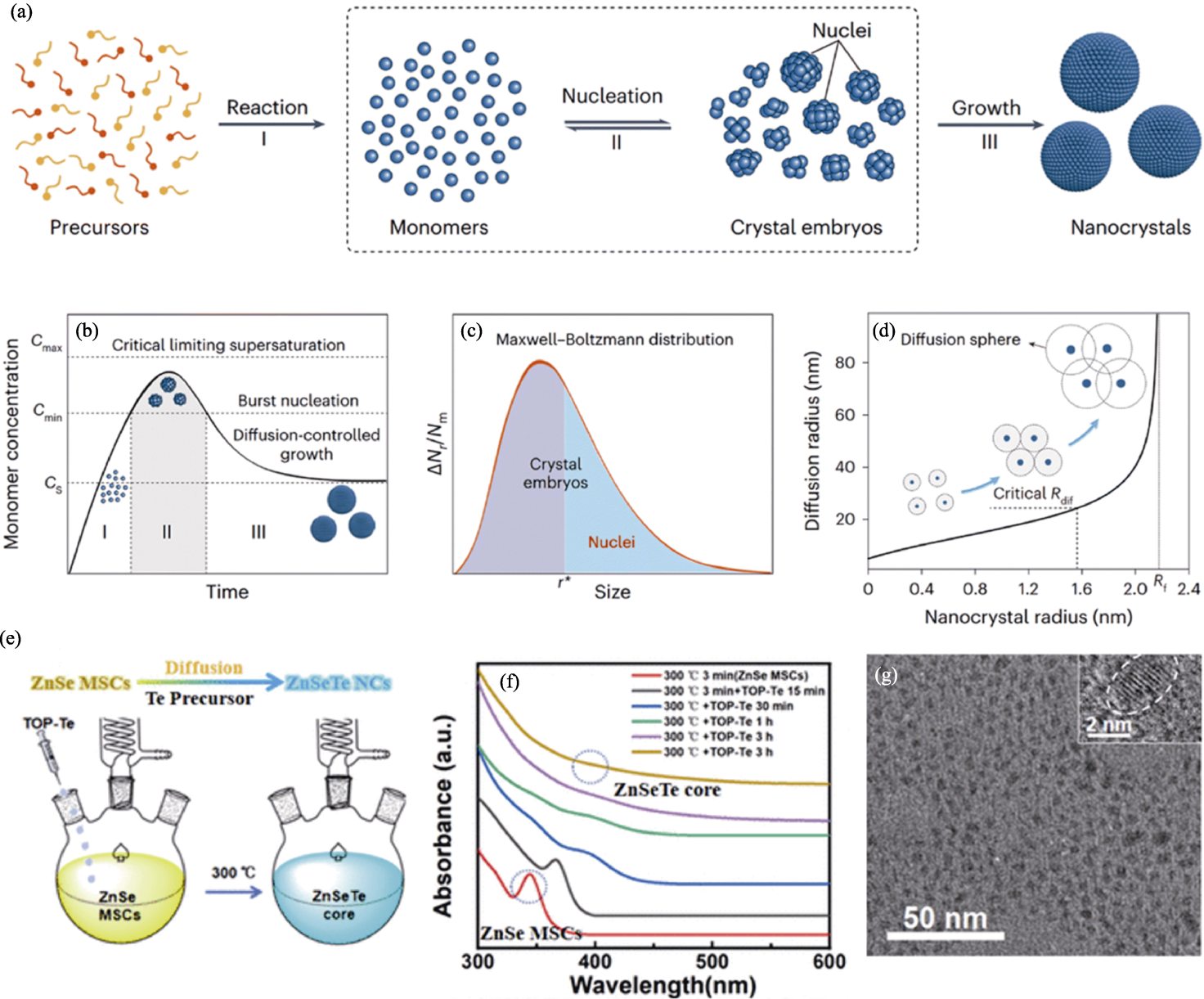
图1 量子点的合成[32,35]
Fig. 1 Synthesis of QDs[32,35] (a) Schematic illustration of QDs formation process[32]; (b) Schematic diagram of the mechanism for the classic LaMer model[32]; (c) Size distribution of crystal embryos following the Maxwell-Boltzmann distribution[32]; (d) Evolution of diffusion radius (Rdif) versus nanocrystal radius[32]; (e) Schematic illustration of ZnSeTe QDs synthesis[35]; (f) Absorption spectra of ZnSeTe QDs at different temperatures[35]; (g) Transmission electron microscope (TEM) image of ZnSeTe QDs[35]
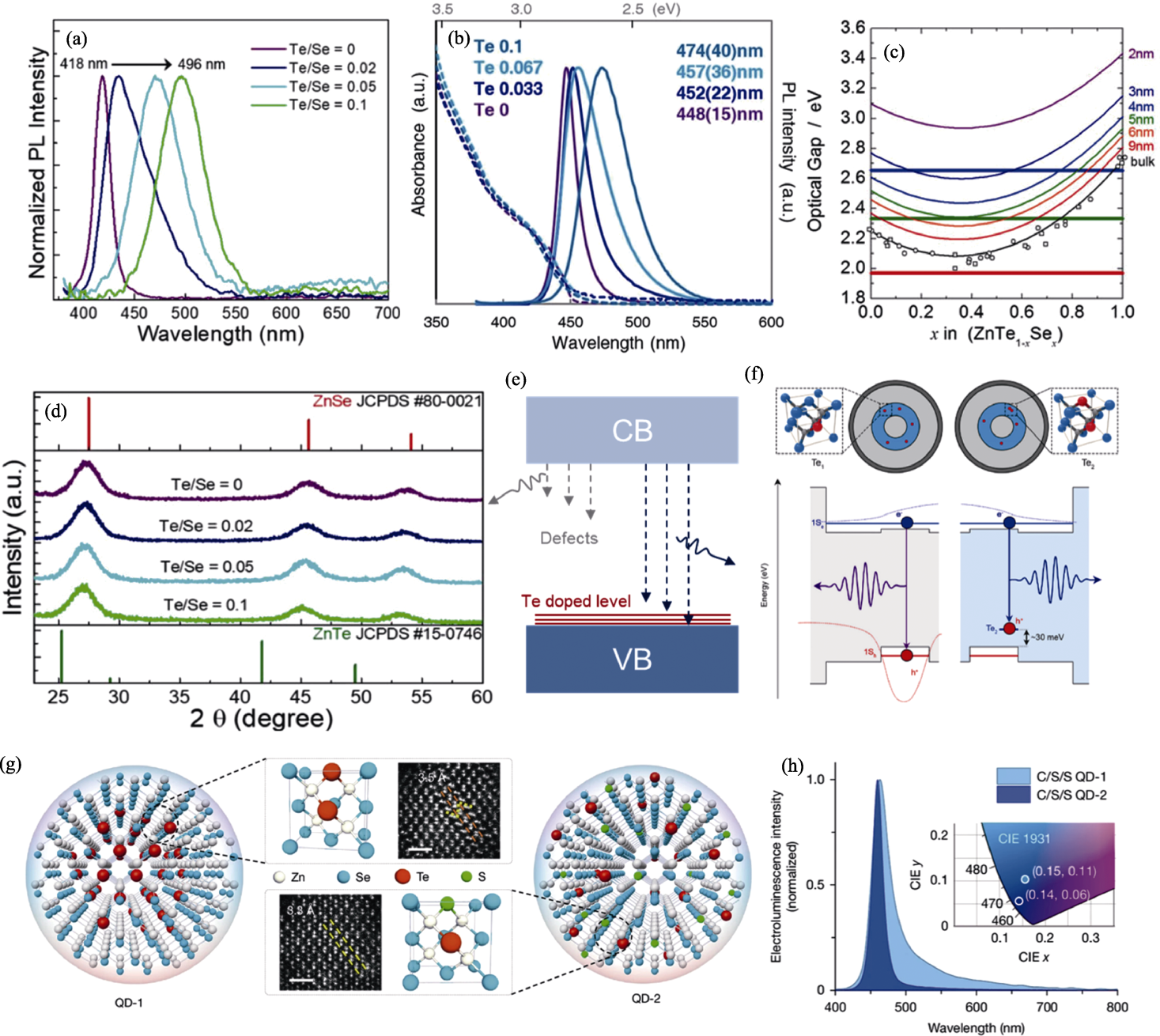
图2 QDs能带工程优化[28,41 -43]
Fig. 2 Band engineering optimization of QDs[28,41 -43] (a) Normalized photoluminescence (PL) spectra of ZnSeTe QDs synthesized at different Te/Se molar ratios (0-0.1)[41]; (b) Absorption and PL spectra of ZnSeTe/ZnSe/ZnS QDs with different compositions[42]; (c) Dependence of the calculated optical band gap of ZnSeTe QDs on composition and size[43]; (d) XRD patterns of ZnSeTe QDs synthesized at different Te/Se molar ratios (0-0.1)[41]; (e) Schematic illustration of shallow-level defect states; (f) Band structures and electronic energy level distributions of ZnSe/ZnSeTe/ZnSe/ZnS QDs without nearest-neighbor Te atom pairs (left) and with nearest-neighbor Te atom pairs (right)[43]; (g) Structural models and aberration-corrected TEM images of ZnSeTe and ZnSeTeS QDs[28]; (h) Electroluminescence (EL) spectra of QLED devices based on ZnSeTe and ZnSeTeS QDs with the C/S/S structure[28]
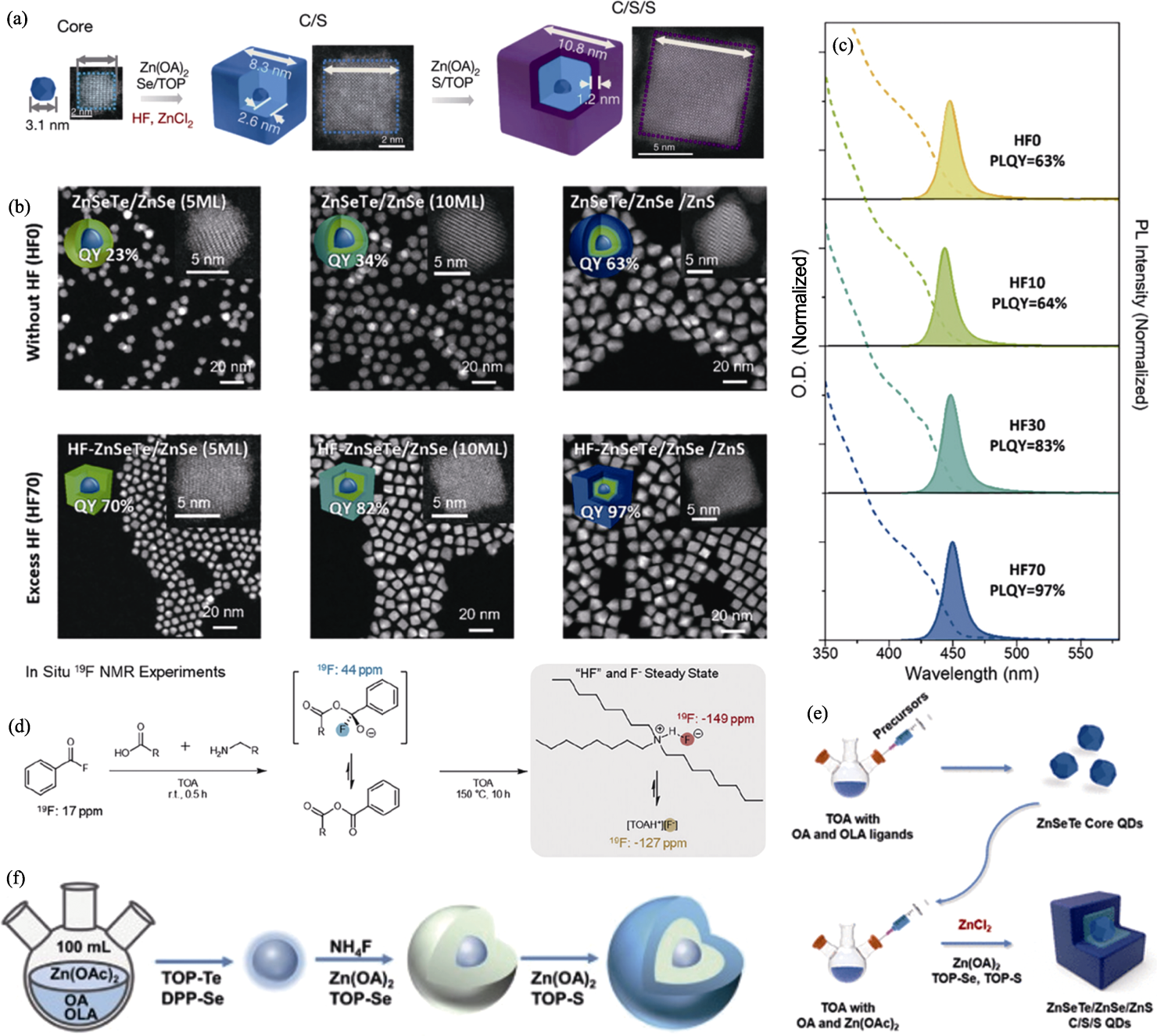
图3 QDs表面刻蚀优化[42,46 -49]
Fig. 3 Surface etching optimization of QDs[42,46 -49] (a) Schematic illustration of ZnTeSe etching by HF and ZnCl2[42]; (b) TEM images and PLQY of ZnTeSe/ZnSe with different HF etching dosages[46]; (c) Absorption and PL spectra of ZnTeSe/ZnSe/ZnS treated with different HF etching dosages[46]; (d) Schematic diagram of the HF-like species generation mechanism from benzoyl fluoride[47]; (e) Schematic illustration of ZnTeSe etching by ZnCl2[48]; (f) Schematic illustration of ZnTeSe etching by NH4F[49]
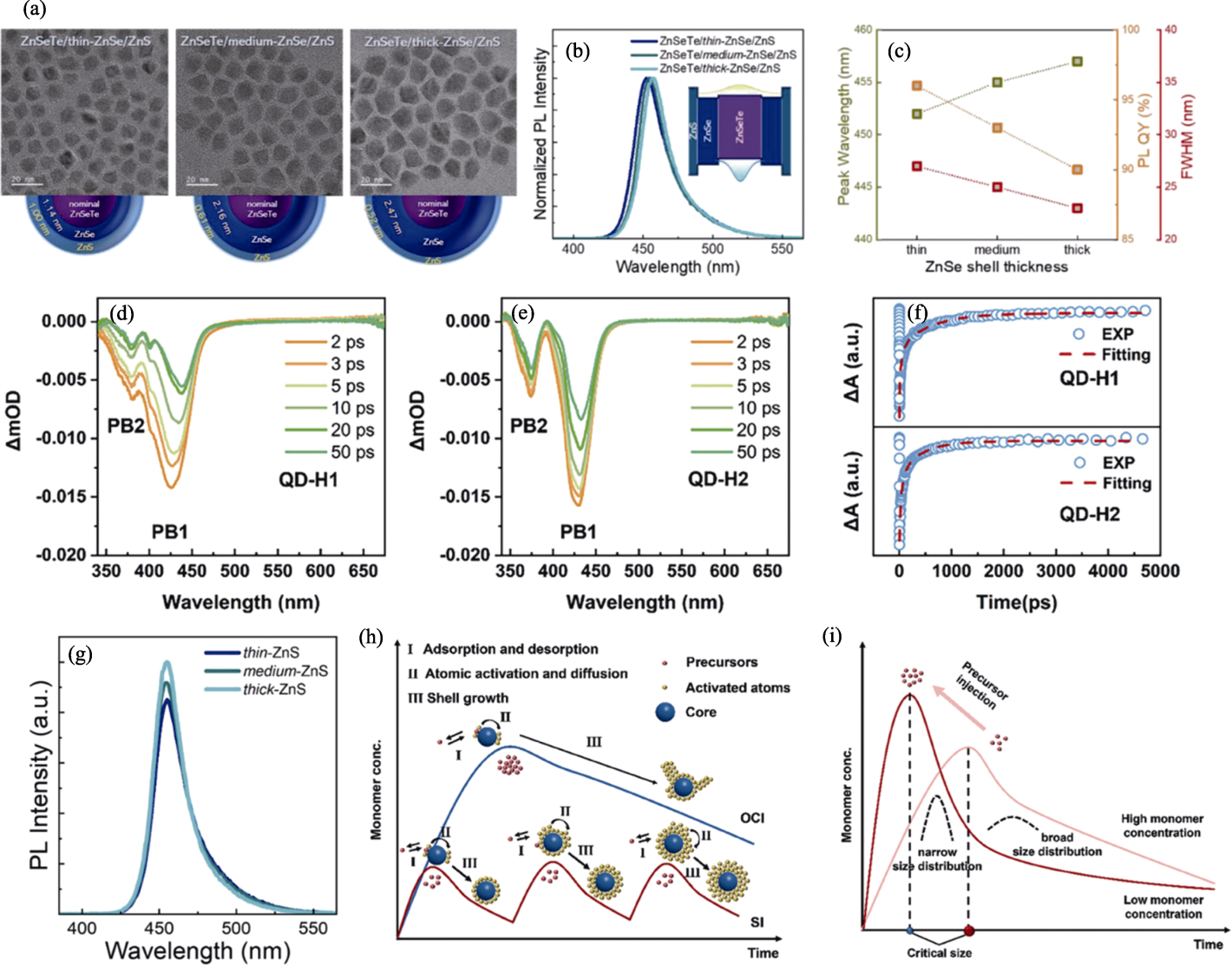
图4 QDs核壳工程[54-56]
Fig. 4 Core-shell engineering of QDs[54-56] (a) TEM images and corresponding sizes of ZnSeTe/thin-, medium-, and thick-ZnSe/ZnS QDs[54]; (b) Normalized PL spectra of QDs as a function of the thickness of ZnSe inner shell[54]; (c) PL emission peak positions, PLQY and FWHM[54]; (d, e) Transient absorption spectra of (d) ZnSeTe/thin-ZnSe/ZnS and (e) ZnSeTe/thick-ZnSe/ZnS[55]; (f) Bleach recovery kinetic processes of ZnSeTe/thin-ZnSe/ZnS and ZnSeTe/thick-ZnSe/ZnS[55]; (g) PL emission peak of QDs varying with the thickness of ZnSe inner shell[54]; (h) Schematic illustration of ZnSe shell growth prepared by the stepwise injection method and one-pot continuous injection method[56]; (i) Schematic illustration of the quantum dot size and size distribution after the second monomer supply in the stepwise injection method[56]
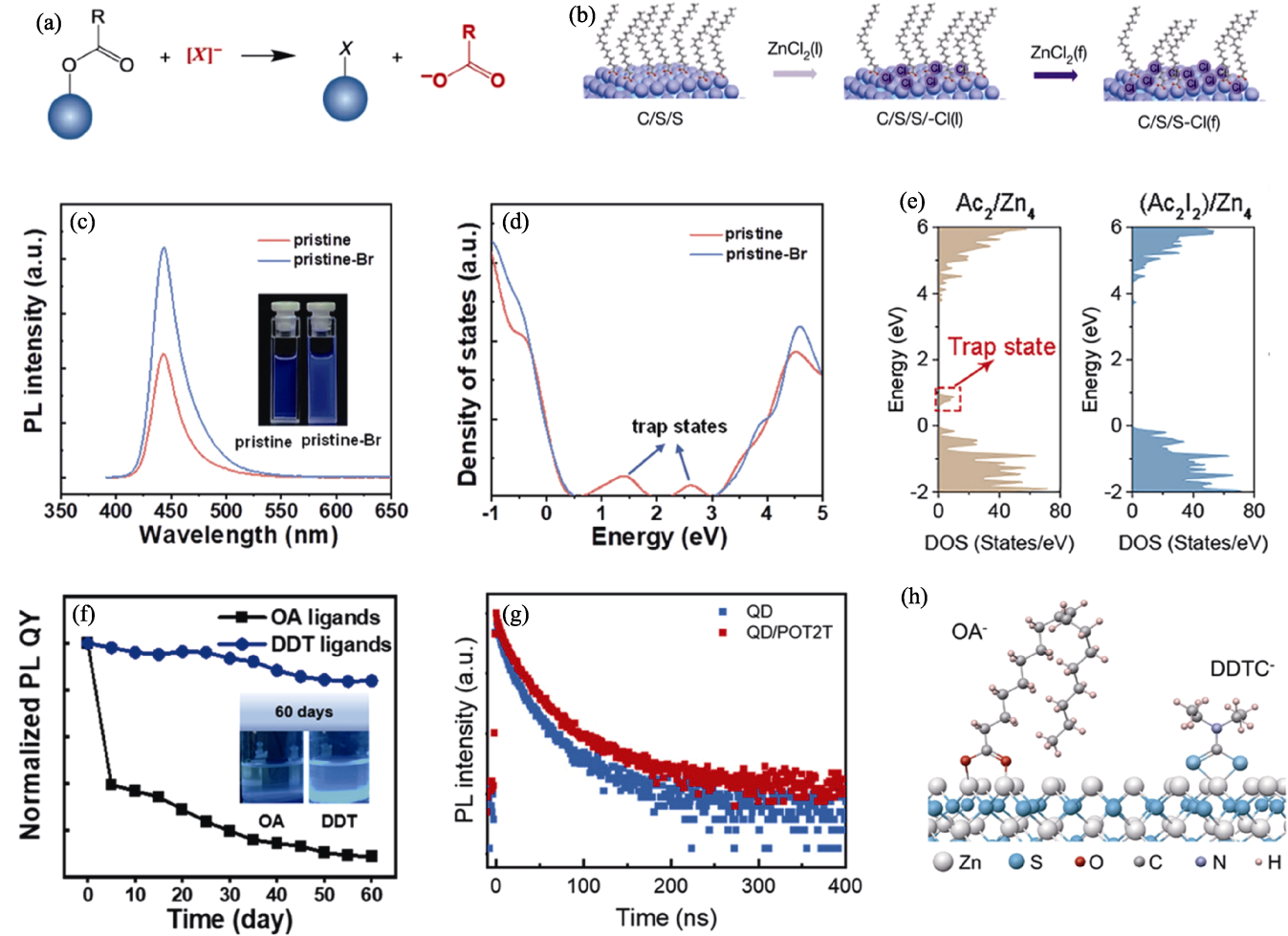
图5 QDs表面配体调控[42,48,57,64,66 -67,72]
Fig. 5 Surface ligand engineering of QDs[42,48,57,64,66 -67,72] (a) Ligand exchange mechanism of halogen anions[64]; (b) Schematic illustration of the ligand exchange process of ZnCl2 in the liquid phase, and the further solid phase ligand exchange process achieved by thin film washing treatment[42]; (c) PL spectra of the as-synthesized QDs and brominated QDs[66]; (d) DOS of ZnS shell on the surfaces of the as-synthesized QDs and brominated QDs[66]; (e) DOS of ZnS shell on the surfaces of the as-synthesized QDs and iodinated QDs[67]; (f) PLQY stability of the as-synthesized ZnSeTe/ZnSe/ZnS QDs and those treated with DDT under ambient conditions[48]; (g) Time-resolved photoluminescence (TRPL) spectra of the untreated ZnSeTe/ZnSe/ZnS QDs and those treated with POT2T[72]; (h) Schematic illustration of the ligand exchange process of DDTC[57]
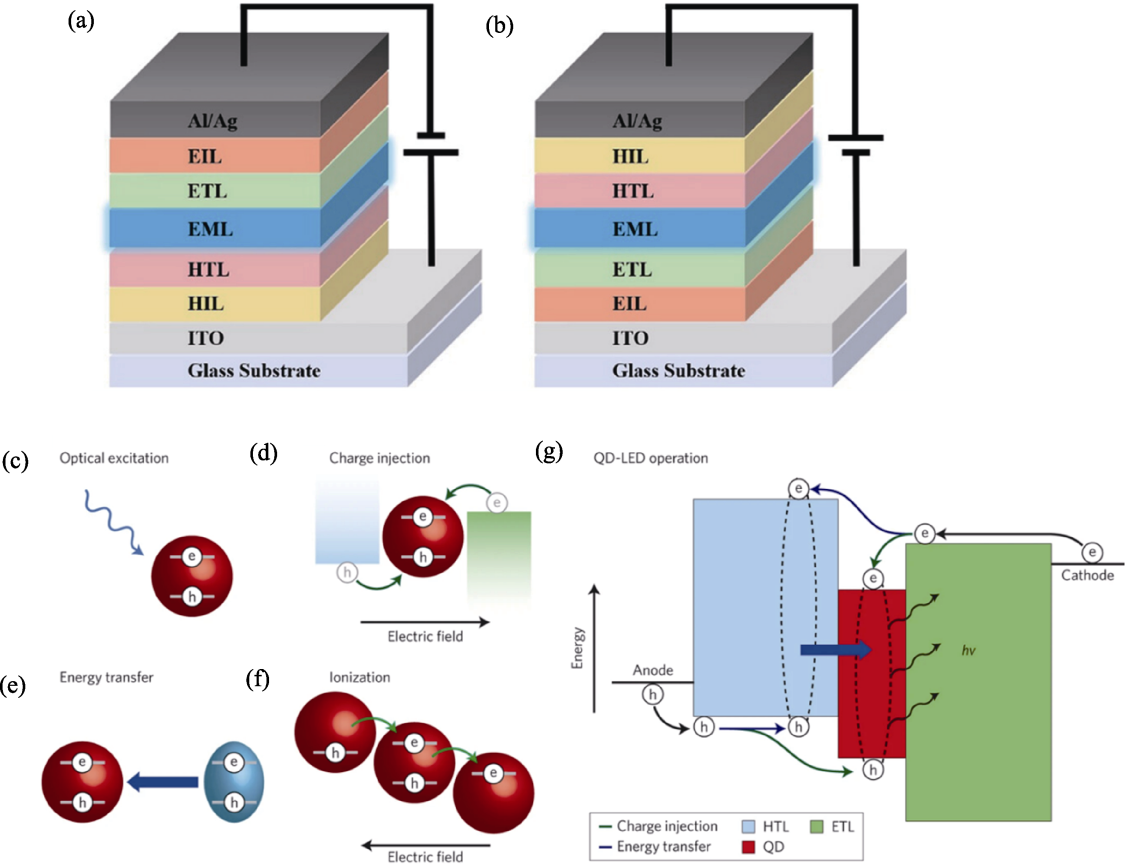
图6 QLED器件结构与工作机理[74]
Fig. 6 Device structure and operation mechanism of QLED devices[74] (a, b) Device architectures of QLEDs with (a) conventional and (b) inverted structures; (c) Schematic illustration of optical excitation; (d) Schematic illustration of charge injection; (e) Schematic illustration of energy transfer; (f) Schematic illustration of ionization; (g) Schematic illustration of the EL mechanism of QLEDs
| Material | PL/nm | Luminance/ (cd·m-2) | EQEmax/ % | T50 | Ref. |
|---|---|---|---|---|---|
| ZnSeTe | 465 | 1500 | 4 | - | [ |
| ZnSeTe | 460 | 3516 | 14.7 | 52.7 h@ 100 cd·m-2 | [ |
| ZnSeTe | 448 | 10240 | 10.9 | - | [ |
| ZnSeTe | 450 | 2904 | 9.5 | - | [ |
| ZnSeTe | 462 | 13677 | 17.2 | - | [ |
| ZnSeTe | 457 | 12654 | 18.6 | - | [ |
| ZnSeTe | 465 | 39739 | 17.1 | 8824 h@ 100 cd·m-2 | [ |
| ZnSeTe | 457 | 88900 | 20.2 | 15850 h@ 100 cd·m-2 | [ |
| ZnSeTeS | 460 | 36850 | 24.7 | ~30000 h@ 100 cd·m-2 | [ |
| ZnSeTe | 452 | - | 23.6 | ~50000 h@ 100 cd·m-2 | [ |
| ZnSeTe | 456 | 13670 | 17.5 | 5.1 h@ 1000 cd·m-2 | [ |
| ZnSeTe | 455 | 6017 | 20.8 | 130.7 h@ 100 cd·m-2 | [ |
| ZnSeTe | 452 | N/A | 18 | 49.1 h@ 100 cd·m-2 | [ |
表1
Table 1 Performance comparison of blue QLEDs based on ZnSeTe QDs[28,37,42,47,49,54 -56,65,68,91 -93]
| Material | PL/nm | Luminance/ (cd·m-2) | EQEmax/ % | T50 | Ref. |
|---|---|---|---|---|---|
| ZnSeTe | 465 | 1500 | 4 | - | [ |
| ZnSeTe | 460 | 3516 | 14.7 | 52.7 h@ 100 cd·m-2 | [ |
| ZnSeTe | 448 | 10240 | 10.9 | - | [ |
| ZnSeTe | 450 | 2904 | 9.5 | - | [ |
| ZnSeTe | 462 | 13677 | 17.2 | - | [ |
| ZnSeTe | 457 | 12654 | 18.6 | - | [ |
| ZnSeTe | 465 | 39739 | 17.1 | 8824 h@ 100 cd·m-2 | [ |
| ZnSeTe | 457 | 88900 | 20.2 | 15850 h@ 100 cd·m-2 | [ |
| ZnSeTeS | 460 | 36850 | 24.7 | ~30000 h@ 100 cd·m-2 | [ |
| ZnSeTe | 452 | - | 23.6 | ~50000 h@ 100 cd·m-2 | [ |
| ZnSeTe | 456 | 13670 | 17.5 | 5.1 h@ 1000 cd·m-2 | [ |
| ZnSeTe | 455 | 6017 | 20.8 | 130.7 h@ 100 cd·m-2 | [ |
| ZnSeTe | 452 | N/A | 18 | 49.1 h@ 100 cd·m-2 | [ |
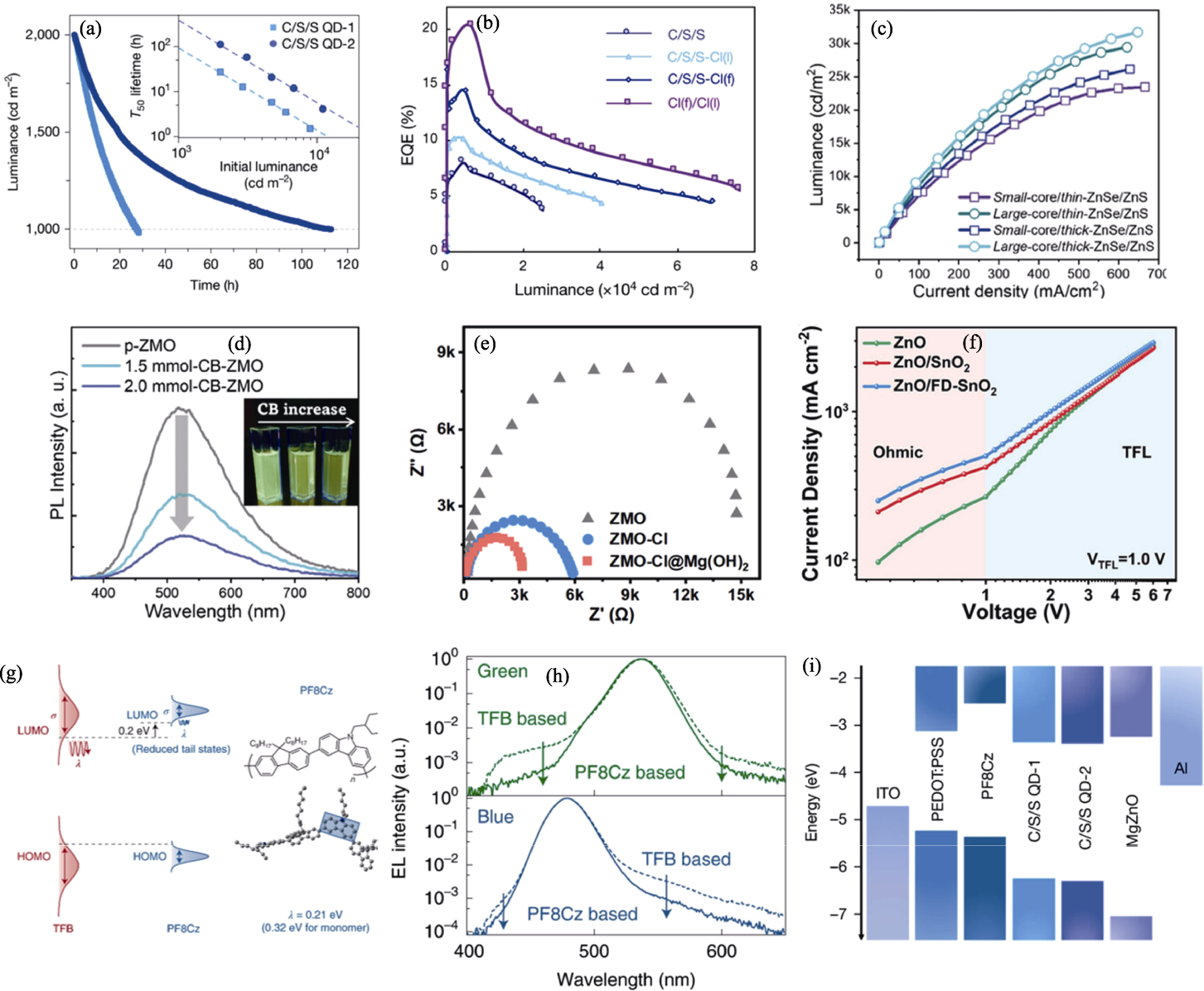
图7 QLED器件性能优化[28,42,91 -93,97]
Fig. 7 Performance optimization of QLED devices[28,42,91 -93,97] (a) Operational lifetimes of QLED devices based on ZnSeTe/ZnSe/ZnS and ZnSeTeS/ZnSe/ZnS QDs[28]; (b) EL spectra of ZnCl2-treated ZnSeTe/ZnSe/ZnS QLEDs[42]; (c) Luminance-current density curves of ZnSeTe/ZnSe/ZnS QLEDs with different shell thicknesses[91]; (d) PL spectra of CB functionalized ZnMgO nanoparticles at different CB addition amounts[91]; (e) Impedance spectra of ZnSeTe-based QLEDs using ZnMgO, ZnMgO-Cl and ZnMgO-Cl@Mg(OH)2 as ETL[92]; (f) Current density-voltage (J-V) curves of ITO/ZnO/Al, ITO/ZnO/SnO2/Al and ITO/ZnO/FD-SnO2/Al thin films[93]; (g) Theoretically optimized molecular configuration and reorganization energy of PF8Cz[97]; (h) EL spectra of green and blue QLEDs with PF8Cz as HTL and TFB as HTL[97]; (i) Schematic illustration of the energy band structures of ZnSeTe-based QLEDs with a PF8Cz HTL[28]
| [1] |
JIN W X, HE S Y, LU X Y, et al. Water-induced high-performance quantum-dot light-emitting diodes. Nature Photonics, 2025, 19(11): 1233.
DOI |
| [2] |
SHEN X Y, KAMATH A, GUYOT-SIONNEST P. Mid-infrared cascade intraband electroluminescence with HgSe-CdSe core-shell colloidal quantum dots. Nature Photonics, 2023, 17(12): 1042.
DOI |
| [3] |
ZEISKE S, BAN H W, LI X B, et al. Revealing additional size-dependent defect suppression channels governing detectivity in InAs colloidal quantum dot photodiodes. Nano Letters, 2025, 25(48): 16862.
DOI URL |
| [4] |
WU Q Q, GONG X W, ZHAO D W, et al. Efficient tandem quantum-dot LEDs enabled by an inorganic semiconductor-metal- dielectric interconnecting layer stack. Advanced Materials, 2022, 34(4): 2108150.
DOI URL |
| [5] |
WANG Y K, WAN H Y, TEALE S, et al. Long-range order enabled stability in quantum dot light-emitting diodes. Nature, 2024, 629(8012): 586.
DOI |
| [6] |
SONG J J, OUYANG W, SHEN H B, et al. Over 30% external quantum efficiency light-emitting diodes by engineering quantum dot-assisted energy level match for hole transport layer. Advanced Functional Materials, 2019, 29(33): 1808377.
DOI URL |
| [7] |
PAN Y Y, PAN J L, WANG Y K, et al. III-V quantum dots: a multidimensional exploration from eco-friendly materials to near infrared optoelectronic applications. Materials Today, 2025, 85: 171.
DOI URL |
| [8] | LI M J, WANG Y, SHEN W S, et al. In situ electronegativity control enables efficient near-infrared electroluminescence. Advanced Functional Materials, 2026, 36(36): e74284. |
| [9] | GAO C, ZHU J C, DING X B, et al. Redefining PbS quantum dot photovoltaics: p-i-n devices with superior efficiency and reproducibility. Advanced Materials, 2025, 37(44): e12933. |
| [10] | WANG Y, XU B T, SONG Z Y, et al. Dipole regulation enables efficient near-infrared perovskite quantum dots photodetector. Advanced Functional Materials, 2026, 36(4): e14588. |
| [11] |
BI Y H, SUN J H, CAO S, et al. Highly efficient and eco-friendly green quantum dot light-emitting diodes through interfacial potential grading. Nature Communications, 2025, 16: 1945.
DOI |
| [12] |
SONG Z X, LI C Y, LIN X, et al. Red, green and blue liquid-film lasers based on colloidal quantum-dots. Advanced Materials, 2025, 37(13): 2414953.
DOI URL |
| [13] |
ZHAO J Y, CHEN L X, LI D Z, et al. Large-area patterning of full-color quantum dot arrays beyond 1000 pixels per inch by selective electrophoretic deposition. Nature Communications, 2021, 12: 4603.
DOI PMID |
| [14] |
DAI X L, DENG Y Z, PENG X G, et al. Quantum-dot light-emitting diodes for large-area displays: towards the dawn of commercialization. Advanced Materials, 2017, 29(14): 1607022.
DOI URL |
| [15] |
YANG Z W, GAO M Y, WU W J, et al. Recent advances in quantum dot-based light-emitting devices: challenges and possible solutions. Materials Today, 2019, 24: 69.
DOI URL |
| [16] |
LIU H L, LIN Q Z, SUN S Q, et al. Tailored large-particle quantum dots with high color purity and excellent electroluminescent efficiency. Science Bulletin, 2025, 70(6): 905.
DOI URL |
| [17] |
ZHANG H, LI J C, WANG L, et al. Hole migration enables efficient and ultra-bright green quantum dot LEDs. Nature Communications, 2025, 16: 10143.
DOI |
| [18] | YANG X T, ZHANG W J, ZENG Y C, et al. Improving internal exciton confinement for efficient CdZnSeS-based blue quantum dot light-emitting diodes. Angewandte Chemie International Edition, 2025, 64(22): e202420421. |
| [19] |
DENG X Z, ZHANG F J, ZHANG Y, et al. Heavy-metal-free blue-emitting ZnSe(Te) quantum dots: synthesis and light-emitting applications. Journal of Materials Chemistry C, 2023, 11(42): 14495.
DOI URL |
| [20] |
ZHAO F, DUAN H W, WANG Y, et al. Diffusion dynamics coupled with in situ etching enable controlled growth of InAs quantum dots with narrow SWIR emission. Science Bulletin, 2026, 71(4): 777.
DOI URL |
| [21] |
YU K, HRDINA A, ZHANG X G, et al. Highly-photoluminescent ZnSe nanocrystals via a non-injection-based approach with precursor reactivity elevated by a secondary phosphine. Chemical Communications, 2011, 47(31): 8811.
DOI URL |
| [22] |
HE J H, WANG C H, LIU M R, et al. Overcoming side reaction effects in the colloidal synthesis of ZnSe/ZnS core/shell quantum dots with an etching strategy. Nano Research, 2024, 17(8): 7020.
DOI |
| [23] |
LIN L H, YE X X, LUO Z Q, et al. Enhancing the efficiency and stability of ZnSe pure blue quantum dot light-emitting diodes via ionic liquid doping. Journal of Materials Chemistry C, 2024, 12(28): 10408.
DOI URL |
| [24] |
NGUYEN D H, KIM S H, LEE J S, et al. Reaction-dependent optical behavior and theoretical perspectives of colloidal ZnSe quantum dots. Scientific Reports, 2024, 14: 13982.
DOI PMID |
| [25] |
LUO Z Q, YU Y S, YANG K Y, et al. High-performance cadmium-free blue quantum dot light-emitting devices with stepwise double hole-transport layers. Advanced Electronic Materials, 2023, 9(3): 2200970.
DOI URL |
| [26] |
LAI C L, CAO S, LIANG Y, et al. Strain modulation in ZnSeTe spherical quantum well quantum dots for efficient blue QLEDs. The Journal of Physical Chemistry Letters, 2025, 16(47): 12266.
DOI URL |
| [27] |
YANG Z W, WU Q Q, ZHOU X C, et al. A seed-mediated and double shell strategy to realize large-size ZnSe/ZnS/ZnS quantum dots for high color purity blue light-emitting diodes. Nanoscale, 2021, 13(8): 4562.
DOI PMID |
| [28] |
WU Q Q, CAO F, YU W K, et al. Homogeneous ZnSeTeS quantum dots for efficient and stable pure-blue LEDs. Nature, 2025, 639(8055): 633.
DOI |
| [29] | SHEN H B, WANG H Z, LI X M, et al. Phosphine-free synthesis of high quality ZnSe, ZnSe/ZnS, and Cu-, Mn-doped ZnSe nanocrystals. Dalton Transactions, 2009(47): 10534. |
| [30] |
CHEN Z N, LI H T, YUAN C X, et al. Color revolution: prospects and challenges of quantum-dot light-emitting diode display technologies. Small Methods, 2024, 8(2): 2300359.
DOI URL |
| [31] |
JANG E, JANG H. Review: quantum dot light-emitting diodes. Chemical Reviews, 2023, 123(8): 4663.
DOI URL |
| [32] |
LONG Z W, LIU M R, WU X G, et al. A reactivity-controlled epitaxial growth strategy for synthesizing large nanocrystals. Nature Synthesis, 2023, 2(3): 296.
DOI |
| [33] | EKIMOV A I, ONUSHCHENKO A A. Quantum size effect in three-dimensional microscopic semiconductor crystals. JETP Letters, 2023, 118(1): S15. |
| [34] |
IOANNOU D, GRIFFIN D K. Nanotechnology and molecular cytogenetics: the future has not yet arrived. Nano Reviews, 2010, 1(1): 5117.
DOI URL |
| [35] |
SONG X R, QIN Y, YU C Y, et al. Construct ZnSeTe/ZnTe nanostructures with the tunable emission from 450 to 760 nm. The Journal of Physical Chemistry Letters, 2025, 16(4): 1045.
DOI URL |
| [36] |
HINES M A, GUYOT-SIONNEST P. Bright UV-blue luminescent colloidal ZnSe nanocrystals. The Journal of Physical Chemistry B, 1998, 102(19): 3655.
DOI URL |
| [37] |
HAN C Y, LEE S H, SONG S W, et al. More than 9% efficient ZnSeTe quantum dot-based blue electroluminescent devices. ACS Energy Letters, 2020, 5(5): 1568.
DOI URL |
| [38] |
REISS P, CARRIÈRE M, LINCHENEAU C, et al. Synthesis of semiconductor nanocrystals, focusing on nontoxic and earth-abundant materials. Chemical Reviews, 2016, 116(18): 10731.
DOI PMID |
| [39] |
PENG Q, DONG Y J, DENG Z X, et al. Low-temperature elemental-direct-reaction route to II-VI semiconductor nanocrystalline ZnSe and CdSe. Inorganic Chemistry, 2001, 40(16): 3840.
PMID |
| [40] |
ZHANG J, CHEN Q H, ZHANG W L, et al. Microwave-assisted aqueous synthesis of transition metal ions doped ZnSe/ZnS core/shell quantum dots with tunable white-light emission. Applied Surface Science, 2015, 351: 655.
DOI URL |
| [41] | JANG E P, HAN C Y, LIM S W, et al. Synthesis of alloyed ZnSeTe quantum dots as bright, color-pure blue emitters. ACS Applied Materials & Interfaces, 2019, 11(49): 46062. |
| [42] |
KIM T, KIM K H, KIM S, et al. Efficient and stable blue quantum dot light-emitting diode. Nature, 2020, 586(7829): 385.
DOI |
| [43] |
CHANG J H, JUNG D, LEE H J, et al. Impact of morphological inhomogeneity on excitonic states in highly mismatched alloy ZnSe1-XTeX nanocrystals. The Journal of Physical Chemistry Letters, 2022, 13(49): 11464.
DOI URL |
| [44] |
LI H Y, ZHANG W J, BIAN Y Y, et al. ZnF2-assisted synthesis of highly luminescent InP/ZnSe/ZnS quantum dots for efficient and stable electroluminescence. Nano Letters, 2022, 22(10): 4067.
DOI URL |
| [45] | DENG J L, ZHANG Z F, BIAN Y Y, et al. Dual-surface treatment for efficient amine-phosphine based red InP QLEDs. Advanced Functional Materials, 2026, 36(18): e21226. |
| [46] |
LEE Y J, KIM S, LEE J, et al. Crystallographic and photophysical analysis on facet-controlled defect-free blue-emitting quantum dots. Advanced Materials, 2024, 36(16): 2311719.
DOI URL |
| [47] |
IMRAN M, PARITMONGKOL W, MILLS H A, et al. Molecular-additive-assisted tellurium homogenization in ZnSeTe quantum dots. Advanced Materials, 2023, 35(45): 2303528.
DOI URL |
| [48] |
CHO S, LIM S N, KIM H S, et al. Air-stable and environmentally friendly full color-emitting ZnSeTe/ZnSe/ZnS quantum dots for display applications. ACS Applied Nano Materials, 2022, 5(12): 18905.
DOI URL |
| [49] |
HE L J, CAO S, LI Q Y, et al. Achieving near-unity quantum yield in blue ZnSeTe quantum dots through NH4F molecular-assisted synthesis for highly efficient light-emitting diodes. Chemical Engineering Journal, 2024, 489: 151347.
DOI URL |
| [50] |
JI B T, KOLEY S, SLOBODKIN I, et al. ZnSe/ZnS core/shell quantum dots with superior optical properties through thermodynamic shell growth. Nano Letters, 2020, 20(4): 2387.
DOI PMID |
| [51] |
GAO M, YANG H W, SHEN H B, et al. Bulk-like ZnSe quantum dots enabling efficient ultranarrow blue light-emitting diodes. Nano Letters, 2021, 21(17): 7252.
DOI URL |
| [52] |
DONG B H, CAO L X, SU G, et al. Facile synthesis of highly luminescent UV-blue emitting ZnSe/ZnS core/shell quantum dots by a two-step method. Chemical Communications, 2010, 46(39): 7331.
DOI PMID |
| [53] |
LAD A D, MAHAMUNI S. Effect of ZnS shell formation on the confined energy levels of ZnSe quantum dots. Physical Review B, 2008, 78(12): 125421.
DOI URL |
| [54] |
LEE S H, SONG S W, YOON S Y, et al. Heterostructural tailoring of blue ZnSeTe quantum dots toward high-color purity and high-efficiency electroluminescence. Chemical Engineering Journal, 2022, 429: 132464.
DOI URL |
| [55] |
BI Y H, CAO S, YU P, et al. Reducing emission linewidth of pure-blue ZnSeTe quantum dots through shell engineering toward high color purity light-emitting diodes. Small, 2023, 19(45): 2303247.
DOI URL |
| [56] |
CHENG C Y, YU B B, HUANG F, et al. Near-unity quantum yield ZnSeTe quantum dots enabled by controlling shell growth for efficient deep-blue light-emitting diodes. Advanced Functional Materials, 2024, 34(24): 2313811.
DOI URL |
| [57] |
CAO F, WU Q Q, ZHANG S Z, et al. Surface- and spatial-regulated Cd-free quantum dots for efficient, mechanically stable, and full-color flexible light-emitting diodes. Advanced Materials, 2025, 37(16): 2420575.
DOI URL |
| [58] |
SHEN H B, CAO W R, SHEWMON N T, et al. High-efficiency, low turn-on voltage blue-violet quantum-dot-based light-emitting diodes. Nano Letters, 2015, 15(2): 1211.
DOI PMID |
| [59] |
PU C D, DAI X L, SHU Y F, et al. Electrochemically-stable ligands bridge the photoluminescence-electroluminescence gap of quantum dots. Nature Communications, 2020, 11: 937.
DOI PMID |
| [60] |
PAN J, QUAN L N, ZHAO Y B, et al. Highly efficient perovskite-quantum-dot light-emitting diodes by surface engineering. Advanced Materials, 2016, 28(39): 8718.
DOI URL |
| [61] |
ZHANG W D, TAN Y Z, DUAN X J, et al. High quantum yield blue InP/ZnS/ZnS quantum dots based on bromine passivation for efficient blue light-emitting diodes. Advanced Optical Materials, 2022, 10(15): 2200685.
DOI URL |
| [62] |
CALVIN J J, SWABECK J K, SEDLAK A B, et al. Thermodynamic investigation of increased luminescence in indium phosphide quantum dots by treatment with metal halide salts. Journal of the American Chemical Society, 2020, 142(44): 18897.
DOI PMID |
| [63] |
SUN H, CAO Z Y, QIN H Y, et al. Ligand-controlled electrochemiluminescence generation from CdSe/CdS/ZnS core/ shell/shell quantum dots. Nano Research, 2024, 17(8): 7776.
DOI |
| [64] |
LI X Y, ZHAO Y B, FAN F J, et al. Bright colloidal quantum dot light-emitting diodes enabled by efficient chlorination. Nature Photonics, 2018, 12(3): 159.
DOI |
| [65] |
FEI W L, LI S N, XIE J C, et al. X-type ligands effect on the operational stability of heavy-metal-free quantum dot light-emitting diodes. Nano Letters, 2024, 24(44): 14066.
DOI URL |
| [66] |
ZHENG Z S, REN Z W, XIA W L, et al. Bromide decorated eco-friendly ZnSeTe/ZnSe/ZnS quantum dots for efficient blue light- emitting diodes. Advanced Materials Interfaces, 2023, 10(5): 2202241.
DOI URL |
| [67] |
GUAN Z Y, HUANG Y, WANG Z J, et al. Surface defects passivation of ZnSeTe/ZnSe/ZnS quantum dots by iodine ions for highly efficient blue light-emitting diodes. Advanced Optical Materials, 2024, 12(35): 2401884.
DOI URL |
| [68] |
SHEN W S, XIE L M, FEI W L, et al. Dipole-assisted functionalization enables long-range ordering of ZnTeSe quantum dots for efficient and stable deep-blue electroluminescence. Nature Photonics, 2026, 20(5): 571.
DOI |
| [69] |
WANG L S, LV Y, LIN J, et al. Surface organic ligand-passivated quantum dots: toward high-performance light-emitting diodes with long lifetimes. Journal of Materials Chemistry C, 2021, 9(7): 2483.
DOI URL |
| [70] | TEH Z L, HU L, ZHANG Z L, et al. Enhanced power conversion efficiency via hybrid ligand exchange treatment of p-type PbS quantum dots. ACS Applied Materials & Interfaces, 2020, 12(20): 22751. |
| [71] |
BUI T D, NGUYEN Q L, LUONG T B, et al. Enhanced luminescence using the core-shell-shell structure of 3-mercaptopropionic acid-capped ZnSe/ZnS: Mn/ZnS quantum dot. Journal of the Chinese Chemical Society, 2024, 71(7): 662.
DOI URL |
| [72] |
LIANG S S, TANG Z B, LI S, et al. Efficient ZnSeTe-based blue quantum-dot light-emitting diodes via phosphine oxide dual passivation of quantum dots and ZnMgO interfaces. Advanced Optical Materials, 2025, 13(15): 2500034.
DOI URL |
| [73] |
COLVIN V L, SCHLAMP M C, ALIVISATOS A P. Light-emitting diodes made from cadmium selenide nanocrystals and a semiconducting polymer. Nature, 1994, 370(6488): 354.
DOI |
| [74] | HUANG M Y, TAN B, JIANG R, et al. Progress and future prospects in eco-friendly blue quantum dot light-emitting diodes for next-generation display applications. Laser & Photonics Reviews, 2026, 20(7): e02575. |
| [75] | CHEN H W, LEE J H, LIN B Y, et al. Liquid crystal display and organic light-emitting diode display: present status and future perspectives. Light: Science & Applications, 2018, 7(3): 17168. |
| [76] |
STECKEL J S, HO J, HAMILTON C, et al. Quantum dots: the ultimate down-conversion material for LCD displays. Journal of the Society for Information Display, 2015, 23(7): 294.
DOI URL |
| [77] |
WANG F F, ZHANG H M, LIN Q L, et al. Suppressed efficiency roll-off in blue light-emitting diodes by balancing the spatial charge distribution. Journal of Materials Chemistry C, 2020, 8(37): 12927.
DOI URL |
| [78] |
LOUDON J C, MATHUR N D, MIDGLEY P A. Charge-ordered ferromagnetic phase in La0.5Ca0.5MnO3. Nature, 2002, 420(6917): 797.
DOI |
| [79] |
ZHANG X Y, LI D W, ZHANG Z H, et al. Constructing effective hole transport channels in cross-linked hole transport layer by stacking discotic molecules for high performance deep blue QLEDs. Advanced Science, 2022, 9(23): 2200450.
DOI URL |
| [80] |
ZHANG L J, ZHU X F, WANG Z H, et al. Synthesis of ZnO doped high valence S element and study of photogenerated charges properties. RSC Advances, 2019, 9(8): 4422.
DOI URL |
| [81] |
YIN Z G, ZHENG Q D, CHEN S C, et al. Bandgap tunable Zn1-xMgxO thin films as highly transparent cathode buffer layers for high-performance inverted polymer solar cells. Advanced Energy Materials, 2014, 4(7): 1301404.
DOI URL |
| [82] | TAN S, HOROWITZ J R, TYE O J, et al. Challenges of II-VI and III-V blue quantum dot light-emitting diodes. Advanced Materials, 2026, 38(2): e12379. |
| [83] |
CAI F S, BAI B, WU Q Q, et al. Blue quantum dot light-emitting diodes toward full-color displays: materials, devices, and large-scale fabrication. Nano Letters, 2025, 25(1): 1.
DOI PMID |
| [84] |
SHIRASAKI Y, SUPRAN G J, BAWENDI M G, et al. Emergence of colloidal quantum-dot light-emitting technologies. Nature Photonics, 2013, 7(1): 13.
DOI |
| [85] |
ZHENG Z S, REN Z W, LIU Y J, et al. Blue-emitting ZnSeTe/ZnSe/ZnS quantum dots for efficient electroluminescent application. ACS Applied Nano Materials, 2024, 7(11): 13166.
DOI URL |
| [86] |
KIM S K, LEE S H, YOON S Y, et al. Localized surface plasmon-enhanced blue electroluminescent device based on ZnSeTe quantum dots and AuAg nanoparticles. Inorganic Chemistry Frontiers, 2022, 9(13): 3138.
DOI URL |
| [87] |
YU B B, GAO L, HUANG F, et al. Precursor reactivity-controlled synthesis of ZnSeTe spherical quantum wells with narrow and symmetric photoluminescence. Advanced Optical Materials, 2025, 13(2): 2402129.
DOI URL |
| [88] |
MA S L, CAO F, JIA G H, et al. Blue ZnSeTe quantum dot light-emitting diodes with low efficiency roll-off enabled by an in situ hybridization of ZnMgO nanoparticles and amino alcohol molecules. Nanoscale, 2024, 16(21): 10441.
DOI URL |
| [89] |
LEE B J, KIM T Y, KIM I, et al. Bright and stable ZnSeTe core/shell quantum dots enabled by surface passivation with organozinc halide ligands. Chemistry of Materials, 2024, 36(1): 471.
DOI URL |
| [90] |
HA J, LEE S, PARK M, et al. Dual ligand exchange of Cd-free quantum dots and optimal control of ink formulation for improving the performance of all-inkjet-printed quantum dot light-emitting diodes. Journal of the Society for Information Display, 2024, 32(5): 332.
DOI URL |
| [91] |
YOON S Y, KIM Y H, LEE S H, et al. Efficient, stable blue light-emitting diodes enabled by heterostructural alteration of ZnSeTe quantum dot and functionalization of ZnMgO. Advanced Optical Materials, 2024, 12(32): 2401085.
DOI URL |
| [92] |
SUN C Y, LI Q Y, CAO S, et al. Synergistic chloride passivation and inorganic shell confinement in ZnMgO nanoparticles for efficient and stable blue ZnSeTe QLEDs. The Journal of Physical Chemistry Letters, 2025, 16(22): 5441.
DOI URL |
| [93] |
HUANG Y J, CAO S, LIANG Y, et al. High-efficiency and stable ZnSeTe-based blue QLEDs enabled by freeze-dried SnO2 nanoparticle interlayers. Laser & Photonics Reviews, 2025, 19(15): 2500049.
DOI URL |
| [94] |
ZHAO J, JIANG R, HUANG M Y, et al. Advancing ecofriendly indium phosphide quantum dots: comprehensive strategies toward color-pure luminescence for wide color gamut displays. ACS Energy Letters, 2025, 10(5): 2096.
DOI URL |
| [95] |
LIN Q L, SHEN H B, WANG H Z, et al. Cadmium-free quantum dots based violet light-emitting diodes: high-efficiency and brightness via optimization of organic hole transport layers. Organic Electronics, 2015, 25: 178.
DOI URL |
| [96] |
BAO Z, JIANG Z F, SU Q, et al. ZnSe:Te/ZnSeS/ZnS nanocrystals: an access to cadmium-free pure-blue quantum-dot light-emitting diodes. Nanoscale, 2020, 12(21): 11556.
DOI PMID |
| [97] |
DENG Y Z, PENG F, LU Y, et al. Solution-processed green and blue quantum-dot light-emitting diodes with eliminated charge leakage. Nature Photonics, 2022, 16(7): 505.
DOI |
| [98] |
TAN S, PARK S, CHOI S G, et al. Oxygen vacancy formation in ZnSeTe blue quantum dot light-emitting diodes. Journal of the American Chemical Society, 2025, 147(44): 40842.
DOI URL |
| [99] |
ZHAO L L, ZHANG H, WANG L, et al. Bright and stable green quantum dot light-emitting diodes via increasing electron concentration. Nano Research, 2025, 18(9): 94907978.
DOI URL |
| [100] |
WANG S B, YANG W Y, LI Y, et al. Efficient and long lifetime red InP-based QLEDs enabled by simultaneously improved carrier injection balance and depressed leakage. Advanced Optical Materials, 2025, 13(12): 2570085.
DOI URL |
| [101] |
CHEN M Y, LI Q, BIAN Y Y, et al. High-efficiency and stable green InP-QLED enabled by lowering electron injection barrier. Advanced Optical Materials, 2025, 13(6): 2402555.
DOI URL |
| [102] |
WANG S B, YANG W Y, LI Y, et al. Stable and efficient red InP-based QLEDs through surface passivation strategies of quantum dots. Nano Letters, 2024, 24(49): 15781.
DOI URL |
| [103] |
WANG X Z, SUN J H, GUO R, et al. Size-dependent quantum confined stark effect in quantum dot light-emitting diodes: an electrically excited transient absorption study. The Journal of Physical Chemistry Letters, 2025, 16(15): 3754.
DOI URL |
| [104] | ZHAO Y D, DAI S G, ZOU S J, et al. Direct photopatterning strategies for ultrafine quantum dot pixel arrays and micropatterned light-emitting diodes. Laser & Photonics Reviews, 2026, 20(7): e02328. |
| [1] | 覃善丽, 郭佳文, 陈燕萌, 聚安安, 韦毅, 黄科林, 侯向华, 吕思师, 文志朋, 吴炼. 二维层状材料构筑电化学储能定向离子传输通道的研究进展[J]. 无机材料学报, 2026, 41(7): 883-898. |
| [2] | 余飞宇, 王文清, 张学勤, 何汝杰. 基于增材制造陶瓷点阵的双相网络互穿复合材料的研究进展与挑战[J]. 无机材料学报, 2026, 41(7): 849-866. |
| [3] | 周翠, 李捷, 孙鲁超, 苏海军, 王京阳. 氧化铝基定向凝固共晶陶瓷的组织特性、调控方法及环境稳定性[J]. 无机材料学报, 2026, 41(7): 899-914. |
| [4] | 陈明俊, 缪洪康, 肖英俊, 邓建波, 张翔, 赵九蓬, 李垚. 光-热双响应材料研究进展: 从设计策略到智能窗应用[J]. 无机材料学报, 2026, 41(6): 723-738. |
| [5] | 宋坤洁, 解荣军. 机器学习驱动新型发光材料的研究进展[J]. 无机材料学报, 2026, 41(6): 689-703. |
| [6] | 胡钰晴, 朱一新, 乐先浩, 万青. 钽酸锂晶圆减薄技术及其热释电红外探测器应用进展[J]. 无机材料学报, 2026, 41(6): 764-774. |
| [7] | 刘春帆, 陈科, 葛芳芳, 黄庆. 核用耐铅铋腐蚀涂层的研究进展[J]. 无机材料学报, 2026, 41(6): 775-786. |
| [8] | 胡扬, 谢敏, 张筱怡, 李想, 郭新伟, 姜南, 周文瀚, 张胜利, 曾海波. 计算与数据驱动环保型发光材料的研究进展[J]. 无机材料学报, 2026, 41(6): 704-722. |
| [9] | 王俊卜, 黄泽皑, 杨茗凯, 蒙颖, 周明炜, 周莹. 甲烷转化用抗积碳催化材料研究进展[J]. 无机材料学报, 2026, 41(6): 739-750. |
| [10] | 王金文, 杨振, 周欢, 夏丹, 杨磊. 可注射无机材料及其生物医学应用[J]. 无机材料学报, 2026, 41(6): 751-763. |
| [11] | 李涵涛, 沈强, 罗国强, 王雪飞, 高明, 陈晨. 机械球磨法调控硅基负极材料结构与性能的研究进展[J]. 无机材料学报, 2026, 41(5): 561-572. |
| [12] | 解陈一, 缪花明, 张蔚然, 刘荣军, 王衍飞, 李端. 理论计算在高熵陶瓷领域的研究进展[J]. 无机材料学报, 2026, 41(5): 545-560. |
| [13] | 李璇, 叶奎材, 冯佳音, 邱家军, 钱文昊, 邢敏. 钛基牙种植体表面改性促进软组织封闭的研究进展[J]. 无机材料学报, 2026, 41(4): 432-444. |
| [14] | 彭德招, 李瑞, 王文鸿, 王梓瑞, 章志珍. 钠氯化物固态电解质研究进展[J]. 无机材料学报, 2026, 41(4): 409-420. |
| [15] | 陈坤, 姜勇刚, 冯军宗, 李良军, 胡艺洁, 冯坚. 锆酸镧多孔隔热材料研究进展[J]. 无机材料学报, 2026, 41(4): 421-431. |
| 阅读次数 | ||||||
|
全文 |
|
|||||
|
摘要 |
|
|||||