无机材料学报 ›› 2026, Vol. 41 ›› Issue (9): 1319-1329.DOI: 10.15541/jim20250457
许嘉垅1( ), 秦浩2, 罗昕沂1, 邢娟娟1(), 张翔宇2(), 顾辉3
收稿日期:2025-11-12
修回日期:2026-02-02
出版日期:2026-09-20
网络出版日期:2026-02-05
通讯作者:
邢娟娟, 副教授. E-mail: xingjuanjuan@shu.edu.cn;作者简介:许嘉垅(2001-), 女, 硕士研究生. E-mail: xjlong_23@shu.edu.cn
基金资助:
XU Jialong1(), QIN Hao2, LUO Xinyi1, XING Juanjuan1(), ZHANG Xiangyu2(), GU Hui3
Received:2025-11-12
Revised:2026-02-02
Published:2026-09-20
Online:2026-02-05
About author:XU Jialong (2001-), female, Master candidate. E-mail: xjlong_23@shu.edu.cn
Supported by:摘要:
BN界面相是SiCf/SiC复合材料的关键组元, 优化成分与微观结构对改善其综合性能与可靠性至关重要。本研究开发了一种基于扫描电子显微镜和激光共聚焦显微镜的智能定位光电联用高通量表征技术, 能够对纤维表面同一区域实现多尺度表征, 获取BN界面相的表面粗糙度、微观形貌及元素组成等关键信息。该技术通过建立统一坐标系实现快速定位, 可在1 h内完成20个组分区域的多尺度分析, 整体表征效率提升约1.1倍。研究表明, 随着制备过程中Si前驱体的输入流量升高, xSi-BN界面相中Si含量增加, B含量相应降低。引入Si导致BN结晶度降低, 表面活性增强, 促使BN吸附空气中的氧并在表面形成凸起颗粒。Si掺杂对BN层状结构及其力学性能具有显著影响。随着Si含量增至8%, 与层间滑移相关的“pop-in”现象消失, 界面层硬度从14.91 GPa显著降低至8.06 GPa; 当Si含量达到11%时, 界面剪切强度从32.76 MPa大幅提升至109.07 MPa。该技术为SiCf/SiC复合材料界面相的成分设计、结构调控与性能优化提供了有效的方法支撑。本文数据集可在
中图分类号:
许嘉垅, 秦浩, 罗昕沂, 邢娟娟, 张翔宇, 顾辉. xSi-BN/SiC纤维光电联用高通量表征[J]. 无机材料学报, 2026, 41(9): 1319-1329.
XU Jialong, QIN Hao, LUO Xinyi, XING Juanjuan, ZHANG Xiangyu, GU Hui. Optoelectric Combining High-throughput Microstructural Characterization of xSi-BN/SiC Fibers[J]. Journal of Inorganic Materials, 2026, 41(9): 1319-1329.

图1 光电联用高通量表征技术示意图
Fig. 1 Schematic diagrams of optoelectric combination high-throughput characterization technology (a) Sample stage; (b) Sample placement diagram; (c) Schematic of the optoelectric combination. Colorful figures are available on website

图2 5 kV电压下电子束在BN界面相表面强度分布的蒙特卡洛模拟
Fig. 2 Monte Carlo simulation of the intensity distribution at BN interphase surface under 5 kV electron beam irradiation
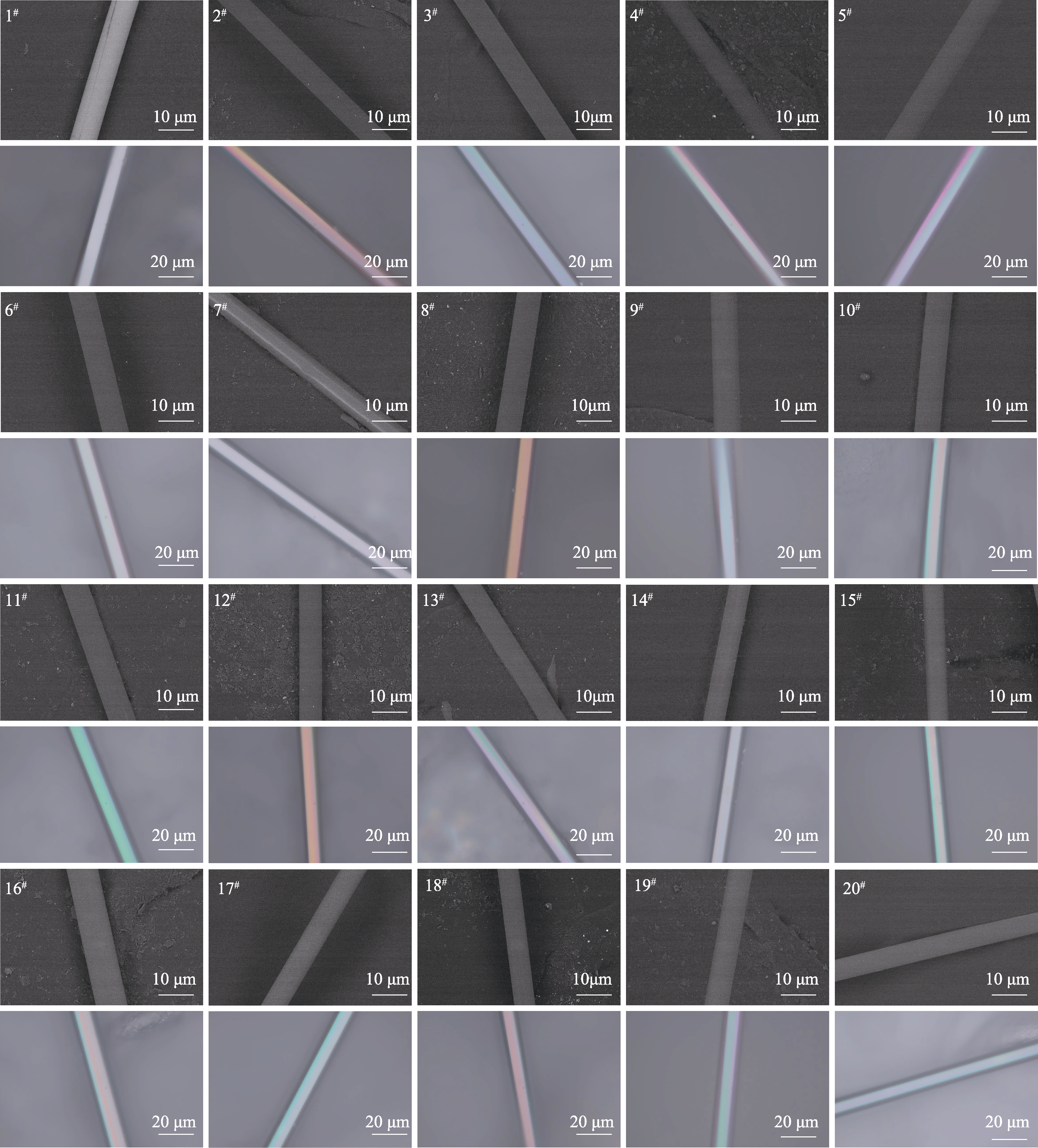
图3 xSi-BN/SiC纤维的SEM照片(单数行)和LSCM照片(偶数行)
Fig. 3 SEM (odd rows) and LSCM (even rows) images of the xSi-BN/SiC fibers

图4 xSi-BN/SiC纤维的高倍SEM照片和LSCM表面粗糙度图像
Fig. 4 High magnification SEM and LSCM roughness images of xSi-BN/SiC fibers Colorful figures are available on website

图5 xSi-BN/SiC纤维的(a) EDS面分布、(b) EDS线扫描及(c)截面SEM照片
Fig. 5 (a) EDS mapping analysis, (b) EDS line scanning analysis and (c) SEM image of cross section for xSi-BN/SiC fibers Colorful figures are available on website
| Sample | B/% | N/% | C/% | O/% | Si/% |
|---|---|---|---|---|---|
| 1 | / | / | 57.70±0.73 | 1.84±0.11 | 40.46±0.83 |
| 2 | 40.12±0.79 | 47.97±0.37 | 8.69±0.39 | 2.63±0.11 | 0.58±0.15 |
| 3 | 39.71±0.65 | 46.11±0.93 | 10.00±0.01 | 3.13±0.46 | 1.05±0.18 |
| 4 | 37.37±0.15 | 44.90±0.41 | 11.98±0.57 | 4.30±0.18 | 1.45±0.11 |
| 5 | 39.91±0.42 | 45.44±0.52 | 10.03±0.14 | 3.13±0.18 | 1.49±0.10 |
| 6 | 37.37±0.64 | 43.99±0.28 | 10.84±0.21 | 5.47±0.25 | 2.31±0.10 |
| 7 | 34.20±0.53 | 36.41±0.86 | 16.92±1.61 | 10.08±0.08 | 2.39±0.08 |
| 8 | 38.27±0.37 | 43.30±0.32 | 11.18±0.27 | 4.29±0.05 | 2.95±0.10 |
| 9 | 36.10±1.31 | 42.57±0.90 | 10.21±0.69 | 8.13±0.14 | 2.98±0.06 |
| 10 | 36.06±1.01 | 42.07±0.66 | 10.76±0.38 | 7.87±0.35 | 3.26±0.12 |
| 11 | 36.28±0.53 | 41.56±0.39 | 12.12±0.79 | 6.75±0.18 | 3.28±0.13 |
| 12 | 36.91±1.04 | 40.99±1.45 | 12.05±0.31 | 5.71±0.23 | 4.34±0.19 |
| 13 | 33.68±0.45 | 42.06±0.53 | 11.62±0.51 | 7.93±0.58 | 4.72±0.01 |
| 14 | 33.53±0.71 | 35.59±0.84 | 12.61±0.11 | 13.50±0.38 | 4.77±0.21 |
| 15 | 31.52±0.81 | 36.99±0.33 | 13.07±0.42 | 12.17±0.90 | 6.26±0.44 |
| 16 | 31.54±0.22 | 36.71±0.26 | 10.66±0.24 | 14.52±0.30 | 6.57±0.27 |
| 17 | 32.02±0.81 | 38.51±0.83 | 11.20±0.35 | 11.41±0.32 | 6.87±0.06 |
| 18 | 30.70±0.45 | 38.21±0.50 | 11.52±0.36 | 12.38±0.44 | 7.19±0.39 |
| 19 | 32.72±0.81 | 42.95±0.24 | 8.83±0.11 | 8.08±0.39 | 7.42±0.12 |
| 20 | 30.05±0.58 | 44.08±0.38 | 8.82±0.31 | 8.37±0.46 | 8.68±0.28 |
表1 xSi-BN/SiC纤维的元素含量(原子百分比)
Table 1 Elemental content (atomic percent) of xSi-BN/SiC fibers
| Sample | B/% | N/% | C/% | O/% | Si/% |
|---|---|---|---|---|---|
| 1 | / | / | 57.70±0.73 | 1.84±0.11 | 40.46±0.83 |
| 2 | 40.12±0.79 | 47.97±0.37 | 8.69±0.39 | 2.63±0.11 | 0.58±0.15 |
| 3 | 39.71±0.65 | 46.11±0.93 | 10.00±0.01 | 3.13±0.46 | 1.05±0.18 |
| 4 | 37.37±0.15 | 44.90±0.41 | 11.98±0.57 | 4.30±0.18 | 1.45±0.11 |
| 5 | 39.91±0.42 | 45.44±0.52 | 10.03±0.14 | 3.13±0.18 | 1.49±0.10 |
| 6 | 37.37±0.64 | 43.99±0.28 | 10.84±0.21 | 5.47±0.25 | 2.31±0.10 |
| 7 | 34.20±0.53 | 36.41±0.86 | 16.92±1.61 | 10.08±0.08 | 2.39±0.08 |
| 8 | 38.27±0.37 | 43.30±0.32 | 11.18±0.27 | 4.29±0.05 | 2.95±0.10 |
| 9 | 36.10±1.31 | 42.57±0.90 | 10.21±0.69 | 8.13±0.14 | 2.98±0.06 |
| 10 | 36.06±1.01 | 42.07±0.66 | 10.76±0.38 | 7.87±0.35 | 3.26±0.12 |
| 11 | 36.28±0.53 | 41.56±0.39 | 12.12±0.79 | 6.75±0.18 | 3.28±0.13 |
| 12 | 36.91±1.04 | 40.99±1.45 | 12.05±0.31 | 5.71±0.23 | 4.34±0.19 |
| 13 | 33.68±0.45 | 42.06±0.53 | 11.62±0.51 | 7.93±0.58 | 4.72±0.01 |
| 14 | 33.53±0.71 | 35.59±0.84 | 12.61±0.11 | 13.50±0.38 | 4.77±0.21 |
| 15 | 31.52±0.81 | 36.99±0.33 | 13.07±0.42 | 12.17±0.90 | 6.26±0.44 |
| 16 | 31.54±0.22 | 36.71±0.26 | 10.66±0.24 | 14.52±0.30 | 6.57±0.27 |
| 17 | 32.02±0.81 | 38.51±0.83 | 11.20±0.35 | 11.41±0.32 | 6.87±0.06 |
| 18 | 30.70±0.45 | 38.21±0.50 | 11.52±0.36 | 12.38±0.44 | 7.19±0.39 |
| 19 | 32.72±0.81 | 42.95±0.24 | 8.83±0.11 | 8.08±0.39 | 7.42±0.12 |
| 20 | 30.05±0.58 | 44.08±0.38 | 8.82±0.31 | 8.37±0.46 | 8.68±0.28 |

图6 xSi-BN界面相的TEM照片
Fig. 6 TEM images of xSi-BN interphase (a, b) Si0; (c, d) Si17

图7 光电联用技术前后对比
Fig. 7 Comparison before and after the optoelectric combination

图8 样品Si0、Si8、Si11和Si17的载荷-位移曲线
Fig. 8 Load-displacement curves of Si0, Si8, Si11 and Si17 Colorful figure is available on website

图9 (a) Si8纳米压痕SPM图像(绿色区域为纳米压痕测试区); (b) 由纳米压痕测得的Si0、Si8、Si11和Si17的硬度
Fig. 9 (a) Typical SPM image of Si8 ( the green area is designated as the nanoindentation test area); (b) Hardness of Si0, Si8, Si11 and Si17 measured by nanoindentation Colorful figures are available on website

图10 (a, b) Si0 CMC和(c, d) Si11 CMC的(a, c)纤维推出强度-位移曲线、(b, d) LSCM表面3D视图和(e)界面剪切强度
Fig. 10 (a, c) Strength-displacement curves of fibers pull out tests, (b, d) surface LSCM 3D images and (e) ISS of (a, b) Si0 CMC and (c, d) Si11 CMC Colorful figures are available on website
| [1] | WANG P R, LIU F Q, WANG H, et al. A review of third generation SiC fibers and SiCf/SiC composites. Journal of Materials Science & Technology, 2019, 35(12): 2743. |
| [2] | WANG X L, GAO X D, ZHANG Z H, et al. Advances in modifications and high-temperature applications of silicon carbide ceramic matrix composites in aerospace: a focused review. Journal of the European Ceramic Society, 2021, 41(9): 4671. |
| [3] |
MANOHARAN V, TAMILPERUVALATHAN S. Experimental investigation and prediction of ECDM parameters on fiber reinforced SiC composite using hybrid ERNN-based sparrow search optimization. Materials Today Communications, 2023, 36: 106777.
DOI URL |
| [4] | ZHAO G C, JIANG Z H, XI H F, et al. Ultrahigh-temperature mechanical behavior and failure mechanisms of SiCf/SiC composites. Ceramics International, 2023, 49(23): 39391. |
| [5] | WU S F, CHEN J X, ZHANG X L, et al. Recent advances in interphase engineering for improved behavior of SiCf/SiC composites. Journal of the European Ceramic Society, 2024, 44(12): 6797. |
| [6] | DING J X, MA X K, FAN X M, et al. Failure behavior of interfacial domain in SiC-matrix based composites. Journal of Materials Science & Technology, 2021, 88: 1. |
| [7] | CHEN Y, QIU H P, CHEN M W, et al. SiC/SiC composite: matrix boron modification and mechanical properties. Journal of Inorganic Materials, 2025, 40(5): 504. |
| [8] | CHEN M L, PAN L, XIA X D, et al. Boron nitride (BN) and BN based multiple-layer interphase for SiCf/SiC composites: a review. Ceramics International, 2022, 48(23): 34107. |
| [9] | YANG H T, LU Z L, BIE B X, et al. Microstructure and damage evolution of SiCf/PyC/SiC and SiCf/BN/SiC mini-composites: a synchrotron X-ray computed microtomography study. Ceramics International, 2019, 45(9): 11395. |
| [10] |
WEI J Y, ZHOU N, GAO M X, et al. Laser ablation of SiC/SiC ceramic matrix composites: morphological characterization, component evolution and oxidation mechanisms. Corrosion Science, 2024, 227: 111762.
DOI URL |
| [11] | CHRISTENSEN V L, ZOK F W. Insights into internal oxidation of SiC/BN/SiC composites. Journal of the American Ceramic Society, 2022, 106(2): 1561. |
| [12] | DETWILER K N, OPILA E J. Oxidation of SiC/BN/SiC ceramic matrix composites in dry and wet oxygen at intermediate temperatures. Journal of the European Ceramic Society, 2022, 42(10): 4110. |
| [13] |
CHENG X, ZHANG Q, YE F, et al. Recent progress on wet-oxygen corrosion resistance of SiCf/SiC composites. Journal of Materials Research and Technology, 2024, 33: 4360.
DOI URL |
| [14] | JACOBSON N S, MORSCHER G N, BRYANT D R, et al. High-temperature oxidation of boron nitride: II, boron nitride layers in composites. Journal of the American Ceramic Society, 2004, 82(6): 1473. |
| [15] | CHRISTENSEN V L, GAVALDA-DIAZ O, SKILLETT R, et al. Influence of BN microstructure on oxidation of SiC/BN/SiC composites. Journal of the American Ceramic Society, 2025, 108(3): e20230. |
| [16] | STÖCKEL S, MARX G, GOEDEL W A. Coating of ceramic SiC, SiBNC, and Al2O3 fibers with SiBN using a continuous CVD process-influence of stoichiometry on stability against oxidation and hydrolysis. Chemical Vapor Deposition, 2007, 13(10): 553. |
| [17] | 廖春景, 董绍明, 张翔宇, 等.一种纤维增强陶瓷基复合材料界面相及其筛选方法: CN1113105257A. 2021-07-13. |
| [18] |
CHRISTENSEN V L, SAMUEL A F, HAN N, et al. Microstructure characterization and process-structure correlations in SiC/BN/SiC minicomposites. Acta Materialia, 2024, 264: 119589.
DOI URL |
| [19] |
LIU Y S, CHAI N, LI Z, et al. Effect of deposition temperature on deposition kinetics and mechanism of silicon boron nitride coating deposited from SiCl4-BCl3-NH3-H2-Ar mixture using low pressure chemical vapor deposition. Surface and Coatings Technology, 2015, 261: 295.
DOI URL |
| [20] |
SUN J, LIU W, LV X, et al. Characterization of BN interface and its effect on the mechanical behavior of SiCf/SiC composites. Vacuum, 2023, 211: 111918.
DOI URL |
| [21] | ZHANG Y H, HU J B, ZHOU L, et al. Influence of fiber surface properties of SiCf/SiC composites on the interfacial debonding behavior. Journal of the European Ceramic Society, 2024, 44(2): 795. |
| [22] | WU X C, ZHENG R X, LI L, et al. Research progress on in-situ monitoring of damage behavior of SiCf/SiC ceramic matrix composites at high temperature environments. Journal of Inorganic Materials, 2024, 39(6): 609. |
| [23] | LÜ X, LI L, SUN J, et al. Microstructure and tensile behavior of (BN/SiC)n coated SiC fibers and SiC/SiC minicomposites. Journal of the European Ceramic Society, 2023, 43(5): 1828. |
| [24] | ISMAIL M Y, PATANEN M, KAUPPINEN S, et al. Surface analysis of tissue paper using laser scanning confocal microscopy and micro-computed topography. Cellulose, 2020, 27(15): 8989. |
| [25] |
ZHANG W Y, REN Q, WAN W H, et al. High-throughput microstructure characterization of titanium alloy by a multi- dimensional information strategy. Materials Today Communications, 2024, 38: 108360.
DOI URL |
| [26] | RODRÍGUEZ M, GONZÁLEZ C, et al. An experimental and numerical study of the influence of local effects on the application of the fibre push-in test. Philosophical Magazine, 2011, 91(7/8/9): 1293. |
| [27] | MUELLER W M, MOOSBURGER-WILL J, SAUSE M G R, et al. Microscopic analysis of single-fiber push-out tests on ceramic matrix composites performed with Berkovich and flat-end indenter and evaluation of interfacial fracture toughness. Journal of the European Ceramic Society, 2013, 33(2): 441. |
| [28] | DE MEYERE R M G, GALE L, HARRIS S, et al. Optimizing the fiber push-out method to evaluate interfacial failure in SiC/BN/SiC ceramic matrix composites. Journal of the American Ceramic Society, 2021, 104(6): 2741. |
| [29] | ZHANG S Y, LIU M, LUO Y X, et al. Theoretical prediction on structure evolution and optimal properties of silicon modified hexagonal boron nitride as interphase in SiCf/SiC composite. Journal of the European Ceramic Society, 2022, 42(13): 5323. |
| [1] | 张剑, 申慧, 杨迎, 张熏涛, 田甜, 徐家跃. PVP浓度对喷墨打印CsPbBr3结晶形貌、发光与稳定性的影响规律[J]. 无机材料学报, 2026, 41(9): 1310-1318. |
| [2] | 李霄, 陆净冰, 艾茜茜, 方鹤, 王梅梅, 刘敏. 机械化学法制备Cs2NaHoCl6:Yb3+双钙钛矿及上转换发光性能研究[J]. 无机材料学报, 2026, 41(9): 1303-1309. |
| [3] | 周岩, 刘骐恺, 夏爱东, 张步豪, 殷杰, 黄政仁. 前驱体衍生ZrB2/(SiC-AlN)陶瓷复合材料的制备及性能研究[J]. 无机材料学报, 2026, 41(9): 1339-1348. |
| [4] | 尚勃屹, 孙婷婷, 王连军, 江莞. Ag2Se热电纤维的硒化反应制备及其性能研究[J]. 无机材料学报, 2026, 41(9): 1238-1246. |
| [5] | 黄东, 吴俊林, 胡辰, 王雁斌, 陈宇洋, 李廷松, 杨文钦, 蒋兴奋, 周健荣, 孙志嘉, 李江. 不同掺杂浓度的Gd2O2S:Tb闪烁陶瓷的制备、微观结构与光学性能[J]. 无机材料学报, 2026, 41(9): 1330-1338. |
| [6] | 郑雪萍, 胡春旭, 李雪, 马秋花, 梁琳坤, 刘文帅, 刘胜林. 溶胶-凝胶法制备TiO2增强LiAlH4放氢性能[J]. 无机材料学报, 2026, 41(9): 1265-1272. |
| [7] | 邵慧慧, 李秋波, 王守志, 王忠新, 孙德福, 蒋凯泽, 齐占国, 徐现刚, 徐明升, 张雷. 蓝宝石图形-多孔薄膜复合衬底生长GaN单晶[J]. 无机材料学报, 2026, 41(8): 1141-1147. |
| [8] | 胡娟, 许頔, 聂怀文, 林根连, 闫继娜. 连续氧化铝纤维高温长时热处理的微结构与力学性能演变[J]. 无机材料学报, 2026, 41(8): 1110-1116. |
| [9] | 司会晨, 梁飞, 于浩海, 张怀金. 黄橙激光晶体材料与全固态激光器件研究进展[J]. 无机材料学报, 2026, 41(8): 1049-1068. |
| [10] | 马稚童, 李众少, 曹逊. 动态辐射热管理技术: 从原理、材料到协同优化设计[J]. 无机材料学报, 2026, 41(8): 1021-1035. |
| [11] | 周文昊, 欧阳琪, 马名生, 陆毅青, 刘志甫. Ba0.57Sr0.39Ca0.03Ti1.01NbxO3基正温度系数陶瓷材料制备及电学性能[J]. 无机材料学报, 2026, 41(8): 1117-1124. |
| [12] | 谭婷婷, 宋旭东, 赵炜迪, 覃祺, 何小玲, 张昌龙. 电极图案及其连接设计对KTP晶体周期极化的调控研究[J]. 无机材料学报, 2026, 41(8): 1125-1132. |
| [13] | 刘宇霄, 梁飞. Dy:Y2SiO5和Dy,Tb:Y2SiO5单晶生长与黄光发射光谱性能[J]. 无机材料学报, 2026, 41(7): 930-938. |
| [14] | 余飞宇, 王文清, 张学勤, 何汝杰. 基于增材制造陶瓷点阵的双相网络互穿复合材料的研究进展与挑战[J]. 无机材料学报, 2026, 41(7): 849-866. |
| [15] | 周翠, 李捷, 孙鲁超, 苏海军, 王京阳. 氧化铝基定向凝固共晶陶瓷的组织特性、调控方法及环境稳定性[J]. 无机材料学报, 2026, 41(7): 899-914. |
| 阅读次数 | ||||||
|
全文 |
|
|||||
|
摘要 |
|
|||||