无机材料学报 ›› 2026, Vol. 41 ›› Issue (1): 105-112.DOI: 10.15541/jim20250121 CSTR: 32189.14.jim20250121
袁子豪1,2( ), 许银生1(), 李昕阔2,3, 谭德志2,3()
收稿日期:2025-03-24
修回日期:2025-04-27
出版日期:2026-01-20
网络出版日期:2025-06-05
通讯作者:
许银生, 研究员. E-mail: xuyinsheng@whut.edu.cn;作者简介:袁子豪(2001-), 男, 硕士研究生. E-mail: yuanzihao19@163.com
基金资助:
YUAN Zihao1,2(), XU Yinsheng1(), LI Xinkuo2,3, TAN Dezhi2,3()
Received:2025-03-24
Revised:2025-04-27
Published:2026-01-20
Online:2025-06-05
Contact:
XU Yinsheng, professor. E-mail: xuyinsheng@whut.edu.cn;About author:YUAN Zihao (2001-), male, Master candidate. E-mail: yuanzihao19@163.com
Supported by:摘要:
CdS量子点具有量子尺寸效应, 通过调控尺寸可调控其光致发光波长, 在微纳光学器件制备等领域具有潜在应用价值。随着超快激光技术的发展, 飞秒激光逐渐被用于光电材料的微纳制造和光学性质调控, 然而, 利用飞秒激光调控CdS量子点发光调谐尚未实现。本工作利用飞秒激光直写技术制备基于玻璃基质的CdS量子点及调控其发光性能, 并探究其在光存储和信息加密等领域的应用。采用熔融淬火法制备了5组不同含量CdS的硼硅酸盐玻璃, 并对玻璃样品进行了精细抛光, 用于后续的飞秒激光加工。因飞秒激光产生的局部热积累效应, CdS量子点可直接在玻璃内部诱导析出, 通过透射电子显微镜表征分析其形貌、微观结构尺寸和分散性。本研究通过系统改变激光参数来调控析出量子点光斑的尺寸和形貌, 实现了激光诱导加工光斑尺寸5.33~12.28 μm范围的连续调控以及发光波长在540~610 nm范围内的调谐。最后, 还展示了飞秒激光直写CdS量子点在信息加密和信息存储等领域的应用。
中图分类号:
袁子豪, 许银生, 李昕阔, 谭德志. 飞秒激光调控CdS量子点玻璃的发光性能[J]. 无机材料学报, 2026, 41(1): 105-112.
YUAN Zihao, XU Yinsheng, LI Xinkuo, TAN Dezhi. Femtosecond Laser Modulation on Luminescence Properties of CdS Quantum Dot Glasses[J]. Journal of Inorganic Materials, 2026, 41(1): 105-112.
| Sample | SiO2/(%, in mole) | B2O3/(%, in mole) | Na2O/(%, in mole) | ZnO/(%, in mole) | CdS/(%, in mole) |
|---|---|---|---|---|---|
| SC0.3 | 40 | 28 | 22 | 10 | 0.3 |
| SC0.5 | 40 | 28 | 22 | 10 | 0.5 |
| SC0.7 | 40 | 28 | 22 | 10 | 0.7 |
| SC1.0 | 40 | 28 | 22 | 10 | 1.0 |
| SC1.5 | 40 | 28 | 22 | 10 | 1.5 |
表1 不同CdS含量硼硅酸盐玻璃组分
Table 1 Compositions of the borosilicate glass with different CdS contents
| Sample | SiO2/(%, in mole) | B2O3/(%, in mole) | Na2O/(%, in mole) | ZnO/(%, in mole) | CdS/(%, in mole) |
|---|---|---|---|---|---|
| SC0.3 | 40 | 28 | 22 | 10 | 0.3 |
| SC0.5 | 40 | 28 | 22 | 10 | 0.5 |
| SC0.7 | 40 | 28 | 22 | 10 | 0.7 |
| SC1.0 | 40 | 28 | 22 | 10 | 1.0 |
| SC1.5 | 40 | 28 | 22 | 10 | 1.5 |
| Classification | Repetition rate | Pulse width | Irradiation time/s | Pulse energy/μJ |
|---|---|---|---|---|
| I | 200 kHz | 1 ps | 2~10 | 0.8-3.0 |
| II | 200 kHz | 230 fs~3 ps | 6 | 0.8-3.0 |
| III | 100 kHz-1 MHz | 1 ps | 6 | 0.5-2.0 |
表2 激光加工参数
Table 2 Laser processing parameters
| Classification | Repetition rate | Pulse width | Irradiation time/s | Pulse energy/μJ |
|---|---|---|---|---|
| I | 200 kHz | 1 ps | 2~10 | 0.8-3.0 |
| II | 200 kHz | 230 fs~3 ps | 6 | 0.8-3.0 |
| III | 100 kHz-1 MHz | 1 ps | 6 | 0.5-2.0 |
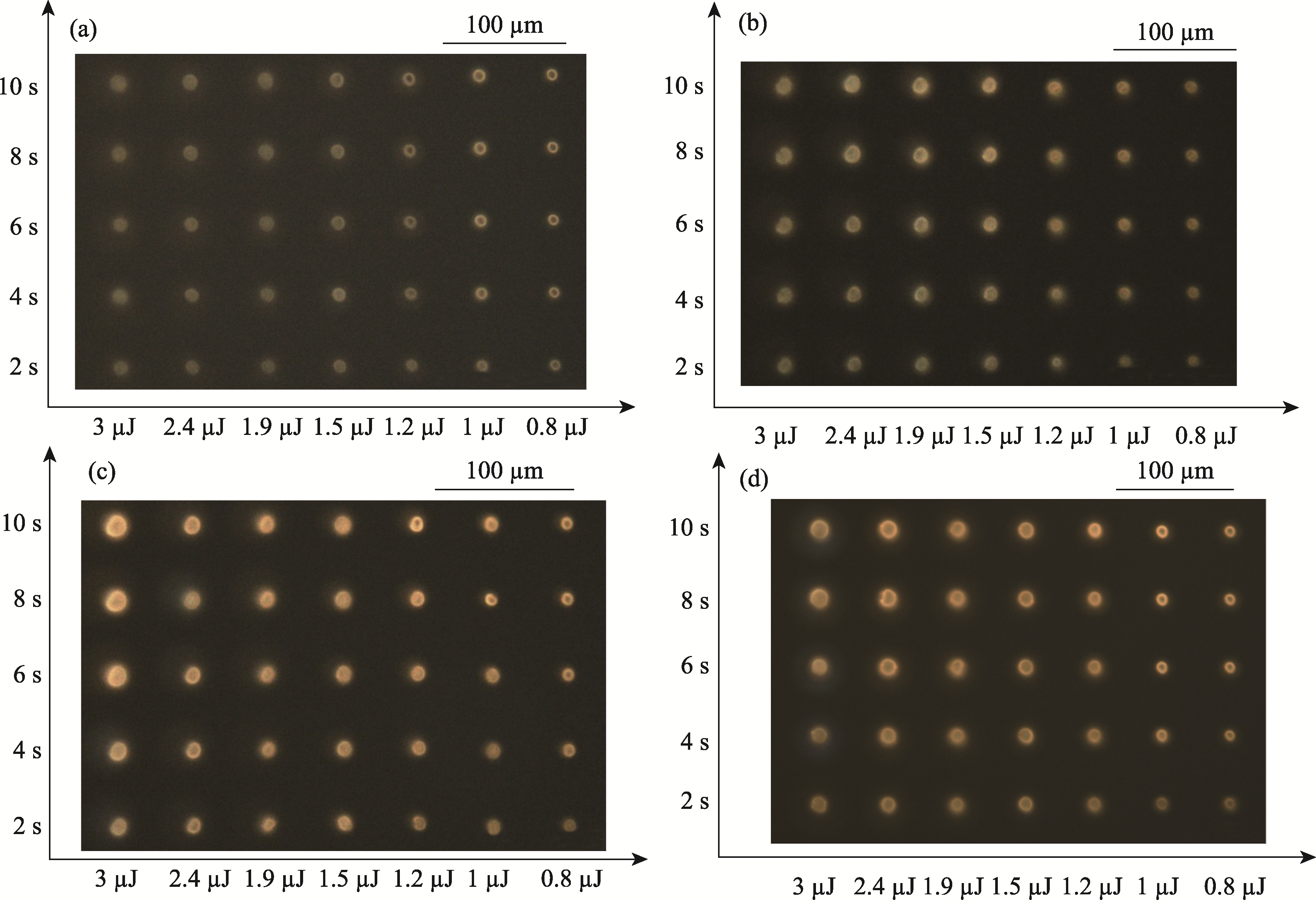
图1 不同脉冲能量和辐照时间的飞秒激光直写CdS量子点的荧光显微图
Fig. 1 Fluorescence micrograph of femtosecond laser direct writing of CdS quantum dots under different irradiation time and pulse energy (a) SC0.3 sample; (b) SC0.5 sample; (c) SC1.0 sample; (d) SC1.5 sample
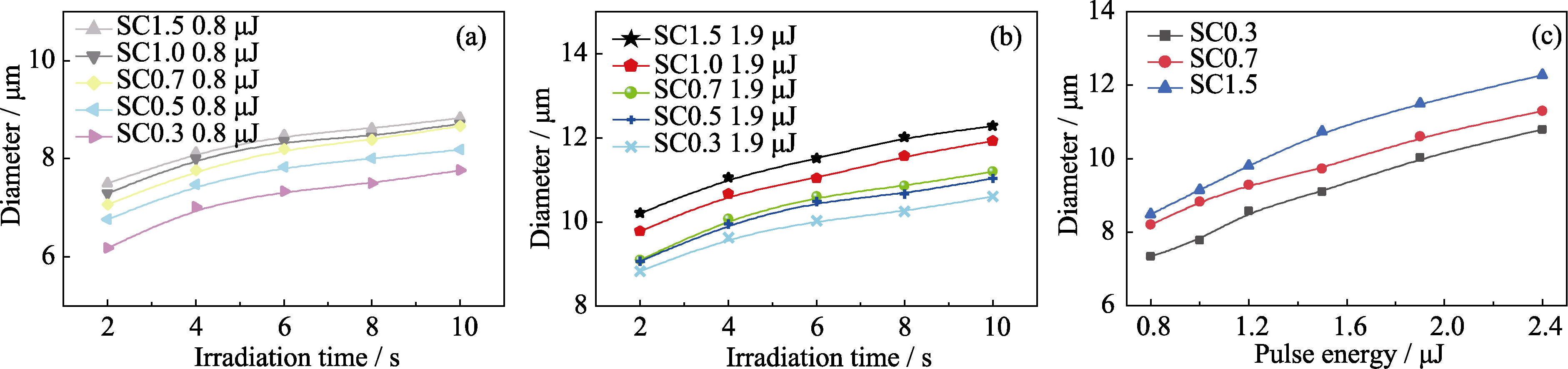
图2 飞秒激光直写CdS量子点光斑尺寸与(a, b)辐照时间、(c)脉冲能量的关系
Fig. 2 Femtosecond laser direct writing of CdS quantum dot spot size vs. (a, b) irradiation time and (c) pulse energy
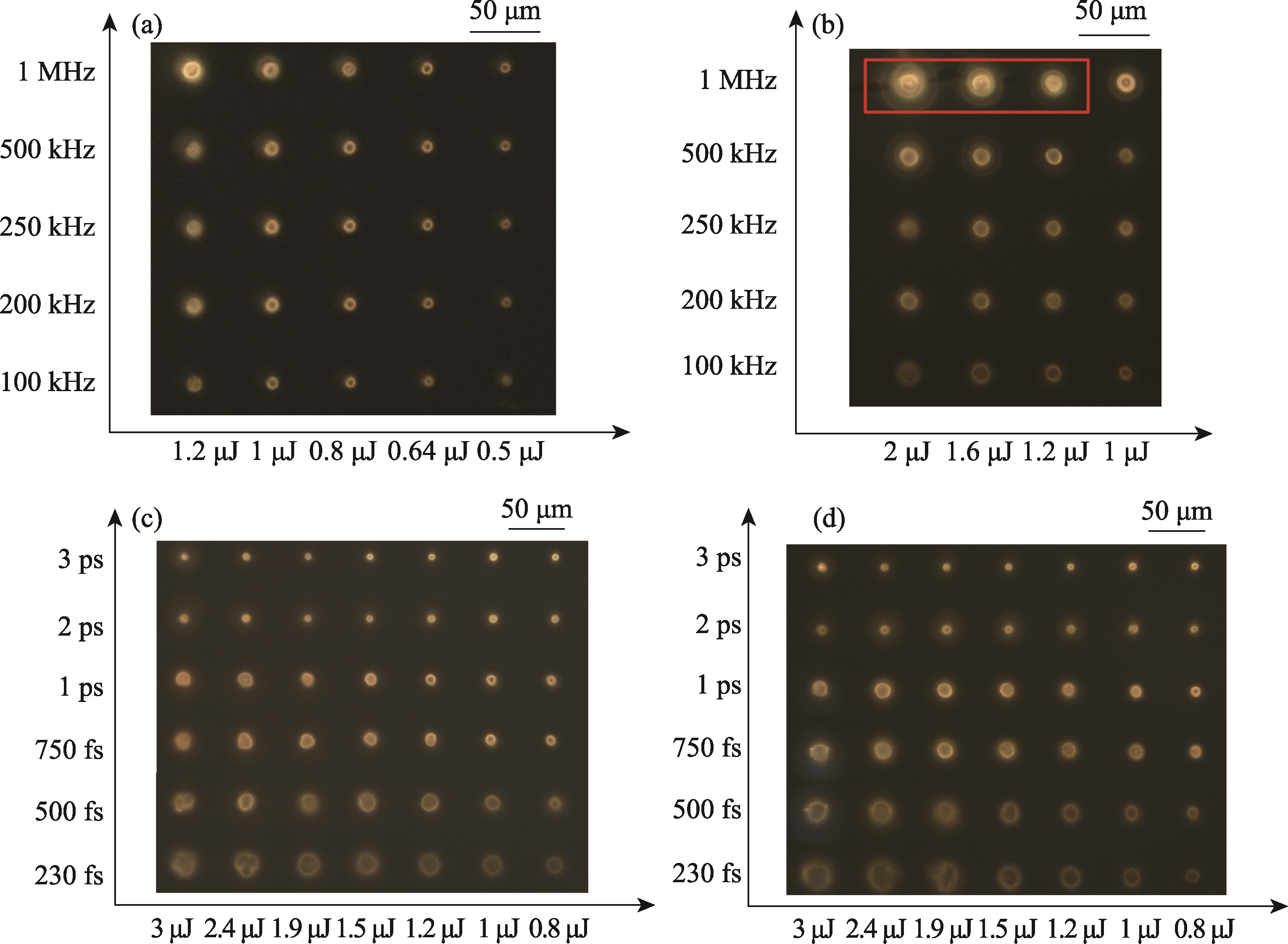
图3 不同重复频率、脉宽和脉冲能量的飞秒激光直写CdS量子点的荧光显微图
Fig. 3 Fluorescence micrograph of femtosecond laser direct writing of CdS quantum dots under different repetition rates, pulse widths and pulse energies (a) SC0.5 sample; (b, c) SC1.5 sample; (d) SC0.7 sample
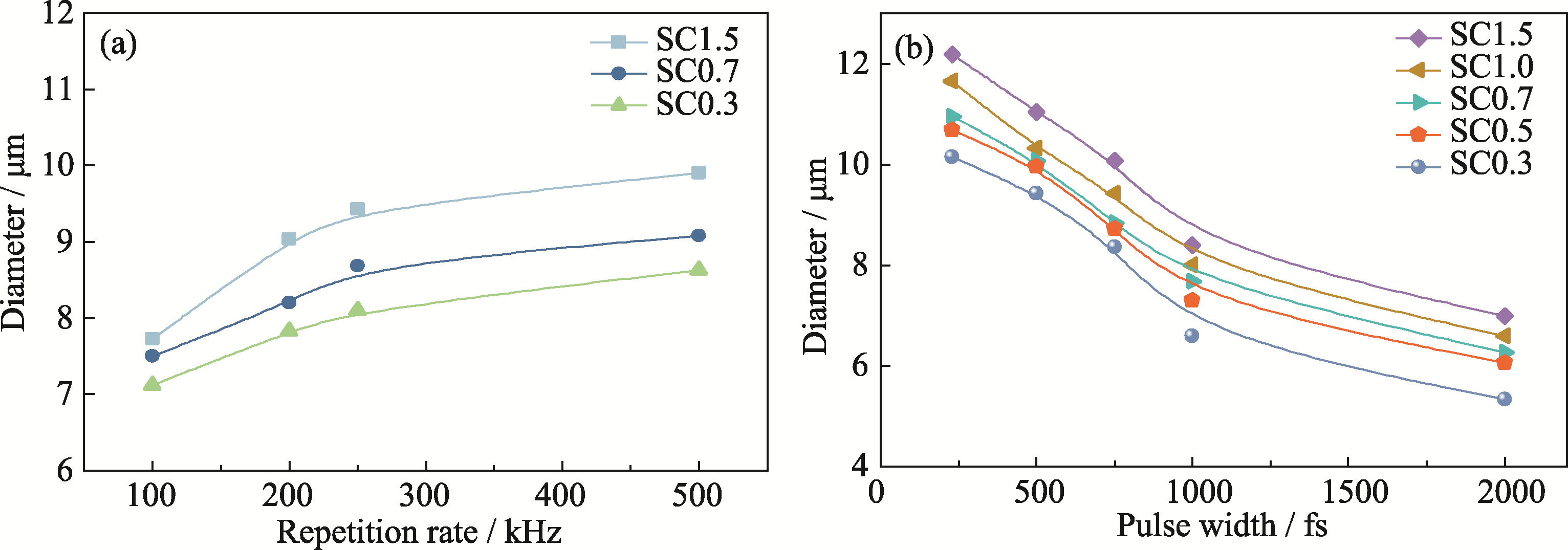
图4 飞秒激光直写CdS量子点光斑尺寸与重复频率和脉冲宽度的关系
Fig. 4 Femtosecond laser direct writing of CdS quantum dot spot size vs. (a) repetition rate and (b) pulse width
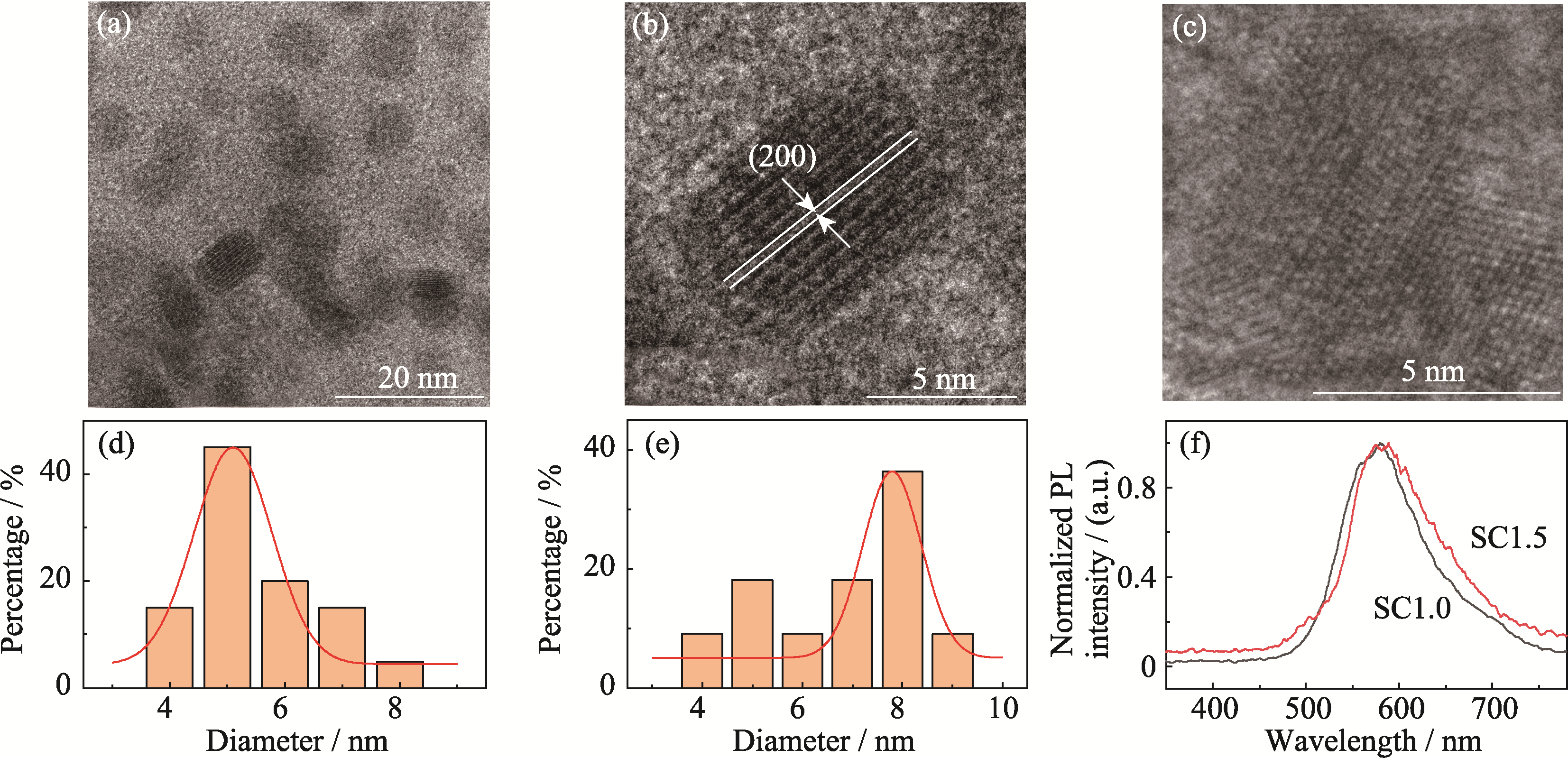
图5 SC1.0和SC1.5扫线样品的TEM照片、CdS量子点粒径分布直方图和PL光谱
Fig. 5 TEM images, size distribution histograms of CdS quantum dots, and PL spectra for SC1.0 and SC1.5 sweep line samples (a-c) TEM images of CdS quantum dots in the (a, b) SC1.0 and (c) SC1.5 sweep line samples; (d, e) Size distribution histograms of CdS quantum dots in the (d) SC1.0 and (e) SC1.5 sweep line samples; (f) PL spectra of SC1.0 and SC1.5 sweep line samples
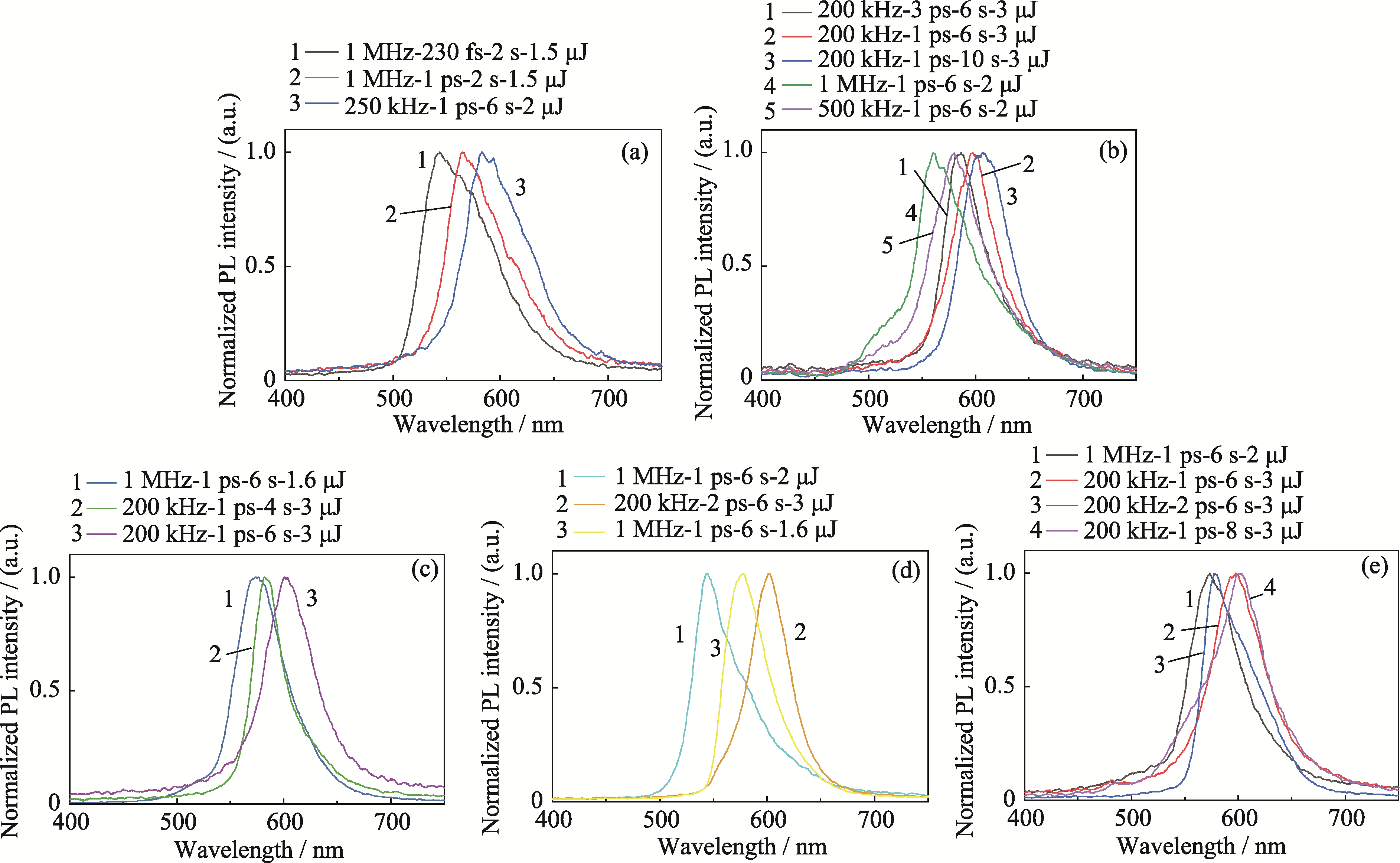
图6 不同飞秒激光加工参数直写的CdS量子点玻璃的PL光谱
Fig. 6 PL spectra of CdS quantum dot glasses with different femtosecond laser processing parameters (a) SC0.3 sample; (b) SC0.5 sample; (c) SC0.7 sample; (d) SC1.0 sample; (e) SC1.5 sample
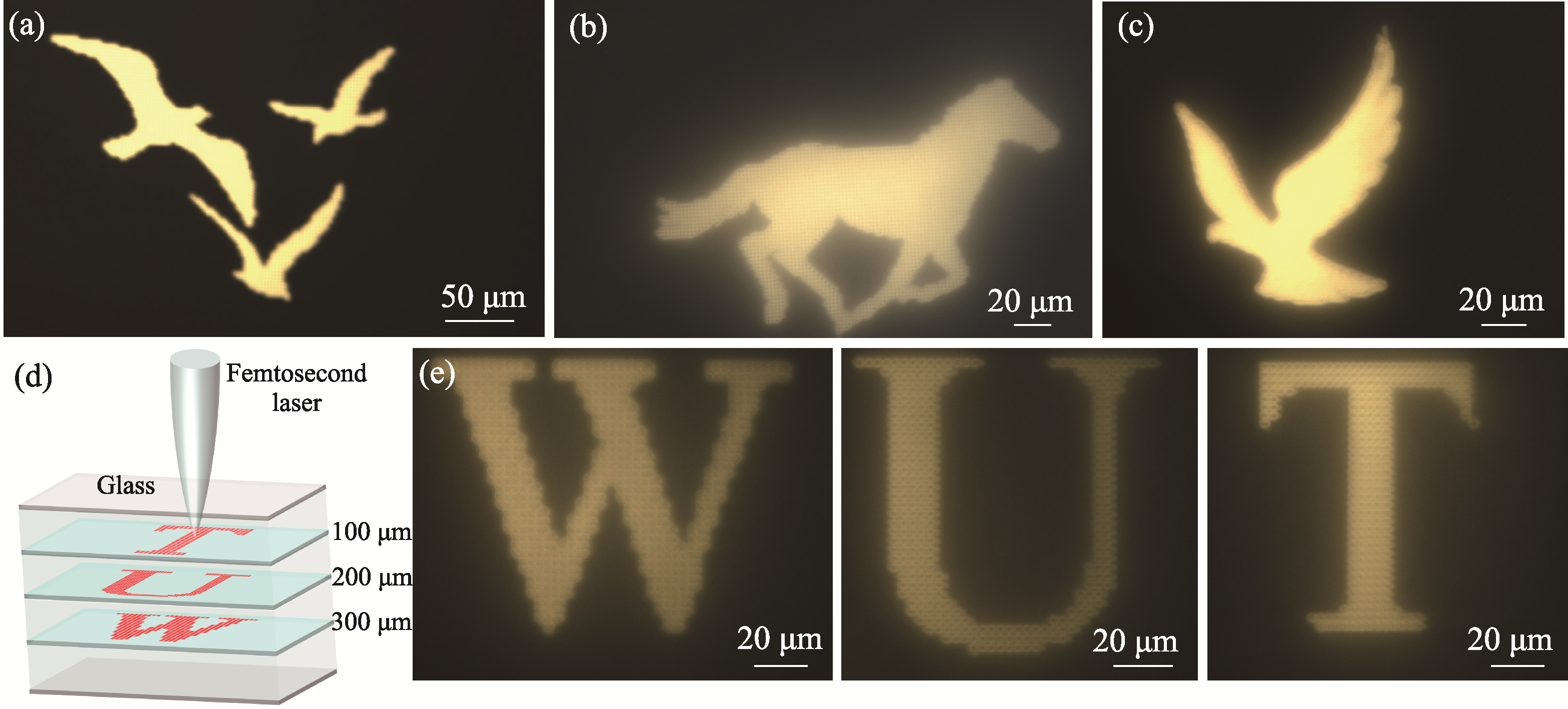
图7 飞秒激光直写CdS量子点玻璃的应用
Fig. 7 Application of femtosecond laser direct writing CdS quantum dots glass (a-c) Femtosecond laser direct writing patterns; (d) Three-dimensional schematic diagram of information storage; (e) Femtosecond laser writes the letters W, U, and T
| [1] |
HAN Y X, YANG C L, SUN Y T, et al. The novel optical properties of CdS caused by concentration of impurity Co. Journal of Alloys and Compounds, 2014, 585: 503.
DOI URL |
| [2] | 徐小齐. 半导体纳米CdS的制备及其性能研究. 南京: 南京航空航天大学硕士学位论文, 2009. |
| [3] |
AKIMOV V A, KOZLOVSKII V I, KOROSTELIN Y V, et al. A Cr2+:CdS laser tunable between 2.2 and 3.3 μm. Quantum Electronics, 2008, 38(9): 803.
DOI URL |
| [4] | BAO Q, LI W, XU P, et al. On-chip single-mode CdS nanowire laser. Light: Science & Application, 2020, 9(1): 42. |
| [5] |
AGARWAL R, BARRELET C J, LIEBER C M. Lasing in single cadmium sulfide nanowire optical cavities. Nano Letters, 2005, 5(5): 917.
PMID |
| [6] |
BÖER K W. Cadmium sulfide enhances solar cell efficiency. Energy Conversion and Management, 2011, 52(1): 426.
DOI URL |
| [7] |
CHEN C, ZHAI Y, LI F, et al. High efficiency CH3NH3PbI3:CdS perovskite solar cells with CuInS2 as the hole transporting layer. Journal of Power Sources, 2017, 341: 396.
DOI URL |
| [8] |
ZHU G, SU F, LV T, et al. Au nanoparticles as interfacial layer for CdS quantum dot-sensitized solar cells. Nanoscale Research Letters, 2010, 5(11): 1749.
PMID |
| [9] | HUSSEIN W S, AHMED A F, AADIM K A. Influence of laser energy and annealing on structural and optical properties of CdS films prepared by laser induced plasma. Iraqi Journal of Science, 2020, 61(6): 1307. |
| [10] |
ULLRICH B. Thin-film CdS formed with pulsed-laser deposition towards optical and hybrid device applications. Journal of Materials Science: Materials in Electronics, 2007, 18(11): 1105.
DOI URL |
| [11] |
SANZ M, NALDA R D, MARCO J F, et al. Femtosecond pulsed laser deposition of nanostructured CdS films. The Journal of Physical Chemistry C, 2010, 114(11): 4864.
DOI URL |
| [12] |
SEMONIN O E, LUTHER J M, BEARD M C. Quantum dots for next-generation photovoltaics. Materials Today, 2012, 15(11): 508.
DOI URL |
| [13] |
CHO S, KIM Y, LEE S, et al. Recent progress in blue-emitting semiconductor nanocrystal quantum dots for display applications. Korean Journal of Chemical Engineering, 2024, 41: 3359.
DOI |
| [14] |
LI X J, CHEN L Q, MAO D Q, et al. Low-threshold cavity-enhanced superfluorescence in polyhedral quantum dot superparticles. Nanoscale Advances, 2024, 6(12): 3220.
DOI PMID |
| [15] |
ZAFAR A J, MITRA A, APALKOV V. High harmonic generation in graphene quantum dots. Journal of Physics-Condensed Matter, 2024, 36(21): 215302.
DOI |
| [16] |
KONDRATENKO T S, SMIRNOV M S, OVCHINNIKOV O V, et al. Size-dependent optical properties of colloidal CdS quantum dots passivated by thioglycolic acid. Semiconductors, 2018, 52(9): 1137.
DOI |
| [17] | KESHARI A K, PANDEY A C. Color tunability and Raman investigation in CdS quantum dots. AIP Conference Proceedings, 2009, 1147(1): 427. |
| [18] |
SUN L, LI Y, YAN J, et al. A review on pulsed laser preparation of quantum dots in colloids for the optimization of perovskite solar cells: advantages, challenges, and prospects. Nanomaterials, 2024, 14(19): 1550.
DOI URL |
| [19] | 袁春云. 半导体量子点的合成及性质研究. 吉林: 长春理工大学硕士学位论文, 2016. |
| [20] |
VETCHINNIKOV M P, LIPATIEV A S, SHAKHGILDYAN G Y, et al. Direct femtosecond laser-induced formation of CdS quantum dots inside silicate glass. Optics Letters, 2018, 43(11): 2519.
DOI PMID |
| [21] | LI X K, TAN D Z, LIU Y, et al. Ultrafast laser direct writing of nanocrystals inside glass and its applications. Bulletin of the Chinese Ceramic Society, 2022, 41(11): 3781. |
| [22] |
SUN K, TAN D Z, FANG X Y, et al. Three-dimensional direct lithography of stable perovskite nanocrystals in glass. Science, 2022, 375(6578): 307.
DOI PMID |
| [23] |
LI X K, SUN K, WU J J, et al. Thermal-triggered phase separation and ion exchange enables photoluminescence tuning of stable mixed-halide perovskite nanocrystals for dynamic display. Laser & Photonics Reviews, 2024, 18(5): 2301244.
DOI URL |
| [24] |
SUN K, LI X K, TAN D Z, et al. Pure blue perovskites nanocrystals in glass: ultrafast laser direct writing and bandgap tuning. Laser & Photonics Reviews, 2023, 17(5): 2200902.
DOI URL |
| [25] |
SUN K, TAN D Z, SONG J, et al. Highly emissive deep-red perovskite quantum dots in glass: photoinduced thermal engineering and applications. Advanced Optical Materials, 2021, 9(11): 2100094.
DOI URL |
| [26] |
TAN D, ZHANG B, QIU J. Ultrafast laser direct writing in glass: thermal accumulation engineering and applications. Laser & Photonics Reviews, 2021, 15(9): 2000455.
DOI URL |
| [27] |
DAI Y, ZHU B, QIU J R, et al. Direct writing three dimensional Ba2TiSi2O8 crystalline pattern in glass with ultrashort pulse laser. Applied Physics Letters, 2007, 90(18): 181109.
DOI URL |
| [28] |
DU X, ZHANG H, CHENG C, et al. Space-selective precipitation of ZnO crystals in glass by using high repetition rate femtosecond laser irradiation. Optics Express, 2014, 22(15): 17908.
DOI PMID |
| [1] | 岳仔豪, 杨小兔, 张正亮, 邓瑞翔, 张涛, 宋力昕. Pb2+对掺杂硼硅酸盐玻璃中CsPbBr3钙钛矿量子点发光性能的影响[J]. 无机材料学报, 2024, 39(4): 449-456. |
| [2] | 靳赛, 刘小根, 齐爽, 赵润昌, 李志军. 激光诱导损伤对熔石英玻璃弯曲强度弱化影响及安全设计[J]. 无机材料学报, 2023, 38(6): 671-677. |
| [3] | 罗淑文, 马名生, 刘峰, 刘志甫. Ca-B-Si体系LTCC材料腐蚀行为及腐蚀机理[J]. 无机材料学报, 2023, 38(5): 553-560. |
| [4] | 庞力斌, 王德平. 介孔硼硅酸盐玻璃微球药物载体的制备及其性能表征[J]. 无机材料学报, 2022, 37(7): 780-786. |
| [5] | 张晓阳, 彭海波, 刘枫飞, 赵彦, 孙梦利, 管明, 张冰焘, 杜鑫, 袁伟, 王铁山. 多种重离子辐照对硼硅酸盐玻璃机械性能的影响[J]. 无机材料学报, 2019, 34(7): 741-747. |
| [6] | 李 玲, 肖俊莹, 崔米豆, 太优一, 庞永文, 韩 松, 李晓苇. 高效CdS量子点敏化B/S共掺杂纳米TiO2太阳能电池的制备及光电性能研究[J]. 无机材料学报, 2016, 31(6): 627-633. |
| [7] | 季振国, 席俊华, 毛启楠. 激光诱导击穿光谱测量重掺硅中的氧含量[J]. 无机材料学报, 2010, 25(8): 893-896. |
| [8] | 鲁 波,戴 晔,马洪良. 飞秒激光诱导玻璃内Ba2TiSi2O8晶体的析出[J]. 无机材料学报, 2009, 24(4): 769-772. |
| [9] | 丛日敏,罗运军,于怀清. 树形分子包覆硫化镉量子点的抗老化性能研究[J]. 无机材料学报, 2008, 23(2): 379-382. |
| [10] | 丁婷,鲍家兴,王 丽,周时凤,邱建荣. 飞秒激光照射银离子掺杂的 BK7光学玻璃的显微结构变化[J]. 无机材料学报, 2007, 22(5): 807-810. |
| [11] | 余本海,戴能利,李玉华,郑启光,陆培祥. 飞秒激光烧蚀MgAl2O4透明陶瓷的实验研究[J]. 无机材料学报, 2007, 22(2): 328-332. |
| [12] | 姜雄伟,邱建荣,曾惠丹,朱从善. 高频超短脉冲激光诱导玻璃内LiNbO3晶体生长[J]. 无机材料学报, 2004, 19(4): 935-938. |
| [13] | 曾惠丹,邱建荣,姜雄伟,朱从善,干福熹. 氧化铅的添加对激光诱导玻璃中金纳米颗粒析出的影响[J]. 无机材料学报, 2004, 19(2): 444-448. |
| [14] | 陈红兵,朱从善,干福熹. 碘化亚铜微晶掺杂硼硅酸盐玻璃的制备及其电致二阶非线性光学效应[J]. 无机材料学报, 1997, 12(4): 487-493. |
| 阅读次数 | ||||||
|
全文 |
|
|||||
|
摘要 |
|
|||||