无机材料学报 ›› 2019, Vol. 34 ›› Issue (1): 17-26.DOI: 10.15541/jim20180211 CSTR: 32189.14.10.15541/jim20180211
所属专题: MAX相和MXene材料; 环境材料优选论文; 优秀作者论文集锦; 2019~2020年度优秀作者作品欣赏:环境材料
王祥学, 于淑君, 王祥科
收稿日期:2018-05-07
修回日期:2018-06-08
出版日期:2019-01-21
网络出版日期:2018-12-17
作者简介:王祥学(1976-),男,讲师. E-mail: xxwang@ncepu.edu.cn
基金资助:WANG Xiang-Xue, YU Shu-Jun, WANG Xiang-Ke
Received:2018-05-07
Revised:2018-06-08
Published:2019-01-21
Online:2018-12-17
About author:WANG Xiang-Xue. E-mail: xxwang@ncepu.edu.cn
摘要:
核能利用的过程中, 从铀矿开采、核燃料加工、核能发电到乏燃料后处理, 会产生大量放射性废物, 部分放射性核素会不可避免的释放到环境中, 对环境和人类健康造成重大危害。放射性核素的高效去除是核电健康发展的重要关键科学问题之一。近年来, 高化学稳定性、具有大量功能基团而且结构可调的多孔金属有机骨架材料(MOFs)在放射性污染治理方面受到国内外同行的高度关注。本文系统地介绍了MOFs及MOFs复合材料在放射性核素吸附去除方面的研究进展, 通过宏观吸附、模型分析、先进光谱表征和理论计算四个方面描述放射性核素与MOFs材料的界面作用机理, 并对MOFs材料的吸附性能与其它材料进行对比, 评价MOFs材料在放射性污染治理中的应用前景。
中图分类号:
王祥学, 于淑君, 王祥科. 金属有机骨架材料在放射性核素去除中的研究[J]. 无机材料学报, 2019, 34(1): 17-26.
WANG Xiang-Xue, YU Shu-Jun, WANG Xiang-Ke. Removal of Radionuclides by Metal-organic Framework-based Materials[J]. Journal of Inorganic Materials, 2019, 34(1): 17-26.

图1 MIL-101及其氨基衍生物的SEM照片(1), XRD图谱(2), FT-IR谱图(3)和N2吸脱附等温线(4)[26]
Fig. 1 (1) SEM images, (2) XRD patterns, (3) FT-IR spectra, (4) N2 sorption isotherms[26] of MIL-101 and its amino derivatives, (a) MIL-101; (b) MIL-101-NH2; (c) MIL-101-ED; (d) MIL-101-DETA

图2 (a)TcO4-的UV-Vis吸收光谱; (b)TcO4-在SCU-101、Purolite A530E和A532E上的吸附动力学; (c)ReO4-在SCU-101、Mg-Al-LDH和NDTB-1上的吸附等温线; (d)阴离子对TcO4-去除效果的影响; (e)SO42-对ReO4-和SCU-101离子交换的影响; (f)SCU-101样品经过多次辐照之后对ReO4-的去除效果[28]
Fig. 2 (a) UV-Vis absorption spectra of TcO4- during the anion exchange; (b) Sorption kinetics of TcO4- by SCU-101 compared with Purolite A530E and A532E; (c) Sorption isotherms of ReO4- by SCU-101, Mg-Al-LDH, and NDTB-1; (d) Effect of competing anions on the removal percentage of TcO4- by SCU-101; (e) Effect of SO42- on the anion exchange of ReO4- by SCU-101; (f) Removal percentage of ReO4- after irradiation as compared with the original SCU-101 sample[28]
| Adsorbents | Radionuclides | (m/V)/(g·L-1) | C0/(mg·L-1) | t/h | pH | Qmax/(mg·g-1) | Interaction mechanism | Ref. |
|---|---|---|---|---|---|---|---|---|
| MIL-101 | U(VI) | 0.4 | 100 | 2 | 5.5 | 20 | Surface complexation | [26] |
| MIL-101-NH2 | U(VI) | 0.4 | 100 | 2 | 5.5 | 90 | Surface complexation | [26] |
| MIL-101-ED | U(VI) | 0.4 | 100 | 2 | 5.5 | 200 | Surface complexation | [26] |
| MIL-101-DETA | U(VI) | 0.4 | 100 | 2 | 5.5 | 350 | Surface complexation | [26] |
| GO-COOH/UiO-66 | U(VI) | 0.5 | 95 | 4 | 8.0 | 188 | Surface complexation and ion exchange | [30] |
| SCU-101 | Re(IV) | 1.0 | 1000 | 0.2 | - | 217 | Ion exchange | [28] |
| SCU-100 | Re(IV) | 1.0 | 28 | 2 | - | 541 | Ion exchange | [29] |
| UiO-66-(COOH)2 | Th(IV) | 0.4 | 100 | 6 | 3.0 | 350 | Surface complexation | [31] |
| MOF-808-SO4 | Ba(II) | 1.0 | 42 | 0.1 | 5.8 | 131 | Surface complexation | [32] |
| UiO-66-Schiff | Co(II) | 0.1 | 10 | 5 | 8.4 | 256 | Surface complexation | [33] |
| FJSM-InMOF | Sr(II) | 2.5 | 18 | 12 | - | 44 | Ion exchange | [34] |
| FJSM-InMOF | Cs(I) | 2.5 | 90 | 3 | - | 199 | Ion exchange | [34] |
| LDO-C | U(VI) | 0.1 | 50 | 4 | 5.0 | 354 | Surface complexation and ion exchange | [35] |
| CS@LDH | U(VI) | 0.2 | 41 | 3 | 5.0 | 157 | Surface complexation | [36] |
| GO | Co(II) | 0.1 | 10 | 4 | 5.0 | 44 | Surface complexation | [37] |
| LDH | U(VI) | 0.2 | 50 | 6 | 4.5 | 69 | Surface complexation and electrostatic interaction | [38] |
| Na-montmorillonite | Ni(II) | 0.5 | 10 | 6 | 6.0 | 13 | Surface complexation and ion exchange | [39] |
| Fe3O4@TNS | U(VI) | 0.2 | 20 | 8 | 5.0 | 83 | Ion exchange | [40] |
表1 放射性核素在不同材料上的去除效果和作用机理
Table 1 Radionuclides adsorption on different materials
| Adsorbents | Radionuclides | (m/V)/(g·L-1) | C0/(mg·L-1) | t/h | pH | Qmax/(mg·g-1) | Interaction mechanism | Ref. |
|---|---|---|---|---|---|---|---|---|
| MIL-101 | U(VI) | 0.4 | 100 | 2 | 5.5 | 20 | Surface complexation | [26] |
| MIL-101-NH2 | U(VI) | 0.4 | 100 | 2 | 5.5 | 90 | Surface complexation | [26] |
| MIL-101-ED | U(VI) | 0.4 | 100 | 2 | 5.5 | 200 | Surface complexation | [26] |
| MIL-101-DETA | U(VI) | 0.4 | 100 | 2 | 5.5 | 350 | Surface complexation | [26] |
| GO-COOH/UiO-66 | U(VI) | 0.5 | 95 | 4 | 8.0 | 188 | Surface complexation and ion exchange | [30] |
| SCU-101 | Re(IV) | 1.0 | 1000 | 0.2 | - | 217 | Ion exchange | [28] |
| SCU-100 | Re(IV) | 1.0 | 28 | 2 | - | 541 | Ion exchange | [29] |
| UiO-66-(COOH)2 | Th(IV) | 0.4 | 100 | 6 | 3.0 | 350 | Surface complexation | [31] |
| MOF-808-SO4 | Ba(II) | 1.0 | 42 | 0.1 | 5.8 | 131 | Surface complexation | [32] |
| UiO-66-Schiff | Co(II) | 0.1 | 10 | 5 | 8.4 | 256 | Surface complexation | [33] |
| FJSM-InMOF | Sr(II) | 2.5 | 18 | 12 | - | 44 | Ion exchange | [34] |
| FJSM-InMOF | Cs(I) | 2.5 | 90 | 3 | - | 199 | Ion exchange | [34] |
| LDO-C | U(VI) | 0.1 | 50 | 4 | 5.0 | 354 | Surface complexation and ion exchange | [35] |
| CS@LDH | U(VI) | 0.2 | 41 | 3 | 5.0 | 157 | Surface complexation | [36] |
| GO | Co(II) | 0.1 | 10 | 4 | 5.0 | 44 | Surface complexation | [37] |
| LDH | U(VI) | 0.2 | 50 | 6 | 4.5 | 69 | Surface complexation and electrostatic interaction | [38] |
| Na-montmorillonite | Ni(II) | 0.5 | 10 | 6 | 6.0 | 13 | Surface complexation and ion exchange | [39] |
| Fe3O4@TNS | U(VI) | 0.2 | 20 | 8 | 5.0 | 83 | Ion exchange | [40] |
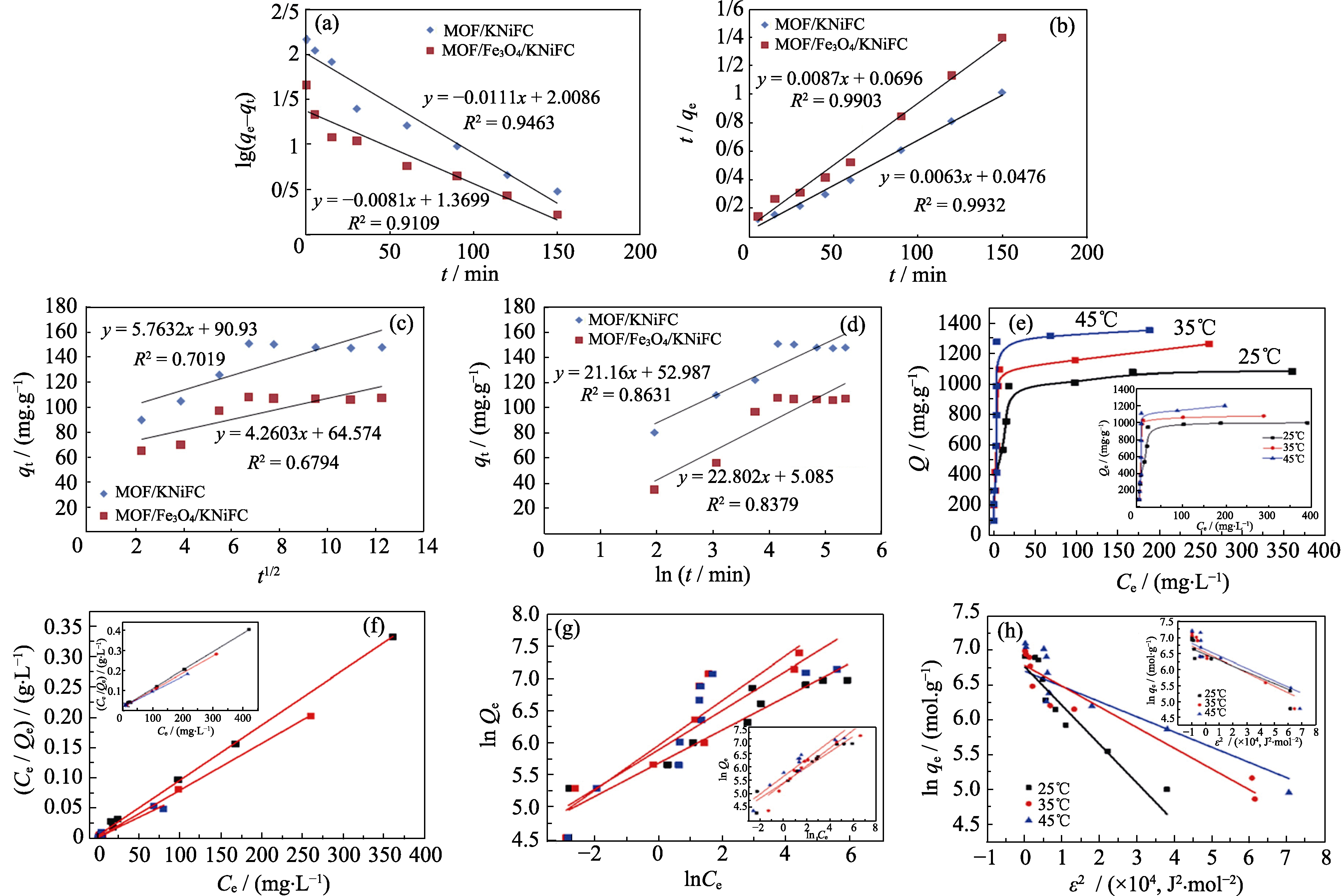
图3 Cs+吸附到MOF/KNiFC和MOF/Fe3O4/KNiFC上的假一阶模型(a)、假二阶模型(b)、扩散模型(c)和Elovich模型(d)拟合[44]; (e)U(VI)在UiO-66(插图)和GO-COOH/UiO-66复合物上的吸附等温线: (f)Langmuir模型, (g)Freundlich模型, (h)Dubinin-Radushkevich模型[30]
Fig. 3 Linear pseudo-first-order kinetic (a), pseudo-second-order (b), intraparticle diffusion (c) and elovich equation (d) for adsorption of Cs+ on MOF/KNiFC and MOF/Fe3O4/KNiFC[44]; (e) Isotherm model of U(VI) adsorption on UiO-66 (inset) and GO-COOH/UiO-66 composites; (f) Langmuir model, (g) Freundlich model, and (h) Dubinin-Radushkevich model[30]
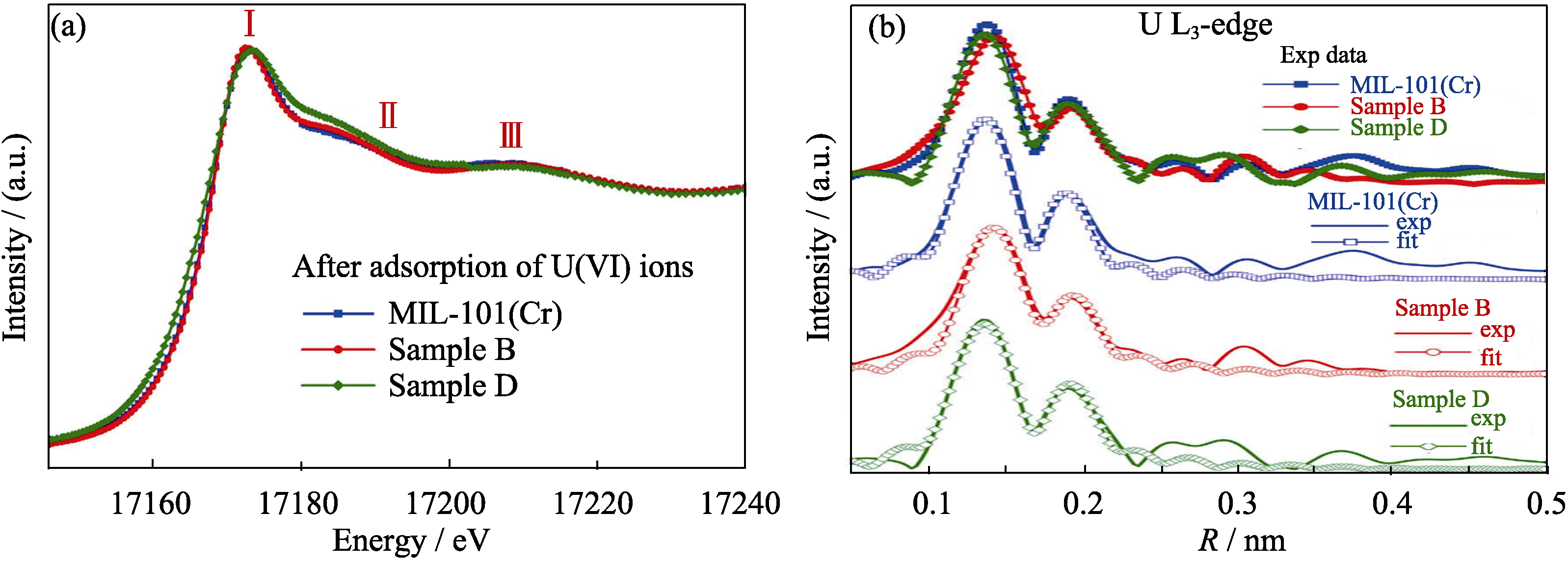
图4 (a)原始的MIL-101(Cr)和不同乙二胺(ED)改性ED-MIL-101(Cr)材料吸附U(VI)之后的U L3-edge XANES光谱, (b)不同样品对应的傅里叶转换光谱图[54]
Fig. 4 (a) Comparison of experimental U L3-edge XANES spectra for pristine MIL-101(Cr), and different ED contents grafting ED-MIL-101(Cr) samples after the adsorption of U(VI), (b) Experimental Fourier transform of the U L3-edge EXAFS data for different samples and their corresponding fits[54]
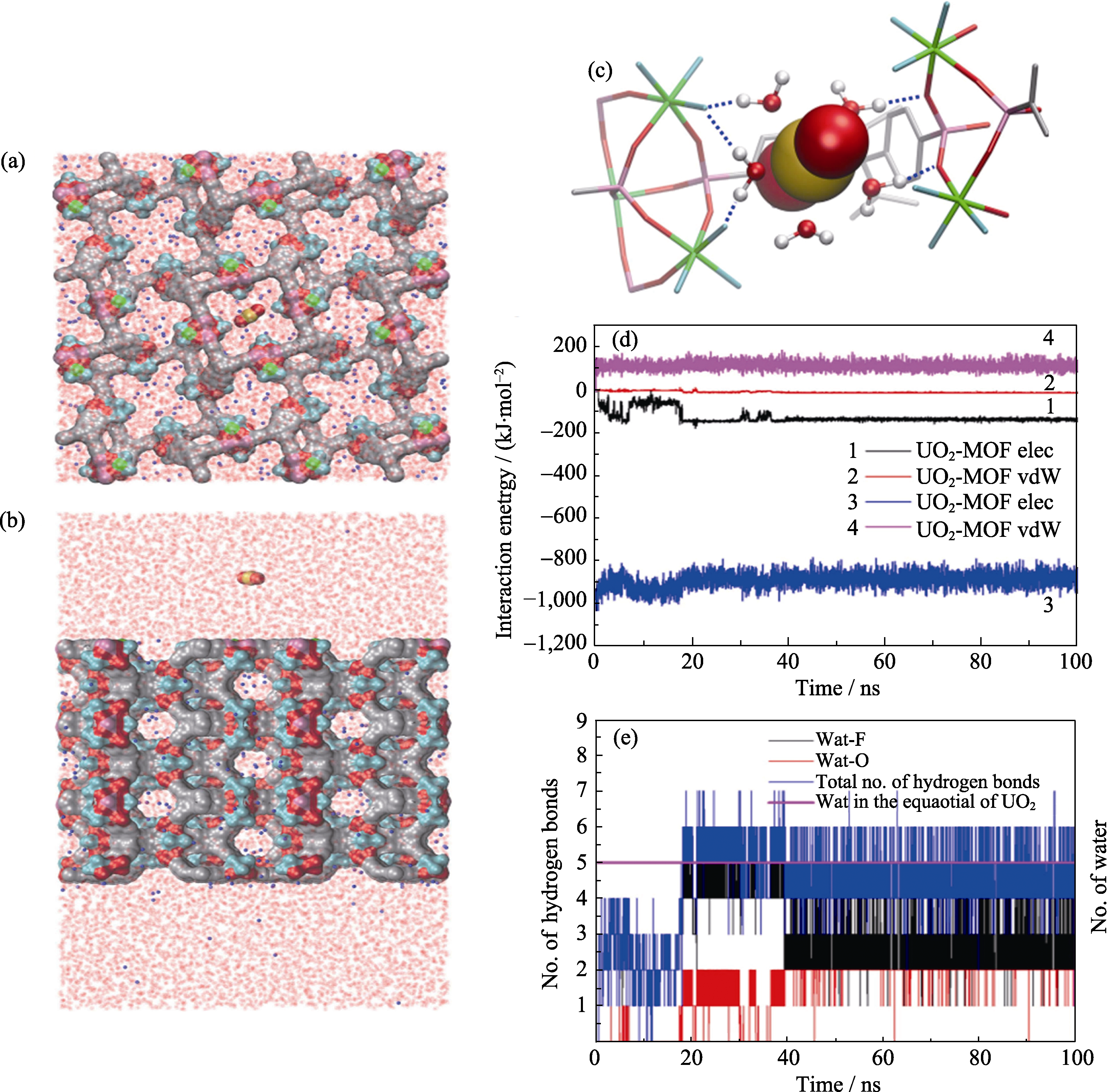
图5 U(VI)在SZ-2吸附的分子动力学模拟。U(VI)接近SZ-2 [001]晶面c轴的(a)俯视和(b)侧视图; (c)U(VI)结合到SZ-2上运行完一次(总共六次)的快照图(蓝色虚线代表赤道水分子和悬挂的氢键受体之间的氢键);(d)时间对U(VI)与SZ-2和水分子之间的静电作用和范德华作用的影响; (e)时间对铀酰离子赤道水分子的数量(粉红色曲线)和赤道水分子与其它受体(包括主框架中的F和O)之间形成的氢键数量的影响[58]
Fig. 5 MD simulations on the process of uranyl sorption into SZ-2. The top (a) and side (b) view of the simulation system-1 (uranyl cation approaching along the c axis); (c) The final snapshot (at t ¼ 100 ns) of run 1 (out of total 6) to show the importance of equatorial water of uranyl cation in mediating its binding to the SZ-2 (the blue dash line indication the hydrogen bond between equatorial water molecules and the dangling hydrogen bond acceptors); (d) Time evolution of the electrostatic and vdW interaction energies of uranyl cation with SZ-2 and water; (e) The number of equatorial water molecules of uranyl cation (pink curve) and the number of hydrogen bonds formed between equatorial coordinating water molecules and other acceptors (including F and O in main framework) as the function of simulation time[58]
| 技术 | 主要目的 | 优点 | 缺点 |
|---|---|---|---|
| 宏观实验 | 反应达到平衡所需时间, 最大吸附量, 选择性和影响因素[ | 非常直观得到实验结果, 方便和有效 | 无法得到分子和原子水平上的作用机理 |
| XPS分析 | 元素氧化态、元素种类和几乎所有元素的键合关系(除了H和He) | 定量分析、元素组成分析、高表面灵敏度检测(1~10 nm) | 在真空中进行的测量, 可能改变样品的性质; 在元素个数比值高于0.05%~ 1.0%条件下进行, 依赖于元素的性质 |
| XAFS分析 | 氧化态、配位数、原子间键距离以及目标离子周围的离子状态[ | 特定的元素, 并且总是可以检测到的, 对于研究非晶体材料是有用的; 吸附物种的分析 | 无法区分原子能相差较小的原子(C、N、O或S、Cl、Mn或Fe)[ |
| FT-IR分析 | 对微米范围内吸附行为的研究(光密度≥10-5) | 灵敏检测官能团和极性键[ | 定性而不是定量, 灵敏度低 |
| DFT计算 | 键能、键长、轨道和系统电荷密度[ | 对局部环境的吸附描述和原子级吸附过程的描述[ | 优化结构之间的能量与长时间模拟结果较不准确 |
| 分子动力学模拟 | 位置、势能和宏观现象的预测[ | 吸附过程的快照在几秒内发生[ | 长时间的计算时间, 依赖于计算的性能 |
表2 上述主要吸附表征技术的目的、优点和缺点
Table 2 The main purpose, advantages and disadvantages of main adsorption characterization techniques mentioned above
| 技术 | 主要目的 | 优点 | 缺点 |
|---|---|---|---|
| 宏观实验 | 反应达到平衡所需时间, 最大吸附量, 选择性和影响因素[ | 非常直观得到实验结果, 方便和有效 | 无法得到分子和原子水平上的作用机理 |
| XPS分析 | 元素氧化态、元素种类和几乎所有元素的键合关系(除了H和He) | 定量分析、元素组成分析、高表面灵敏度检测(1~10 nm) | 在真空中进行的测量, 可能改变样品的性质; 在元素个数比值高于0.05%~ 1.0%条件下进行, 依赖于元素的性质 |
| XAFS分析 | 氧化态、配位数、原子间键距离以及目标离子周围的离子状态[ | 特定的元素, 并且总是可以检测到的, 对于研究非晶体材料是有用的; 吸附物种的分析 | 无法区分原子能相差较小的原子(C、N、O或S、Cl、Mn或Fe)[ |
| FT-IR分析 | 对微米范围内吸附行为的研究(光密度≥10-5) | 灵敏检测官能团和极性键[ | 定性而不是定量, 灵敏度低 |
| DFT计算 | 键能、键长、轨道和系统电荷密度[ | 对局部环境的吸附描述和原子级吸附过程的描述[ | 优化结构之间的能量与长时间模拟结果较不准确 |
| 分子动力学模拟 | 位置、势能和宏观现象的预测[ | 吸附过程的快照在几秒内发生[ | 长时间的计算时间, 依赖于计算的性能 |
| [1] | AI Y J, LIU Y, LAN W Y, et al.The effect of pH on the U(VI) sorption on graphene oxide (GO): a theoretical study. Chemical Engineering Journal, 2018, 343: 460-466. |
| [2] | PANG H W, WANG X X, YAO W, et al.Removal of radionuclides by metal oxide materials and mechanism research. Scientia Sinica Chimica, 2018, 48: 58-73. |
| [3] | YANG S Y, WANG X X, CHEN Z S, et al.Synthesis of Fe3O4-based nanomaterials and their application in the removal of radionuclides and heavy metal ions. Progress in Chemistry, 2018, 30(2/3): 225-242. |
| [4] | YU S J, WANG X X, PANG H W, et al.Boron nitride-based materials for the removal of pollutants from aqueous solutions: a review. Chemical Engineering Journal, 2018, 333: 343-360. |
| [5] | YU S J, WANG X X, YANG S T, et al.Interaction of radionuclides with natural and manmade materials using XAFS technique. Science China Chemistry, 2016, 60(2): 170-187. |
| [6] | LI X, LIU Y, ZHANG C L, et al.Porous Fe2O3 microcubes derived from metal organic frameworks for efficient elimination of organic pollutants and heavy metal ions. Chemical Engineering Journal, 2018, 336: 241-252. |
| [7] | LIANG Y, GU P C, YAO W, et al.Adsorption of radionuclide uranium onto carbon-based nanomaterials from aqueous systems. Process in Chemistry, 2017, 29(9): 1062-1071. |
| [8] | DU Y C, WANG X K, HOU R Q, et al.In-situ growth of Nb2O5 nanorods on diatomite and highly effective removal of Cr(VI). Journal of Inorganic Materials, 2018, 33(5): 557-564. |
| [9] | CHEN H J, HUANG S Y, ZHANG Z B, et al.Synthesis of functional nanoscale zero-valent iron composites for the application of radioactive uranium enrichment from environment: a review. Acta Chimica Sinica, 2017, 75(6): 560-574. |
| [10] | DU Y, WANG J, WANG H Q, et al.Research on sorption mechanism of radionuclides by manufactured nanomaterials. Journal of Agro-Environment Science, 2016, 35: 1837-1847. |
| [11] | WANG X N, MENG H, MA F Y, et al.Influence of preparation method on oxidation degree of graphene oxide and adsorption for Th(IV) and U(VI). Journal of Inorganic Materials, 2016, 31(5): 454-460. |
| [12] | GU P C, XING J L, WEN T, et al.Experimental and theoretical calculation investigation on efficient Pb(II) adsorption on etched Ti3AlC2 nanofibers and nanosheets. Environmental Science: Nano, 2018, 5(4): 946-955. |
| [13] | YAO W, WU Y H, PANG H W, et al.In-situ reduction synthesis of manganese dioxide@polypyrrole core/shell nanomaterial for highly efficient enrichment of U(VI) and Eu(III). Science China Chemistry, 2018(7): 1-12. |
| [14] | SONG S, YIN L, WANG X X, et al.Interaction of U(VI) with ternary layered double hydroxides by combined batch experiments and spectroscopy study. Chemical Engineering Journal, 2018, 338: 579-590. |
| [15] | WANG P Y, YIN L, WANG X X, et al.L-cysteine intercalated layered double hydroxide for highly efficient capture of U(VI) from aqueous solutions. Journal of Environmental Management, 2018, 217: 468-477. |
| [16] | LIU W, DAI X, BAI Z L, et al.Highly sensitive and selective uranium detection in natural water systems using a luminescent mesoporous metal-organic framework equipped with abundant lewis basic sites: a combined batch, X-ray absorption spectroscopy, and first principles simulation investigation. Environmental Science & Technology, 2017, 51(7): 3911-3921. |
| [17] | LI J, WANG X X, ZHAO G X, et al.Metal-organic framework- based materials: superior adsorbents for the capture of toxic and radioactive metal ions. Chemical Society Reviews, 2018, 47(7): 2322-2356. |
| [18] | WU Y H, PANG H W, YAO W, et al.Synthesis of rod-like metal-organic framework (MOF-5) nanomaterial for efficient removal of U(VI): batch experiments and spectroscopy study. Science Bulletin, 2018, 63(13): 831-839. |
| [19] | DROUT R J, OTAKE K, HOWARTH A J, et al.Efficient capture of perrhenate and pertechnetate by a mesoporous Zr metal-organic framework and examination of anion binding motifs. Chemistry of Materials, 2018, 30(4): 1277-1284. |
| [20] | WANG Y L, LIU Z Y, LI Y X, et al.Umbellate distortions of the uranyl coordination environment result in a stable and porous polycatenated framework that can effectively remove cesium from aqueous solutions. Journal of America Chemistry Society, 2015, 137(19): 6144-6147. |
| [21] | BANERJEE D, KIM D, SCHWEIGER M J, et al.Removal of TcO4- ions from solution: materials and future outlook. Chemical Society Reviews, 2016, 45(10): 2724-2739. |
| [22] | PANG H W, HUANG S Y, WU Y H, et al.Efficient elimination of U(VI) by polyethyleneimine decorated fly ash. Inorganic Chemistry Frontiers, 2018, 5: 2399-2407 |
| [23] | YU S J, WANG X X, TAN X L, et al.Sorption of radionuclides from aqueous systems onto graphene oxide-based materials: a review. Inorganic Chemistry Frontiers, 2015, 2(7): 593-612. |
| [24] | DUAN L F, ZHANG Y, WANG L M, et al.Synthesis and characterization of MnFe2O4 with different morphologies and their application in water treatment. Journal of Inorganic Materials, 2014, 29(7): 763-768. |
| [25] | CARBONI M, ABNEY C W, LIU S B, et al.Highly porous and stable metal-organic frameworks for uranium extraction. Chemical Science, 2013, 4(6): 2396-2402. |
| [26] | BAI Z Q, YUAN L Y, ZHU L, et al.Introduction of amino groups into acid-resistant MOFs for enhanced U(VI) sorption. Journal of Materials Chemistry A, 2015, 3(2): 525-534. |
| [27] | LI L N, MA W, SHEN S S, et al.A combined experimental and theoretical study on the extraction of uranium by amino-derived metal-organic frameworks through post-synthetic strategy. ACS Applied Materials & Interfaces, 2016, 8(45): 31032-31041. |
| [28] | ZHU L, SHENG D P, XU C, et al.Identifying the recognition site for selective trapping of 99TcO4- in a hydrolytically stable and radiation resistant cationic metal-organic framework. Journal of America Chemistry Society, 2017, 139(42): 14873-14876. |
| [29] | SHENG D P, ZHU L, XU C, et al.Efficient and selective uptake of TcO4- by a cationic metal-organic framework material with open Ag+ sites. Environmental Science & Technology, 2017, 51(6): 3471-3479. |
| [30] | YANG P P, LIU Q, LIU J Y, et al.Interfacial growth of a metal-organic framework (UiO-66) on functionalized graphene oxide (GO) as a suitable seawater adsorbent for extraction of uranium(VI). Journal of Materials Chemistry A, 2017, 5(34): 17933-17942. |
| [31] | ZHANG N, YUAN L Y, GUO W L, et al.Extending the use of highly porous and functionalized MOFs to Th(IV) capture. ACS Applied Materials & Interfaces, 2017, 9(30): 25216-25224. |
| [32] | PENG Y G, HUANG H L, LIU D H, et al.Radioactive barium ion trap based on metal-organic framework for efficient and irreversible removal of barium from nuclear wastewater. ACS Applied Materials & Interfaces, 2016, 8(13): 8527-8535. |
| [33] | YUAN G Y, TIAN Y, LIU J, et al.Schiff base anchored on metal-organic framework for Co(II) removal from aqueous solution. Chemical Engineering Journal, 2017, 326: 691-699. |
| [34] | GAO Y J, FENG M L, ZHANG B, et al.An easily synthesized microporous framework material for the selective capture of radioactive Cs+ and Sr2+ ions. Journal of Materials Chemistry A, 2018, 6(9): 3967-3976. |
| [35] | YAO W, WANG X X, LIANG Y, et al.Synthesis of novel flower-like layered double oxides/carbon dots nanocomposites for U(VI) and 241Am(III) efficient removal: batch and EXAFS studies. Chemical Engineering Journal, 2018, 332: 775-786. |
| [36] | WANG X X, YU S J, WU Y H, et al.The synergistic elimination of uranium(VI) species from aqueous solution using bi-functional nanocomposite of carbon sphere and layered double hydroxide. Chemical Engineering Journal, 2018, 342: 321-330. |
| [37] | WANG X X, LIU Y, PANG H W, et al.Effect of graphene oxide surface modification on the elimination of Co(II) from aqueous solutions. Chemical Engineering Journal, 2018, 344: 380-390. |
| [38] | YU S J, WANG J, SONG S, et al.One-pot synthesis of graphene oxide and Ni-Al layered double hydroxides nanocomposites for the efficient removal of U(VI) from wastewater. Science China Chemistry, 2017, 60(3): 415-422. |
| [39] | YU S J, WANG X X, CHEN Z S, et al.Interaction mechanism of radionickel on Na-montmorillonite: influences of pH, electrolyte cations, humic acid and temperature. Chemical Engineering Journal, 2016, 302: 77-85. |
| [40] | YIN L, SONG S, WANG X X, et al.Rationally designed core-shell and yolk-shell magnetic titanate nanosheets for efficient U(VI) adsorption performance. Environmental Pollution, 2018, 238: 725-738. |
| [41] | GU P C, ZHANG S, LI X, et al.Recent advances in layered double hydroxide-based nanomaterials for the removal of radionuclides from aqueous solution. Environmental Pollution, 2018, 240: 493-505. |
| [42] | SONG W C, WANG X X, CHEN Z S, et al.Enhanced immobilization of U(VI) on Mucor circinelloides in presence of As(V): batch and XAFS investigation. Environmental Pollution, 2018, 237: 228-236. |
| [43] | TAN X L, FANG M, TAN L Q, et al.Core-shell hierarchical C@Na2Ti3O7·9H2O nanostructures for the efficient removal of radionuclides. Environmental Science: Nano, 2018, 5(5): 1140-1149. |
| [44] | NAEIMI S, FAGHIHIAN H.Performance of novel adsorbent prepared by magnetic metal-organic framework MOF modified by potassium nickel hexacyanoferrate for removal of Cs+ from aqueous solution. Separation and Purification Technology, 2017, 175: 255-265. |
| [45] | ZHANG C L, LIU Y, LI X, et al.Highly uranium elimination by crab shells-derived porous graphitic carbon nitride: batch, EXAFS and theoretical calculations. Chemical Engineering Journal, 2018, 346: 406-415. |
| [46] | HU Y Z, WANG X X, ZOU Y D, et al.Superior sorption capacities of Ca-Ti and Ca-Al bimetallic oxides for U(VI) from aqueous solutions. Chemical Engineering Journal, 2017, 316: 419-428. |
| [47] | CHEN Z S, WANG J, PU Z X, et al.Synthesis of magnetic Fe3O4/CFA composites for the efficient removal of U(VI) from wastewater. Chemical Engineering Journal, 2017, 320: 448-457. |
| [48] | ZHANG C L, LI X, CHEN Z S, et al.Synthesis of ordered mesoporous carbonaceous materials and its highly efficient capture of uranium from solutions. Science China Chemistry, 2018, 61(3): 281-293. |
| [49] | SUN Y B, LU S H, WANG X X, et al.Plasma-facilitated synthesis of amidoxime/carbon nanofiber hybrids for effective enrichment of 238U(VI) and 241Am(III). Environmental Science & Technology, 2017, 51(21): 12274-12282. |
| [50] | WANG J, WANG X X, ZHAO G X, et al.Polyvinylpyrrolidone and polyacrylamide intercalated molybdenum disulfide as adsorbents for enhanced removal of chromium(VI) from aqueous solutions. Chemical Engineering Journal, 2018, 334: 569-578. |
| [51] | YANG D X, WANG X X, SONG G, et al.One-pot synthesis of arginine modified hydroxyapatite carbon microsphere composites for efficient removal of U(VI) from aqueous solutions. Science Bulletin, 2017, 62(23): 1609-1618. |
| [52] | SONG S, HUANG S Y, ZHANG R, et al.Simultaneous removal of U(VI) and humic acid on defective TiO2-x investigated by batch and spectroscopy techniques. Chemical Engineering Journal, 2017, 325: 576-587. |
| [53] | TAN L Q, TAN X L, MEI H Y, et al.Coagulation behavior of humic acid in aqueous solutions containing Cs+, Sr2+ and Eu3+: DLS, EEM and MD simulation. Environmental Pollution, 2018, 235: 835-843. |
| [54] | ZHANG J Y, ZHANG N, ZHANG L J, et al. Adsorption of uranyl ions on amine-functionalization of MIL-101(Cr) nanoparticles by a facile coordination-based post-synthetic strategy and X-ray absorption spectroscopy studies. Scientific Reports, 2015, 5: 13514- 1-10. |
| [55] | WEN H, PAN Z Z, GIAMMAR D E, et al.Enhanced uranium immobilization by phosphate amendment under variable geochemical and flow conditions: insights from reactive transport modeling. Environmental Science & Technology, 2018, 52(10): 5841-5850. |
| [56] | ZHANG Y J, LAN J H, WANG L, et al.Adsorption of uranyl species on hydroxylated titanium carbide nanosheet: a first-principles study. Journal of Hazardous Materials, 2016, 308: 402-410. |
| [57] | WANG L, YUAN L Y, CHEN K, et al.Loading actinides in multilayered structures for nuclear waste treatment: the first case study of uranium capture with vanadium carbide MXene. ACS Applied Materials & Interfaces, 2016, 8(25): 16396-16403. |
| [58] | ZHENG T, YANG Z X, GUI D X, et al. Overcoming the crystallization and designability issues in the ultrastable zirconium phosphonate framework system. Nature Communications, 2017, 8: 15369-1-11. |
| [59] | SHENG G D, SHAO D D, FAN Q H D, et al. Effect of pH and ionic strength on sorption of Eu(III) to MX-80 bentonite: batch and XAFS study. Radiochimica Acta, 2009, 97(11): 621-630. |
| [60] | TAN X L, REN X M, CHEN C L, et al.Analytical approaches to the speciation of lanthanides at solid-water interfaces. TrAC Trends in Analytical Chemistry, 2014, 61: 107-132. |
| [61] | LUO F, CHEN J L, DANG L L, et al.High-performance Hg2+ removal from ultra-low-concentration aqueous solution using both acylamide-and hydroxyl-functionalized metal-organic framework. Journal of Materials Chemistry A, 2015, 3(18): 9616-9620. |
| [62] | BANERJEE D, XU W Q, NIE Z M, et al.Zirconium-based metal-organic framework for removal of perrhenate from water. Inorganic Chemistry, 2016, 55(17): 8241-8243. |
| [63] | HOSKINS B F, ROBSON R.Infinite polymeric frameworks consisting of three dimensionally linked rod-like segments. Journal of the American Chemical Society, 1989, 111(15): 5962-5964. |
| [64] | NALAPARAJU A, JIANG J W.Ion exchange in metal-organic framework for water purification: insight from molecular simulation. The Journal of Physical Chemistry C, 2012, 116(12): 6925-6931. |
| [1] | 陈明俊, 缪洪康, 肖英俊, 邓建波, 张翔, 赵九蓬, 李垚. 光-热双响应材料研究进展: 从设计策略到智能窗应用[J]. 无机材料学报, 2026, 41(6): 723-738. |
| [2] | 宋坤洁, 解荣军. 机器学习驱动新型发光材料的研究进展[J]. 无机材料学报, 2026, 41(6): 689-703. |
| [3] | 胡钰晴, 朱一新, 乐先浩, 万青. 钽酸锂晶圆减薄技术及其热释电红外探测器应用进展[J]. 无机材料学报, 2026, 41(6): 764-774. |
| [4] | 刘春帆, 陈科, 葛芳芳, 黄庆. 核用耐铅铋腐蚀涂层的研究进展[J]. 无机材料学报, 2026, 41(6): 775-786. |
| [5] | 胡扬, 谢敏, 张筱怡, 李想, 郭新伟, 姜南, 周文瀚, 张胜利, 曾海波. 计算与数据驱动环保型发光材料的研究进展[J]. 无机材料学报, 2026, 41(6): 704-722. |
| [6] | 王俊卜, 黄泽皑, 杨茗凯, 蒙颖, 周明炜, 周莹. 甲烷转化用抗积碳催化材料研究进展[J]. 无机材料学报, 2026, 41(6): 739-750. |
| [7] | 王金文, 杨振, 周欢, 夏丹, 杨磊. 可注射无机材料及其生物医学应用[J]. 无机材料学报, 2026, 41(6): 751-763. |
| [8] | 李涵涛, 沈强, 罗国强, 王雪飞, 高明, 陈晨. 机械球磨法调控硅基负极材料结构与性能的研究进展[J]. 无机材料学报, 2026, 41(5): 561-572. |
| [9] | 解陈一, 缪花明, 张蔚然, 刘荣军, 王衍飞, 李端. 理论计算在高熵陶瓷领域的研究进展[J]. 无机材料学报, 2026, 41(5): 545-560. |
| [10] | 李璇, 叶奎材, 冯佳音, 邱家军, 钱文昊, 邢敏. 钛基牙种植体表面改性促进软组织封闭的研究进展[J]. 无机材料学报, 2026, 41(4): 432-444. |
| [11] | 彭德招, 李瑞, 王文鸿, 王梓瑞, 章志珍. 钠氯化物固态电解质研究进展[J]. 无机材料学报, 2026, 41(4): 409-420. |
| [12] | 陈坤, 姜勇刚, 冯军宗, 李良军, 胡艺洁, 冯坚. 锆酸镧多孔隔热材料研究进展[J]. 无机材料学报, 2026, 41(4): 421-431. |
| [13] | 韦连金, 齐志杰, 汪信, 朱俊武, 付永胜. 纳米金刚石改性及其在电催化氧还原反应中的应用[J]. 无机材料学报, 2026, 41(3): 273-288. |
| [14] | 刘占一, 李勉, 欧阳晓平, 柴之芳, 黄庆. 干法后处理熔盐中Sr/Cs去除方法的研究进展[J]. 无机材料学报, 2026, 41(2): 150-158. |
| [15] | 孙炼, 张磊磊, 薛泽旭, 吴坤, 陈晔, 李志远, 王鲁凯, 王尊刚. 面向辐射探测应用的零维金属卤化物闪烁体研究进展[J]. 无机材料学报, 2026, 41(2): 159-176. |
| 阅读次数 | ||||||
|
全文 |
|
|||||
|
摘要 |
|
|||||