
Journal of Inorganic Materials ›› 2026, Vol. 41 ›› Issue (4): 500-508.DOI: 10.15541/jim20250211
• RESEARCH ARTICLE • Previous Articles Next Articles
XUE Xinyan1,2( ), ZHANG Xiaowei1,2, LU Heng1,2, LI Shijie1,2, ZHANG Weike1,2(), CHAN Siewhwa2,3
Received:2025-05-15
Revised:2025-09-23
Published:2026-04-20
Online:2025-10-17
Contact:
ZHANG Weike, associate professor. E-mail: zhangweike@tyut.edu.cnAbout author:XUE Xinyan (2000-), female, Master candidate. E-mail: 17336334425@163.com
Supported by:CLC Number:
XUE Xinyan, ZHANG Xiaowei, LU Heng, LI Shijie, ZHANG Weike, CHAN Siewhwa. Co-Mg Synergistic Carbon Nano Onions Catalyst: Preparation and Low-temperature Catalytic Hydrogen Production from Ammonia Decomposition[J]. Journal of Inorganic Materials, 2026, 41(4): 500-508.
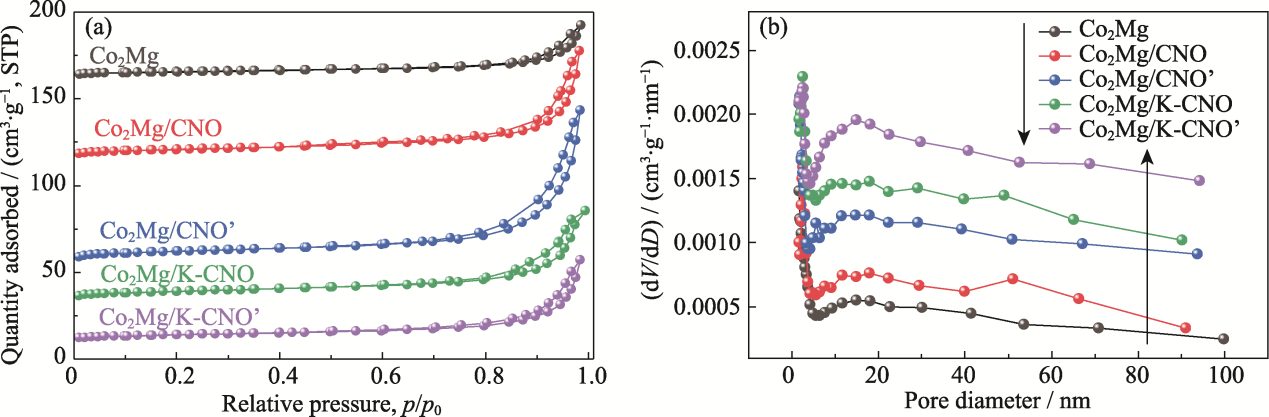
Fig. 1 N2 adsorption-desorption isotherms (a) and pore size distributions (b) of different catalysts
| Catalyst | BET specific surface area/ (m2·g-1) | Micropore volume/ (cm3·g-1) | Micropore area/ (m2·g-1) | Average pore size/nm | Co content/% (in mass) |
|---|---|---|---|---|---|
| Co2Mg | 12.7434 | 0.002212 | 6.0318 | 14.6403 | 50 |
| Co2Mg/CNO | 23.4634 | 0.002876 | 6.0278 | 19.4730 | 29 |
| Co2Mg/CNO’ | 23.4880 | 0.003788 | 8.6815 | 20.0063 | 29 |
| Co2Mg/K-CNO | 28.5727 | 0.002307 | 4.8487 | 18.2552 | 29 |
| Co2Mg/K-CNO’ | 34.8266 | 0.002539 | 8.6815 | 17.6383 | 29 |
Table 1 Specific surface area and pore structure parameters of different catalysts
| Catalyst | BET specific surface area/ (m2·g-1) | Micropore volume/ (cm3·g-1) | Micropore area/ (m2·g-1) | Average pore size/nm | Co content/% (in mass) |
|---|---|---|---|---|---|
| Co2Mg | 12.7434 | 0.002212 | 6.0318 | 14.6403 | 50 |
| Co2Mg/CNO | 23.4634 | 0.002876 | 6.0278 | 19.4730 | 29 |
| Co2Mg/CNO’ | 23.4880 | 0.003788 | 8.6815 | 20.0063 | 29 |
| Co2Mg/K-CNO | 28.5727 | 0.002307 | 4.8487 | 18.2552 | 29 |
| Co2Mg/K-CNO’ | 34.8266 | 0.002539 | 8.6815 | 17.6383 | 29 |
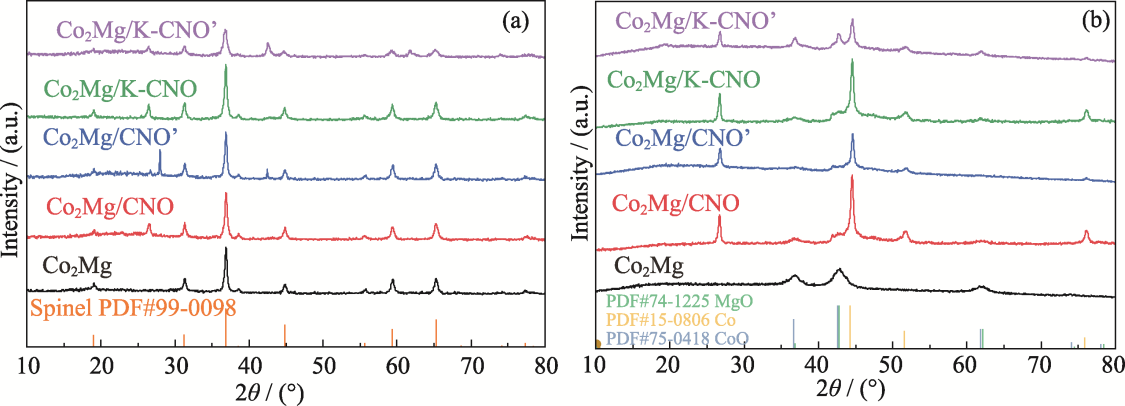
Fig. 2 XRD patterns of catalysts before (a) and after (b) reduction at 500 ℃
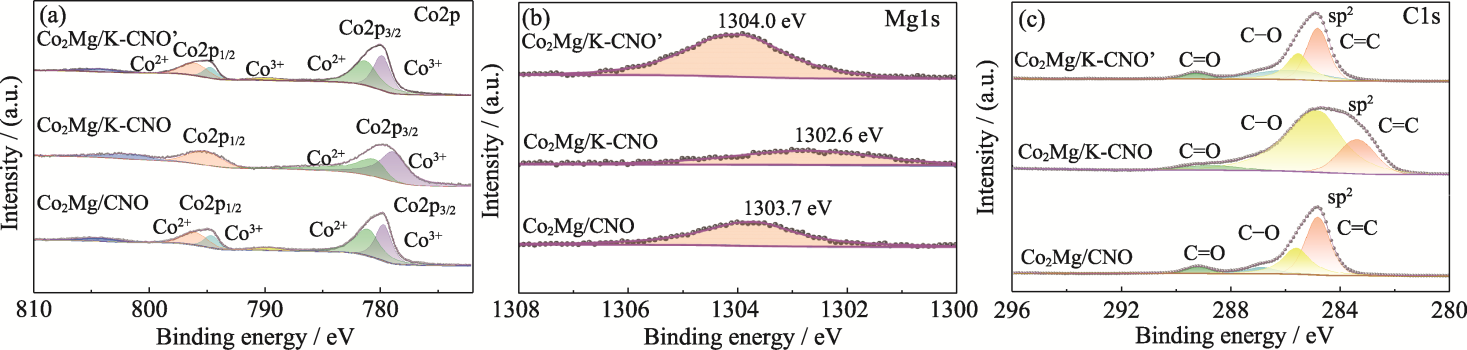
Fig. 3 XPS spectra of Co2Mg/CNO, Co2Mg/K-CNO and Co2Mg/K-CNO’ (a) Co2p; (b) Mg1s; (c) C1s
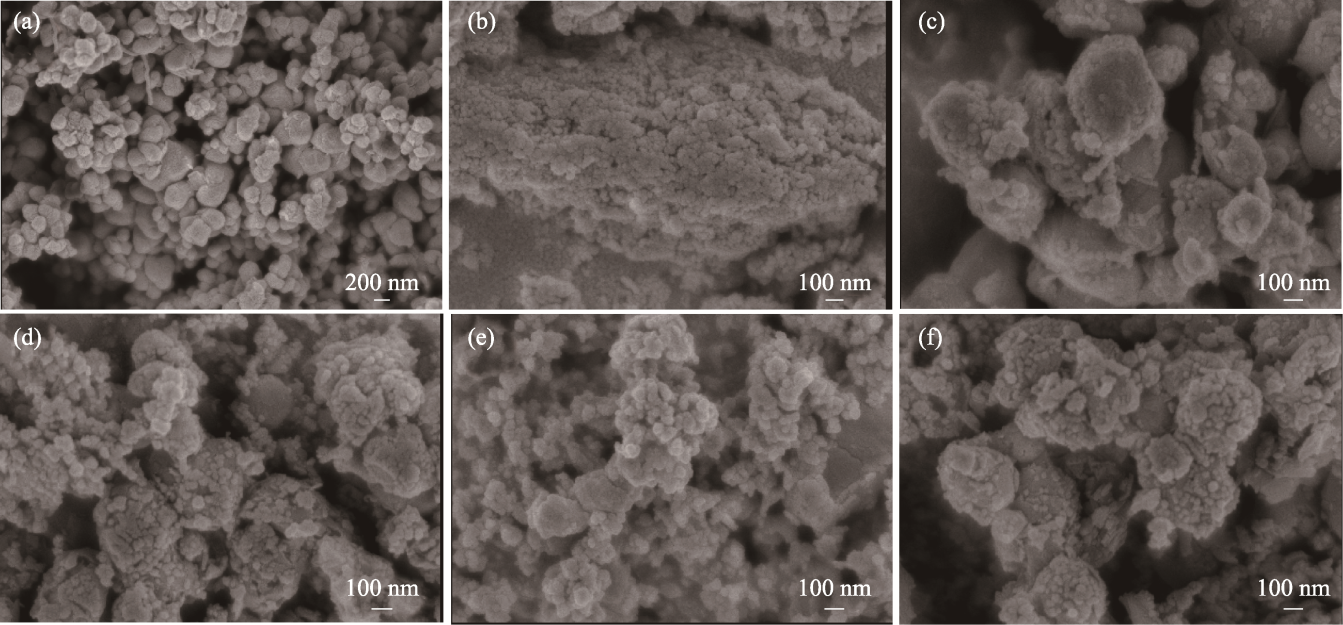
Fig. 4 SEM images of catalysts (a) CNOs; (b) Co2MgO4; (c) Co2Mg/CNO; (d) Co2Mg/CNO’; (e) Co2Mg/K-CNO; (f) Co2Mg/K-CNO’
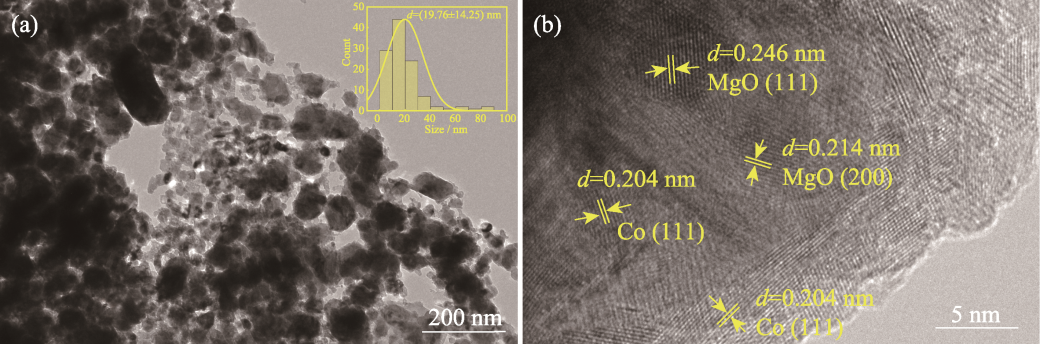
Fig. 5 TEM (a) and HRTEM (b) images of Co2Mg/K-CNO’
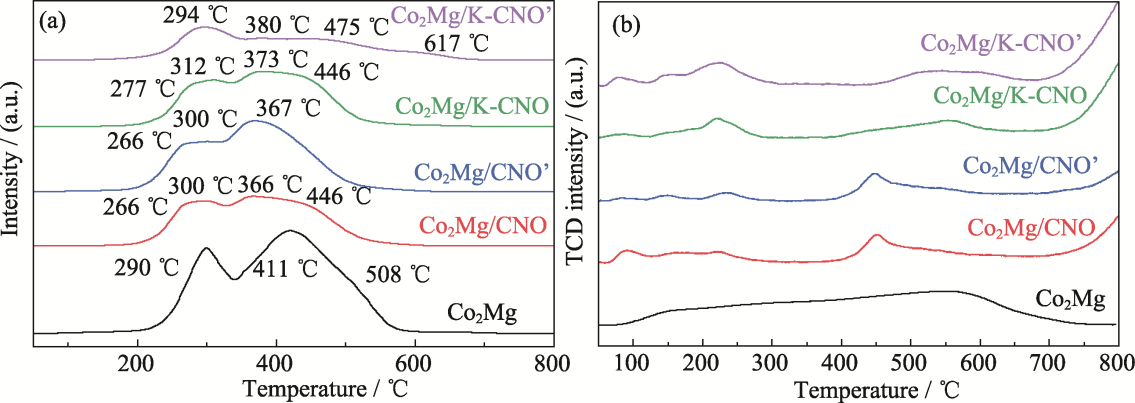
Fig. 6 H2-TPR (a) and CO2-TPD (b) profiles of catalysts
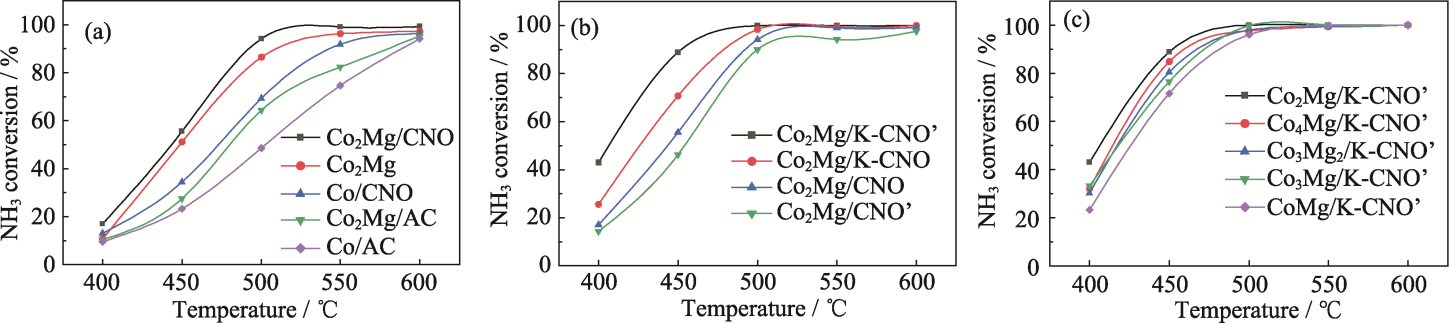
Fig. 7 Comparison of catalytic activity for ammonia decomposition (a) Co-Mg synergy; (b) K-activated carriers; (c) Different ratios of Co-Mg
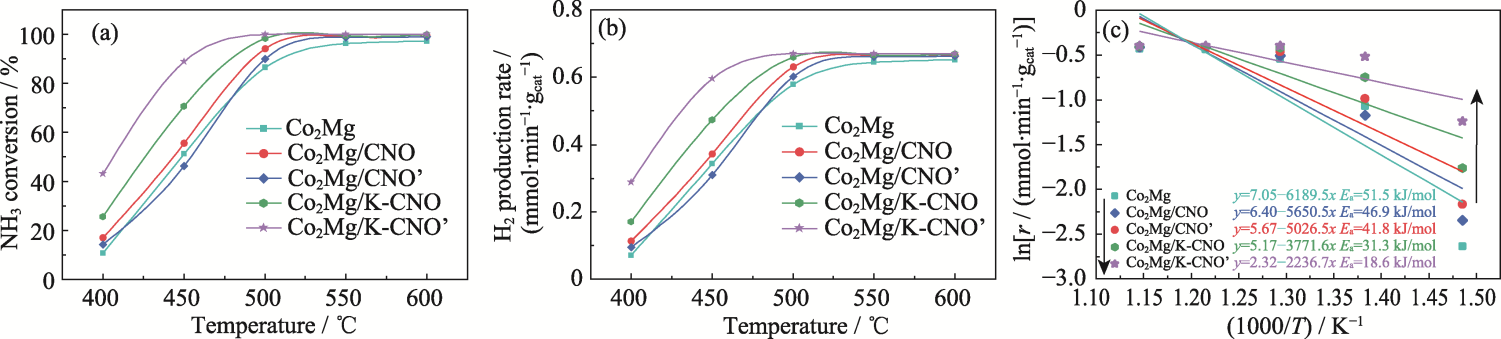
Fig. 8 Ammonia conversion (a), hydrogen generation rate (b) and activation energy (c) of catalysts
| Catalyst | Temperature/℃ | GHSV/(mL·gcat-1·h-1) | NH3 conversion/% | Ref. |
|---|---|---|---|---|
| Co2Mg/K-CNO’ | 550 | 12000 | 99.6 | This work |
| 20CoNaTi-NT | 550 | 6000 | 41 | [ |
| 35%Co/SiC-700 | 550 | 30000 | 78.3 | [ |
| CoOx@C-700A | 500 | 15000 | 55 | [ |
| 90CoAl | 500 | 30000 | 37.8 | [ |
| Co/CNTs | 500 | 6000 | 61 | [ |
| Co-Mo/SiO2-Cap | 500 | 6000 | 20 | [ |
| Co/CeO2 | 500 | 6000 | 62 | [ |
| 26Co-CAT(A) | 500 | 6000 | 58 | [ |
| Fe/CNTs | 500 | 6000 | 15 | [ |
| Co/MWCNTs | 500 | 6000 | 74.6 | [ |
Table 2 Catalytic performance of Co-based catalysts for ammonia decomposition
| Catalyst | Temperature/℃ | GHSV/(mL·gcat-1·h-1) | NH3 conversion/% | Ref. |
|---|---|---|---|---|
| Co2Mg/K-CNO’ | 550 | 12000 | 99.6 | This work |
| 20CoNaTi-NT | 550 | 6000 | 41 | [ |
| 35%Co/SiC-700 | 550 | 30000 | 78.3 | [ |
| CoOx@C-700A | 500 | 15000 | 55 | [ |
| 90CoAl | 500 | 30000 | 37.8 | [ |
| Co/CNTs | 500 | 6000 | 61 | [ |
| Co-Mo/SiO2-Cap | 500 | 6000 | 20 | [ |
| Co/CeO2 | 500 | 6000 | 62 | [ |
| 26Co-CAT(A) | 500 | 6000 | 58 | [ |
| Fe/CNTs | 500 | 6000 | 15 | [ |
| Co/MWCNTs | 500 | 6000 | 74.6 | [ |
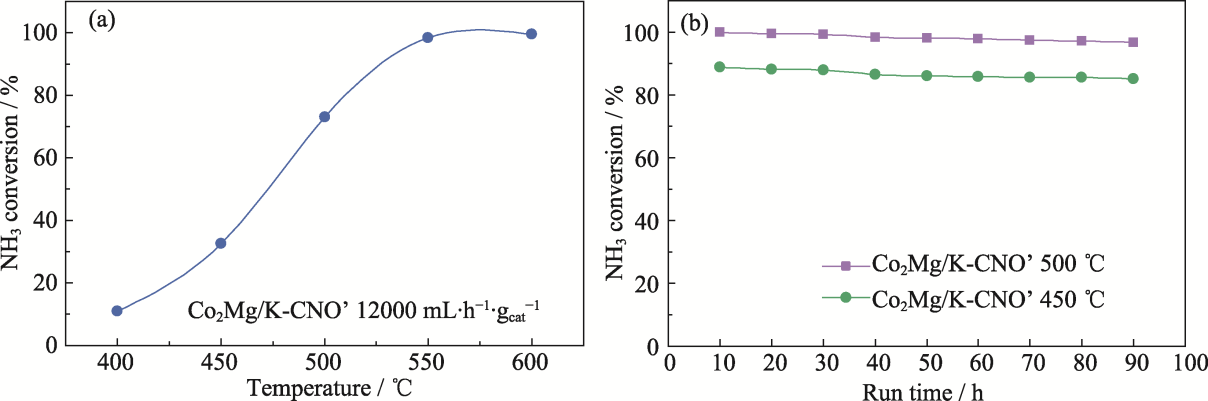
Fig. 9 Ammonia conversion (a) and long-term stability (b) of Co2Mg/K-CNO’
| [1] |
SUN Y H, SHEN C Q, LAI Q W, et al. Tailoring magnesium based materials for hydrogen storage through synthesis: current state of the art. Energy Storage Materials, 2018, 10: 168.
DOI URL |
| [2] |
SIKIRU S, OLADOSU T L, AMOSA T I, et al. Hydrogen- powered horizons: transformative technologies in clean energy generation, distribution, and storage for sustainable innovation. International Journal of Hydrogen Energy, 2024, 56: 1152.
DOI URL |
| [3] | AL-GHUSSAIN L. Global warming: review on driving forces and mitigation. Environmental Progress & Sustainable Energy, 2019, 38(1): 13. |
| [4] |
LE P A, TRUNG V D, NGUYEN P L, et al. The current status of hydrogen energy: an overview. RSC Advances, 2023, 13(40): 28262.
DOI URL |
| [5] |
PASHCHENKO D. Green hydrogen as a power plant fuel: what is energy efficiency from production to utilization? Renewable Energy, 2024, 223: 120033.
DOI URL |
| [6] |
FELDERHOFF M, WEIDENTHALER C, VON HELMOLT R, et al. Hydrogen storage: the remaining scientific and technological challenges. Physical Chemistry Chemical Physics, 2007, 9(21): 2643.
PMID |
| [7] |
METKEMEIJER R, ACHARD P. Comparison of ammonia and methanol applied indirectly in a hydrogen fuel cell. International Journal of Hydrogen Energy, 1994, 19(6): 535.
DOI URL |
| [8] |
LAMB K E, DOLAN M D, KENNEDY D F. Ammonia for hydrogen storage; a review of catalytic ammonia decomposition and hydrogen separation and purification. International Journal of Hydrogen Energy, 2019, 44(7): 3580.
DOI URL |
| [9] |
MUKHERJEE S, DEVAGUPTAPU S V, SVIRIPA A, et al. Low-temperature ammonia decomposition catalysts for hydrogen generation. Applied Catalysis B: Environmental, 2018, 226: 162.
DOI URL |
| [10] | LIANG D T, FENG C, XU L, et al. Promotion effects of different methods in COx-free hydrogen production from ammonia decomposition. Catalysis Science & Technology, 2023, 13(12): 3614. |
| [11] |
LIU Y, LI X, ZHANG D Q, et al. A general route to prepare low-ruthenium-content bimetallic electrocatalysts for pH-universal hydrogen evolution reaction by using carbon quantum dots. Angewandte Chemie International Edition, 2020, 59(4): 1718.
DOI URL |
| [12] | ZHANG J, COMOTTI M, SCHÜTH F, et al. Commercial Fe- or Co-containing carbon nanotubes as catalysts for NH3 decomposition. Chemical Communications, 2007(19): 1916. |
| [13] |
YIN S F, XU B Q, NG C F, et al. Nano Ru/CNTs: a highly active and stable catalyst for the generation of COx-free hydrogen in ammonia decomposition. Applied Catalysis B: Environmental, 2004, 48(4): 237.
DOI URL |
| [14] |
ZHANG X W, LU H, LI S J, et al. NiTiO3 enhanced Ni/TiO2 strong metal support interaction catalyst towards effective methane catalytic decomposition for hydrogen production with COx-free. Journal of Industrial and Engineering Chemistry, 2025, 147: 482.
DOI URL |
| [15] |
SCHAETZEL P, FAVRE É, THOMAS S, et al. A simple mechanistic multilayer model for the rigorous description of Brunauer- Emmett-Teller type isotherms. Industrial & Engineering Chemistry Research, 2021, 60(34): 12545.
DOI URL |
| [16] |
CHEN B F, LI F B, HUANG Z J, et al. Carbon-coated Cu-Co bimetallic nanoparticles as selective and recyclable catalysts for production of biofuel 2,5-dimethylfuran. Applied Catalysis B: Environmental, 2017, 200: 192.
DOI URL |
| [17] |
NIELSEN D, GAO Q, JANSSENS T V W, et al. Cu-speciation in dehydrated CHA zeolites studied by H2-TPR and in situ EPR. The Journal of Physical Chemistry C, 2023, 127(27): 12995.
DOI URL |
| [18] | YING Q J, WANG X Q, LIU Y, et al. Rational design of a novel core-shell Cu-ZSM-5@Ru/S-1 tandem catalyst for the catalytic combustion of dichloromethane. ACS ES&T Engineering, 2023, 3(7): 1013. |
| [19] | TABASSUM H, MUKHERJEE S, CHEN J J, et al. Hydrogen generation via ammonia decomposition on highly efficient and stable Ru-free catalysts: approaching complete conversion at 450 ℃. Energy & Environmental Science, 2022, 15(10): 4190. |
| [20] |
PINZÓN M, SÁNCHEZ-SÁNCHEZ A, SÁNCHEZ P, et al. Ammonia as a carrier for hydrogen production by using lanthanum based perovskites. Energy Conversion and Management, 2021, 246: 114681.
DOI URL |
| [21] |
GUO X H, LI Y, SHI R J, et al. Co/MgO catalysts for hydrogenolysis of glycerol to 1,2-propanediol. Applied Catalysis A: General, 2009, 371(1/2): 108.
DOI URL |
| [22] |
LARA-GARCÍA H A, MENDOZA-NIETO J A, PFEIFFER H, et al. COx-free hydrogen production from ammonia on novel cobalt catalysts supported on 1D titanate nanotubes. International Journal of Hydrogen Energy, 2019, 44(57): 30062.
DOI URL |
| [23] |
XU R J, YIN F X, ZHANG J, et al. Preparation of Co/SiC catalyst and its catalytic activity for ammonia decomposition to produce hydrogen. Catalysis Today, 2024, 437: 114774.
DOI URL |
| [24] | LI L, JIANG R Y, CHU W, et al. Cobalt nanoparticles embedded in a porous carbon matrix as an efficient catalyst for ammonia decomposition. Catalysis Science & Technology, 2017, 7(6): 1363. |
| [25] |
ZHANG Z S, FU X P, WANG W W, et al. Promoted porous Co3O4-Al2O3 catalysts for ammonia decomposition. Science China Chemistry, 2018, 61(11): 1389.
DOI |
| [26] |
LI Y P, WEN J, ALI A M, et al. Size structure-catalytic performance correlation of supported Ni/MCF-17 catalysts for COx-free hydrogen production. Chemical Communications, 2018, 54(49): 6364.
DOI URL |
| [27] |
SPATOLISANO E, PELLEGRINI L A, DE ANGELIS A R, et al. Ammonia as a carbon-free energy carrier: NH3 cracking to H2. Industrial & Engineering Chemistry Research, 2023, 62(28): 10813.
DOI URL |
| [28] |
GOU H P, LI W B, YANG Y F, et al. Porous skeleton-stabilized Co/N-C coated separator for boosting lithium-ion batteries stability and safety. Journal of Power Sources, 2021, 499: 229933.
DOI URL |
| [29] |
ALAMOUDI O M, KHAN W U, HANTOKO D, et al. Catalytic activity of Co/γ-Al2O3 catalysts for decomposition of ammonia to produce hydrogen. Fuel, 2024, 372: 132230.
DOI URL |
| [30] | ZHANG H, ALHAMED Y A, CHU W, et al. Controlling co-support interaction in Co/MWCNTs catalysts and catalytic performance for hydrogen production via NH3 decomposition. Applied Catalysis A: General, 2013, 464: 156. |
| [1] | WANG Junbu, HUANG Zeai, YANG Mingkai, MENG Ying, ZHOU Mingwei, ZHOU Ying. Research Progress on Anti-coking Catalytic Materials for Methane Conversion [J]. Journal of Inorganic Materials, 2026, 41(6): 739-750. |
| [2] | LI Na, WEI Jin, CAO Ruixiao, LIU Yu, HUANG Guiwen, XIAO Hongmei. Self-developed Ortho-para Hydrogen Conversion Catalyst: Catalytic Testing and Optimization of Batch Preparation Process [J]. Journal of Inorganic Materials, 2026, 41(5): 645-652. |
| [3] | HUANG Yinghe, HUANG Renxing, SHI Yuxing, LEI Yijie, YU Tao, WANG Cheng, GU Jun. Enhancing Durability of Pt Catalysts in the Oxygen Reduction Reaction by Confinement Effect of Mesoporous Carbon [J]. Journal of Inorganic Materials, 2026, 41(3): 289-294. |
| [4] | REN Xianpei, LI Chao, HU Qiwei, XIANG Hui, PENG Yuehong. Research Progress on Mott-Schottky Hydrogen Evolution Catalysts Based on Metal/Transition Metal Compounds [J]. Journal of Inorganic Materials, 2026, 41(2): 137-149. |
| [5] | WU Boyu, ZHANG Shengen, ZHANG Shengyang, LIU Bo, ZHANG Bolin. Effect of CeO2 on Low-temperature Denitrification Performance of MnOx Catalysts and Its Mechanism [J]. Journal of Inorganic Materials, 2026, 41(1): 87-95. |
| [6] | LIU Jiangping, GUAN Xin, TANG Zhenjie, ZHU Wenjie, LUO Yongming. Research Progress on Catalytic Oxidation of Nitrogen-containing Volatile Organic Compounds [J]. Journal of Inorganic Materials, 2025, 40(9): 933-943. |
| [7] | GUO Ziyu, ZHU Yunzhou, WANG Li, CHEN Jian, LI Hong, HUANG Zhengren. Effect of Zn2+ Catalyst on Microporous Structure of Porous Carbon Prepared from Phenolic Resin/Ethylene Glycol [J]. Journal of Inorganic Materials, 2025, 40(5): 466-472. |
| [8] | LI Jianjun, CHEN Fangming, ZHANG Lili, WANG Lei, ZHANG Liting, CHEN Huiwen, XUE Changguo, XU Liangji. Peroxymonosulfate Activation by CoFe2O4/MgAl-LDH Catalyst for the Boosted Degradation of Antibiotic [J]. Journal of Inorganic Materials, 2025, 40(4): 440-448. |
| [9] | XIN Zhenyu, GUO Ruihua, WUREN Tuoya, WANG Yan, AN Shengli, ZHANG Guofang, GUAN Lili. Pt-Fe/GO Nanocatalysts: Preparation and Electrocatalytic Performance on Ethanol Oxidation [J]. Journal of Inorganic Materials, 2025, 40(4): 379-387. |
| [10] | SUN Shujuan, ZHENG Nannan, PAN Haokun, MA Meng, CHEN Jun, HUANG Xiubing. Research Progress on Preparation Methods of Single-atom Catalysts [J]. Journal of Inorganic Materials, 2025, 40(2): 113-127. |
| [11] | LI Xueru, MA Zhejie, GUO Yujie, LI Ping. Influence of Support Characteristics on Coverage of Ionomer and Oxygen Reduction Performance for Pt/C Catalysts [J]. Journal of Inorganic Materials, 2025, 40(12): 1395-1404. |
| [12] | ZHAO Lijuan, TAN Zhe, ZHANG Xiaoguang, JIANG Guosai, TAO Ran, PAN De’an. Numerical Simulation of Particle Classification for Spent Hydrogenation Catalyst [J]. Journal of Inorganic Materials, 2025, 40(12): 1387-1394. |
| [13] | LIU Panpan, YAO Peng, LIU Xuzi, QU Li, ZENG Lu, SONG Zhaohua, JIAO Yi, WANG Jianli, CHEN Yaoqiang. MnOx/CeO2-ZrO2 Composite Oxides: Construction and Application in Soot Oxidation [J]. Journal of Inorganic Materials, 2025, 40(11): 1300-1308. |
| [14] | TANG Yang, LIU Limin, ZHOU Xiaoliang, ZHANG Bo, JIANG Xingzhou, JIA Haoyi, LUO Yanlinqing. Proton Ceramic Membrane Reactor: Preparation and Low-temperature Ammonia Decomposition Performance [J]. Journal of Inorganic Materials, 2025, 40(11): 1277-1284. |
| [15] | LI Na, CAO Ruixiao, WEI Jin, ZHOU Han, XIAO Hongmei. Performance and Influencing Factors of Iron-based Catalyst for Ortho to Para Hydrogen Conversion [J]. Journal of Inorganic Materials, 2025, 40(1): 47-52. |
| Viewed | ||||||
|
Full text |
|
|||||
|
Abstract |
|
|||||
