
Journal of Inorganic Materials ›› 2026, Vol. 41 ›› Issue (7): 899-914.DOI: 10.15541/jim20250440
• REVIEW • Previous Articles Next Articles
ZHOU Cui1( ), LI Jie2, SUN Luchao2(), SU Haijun3(), WANG Jingyang2
Received:2025-10-31
Revised:2025-12-26
Published:2026-07-20
Online:2026-01-06
Contact:
SUN Luchao, professor. E-mail: lcsun@imr.ac.cn;About author:ZHOU Cui (1997-), female, PhD. E-mail: zhouc@lam.ln.cn
Supported by:CLC Number:
ZHOU Cui, LI Jie, SUN Luchao, SU Haijun, WANG Jingyang. Alumina-based Directionally Solidified Eutectic Ceramics: Microstructure, Control Strategies and Environmental Stability[J]. Journal of Inorganic Materials, 2026, 41(7): 899-914.
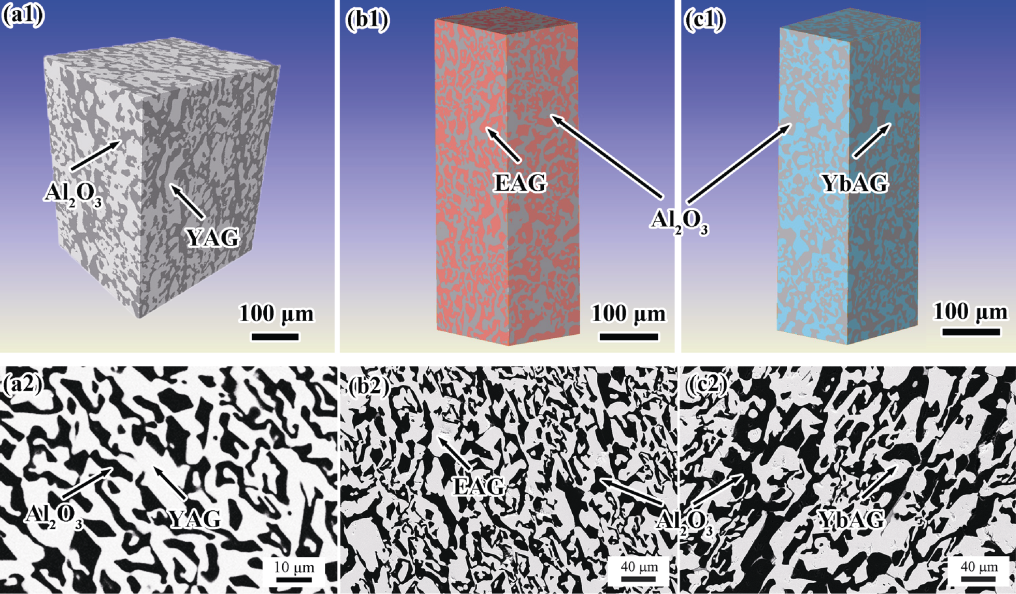
Fig. 1 Typical microstructure of Al2O3-based directionally solidified eutectic ceramics[28-30] (a1-c1) Three-dimensional network structure of (a1) YAG/Al2O3[28-29], (b1) Er3Al5O12 (EAG)/Al2O3[30] and (c1) Yb3Al5O12 (YbAG)/Al2O3[30]; (a2-c2) SEM morphologies of transverse section of (a2) YAG/Al2O3[28-29], (b2) EAG/Al2O3[30] and (c2) YbAG/Al2O3[30]
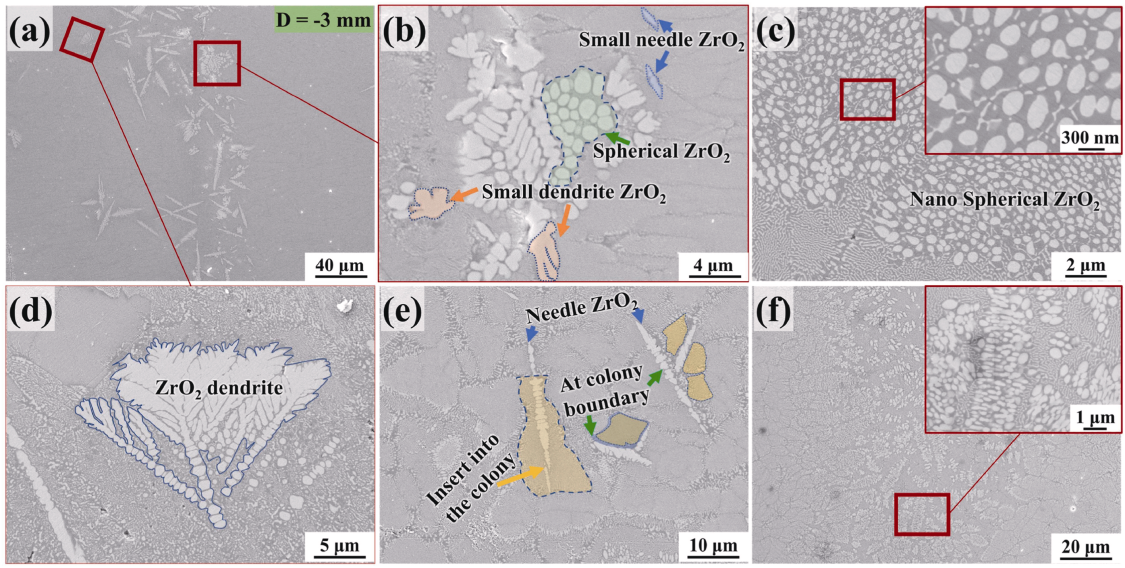
Fig. 2 Microstructure of top surface of LPBF-fabricated sample[38] (a) Needle-like ZrO2 settlement in the center of the molten pool; (b) Imperfectly needle-like ZrO2; (c) Colony eutectic with nano spherical ZrO2 structure; (d) Dendritic ZrO2 located in colony eutectic structure; (e) Needle-like structure ZrO2 located in colony eutectic structure; (f) Aggregation, growth, and elongation of nano spherical ZrO2
| Eutectic system | Preparation method | Crystallographic relationship | |
|---|---|---|---|
| Growth direction | Interface relationship | ||
| YAG/Al2O3[ | MLSPM | < | (121) YAG // (0001) Al2O3 |
| YAG/Al2O3[ | OFZM | <011> YAG // < | ( |
| YAG/Al2O3[ | LFZM | <111> YAG // < | ( |
| YAG/Al2O3[ | Bridgman | <101> YAG // < | ( |
| YAG/Al2O3[ | Bridgman | <110> YAG // < | ( |
| REAG/Al2O3[ | OFZM | <110> or < | (121) REAG// (0001) Al2O3 (RE=Y, Yb, Er, Dy) |
| YAG:Ce3+/Al2O3[ | LFZM | < | (220) YAG:Ce3+ // ( |
| YAG/Al2O3/ZrO2[ | OFZM | <001> YAG // < | (001) YAG // (0001) Al2O3 // (100) ZrO2 |
| YAG/Al2O3/ZrO2[ | OFZM | <001> YAG // < | (001) YAG // ( |
| YAG/Al2O3/ZrO2[ | μ-PD | <100> YAG // < | ( |
| ZrO2/Al2O3[ | CZ/OFZM | <010>/<001> ZrO2 // <0001>/< | (100) ZrO2 // ( |
| ZrO2/Al2O3[ | CZ/OFZM | <001> ZrO2 // < | (100)/(010) ZrO2 // ( |
| ZrO2/Al2O3[ | LHFZ | <011> ZrO2 // <0001> Al2O3 | (200) ZrO2 // ( |
Table 1 Crystallographic relationships in Al2O3-based directionally solidified eutectic ceramics fabricated via various methods[21,25,44 -53]
| Eutectic system | Preparation method | Crystallographic relationship | |
|---|---|---|---|
| Growth direction | Interface relationship | ||
| YAG/Al2O3[ | MLSPM | < | (121) YAG // (0001) Al2O3 |
| YAG/Al2O3[ | OFZM | <011> YAG // < | ( |
| YAG/Al2O3[ | LFZM | <111> YAG // < | ( |
| YAG/Al2O3[ | Bridgman | <101> YAG // < | ( |
| YAG/Al2O3[ | Bridgman | <110> YAG // < | ( |
| REAG/Al2O3[ | OFZM | <110> or < | (121) REAG// (0001) Al2O3 (RE=Y, Yb, Er, Dy) |
| YAG:Ce3+/Al2O3[ | LFZM | < | (220) YAG:Ce3+ // ( |
| YAG/Al2O3/ZrO2[ | OFZM | <001> YAG // < | (001) YAG // (0001) Al2O3 // (100) ZrO2 |
| YAG/Al2O3/ZrO2[ | OFZM | <001> YAG // < | (001) YAG // ( |
| YAG/Al2O3/ZrO2[ | μ-PD | <100> YAG // < | ( |
| ZrO2/Al2O3[ | CZ/OFZM | <010>/<001> ZrO2 // <0001>/< | (100) ZrO2 // ( |
| ZrO2/Al2O3[ | CZ/OFZM | <001> ZrO2 // < | (100)/(010) ZrO2 // ( |
| ZrO2/Al2O3[ | LHFZ | <011> ZrO2 // <0001> Al2O3 | (200) ZrO2 // ( |
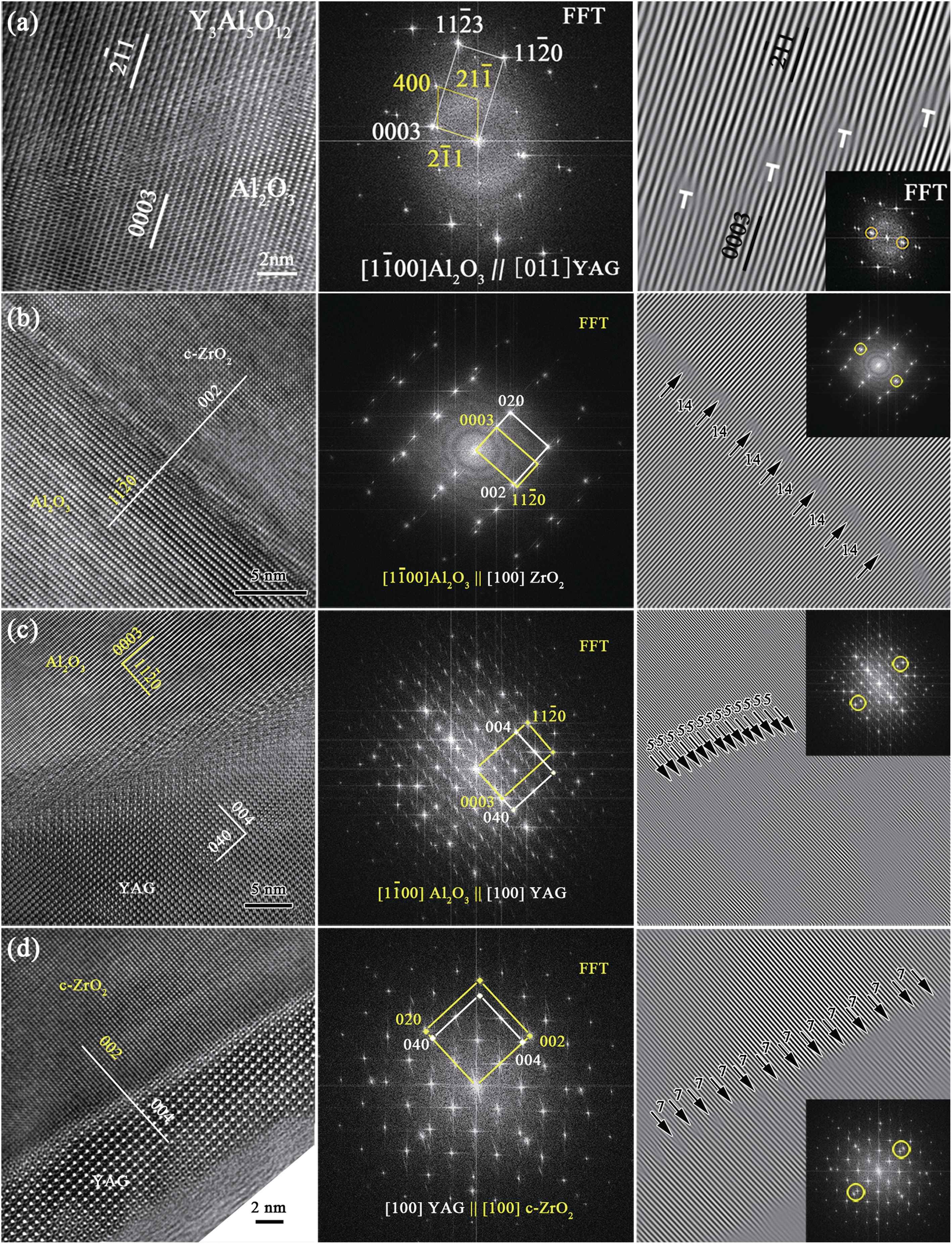
Fig. 3 High-resolution transmission electron microscope images of interface in Al2O3-based directionally solidified eutectic ceramics[25,50] (a) YAG/Al2O3[25]; (b-d) YAG/Al2O3/ZrO2[50]
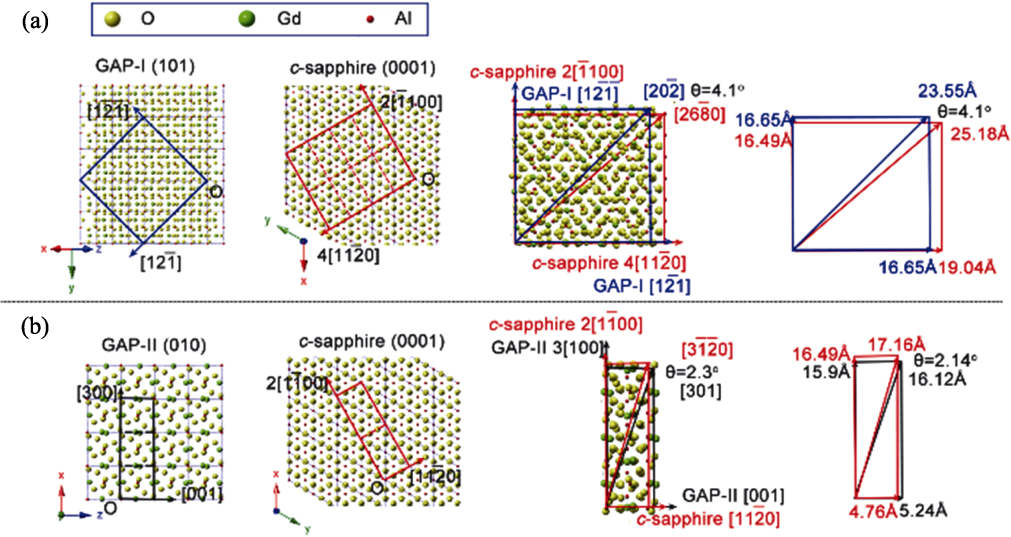
Fig. 4 Schematic illustrations of lattice mismatch in GAP/Al2O3 directionally solidified eutectic ceramics[42] (a) (101) GAP // (0001) Al2O3; (b) (010) GAP // (0001) Al2O3
| Eutectic system | Preparation method | C=λ·v1/2/(μm1.5·s-0.5) | Microstructure |
|---|---|---|---|
| YAG/Al2O3[ | OFZM | 11.6 | Chinese script |
| YAG/Al2O3[ | Bridgman | 44.7 | Chinese script/Cellular structure |
| YAG/Al2O3[ | EBFZM | 6.7 | Chinese script/Lamellar structure |
| YAG/Al2O3[ | LHFZ | 10 | Chinese script |
| YAG/Al2O3[ | μ-PD | 10 | Chinese script |
| YbAG/Al2O3[ | LFZM | 11.5 | Chinese script |
| EAG/Al2O3[ | LHFZ | 11.6 | Chinese script |
| Al2O3/YAG:Ce3+[ | LFZM | 22.0 | Chinese script/Cellular structure |
| YAG/Al2O3/ZrO2[ | μ-PD | 8 | Chinese script/Geometric structure |
| YAG/Al2O3/ZrO2[ | μ-PD | 8 | Chinese script |
| YAG/Al2O3/ZrO2[ | LFZM | 12.4 | Chinese script/Cellular structure |
| YAG/Al2O3/ZrO2[ | LFZM | 14.7 | Chinese script/Cellular structure |
| YAG/Al2O3/ZrO2[ | μ-PD | 6.5 | Chinese script |
| YAG/Al2O3/ZrO2[ | EBFZM | 5.3 | Chinese script/Cellular structure |
| ZrO2/Al2O3[ | Laser 3D printing | 1 | Chinese script/Cellular structure |
Table 2 Eutectic systems, preparation methods, λv1/2 and microstructures of some Al2O3-based eutectic ceramics[10,19 -20,22,46,49,61 -68]
| Eutectic system | Preparation method | C=λ·v1/2/(μm1.5·s-0.5) | Microstructure |
|---|---|---|---|
| YAG/Al2O3[ | OFZM | 11.6 | Chinese script |
| YAG/Al2O3[ | Bridgman | 44.7 | Chinese script/Cellular structure |
| YAG/Al2O3[ | EBFZM | 6.7 | Chinese script/Lamellar structure |
| YAG/Al2O3[ | LHFZ | 10 | Chinese script |
| YAG/Al2O3[ | μ-PD | 10 | Chinese script |
| YbAG/Al2O3[ | LFZM | 11.5 | Chinese script |
| EAG/Al2O3[ | LHFZ | 11.6 | Chinese script |
| Al2O3/YAG:Ce3+[ | LFZM | 22.0 | Chinese script/Cellular structure |
| YAG/Al2O3/ZrO2[ | μ-PD | 8 | Chinese script/Geometric structure |
| YAG/Al2O3/ZrO2[ | μ-PD | 8 | Chinese script |
| YAG/Al2O3/ZrO2[ | LFZM | 12.4 | Chinese script/Cellular structure |
| YAG/Al2O3/ZrO2[ | LFZM | 14.7 | Chinese script/Cellular structure |
| YAG/Al2O3/ZrO2[ | μ-PD | 6.5 | Chinese script |
| YAG/Al2O3/ZrO2[ | EBFZM | 5.3 | Chinese script/Cellular structure |
| ZrO2/Al2O3[ | Laser 3D printing | 1 | Chinese script/Cellular structure |
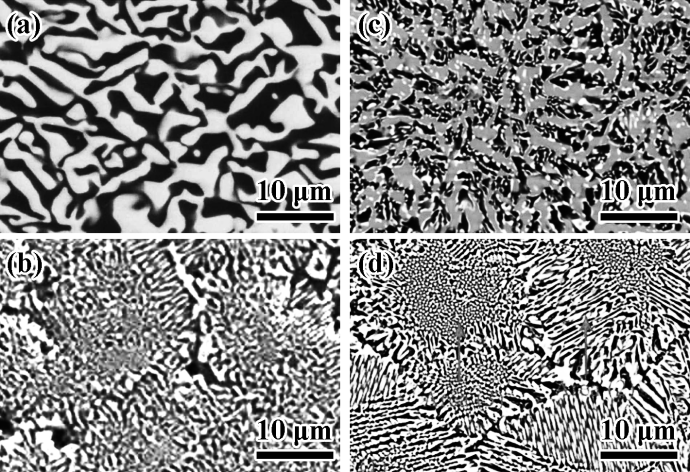
Fig. 5 Transversal sections of Al2O3-based directionally solidified eutectic ceramics fabricated via laser zone melting method[75]
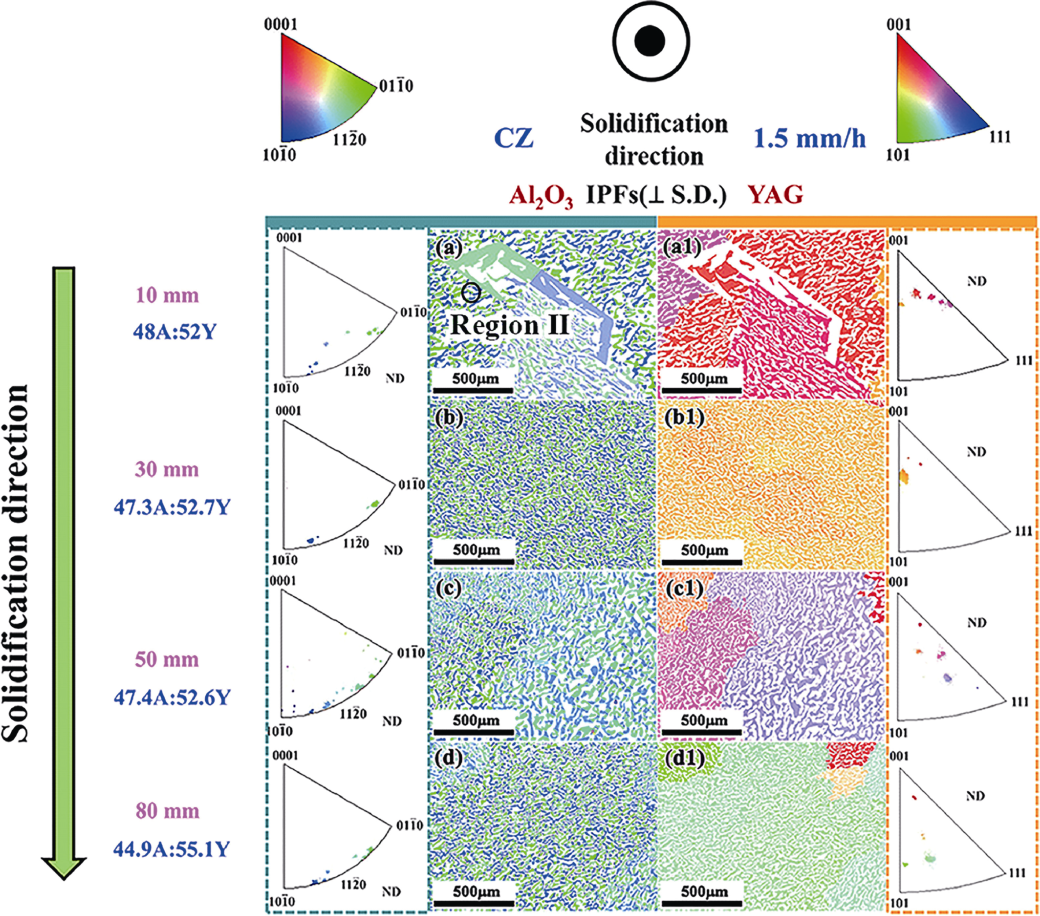
Fig. 6 Crystallographic orientation electron back scatter diffraction (EBSD) images and corresponding inverse pole figures of YAG/Al2O3 eutectic ceramics obtained at various distances from polycrystalline Al2O3 seed[77] (a-d) Al2O3 phase; (a1-d1) YAG phase
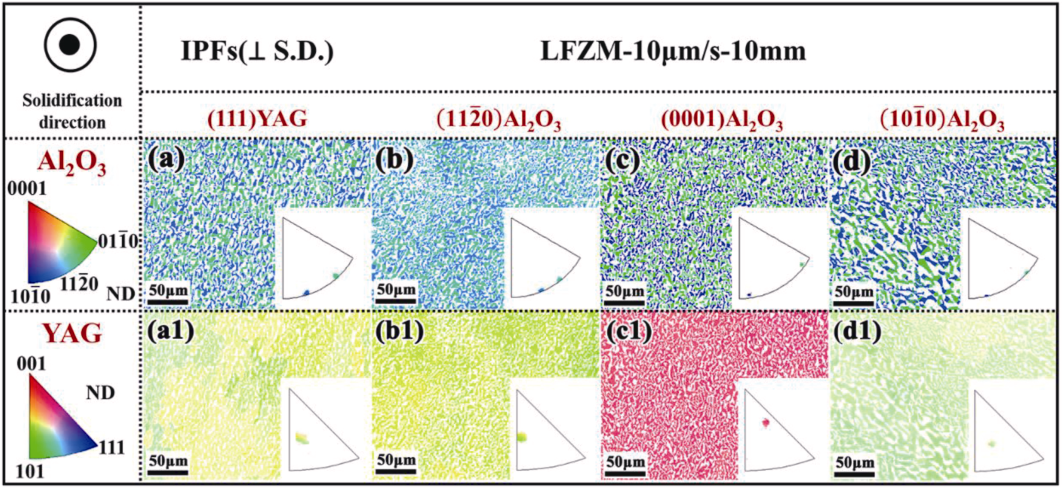
Fig. 7 EBSD images and corresponding inverse pole figures of YAG/Al2O3 eutectic ceramics after growing 10 mm induced by different single crystal seeds[79] (a-d) Al2O3 phase; (a1-d1) YAG phase
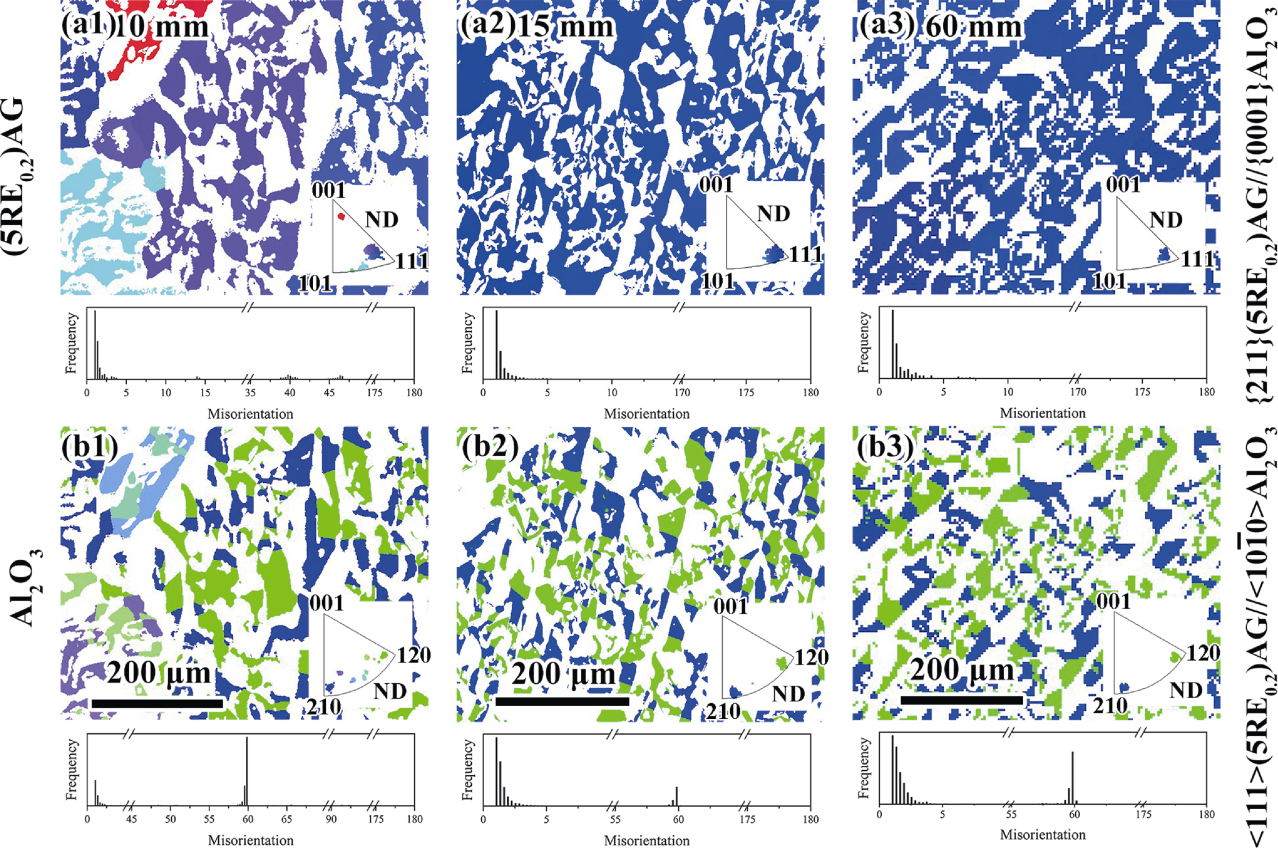
Fig. 8 Typical EBSD images and corresponding inverse pole figures of (Y0.2Gd0.2Ho0.2Er0.2Yb0.2)3Al5O12/Al2O3 eutectic ceramics at different positions from seed crystal[88]
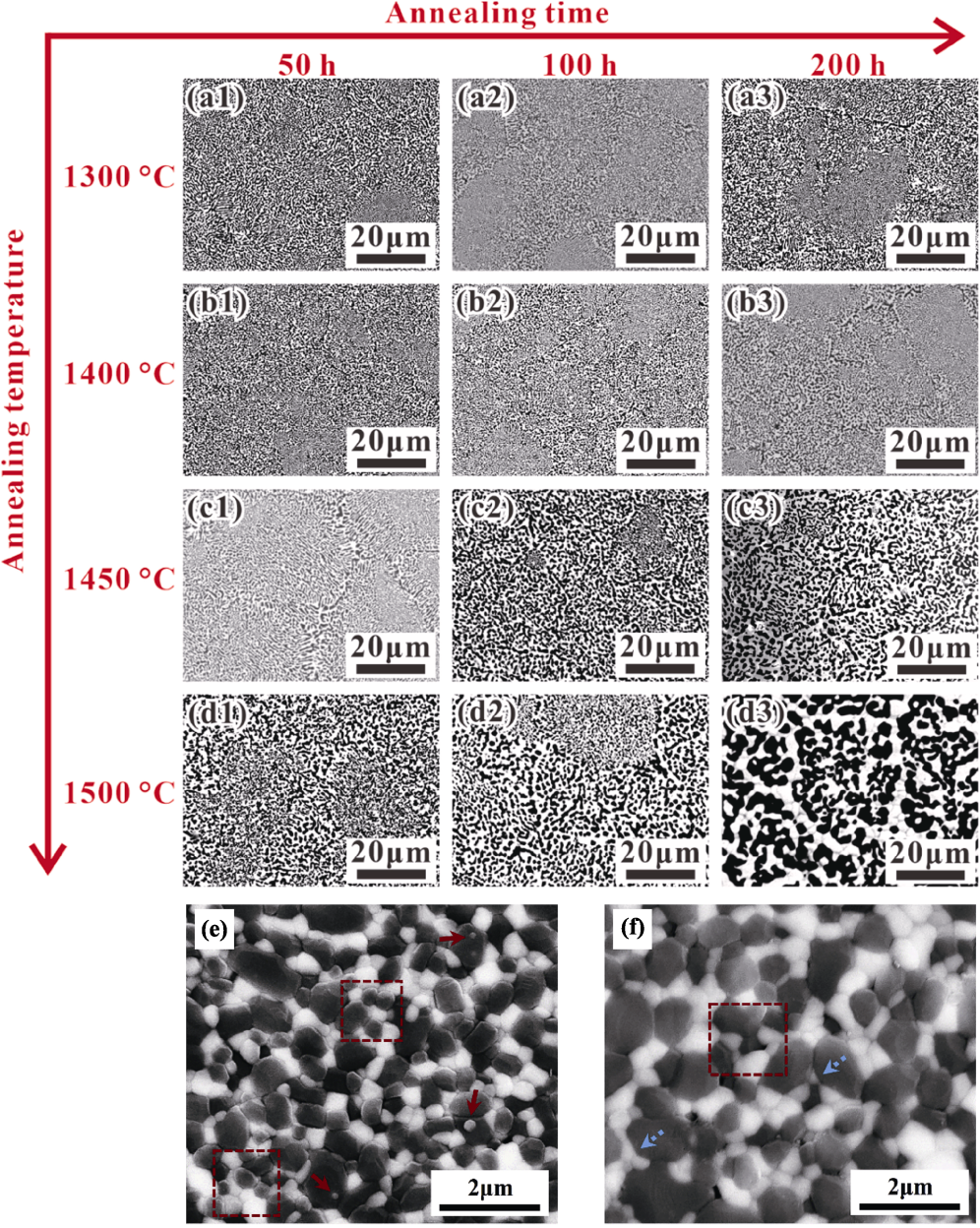
Fig. 9 (a1-d3) Surface scanning electron microscope (SEM) images of Al2O3-based directionally solidified eutectic ceramics subjected to various heat treatment temperatures and durations[93]; (e, f) Surface SEM images of Al2O3-based eutectic ceramics sintered at (e) 1450 and (f) 1500 ℃[94]
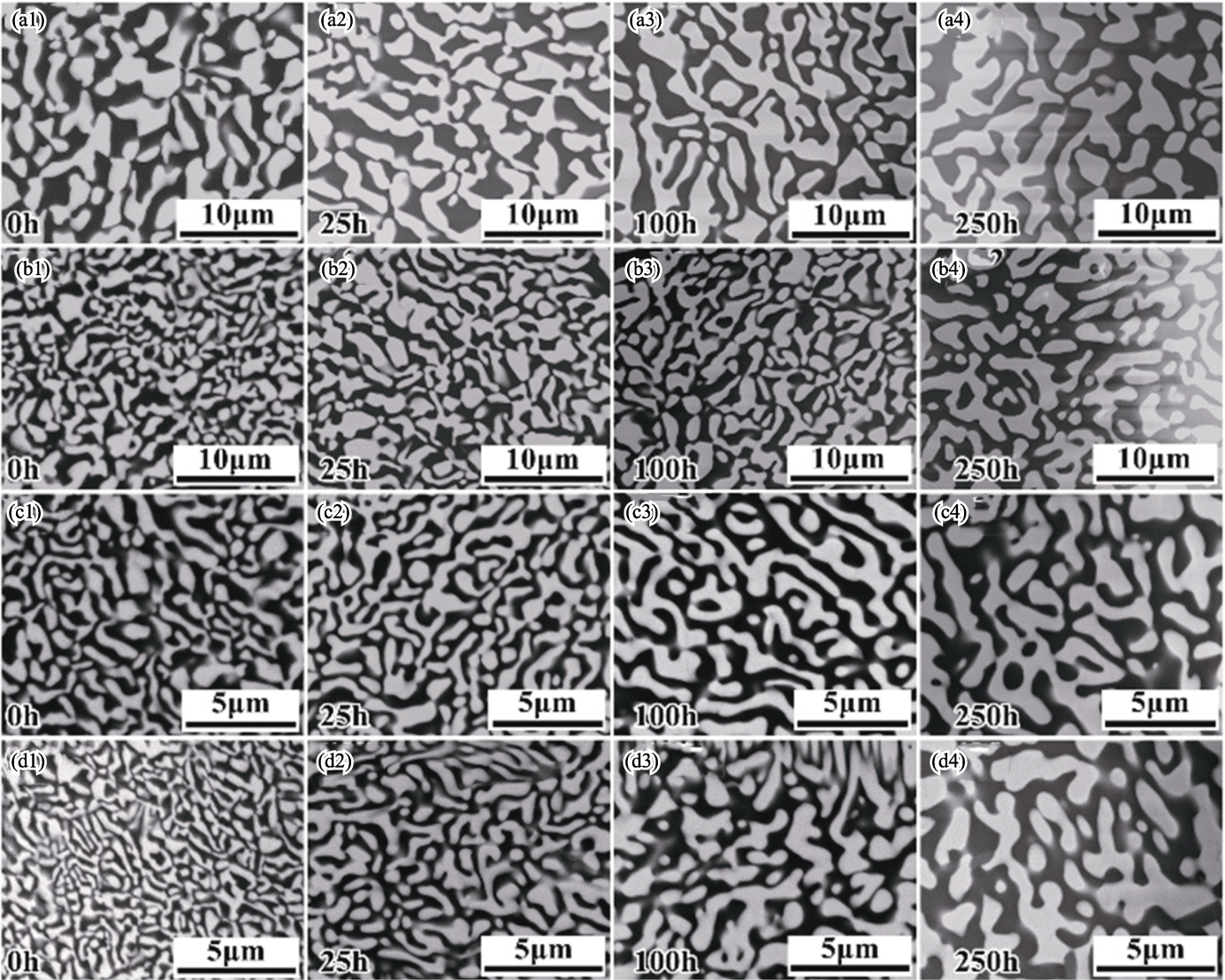
Fig. 10 Microstructural evolution of GAP/Al2O3 eutectic ceramics fabricated under various growth rates before and after heat treatment at 1773 K[96] (a1-a4) 2 μm/s; (b1-b4) 16 μm/s; (c1-c4) 50 μm/s; (d1-d4) 100 μm/s
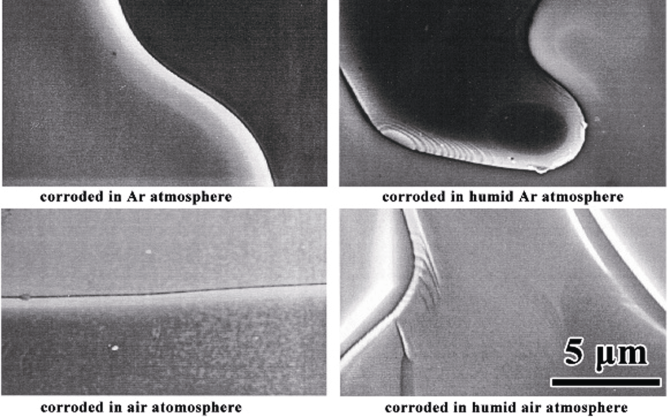
Fig. 11 SEM images of the YAG/Al2O3 interface after 10 h of corrosion at 1800 ℃ in different atmospheres[100]
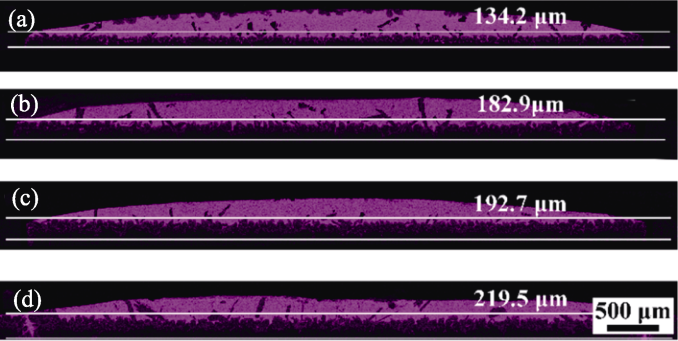
Fig. 12 Ca elemental mappings of the cross-section of (Y0.2Gd0.2Ho0.2Er0.2Yb0.2)3Al5O12/Al2O3 eutectic ceramics after CMAS corrosion at 1500 ℃ for different durations[102] (a) 4 h; (b) 50 h; (c) 100 h; (d) 200 h
| [1] | 杜昆, 陈麒好, 孟宪龙, 等. 陶瓷基复合材料在航空发动机热端部件应用及热分析研究进展. 推进技术, 2022, 43(2): 113. |
| [2] | 林左鸣. 战斗机发动机的研制现状和发展趋势. 航空发动机, 2006, 32(1): 1. |
| [3] |
PEREPEZKO J H. The hotter the engine, the better. Science, 2009, 326(5956): 1068.
DOI URL |
| [4] |
PADTURE N P. Advanced structural ceramics in aerospace propulsion. Nature Materials, 2016, 15(8): 804.
DOI PMID |
| [5] | 杨金华, 董禹飞, 杨瑞, 等. 航空发动机用陶瓷基复合材料研究进展. 航空动力, 2021, 5: 56. |
| [6] |
WAKU Y, NAKAGAWA N, WAKAMOTO T, et al. A ductile ceramic eutectic composite with high strength at 1873 K. Nature, 1997, 389(6646): 49.
DOI |
| [7] |
WAKU Y, NAKAGAWA N, OHTSUBO H, et al. Fracture and deformation behaviour of melt growth composites at very high temperatures. Journal of Materials Science, 2001, 36(7): 1585.
DOI |
| [8] |
WANG Z G, ZHANG Y Z, OUYANG J H, et al. Nanocrystalline alumina-zirconia-based eutectic ceramics fabricated with high- energy beams: principle, solidification techniques, microstructure and mechanical properties. Materials, 2023, 16(8): 2985.
DOI URL |
| [9] |
REN Q, SU H J, ZHANG J, et al. Processing, microstructure and performance of Al2O3/Er3Al5O12/ZrO2 ternary eutectic ceramics prepared by laser floating zone melting with ultra-high temperature gradient. Ceramics International, 2018, 44(5): 4766.
DOI URL |
| [10] |
MESA M C, OLIETE P B, ORERA V M, et al. Microstructure and mechanical properties of Al2O3/Er3Al5O12 eutectic rods grown by the laser-heated floating zone method. Journal of the European Ceramic Society, 2011, 31(7): 1241.
DOI URL |
| [11] |
VIECHNICKI D, SCHMID F. Eutectic solidification in the system Al2O3/Y3Al5O12. Journal of Materials Science, 1969, 4(1): 84.
DOI URL |
| [12] |
LIU J L, LIU D G, REN K, et al. Research progress on the flash sintering mechanism of oxide ceramics and its application. Journal of Inorganic Materials, 2022, 37(5): 473.
DOI |
| [13] |
XIONG Z W, ZHANG K, LIAO W H, et al. Laser powder bed fusion fabrication of TiB2-modified Al2O3-ZrO2 eutectic ceramics: microstructure evolution and mechanical properties. Ceramics International, 2024, 50(24): 55577.
DOI URL |
| [14] |
AOKI Y, MASUDA H, TOCHIGI E, et al. Overcoming the intrinsic brittleness of high-strength Al2O3-GdAlO3 ceramics through refined eutectic microstructure. Nature Communications, 2024, 15: 8700.
DOI |
| [15] |
YOSHIMURA M, SAKATA S I, YAMADA S, et al. The growth of Al2O3/YAG:Ce melt growth composite by the vertical bridgman technique using an a-axis Al2O3 seed. Journal of Crystal Growth, 2015, 427: 16.
DOI URL |
| [16] |
YOSHIMURA M, SAKATA S I, IBA H, et al. Vertical bridgman growth of Al2O3/YAG:Ce melt growth composite. Journal of Crystal Growth, 2015, 416: 100.
DOI URL |
| [17] |
LIU Y, SU H J, TAN X, et al. Stability of crystallographic texture and mechanical anisotropy toward Al2O3/YAG eutectic ceramic composite using single crystalline seeds. Composites Part B: Engineering, 2024, 274: 111263.
DOI URL |
| [18] |
CHERIF M, DUFFAR T, CARROZ L, et al. On the growth and structure of Al2O3-Y3Al5O12-ZrO2: Y solidified eutectic. Journal of the European Ceramic Society, 2020, 40(8): 3172.
DOI URL |
| [19] | EPELBAUM B M, YOSHIKAWA A, SHIMAMURA K, et al. Microstructure of Al2O3/Y3Al5O12 eutectic fibers grown by μ-PD method. Journal of Crystal Growth, 1999, 198: 471. |
| [20] |
BENAMARA O, CHERIF M, DUFFAR T, et al. Microstructure and crystallography of Al2O3-Y3Al5O12-ZrO2 ternary eutectic oxide grown by the micropulling down technique. Journal of Crystal Growth, 2015, 429: 27.
DOI URL |
| [21] |
BENAMARA O, LEBBOU K. The impact of the composition and solidification rate on the microstructure and the crystallographic orientations of Al2O3-YAG-ZrO2 eutectic solidified by the micro- pulling down technique. RSC Advances, 2021, 11(22): 13602.
DOI URL |
| [22] |
SU H J, ZHANG J, DENG Y F, et al. A modified preparation technique and characterization of directionally solidified Al2O3/Y3Al5O12 eutectic in situ composites. Scripta Materialia, 2009, 60(6): 362.
DOI URL |
| [23] |
REN Q, SU H J, ZHANG J, et al. Solid-liquid interface and growth rate range of Al2O3-based eutectic in situ composites grown by laser floating zone melting. Journal of Alloys and Compounds, 2016, 662: 634.
DOI URL |
| [24] |
SU H J, SHEN Z L, REN Q, et al. Evolutions of rod diameter, molten zone and temperature gradient of oxide eutectic ceramics during laser floating zone melting. Ceramics International, 2020, 46(11): 18750.
DOI URL |
| [25] |
WANG X, WANG J Y, SUN L C, et al. Microstructure evolution of Al2O3/Y3Al5O12 eutectic crystal during directional solidification. Scripta Materialia, 2015, 108: 31.
DOI URL |
| [26] |
LIU Y, SU H J, TAN X, et al. The effect of processing parameters on the temperature distribution and interface shape in Czochralski growth of Al2O3/YAG eutectic ceramic composite: modeling and experiment. Ceramics International, 2025, 51(22): 36401.
DOI URL |
| [27] |
WAKU Y, SAKATA S, MITANI A, et al. Microstructure and high- temperature strength of Al2O3/Er3Al5O12/ZrO2 ternary melt growth composite. Journal of Materials Science, 2005, 40(3): 711.
DOI URL |
| [28] |
WANG X, TIAN Z L, ZHANG W, et al. Mechanical properties of directionally solidified Al2O3/Y3Al5O12 eutectic ceramic prepared by optical floating zone technique. Journal of the European Ceramic Society, 2018, 38(10): 3610.
DOI URL |
| [29] |
WANG X, ZHONG Y J, WANG D, et al. Effect of interfacial energy on microstructure of a directionally solidified Al2O3/YAG eutectic ceramic. Journal of the American Ceramic Society, 2018, 101(3): 1029.
DOI URL |
| [30] |
SUN L C, ZHOU C, DU T F, et al. Directionally solidified Al2O3/Er3Al5O12 and Al2O3/Yb3Al5O12 eutectic ceramics prepared by optical floating zone melting. Journal of Inorganic Materials, 2021, 36(6): 652.
DOI URL |
| [31] | JACSON K A, HUNT J D. Lamellar and rod eutectic growth. Transactions of the Metallurgical Society of AIME, 1966, 236(8): 363. |
| [32] |
SU H J, ZHANG J, CUI C J, et al. Rapid solidification of Al2O3/Y3Al5O12/ZrO2 eutectic in situ composites by laser zone remelting. Journal of Crystal Growth, 2007, 307(2): 448.
DOI URL |
| [33] |
ORERA V M, MERINO R I, PARDO J A, et al. Microstructure and physical properties of some oxide eutectic composites processed by directional solidification. Acta Materialia, 2000, 48(18/19): 4683.
DOI URL |
| [34] |
LLORCA J, ORERA V M.Directionally solidified eutectic ceramic oxides. Progress in Materials Science, 2006, 51(6): 711.
DOI URL |
| [35] |
SUN J Z, STIRNER T, MATTHEWS A. Structure and surface energy of low-index surfaces of stoichiometric α-Al2O3 and α-Cr2O3. Surface and Coatings Technology, 2006, 201(7): 4205.
DOI URL |
| [36] |
SUN H F, ZHOU C, DU T F, et al. Preparation, microstructures, and mechanical properties of directionally solidified Al2O3/Lu3Al5O12 eutectic ceramics. International Journal of Applied Ceramic Technology, 2022, 19(2): 695.
DOI URL |
| [37] |
XU X, FAN J Y, LIU J L, et al. Formation of eutectic structure in dense Al2O3-YAG composite by electric field treatment. Ceramics International, 2021, 47(16): 23647.
DOI URL |
| [38] |
XIONG Z W, ZHANG K, ZHU Z G, et al. Effect of laser focus shift on the forming quality, microstructure and mechanical properties of additively manufactured Al2O3-ZrO2 eutectic ceramics. Ceramics International, 2023, 49(22): 35948.
DOI URL |
| [39] |
YAO S, LIU D G, LIU J L, et al. Ultrafast preparation of Al2O3- ZrO2 multiphase ceramics with eutectic morphology via flash sintering. Ceramics International, 2021, 47(22): 31555.
DOI URL |
| [40] |
YAO S, LIU Y S, LIU D G, et al. Flash sintering of Al2O3-ZrO2 ceramics under alternating current electric field. Ceramics International, 2022, 48(24): 36764.
DOI URL |
| [41] | WANG X, ZHONG Y J, HU Q D. A review of Al2O3-based eutectic ceramics for high-temperature structural materials. Journal of Materials Science & Technology, 2025, 214: 214. |
| [42] |
ZHONG Y J, YUAN Y, LI H D, et al. Orientation relationships of seed crystal-induced Al2O3/GdAlO3 eutectic ceramics. Acta Materialia, 2025, 294: 121094.
DOI URL |
| [43] |
WANG X, ZHANG W, ZHONG Y J, et al. Introduction of low strain energy GdAlO3 grain boundaries into directionally solidified Al2O3/GdAlO3 eutectics. Acta Materialia, 2021, 221: 117355.
DOI URL |
| [44] |
SU H J, ZHANG J, MA W D, et al. In situ fabrication of highly-dense Al2O3/YAG nanoeutectic composite ceramics by a modified laser surface processing. Journal of the European Ceramic Society, 2014, 34(3): 739.
DOI URL |
| [45] |
LIU Y, SU H J, SHEN Z L, et al. Insight into the complex coupled growth behavior of Al2O3/YAG eutectic ceramic based on the evolutions of microstructure and crystallographic texture. Journal of the European Ceramic Society, 2023, 43(10): 4482.
DOI URL |
| [46] |
WANG X, ZHANG W, XIAN Q G, et al. Preparation and microstructure of large-sized directionally solidified Al2O3/Y3Al5O12 eutectics with the seeding technique. Journal of the European Ceramic Society, 2018, 38(16): 5625.
DOI URL |
| [47] |
SAKATA S, MITANI A, SHIMIZU K, et al. Crystallographic orientation analysis and high temperature strength of melt growth composite. Journal of the European Ceramic Society, 2005, 25(8): 1441.
DOI URL |
| [48] |
MAZEROLLES L, PERRIERE L, LARTIGUE-KORINEK S, et al. Microstructures, crystallography of interfaces, and creep behavior of melt-growth composites. Journal of the European Ceramic Society, 2008, 28(12): 2301.
DOI URL |
| [49] |
LIU Y, SU H J, LU Z, et al. Collaborative enhancement of luminous efficacy and fracture toughness based on interface design of Al2O3/YAG:Ce3+ eutectic phosphor ceramic grown by laser floating zone melting. Ceramics International, 2022, 48(7): 10144.
DOI URL |
| [50] |
WANG X, ZHONG Y J, SUN Q, et al. Competitive growth of Al2O3/YAG/ZrO2 eutectic ceramics during directional solidification: effect of interfacial energy. Journal of the American Ceramic Society, 2019, 102(4): 2176.
DOI URL |
| [51] |
MAZEROLLES L, MICHEL D, HŸTCH M J. Microstructures and interfaces in directionally solidified oxide-oxide eutectics. Journal of the European Ceramic Society, 2005, 25(8): 1389.
DOI URL |
| [52] |
MAZEROLLES L, MICHEL D, PORTIER R. Interfaces in oriented Al2O3-ZrO2 (Y2O3) eutectics. Journal of the American Ceramic Society, 1986, 69(3): 252.
DOI URL |
| [53] |
SAYIR A, FARMER S C. The effect of the microstructure on mechanical properties of directionally solidified Al2O3/ZrO2(Y2O3) eutectic. Acta Materialia, 2000, 48(18/19): 4691.
DOI URL |
| [54] | KURZ W, FISHER D J, RAPPAZ M. Fundamentals of solidification 5th edition. Switzerland: Trans Tech Publications Ltd., 2023, 103(5): 372. |
| [55] |
MA Y H, WANG Z G, OUYANG J H, et al. In-situ microcantilever deflection to evaluate the interfacial fracture properties of binary Al2O3/SmAlO3 eutectic. Journal of the European Ceramic Society, 2019, 39(10): 3277.
DOI URL |
| [56] | 沈强, 吴信婷, 魏琴琴, 等. 高密度高温高熵合金与陶瓷共晶复合材料的研究进展. 硅酸盐学报, 2024, 52(2): 463. |
| [57] |
GAO R, CHU Z F, WANG S H, et al. The evolution of Al2O3/GdAlO3/ZrO2 ternary eutectic ceramic microstructure and property with the growth rate. Journal of Materials Research, 2024, 39(5): 801.
DOI |
| [58] |
ZHANG Y Z, WANG Z G, XIE L Y, et al. Laser surface nanocrystallization of oxide ceramics with eutectic composition: a comprehensive review. Heat Treatment and Surface Engineering, 2021, 3(1): 37.
DOI URL |
| [59] |
XIE L Y, WANG Z G, ZHANG Y Z, et al. Microstructural refinement and mechanical response of Al2O3-ZrO2 eutectics fabricated by a novel pulse discharge plasma assisted melting method. Ceramics International, 2022, 48(16): 23510.
DOI URL |
| [60] |
ZHONG Y J, LIU Y R, GAO Q, et al. Microstructure of directionally solidified Al2O3/EAG eutectic ceramics prepared with high-temperature gradient. Ceramics International, 2021, 47(4): 5456.
DOI URL |
| [61] |
PASTOR J Y, LLORCA J, SALAZAR A, et al. Mechanical properties of melt-grown alumina-yttrium aluminum garnet eutectics up to 1900 K. Journal of the American Ceramic Society, 2005, 88(6): 1488.
DOI URL |
| [62] |
OLIETE P B, MESA M C, MERINO R I, et al. Directionally solidified Al2O3-Yb3Al5O12 eutectics for selective emitters. Solar Energy Materials and Solar Cells, 2016, 144: 405.
DOI URL |
| [63] |
LEE J H, YOSHIKAWA A, MURAYAMA Y, et al. Microstructure and mechanical properties of Al2O3/Y3Al5O12/ZrO2 ternary eutectic materials. Journal of the European Ceramic Society, 2005, 25(8): 1411.
DOI URL |
| [64] |
LEE J H, YOSHIKAWA A, FUKUDA T, et al. Growth and characterization of Al2O3/Y3Al5O12/ZrO2 ternary eutectic fibers. Journal of Crystal Growth, 2001, 231(1/2): 115.
DOI URL |
| [65] |
贾晓娇, 张军, 苏海军, 等. 激光悬浮区熔Al2O3基共晶自生复合材料微观组织与力学性能. 金属学报, 2012, 48(12): 1479.
DOI |
| [66] |
SONG K, ZHANG J, JIA X J, et al. Microstructure of Al2O3/ YAG/ZrO2 hypereutectic alloy directionally solidified by laser floating zone method. Acta Metallurgica Sinica, 2012, 48(2): 220.
DOI |
| [67] |
SU H J, ZHANG J, LIU L, et al. Preparation and microstructure evolution of directionally solidified Al2O3/YAG/YSZ ternary eutectic ceramics by a modified electron beam floating zone melting. Materials Letters, 2013, 91: 92.
DOI URL |
| [68] | LIU Z, SONG K, GAO B, et al. Microstructure and mechanical properties of Al2O3/ZrO2 directionally solidified eutectic ceramic prepared by laser 3D printing. Journal of Materials Science & Technology, 2016, 32(4): 320. |
| [69] | CAO X, SU H J, GUO F W, et al. Directionally solidified Al2O3/GAP eutectic ceramics by micro-pulling-down method. AIP Conference Proceddings, 2016, 1783: 020021. |
| [70] |
ZHAO D, SU H J, LU B H, et al. Ultra-high strength micro-nano quasi-monocrystalline Al2O3/Y3Al5O12/ZrO2 ternary eutectic ceramics processed by high-speed directional solidification. Journal of the European Ceramic Society, 2025, 45(13): 117485.
DOI URL |
| [71] |
YAO S, LIU Y S, LIU D G, et al. Effect of the Al2O3 content on the microstructure evolution of flash-sintered Al2O3-8YSZ ceramics. Open Ceramics, 2023, 16: 100468.
DOI URL |
| [72] |
WU D J, YU X X, ZHAO Z Y, et al. One-step additive manufacturing of TiCp reinforced Al2O3-ZrO2 eutectic ceramics composites by laser directed energy deposition. Ceramics International, 2023, 49(8): 12758.
DOI URL |
| [73] |
WU D J, SHI J, NIU F Y, et al. Direct additive manufacturing of melt growth Al2O3-ZrO2 functionally graded ceramics by laser directed energy deposition. Journal of the European Ceramic Society, 2022, 42(6): 2957.
DOI URL |
| [74] |
WANG S H, LIU J C. Microstructure and growth characteristics of Al2O3/Er2O3/ZrO2 solidified ceramics with different compositions. Journal of the European Ceramic Society, 2021, 41(7): 4284.
DOI URL |
| [75] |
WANG S H, PEÑA J I, LUN Z Y, et al. Optimization of growth theory of the directionally solidified alumina based eutectic ceramics. Journal of Alloys and Compounds, 2024, 982: 173783.
DOI URL |
| [76] | SU H J, LIU Y, REN Q, et al. Distribution control and formation mechanism of gas inclusions in directionally solidified Al2O3-Er3Al5O12-ZrO2 ternary eutectic ceramic by laser floating zone melting. Journal of Materials Science & Technology, 2021, 66: 21. |
| [77] | LIU Y, SU H J, SHEN Z L, et al. Effect of seed orientations on crystallographic texture control in faceted Al2O3/YAG eutectic ceramic during directional solidification. Journal of Materials Science & Technology, 2023, 146: 86. |
| [78] | ZHOU C, SUN L C, DU T F, et al. Microstructure, crystallographic texture and mechanical properties of directionally solidified high-entropy (Y0.2Gd0.2Ho0.2Er0.2Yb0.2)AG/Al2O3 eutectic oxides: insights of growth rate control. Journal of Materials Science & Technology, 2026, 252: 232. |
| [79] |
LIU Y, SU H J, TAN X, et al. Unveiling crystallographic texture in laser floating zone melted Al2O3/YAG eutectic ceramic by seed- crystal inducing. Ceramics International, 2024, 50(20): 40185.
DOI URL |
| [80] | HE L T, WANG X, LI J Z, et al. Can orientations of directionally solidified dual-phase Al2O3/YAG eutectics be induced by single-phase sapphire seeds? Journal of Materials Science & Technology, 2023, 142: 216. |
| [81] |
HE Z S, XUAN W D, HU T, et al. Development of a novel (Mg0.25Co0.25Ni0.25Zn0.25)O medium entropy oxide for dielectric applications. Ceramics International, 2024, 50(17): 31598.
DOI URL |
| [82] |
CAI J H, LAN S, WEI B, et al. Colossal permittivity in high-entropy CaTiO3 ceramics by chemical bonding engineering. Nature Communications, 2025, 16: 4008.
DOI |
| [83] |
WANG Y C, REECE M J. Oxidation resistance of (Hf-Ta-Zr-Nb)C high entropy carbide powders compared with the component monocarbides and binary carbide powders. Scripta Materialia, 2021, 193: 86.
DOI URL |
| [84] |
SUN J, GUO L X, ZHANG Y Y, et al. Superior phase stability of high entropy oxide ceramic in a wide temperature range. Journal of the European Ceramic Society, 2022, 42(12): 5053.
DOI URL |
| [85] |
SUN L C, REN X M, LUO Y X, et al. Exploration of the mechanism of enhanced CMAS corrosion resistance at 1500 ℃ for multicomponent (Er0.25Tm0.25Yb0.25Lu0.25)2Si2O7 disilicate. Corrosion Science, 2022, 203: 110343.
DOI URL |
| [86] |
LUO Y X, SUN L C, WANG J M, et al. Phase formation capability and compositional design of β-phase multiple rare-earth principal component disilicates. Nature Communications, 2023, 14: 1275.
DOI |
| [87] |
ZHONG Y J, XIANG W S, HE L T, et al. Directionally solidified Al2O3/(Y0.2Er0.2Yb0.2Ho0.2Lu0.2)3Al5O12 eutectic high-entropy oxide ceramics with well-oriented structure, high hardness, and low thermal conductivity. Journal of the European Ceramic Society, 2021, 41(14): 7119.
DOI URL |
| [88] |
ZHOU C, LUO Z P, DU T F, et al. Directionally solidified high-entropy (Y0.2Gd0.2Ho0.2Er0.2Yb0.2)3Al5O12/Al2O3 eutectic with outstanding crystallographic texture formation capability. Scripta Materialia, 2022, 220: 114939.
DOI URL |
| [89] |
ZHONG Y J, LI Z, WANG X. Seed-crystal-induced directional solidification toward Al2O3/(Y0.2Er0.2Yb0.2Ho0.2Lu0.2)3Al5O12/ZrO2 ternary eutectic ceramics. Acta Materialia, 2024, 262: 119369.
DOI URL |
| [90] |
ZHONG Y J, LI Z, WANG X. Insight into tuning of ZrO2 distribution and mechanical properties of directionally solidified Al2O3/(5Re0.2)AG/ZrO2 eutectic ceramic composites. Composites Part B: Engineering, 2023, 266: 111016.
DOI URL |
| [91] |
XIONG Z W, ZHANG K, LIAO W H, et al. In-situ synthesis of high-entropy Al2O3/RE3Al5O12/ZrO2 ceramic by laser powder bed fusion with exceptional properties. Journal of Advanced Ceramics, 2024, 13(12): 2004.
DOI URL |
| [92] |
ZHAO D K, BI G J, CHEN J, et al. Melt-grown behaviour of heat treated high-purity alumina ceramics prepared by laser directed energy deposition. Ceramics International, 2024, 50(1): 1777.
DOI URL |
| [93] |
LIU H F, SU H J, SHEN Z L, et al. Insights into high thermal stability of laser additively manufactured Al2O3/GdAlO3/ZrO2 eutectic ceramics under high temperatures. Additive Manufacturing, 2021, 48: 102425.
DOI URL |
| [94] |
WANG Z G, OUYANG J H, MA Y H, et al. Grain size dependence, mechanical properties and surface nanoeutectic modification of Al2O3-ZrO2 ceramic. Ceramics International, 2019, 45(11): 14297.
DOI URL |
| [95] |
WANG S H, LIU J C, LAN D H, et al. Microstructural stability and high temperature strength of directionally solidified Al2O3/Er3Al5O12/ZrO2 eutectic ceramics. Ceramics International, 2024, 50(1): 306.
DOI URL |
| [96] |
SU H J, SHEN Z L, MA W D, et al. Comprehensive microstructure regularization mechanism and microstructure-property stability at 1773 K of directionally solidified Al2O3/GdAlO3 eutectic ceramic composite. Composites Part B: Engineering, 2023, 256: 110647.
DOI URL |
| [97] |
HAO S Q, SU H J, ZHAO D, et al. Complex shaped Al2O3/YAG/ZrO2 eutectic ceramics with excellent high temperature mechanical properties printed by vat photopolymerization. Additive Manufacturing, 2025, 101: 104703.
DOI URL |
| [98] |
BAKAN E, SOHN Y J, KUNZ W, et al. Effect of processing on high-velocity water vapor recession behavior of Yb-silicate environmental barrier coatings. Journal of the European Ceramic Society, 2019, 39(4): 1507.
DOI URL |
| [99] |
MA Y J, GUO C, CUI Y J, et al. Enhanced water-oxygen corrosion resistance of SiC/SiC composites at 1350 ℃ via a single-layer Y-Al-Si-O glass-ceramics environmental barrier coating. Journal of the European Ceramic Society, 2024, 44(15): 116728.
DOI URL |
| [100] |
BAHLAWANE N, WATANABE T, WAKU Y, et al. Effect of moisture on the high-temperature stability of unidirectionally solidified Al2O3/YAG eutectic composites. Journal of the American Ceramic Society, 2000, 83(12): 3077.
DOI URL |
| [101] |
SUN H F, SUN L C, REN X M, et al. Outstanding molten calcium-magnesium-aluminosilicate (CMAS) corrosion resistance of directionally solidified Al2O3/Y3Al5O12 eutectic ceramic at 1500 ℃. Corrosion Science, 2023, 220: 111289.
DOI URL |
| [102] |
ZHOU C, SUN L C, DU T F, et al. Excellent calcium- magnesium-aluminosilicate corrosion resistance of high-entropy garnet/alumina directionally solidified eutectic at 1500 ℃. Journal of the American Ceramic Society, 2024, 107(3): 1748.
DOI URL |
| [103] | LIU Y, SU H J, SHEN Z L, et al. High temperature calcium- magnesium-alumina-silicate (CMAS) corrosion behavior of directionally solidified Al2O3/YAG eutectic ceramic. Journal of Materials Science & Technology, 2023, 165: 66. |
| [104] |
TAN X, SU H J, LIU Y, et al. CMAS corrosion resistance and mechanism of directionally solidified Al2O3/YAG eutectic ceramics at high temperatures of 1300-1500 ℃. Corrosion Science, 2025, 248: 112793.
DOI URL |
| [105] |
LI J, LUO Z X, CUI Y, et al. CMAS corrosion resistance of Y3Al5O12/Al2O3 ceramic coating deposited by atmospheric plasma spraying. Journal of Inorganic Materials, 2024, 39(6): 671.
DOI URL |
| [1] | QIN Shanli, GUO Jiawen, CHEN Yanmeng, JU An’an, WEI Yi, HUANG Kelin, HOU Xianghua, LÜ Sishi, WEN Zhipeng, WU Lian. Recent Advances in Constructing Oriented Ion Transport Channels with Two-dimensional Layered Materials for Electrochemical Energy Storage [J]. Journal of Inorganic Materials, 2026, 41(7): 883-898. |
| [2] | YU Feiyu, WANG Wenqing, ZHANG Xueqin, HE Rujie. Additively Manufactured Ceramic Lattice-based Interpenetrating Phase Composites: Progress and Challenges [J]. Journal of Inorganic Materials, 2026, 41(7): 849-866. |
| [3] | FEI Wenlong, WANG Yakun, LIAO Liangsheng. Research Progress on Controllable Synthesis of Blue-emitting ZnSeTe Quantum Dots and Quantum-dot Light-emitting Diode Devices [J]. Journal of Inorganic Materials, 2026, 41(7): 867-882. |
| [4] | CHEN Mingjun, MIAO Hongkang, XIAO Yingjun, DENG Jianbo, ZHANG Xiang, ZHAO Jiupeng, LI Yao. Photo- and Thermo-chromic Dual-responsive Materials: A Review on Design Strategies and Applications in Smart Windows [J]. Journal of Inorganic Materials, 2026, 41(6): 723-738. |
| [5] | SONG Kunjie, XIE Rongjun. Research Advances on Machine Learning-driven Development of Novel Luminescent Materials [J]. Journal of Inorganic Materials, 2026, 41(6): 689-703. |
| [6] | HU Yuqing, ZHU Yixin, LE Xianhao, WAN Qing. Lithium Tantalate Wafer: Advances in Thinning Technology and Application in Pyroelectric Infrared Detectors [J]. Journal of Inorganic Materials, 2026, 41(6): 764-774. |
| [7] | LIU Chunfan, CHEN Ke, GE Fangfang, HUANG Qing. Research Progress on Lead-bismuth Eutectic Corrosion Resistant Coatings [J]. Journal of Inorganic Materials, 2026, 41(6): 775-786. |
| [8] | HU Yang, XIE Min, ZHANG Xiaoyi, LI Xiang, GUO Xinwei, JIANG Nan, ZHOU Wenhan, ZHANG Shengli, ZENG Haibo. Research Progress on Computational and Data-driven Environmental-friendly Luminescent Materials [J]. Journal of Inorganic Materials, 2026, 41(6): 704-722. |
| [9] | WANG Junbu, HUANG Zeai, YANG Mingkai, MENG Ying, ZHOU Mingwei, ZHOU Ying. Research Progress on Anti-coking Catalytic Materials for Methane Conversion [J]. Journal of Inorganic Materials, 2026, 41(6): 739-750. |
| [10] | WANG Jinwen, YANG Zhen, ZHOU Huan, XIA Dan, YANG Lei. Biomedical Applications of Injectable Inorganic Biomaterials [J]. Journal of Inorganic Materials, 2026, 41(6): 751-763. |
| [11] | LI Hantao, SHEN Qiang, LUO Guoqiang, WANG Xuefei, GAO Ming, CHEN Chen. Research Progress on Structure and Performance Regulation of Silicon-based Anode Materials via Mechanical Ball Milling [J]. Journal of Inorganic Materials, 2026, 41(5): 561-572. |
| [12] | XIE Chenyi, MIAO Huaming, ZHANG Weiran, LIU Rongjun, WANG Yanfei, LI Duan. Research Progress on Theoretical Calculation in the Field of High-entropy Ceramics [J]. Journal of Inorganic Materials, 2026, 41(5): 545-560. |
| [13] | LI Xuan, YE Kuicai, FENG Jiayin, QIU Jiajun, QIAN Wenhao, XING Min. Surface Modification of Titanium-based Dental Implants for Soft Tissue Sealing: A Review [J]. Journal of Inorganic Materials, 2026, 41(4): 432-444. |
| [14] | PENG Dezhao, LI Rui, WANG Wenhong, WANG Zirui, ZHANG Zhizhen. Research Progress on Sodium Chloride Solid Electrolytes [J]. Journal of Inorganic Materials, 2026, 41(4): 409-420. |
| [15] | CHEN Kun, JIANG Yonggang, FENG Junzong, LI Liangjun, HU Yijie, FENG Jian. Research Progress on Lanthanum Zirconate Porous Materials for Thermal Insulation [J]. Journal of Inorganic Materials, 2026, 41(4): 421-431. |
| Viewed | ||||||
|
Full text |
|
|||||
|
Abstract |
|
|||||
