
Journal of Inorganic Materials ›› 2026, Vol. 41 ›› Issue (6): 775-786.DOI: 10.15541/jim20250372
Special Issue: 【结构材料】核用陶瓷(202606)
• REVIEW • Previous Articles Next Articles
LIU Chunfan1,3( ), CHEN Ke1,2, GE Fangfang1,2(), HUANG Qing1,2
Received:2025-09-24
Revised:2025-12-04
Published:2026-06-20
Online:2026-01-21
Contact:
GE Fangfang, professor. E-mail: gefangfang@nimte.ac.cnAbout author:LIU Chunfan (2001-), male, Master candidate. E-mail: liuchunfan@nimte.ac.cn
Supported by:CLC Number:
LIU Chunfan, CHEN Ke, GE Fangfang, HUANG Qing. Research Progress on Lead-bismuth Eutectic Corrosion Resistant Coatings[J]. Journal of Inorganic Materials, 2026, 41(6): 775-786.
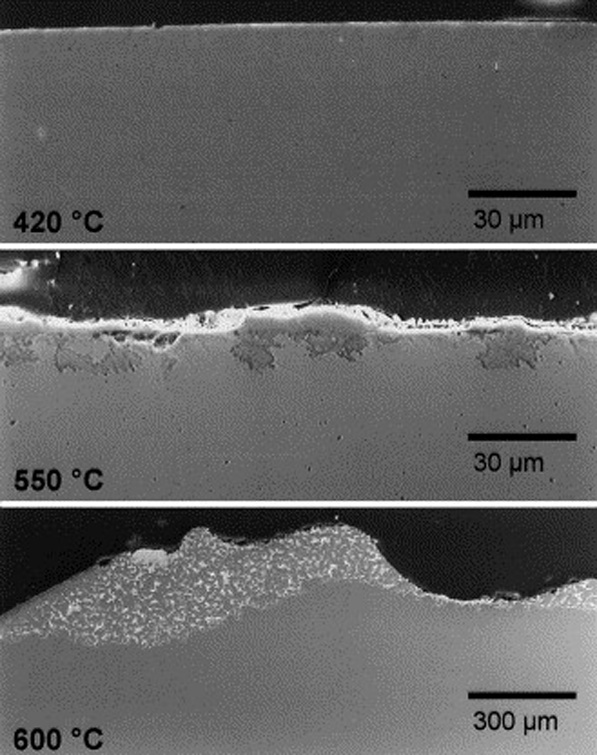
Fig. 1 Cross-sectional morphologies of AISI 316L after dynamic LBE corrosion (420/550/600 ℃, 2000 h, 2 m/s)[8]
| Coating | Base material | Deposition method | Thickness/ μm | LBE corrosion test | Ref. | ||
|---|---|---|---|---|---|---|---|
| O2 concentration (mass fraction) | Temperature/℃ | Duration/h | |||||
| FeCrAl | T91 | GESA | 30 | 10-6% | 480−600 | 2000 | [ |
| T91 | GESA | 30 | Saturated | 400 | 900 | [ | |
| T91 | LPPS/GESA | 30 | 10-6%/10-8% | 400−550 | 900 | [ | |
| F/M steel | MS | 1.7−7.1 | 6.6×10⁻³% | 500−650 | 1000 | [ | |
| FeCrAlSi | F/M steel | MS | 2.6−3.9 | 8.1×10⁻⁴%/1.8×10−3%/ 4.0×10⁻³% | 500/550/600 | 1000 | [ |
| FeCrAlWx | F/M steel | SLM | 5.1 | 1.37×10⁻⁴% | 550 | 500/1000/2000 | [ |
| FeCrAlY | F/M steel | MS | 6 | 1.7×10⁻³% | 550 | 40 | [ |
| FeCrMoWCBY | F/M steel | Arc melting | 40 | 2.1×10⁻³% | 500 | 1000 | [ |
| AlCrFeMoTi | F/M steel | MS | 3.6 | Saturated | 450-650 | 1000 | [ |
| F/M steel | MS | 4.1 | 6.04×10⁻³% | 650 | 1000 | [ | |
| AlCrFeMoTiSix | F/M steel | MS | 10 | 6.04×10⁻³% | 650 | 1000 | [ |
| FeCrAlTiNb | F/M steel | MS | 3 | 1.8×10⁻³%/6.8×10−3% | 550/650 | 500−1500 | [ |
| F/M steel | MS | 5−15 | 8×10⁻⁴% | 500 | 500 | [ | |
| F/M steel | MS | 4.5 | 10−4%/10−7% | 500 | 1000 | [ | |
| TiNbZrMoV | F/M steel | MS | 3.9 | 6.8×10⁻³% | 650 | 100−1000 | [ |
| FeAl | 316L | Slurry aluminizing | 48.8 | 10-7%/1.8×10−3% | 550 | 1500 | [ |
Table 1 Lead-bismuth corrosion resistance of various alloy coatings[9,18 -32]
| Coating | Base material | Deposition method | Thickness/ μm | LBE corrosion test | Ref. | ||
|---|---|---|---|---|---|---|---|
| O2 concentration (mass fraction) | Temperature/℃ | Duration/h | |||||
| FeCrAl | T91 | GESA | 30 | 10-6% | 480−600 | 2000 | [ |
| T91 | GESA | 30 | Saturated | 400 | 900 | [ | |
| T91 | LPPS/GESA | 30 | 10-6%/10-8% | 400−550 | 900 | [ | |
| F/M steel | MS | 1.7−7.1 | 6.6×10⁻³% | 500−650 | 1000 | [ | |
| FeCrAlSi | F/M steel | MS | 2.6−3.9 | 8.1×10⁻⁴%/1.8×10−3%/ 4.0×10⁻³% | 500/550/600 | 1000 | [ |
| FeCrAlWx | F/M steel | SLM | 5.1 | 1.37×10⁻⁴% | 550 | 500/1000/2000 | [ |
| FeCrAlY | F/M steel | MS | 6 | 1.7×10⁻³% | 550 | 40 | [ |
| FeCrMoWCBY | F/M steel | Arc melting | 40 | 2.1×10⁻³% | 500 | 1000 | [ |
| AlCrFeMoTi | F/M steel | MS | 3.6 | Saturated | 450-650 | 1000 | [ |
| F/M steel | MS | 4.1 | 6.04×10⁻³% | 650 | 1000 | [ | |
| AlCrFeMoTiSix | F/M steel | MS | 10 | 6.04×10⁻³% | 650 | 1000 | [ |
| FeCrAlTiNb | F/M steel | MS | 3 | 1.8×10⁻³%/6.8×10−3% | 550/650 | 500−1500 | [ |
| F/M steel | MS | 5−15 | 8×10⁻⁴% | 500 | 500 | [ | |
| F/M steel | MS | 4.5 | 10−4%/10−7% | 500 | 1000 | [ | |
| TiNbZrMoV | F/M steel | MS | 3.9 | 6.8×10⁻³% | 650 | 100−1000 | [ |
| FeAl | 316L | Slurry aluminizing | 48.8 | 10-7%/1.8×10−3% | 550 | 1500 | [ |
| Coating | Base material | Deposition method | Thickness/ μm | LBE corrosion test | Ref. | ||
|---|---|---|---|---|---|---|---|
| O2 concentration (mass fraction) | Temperature/℃ | Duration/h | |||||
| Al2O3 | 316L | PLD | 1 | 10-8% | 550 | 1000/4000 | [ |
| CrNiFe600 | Sol-Gel | 10 | 7.88×10⁻⁴% | 500 | 200 | [ | |
| Inconel 600 | Sol-Gel | 10 | No mention | 650 | 100 | [ | |
| T91 | MS | 1.5 | 10-6% | 550 | 1200 | [ | |
| F/M steel | MS | 3.3 | 1.79×10⁻³% | 550 | 1000 | [ | |
| 9Cr1Mo steel | PLD | 2-8 | No mention | 550 | 500 | [ | |
| ZrO2 | F/M steel | MS | 0.5 | 3.25×10⁻⁴% | 450−650 | 1000 | [ |
| AlTiN | 316L | CAIP | 4.35 | 1.61×10⁻³% (550 ℃)/3.21×10-3% (600 ℃) | 550/600 | 500 | [ |
| TiAlN | T91 | HIPIMS | 2.2 | 10-6% | 550 | 1200 | [ |
| WNiFe alloy | CAIP | 3.7 | Saturated oxygen | 450 | 3000 | [ | |
| TiSiN | 316L | CAIP | 2-2.5 | 2.15×10⁻²% | 550 | 500 | [ |
| TiC | SIMP steel | CAIP | 5.1 | 2.0×10⁻³% | 600 | 2000 | [ |
| Ti3AlC2 | Al2O3 | MS | 3 | 1×10⁻⁶% | 600 | 3200 | [ |
| Ti2AlC | |||||||
| V2AlC | |||||||
| Cr2AlC | |||||||
| (CrAlTiNbV)Nx | F/M steel | MS | 0.8/0.9 | 7.0×10⁻³% | 550 | 1200 | [ |
Table 2 Lead-bismuth corrosion resistance of various ceramic coatings[33-45]
| Coating | Base material | Deposition method | Thickness/ μm | LBE corrosion test | Ref. | ||
|---|---|---|---|---|---|---|---|
| O2 concentration (mass fraction) | Temperature/℃ | Duration/h | |||||
| Al2O3 | 316L | PLD | 1 | 10-8% | 550 | 1000/4000 | [ |
| CrNiFe600 | Sol-Gel | 10 | 7.88×10⁻⁴% | 500 | 200 | [ | |
| Inconel 600 | Sol-Gel | 10 | No mention | 650 | 100 | [ | |
| T91 | MS | 1.5 | 10-6% | 550 | 1200 | [ | |
| F/M steel | MS | 3.3 | 1.79×10⁻³% | 550 | 1000 | [ | |
| 9Cr1Mo steel | PLD | 2-8 | No mention | 550 | 500 | [ | |
| ZrO2 | F/M steel | MS | 0.5 | 3.25×10⁻⁴% | 450−650 | 1000 | [ |
| AlTiN | 316L | CAIP | 4.35 | 1.61×10⁻³% (550 ℃)/3.21×10-3% (600 ℃) | 550/600 | 500 | [ |
| TiAlN | T91 | HIPIMS | 2.2 | 10-6% | 550 | 1200 | [ |
| WNiFe alloy | CAIP | 3.7 | Saturated oxygen | 450 | 3000 | [ | |
| TiSiN | 316L | CAIP | 2-2.5 | 2.15×10⁻²% | 550 | 500 | [ |
| TiC | SIMP steel | CAIP | 5.1 | 2.0×10⁻³% | 600 | 2000 | [ |
| Ti3AlC2 | Al2O3 | MS | 3 | 1×10⁻⁶% | 600 | 3200 | [ |
| Ti2AlC | |||||||
| V2AlC | |||||||
| Cr2AlC | |||||||
| (CrAlTiNbV)Nx | F/M steel | MS | 0.8/0.9 | 7.0×10⁻³% | 550 | 1200 | [ |
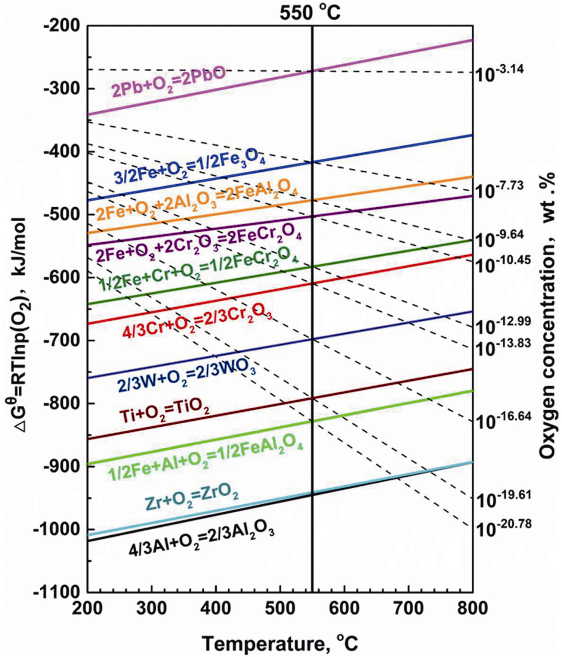
Fig. 2 Gibbs free energy change-temperature diagram of metal oxides for ODS-FeCrAl exposed to liquid LBE at 550 ℃[46]
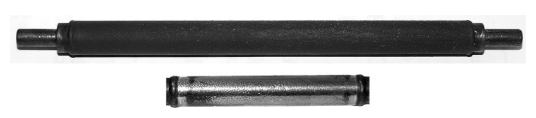
Fig. 3 Original (above) and surface coated (below) test tubes after 2000 h LBE corrosion at 550 ℃ with a flow rate of 1-1.2 m/s[47]
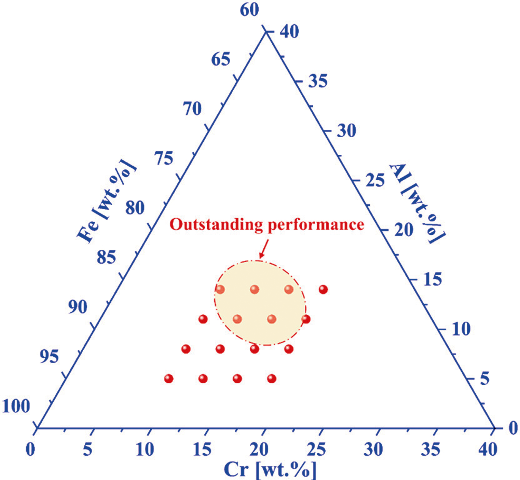
Fig. 4 Ternary phase diagram with the composition of FeCrAl coatings[19]
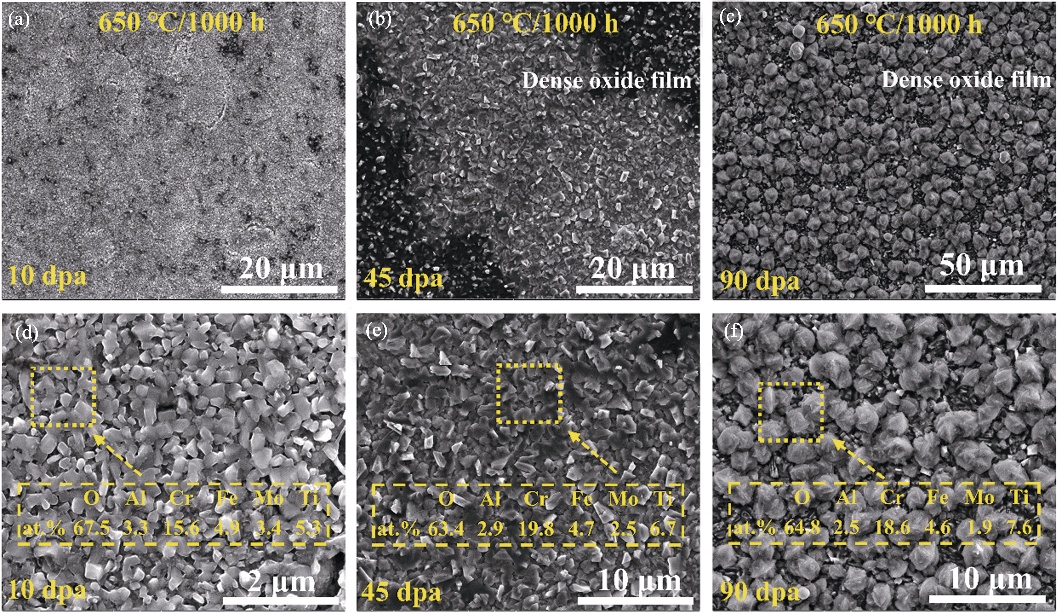
Fig. 5 Surface scanning electron microscope (SEM) images of the irradiated AlCrFeMoTi HEA coatings with different irradiation damage doses after static LBE corrosion tests at 650 ℃ for 1000 h[26] (a, d) 10 dpa; (b, e) 45 dpa; (c, f) 90 dpa
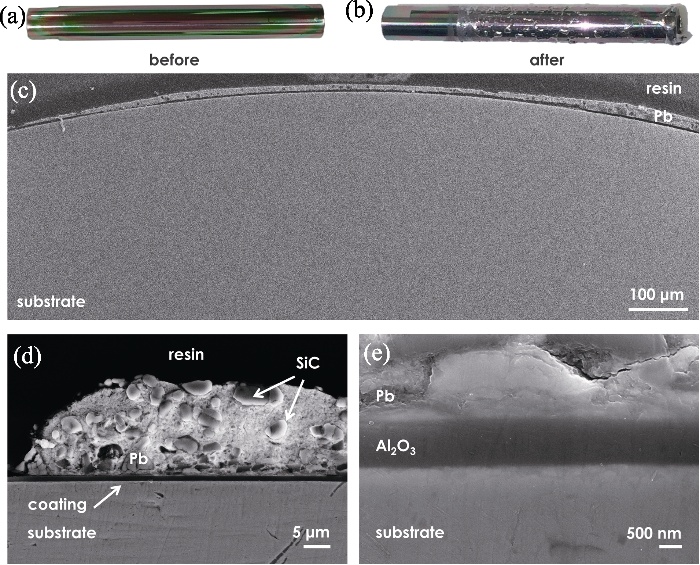
Fig. 6 (a, b) Coated 1515Ti cylinders before (a) and after (b) the corrosion tests (stagnant lead, 550 ℃, 4000 h, 10−8% (in mass) O); (c) Macroscopic and (d, e) microscopic scale of the matrix morphology[33]
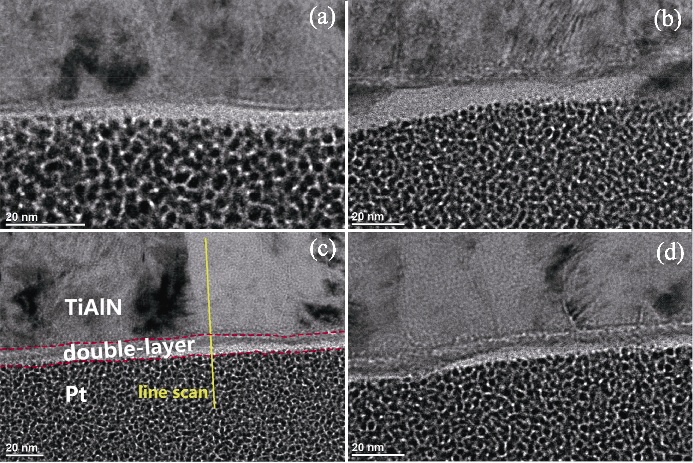
Fig. 7 Transmission electron microscope (TEM) images of TiAlN coating[41] (a) Original sample; (b-d) After corrosion for 3000 h of (b) samples unirradiated, (c) pre-irradiated with 4×10¹⁵ ions/cm2, and (d) irradiated with 2×10¹⁶ ions/cm2
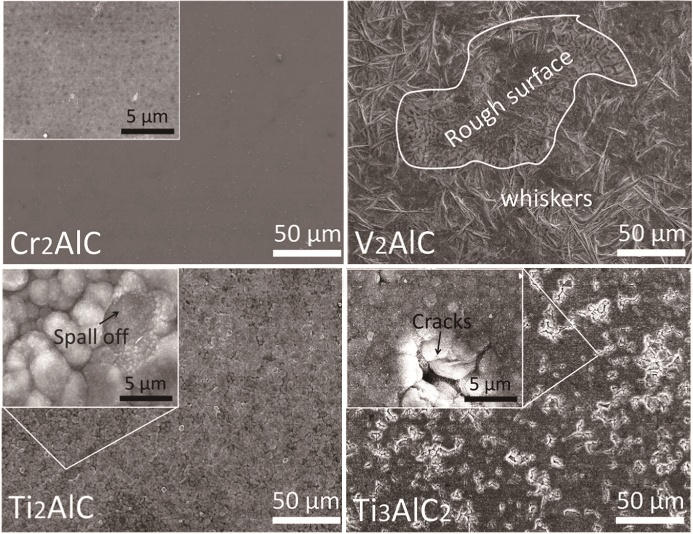
Fig. 8 SEM images of MAX-phase coatings (Cr2AlC, V2AlC, Ti2AlC, and Ti3AlC2) after the corrosion test[44]
| [1] | YANG L, ZHAN W. A closed nuclear energy system by accelerator-driven ceramic reactor and extend AIROX reprocessing. Science China Technological Sciences, 2017, 60(11): 1702. |
| [2] | LORUSSO P, BASSINI S, DEL NEVO A, et al. GEN-IV LFR development: status & perspectives. Progress in Nuclear Energy, 2018, 105: 318. |
| [3] | FIORI F, ZHOU Z. A study on the Chinese nuclear energy options and the role of ADS reactor in the Chinese nuclear expansion. Progress in Nuclear Energy, 2016, 91: 159. |
| [4] | ZHANG J. A review of steel corrosion by liquid lead and lead-bismuth. Corrosion Science, 2009, 51(6): 1207. |
| [5] | ZHANG J, LI N. Review of the studies on fundamental issues in LBE corrosion. Journal of Nuclear Materials, 2008, 373(1): 351. |
| [6] | AUGER T, LORANG G, GUÉRIN S, et al. Effect of contact conditions on embrittlement of T 91 steel by lead-bismuth. Journal of Nuclear Materials, 2004, 335(2): 227. |
| [7] | GONG X, SHORT M P, AUGER T, et al. Environmental degradation of structural materials in liquid lead- and lead-bismuth eutectic-cooled reactors. Progress in Materials Science, 2022, 126: 100920. |
| [8] | MÜLLER G, HEINZEL A, KONYS J, et al. Results of steel corrosion tests in flowing liquid Pb/Bi at 420-600 ℃ after 2000 h. Journal of Nuclear Materials, 2002, 301(1): 40. |
| [9] | FETZER R, WEISENBURGER A, JIANU A, et al. Oxide scale formation of modified FeCrAl coatings exposed to liquid lead. Corrosion Science, 2012, 55: 213. |
| [10] | CHEN Q, BAI F, WANG P, et al. Microstructure response and lead-bismuth eutectic corrosion behavior of 11Cr1Si ferritic/ martensitic steel after Au-ion irradiation. Corrosion Science, 2022, 198: 110101. |
| [11] | FRAZER D, QVIST S, PARKER S, et al. Degradation of HT9 under simultaneous ion beam irradiation and liquid metal corrosion. Journal of Nuclear Materials, 2016, 479: 382. |
| [12] | YAO C, ZHANG H, CHANG H, et al. Structure of surface oxides on martensitic steel under simultaneous ion irradiation and molten LBE corrosion. Corrosion Science, 2022, 195: 109953. |
| [13] | SHI H, WANG H, FETZER R, et al. Influence of Si addition on the corrosion behavior of 9 wt.% Cr ferritic/martensitic steels exposed to oxygen-controlled molten Pb-Bi eutectic at 550 and 600 ℃. Corrosion Science, 2021, 193: 109871. |
| [14] | ZHANG H, LIU X, XU Y, et al. Comparison investigation on corrosion of SIMP and T 91 steels exposed to liquid LBE at 450 ℃: the role of Si on reducing oxidation rate. Corrosion Science, 2023, 225: 111553. |
| [15] | ZHUANG Y, ZHANG X, ZENG X, et al. The influence of Y addition on oxide layers of 15-15Ti-Y steel exposed to static Pb-Bi alloys with containing oxygen. Journal of Nuclear Materials, 2024, 588: 154806. |
| [16] | LUO W, HUANG Q, LUO L, et al. Effect of minor addition of Ce on microstructure and LBE corrosion resistance for CLAM steel. Corrosion Science, 2022, 209: 110796. |
| [17] | VAN DEN BOSCH J, HOSEMANN P, ALMAZOUZI A, et al. Liquid metal embrittlement of silicon enriched steel for nuclear applications. Journal of Nuclear Materials, 2010, 398(1): 116. |
| [18] | DAI Y, BOUTELLIER V, GAVILLET D, et al. FeCrAlY and TiN coatings on T91 steel after irradiation with 72 MeV protons in flowing LBE. Journal of Nuclear Materials, 2012, 431(1): 66. |
| [19] | ZHANG W, ZHONG Y, QIU X, et al. Screening of the FeCrAl LBE corrosion-resistant coatings: the effect of Cr and Al contents. Surface and Coatings Technology, 2023, 462: 129477. |
| [20] | PALM M. Concepts derived from phase diagram studies for the strengthening of Fe-Al-based alloys. Intermetallics, 2005, 13(12): 1286. |
| [21] | ZHANG W, ZHOU M, DENG J, et al. Improved LBE corrosion resistance of the FeCrAl coating by the addition of trace Si element. Intermetallics, 2024, 166: 108197. |
| [22] | ZHANG P, YAO Z, WANG X, et al. A novel FeCrAlWx high entropy alloy coating for enhancing lead-bismuth eutectic corrosion resistance. Journal of Nuclear Materials, 2024, 589: 154844. |
| [23] | ZHANG W, DENG J, ZHOU M, et al. Synergistic effect of simultaneous proton irradiation and LBE corrosion on the microstructure of the FeCrAl(Y) coatings. Corrosion Science, 2024, 229: 111874. |
| [24] | WEI X S, JIN J L, JIANG Z Z, et al. FeCrMoWCBY metallic glass with high corrosion resistance in molten lead-bismuth eutectic alloy. Corrosion Science, 2021, 190: 109688. |
| [25] | YANG J, SHI K, ZHANG W, et al. A novel AlCrFeMoTi high-entropy alloy coating with a high corrosion-resistance in lead-bismuth eutectic alloy. Corrosion Science, 2021, 187: 109524. |
| [26] | YANG J, ZHANG F, CHEN Q, et al. Effect of Au-ions irradiation on mechanical and LBE corrosion properties of amorphous AlCrFeMoTi HEA coating: enhanced or deteriorated? Corrosion Science, 2021, 192: 109862. |
| [27] | YANG J, ZHOU M, LV L, et al. Influence of Si addition on the microstructure, mechanical and lead-bismuth eutectic corrosion properties of an amorphous AlCrFeMoTiSix high-entropy alloy coating. Intermetallics, 2022, 148: 107649. |
| [28] | SHORT M P, BALLINGER R G. A functionally graded composite for service in high-temperature lead- and lead-bismuth-cooled nuclear reactors—I: design. Nuclear Technology, 2012, 177(3): 366. |
| [29] | YANG J, LIANG J, WANG G, et al. Microstructure, mechanical properties and lead-bismuth eutectic corrosion behavior of FeCrAlTiNb high-entropy alloy coatings. Corrosion Science, 2023, 222: 111407. |
| [30] | YANG J, ZHAO K, WANG G, et al. Influence of coating thickness on microstructure, mechanical and LBE corrosion performance of amorphous AlCrFeTiNb high-entropy alloy coatings. Surface and Coatings Technology, 2022, 441: 128502. |
| [31] | DENG J, YANG J, LV L, et al. Corrosion behavior of refractory TiNbZrMoV high-entropy alloy coating in static lead-bismuth eutectic alloy: a novel design strategy of LBE corrosion-resistant coating? Surface and Coatings Technology, 2022, 448: 128884. |
| [32] | WANG W, ZHU Z, YANG L, et al. Superior corrosion resistance of a slurry FeAl coating on 316LN stainless steel in 550 ℃ liquid lead-bismuth eutectic. Corrosion Science, 2024, 227: 111757. |
| [33] | FERRÉ F G, MAIROV A, IADICICCO D, et al. Corrosion and radiation resistant nanoceramic coatings for lead fast reactors. Corrosion Science, 2017, 124: 80. |
| [34] | DOU P, KASADA R. Preliminary study on nano- and micro-composite Sol-Gel based alumina coatings on structural components of lead-bismuth eutectic cooled fast breeder reactors. Journal of Nuclear Materials, 2011, 409(3): 177. |
| [35] | KASADA R, DOU P. Sol-Gel composite coatings as anti-corrosion barrier for structural materials of lead-bismuth eutectic cooled fast reactor. Journal of Nuclear Materials, 2013, 440(1): 647. |
| [36] | MIORIN E, MONTAGNER F, ZIN V, et al. Al rich PVD protective coatings: a promising approach to prevent T91 steel corrosion in stagnant liquid lead. Surface and Coatings Technology, 2019, 377: 124890. |
| [37] | ZHONG Y, ZHANG W, CHEN Q, et al. Effect of LBE corrosion on microstructure of amorphous Al2O3 coating by magnetron sputtering. Surface and Coatings Technology, 2022, 443: 128598. |
| [38] | FERRÉ F G, ORMELLESE M, FONZO F D, et al. Advanced Al2O3 coatings for high temperature operation of steels in heavy liquid metals: a preliminary study. Corrosion Science, 2013, 77: 375. |
| [39] | ZHU C, ZHOU M, LI Q, et al. Microstructural evolution and corrosion resistance of ZrO2 coated ferrite/martensite steel in liquid lead- bismuth eutectic. Materials Today Communications, 2023, 35: 105603. |
| [40] | WU Z Y, ZHAO X, LIU Y, et al. Lead-bismuth eutectic (LBE) corrosion behavior of AlTiN coatings at 550 and 600 ℃. Journal of Nuclear Materials, 2020, 539: 152280. |
| [41] | HUANG S, PANG L, TAI P, et al. Lead-bismuth eutectic corrosion resistance of TiAlN coating after N5+ ion irradiation. Thin Solid Films, 2024, 791: 140224. |
| [42] | WAN Q, WU Z Y, LIU Y, et al. Lead-bismuth eutectic (LBE) corrosion mechanism of nano-amorphous composite TiSiN coatings synthesized by cathodic arc ion plating. Corrosion Science, 2021, 183: 109264. |
| [43] | SHI Q Q, YAN W, SHA W, et al. Corrosion resistance of self-growing TiC coating on SIMP steel in LBE at 600 ℃. Materials and Corrosion, 2016, 67(11): 1204. |
| [44] | SHI H, AZMI R, HAN L, et al. Corrosion behavior of Al-containing MAX-phase coatings exposed to oxygen containing molten Pb at 600 ℃. Corrosion Science, 2022, 201: 110275. |
| [45] | YIN X, WANG H, XIAO J, et al. A high-entropy alloy nitride protective coating for fuel cladding in high temperature lead-bismuth eutectic alloy. Journal of Nuclear Materials, 2022, 568: 153888. |
| [46] | ZHU Z, TAN J, ZHANG Z, et al. Corrosion behaviors of ODS-FeCrAl in oxygen-saturated lead-bismuth eutectic at 550 ℃: effects of grain boundaries and minor elements. Journal of Nuclear Materials, 2023, 587: 154710. |
| [47] | WEISENBURGER A, HEINZEL A, MÜLLER G, et al. T91 cladding tubes with and without modified FeCrAlY coatings exposed in LBE at different flow, stress and temperature conditions. Journal of Nuclear Materials, 2008, 376(3): 274. |
| [48] | POPOVIC M P, CHEN K, SHEN H, et al. A study of deformation and strain induced in bulk by the oxide layers formation on a Fe-Cr-Al alloy in high-temperature liquid Pb-Bi eutectic. Acta Materialia, 2018, 151: 301. |
| [49] | WEISENBURGER A, JIANU A, DOYLE S, et al. Oxide scales formed on Fe-Cr-Al-based model alloys exposed to oxygen containing molten lead. Journal of Nuclear Materials, 2013, 437(1): 282. |
| [50] | KIM S, LEE C H, KIM T, et al. Effects of yttrium on the oxidation behavior of Fe13Cr6AlY alloys under 1200 ℃ steam. Journal of Alloys and Compounds, 2023, 960: 170642. |
| [51] | LIANG J, YANG J, ZHANG W, et al. Corrosion behavior of magnetron sputtering Fe31Cr20Al17Ti16Nb16 high entropy coating in liquid lead-bismuth eutectic with different oxygen concentration at 500 ℃. Surface and Coatings Technology, 2024, 480: 130579. |
| [52] | ALI S, AHMED M, LIU B, et al. Microstructural stability and mechanical property of AlCrFeMoTi high-entropy amorphous alloy thin films under He+ ions irradiation. Surface and Coatings Technology, 2024, 487: 130952. |
| [53] | CHARALAMPOPOULOU E, LAMBRINOU K, VAN DER DONCK T, et al. Early stages of dissolution corrosion in 316L and DIN 1.4970 austenitic stainless steels with and without anticorrosion coatings in static liquid lead-bismuth eutectic (LBE) at 500 ℃. Materials Characterization, 2021, 178: 111234. |
| [54] | ZHANG T, MA J, LIU W, et al. Corrosion behavior of Al-O coating in oxygen-saturated lead-bismuth eutectic at 550 ℃. Journal of Materials Research and Technology, 2024, 30: 4123. |
| [55] | ZHANG Z, DUAN X, JIA D, et al. On the formation mechanisms and properties of MAX phases: a review. Journal of the European Ceramic Society, 2021, 41(7): 3851. |
| [56] | BARSOUM M W. The MN+1AXN phases: a new class of solids: thermodynamically stable nanolaminates. Progress in Solid State Chemistry, 2000, 28(1): 201. |
| [57] | SOKOL M, NATU V, KOTA S, et al. On the chemical diversity of the MAX phases. Trends in Chemistry, 2019, 1(2): 210. |
| [58] | GONZALEZ-JULIAN J. Processing of MAX phases: from synthesis to applications. Journal of the American Ceramic Society, 2020, 104(2): 659. |
| [59] | BARNES L A, RAGO N L D, LEIBOWITZ L. Corrosion of ternary carbides by molten lead. Journal of Nuclear Materials, 2008, 373(1): 424. |
| [60] | HEINZEL A, WEISENBURGER A, MÜLLER G. Long-term corrosion tests of Ti3SiC2 and Ti2AlC in oxygen containing LBE at temperatures up to 700 ℃. Journal of Nuclear Materials, 2016, 482: 114. |
| [61] | LAPAUW T, TUNCA B, JORIS J, et al. Interaction of Mn+1AXn phases with oxygen-poor, static and fast-flowing liquid lead- bismuth eutectic. Journal of Nuclear Materials, 2019, 520: 258. |
| [62] | LYU L, QIU X, YUE H, et al. Corrosion behavior of Ti3SiC2 in flowing liquid lead-bismuth eutectic at 500 ℃. Materials, 2022, 15(21): 7406. |
| [63] | HEINZEL A, MÜLLER G, WEISENBURGER A. Compatibility of Ti3SiC2 with liquid Pb and PbBi containing oxygen. Journal of Nuclear Materials, 2009, 392(2): 255. |
| [64] | UTILI M, AGOSTINI M, COCCOLUTO G, et al. Ti3SiC2 as a candidate material for lead cooled fast reactor. Nuclear Engineering and Design, 2011, 241(5): 1295. |
| [65] | LI Q, ZHONG Y, ZHANG W, et al. Microstructure, mechanical properties, and lead-bismuth eutectic corrosion behaviors of FeCrAlY-Al2O3 nanoceramic composite coatings. Coatings, 2024, 14(4): 393. |
| [66] | 张顺蔺, 潘东, 尹星, 等. 多弧离子镀Al2O3-TiO2/FeCrAl涂层的热冲击性能及在静态铅铋中的耐腐蚀行为研究. 核动力工程, 2024, 45(1): 90. |
| [67] | HUANG S, PANG L, TAI P, et al. Study on Al2O3/Fe-Al gradient coating assisted prepared by ionic liquid for lead-bismuth eutectic corrosion resistance. Nuclear Materials and Energy, 2024, 38: 101623. |
| [1] | QIN Shanli, GUO Jiawen, CHEN Yanmeng, JU An’an, WEI Yi, HUANG Kelin, HOU Xianghua, LÜ Sishi, WEN Zhipeng, WU Lian. Recent Advances in Constructing Oriented Ion Transport Channels with Two-dimensional Layered Materials for Electrochemical Energy Storage [J]. Journal of Inorganic Materials, 2026, 41(7): 883-898. |
| [2] | YU Feiyu, WANG Wenqing, ZHANG Xueqin, HE Rujie. Additively Manufactured Ceramic Lattice-based Interpenetrating Phase Composites: Progress and Challenges [J]. Journal of Inorganic Materials, 2026, 41(7): 849-866. |
| [3] | ZHOU Cui, LI Jie, SUN Luchao, SU Haijun, WANG Jingyang. Alumina-based Directionally Solidified Eutectic Ceramics: Microstructure, Control Strategies and Environmental Stability [J]. Journal of Inorganic Materials, 2026, 41(7): 899-914. |
| [4] | SHANG Sen, JIANG Linwen, DONG Hao, DAI Rui, WU Jian, ZHUO Xueshi, ZHANG Jungui, ZHANG Xiaofeng. CMAS Corrosion Resistance of Al-modified Si-HfO2/YbDS/GYYZO Thermal/Environmental Barrier Coating [J]. Journal of Inorganic Materials, 2026, 41(7): 923-929. |
| [5] | FEI Wenlong, WANG Yakun, LIAO Liangsheng. Research Progress on Controllable Synthesis of Blue-emitting ZnSeTe Quantum Dots and Quantum-dot Light-emitting Diode Devices [J]. Journal of Inorganic Materials, 2026, 41(7): 867-882. |
| [6] | CHEN Mingjun, MIAO Hongkang, XIAO Yingjun, DENG Jianbo, ZHANG Xiang, ZHAO Jiupeng, LI Yao. Photo- and Thermo-chromic Dual-responsive Materials: A Review on Design Strategies and Applications in Smart Windows [J]. Journal of Inorganic Materials, 2026, 41(6): 723-738. |
| [7] | SONG Kunjie, XIE Rongjun. Research Advances on Machine Learning-driven Development of Novel Luminescent Materials [J]. Journal of Inorganic Materials, 2026, 41(6): 689-703. |
| [8] | HU Yuqing, ZHU Yixin, LE Xianhao, WAN Qing. Lithium Tantalate Wafer: Advances in Thinning Technology and Application in Pyroelectric Infrared Detectors [J]. Journal of Inorganic Materials, 2026, 41(6): 764-774. |
| [9] | HU Yang, XIE Min, ZHANG Xiaoyi, LI Xiang, GUO Xinwei, JIANG Nan, ZHOU Wenhan, ZHANG Shengli, ZENG Haibo. Research Progress on Computational and Data-driven Environmental-friendly Luminescent Materials [J]. Journal of Inorganic Materials, 2026, 41(6): 704-722. |
| [10] | WANG Junbu, HUANG Zeai, YANG Mingkai, MENG Ying, ZHOU Mingwei, ZHOU Ying. Research Progress on Anti-coking Catalytic Materials for Methane Conversion [J]. Journal of Inorganic Materials, 2026, 41(6): 739-750. |
| [11] | WANG Jinwen, YANG Zhen, ZHOU Huan, XIA Dan, YANG Lei. Biomedical Applications of Injectable Inorganic Biomaterials [J]. Journal of Inorganic Materials, 2026, 41(6): 751-763. |
| [12] | LI Hantao, SHEN Qiang, LUO Guoqiang, WANG Xuefei, GAO Ming, CHEN Chen. Research Progress on Structure and Performance Regulation of Silicon-based Anode Materials via Mechanical Ball Milling [J]. Journal of Inorganic Materials, 2026, 41(5): 561-572. |
| [13] | XIE Chenyi, MIAO Huaming, ZHANG Weiran, LIU Rongjun, WANG Yanfei, LI Duan. Research Progress on Theoretical Calculation in the Field of High-entropy Ceramics [J]. Journal of Inorganic Materials, 2026, 41(5): 545-560. |
| [14] | ZHAO Tongtong, DAI Jixiang, SU Cheng, SHI Yan, SHA Jianjun. Microstructure and Ablation Resistance of C/C Composites Modified by Hf-Si-based Coating-matrix Integrated Structure Fabricated by Reactive Melt Infiltration [J]. Journal of Inorganic Materials, 2026, 41(5): 583-594. |
| [15] | LI Xuan, YE Kuicai, FENG Jiayin, QIU Jiajun, QIAN Wenhao, XING Min. Surface Modification of Titanium-based Dental Implants for Soft Tissue Sealing: A Review [J]. Journal of Inorganic Materials, 2026, 41(4): 432-444. |
| Viewed | ||||||
|
Full text |
|
|||||
|
Abstract |
|
|||||
