
Journal of Inorganic Materials ›› 2026, Vol. 41 ›› Issue (6): 723-738.DOI: 10.15541/jim20250361
• REVIEW • Previous Articles Next Articles
CHEN Mingjun1( ), MIAO Hongkang2, XIAO Yingjun2, DENG Jianbo3, ZHANG Xiang1(), ZHAO Jiupeng3, LI Yao1,4()
Received:2025-09-18
Revised:2025-11-05
Published:2025-11-11
Online:2025-11-11
Contact:
ZHANG Xiang, associate professor. E-mail: zhangxhit@hit.edu.cn;About author:CHEN Mingjun (1996-), male, associate professor. E-mail: mingjunchen@hit.edu.cn
Supported by:CLC Number:
CHEN Mingjun, MIAO Hongkang, XIAO Yingjun, DENG Jianbo, ZHANG Xiang, ZHAO Jiupeng, LI Yao. Photo- and Thermo-chromic Dual-responsive Materials: A Review on Design Strategies and Applications in Smart Windows[J]. Journal of Inorganic Materials, 2026, 41(6): 723-738.
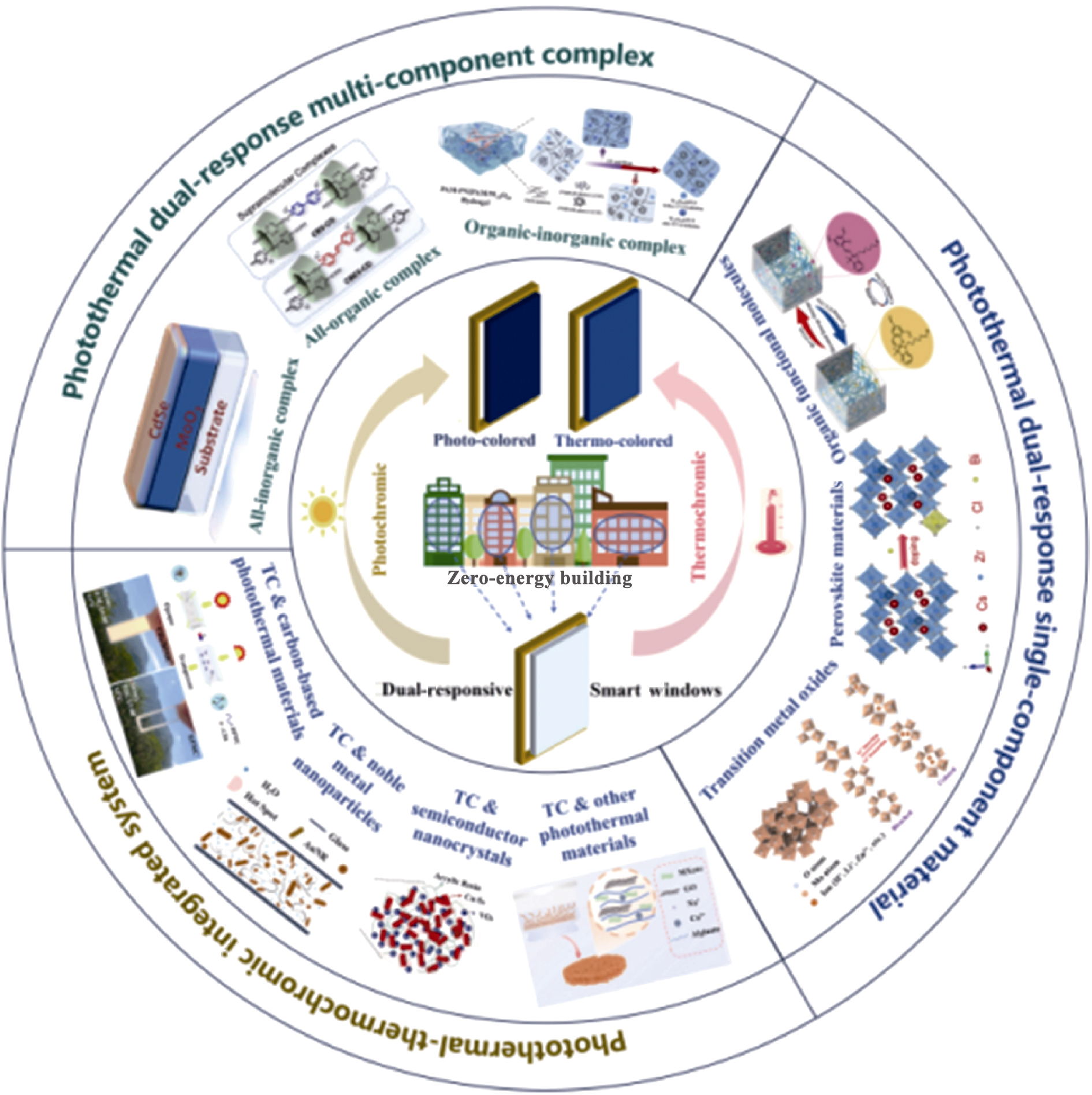
Fig. 1 Overview of the design strategy, structure and principle for the photo- and thermo-chromic dual-responsive materials and smart windows in zero-energy buildings
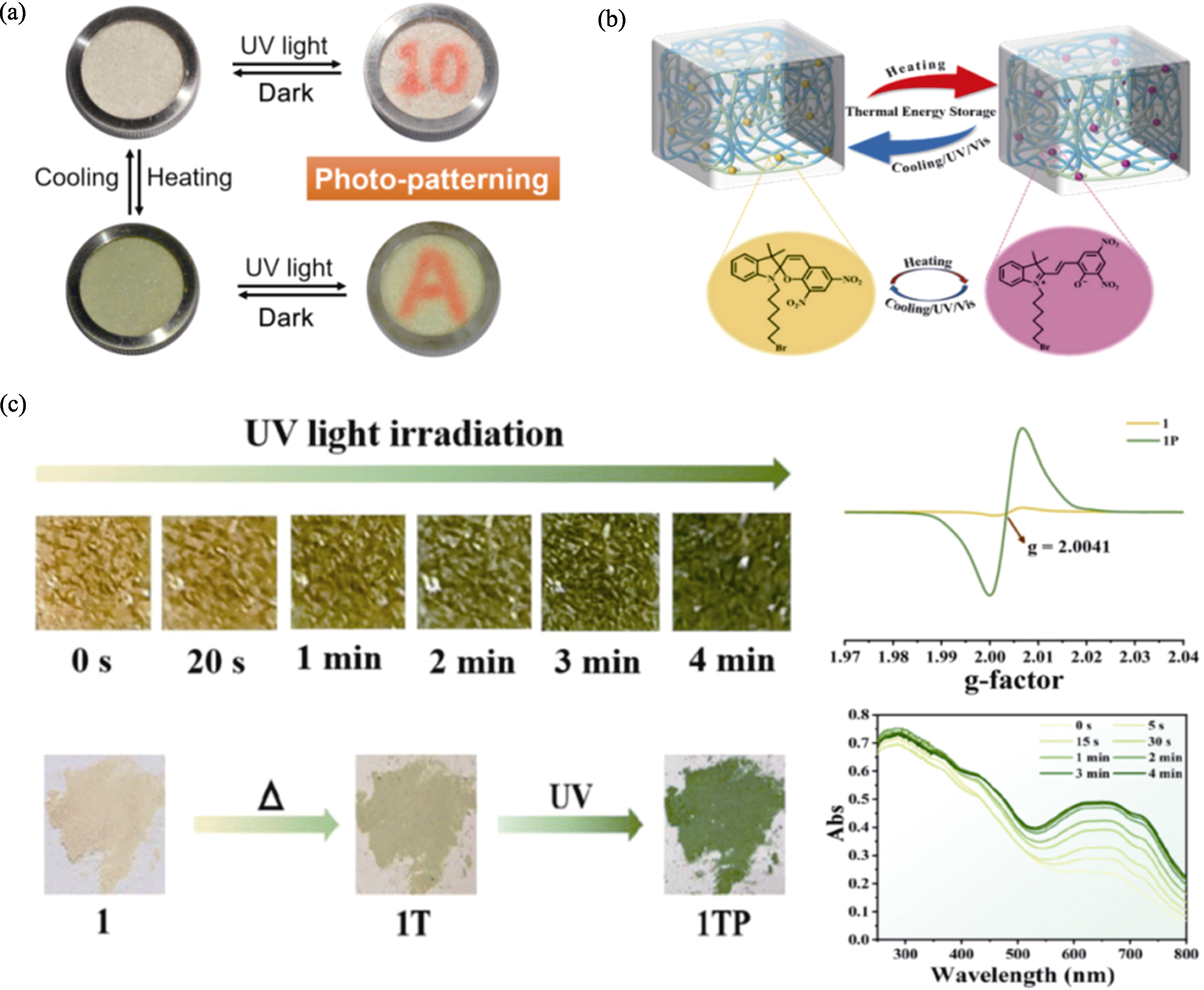
Fig. 2 Photo-thermal dual-responsive of organic functional molecules[31,33,35] (a) π-π stacking controlled salicylaldehyde Schiff base derivatives[31]; (b) Spiropyran compounds[33]; (c) Cd(II)-viologen coordination polymer[35]
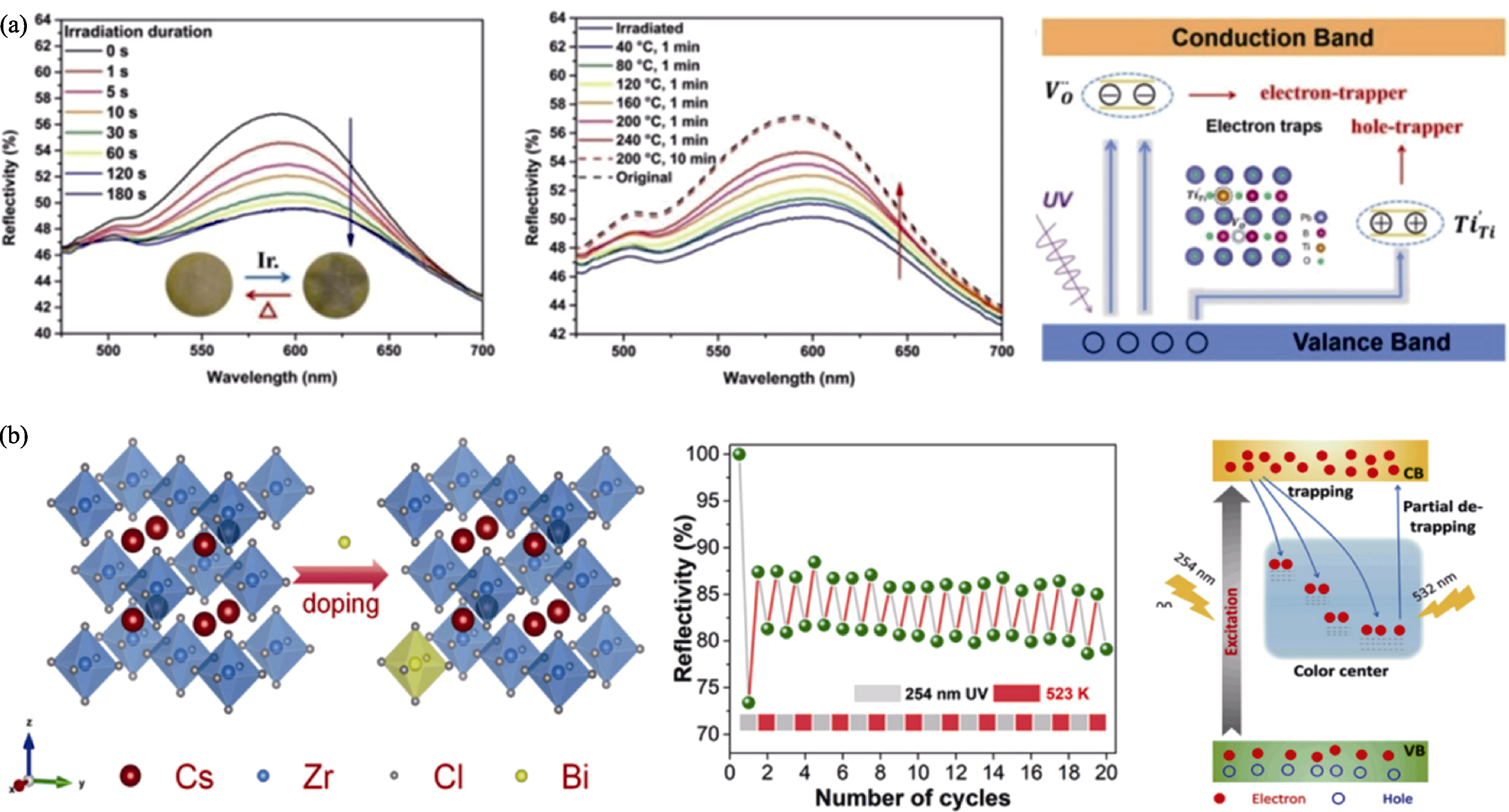
Fig. 3 (a) Photochromic, thermochromic properties and mechanism of PZNNT perovskite ceramics[41]; (b) Structure, photo-thermal dual-responsive properties and mechanism of Cs2ZrCl6:Bi3+ halide perovskite[43]
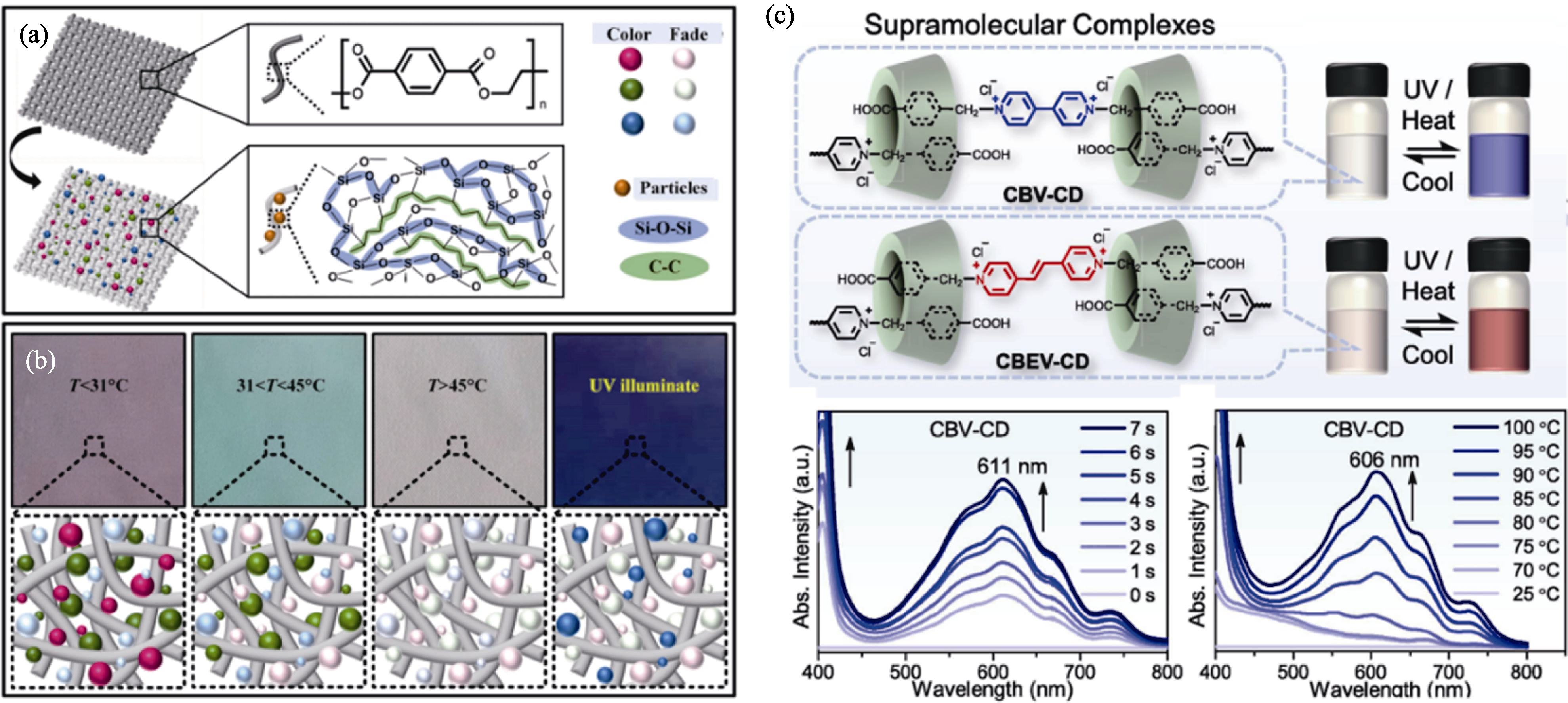
Fig. 4 (a) Schematic diagram and (b) photographs of multicolor response of the superhydrophobic photo-thermal dual-responsive coatings[44]; (c) Schematic diagram and photo- and thermo-chromic performance of photo-thermal dual-responsive supramolecular complexes CBV-CD[45]
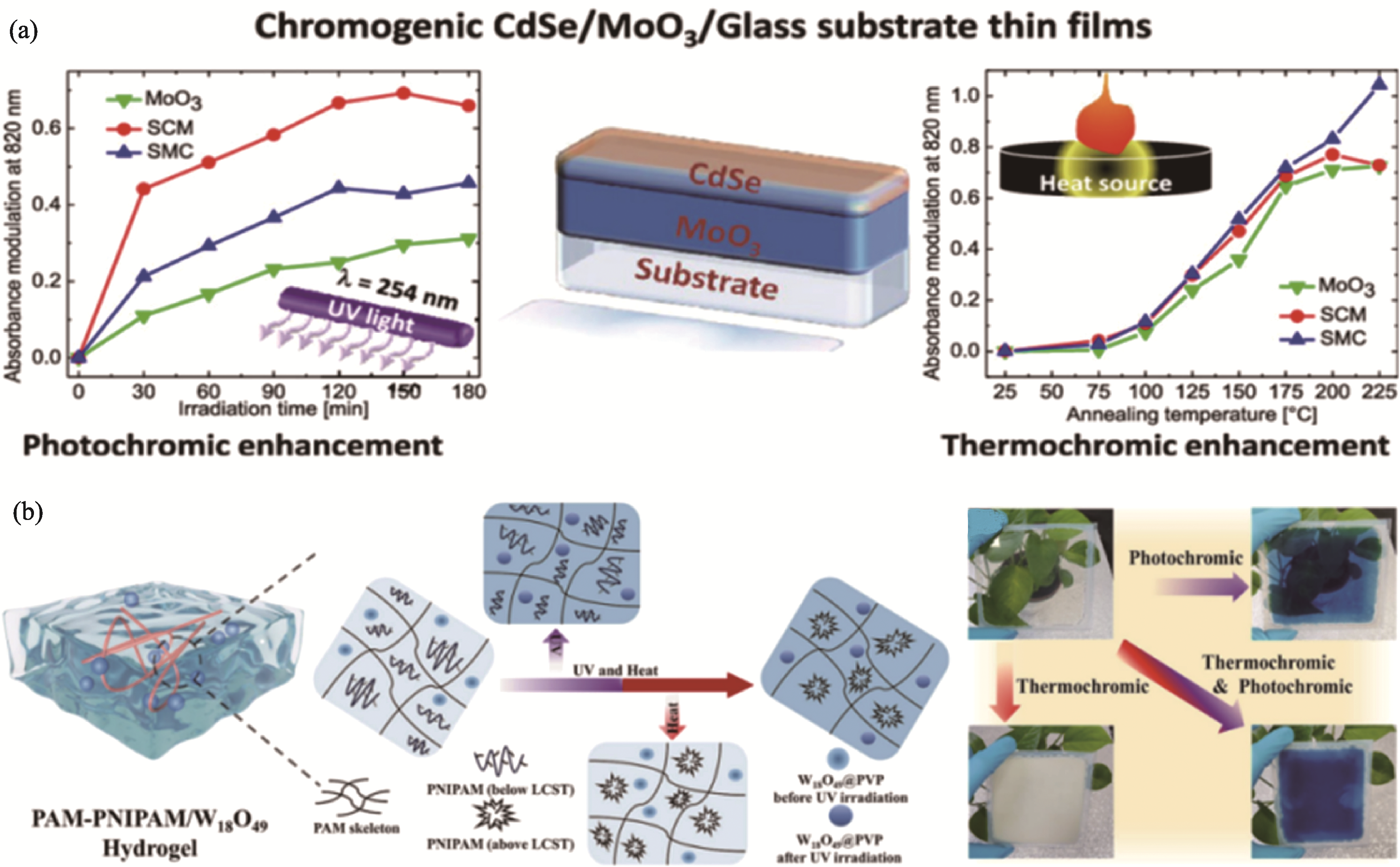
Fig. 5 Schematic diagrams and photo-thermal dual-responsive performance of (a) all-inorganic CdSe/MoO3 composite films[47] and (b) organic-inorganic W18O49/PAM-PNIPAM composite films[27]
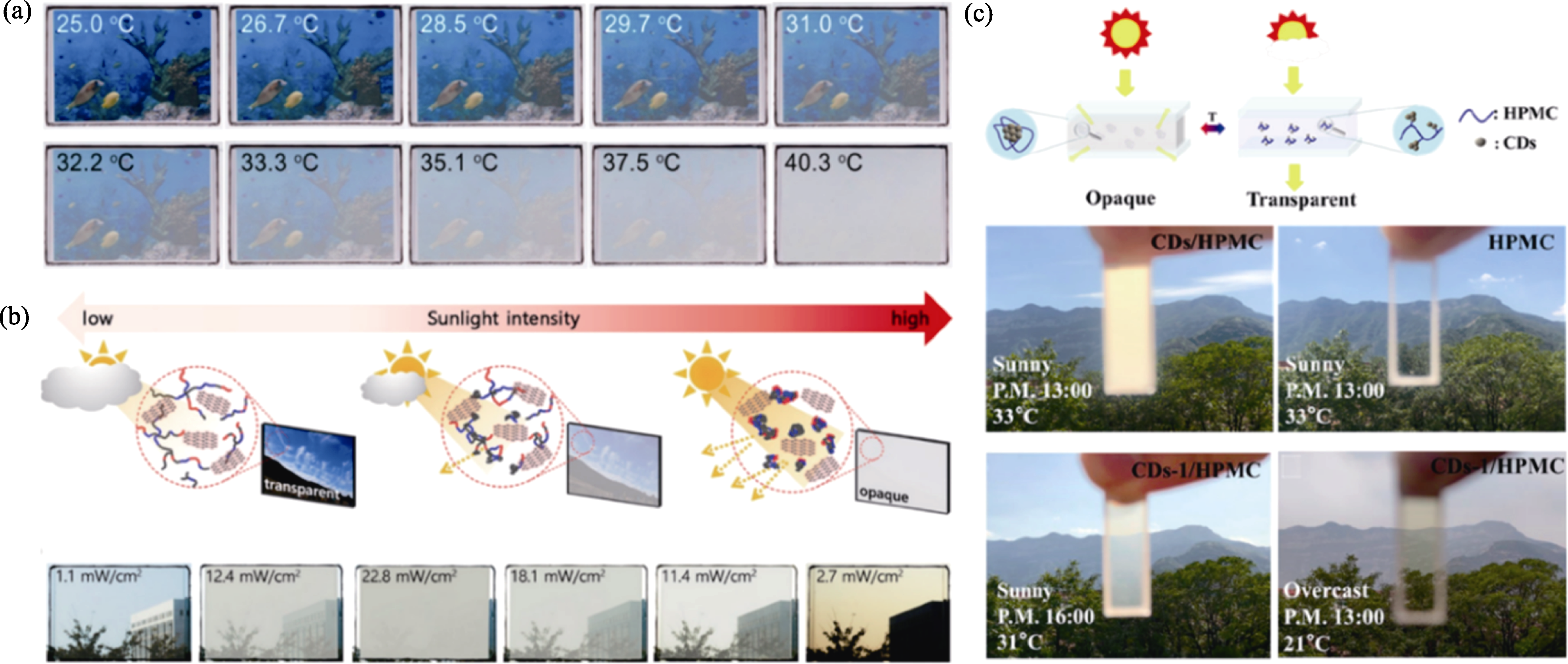
Fig. 6 (a) Thermochromic and (b) photochromic performance of PNDV/GO hydrogel window[52]; (c) Schematic diagram and photo- and thermo-chromic performance of CDs/HPMC composite film[54]
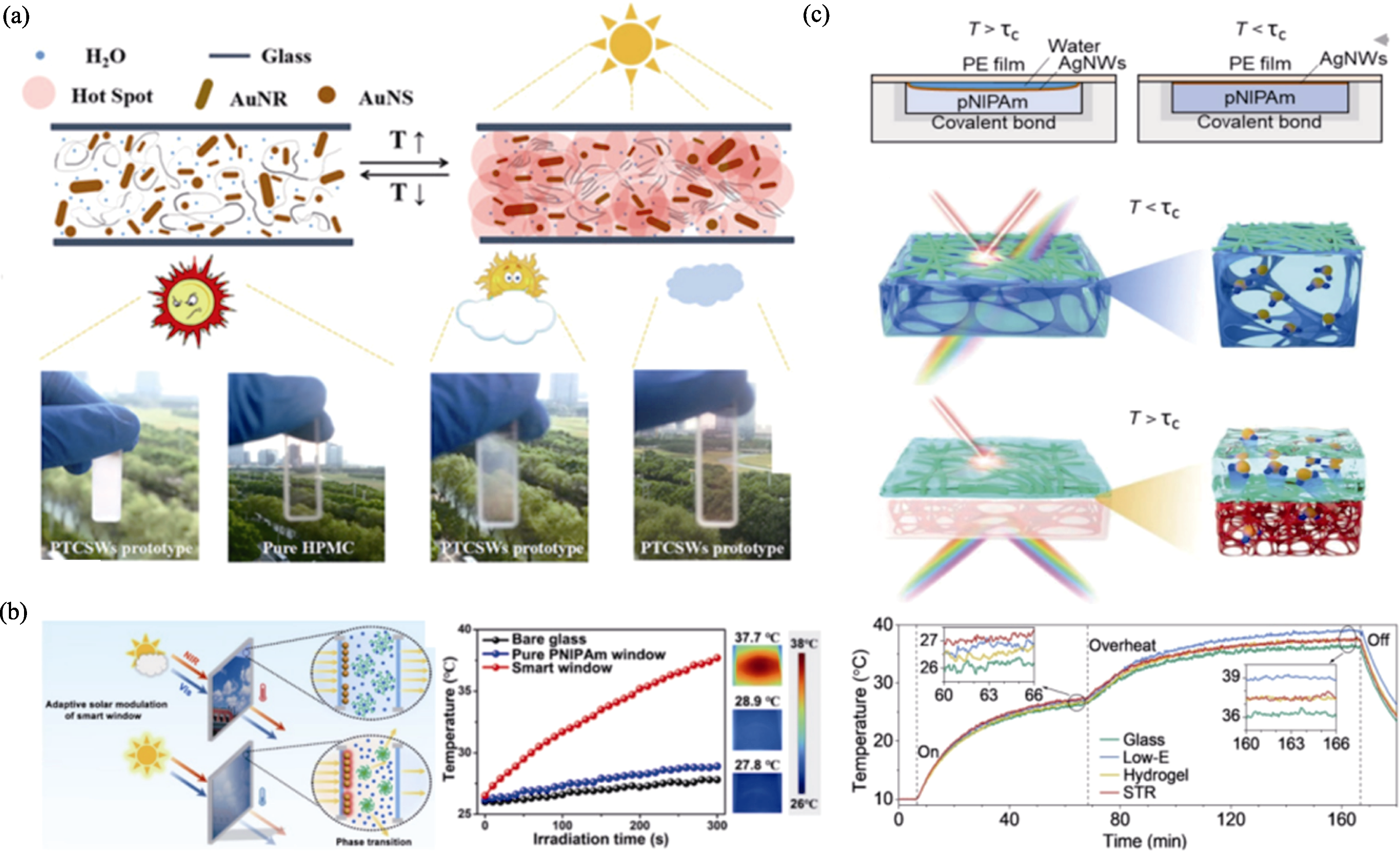
Fig. 7 Schematic diagrams of color-changing mechanism and thermal regulation performance for the photo- and thermo-chromic dual-responsive smart windows integrated with (a) Au nanocrystals and HPMC[55], (b) one-dimensional Au nanochains and PNIPAM hydrogel[56], and (c) Ag nanowires and PNIPAM hydrogel[28]
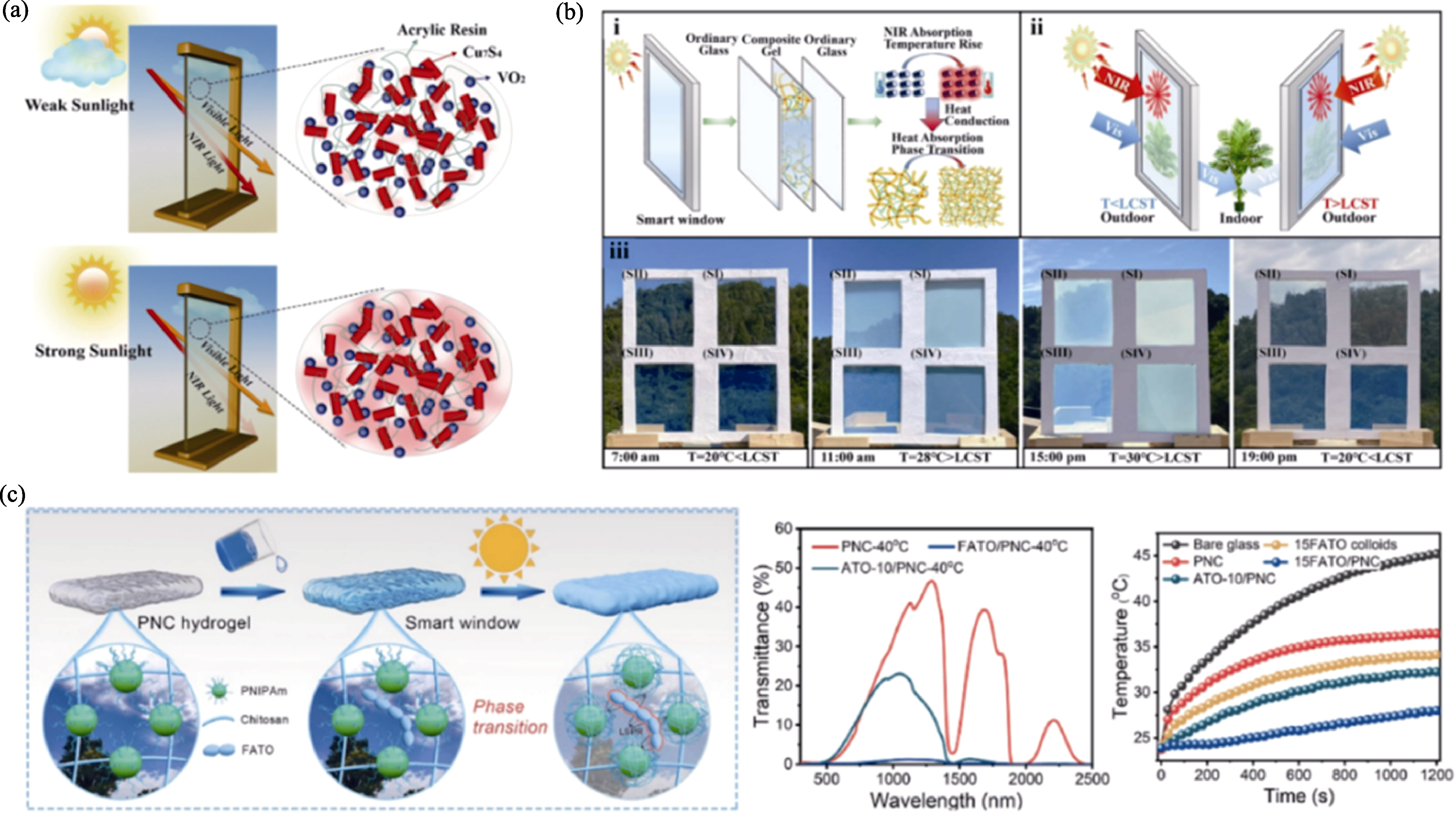
Fig. 8 (a) Schematic diagram of color-changing mechanism of the smart window integrated with Cu7S4 and traditional VO2-based TC film[60]; (b) Schematic diagram of structure (i), color-changing mechanism (ii), and optical photos at different time of the day (iii) of the smart window integrated with LimCsnWO3 and PVA-PNIPAM hydrogel[64]; (c) Schematic diagram of color-changing mechanism and dimming and temperature control performance of the smart window integrated with fluorine-doped ATO nanocrystals and PNC hydrogel[68]
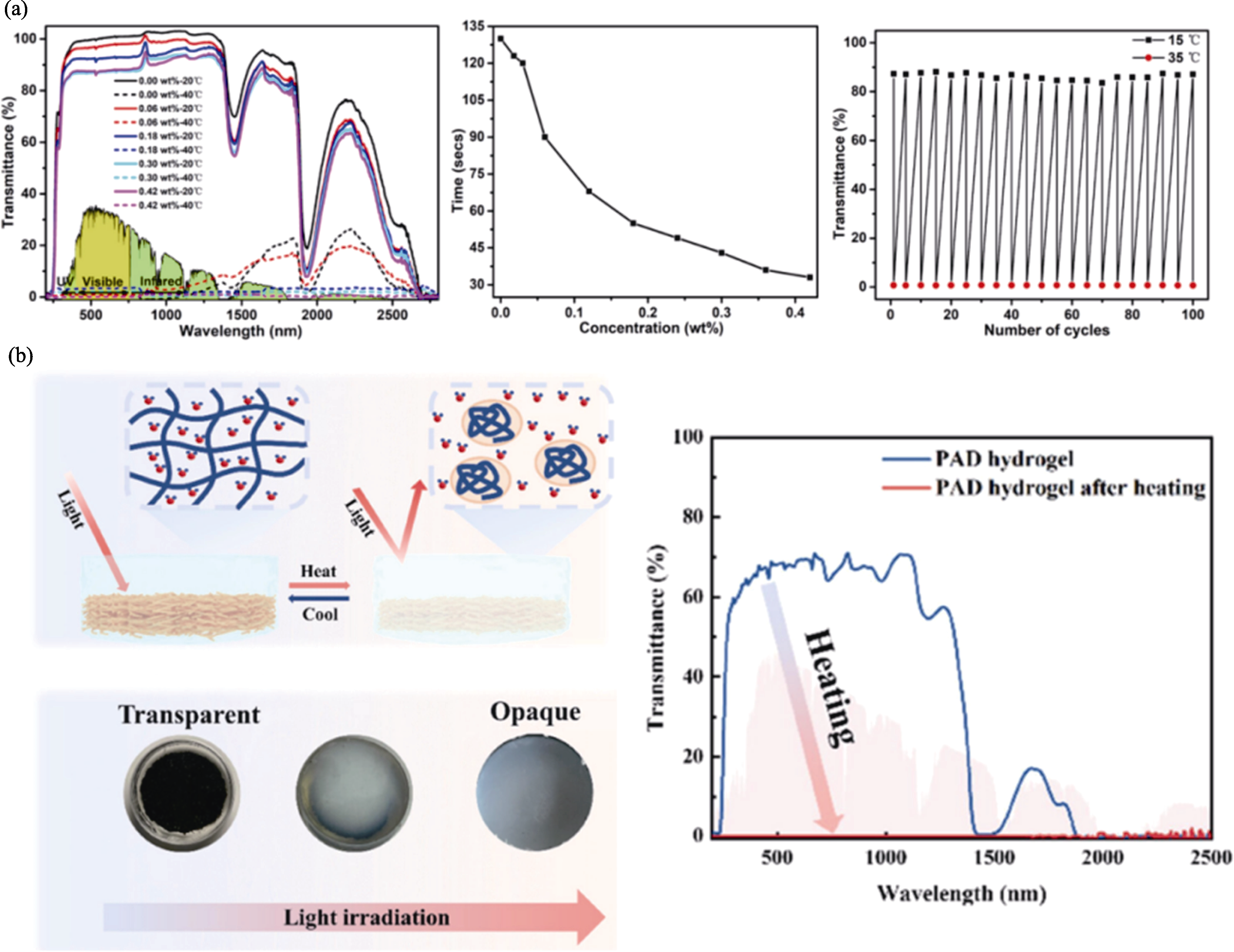
Fig. 9 (a) Photo- and thermo-chromic performance of the composite hydrogel-based smart window composed of PDAPs and PNIPAM[70]; (b) Schematic diagram and photo- and thermo-chromic performance of the smart window integrated with Ti3C3Tx MXene/GO composite photothermal film and PAD hydrogel[72]
| Photo- and thermo-chromic dual-responsive materials | PC performance | TC performance | |||||
|---|---|---|---|---|---|---|---|
| Stimulus-response condition | Optical modulation or color change | Response time | Stimulus- response condition | Optical modulation or color change | |||
| Single- component material | Organic functional molecule | Salicylaldehyde Schiff base[ | Irradiation with 365 nm UV light | White to red | — | Heating at 90 ℃ | White to yellow |
| Spiropyran derivative[ | Irradiation with UV light (365 nm) or visible light (>420 nm) | Purplish red to colorless | 60 s (UV light), 12 min (visible light) | Heating at 60 ℃ | Colorless to purplish red | ||
| Viologen derivativer[ | Irradiation with UV light | Yellow to light green | 20 s | Heating at 120-170 ℃ | Yellow to light green and dark green | ||
| Inorganic transition metal oxide | ZnSe-doped MoO3[ | Irradiation with UV light | Pale-yellow to blue | 180 min | Heating at 23-125 ℃ | Pale-yellow to deep blue | |
| Oxygen-deficient MoO3[ | Irradiation with UV light | Colorless to dark blue | 180 min | Heating at 250 ℃ | Colorless to dark blue | ||
| Perovskite material | PZNNT ceramic[ | Irradiation with 395 nm UV light | ~9% (∆R) | 120 s | Heating at 250 ℃ for 10 min | ~8% (∆R) | |
| Cs2ZrCl6:Bi3+[ | Irradiation with 254 nm UV light | ~27% (∆R) | 20 min | 365 nm excitation after being kept at 250 ℃ | Blue to cyan | ||
| Multicomponent composite material | All-organic complex | Mixing TC with PC organic pigment[ | Irradiation with UV light | Purple to blue | — | Heating from 31 to 45 ℃ | Purple to green and then to colorless |
| Host-guest complex CBV-CD[ | Irradiation with 365 nm UV light | Colorless to blue | 7 s | Heating from 25 to 100 ℃ | Colorless to reddish brown | ||
| All-inorganic composite film | MoO3/CdS[ | Irradiation with a 100 W tungsten lamp | 1.8 (∆OD) | 45-180 min | Heating from 100 to 225 ℃ | 1.0 (∆OD) | |
| MoO3/CdSe and CdSe/MoO3[ | Irradiation with 254 nm UV light | 0.7 (∆A) | 180 min | Heating from 25 to 225 ℃ | 1.0 (∆A) | ||
| Organic- inorganic composite film | W18O49/PAM-PNIPAM hydrogel[ | Irradiation with UV light | 34.6% (∆Tlum) | 20 min | Heating from 20 to 40 ℃ | 79.49% (∆Tlum) | |
| Integrated system combining TC material with photo-thermal material | Carbon-based photothermal material | PNDV hydrogel & GO[ | Solar irradiation of 22.8 mW/cm2 | Colorless to yellow | — | Heating at 40 ℃ | Transparent to opaque |
| HPMC & CDs[ | Solar irradiation of 100 mW/cm2 | 65.6% (∆Tsol) | 5 min | Heating at 33 ℃ | Transparent to opaque | ||
| Nobel metal nanoparticles photothermal material | PNIPAm hydrogel & 1D Au nanochain[ | Solar irradiation of 2.8 kW·m−2 | 80% (∆T) | 2 h | Heating from 20 to 40 ℃ | 80% (∆T) | |
| PNIPAm hydrogel & Ag nanowire[ | Solar irradiation of 800 W/m2 | 58.4% (∆Tsol) | 40 min | Heating from 25 to 40 ℃ | 58.4% (∆Tsol) | ||
| Semiconductor nanocrystal photothermal material | VO2 & Cu7S4[ | Infrared light irradiation of 100 W | Transparent to opaque | 3 min | Heating at 70 ℃ | 12.3% (∆Tsol) | |
| PVA-PNIPAM & LimCsnWO3[ | Near-infrared light irradiation | Transparent light blue to translucent blue | — | Heating at 50℃ | 50.7% (∆Tvis) | ||
| Other photothermal material | PNIPAm hydrogel & PDAPs[ | Solar irradiation | 87.6% (∆Tlum) | 33 s | Heating from 20 to 40 ℃ | 87.6% (∆Tlum) | |
| PAD hydrogel & Ti3C3Tx MXene/GO[ | One-sun illumination | Transparent to opaque | — | Heating at 37.7 ℃ | 67.6% (∆Tlum) | ||
Table 1 Properties comparison of typical photo- and thermo-chromic dual-responsive materials
| Photo- and thermo-chromic dual-responsive materials | PC performance | TC performance | |||||
|---|---|---|---|---|---|---|---|
| Stimulus-response condition | Optical modulation or color change | Response time | Stimulus- response condition | Optical modulation or color change | |||
| Single- component material | Organic functional molecule | Salicylaldehyde Schiff base[ | Irradiation with 365 nm UV light | White to red | — | Heating at 90 ℃ | White to yellow |
| Spiropyran derivative[ | Irradiation with UV light (365 nm) or visible light (>420 nm) | Purplish red to colorless | 60 s (UV light), 12 min (visible light) | Heating at 60 ℃ | Colorless to purplish red | ||
| Viologen derivativer[ | Irradiation with UV light | Yellow to light green | 20 s | Heating at 120-170 ℃ | Yellow to light green and dark green | ||
| Inorganic transition metal oxide | ZnSe-doped MoO3[ | Irradiation with UV light | Pale-yellow to blue | 180 min | Heating at 23-125 ℃ | Pale-yellow to deep blue | |
| Oxygen-deficient MoO3[ | Irradiation with UV light | Colorless to dark blue | 180 min | Heating at 250 ℃ | Colorless to dark blue | ||
| Perovskite material | PZNNT ceramic[ | Irradiation with 395 nm UV light | ~9% (∆R) | 120 s | Heating at 250 ℃ for 10 min | ~8% (∆R) | |
| Cs2ZrCl6:Bi3+[ | Irradiation with 254 nm UV light | ~27% (∆R) | 20 min | 365 nm excitation after being kept at 250 ℃ | Blue to cyan | ||
| Multicomponent composite material | All-organic complex | Mixing TC with PC organic pigment[ | Irradiation with UV light | Purple to blue | — | Heating from 31 to 45 ℃ | Purple to green and then to colorless |
| Host-guest complex CBV-CD[ | Irradiation with 365 nm UV light | Colorless to blue | 7 s | Heating from 25 to 100 ℃ | Colorless to reddish brown | ||
| All-inorganic composite film | MoO3/CdS[ | Irradiation with a 100 W tungsten lamp | 1.8 (∆OD) | 45-180 min | Heating from 100 to 225 ℃ | 1.0 (∆OD) | |
| MoO3/CdSe and CdSe/MoO3[ | Irradiation with 254 nm UV light | 0.7 (∆A) | 180 min | Heating from 25 to 225 ℃ | 1.0 (∆A) | ||
| Organic- inorganic composite film | W18O49/PAM-PNIPAM hydrogel[ | Irradiation with UV light | 34.6% (∆Tlum) | 20 min | Heating from 20 to 40 ℃ | 79.49% (∆Tlum) | |
| Integrated system combining TC material with photo-thermal material | Carbon-based photothermal material | PNDV hydrogel & GO[ | Solar irradiation of 22.8 mW/cm2 | Colorless to yellow | — | Heating at 40 ℃ | Transparent to opaque |
| HPMC & CDs[ | Solar irradiation of 100 mW/cm2 | 65.6% (∆Tsol) | 5 min | Heating at 33 ℃ | Transparent to opaque | ||
| Nobel metal nanoparticles photothermal material | PNIPAm hydrogel & 1D Au nanochain[ | Solar irradiation of 2.8 kW·m−2 | 80% (∆T) | 2 h | Heating from 20 to 40 ℃ | 80% (∆T) | |
| PNIPAm hydrogel & Ag nanowire[ | Solar irradiation of 800 W/m2 | 58.4% (∆Tsol) | 40 min | Heating from 25 to 40 ℃ | 58.4% (∆Tsol) | ||
| Semiconductor nanocrystal photothermal material | VO2 & Cu7S4[ | Infrared light irradiation of 100 W | Transparent to opaque | 3 min | Heating at 70 ℃ | 12.3% (∆Tsol) | |
| PVA-PNIPAM & LimCsnWO3[ | Near-infrared light irradiation | Transparent light blue to translucent blue | — | Heating at 50℃ | 50.7% (∆Tvis) | ||
| Other photothermal material | PNIPAm hydrogel & PDAPs[ | Solar irradiation | 87.6% (∆Tlum) | 33 s | Heating from 20 to 40 ℃ | 87.6% (∆Tlum) | |
| PAD hydrogel & Ti3C3Tx MXene/GO[ | One-sun illumination | Transparent to opaque | — | Heating at 37.7 ℃ | 67.6% (∆Tlum) | ||
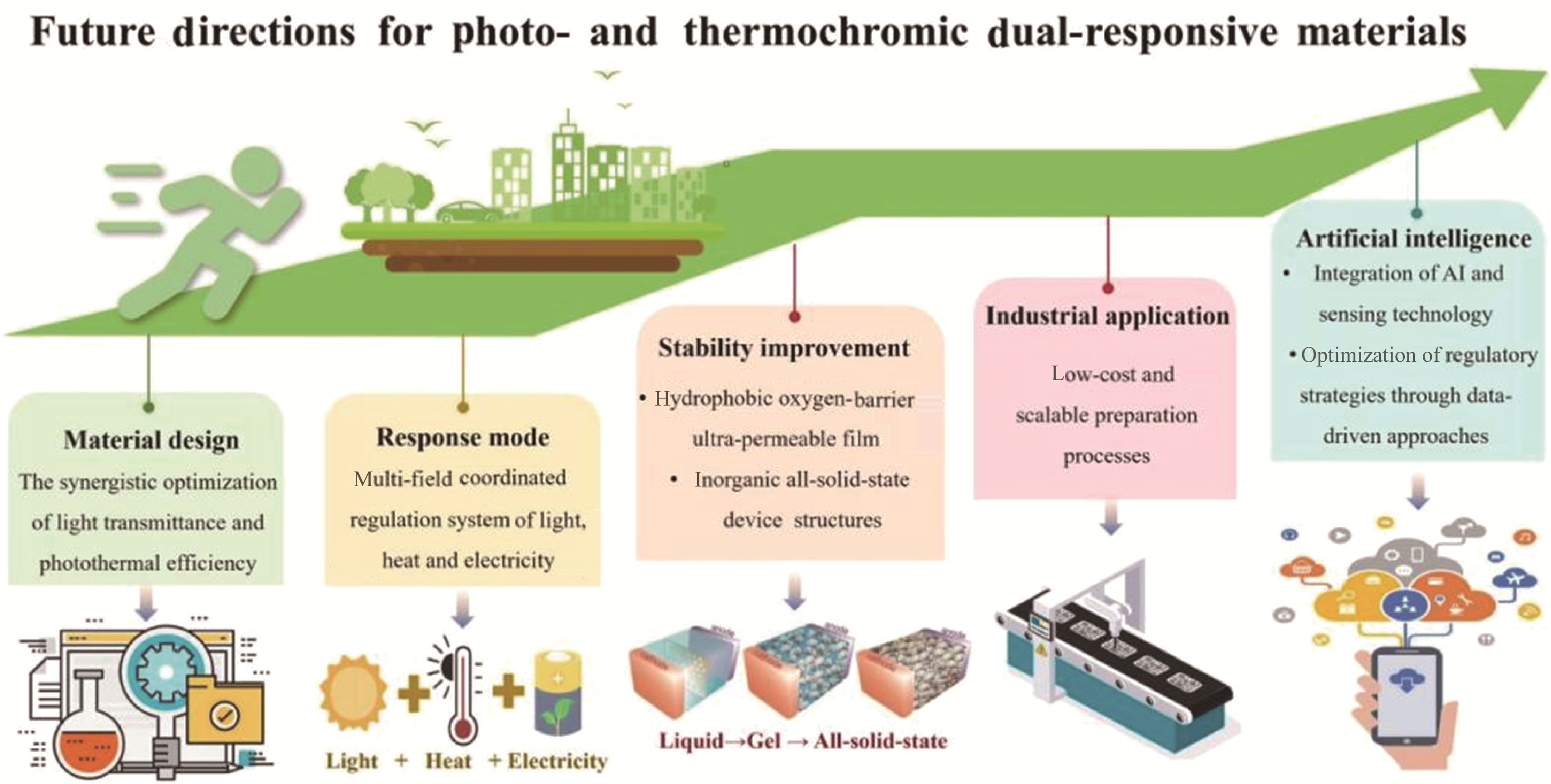
Fig. 10 Prospective development orientation of photo- and thermo-chromic dual-responsive materials and smart windows
| [1] | WANG S, JIANG T, MENG Y, et al. Scalable thermochromic smart windows with passive radiative cooling regulation. Science, 2021, 374(6574): 1501. |
| [2] | MEI Z, DING Y, WANG M, et al. A colorful electrochromic infrared emissivity regulator for all-season intelligent thermal management in buildings. Advanced Materials, 2025, 37(20): 2420578. |
| [3] | CHEN M, DENG J, ZHANG H, et al. Advanced dual-band smart windows: inorganic all-solid-state electrochromic devices for selective visible and near-infrared modulation. Advanced Functional Materials, 2025, 35(3): 2413659. |
| [4] | 赵思名, 郭震宇, 黄娅, 等. 面向建筑节能的新型光热调控技术: 主动电致变色与被动辐射制冷. 材料导报, 2025, 39(1): 24100008. |
| [5] | LIANG J, SUI C, TIAN J, et al. Ionic liquid-based reversible metal electrodeposition for adaptive radiative thermoregulation under extreme environments. Advanced Functional Materials, 2026, 36(6): 2419087. |
| [6] | HUANG S, GUO H, XIA P, et al. Integrated device of luminescent solar concentrators and electrochromic supercapacitors for self- powered smart window and display. Nature Communications, 2025, 16: 2085. |
| [7] | ZHAO F, WANG B, HUANG B, et al. Inorganic electrochromic smart windows for advancing building energy efficiency. Nature Reviews Clean Technology, 2025, 1(6): 396. |
| [8] | ZHAO T, CHEN Y, GUO X, et al. High performance tungsten- doped VO2 polycrystalline films for advanced dynamic radiant thermal management. Materials Futures, 2025, 4(3): 035101. |
| [9] | YAO G, XIAO Y, CHEN M, et al. All-solid-state variable emissivity devices with excellent smart thermal control performance. Laser & Photonics Reviews, 2025, 19(16): 2402082. |
| [10] | WANG Y, SUN X, LIU Q, et al. Functional gel materials for next-generation electrochromic devices and applications. Chemical Society Reviews, 2025, 54(7): 3475. |
| [11] | WANG J, GUO X, BIAN C, et al. Roadmap for electrochromic smart devices: from materials engineering and architectures design to multifunctional application. Progress in Materials Science, 2025, 153: 101461. |
| [12] | CHEN M, ZHANG X, YAN D, et al. Oxygen vacancy modulated amorphous tungsten oxide films for fast-switching and ultra-stable dual-band electrochromic energy storage smart windows. Materials Horizons, 2023, 10(6): 2191. |
| [13] | ZHAO X, CHEN Q, FAN F, et al. Dual-band electrochromic smart window for dynamic switching between radiative cooling and solar heating. Advanced Science, 2025, 12: e04483. |
| [14] | SHAO Z, HUANG A, CAO C, et al. Tri-band electrochromic smart window for energy savings in buildings. Nature Sustainability, 2024, 7(6): 796. |
| [15] | DENG J, CHEN M, ZHANG X, et al. Water-in-eutectogel electrolytes for scalable solid-state electrochromic devices. Chemical Engineering Journal, 2025, 516: 163746. |
| [16] | CHEN M, ZHANG X, SUN W, et al. A dual-responsive smart window based on inorganic all-solid-state electro- and photochromic device. Nano Energy, 2024, 123: 109352. |
| [17] | KUROIWA H, INAGAKI Y, MUTOH K, et al. On-demand control of the photochromic properties of naphthopyrans. Advanced Materials, 2019, 31(2): 1805661. |
| [18] | MENG W, KRAGT A J J, GAO Y, et al. Scalable photochromic film for solar heat and daylight management. Advanced Materials, 2024, 36(5): 2304910. |
| [19] | ZHU Y, YAO Y, CHEN Z, et al. WO3 quantum dot photochromical film. Solar Energy Materials and Solar Cells, 2022, 239: 111664. |
| [20] | TANG K, DONG K, LI J, et al. Temperature-adaptive radiative coating for all-season household thermal regulation. Science, 2021, 374(6574): 1504. |
| [21] | 陈艺丹, 赵九蓬, 豆书亮, 等. 二氧化钒智能窗光热调控原理及进展. 光学学报, 2024, 44(19): 1925004. |
| [22] | GENG C, CHEN Y, WEI H, et al. Adaptive variable emissivity reflector for seasonal and daily thermal regulation in regions with significant temperature variations. Advanced Functional Materials, 2024, 34(52): 2410819. |
| [23] | ZHANG Z, ZHANG L, ZHOU Y, et al. Thermochromic energy efficient windows: fundamentals, recent advances, and perspectives. Chemical Reviews, 2023, 123(11): 7025. |
| [24] | WANG Y, RUNNERSTROM E L, MILLIRON D J. Switchable materials for smart windows. Annual Review of Chemical and Biomolecular Engineering, 2016, 7: 283. |
| [25] | ZOU X, JI H, ZHAO Y, et al. Research progress of photo-/electro- driven thermochromic smart windows. Nanomaterials, 2021, 11(12): 3335. |
| [26] | YONG W, CHEN N, XIONG T, et al. Development of high-performance Mo doped WO3 photo-electrochromic devices. Materials Today Chemistry, 2024, 38: 102095. |
| [27] | TAO J, TIAN S, LI B, et al. Photo-thermochromic W18O49/ hydrogel hybrid smart windows for graded and dual-band sunlight control. Chemical Engineering Journal, 2024, 482: 149079. |
| [28] | LIN C, HUR J, CHAO C Y H, et al. All-weather thermochromic windows for synchronous solar and thermal radiation regulation. Science Advances, 2022, 8(17): eabn7359. |
| [29] | HADJOUDIS E, MAVRIDIS I M. Photochromism and thermochromism of Schiff bases in the solid state: structural aspects. Chemical Society Reviews, 2004, 33: 579. |
| [30] | HADJOUDIS E. Photochromic and thermochromic anils. Molecular Engineering, 1995, 5: 301. |
| [31] | LI Y, LI H, JIN W, et al. π-π stacking controlled photochromic/ thermochromic properties of salicylaldehyde Schiff base in solid state. Dyes and Pigments, 2022, 202: 110295. |
| [32] | TER SCHIPHORST J, VAN DEN BROEK M, DE KONING T, et al. Dual light and temperature responsive cotton fabric functionalized with a surface-grafted spiropyran-NIPAAm-hydrogel. Journal of Materials Chemistry A, 2016, 4(22): 8676. |
| [33] | JI S, WANG M, SU C, et al. Preparation and performance of thermochromic solid-solid phase change materials based on negative photochromic spiropyran. Polymer, 2025, 318: 127995. |
| [34] | ZENG Y, FU Z, CHEN H, et al. Photo- and thermally induced coloration of a crystalline MOF accompanying electron transfer and long-lived charge separation in a stable host-guest system. Chemical Communications, 2012, 48(65): 8114. |
| [35] | HUANG L, LI X N, SHEN Y, et al. Tunable photo/thermochromic properties of Cd(II)-viologen coordination polymers modulated by coordination modes for flexible imaging films and anti-counterfeiting. Dalton Transactions, 2024, 53(20): 8803. |
| [36] | TOMÁS S A, ARVIZU M A, ZELAYA-ANGEL O, et al. Effect of ZnSe doping on the photochromic and thermochromic properties of MoO3 thin films. Thin Solid Films, 2009, 518(4): 1332. |
| [37] | MARTÍN V C S, MORALES-LUNA M, GARCÍA-TINOCO P E, et al. Chromogenic MoO3 thin films: thermo-, photo-, and electrochromic response to working pressure variation in rf reactive magnetron sputtering. Journal of Materials Science: Materials in Electronics, 2018, 29(18): 15486. |
| [38] | LE T K, PHAM P V, DONG C L, et al. Recent advances in vanadium pentoxide (V2O5) towards related applications in chromogenics and beyond: fundamentals, progress, and perspectives. Journal of Materials Chemistry C, 2022, 10(11): 4019. |
| [39] | MCGEE R, GOSWAMI A, KHORSHIDI B, et al. Effect of process parameters on phase stability and metal-insulator transition of vanadium dioxide (VO2) thin films by pulsed laser deposition. Acta Materialia, 2017, 137: 12. |
| [40] | LUKONG V T, UKOBA K, JEN T C. Fabrication of vanadium dioxide thin films and application of its thermochromic and photochromic nature in self-cleaning: a review. Energy & Environment, 2023, 34(8): 3495. |
| [41] | FENG X, CAO S, GUO Y, et al. The photo-thermochromic properties and mechanism of PZNNT ferroelectric ceramics. Materials Letters, 2022, 320: 132354. |
| [42] | YUAN X, WANG J X, LI Y, et al. Multilevel information encryption based on thermochromic perovskite microcapsules via orthogonal photic and thermal stimuli responses. ACS Nano, 2024, 18(16): 10874. |
| [43] | YI Q, BAO H, LI H, et al. Enhanced photochromism and thermochromism in zirconium halide perovskite through bismuth doping and thermal recrystallization. Laser & Photonics Reviews, 2025, 19: 2401964. |
| [44] | WANG P, ZHANG X, WANG Z, et al. A robust superhydrophobic smart coating with reversible thermochromic and photochromic property. Journal of Bionic Engineering, 2022, 19(6): 1589. |
| [45] | ZHOU F, ZHANG Y, ZONG H, et al. Photochromic and thermochromic inks based on supramolecular complexes of viologens and cyclodextrin for printable anticounterfeiting applications. Chemical Engineering Journal, 2025, 507: 160650. |
| [46] | QUEVEDO-LOPEZ M A, RAMIREZ-BON R, OROZCO- TERAN R A, et al. Effect of a CdS interlayer in thermochromism and photochromism of MoO3 thin films. Thin Solid Films, 1999, 343/344: 202. |
| [47] | MORALES-LUNA M, ARVIZU M A, PÉREZ-GONZÁLEZ M, et al. Effect of a CdSe layer on the thermo- and photochromic properties of MoO3 thin films deposited by physical vapor deposition. The Journal of Physical Chemistry C, 2019, 123(28): 17083. |
| [48] | ZHAO T, CHEN Y, GU J, et al. Multifunctional radiation conditioning emitter for laser and infrared with adaptive radiative cooling. ACS Applied Materials & Interfaces, 2024, 16(39): 52153. |
| [49] | ZHAO Y, JI H, LU M, et al. Thermochromic smart windows assisted by photothermal nanomaterials. Nanomaterials, 2022, 12(21): 3865. |
| [50] | KE Y, CHEN J, LIN G, et al. Smart windows: electro-, thermo-, mechano-, photochromics, and beyond. Advanced Energy Materials, 2019, 9(39): 1902066. |
| [51] | ZHU C H, LU Y, PENG J, et al. Photothermally sensitive poly(N-isopropylacrylamide)/graphene oxide nanocomposite hydrogels as remote light-controlled liquid microvalves. Advanced Functional Materials, 2012, 22(19): 4017. |
| [52] | LEE E, KIM D, YOON J. Stepwise activation of switchable glazing by compositional gradient of copolymers. ACS Applied Materials & Interfaces, 2016, 8(39): 26359. |
| [53] | CHOU H T, CHEN Y C, LEE C Y, et al. Switchable transparency of dual-controlled smart glass prepared with hydrogel-containing graphene oxide for energy efficiency. Solar Energy Materials and Solar Cells, 2017, 166: 45. |
| [54] | CHANG Q, SHEN Z, GUO Z, et al. Hydroxypropylmethyl cellulose modified with carbon dots exhibits light-responsive and reversible optical switching. ACS Applied Materials & Interfaces, 2021, 13(10): 12375. |
| [55] | CAO D, XU C, LU W, et al. Sunlight-driven photo-thermochromic smart windows. Solar RRL, 2018, 2(4): 1700219. |
| [56] | GUO M, YU Q, WANG X, et al. Tailoring broad-band-absorbed thermoplasmonic 1D nanochains for smart windows with adaptive solar modulation. ACS Applied Materials & Interfaces, 2021, 13(4): 5634. |
| [57] | LI Y, WANG Y, LU J, et al. Synergistically photothermal Au nanoprisms@MXene enable adaptive solar modulation of HA-PNIPAM hydrogels for smart window. Chemical Engineering Journal, 2023, 457: 141299. |
| [58] | ZHANG Z, WANG Q, LI Z, et al. A skin-beyond multifrequency camouflage system with self-adaptive discoloration and radar- infrared stealth. Chemical Engineering Journal, 2024, 494: 152867. |
| [59] | ZHU H, WANG L. Smart window based on Cu7S4/hydrogel composites with fast photothermal response. Solar Energy Materials and Solar Cells, 2019, 202: 110109. |
| [60] | ZHAO Y, JI H, OU Y, et al. Novel sunlight-driven Cu7S4/VO2 composite films for smart windows. Journal of Materials Chemistry C, 2024, 12(7): 2534. |
| [61] | ZHANG J, DU P, XU D, et al. Near-infrared responsive MoS2/poly(N-isopropylacrylamide) hydrogels for remote light- controlled microvalves. Industrial & Engineering Chemistry Research, 2016, 55(16): 4526. |
| [62] | WU M, SHI Y, LI R, et al. Spectrally selective smart window with high near-infrared light shielding and controllable visible light transmittance. ACS Applied Materials & Interfaces, 2018, 10(46): 39819. |
| [63] | WANG B, WANG Q, ZHU Y, et al. A photo-/thermo-dual- responsible CsxWO3/PNIPAM composite hydrogel for energy- efficient windows. Materials Research Express, 2019, 6(8): 085708. |
| [64] | ZHANG H, LIU J, SHI F, et al. A novel bidirectional fast self-responsive PVA-PNIPAM/LimCsnWO3 composite hydrogel for smart window applications. Chemical Engineering Journal, 2022, 431: 133353. |
| [65] | LIANG X, GUO S, CHEN M, et al. A temperature and electric field-responsive flexible smart film with full broadband optical modulation. Materials Horizons, 2017, 4(5): 878. |
| [66] | XU Z, WANG S, HU X Y, et al. Sunlight-induced photo- thermochromic supramolecular nanocomposite hydrogel film for energy-saving smart window. Solar RRL, 2018, 2(11): 1800204. |
| [67] | ZHANG Z, ZHANG R, XU L, et al. Visible and infrared optical modulation of PSLC smart films doped with ATO nanoparticles. Dalton Transactions, 2021, 50(29): 10033. |
| [68] | YANG Z, ZHANG M, ZHAO X, et al. Fluorine-doped ATO NCs with enhanced LSPR effect for smart windows with adaptive solar modulation. Ceramics International, 2024, 50(11): 19543. |
| [69] | LIU J, RAN S, FAN C, et al. One pot synthesis of Pt-doped CsxWO3 with improved near infrared shielding for energy-saving film applications. Solar Energy, 2019, 178: 17. |
| [70] | TIAN J, GU J, PENG H, et al. Sunlight-driven photo- thermochromic hybrid hydrogel with fast responsiveness and durability for energy efficient smart windows. Composites Part A: Applied Science and Manufacturing, 2021, 149: 106538. |
| [71] | MA D, CHEN L, FAN F, et al. Solar light management enabled by dual-responsive smart window. ACS Applied Materials & Interfaces, 2022, 14(50): 56065. |
| [72] | YAN Q, DING R, LI P, et al. Thermochromic Janus membranes with dynamic solar modulation toward sustainable and high- efficiency solar-to-thermal intelligent management. ACS Sustainable Chemistry & Engineering, 2024, 12(19): 7487. |
| [1] | QIN Shanli, GUO Jiawen, CHEN Yanmeng, JU An’an, WEI Yi, HUANG Kelin, HOU Xianghua, LÜ Sishi, WEN Zhipeng, WU Lian. Recent Advances in Constructing Oriented Ion Transport Channels with Two-dimensional Layered Materials for Electrochemical Energy Storage [J]. Journal of Inorganic Materials, 2026, 41(7): 883-898. |
| [2] | YU Feiyu, WANG Wenqing, ZHANG Xueqin, HE Rujie. Additively Manufactured Ceramic Lattice-based Interpenetrating Phase Composites: Progress and Challenges [J]. Journal of Inorganic Materials, 2026, 41(7): 849-866. |
| [3] | ZHOU Cui, LI Jie, SUN Luchao, SU Haijun, WANG Jingyang. Alumina-based Directionally Solidified Eutectic Ceramics: Microstructure, Control Strategies and Environmental Stability [J]. Journal of Inorganic Materials, 2026, 41(7): 899-914. |
| [4] | FEI Wenlong, WANG Yakun, LIAO Liangsheng. Research Progress on Controllable Synthesis of Blue-emitting ZnSeTe Quantum Dots and Quantum-dot Light-emitting Diode Devices [J]. Journal of Inorganic Materials, 2026, 41(7): 867-882. |
| [5] | SONG Kunjie, XIE Rongjun. Research Advances on Machine Learning-driven Development of Novel Luminescent Materials [J]. Journal of Inorganic Materials, 2026, 41(6): 689-703. |
| [6] | HU Yuqing, ZHU Yixin, LE Xianhao, WAN Qing. Lithium Tantalate Wafer: Advances in Thinning Technology and Application in Pyroelectric Infrared Detectors [J]. Journal of Inorganic Materials, 2026, 41(6): 764-774. |
| [7] | LIU Chunfan, CHEN Ke, GE Fangfang, HUANG Qing. Research Progress on Lead-bismuth Eutectic Corrosion Resistant Coatings [J]. Journal of Inorganic Materials, 2026, 41(6): 775-786. |
| [8] | HU Yang, XIE Min, ZHANG Xiaoyi, LI Xiang, GUO Xinwei, JIANG Nan, ZHOU Wenhan, ZHANG Shengli, ZENG Haibo. Research Progress on Computational and Data-driven Environmental-friendly Luminescent Materials [J]. Journal of Inorganic Materials, 2026, 41(6): 704-722. |
| [9] | WANG Junbu, HUANG Zeai, YANG Mingkai, MENG Ying, ZHOU Mingwei, ZHOU Ying. Research Progress on Anti-coking Catalytic Materials for Methane Conversion [J]. Journal of Inorganic Materials, 2026, 41(6): 739-750. |
| [10] | WANG Jinwen, YANG Zhen, ZHOU Huan, XIA Dan, YANG Lei. Biomedical Applications of Injectable Inorganic Biomaterials [J]. Journal of Inorganic Materials, 2026, 41(6): 751-763. |
| [11] | LI Hantao, SHEN Qiang, LUO Guoqiang, WANG Xuefei, GAO Ming, CHEN Chen. Research Progress on Structure and Performance Regulation of Silicon-based Anode Materials via Mechanical Ball Milling [J]. Journal of Inorganic Materials, 2026, 41(5): 561-572. |
| [12] | XIE Chenyi, MIAO Huaming, ZHANG Weiran, LIU Rongjun, WANG Yanfei, LI Duan. Research Progress on Theoretical Calculation in the Field of High-entropy Ceramics [J]. Journal of Inorganic Materials, 2026, 41(5): 545-560. |
| [13] | LI Xuan, YE Kuicai, FENG Jiayin, QIU Jiajun, QIAN Wenhao, XING Min. Surface Modification of Titanium-based Dental Implants for Soft Tissue Sealing: A Review [J]. Journal of Inorganic Materials, 2026, 41(4): 432-444. |
| [14] | PENG Dezhao, LI Rui, WANG Wenhong, WANG Zirui, ZHANG Zhizhen. Research Progress on Sodium Chloride Solid Electrolytes [J]. Journal of Inorganic Materials, 2026, 41(4): 409-420. |
| [15] | CHEN Kun, JIANG Yonggang, FENG Junzong, LI Liangjun, HU Yijie, FENG Jian. Research Progress on Lanthanum Zirconate Porous Materials for Thermal Insulation [J]. Journal of Inorganic Materials, 2026, 41(4): 421-431. |
| Viewed | ||||||
|
Full text |
|
|||||
|
Abstract |
|
|||||
