无机材料学报 ›› 2022, Vol. 37 ›› Issue (1): 3-14.DOI: 10.15541/jim20210368 CSTR: 32189.14.10.15541/jim20210368
所属专题: 2022年度中国知网高下载论文
高娃1( ), 熊宇杰2, 吴聪萍1,3,4(), 周勇1,3(), 邹志刚1,3,4
收稿日期:2021-06-10
修回日期:2021-07-30
出版日期:2022-01-20
网络出版日期:2021-07-20
通讯作者:
周 勇, 教授. E-mail: zhouyong1999@nju.edu.cn; 吴聪萍, 高级工程师. E-mail: cpwu@nju.edu.cn
作者简介:高 娃(1994-), 女, 博士研究生. E-mail: dz1622007@smail.nju.edu.cn
基金资助:
GAO Wa1(), XIONG Yujie2, WU Congping1,3,4(), ZHOU Yong1,3(), ZOU Zhigang1,3,4
Received:2021-06-10
Revised:2021-07-30
Published:2022-01-20
Online:2021-07-20
Contact:
ZHOU Yong, professor. E-mail: zhouyong1999@nju.edu.cn; WU Congping, senior engineer. E-mail: cpwu@nju.edu.cn
About author:GAO Wa (1994-), female, PhD candidate. E-mail: dz1622007@smail.nju.edu.cn
Supported by:摘要:
21世纪以来, 能源短缺和环境污染一直是人类面临的重大挑战。光催化二氧化碳(CO2)还原, 通过半导体捕获光能, 获得碳氢化合物太阳能燃料是解决能源危机并推动碳循环的有前景的策略之一。然而, 活性低、产物选择性差又极大地限制了这一技术的实际应用。因此, 调控产物选择性并提高光催化效率、加深对CO2还原反应机理的理解具有重要意义。近年来, 超薄材料以其较高的比表面积, 丰富的不饱和配位的表面原子, 较短的电荷从内部到表面的迁移路径, 以及可裁剪的能带结构受到了广泛关注, 并在光催化CO2还原领域取得了可喜的成果。本文在总结光催化CO2还原反应机理的基础上, 介绍了通过构建异质结构、设计Z型系统、引入助催化剂以及缺陷工程等策略促进超薄纳米结构电子空穴分离和调控其电荷迁移路径的研究成果, 并指出了提高光催化CO2还原效率和优化产物选择性的发展前景与挑战。
中图分类号:
高娃, 熊宇杰, 吴聪萍, 周勇, 邹志刚. 基于超薄纳米结构的光催化二氧化碳选择性转化[J]. 无机材料学报, 2022, 37(1): 3-14.
GAO Wa, XIONG Yujie, WU Congping, ZHOU Yong, ZOU Zhigang. Recent Progress on Photocatalytic CO2 Reduction with Ultrathin Nanostructures[J]. Journal of Inorganic Materials, 2022, 37(1): 3-14.
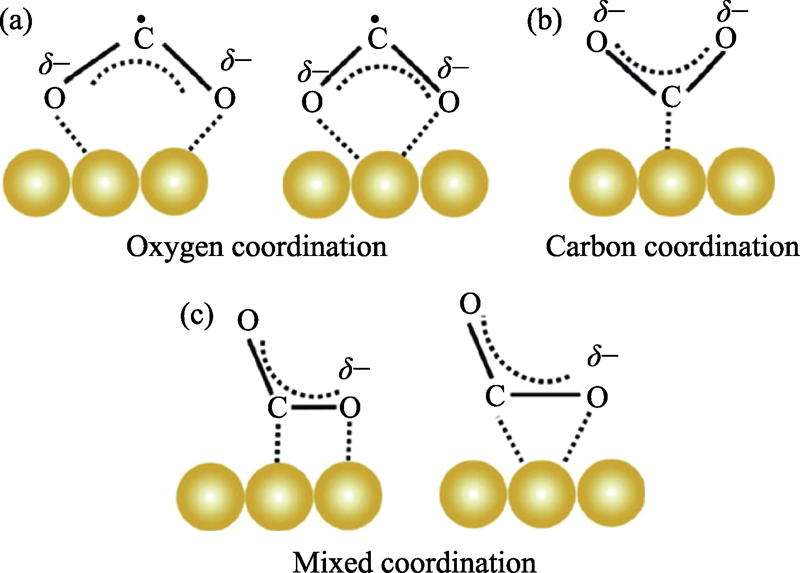
图1 CO2吸附在光催化剂表面的不同模式[4]
Fig. 1 Different CO2 adsorption modes on the surface of photocatalysts[4]
| Half electrochemical thermodynamic reactions | Standard potential /V (vs SHE) |
|---|---|
| CO2(g) + 2H+ + 2e- = HCOOH(1) | -0.250 |
| CO2(g) + 2H+ + 2e- = CO(g)+ H2O (1) | -0.106 |
| 2CO2(g) + 2H+ + 2e- = H2C2O4(aq) | -0.500 |
| 2CO2(g) + 2e- = C2O42-(aq) | -0.590 |
| CO2(g) + 4H+ + 4e- = C(s) + 2H2O(1) | 0.210 |
| CO2(g) + 4H+ + 4e- = CH2O(1) + H2O(1) | -0.070 |
| CO2(g) + 6H+ + 6e- = CH3OH(1) + H2O(1) | 0.016 |
| CO2(g) + 8H+ + 8e- = CH4(g) + 2H2O(1) | 0.169 |
| 2CO2(g) + 12H+ + 12e- = CH2CH2(g) + 4H2O(1) | 0.064 |
| 2CO2(g) + 12H+ + 12e- = CH3CH2OH(1) + 3H2O(1) | 0.084 |
表1 在标准条件下(1.01×10⁵ Pa和25 ℃)将水溶液中的CO2转化为各种C1和C2产物的标准电位[34]
Table 1 Standard potentials of convert CO2 to various C1 and C2 products in aqueous solutions at standard conditions (1.01×10⁵ Pa and 25 ℃) [34]
| Half electrochemical thermodynamic reactions | Standard potential /V (vs SHE) |
|---|---|
| CO2(g) + 2H+ + 2e- = HCOOH(1) | -0.250 |
| CO2(g) + 2H+ + 2e- = CO(g)+ H2O (1) | -0.106 |
| 2CO2(g) + 2H+ + 2e- = H2C2O4(aq) | -0.500 |
| 2CO2(g) + 2e- = C2O42-(aq) | -0.590 |
| CO2(g) + 4H+ + 4e- = C(s) + 2H2O(1) | 0.210 |
| CO2(g) + 4H+ + 4e- = CH2O(1) + H2O(1) | -0.070 |
| CO2(g) + 6H+ + 6e- = CH3OH(1) + H2O(1) | 0.016 |
| CO2(g) + 8H+ + 8e- = CH4(g) + 2H2O(1) | 0.169 |
| 2CO2(g) + 12H+ + 12e- = CH2CH2(g) + 4H2O(1) | 0.064 |
| 2CO2(g) + 12H+ + 12e- = CH3CH2OH(1) + 3H2O(1) | 0.084 |
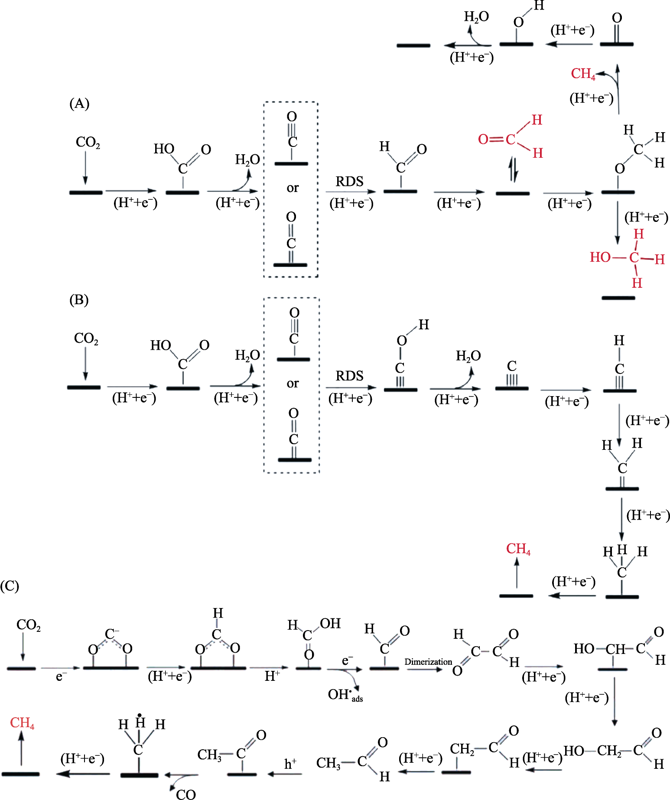
图2 CO2还原为HCHO、CH3OH和CH4的可能反应路线[35,36]
Fig. 2 Possible reaction paths for CO2 reduction to produce HCHO, CH3OH, and CH4[35,36] (A) A thermodynamic analysis; (B) A combined thermodynamic and kinetic analysis; (C) Glyoxal route
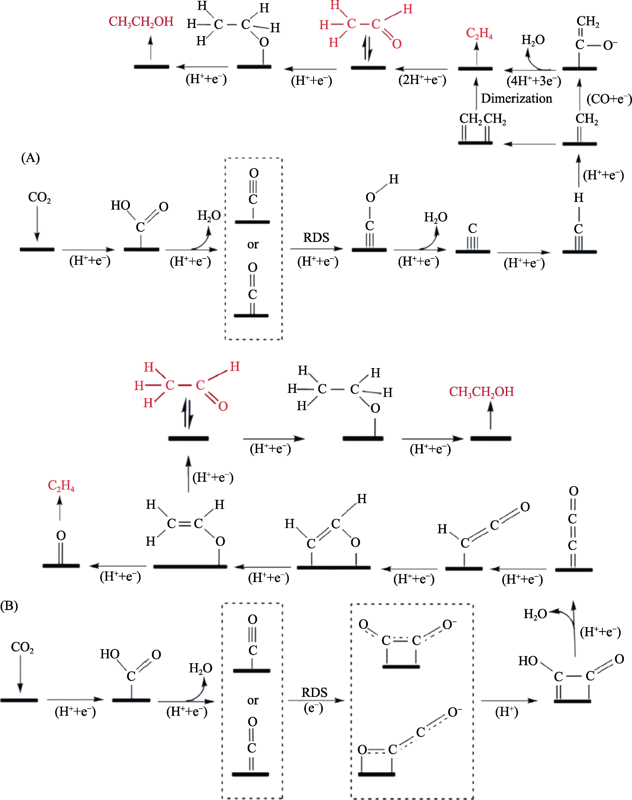
图3 CO2还原为C2H4、CH3CHO和C2H5OH的可能反应路线[35]
Fig. 3 Possible reaction paths for CO2 reduction to produce C2H4, CH3CHO, and C2H5OH[35] (A) Coupling of two *CH2 species or CO insertion in a Fischer-Tropsch-like step; (B) *CO dimerization
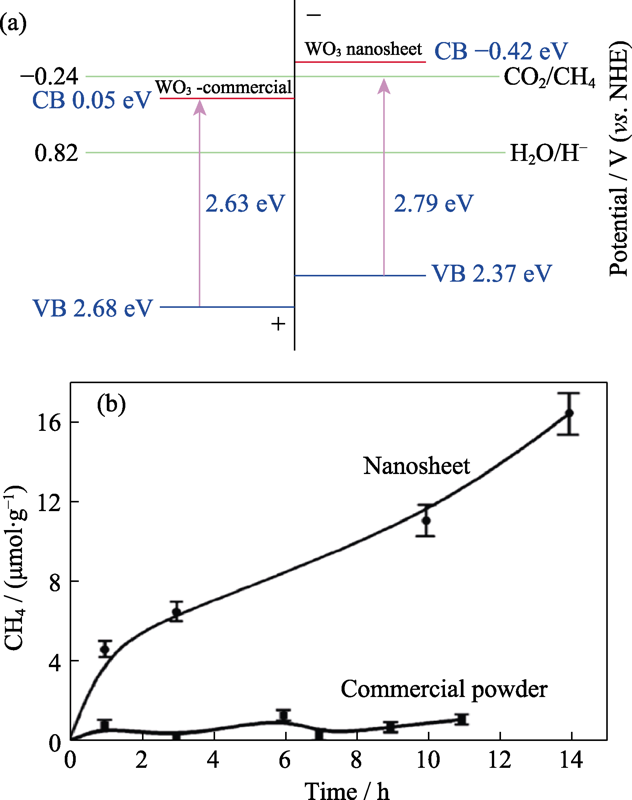
图4 (a)计算的WO3纳米片和商用WO3粉末相对于CO2/CH4氧化还原电位的能带位置, (b)可见光照射下WO3纳米片和商品粉末的CH4产量随时间的变化(λ≥420 nm)[38]
Fig. 4 (a) Calculated band positions of the WO3 nanosheet and commercial WO3, relative to the redox potential of CO2/CH4 in the presence of water, and (b) CH4 generation over the nanosheet and commercial powder as a function of visible light irradiation time (λ≥420 nm)[38]
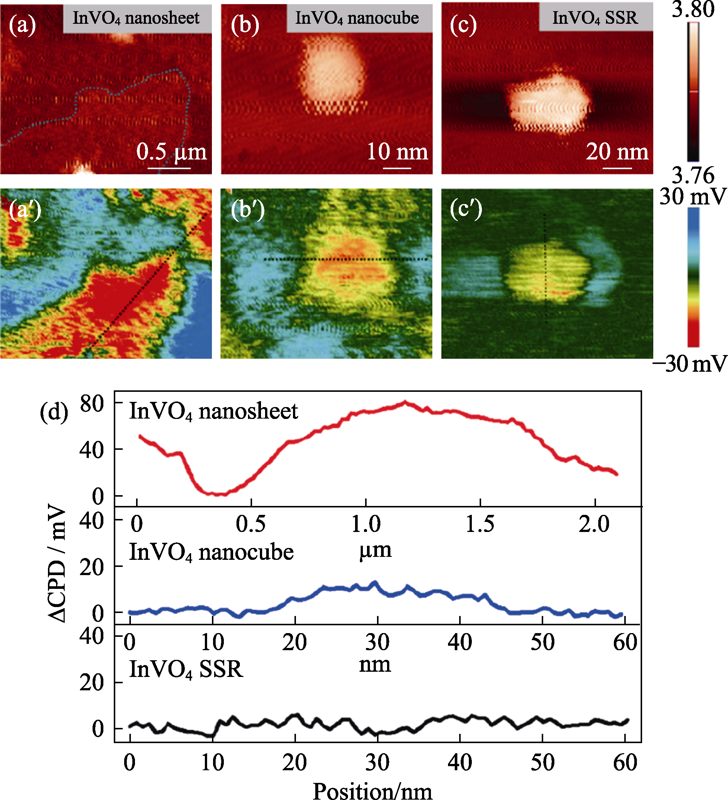
图5 (a)原子薄的InVO4纳米片, (b)InVO4纳米立方体, 和(c)固相烧结InVO4样品的高度图像; (a’)、(b’)和(c’)中的表面光电压图像是光照条件下和暗态下图像之间的差值图像; (d)表面光电压变化, 由暗条件下的电势减去光照条件下的电势(ΔCPD = CPDdark - CPDlight)[13]
Fig. 5 Height images of (a) atomically thin InVO4 nanosheet, (b) nanocube, and (c) bulk materials obtained by conventional solid-state reaction, surface photovoltage spectroscopy (SPV) images in (a′), (b′), and (c′) displaying differential images between potential images under light and in the dark, and (d) surface photovoltage change by subtracting the potential under dark conditions from that under illumination (SPV, ΔCPD = CPDdark - CPDlight)[13]
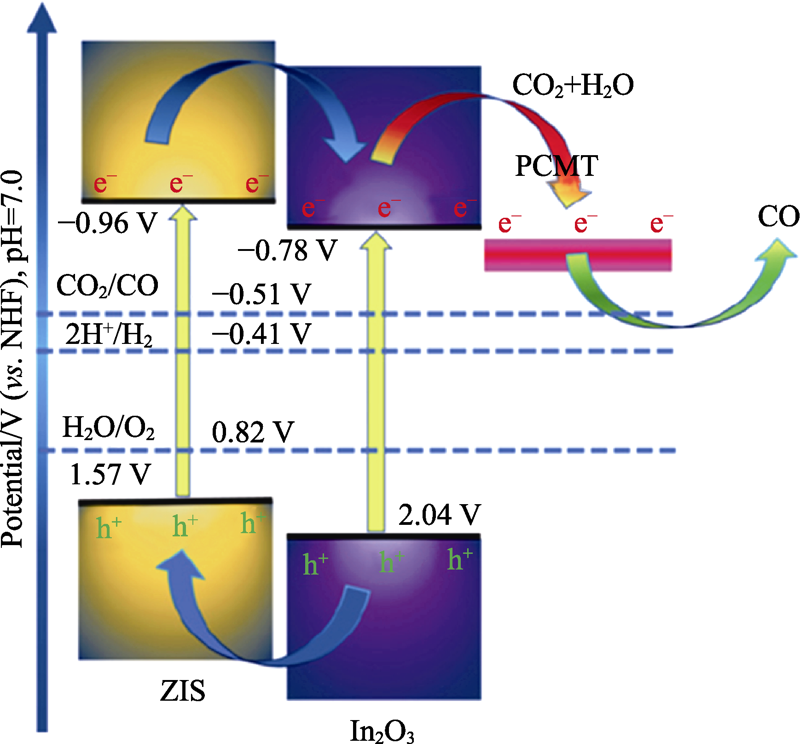
图6 PCMT@In2O3/ZIS的能带结构[47]
Fig. 6 Band structures of PCMT@In2O3/ZIS[47]
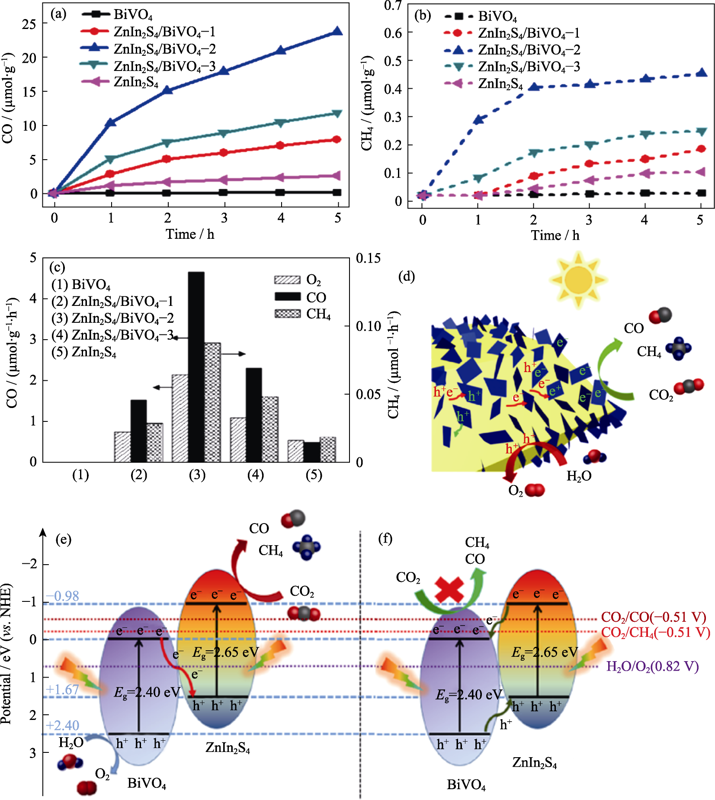
图7 光催化(a)CO和(b)CH4的产量随光照时间的变化; (c)不同样品的光催化活性比较; (d)ZnIn2S4/BiVO4纳米复合材料光催化CO2还原示意图; (e)Z型电子/空穴转移机制示意图; (f)光辐照下异质结型电子空穴转移机制[50]
Fig. 7 Photocatalytic (a) CO and (b) CH4 output changing with light irradiation time, (c) comparison of photocatalytic activity over different samples, (d)schematic illustration of the photocatalytic CO2 reduction for ZnIn2S4/BiVO4 nanocomposite, schematic representation of (e) Z-scheme electron-hole transfer mechanisms, and (f) heterojunction-type electron-hole transfer mechanisms under light irradiation[50]
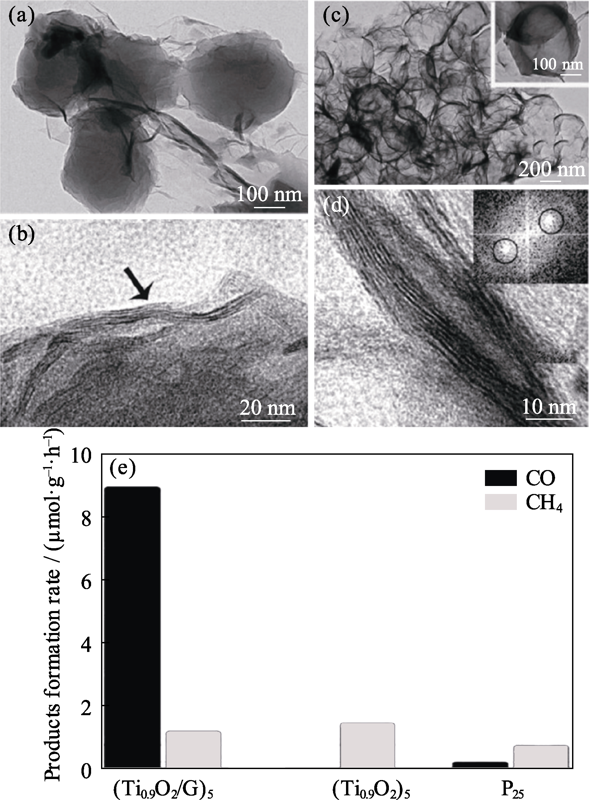
图8 (a, b)聚甲基丙烯酸甲酯球包覆(PEI/Ti0.91O2/PEI/GO)5, (c, d)(G-Ti0.91O2)5空心球的TEM照片, (e)产物产率的比较[53]
Fig. 8 TEM images of (a, b) poly(methylmethacrylate) spheres coated with (protonic polyethylenimine (PEI)/Ti0.91O2/ PEI/GO)5, (c, d) (G-Ti0.91O2)5 hollow spheres, and (e)comparation of the average product formation rates[53]
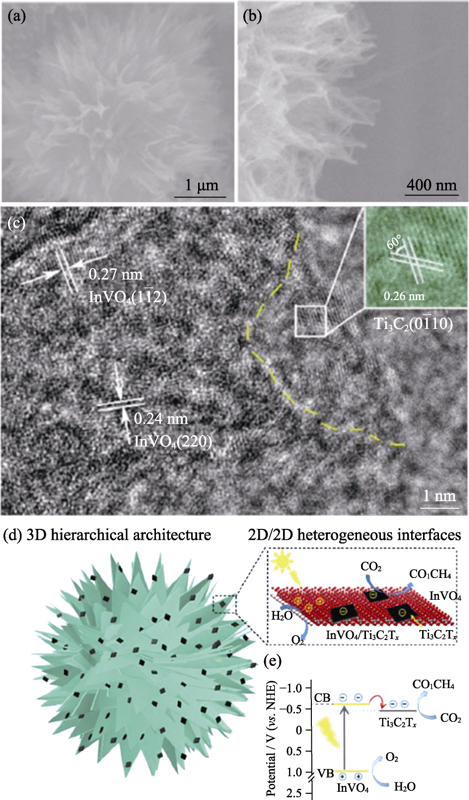
图9 (a, b)高倍率下InVO4/Ti3C2Tx的SEM照片, (c)InVO4/ Ti3C2Tx的HRTEM照片, (d)InVO4/Ti3C2Tx杂化体系中, CO2光催化还原过程中的空间电荷分离和传输方案, (e)InVO4/ Ti3C2Tx的能级结构[56]
Fig. 9 (a, b) SEM images of InVO4/Ti3C2Tx at higher magnification, (c) HRTEM images of InVO4/Ti3C2Tx, (d)scheme for spatial charge separation and transport during the photocatalytic reduction of CO2 over hierarchical InVO4/Ti3C2Tx heterosystem, and (e)energy level alignment of InVO4/Ti3C2Tx hybrid[56]
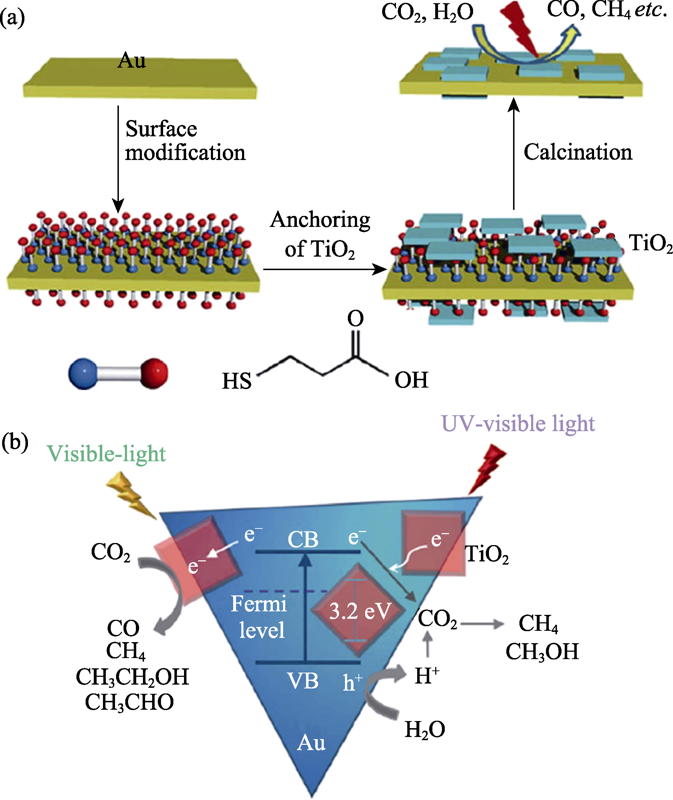
图10 (a) Au-TiO2复合材料的制备过程示意图, (b) Au-TiO2体系中电荷分离和转移及CO2光还原成不同产物的示意图[57]
Fig. 10 Schematic illustration of the preparation procedure of the Au-TiO2 composites (b), schematic illustration of charge separation and transfer in the Au-TiO2 system and photoreduction of CO2 into different products[57]
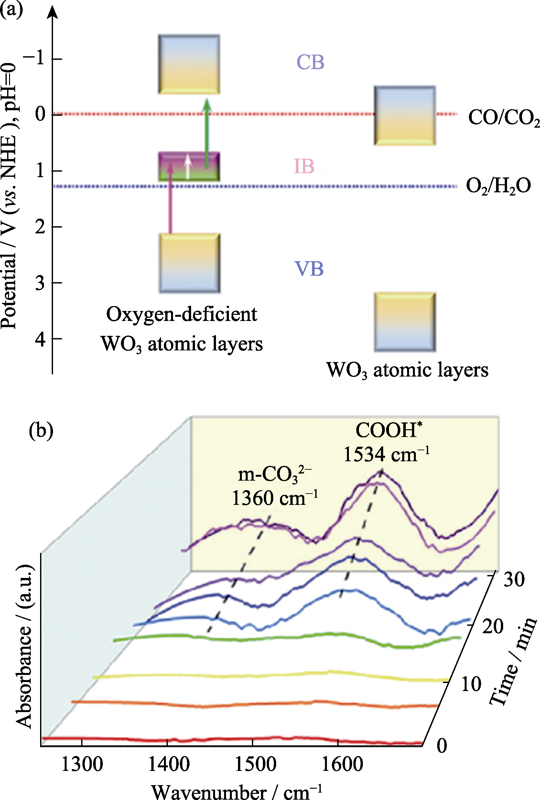
图11 (a)富氧空位WO3原子层和WO3原子层的电子能带结构示意图和(b)富氧空位WO3原子层的原位红外光谱[60]
Fig. 11 (a) Scheme of the electronic band structures of Vo-rich WO3 atomic layers and WO3 atomic layers, and (b) in situ FT-IR spectra for the IR light-driven CO2 reduction process on the Vo-rich WO3 atomic layers[60]
| [1] |
ZHOU YAN-SONG, WANG ZHI-TONG, HUANG LEI, et al. Engineering 2D photocatalysts toward carbon dioxide reduction. Adv. Energy Mater., 2021, 11(8):2003159.
DOI URL |
| [2] | VU NHU-NANG, SERGE KALIAGUINE, DO TRONG-ON. Critical aspects and recent advances in structural engineering of photocatalysts for sunlight-driven photocatalytic reduction of CO2 into fuels. Adv. Funct. Mater., 2019, 29(31): 1901825. |
| [3] |
JIAO XING-CHEN, ZHENG KAI, LIANG LIANG, et al. Fundamentals and challenges of ultrathin 2D photocatalysts in boosting CO2 photoreduction. Chem. Soc. Rev., 2020, 49(18):6592-6604.
DOI URL |
| [4] |
FU JUN-WEI, JIANG KE-XIN, QIU XIAO-QING, et al. Product selectivity of photocatalytic CO2 reduction reactions. Mater. Today, 2020, 32:222-243.
DOI URL |
| [5] |
TU WEN-GUANG, ZHOU YONG, ZOU ZHI-GANG. Versatile graphene-promoting photocatalytic performance of semiconductors: basic principles, synthesis, solar energy conversion, and environmental applications. Adv. Funct. Mater., 2013, 23(40):4996-5008.
DOI URL |
| [6] |
TU WEN-GUANG, ZHOU YONG, ZOU ZHI-GANG. Photocatalytic conversion of CO2 into renewable hydrocarbon fuels: state-of-the-art accomplishment, challenges, and prospects. Adv. Mater., 2014, 26(27):4607-4626.
DOI URL |
| [7] |
ZHAO YU-FEI, GEOFFREY I N WATERHOUSE, CHEN GUAN-BO, et al. Two-dimensional-related catalytic materials for solar-driven conversion of CO:X into valuable chemical feedstocks. Chem. Soc. Rev., 2019, 48(7):1972-2010.
DOI URL |
| [8] |
XIONG JUN, SONG PIN, DI JUN, et al. Ultrathin structured photocatalysts: a versatile platform for CO2 reduction. Appl. Catal. B Environ., 2019, 256:117788.
DOI URL |
| [9] |
CHEN SHAN-SHAN, QI YU, LI CAN, et al. Surface strategies for particulate photocatalysts toward artificial photosynthesis. Joule, 2018, 2(11):2260-2288.
DOI URL |
| [10] | 涂文广, 周勇, 邹志刚. 半导体纳米催化剂的结构调控及其光还原CO2的研究进展. 影像科学与光化学, 2015, 33:347-357. |
| [11] | 王冰, 赵美明, 周勇, 等. 光催化还原二氧化碳制备太阳燃料研究进展及挑战. 中国科学: 技术科学, 2017, 44:286-296. |
| [12] | 崔新江, 石峰. 基于单原子催化剂的二氧化碳选择性转化. 物理化学学报, 2021, 37(5): 2006080. |
| [13] |
HAN QIU-TONG, BAI XIAO-WAN, MAN ZAI-QIN, et al. Convincing synthesis of atomically thin, single-crystalline InVO4 sheets toward promoting highly selective and efficient solar conversion of CO2 into CO. J. Am. Chem. Soc., 2019, 141(10):4209-4213.
DOI URL |
| [14] |
WU XIAO-YONG, LI YUAN, ZHANG GAO-KE, et al. Photocatalytic CO2 conversion of M0.33WO3 directly from the air with high selectivity: insight into full spectrum-induced reaction mechanism. J. Am. Chem. Soc., 2019, 141(13):5267-5274.
DOI URL |
| [15] |
LIU QI, WU DI, ZHOU YONG, et al. Single-crystalline, ultrathin ZnGa2O4 nanosheet scaffolds to promote photocatalytic activity in CO2 reduction into methane. ACS Appl. Mater. Interfaces, 2014, 6(4):2356-2361.
DOI URL |
| [16] |
GAO WA, BAI XIAO-WAN, GAO YU-YING, et al. Anchoring of black phosphorus quantum dots onto WO3 nanowires to boost photocatalytic CO2 conversion into solar fuels. Chem. Commun., 2020, 56(56):7777-7780.
DOI URL |
| [17] |
TU WEN-GUANG, ZHOU YONG, LIU QI, et al. An in situ simultaneous reduction-hydrolysis technique for fabrication of TiO2-graphene 2D sandwich-like hybrid nanosheets: graphene- promoted selectivity of photocatalytic-driven hydrogenation and coupling of CO2 into methane and ethane. Adv. Funct. Mater., 2013, 23(14):1743-1749.
DOI URL |
| [18] |
CAO SHAO-WEN, SHEN BAO-JIA, TONG TONG, et al. 2D/2D heterojunction of ultrathin MXene/Bi2WO6 nanosheets for improved photocatalytic CO2 reduction. Adv. Funct. Mater., 2018, 28(21):1800136.
DOI URL |
| [19] |
YANG SI-ZHOU, HU WEN-HUI, ZHANG XIN, et al. 2D covalent organic frameworks as intrinsic photocatalysts for visible light-driven CO2 reduction. J. Am. Chem. Soc., 2018, 140(44):14614-14618.
DOI URL |
| [20] |
LIU WEN-BO, LI XIAO-KANG, WANG CHI-MING, et al. A scalable general synthetic approach toward ultrathin imine-linked two-dimensional covalent organic framework nanosheets for photocatalytic CO2 reduction. J. Am. Chem. Soc., 2019, 141(43):17431-17440.
DOI URL |
| [21] |
LI XIAO-DONG, SUN YONG-FU, XU JIA-QI, et al. Selective visible-light-driven photocatalytic CO2 reduction to CH4 mediated by atomically thin CuIn5S8 layers. Nat. Energy, 2019, 4(8):690-699.
DOI URL |
| [22] |
JIAO XING-CHEN, CHEN ZONG-WEI, LI XIAO-DONG, et al. Defect-mediated electron-hole separation in one-unit-cell ZnIn2S4 layers for boosted solar-driven CO2 reduction. J. Am. Chem. Soc., 2017, 139(22):7586-7594.
DOI URL |
| [23] |
LIANG LIANG, LI XIAO-DONG, ZHANG JIA-CHEN, et al. Efficient infrared light induced CO2 reduction with nearly 100% CO selectivity enabled by metallic CoN porous atomic layers. Nano Energy, 2020, 69:104421.
DOI URL |
| [24] |
WU JU, LI XIAO-DONG, SHI WEN, et al. Efficient visible- light-driven CO2 reduction mediated by defect-engineered BiOBr atomic layers. Angew. Chem. Int. Ed., 2018, 57(28):8719-8723.
DOI URL |
| [25] |
LIANG LIANG, LI XIAO-DONG, SUN YONG-FU, et al. Infrared light-driven CO2 overall splitting at room temperature. Joule, 2018, 2(5):1004-1016.
DOI URL |
| [26] |
JIAO XING-CHEN, LI XIAO-DONG, JIN XIU-YU, et al. Partially oxidized SnS2 atomic layers achieving efficient visible- light-driven CO2 reduction. J. Am. Chem. Soc., 2017, 139(49):18044-18051.
DOI URL |
| [27] |
ZHENG HUI-LI, HUANG SHAN-LIN, LUO MING-BU, et al. Photochemical in situ exfoliation of metal-organic frameworks for enhanced visible-light-driven CO2 reduction. Angew. Chem. Int. Ed., 2020, 59(52):23588-23592.
DOI URL |
| [28] |
LI XIAO-DONG, LIANG LIANG, SUN YONG-FU, et al. Ultrathin conductor enabling efficient IR light CO2 reduction. J. Am. Chem. Soc., 2019, 141(1):423-430.
DOI URL |
| [29] |
HAN BIN, OU XIN-WEN, DENG ZI-QI, et al. Nickel metal- organic framework monolayers for photoreduction of diluted CO2: metal-node-dependent activity and selectivity. Angew. Chem. Int. Ed., 2018, 57(51):16811-16815.
DOI URL |
| [30] |
ZHAO YU-FEI, CHEN GUAN-GBO, BIAN TONG, et al. Defect-rich ultrathin ZnAl-layered double hydroxide nanosheets for efficient photoreduction of CO2 to CO with water. Adv. Mater., 2015, 27(47):7824-7831.
DOI URL |
| [31] |
DI JUN, ZHAO XIAO-XU, LIAN CHENG, et al. Atomically-thin Bi2MoO6 nanosheets with vacancy pairs for improved photocatalytic CO2 reduction. Nano Energy, 2019, 61:54-59.
DOI URL |
| [32] |
GAO SHAN, GU BING-CHUAN, JIAO XING-CHEN, et al. Highly efficient and exceptionally durable CO2 photoreduction to methanol over freestanding defective single-unit-cell bismuth vanadate layers. J. Am. Chem. Soc., 2017, 139(9):3438-3445.
DOI URL |
| [33] |
ZHU XING-WANG, HUANG SHU-QUAN, YU QING, et al. In-situ hydroxyl modification of monolayer black phosphorus for stable photocatalytic carbon dioxide conversion. Appl. Catal. B Environ., 2020, 269:118760.
DOI URL |
| [34] |
LI XIAO-DONG, WANG SHU-MIN, LI LI, et al. Opportunity of atomically thin two-dimensional catalysts for promoting CO2 electroreduction. Acc. Chem. Res., 2020, 53(12):2964-2974.
DOI URL |
| [35] |
SUN ZHEN-YU, MA TAO, TAO HENG-CONG, et al. Fundamentals and challenges of electrochemical CO2 reduction using two-dimensional materials. Chem, 2017, 3(4):560-587.
DOI URL |
| [36] |
WANG LI-MING, CHEN WEN-LONG, ZHANG DOU-DOU, et al. Surface strategies for catalytic CO2 reduction: from two-dimensional materials to nanoclusters to single atoms. Chem. Soc. Rev., 2019, 48(21):5310-5349.
DOI URL |
| [37] |
ZHUA XING-WANG, HUANG SHU-QUAN, YU QING, et al. In-situ hydroxyl modification of monolayer black phosphorus for stable photocatalytic carbon dioxide conversion. Appl. Catal. B Environ., 2020, 269:118760.
DOI URL |
| [38] |
CHEN XIAO-YU, ZHOU YONG, LIU QI, et al. Ultrathin, single-crystal WO3 nanosheets by two-dimensional oriented attachment toward enhanced photocatalystic reduction of CO2 into hydrocarbon fuels under visible light. ACS Appl. Mater. Interfaces, 2012, 4(7):3372-3377.
DOI URL |
| [39] |
JIAO XING-CHEN, LI XIAO-DONG, JIN XIU-YU, et al. Partially oxidized SnS2 atomic layers achieving efficient visible- light-driven CO2 reduction. J. Am. Chem. Soc., 2017, 139(49):18044-18051.
DOI URL |
| [40] |
LIU QI, ZHOU YONG, KOU JIAHUI, et al. High-yield synthesis of ultralong and ultrathin Zn2GeO4 nanoribbons toward improved photocatalytic reduction of CO2 into renewable hydrocarbon fuel. J. Am. Chem. Soc., 2010, 132(41):14385-14387.
DOI URL |
| [41] |
LI PING, ZHOU YONG, TU WEN-GUANG, et al. Direct growth of Fe2V4O13 nanoribbons on a stainless-steel mesh for visible-light photoreduction of CO2 into renewable hydrocarbon fuel and degradation of gaseous isopropyl alcohol. ChemPlusChem, 2013, 78(3):274-278.
DOI URL |
| [42] |
ZHOU YONG, TIAN ZHONG-PING, ZHAO ZONG-YAN, et al. High-yield synthesis of ultrathin and uniform Bi2WO6 square nanoplates benefitting from photocatalytic reduction of CO2 into renewable hydrocarbon fuel under visible light. ACS Appl. Mater. Interfaces, 2011, 3(9):3594-3601.
DOI URL |
| [43] |
SU JUAN, LI GUO-DONG, LI XIN-HAO, et al. 2D/2D heterojunctions for catalysis. Adv. Sci., 2019, 6(7):1801702.
DOI URL |
| [44] |
WANG SI-BO, GUAN BU YUAN, WEN XIONG, et al. Construction of ZnIn2S4-In2O3 hierarchical tubular heterostructures for efficient CO2 photoreduction. J. Am. Chem. Soc., 2018, 140:5037-5040.
DOI URL |
| [45] |
ZHOU YANG-EN, ZHANG YONG-FAN, LIN MOU-SHENG, et al. Monolayered Bi2WO6 nanosheets mimicking heterojunction interface with open surfaces for photocatalysis. Nat. Commun., 2015, 6:8340.
DOI URL |
| [46] |
TU WEN-GUANG, ZHOU YONG, FENG SHI-CHAO, et al. Hollow spheres consisting of Ti0.91O2/CdS nanohybrids for CO2 photofixation. Chem. Commun., 2015, 51(69):13354-13357.
DOI URL |
| [47] |
GAO WA, WANG LU, GAO CHAO, et al. Exquisite design of porous carbon microtubule-scaffolding hierarchical In2O3-ZnIn2S4 heterostructures toward efficient photocatalytic conversion of CO2 into CO. Nanoscale, 2020, 12(27):14676-14681.
DOI URL |
| [48] |
SURENDAR TONDA, SANTOSH KUMAR, MONIKA BHARDWAJ, et al. g-C3N4/NiAl-LDH 2D/2D hybrid heterojunction for high-performance photocatalytic reduction of CO2 into renewable fuels. ACS Appl. Mater. Interfaces, 2018, 10:2667-2678.
DOI URL |
| [49] | 韩布兴. 直接和间接Z-型异质结耦合的高效CO2光催化还原系统. 物理化学学报, 2021, 37(5):2011071. |
| [50] |
HAN QIU-TONG, LI LIANG, GAO WA, et al. Elegant construction of ZnIn2S4/BiVO4 hierarchical heterostructures as direct Z-scheme photocatalysts for efficient CO2 photoreduction. ACS Appl. Mater. Interfaces, 2021, 13(13):15092-15100.
DOI URL |
| [51] |
YANG YONG, WU JIA-JIA, XIAO TING-TING, et al. Urchin-like hierarchical CoZnAl-LDH/RGO/g-C3N4 hybrid as a Z-Scheme photocatalyst for efficient and selective CO2 reduction. Appl. Catal. B Environ., 2019, 255:117771.
DOI URL |
| [52] |
JO WAN-KUEN, KUMAR SANTOSH, ESLAVA SALVADOR, et al. Construction of Bi2WO6/RGO/g-C3N4 2D/2D/2D hybrid Z-scheme heterojunctions with large interfacial contact area for efficient charge separation and high-performance photoreduction of CO2 and H2O into solar fuels. Appl. Catal. B Environ., 2018, 239:586-598.
DOI URL |
| [53] |
TU WEN-GUAG, ZHOU YONG, LIU QI, et al. Robust hollow spheres consisting of alternating titania nanosheets and graphene nanosheets with high photocatalytic activity for CO2 conversion into renewable fuels. Adv. Funct. Mater., 2012, 22(6):1215-1221.
DOI URL |
| [54] |
FENG SHI-CHAO, CHEN XIAO-YU, ZHOU YONG, et al. Na2V6O16·xH2O nanoribbons: large-scale synthesis and visible- light photocatalytic activity of CO2 into solar fuels. Nanoscale, 2014, 6(3):1896-1900.
DOI URL |
| [55] |
CAO SHAO-WEN, SHEN BAO-JIA, TONG TONG, et al. 2D/2D heterojunction of ultrathin MXene / Bi2WO6 nanosheets for improved photocatalytic CO2 reduction. Adv. Funct. Mater., 2018, 28:1800136.
DOI URL |
| [56] |
LI LIANG, YANG YONG, YANG LIU-QING, et al. 3D hydrangea-like InVO4/Ti3C2Tx hierarchical heterosystem collaborating with 2D/2D interface interaction for enhanced photocatalytic CO2 reduction. ChemNanoMat, 2021, 7(7):815-823.
DOI URL |
| [57] |
WANG MENG, HAN QIU-TONG, ZHOU YONG, et al. TiO2 nanosheet-anchoring Au nanoplates: high-energy facet and wide spectra surface plasmon-promoting photocatalytic efficiency and selectivity for CO2 reduction. RSC Adv., 2016, 6(85):81510-81516
DOI URL |
| [58] |
XIONG JUN, DI JUN, XIA JIE-XIANG, et al. Surface defect engineering in 2D nanomaterials for photocatalysis. Adv. Funct. Mater., 2018, 28:1801983.
DOI URL |
| [59] | 李景虹. 类水滑石材料的缺陷调控对光催化CO2 还原产物的选择性. 科学通报, 2019, 64(31):3151-3152. |
| [60] |
LIANG LIANG, LI XIAO-DONG, SUN YONG-FU, et al. Infrared light-driven CO2 overall splitting at room temperature. Joule, 2018, 2:1004-1016.
DOI URL |
| [1] | 陈明俊, 缪洪康, 肖英俊, 邓建波, 张翔, 赵九蓬, 李垚. 光-热双响应材料研究进展: 从设计策略到智能窗应用[J]. 无机材料学报, 2026, 41(6): 723-738. |
| [2] | 宋坤洁, 解荣军. 机器学习驱动新型发光材料的研究进展[J]. 无机材料学报, 2026, 41(6): 689-703. |
| [3] | 胡钰晴, 朱一新, 乐先浩, 万青. 钽酸锂晶圆减薄技术及其热释电红外探测器应用进展[J]. 无机材料学报, 2026, 41(6): 764-774. |
| [4] | 刘春帆, 陈科, 葛芳芳, 黄庆. 核用耐铅铋腐蚀涂层的研究进展[J]. 无机材料学报, 2026, 41(6): 775-786. |
| [5] | 胡扬, 谢敏, 张筱怡, 李想, 郭新伟, 姜南, 周文瀚, 张胜利, 曾海波. 计算与数据驱动环保型发光材料的研究进展[J]. 无机材料学报, 2026, 41(6): 704-722. |
| [6] | 王俊卜, 黄泽皑, 杨茗凯, 蒙颖, 周明炜, 周莹. 甲烷转化用抗积碳催化材料研究进展[J]. 无机材料学报, 2026, 41(6): 739-750. |
| [7] | 王金文, 杨振, 周欢, 夏丹, 杨磊. 可注射无机材料及其生物医学应用[J]. 无机材料学报, 2026, 41(6): 751-763. |
| [8] | 李涵涛, 沈强, 罗国强, 王雪飞, 高明, 陈晨. 机械球磨法调控硅基负极材料结构与性能的研究进展[J]. 无机材料学报, 2026, 41(5): 561-572. |
| [9] | 解陈一, 缪花明, 张蔚然, 刘荣军, 王衍飞, 李端. 理论计算在高熵陶瓷领域的研究进展[J]. 无机材料学报, 2026, 41(5): 545-560. |
| [10] | 李璇, 叶奎材, 冯佳音, 邱家军, 钱文昊, 邢敏. 钛基牙种植体表面改性促进软组织封闭的研究进展[J]. 无机材料学报, 2026, 41(4): 432-444. |
| [11] | 彭德招, 李瑞, 王文鸿, 王梓瑞, 章志珍. 钠氯化物固态电解质研究进展[J]. 无机材料学报, 2026, 41(4): 409-420. |
| [12] | 陈坤, 姜勇刚, 冯军宗, 李良军, 胡艺洁, 冯坚. 锆酸镧多孔隔热材料研究进展[J]. 无机材料学报, 2026, 41(4): 421-431. |
| [13] | 韦连金, 齐志杰, 汪信, 朱俊武, 付永胜. 纳米金刚石改性及其在电催化氧还原反应中的应用[J]. 无机材料学报, 2026, 41(3): 273-288. |
| [14] | 刘占一, 李勉, 欧阳晓平, 柴之芳, 黄庆. 干法后处理熔盐中Sr/Cs去除方法的研究进展[J]. 无机材料学报, 2026, 41(2): 150-158. |
| [15] | 孙炼, 张磊磊, 薛泽旭, 吴坤, 陈晔, 李志远, 王鲁凯, 王尊刚. 面向辐射探测应用的零维金属卤化物闪烁体研究进展[J]. 无机材料学报, 2026, 41(2): 159-176. |
| 阅读次数 | ||||||
|
全文 |
|
|||||
|
摘要 |
|
|||||