无机材料学报 ›› 2026, Vol. 41 ›› Issue (10): 1365-1379.DOI: 10.15541/jim20250507
夏芳芳1( ), 黄文娟2, 翟天佑1()
收稿日期:2025-12-19
修回日期:2026-01-22
出版日期:2026-10-20
网络出版日期:2026-03-18
通讯作者:
翟天佑, 教授. E-mail: zhaity@hust.edu.cn作者简介:夏芳芳(1986-), 女, 助理研究员. E-mail: xiafangfang@hust.edu.cn
XIA Fangfang1(), HUANG Wenjuan2, ZHAI Tianyou1()
Received:2025-12-19
Revised:2026-01-22
Published:2026-10-20
Online:2026-03-18
Contact:
ZHAI Tianyou, professor. E-mail: zhaity@hust.edu.cnAbout author:XIA Fangfang (1986-), female, assistant professor. E-mail: xiafangfang@hust.edu.cn
摘要:
层间堆叠方式在二维材料的晶体对称性与层间库仑相互作用中起着关键作用。通过精准调控堆叠结构, 可以诱导出丰富的有序态, 并赋予材料新颖的光学、电子和磁学性质, 从而推动二维材料在非线性光学领域的研究与应用。二维材料具有显著的二阶非线性极化率、原子级厚度以及良好的相位匹配条件, 为非线性光学研究提供了理想平台。二次谐波产生(Second harmonic generation, SHG)作为一种重要的非线性光学效应, 能够灵敏地反映二维材料的层间堆叠信息, 是表征堆叠结构的有力工具。本文对基于SHG技术的二维材料堆叠工程研究进展进行了系统综述。以“堆叠工程”为核心, 系统整合了SHG技术在堆叠结构表征与性能调控中的双重应用, 重点剖析了同质/异质堆叠、扭转角等关键参数对SHG性能的调控机制。接着, 详细讨论了利用SHG表征二维材料层数、堆叠顺序和层间转角的多种技术途径, 并深入分析了同质堆叠与异质堆叠对SHG响应的调控机制, 包括对称性破缺、层间耦合增强等关键物理效应。最后, 对材料体系拓展与跨维度堆叠结构在微纳器件中的应用前景进行了展望。通过充分发挥堆叠工程的潜力, 有望在二维材料中发现更多前所未有的光学与电子特性, 为发展下一代微纳器件提供新的思路与方向, 推动基础研究与工业应用的双重进步。
中图分类号:
夏芳芳, 黄文娟, 翟天佑. 二维材料堆叠工程的二次谐波产生: 表征与调控[J]. 无机材料学报, 2026, 41(10): 1365-1379.
XIA Fangfang, HUANG Wenjuan, ZHAI Tianyou. Second-harmonic Generation in Stacking-engineered 2D Materials: Characterization and Modulation[J]. Journal of Inorganic Materials, 2026, 41(10): 1365-1379.
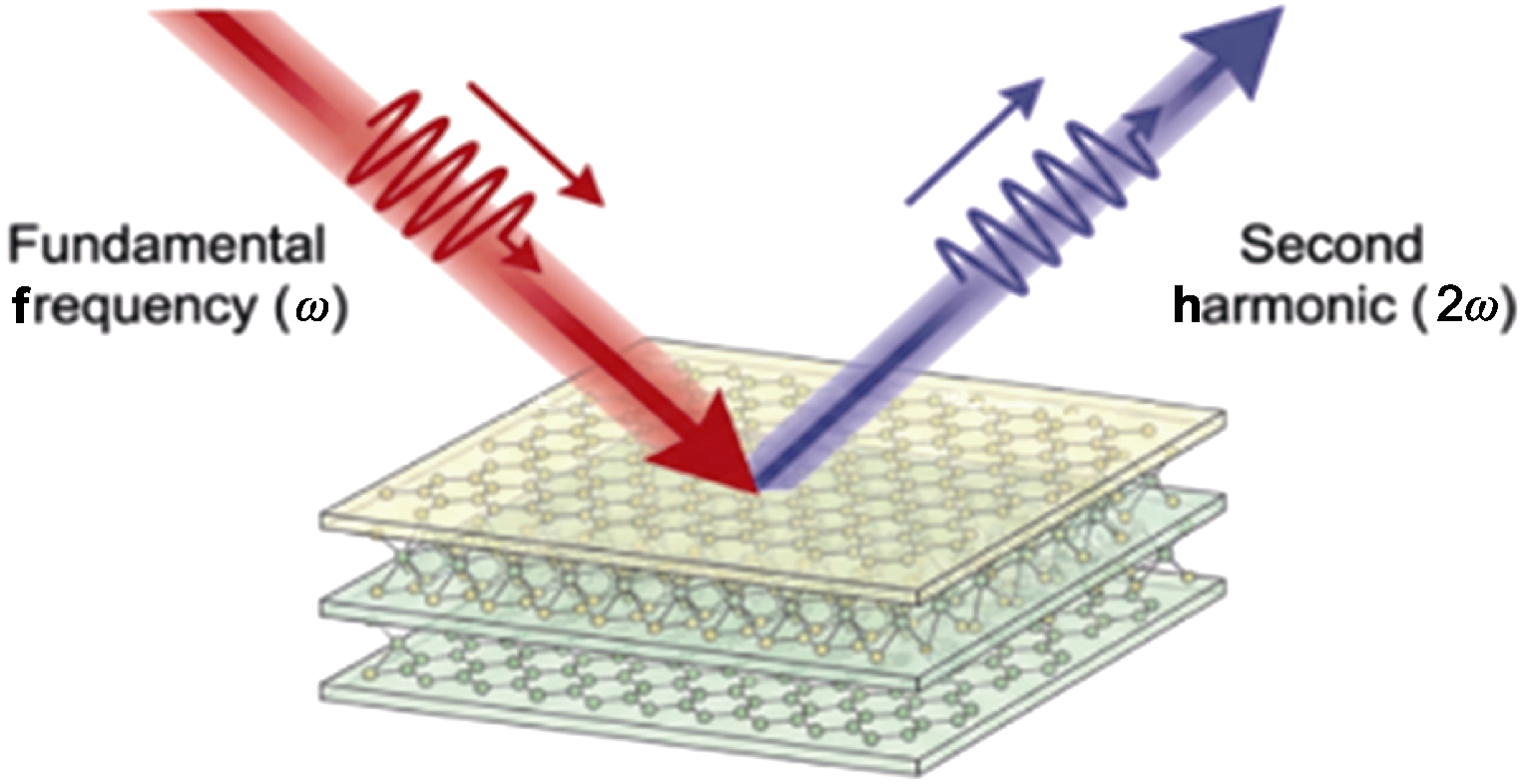
图1 堆叠二维材料中SHG示意图
Fig. 1 Schematic diagram of SHG in stacked 2D materials
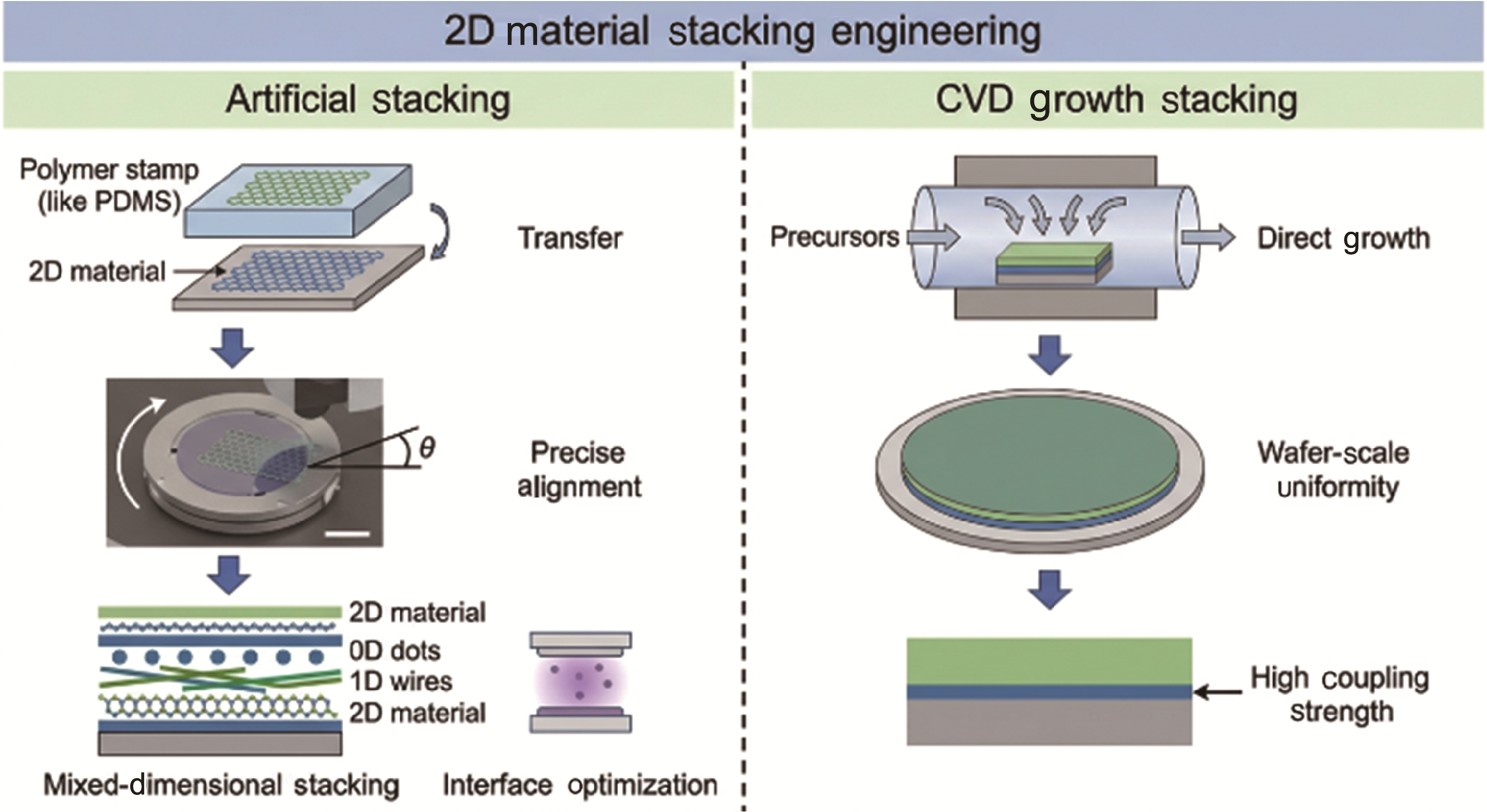
图2 二维材料堆叠工程示意图
Fig. 2 Schematic diagram of 2D material stacking engineering
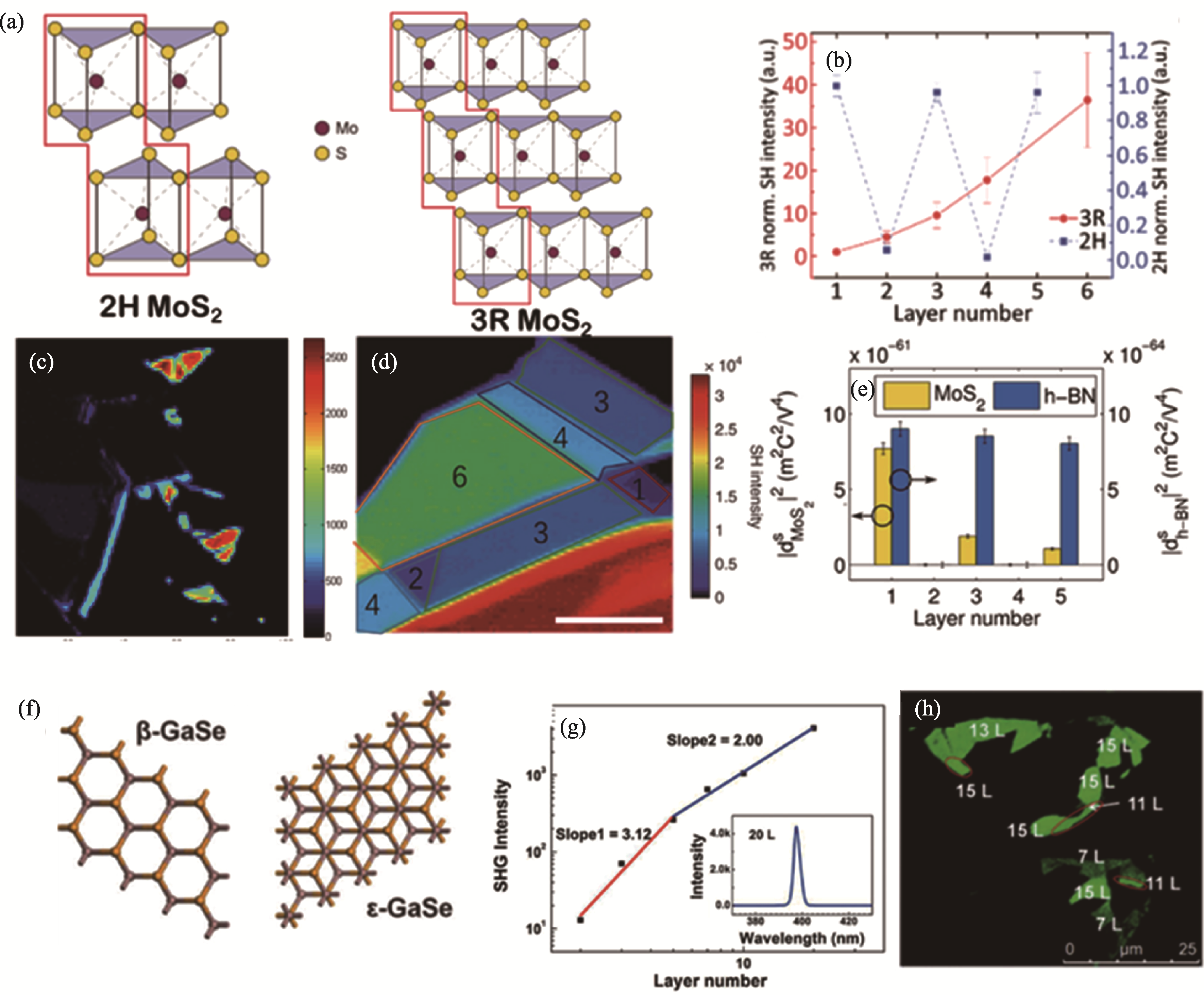
图3 SHG表征堆叠层数[19-22]
Fig. 3 SHG characterization of stacking layers[19-22] (a) Schematic crystal structures of 2H-MoS2 and 3R-MoS2[19]; (b) Relationship between second-harmonic (SH) intensity and layer number for 2H-MoS2 and 3R-MoS2 (SH intensity of 3R-MoS2 follows an approximate quadratic dependence, whereas that of 2H-MoS2 oscillates with changing layer number)[19]; (c) SHG image of 2H-MoS2, where pronounced signal intensity is observed only in odd-numbered layers such as monolayer, trilayer, and five-layer samples[20]; (d) Comparison of SHG intensity variations for 2H-MoS2 with different thicknesses[20]; (e) Comparison of SHG signal intensity between h-BN and 2H-MoS2[20]; (f) Schematic crystal structures of β-GaSe and ε-GaSe[22-23]; (g) Relationship between SHG intensity and layer number for β-GaSe and ε-GaSe[22]; (h) SHG signal distribution of GaSe nanosheets with different thicknesses[22]
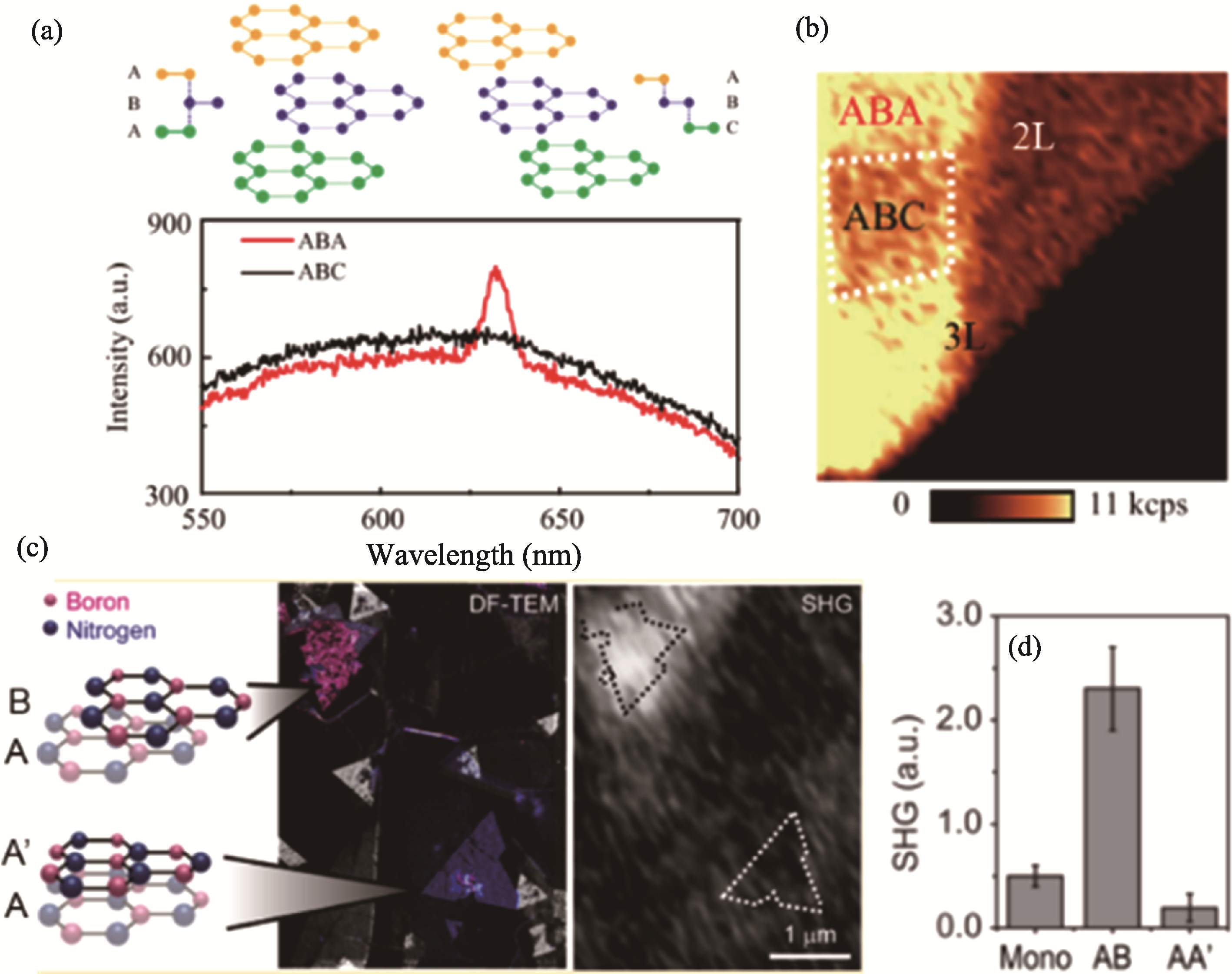
图4 SHG信号强度与堆叠次序的关联[25-26]
Fig. 4 Correlation between SHG signal intensity and stacking order[25-26] (a) Different stacking structures of graphene and their corresponding SHG signal intensities[26]; (b) SHG microscopy image of ABA-stacked and ABC-stacked graphene[26]; (c) Various stacking configurations of h-BN along with the corresponding dark-field transmission electron microscopy and SHG microscopy images[25]; (d) SHG signal intensities of h-BN with different stacking configurations[25]

图5 不同堆叠次序的MoS2同质双层的二阶非线性系数及角分辨SHG图案[24]
Fig. 5 Second-order nonlinear coefficients and angle-resolved SHG patterns of MoS2 homobilayers with different stacking orders[24] (a, b) Top and side views of the atomic structures of two typical stacking sequences in MoS2 homobilayers; (c) d16, d21 and d22 coefficients of AA-stacked and AA′_Mo-60 -stacked MoS2 homobilayers; (d) d15, d24, d31, d32 and d33 coefficients of AA′_Mo-60-stacked MoS2 homobilayers; (e, f) Angle-resolved SHG patterns of (e) AA-stacked and (f) AA′_Mo-60-stacked MoS2 homobilayers under a pump polarization angle of 0° and an incident angle of 60°
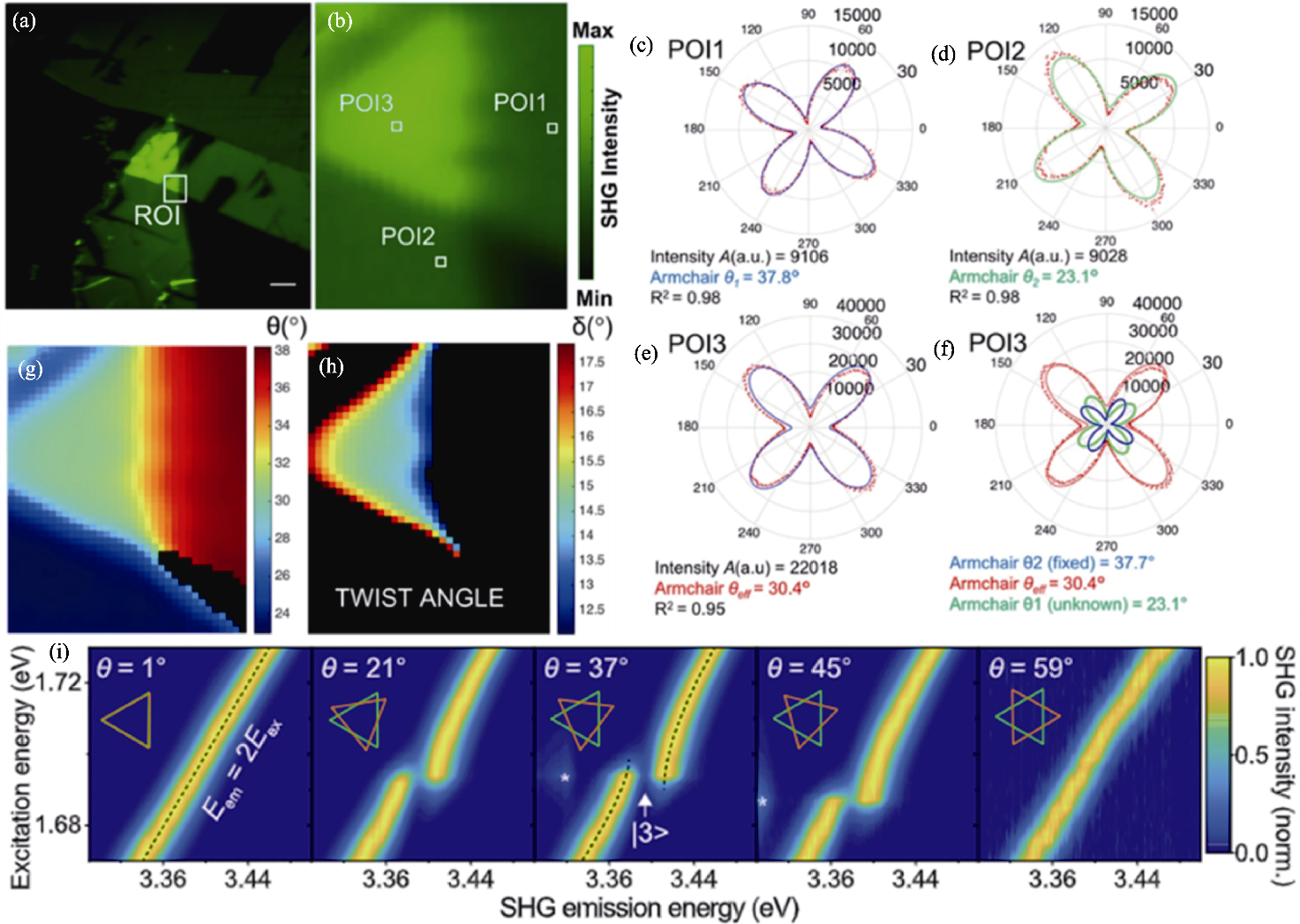
图6 SHG表征层间扭转角[27,29]
Fig. 6 SHG characterization of interlayer twist angles[27,29] (a, b) Total SHG signal (without an analyzer) of two overlapping WS2 monolayers in the region of interest (ROI), and a magnified view of the total SH intensity within the selected ROI (three points of interest (POIs) are marked in the image)[29]; (c-f) Polar plots of the SHG intensities at the three POIs[29]; (g, h) Armchair orientation imaging within the ROI and the spatial distribution map of the twist angle in the overlapping region of the two WS2 monolayers[29]; (i) Variation of the SHG signal of bilayer WSe2 as a function of twist angle (θ), where the vertical axis represents the excitation laser’s central photon energy Eex, and the horizontal axis represents the emitted SHG photon energy Eem (color scale indicates normalized SHG intensity)[27]
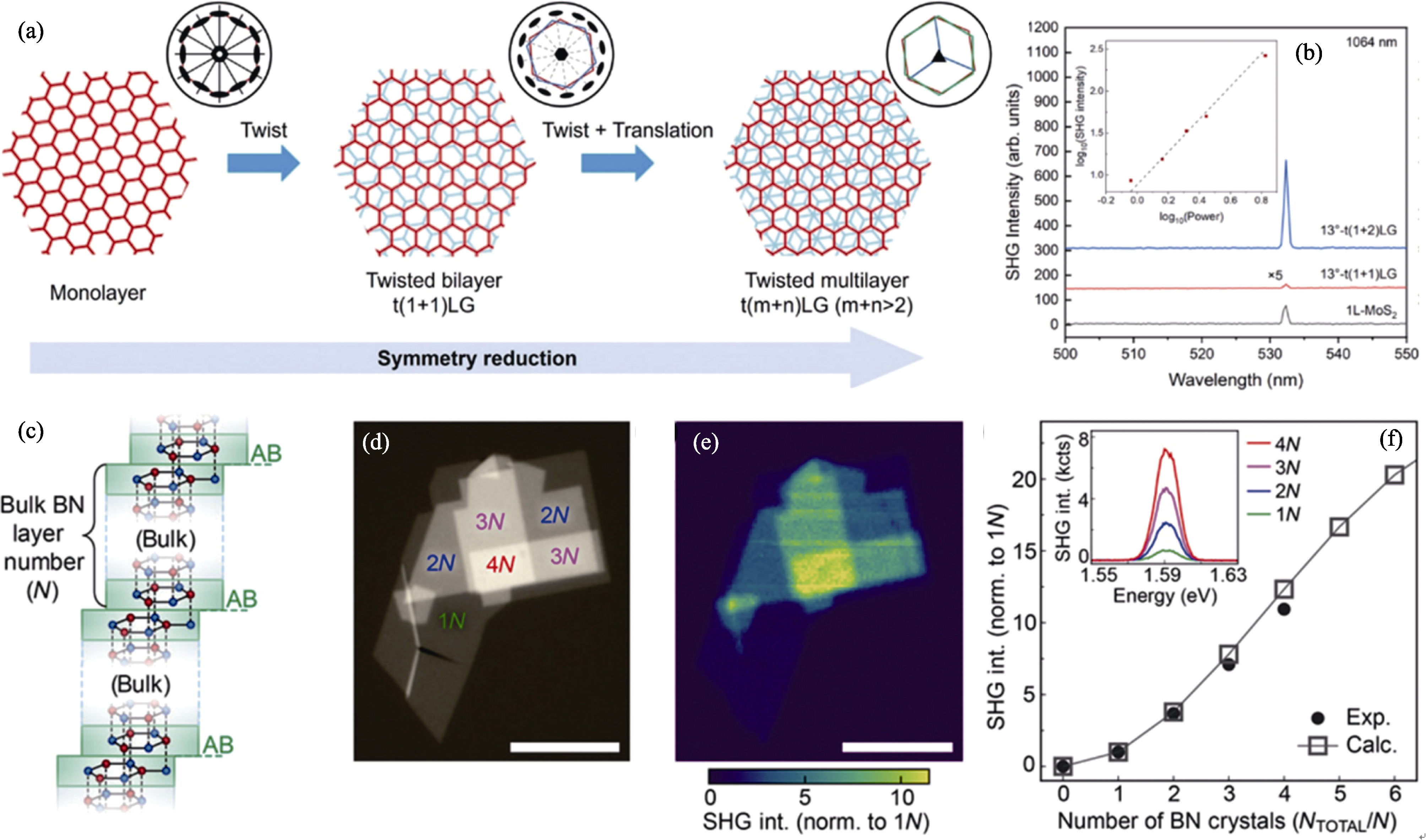
图7 同质堆叠二维材料的SHG性能[32,43]
Fig. 7 SHG performance of homostacked 2D materials[32,43] (a) Schematic illustration of the stacking procedure for a t(m+n) layered-graphene (LG) structure[43]; (b) SHG responses under 1064 nm excitation for monolayer MoS2 (black curve), 13°-t(1+1) LG (red curve), and 13°-t(1+2) LG (blue curve) (inset showing the log-log plots of SHG intensity versus incident laser power for the 13°-t(1+2) LG, where t denotes the twist angle, m and n represent the layer numbers of the two stacked graphene parts, and LG refers to layered graphene)[43]; (c) Schematic stacking structure of an N-layer bulk BN crystal arranged with oriented domains separated by AB interfaces[32]; (d) Optical image and (e) confocal SHG image of the device, which contains regions with thicknesses from 1 to 4 layers (N=25)[32]; (f) Dependence of SHG intensity on the number of oriented bulk BN crystal blocks in the stack (inset showing the SHG intensities for regions of different thicknesses)[32]
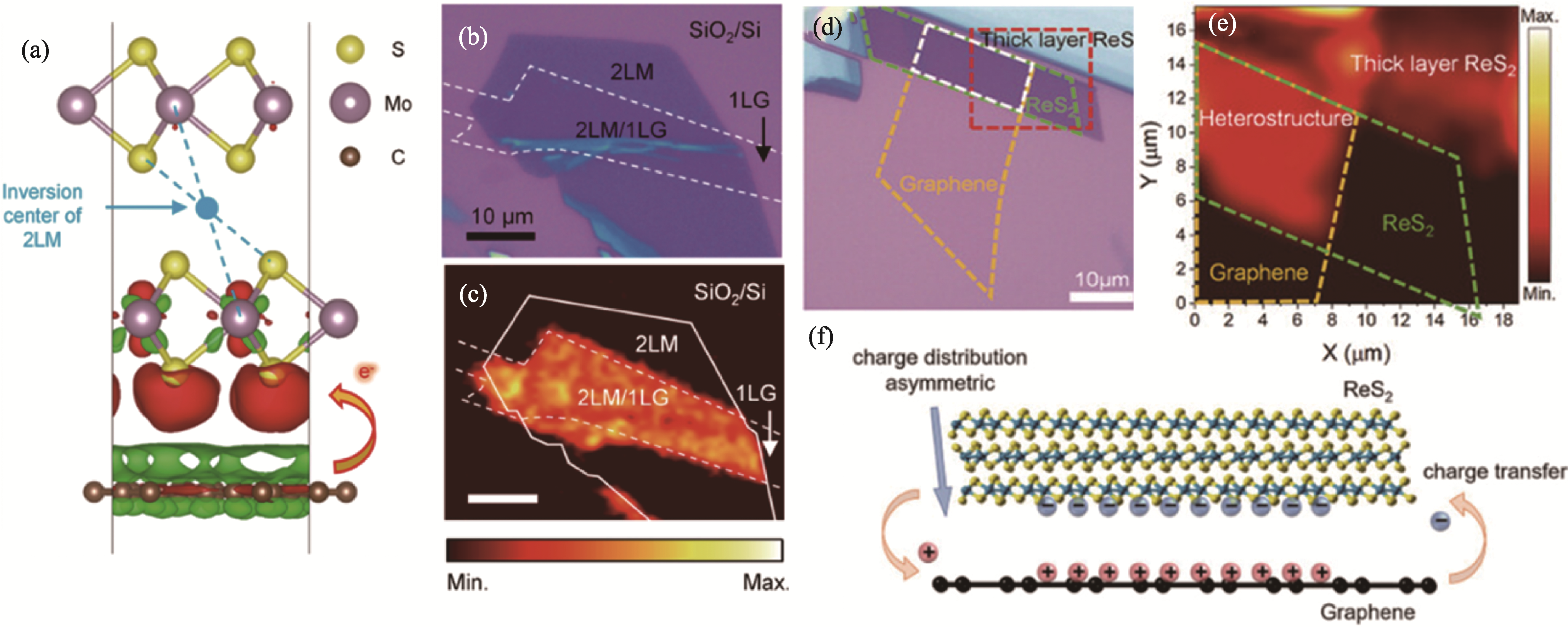
图8 异质堆叠二维材料的SHG性能[50-51]
Fig. 8 SHG performance of heterostacked 2D materials[50-51] (a) Side-view isosurface map of the charge-density difference induced in the 2LM/1LG van der Waals heterostructure, with an isovalue of 1×10⁻⁴ e/Å3, where red regions indicate electron accumulation, while green regions indicate electron depletion[50]; (b) Optical microscope image of a 2LM/1LG van der Waals heterostructure formed by transferring bilayer MoS2 (2LM) onto monolayer graphene (1LG), and (c) the corresponding spatial SHG mapping acquired under 532 nm excitation[50]; (d) Optical microscope image of a trilayer ReS2/graphene heterostructure and (e) its corresponding SHG image[51]; (f) Schematic illustration of charge transfer between trilayer ReS2 and graphene[51]
| Stacking type | Material | SHG performance | Fabrication | Thickness | Ref. | |
|---|---|---|---|---|---|---|
| χ(2)/ (×10-12, m·V-1) | Emission wavelength/nm | |||||
| Intrinsic stacking | MoS2 | 5.5 | 400 | CVD | 1 layer | [ |
| MoTe2 | 5 | 500 | Exfoliation | Few layers | [ | |
| WS2 | 17 | 400 | CVD | 1 layer | [ | |
| h-BN | 200 | 405 | Exfoliation | 1 layer, few layers | [ | |
| WSe2 | 0.4-6 | 400 | CVD | Few layers | [ | |
| Homogeneous stacking | MoS2/MoS2 | 280 | 405 | CVD | 2 layers | [ |
| h-BN (AB/AC) | 4 | 405 | CVD | 2 layers | [ | |
| Heterogeneous stacking | WS2-MoS2 | 95 | 625-750 | Exfoliation | 2 layers | [ |
| WSe2/MoSe2 | 4.5 | 400 | Exfoliation | 2 layers | [ | |
| Twisted stacking | Twisted bilayer MoS2 (θ=95.3°) | 140 | 400 | CVD | 2 layers | [ |
| Twisted bilayer MoS2 (θ=1.2°/58.2°) | 190 | 400 | CVD | 2 layers | [ | |
| Twisted MoS2/WSe2 (θ=29.82°) | 130 | 282-387 | Exfoliation | 2 layers | [ | |
| Twisted MoS2/WSe2 (θ=0.79°) | 700 | 282-387 | Exfoliation | 2 layers | [ | |
| Twisted MoS2/WS2 (θ=60°) | 11.5 | 400 | CVD | 2 layers | [ | |
表1 堆叠二维材料的SHG性能
Table 1 SHG performance of stacked 2D materials
| Stacking type | Material | SHG performance | Fabrication | Thickness | Ref. | |
|---|---|---|---|---|---|---|
| χ(2)/ (×10-12, m·V-1) | Emission wavelength/nm | |||||
| Intrinsic stacking | MoS2 | 5.5 | 400 | CVD | 1 layer | [ |
| MoTe2 | 5 | 500 | Exfoliation | Few layers | [ | |
| WS2 | 17 | 400 | CVD | 1 layer | [ | |
| h-BN | 200 | 405 | Exfoliation | 1 layer, few layers | [ | |
| WSe2 | 0.4-6 | 400 | CVD | Few layers | [ | |
| Homogeneous stacking | MoS2/MoS2 | 280 | 405 | CVD | 2 layers | [ |
| h-BN (AB/AC) | 4 | 405 | CVD | 2 layers | [ | |
| Heterogeneous stacking | WS2-MoS2 | 95 | 625-750 | Exfoliation | 2 layers | [ |
| WSe2/MoSe2 | 4.5 | 400 | Exfoliation | 2 layers | [ | |
| Twisted stacking | Twisted bilayer MoS2 (θ=95.3°) | 140 | 400 | CVD | 2 layers | [ |
| Twisted bilayer MoS2 (θ=1.2°/58.2°) | 190 | 400 | CVD | 2 layers | [ | |
| Twisted MoS2/WSe2 (θ=29.82°) | 130 | 282-387 | Exfoliation | 2 layers | [ | |
| Twisted MoS2/WSe2 (θ=0.79°) | 700 | 282-387 | Exfoliation | 2 layers | [ | |
| Twisted MoS2/WS2 (θ=60°) | 11.5 | 400 | CVD | 2 layers | [ | |
| [1] |
FOX C, MAO Y, ZHANG X, et al. Stacking order engineering of two-dimensional materials and device applications. Chemical Reviews, 2024, 124(4): 1862.
DOI URL |
| [2] |
DOGADOV O, TROVATELLO C, YAO B, et al. Parametric nonlinear optics with layered materials and related heterostructures. Laser & Photonics Reviews, 2022, 16(9): 2100726.
DOI URL |
| [3] |
KHAN A R, ZHANG L, ISHFAQ K, et al. Optical harmonic generation in 2D materials. Advanced Functional Materials, 2022, 32(3): 2105259.
DOI URL |
| [4] |
ZHANG J, ZHAO W, YU P, et al. Second harmonic generation in 2D layered materials. 2D Materials, 2020, 7(4): 042002.
DOI |
| [5] | JIANG T, HUANG D, SONG R K, et al. Nonlinear optical microscopy in two-dimensional materials. Optics and Precision Engineering, 2022, 30(21): 26. |
| [6] |
XIA F F, WANG F K, HU H L, et al. Application of second harmonic generation in characterization of 2D materials. Journal of Inorganic Materials, 2021, 36(10): 1022.
DOI |
| [7] |
WANG Y, XIAO J, YANG S, et al. Second harmonic generation spectroscopy on two-dimensional materials. Optical Materials Express, 2019, 9(3): 1136.
DOI URL |
| [8] | WU Q X, JIANG T, WEI K. Optical second harmonic generation in thin-films of MoS2. SPIE LIDAR Imaging Detection and Target Recognition, Changchun, 2017: 1060549. |
| [9] |
ZHENG X, WEI Y, ZHANG X, et al. Symmetry engineering induced in-plane polarization in MoS2 through van der Waals interlayer coupling. Advanced Functional Materials, 2022, 32(28): 2202658.
DOI URL |
| [10] |
MALARD L M, ALENCAR T V, BARBOZA A P M, et al. Observation of intense second harmonic generation from MoS2 atomic crystals. Physical Review B, 2013, 87(20): 201401.
DOI URL |
| [11] |
YANG D, HU X, ZHUANG M, et al. Inversion symmetry broken 2D 3R-MoTe2. Advanced Functional Materials, 2018, 28(26): 1800785.
DOI URL |
| [12] |
TANG B, ZHONG W, ZHANG H, et al. Second harmonic generation in van der Waals ferroelectric CuInP2S6 nanoflakes under uniaxial strain. Advanced Optical Materials, 2025, 13(16): 2500164.
DOI URL |
| [13] |
MA H, LIANG J, HONG H, et al. Rich information on 2D materials revealed by optical second harmonic generation. Nanoscale, 2020, 12(45): 22891.
DOI PMID |
| [14] |
ADESHINA M A, KIM H. Exploring the frontier: nonlinear optics in low dimensional materials. Nanophotonics, 2025, 14(10): 1451.
DOI PMID |
| [15] |
LI J, YANG X, ZHANG Z, et al. Towards the scalable synthesis of two-dimensional heterostructures and superlattices beyond exfoliation and restacking. Nature Materials, 2024, 23(10): 1326.
DOI PMID |
| [16] |
LIN L, DENG B, SUN J, et al. Bridging the gap between reality and ideal in chemical vapor deposition growth of graphene. Chemical Reviews, 2018, 118(18): 9281.
DOI PMID |
| [17] |
GUO H W, HU Z, LIU Z B, et al. Stacking of 2D materials. Advanced Functional Materials, 2021, 31(4): 2007810.
DOI URL |
| [18] |
LI X L, HAN W P, WU J B, et al. Layer-number dependent optical properties of 2D materials and their application for thickness determination. Advanced Functional Materials, 2017, 27(19): 1604468.
DOI URL |
| [19] | ZHAO M, YE Z, SUZUKI R, et al. Atomically phase-matched second-harmonic generation in a 2D crystal. Light: Science & Applications, 2016, 5(8): e16131. |
| [20] |
LI Y, RAO Y, MAK K F, et al. Probing symmetry properties of few-layer MoS2 and h-BN by optical second-harmonic generation. Nano Letters, 2013, 13(7): 3329.
DOI URL |
| [21] |
SUN Z, YI Y, SONG T, et al. Giant nonreciprocal second- harmonic generation from antiferromagnetic bilayer CrI3. Nature, 2019, 572(7770): 497.
DOI |
| [22] |
JIE W, CHEN X, LI D, et al. Layer-dependent nonlinear optical properties and stability of non-centrosymmetric modification in few-layer gase sheets. Angewandte Chemie International Edition, 2015, 54(4): 1185.
DOI URL |
| [23] |
ZENG H, LIU G B, DAI J, et al. Optical signature of symmetry variations and spin-valley coupling in atomically thin tungsten dichalcogenides. Scientific Reports, 2013, 3: 1608
DOI PMID |
| [24] |
HE C, ZHU L, HUANG Y, et al. Accurately controlling angle-resolved second harmonic generation by stacking orders from a MoS2 homobilayer. The Journal of Physical Chemistry C, 2022, 126(25): 10584.
DOI URL |
| [25] |
KIM C J, BROWN L, GRAHAM M W, et al. Stacking order dependent second harmonic generation and topological defects in h-BN bilayers. Nano Letters, 2013, 13(11): 5660.
DOI URL |
| [26] |
SHAN Y, LI Y, HUANG D, et al. Stacking symmetry governed second harmonic generation in graphene trilayers. Science Advances, 2018, 4(6): eaat0074.
DOI URL |
| [27] |
LIN K Q, JUNIOR P E F, BAUER J M, et al. Twist-angle engineering of excitonic quantum interference and optical nonlinearities in stacked 2D semiconductors. Nature Communications, 2021, 12: 1553.
DOI |
| [28] |
SHAO G, XUE X X, LIU X, et al. Twist angle-dependent optical responses in controllably grown WS2 vertical homojunctions. Chemistry of Materials, 2020, 32(22): 9721.
DOI URL |
| [29] |
PSILODIMITRAKOPOULOS S, MOUCHLIADIS L, PARADISANOS I, et al. Twist angle mapping in layered WS2 by polarization-resolved second harmonic generation. Scientific Reports, 2019, 9: 14285.
DOI |
| [30] |
ZHENG W, XIANG L, DE QUESADA F A, et al. Thickness- and twist-angle-dependent interlayer excitons in metal monochalcogenide heterostructures. ACS Nano, 2022, 16(11): 18695.
DOI PMID |
| [31] | LIU W, LUO S, QI X, et al. Inversion symmetry and exotic interlayer exciton behavior in twisted trilayer MoS2 produced by vapor deposition. ACS Applied Materials & Interfaces, 2023, 15(3): 4724. |
| [32] |
YAO K, FINNEY N R, ZHANG J, et al. Enhanced tunable second harmonic generation from twistable interfaces and vertical superlattices in boron nitride homostructures. Science Advances, 2021, 7(10): eabe8691.
DOI URL |
| [33] |
MA H, YANG C, NI B, et al. Artificial stacking dependences of band structures and second-harmonic generations in bilayer hexagonal boron nitride. ACS Nano, 2025, 19(17): 16569.
DOI URL |
| [34] |
HSU W T, ZHAO Z A, LI L J, et al. Second harmonic generation from artificially stacked transition metal dichalcogenide twisted bilayers. ACS Nano, 2014, 8(3): 2951.
DOI URL |
| [35] |
KHAN A R, LIU B, LÜ T, et al. Direct measurement of folding angle and strain vector in atomically thin WS2 using second- harmonic generation. ACS Nano, 2020, 14(11): 15806.
DOI URL |
| [36] |
SUN Z, ZHANG Y, QIAN J, et al. Compelling evidence for the ε-phase InSe crystal by oblique incident second harmonic generation. Advanced Optical Materials, 2022, 10(19): 2201183.
DOI URL |
| [37] |
ZENG Z, SUN X, ZHANG D, et al. Controlled vapor growth and nonlinear optical applications of large-area 3R phase WS2 and WSe2 atomic layers. Advanced Functional Materials, 2019, 29(11): 1806874.
DOI URL |
| [38] |
MISHINA E, SHERSTYUK N, LAVROV S, et al. Observation of two polytypes of MoS2 ultrathin layers studied by second harmonic generation microscopy and photoluminescence. Applied Physics Letters, 2015, 106(13): 131901.
DOI URL |
| [39] |
XU M, JI H, ZHANG M, et al. CVD synthesis of twisted bilayer WS2 with tunable second harmonic generation. Advanced Materials, 2024, 36(19): 2313638.
DOI URL |
| [40] |
XU M, JI H, ZHENG L, et al. Reconfiguring nucleation for CVD growth of twisted bilayer MoS2 with a wide range of twist angles. Nature Communications, 2024, 15: 562.
DOI |
| [41] |
YANG X, WANG X, FAIZAN M, et al. Second-harmonic generation in 2D moiré superlattices composed of bilayer transition metal dichalcogenides. Nanoscale, 2024, 16(6): 2913.
DOI URL |
| [42] | YE K, LIU L, CHEN L, et al. Controllable growth of multilayered XSe2 (X=W and Mo) for nonlinear optical and optoelectronic applications. 2D Materials, 2022, 9(1): 015012. |
| [43] |
SONG G, HONG H, MA C, et al. Stacking engineering toward giant second harmonic generation in twisted graphene superstructures. Journal of the American Chemical Society, 2025, 147(1): 473.
DOI PMID |
| [44] |
WEN X, XU W, ZHAO W, et al. Plasmonic hot carriers-controlled second harmonic generation in WSe2 bilayers. Nano Letters, 2018, 18(3): 1686.
DOI URL |
| [45] | WU B, ZHENG H, LI S, et al. Enhanced homogeneity of moiré superlattices in double-bilayer WSe2 homostructure. ACS Applied Materials & Interfaces, 2023, 15(41): 48475. |
| [46] | RAZA W, SHAHEEN A, KHAN N A, et al. Advanced strategies for the synthesis and modulation of 2D layered heterostructures for energy conversion and storage applications. Progress in Materials Science, 2024, 146: 146101325. |
| [47] |
BAI X, LI S, DAS S, et al. Single-step chemical vapour deposition of anti-pyramid MoS2/WS2 vertical heterostructures. Nanoscale, 2021, 13(8): 4537.
DOI URL |
| [48] |
HE C, ZHAO Q, HUANG Y, et al. Nonlinear optical response in graphene/WX2 (X=S, Se, and Te) van der Waals heterostructures. The Journal of Physical Chemistry Letters, 2019, 10(9): 2090.
DOI URL |
| [49] |
ZIMMERMANN J E, KIM Y D, HONE J C, et al. Directional ultrafast charge transfer in a WSe2/MoSe2 heterostructure selectively probed by time-resolved SHG imaging microscopy. Nanoscale Horizons, 2020, 5(12): 1603.
DOI URL |
| [50] | ZHANG M, HAN N, ZHANG J, et al. Emergent second-harmonic generation in van der Waals heterostructure of bilayer MoS2 and monolayer graphene. Science Advances, 2023, 9(11): eadf4571. |
| [51] |
WANG J, ZHANG M, HAN N, et al. Second harmonic generation in van der Waals heterostructure of centrosymmetric ReS2 and graphene. Advanced Optical Materials, 2023, 11(10): 2202495.
DOI URL |
| [52] |
YUAN Y, LIU P, WU H, et al. Probing the twist-controlled interlayer coupling in artificially stacked transition metal dichalcogenide bilayers by second-harmonic generation. ACS Nano, 2023, 17(18): 17897.
DOI PMID |
| [53] | HE C, WU R, QI M, et al. Dispersion property and evolution of second harmonic generation pattern in type-I and type-II van der Waals heterostructures. ACS Applied Materials & Interfaces, 2021, 13(23): 27334. |
| [54] |
JIN C, REGAN E C, YAN A, et al. Observation of moiré excitons in WSe2/WS2 heterostructure superlattices. Nature, 2019, 567(7746): 76.
DOI |
| [55] |
DU L, HUANG Z, ZHANG J, et al. Nonlinear physics of moiré superlattices. Nature Materials, 2024, 23(9): 1179.
DOI PMID |
| [56] |
LIN Q, FANG H, KALABOUKHOV A, et al. Moiré-engineered light-matter interactions in MoS2/WSe2 heterobilayers at room temperature. Nature Communications, 2024, 15: 8762.
DOI |
| [57] |
YE K, YAN J, LI Q, et al. Symmetry breaking in twisted mixed-dimensional heterostructure interfaces for multifunctional polarization-sensitive photodetection. ACS Nano, 2025, 19(1): 1340.
DOI PMID |
| [58] |
AUTERE A, JUSSILA H, DAI Y, et al. Nonlinear optics with 2D layered materials. Advanced Materials, 2018, 30(24): 1705963.
DOI URL |
| [59] |
BEAMS R, CANÇADO L G, KRYLYUK S, et al. Characterization of few-layer 1T’ MoTe2 by polarization-resolved second harmonic generation and Raman scattering. ACS Nano, 2016, 10(10): 9626.
DOI URL |
| [60] |
SEYLER K L, SCHAIBLEY J R, GONG P, et al. Electrical control of second-harmonic generation in a WSe2 monolayer transistor. Nature Nanotechnology, 2015, 10(5): 407.
DOI |
| [61] |
RIBEIRO-SOARES J, JANISCH C, LIU Z, et al. Second harmonic generation in WSe2. 2D Materials, 2015, 2(4): 045015.
DOI URL |
| [62] |
PARADISANOS I, RAVEN A M S, AMAND T, et al. Second harmonic generation control in twisted bilayers of transition metal dichalcogenides. Physical Review B, 2022, 105(11): 115420.
DOI URL |
| [63] |
YASUDA K, WANG X, WATANABE K, et al. Stacking- engineered ferroelectricity in bilayer boron nitride. Science, 2021, 372(6549): 1458.
DOI URL |
| [64] |
HAN X, ZHAO X. Stackingtronics: programmable interlayer sliding in 2D materials. Nano Letters, 2025, 25(49):16955.
DOI URL |
| [65] |
LIAO M, WEI Z, DU L, et al. Precise control of the interlayer twist angle in large scale MoS2 homostructures. Nature Communications, 2020, 11: 2153.
DOI |
| [66] |
LI Q, ZHANG H, WANG Y, et al. Evolution of the flat band and the role of lattice relaxations in twisted bilayer graphene. Nature Materials, 2024, 23(8): 1070.
DOI |
| [67] |
WANG W, SONG Y, SHAN Y, et al. Theory of the interference tunability of second harmonic generation for two-dimensional materials in layered structures. Optics Express, 2024, 32(18): 31495.
DOI PMID |
| [68] |
JIANG T, LIU H, HUANG D, et al. Valley and band structure engineering of folded MoS2 bilayers. Nature Nanotechnology, 2014, 9(10): 825.
DOI |
| [69] |
WU D, YE M, CHEN H, et al. Giant and controllable nonlinear magneto-optical effects in two-dimensional magnets. npj Computational Materials, 2024, 10(1): 79.
DOI |
| [70] |
LI D, WEI C, SONG J, et al. Anisotropic enhancement of second-harmonic generation in monolayer and bilayer MoS2 by integrating with TiO2 nanowires. Nano Letters, 2019, 19(6): 4195.
DOI URL |
| [71] |
FAN X, JIANG Y, ZHUANG X, et al. Broken symmetry induced strong nonlinear optical effects in spiral WS2 nanosheets. ACS Nano, 2017, 11(5): 4892.
DOI URL |
| [72] |
LIANG D, QIN M, LIU Y, et al. Topologically enhanced giant broadband second-harmonic generation in Weyl semiconductor tellurium. Nature Communications, 2025, 16: 10393.
DOI |
| [73] |
YOU J W, BONGU S R, BAO Q, et al. Nonlinear optical properties and applications of 2D materials: theoretical and experimental aspects. Nanophotonics, 2019, 8(1): 63.
DOI URL |
| [1] | 曹丙强, 李兴牧, 魏浩铭, 单衍苏. 脉冲激光沉积制备卤化物钙钛矿薄膜研究进展[J]. 无机材料学报, 2026, 41(9): 1178-1192. |
| [2] | 黄淦, 薛佳祥, 檀财旺, 刘洋, 张国梁, 杨正茂, 陈招科. 核用SiC复合包壳多尺度力学损伤研究方法评述[J]. 无机材料学报, 2026, 41(9): 1157-1177. |
| [3] | 钟鸿, 张宇豪, 单青松, 胡天鋆, 曾海波. 叠层量子点发光二极管的研究进展[J]. 无机材料学报, 2026, 41(8): 1036-1048. |
| [4] | 马稚童, 李众少, 曹逊. 动态辐射热管理技术: 从原理、材料到协同优化设计[J]. 无机材料学报, 2026, 41(8): 1021-1035. |
| [5] | 司会晨, 梁飞, 于浩海, 张怀金. 黄橙激光晶体材料与全固态激光器件研究进展[J]. 无机材料学报, 2026, 41(8): 1049-1068. |
| [6] | 覃善丽, 郭佳文, 陈燕萌, 聚安安, 韦毅, 黄科林, 侯向华, 吕思师, 文志朋, 吴炼. 二维层状材料构筑电化学储能定向离子传输通道的研究进展[J]. 无机材料学报, 2026, 41(7): 883-898. |
| [7] | 余飞宇, 王文清, 张学勤, 何汝杰. 基于增材制造陶瓷点阵的双相网络互穿复合材料的研究进展与挑战[J]. 无机材料学报, 2026, 41(7): 849-866. |
| [8] | 周翠, 李捷, 孙鲁超, 苏海军, 王京阳. 氧化铝基定向凝固共晶陶瓷的组织特性、调控方法及环境稳定性[J]. 无机材料学报, 2026, 41(7): 899-914. |
| [9] | 费文龙, 王亚坤, 廖良生. 蓝光ZnSeTe量子点的可控制备及其量子点发光二极管器件研究进展[J]. 无机材料学报, 2026, 41(7): 867-882. |
| [10] | 陈明俊, 缪洪康, 肖英俊, 邓建波, 张翔, 赵九蓬, 李垚. 光-热双响应材料研究进展: 从设计策略到智能窗应用[J]. 无机材料学报, 2026, 41(6): 723-738. |
| [11] | 宋坤洁, 解荣军. 机器学习驱动新型发光材料的研究进展[J]. 无机材料学报, 2026, 41(6): 689-703. |
| [12] | 胡钰晴, 朱一新, 乐先浩, 万青. 钽酸锂晶圆减薄技术及其热释电红外探测器应用进展[J]. 无机材料学报, 2026, 41(6): 764-774. |
| [13] | 刘春帆, 陈科, 葛芳芳, 黄庆. 核用耐铅铋腐蚀涂层的研究进展[J]. 无机材料学报, 2026, 41(6): 775-786. |
| [14] | 胡扬, 谢敏, 张筱怡, 李想, 郭新伟, 姜南, 周文瀚, 张胜利, 曾海波. 计算与数据驱动环保型发光材料的研究进展[J]. 无机材料学报, 2026, 41(6): 704-722. |
| [15] | 王俊卜, 黄泽皑, 杨茗凯, 蒙颖, 周明炜, 周莹. 甲烷转化用抗积碳催化材料研究进展[J]. 无机材料学报, 2026, 41(6): 739-750. |
| 阅读次数 | ||||||
|
全文 |
|
|||||
|
摘要 |
|
|||||