
Journal of Inorganic Materials ›› 2025, Vol. 40 ›› Issue (3): 256-270.DOI: 10.15541/jim20240424
Special Issue: 【信息功能】忆阻器材料与器件(202512)
• REVIEW • Previous Articles Next Articles
FAN Xiaobo1( ), ZU Mei1(), YANG Xiangfei2, SONG Ce1, CHEN Chen1, WANG Zi3, LUO Wenhua2, CHENG Haifeng1()
Received:2024-10-07
Revised:2024-11-03
Published:2025-03-20
Online:2025-03-12
Contact:
CHENG Haifeng, professor. E-mail: chenghf@nudt.edu.cn;About author:FAN Xiaobo (2000-), male, PhD candidate. E-mail: fanxiaobo18@163.com
Supported by:CLC Number:
FAN Xiaobo, ZU Mei, YANG Xiangfei, SONG Ce, CHEN Chen, WANG Zi, LUO Wenhua, CHENG Haifeng. Research Progress on Proton-regulated Electrochemical Ionic Synapses[J]. Journal of Inorganic Materials, 2025, 40(3): 256-270.
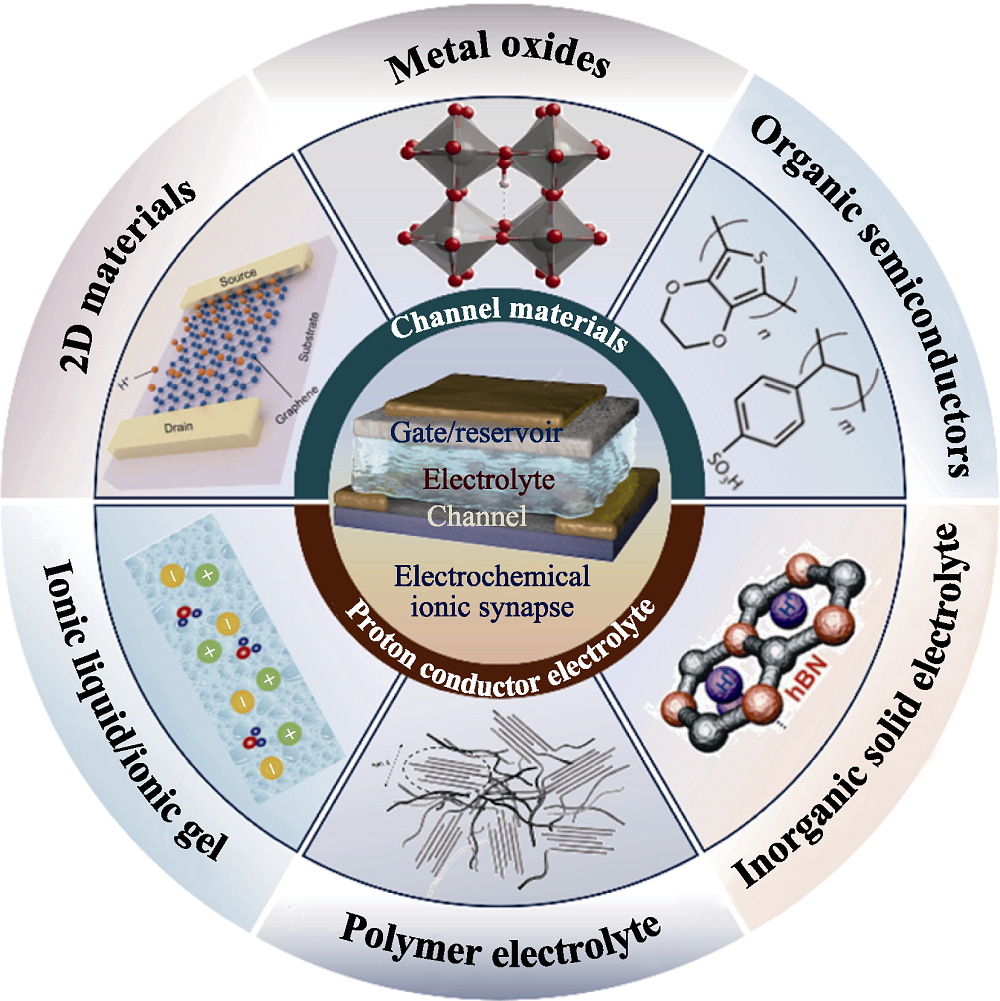
Fig. 1 Classification of channel materials and electrolyte materials for proton-regulated electrochemical ion synapses
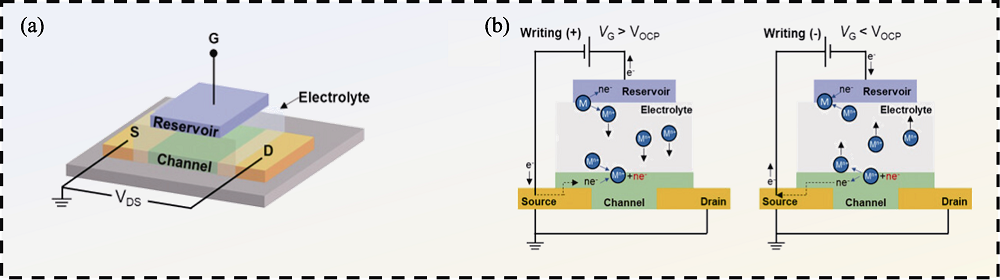
Fig. 2 Device structure and operation principle of an electrochemical ionic synapse[3] (a) Schematic illustration of the device; (b) Schematic illustration of the writing process for an electrochemical ionic synapse based on cation (Mn+) transport and intercalation of M into the channel
| Action ion | Material (channel/electrolyte) | Dynamic range | Operation voltage/current (pulse width) | Energy consumption | Channel dimension | Ref. |
|---|---|---|---|---|---|---|
| Li+ | Li1-xCoO2/LiPON | 4.5-270 μS | 70 mV (2 s) | <10 aJ per write (projection) | L=2 μm | [4] |
| WO2.7/Li3PO4 | 0.5-3.5 μS | +3 V (1 s)/-2 V (0.5 s) -2.5 V (1 s)/+1 V (0.5 s) | - | W=5 μm L=5 μm | [6] | |
| O2- | TiO2-x/YSZ (work at 160 ℃) | 100-450 nS | ±1.5 V (2 μs) | 8.1 nJ/mm2 | W=250 μm L=8000 μm | [8] |
| WO3/HfO2 | 1.5-3.5 μS | ±4 V (10 μs) | 1 fJ/(nm2×nS) (projection) | W=20 μm L=80 μm | [9] | |
| H+ | P(g2T-TT)/ EMIM:TFSI+PVDF-HFP | 30-75 μS | ±1 V (20 ns) | 80 fJ per write | W=15 μm L=45 μm | [11] |
| WO3/PSG | 87.6-4.28 MΩ | ±10 V (5 ns)/-8.5 V (5 ns) | 10 fJ per write | W=50 nm L=150 nm | [12] | |
| Graphene/Nafion | 1.0-2.8 mS | ±10 μA (1 ms) | 50 aJ/μm2 | W=4 mm L=3-5 mm | [13] | |
| Ti3C2Tx/PVA-H2SO4 | 1.6-2.8 mS | ±1 V (4 μs) | 80 fJ/μm2 | W=1000 μm L=20 μm | [14] |
Table 1 Comparison of performance of electrochemical ion synapses regulated by different ions[4,6,8 -9,11⇓⇓ -14]
| Action ion | Material (channel/electrolyte) | Dynamic range | Operation voltage/current (pulse width) | Energy consumption | Channel dimension | Ref. |
|---|---|---|---|---|---|---|
| Li+ | Li1-xCoO2/LiPON | 4.5-270 μS | 70 mV (2 s) | <10 aJ per write (projection) | L=2 μm | [4] |
| WO2.7/Li3PO4 | 0.5-3.5 μS | +3 V (1 s)/-2 V (0.5 s) -2.5 V (1 s)/+1 V (0.5 s) | - | W=5 μm L=5 μm | [6] | |
| O2- | TiO2-x/YSZ (work at 160 ℃) | 100-450 nS | ±1.5 V (2 μs) | 8.1 nJ/mm2 | W=250 μm L=8000 μm | [8] |
| WO3/HfO2 | 1.5-3.5 μS | ±4 V (10 μs) | 1 fJ/(nm2×nS) (projection) | W=20 μm L=80 μm | [9] | |
| H+ | P(g2T-TT)/ EMIM:TFSI+PVDF-HFP | 30-75 μS | ±1 V (20 ns) | 80 fJ per write | W=15 μm L=45 μm | [11] |
| WO3/PSG | 87.6-4.28 MΩ | ±10 V (5 ns)/-8.5 V (5 ns) | 10 fJ per write | W=50 nm L=150 nm | [12] | |
| Graphene/Nafion | 1.0-2.8 mS | ±10 μA (1 ms) | 50 aJ/μm2 | W=4 mm L=3-5 mm | [13] | |
| Ti3C2Tx/PVA-H2SO4 | 1.6-2.8 mS | ±1 V (4 μs) | 80 fJ/μm2 | W=1000 μm L=20 μm | [14] |
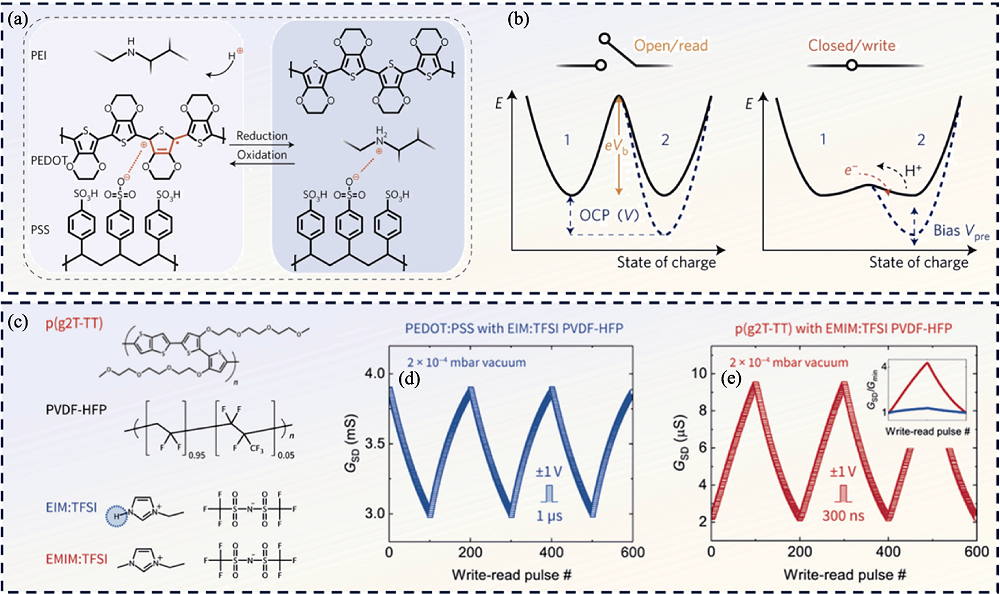
Fig. 3 Researches on organic semiconductor channel materials[10-11] (a) A positive Vpre drives protons into the postsynaptic electrode, which results in the compensation of some PSS by the protonated PEI and the reaction is reversed upon applying a negative Vpre[10]; (b) Schematic explaining the decoupling of the read and write operations[10]; (c) Chemical structures of the channel/gate and electrolyte materials[11]; Cycling of device with PEDOT:PSS (d) and p(g2T-TT) (e) as the channel material[11]. Colorful figures are available on website

Fig. 4 Researches based on metal oxide channel materials[12,22,27,29] (a) Schematic diagram of synaptic transistor modulation based on VO2 channel material[22]; (b) Calculated electronic structure with protonation in WO3[27]; (c) Electronic conductivity and open circuit voltage changed with hydrogen content in WO3, as well as schematic diagram of the device structure[27]; (d) Ultrafast and energy-efficient modulation characteristics of synaptic transistor (channel, WO3;electrolyte, PSG)[12]; (e) Schematic diagram of device structure and STEM micrograph[29]; (f) Endurance test for 108 write-read pulse cycles[29]. Colorful figures are available on website
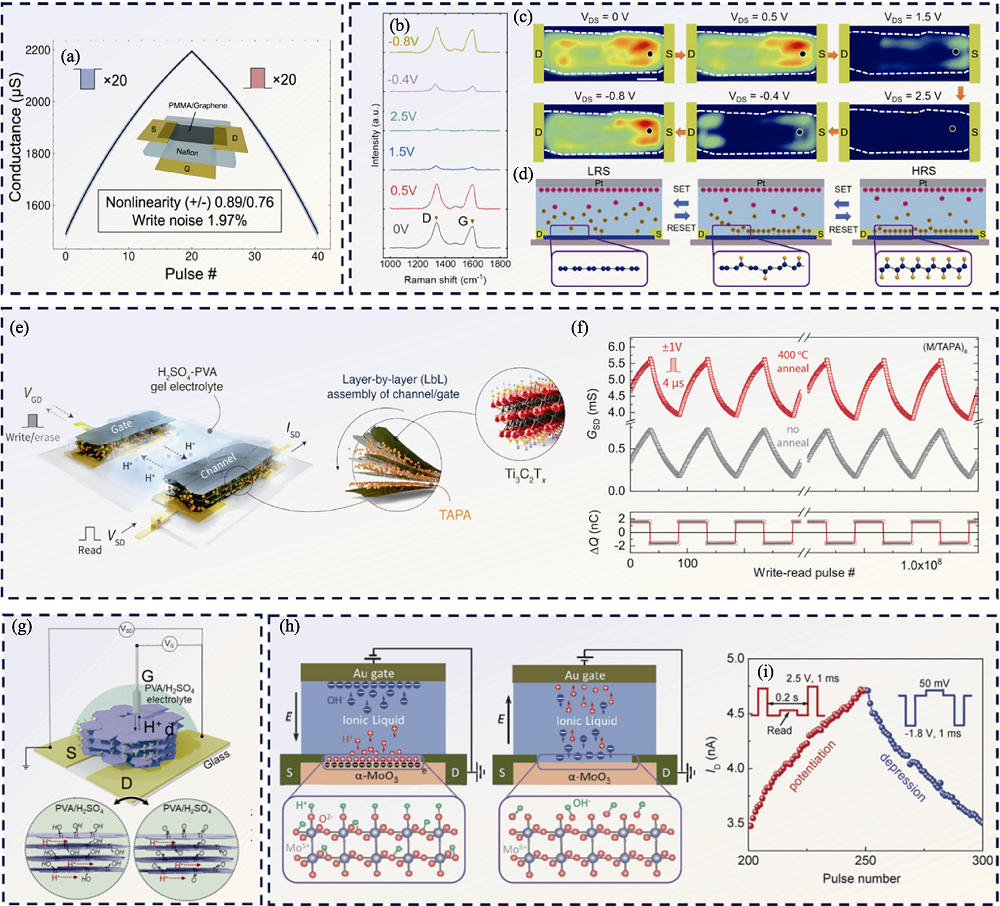
Fig. 5 Researches based on two-dimensional channel materials[13-14,34,40 -41] (a) Schematic diagram of graphene-based artificial synaptic and conductance per pulse number (20 negative and 20 positive pulses)[13]; (b) Raman spectra of hydrogenated graphene at varied VDS in a switching cycle[34]; (c) Raman mappings of the D peak intensity during VDS sweeps from 0 to 2.5 V and a return to -0.8 V[34]; (d) Schematic representation of hydrogenation reactions between graphene lattice and H+ ions[34]; (e) Schematic diagram of synaptic device based on 2D Ti3C2Tx MXene[14]; (f) MXene channel-based synaptic device resilience to high temperature[14]; (g) Schematic diagram of 2D MXene electrochemical transistor[40]; (h) Schematic diagram of the quasi-2D α-MoO3-based three-terminal synaptic device[41]; (i) Gradual channel current modulation under repeated positive and negative gate voltage pulses[41]. Colorful figures are available on website

Fig. 6 Related researches on ionic liquid and ion gel electrolytes[28,46,49 -50] (a) Schematic diagram of a synaptic device using the ionic liquid electrolyte[28]; (b) Contaminated water in ionic liquid could dissociate into H+ and OH−, then the small protons can intercalate into WO3 film to form a HxWO3 phase[28]; (c) FT-IR spectra of double-layered pectin/chitosan composite electrolyte film[46]; (d) FT-IR characterization of sodium alginate thin films[49]; (e) Pictures of konjac tuber and solution, and molecular structure of KGM[50]; (f) AFM image of the prepared KGM film[50]. Colorful figures are available on website
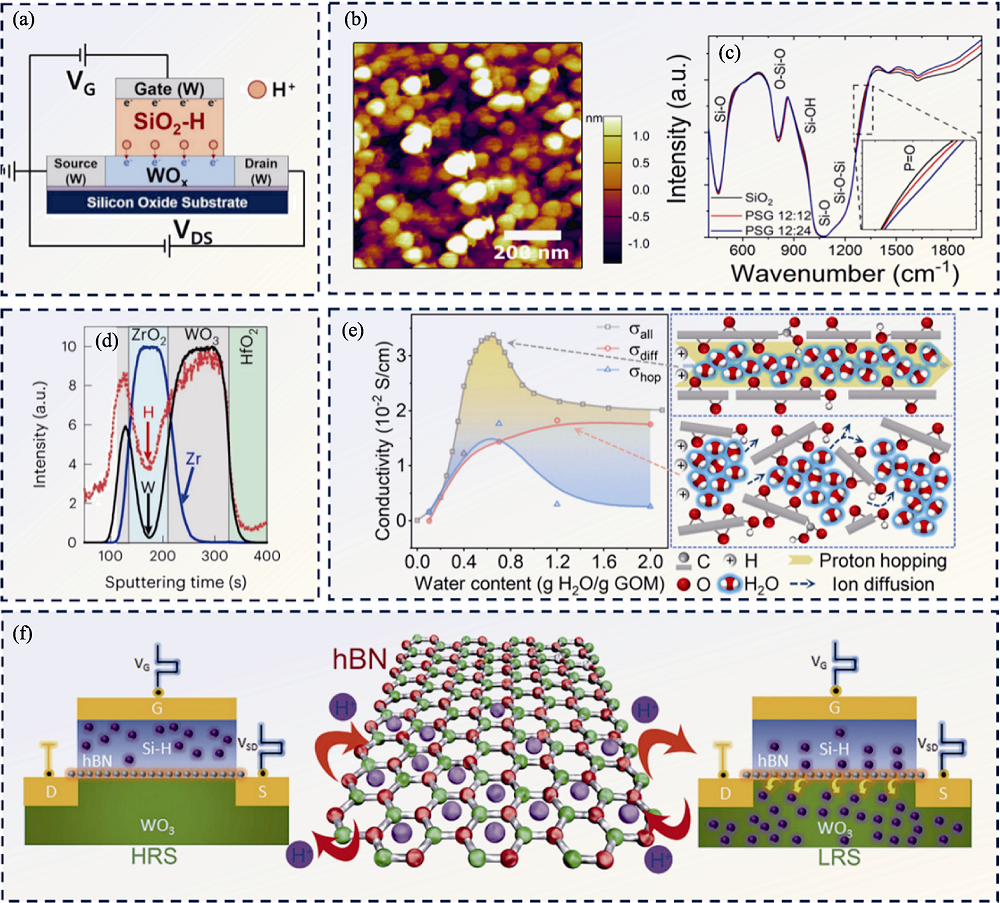
Fig. 7 Related researches on inorganic solid electrolytes[29-30,56⇓ -58] (a) Schematic diagram of a synaptic device using SiO2 electrolyte[56]; (b) AFM image of PSG thin film surface deposited on Si surface[30]; (c) FT-IR spectra of SiO2 and PSG[30]; (d) SIMS depth profiles for W (black), Zr (blue) and H (red) across device gate stack[29]; (e) Schematic diagram of the change of conductivity of graphene oxide film with water content and its microstructure at a specific water content[57]; (f) Transport of H+ ion through the weak electron cloud of a hexagonal B-N ring of hBN[58]. Colorful figures are available on website
| [1] | ZHU L Q, WAN C J, GUO L Q, et al. Artificial synapse network on inorganic proton conductor for neuromorphic systems. Nature Communications, 2014, 5(1): 3158. |
| [2] | KANEKO Y, NISHITANI Y, UEDA M. Ferroelectric artificial synapses for recognition of a multishaded image. IEEE Transactions on Electron Devices, 2014, 61(8): 2827. |
| [3] | HUANG M, SCHWACKE M, ONEN M, et al. Electrochemical ionic synapses: progress and perspectives. Advanced Materials, 2023, 35(37): 2205169. |
| [4] | FULLER E J, GABALY F E, LÉONARD F, et al. Li-ion synaptic transistor for low power analog computing. Advanced Materials, 2017, 29(4): 1604310. |
| [5] | MILEWSKA A, ŚWIERCZEK K, TOBOLA J, et al. The nature of the nonmetal-metal transition in LixCoO2 oxide. Solid State Ionics, 2014, 263: 110. |
| [6] | LEE J, NIKAM R D, LIM S, et al. Excellent synaptic behavior of lithium-based nano-ionic transistor based on optimal WO2.7 stoichiometry with high ion diffusivity. Nanotechnology, 2020, 31(23): 235203. |
| [7] | YANG C, SHANG D, LIU N, et al. All-solid-state synaptic transistor with ultralow conductance for neuromorphic computing. Advanced Functional Materials, 2018, 28(42): 1804170. |
| [8] | LI Y, FULLER E J, SUGAR J D, et al. Filament-free bulk resistive memory enables deterministic analogue switching. Advanced Materials, 2020, 32(45): 2003984. |
| [9] | KIM S, TODOROV T, ONEN M, et al. Metal-oxide based, CMOS-compatible ECRAM for deep learning accelerator. IEEE International Electron Devices Meeting, San Francisco, 2019: 35.7.1-35.7.4. |
| [10] | VAN DE BURGT Y, LUBBERMAN E, FULLER E J, et al. A non-volatile organic electrochemical device as a low-voltage artificial synapse for neuromorphic computing. Nature Materials, 2017, 16(4): 414. |
| [11] | MELIANAS A, QUILL T J, LECROY G, et al. Temperature- resilient solid-state organic artificial synapses for neuromorphic computing. Science Advances, 2020, 6(27): eabb2958. |
| [12] | ONEN M, EMOND N, WANG B, et al. Nanosecond protonic programmable resistors for analog deep learning. Science, 2022, 377(6605): 539. |
| [13] | KIREEV D, LIU S, JIN H, et al. Metaplastic and energy-efficient biocompatible graphene artificial synaptic transistors for enhanced accuracy neuromorphic computing. Nature Communications, 2022, 13(1): 4386. |
| [14] | MELIANAS A, KANG M, VAHIDMOHAMMADI A, et al. High-speed ionic synaptic memory based on 2D titanium carbide MXene. Advanced Functional Materials, 2022, 32(12): 2109970. |
| [15] | JONAS F, SCHRADER L. Conductive modifications of polymers with polypyrroles and polythiophenes. Synthetic Metals, 1991, 41(3): 831. |
| [16] | BOMBILE J H, JANIK M J, MILNER S T. Polaron formation mechanisms in conjugated polymers. Physical Chemistry Chemical Physics, 2017, 20(1): 317. |
| [17] | MORIN F J. Oxides which show a metal-to-insulator transition at the neel temperature. Physical Review Letters, 1959, 3(1): 34. |
| [18] | GOODENOUGH J B. The two components of the crystallographic transition in VO2. Journal of Solid State Chemistry, 1971, 3(4): 490. |
| [19] | LI G, XIE D, ZHONG H, et al. Photo-induced non-volatile VO2 phase transition for neuromorphic ultraviolet sensors. Nature Communications, 2022, 13(1): 1729. |
| [20] | GE C, LI G, ZHOU Q, et al. Gating-induced reversible HxVO2 phase transformations for neuromorphic computing. Nano Energy, 2020, 67: 104268. |
| [21] | PARK J, OH C, SON J. Anisotropic ionic transport-controlled synaptic weight update by protonation in a VO2 transistor. Journal of Materials Chemistry C, 2021, 9(7): 2521. |
| [22] | DENG X, WANG S, LIU Y, et al. A flexible mott synaptic transistor for nociceptor simulation and neuromorphic computing. Advanced Functional Materials, 2021, 31(23): 2101099. |
| [23] | OH C, KIM I, PARK J, et al. Deep proton insertion assisted by oxygen vacancies for long-term memory in VO2 synaptic transistor. Advanced Electronic Materials, 2021, 7(2): 2000802. |
| [24] | WU Z, SHI P, XING R, et al. Flexible mott synaptic transistor on polyimide substrate for physical neural networks. Advanced Electronic Materials, 2022, 8(9): 2200078. |
| [25] | YANG J, MA C, GE C, et al. Effects of line defects on the electronic and optical properties of strain-engineered WO3 thin films. Journal of Materials Chemistry C, 2017, 5(45): 11694. |
| [26] | HJELM A, GRANQVIST C G, WILLS J M. Electronic structure and optical properties of WO3, LiWO3, NaWO3, and HWO3. Physical Review B, 1996, 54(4): 2436. |
| [27] | YAO X, KLYUKIN K, LU W, et al. Protonic solid-state electrochemical synapse for physical neural networks. Nature Communications, 2020, 11(1): 3134. |
| [28] | YANG J, GE C, DU J, et al. Artificial synapses emulated by an electrolyte-gated tungsten-oxide transistor. Advanced Materials, 2018, 30(34): 1801548. |
| [29] | CUI J, AN F, QIAN J, et al. CMOS-compatible electrochemical synaptic transistor arrays for deep learning accelerators. Nature Electronics, 2023, 6(4): 292. |
| [30] | ONEN M, EMOND N, LI J, et al. CMOS-compatible protonic programmable resistor based on phosphosilicate glass electrolyte for analog deep learning. Nano Letters, 2021, 21(14): 6111. |
| [31] | GOKMEN T, VLASOV Y. Acceleration of deep neural network training with resistive cross-point devices: design considerations. Frontiers in Neuroscience, 2016, 10(51): 333. |
| [32] | GUO L Q, HAN H, ZHU L Q, et al. Oxide neuromorphic transistors gated by polyvinyl alcohol solid electrolytes with ultralow power consumption. ACS Applied Materials & Interfaces, 2019, 11(31): 28352. |
| [33] | MOHANTY H N, TSURUOKA T, MOHANTY J R, et al. Proton-gated synaptic transistors, based on an electron-beam patterned Nafion electrolyte. ACS Applied Materials & Interfaces, 2023, 15(15): 19279. |
| [34] | YU C, LI S, PAN Z, et al. Gate-controlled neuromorphic functional transition in an electrochemical graphene transistor. Nano Letters, 2024, 24(5): 1620. |
| [35] | FERRARI A C, BASKO D M. Raman spectroscopy as a versatile tool for studying the properties of graphene. Nature Nanotechnology, 2013, 8(4): 235. |
| [36] | MALARD L M, PIMENTA M A, DRESSELHAUS G, et al. Raman spectroscopy in graphene. Physics Reports, 2009, 473(5): 51. |
| [37] | ELIAS D C, NAIR R R, MOHIUDDIN T M G, et al. Control of graphene’s properties by reversible hydrogenation: evidence for graphane. Science, 2009, 323(5914): 610. |
| [38] | BOUKHVALOV D W, KATSNELSON M I, LICHTENSTEIN A I. Hydrogen on graphene: electronic structure, total energy, structural distortions and magnetism from first-principles calculations. Physical Review B, 2008, 77(3): 035427. |
| [39] | HART J L, HANTANASIRISAKUL K, LANG A C, et al. Control of MXenes’ electronic properties through termination and intercalation. Nature Communications, 2019, 10(1): 522. |
| [40] | SHAKYA J, KANG M A, LI J, et al. 2D MXene electrochemical transistors. Nanoscale, 2024, 16(6): 2883. |
| [41] | YANG C S, SHANG D S, LIU N, et al. A synaptic transistor based on quasi-2D molybdenum oxide. Advanced Materials, 2017, 29(27): 1700906. |
| [42] | CHENG H, WEN M, MA X, et al. Hydrogen doped metal oxide semiconductors with exceptional and tunable localized surface plasmon resonances. Journal of the American Chemical Society, 2016, 138(29): 9316. |
| [43] | XIE L, ZHU Q, ZHANG G, et al. Tunable hydrogen doping of metal oxide semiconductors with acid-metal treatment at ambient conditions. Journal of the American Chemical Society, 2020, 142(9): 4136. |
| [44] | KUMAR M N V R. A review of chitin and chitosan applications. Reactive and Functional Polymers, 2000, 46(1): 1. |
| [45] | REN Z Y, ZHU L Q, YU F, et al. Synaptic metaplasticity of protonic/electronic coupled oxide neuromorphic transistor. Organic Electronics, 2019, 74: 304. |
| [46] | LI Y, HUANG Y J, CHEN X L, et al. Multi-terminal pectin/chitosan hybrid electrolyte gated oxide neuromorphic transistor with multi-mode cognitive activities. Frontiers of Physics, 2024, 19(5): 53204. |
| [47] | LI Y, ZHANG C, ZHAO X, et al. Ultrasensitive and degradable ultraflexible synaptic transistors based on natural pectin. ACS Applied Electronic Materials, 2022, 4(1): 316. |
| [48] | HU W, JIANG J, XIE D, et al. Transient security transistors self- supported on biodegradable natural-polymer membranes for brain- inspired neuromorphic applications. Nanoscale, 2018, 10(31): 14893. |
| [49] | LIU Y, FENG G, ZHU Q, et al. Synaptic devices with sodium alginate ionic gel gating for global regulation. Journal of Applied Physics, 2024, 135(4): 045501. |
| [50] | HUANG K W, ZHU L, YING L Y, et al. Artificial synaptic transistors based on konjac glucomannan for brain-inspired neuromorphic applications. ACS Applied Electronic Materials, 2024, 6(2): 1521. |
| [51] | KREUER K D. Proton conductivity: materials and applications. Chemistry of Materials, 1996, 8(3): 610. |
| [52] | MAURITZ K A, MOORE R B. State of understanding of Nafion. Chemical Reviews, 2004, 104(10): 4535. |
| [53] | FENG C, HE P F. Moisture and thermal expansion properties and mechanism of interaction between ions of a Nafion-based membrane electrode assembly. RSC Advances, 2017, 7(55): 34556. |
| [54] | LARSSON O, SAID E, BERGGREN M, et al. Insulator polarization mechanisms in polyelectrolyte-gated organic field-effect transistors. Advanced Functional Materials, 2009, 19(20): 3334. |
| [55] | ZHANG W, LI J, CHENG L, et al. Synaptic transistor arrays based on PVA/lignin composite electrolyte films. IEEE Transactions on Electron Devices, 2023, 70(6): 3245. |
| [56] | LEE J, LIM S, KWAK M, et al. Understanding of proton induced synaptic behaviors in three-terminal synapse device for neuromorphic systems. Nanotechnology, 2019, 30(25): 255202. |
| [57] | ZHANG L, LIU Z, YANG C, et al. Conduction mechanism in graphene oxide membranes with varied water content: from proton hopping dominant to ion diffusion dominant. ACS Nano, 2022, 16(9): 13771. |
| [58] | NIKAM R D, LEE J, CHOI W, et al. Ionic sieving through one-atom-thick 2D material enables analog nonvolatile memory for neuromorphic computing. Small, 2021, 17(44): 2103543. |
| [59] | WAN C J, ZHU L Q, ZHOU J M, et al. Memory and learning behaviors mimicked in nanogranular SiO2-based proton conductor gated oxide-based synaptic transistors. Nanoscale, 2013, 5(21): 10194. |
| [60] | GUO L Q, WEN J, ZHU L Q, et al. Humidity-dependent synaptic plasticity for proton gated oxide synaptic transistor. IEEE Electron Device Letters, 2017, 38(9): 1248. |
| [61] | MENG Y, GAO J, ZHAO Z, et al. Review: recent progress in low-temperature proton-conducting ceramics. Journal of Materials Science, 2019, 54(13): 9291. |
| [62] | WU Z, SHI P, XING R, et al. Quasi-two-dimensional α-molybdenum oxide thin film prepared by magnetron sputtering for neuromorphic computing. RSC Advances, 2022, 12(28): 17706. |
| [63] | LOZADA-HIDALGO M, HU S, MARSHALL O, et al. Sieving hydrogen isotopes through two-dimensional crystals. Science, 2016, 351(6268): 68. |
| [64] | HU S, GOPINADHAN K, RAKOWSKI A, et al. Transport of hydrogen isotopes through interlayer spacing in van der Waals crystals. Nature Nanotechnology, 2018, 13(6): 468. |
| [65] | WAN C J, ZHU L Q, LIU Y H, et al. Proton-conducting graphene oxide-coupled neuron transistors for brain-inspired cognitive systems. Advanced Materials, 2016, 28(18): 3557. |
| [66] | MOGG L, ZHANG S, HAO G P, et al. Perfect proton selectivity in ion transport through two-dimensional crystals. Nature Communications, 2019, 10(1): 4243. |
| [67] | HU S, LOZADA-HIDALGO M, WANG F C, et al. Proton transport through one-atom-thick crystals. Nature, 2014, 516(7530): 227. |
| [1] | CHEN Mingjun, MIAO Hongkang, XIAO Yingjun, DENG Jianbo, ZHANG Xiang, ZHAO Jiupeng, LI Yao. Photo- and Thermo-chromic Dual-responsive Materials: A Review on Design Strategies and Applications in Smart Windows [J]. Journal of Inorganic Materials, 2026, 41(6): 723-738. |
| [2] | SONG Kunjie, XIE Rongjun. Research Advances on Machine Learning-driven Development of Novel Luminescent Materials [J]. Journal of Inorganic Materials, 2026, 41(6): 689-703. |
| [3] | HU Yuqing, ZHU Yixin, LE Xianhao, WAN Qing. Lithium Tantalate Wafer: Advances in Thinning Technology and Application in Pyroelectric Infrared Detectors [J]. Journal of Inorganic Materials, 2026, 41(6): 764-774. |
| [4] | LIU Chunfan, CHEN Ke, GE Fangfang, HUANG Qing. Research Progress on Lead-bismuth Eutectic Corrosion Resistant Coatings [J]. Journal of Inorganic Materials, 2026, 41(6): 775-786. |
| [5] | HU Yang, XIE Min, ZHANG Xiaoyi, LI Xiang, GUO Xinwei, JIANG Nan, ZHOU Wenhan, ZHANG Shengli, ZENG Haibo. Research Progress on Computational and Data-driven Environmental-friendly Luminescent Materials [J]. Journal of Inorganic Materials, 2026, 41(6): 704-722. |
| [6] | WANG Junbu, HUANG Zeai, YANG Mingkai, MENG Ying, ZHOU Mingwei, ZHOU Ying. Research Progress on Anti-coking Catalytic Materials for Methane Conversion [J]. Journal of Inorganic Materials, 2026, 41(6): 739-750. |
| [7] | WANG Jinwen, YANG Zhen, ZHOU Huan, XIA Dan, YANG Lei. Biomedical Applications of Injectable Inorganic Biomaterials [J]. Journal of Inorganic Materials, 2026, 41(6): 751-763. |
| [8] | LI Hantao, SHEN Qiang, LUO Guoqiang, WANG Xuefei, GAO Ming, CHEN Chen. Research Progress on Structure and Performance Regulation of Silicon-based Anode Materials via Mechanical Ball Milling [J]. Journal of Inorganic Materials, 2026, 41(5): 561-572. |
| [9] | XIE Chenyi, MIAO Huaming, ZHANG Weiran, LIU Rongjun, WANG Yanfei, LI Duan. Research Progress on Theoretical Calculation in the Field of High-entropy Ceramics [J]. Journal of Inorganic Materials, 2026, 41(5): 545-560. |
| [10] | LI Xuan, YE Kuicai, FENG Jiayin, QIU Jiajun, QIAN Wenhao, XING Min. Surface Modification of Titanium-based Dental Implants for Soft Tissue Sealing: A Review [J]. Journal of Inorganic Materials, 2026, 41(4): 432-444. |
| [11] | PENG Dezhao, LI Rui, WANG Wenhong, WANG Zirui, ZHANG Zhizhen. Research Progress on Sodium Chloride Solid Electrolytes [J]. Journal of Inorganic Materials, 2026, 41(4): 409-420. |
| [12] | CHEN Kun, JIANG Yonggang, FENG Junzong, LI Liangjun, HU Yijie, FENG Jian. Research Progress on Lanthanum Zirconate Porous Materials for Thermal Insulation [J]. Journal of Inorganic Materials, 2026, 41(4): 421-431. |
| [13] | WEI Lianjin, QI Zhijie, WANG Xin, ZHU Junwu, FU Yongsheng. Modification of Nanodiamond and Its Application in Electrocatalytic Oxygen Reduction Reaction [J]. Journal of Inorganic Materials, 2026, 41(3): 273-288. |
| [14] | LIU Zhanyi, LI Mian, OUYANG Xiaoping, CHAI Zhifang, HUANG Qing. Recent Progress on Removal of Sr/Cs from Molten Salt in Dry Reprocessing [J]. Journal of Inorganic Materials, 2026, 41(2): 150-158. |
| [15] | SUN Lian, ZHANG Leilei, XUE Zexu, WU Kun, CHEN Ye, LI Zhiyuan, WANG Lukai, WANG Zungang. Research Progress on Zero-dimensional Metal Halide Scintillators towards Radiation Detection Applications [J]. Journal of Inorganic Materials, 2026, 41(2): 159-176. |
| Viewed | ||||||
|
Full text |
|
|||||
|
Abstract |
|
|||||
