Journal of Inorganic Materials ›› 2026, Vol. 41 ›› Issue (8): 1110-1116.DOI: 10.15541/jim20250462
• RESEARCH ARTICLE • Previous Articles Next Articles
HU Juan( ), XU Di(), NIE Huaiwen, LIN Genlian, YAN Jina()
Received:2025-11-21
Revised:2026-01-21
Published:2026-08-20
Online:2026-02-05
Contact:
XU Di, senior engineer. E-mail: xudi@mail.sic.ac.cn;About author:HU Juan (1975-), female, senior engineer. E-mail: hujuan@mail.sic.ac.cn
Supported by:CLC Number:
HU Juan, XU Di, NIE Huaiwen, LIN Genlian, YAN Jina. Microstructure and Mechanical Property Evolution of Continuous Alumina Fibers during Long-term Exposure at Elevated Temperatures[J]. Journal of Inorganic Materials, 2026, 41(8): 1110-1116.
| Fiber | Composition (in mass) | Crystal structure | Tensile strength/GPa | Diameter/μm |
|---|---|---|---|---|
| NextelTM 440 | 70% Al2O3, 28% SiO2, 2% B2O3 | γ-Al2O3 + amorphous SiO2 | 1.84 | 10-12 |
| NITIVY ALFTM | 72% Al2O3, 28% SiO2 | γ-Al2O3 + amorphous SiO2 | 1.78 | 7.0 |
| SLF72 | 72% Al2O3, 28% SiO2 | γ-Al2O3 + amorphous SiO2 | 1.72 | 7.6 |
Table 1 Room temperature properties of three continuous alumina fibers
| Fiber | Composition (in mass) | Crystal structure | Tensile strength/GPa | Diameter/μm |
|---|---|---|---|---|
| NextelTM 440 | 70% Al2O3, 28% SiO2, 2% B2O3 | γ-Al2O3 + amorphous SiO2 | 1.84 | 10-12 |
| NITIVY ALFTM | 72% Al2O3, 28% SiO2 | γ-Al2O3 + amorphous SiO2 | 1.78 | 7.0 |
| SLF72 | 72% Al2O3, 28% SiO2 | γ-Al2O3 + amorphous SiO2 | 1.72 | 7.6 |
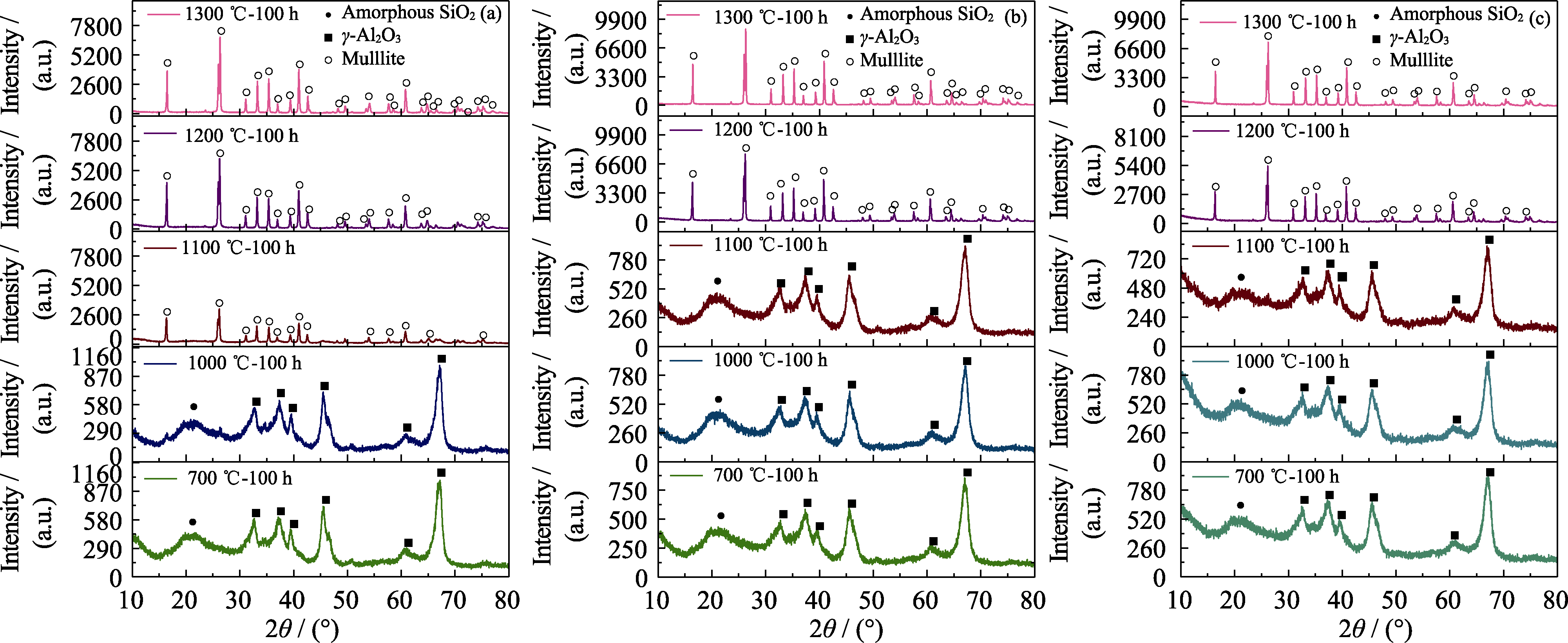
Fig. 1 XRD patterns of three fibers after heat treatment at different temperatures for 100 h (a) NextelTM 440 fiber; (b) NITIVY ALFTM fiber; (c) SLF72 fiber
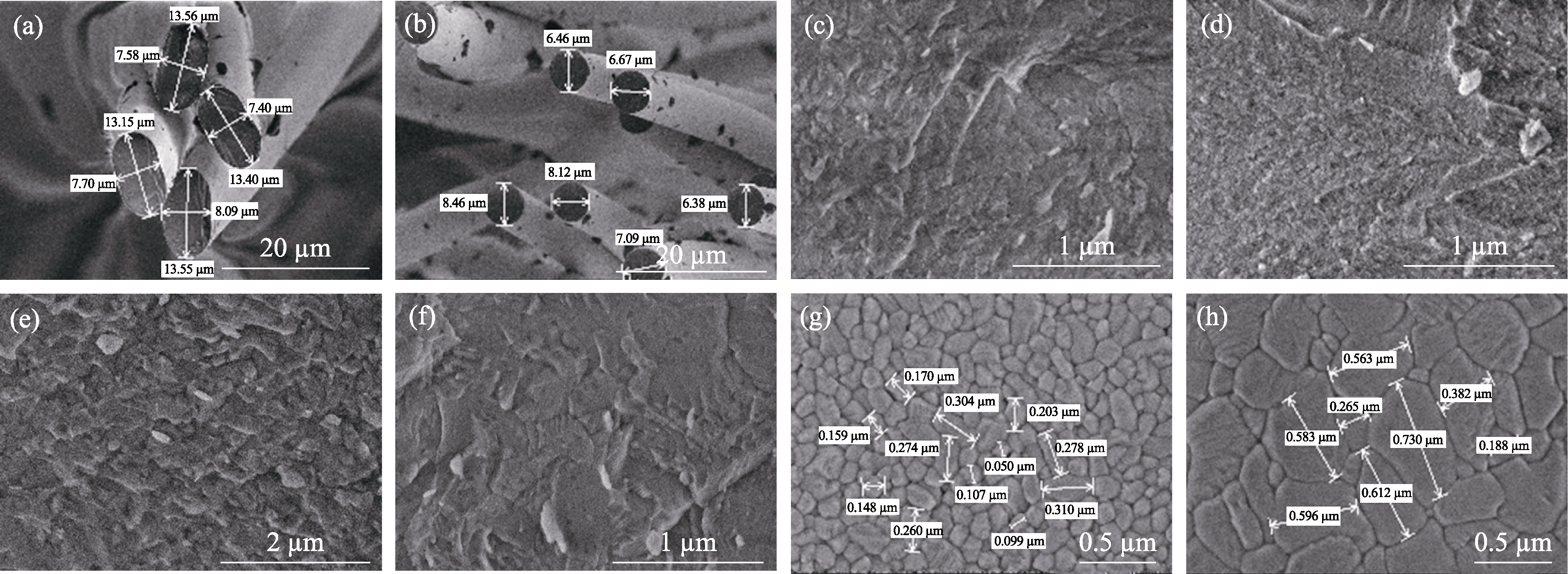
Fig. 2 SEM images of NextelTM 440 and NITIVY ALFTM fibers (a) Untreated NextelTM 440; (b) Untreated NITIVY ALFTM; (c) NextelTM 440 fiber after heat-treated at 1100 ℃ for 100 h; (d) NITIVY ALFTM after heat-treated at 1100 ℃ for 100 h; (e) NextelTM 440 after heat-treated at 1200 ℃ for 100 h; (f) NITIVY ALFTM after heat-treated at 1200 ℃ for 100 h; (g) NextelTM 440 after heat-treated at 1300 ℃ for 100 h; (f) NITIVY ALFTM after heat-treated at 1300 ℃ for 100 h
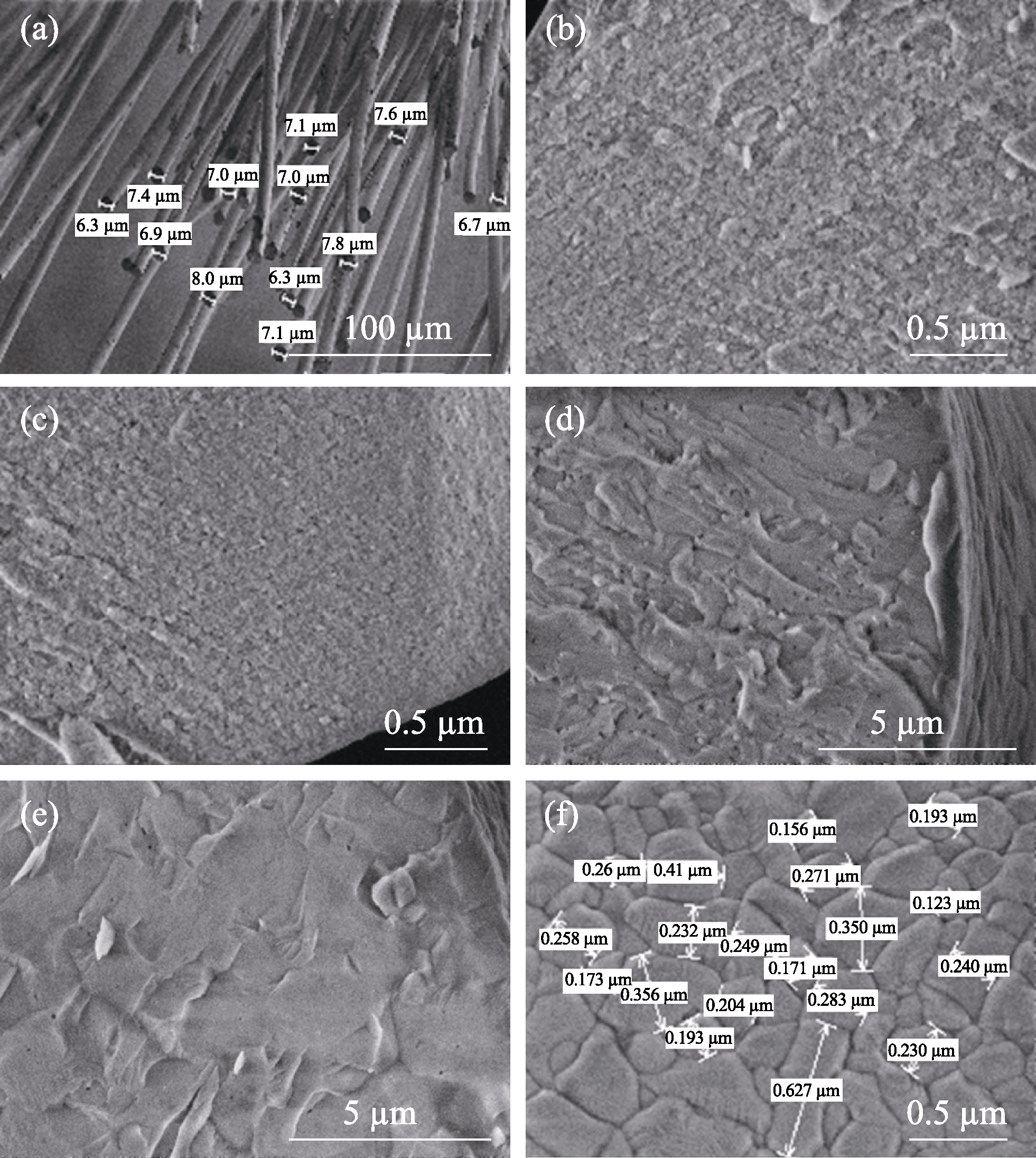
Fig. 3 SEM images of SLF72 fiber heat-treated at different temperatures for 100 h Surface: (a) Untreated, (f) 1300 ℃; Cross section: (b) Untreated, (c) 1100 ℃, (d) 1200 ℃, (e) 1300 ℃
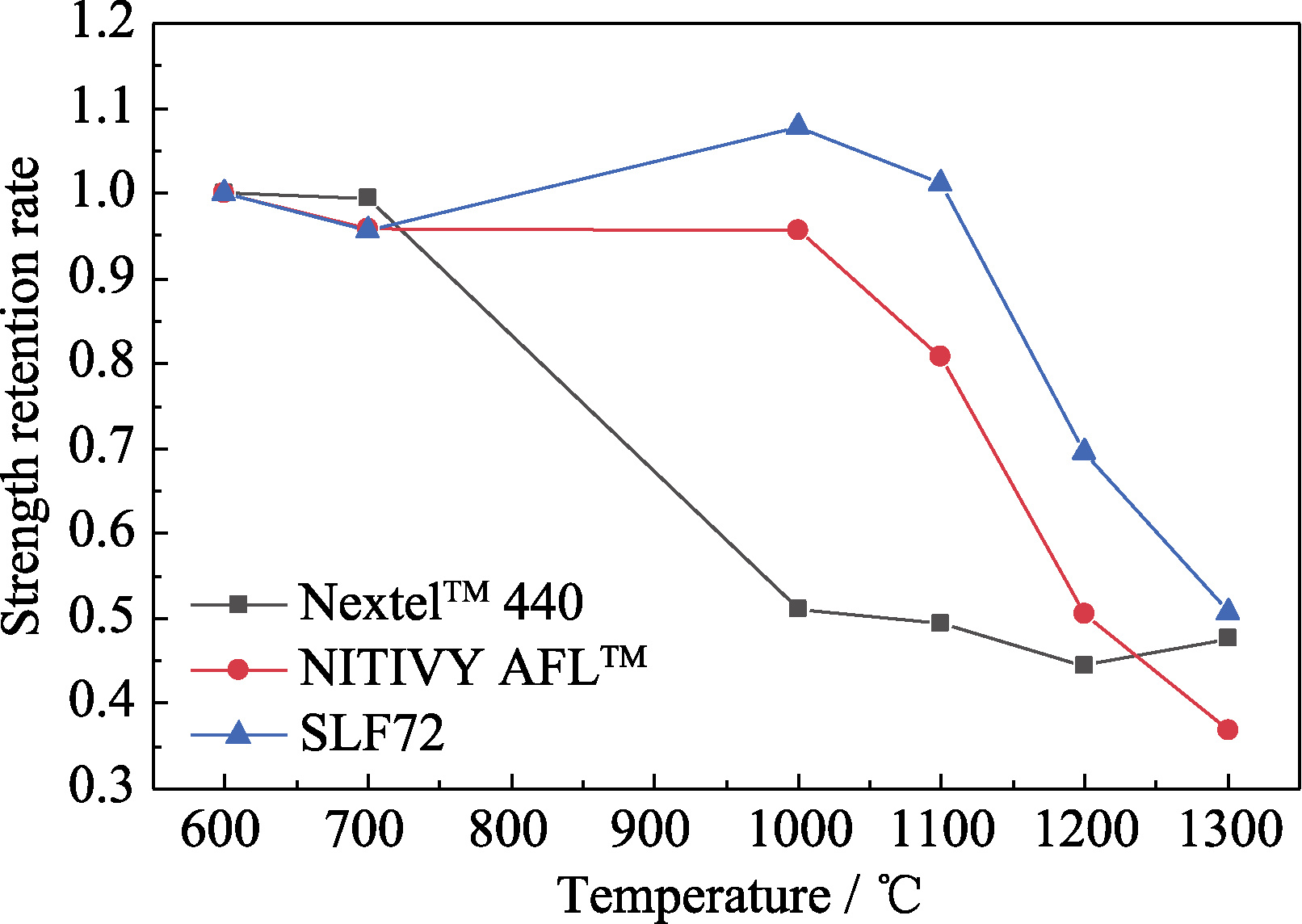
Fig. 4 Strength retention rate of NextelTM 440, NITIVY ALFTM and SLF72 fibers after heat-treated at different temperatures for 100 h
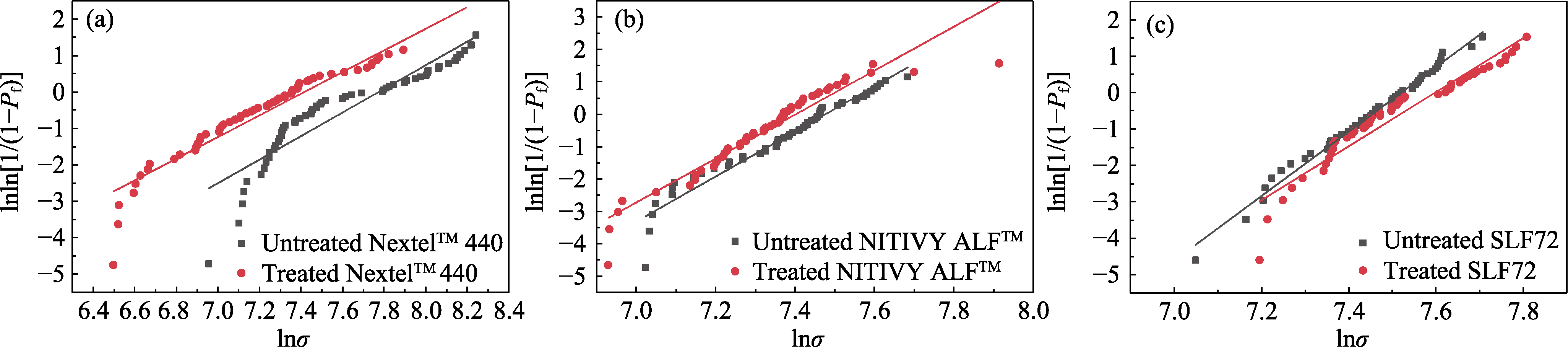
Fig.5 Weibull plots of three fibers before and after heat treatment (a) Untreated NextelTM 440 fiber and treated at 1000 ℃ for 100 h; (b) Untreated NITIVY ALFTM fiber and treated at 1100 ℃ for 100 h; (c) Untreated SLF72 fiber and treated at 1100 ℃ for 100 h
| Fiber | Weibull modulus, m (untreated/treated at 1100 ℃ for 100 h) | Scale parameter, σ0/MPa (untreated/ treated at 1100 ℃ for 100 h) |
|---|---|---|
| 3M NextelTM 440 | 3.24/2.97 | 2365/1665 |
| NITIVY ALFTM | 6.95/6.78 | 1771/1642 |
| SLF72 | 8.86/7.42 | 1841/2043 |
Table 2 Weibull modulus (m) and the scale parameter (σ0) for three fibers untreated and treated at 1100 ℃ for 100 h
| Fiber | Weibull modulus, m (untreated/treated at 1100 ℃ for 100 h) | Scale parameter, σ0/MPa (untreated/ treated at 1100 ℃ for 100 h) |
|---|---|---|
| 3M NextelTM 440 | 3.24/2.97 | 2365/1665 |
| NITIVY ALFTM | 6.95/6.78 | 1771/1642 |
| SLF72 | 8.86/7.42 | 1841/2043 |
| [1] | WILSON D. Continuous oxide fibers// BUNSELL A R. Handbook of properties of textile and technical fibres (second edition). Cambridge: Woodhead Publishing, 2018: 903-927. |
| [2] | 任春华, 叶亚莉, 周国成, 等. 氧化铝纤维的发展现状及前景. 新材料产业, 2010(4): 38. |
| [3] | 张恒飞, 王东哲, 刘茂举, 等. 氧化铝超细纤维的制备方法及应用研究现状. 合成纤维工业, 2023, 46(1): 68. |
| [4] | 汪家铭, 孔亚琴. 氧化铝纤维发展现状及应用前景. 高科技纤维与应用, 2010, 35(4): 49. |
| [5] | POULON-QUINTIN A, BERGER M H, BUNSELL A R. Mechanical and microstructural characterisation of Nextel 650 alumina-zirconia fibres. Journal of the European Ceramic Society, 2004, 24(9): 27693. |
| [6] | SCHAWALLER D, CLAUß B, BUCHMEISER M R. Ceramic filament fibers—a review. Macromolecular Materials and Engineering, 2012, 297(6): 502. |
| [7] | YALAMAÇ E, SUTCU M, BASTURK S B. Ceramic fibers// SEYDIBEYOĞLU M Ö, MOHANTY A K, MISRA M. Fiber technology for fiber-reinforced composites. Cambridge: Woodhead Publishing, 2017: 187-207. |
| [8] | REINDERS L, BIRKENSTOCK J, PFEIFER S, et al. Temperature- dependent structure-property relations in continuous mullite-based ceramic fibers. Ceramics International, 2024, 50(11): 19048. |
| [9] | CHENG M, LIU W, YAO S, et al. Kinetics and mechanisms for the densification and grain growth of the α-alumina fibers isothermally sintered at elevated temperatures. Ceramics International, 2022, 48(15): 21756. |
| [10] | WILSON D. BUNSELL A R. The structure and tensile properties of continuous oxide fibers//Handbook of tensile properties of textile and technical fibres. Cambridge: Woodhead Publishing, 2009: 626-650. |
| [11] | ZHANG W, XIANG Y, HUANG M, et al. Microstructural and mechanical characterization of a mullite fiber. Ceramics International, 2021, 47(23): 33252. |
| [12] | MO C, XIANG Y, HAN Q Z, et al. Effect of heat-treatment on the microstructure and room-temperature mechanical properties of alumina-silica fiber. International Journal of Applied Ceramic Technology, 2024, 22(2): e14934. |
| [13] |
JIANG R, LIU H T, YANG L W, et al. Mechanical properties of aluminosilicate fiber heat-treated from 800 ℃ to 1400 ℃: effects of phase transition, grain growth and defects. Materials Characterization, 2018, 138: 120.
DOI URL |
| [14] | PETRY M D, MAH T I. Effect of thermal exposures on the strengths of Nextel™ 550 and 720 filaments. Journal of the American Ceramic Society, 1999, 82(10): 2801. |
| [15] | SCHMÜCKER M, FLUCHT F, SCHNEIDER H. High temperature behaviour of polycrystalline aluminosilicate fibres with mullite bulk composition. I. Microstructure and strength properties. Journal of the European Ceramic Society, 1996, 16(2): 281. |
| [16] | 中国科学院上海硅酸盐研究所, 中国航空制造技术研究院. 连续氧化物陶瓷纤维单丝拉伸性能测试方法: T/CBMF 97-2021. 北京: 中国建筑材料联合会, 2021. |
| [17] | WANG Y, CHENG H F, LIU H T, et al. Microstructure and room temperature mechanical properties of mullite fibers after heat- treatment at elevated temperatures. Materials Science & Engineering A, 2013, 578: 287. |
| [18] | WANG X G, YANG Q Q, LIN G L, et al. High temperature tensile property of domestic 550-grade continuous alumina ceramic fiber. Journal of Inorganic Materials, 2022, 37(6): 629. |
| [19] | HILDMANN B O, SCHNEIDER H, SCHMÜCKER M. High temperature behaviour of polycrystalline aluminosilicate fibres with mullite bulk composition. II. Kinetics of mullite formation. Journal of the European Ceramic Society, 1996, 16(2): 287. |
| [20] | RICHARDS E A, GOODBRAKE C J, SOWMAN H G. Reactions and microstructure development in mullite fibers. Journal of the American Ceramic Society, 1991, 74(10): 2404. |
| [21] | ZHANG W, YANG X, HUANG M, et al. Microstructure evolution and mechanical behavior of a mullite fiber heat-treated from 1100 to 1300 ℃. Journal of the American Ceramic Society, 2021, 105(2): 1442. |
| [22] | HAY R S, FAIR G E, TIDBALL T, et al. Fiber strength after grain growth in Nextel™ 610 alumina fiber. Journal of the American Ceramic Society, 2015, 98(6): 1907. |
| [23] | 王小飞, 邱海鹏, 陈明伟, 等. Nextel 720陶瓷纤维拉伸强度的威布尔统计分析研究. 陶瓷学报, 2020, 41(5): 715. |
| [24] | WILSON D M, VISSER L R. High performance oxide fibers for metal and ceramic composites. Composites Part A: Applied Science and Manufacturing, 2001, 32(8): 1143. |
| [1] | ZHOU Cui, LI Jie, SUN Luchao, SU Haijun, WANG Jingyang. Alumina-based Directionally Solidified Eutectic Ceramics: Microstructure, Control Strategies and Environmental Stability [J]. Journal of Inorganic Materials, 2026, 41(7): 899-914. |
| [2] | ZHOU Xue, LIU Zhe, REN Yan, YU Jinshan, YANG Tianyue, ZHAO Zhongqian, WANG Honglei, ZHOU Xingui, GOU Yanzi. Quantitative Investigation of the Creep Resistance of Different SiC Fibers after Annealing at High Temperature [J]. Journal of Inorganic Materials, 2026, 41(7): 1011-1020. |
| [3] | ZHAO Tongtong, DAI Jixiang, SU Cheng, SHI Yan, SHA Jianjun. Microstructure and Ablation Resistance of C/C Composites Modified by Hf-Si-based Coating-matrix Integrated Structure Fabricated by Reactive Melt Infiltration [J]. Journal of Inorganic Materials, 2026, 41(5): 583-594. |
| [4] | ZHENG Chen, WANG Xiangning, YUAN Henan, YANG Jiawei, LI Chuanjian, WANG Huadong. Mechanical Property Failure of Alumina Fiber Reinforced Silica Composite [J]. Journal of Inorganic Materials, 2026, 41(3): 331-339. |
| [5] | YUAN Wang, HU Jianbao, ZHOU Liang, KAN Yanmei, ZHANG Xiangyu, DONG Shaoming. Effect of Argon Atmosphere Heat Treatment on Mechanical Properties and Microstructural Evolution of Shicolon-II SiC Fibers [J]. Journal of Inorganic Materials, 2026, 41(1): 119-128. |
| [6] | HAN Weiwei, HUANG Dong, LI Tingsong, LI Jiang. Sm:LuAG/Nd:LuAG Composite Laser Ceramics with Cladding Structure: Fabrication and Properties [J]. Journal of Inorganic Materials, 2026, 41(1): 113-118. |
| [7] | ZHONG Weimin, ZHAO Ke, WANG Kewei, LIU Dianguang, LIU Jinling, AN Linan. Effect of Oscillatory Pressure Amplitude on Microstructures and Wear Resistance of Tungsten Carbide [J]. Journal of Inorganic Materials, 2025, 40(9): 964-970. |
| [8] | MU Haojie, ZHANG Yuanjiang, YU Bin, FU Xiumei, ZHOU Shibin, LI Xiaodong. Preparation and Properties of ZrO2 Doped Y2O3-MgO Nanocomposite Ceramics [J]. Journal of Inorganic Materials, 2025, 40(3): 281-289. |
| [9] | ZHENG Yuanshun, YU Jian, YE Xianfeng, LIANG Dong, ZHU Wanting, NIE Xiaolei, WEI Ping, ZHAO Wenyu, ZHANG Qingjie. Boosting the Thermoelectric Performance of Full-Heusler Fe2VAl Alloy via Substituting Al Site with V [J]. Journal of Inorganic Materials, 2025, 40(12): 1425-1432. |
| [10] | FAN Wugang, CAO Xiong, ZHOU Xiang, LI Ling, ZHAO Guannan, ZHANG Zhaoquan. Anticorrosion Performance of 8YSZ Ceramics in Simulated Aqueous Environment of Pressurized Water Reactor [J]. Journal of Inorganic Materials, 2024, 39(7): 803-809. |
| [11] | CHEN Qian, SU Haijun, JIANG Hao, SHEN Zhonglin, YU Minghui, ZHANG Zhuo. Progress of Ultra-high Temperature Oxide Ceramics: Laser Additive Manufacturing and Microstructure Evolution [J]. Journal of Inorganic Materials, 2024, 39(7): 741-753. |
| [12] | JIANG Lingyi, PANG Shengyang, YANG Chao, ZHANG Yue, HU Chenglong, TANG Sufang. Preparation and Oxidation Behaviors of C/SiC-BN Composites [J]. Journal of Inorganic Materials, 2024, 39(7): 779-786. |
| [13] | ZHENG Yawen, ZHANG Cuiping, ZHANG Ruijie, XIA Qian, RU Hongqiang. Fabrication of Boron Carbide Ceramic Composites by Boronic Acid Carbothermal Reduction and Silicon Infiltration Reaction Sintering [J]. Journal of Inorganic Materials, 2024, 39(6): 707-714. |
| [14] | XUE Yifan, LI Weijie, ZHANG Zhongwei, PANG Xu, LIU Yu. Process Control of PyC Interphases Microstructure and Uniformity in Carbon Fiber Cloth [J]. Journal of Inorganic Materials, 2024, 39(4): 399-408. |
| [15] | SUN Chuan, HE Pengfei, HU Zhenfeng, WANG Rong, XING Yue, ZHANG Zhibin, LI Jinglong, WAN Chunlei, LIANG Xiubing. SiC-based Ceramic Materials Incorporating GNPs Array: Preparation and Mechanical Characterization [J]. Journal of Inorganic Materials, 2024, 39(3): 267-273. |
| Viewed | ||||||
|
Full text |
|
|||||
|
Abstract |
|
|||||
