无机材料学报 ›› 2026, Vol. 41 ›› Issue (5): 573-582.DOI: 10.15541/jim20250341 CSTR: 32189.14.10.15541/jim20250341
高科丰1,2( ), 何昕昕1,2, 刘增乾1,2(), 张哲峰1,2
收稿日期:2025-08-19
修回日期:2025-10-21
出版日期:2026-05-20
网络出版日期:2025-10-31
通讯作者:
刘增乾, 研究员. E-mail: zengqianliu@imr.ac.cn作者简介:高科丰(1997-), 男, 博士研究生. E-mail: kfgao22b@imr.ac.cn
基金资助:
GAO Kefeng1,2(), HE Xinxin1,2, LIU Zengqian1,2(), ZHANG Zhefeng1,2
Received:2025-08-19
Revised:2025-10-21
Published:2026-05-20
Online:2025-10-31
Contact:
LIU Zengqian, professor. E-mail: zengqianliu@imr.ac.cnAbout author:GAO Kefeng (1997-), male, PhD candidate. E-mail: kfgao22b@imr.ac.cn
Supported by:摘要:
陶瓷材料的本征脆性及对结构缺陷的高度敏感, 严重制约了其在结构承载、抗冲击以及复杂服役环境中的广泛应用。以贝壳为代表的天然生物陶瓷材料在长期演变中形成了复杂而精巧的多尺度结构, 兼具高强度和韧性, 可为人造陶瓷材料设计提供重要启示。本研究利用坯体累积叠轧技术结合逐层构筑工艺, 制备得到具有多尺度类贝壳珍珠质层状与梯度结构的仿生陶瓷-树脂复合材料。该材料在微观尺度上呈现出类似天然贝壳的“砖-泥”结构, 在介观尺度上则表现为陶瓷相含量沿厚度方向呈周期性交替或梯度变化, 从而构建出多尺度层状与梯度仿生结构。本研究系统评估了仿生材料的力学性能, 并与组成相一致的均质结构进行对比, 揭示了仿生结构、力学性能及损伤机制之间的内在联系。结果显示, 多尺度层状与梯度结构仿生材料沿厚度方向呈现出高达数倍的硬度和弹性模量差异。特别是具有“软-硬-软”梯度结构的仿生材料表现出更优的强度-韧性协同效应, 其强度、断裂功、断裂与冲击韧性均显著高于相同陶瓷含量的均匀材料, 这主要归因于该结构能够有效拓宽应力分布范围, 减轻局部应力集中, 并促进机械能的广泛耗散。本研究有望为高强韧仿生陶瓷-树脂复合材料的结构优化设计提供理论依据与方法参考。
中图分类号:
高科丰, 何昕昕, 刘增乾, 张哲峰. 多尺度类贝壳珍珠质层状与梯度结构仿生陶瓷-树脂复合材料[J]. 无机材料学报, 2026, 41(5): 573-582.
GAO Kefeng, HE Xinxin, LIU Zengqian, ZHANG Zhefeng. Bioinspired Nacre-like Ceramic-polymer Composites with Multiscale Layered and Gradient Structures[J]. Journal of Inorganic Materials, 2026, 41(5): 573-582.
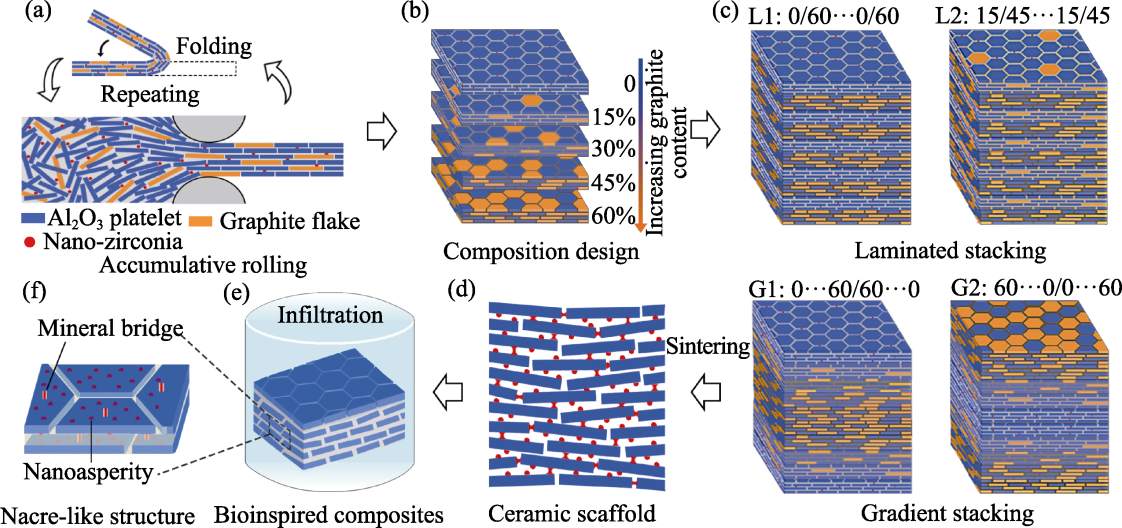
图1 仿生陶瓷-树脂复合材料的制备过程示意图和微观“砖-泥”结构的形成机制
Fig. 1 Schematic illustration of the fabrication procedure of the bioinspired nacre-like ceramic-polymer composites and the formation mechanism of the brick-and-mortar structure (a) Schematic of the accumulative rolling process; (b) Thin sheets with varying graphite flake contents produced via rolling; (c) Stacking configurations of thin sheets for the fabrication of bioinspired multiscale layered and gradient composites; (d) Microstructure of the porous ceramic scaffold; (e) Infiltration of the scaffold with liquid monomers; (f) Nanoscale structure of the resulting bioinspired composites
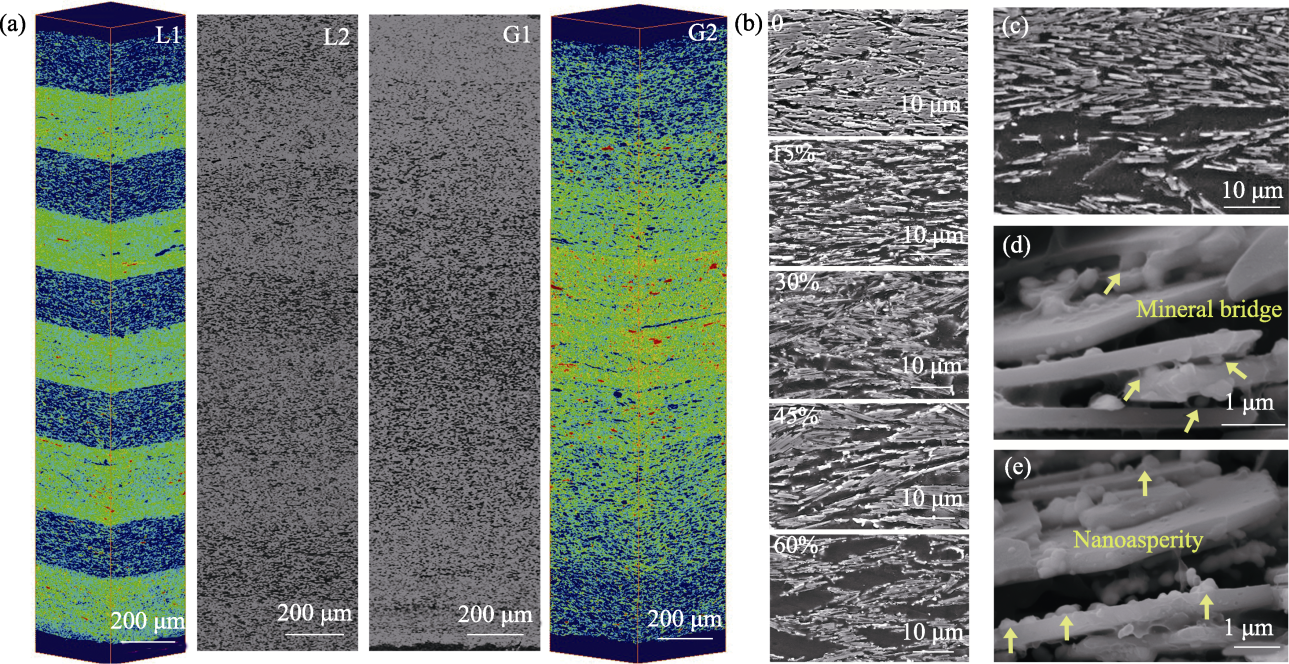
图2 仿生陶瓷-树脂复合材料在厚度截面上的微观结构
Fig. 2 Microstructures on the through-thickness cross section of bioinspired nacre-like ceramic-polymer composites (a) Through-thickness 3D XRT images (L1, G2) and SEM images (L2, G1) of bioinspired composites; (b) Representative SEM images of mesoscale layers with varying ceramic contents; (c) SEM image of the interface between layers with different ceramic contents; (d, e) Magnified SEM images of mineral bridges (d) and nanoasperities (e) on the ceramic platelets
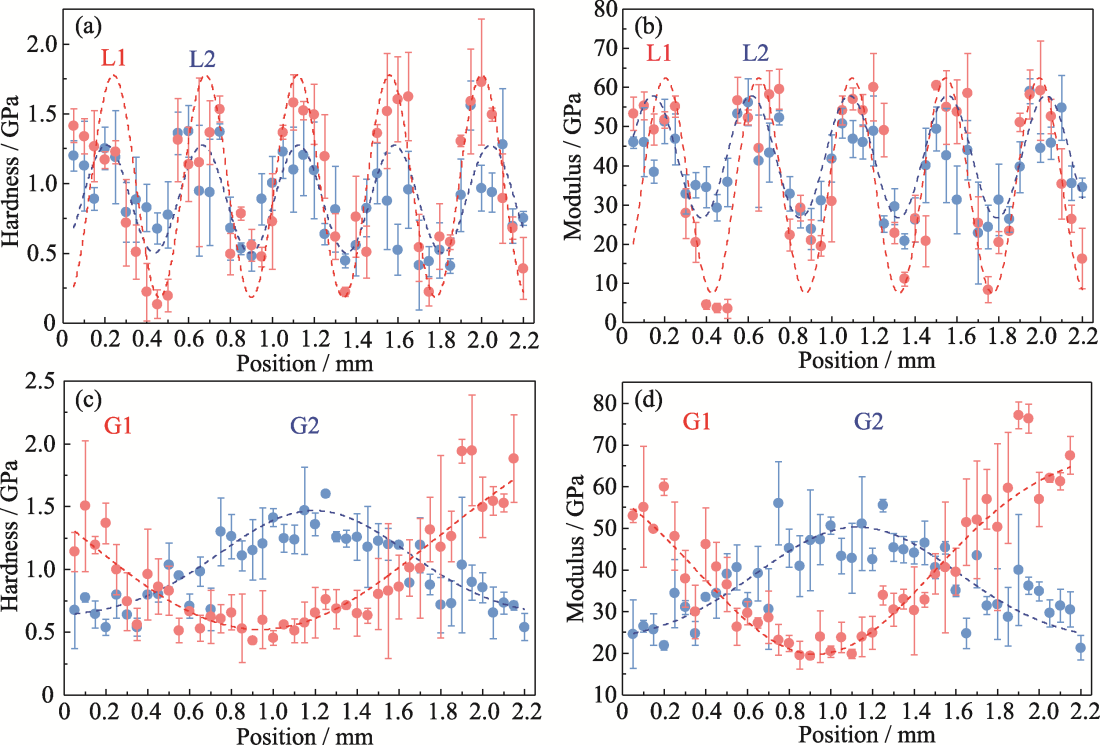
图3 仿生陶瓷-树脂复合材料的纳米压痕硬度H和模量E沿厚度方向的变化
Fig. 3 Variations in local mechanical properties of nanoindentation hardness H and modulus E across the thickness direction of bioinspired nacre-like ceramic-polymer composites (a, b) Local variations in nanoindentation hardness (a) and modulus (b) in the L1 and L2 composites; (c, d) Local variations of nanoindentation hardness (c) and modulus (d) in the G1 and G2 composites. Colorful figures are available on website
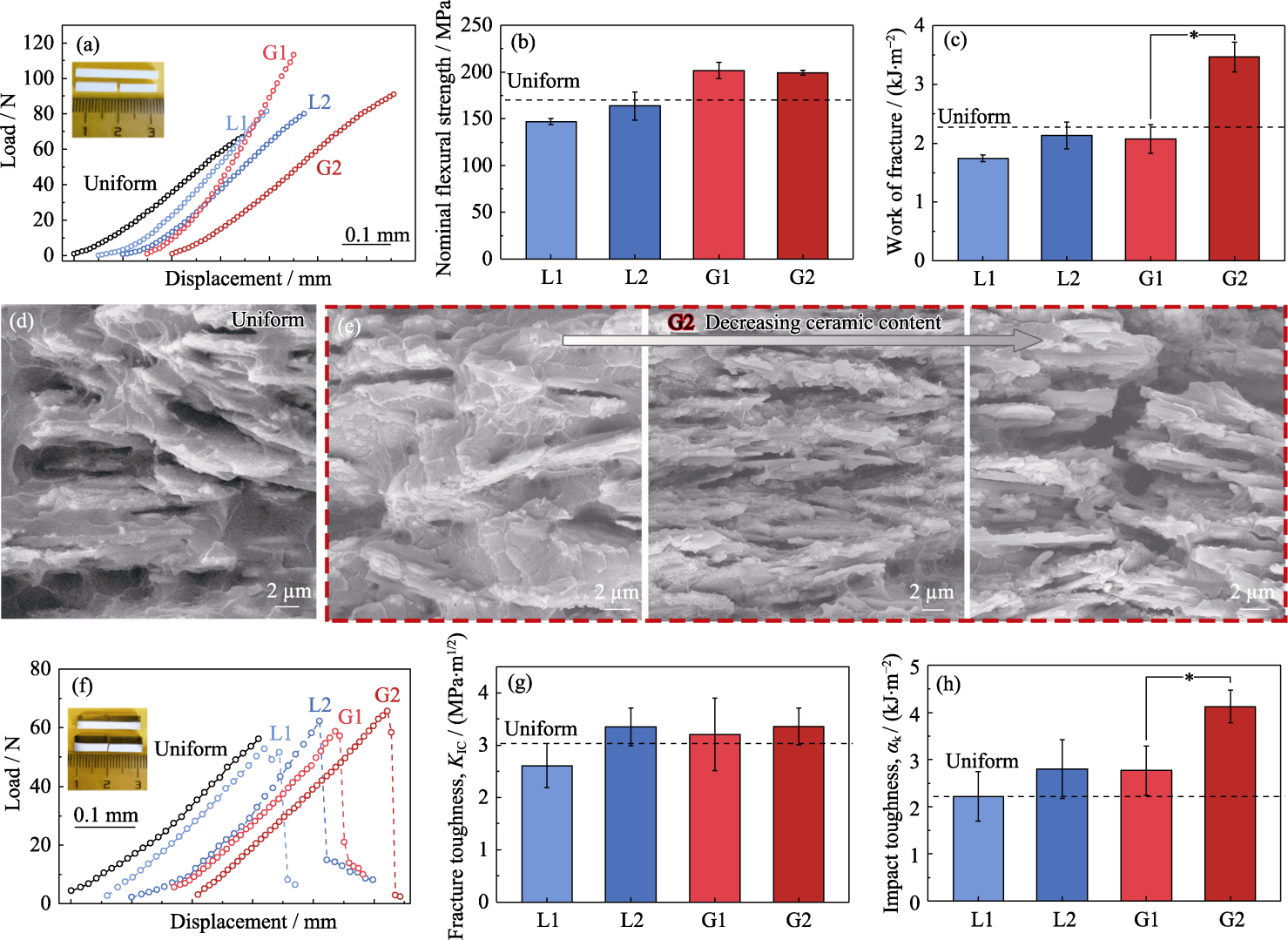
图4 仿生陶瓷-树脂复合材料的力学性能及其与均匀材料的比较
Fig. 4 Mechanical properties of bioinspired ceramic-polymer composites compared with uniform composite (a) Representative load-displacement curves of composites in three-point bending tests; (b, c) Corresponding nominal flexural strength (b) and work of fracture (c) of composites; (d, e) Representative fracture morphologies of uniform (d) and G2 (e) composites after flexural testing; (f) Representative load-displacement curves of composites in SENB tests; (g, h) Plain-strain fracture toughness for crack initiation KIC (g) and impact toughness αk (h) of composites
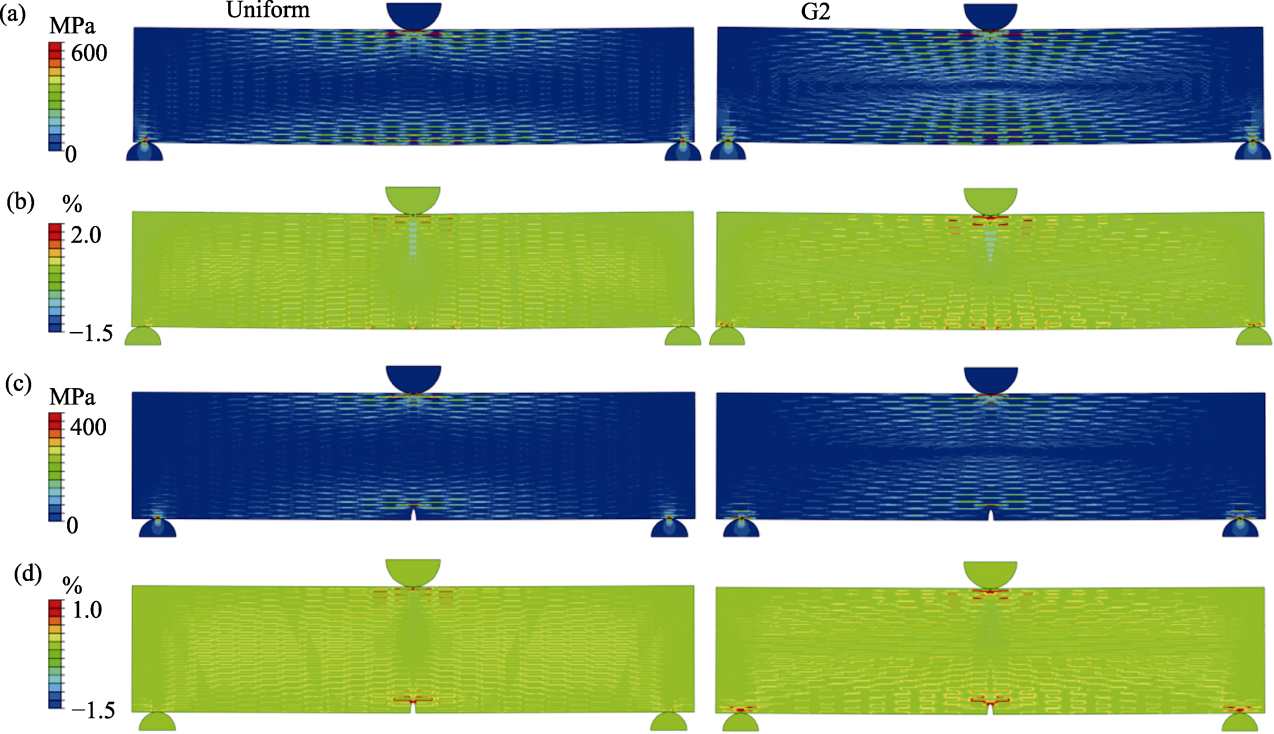
图5 G2梯度材料在无缺口和存在单边缺口的三点弯曲条件下的范式等效应力与应变分布的有限元模拟结果及其与均匀材料的比较
Fig. 5 Finite element modelling simulation results of the von Mises stress and strain distributions in bioinspired G2 composite compared with uniform composite (a, b) Distributions of von Mises stress (a) and strain (b) in the bioinspired G2 and uniform composites under three-point bending; (c, d) Distributions of von Mises stress (c) and strain (d) in the bioinspired G2 and uniform composites under single-edge notched bending
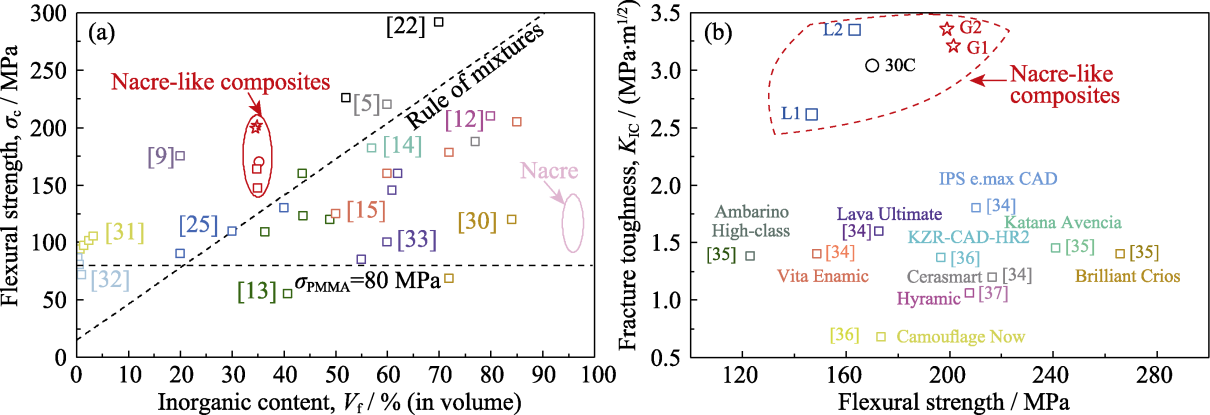
图6 仿生材料与其他陶瓷-树脂复合材料的性能比较
Fig. 6 Comparison of mechanical properties between bioinspired composites and other ceramic-polymer composites (a) Variation of flexural strength as a function of the content of inorganic phase in PMMA-based ceramic-polymer composites; (b) Comparison of flexural strength and fracture toughness KIC between current bioinspired composites and other ceramic-polymer composites for dental restoration
| [1] |
WILMERS J, BARGMANN S. Nature’s design solutions in dental enamel: uniting high strength and extreme damage resistance. Acta Biomaterialia, 2020, 107: 1.
DOI URL |
| [2] |
WANG R, GUPTA H S. Deformation and fracture mechanisms of bone and nacre. Annual Review of Materials Research, 2011, 41(1): 41.
DOI URL |
| [3] |
MEYERS M A, CHEN P Y, LOPEZ M I, et al. Biological materials: a materials science approach. Journal of the Mechanical Behavior of Biomedical Materials, 2011, 4(5): 626.
DOI PMID |
| [4] |
JI B, GAO H. Mechanical properties of nanostructure of biological materials. Journal of the Mechanics and Physics of Solids, 2004, 52(9): 1963.
DOI URL |
| [5] |
LE FERRAND H, BOUVILLE F, NIEBEL T P, et al. Magnetically assisted slip casting of bioinspired heterogeneous composites. Nature Materials, 2015, 14(11): 1172.
DOI PMID |
| [6] |
BARTHELAT F, YIN Z, BUEHLER M J. Structure and mechanics of interfaces in biological materials. Nature Reviews Materials, 2016, 1(4): 16007.
DOI |
| [7] |
DASTJERDI A K, RABIEI R, BARTHELAT F. The weak interfaces within tough natural composites: experiments on three types of nacre. Journal of the Mechanical Behavior of Biomedical Materials, 2013, 19: 50.
DOI PMID |
| [8] |
BARTHELAT F, TANG H, ZAVATTIERI P D, et al. On the mechanics of mother of pearl: a key feature in the material hierarchical structure. Journal of the Mechanics and Physics of Solids, 2007, 55(2): 306.
DOI URL |
| [9] |
TAN G, ZHANG J, ZHENG L, et al. Nature-inspired nacre-like composites combining human tooth-matching elasticity and hardness with exceptional damage tolerance. Advanced Materials, 2019, 31(52): 1904603.
DOI URL |
| [10] |
LIU Y Y, XIE X, LIU Z Q, et al. Metal matrix composites reinforced by MAX phase ceramics: fabrication, properties and bioinspired designs. Journal of Inorganic Materials, 2024, 39(2): 145.
DOI URL |
| [11] |
ZHANG H, MA Y, WANG Y, et al. Rational design of soft- hard interfaces through bioinspired engineering. Small, 2023, 19(1): 2204498.
DOI URL |
| [12] |
MUNCH E, LAUNEY M E, ALSEM D H, et al. Tough, bio-inspired hybrid materials. Science, 2008, 322(5907): 1516.
DOI PMID |
| [13] |
ZHANG N, TONG Y, XIE X, et al. Bioinspired ceramic-polymer composites with hierarchical nacre-mimetic structure via accumulative rolling technique. Ceramics International, 2023, 49(21): 33851.
DOI URL |
| [14] |
NIEBEL T P, BOUVILLE F, KOKKINIS D, et al. Role of the polymer phase in the mechanics of nacre-like composites. Journal of the Mechanics and Physics of Solids, 2016, 96: 133.
DOI URL |
| [15] |
WAN H, LEUNG N, ALGHARAIBEH S, et al. Cost-effective fabrication of bio-inspired nacre-like composite materials with high strength and toughness. Composites Part B: Engineering, 2020, 202: 108414.
DOI URL |
| [16] |
LOPEZ M I, MARTINEZ P E M, MEYERS M A. Organic interlamellar layers, mesolayers and mineral nanobridges: contribution to strength in abalone (Haliotis rufescence) nacre. Acta Biomaterialia, 2014, 10(5): 2056.
DOI PMID |
| [17] |
LIU Y Y, LIU Z Q, LIU Z Y, et al. Nature inspires new high- performance metal composites. Interdisciplinary Materials, 2025, 4(3): 502.
DOI URL |
| [18] |
NEPAL D, KANG S, ADSTEDT K M, et al. Hierarchically structured bioinspired nanocomposites. Nature Materials, 2023, 22(1): 18.
DOI |
| [19] | WEAVER J C, WANG Q, MISEREZ A, et al. Analysis of an ultra hard magnetic biomineral in chiton radular teeth. Materials Today, 2010, 13(1): 42. |
| [20] |
RAABE D, SACHS C, ROMANO P. The crustacean exoskeleton as an example of a structurally and mechanically graded biological nanocomposite material. Acta Materialia, 2005, 53(15): 4281.
DOI URL |
| [21] |
MISEREZ A, SCHNEBERK T, SUN C, et al. The transition from stiff to compliant materials in squid beaks. Science, 2008, 319(5871): 1816.
DOI PMID |
| [22] |
ZHANG Z B, GAO H L, WEN S M, et al. Scalable manufacturing of mechanical robust bioinspired ceramic-resin composites with locally tunable heterogeneous structures. Advanced Materials, 2023, 35(14): 2209510.
DOI URL |
| [23] |
PRAGYA A, GHOSH T K. Soft functionally gradient materials and structures-natural and manmade: a review. Advanced Materials, 2023, 35(49): 2300912.
DOI URL |
| [24] |
KOKKINIS D, BOUVILLE F, STUDART A R. 3D printing of materials with tunable failure via bioinspired mechanical gradients. Advanced Materials, 2018, 30(19): 1705808.
DOI URL |
| [25] |
WEN S M, CHEN S M, GAO W, et al. Biomimetic gradient bouligand structure enhances impact resistance of ceramic-polymer composites. Advanced Materials, 2023, 35(21): 2211175.
DOI URL |
| [26] |
WU Z, PAN H, HUANG P, et al. Biomimetic mechanical robust cement-resin composites with machine learning-assisted gradient hierarchical structures. Advanced Materials, 2024, 36(35): 2405183.
DOI URL |
| [27] |
ZHANG N, LIU Z Q, YU Q T, et al. On the damage tolerance of bioinspired gradient composites with nacre-like architecture. Advanced Functional Materials, 2025, 35(14): 2421057.
DOI URL |
| [28] |
ZHANG N, LIU Z Q, DU Y B, et al. Facile processing of oriented macro-porous ceramics with high strength and low thermal conductivity. Journal of the European Ceramic Society, 2022, 42(15): 7196.
DOI URL |
| [29] | Committee E08 on Fatigue and Fracture. Standard Test Method for Measurement of Fracture Toughness: ASTM E1820-13. West Conshohocken, PA: ASTM International, 2013. |
| [30] |
BAI H, WALSH F, GLUDOVATZ B, et al. Bioinspired hydroxyapatite/poly(methyl methacrylate) composite with a nacre-mimetic architecture by a bidirectional freezing method. Advanced Materials, 2016, 28(1): 50.
DOI URL |
| [31] |
ALHOTAN A, YATES J, ZIDAN S, et al. Flexural strength and hardness of filler-reinforced PMMA targeted for denture base application. Materials, 2021, 14(10): 2659.
DOI URL |
| [32] |
YERLIYURT K, TASDELEN T B, EGRI O, et al. Flexural properties of heat-polymerized PMMA denture base resins reinforced with fibers with different characteristics. Polymers, 2023, 15(15): 3211.
DOI URL |
| [33] |
MAGRINI T, MOSER S, FELLNER M, et al. Transparent nacre- like composites toughened through mineral bridges. Advanced Functional Materials, 2020, 30(27): 2002149.
DOI URL |
| [34] |
GOUJAT A, ABOUELLEIL H, COLON P, et al. Mechanical properties and internal fit of 4 CAD-CAM block materials. The Journal of Prosthetic Dentistry, 2018, 119(3): 384.
DOI URL |
| [35] | HAMPE R, THEELKE B, LUMKEMANN N, et al. Fracture toughness analysis of ceramic and resin composite CAD/CAM material. Operative Dentistry, 2019, 44(4): E190. |
| [36] |
LUCSANSZKY I J R, RUSE N D. Fracture toughness, flexural strength, and flexural modulus of new CAD/CAM resin composite blocks. Journal of Prosthodontics, 2020, 29(1): 34.
DOI URL |
| [37] | 刘丽杨, 郭佳杰, 杜亚鑫, 等. 3种可切削树脂陶瓷复合材料机械性能比较. 上海口腔医学, 2019, 28(1): 25. |
| [1] | 石金瑜, 雷一明, 王晨旭, 张洁, 王京阳. 不同化学计量碳化钛的离子辐照损伤行为研究[J]. 无机材料学报, 2026, 41(3): 322-330. |
| [2] | 唐依帆, 黄泽皑, 张瑞阳, 詹俊杰, 陈国星, 杨茗凯, 刘彤, 陈红吉, 周莹. 不同浓度甲烷对熔融盐催化裂解碳产物的形貌调控研究[J]. 无机材料学报, 2026, 41(3): 385-392. |
| [3] | 郑晨, 王湘宁, 苑贺楠, 杨嘉伟, 李传建, 王华栋. 氧化铝纤维增强二氧化硅复合材料力学性能失效研究[J]. 无机材料学报, 2026, 41(3): 331-339. |
| [4] | 张韵铂, 王兵, 李威, 宋曲之, 杜贻昂, 王应德. BNNS/聚硼氮烷杂化先驱体转化BN纤维中的纳米片尺寸效应[J]. 无机材料学报, 2026, 41(3): 359-369. |
| [5] | 袁旺, 胡建宝, 周亮, 阚艳梅, 张翔宇, 董绍明. 氩气气氛热处理对Shicolon-II SiC纤维机械性能和微观结构演变的影响[J]. 无机材料学报, 2026, 41(1): 119-128. |
| [6] | 张永恒, 陈继新. 镱铝硅酸盐玻璃和SiC改性h-BN基复合材料的制备与性能研究[J]. 无机材料学报, 2026, 41(1): 37-44. |
| [7] | 谭博文, 耿双龙, 张锴, 郑百林. 硅电极组分梯度设计抑制力-化学耦合劣化[J]. 无机材料学报, 2025, 40(7): 772-780. |
| [8] | 陈义, 邱海鹏, 陈明伟, 徐昊, 崔恒. SiC/SiC复合材料基体硼改性方法及其力学性能研究[J]. 无机材料学报, 2025, 40(5): 504-510. |
| [9] | 崔宁, 张玉新, 王鲁杰, 李彤阳, 于源, 汤华国, 乔竹辉. (TiVNbMoW)Cx高熵陶瓷的单相形成过程与碳空位调控[J]. 无机材料学报, 2025, 40(5): 511-520. |
| [10] | 李紫薇, 弓伟露, 崔海峰, 叶丽, 韩伟健, 赵彤. 前驱体法制备(Zr, Hf, Nb, Ta, W)C-SiC复相陶瓷及性能研究[J]. 无机材料学报, 2025, 40(3): 271-280. |
| [11] | 高晨光, 孙晓亮, 陈君, 李达鑫, 陈庆庆, 贾德昌, 周玉. 基于湿法纺丝技术的SiBCN-rGO陶瓷纤维的组织结构、力学和吸波性能[J]. 无机材料学报, 2025, 40(3): 290-296. |
| [12] | 穆浩洁, 张源江, 喻彬, 付秀梅, 周世斌, 李晓东. ZrO2掺杂Y2O3-MgO纳米复相陶瓷的制备及性能研究[J]. 无机材料学报, 2025, 40(3): 281-289. |
| [13] | 李伟, 许志明, 苟燕子, 尹森虎, 余艺平, 王松. SiC纤维烧结陶瓷的制备及其性能研究[J]. 无机材料学报, 2025, 40(2): 177-183. |
| [14] | 范武刚, 曹雄, 周响, 李玲, 赵冠楠, 张兆泉. 8YSZ陶瓷在模拟压水堆水环境中的耐腐蚀性能[J]. 无机材料学报, 2024, 39(7): 803-809. |
| [15] | 王伟明, 王为得, 粟毅, 马青松, 姚冬旭, 曾宇平. 以非氧化物为烧结助剂制备高导热氮化硅陶瓷的研究进展[J]. 无机材料学报, 2024, 39(6): 634-646. |
| 阅读次数 | ||||||
|
全文 |
|
|||||
|
摘要 |
|
|||||