
Journal of Inorganic Materials ›› 2026, Vol. 41 ›› Issue (7): 939-946.DOI: 10.15541/jim20260018
• RESEARCH ARTICLE • Previous Articles Next Articles
LIU Jinxiao1,2( ), LIU Zhenhan1,2, CHEN Xingyu1,2, ZHOU Zhengyang1,2, QIU Pengfei1,2, ZHANG Jiawei1,2(), SHI Xun1,2()
Received:2026-01-13
Revised:2026-03-14
Published:2026-07-20
Online:2026-03-18
Contact:
ZHANG Jiawei, professor. E-mail: jiaweizhang@mail.sic.ac.cn;About author:LIU Jinxiao (2000-), female, Master candidate. E-mail: liujinxiao23@mails.ucas.ac.cn
Supported by:CLC Number:
LIU Jinxiao, LIU Zhenhan, CHEN Xingyu, ZHOU Zhengyang, QIU Pengfei, ZHANG Jiawei, SHI Xun. Influence of Preparation Processes on the Structure and Properties of the Ductile Thermoelectric Material Ag2S0.4Te0.6[J]. Journal of Inorganic Materials, 2026, 41(7): 939-946.
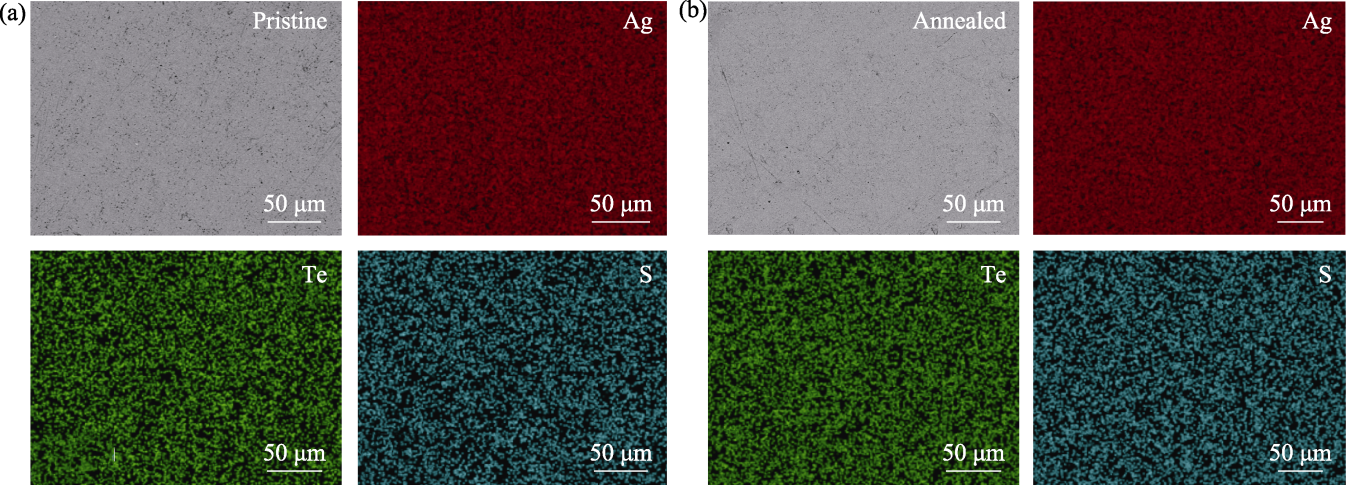
Fig. 1 BSE images of (a) pristine and (b) annealed Ag2S0.4Te0.6 bulk samples, along with EDS elemental distribution mappings of Ag, Te and S
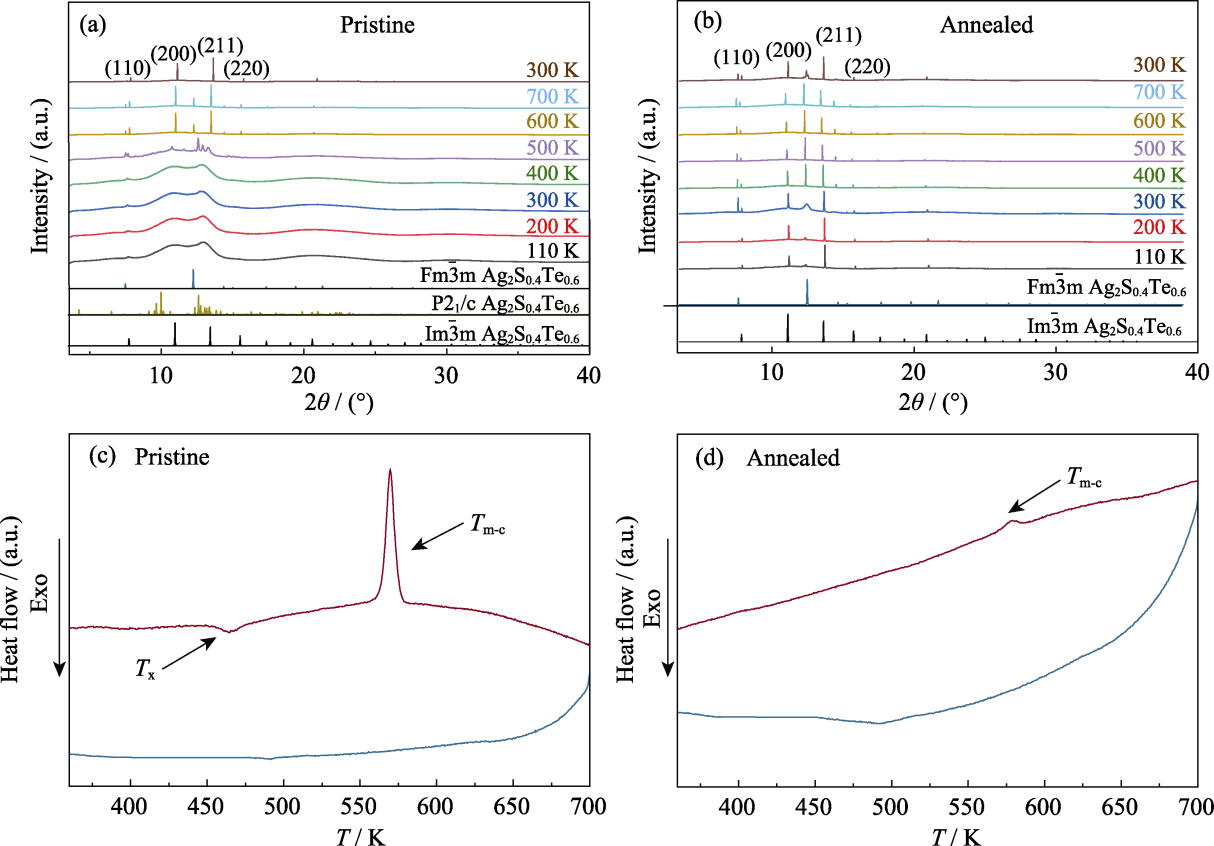
Fig. 2 (a, b) SPXRD patterns (λ=0.490027(0) Å) and (c, d) DSC curves of (a, c) pristine and (b, d) annealed Ag2S0.4Te0.6 powder samples
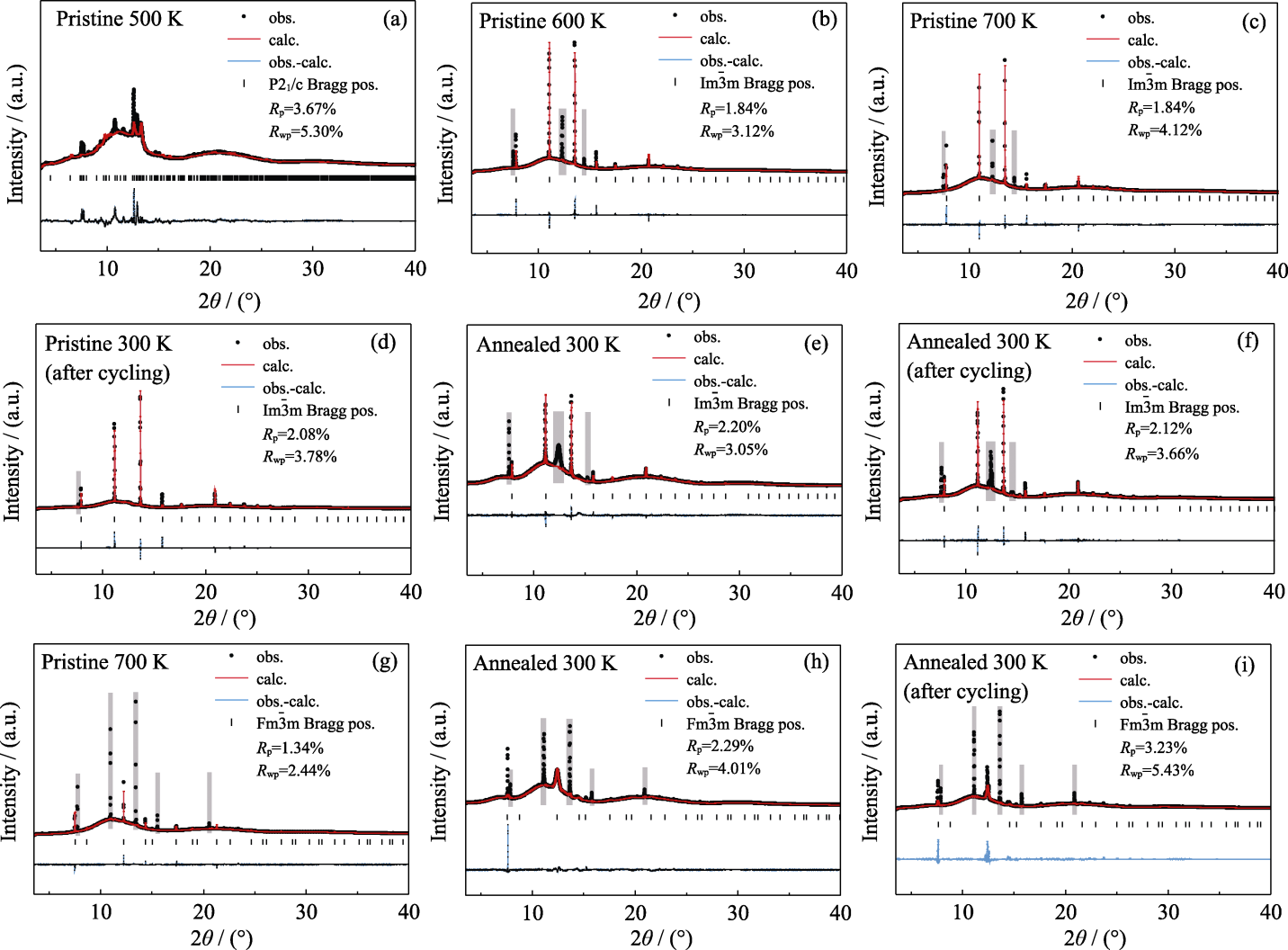
Fig. 3 Rietveld refinement of SPXRD data of samples using (a) monoclinic Ag2Te, (b-f) bcc Ag2Te, and (g-i) fcc Ag2Te as models
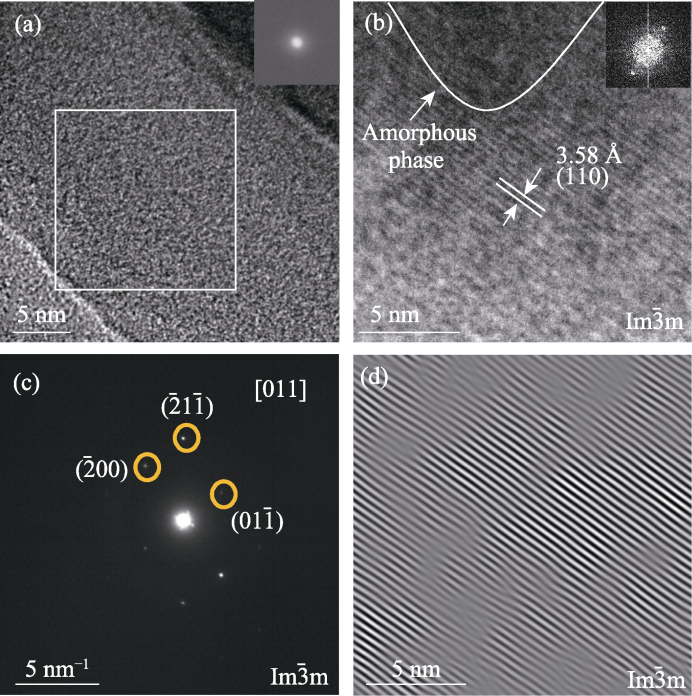
Fig. 4 (a) HRTEM image of amorphous region in the pristine Ag2S0.4Te0.6 powder sample with inset showing the fast Fourier transform (FFT) image corresponding to area marked by the white square; (b) HRTEM image of the annealed Ag2S0.4Te0.6 powder sample showing a crystalline matrix with a bcc structure embedded in an amorphous region with inset showing the FFT image of the crystalline area; (c) SAED pattern and (d) IFFT image corresponding to the crystalline region marked in panel Fig. (b)
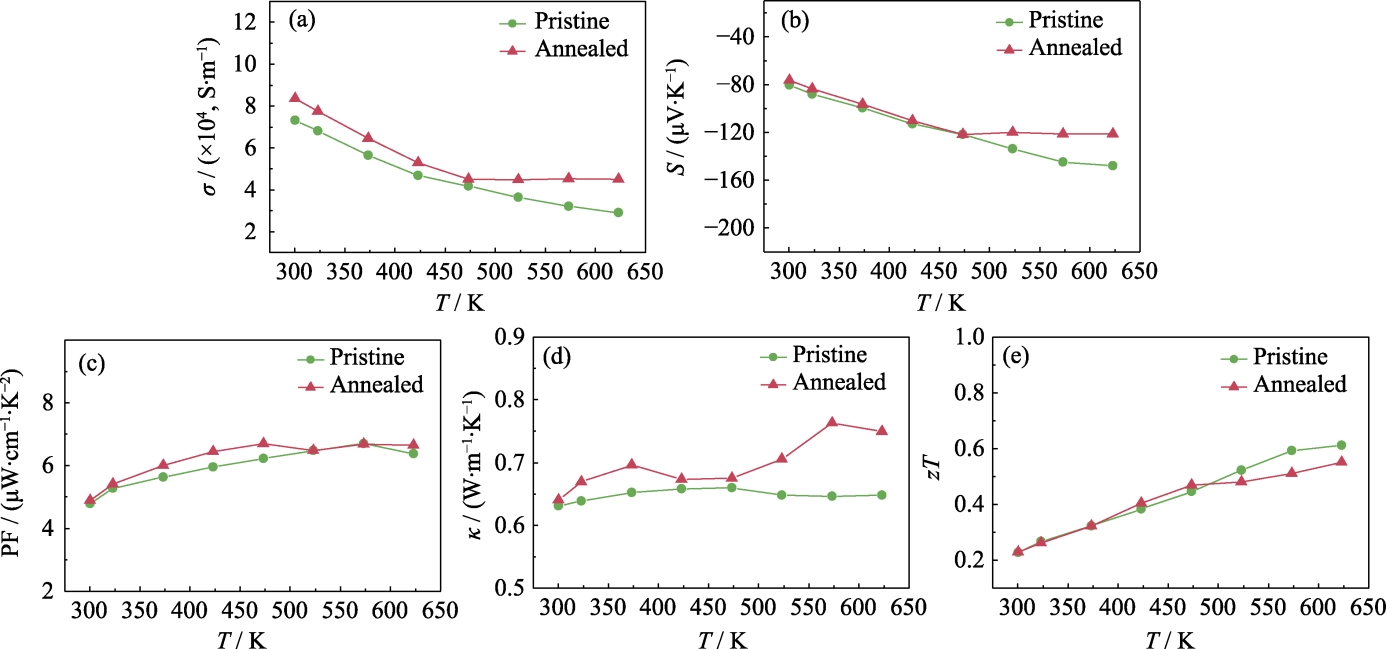
Fig. 5 Temperature-dependent curves of (a) electrical conductivity, (b) Seebeck coefficient, (c) power factor, (d) total thermal conductivity, and (e) thermoelectric figure of merit zT for pristine and annealed Ag2S0.4Te0.6 bulk sample
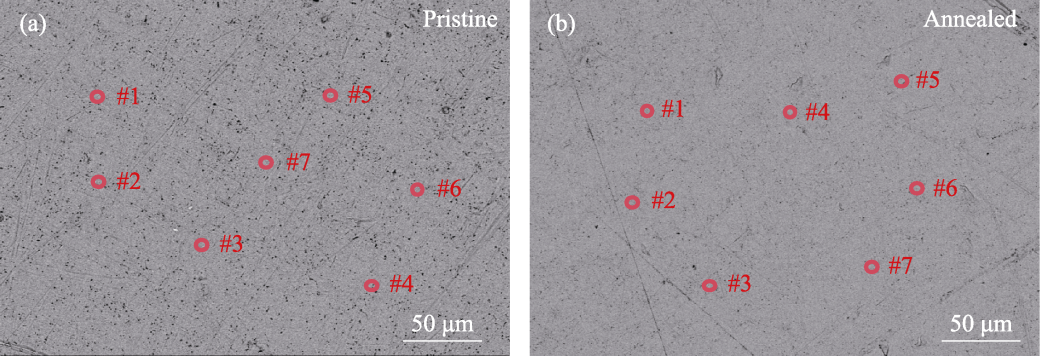
Fig. S1 BSE images of the (a) pristine and (b) annealed Ag2S0.4Te0.6 bulk samples Red circles indicate the selected regions for EDS point analysis
| Point | #1 | #2 | #3 | #4 | #5 | #6 | #7 | Average |
|---|---|---|---|---|---|---|---|---|
| Ag/% | 67.5 | 67.5 | 67.4 | 67.0 | 67.8 | 67.1 | 67.4 | 67.4 |
| Te/% | 19.5 | 19.7 | 19.7 | 19.6 | 19.6 | 19.3 | 19.4 | 19.5 |
| S/% | 13.0 | 12.8 | 12.9 | 13.3 | 12.6 | 13.6 | 13.2 | 13.1 |
Table S1 Atomic percentages of the element distribution at the designated detection points in the pristine bulk sample
| Point | #1 | #2 | #3 | #4 | #5 | #6 | #7 | Average |
|---|---|---|---|---|---|---|---|---|
| Ag/% | 67.5 | 67.5 | 67.4 | 67.0 | 67.8 | 67.1 | 67.4 | 67.4 |
| Te/% | 19.5 | 19.7 | 19.7 | 19.6 | 19.6 | 19.3 | 19.4 | 19.5 |
| S/% | 13.0 | 12.8 | 12.9 | 13.3 | 12.6 | 13.6 | 13.2 | 13.1 |
| Point | #1 | #2 | #3 | #4 | #5 | #6 | #7 | Average | |
|---|---|---|---|---|---|---|---|---|---|
| Ag/% | 67.5 | 68.0 | 67.4 | 68.2 | 67.9 | 67.4 | 67.4 | 67.7 | |
| Te/% | 19.5 | 19.3 | 19.7 | 19.0 | 19.5 | 19.8 | 19.9 | 19.5 | |
| S/% | 13.0 | 12.7 | 12.9 | 12.8 | 12.6 | 12.8 | 12.7 | 12.8 | |
Table S2 Atomic percentages of the element distribution at the designated detection points in the annealed bulk sample
| Point | #1 | #2 | #3 | #4 | #5 | #6 | #7 | Average | |
|---|---|---|---|---|---|---|---|---|---|
| Ag/% | 67.5 | 68.0 | 67.4 | 68.2 | 67.9 | 67.4 | 67.4 | 67.7 | |
| Te/% | 19.5 | 19.3 | 19.7 | 19.0 | 19.5 | 19.8 | 19.9 | 19.5 | |
| S/% | 13.0 | 12.7 | 12.9 | 12.8 | 12.6 | 12.8 | 12.7 | 12.8 | |
| Temperature | 600 K (pristine) | 700 K (pristine) | 300 K (pristine, after cycling) | 300 K (annealed) | 300 K (annealed, after cycling) | |
|---|---|---|---|---|---|---|
| No. of points | 30052 | 30052 | 30057 | 30062 | 30059 | |
| No. of reflections | 52 | 53 | 51 | 52 | 52 | |
| No. of parameters | 15 | 16 | 16 | 16 | 16 | |
| Rp/% | 1.84 | 1.84 | 2.08 | 2.20 | 2.12 | |
| Rwp/% | 3.12 | 4.12 | 3.78 | 3.05 | 3.66 | |
| GOF | 4.54 | 5.02 | 5.48 | 2.20 | 2.98 | |
| a=b=c/Å | 5.1031(8) | 5.1263(13) | 5.0481(6) | 5.0420(2) | 5.0536(10) | |
| Volume/Å3 | 132.8930(4) | 134.7170(6) | 128.6440(3) | 128.1770(9) | 129.0650(4) | |
| Uiso/Å2 | Ag1 | 0.2084(6) | 0.2077(7) | 0.1917(18) | 0.1861(18) | 0.1892(13) |
| Te1 | 0.1068(7) | 0.1102(13) | 0.0887(7) | 0.0944(15) | 0.0955(9) | |
| S1 | 0.1068(7) | 0.1102(13) | 0.0887(7) | 0.0944(15) | 0.0955(9) | |
| Occupancy | Ag1 | 0.3333 | 0.3333 | 0.3522(15) | 0.3333 | 0.3461(12) |
| Te1 | 0.6 | 0.6 | 0.6(6) | 0.6 | 0.6 | |
| S1 | 0.4 | 0.4 | 0.3999(6) | 0.4 | 0.4 | |
Table S3 Rietveld refinement of SPXRD data for the bcc Ag2Te phase
| Temperature | 600 K (pristine) | 700 K (pristine) | 300 K (pristine, after cycling) | 300 K (annealed) | 300 K (annealed, after cycling) | |
|---|---|---|---|---|---|---|
| No. of points | 30052 | 30052 | 30057 | 30062 | 30059 | |
| No. of reflections | 52 | 53 | 51 | 52 | 52 | |
| No. of parameters | 15 | 16 | 16 | 16 | 16 | |
| Rp/% | 1.84 | 1.84 | 2.08 | 2.20 | 2.12 | |
| Rwp/% | 3.12 | 4.12 | 3.78 | 3.05 | 3.66 | |
| GOF | 4.54 | 5.02 | 5.48 | 2.20 | 2.98 | |
| a=b=c/Å | 5.1031(8) | 5.1263(13) | 5.0481(6) | 5.0420(2) | 5.0536(10) | |
| Volume/Å3 | 132.8930(4) | 134.7170(6) | 128.6440(3) | 128.1770(9) | 129.0650(4) | |
| Uiso/Å2 | Ag1 | 0.2084(6) | 0.2077(7) | 0.1917(18) | 0.1861(18) | 0.1892(13) |
| Te1 | 0.1068(7) | 0.1102(13) | 0.0887(7) | 0.0944(15) | 0.0955(9) | |
| S1 | 0.1068(7) | 0.1102(13) | 0.0887(7) | 0.0944(15) | 0.0955(9) | |
| Occupancy | Ag1 | 0.3333 | 0.3333 | 0.3522(15) | 0.3333 | 0.3461(12) |
| Te1 | 0.6 | 0.6 | 0.6(6) | 0.6 | 0.6 | |
| S1 | 0.4 | 0.4 | 0.3999(6) | 0.4 | 0.4 | |
| Temperature | 700 K (pristine) | 300 K (annealed) | 300 K (annealed, after cycling) | |
|---|---|---|---|---|
| No. of points | 30052 | 30062 | 30059 | |
| No. of reflections | 58 | 62 | 58 | |
| No. of parameters | 17 | 17 | 16 | |
| Rp/% | 1.34 | 2.29 | 3.23 | |
| Rwp/% | 2.44 | 4.01 | 5.43 | |
| GOF | 2.87 | 3.13 | 4.42 | |
| a=b=c/Å | 6.4927(14) | 6.4140(4) | 6.3978(6) | |
| Volume/Å3 | 273.6970(10) | 263.9000(3) | 261.8700(4) | |
| Uiso/Å2 | Ag1 | 0.0546(4) | 0.0547(3) | 0.0550(4) |
| Ag2 | 0.1926(4) | 0.1800(3) | 0.1795(4) | |
| Te1 | 0.1795(2) | 0.1752(3) | 0.1750(7) | |
| S1 | 0.1795(2) | 0.1752(3) | 0.1750(7) | |
| Occupancy | Ag1 | 0.1345(6) | 0.1330(2) | 0.1435(3) |
| Ag2 | 0.0703(6) | 0.0766(2) | 0.0613(3) | |
| Te1 | 0.6050(7) | 0.6060(3) | 0.6094(4) | |
| S1 | 0.3950(7) | 0.3940(3) | 0.3906(4) | |
Table S4 Rietveld refinement of the SPXRD data for the fcc Ag2Te phase
| Temperature | 700 K (pristine) | 300 K (annealed) | 300 K (annealed, after cycling) | |
|---|---|---|---|---|
| No. of points | 30052 | 30062 | 30059 | |
| No. of reflections | 58 | 62 | 58 | |
| No. of parameters | 17 | 17 | 16 | |
| Rp/% | 1.34 | 2.29 | 3.23 | |
| Rwp/% | 2.44 | 4.01 | 5.43 | |
| GOF | 2.87 | 3.13 | 4.42 | |
| a=b=c/Å | 6.4927(14) | 6.4140(4) | 6.3978(6) | |
| Volume/Å3 | 273.6970(10) | 263.9000(3) | 261.8700(4) | |
| Uiso/Å2 | Ag1 | 0.0546(4) | 0.0547(3) | 0.0550(4) |
| Ag2 | 0.1926(4) | 0.1800(3) | 0.1795(4) | |
| Te1 | 0.1795(2) | 0.1752(3) | 0.1750(7) | |
| S1 | 0.1795(2) | 0.1752(3) | 0.1750(7) | |
| Occupancy | Ag1 | 0.1345(6) | 0.1330(2) | 0.1435(3) |
| Ag2 | 0.0703(6) | 0.0766(2) | 0.0613(3) | |
| Te1 | 0.6050(7) | 0.6060(3) | 0.6094(4) | |
| S1 | 0.3950(7) | 0.3940(3) | 0.3906(4) | |
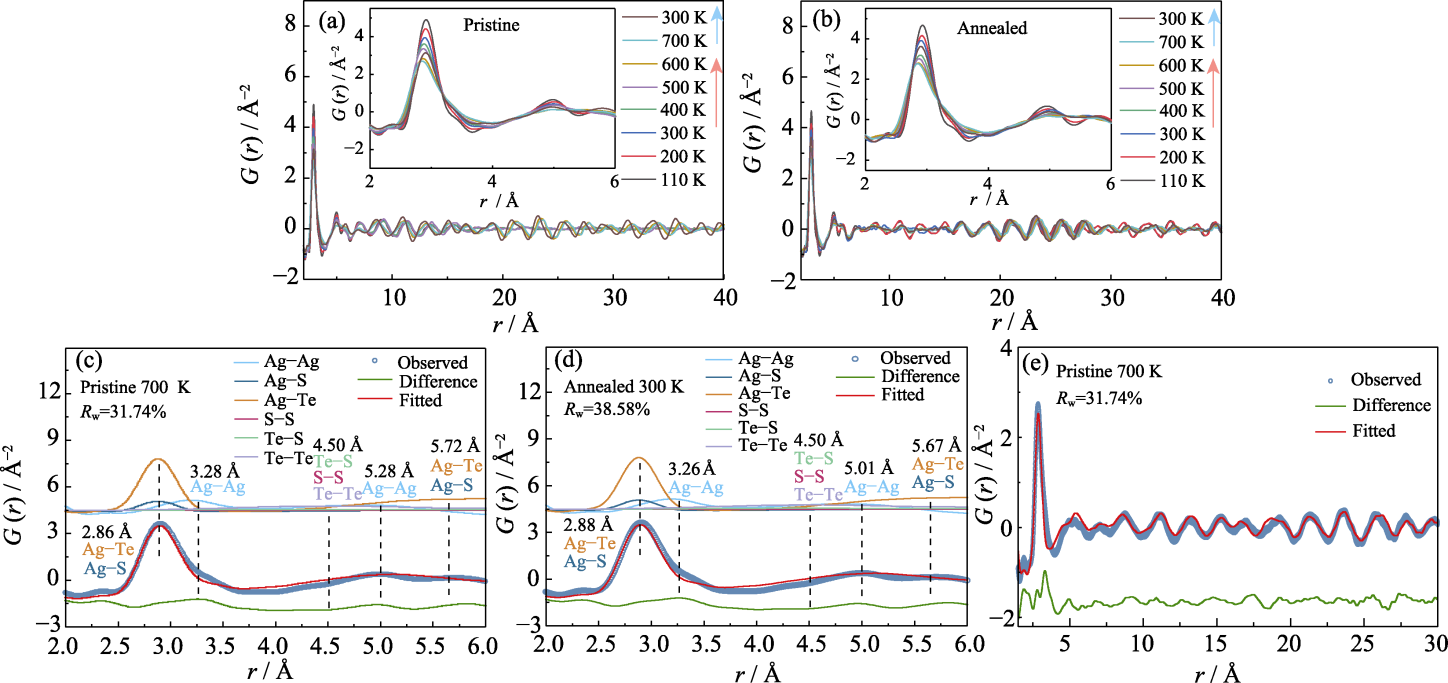
Fig. S2 (a, b) PDF spectra at different temperatures for (a) pristine and (b) annealed powder samples in the range of 2-40 Å with inset showing the PDF spectra in the short range of 2-6 Å; (c, d) Synchrotron radiation X-ray PDF spectra of (c) pristine powder at 700 K and (d) annealed powder at 300 K in the range of 2-6 Å fitted with average structures from the Im$\bar{3}$m and Fm$\bar{3}$m space groups, together with partial PDF data for different atomic pairs; (e) Synchrotron radiation X-ray PDF spectra for pristine Ag2S0.4Te0.6 at 700 K in the range of 2-30 Å Blue circles are fitted using the average structures of the Im¯3m and Fm¯3m space groups, with the fitting model displayed as a red line and the difference curve as a green line (with offset shown below the data and fit)
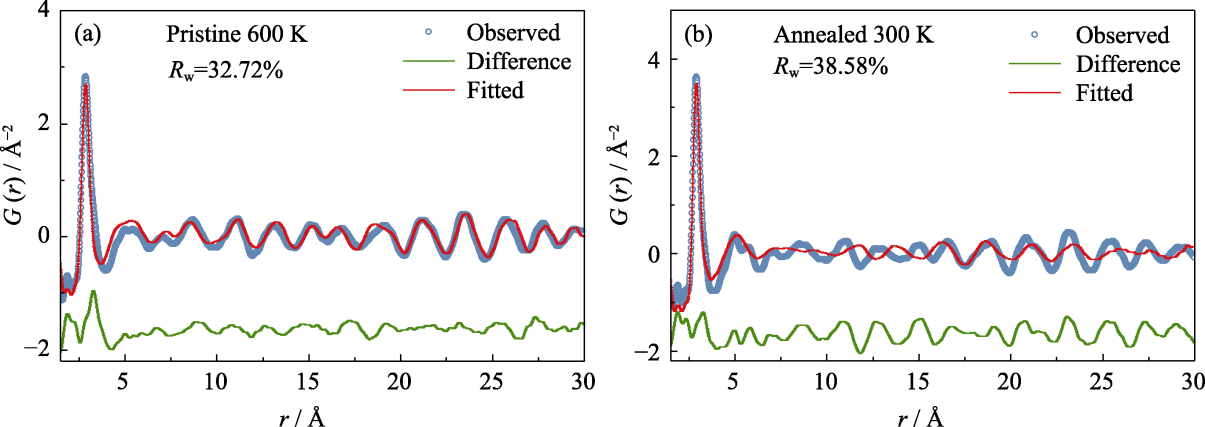
Fig. S3 Synchrotron radiation X-ray PDF patterns of Ag2S0.4Te0.6 powder (a) before annealing at 600 K and (b) after annealing at 300 K
| [1] | LIM H R, KIM H S, QAZI R, et al. Advanced soft materials, sensor integrations, and applications of wearable flexible hybrid electronics in healthcare, energy, and environment. Advanced Materials, 2020, 32(15): e1901924. |
| [2] |
GUO C F, DING L M. Integration of soft electronics and biotissues. The Innovation, 2021, 2(1): 100074.
DOI URL |
| [3] | MENG B, TANG W, TOO Z H, et al. A transparent single-friction-surface triboelectric generator and self-powered touch sensor. Energy & Environmental Science, 2013, 6(11): 3235. |
| [4] |
BOLAND C S, KHAN U, RYAN G, et al. Sensitive electromechanical sensors using viscoelastic graphene-polymer nanocomposites. Science, 2016, 354(6317): 1257.
PMID |
| [5] |
YANG Q Y, YANG S Q, QIU P F, et al. Flexible thermoelectrics based on ductile semiconductors. Science, 2022, 377(6608): 854.
DOI PMID |
| [6] |
HOU C Y, ZHU M F. Semiconductors flex thermoelectric power. Science, 2022, 377(6608): 815.
DOI PMID |
| [7] |
PERUMAL S, ROYCHOWDHURY S, BISWAS K. Reduction of thermal conductivity through nanostructuring enhances the thermoelectric figure of merit in Ge1-xBixTe. Inorganic Chemistry Frontiers, 2016, 3(1): 125.
DOI URL |
| [8] |
PERUMAL S, SAMANTA M, GHOSH T, et al. Realization of high thermoelectric figure of merit in GeTe by complementary co-doping of Bi and In. Joule, 2019, 3(10): 2565.
DOI URL |
| [9] | BU Z L, ZHANG X Y, SHAN B, et al. Realizing a 14% single-leg thermoelectric efficiency in GeTe alloys. Science Advances, 2021, 7(19): eabf2738. |
| [10] |
JIANG Y L, DONG J F, ZHUANG H L, et al. Evolution of defect structures leading to high ZT in GeTe-based thermoelectric materials. Nature Communications, 2022, 13: 6087.
DOI PMID |
| [11] |
XING T, ZHU C X, SONG Q F, et al. Ultralow lattice thermal conductivity and superhigh thermoelectric figure-of-merit in (Mg, Bi) Co-doped GeTe. Advanced Materials, 2021, 33(17): 2008773.
DOI URL |
| [12] | WANG J, LI J B, YU H Y, et al. Enhanced thermoelectric performance in n-type SrTiO3/SiGe composite. ACS Applied Materials & Interfaces, 2020, 12(2): 2687. |
| [13] |
BASU R, SINGH A. High temperature Si-Ge alloy towards thermoelectric applications: a comprehensive review. Materials Today Physics, 2021, 21: 100468.
DOI URL |
| [14] |
CHEN H B, ZHANG Z W, LIANG J S, et al. Phonon relaxation effect by regeneration of nano-inclusions in SiGe for ultralow thermal conductivity and enhanced thermoelectric performance. Materials Today Physics, 2024, 43: 101405.
DOI URL |
| [15] | JIANG Z X, LI E L, SHI R Z, et al. Effective nonstoichiometric strategy combined post-annealing process for boosting thermoelectric properties in n-type PbTe. ACS Applied Materials & Interfaces, 2024, 16(15): 19048. |
| [16] |
MA B P, LI Y Q, ZHU L J, et al. Modulation doping promoted ultrahigh electron mobility and enhanced thermoelectric performance in PbTe. Chemical Engineering Journal, 2024, 488: 150647.
DOI URL |
| [17] | CAO Y, BAI H, LI Z, et al. Zn-induced defect complexity for the high thermoelectric performance of n-type PbTe compounds. ACS Applied Materials & Interfaces, 2021, 13(36): 43134. |
| [18] |
CAO T Y, SHI X L, CHEN Z G. Advances in the design and assembly of flexible thermoelectric device. Progress in Materials Science, 2023, 131: 101003.
DOI URL |
| [19] |
JUNG S J, SHIN J, LIM S S, et al. Porous organic filler for high efficiency of flexible thermoelectric generator. Nano Energy, 2021, 81: 105604.
DOI URL |
| [20] |
ZHANG Q, SUN Y M, QIN Y K, et al. Two soluble polymers with lower ionization potentials: doping and thermoelectric properties. Journal of Materials Chemistry A, 2016, 4(4): 1432.
DOI URL |
| [21] |
AÏCH R B, BLOUIN N, BOUCHARD A, et al. Electrical and thermoelectric properties of poly(2,7-carbazole) derivatives. Chemistry of Materials, 2009, 21(4): 751.
DOI URL |
| [22] |
SHI X, CHEN H Y, HAO F, et al. Room-temperature ductile inorganic semiconductor. Nature Materials, 2018, 17(5): 421.
DOI PMID |
| [23] |
ZHAO P, XUE W H, ZHANG Y, et al. Plasticity in single- crystalline Mg3Bi2 thermoelectric material. Nature, 2024, 631: 777.
DOI |
| [24] |
LI A R, WANG Y C, LI Y Z, et al. High performance magnesium- based plastic semiconductors for flexible thermoelectrics. Nature Communications, 2024, 15: 5108.
DOI |
| [25] |
HU H P, WANG Y C, FU C G, et al. Achieving metal-like malleability and ductility in Ag2Te1-xSx inorganic thermoelectric semiconductors with high mobility. The Innovation, 2022, 3(6): 100341.
DOI URL |
| [26] |
YANG S Q, GAO Z Q, QIU P F, et al. Ductile Ag20S7Te3 with excellent shape-conformability and high thermoelectric performance. Advanced Materials, 2021, 33(10): 2007681.
DOI URL |
| [27] |
WEI T R, JIN M, WANG Y C, et al. Exceptional plasticity in the bulk single-crystalline van der Waals semiconductor InSe. Science, 369(6503): 542.
DOI URL |
| [28] |
DENG T T, GAO Z Q, QIU P F, et al. High thermoelectric power factors in plastic/ductile bulk SnSe2-based crystals. Advanced Materials, 2024, 36(5): 2304219.
DOI URL |
| [29] |
KUMAR V, CHANDRA S, SANTOSH R. electronic, First-principles calculations of the structural, elastic and optical properties of LiGaS2 and LiGaSe2 semiconductors under different pressures. Journal of Electronic Materials, 2018, 47: 1223.
DOI URL |
| [30] |
ZHANG J, LIU G H, CUI W, et al. Plastic deformation in silicon nitride ceramics via bond switching at coherent interfaces. Science, 2022, 378(6618): 371.
DOI URL |
| [31] |
LI X C, MENG Y, LI W P, et al. Multislip-enabled morphing of all-inorganic perovskites. Nature Materials, 2023, 22(10): 1175.
DOI PMID |
| [32] |
WU Y J, ZHANG Y, WANG X Y, et al. Twisted-layer boron nitride ceramic with high deformability and strength. Nature, 2024, 626: 779.
DOI |
| [33] | LUO J, CHEN J, GAO Z Q, et al. Ductile inorganic ferromagnetic semiconductor. Advanced Materials, 2026, 38(4): e14083. |
| [34] | LV S Y, LIU X Y, LI X H, et al. Electrochemical peeling few-layer SnSe2 for high-performance ultrafast photonics. ACS Applied Materials & Interfaces, 2020, 12(38): 43049. |
| [35] | LIANG J S, WANG T, QIU P F, et al. Flexible thermoelectrics: from silver chalcogenides to full-inorganic devices. Energy & Environmental Science, 2019, 12(10): 2983. |
| [36] |
CHEN H Y, SHAO C L, HUANG S J, et al. High-entropy cubic pseudo-ternary Ag2(S, Se, Te) materials with excellent ductility and thermoelectric performance. Advanced Energy Materials, 2024, 14(10): 2303473.
DOI URL |
| [37] |
CHANG Y, LI Z L, LUO P F, et al. Room-temperature cubic Ag2S1-2xSexTex with promising ductility and thermoelectric properties enabled by entropy engineering. Advanced Functional Materials, 2024, 34(12): 2310016.
DOI URL |
| [38] | HE S Y, LI Y B, LIU L, et al. Semiconductor glass with superior flexibility and high room temperature thermoelectric performance. Science Advances, 2020, 6(15): eaaz8423. |
| [39] |
WANG Y C, LI A R, HU H P, et al. Reversible room temperature brittle-plastic transition in Ag2Te0.6S0.4 inorganic thermoelectric semiconductor. Advanced Functional Materials, 2023, 33(26): 2300189.
DOI URL |
| [40] |
WANG Y C, LI A R, HONG Y R, et al. Iterative sublattice amorphization facilitates exceptional processability in inorganic semiconductors. Nature Materials, 2025, 24: 1545.
DOI |
| [41] | KATO K, HIROSE R, TAKEMOTO M, et al. The RIKEN materials science beamline at SPring-8:towards visualization of electrostatic interaction. AIP Conference Proceedings, 2010, 1234(1): 875. |
| [42] | PETŘÍČEK V, DUŠEK M, PALATINUS L. Crystallographic computing system JANA2006: general features. Zeitschrift fur Kristallographie-Crystalline Materials, 2014, 229(5): 345. |
| [43] |
THOMPSON P, COX D E, HASTINGS J B. Rietveld refinement of Debye-Scherrer synchrotron X-ray data from Al2O3. Journal of Applied Crystallography, 1987, 20(2): 79.
DOI URL |
| [44] |
TUCKER M G, KEEN D A, DOVE M T, et al. RMCProfile: reverse Monte Carlo for polycrystalline materials. Journal of Physics: Condensed Matter, 2007, 19(33): 335218.
DOI URL |
| [45] | FARROW C L, JUHAS P, LIU J W, et al. PDFfit2 and PDFgui: computer programs for studying nanostructure in crystals. Journal of Physics: Condensed Matter, 2007, 19(33): 335219. |
| [46] |
LI Z L, ZHANG J Y, LIN C, et al. Origin of ductility in amorphous Ag2S0.4Te0.6. Applied Physics Letters, 2022, 120(7): 073905.
DOI URL |
| [47] | ZHONG S L, BAI H, LUO H, et al. Nature of thermal hysteresis of thermoelectric properties in Ag2TexS1-x compounds. ACS Applied Materials & Interfaces, 2024, 16(1): 1148. |
| [1] | LIU Leimin, LUO Hongxin, HE Yumei, JIN Limin, LI Yongjie, LIU Jingwen, WEI Yuquan, SUN Anle, CHEN Zhongming, LIU Xuejian, YIN Jie, HUANG Zhengren. Performance of Silicon Carbide Mirrors for Advanced Light Source Devices [J]. Journal of Inorganic Materials, 2026, 41(6): 805-813. |
| [2] | QIAO Junyi, LI Tao, DONG Xinji, YANG Hange, LIN Tianquan. Long-cycling Aqueous Zinc-iodine Batteries with Uniform Zinc Deposition Regulated by Crystal Planes of Copper Current Collector [J]. Journal of Inorganic Materials, 2026, 41(6): 823-830. |
| [3] | LI Tingsong, WANG Wenli, LIU Qiang, WANG Yanbin, ZHOU Zhenzhen, HU Chen, LI Jiang. Influence of Cr3+ Doping Concentration on the Persistent Performance of YAGG:Ce3+,Cr3+ Luminescent Ceramics [J]. Journal of Inorganic Materials, 2025, 40(9): 1037-1044. |
| [4] | CHENG Jun, ZHANG Jiawei, QIU Pengfei, CHEN Lidong, SHI Xun. Preparation and Thermoelectric Transport Properties of P-doped β-FeSi2 [J]. Journal of Inorganic Materials, 2024, 39(8): 895-902. |
| [5] | CHEN Hao, FAN Wenhao, AN Decheng, CHEN Shaoping. Improvement of Thermoelectric Performance of SnTe by Energy Band Optimization and Carrier Regulation [J]. Journal of Inorganic Materials, 2024, 39(3): 306-312. |
| [6] | LIU Song, ZHANG Faqiang, LUO Jin, LIU Zhifu. 0.9BaTiO3-0.1Bi(Mg1/2Ti1/2)O3 Ferroelectric Thin Films: Preparation and Energy Storage [J]. Journal of Inorganic Materials, 2024, 39(3): 291-298. |
| [7] | TIAN Zhen, JIANG Quanwei, LI Jianbo, YU Lifeng, KANG Huijun, WANG Tongmin. Simultaneous Optimization of Electrical and Thermal Transport Properties of BiSbSe1.50Te1.50 Thermoelectrics by Hot Deformation [J]. Journal of Inorganic Materials, 2024, 39(12): 1316-1324. |
| [8] | ZHANG Zhe, SUN Tingting, WANG Lianjun, JIANG Wan. Flexible Thermoelectric Films with Different Ag2Se Dimensions: Performance Optimization and Device Integration [J]. Journal of Inorganic Materials, 2024, 39(11): 1221-1227. |
| [9] | MENG Yuting, WANG Xuemei, ZHANG Shuxian, CHEN Zhiwei, PEI Yanzhong. Single- and Two-band Transport Properties Crossover in Bi2Te3 Based Thermoelectrics [J]. Journal of Inorganic Materials, 2024, 39(11): 1283-1291. |
| [10] | SU Haojian, ZHOU Min, LI Laifeng. Optimization of Thermoelectric Properties of SnTe via Multi-element Doping [J]. Journal of Inorganic Materials, 2024, 39(10): 1159-1166. |
| [11] | XIAO Yani, LYU Jianan, LI Zhenming, LIU Mingyang, LIU Wei, REN Zhigang, LIU Hongjing, YANG Dongwang, YAN Yonggao. Hygrothermal Stability of Bi2Te3-based Thermoelectric Materials [J]. Journal of Inorganic Materials, 2023, 38(7): 800-806. |
| [12] | ZHANG Shouchao, CHEN Hongyu, LIU Hongfei, YANG Yu, LI Xin, LIU Defeng. High Temperature Recovery of Neutron Irradiation-induced Swelling and Optical Property of 6H-SiC [J]. Journal of Inorganic Materials, 2023, 38(6): 678-686. |
| [13] | HE Danqi, WEI Mingxu, LIU Ruizhi, TANG Zhixin, ZHAI Pengcheng, ZHAO Wenyu. Heavy-Fermion YbAl3 Materials: One-step Synthesis and Enhanced Thermoelectric Performance [J]. Journal of Inorganic Materials, 2023, 38(5): 577-582. |
| [14] | YU Ruixian, WANG Guodong, WANG Shouzhi, HU Xiaobo, XU Xiangang, ZHANG Lei. Effect of High-temperature Annealing on AlN Crystal Grown by PVT Method [J]. Journal of Inorganic Materials, 2023, 38(3): 343-349. |
| [15] | SHANGGUAN Li, NIE Xiaoshuang, YE Kuicai, CUI Yuanyuan, QIAO Yuqin. Effects of Surface Wettability of Titanium Oxide Coatings on Osteoimmunomodulatory Properties [J]. Journal of Inorganic Materials, 2023, 38(12): 1457-1565. |
| Viewed | ||||||
|
Full text |
|
|||||
|
Abstract |
|
|||||
