无机材料学报 ›› 2026, Vol. 41 ›› Issue (6): 739-750.DOI: 10.15541/jim20250439 CSTR: 32189.14.10.15541/jim20250439
所属专题: 【能源环境】化工催化(202606)
王俊卜1,2( ), 黄泽皑1,2(), 杨茗凯2, 蒙颖2, 周明炜2, 周莹1,2()
收稿日期:2025-10-31
修回日期:2025-12-10
出版日期:2026-06-20
网络出版日期:2026-01-22
通讯作者:
黄泽皑, 副教授. E-mail: zeai.Huang@swpu.edu.cn;作者简介:王俊卜(1996-), 女, 博士研究生. E-mail: wangjb0401@163.com
基金资助:
WANG Junbu1,2(), HUANG Zeai1,2(), YANG Mingkai2, MENG Ying2, ZHOU Mingwei2, ZHOU Ying1,2()
Received:2025-10-31
Revised:2025-12-10
Published:2026-06-20
Online:2026-01-22
Contact:
HUANG Zeai, associate professor. E-mail: zeai.Huang@swpu.edu.cn;About author:WANG Junbu (1996-), female, PhD candidate. E-mail: wangjb0401@163.com
Supported by:摘要:
甲烷是天然气、页岩气、沼气及天然气水合物等资源中的主要组分, 因其含氢量高、资源丰富而成为生产高附加值化学品的重要原料。然而, 甲烷具有较高的化学稳定性, 其催化转化面临高活化能和复杂的积碳问题, 常导致催化剂失活、寿命缩短和选择性下降, 成为制约其高效利用的关键瓶颈。在全球能源结构转型与化工产业升级的背景下, 开发高性能甲烷催化体系具有重要意义。近年来, 热催化、光热催化和光电催化等外场驱动技术为甲烷在温和条件下的转化提供了新的可能, 但不同反应路径均涉及复杂的积碳形成机制。本文在总结氧化性与非氧化性气氛中甲烷催化转化过程的积碳形成机制基础上, 系统阐述了催化剂在热催化材料体系、光热/光电催化材料体系及熔融催化材料体系中的作用, 重点探讨了活性位点设计、金属-载体界面调控等策略对积碳生成、催化寿命和选择性的影响。最后, 本文归纳了催化剂抗积碳及再生策略, 并展望了未来甲烷催化转化技术的发展方向。
中图分类号:
王俊卜, 黄泽皑, 杨茗凯, 蒙颖, 周明炜, 周莹. 甲烷转化用抗积碳催化材料研究进展[J]. 无机材料学报, 2026, 41(6): 739-750.
WANG Junbu, HUANG Zeai, YANG Mingkai, MENG Ying, ZHOU Mingwei, ZHOU Ying. Research Progress on Anti-coking Catalytic Materials for Methane Conversion[J]. Journal of Inorganic Materials, 2026, 41(6): 739-750.
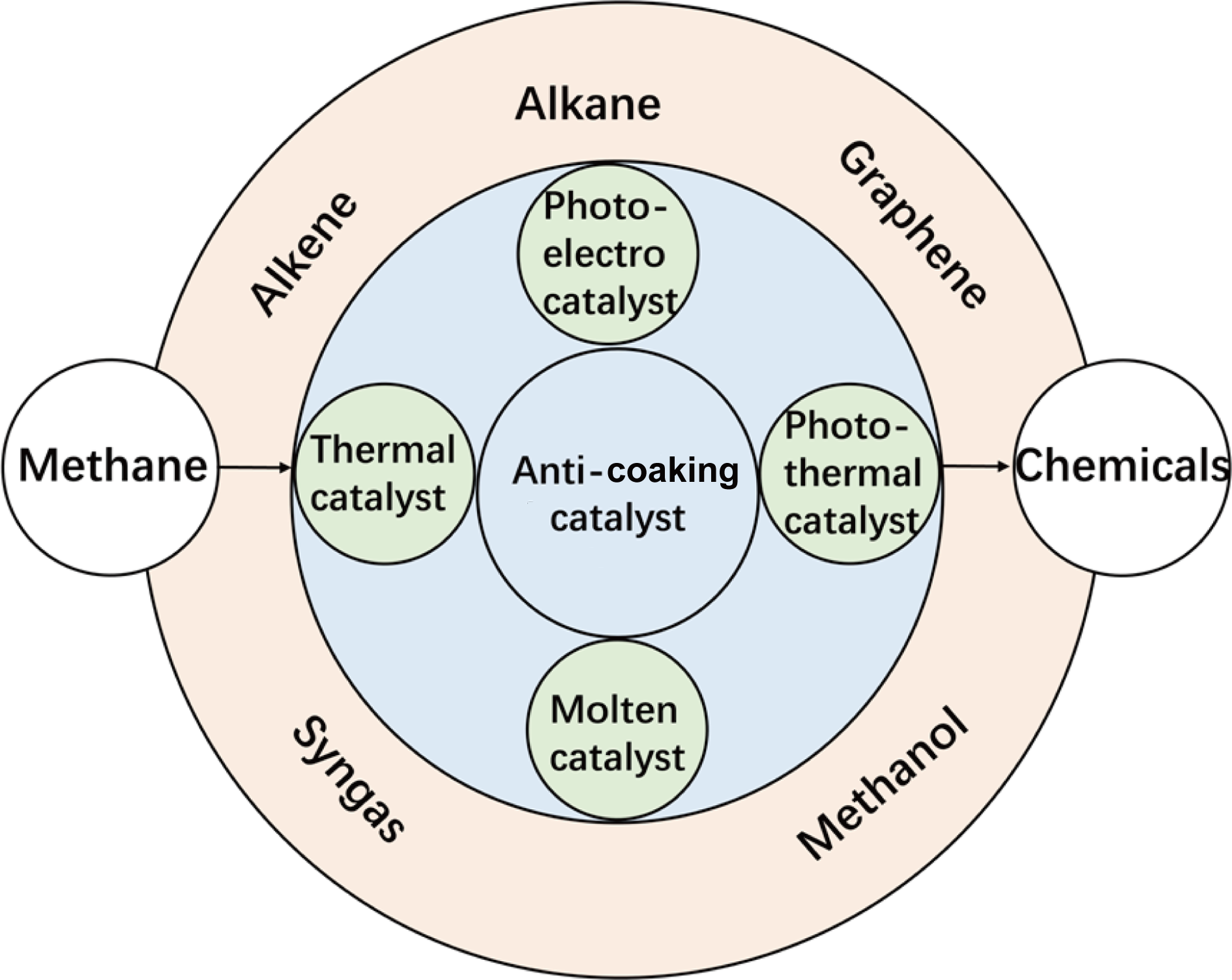
图1 甲烷转化为高附加值产品的抗积碳催化剂分类
Fig. 1 Classification of anti-coking catalysts for methane conversion to value-added products
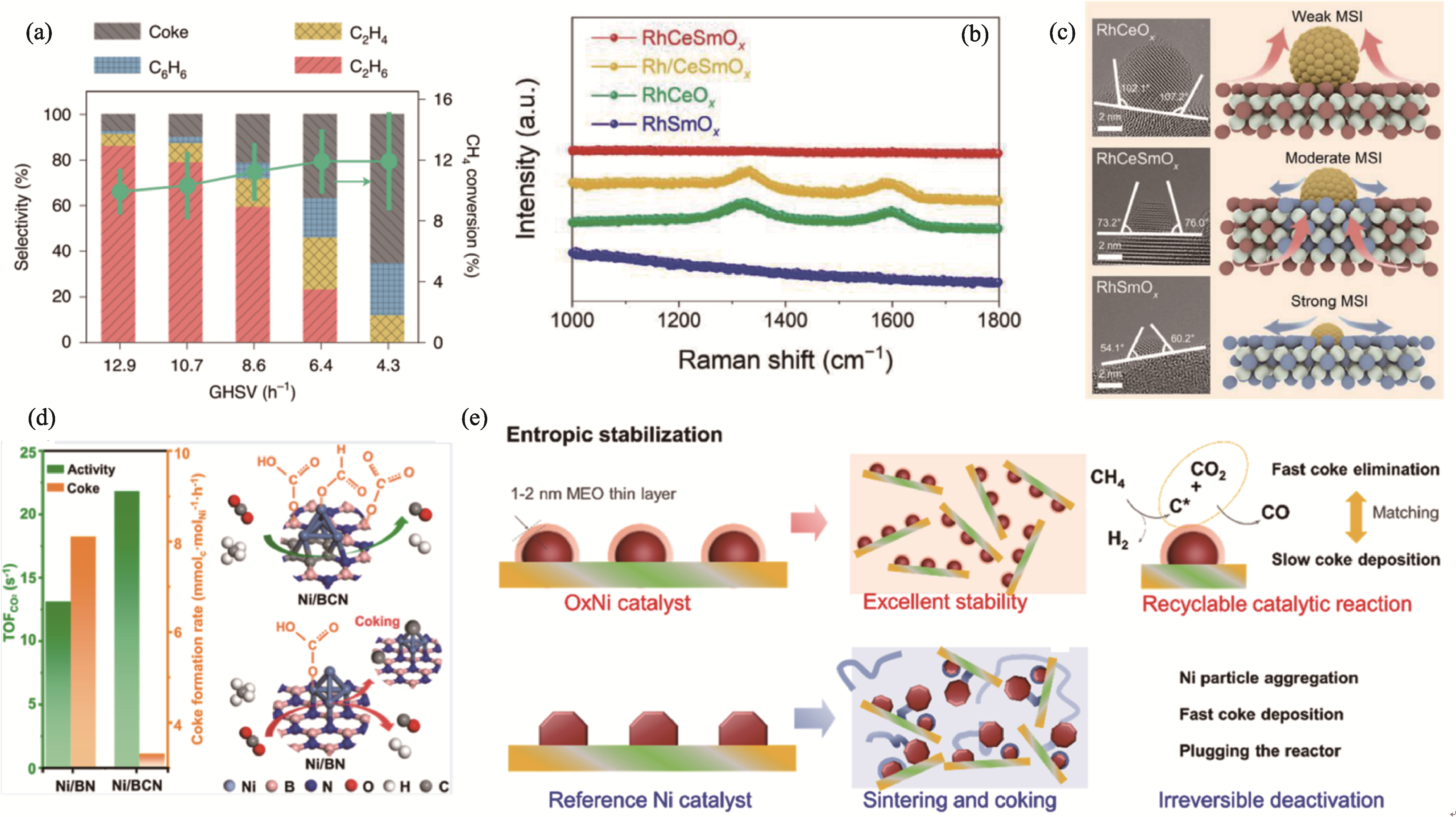
图2 不同热催化剂的积碳性能及抗积碳示意图[15,24,26,32]
Fig. 2 Carbon deposition performance and schematic of anti-coking of different thermocatalysts[15,24,26,32] (a) Catalytic performance of 2% (in mass) Pt/Mo2TiC2Tx for non-oxidative coupling of methane[15]; (b) Raman spectra of the catalysts after the DRM stability test[24]; (c) High resolution transmission electron microscopy (HR-TEM) images and corresponding contact angles with a schematic diagram of the different metal-support interaction (MSI) exsolution catalysts[24]; (d) Carbon deposition rate and catalyst schematic diagram of Ni/BCN[26]; (e) Schematic diagram of multielement oxide (MEO) thin layer constrained stable nickel catalyst[32]
| Catalyst | Reaction condition | Stability | Ref. |
|---|---|---|---|
| Ni/CeO2 | CH4/CO2/Ar=1/1/3, 20 mL·min−1, 25 mg, 2.4 W·cm-2 | 230 h | [ |
| Ni/Pr5-CeO2 | CH4/CO2/Ar=1/1/3, 20 mL·min−1, 25 mg, 2.4 W·cm-2 | 110 h | [ |
| NiMo/MgO | CH4/CO2/Ar=1/1/3, 20 mL·min−1, 25 mg, 2.4 W·cm-2 | 60 h | [ |
| Pd-Bi/Ga2O3 | CH4/Ar=1/9, 30 mL·min−1, 800 mg, 20 W·cm-2 | 100 h | [ |
| Ni/CeO2(100) | CH4/CO2=1/1, 10 mL·min−1, 200 mg, 6.8 W·cm-2 | 800 h | [ |
| Cu-Ru/MgO-Al2O3 | CH4/CO2=1/1, 16 mL·min-1, 1.5 mg, 19.2 W·cm-2 | 50h | [ |
| (Ni/CeO2)@SiO2 | CH4/CO2/N2=3/3/4, 50 mL·min-1, 25 mg, 300 W Xe lamp | 40 h | [ |
| Pd-Ni/Al2O3 | CH4/CO2/Ar=3/3/4, 89.6 mL·min-1, 8 mg, 80.3 kW·cm-2 | 50 h | [ |
表1
Table 1 Comparison of the stability of photothermal catalysts[38-45]
| Catalyst | Reaction condition | Stability | Ref. |
|---|---|---|---|
| Ni/CeO2 | CH4/CO2/Ar=1/1/3, 20 mL·min−1, 25 mg, 2.4 W·cm-2 | 230 h | [ |
| Ni/Pr5-CeO2 | CH4/CO2/Ar=1/1/3, 20 mL·min−1, 25 mg, 2.4 W·cm-2 | 110 h | [ |
| NiMo/MgO | CH4/CO2/Ar=1/1/3, 20 mL·min−1, 25 mg, 2.4 W·cm-2 | 60 h | [ |
| Pd-Bi/Ga2O3 | CH4/Ar=1/9, 30 mL·min−1, 800 mg, 20 W·cm-2 | 100 h | [ |
| Ni/CeO2(100) | CH4/CO2=1/1, 10 mL·min−1, 200 mg, 6.8 W·cm-2 | 800 h | [ |
| Cu-Ru/MgO-Al2O3 | CH4/CO2=1/1, 16 mL·min-1, 1.5 mg, 19.2 W·cm-2 | 50h | [ |
| (Ni/CeO2)@SiO2 | CH4/CO2/N2=3/3/4, 50 mL·min-1, 25 mg, 300 W Xe lamp | 40 h | [ |
| Pd-Ni/Al2O3 | CH4/CO2/Ar=3/3/4, 89.6 mL·min-1, 8 mg, 80.3 kW·cm-2 | 50 h | [ |
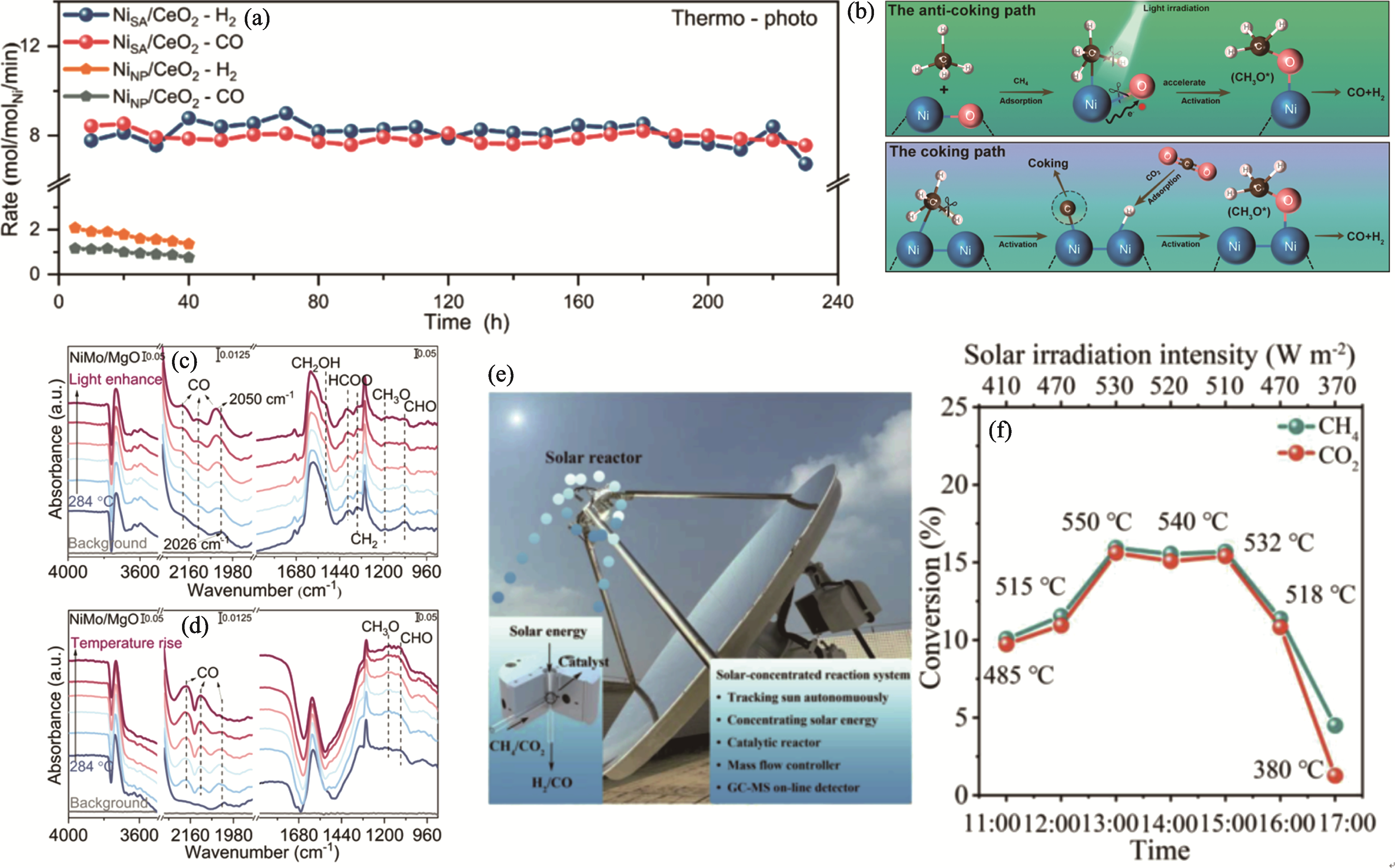
图3 光热催化剂催化机理与抗积碳性能[38,40,42]
Fig. 3 Mechanism and anti-coking performance of photothermal catalysts[38,40,42] (a) Long-term stability of the thermo-photo catalytic DRM reaction over NiSA/CeO2 and NiNP/CeO2 catalysts at 472 ℃[38]; (b) Comparison of the anti-coking mechanism and coking mechanism of Ni single-atom sites under synergistic photothermal catalysis[38];(c, d) In situ DRIFTS spectra over NiMo/MgO under (c) photothermal and (d) thermal conditions[40]; (e) Solar-concentrating catalytic system[42]; (f) Solar-concentrated catalytic DRM performance by using sunlight over Ni/CeO2(100) catalyst (the test was performed on November 16, 2022, at 104°11'15.0936'' E and 30°49'56.82'' N)[42]
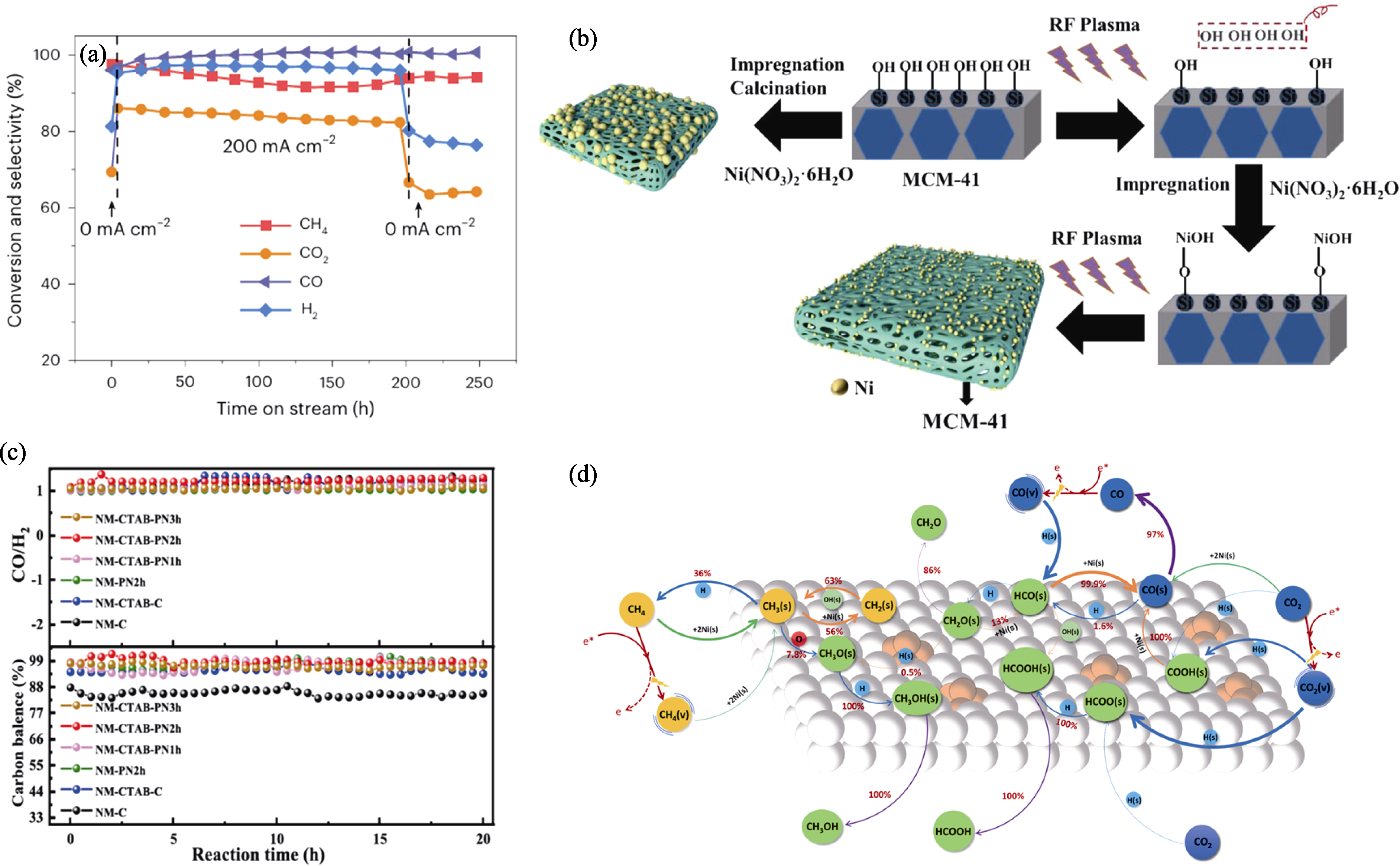
图4 在电场调控下催化剂的合成机理、积碳性能及抗积碳示意图[53-55,57]
Fig. 4 Diagrams of the synthesis mechanism of the catalyst under electric field regulation, carbon deposition performance, and anti-coking illustration[53-55,57] (a) Time-on-stream stability at 800 ℃ and 200mA·cm-2 using a CO2/CH4 feed ratio of two[53]; (b) Schematic diagram of the catalyst preparation[54]; (c) CO2 conversion[55]; (d) Network of surface reaction pathways for plasma-catalytic CH4/CO2 reforming over Ni-based catalyst[57]
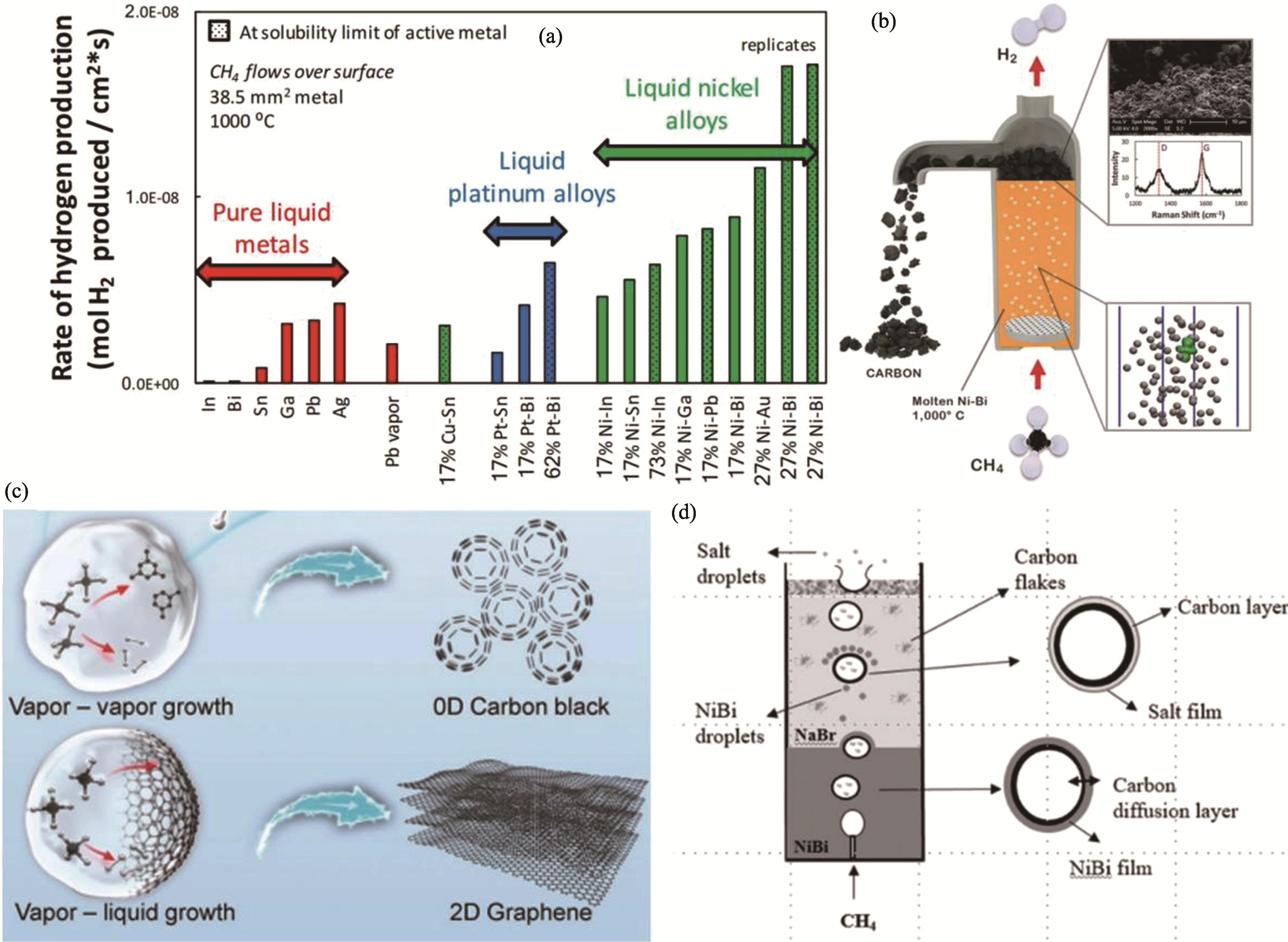
图5 不同类型熔融介质的催化活性与反应机理[61,68 -69]
Fig. 5 Catalytic activity and reaction mechanism diagrams for different types of molten media[61,68 -69] (a) Catalytic activity of various mono-metallic and alloy systems for methane pyrolysis under molten conditions[61]; (b) Mechanistic schematic of methane decomposition over molten metals/alloys[61]; (c) Molten salts[68]; (d) Molten salt-metal composite catalysts[69]
| [1] | NI Y W, TIAN J Q, HAN Z, et al. Catalysis in sustainable energy resources: overview studies of hydrogen, methane, biomass and plastics. Industrial Chemistry & Materials, 2025, 3(3): 257. |
| [2] | ZHANG H, BOLSHAKOV A, MEENA R, et al. Revealing active sites and reaction pathways in methane non-oxidative coupling over iron-containing zeolites. Angewandte Chemie International Edition, 2023, 62(32): e202306196. |
| [3] | BUELENS L C, GALVITA V V, POELMAN H, et al. Super-dry reforming of methane intensifies CO2 utilization via Le Chatelier’s principle. Science, 2016, 354(6311): 449. |
| [4] | ZHU Z Z, GUO W Y, ZHANG Y, et al. Research progress on methane conversion coupling photocatalysis and thermocatalysis. Carbon Energy, 2021, 3(4): 519. |
| [5] | LE SACHÉ E, REINA T R. Analysis of dry reforming as direct route for gas phase CO2 conversion. The past, the present and future of catalytic DRM technologies. Progress in Energy and Combustion Science, 2022, 89: 100970. |
| [6] | LI Q, OUYANG Y X, LI H L, et al. Photocatalytic conversion of methane: recent advancements and prospects. Angewandte Chemie International Edition, 2022, 61(2): e202108069. |
| [7] | SONG H, MENG X G, WANG Z J, et al. Solar-energy-mediated methane conversion. Joule, 2019, 3(7): 1606. |
| [8] | SHAH M S A S, OH C, PARK H, et al. Catalytic oxidation of methane to oxygenated products: recent advancements and prospects for electrocatalytic and photocatalytic conversion at low temperatures. Advanced Science, 2020, 7(23): 2001946. |
| [9] | VOGT C, WECKHUYSEN B M. The concept of active site in heterogeneous catalysis. Nature Reviews. Chemistry, 2022, 6(2): 89. |
| [10] | VAN DEELEN T W, MEJÍA C H, DE JONG K P. Control of metal-support interactions in heterogeneous catalysts to enhance activity and selectivity. Nature Catalysis, 2019, 2: 955. |
| [11] | ZENG L, CHENG Z, FAN J A, et al. Metal oxide redox chemistry for chemical looping processes. Nature Reviews Chemistry, 2018, 2: 349. |
| [12] | GUO X G, FANG G Z, LI G, et al. Direct, nonoxidative conversion of methane to ethylene, aromatics, and hydrogen. Science, 2014, 344(6184): 616. |
| [13] | HE D D, ZHANG Y M, LI T, et al. Designing ultra-stable and surface-exposed Ni nanoparticles with dually confined microenvironment for high-temperature methane dry reforming. Advanced Functional Materials, 2025, 35(2): 2412895. |
| [14] | TIAN J S, KONG R, WANG Z, et al. Enhancing methane combustion activity by modulating the local environment of Pd single atoms in Pd1/CeO2 catalysts. ACS Catalysis, 2024, 14(1): 183. |
| [15] | LI Z, XIAO Y, CHOWDHURY P R, et al. Direct methane activation by atomically thin platinum nanolayers on two-dimensional metal carbides. Nature Catalysis, 2021, 4: 882. |
| [16] | HUANG X, EGGART D, QIN G Q, et al. Methyl radical chemistry in non-oxidative methane activation over metal single sites. Nature Communications, 2023, 14: 5716. |
| [17] | PETERS S, RIEG C, BARTLING S, et al. Accessibility of reactants and neighborhood of Mo species during methane aromatization uncovered by operando NAP-XPS and MAS NMR. ACS Catalysis, 2023, 13(19): 13056. |
| [18] | ZHANG Y N, CAO N, WANG K, et al. Atomically dispersed Rh-O-V pairs promote methane dry reforming with sustained catalytic activity. ACS Catalysis, 2025, 15(11): 8833. |
| [19] | ZHAO X Y, YIN H B, LIN H F, et al. The importance of Si-ONa-Al moieties in Fe/ZSM-5 zeolite catalysts for selective oxidation of methane to acetic acid. Angewandte Chemie International Edition, 2025, 64(40): e202511056. |
| [20] | ZHANG H X, WEI L H, SUN Y W, et al. Brønsted acid site catalytic role in methane dehydroaromatization over Mo/HZSM-5. ACS Catalysis, 2024, 14(15): 11591. |
| [21] | JEONG Y, JUNE H, ROH J, et al. Enhanced structural stability of Mo/ZSM-5 for regenerability improvement in shale gas aromatization: the effect of external acidity and defect density. Applied Catalysis B: Environment and Energy, 2025, 379: 125655. |
| [22] | YU J Q, LE T E, JING D P, et al. Balancing elementary steps enables coke-free dry reforming of methane. Nature Communications, 2023, 14: 7514. |
| [23] | PHAM-NGOC N, JAMSAZ A, LEE Y, et al. Homogeneous formation of a disordered NiAl2O4 structure in three-dimensional macroporous Ni/Al2O3 catalysts for dry reforming of methane and coke-resistant catalytic behavior on its Ni-oxygen vacancy interface. Chemical Engineering Journal, 2025, 510: 161545. |
| [24] | YE Y J, LEI H F, QIN Y B, et al. Harmonizing nanoparticle exsolution from Ce-Sm oxide matrix for stable methane dry reforming. Angewandte Chemie International Edition, 2025, 64(31): e202503997. |
| [25] | CHENG Q P, YAO X L, OU L F, et al. Highly efficient and stable methane dry reforming enabled by a single-site cationic Ni catalyst. Journal of the American Chemical Society, 2023, 145(46): 25109. |
| [26] | ZHANG X Y, DENG J, LAN T W, et al. Promoting methane dry reforming over Ni catalysts via modulating surface electronic structures of BN supports by doping carbon. ACS Catalysis, 2022, 12(22): 14152. |
| [27] | WANG H, CUI G Q, LU H, et al. Facilitating the dry reforming of methane with interfacial synergistic catalysis in an Ir@CeO2-x catalyst. Nature Communications, 2024, 15: 3765. |
| [28] | FAN J, LI W C, HE L, et al. Generating cationic nickel clusters over oxygen-functionalized boron nitride to boost methane dry reforming. ACS Catalysis, 2024, 14(23): 17748. |
| [29] | WANG J Y, FU Y, KONG W B, et al. Investigation of atom-level reaction kinetics of carbon-resistant bimetallic NiCo-reforming catalysts: combining microkinetic modeling and density functional theory. ACS Catalysis, 2022, 12(8): 4382. |
| [30] | ZHANG X Y, DENG J, PUPUCEVSKI M, et al. High- performance binary Mo-Ni catalysts for efficient carbon removal during carbon dioxide reforming of methane. ACS Catalysis, 2021, 11(19): 12087. |
| [31] | JOHNSON O, HE Y, RICHTER J, et al. Stabilizing catalytic performance in dry reforming of methane via surface-engineered intermetallic carbide nanoparticles. Journal of the American Chemical Society, 2025, 147(20): 16786. |
| [32] | HE L, LI M R, LI W C, et al. Robust and coke-free Ni catalyst stabilized by 1-2 nm-thick multielement oxide for methane dry reforming. ACS Catalysis, 2021, 11(20): 12409. |
| [33] | KIM S, LAUTERBACH J, SASMAZ E. Yolk-shell Pt-NiCe@SiO2 single-atom-alloy catalysts for low-temperature dry reforming of methane. ACS Catalysis, 2021, 11(13): 8247. |
| [34] | GUO D, LI M S, LU Y, et al. Enhanced thermocatalytic stability by coupling nickel step sites with nitrogen heteroatoms for dry reforming of methane. ACS Catalysis, 2022, 12(1): 316. |
| [35] | KIM H, LEE S, SEO B, et al. Surface interactive assembly of ruthenium based Janus bimetallic nanoparticles with active dual-function sites for efficient use in CO2 utilization. Advanced Functional Materials, 2025, 35(27): 2418874. |
| [36] | LIU C Y, QIAN B, XIAO T C, et al. Illustrating the fate of methyl radical in photocatalytic methane oxidation over Ag-ZnO by in situ synchrotron radiation photoionization mass spectrometry. Angewandte Chemie International Edition, 2023, 62(32): e202304352. |
| [37] | MING L Y, WANG C L, HU Y H. CePMo12O40/TiO2 catalysts for photocatalytic oxidation of methane to value-added organic oxygenates. International Journal of Energy Research, 2021, 45(9): 12996. |
| [38] | RAO Z Q, WANG K W, CAO Y H, et al. Light-reinforced key intermediate for anticoking to boost highly durable methane dry reforming over single atom Ni active sites on CeO2. Journal of the American Chemical Society, 2023, 145(45): 24625. |
| [39] | RAO Z Q, HUANG Z A, CHEN G X, et al. Atomically dispersed praseodymium-modified Ni active sites boost the direct cleavage of carbonate intermediates for photothermal CO2 conversion. ACS Nano, 2025, 19(28): 25904. |
| [40] | WANG J B, HUANG Z A, HU W, et al. Constructing molybdenum- stabilized nickel-oxo sites for boosting low-temperature dry reforming of methane. ACS Catalysis, 2025, 15(22): 18944. |
| [41] | SINGH S P, YAMAMOTO A, FUDO E, et al. A Pd-Bi dual-cocatalyst-loaded gallium oxide photocatalyst for selective and stable nonoxidative coupling of methane. ACS Catalysis, 2021, 11(22): 13768. |
| [42] | RAO Z Q, HUANG Z A, ZHANG K K, et al. Concentrated-solar catalytic methane dry reforming with ultrahigh conversion and durability. Nature Communications, 2025, 16: 9605. |
| [43] | ZHOU L N, MARTIREZ J M P, FINZEL J, et al. Light-driven methane dry reforming with single atomic site antenna-reactor plasmonic photocatalysts. Nature Energy, 2020, 5: 61. |
| [44] | HAN K H, WANG Y, WANG S, et al. Narrowing band gap energy of CeO2 in (Ni/CeO2)@SiO2 catalyst for photothermal methane dry reforming. Chemical Engineering Journal, 2021, 421: 129989. |
| [45] | JI L, LI Y Z, WU J C, et al. Light-promoted synergistic effect significantly enhances the performance of photothermocatalytic dry reforming of methane on low-loading Pd-Ni/Al2O3. Chemical Engineering Journal, 2025, 519: 165227. |
| [46] | XIE J, JIANG Y, LI S, et al. Stable photocatalytic coupling of methane to ethane with water vapor using TiO2 supported ultralow loading AuPd nanoparticles. Acta Physico-Chimica Sinica, 2023, 39(10): 2306037. |
| [47] | AWAZU K, FUJIMAKI M, ROCKSTUHL C, et al. A plasmonic photocatalyst consisting of silver nanoparticles embedded in titanium dioxide. Journal of the American Chemical Society, 2008, 130(5): 1676. |
| [48] | WANG M Y, YE M D, IOCOZZIA J, et al. Plasmon-mediated solar energy conversion via photocatalysis in noble metal/ semiconductor composites. Advanced Science, 2016, 3(6): 1600024. |
| [49] | XIAO Q H, ZHOU Y, MIAO X C, et al. Study on the as-cast microstructure and mechanical properties of 35CrMo steel based on electric field control. Materials Research Express, 2024, 11(4): 046512. |
| [50] | ZHENG M, GUAN P F. Electric field control of photoluminescence response in lanthanide doped ferroelectric materials: a brief review. Ferroelectrics, 2022, 598(1): 152. |
| [51] | LEE K X, HU B X, DUBEY P K, et al. High-entropy alloy anode for direct internal steam reforming of methane in SOFC. International Journal of Hydrogen Energy, 2022, 47(90): 38372. |
| [52] | JIAO H, WANG G C. Mechanistic study of a coke-resistance Ni/ZrO2 catalyst for dry reforming of methane under external electric fields: a combined first-principles and microkinetic modeling study. Catalysis Science & Technology, 2024, 14(14): 4045. |
| [53] | LV H F, DONG X, LI R T, et al. Super-dry reforming of methane using a tandem electro-thermocatalytic system. Nature Chemistry, 2025, 17(5): 695. |
| [54] | GUO F, CAO W Y, WANG L, et al. High activity and strong coke resistance of nickel CO2-CH4 reforming catalyst promoted by different plasma treated modes. Molecular Catalysis, 2023, 535: 112821. |
| [55] | GUO F, ZHANG R H, CAO W Y, et al. CTAB-assisted radio frequency discharge plasma treatment enhances catalytic activity at sustained coking resistance of nickel-based catalysts for CO2/CH4 reforming reaction. Molecular Catalysis, 2024, 569: 114557. |
| [56] | XU W C, BUELENS L C, GALVITA V V, et al. Improving the performance of gliding arc plasma-catalytic dry reforming via a new post-plasma tubular catalyst bed. Journal of CO2 Utilization, 2024, 83: 102820. |
| [57] | SUN J T, CHEN Q, QIN W Y, et al. Plasma-catalytic dry reforming of CH4: effects of plasma-generated species on the surface chemistry. Chemical Engineering Journal, 2024, 498: 155847. |
| [58] | NOZAKI T, TSUKIJIHARA H, FUKUI W, et al. Kinetic analysis of the catalyst and nonthermal plasma hybrid reaction for methane steam reforming. Energy & Fuels, 2007, 21(5): 2525. |
| [59] | NOZAKI T, OKAZAKI K. Non-thermal plasma catalysis of methane: principles, energy efficiency, and applications. Catalysis Today, 2013, 211: 29. |
| [60] | CHEN Y X, ZHU T H, QI C H, et al. Plasma-assisted chemical- looping dry reforming of methane for hydrogen generation at room temperature. Fuel, 2025, 400: 135664. |
| [61] | UPHAM D C, AGARWAL V, KHECHFE A, et al. Catalytic molten metals for the direct conversion of methane to hydrogen and separable carbon. Science, 2017, 358(6365): 917. |
| [62] | PALMER C, TARAZKAR M, KRISTOFFERSEN H H, et al. Methane pyrolysis with a molten Cu-Bi alloy catalyst. ACS Catalysis, 2019, 9(9): 8337. |
| [63] | ZAGHLOUL N, KODAMA S, SEKIGUCHI H. Hydrogen production by methane pyrolysis in a molten-metal bubble column. Chemical Engineering & Technology, 2021, 44(11): 1986. |
| [64] | CHEN L N, SONG Z G, ZHANG S C, et al. Ternary NiMo-Bi liquid alloy catalyst for efficient hydrogen production from methane pyrolysis. Science, 2023, 381(6660): 857. |
| [65] | CAI G P, MIEDERHOFF N, D’ENTREMONT S, et al. Production of carbon fibers using a molten Cu-In catalyst for methane pyrolysis. ACS Applied Materials & Interfaces, 2024, 16(49): 67674. |
| [66] | PARKINSON B, PATZSCHKE C F, NIKOLIS D, et al. Methane pyrolysis in monovalent alkali halide salts: kinetics and pyrolytic carbon properties. International Journal of Hydrogen Energy, 2021, 46(9): 6225. |
| [67] | KANG D, RAHIMI N, GORDON M J, et al. Catalytic methane pyrolysis in molten MnCl2-KCl. Applied Catalysis B: Environmental, 2019, 254: 659. |
| [68] | ZHAO Y F, SHI Z Y, ZHU Y L, et al. Mechanism for one-pot synthesis of 0D-2D carbon materials in the bubbles inside molten salts. Advanced Functional Materials, 2022, 32(42): 2202381. |
| [69] | RAHIMI N, KANG D, GELINAS J, et al. Solid carbon production and recovery from high temperature methane pyrolysis in bubble columns containing molten metals and molten salts. Carbon, 2019, 151: 181. |
| [70] | PATZSCHKE C F, PARKINSON B, WILLIS J J, et al. Co-Mn catalysts for H2 production via methane pyrolysis in molten salts. Chemical Engineering Journal, 2021, 414: 128730. |
| [71] | NOH Y G, LEE Y J, KIM J, et al. Enhanced efficiency in CO2-free hydrogen production from methane in a molten liquid alloy bubble column reactor with zirconia beads. Chemical Engineering Journal, 2022, 428: 131095. |
| [72] | TYRER D. Production of hydrogen: US1803221A. 1931-04-28. |
| [73] | STEINBERG M. Fossil fuel decarbonization technology for mitigating global warming. International Journal of Hydrogen Energy, 1999, 24(8): 771. |
| [74] | WI T G, PARK Y J, LEE U, et al. Methane pyrolysis rate measurement using electromagnetic levitation techniques for turquoise hydrogen production: liquid In, Ga, Bi, Sn, and Cu as catalysts. Chemical Engineering Journal, 2023, 460: 141558. |
| [75] | ERBASAN A, USTUNEL H, TOFFOLI D, et al. Insights into reaction mechanisms in liquid metals from density functional theory: CH4 pyrolysis in BiNiX (X = Cu, Al) molten metals as a case study. ACS Applied Energy Materials, 2024, 7(8): 3220. |
| [76] | GEIßLER T, ABÁNADES A, HEINZEL A, et al. Hydrogen production via methane pyrolysis in a liquid metal bubble column reactor with a packed bed. Chemical Engineering Journal, 2016, 299: 192. |
| [77] | YANG M K, HUANG Z A, ZHOU Y X, et al. Co-production of few-layer graphene and hydrogen from methane pyrolysis based on Cu and metal oxide-KCl molten medium. Journal of Inorganic Materials, 2025, 40(5): 473. |
| [78] | YANG M K, HUANG Z A, HE Y D, et al. Directed growth of multilayer graphene via methane pyrolysis using Cu/ZrO2 in molten KCl. International Journal of Hydrogen Energy, 2025, 157: 150369. |
| [1] | 覃善丽, 郭佳文, 陈燕萌, 聚安安, 韦毅, 黄科林, 侯向华, 吕思师, 文志朋, 吴炼. 二维层状材料构筑电化学储能定向离子传输通道的研究进展[J]. 无机材料学报, 2026, 41(7): 883-898. |
| [2] | 余飞宇, 王文清, 张学勤, 何汝杰. 基于增材制造陶瓷点阵的双相网络互穿复合材料的研究进展与挑战[J]. 无机材料学报, 2026, 41(7): 849-866. |
| [3] | 周翠, 李捷, 孙鲁超, 苏海军, 王京阳. 氧化铝基定向凝固共晶陶瓷的组织特性、调控方法及环境稳定性[J]. 无机材料学报, 2026, 41(7): 899-914. |
| [4] | 沈雪松, 谢凯峰, 薛强, 郑国柱, 肖国萍, 陈婷, 陈文淼, 王绍荣. 表面修饰LSCF-GDC多相复合空气电极的高效构筑与性能优化[J]. 无机材料学报, 2026, 41(7): 965-973. |
| [5] | 费文龙, 王亚坤, 廖良生. 蓝光ZnSeTe量子点的可控制备及其量子点发光二极管器件研究进展[J]. 无机材料学报, 2026, 41(7): 867-882. |
| [6] | 陈明俊, 缪洪康, 肖英俊, 邓建波, 张翔, 赵九蓬, 李垚. 光-热双响应材料研究进展: 从设计策略到智能窗应用[J]. 无机材料学报, 2026, 41(6): 723-738. |
| [7] | 宋坤洁, 解荣军. 机器学习驱动新型发光材料的研究进展[J]. 无机材料学报, 2026, 41(6): 689-703. |
| [8] | 胡钰晴, 朱一新, 乐先浩, 万青. 钽酸锂晶圆减薄技术及其热释电红外探测器应用进展[J]. 无机材料学报, 2026, 41(6): 764-774. |
| [9] | 刘春帆, 陈科, 葛芳芳, 黄庆. 核用耐铅铋腐蚀涂层的研究进展[J]. 无机材料学报, 2026, 41(6): 775-786. |
| [10] | 胡扬, 谢敏, 张筱怡, 李想, 郭新伟, 姜南, 周文瀚, 张胜利, 曾海波. 计算与数据驱动环保型发光材料的研究进展[J]. 无机材料学报, 2026, 41(6): 704-722. |
| [11] | 王金文, 杨振, 周欢, 夏丹, 杨磊. 可注射无机材料及其生物医学应用[J]. 无机材料学报, 2026, 41(6): 751-763. |
| [12] | 李涵涛, 沈强, 罗国强, 王雪飞, 高明, 陈晨. 机械球磨法调控硅基负极材料结构与性能的研究进展[J]. 无机材料学报, 2026, 41(5): 561-572. |
| [13] | 解陈一, 缪花明, 张蔚然, 刘荣军, 王衍飞, 李端. 理论计算在高熵陶瓷领域的研究进展[J]. 无机材料学报, 2026, 41(5): 545-560. |
| [14] | 李娜, 魏进, 曹锐霄, 刘玉, 黄贵文, 肖红梅. 自研正仲氢转化催化剂的催化测试分析及批量制备工艺优化[J]. 无机材料学报, 2026, 41(5): 645-652. |
| [15] | 李璇, 叶奎材, 冯佳音, 邱家军, 钱文昊, 邢敏. 钛基牙种植体表面改性促进软组织封闭的研究进展[J]. 无机材料学报, 2026, 41(4): 432-444. |
| 阅读次数 | ||||||
|
全文 |
|
|||||
|
摘要 |
|
|||||