无机材料学报 ›› 2026, Vol. 41 ›› Issue (10): 1459-1469.DOI: 10.15541/jim20260067
李晓磊( ), 齐小方, 马文成(), 徐永宽
收稿日期:2026-02-07
修回日期:2026-03-19
出版日期:2026-10-20
网络出版日期:2026-05-08
通讯作者:
马文成, 副教授. E-mail: wcma@email.tjut.edu.cn作者简介:李晓磊(1999-), 男, 硕士研究生. E-mail: 574029178@qq.com
基金资助:
LI Xiaolei(), QI Xiaofang, MA Wencheng(), XU Yongkuan
Received:2026-02-07
Revised:2026-03-19
Published:2026-10-20
Online:2026-05-08
Contact:
MA Wencheng, associate professor. E-mail: wcma@email.tjut.edu.cnAbout author:LI Xiaolei (1999-), male, Master candidate. E-mail: 574029178@qq.com
Supported by:摘要:
碳化硅(SiC)是制备大功率、高温高频电子器件的核心宽禁带半导体材料, 其外延层质量直接关系器件的性能与可靠性。垂直热壁化学气相沉积(Chemical Vapor Deposition, CVD)因具备温度场和流场稳定、生长速率快、有助于提高厚度均匀性等优势, 代表了未来SiC外延行业的重要发展方向。反应腔压力和衬底转速作为垂直热壁CVD工艺中的两个关键可调参数, 通过改变反应腔内流场分布、边界层厚度及前驱体浓度分布, 对外延层生长速率和厚度均匀性产生显著影响。因此, 本研究探究上述两个关键工艺参数对垂直热壁CVD SiC外延生长过程的影响机理, 并确定兼顾高生长速率与均匀性的优化工艺窗口。基于有限体积法, 建立了垂直热壁CVD SiC外延过程的传热传质数值模型, 采用三氯氢硅(TCS)/C2H4/H2前驱体体系的气相反应和表面反应动力学。设计多组数值模拟算例, 系统研究不同反应腔压力和衬底转速对外延过程的影响规律。模拟结果表明, 随着反应腔压力从5 kPa升高到45 kPa, 衬底上方CH4和SiCl2等主要反应物浓度逐渐升高, 同时组分边界层厚度减薄, 但当压力超过25 kPa时, 腔体内流场易产生涡流, 导致径向质量输运不均匀, 厚度均匀性逐渐恶化。在衬底转速方面, 生长速率随转速提高而逐渐上升, 在0~500 r/min范围内, 转速提升有效优化了径向组分浓度分布, 改善了外延层厚度均匀性; 而当转速超过500 r/min时, 旋转效应加剧衬底边缘组分聚集, 形成中心浓度高、边缘浓度低的分布, 导致均匀性轻微恶化。上述结果揭示了反应腔压力与衬底转速通过调控边界层厚度和径向浓度分布影响外延生长速率和厚度均匀性的内在机理, 确定了腔体压力为25 kPa, 衬底转速为500 r/min的工艺参数可实现51 μm/h的生长速率和2.1%的厚度均匀性, 为优化SiC外延生长工艺参数、推动垂直热壁CVD技术的产业化应用提供了理论依据。
中图分类号:
李晓磊, 齐小方, 马文成, 徐永宽. 压力和转速对垂直热壁CVD外延SiC生长速率和均匀性的影响[J]. 无机材料学报, 2026, 41(10): 1459-1469.
LI Xiaolei, QI Xiaofang, MA Wencheng, XU Yongkuan. Effects of Pressure and Rotation Speed on the Growth Rate and Uniformity of SiC in a Vertical Hot-wall CVD Epitaxial System[J]. Journal of Inorganic Materials, 2026, 41(10): 1459-1469.
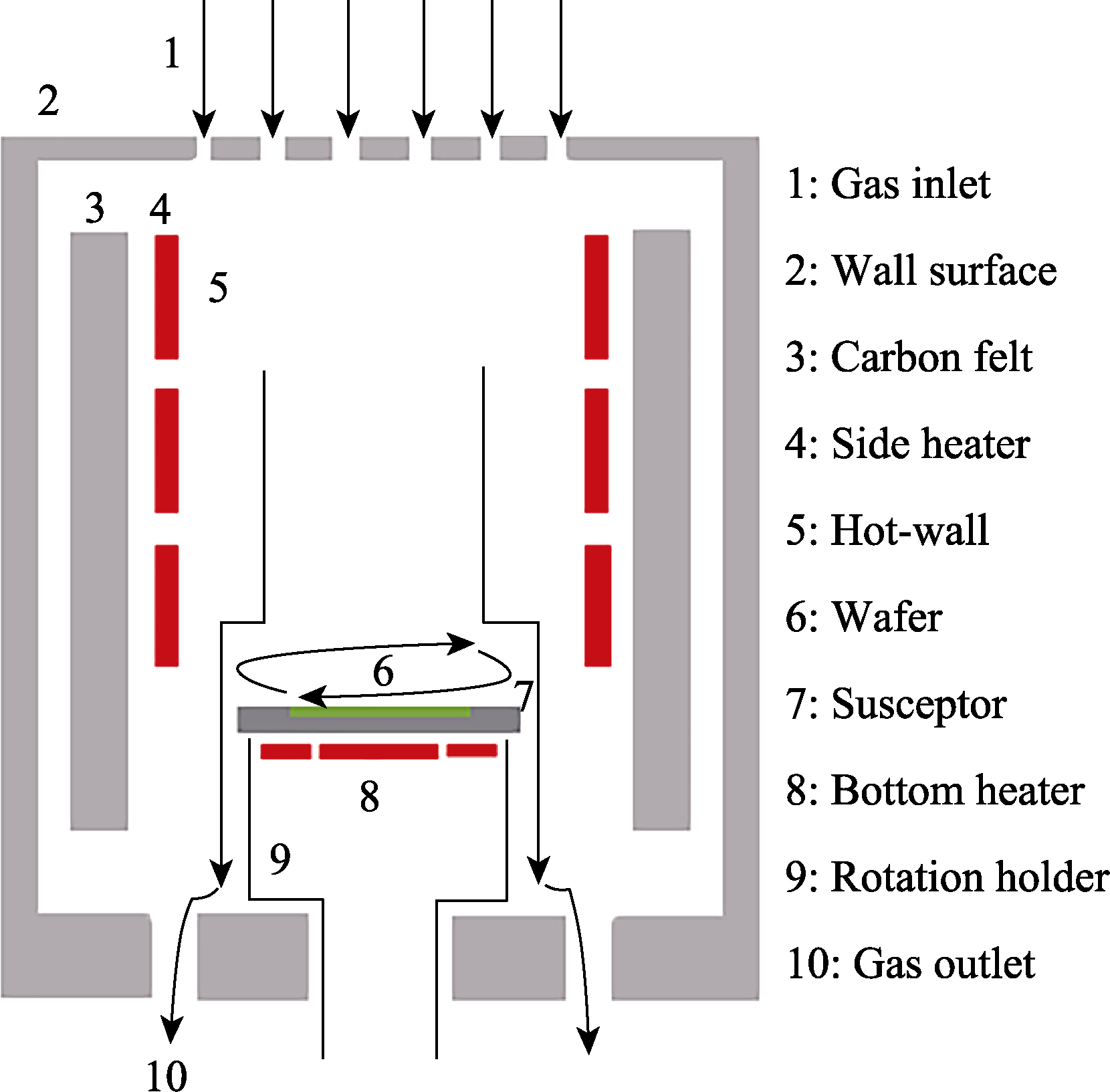
图1 垂直热壁CVD SiC外延生长炉结构示意图
Fig. 1 Schematic diagram of the vertical hot-wall CVD SiC epitaxial growth furnace
| Material | Density/(kg·m-3) | Specific heat/(J·kg-1·K-1) | Thermal conductivity/ (W·m-1·K-1) | Viscosity/ (kg·m-1·s-1) | Surface emissivity |
|---|---|---|---|---|---|
| Felt | 120 | 200 | 9×10⁻³+2.7×10⁻⁴T+1.1× 10⁻¹⁰T3 | - | 0.8 |
| Graphite | 1950 | 753.5lnT-3466.7 | 1808×T-0.479 | - | 0.8 |
| SiC | 3220 | 1281 | 6.11×10⁴/(T-115) | - | 0.9 |
| H2 | Incompressible-ideal-gas | 1.4×10⁴+3.4T-3.4×10⁻³T2- 3.9×10⁻⁷T3+1.7×10⁻⁹T4 | 0.2+3.2×10⁻⁴T | 8.4×10⁻⁶+1.1×10⁻⁸T | - |
| Mixture-gas | Kinetic-theory | Kinetic-theory | Kinetic-theory | - | - |
表1 主要材料的物理参数
Table 1 Physical parameters of main materials
| Material | Density/(kg·m-3) | Specific heat/(J·kg-1·K-1) | Thermal conductivity/ (W·m-1·K-1) | Viscosity/ (kg·m-1·s-1) | Surface emissivity |
|---|---|---|---|---|---|
| Felt | 120 | 200 | 9×10⁻³+2.7×10⁻⁴T+1.1× 10⁻¹⁰T3 | - | 0.8 |
| Graphite | 1950 | 753.5lnT-3466.7 | 1808×T-0.479 | - | 0.8 |
| SiC | 3220 | 1281 | 6.11×10⁴/(T-115) | - | 0.9 |
| H2 | Incompressible-ideal-gas | 1.4×10⁴+3.4T-3.4×10⁻³T2- 3.9×10⁻⁷T3+1.7×10⁻⁹T4 | 0.2+3.2×10⁻⁴T | 8.4×10⁻⁶+1.1×10⁻⁸T | - |
| Mixture-gas | Kinetic-theory | Kinetic-theory | Kinetic-theory | - | - |
| Reaction | A | Ea | n |
|---|---|---|---|
| C2H4+H→C2H5 | 2.2×10⁸ | 8.64×10³ | 0 |
| C2H5+3H→2CH4 | 5.0×10¹¹ | 0 | 0 |
| C2H5+2H2→2CH4+H | 9.0×10¹³ | 0 | 0 |
| C2H6+H→C2H5+H2 | 1.4×10⁹ | 3.09×10⁵ | 0.5 |
| C2H5→C2H4+H | 1.4×10⁸ | 1.56×10⁵ | 0 |
| SiHCl3→SiCl2+HCl | 3.2×10¹² | 7.00×10⁴ | 0 |
| SiHCl3+H2→SiH2Cl2+HCl | 3.2×10⁻⁸ | 2.33×10⁵ | 0 |
| SiH2Cl2→SiCl2+H2 | 2.1×10¹⁸ | 3.20×10⁵ | 0 |
| SiH2Cl2→SiHCl+HCl | 6.9×10¹⁴ | 3.17×10⁵ | 0 |
| SiHCl3+H→SiCl3+H2 | 7.4×10⁸ | 2.70×10³ | 0 |
| SiCl3+HCl→SiCl4+H | 1.2×10² | 1.10×10⁴ | 0 |
| SiHCl3+HCl→SiCl4+H2 | 2.2×10³ | 4.26×10⁴ | 0 |
| SiCl4→SiCl3+Cl | 7.0×10²² | 1.11×10⁴ | 0 |
| C2H4→C2H2+H2 | 1.5×10¹⁵ | 3.45×10⁴ | 0 |
| SiHCl+HCl→SiCl2+H2 | 2.2×10⁸ | 1.00×10⁸ | 0.5 |
| H+H2→H2 | 5.0×10¹¹ | 9.20×10⁷ | -0.6 |
表2 气相动力学机理
Table 2 Gas phase kinetic mechanism
| Reaction | A | Ea | n |
|---|---|---|---|
| C2H4+H→C2H5 | 2.2×10⁸ | 8.64×10³ | 0 |
| C2H5+3H→2CH4 | 5.0×10¹¹ | 0 | 0 |
| C2H5+2H2→2CH4+H | 9.0×10¹³ | 0 | 0 |
| C2H6+H→C2H5+H2 | 1.4×10⁹ | 3.09×10⁵ | 0.5 |
| C2H5→C2H4+H | 1.4×10⁸ | 1.56×10⁵ | 0 |
| SiHCl3→SiCl2+HCl | 3.2×10¹² | 7.00×10⁴ | 0 |
| SiHCl3+H2→SiH2Cl2+HCl | 3.2×10⁻⁸ | 2.33×10⁵ | 0 |
| SiH2Cl2→SiCl2+H2 | 2.1×10¹⁸ | 3.20×10⁵ | 0 |
| SiH2Cl2→SiHCl+HCl | 6.9×10¹⁴ | 3.17×10⁵ | 0 |
| SiHCl3+H→SiCl3+H2 | 7.4×10⁸ | 2.70×10³ | 0 |
| SiCl3+HCl→SiCl4+H | 1.2×10² | 1.10×10⁴ | 0 |
| SiHCl3+HCl→SiCl4+H2 | 2.2×10³ | 4.26×10⁴ | 0 |
| SiCl4→SiCl3+Cl | 7.0×10²² | 1.11×10⁴ | 0 |
| C2H4→C2H2+H2 | 1.5×10¹⁵ | 3.45×10⁴ | 0 |
| SiHCl+HCl→SiCl2+H2 | 2.2×10⁸ | 1.00×10⁸ | 0.5 |
| H+H2→H2 | 5.0×10¹¹ | 9.20×10⁷ | -0.6 |
| Reaction | A | Ea | n |
|---|---|---|---|
| SiHCl3+C-surf→SiCl-surf+C-vol+H+2Cl | 2.6×10¹⁶ | 0 | 0.5 |
| SiCl3+C-surf→SiCl-surf+C-vol | 3.2×10¹⁸ | 0 | 0.5 |
| SiCl2+C-surf→SiCl-surf+C-vol+Cl | 3.1×10¹⁹ | 0 | 0.5 |
| SiCl4+C-surf→SiCl-surf+C-vol+3Cl | 2.9×10¹⁶ | 0 | 0.5 |
| SiH2Cl2+C-surf→SiCl-surf+C-vol+2H+Cl | 3.8×10⁸ | 0 | 0.5 |
| SiHCl+C-surf→Si-surf+HCl+C-vol | 3.1×10¹⁶ | 0 | 0.5 |
| SiCl-surf→Si-surf+Cl | 2.3×10¹² | 0 | 0.5 |
| C2H2+2Si-surf→2C-surf+H2+2Si-vol | 3.0×10¹⁸ | 0 | 0.5 |
| C2H4+2Si-surf→2C-surf+2H2+2Si-vol | 2.3×10¹⁶ | 0 | 0.5 |
| CH4+Si-surf→C-surf+2H2+Si-vol | 4.3×10¹¹ | 0 | 0.5 |
表3 表面动力学机理
Table 3 Surface kinetic mechanism
| Reaction | A | Ea | n |
|---|---|---|---|
| SiHCl3+C-surf→SiCl-surf+C-vol+H+2Cl | 2.6×10¹⁶ | 0 | 0.5 |
| SiCl3+C-surf→SiCl-surf+C-vol | 3.2×10¹⁸ | 0 | 0.5 |
| SiCl2+C-surf→SiCl-surf+C-vol+Cl | 3.1×10¹⁹ | 0 | 0.5 |
| SiCl4+C-surf→SiCl-surf+C-vol+3Cl | 2.9×10¹⁶ | 0 | 0.5 |
| SiH2Cl2+C-surf→SiCl-surf+C-vol+2H+Cl | 3.8×10⁸ | 0 | 0.5 |
| SiHCl+C-surf→Si-surf+HCl+C-vol | 3.1×10¹⁶ | 0 | 0.5 |
| SiCl-surf→Si-surf+Cl | 2.3×10¹² | 0 | 0.5 |
| C2H2+2Si-surf→2C-surf+H2+2Si-vol | 3.0×10¹⁸ | 0 | 0.5 |
| C2H4+2Si-surf→2C-surf+2H2+2Si-vol | 2.3×10¹⁶ | 0 | 0.5 |
| CH4+Si-surf→C-surf+2H2+Si-vol | 4.3×10¹¹ | 0 | 0.5 |
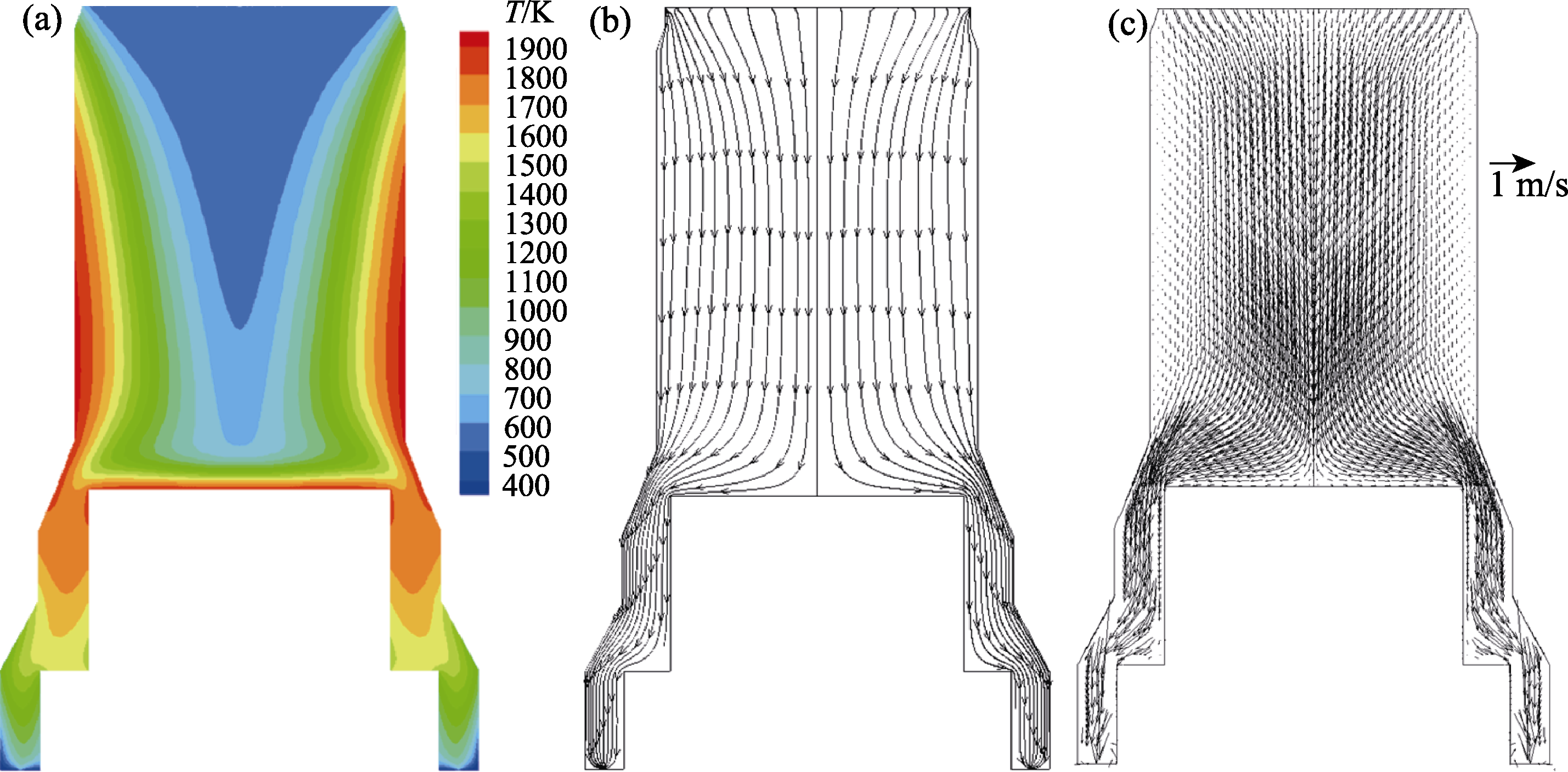
图2 基准条件下反应腔体内温度场和流速分布
Fig. 2 Temperature distribution and streamline distribution in the reaction chamber under baseline case (a) Temperature distribution; (b) Streamline distribution; (c) Flow velocity distribution. Colorful figures are available on website
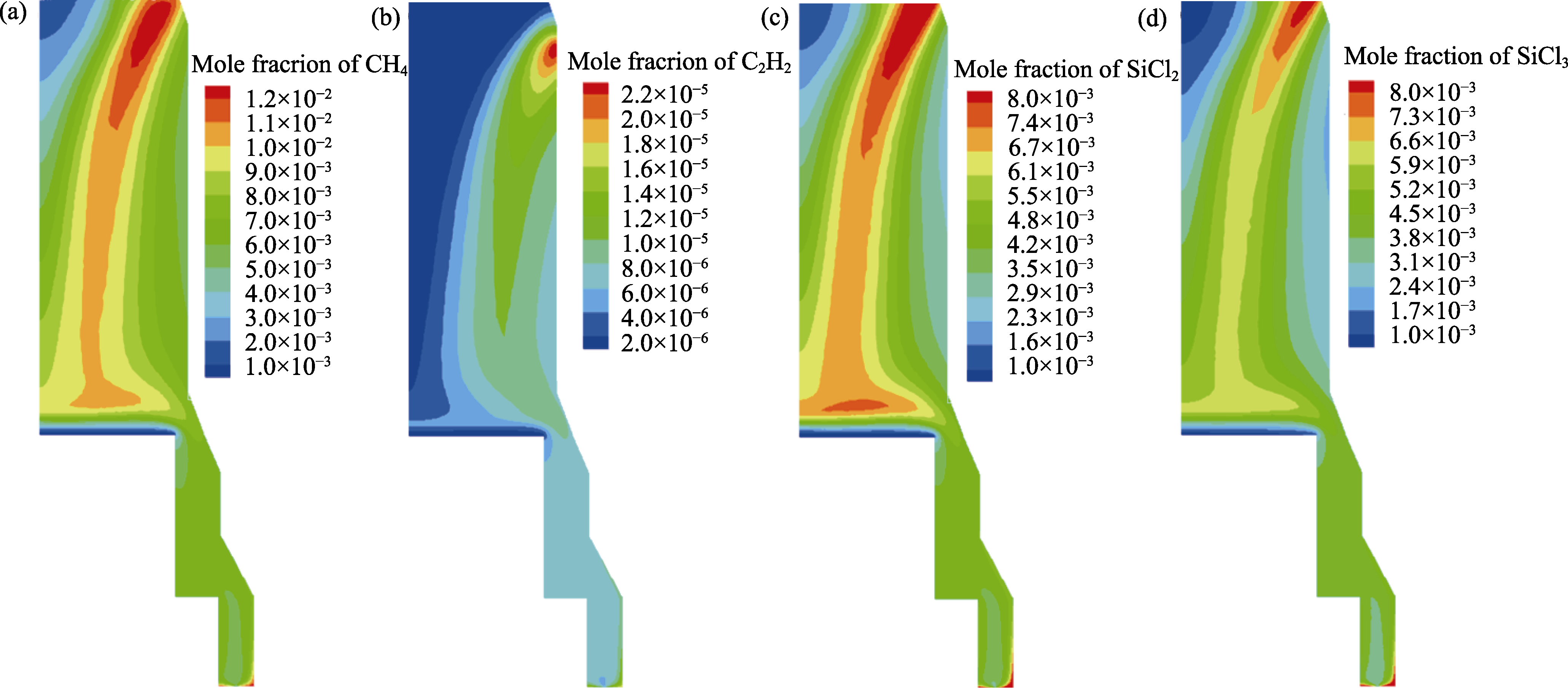
图3 基准算例反应腔体内不同组分的摩尔分数占比分布
Fig. 3 Distribution of molar fractions for different components in the reaction chamber under baseline case (a) CH4 molar fraction; (b) C2H2 molar fraction; (c) SiCl2 molar fraction; (d) SiCl3 molar fraction. Colorful figures are available on website
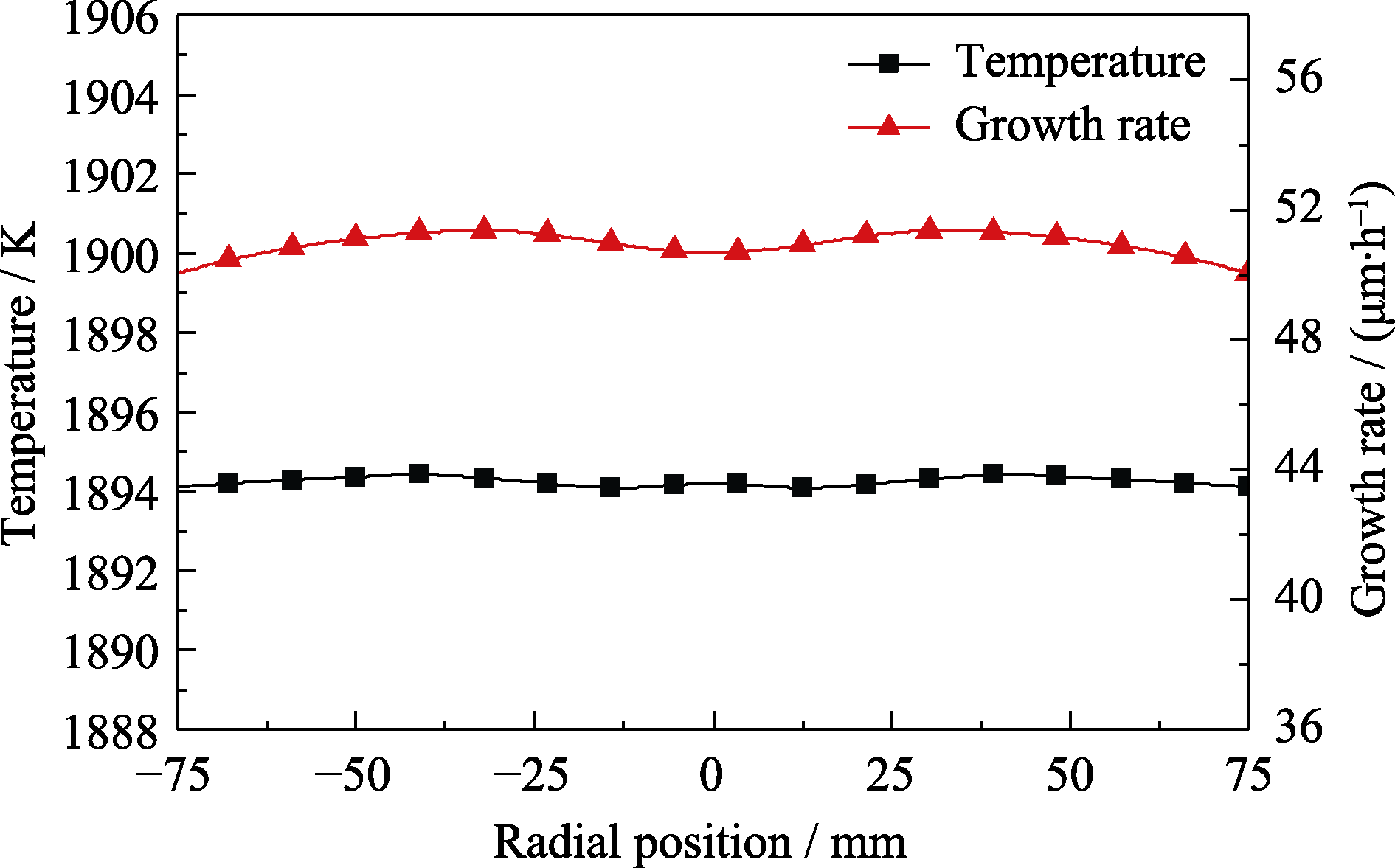
图4 基准算例衬底表面的温度和生长速率分布
Fig. 4 Temperature and growth rate distributions on the substrate surface for baseline case
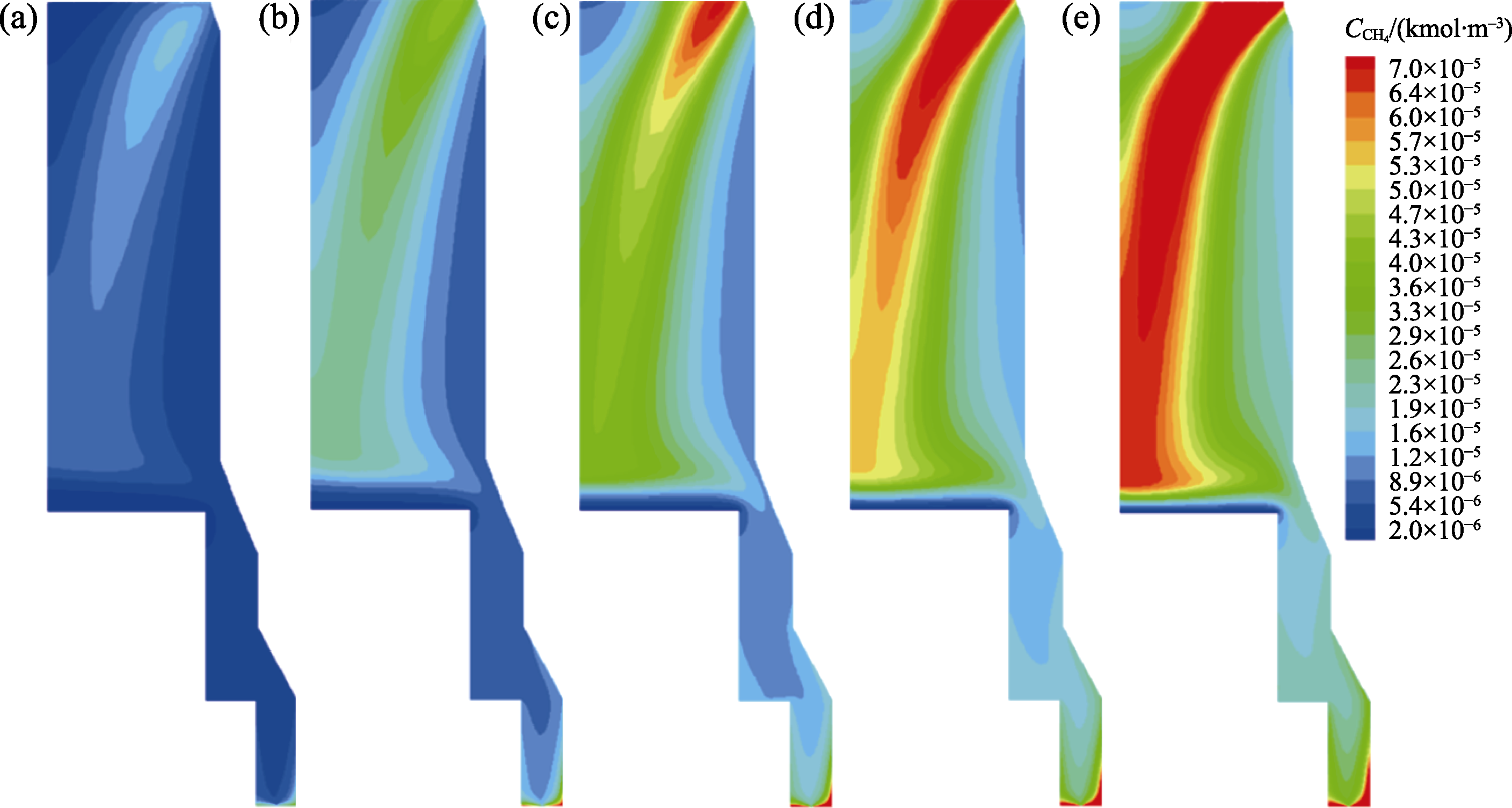
图5 不同压力下CH4摩尔浓度分布
Fig. 5 Distribution of molar concentration of CH4 at different pressures (a) 5 kPa; (b) 15 kPa; (c) 25 kPa; (d) 35 kPa; (e) 45 kPa. Colorful figures are available on website
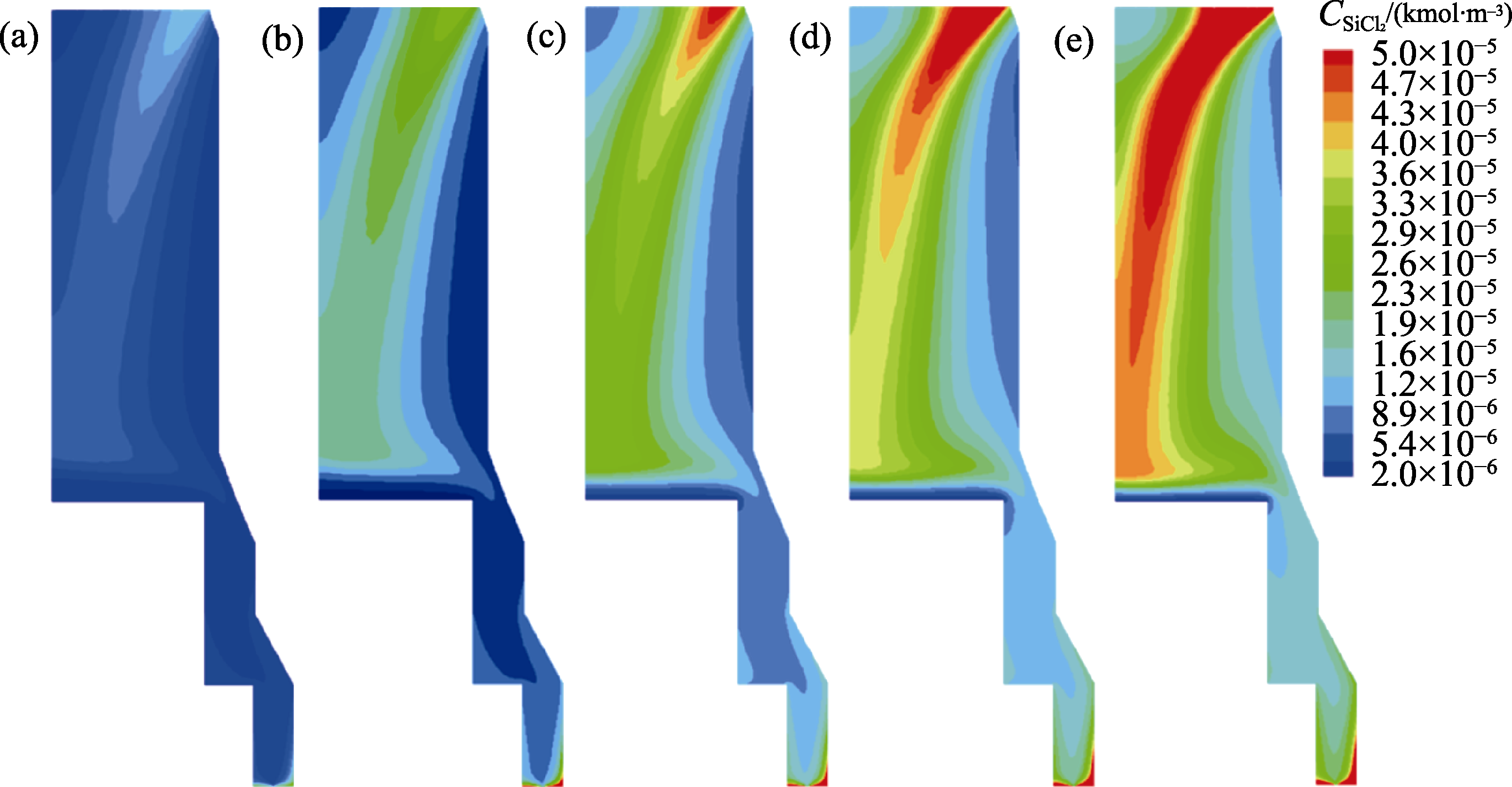
图6 不同压力下SiCl2摩尔浓度分布
Fig. 6 Distribution of molar concentration of SiCl2 at different pressures (a) 5 kPa; (b) 15 kPa (c) 25 kPa; (d) 35 kPa; (e) 45 kPa. Colorful figures are available on website
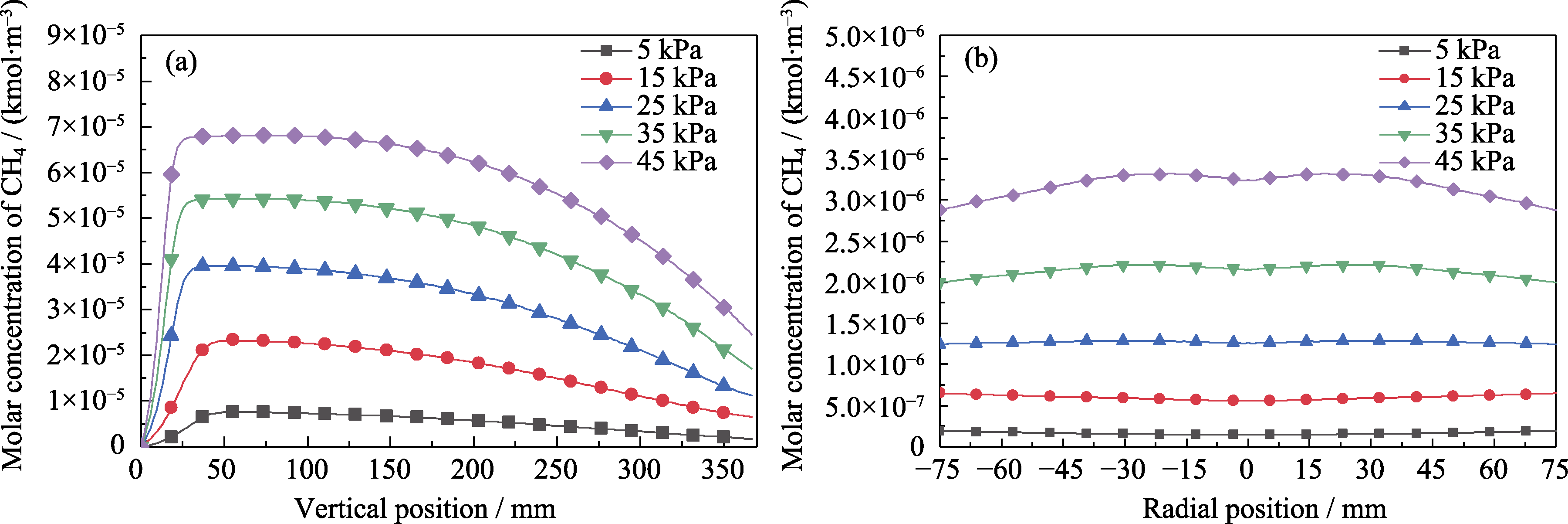
图7 不同压力下衬底上方CH4摩尔浓度轴向和径向分布
Fig. 7 Vertical and radial distributions of CH4 molar concentration above the substrate surface at different pressures (a) Vertical distribution; (b) Radial distribution
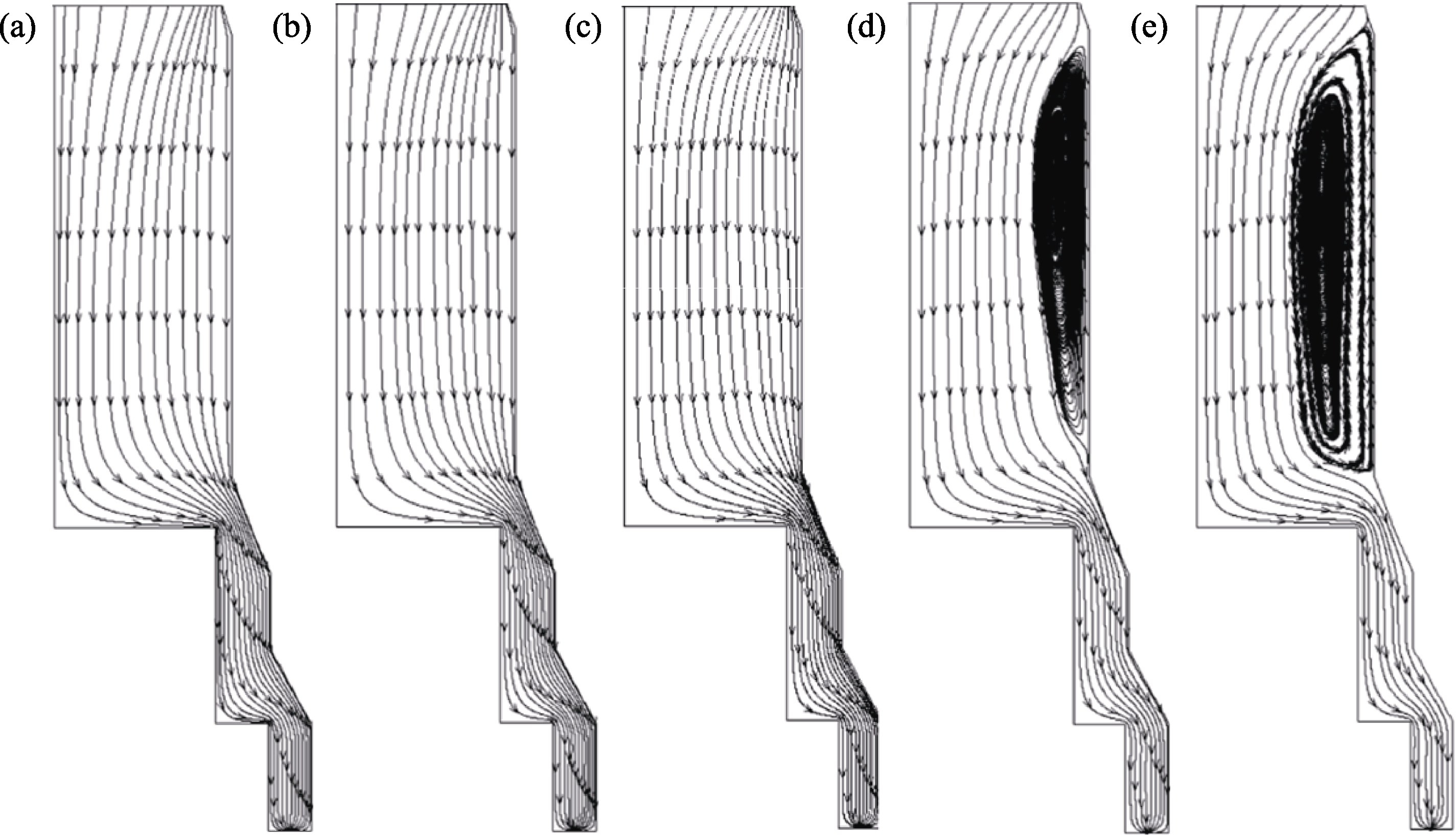
图8 不同压力下的流线分布
Fig. 8 Streamline distribution at different pressures (a) 5 kPa; (b) 15 kPa; (c) 25 kPa; (d) 35 kPa; (e) 45 kPa
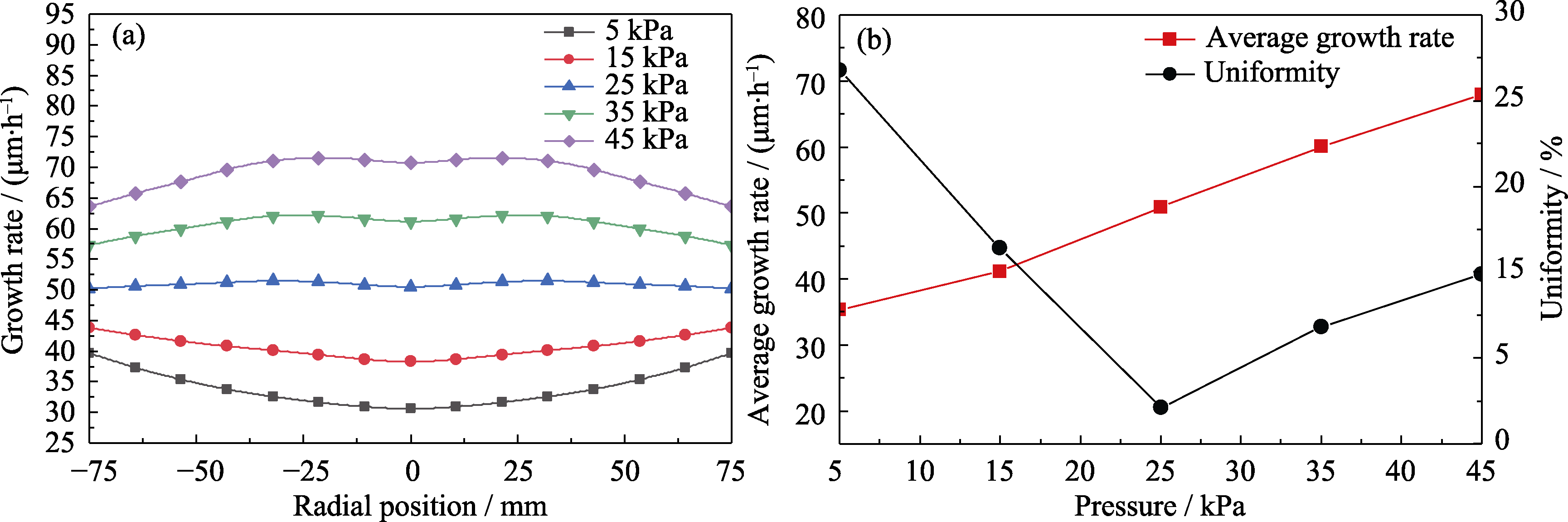
图9 (a)衬底表面生长速率分布和(b)平均生长速率、均匀性随压力的变化
Fig. 9 (a) Growth rate distribution and (b) average growth rate and uniformity versus pressure
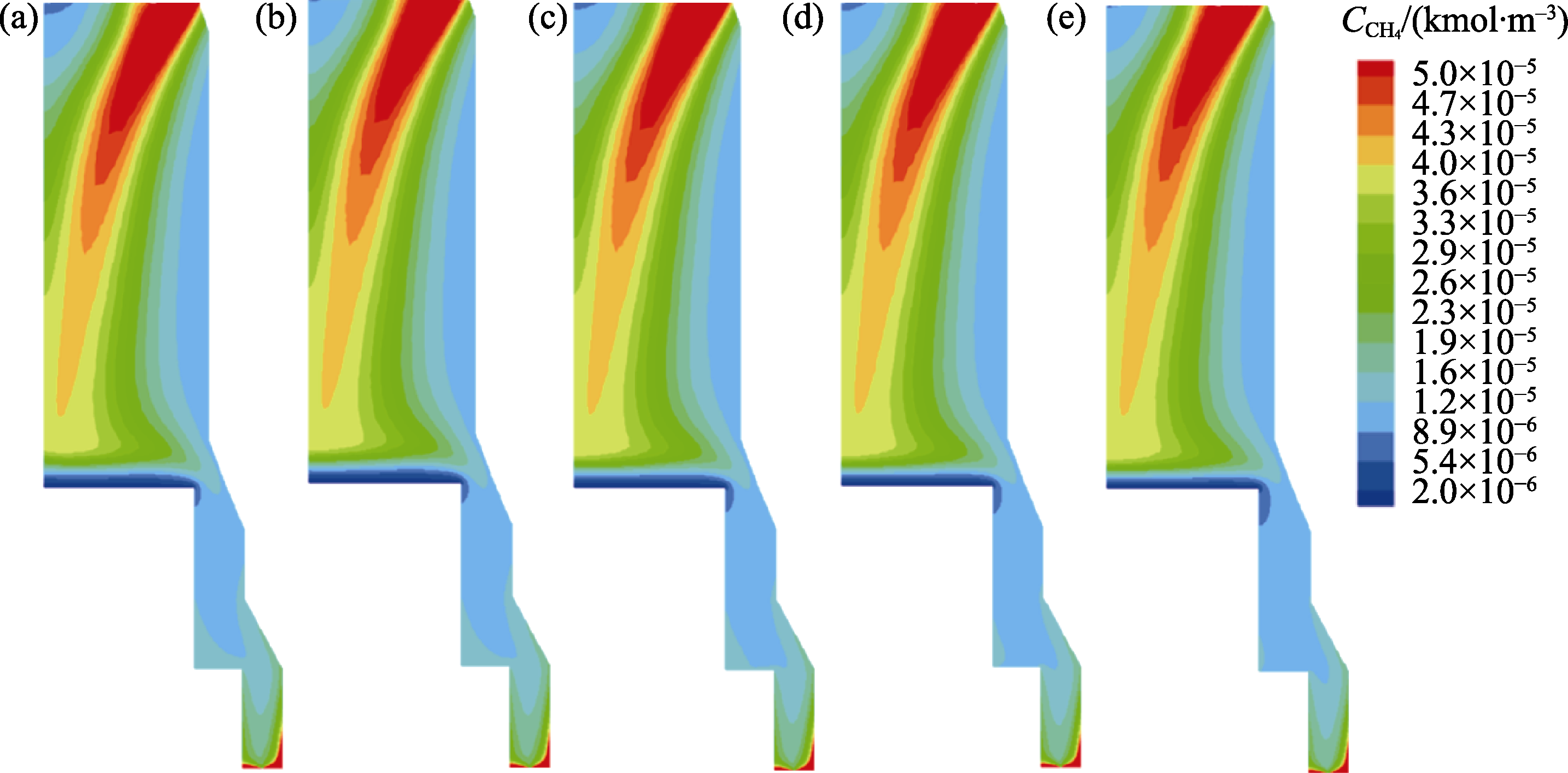
图10 不同转速下CH4摩尔浓度分布
Fig. 10 Distribution of CH4 molar concentration at different rotational rates (a) 0 r/min; (b) 250 r/min; (c) 500 r/min; (d) 750 r/min; (e) 1000 r/min. Colorful figures are available on website
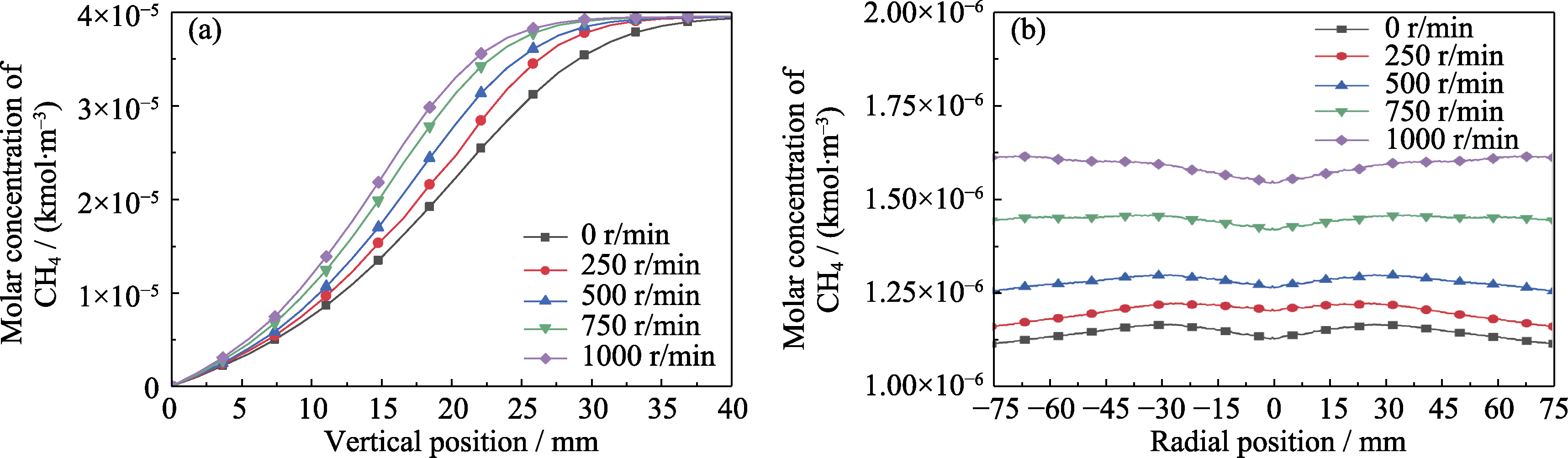
图11 不同转速下衬底表面上方CH4摩尔浓度轴向和径向分布
Fig. 11 Vertical and radial distributions of CH4 molar concentration above the substrate surface at different rotational rates (a) Vertical distribution; (b) Radial distribution
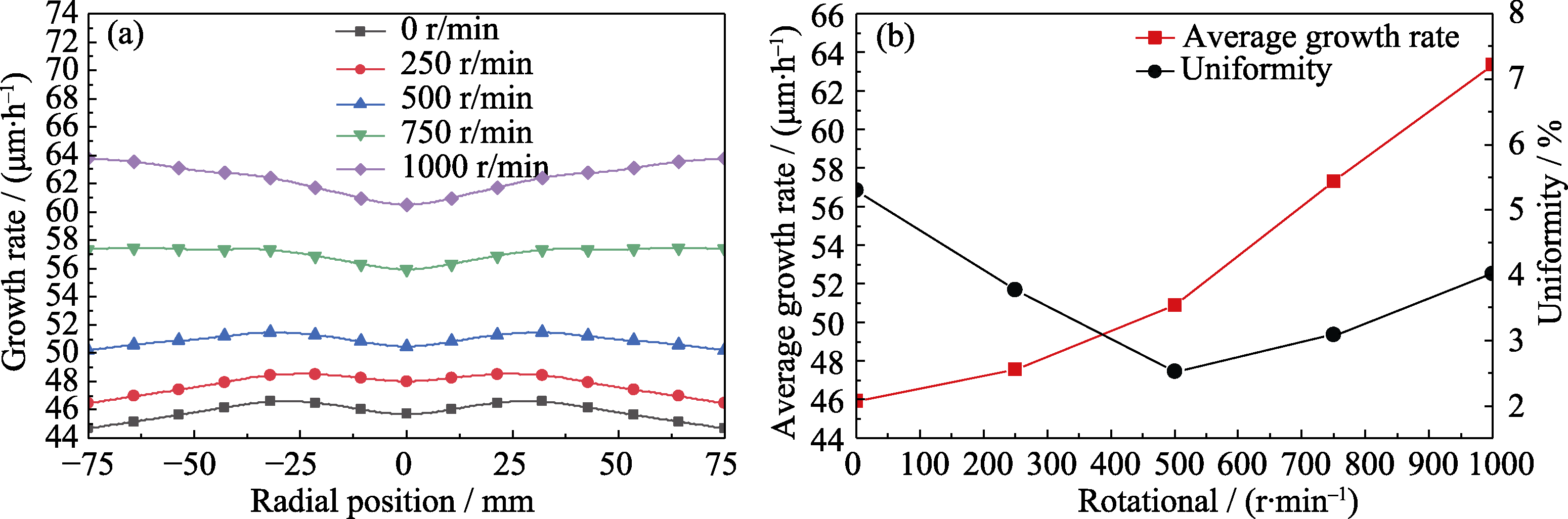
图12 (a)衬底表面生长速率径向分布和(b)平均生长速率、均匀性随转速的变化
Fig. 12 (a) Growth rate distribution and (b) average growth rate and uniformity versus rotational rate
| [1] |
MUSOLINO M, CARRIA E, CRIPPA D, et al. Development of n-type epitaxial growth on 200 mm 4H-SiC wafers for the next generation of power devices. Microelectronic Engineering, 2023, 274: 111976.
DOI URL |
| [2] |
LI Q, ZHANG Y, JI B, et al. Improvement of SiC deposition uniformity in CVD reactor by showerhead with baffle. Journal of Crystal Growth, 2023, 615: 127255.
DOI URL |
| [3] |
ZHAO S, WANG J, YAN G, et al. Surface uniformity of wafer-scale 4H-SiC epitaxial layers grown under various epitaxial conditions. Coatings, 2022, 12(5): 597.
DOI URL |
| [4] |
CHOKAWA K, DAIGO Y, MIZUSHIMA I, et al. First-principles and thermodynamic analysis for gas phase reactions and structures of the SiC(0001) surface under conventional CVD and halide CVD environments. Japanese Journal of Applied Physics, 2021, 60(8): 085503.
DOI |
| [5] | HAN Y B, PU Y, SHI J X, et al. Technical progress of silicon carbide epitaxial equipment by chemical vapor deposition. Journal of Synthetic Crystals, 2022, 51(7): 1300. |
| [6] | HAN Q W, LI G D. Simplified reaction simulation of SiC deposition by CH3SiCl3-H2-Ar chemical vapor deposition. Materials Science and Engineering of Powder Metallurgy, 2021, 26(2): 99. |
| [7] | YUAN W, PEI Y, LI Y, et al. Research on the influence of carbon sources and buffer layers on the homogeneous epitaxial growth of 4H-SiC. Micromachines (Basel), 2024, 15(5): 600. |
| [8] |
GUAN K, GAO Y, ZENG Q, et al. Numerical modeling of SiC by low-pressure chemical vapor deposition from methyltrichlorosilane. Chinese Journal of Chemical Engineering, 2020, 28(6): 1733.
DOI URL |
| [9] |
TANG Z, GU L, JIN L, et al. Insights into the effect of susceptor rotational speed in CVD reactor on the quality of 4H-SiC epitaxial layer on homogeneous substrates. Materials Today Communications, 2024, 38: 108037.
DOI URL |
| [10] |
DAIGO Y, ISHIGURO A, ISHII S, et al. Reduction of surface and PL defects on n-type 4H-SiC epitaxial films grown using a high speed wafer rotation vertical CVD tool. Materials Science Forum, 2018, 924: 108.
DOI URL |
| [11] | FUJIBAYASHI H, ITO M, ITO H, et al. Fast 4H-SiC epitaxial growth on 150 mm diameter area with high-speed wafer rotation. Materials Science Forum, 2014, 778/779/780: 117. |
| [12] |
GAKIS G P, KORONAKI E D, BOUDOUVIS A G. Numerical investigation of multiple stationary and time-periodic flow regimes in vertical rotating disc CVD reactors. Journal of Crystal Growth, 2015, 432: 152.
DOI URL |
| [13] |
TANG Z, ZHAO S, LI J, et al. Optimizing the chemical vapor deposition process of 4H-SiC epitaxial layer growth with machine-learning-assisted multiphysics simulations. Case Studies in Thermal Engineering, 2024, 59: 104507.
DOI URL |
| [14] |
GUO N, PEI Y, YUAN W, et al. Effect of TCS gas flow and pre-etching on homopitaxial growth of 4H-SiC. RSC Advances, 2024, 14(23): 16574.
DOI PMID |
| [15] |
SONG B, GAO B, HAN P, et al. Surface kinetic mechanisms of epitaxial chemical vapour deposition of 4H silicon carbide growth by methyltrichlorosilane-H2 gaseous system. Materials (Basel), 2022, 15(11): 3768.
DOI URL |
| [16] |
ZHENG G, SUN Y, LIU S, et al. Numerical investigation on the effect of growth conditions on silicon carbide growth in chemical vapor deposition. Journal of Crystal Growth, 2025, 657: 128108.
DOI URL |
| [17] | LU R L, ZHENG L L, ZHANG H, et al. Effect of hot-wall CVD preparation process on thickness uniformity of 8-inch SiC epitaxial layer. Journal of Synthetic Crystals, 2025, 54(9): 1509. |
| [18] | DAIGO Y, WATANABE T, ISHIGURO A, et al. Impact of precise temperature control for 4H-SiC epitaxy on large diameter wafers. 2020 International Symposium on Semiconductor Manufacturing (ISSM), 2020: 1-4. |
| [19] |
HA M T, SHIN Y J, BAE S Y, et al. Effect of hot-zone aperture on the growth behavior of SiC single crystal produced via top-seeded solution growth method. Journal of the Korean Ceramic Society, 2019, 56: 589.
DOI URL |
| [20] | FANG Y L, WANG C L, TIAN W X, et al. Calculation and analysis of thermophysical properties of high-temperature hydrogen working fluid. Atomic Energy Science and Technology, 2021, 55(8): 1411. |
| [21] |
DAIKOKU H, KAWANISHI S, ISHIKAWA T, et al. Density, surface tension, and viscosity of liquid Si-Cr alloys and influence on temperature and fluid flow during solution growth of SiC. Journal of Chemical Thermodynamics, 2021, 160: 106476.
DOI URL |
| [22] |
VENERONI A, OMARINI F, MASI M. Silicon carbide growth mechanisms from SiH4, SiHCl3 and nC3H8. Crystal Research and Technology, 2005, 40(10/11): 967.
DOI URL |
| [23] |
RAVASIO S, MASI M, CAVALLOTTI C. Analysis of the gas phase reactivity of chlorosilanes. The Journal of Physical Chemistry A, 2013, 117(25): 5221.
DOI URL |
| [24] |
VENERONI A, MASI M. Gas-phase and surface kinetics of epitaxial silicon carbide growth involving chlorine-containing species. Chemical Vapor Deposition, 2006, 12(8/9): 562.
DOI URL |
| [25] |
GE Y, GORDON M S, BATTAGLIA F, et al. Theoretical study of the pyrolysis of methyltrichlorosilane in the gas phase. 3. Reaction rate constant calculations. The Journal of Physical Chemistry A, 2010, 114(6): 2384.
DOI URL |
| [26] |
SEO J W, CHOI K. Application of CFD simulation to silicon carbide deposition for nozzles with funnel. Journal of the Korean Ceramic Society, 2021, 58: 184.
DOI |
| [27] |
SONG B T, GAO B, HAN P F, et al. Numerical simulation of gas phase reaction for epitaxial chemical vapor deposition of silicon carbide by methyltrichlorosilane in horizontal hot-wall reactor. Materials, 2021, 14(24): 7532.
DOI URL |
| [28] | HAN Y B, PU Y, SHI J X, et al. Study on epitaxial growth of n-type 4H-SiC films by high-speed rotating vertical hot-wall CVD. Journal of Synthetic Crystals, 2023, 52(5): 918. |
| [29] |
SUN Y Q, FENG G, ZHANG J H, et al. Reduction of epitaxial defects on 4°-off 4H-SiC homoepitaxial growth by optimizing in-situ etching process. Superlattices and Microstructures, 2016, 99: 145.
DOI URL |
| [30] |
LIU X F, YAN G G, LIU B, et al. Process optimization for homoepitaxial growth of thick 4H-SiC films via hydrogen chloride chemical vapor deposition. Journal of Crystal Growth, 2018, 504: 7.
DOI URL |
| [31] |
DAIGO Y, ISHIGURO A, ISHII S, et al. High in-wafer uniformity of growth rate and carrier concentration on n-type 4H-SiC epitaxial films achieved by high speed wafer rotation vertical CVD tool. Materials Science Forum, 2018, 924: 88.
DOI URL |
| [32] |
TOUKABRI R, SHI Y. Effect of pressure on the gas-phase chemistry when using monomethylsilane and dimethylsilane in hot-wire chemical vapor deposition. Canadian Journal of Chemistry, 2015, 93(1): 82.
DOI URL |
| [33] |
KOLLMUSS M, LA VIA F, WELLMANN P J. Effect of growth conditions on the surface morphology and defect density of CS-PVT-grown 3C-SiC. Crystal Research and Technology, 2023, 58: 2300034.
DOI URL |
| [34] |
LE B P, CHEN J C, HU C, et al. Numerical analysis of the use of multiple inlet plates to improve the thickness uniformity of silicon epitaxial layers during atmospheric pressure chemical vapor deposition. Results in Engineering, 2024, 24: 103688.
DOI URL |
| [1] | 刘雷敏, 罗红心, 何玉梅, 金利民, 李永杰, 刘静雯, 魏玉全, 孙安乐, 陈忠明, 刘学建, 殷杰, 黄政仁. 先进光源装置用碳化硅反射镜性能研究[J]. 无机材料学报, 2026, 41(6): 805-813. |
| [2] | 蒋圣楠, 郑重, 何唯一, 刘涛, 潘秀红, 陈锟, 郭辉, 高攀, 刘春俊, 刘学超. 硼镓共掺氧化锌透明电极的制备及性能优化[J]. 无机材料学报, 2026, 41(4): 479-485. |
| [3] | 曹娟, 吴西士, 刘泽华, 裴兵兵, 韩建燊, 刘欢, 杨亦天, 吴海波, 黄政仁. 晶粒尺寸对常压固相烧结SiC陶瓷断裂强度Weibull分布的影响[J]. 无机材料学报, 2026, 41(2): 217-224. |
| [4] | 何涛, 王新刚, 王小飞, 王铭, 徐京城, 吕松泽, 陈悦, 刘宸宇, 蒋丹宇. SiC纤维室温至2000 ℃的拉伸性能与微观结构演变[J]. 无机材料学报, 2026, 41(10): 1415-1424. |
| [5] | 王鲁杰, 张玉新, 李彤阳, 于源, 任鹏伟, 王建章, 汤华国, 姚秀敏, 黄毅华, 刘学建, 乔竹辉. 深海服役环境下碳化硅陶瓷材料的腐蚀及磨损行为[J]. 无机材料学报, 2025, 40(7): 799-807. |
| [6] | 李紫薇, 弓伟露, 崔海峰, 叶丽, 韩伟健, 赵彤. 前驱体法制备(Zr, Hf, Nb, Ta, W)C-SiC复相陶瓷及性能研究[J]. 无机材料学报, 2025, 40(3): 271-280. |
| [7] | 赵丽娟, 谭哲, 张晓光, 蒋国赛, 陶然, 潘德安. 废加氢催化剂颗粒分级数值模拟研究[J]. 无机材料学报, 2025, 40(12): 1387-1394. |
| [8] | 王浩, 刘学超, 郑重, 潘秀红, 徐锦涛, 朱新锋, 陈锟, 邓伟杰, 汤美波, 郭辉, 高攀. 非本征背照触发平面型4H-SiC光导开关性能研究[J]. 无机材料学报, 2024, 39(9): 1070-1076. |
| [9] | 王康龙, 殷杰, 陈晓, 王力, 刘学建, 黄政仁. 颗粒级配对选区激光烧结打印结合常压固相烧结制备碳化硅陶瓷性能的影响[J]. 无机材料学报, 2024, 39(7): 754-760. |
| [10] | 孙川, 何鹏飞, 胡振峰, 王荣, 邢悦, 张志彬, 李竞龙, 万春磊, 梁秀兵. 含有石墨烯阵列的SiC基陶瓷材料的制备与力学性能[J]. 无机材料学报, 2024, 39(3): 267-273. |
| [11] | 徐昊, 钱伟, 花银群, 叶云霞, 戴峰泽, 蔡杰. 皮秒激光加工的微织构对碳化硅润湿性的影响[J]. 无机材料学报, 2023, 38(8): 923-930. |
| [12] | 陈强, 白书欣, 叶益聪. 热管理用高导热碳化硅陶瓷基复合材料研究进展[J]. 无机材料学报, 2023, 38(6): 634-646. |
| [13] | 穆宏赫, 王鹏飞, 施宇峰, 张中晗, 武安华, 苏良碧. 热交换坩埚下降法制备大尺寸氟化铈晶体的热场设计与优化[J]. 无机材料学报, 2023, 38(3): 288-295. |
| [14] | 史艳磊, 孙聂枫, 徐成彦, 王书杰, 林朋, 马春雷, 徐森锋, 王维, 陈春梅, 付莉杰, 邵会民, 李晓岚, 王阳, 秦敬凯. 半密封直拉法生长6英寸磷化铟单晶热场研究[J]. 无机材料学报, 2023, 38(3): 335-342. |
| [15] | 顾薛苏, 殷杰, 王康龙, 崔崇, 梅辉, 陈忠明, 刘学建, 黄政仁. 颗粒级配对黏结剂喷射打印碳化硅陶瓷性能的影响[J]. 无机材料学报, 2023, 38(12): 1373-1378. |
| 阅读次数 | ||||||
|
全文 |
|
|||||
|
摘要 |
|
|||||