无机材料学报 ›› 2026, Vol. 41 ›› Issue (7): 1011-1020.DOI: 10.15541/jim20250498 CSTR: 32189.14.10.15541/jim20250498
• 研究快报 • 上一篇
周雪1( ), 刘喆2, 任岩2, 余金山1(), 杨天月1, 赵钟倩1, 王洪磊1, 周新贵1, 苟燕子1()
收稿日期:2025-12-15
修回日期:2026-02-23
出版日期:2026-07-20
网络出版日期:2026-02-28
通讯作者:
苟燕子, 副研究员. E-mail: y.gou2012@hotmail.com;作者简介:周 雪(2001-), 女, 硕士研究生. E-mail: zhouxue23@nudt.edu.cn
ZHOU Xue1(), LIU Zhe2, REN Yan2, YU Jinshan1(), YANG Tianyue1, ZHAO Zhongqian1, WANG Honglei1, ZHOU Xingui1, GOU Yanzi1()
Received:2025-12-15
Revised:2026-02-23
Published:2026-07-20
Online:2026-02-28
Contact:
GOU Yanzi, associate professor. E-mail: y.gou2012@hotmail.com;About author:ZHOU Xue (2001-), female, Master candidate. E-mail: zhouxue23@nudt.edu.cn
Supported by:摘要:
SiC纤维具有优异的高温稳定性和力学性能, 是可重复使用飞行器中先进陶瓷基复合材料的关键增强体。不同类型SiC纤维的组成与微观结构差异显著, 这直接影响其高温抗蠕变性能。然而, 热处理影响蠕变性能的微观机制尚不明确。本研究对比了Shincolon-Ⅱ (F-1)、KD-S (F-2)和KD-SA (F-3)三种SiC纤维的蠕变行为, 发现F-3因近化学计量比的组成及高结晶度结构而呈现最优的抗蠕变性能, 而F-2较F-1的抗蠕变性能提升主要源于游离碳含量较低与结构有序度更高。氩气环境高温热处理能普遍改善纤维的抗蠕变性能: 经1900 ℃热处理1 h后, 在1500 ℃测试条件下, F-1和F-2的应力松弛参数(m)较原始纤维提升超过10倍, F-3则提升约5倍。但不同纤维的增强机制存在差异: F-1和F-2主要得益于晶粒长大和碳的石墨化; F-3则主要依赖铝化合物与石墨化碳对晶界的稳定作用, 以及热处理后的结构致密化。本研究可为提升SiC纤维抗蠕变性能及优化其综合力学性能提供理论基础。
中图分类号:
周雪, 刘喆, 任岩, 余金山, 杨天月, 赵钟倩, 王洪磊, 周新贵, 苟燕子. 不同SiC纤维高温退火后抗蠕变性能的定量研究[J]. 无机材料学报, 2026, 41(7): 1011-1020.
ZHOU Xue, LIU Zhe, REN Yan, YU Jinshan, YANG Tianyue, ZHAO Zhongqian, WANG Honglei, ZHOU Xingui, GOU Yanzi. Quantitative Investigation of the Creep Resistance of Different SiC Fibers after Annealing at High Temperature[J]. Journal of Inorganic Materials, 2026, 41(7): 1011-1020.
| Fiber | Generation | C/Si ratio | Oxygen/ % (in mass) | Al/% (in mass) | Diameter/µm | Young's modulus/GPa | Tensile strength/GPa |
|---|---|---|---|---|---|---|---|
| F-1 | Second | 1.35 | 0.89 | - | 10.0 | 301 | 3.6 |
| F-2 | Third | 1.08 | 0.91 | - | 9.9 | 367 | 3.6 |
| F-3 | Third | 1.01 | 0.07 | <1.00 | 9.8 | 373 | 1.7 |
Table 1 Relevant parameters of SiC fibers employed in this work
| Fiber | Generation | C/Si ratio | Oxygen/ % (in mass) | Al/% (in mass) | Diameter/µm | Young's modulus/GPa | Tensile strength/GPa |
|---|---|---|---|---|---|---|---|
| F-1 | Second | 1.35 | 0.89 | - | 10.0 | 301 | 3.6 |
| F-2 | Third | 1.08 | 0.91 | - | 9.9 | 367 | 3.6 |
| F-3 | Third | 1.01 | 0.07 | <1.00 | 9.8 | 373 | 1.7 |
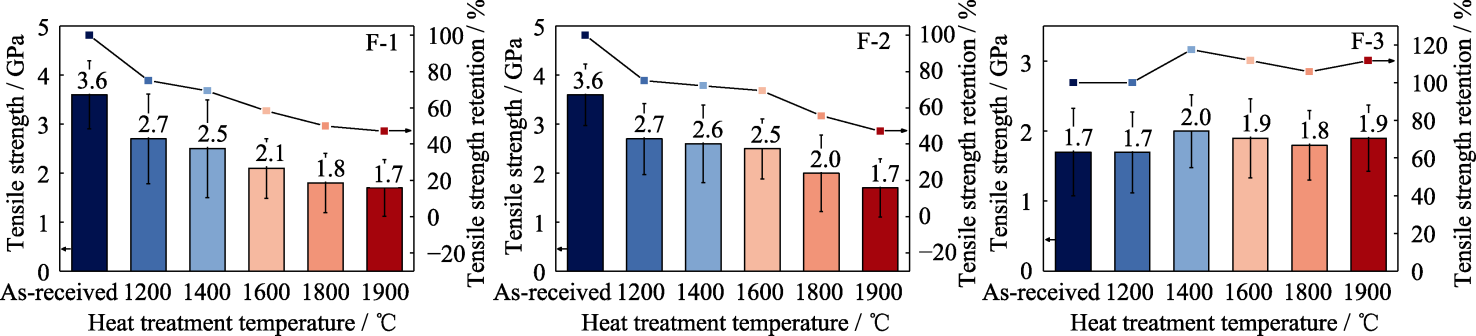
Fig. 1 Tensile strength and tensile strength retention of SiC fibers after heat treatment at different temperatures for 1 h
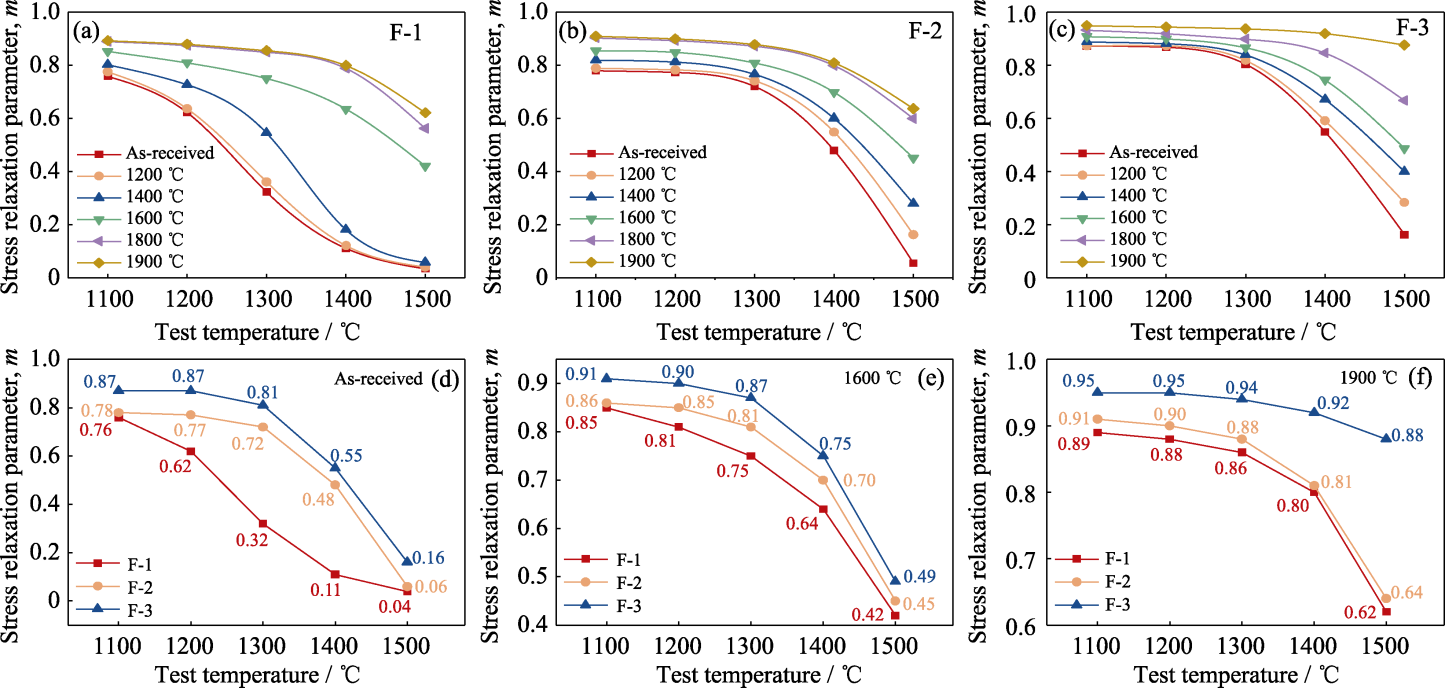
Fig. 2 (a-c) Variation of stress relaxation parameter (m) with BSR testing temperature for (a) F-1, (b) F-2 and (c) F-3 fibers after being annealed at different temperatures for 1 h; (d-f) Comparison of m values of (d) as-received three SiC fibers, and the three SiC fibers after heat treatment at (e) 1600 and (f) 1900 ℃ for 1 h
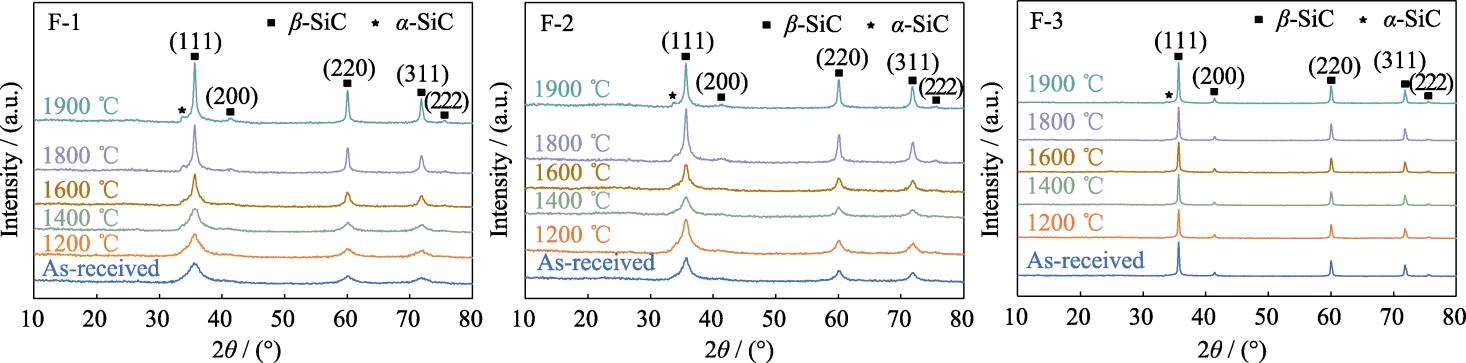
Fig. 3 XRD patterns of SiC fibers after being annealed at different temperatures for 1 h
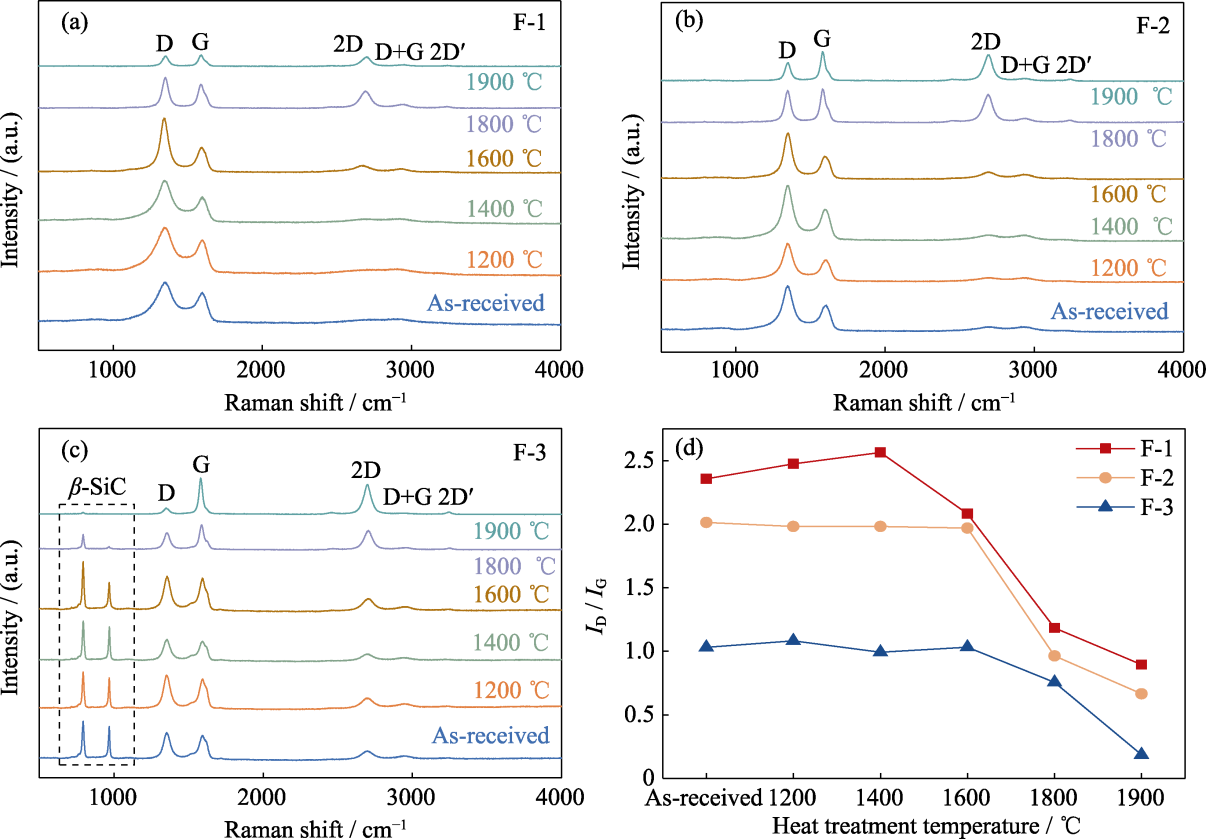
Fig. 4 (a-c) Raman spectra of (a) F-1, (b) F-2 and (c) F-3 fibers after being annealed at different temperatures; (d) ID/IG values
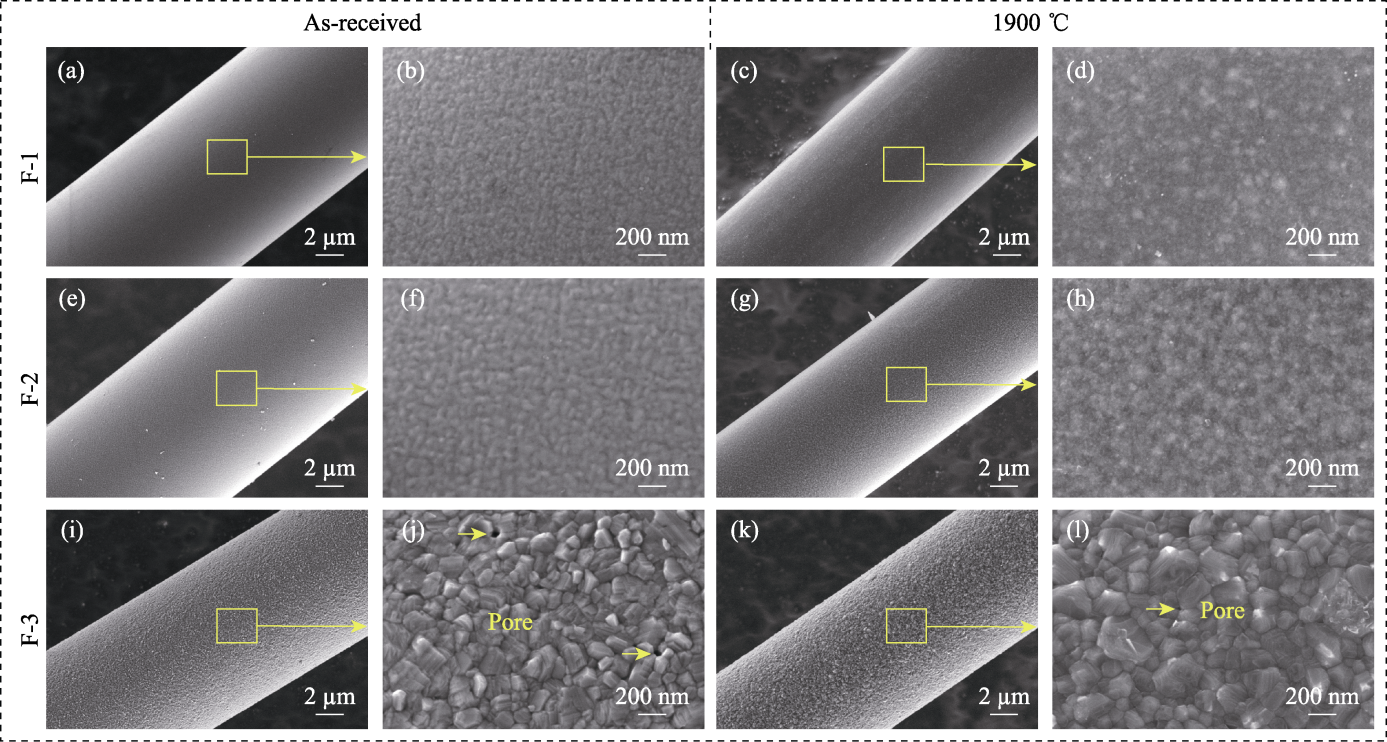
Fig. 5 SEM images of surfaces of (a-d) F-1, (e-h) F-2 and (i-l) F-3 fibers before and after heat treatment at 1900 ℃ for 1 h
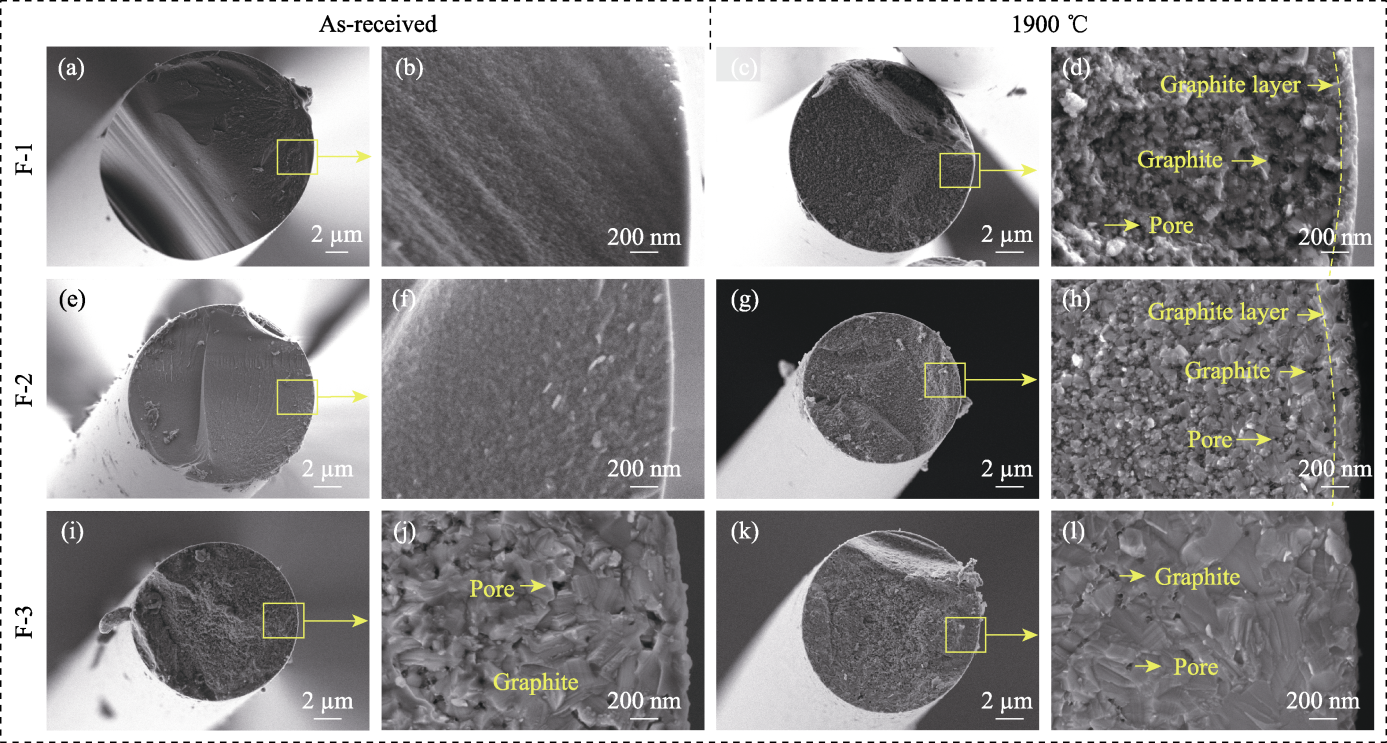
Fig. 6 SEM images of cross-sections of (a-d) F-1, (e-h) F-2 and (i-l) F-3 fibers before and after heat treatment at 1900 ℃ for 1 h
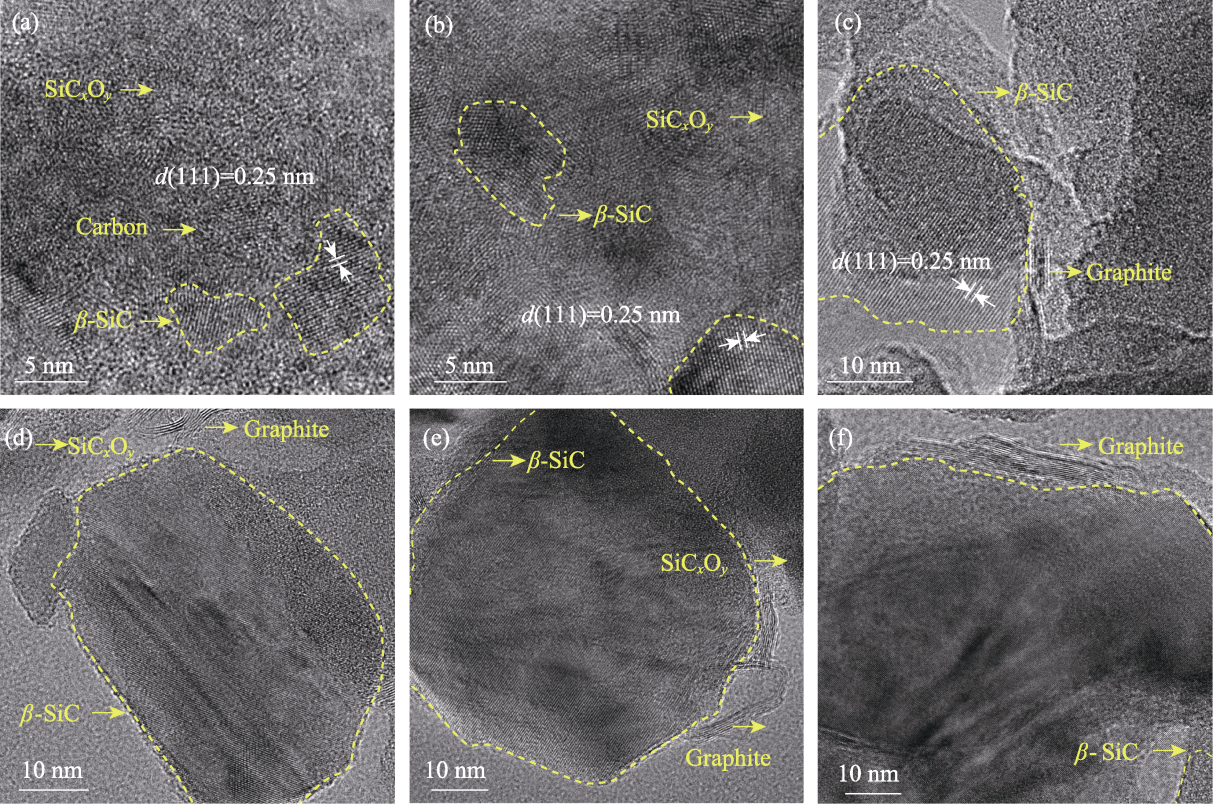
Fig. 7 HRTEM images of (a, d) F-1, (b, e) F-2 and (c, f) F-3 fibers (a-c) before and (d-f) after heat treatment at 1900 ℃ for 1 h
| Fiber | Heat treatment temperature/℃ | Growth rate of m value after BSR test/% | ||||
|---|---|---|---|---|---|---|
| 1100 ℃ | 1200 ℃ | 1300 ℃ | 1400 ℃ | 1500 ℃ | ||
| F-1 | 1200 | 2.2 | 2.2 | 11.7 | 8.9 | 17.1 |
| 1400 | 5.8 | 16.9 | 68.5 | 62.5 | 68.6 | |
| 1600 | 12.4 | 30.0 | 131.8 | 467.9 | 1102.9 | |
| 1800 | 17.3 | 40.4 | 162.3 | 604.5 | 1508.6 | |
| 1900 | 17.7 | 41.3 | 164.2 | 614.3 | 1677.1 | |
| F-2 | 1200 | 1.2 | 1.2 | 2.9 | 14.4 | 191.1 |
| 1400 | 5.1 | 5.0 | 6.4 | 25.2 | 400.0 | |
| 1600 | 9.6 | 9.7 | 12.2 | 45.6 | 707.1 | |
| 1800 | 15.9 | 15.5 | 21.1 | 66.7 | 971.4 | |
| 1900 | 16.7 | 16.3 | 21.9 | 68.8 | 1037.5 | |
| F-3 | 1200 | 0.1 | 0.6 | 1.7 | 7.6 | 74.2 |
| 1400 | 1.8 | 1.5 | 4.3 | 22.2 | 145.4 | |
| 1600 | 4.1 | 3.6 | 7.7 | 35.5 | 198.8 | |
| 1800 | 6.9 | 5.9 | 11.7 | 54.0 | 309.8 | |
| 1900 | 8.8 | 8.7 | 16.5 | 67.3 | 438.0 | |
Table S1 Growth rates of m values for heat-treated SiC fibers relative to as-received fibers after BSR test at different temperatures
| Fiber | Heat treatment temperature/℃ | Growth rate of m value after BSR test/% | ||||
|---|---|---|---|---|---|---|
| 1100 ℃ | 1200 ℃ | 1300 ℃ | 1400 ℃ | 1500 ℃ | ||
| F-1 | 1200 | 2.2 | 2.2 | 11.7 | 8.9 | 17.1 |
| 1400 | 5.8 | 16.9 | 68.5 | 62.5 | 68.6 | |
| 1600 | 12.4 | 30.0 | 131.8 | 467.9 | 1102.9 | |
| 1800 | 17.3 | 40.4 | 162.3 | 604.5 | 1508.6 | |
| 1900 | 17.7 | 41.3 | 164.2 | 614.3 | 1677.1 | |
| F-2 | 1200 | 1.2 | 1.2 | 2.9 | 14.4 | 191.1 |
| 1400 | 5.1 | 5.0 | 6.4 | 25.2 | 400.0 | |
| 1600 | 9.6 | 9.7 | 12.2 | 45.6 | 707.1 | |
| 1800 | 15.9 | 15.5 | 21.1 | 66.7 | 971.4 | |
| 1900 | 16.7 | 16.3 | 21.9 | 68.8 | 1037.5 | |
| F-3 | 1200 | 0.1 | 0.6 | 1.7 | 7.6 | 74.2 |
| 1400 | 1.8 | 1.5 | 4.3 | 22.2 | 145.4 | |
| 1600 | 4.1 | 3.6 | 7.7 | 35.5 | 198.8 | |
| 1800 | 6.9 | 5.9 | 11.7 | 54.0 | 309.8 | |
| 1900 | 8.8 | 8.7 | 16.5 | 67.3 | 438.0 | |
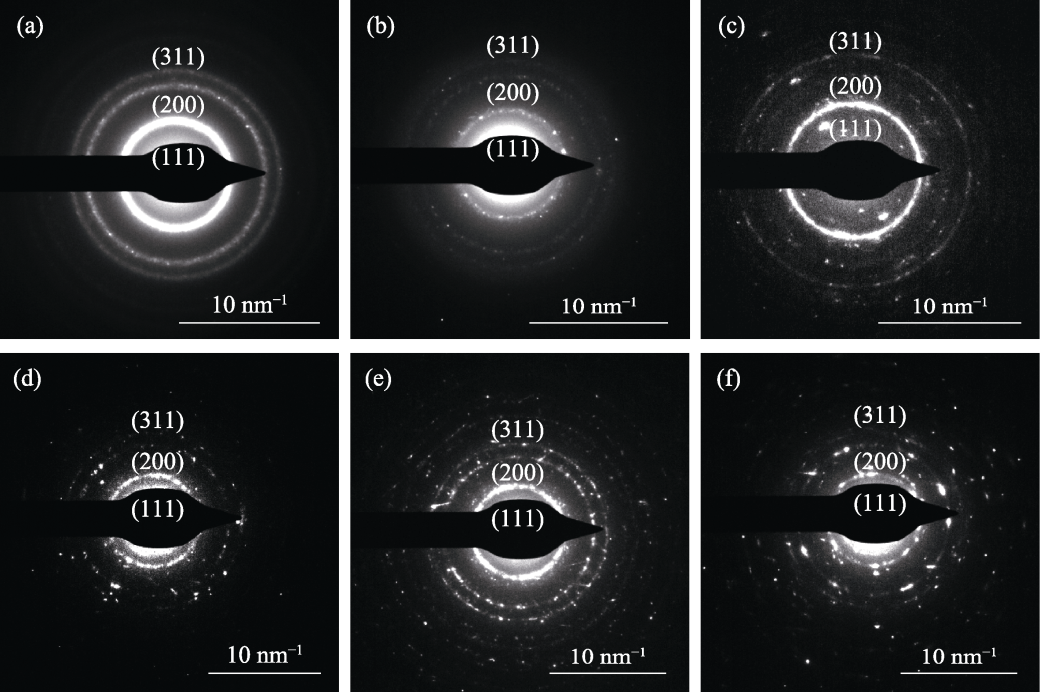
Fig. S1 SAED patterns of (a, d) F-1, (b, e) F-2 and (c, f) F-3 fibers (a-c) before and (d-f) after heat treatment at 1900 ℃ for 1 h
| [1] |
IVEKOVIĆ A, NOVAK S, DRAŽIĆ G, et al. Current status and prospects of SiCf/SiC for fusion structural applications. Journal of the European Ceramic Society, 2013, 33(10): 1577.
DOI URL |
| [2] |
PADTURE N P. Advanced structural ceramics in aerospace propulsion. Nature Materials, 2016, 15(8): 804.
DOI PMID |
| [3] | WANG P R, LIU F Q, WANG H, et al. A review of third generation SiC fibers and SiCf/SiC composites. Journal of Materials Science & Technology, 2019, 35(12): 2743. |
| [4] |
KATOH Y, SNEAD L L, HENAGER C H, et al. Current status and recent research achievements in SiC/SiC composites. Journal of Nuclear Materials, 2014, 455(1/2/3): 387.
DOI URL |
| [5] |
SONG J P, JIAO J, LIU H, et al. Effect of surface state of SiC fibers on their interfacial properties. Composites Communications, 2025, 53: 102232.
DOI URL |
| [6] |
SANTORO U, NOVITSKAYA E, KARANDIKAR K, et al. Phase stability of SiC/SiC fiber reinforced composites: the effect of processing on the formation of α and β phases. Materials Letters, 2019, 241: 123.
DOI URL |
| [7] |
SHI X G, LI M Y, MA W G, et al. Experimental study on thermal transport property of KD-Ⅱ SiC fiber. Journal of Inorganic Materials, 2018, 33(7): 756.
DOI URL |
| [8] |
DONG S M, KATOH Y, KOHYAMA A. Processing optimization and mechanical evaluation of hot pressed 2D Tyranno-SA/SiC composites. Journal of the European Ceramic Society, 2003, 23(8): 1223.
DOI URL |
| [9] |
BHATT R T, HALBIG M C. Creep properties of melt infiltrated SiC/SiC composites with Sylramic™-iBN and Hi-Nicalon™-S fibers. International Journal of Applied Ceramic Technology, 2022, 19(2): 1074.
DOI URL |
| [10] |
HUGUET-GARCIA J, JANKOWIAK A, MIRO S, et al. In situ characterization of ion-irradiation enhanced creep of third generation Tyranno SA 3 SiC fibers. Journal of Materials Research, 2015, 30(9): 1572.
DOI URL |
| [11] |
HOLMES J W, PARK Y H, JONES J W. Tensile creep and creep- recovery behavior of a SiC-fiber-Si3N4-matrix composite. Journal of the American Ceramic Society, 1993, 76(5): 1281.
DOI URL |
| [12] |
LAMOUROUX F, VALLÉS J L, STEEN M. Uniaxial tensile and creep behaviour of an alumina fibre-reinforced ceramic matrix composite: Ⅱ. Modelling of tertiary creep. Journal of the European Ceramic Society, 1994, 14(6): 539.
DOI URL |
| [13] |
ALMANSOUR A S, MORSCHER G N. Tensile creep behavior of SiCf/SiC ceramic matrix minicomposites. Journal of the European Ceramic Society, 2020, 40(15): 5132.
DOI URL |
| [14] |
YAJIMA S, OKAMURA K, HAYASHI J, et al. Synthesis of continuous sic fibers with high tensile strength. Journal of the American Ceramic Society, 1976, 59(7/8): 324.
DOI URL |
| [15] |
BODET R, LAMON J, JIA N Y, et al. Microstructural stability and creep behavior of Si-C-O (nicalon) fibers in carbon monoxide and argon environments. Journal of the American Ceramic Society, 1996, 79(10): 2673.
DOI URL |
| [16] |
VAHLAS C, MONTHIOUX M. On the thermal degradation of lox-M tyranno® fibres. Journal of the European Ceramic Society, 1995, 15(5): 445.
DOI URL |
| [17] |
WILSON M, OPILA E. A review of SiC fiber oxidation with a new study of Hi-Nicalon SiC fiber oxidation. Advanced Engineering Materials, 2016, 18(10): 1698.
DOI URL |
| [18] |
YOUNGBLOOD G E, LEWINSOHN C, JONES R H, et al. Tensile strength and fracture surface characterization of Hi-Nicalon™ SiC fibers. Journal of Nuclear Materials, 2001, 289(1/2): 1.
DOI URL |
| [19] |
TAKEDA M, SAEKI A, SAKAMOTO J I, et al. Effect of hydrogen atmosphere on pyrolysis of cured polycarbosilane fibers. Journal of the American Ceramic Society, 2000, 83(5): 1063.
DOI URL |
| [20] | TAKEDA M, SAKAMOTO J, IMAI Y, et al. Properties of stoichiometric silicon carbide fiber derived from polycarbosilane// WACHTMAN J B. Proceedings of the 18th annual conference on composites and advanced ceramic materials—A:ceramic engineering and science proceedings. Hoboken: John Wiley & Sons, Inc., 1994. |
| [21] |
BUNSELL A R, PIANT A. A review of the development of three generations of small diameter silicon carbide fibres. Journal of Materials Science, 2006, 41(3): 823.
DOI URL |
| [22] |
ISHIKAWA T, KOHTOKU Y, KUMAGAWA K, et al. High-strength alkali-resistant sintered SiC fibre stable to 2200 ℃. Nature, 1998, 391(6669): 773.
DOI |
| [23] |
GOU Y Z, WANG H, JIAN K, et al. Preparation and characterization of SiC fibers with diverse electrical resistivity through pyrolysis under reactive atmospheres. Journal of the European Ceramic Society, 2017, 37(2): 517.
DOI URL |
| [24] |
MORSCHER G N, DICARLO J A. A simple test for thermomechanical evaluation of ceramic fibers. Journal of the American Ceramic Society, 1992, 75(1): 136.
DOI URL |
| [25] |
SHA J J, PARK J S, HINOKI T, et al. Heat treatment effects on creep behavior of polycrystalline SiC fibers. Materials Characterization, 2006, 57(1): 6.
DOI URL |
| [26] |
SHA J J, PARK J S, HINOKI T, et al. Bend stress relaxation of advanced SiC-based fibers and its prediction to tensile creep. Mechanics of Materials, 2007, 39(2): 175.
DOI URL |
| [27] | GAN Y. The regulation of microscopic composition and microstructure of KD-S silicon carbide fibers and the research on these high-temperature creep resistance. Changsha: A Master’s dissertation in National University of Defense Technology, 2018. |
| [28] | SHA J J, NOZAWA T, PARK J S, et al. Effect of heat treatment on the tensile strength and creep resistance of advanced SiC fibers. Journal of Nuclear Materials, 2004, 329: 592. |
| [29] |
YUAN W, HU J B, ZHOU L, et al. Effect of argon atmosphere heat treatment on mechanical properties and microstructural evolution of Shicolon-II SiC fibers. Journal of Inorganic Materials, 2026, 41(1): 119.
DOI URL |
| [30] |
GOU Y Z, JIAN K, WANG H, et al. Fabrication of nearly stoichiometric polycrystalline SiC fibers with excellent high-temperature stability up to 1900 ℃. Journal of the American Ceramic Society, 2018, 101(5): 2050.
DOI URL |
| [31] |
WU S, GOU Y Z, XIANG Y, et al. Effect of long-time annealing at high temperature on the microstructure and mechanical properties of different types of SiC fibers. Composites Part A: Applied Science and Manufacturing, 2024, 185: 108291.
DOI URL |
| [32] |
ZHANG Y, CHEN T X, CHEN J H, et al. The effects of annealing atmosphere and intrinsic component on high temperature evolution behaviors of SiC fibers. Materials Science and Engineering: A, 2022, 848: 143363.
DOI URL |
| [33] |
WU S, GOU Y Z, WANG Y S, et al. Effect of heat treatment on composition, microstructure and mechanical property of domestic KD-SA SiC fibers. Journal of Inorganic Materials, 2023, 38(5): 569.
DOI |
| [34] |
ICHIKAWA H. Polymer-derived ceramic fibers. Annual Review of Materials Research, 2016, 46: 335.
DOI URL |
| [35] |
SHA J J, HINOKI T, KOHYAMA A. Microstructural characterization and fracture properties of SiC-based fibers annealed at elevated temperatures. Journal of Materials Science, 2007, 42(13): 5046.
DOI URL |
| [36] |
USUKAWA R, ISHIKAWA T. Effect of Al contained in polymer- derived SiC crystals on creating stable crystal grain boundaries. International Journal of Applied Ceramic Technology, 2021, 18(1): 6.
DOI URL |
| [37] |
ZHANG Y, WU C L, WANG Y D, et al. A detailed study of the microstructure and thermal stability of typical SiC fibers. Materials Characterization, 2018, 146: 91.
DOI URL |
| [38] |
ZHANG Y, CHEN J H, YAN D X, et al. Conversion of silicon carbide fibers to continuous graphene fibers by vacuum annealing. Carbon, 2021, 182: 435.
DOI URL |
| [39] | CHEN J, ZHAO Z Q, WU S, et al. Relationship of defects and mechanical performance of high-crystalline SiC fibers after ultra-high-temperature annealing. Journal of the American Ceramic Society, 2025, 108(12): e20540. |
| [1] | 赵彤彤, 代吉祥, 苏成, 师艳, 沙建军. 反应熔渗法制备Hf-Si基涂层-基体一体化改性C/C复合材料的微观结构及烧蚀性能[J]. 无机材料学报, 2026, 41(5): 583-594. |
| [2] | 隋金洋, 周大雨, 赵文瑾, 童祎, 王新朋. 工作气压对AlScN薄膜结构和电学性能的影响[J]. 无机材料学报, 2026, 41(4): 486-492. |
| [3] | 袁旺, 胡建宝, 周亮, 阚艳梅, 张翔宇, 董绍明. 氩气气氛热处理对Shicolon-II SiC纤维机械性能和微观结构演变的影响[J]. 无机材料学报, 2026, 41(1): 119-128. |
| [4] | 陈斌, 任科, 王一光. Mini-SiCf/SiC复合材料长时间高温下的力学性能演变[J]. 无机材料学报, 2025, 40(9): 971-980. |
| [5] | 钟卫民, 赵科, 王珂玮, 刘佃光, 刘金铃, 安立楠. 振荡压力振幅对碳化钨微观结构和摩擦磨损性能的影响[J]. 无机材料学报, 2025, 40(9): 964-970. |
| [6] | 苟燕子, 康伟峰, 王堋人. 烧结条件对制备高结晶近化学计量比SiC纤维的影响[J]. 无机材料学报, 2025, 40(4): 405-414. |
| [7] | 穆浩洁, 张源江, 喻彬, 付秀梅, 周世斌, 李晓东. ZrO2掺杂Y2O3-MgO纳米复相陶瓷的制备及性能研究[J]. 无机材料学报, 2025, 40(3): 281-289. |
| [8] | 栾新刚, 何典蔚, 涂建勇, 成来飞. 2D平纹和3D针刺C/SiC复合材料的低速冲击破坏行为和失效机理[J]. 无机材料学报, 2025, 40(2): 205-214. |
| [9] | 李伟, 许志明, 苟燕子, 尹森虎, 余艺平, 王松. SiC纤维烧结陶瓷的制备及其性能研究[J]. 无机材料学报, 2025, 40(2): 177-183. |
| [10] | 曹路涵, 孟佳, 薛玉冬, 盛晓晨, 崔苑苑, 乐军, 宋力昕. SiC过渡层对SiC/SiC陶瓷基复合材料表面MoSi2-SABB涂层结合性能的影响[J]. 无机材料学报, 2025, 40(10): 1119-1128. |
| [11] | 范武刚, 曹雄, 周响, 李玲, 赵冠楠, 张兆泉. 8YSZ陶瓷在模拟压水堆水环境中的耐腐蚀性能[J]. 无机材料学报, 2024, 39(7): 803-809. |
| [12] | 姜灵毅, 庞生洋, 杨超, 张悦, 胡成龙, 汤素芳. C/SiC-BN复合材料的制备及氧化行为[J]. 无机材料学报, 2024, 39(7): 779-786. |
| [13] | 李捷, 罗志新, 崔阳, 张广珩, 孙鲁超, 王京阳. 大气等离子喷涂Y3Al5O12/Al2O3陶瓷涂层的CMAS腐蚀抗力[J]. 无机材料学报, 2024, 39(6): 671-680. |
| [14] | 赵日达, 汤素芳. 多孔碳陶瓷化改进反应熔渗法制备陶瓷基复合材料研究进展[J]. 无机材料学报, 2024, 39(6): 623-633. |
| [15] | 方光武, 谢浩元, 张华军, 高希光, 宋迎东. CMC-EBC损伤耦合机理及一体化设计研究进展[J]. 无机材料学报, 2024, 39(6): 647-661. |
| 阅读次数 | ||||||
|
全文 |
|
|||||
|
摘要 |
|
|||||