无机材料学报 ›› 2026, Vol. 41 ›› Issue (7): 955-964.DOI: 10.15541/jim20250489 CSTR: 32189.14.10.15541/jim20250489
崔楷敏( ), 李端(), 曾雷, 彭江山, 王衍飞, 刘荣军
收稿日期:2025-12-10
修回日期:2026-01-08
出版日期:2026-07-20
网络出版日期:2026-01-21
通讯作者:
李 端, 副研究员. E-mail: duan_li_2016@163.com作者简介:崔楷敏(2000-), 女, 硕士研究生. E-mail: 1850712227@qq.com
基金资助:
CUI Kaimin(), LI Duan(), ZENG Lei, PENG Jiangshan, WANG Yanfei, LIU Rongjun
Received:2025-12-10
Revised:2026-01-08
Published:2026-07-20
Online:2026-01-21
Contact:
LI Duan, associate professor. E-mail: duan_li_2016@163.comAbout author:CUI Kaimin (2000-), female, Master candidate. E-mail: 1850712227@qq.com
Supported by:摘要:
高速飞行器技术的快速发展, 对极端环境下兼具雷达透波与红外传输功能的材料提出迫切需求。莫来石陶瓷因具有优异的高温力学性能、介电性能及一定的红外透明性, 成为理想候选材料之一。然而, 莫来石陶瓷的传统制备方法温度高、工艺复杂, 限制了其实际应用。本研究开发了一种低成本、短周期的莫来石陶瓷低温制备方法, 选用高活性廉价多孔原料, 采用放电等离子烧结(SPS)技术, 利用介孔结构坍塌释放的高活性表面与SPS场效应的协同作用, 在1200 ℃下实现莫来石陶瓷的一步快速烧结制备, 显著降低烧结温度和缩短制备周期, 深入研究了烧结工艺参数对陶瓷的微结构、力学性能、介电性能以及红外传输性能的影响。1200 ℃、70 MPa、升温速率100 ℃·min-1条件下制备所得陶瓷的密度可达3.06 g·cm-3, 开孔率低至1.6%, 弯曲强度达152.9 MPa, 弯曲模量达87.1 GPa。较高的机械压力促使莫来石晶粒由针状向短柱状转变, 断裂模式由沿晶断裂过渡为穿晶断裂, 从而使陶瓷获得优异的力学性能。在8~16 GHz频段, 该陶瓷的的平均介电常数为6.77且呈现出良好的稳定性, 损耗角正切值为4.7×10⁻⁴, 透波率大于70%, 这得益于陶瓷烧结后的残余气孔显著降低了介质极化。同时, 陶瓷在近红外波段的透过率达45.11%, 在雷达/红外双模透波材料领域展现出良好的应用前景。
中图分类号:
崔楷敏, 李端, 曾雷, 彭江山, 王衍飞, 刘荣军. 低温快速制备具有雷达/红外双模传输特性的莫来石陶瓷[J]. 无机材料学报, 2026, 41(7): 955-964.
CUI Kaimin, LI Duan, ZENG Lei, PENG Jiangshan, WANG Yanfei, LIU Rongjun. Rapid and Low-temperature Fabrication of Mullite Ceramics with Dual-mode Radar/Infrared Transmission Characteristics[J]. Journal of Inorganic Materials, 2026, 41(7): 955-964.
| Sample | Heating rate/ (℃·min-1) | Sintering temperature/℃ | Dwell time/ min | Pressure/ MPa | Density/ (g·cm-3) | Open porosity/% |
|---|---|---|---|---|---|---|
| AS-1 | 300 | 1150 | 2 | 30 | 2.44 | 21.1 |
| AS-2 | 300 | 1150 | 2 | 50 | 2.45 | 21.1 |
| AS-3 | 300 | 1150 | 2 | 70 | 2.58 | 16.4 |
| AS-4 | 300 | 1200 | 2 | 70 | 2.78 | 10.5 |
| AS-5 | 200 | 1200 | 2 | 70 | 2.80 | 9.0 |
| AS-6 | 100 | 1200 | 5 | 70 | 3.06 | 1.6 |
表1 陶瓷的烧结工艺参数及对应的密度与开孔率
Table 1 Sintering parameters, density and open porosity of ceramics
| Sample | Heating rate/ (℃·min-1) | Sintering temperature/℃ | Dwell time/ min | Pressure/ MPa | Density/ (g·cm-3) | Open porosity/% |
|---|---|---|---|---|---|---|
| AS-1 | 300 | 1150 | 2 | 30 | 2.44 | 21.1 |
| AS-2 | 300 | 1150 | 2 | 50 | 2.45 | 21.1 |
| AS-3 | 300 | 1150 | 2 | 70 | 2.58 | 16.4 |
| AS-4 | 300 | 1200 | 2 | 70 | 2.78 | 10.5 |
| AS-5 | 200 | 1200 | 2 | 70 | 2.80 | 9.0 |
| AS-6 | 100 | 1200 | 5 | 70 | 3.06 | 1.6 |
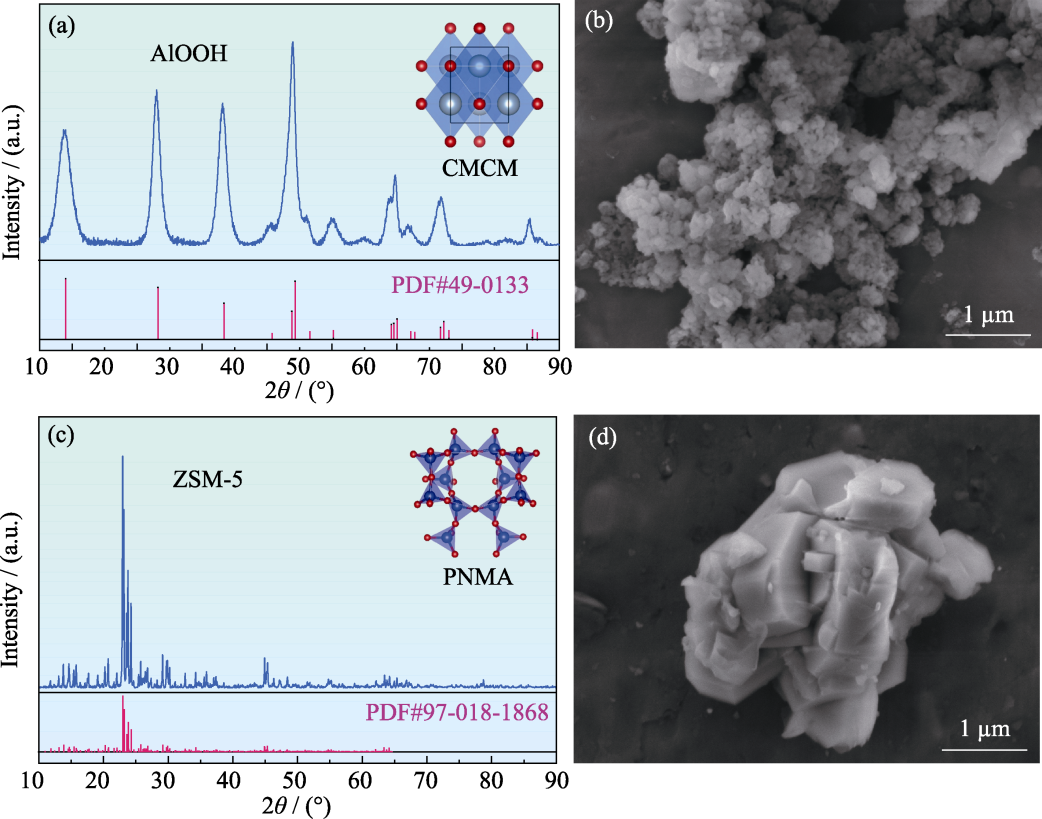
图1 原料粉体的(a, c) XRD图谱及(b, d) SEM照片
Fig. 1 (a, c) XRD patterns and (b, d) SEM images of the raw powders (a, b) AlOOH; (c, d) ZSM-5
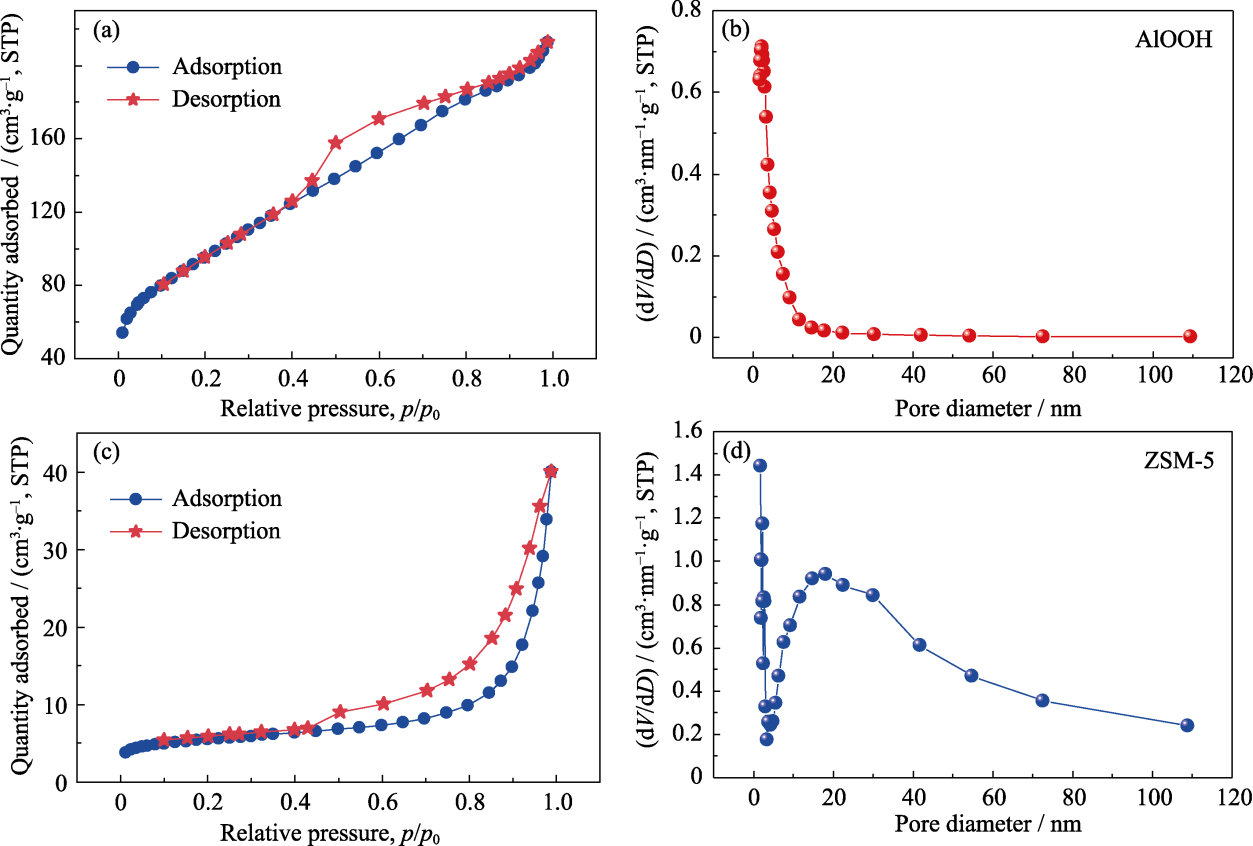
图2 原料粉体的(a, c) N2吸脱附曲线及(b, d)孔径分布图
Fig. 2 (a, c) N2 adsorption-desorption isotherms and (b, d) pore size distributions of the raw powders (a, b) AlOOH; (c, d) ZSM-5
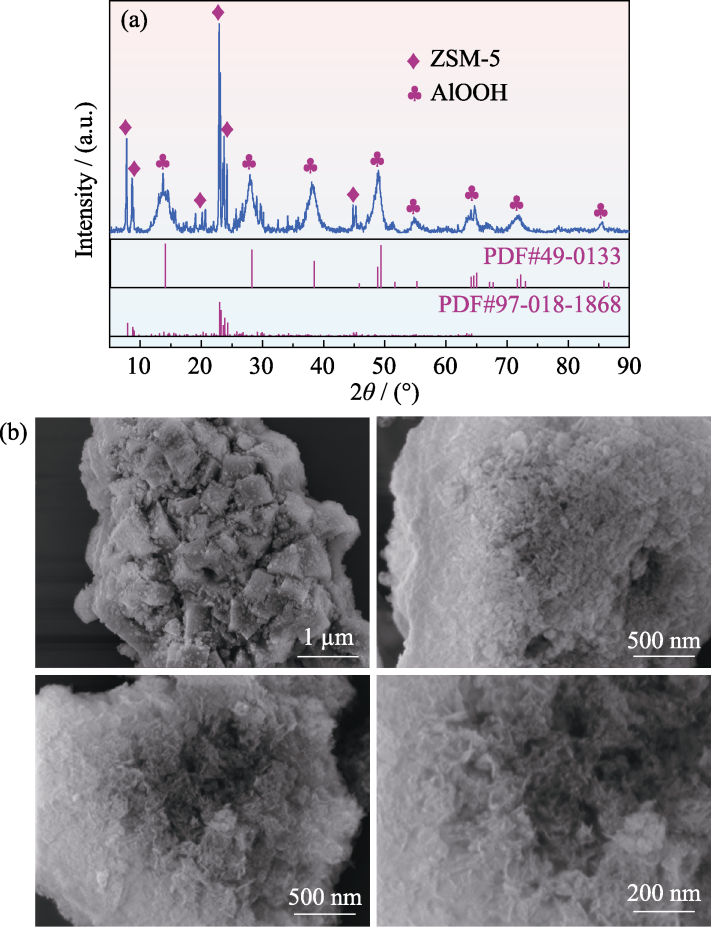
图3 干混原粉的(a) XRD图谱及(b) SEM照片
Fig. 3 (a) XRD pattern and (b) SEM images of the dry-mixed raw powders
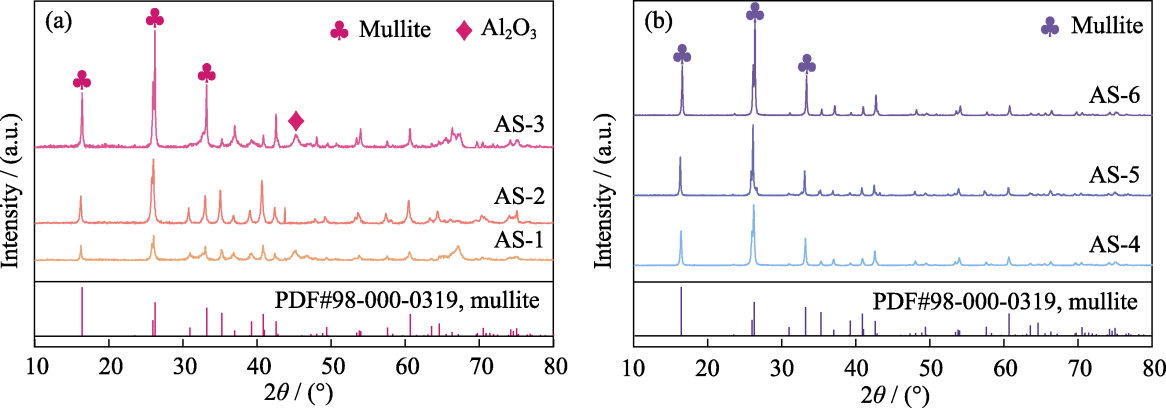
图4 不同烧结参数制得莫来石陶瓷的XRD图谱
Fig. 4 XRD patterns of the obtained mullite ceramics under different sintering parameters (a) AS-1, AS-2, and AS-3; (b) AS-4, AS-5, and AS-6
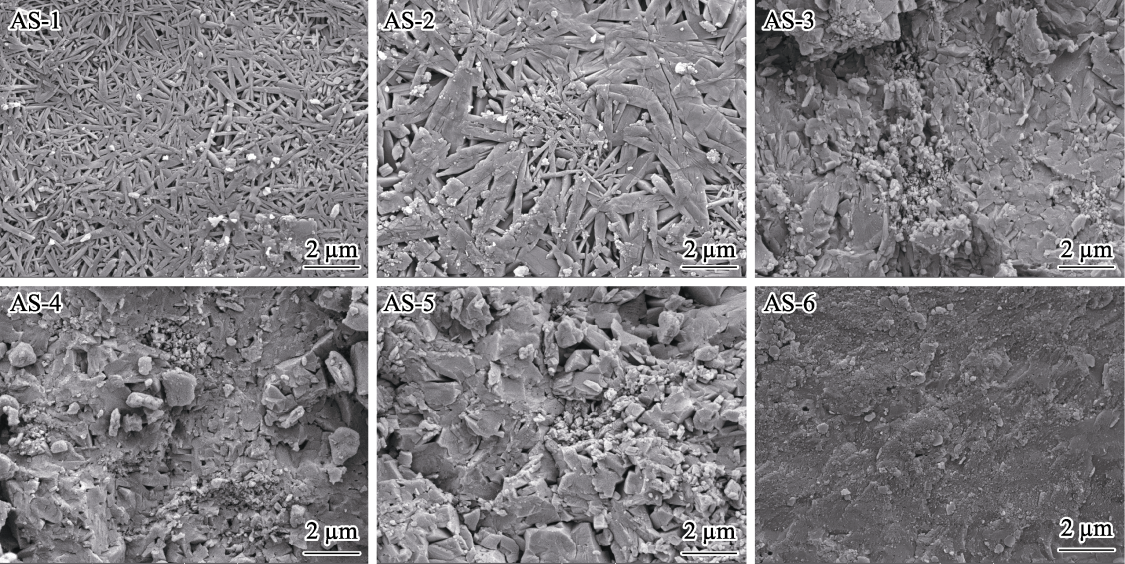
图5 不同烧结工艺参数制得莫来石陶瓷的SEM照片
Fig. 5 SEM images of the obtained mullite ceramics under different sintering parameters
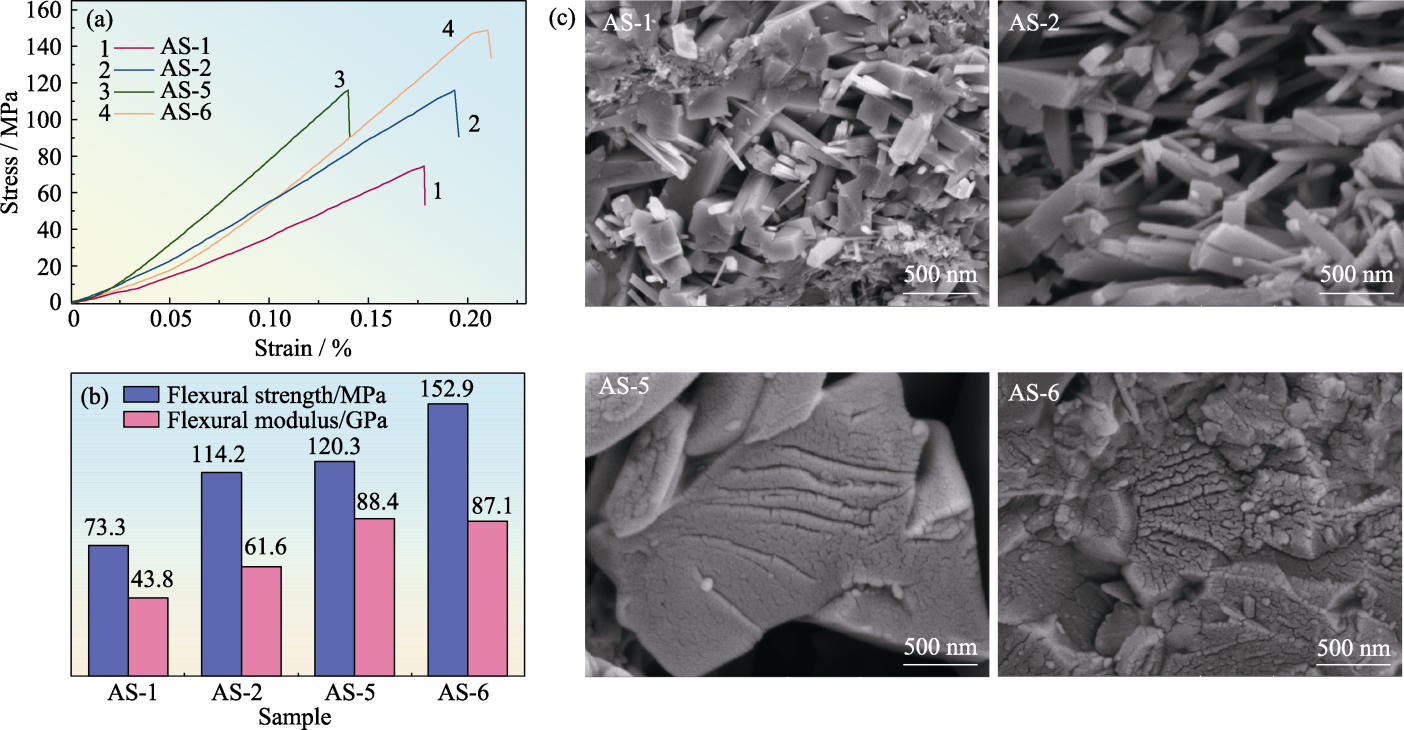
图6 不同烧结工艺参数制得莫来石陶瓷的力学性能及断口形貌照片
Fig. 6 Mechanical characterization and fracture morphologies of the obtained mullite ceramics under different sintering parameters (a) Stress-strain curves; (b) Flexural strength and modulus; (c) SEM images of fracture surfaces
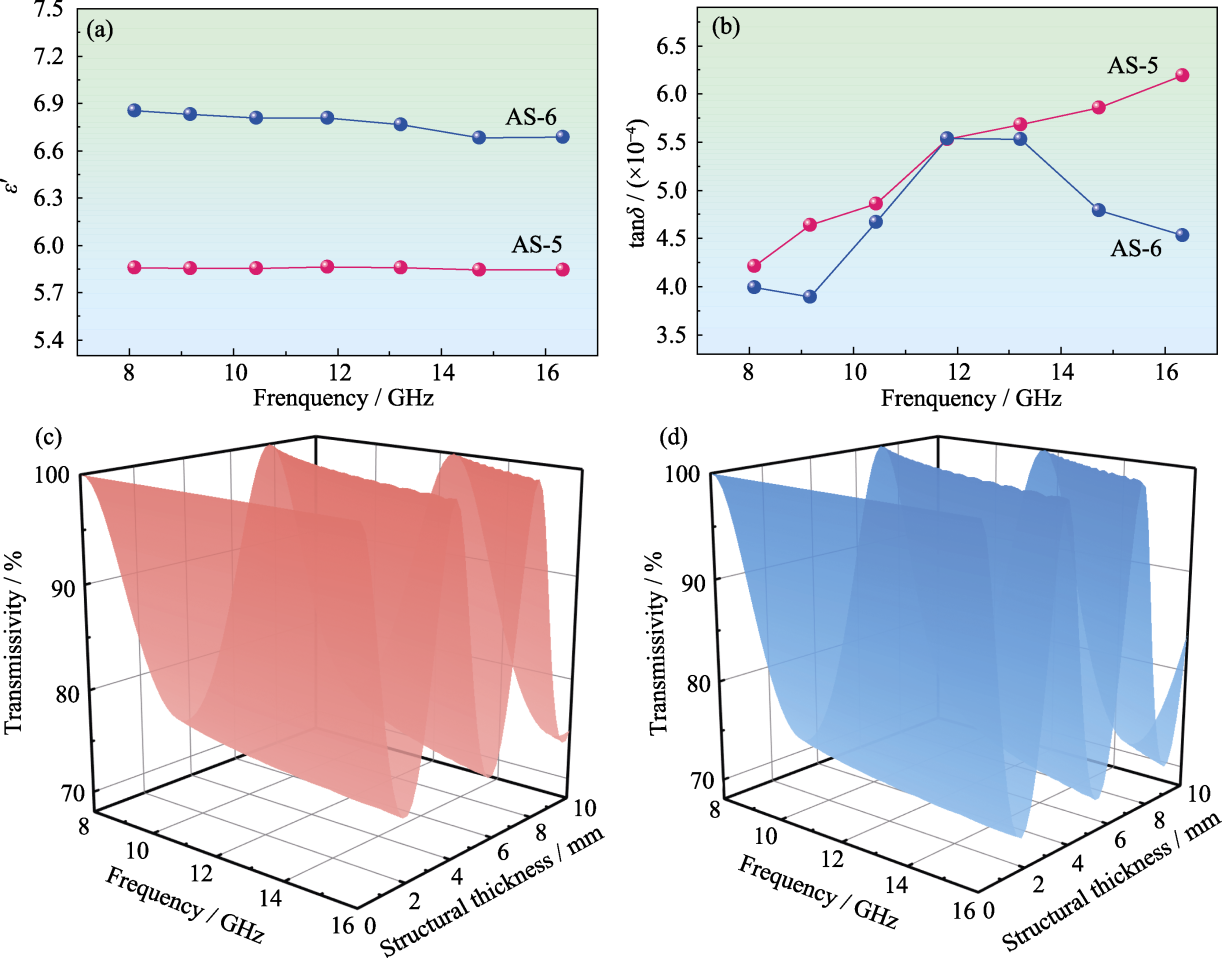
图7 不同烧结工艺参数制得莫来石陶瓷的介电性能
Fig. 7 Dielectric properties of the obtained mullite ceramics under different sintering parameters (a) ${\epsilon }^{\prime }$; (b) $\mathrm{tan}\delta $; (c, d) Microwave transmittance of (c) AS-5 and (d) AS-6
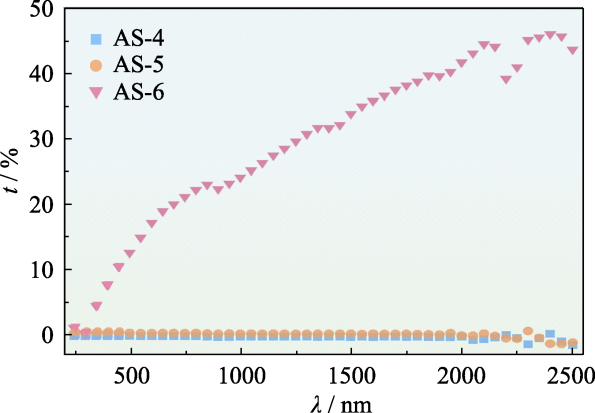
图8 莫来石陶瓷的红外透过率曲线
Fig. 8 Infrared transmittance spectra of mullite ceramic samples
| [1] |
KOČÍ J, HAMÁČEK J, MACHÁČEK J, et al. Effect of long-term high-temperature exposure in a controlled atmosphere on mullite- corundum ceramics for advanced applications in nuclear power technology. Ceramics International, 2024, 50(13): 24273.
DOI URL |
| [2] |
ROY S. Properties and advanced applications of porous ceramic composites. Open Ceramics, 2025, 21: 100714.
DOI URL |
| [3] |
LIN Y W, JING Z, CHEN H T, et al. Ablative properties of SiCp doped Cf/Li2O-Al2O3-SiO2 composites. Journal of Inorganic Materials, 2025, 40(10): 1153.
DOI URL |
| [4] |
CHENG X T, LIU Y T, SI Y, et al. Direct synthesis of highly stretchable ceramic nanofibrous aerogels via 3D reaction electrospinning. Nature Communications, 2022, 13: 2637.
DOI |
| [5] |
WANG Y L, PENG Z W, TIAN R, et al. Microwave-transparent refractory materials for high-temperature metallurgical applications. Journal of Alloys and Compounds, 2025, 1033: 181063.
DOI URL |
| [6] |
ZHU Z X, WANG F, YAO H J. High-temperature insulation property of opacifier-doped Al2O3-SiO2 aerogel/mullite fiber composites. Journal of Inorganic Materials, 2018, 33(9): 969.
DOI URL |
| [7] |
SYAMKUMAR K, BABU N, GOVINDARAJAN S, et al. Hot corrosion behaviour of mullite thermal barrier coatings for marine diesel engines. Ceramics International, 2024, 50(2): 2808.
DOI URL |
| [8] |
GAO J M, WANG B, DU Z Y, et al. Molten salt synthesis of mullite whiskers entirely derived from fly ash for electronic packaging toughening ceramic applications. Journal of Materials Research and Technology, 2022, 21: 3719.
DOI URL |
| [9] |
ZHANG J X, ZHANG M J, GU H Z, et al. Processing and properties of Al-Si microcapsules with a biomimetic-corrugated structure and corundum-mullite composite shell. Journal of Materiomics, 2025, 11(3): 100906.
DOI URL |
| [10] |
LI X, HU C, LIU Q, et al. Fluoride transparent ceramics for solid-state lasers: a review. Journal of Advanced Ceramics, 2024, 13(12): 1891.
DOI URL |
| [11] |
XU J, SHAO Y Q, FENG X Y, et al. Low sintering shrinkage porous ceramics: principles, progress, and perspectives. Journal of Advanced Ceramics, 2025, 14(2): 9221015.
DOI URL |
| [12] |
SHAO J H, BAI C Y, LI X Y, et al. Open-cell mullite ceramic foams derived from porous geopolymer precursors with tailored porosity. Journal of Advanced Ceramics, 2023, 12(2): 279.
DOI URL |
| [13] | GREGOROVIČOVÁ E, POSPÍŠIL J. Ceramic filters for high-temperature flue gas filtration and their regeneration: a review of the current state of knowledge. Process Safety and Environmental Protection, 2024, 190: 688. |
| [14] |
DUN Y H, LIU Y F, XU J, et al. Advancements in rare earth mullite oxides (AMn2O5) for catalytic oxidation: structure, activity and design strategies. Applied Catalysis A: General, 2024, 685: 119872.
DOI URL |
| [15] |
GUO X Z, LI W Y, NAKANISHI K, et al. Preparation of mullite monoliths with well-defined macropores and mesostructured skeletons via the Sol-Gel process accompanied by phase separation. Journal of the European Ceramic Society, 2013, 33(10): 1967.
DOI URL |
| [16] |
SANAD M M S, RASHAD M M, ABDEL-AAL E A, et al. Synthesis and characterization of nanocrystalline mullite powders at low annealing temperature using a new technique. Journal of the European Ceramic Society, 2012, 32(16): 4249.
DOI URL |
| [17] |
XU H Q, LI D X, LUO R W, et al. Low-temperature synthesis of mullite and its structural evolution during mullitization. Ceramics International, 2025, 51(6): 7100.
DOI URL |
| [18] |
KAYA C, HE J Y, GU X, et al. Nanostructured ceramic powders by hydrothermal synthesis and their applications. Microporous and Mesoporous Materials, 2002, 54(1/2): 37.
DOI URL |
| [19] |
LIU R P, XIANG D P. Recycling photovoltaic silicon waste for fabricating porous mullite ceramics by low-temperature reaction sintering. Journal of the European Ceramic Society, 2021, 41(12): 5957.
DOI URL |
| [20] |
HUO W L, ZHANG X Y, CHEN Y G, et al. Novel mullite ceramic foams with high porosity and strength using only fly ash hollow spheres as raw material. Journal of the European Ceramic Society, 2018, 38(4): 2035.
DOI URL |
| [21] |
MA B Y, SU C, REN X M, et al. Preparation and properties of porous mullite ceramics with high-closed porosity and high strength from fly ash via reaction synthesis process. Journal of Alloys and Compounds, 2019, 803: 981.
DOI URL |
| [22] |
AKPINAR S, KUSOGLU I M, ERTUGRUL O, et al. In situ mullite foam fabrication using microwave energy. Journal of the European Ceramic Society, 2012, 32(4): 843.
DOI URL |
| [23] |
HAN L, DENG X G, LI F L, et al. Preparation of high strength porous mullite ceramics via combined foam-gelcasting and microwave heating. Ceramics International, 2018, 44(12): 14728.
DOI URL |
| [24] |
LÜ Q K, DONG X F, ZHU Z W, et al. Environment-oriented low- cost porous mullite ceramic membrane supports fabricated from coal gangue and bauxite. Journal of Hazardous Materials, 2014, 273: 136.
DOI URL |
| [25] |
VIJAYAN S, WILSON P, PRABHAKARAN K. Ultra low-density mullite foams by reaction sintering of thermo-foamed alumina- silica powder dispersions in molten sucrose. Journal of the European Ceramic Society, 2017, 37(4): 1657.
DOI URL |
| [26] |
FUKUSHIMA M, YOSHIZAWA Y. Fabrication and morphology control of highly porous mullite thermal insulators prepared by gelation freezing route. Journal of the European Ceramic Society, 2016, 36: 2947.
DOI URL |
| [27] |
HOU Z P, ZHANG B, ZHANG R, et al. Fabrication of highly porous mullite microspheres via oil-drop molding accompanied by freeze casting. Ceramics International, 2017, 43(12): 8809.
DOI URL |
| [28] |
LI J S, ZENG L, LIU R J, et al. Functional strontium tantalum oxynitride ceramics: efficient synthesis, densification and dielectric performance. Journal of Inorganic Materials, 2023, 38(8): 885.
DOI URL |
| [29] |
IRSHAD H M, HAKEEM A S, AHMED T, et al. Tribological and thermomechanical behaviour of alumina-based hybrid nanocomposites. Materials Chemistry and Physics, 2025, 341: 130828.
DOI URL |
| [30] |
YANG J W, LEI L W, ZHANG J Y. Preparation of alumina ceramics via a two-step sintering process. Materials, 2025, 18(8): 1789.
DOI URL |
| [31] |
MAJIDIAN H, NIKZAD L, FARVIZI M, et al. Reactive spark plasma sintering of alumina-mullite-zirconia composites. Ceramics International, 2025, 51(23): 38636.
DOI URL |
| [32] | REN L, FU Z Y, WANG Y C, et al. Fabrication of transparent mullite ceramic by spark plasma sintering from powders synthesized via Sol-Gel process combined with pulse current heating. Materials & Design, 2015, 83: 753. |
| [33] |
LIU Y, ZHANG K Y, LI T Y, et al. Electric-field assisted joining technology for the ceramics materials: current status and development trend. Journal of Inorganic Materials, 2023, 38(2): 113.
DOI |
| [34] |
HUANG P, ZHOU B Y, ZHENG Q, et al. Nano wave plates structuring and index matching in transparent hydroxyapatite-YAG: Ce composite ceramics for high luminous efficiency white light- emitting diodes. Advanced Materials, 2020, 32(1): 1905951.
DOI URL |
| [35] | FARBER E M, SERAPHIM N M, TAMAKUWALA K, et al. Porous materials: the next frontier in energy technologies. Science, 2025, 390(6772): 9391. |
| [36] |
LI X Q, CHEN F Y, ZHANG L L, et al. Preparation of low- dielectric porous silica ceramics by sintering mesoporous silica. Integrated Ferroelectrics, 2012, 135(1): 144.
DOI URL |
| [37] |
YU S Y, LI Z F, CUI J P, et al. Preparation of pressureless-sintered dense cordierite ceramics with high flexural strength by mesoporous powder. Ceramics International, 2025, 51(17): 24202.
DOI URL |
| [38] |
FANG H L, GU S J, FAN S J, et al. Rapidly fabricating Y2O3 transparent ceramics at low temperature by SPS with mesoporous powder. Journal of the American Ceramic Society, 2023, 106(4): 2491.
DOI URL |
| [39] |
HENNING L M, MÜLLER J T, SMALES G J, et al. Hierarchically porous and mechanically stable monoliths from ordered mesoporous silica and their water filtration potential. Nanoscale Advances, 4(18): 3892.
DOI URL |
| [40] |
PÉREZ J M, RINCÓN J M, ROMERO M. Effect of moulding pressure on microstructure and technological properties of porcelain stoneware. Ceramics International, 2012, 38(1): 317.
DOI URL |
| [41] |
HSIUNG C H H, PYZIK A J, DE CARLO F, et al. Microstructure and mechanical properties of acicular mullite. Journal of the European Ceramic Society, 2013, 33(3): 503.
DOI URL |
| [42] |
XIA L, YANG Y N, ZHANG X Y, et al. Crystal structure and wave-transparent properties of lithium aluminum silicate glass- ceramics. Ceramics International, 2018, 44(12): 14896.
DOI URL |
| [43] |
SHANG X B, ZHAI D, LIU M H, et al. Dielectric properties and electromagnetic wave transmission performance of aluminium silicate fibreboard at 915 MHz and 2450 MHz. Ceramics International, 2021, 47(6): 7539.
DOI URL |
| [44] |
TU G S, XU P Y, CHEN B W, et al. Reaction-sintered highly transparent MgGa2O4 ceramics with enhanced dielectric properties. Journal of the European Ceramic Society, 2025, 45(3): 117024.
DOI URL |
| [45] |
AHMADI S, YEKTA B E, SARPOOLAKY H, et al. Preparation of monolithic transparent mullite-based glass-ceramics by the Sol-Gel method. Journal of Non-Crystalline Solids, 2022, 575: 121186.
DOI URL |
| [46] |
YE J H, ZHOU Z Z, HU C, et al. Yb:Sc2O3 transparent ceramics fabricated from co-precipitated nano-powders: microstructure and optical property. Journal of Inorganic Materials, 2025, 40(2): 215.
DOI URL |
| [47] |
HŘÍBALOVÁ S, PABST W. Modeling light scattering by spherical pores for calculating the transmittance of transparent ceramics-all you need to know. Journal of the European Ceramic Society, 2021, 41(4): 2169.
DOI URL |
| [48] |
PABST W, HŘÍBALOVÁ S. Light scattering models for describing the transmittance of transparent and translucent alumina and zirconia ceramics. Journal of the European Ceramic Society, 2021, 41(3): 2058.
DOI URL |
| [49] | 张桂敏, 王玉成, 傅正义, 等. 单相胶的化学组成对莫来石微观结构及红外透波性能的影响. 硅酸盐学报, 2009, 37(6): 987. |
| [50] |
SHEPILOV M, DYMSHITS O, ALEKSEEVA I, et al. Structure and anomalous light scattering of Er-doped transparent glass- ceramics containing ZnO nanocrystals. Journal of Non-Crystalline Solids, 2021, 571: 121067.
DOI URL |
| [1] | 李文元, 徐佳楠, 邓瀚澳, 常爱民, 张博. 钒取代对LaTaO4陶瓷微观结构和微波介电性能的影响[J]. 无机材料学报, 2025, 40(6): 697-703. |
| [2] | 黄子鹏, 贾文晓, 李玲霞. (Ti0.5W0.5)5+掺杂MgNb2O6陶瓷的晶体结构与太赫兹介电性能[J]. 无机材料学报, 2025, 40(6): 647-655. |
| [3] | 尹长志, 成名飞, 雷微程, 蔡弋炀, 宋小强, 付明, 吕文中, 雷文. Ga3+掺杂对SrAl2Si2O8陶瓷晶体结构及微波介电性能的影响[J]. 无机材料学报, 2025, 40(6): 704-710. |
| [4] | 熊思宇, 莫尘, 朱肖伟, 朱国斌, 陈德钦, 刘来君, 施晓东, 李纯纯. 超低介电常数LiBxAl1-xSi2O6微波介质陶瓷的低温烧结[J]. 无机材料学报, 2025, 40(5): 536-544. |
| [5] | 缪鹏程, 王丽君, 沈紫怡, 黄莉, 袁宁一, 丁建宁. 微球状Ag2Se的溶剂热合成及其热电性能研究[J]. 无机材料学报, 2025, 40(12): 1373-1378. |
| [6] | 李俊生, 曾良, 刘荣军, 王衍飞, 万帆, 李端. 锶钽氧氮化物功能陶瓷的高效合成、致密化及介电性能研究[J]. 无机材料学报, 2023, 38(8): 885-892. |
| [7] | 陈雷, 胡海龙. 柔性PDMS基介电复合材料的电场及击穿损伤形貌演变规律研究[J]. 无机材料学报, 2023, 38(2): 155-162. |
| [8] | 产思义, 屠菊萍, 黄珂, 邵思武, 杨志亮, 刘鹏, 刘金龙, 陈良贤, 魏俊俊, 安康, 郑宇亭, 李成明. 2英寸MPCVD光学级均匀金刚石膜的制备研究[J]. 无机材料学报, 2023, 38(12): 1413-1419. |
| [9] | 韦婷婷, 徐华蕊, 朱归胜, 龙神峰, 张秀云, 赵昀云, 江旭鹏, 宋金杰, 郭宁杰, 龚祎鹏. BaTiO3陶瓷的低温冷烧结制备及性能研究[J]. 无机材料学报, 2022, 37(8): 903-910. |
| [10] | 姚晓刚, 彭海益, 顾忠元, 何飞, 赵相毓, 林慧兴. 聚苯醚/钙镧钛微波复合基板[J]. 无机材料学报, 2022, 37(5): 493-498. |
| [11] | 叶芬, 江向平, 陈云婧, 黄枭坤, 曾仁芬, 陈超, 聂鑫, 成昊. (0.96NaNbO3-0.04CaZrO3)-xFe2O3反铁电陶瓷的介电及储能性能研究[J]. 无机材料学报, 2022, 37(5): 499-506. |
| [12] | 孙扬善, 杨治华, 蔡德龙, 张正义, 柳琪, 房树清, 冯良, 石丽芬, 王友乐, 贾德昌. 粉末烧结法制备α-堇青石基玻璃陶瓷的析晶动力学和性能[J]. 无机材料学报, 2022, 37(12): 1351-1357. |
| [13] | 张晓燕, 刘馨玥, 闫金华, 谷耀行, 齐西伟. 钙钛矿型(La0.2Li0.2Ba0.2Sr0.2Ca0.2)TiO3高熵氧化物陶瓷的制备及性能研究[J]. 无机材料学报, 2021, 36(4): 379-385. |
| [14] | 万朋, 李勉, 黄庆. 熔盐辅助合成Dy3Si2C2包裹SiC粉体及其陶瓷的烧结行为[J]. 无机材料学报, 2021, 36(1): 49-54. |
| [15] | 王通,王渊浩,杨海波,高淑雅,王芬,鲁雅文. BaTiO3-ZnNb2O6陶瓷介电及储能性能研究[J]. 无机材料学报, 2020, 35(4): 431-438. |
| 阅读次数 | ||||||
|
全文 |
|
|||||
|
摘要 |
|
|||||