
Journal of Inorganic Materials ›› 2026, Vol. 41 ›› Issue (10): 1453-1458.DOI: 10.15541/jim20250521
• RESEARCH ARTICLE • Previous Articles Next Articles
YU Yanqiang1,2( ), XIONG Wei2(), CHEN Liang2, ZHOU Yao2, LI Ying1(), YUAN Hui2
Received:2025-12-31
Revised:2026-01-29
Published:2026-10-20
Online:2026-04-03
Contact:
XIONG Wei, associate professor. E-mail: xiongwei@mail.sic.ac.cn;About author:YU Yanqiang (1997-), male, Master candidate. E-mail: yuyanqiang2023@163.com
Supported by:CLC Number:
YU Yanqiang, XIONG Wei, CHEN Liang, ZHOU Yao, LI Ying, YUAN Hui. Scattering Particles in Bi12SiO20 Crystals Grown by the Vertical Bridgman Method[J]. Journal of Inorganic Materials, 2026, 41(10): 1453-1458.
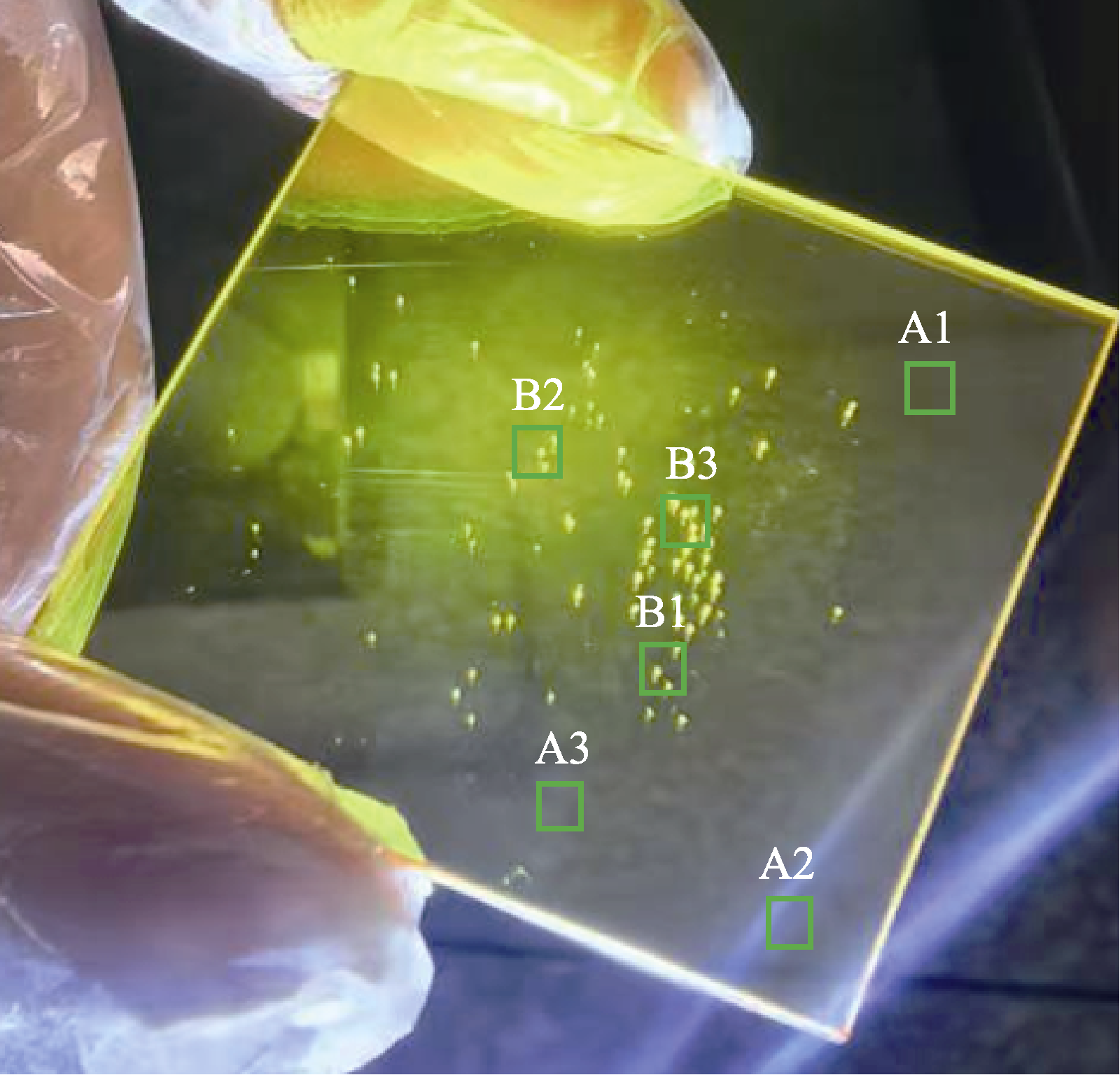
Fig. 1 Scattering particles observed under intense light and transmission test areas
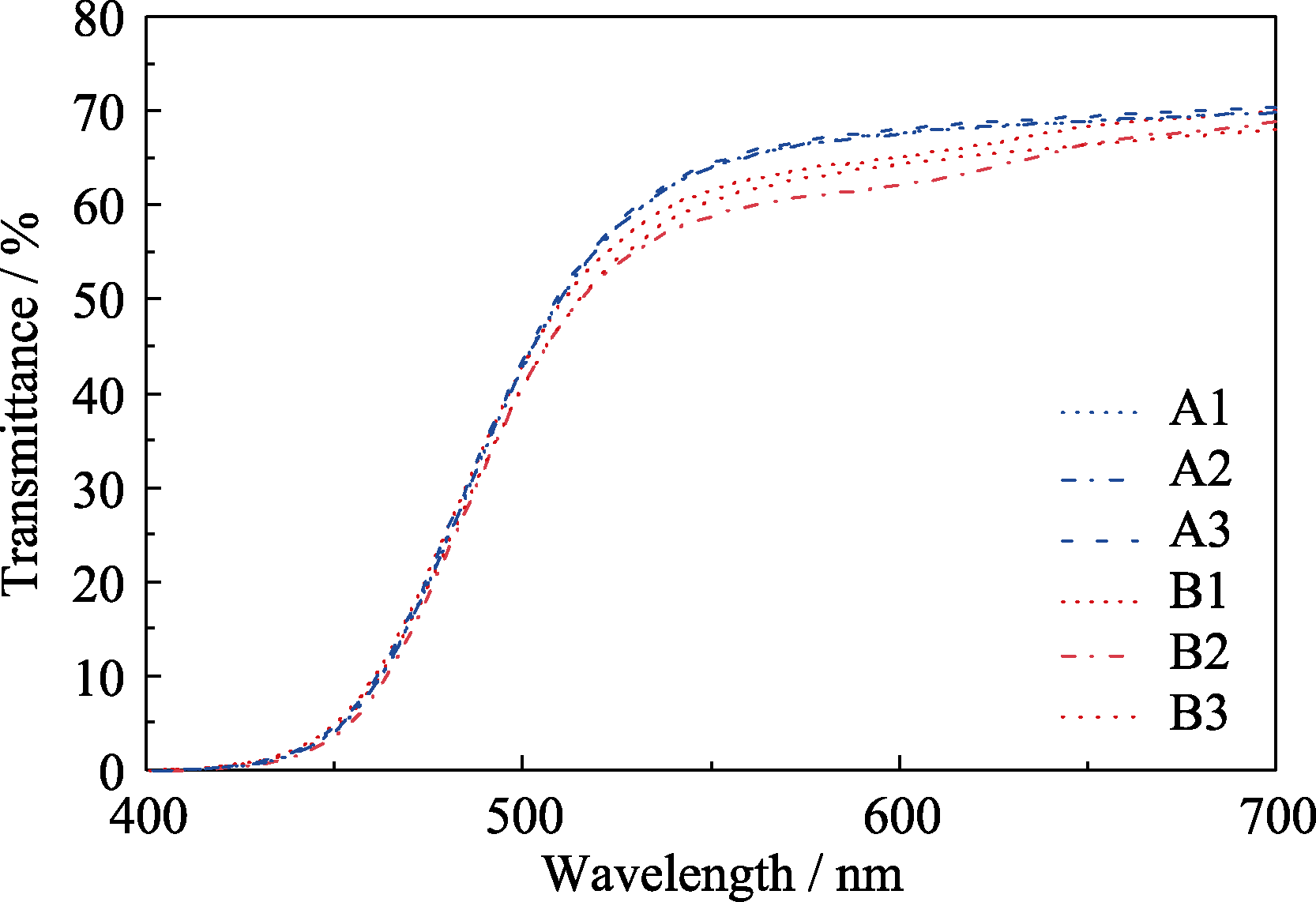
Fig. 2 Transmission spectra of the labeled areas in Fig. 1 Colorful figure is available on website
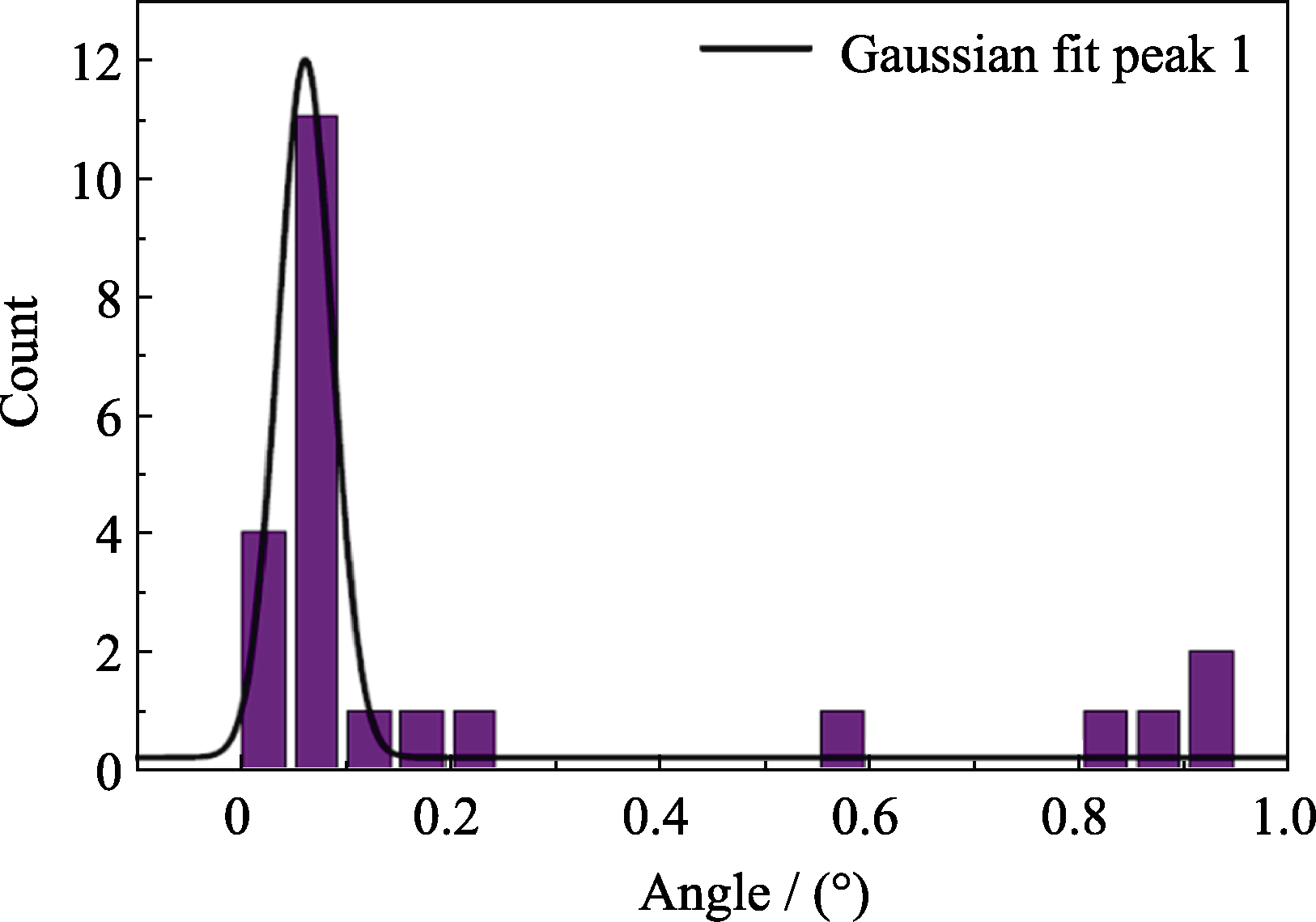
Fig. 3 Gaussian fitting curve of the angle distribution between the scattering particle orientation and the crystal growth direction [100]
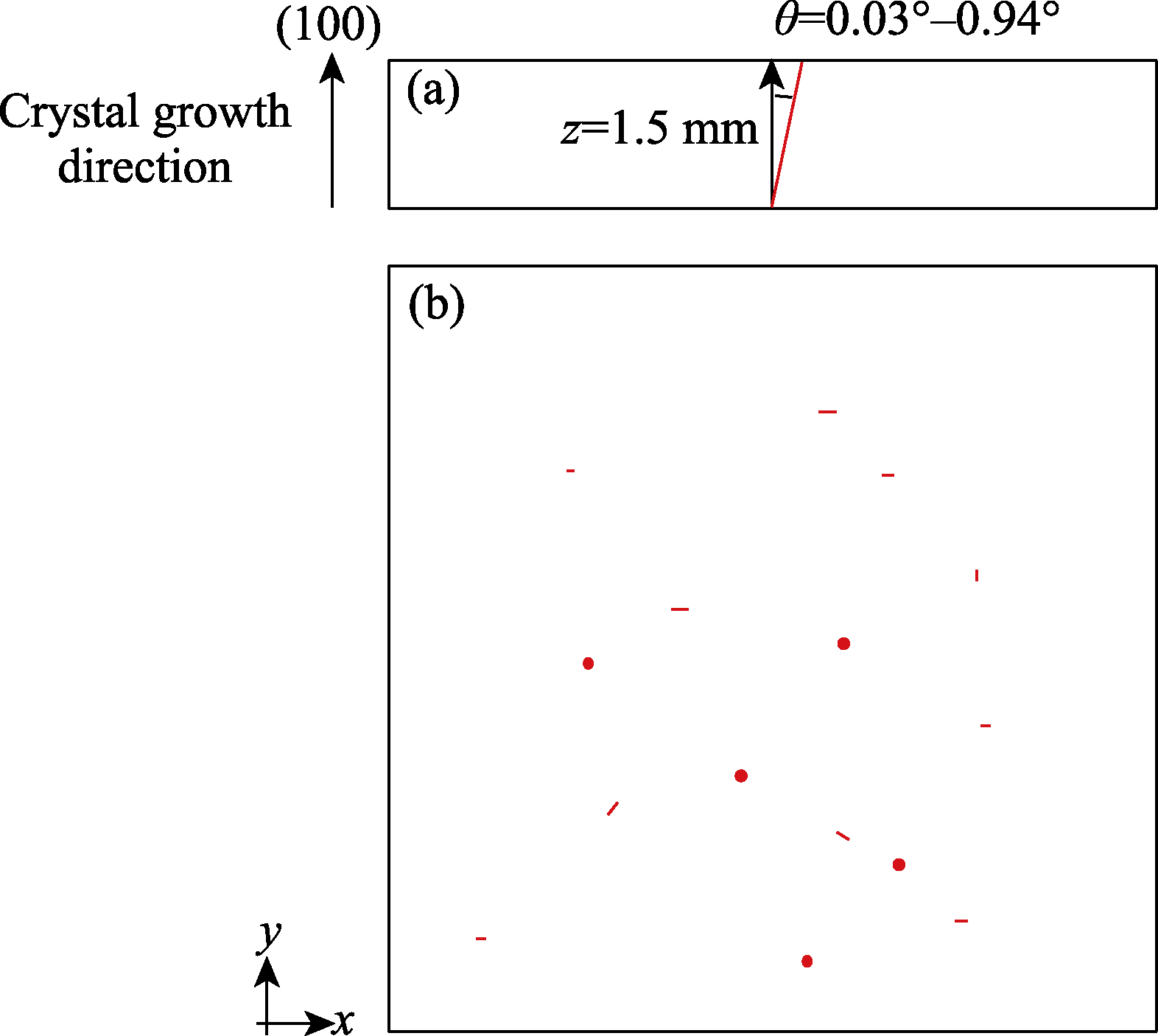
Fig. 4 Schematic diagram of the spatial position distribution of scattering particles in BSO crystal (a) Angle with the growth direction [100]; (b) Distribution in the x-y plane
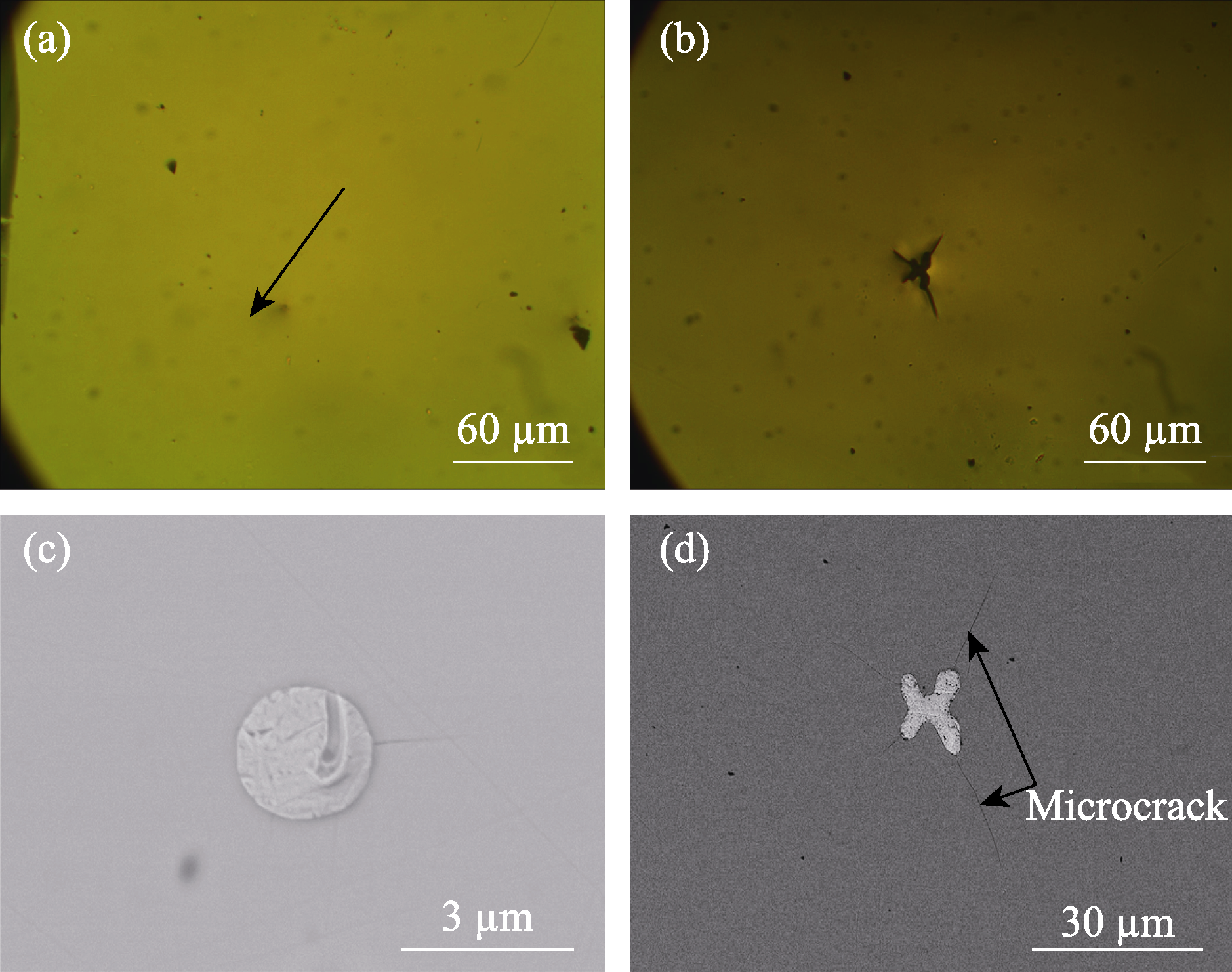
Fig. 5 TPM and SEM images of scattering particles in BSO crystal before corrosion (a, c) Scattering particles on the A-side of the crystal; (b, d) Scattering particles on the B-side of the crystal
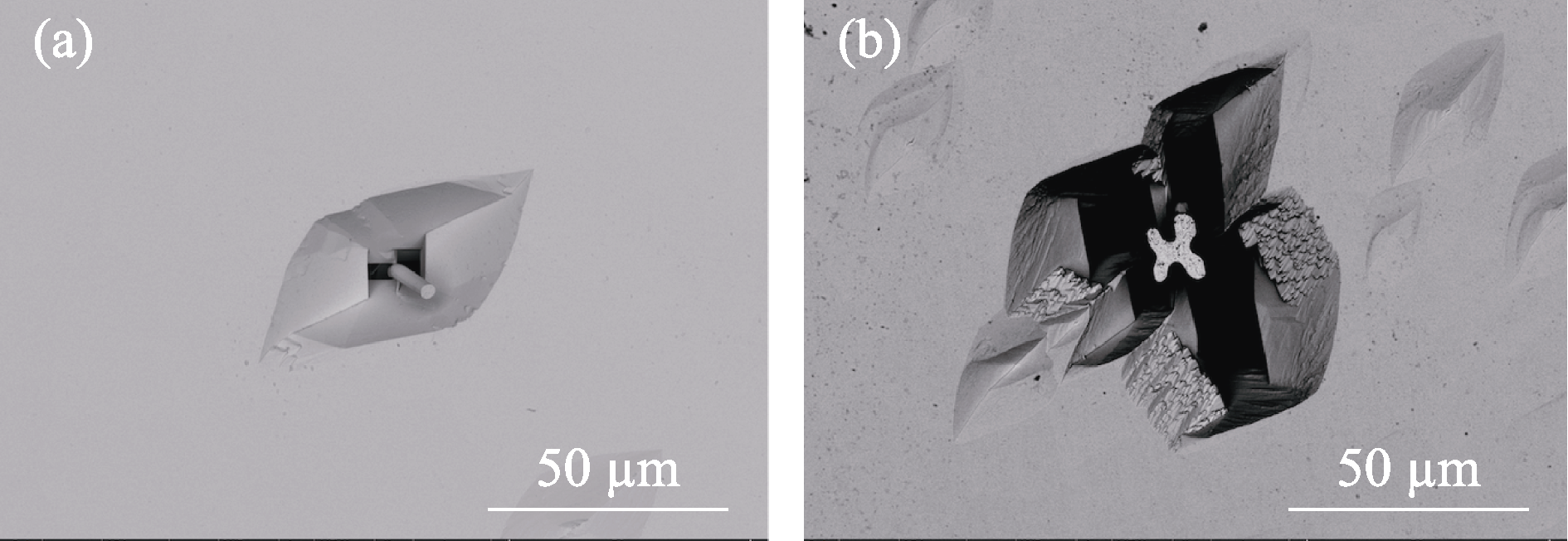
Fig. 6 SEM images of scattering particles in BSO crystal after 2 h HNO3 etching (a) Scattering particles on the A-side of the crystal; (b) Scattering particles on the B-side of the crystal
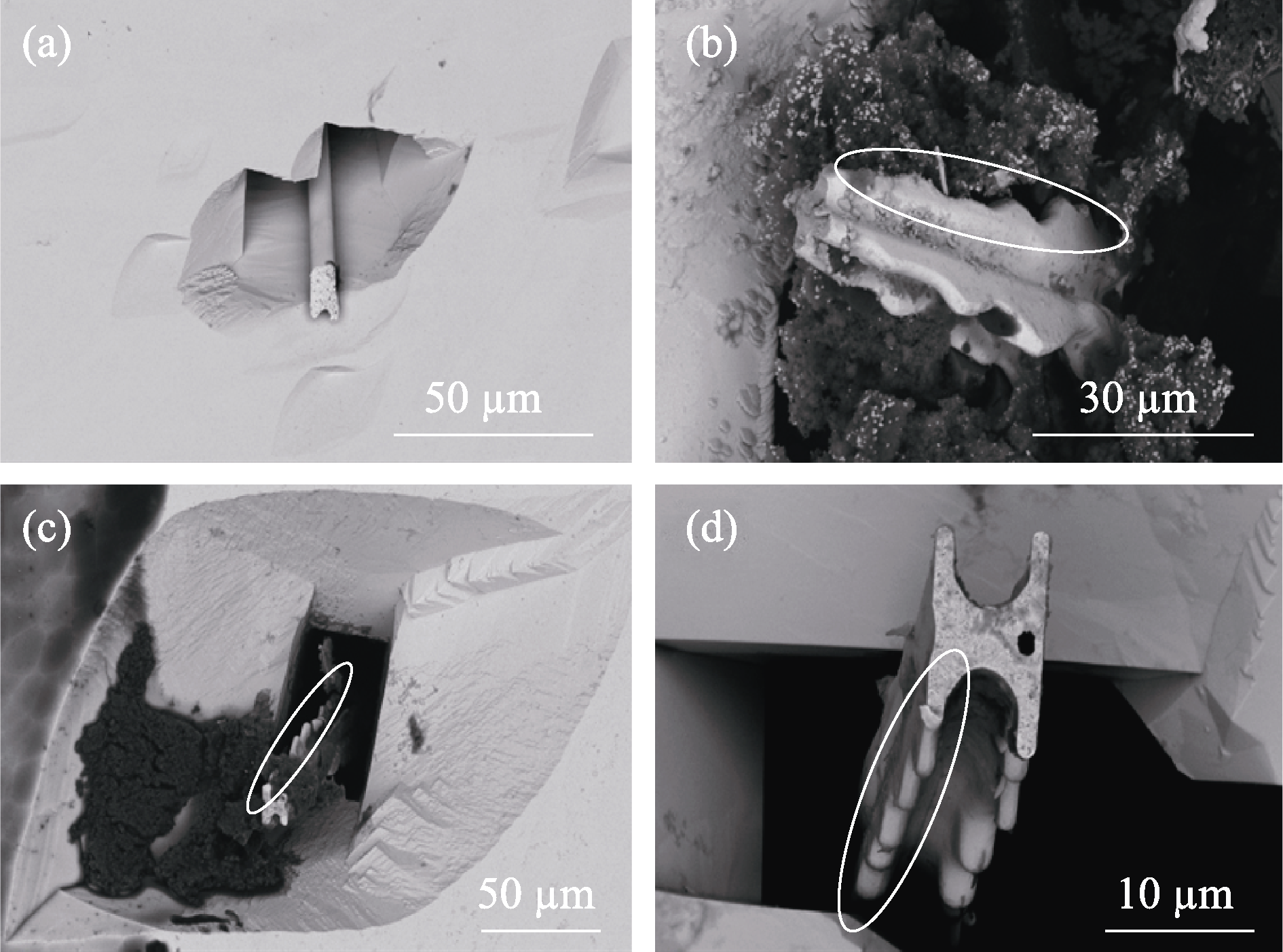
Fig. 7 SEM images of scattering particles in BSO crystal after 6 h HNO3 etching (a) Transition between cylindrical and H-shaped particles; (b-d) H-shaped scattering particles in the BSO crystal
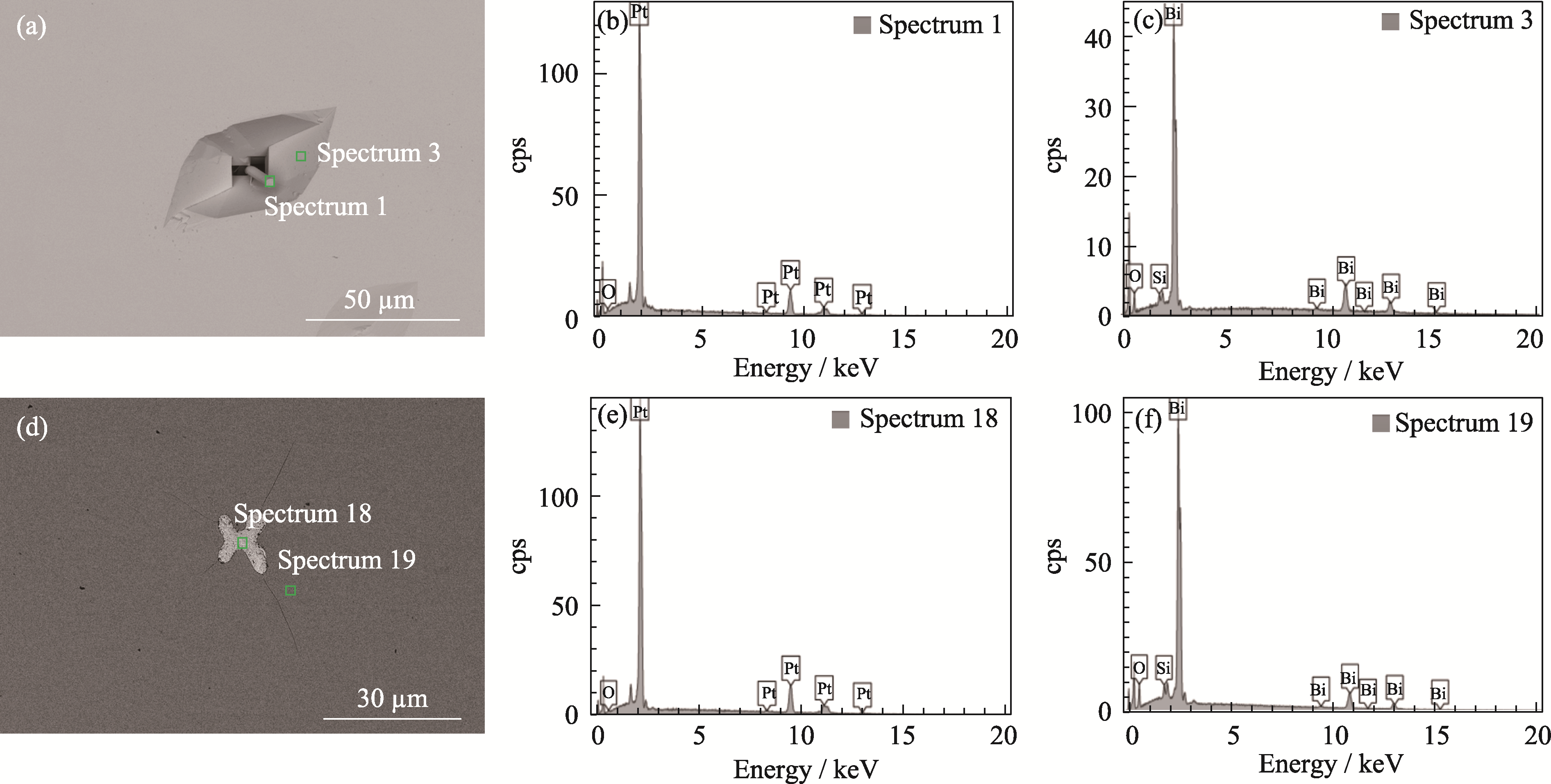
Fig. 8 SEM images (a, d) and EDS spectra (b, c, e, f) of scattering particles in BSO crystal
| Spectrum | Pt/% (in atomic) | Bi/% (in atomic) | Si/% (in atomic) | O/% (in atomic) |
|---|---|---|---|---|
| 1 | 85.39 | - | - | 14.61 |
| 3 | - | 48.12 | 3.09 | 48.79 |
| 18 | 92.54 | - | - | 7.46 |
| 19 | - | 43.56 | 3.26 | 53.19 |
Table 1 SEM-EDS component analysis of the scattering particles in BSO crystal
| Spectrum | Pt/% (in atomic) | Bi/% (in atomic) | Si/% (in atomic) | O/% (in atomic) |
|---|---|---|---|---|
| 1 | 85.39 | - | - | 14.61 |
| 3 | - | 48.12 | 3.09 | 48.79 |
| 18 | 92.54 | - | - | 7.46 |
| 19 | - | 43.56 | 3.26 | 53.19 |
| [1] |
NEOV S, MARINOVA V, REEHUIS M, et al. Neutron-diffraction study of Bi12MO20 single crystals with sillenite structure (M=Si, Si0.995Mn0.005, Bi0.53Mn0.47). Applied Physics A, 2002, 74(Suppl. 1): S1016.
DOI URL |
| [2] |
MEL’NIKOVA T I, KUZ’MICHEVA G M, BOLOTINA N B, et al. Structural features of compounds of the sillenite family. Crystallography Reports, 2014, 59(3): 353.
DOI URL |
| [3] |
ISIK M, DELICE S, NASSER H, et al. Optical characteristics of Bi12SiO20 single crystals by spectroscopic ellipsometry. Materials Science in Semiconductor Processing, 2020, 120: 105286.
DOI URL |
| [4] |
CHEN C C, YANG C T, CHUNG W H, et al. Synthesis and characterization of Bi4Si3O12, Bi2SiO5, and Bi12SiO20 by controlled hydrothermal method and their photocatalytic activity. Journal of the Taiwan Institute of Chemical Engineers, 2017, 78: 157.
DOI URL |
| [5] |
MARINOVA V, LIN S H, PETROV S, et al. Graphene-based spatial light modulator operating at near infrared spectral range. Applied Surface Science, 2019, 472: 2.
DOI URL |
| [6] |
VIEIRA T A, YEPES I S V, SUAREZ R A B, et al. Optical reconstruction of non-diffracting beams via photorefractive holography. Applied Physics B, 2017, 123: 134.
DOI URL |
| [7] |
RESIDORI S, BORTOLOZZO U, HUIGNARD J P. Liquid crystal light valves as optically addressed liquid crystal spatial light modulators: optical wave mixing and sensing applications. Liquid Crystals Reviews, 2018, 6(1): 1.
DOI URL |
| [8] |
TSCHIERSCH R, BOGACZYK M, WAGNER H E. Systematic investigation of the barrier discharge operation in helium, nitrogen, and mixtures: discharge development, formation and decay of surface charges. Journal of Physics D: Applied Physics, 2014, 47: 365204.
DOI URL |
| [9] |
DUTTA V, SHARMA S, RAIZADA P, et al. Recent progress on bismuth-based Z-scheme semiconductor photocatalysts for energy and environmental applications. Journal of Environmental Chemical Engineering, 2020, 8(6): 104505.
DOI URL |
| [10] |
EFTIMOV T, DYANKOV G, KOLEV P, et al. A polarimetric fiber optic current sensor based on Bi12SiO20 crystal fluorescence. Optical Materials, 2022, 133: 112837.
DOI URL |
| [11] |
CHANG F, ZHAO S, LEI Y, et al. Jointly augmented photocatalytic NO removal by S-scheme Bi12SiO20/Ag2MoO4 heterojunctions with surface oxygen vacancies. Journal of Colloid and Interface Science, 2023, 649: 713.
DOI URL |
| [12] |
GAO J, ZHANG B, FENG Q, et al. Enhanced vibration measurement using differential dynamic holographic interferometry with dual photorefractive crystals. Optics and Laser Technology, 2025, 188: 113000.
DOI URL |
| [13] |
GOLUBOVIĆ A V, NIKOLIĆ S N, GAJIĆ R, et al. The growth and optical properties of Bi12SiO20 single crystals. Journal of the Serbian Chemical Society, 2002, 67(4): 279.
DOI URL |
| [14] |
RISCOB B, SHKIR M, GANESH V, et al. Synthesis, crystal growth and mechanical properties of bismuth silicon oxide (BSO) single crystal. Journal of Alloys and Compounds, 2014, 588: 242.
DOI URL |
| [15] |
XU X W, LIAO J Y, SHNE B F, et al. Bi12SiO20 single crystal growth by the Bridgman method. Journal of Crystal Growth, 1993, 133: 267.
DOI URL |
| [16] |
ZHANG Y, LIU Y, JIANG W, et al. Vertical Bridgman growth of Bi12SiO20 crystal with axial vibration. Journal of Crystal Growth, 2008, 310: 5432.
DOI URL |
| [17] |
TANGUAY A R, MROCZKOWSKI S, BARKER R C. The Czochralski growth of optical quality bismuth silicon oxide (Bi12SiO20). Journal of Crystal Growth, 1977, 42: 431.
DOI URL |
| [18] |
AGGARWAL M D, WANG W S, CHOI J, et al. Morphology and formation of the color core of Bi12SiO20 crystals grown by the Czochralski method. Journal of Crystal Growth, 1994, 137: 132.
DOI URL |
| [19] |
GOPALAKRISHNAN R, KRISHNAMURTHY D, ARIVUOLI D, et al. Microscopy observations of Cz-grown BSO (Bi12SiO20) crystals. Materials Chemistry and Physics, 1994, 37: 90.
DOI URL |
| [20] |
ZHANG A Q, XU J Y, FAN S J. Bridgman growth and platinum- related defects of Bi12SiO20 crystal. Chemistry Research, 2004, 15(3): 1.
DOI URL |
| [21] | YIN Z W, XUE Z L, HU G Q, et al. Studies on the macro-defects in BGO single crystals. Journal of Inorganic Materials, 1991, 6(4): 391. |
| [22] |
QI X J, ZHANG J, CHEN L, et al. Macroscopic defects of large Bi12GeO20 crystals grown using vertical Bridgman method. Journal of Inorganic Materials, 2023, 38(3): 280.
DOI URL |
| [23] |
SANZ O, HARO-PONIATOWSKI E, GONZALO J, et al. Influence of the melting conditions of heavy metal oxide glasses containing bismuth oxide on their optical absorption. Journal of Non-Crystalline Solids, 2006, 352: 761.
DOI URL |
| [24] |
DENISOV V M, PODKOPAEV O I, DENISOVA L T, et al. Contact interaction of the Bi12GeO20, Bi12SiO20, and Bi4Ge3O12 melts with noble metals. Russian Metallurgy (Metally), 2014, 2014(2): 97.
DOI URL |
| [25] |
DENISOV V M, ZHEREB V P, DENISOVA L T, et al. Contact interaction of Bi2O3-SiO2 melts with gold. Inorganic Materials, 2012, 48(2): 210.
DOI URL |
| [1] | SI Huichen, LIANG Fei, YU Haohai, ZHANG Huaijin. Research Progress on Yellow-orange Laser Crystals and Their All-solid-state Laser Devices [J]. Journal of Inorganic Materials, 2026, 41(8): 1049-1068. |
| [2] | LIU Yuxiao, LIANG Fei. Growth and Yellow Emission Spectral Properties of Dy:Y2SiO5 and Dy,Tb:Y2SiO5 Single Crystals [J]. Journal of Inorganic Materials, 2026, 41(7): 930-938. |
| [3] | LIU Guojin, HUANG Changbao, YU Xuezhou, QI Huabei, HU Qianqian, NI Youbao, WANG Zhenyou, WU Haixin. Growth and Spectral Property of KTb3F10 Single Crystal [J]. Journal of Inorganic Materials, 2026, 41(3): 370-376. |
| [4] | LI Ya, HUANG Changbao, YU Xuezhou, QI Huabei, ZHU Zhicheng, WU Haixin, CHEN Weihao, YU Ping. ZnSe Single Crystal Growth and Cr2+ Doping Behavior Enabled by a Molybdenum-crucible Sealing Method [J]. Journal of Inorganic Materials, 2026, 41(10): 1435-1441. |
| [5] | XU Jintao, GAO Pan, HE Weiyi, JIANG Shengnan, PAN Xiuhong, TANG Meibo, CHEN Kun, LIU Xuechao. Recent Progress on Preparation of 3C-SiC Single Crystal [J]. Journal of Inorganic Materials, 2026, 41(1): 1-11. |
| [6] | LI Xianke, ZHANG Chaoyi, HUANG Lin, SUN Peng, LIU Bo, XU Jun, TANG Huili. High-quality Indium-doped Gallium Oxide Single Crystal Growth by Floating Zone Method [J]. Journal of Inorganic Materials, 2024, 39(12): 1384-1390. |
| [7] | CAI Hao, WANG Qihang, ZOU Zhaoyong. Crystallization Pathway of Monohydrocalcite via Amorphous Calcium Carbonate Regulated by Magnesium Ion [J]. Journal of Inorganic Materials, 2024, 39(11): 1275-1282. |
| [8] | HAO Yongxin, QIN Juan, SUN Jun, YANG Jinfeng, LI Qinglian, HUANG Guijun, XU Jingjun. Impact of Crucible Bottom Shape on the Growth of Congruent Lithium Niobate Crystals by Czochralski Method [J]. Journal of Inorganic Materials, 2024, 39(10): 1167-1174. |
| [9] | QIN Juan, LIANG Dandan, SUN Jun, YANG Jinfeng, HAO Yongxin, LI Qinglian, ZHANG Ling, XU Jingjun. Flat Shoulder Congruent Lithium Niobate Crystals Grown by the Czochralski Method [J]. Journal of Inorganic Materials, 2023, 38(8): 978-986. |
| [10] | LIN Siqi, LI Airan, FU Chenguang, LI Rongbing, JIN Min. Crystal Growth and Thermoelectric Properties of Zintl Phase Mg3X2 (X=Sb, Bi) Based Materials: a Review [J]. Journal of Inorganic Materials, 2023, 38(3): 270-279. |
| [11] | YANG Jiaxue, LI Wen, WANG Yan, ZHU Zhaojie, YOU Zhenyu, LI Jianfu, TU Chaoyang. Spectroscopic and Yellow Laser Features of Dy3+: Y3Al5O12 Single Crystals [J]. Journal of Inorganic Materials, 2023, 38(3): 350-356. |
| [12] | WU Zhen, LI Huifang, ZHANG Zhonghan, ZHANG Zhen, LI Yang, LAN Jianghe, SU Liangbi, WU Anhua. Growth and Characterization of CeF3 Crystals for Magneto-optical Application [J]. Journal of Inorganic Materials, 2023, 38(3): 296-302. |
| [13] | QI Xuejun, ZHANG Jian, CHEN Lei, WANG Shaohan, LI Xiang, DU Yong, CHEN Junfeng. Macroscopic Defects of Large Bi12GeO20 Crystals Grown Using Vertical Bridgman Method [J]. Journal of Inorganic Materials, 2023, 38(3): 280-287. |
| [14] | QI Zhanguo, LIU Lei, WANG Shouzhi, WANG Guogong, YU Jiaoxian, WANG Zhongxin, DUAN Xiulan, XU Xiangang, ZHANG Lei. Progress in GaN Single Crystals: HVPE Growth and Doping [J]. Journal of Inorganic Materials, 2023, 38(3): 243-255. |
| [15] | ZHANG Chaoyi, TANG Huili, LI Xianke, WANG Qingguo, LUO Ping, WU Feng, ZHANG Chenbo, XUE Yanyan, XU Jun, HAN Jianfeng, LU Zhanwen. Research Progress of ScAlMgO4 Crystal: a Novel GaN and ZnO Substrate [J]. Journal of Inorganic Materials, 2023, 38(3): 228-242. |
| Viewed | ||||||
|
Full text |
|
|||||
|
Abstract |
|
|||||
