
Journal of Inorganic Materials ›› 2026, Vol. 41 ›› Issue (8): 1049-1068.DOI: 10.15541/jim20250471
• REVIEW • Previous Articles Next Articles
SI Huichen1( ), LIANG Fei2(), YU Haohai2, ZHANG Huaijin2
Received:2025-11-26
Revised:2026-01-03
Published:2026-08-20
Online:2026-02-28
Contact:
LIANG Fei, professor. E-mail: liangfei@sdu.edu.cnAbout author:SI Huichen (1995-), female, lecturer. E-mail: huichensi@wfu.edu.cn
Supported by:CLC Number:
SI Huichen, LIANG Fei, YU Haohai, ZHANG Huaijin. Research Progress on Yellow-orange Laser Crystals and Their All-solid-state Laser Devices[J]. Journal of Inorganic Materials, 2026, 41(8): 1049-1068.
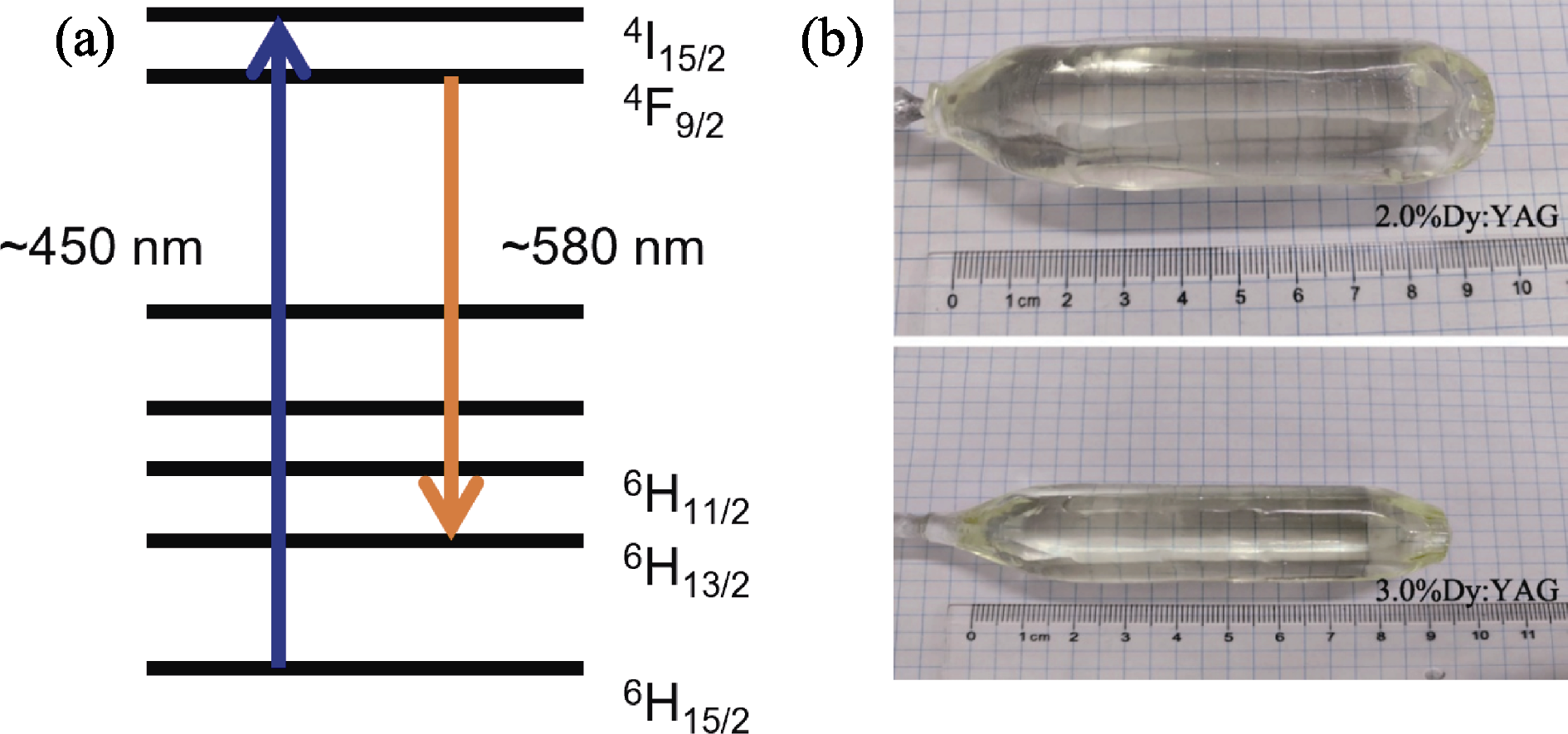
Fig. 1 Dy:YAG crystal[21-22] (a) Energy level scheme of the Dy3+[21]; (b) Dy:YAG crystal fabricated by the Czochralski method[22]
| Crystal | Absorption wavelength, λabs/nm | Absorption cross-section, σabs/(×10-21, cm2) | Emission wavelength, λem/nm | Emission cross-section, σem/(×10-21, cm2) | Fluorescence lifetime, τf/μs | Ref. |
|---|---|---|---|---|---|---|
| Dy:Y3Al5O12 | 447.4 | 1.6 | 582.7 | 3 | 376 | [ |
| Dy:YAlO3 | 450 | 0.743 (E//a) 0.690 (E//b) 0.870 (E//c) | 574 | 2.98 (E//a) 4.5 (E//b) 4.52 (E//c) | 185 | [ |
| Dy:LiGd(MoO4)2 | 455 | 2 (σ) 3.3 (π) | 575 | 1.52 (σ) 2.23 (π) | 139 | [ |
| Dy:Lu2O3 | 446 | 0.71 | 574 | 5.3 | 112.1 | [ |
| Dy:LiLuF4 | 447 | 0.98 | 582 | 3 | 582 | [ |
| Dy:Sr3Y(BO3)3 | 454 | 0.6 (σ) 0.8 (π) | 576 | 1 (σ) 1.2 (π) | 820 | [ |
| Dy:Ca3NbGa3Si2O14 | 453 | 1.3 | 572 | 1.8 | 240 | [ |
| Dy:GdMgB5O4 | 452 | 0.66 (E//X) 1.04 (E//Y) 0.3 (E//Z) | 578.5/581 | 2.48 (E//Y) 1.58 (E//X) | 459 | [ |
| Dy:GdCa4O(BO3)3 | 454 | 0.28 (E//X) 0.93 (E//Y) 1.09 (E//Z) | 585 | 1.29 (E//X) 1.19 (E//Y) 0.87 (E//Z) | 495 | [ |
| Dy:LaMgB5O10 | 452 | 0.97 (E//X) 1.69 (E//Y) 1.08 (E//Z) | 581/578 | 3.48/1.58 | 516 | [ |
| Tb:LiLuF4 | 488.8 | ~0.2 (E//a) ~0.3 (E//c) | 587 | ~0.5 (E//a) ~1 (E//c) | 4800 | [ |
| Tb:LiYF4 | 488.7 | ~0.3 (E//a) ~0.2 (E//c) | 587 | ~1 (E//a) ~0.5 (E//c) | 5000 | [ |
| Tb:KY3F10 | 485.3 | ~0.3 | 584 | ~0.5 | 4800 | [ |
| Tb:BaLu2F8 | 486 | ~0.1 (E//X) ~0.2 (E//Y) ~0.1(E//Z) | 581 | ~0.5 | 4900 | [ |
Table 1 Spectroscopic parameters of Dy3+/Tb3+ doped crystals
| Crystal | Absorption wavelength, λabs/nm | Absorption cross-section, σabs/(×10-21, cm2) | Emission wavelength, λem/nm | Emission cross-section, σem/(×10-21, cm2) | Fluorescence lifetime, τf/μs | Ref. |
|---|---|---|---|---|---|---|
| Dy:Y3Al5O12 | 447.4 | 1.6 | 582.7 | 3 | 376 | [ |
| Dy:YAlO3 | 450 | 0.743 (E//a) 0.690 (E//b) 0.870 (E//c) | 574 | 2.98 (E//a) 4.5 (E//b) 4.52 (E//c) | 185 | [ |
| Dy:LiGd(MoO4)2 | 455 | 2 (σ) 3.3 (π) | 575 | 1.52 (σ) 2.23 (π) | 139 | [ |
| Dy:Lu2O3 | 446 | 0.71 | 574 | 5.3 | 112.1 | [ |
| Dy:LiLuF4 | 447 | 0.98 | 582 | 3 | 582 | [ |
| Dy:Sr3Y(BO3)3 | 454 | 0.6 (σ) 0.8 (π) | 576 | 1 (σ) 1.2 (π) | 820 | [ |
| Dy:Ca3NbGa3Si2O14 | 453 | 1.3 | 572 | 1.8 | 240 | [ |
| Dy:GdMgB5O4 | 452 | 0.66 (E//X) 1.04 (E//Y) 0.3 (E//Z) | 578.5/581 | 2.48 (E//Y) 1.58 (E//X) | 459 | [ |
| Dy:GdCa4O(BO3)3 | 454 | 0.28 (E//X) 0.93 (E//Y) 1.09 (E//Z) | 585 | 1.29 (E//X) 1.19 (E//Y) 0.87 (E//Z) | 495 | [ |
| Dy:LaMgB5O10 | 452 | 0.97 (E//X) 1.69 (E//Y) 1.08 (E//Z) | 581/578 | 3.48/1.58 | 516 | [ |
| Tb:LiLuF4 | 488.8 | ~0.2 (E//a) ~0.3 (E//c) | 587 | ~0.5 (E//a) ~1 (E//c) | 4800 | [ |
| Tb:LiYF4 | 488.7 | ~0.3 (E//a) ~0.2 (E//c) | 587 | ~1 (E//a) ~0.5 (E//c) | 5000 | [ |
| Tb:KY3F10 | 485.3 | ~0.3 | 584 | ~0.5 | 4800 | [ |
| Tb:BaLu2F8 | 486 | ~0.1 (E//X) ~0.2 (E//Y) ~0.1(E//Z) | 581 | ~0.5 | 4900 | [ |
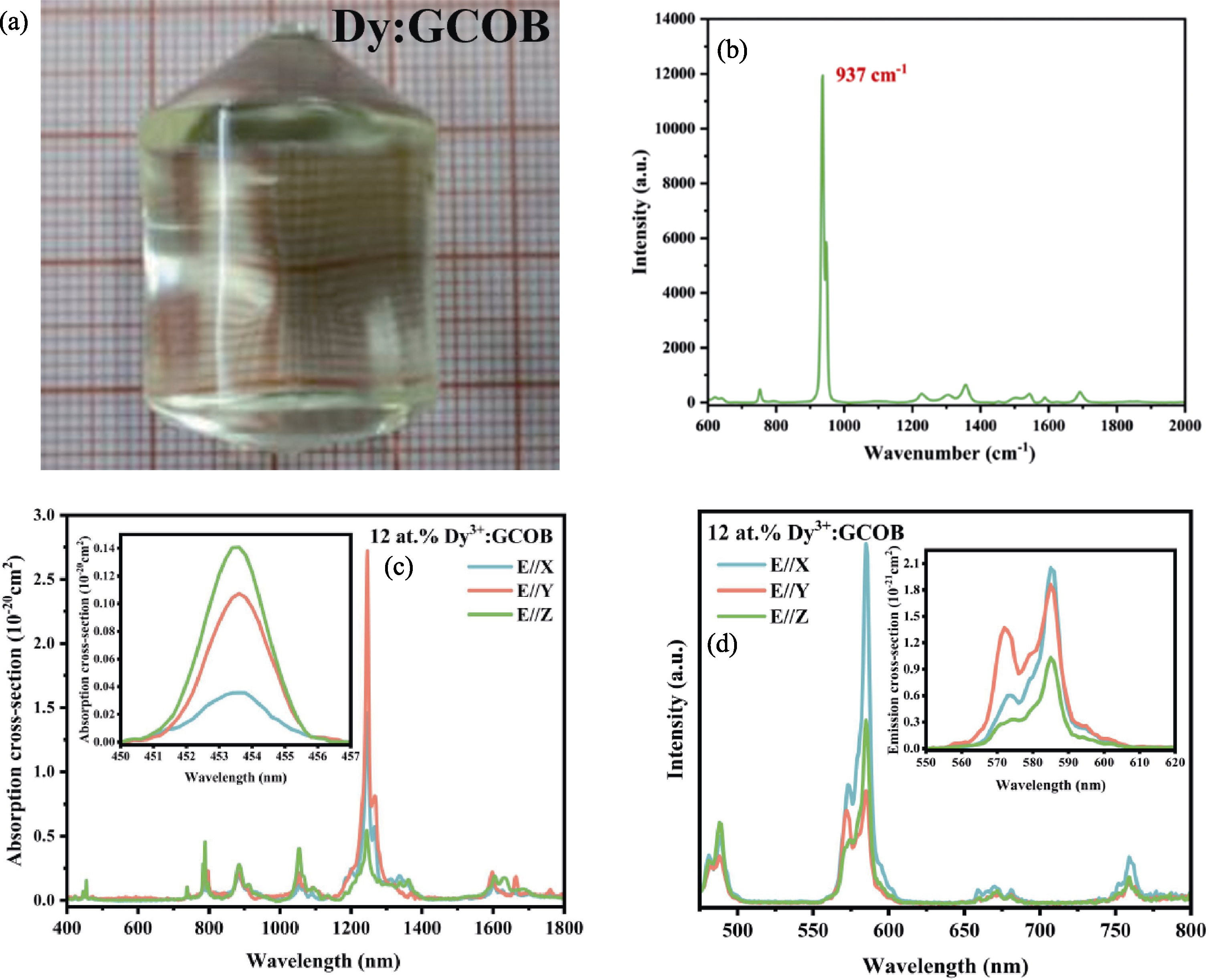
Fig. 2 Dy:GCOB crystal[30] (a) As-grown Dy:GCOB crystal; (b) Raman spectrum; (c) Polarized absorption spectra; (d) Polarized fluorescence spectra
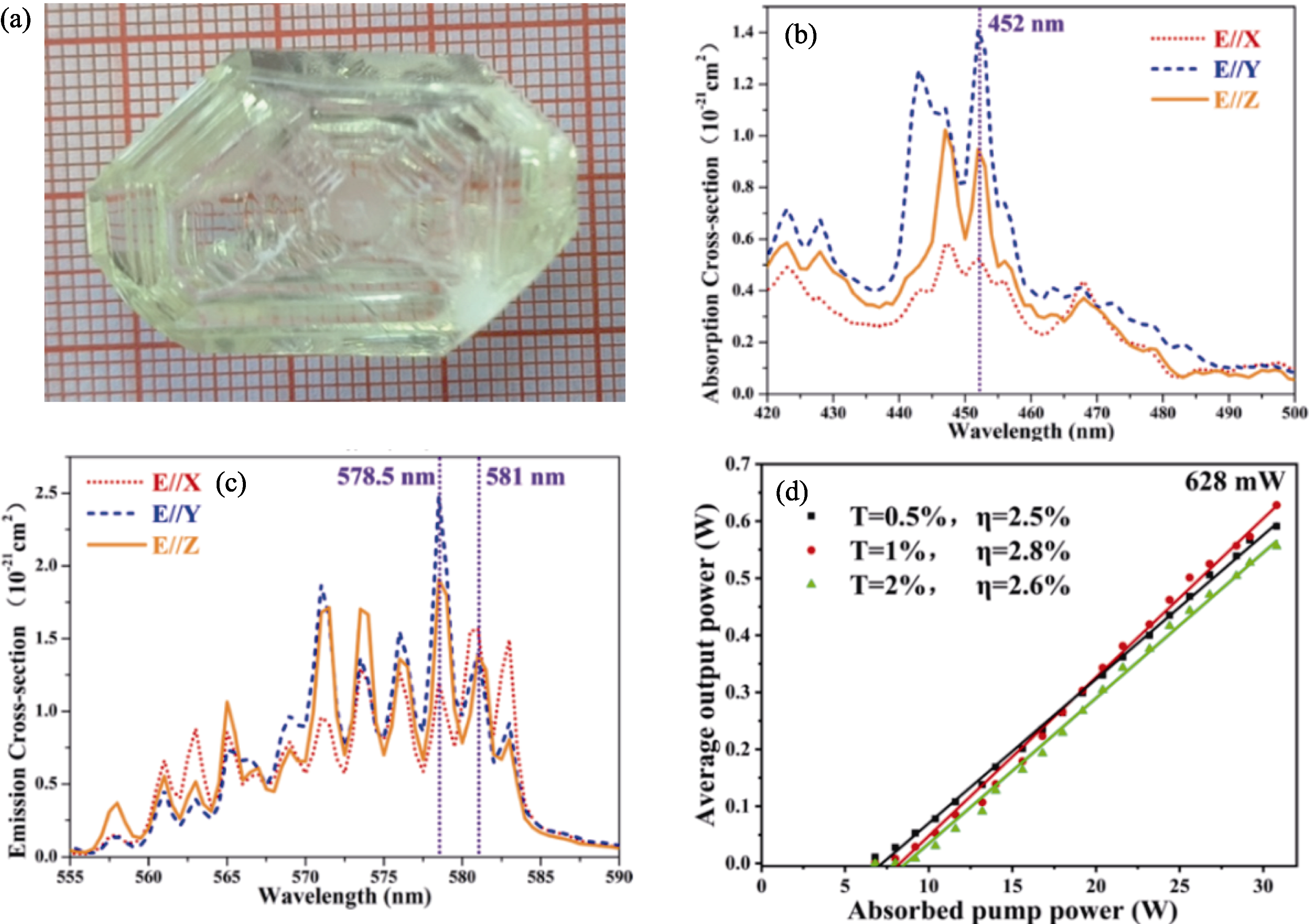
Fig. 3 Dy:GMB crystal[11] (a) As-grown Dy:GMB crystal; (b) Polarized absorption spectra; (c) Polarized fluorescence spectra; (d) Yellow laser output power
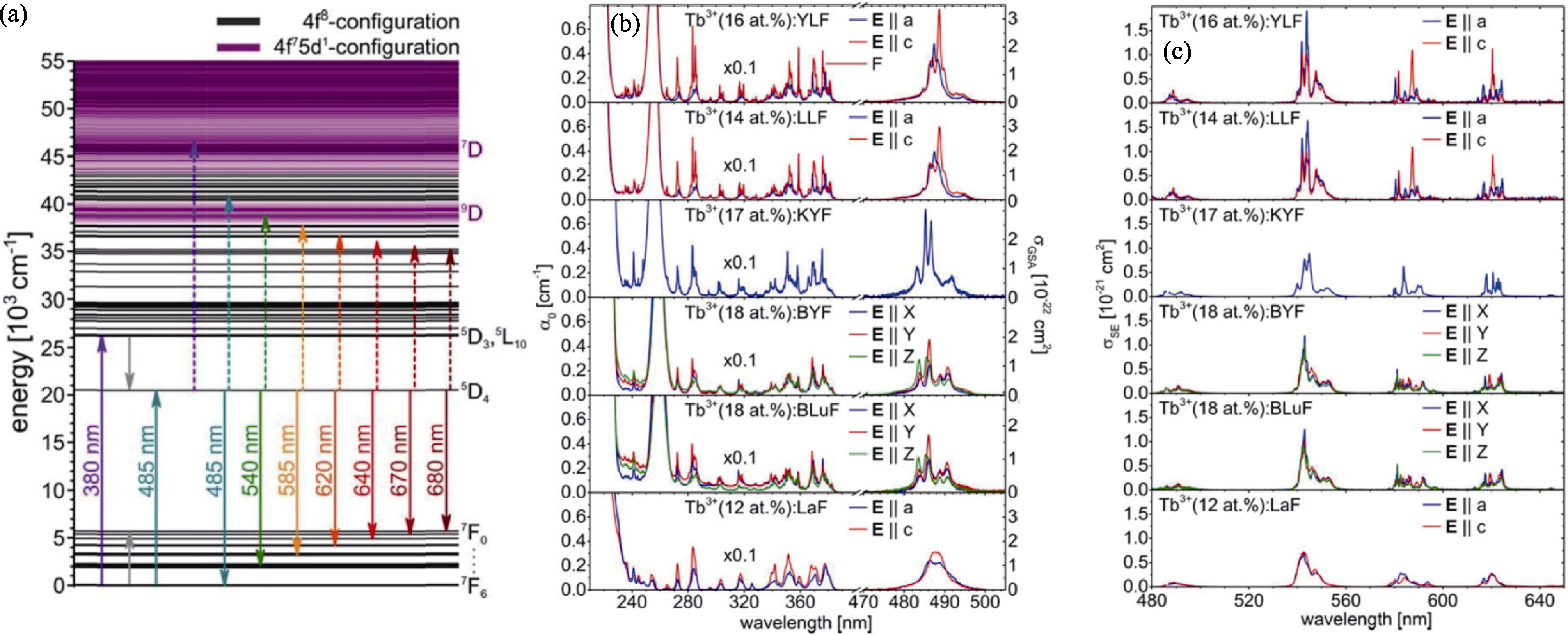
Fig. 4 Tb3+ doped fluoride crystals[32] (a) Energy level scheme; (b) Absorption spectra; (c) Emission spectra
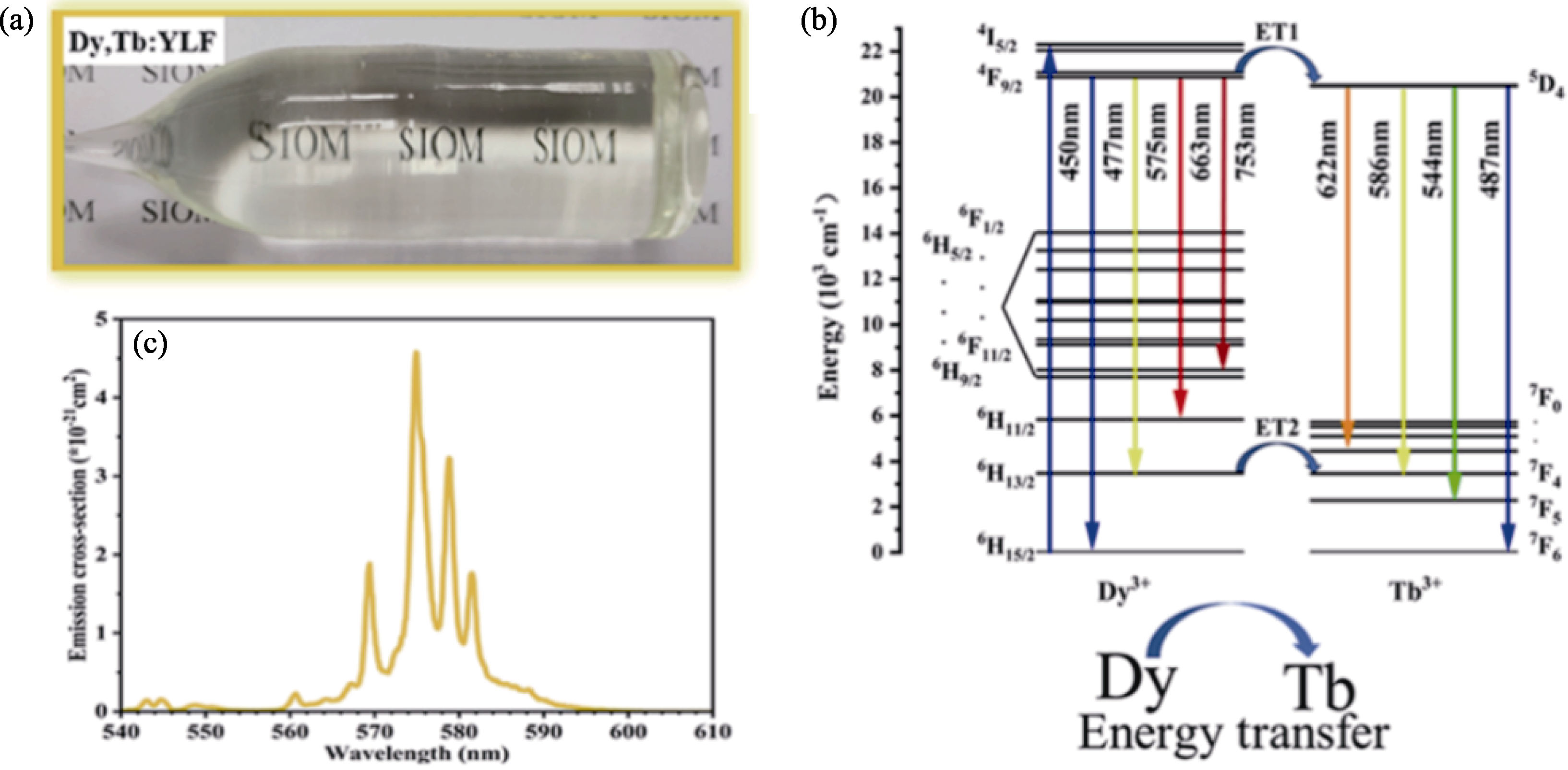
Fig. 5 Dy,Tb:YLF crystal[43] (a) As-grown Dy,Tb:YLF crystal; (b) Energy level scheme; (c) Emission spectrum
| Crystal | Pump | Wavelength/ nm | Output power/W | Slope efficiency/% | Threshold/ W | Operation mode | Year | Ref. |
|---|---|---|---|---|---|---|---|---|
| Dy:Y3Al5O12 | Blue LD | 583 | 0.15 | 12 | - | Pulse | 2012 | [ |
| Dy:LiLuF4 | Blue LD | 578 | 0.007 | 4 | 0.18 | CW | 2013 | [ |
| Dy,Tb:LiLuF4 | Blue LD | 578 | 0.055 | 13.4 | 0.32 | CW | 2014 | [ |
| Dy,Eu:LiLuF4 | Blue LD | 574 | 0.047 | 10 | 0.244 | CW | 2016 | [ |
| Tb:LiYF4 | 2ω-OPSL | 587 | 0.071 | 22 | 0.032 | CW | 2016 | [ |
| Tb:LiLuF4 | 2ω-OPSL | 587 | 0.082 | 14 | 0.107 | CW | 2016 | [ |
| Tb:KY3F10 | 2ω-OPSL | 584 | 0.018 | 5 | 0.038 | CW | 2016 | [ |
| Tb:BaLu2F8 | 2ω-OPSL | 581 | - | - | - | CW | 2016 | [ |
| Dy:ZnWO4 | Blue LD | 575 | 0.11 | 13 | 0.55 | CW | 2017 | [ |
| Tb:LiLuF4 | 2ω-OPSL | 587.5 | 0.5 | 25 | 0.21 | CW | 2018 | [ |
| Tb:LiYF4 | 2ω-OPSL | 582 | 0.106 | 21 | - | CW | 2020 | [ |
| Tb:LiLuF4 | SHG of Ti:sapphire laser at 359 nm | 587 | 0.034 | 20 | 0.024 | CW | 2020 | [ |
| Dy,Tb:LuLiF4 | Blue LD | 574 | 0.22 | 12.6 | ~0.4 | CW | 2022 | [ |
| Dy,Tb:LuLiF4 | Blue LD | 574 | 0.026 | - | ~1.4 | Pulse | 2022 | [ |
| Dy,Tb:LuLiF4 | Blue LD | 573.9 | 0.351 | 15 | 0.518 | CW | 2022 | [ |
| Dy,Tb:LuLiF4 | Blue LD | 573.9 | 0.085 | - | 0.941 | Pulse | 2022 | [ |
| Dy:GdMgB5O10 | Blue LD | 581 | 0.628 | 2.8 | - | CW | 2024 | [ |
| Dy:LaMgB5O10 | Blue LD | 583 | 0.1958 | 3.3 | 4 | CW | 2025 | [ |
| Tb:LiYF4 | 2ω-OPSL | 587 | ~0.15 | 36 | 0.104 | CW | 2025 | [ |
| Tb:LiYF4 | 2ω-OPSL | 581 | ~0.4 | 61 | 0.066 | CW | 2025 | [ |
| Tb:LiYF4 | Blue LD | 587 | 0.195 | 24 | 0.25 | CW | 2025 | [ |
| Tb:LiYF4 | VECSEL-SHG | 587 | 1 | 32 | 0.83 | CW | 2025 | [ |
| Tb:LiYF4 | VECSEL-SHG | 587 | - | - | - | Pulse | 2025 | [ |
Table 2 Yellow-orange laser output of Dy3+/Tb3+ doped crystals
| Crystal | Pump | Wavelength/ nm | Output power/W | Slope efficiency/% | Threshold/ W | Operation mode | Year | Ref. |
|---|---|---|---|---|---|---|---|---|
| Dy:Y3Al5O12 | Blue LD | 583 | 0.15 | 12 | - | Pulse | 2012 | [ |
| Dy:LiLuF4 | Blue LD | 578 | 0.007 | 4 | 0.18 | CW | 2013 | [ |
| Dy,Tb:LiLuF4 | Blue LD | 578 | 0.055 | 13.4 | 0.32 | CW | 2014 | [ |
| Dy,Eu:LiLuF4 | Blue LD | 574 | 0.047 | 10 | 0.244 | CW | 2016 | [ |
| Tb:LiYF4 | 2ω-OPSL | 587 | 0.071 | 22 | 0.032 | CW | 2016 | [ |
| Tb:LiLuF4 | 2ω-OPSL | 587 | 0.082 | 14 | 0.107 | CW | 2016 | [ |
| Tb:KY3F10 | 2ω-OPSL | 584 | 0.018 | 5 | 0.038 | CW | 2016 | [ |
| Tb:BaLu2F8 | 2ω-OPSL | 581 | - | - | - | CW | 2016 | [ |
| Dy:ZnWO4 | Blue LD | 575 | 0.11 | 13 | 0.55 | CW | 2017 | [ |
| Tb:LiLuF4 | 2ω-OPSL | 587.5 | 0.5 | 25 | 0.21 | CW | 2018 | [ |
| Tb:LiYF4 | 2ω-OPSL | 582 | 0.106 | 21 | - | CW | 2020 | [ |
| Tb:LiLuF4 | SHG of Ti:sapphire laser at 359 nm | 587 | 0.034 | 20 | 0.024 | CW | 2020 | [ |
| Dy,Tb:LuLiF4 | Blue LD | 574 | 0.22 | 12.6 | ~0.4 | CW | 2022 | [ |
| Dy,Tb:LuLiF4 | Blue LD | 574 | 0.026 | - | ~1.4 | Pulse | 2022 | [ |
| Dy,Tb:LuLiF4 | Blue LD | 573.9 | 0.351 | 15 | 0.518 | CW | 2022 | [ |
| Dy,Tb:LuLiF4 | Blue LD | 573.9 | 0.085 | - | 0.941 | Pulse | 2022 | [ |
| Dy:GdMgB5O10 | Blue LD | 581 | 0.628 | 2.8 | - | CW | 2024 | [ |
| Dy:LaMgB5O10 | Blue LD | 583 | 0.1958 | 3.3 | 4 | CW | 2025 | [ |
| Tb:LiYF4 | 2ω-OPSL | 587 | ~0.15 | 36 | 0.104 | CW | 2025 | [ |
| Tb:LiYF4 | 2ω-OPSL | 581 | ~0.4 | 61 | 0.066 | CW | 2025 | [ |
| Tb:LiYF4 | Blue LD | 587 | 0.195 | 24 | 0.25 | CW | 2025 | [ |
| Tb:LiYF4 | VECSEL-SHG | 587 | 1 | 32 | 0.83 | CW | 2025 | [ |
| Tb:LiYF4 | VECSEL-SHG | 587 | - | - | - | Pulse | 2025 | [ |
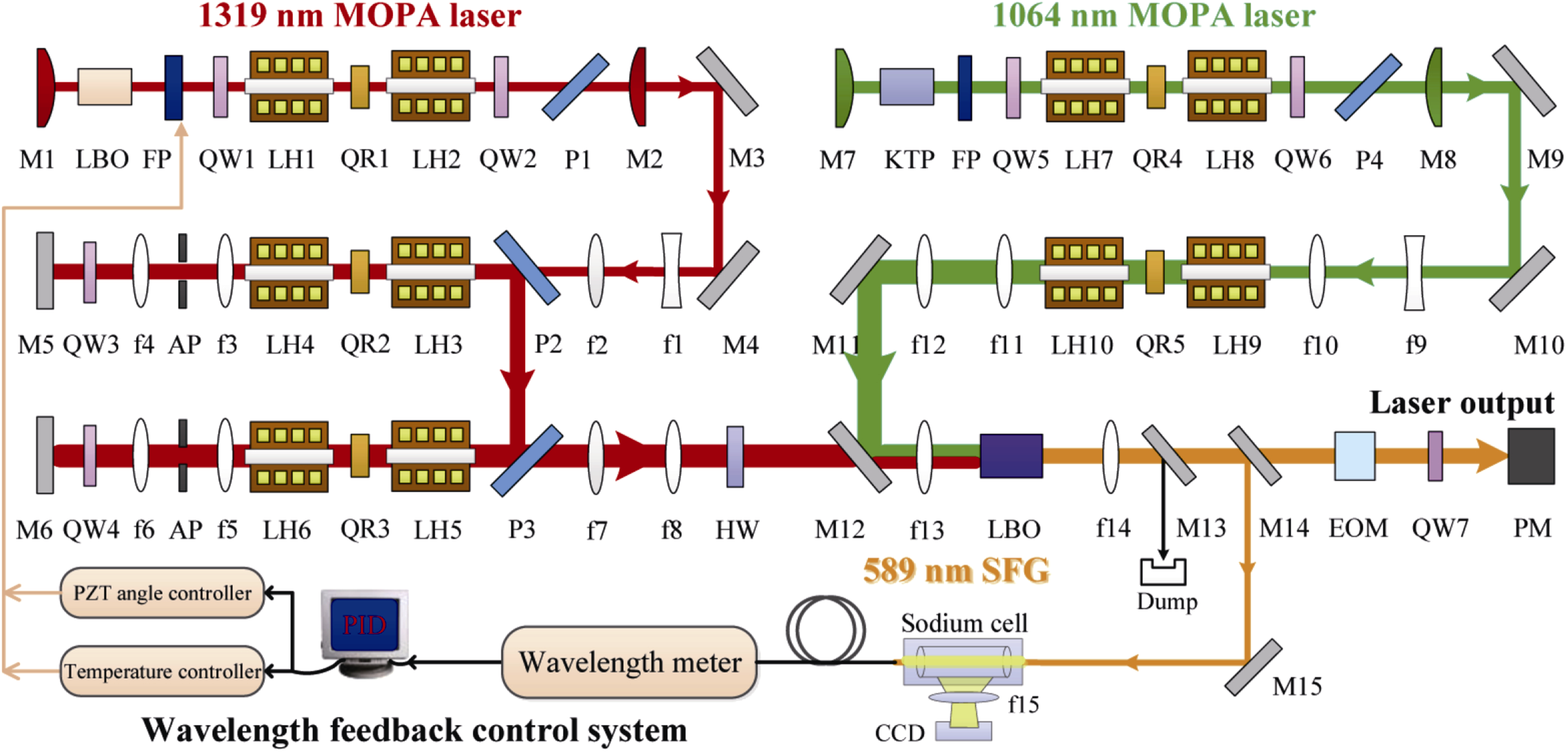
Fig. 6 Setup for generating sum frequency yellow light[13]
| Wavelength/nm | Output power/W | Conversion efficiency/% | Repetition rate | Pulse width | Year | Ref. |
|---|---|---|---|---|---|---|
| 589.06 | 0.506 | 5.5 | 3 kHz | 292 ns | 2010 | [ |
| 589 | 12.7 | 16.7 | 1 kHz | 80 μs | 2010 | [ |
| 593.5 | 3.62 | 13.2 | - | - | 2011 | [ |
| 589 | 20.5 | 5.11 | 14.49 kHz | 157 ns | 2013 | [ |
| 593.5 | 0.224 | 4.48 | - | - | 2014 | [ |
| 593.5 | 0.55 | 3.83 | - | - | 2014 | [ |
| 589.159 | 8 | 2 | 5 kHz | 152 ns | 2014 | [ |
| 589 | 33 | 22 | 500 Hz | 105 μs | 2014 | [ |
| 589 | 11.4 | - | 5 kHz | 135 ns | 2014 | [ |
| 589 | 81 | 32.5 | 250 Hz | 150 μs | 2015 | [ |
| 589 | 0.102 | 5.1 | - | - | 2016 | [ |
| 578 | 0.0375 | 0.27 | - | - | 2016 | [ |
| 589.159 | 65 | - | 500 Hz | 120 μs | 2016 | [ |
| 578 | 0.1 | - | - | - | 2017 | [ |
| 582 | 0.136 | - | - | - | 2017 | [ |
| 589 | 101 | - | - | - | 2017 | [ |
| 589.159 | 44 | - | 500 Hz | 90 μs | 2019 | [ |
| 589 | 4.8 | - | 500 Hz | 90 μs | 2019 | [ |
| 589.159 | 208 | - | 250 Hz | 150 μs | 2019 | [ |
| 589.159 | 86.1 | 30.1 | 400 Hz | 100 μs | 2020 | [ |
Table 3 Solid-state SFG yellow laser output of Nd3+ doped crystals
| Wavelength/nm | Output power/W | Conversion efficiency/% | Repetition rate | Pulse width | Year | Ref. |
|---|---|---|---|---|---|---|
| 589.06 | 0.506 | 5.5 | 3 kHz | 292 ns | 2010 | [ |
| 589 | 12.7 | 16.7 | 1 kHz | 80 μs | 2010 | [ |
| 593.5 | 3.62 | 13.2 | - | - | 2011 | [ |
| 589 | 20.5 | 5.11 | 14.49 kHz | 157 ns | 2013 | [ |
| 593.5 | 0.224 | 4.48 | - | - | 2014 | [ |
| 593.5 | 0.55 | 3.83 | - | - | 2014 | [ |
| 589.159 | 8 | 2 | 5 kHz | 152 ns | 2014 | [ |
| 589 | 33 | 22 | 500 Hz | 105 μs | 2014 | [ |
| 589 | 11.4 | - | 5 kHz | 135 ns | 2014 | [ |
| 589 | 81 | 32.5 | 250 Hz | 150 μs | 2015 | [ |
| 589 | 0.102 | 5.1 | - | - | 2016 | [ |
| 578 | 0.0375 | 0.27 | - | - | 2016 | [ |
| 589.159 | 65 | - | 500 Hz | 120 μs | 2016 | [ |
| 578 | 0.1 | - | - | - | 2017 | [ |
| 582 | 0.136 | - | - | - | 2017 | [ |
| 589 | 101 | - | - | - | 2017 | [ |
| 589.159 | 44 | - | 500 Hz | 90 μs | 2019 | [ |
| 589 | 4.8 | - | 500 Hz | 90 μs | 2019 | [ |
| 589.159 | 208 | - | 250 Hz | 150 μs | 2019 | [ |
| 589.159 | 86.1 | 30.1 | 400 Hz | 100 μs | 2020 | [ |
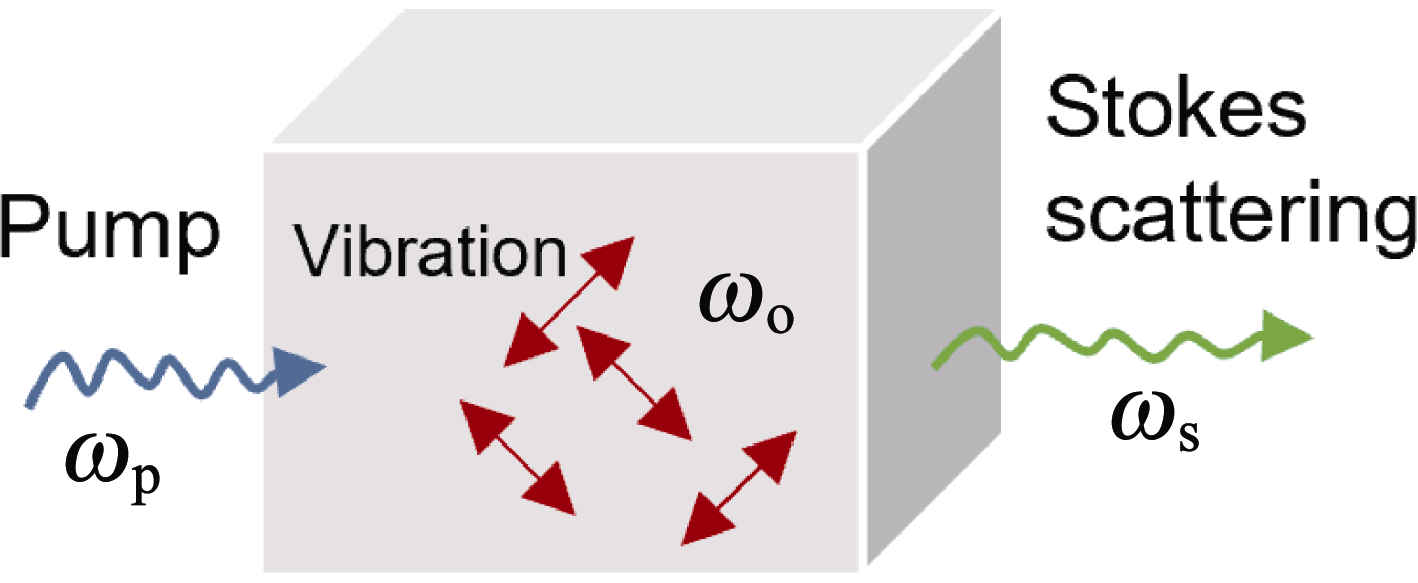
Fig. 7 Schematic diagram of SRS excitation process
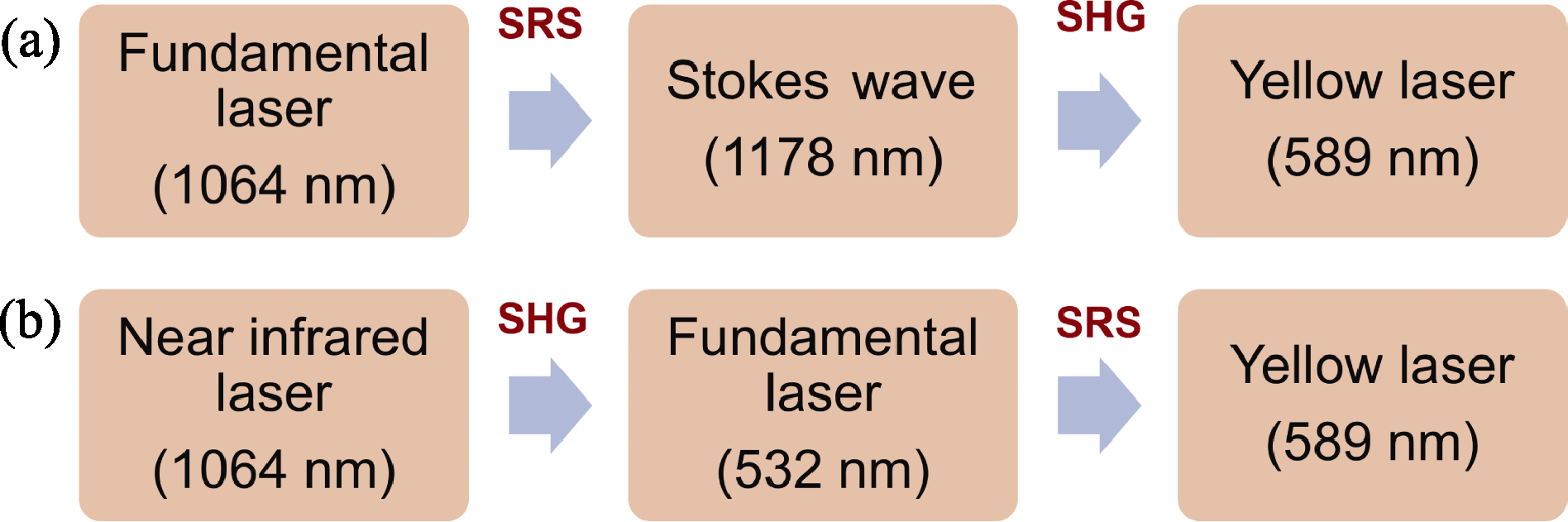
Fig. 8 Principle schematic of crystalline Raman yellow laser (a) SRS+SHG; (b) SHG+SRS
| Raman crystal | Raman shift/ cm-1 | Raman linewidth/ cm-1 | Raman gain@ 1064 nm/ (cm·GW-1) | Thermal conductivity/ (W·m-1·K-1) |
|---|---|---|---|---|
| KGd(WO4)2 | 901.0 | 3.3 | 5.9 | 2.6 |
| BaWO4 | 925.0 | 1.6 | 8.5 | 2.6 |
| CaWO4 | 910.7 | 7.0 | 3.8 | 16 |
| SrWO4 | 921.0 | 3.0 | 5.0 | - |
| YVO4 | 890.0 | 3.5 | 4.5 | 5.2 |
| GdVO4 | 882.0 | 3.5 | 4.5 | 10.5 |
| CaMoO4 | 879.3 | 5.0 | 3.5 | 3.9 |
| BaTeMo2O9 | 904.8 | 5.6 | - | <2.0 |
| Diamond | 1332.9 | 2.7 | 13.5 | >1000 |
| Ba(NO3)2 | 1047.3 | 0.4 | 11.0 | 1.17 |
| LiIO3 | 822.0 | 5.0 | 4.8 | - |
Table 4 Main physical and Raman-related properties of bulk Raman gain media[3,71 -72]
| Raman crystal | Raman shift/ cm-1 | Raman linewidth/ cm-1 | Raman gain@ 1064 nm/ (cm·GW-1) | Thermal conductivity/ (W·m-1·K-1) |
|---|---|---|---|---|
| KGd(WO4)2 | 901.0 | 3.3 | 5.9 | 2.6 |
| BaWO4 | 925.0 | 1.6 | 8.5 | 2.6 |
| CaWO4 | 910.7 | 7.0 | 3.8 | 16 |
| SrWO4 | 921.0 | 3.0 | 5.0 | - |
| YVO4 | 890.0 | 3.5 | 4.5 | 5.2 |
| GdVO4 | 882.0 | 3.5 | 4.5 | 10.5 |
| CaMoO4 | 879.3 | 5.0 | 3.5 | 3.9 |
| BaTeMo2O9 | 904.8 | 5.6 | - | <2.0 |
| Diamond | 1332.9 | 2.7 | 13.5 | >1000 |
| Ba(NO3)2 | 1047.3 | 0.4 | 11.0 | 1.17 |
| LiIO3 | 822.0 | 5.0 | 4.8 | - |
| Principle | Pump wavelength/ nm | Laser/Raman/SHG crystals | Saturable absorber | Wavelength/ nm | Output power/W | Repetition rate | Pulse width | Year | Ref. |
|---|---|---|---|---|---|---|---|---|---|
| SRS+ SHG | 808 | Nd:YAG/BaWO4/KTP | AO | 590 | 8.3 | 15 kHz | 20 ns | 2010 | [ |
| 808 | Nd:YVO4/Nd:YVO4/LBO | AO | 589.17 | 2.15 | 40 kHz | 16 ns | 2011 | [ | |
| 808 | Nd:GGG/BaWO4/KTP | AO | 589 | 0.82 | 10 kHz | 9 ns | 2012 | [ | |
| 808 | Nd:YAG/SrWO4/KTP | Cr:YAG | 590 | 1.02 | 21.9 kHz | 3 ns | 2012 | [ | |
| 807.5 | Nd:GdVO4/Nd:GdVO4/LBO | Cr:YAG | 586.5 | 0.01 | 27.5 kHz | 1.8 ns | 2012 | [ | |
| 808 | Nd:YAG/SrWO4/KTP | Cr:YAG | 590 | 0.35 | ~15.3 kHz | ~3 ns | 2013 | [ | |
| 808 | Nd:YAG/KLu(WO4)2/KTP | AO | 589 | 4.33 | 10 kHz | 38 ns | 2013 | [ | |
| 1064 | -/BaTeMo2O9/- | - | 589 | - | 1 Hz | 3.5 ns | 2013 | [ | |
| 808 | Nd:YAG/YVO4/KTP | Cr:YAG | 588 | 0.105 | 10.75 kHz | 4.95 ns | 2014 | [ | |
| 808 | Nd:GGG/BaWO4/KTP | AO | 588 | 4.2 | 33.3 kHz | 13.6 ns | 2016 | [ | |
| 804 | Nd:YAP/YVO4/LBO | AO | 567.2/597.4 | 0.305/0.508 | 20 kHz | 4.7/4.1 ns | 2019 | [ | |
| 804 | Nd:YAP/YVO4/BBO | Cr:YAG/YAG | 567.2/597.4 | 0.431/0.472 | 10.9/ 1.9 kHz | 2.4/2.6 ns | 2020 | [ | |
| 808 | Nd:YAG/ YVO4/KTP | AO | 588 | 13.7 | 10 kHz | 12.5 ns | 2020 | [ | |
| 808 | Nd:YVO4/Nd:YVO4/LBO | AO | 588 | 8.8 | 200 kHz | 8 ns | 2020 | [ | |
| 804 | Nd:YAP/YVO4/BBO | AO | 567.2/597.4 | 0.34/0.46 | - | 4.1/4.7 ns | 2020 | [ | |
| 1018 | -/Diamond/LBO | - | 589 | 22 | - | - | 2020 | [ | |
| 940 | Yb:YAG/YVO4/KTP | Cr:YAG/YAG | 578.3 | 0.183 | 6.5 kHz | 6.5 ns | 2021 | [ | |
| 808 | YVO4-Nd:YVO4-YVO4/-/ LBO | YAG/Cr:YAG/YAG | 588 | 0.66 | 16 kHz | 2.8 ns | 2021 | [ | |
| 808 | Nd:YVO4/KGW/LBO | AO | 589 | 15.1 | 400 kHz | 10.2 ns | 2021 | [ | |
| 878.4 | YVO4-Nd:YVO4-YVO4/YVO4/LBO | AO | 588 | 2.85 | 50 kHz | 3 ns | 2023 | [ | |
| 808 | Nd:YVO4/KGW/LBO | Cr:YAG | 589 | - | 10 kHz | 0.91 ns | 2023 | [ | |
| SRS+ SHG | 808 | Nd:YVO4/KGW/LBO | Cr:YAG | 579/589 | - | 10 kHz | 1.25 ns | 2023 | [ |
| 808 | Nd:YVO4/KGW/LBO | Cr:YAG | 579/589 | 1.2/1 | 10 kHz | 0.67/0.7ns | 2024 | [ | |
| 808 | Nd:YVO4/YVO4/LBO | AO | 589/598 | 2.56/1.07 | 40/ 40 kHz | 18.4/11.8 ns | 2024 | [ | |
| 1018 | -/Diamond/LBO | - | 589 | 32.6 | - | - | 2024 | [ | |
| 880 | Nd:LiYF4/KGW/LBO | AO | 578 | 4.5 | 5 kHz | 6.7 ns | 2025 | [ | |
| 880 | Nd:LiYF4/KGW/LBO | AO | 573/582 | 2.5/3.4 | 5 kHz | 8.3/7.6 ns | 2025 | [ | |
| SHG+ SRS | 532 | -/Diamond/- | - | 573 | 2.2 | - | 21 ps | 2010 | [ |
| 532 | -/KGW/- | - | 589 | 1.4 | - | 5.5 ps | 2010 | [ | |
| 532 | -/Diamond/- | - | 573 | - | 10 kHz | 1.2 ns | 2015 | [ | |
| 532 | -/Diamond/- | - | 572.5 | 9.2 | 10 kHz | - | 2021 | [ |
Table 5 Summary of actively Q-switched crystalline Raman yellow laser results
| Principle | Pump wavelength/ nm | Laser/Raman/SHG crystals | Saturable absorber | Wavelength/ nm | Output power/W | Repetition rate | Pulse width | Year | Ref. |
|---|---|---|---|---|---|---|---|---|---|
| SRS+ SHG | 808 | Nd:YAG/BaWO4/KTP | AO | 590 | 8.3 | 15 kHz | 20 ns | 2010 | [ |
| 808 | Nd:YVO4/Nd:YVO4/LBO | AO | 589.17 | 2.15 | 40 kHz | 16 ns | 2011 | [ | |
| 808 | Nd:GGG/BaWO4/KTP | AO | 589 | 0.82 | 10 kHz | 9 ns | 2012 | [ | |
| 808 | Nd:YAG/SrWO4/KTP | Cr:YAG | 590 | 1.02 | 21.9 kHz | 3 ns | 2012 | [ | |
| 807.5 | Nd:GdVO4/Nd:GdVO4/LBO | Cr:YAG | 586.5 | 0.01 | 27.5 kHz | 1.8 ns | 2012 | [ | |
| 808 | Nd:YAG/SrWO4/KTP | Cr:YAG | 590 | 0.35 | ~15.3 kHz | ~3 ns | 2013 | [ | |
| 808 | Nd:YAG/KLu(WO4)2/KTP | AO | 589 | 4.33 | 10 kHz | 38 ns | 2013 | [ | |
| 1064 | -/BaTeMo2O9/- | - | 589 | - | 1 Hz | 3.5 ns | 2013 | [ | |
| 808 | Nd:YAG/YVO4/KTP | Cr:YAG | 588 | 0.105 | 10.75 kHz | 4.95 ns | 2014 | [ | |
| 808 | Nd:GGG/BaWO4/KTP | AO | 588 | 4.2 | 33.3 kHz | 13.6 ns | 2016 | [ | |
| 804 | Nd:YAP/YVO4/LBO | AO | 567.2/597.4 | 0.305/0.508 | 20 kHz | 4.7/4.1 ns | 2019 | [ | |
| 804 | Nd:YAP/YVO4/BBO | Cr:YAG/YAG | 567.2/597.4 | 0.431/0.472 | 10.9/ 1.9 kHz | 2.4/2.6 ns | 2020 | [ | |
| 808 | Nd:YAG/ YVO4/KTP | AO | 588 | 13.7 | 10 kHz | 12.5 ns | 2020 | [ | |
| 808 | Nd:YVO4/Nd:YVO4/LBO | AO | 588 | 8.8 | 200 kHz | 8 ns | 2020 | [ | |
| 804 | Nd:YAP/YVO4/BBO | AO | 567.2/597.4 | 0.34/0.46 | - | 4.1/4.7 ns | 2020 | [ | |
| 1018 | -/Diamond/LBO | - | 589 | 22 | - | - | 2020 | [ | |
| 940 | Yb:YAG/YVO4/KTP | Cr:YAG/YAG | 578.3 | 0.183 | 6.5 kHz | 6.5 ns | 2021 | [ | |
| 808 | YVO4-Nd:YVO4-YVO4/-/ LBO | YAG/Cr:YAG/YAG | 588 | 0.66 | 16 kHz | 2.8 ns | 2021 | [ | |
| 808 | Nd:YVO4/KGW/LBO | AO | 589 | 15.1 | 400 kHz | 10.2 ns | 2021 | [ | |
| 878.4 | YVO4-Nd:YVO4-YVO4/YVO4/LBO | AO | 588 | 2.85 | 50 kHz | 3 ns | 2023 | [ | |
| 808 | Nd:YVO4/KGW/LBO | Cr:YAG | 589 | - | 10 kHz | 0.91 ns | 2023 | [ | |
| SRS+ SHG | 808 | Nd:YVO4/KGW/LBO | Cr:YAG | 579/589 | - | 10 kHz | 1.25 ns | 2023 | [ |
| 808 | Nd:YVO4/KGW/LBO | Cr:YAG | 579/589 | 1.2/1 | 10 kHz | 0.67/0.7ns | 2024 | [ | |
| 808 | Nd:YVO4/YVO4/LBO | AO | 589/598 | 2.56/1.07 | 40/ 40 kHz | 18.4/11.8 ns | 2024 | [ | |
| 1018 | -/Diamond/LBO | - | 589 | 32.6 | - | - | 2024 | [ | |
| 880 | Nd:LiYF4/KGW/LBO | AO | 578 | 4.5 | 5 kHz | 6.7 ns | 2025 | [ | |
| 880 | Nd:LiYF4/KGW/LBO | AO | 573/582 | 2.5/3.4 | 5 kHz | 8.3/7.6 ns | 2025 | [ | |
| SHG+ SRS | 532 | -/Diamond/- | - | 573 | 2.2 | - | 21 ps | 2010 | [ |
| 532 | -/KGW/- | - | 589 | 1.4 | - | 5.5 ps | 2010 | [ | |
| 532 | -/Diamond/- | - | 573 | - | 10 kHz | 1.2 ns | 2015 | [ | |
| 532 | -/Diamond/- | - | 572.5 | 9.2 | 10 kHz | - | 2021 | [ |
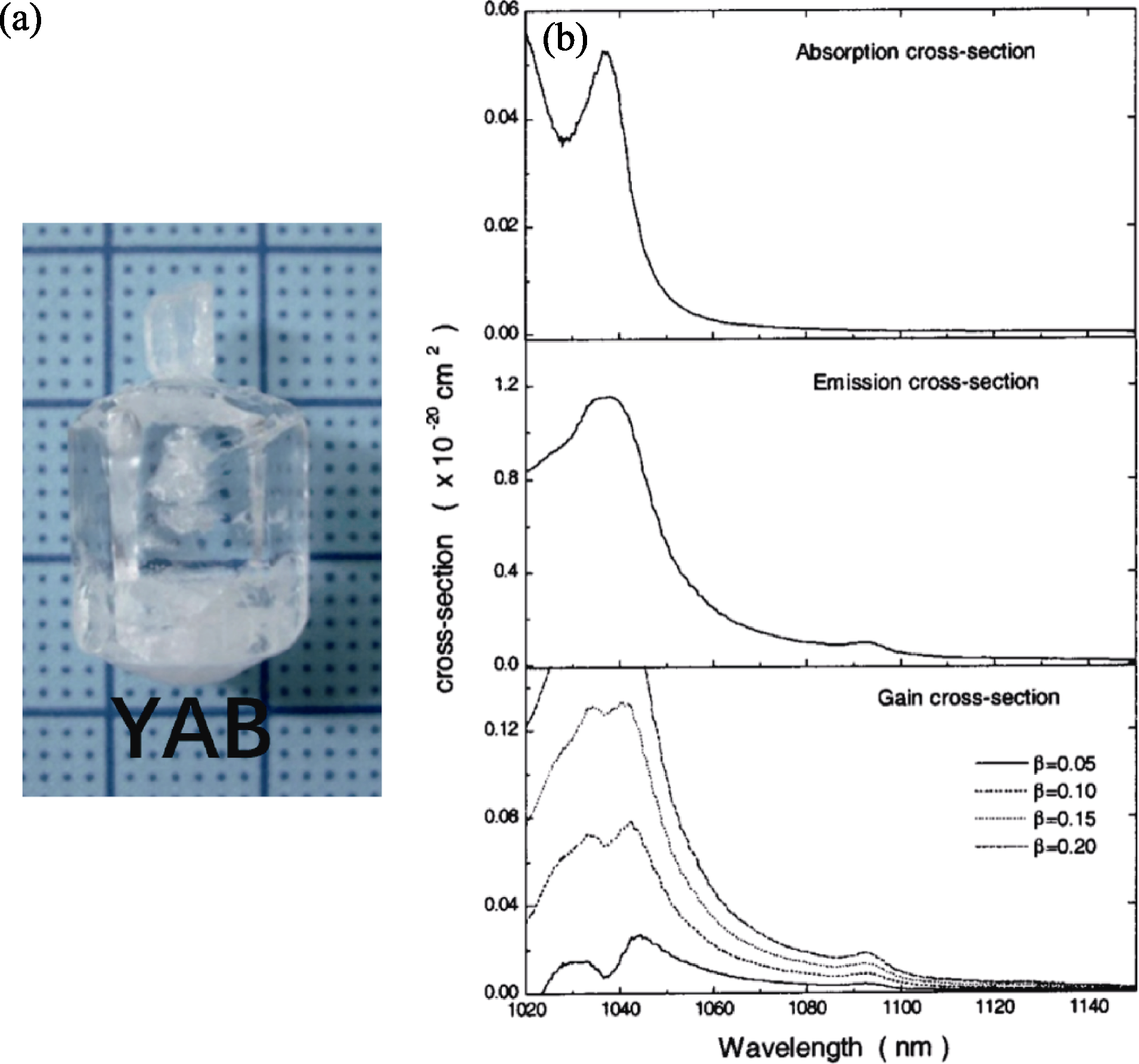
Fig. 9 Yb:YAB crystal[103,106] (a) As-grown YAB crystal[103]; (b) Emission spectra[106]
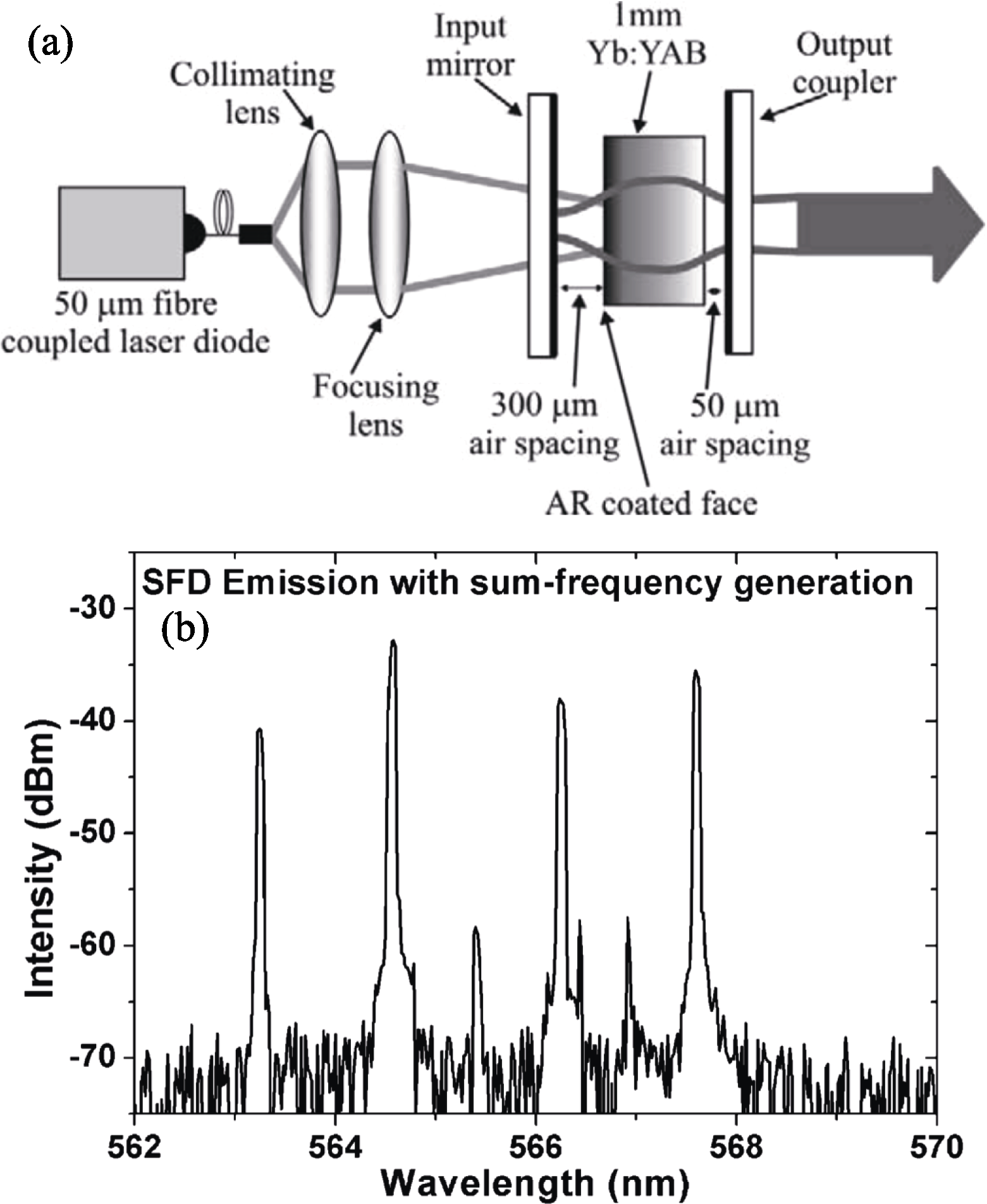
Fig. 10 Yb:YAB yellow laser[18] (a) Laser device; (b) Laser output wavelength
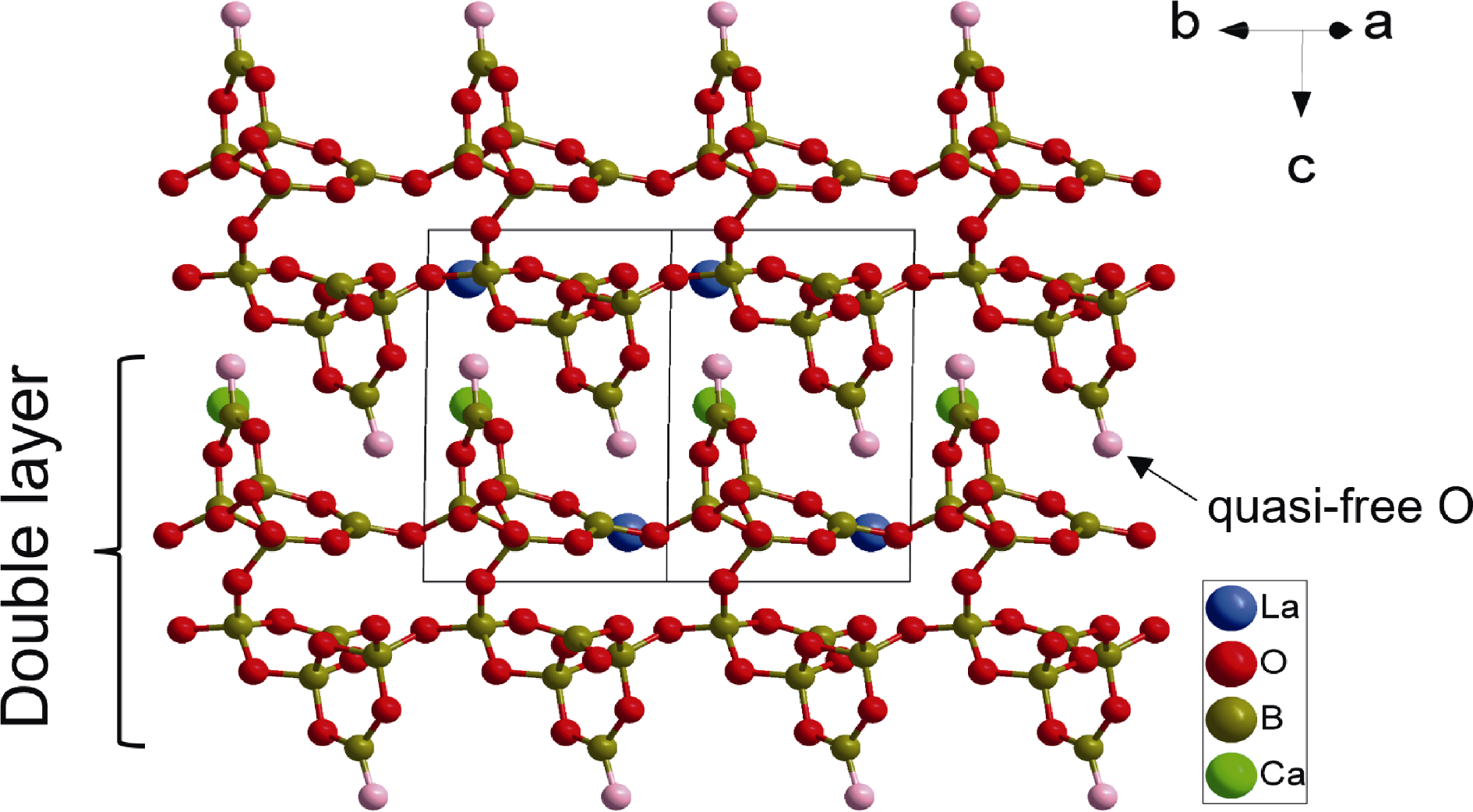
Fig. 11 Structure of LCB crystal[109]
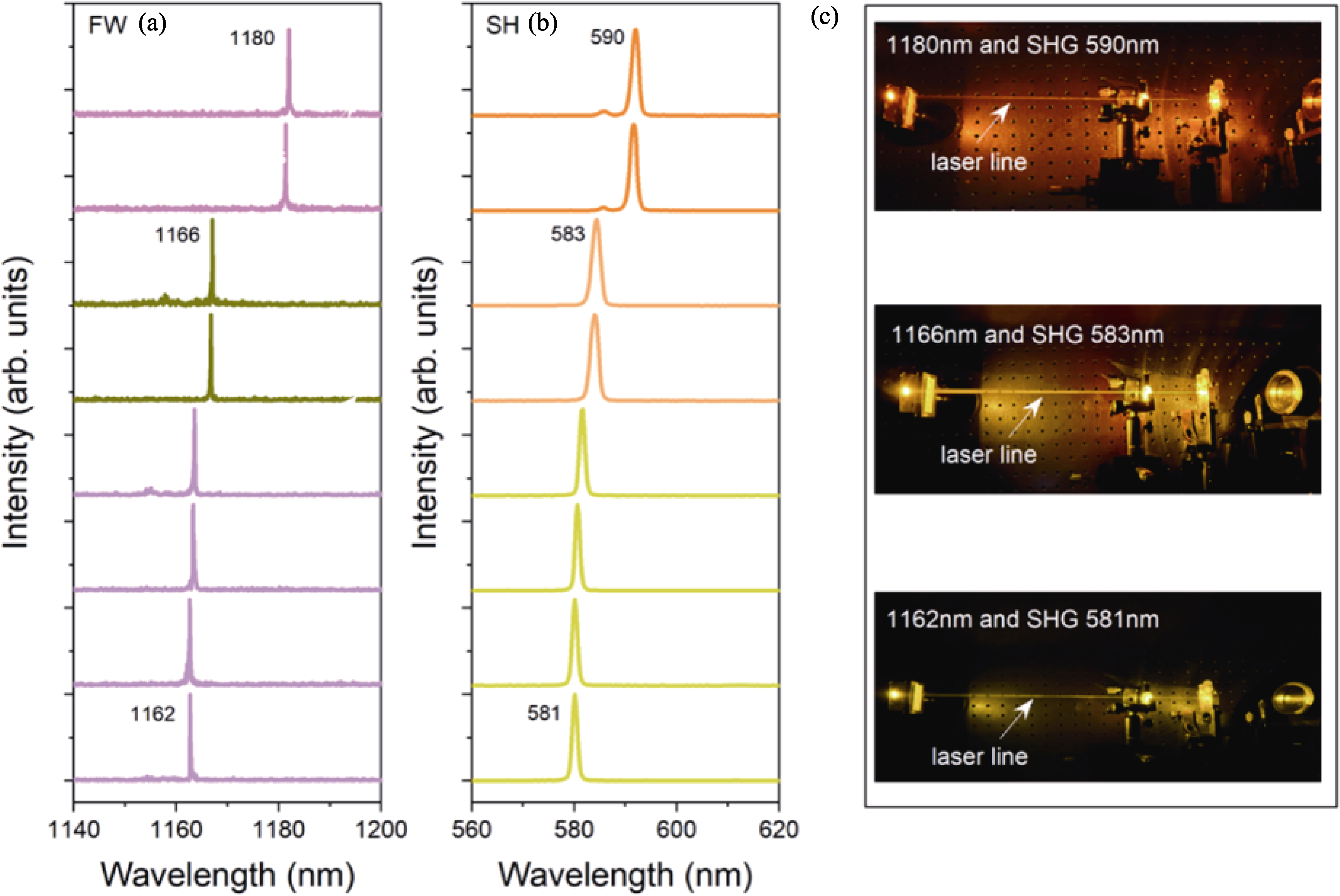
Fig. 12 Yb:LCB yellow laser[114] (a, b) Fundamental wavelength and the corresponding yellow laser wavelength; (c) Photographs of yellow laser
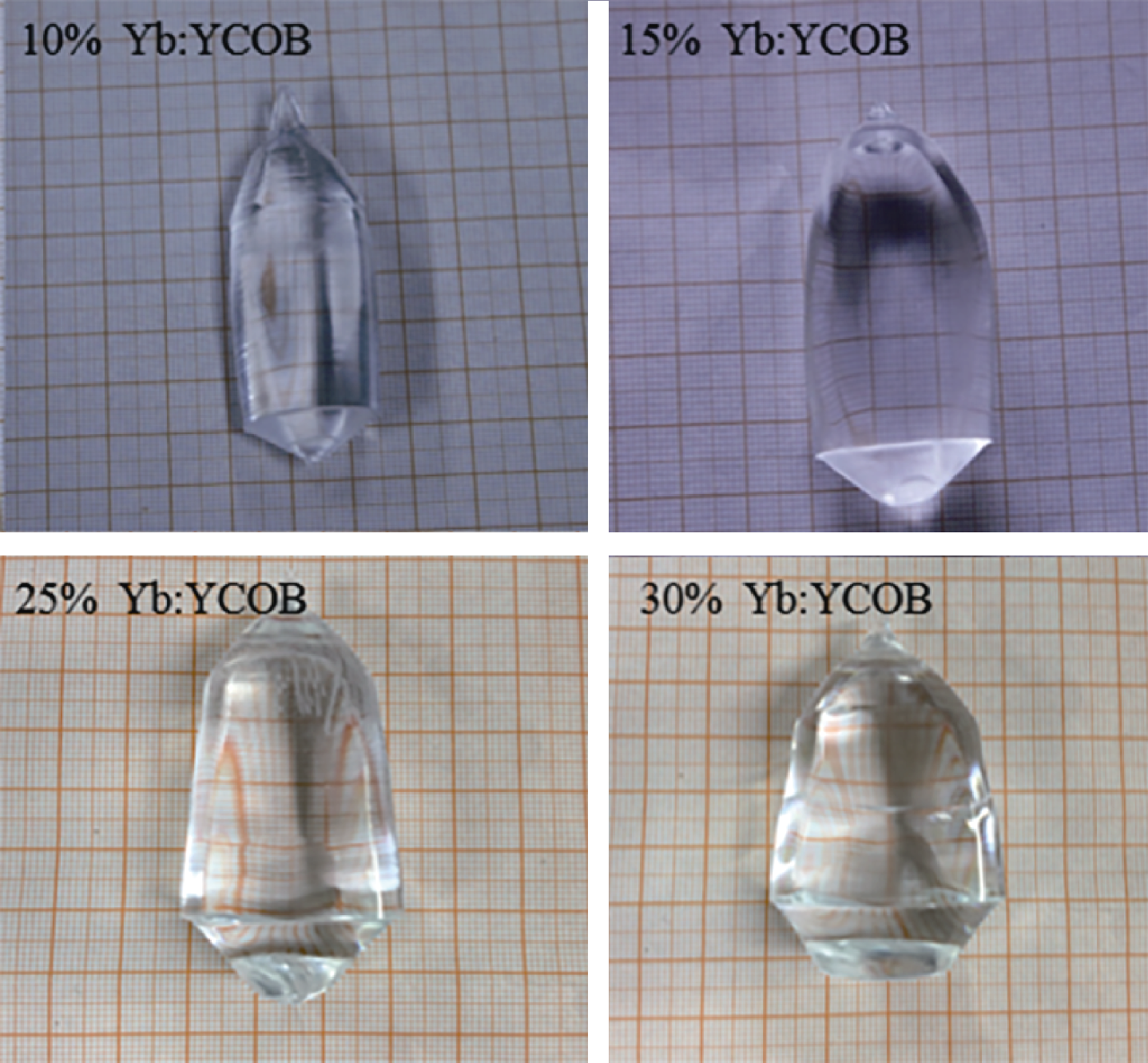
Fig. 13 As-grown Yb:YCOB crystals with different doping concentrations by Czochralski method[118]
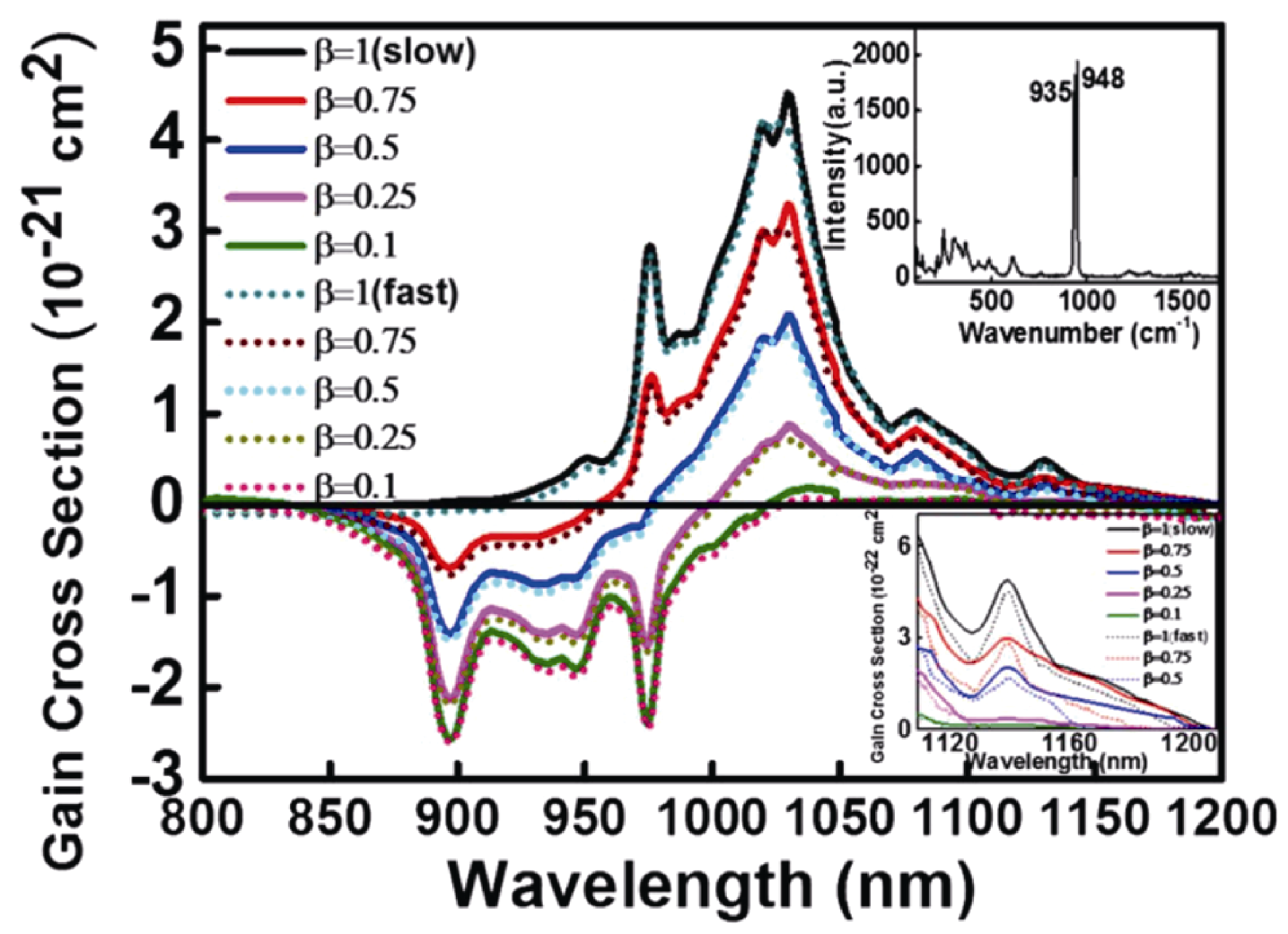
Fig. 14 Polarized gain cross sections of Yb:YCOB[119]
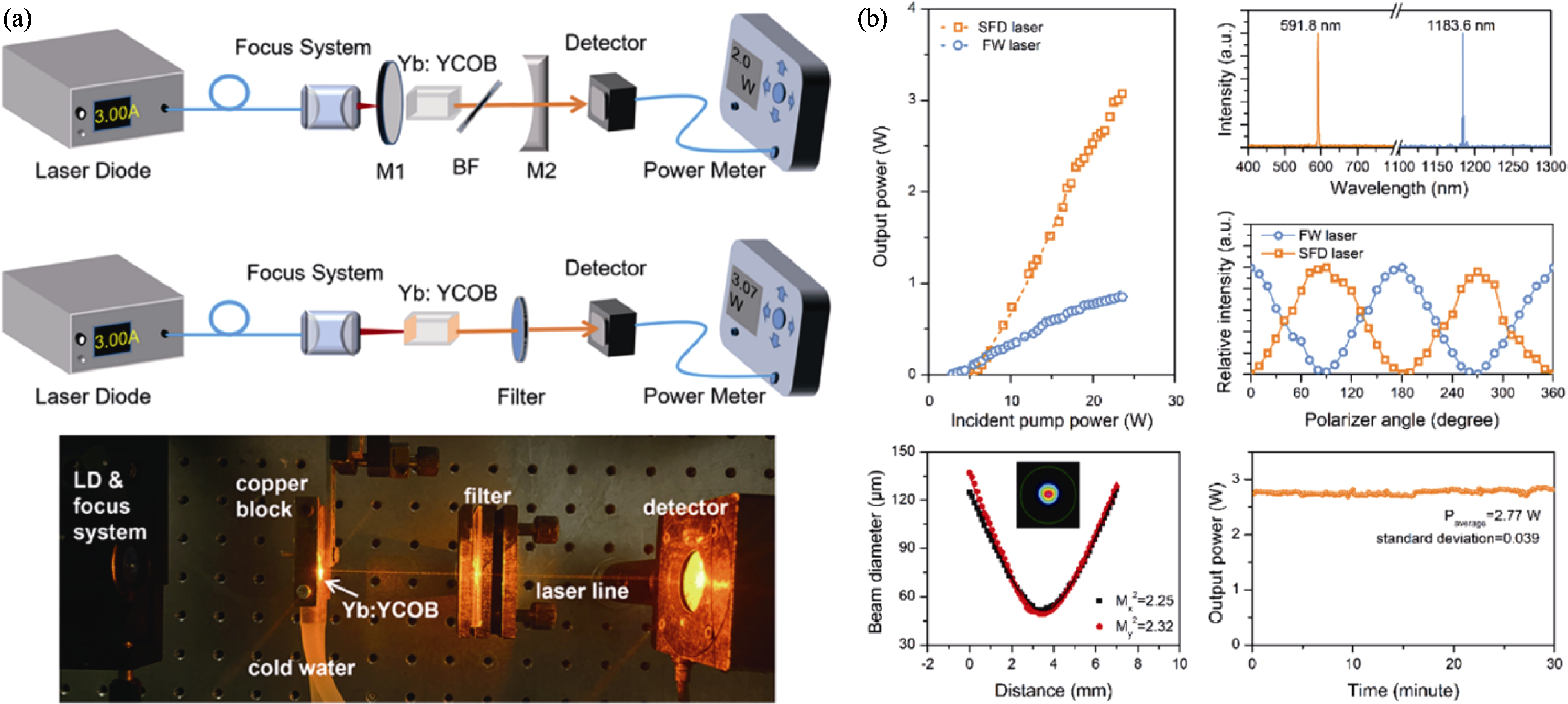
Fig. 15 Yb:YCOB yellow-orange laser[128] (a) Experimental configuration; (b) Laser performance, including output powers, laser spectrum, polarization performance, beam quality and stability
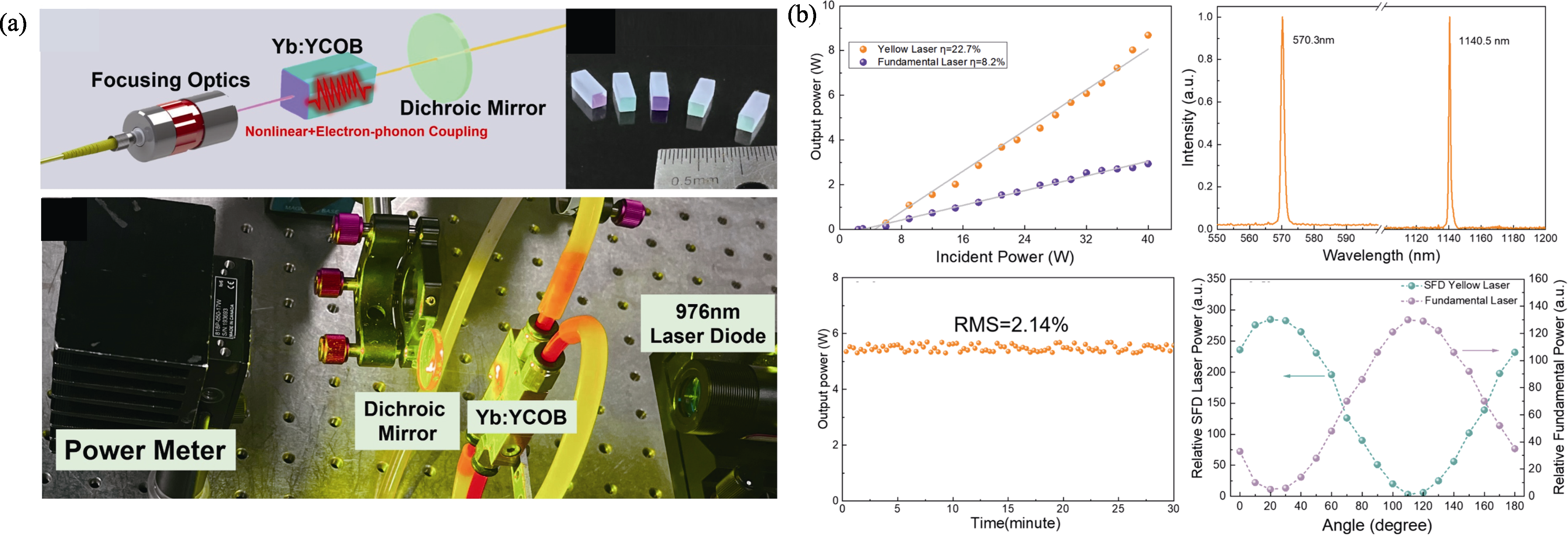
Fig. 16 Yb:YCOB yellow laser[19] (a) Experimental setup; (b) Laser performance, including output powers, laser spectrum, stability and polarization performance
| Crystal | Pump | Wavelength/nm | Output power/W | Slope efficiency/% | Threshold/W | Year | Ref. |
|---|---|---|---|---|---|---|---|
| Yb:YAB | 977 nm LD | 558-556 | 0.0012 | ~0.03 | ~4 | 2003 | [ |
| Yb:YCOB | 976 nm LD | 570 | 1.08 | 7.21 | 1.23 | 2016 | [ |
| Yb:YCOB | 976 nm LD | 570 | 1.71 | 11.97 | ~0.5 | 2020 | [ |
| Yb:YCOB | 1020 nm laser | 570 | - | - | - | 2023 | [ |
| Yb:YCOB | 976 nm LD | 591.8 | 3.07 | 13 | 3.95 | 2023 | [ |
| Yb:LCB | 976 nm LD | 590 | 4.83 | 31.6 | 0.56 | 2024 | [ |
| Yb:YCOB | 976 nm LD | 570.3 | 8.7 | 22.7 | ~2 | 2025 | [ |
Table 6 Functional-integrated yellow-orange lasers
| Crystal | Pump | Wavelength/nm | Output power/W | Slope efficiency/% | Threshold/W | Year | Ref. |
|---|---|---|---|---|---|---|---|
| Yb:YAB | 977 nm LD | 558-556 | 0.0012 | ~0.03 | ~4 | 2003 | [ |
| Yb:YCOB | 976 nm LD | 570 | 1.08 | 7.21 | 1.23 | 2016 | [ |
| Yb:YCOB | 976 nm LD | 570 | 1.71 | 11.97 | ~0.5 | 2020 | [ |
| Yb:YCOB | 1020 nm laser | 570 | - | - | - | 2023 | [ |
| Yb:YCOB | 976 nm LD | 591.8 | 3.07 | 13 | 3.95 | 2023 | [ |
| Yb:LCB | 976 nm LD | 590 | 4.83 | 31.6 | 0.56 | 2024 | [ |
| Yb:YCOB | 976 nm LD | 570.3 | 8.7 | 22.7 | ~2 | 2025 | [ |
| [1] | LIANG F, HE C, CHEN Y F, et al. China’s top 10 optical breakthroughs: electron-phonon coupling effect and laser wavelength extension. Laser & Optoelectronics Progress, 2023, 60(23): 2300001. |
| [2] | JI L L. Twenty questions on the frontier of laser science and technology. Advanced Photonics, 2024, 6(6): 060505. |
| [3] |
HUO X, QI Y, ZHANG Y, et al. Research development of 589 nm laser for sodium laser guide stars. Optics and Lasers in Engineering, 2020, 134: 106207.
DOI URL |
| [4] | CAI Y, DING J, BAI Z, et al. Recent progress in yellow laser: principles, status and perspectives. Optics & Laser Technology, 2022, 152: 108113. |
| [5] | SHANK C V, DIENES A, TROZZOLO A M, et al. Near UV to yellow tunable laser emission from an organic dye. Applied Physics Letters, 1970, 16(10): 405. |
| [6] | MAJID M A, AL-JABR A A, OUBEI H M, et al. First demonstration of InGaP/InAlGaP based 608 nm orange laser and 583 nm yellow superluminescent diode. Reston: IEEE Photonics Conference, 2015: 575-576. |
| [7] | KIM E B, LEE W K, PARK C Y, et al. Narrow linewidth 578 nm light generation using frequency-doubling with a waveguide PPLN pumped by an optical injection-locked diode laser. Optics Express, 2010, 18(10): 10308. |
| [8] | LEINONEN T, KORPIJÄRVI V M, HÄRKÖNEN A, et al. 7.4 W yellow GaInNAs-based semiconductor disk laser. Electronic Letters, 2011, 47(20): 1139. |
| [9] | KANTOLA E, LEINONEN T, RANTA S, et al. High-efficiency 20 W yellow VECSEL. Optics Express, 2014, 22(6): 6372. |
| [10] | SHEN C, FANG S, ZHANG J, et al. High performance and stable pure-blue quasi-2D perovskite light-emitting diodes by multifunctional zwitterionic passivation engineering. Advanced Photonics, 2024, 6(2): 026002. |
| [11] | HUANG Y, GONG X, ZHANG L, et al. First achievement of yellow laser operation in Dy3+-doped borate crystals. ACS Applied Materials & Interfaces, 2024, 16(37): 49556. |
| [12] | XU J, XU X D, HOU W T, et al. Research progress of rare-earth doped laser crystals in visible region. Journal of Inorganic Materials, 2019, 34(6): 573. |
| [13] | BIAN Q, BO Y, ZUO J W, et al. High-power repetition rate-and pulse width-tunable 589 nm versatile laser for adaptive optical systems. Optics Express, 2020, 28(9): 13895. |
| [14] | CHEN P, XIAO Z, NAN Y, et al. Acousto-optically Q-switched Nd:YLF/KGW/LBO Raman yellow laser operating at 578 nm. Optics Letters, 2025, 50(5): 1621. |
| [15] |
TU H, MA S, HU Z, et al. Efficient monolithic diamond Raman yellow laser at 572.5 nm. Optical Materials, 2021, 114: 110912.
DOI URL |
| [16] | MCKINNIE I T, OIEN A M L. Tunable red-yellow laser based on second harmonic generation of Cr:forsterite in KTP. Optics Communications, 1997, 141(3/4): 157. |
| [17] | GIFFIN S M, BAXTER G W, MCKINNIE I T, et al. Efficient 550-600 nm tunable laser based on noncritically phase-matched frequency doubling of room-temperature LiF:F2- in lithium triborate. Applied Optics, 2002, 41(21): 4331. |
| [18] |
BURNS P A, DAWESA J M, DEKKERA P, et al. Coupled-cavity, single-frequency, tunable cw Yb:YAB yellow microchip laser. Optics Communications, 2002, 207: 315.
DOI URL |
| [19] | DU J, LU D, LIANG F, et al. Monolithic continuous-wave yellow laser with the integration of multiphonon-electron coupling and self- frequency doubling. Optics & Laser Technology, 2025, 181: 111894. |
| [20] | KRANKEL C, MARZAHL D T, MOGLIA F, et al. Out of the blue: semiconductor laser pumped visible rare-earth doped lasers. Laser & Photonics Reviews, 2016, 10(4): 548. |
| [21] |
CAI X Y, WANG Y, LI J F, et al. Thermal, and optical features study of Dy:YAlO3 and Dy/Tb:YAlO3 crystals for yellow laser applications. Journal of Luminescence, 2021, 231: 117711.
DOI URL |
| [22] | TU C, LI J, YOU Z, et al. Spectroscopic and yellow laser features of Dy3+:Y3Al5O12 single crystals. Journal of Inorganic Materials, 2023, 38(3): 350. |
| [23] | BOWMAN S R, O’CONNOR S, CONDON N J. Diode pumped yellow dysprosium lasers. Optics Express, 2012, 20(12): 12906. |
| [24] |
LIU B, SHI J, WANG Q, et al. Crystal growth and yellow emission of Dy:YAlO3. Optical Materials, 2017, 72: 208.
DOI URL |
| [25] |
ZHOU W W, WEI B, ZHAO W, et al. Intense yellow emission in Dy3+-doped LiGd(MoO4)2 crystal for visible lasers. Optical Materials, 2011, 34: 56.
DOI URL |
| [26] | SHI J, LIU B, WANG Q, et al. Crystal growth, spectroscopic characteristics, and Judd-Ofelt analysis of Dy:Lu2O3for yellow laser. Chinese Physics B, 2018, 27(7): 077802. |
| [27] | BIGOTTA S, TONELLI M, CAVALLI E, et al. Optical spectra of Dy3+ in KY3F10 and LiLuF4 crystalline fibers. Journal of Luminescence, 2010, 130(1): 13. |
| [28] |
JIANG T, CHEN Y, GONG X, et al. Spectroscopic properties of Dy3+-doped Sr3Y(BO3)3 crystal. Optical Materials, 2019, 91: 171.
DOI URL |
| [29] |
CHEN X, HUANG Y, YUAN F, et al. A novel yellow laser candidate: Dy3+ doped Ca3NbGa3Si2O14 crystal. Journal of Crystal Growth, 2021, 564: 126114.
DOI URL |
| [30] |
LI Y, LIU L, HUANG Y, et al. Growth and spectroscopic properties of Dy3+:GdCa4O(BO3)3 crystals. Optical Materials, 2024, 157: 116230.
DOI URL |
| [31] | HUANG Y, LI Y, PAN S, et al. Spectroscopy and laser performance of Dy3+:LaMgB5O10 crystal. Optics & Laser Technology, 2025, 183: 112393. |
| [32] | METZ P W, MARZAHL D T, MAJID A, et al. Efficient continuous wave laser operation of Tb3+-doped fluoride crystals in the green and yellow spectral regions. Laser & Photonics Reviews, 2016, 10(2): 335. |
| [33] |
KAMINSKII A, HÖMMERICH U, TEMPLE D, et al. Visible laser action of Dy3+ ions in monoclinic KY(WO4)2 and KGd(WO4)2 crystals under Xe-flashlamp pumping. Japanese Journal of Applied Physics, 2000, 39: 208.
DOI |
| [34] | LIMPERT J, ZELLMER H, RIEDEL P, et al. Laser oscillation in yellow and blue spectral range in Dy3+:ZBLAN. Electronics Letters, 2000, 36(16): 1386. |
| [35] | METZ P W, MOGLIA F, REICHERT F, et al. Novel rare earth solid state lasers with emission wavelengths in the visible spectral range. 2013 Conference on Lasers & Electro-Optics Europe & International Quantum Electronics Conference CLEO EUROPE/ IQEC, Munich, 2013. |
| [36] |
XIA Z C, YANG F G, QIAO L, et al. End pumped yellow laser performance of Dy3+:ZnWO4. Optics Communications, 2017, 387: 357.
DOI URL |
| [37] | BADTKE M, KALUSNIAK S, SCHEL S P, et al. Temperature- dependent spectroscopy and laser performance of yellow Tb:YLF lasers with 36% slope efficiency at room temperature and 61% at 100 K. Laser & Photonics Reviews, 2025, 19(16): 2402019. |
| [38] | CASTELLANO-HERNÁNDEZ E, METZ P W, DEMESH M, et al. Efficient directly emitting high-power Tb3+:LiLuF4 laser operating at 587.5 nm in the yellow range. Optics Letters, 2018, 43(19): 4791. |
| [39] | CHEN H, UEHARA H, KAWASE H, et al. Efficient visible laser operation of Tb:LiYF4 and LiTbF4. Optics Express, 2020, 28(8): 10951. |
| [40] | KALUSNIAK S, TANAKA H, CASTELLANO-HERNÁNDEZ E, et al. UV-pumped visible Tb3+-lasers. Optics Letters, 2020, 45(22): 6170. |
| [41] | KOTOV L, KANEDA Y, SCHEL S P, et al. Continuous-wave and Q-switched Tb:YLF lasers at 587 nm. Optics Express, 2025, 33(3): 3950. |
| [42] | BOLOGNESI G, PARISI D, CALONICO D, et al. Yellow laser performance of Dy3+ in co-doped Dy,Tb:LiLuF4. Optics Letters, 2014, 39(23): 6628. |
| [43] | LIU X, GONG Q, HUANG C, et al. Crystal growth, property investigation, and the deactivation effect of Tb3+ in Dy3+/Tb3+ codoped LiYF4 crystals: promising crystals for all-solid-state yellow lasers. Crystal Growth & Design, 2024, 24(9): 3699. |
| [44] |
ZHANG Y X, WANG R, ZHOU Y S, et al. Diode-pumped Dy3+, Tb3+:LuLiF4 continuous-wave and passively Q-switched yellow lasers. Optics Communications, 2022, 510: 127917.
DOI URL |
| [45] |
WANG R, ZHOU Y, LI X, et al. Graphene-based passive Q-switching of a Dy3+,Tb3+:LuLiF4yellow laser. Optical Materials, 2022, 125: 112067.
DOI URL |
| [46] | ZOU J, HE H, SONG L, et al. Sub-100-fs deep-red mode-locked fiber laser for multicolor two-photon microscopy. Advanced Photonics, 2025, 7(4): 046009. |
| [47] | CHENGCHUN Z, SHANMING L, MIN X, et al. Research progress in laser crystals. Chinese Journal of Lasers, 2024, 51(11): 1101022. |
| [48] | FUJIMOTO Y, ISHII O, YAMAZAKI M. Yellow laser oscillation in Dy3+-doped waterproof fluoro-aluminate glass fibre pumped by 398.8 nm GaN laser diodes. Electronics Letters, 2010, 46(8): 586. |
| [49] | JEYS T H, BRAILOVE A A, MOORADIAN A. Sum frequency generation of sodium resonance radiation. Applied Optics, 1989, 28(13): 2588. |
| [50] | SCHULZ P A, JEYS T H. Three-wavelength interconversion laser. Optics Letters, 1993, 18(19): 1630. |
| [51] | VANCE J D, SHE C Y, MOOSMULLER H. Continuous-wave, all-solid-state, single-frequency 400-mW source at 589 nm based on doubly resonant sum-frequency mixing in a monolithic lithium niobate resonator. Optical Society of America, 1998, 37(21): 4891. |
| [52] | BU Y, ZHENG Q, XUE Q, et al. Diode-pumped 593.5 nm cw yellow laser by type-I CPM LBO intracavity sum-frequency- mixing. Optics & Laser Technology, 2006, 38(8): 565. |
| [53] | BO Y, XIE S Y, WANG Z C, et al. 589 nm high power sum-frequency generation with quasi-continuous-wave diode- pumped Nd:YAG lasers. 2010 International Conference on Advanced Optoelectronics & Lasers, Ukraine, 2010: 64-66. |
| [54] | LI L Y, DONG Y, FEI L Y. 3.62 W of continuous-wave orange- yellow light generated by intra-cavity sum-frequency mixing of Nd:YVO4. Optik, 2011, 122(13): 1125. |
| [55] | LU Y H, FAN G B, REN H J, et al. High-average-power narrow- line-width sum frequency generation 589 nm laser. Technologies for Optical Countermeasures XII; and High-power Lasers 2015: Technology and Systems, Toulouse, 2015, 9650: 965008. |
| [56] | YANG J, TAN H, TIAN Y, et al. Generation of a 578-nm yellow laser by the use of sum-frequency mixing in a branched cavity. IEEE Photonics Journal, 2016, 8(1): 1500607. |
| [57] | MA G, YANG J, TAN H, et al. Continuous-wave yellow laser generation at 578 nm by intracavity sum-frequency mixing of thin disk Yb:YAG laser and Nd:YAG laser. Optics & Laser Technology, 2017, 92: 32. |
| [58] | LU Y, ZHANG L, XU X, et al. 208 W all-solid-state sodium guide star laser operated at modulated-longitudinal mode. Optics Express, 2019, 27(15): 20282. |
| [59] | ZHAO L N, SU J, HU X P, et al. Single-pass sum-frequency- generation of 589-nm yellow light based on dual-wavelength Nd:YAG laser with periodically-poled LiTaO3 crystal. Optics Express, 2010, 18(13): 13331. |
| [60] | WANG Y N, ZHENG Q, YAO Y, et al. Intracavity sum-frequency diode side-pumped all-solid-state generation yellow laser at 589 nm with an output power of 20.5 W. Applied Optics, 2013, 52(9): 1876. |
| [61] | LI B, YAO J Q, DING X, et al. A novel CW yellow light generated by a diode-end-pumped intra-cavity frequency mixed Nd:YVO4 laser. Optics & Laser Technology, 2014, 56: 99. |
| [62] | SINGH A J, GUPTA P K, SHARMA S K, et al. Efficient yellow beam generation by intracavity sum frequency mixing in DPSS Nd:YVO4 laser. Pramana, 2014, 82(2): 197. |
| [63] | LIU J, WANG J L, LÜ T Y, et al. All-solid-state 589 nm laser and the brightness of excited sodium guide star. Optics and Precision Engineering, 2014, 22(12): 3200. |
| [64] | WANG P Y, XIE S Y, BO Y, et al. 33 W quasi-continuous-wave narrow-band sodium D2a laser by sum-frequency generation in LBO. Chinese Physics B, 2014, 23(9): 094208. |
| [65] | ZHU P F, WANG L L, ZHANG C M, et al. All-solid-state side- pumped intracavity sum frequency generation yellow laser at 589 nm with the output power of 11.4 W. Optics and Spectroscopy, 2014, 116(3): 479. |
| [66] | YUAN Y, LI BIN, GUO X. Laser diode pumped Nd:YAG crystals frequency summing 589 nm yellow laser. Optik, 2016, 127(2): 710. |
| [67] | BIAN Q, BO Y, ZUO J W, et al. High-power QCW microsecond- pulse solid-state sodium beacon laser with spiking suppression and D2b re-pumping. Optics Letters, 2016, 41(8): 1732. |
| [68] | BOHN W L, ACKERMANN H, TITTERTON D H, et al. Tunable line width all solid state double spectral line sodium beacon laser. Proceeding of SPIE, 2017, 10436: 1043605. |
| [69] | ZONG Q S, GUO C, BIAN Q, et al. Watt level laser source for a polychromatic laser guide stars: double resonant fluorescence from 3S1/2-3P3/2-3D5/2 transition of sodium atoms. Optics Express, 2019, 27(9): 12255. |
| [70] | ZONG Q, BIAN Q, YANG Y, et al. Narrow linewidth high beam quality long pulse solid-state yellow laser at 589 nm by intra-cavity sum-frequency generation. 14th National Conference on Laser Technology and Optoelectronics, Shanghai, 2019, 11170: 111700M. |
| [71] | WILLIAMS R J, KITZLER O, MCKAY A, et al. Investigating diamond Raman lasers at the 100 W level using quasi-continuous- wave pumping. Optics Letters, 2014, 39(14): 4152. |
| [72] | IVLEVA L I, BASIEV T T, VORONINA I S, et al. SrWO4:Nd3+- new material for multifunctional lasers. Optical Materials, 2003, 23(1/2): 439. |
| [73] | SPENCE D J, GRANADOS E, MILDREN R P. Mode-locked picosecond diamond Raman laser. Optics Letters, 2010, 35(4): 556. |
| [74] | REILLY S, SAVITSKI V G, LIU H, et al. Monolithic diamond Raman laser. Optics Letters, 2015, 40(6): 930. |
| [75] | YANG X, KITZLER O, SPENCE D J, et al. Diamond sodium guide star laser. Optics Letters, 2020, 45(7): 1898. |
| [76] | SUN Y, YANG X, LI M, et al. Diamond guide star laser pulsed at a Larmor frequency. Optics Express, 2024, 32(26): 46345. |
| [77] | SUN B, DING X, JIANG P, et al. 13.7-W 588-nm yellow laser generation by frequency doubling of 885-nm side-pumped Nd: YAG-YVO4 intracavity Raman laser. IEEE Photonics Journal, 2020, 12(2): 1501607. |
| [78] | HSIAO J Q, HUANG Y J, LEE C C, et al. Powerful Q-switched Raman laser at 589 nm with a repetition rate between 200 and 500 kHz. Optics Letters, 2021, 46(9): 2063. |
| [79] | CHEN H H, HU W J, WEI X, et al. High beam quality yellow laser at 588 nm by an intracavity frequency-doubled composite Nd:YVO4 Raman laser Optics Express, 2023, 31(5): 8494. |
| [80] | CHEN P, XIAO Z, GUO C, et al. Nanosecond pulsed Raman yellow laser operating at 573 and 582 nm. Optics Express, 2025, 33(15): 31334. |
| [81] | CONG Z, ZHANG X, WANG Q, et al. Theoretical and experimental study on the Nd:YAG/BaWO4/KTP yellow laser generating 8.3 W output power. Optics Express, 2010, 18(12): 12111. |
| [82] | DUAN Y, ZHU H, HUANG C, et al. Potential sodium D2 resonance radiation generated by intra-cavity SHG of a c-cut Nd:YVO4 self-Raman laser. Optics Express, 2011, 19(7): 6333. |
| [83] | WAN X, WANG Q, LIU Z, et al. Frequency-doubled Nd:Gd3Ga5O12/ BaWO4Raman laser emitting at 589 nm. Applied Physics Express, 2012, 5(10): 102702. |
| [84] | XU H, ZHANG X, WANG Q, et al. Diode-pumped passively Q-switched yellow laser with SrWO4 Raman crystal and ceramic Nd:YAG gain medium. Optics Communications, 2012, 285(24): 5302. |
| [85] | PENG J Y, ZHENG Y, SHI Y X, et al. Passively Q-switched a-cut Nd:GdVO4 self-Raman laser with Cr:YAG. Optics & Laser Technology, 2012, 44(7): 2175. |
| [86] | DING S, ZHANG W, WANG S, et al. Theoretical and experimental study on passively Q-switched intracavity frequency-doubled solid- state yellow Raman lasers. Applied Optics, 2013, 52(15): 3583. |
| [87] | SHEN H, WANG Q, ZHANG X, et al. Intracavity frequency- doubled Nd:YAG/KLu(WO4)2 Raman laser at 589 nm: a potential source for sodium D2 resonance radiation Optics & Laser Technology, 2013, 45: 142. |
| [88] | GAO Z L, LIU S D, ZHANG J J, et al. Self-frequency-doubled BaTeMo2O9 Raman laser emitting at 589 nm. Optics Express, 2013, 21(6): 7821. |
| [89] | JIANG W, ZHU S, CHEN X, et al. Compact passively Q-switched Raman laser at 1176 nm and yellow laser at 588 nm using Nd3+:YAG/Cr4+:YAG composite crystal. Applied Optics, 2014, 53(7): 1328. |
| [90] | LIU Y, LIU Z, CONG Z, et al. Quasi-continuous-wave 589-nm radiation based on intracavity frequency-doubled Nd:GGG/BaWO4 Raman laser. Optics & Laser Technology, 2016, 81: 184. |
| [91] | MAO T, DUAN Y, CHEN S, et al. Yellow and orange light selectable output generated by Nd:YAP/YVO4/LBO Raman laser. IEEE Photonics Technology Letters, 2019, 31(13): 1112. |
| [92] |
ZHANG L, DUAN Y, SUN Y, et al. Passively Q-switched multiple visible wavelengths switchable YVO4 Raman laser. Journal of Luminescence, 2020, 228: 117650.
DOI URL |
| [93] | CHEN Y F, CHEN K Y, LIU Y C, et al. Criterion for optimizing high-power acousto-optically Q-switched self-Raman yellow lasers with repetition rates up to 500 kHz. Optics Letters, 2020, 45(7): 1922. |
| [94] | DUAN Y, SUN Y, ZHU H, et al. YVO4 cascaded Raman laser for five-visible-wavelength switchable emission. Optics Letters, 2020, 45(9): 2564. |
| [95] | HUI Z, HAOYU W, SIQI Z, et al. 578.5 nmend-pumped passively Q-switched Raman yellow laser. Laser and Optoelectronics Progress, 2021, 58(1): 0114004. |
| [96] | CHEN M, DAI S, YIN H, et al. Passively Q-switched yellow laser at 589 nm by intracavity frequency-doubled c-cut composite Nd:YVO4 self-Raman laser Optics & Laser Technology, 2021, 133: 106534. |
| [97] | CHEN J C, HO Y W, TU Y C, et al. High-peak-power passively Q-switched laser at 589 nm with intracavity stimulated Raman scattering. Crystals, 2023, 13(2): 334. |
| [98] | CHEN J C, TU Y C, HO Y W, et al. Highly efficient diode-pumped passively Q-switched Nd:YVO4/KGW Raman lasers at yellow and orange wavelengths. Optics Express, 2023, 31(5): 8696. |
| [99] | HO Y W, CHEN J C, TU Y C, et al. Sub-nanosecond passively Q-switched yellow and orange Raman lasers. Photonics, 2024, 11(2): 157. |
| [100] |
DUAN Y, XU J, WEI Y, et al. Yellow-orange wavelength- switchable laser emission generated from c-cut Nd:YVO4 self- Raman with 890 and 259 cm-1 shifts. Journal of Luminescence, 2024, 267: 120402.
DOI URL |
| [101] | GRANADOS E, PASK H M, ESPOSITO E, et al. Multi- wavelength, all-solid-state, continuous wave mode locked picosecond Raman laser. Optics Express, 2010, 18(5): 5289. |
| [102] | CHENG Y, YU H, ZHANG H, et al. Advances in the research and laser applications of self-frequency doubling crystals. Journal of Technology, 2021, 21(2): 96. |
| [103] | YU X, YUE Y, YAO J, et al. YAl3(BO3)4: Crystal growth and characterization. Journal of Crystal Growth, 2010, 312(20): 3029. |
| [104] |
LEONYUK N I, LEONYUK L I. Growth and characterization of RM3(BO3)4 crystals. Progress in Crystal Growth and Characterization of Materials, 1995, 31: 179.
DOI URL |
| [105] | FILIMONOV A A, LEONYUK N I, MEISSNER L B, et al. Nonlinear optical properties of isomorphic family of crystals with yttrium-aluminium borate (YAB) structure. Kristall and Technik, 1974, 9(1): 63. |
| [106] | DEKKER P, BURNS P A, DAWES J M, et al. Widely tunable yellow-green lasers based on the self-frequency-doubling material Yb:YAB. Journal of the Optical Society of America B-Optical Physics, 2003, 20(4): 706. |
| [107] | WU Y C, LIU J G, FU P Z, et al. A new class of nonlinear optical crystals R2CaB10O19 (RCB). International Society for Optics and Photonics, 1998, 10: 8. |
| [108] | WU Y, HU Z, JING F, et al. Growth and property of Ce3+-doped La2CaB10O19 crystal. Journal of Inorganic Materials, 2023, 38(5): 583. |
| [109] | CHENG Y, FENG J, WANG F, et al. Enhanced electron-phonon coupling effect in rare-earth borate vrystals containing a “Quasi- Free-Oxygen” motif. Inorganic Chemistry, 2022, 61(26): 10228. |
| [110] |
GUO R, WU Y, FU P, et al. Growth and spectroscopic properties of ytterbium-doped lanthanum calcium borate (Yb3+:La2CaB10O19) crystal. Optics Communications, 2005, 244(1-6): 321.
DOI URL |
| [111] | BRENIER A, WU Y, ZHANG J, et al. Lasing Yb3+ in crystals with a wavelength dependence anisotropy displayed from La2CaB10O19. Applied Physics B, 2012, 107(1): 59. |
| [112] | CHENG Y, FENG J, LIANG F, et al. Diode-pumped continuous- wave laser of a self-frequency-doubling Yb:La2CaB10O19 crystal. Optics Letters, 2022, 47(23): 6145. |
| [113] | CHENG Y L, LIANG F, LU D Z, et al. Phonon engineering in Yb:La2CaB10O19 crystal for extended lasing beyond the fluorescence spectrum. Light: Science & Applications, 2023, 12(1): 1. |
| [114] | CHENG Y, LIANG F, FENG J, et al. Multiphonon-coupling yellow laser in Yb:La2CaB10O19 crystal. Optics Express, 2024, 32(11): 20316. |
| [115] | HUAQING X, JUN L, TONGGENG X, et al. Research on the thermophysical properties of Ca2YO(BO3)3 crystals. Journal of Inorganic Materials, 2002, 17(2): 226. |
| [116] | LIU F F, CAI S X, LIU J H. Research of Yb-doped rare-earth calcium oxyborate crystal lasers. Laser and Optoelectronics Progress, 2020, 57(7): 071604. |
| [117] | MOUGEL F, DARDENNE K, AKA G, et al. Ytterbium-doped Ca4GdO(BO3)3: an efficient infrared laser and self-frequency doubling crystal. Journal of the Optical Society of America B-Optical Physics, 1999, 16(1): 164. |
| [118] | LU D Z, FANG Q N, YU H H, et al. Yb:YCOB self-frequency- doubled yellow laser crystal and device. Journal of the Chinese Ceramic Society, 2020, 49(2): 247. |
| [119] | FANG Q, LU D, YU H, et al. Self-frequency-doubled vibronic yellow Yb:YCOB laser at the wavelength of 570 nm. Optics Letters, 2016, 41(5): 1002. |
| [120] | WANG F, LIANG F, JING F, et al. Phonon-assisted photoluminescence-excited (PLE) spectrum in Eu3+-doped single crystals. Crystal Growth & Design, 2025, 25(3): 838. |
| [121] | WANG F, LIANG F, LU D, et al. Dimensionality effect of the “Free-Oxygen” motif on the crystal field splitting in rare-earth crystals. The Journal of Physical Chemistry C, 2023, 127(30): 15011. |
| [122] | WANG F, LIANG F, LIU W, et al. Anion-centered polyhedron strategy for strengthening photon emission induced by electron- phonon coupling. Inorganic Chemistry, 2022, 61(9): 4071. |
| [123] | BLASSE G. Interaction between optical centers and their surroundings: an inorganic chemist’s approach. Advances in Inorganic Chemistry, 1990, 35: 319. |
| [124] | LIANG F, HE C, LU D, et al. Multiphonon-assisted lasing beyond the fluorescence spectrum. Nature Physics, 2022, 18(11): 1312. |
| [125] | SI H, LIANG F, LU D, et al. Coherent phonon excitation in multiphonon-coupled lasing beyond the fluorescence spectrum. Optics & Laser Technology, 2025, 192: 113932. |
| [126] |
FU Y, LIANG F, HE C, et al. Photon-phonon collaboratively pumped laser. Nature Communications, 2023, 14: 8110.
DOI PMID |
| [127] | SI H, LIANG F, LU D, et al. Efficient direct laser generation by three-phonon-assisted transition with Yb:YCOB crystal. Advanced Photonics Research, 2023, 4(6): 2300092. |
| [128] | SI H, LIANG F, ZHOU Y, et al. Monolithic 591-nm laser with cooperative multiphonon-coupling and nonlinear frequency-doubling. Optics Letters, 2023, 48(18): 4913. |
| [129] | OGILVY H, WITHFORD M J, DEKKER P, et al. Efficient diode double-end-pumped Nd:YVO4 laser operating at 1342 nm. Optics Express, 2003, 11(19): 2411. |
| [130] | FU Y, HAO H, LIANG F, et al. Intracavity frequency-doubled yellow laser in an electron-phonon-coupled Nd:YVO4 crystal. Optics Letters, 2024, 49(3): 578. |
| [131] | WAN X B, WANG Q P, LIU Z J, et al. Comparison of c-Nd:YVO4/YVO4 Raman lasers and c-Nd:YVO4 self-Raman lasers. Laser Physics, 2011, 22(1): 106. |
| [132] | DING X, LIU J, SHENG Q, et al. Efficient eye-safe Nd:YVO4 self-Raman laser in-band pumped at 914 nm. IEEE Photonics Journal, 2015, 7(6): 1503807. |
| [133] | WANG A Y, YU X S, YUAN G. Self-frequency doubling yellow laser with low thermal effect and high beam quality. Laser & Optoelectronics Progress, 2023, 60(13): 1314001. |
| [1] | ZHONG Hong, ZHANG Yuhao, SHAN Qingsong, HU Tianjun, ZENG Haibo. Research Progress on Tandem Quantum-dot Light-emitting Diodes [J]. Journal of Inorganic Materials, 2026, 41(8): 1036-1048. |
| [2] | MA Zhitong, LI Zhongshao, CAO Xun. Dynamic Radiative Thermal Management Technologies: From Principles and Materials to Synergistic Optimization of Materials and Structures [J]. Journal of Inorganic Materials, 2026, 41(8): 1021-1035. |
| [3] | LIU Yuxiao, LIANG Fei. Growth and Yellow Emission Spectral Properties of Dy:Y2SiO5 and Dy,Tb:Y2SiO5 Single Crystals [J]. Journal of Inorganic Materials, 2026, 41(7): 930-938. |
| [4] | QIN Shanli, GUO Jiawen, CHEN Yanmeng, JU An’an, WEI Yi, HUANG Kelin, HOU Xianghua, LÜ Sishi, WEN Zhipeng, WU Lian. Recent Advances in Constructing Oriented Ion Transport Channels with Two-dimensional Layered Materials for Electrochemical Energy Storage [J]. Journal of Inorganic Materials, 2026, 41(7): 883-898. |
| [5] | YU Feiyu, WANG Wenqing, ZHANG Xueqin, HE Rujie. Additively Manufactured Ceramic Lattice-based Interpenetrating Phase Composites: Progress and Challenges [J]. Journal of Inorganic Materials, 2026, 41(7): 849-866. |
| [6] | ZHOU Cui, LI Jie, SUN Luchao, SU Haijun, WANG Jingyang. Alumina-based Directionally Solidified Eutectic Ceramics: Microstructure, Control Strategies and Environmental Stability [J]. Journal of Inorganic Materials, 2026, 41(7): 899-914. |
| [7] | FEI Wenlong, WANG Yakun, LIAO Liangsheng. Research Progress on Controllable Synthesis of Blue-emitting ZnSeTe Quantum Dots and Quantum-dot Light-emitting Diode Devices [J]. Journal of Inorganic Materials, 2026, 41(7): 867-882. |
| [8] | CHEN Mingjun, MIAO Hongkang, XIAO Yingjun, DENG Jianbo, ZHANG Xiang, ZHAO Jiupeng, LI Yao. Photo- and Thermo-chromic Dual-responsive Materials: A Review on Design Strategies and Applications in Smart Windows [J]. Journal of Inorganic Materials, 2026, 41(6): 723-738. |
| [9] | SONG Kunjie, XIE Rongjun. Research Advances on Machine Learning-driven Development of Novel Luminescent Materials [J]. Journal of Inorganic Materials, 2026, 41(6): 689-703. |
| [10] | HU Yuqing, ZHU Yixin, LE Xianhao, WAN Qing. Lithium Tantalate Wafer: Advances in Thinning Technology and Application in Pyroelectric Infrared Detectors [J]. Journal of Inorganic Materials, 2026, 41(6): 764-774. |
| [11] | LIU Chunfan, CHEN Ke, GE Fangfang, HUANG Qing. Research Progress on Lead-bismuth Eutectic Corrosion Resistant Coatings [J]. Journal of Inorganic Materials, 2026, 41(6): 775-786. |
| [12] | HU Yang, XIE Min, ZHANG Xiaoyi, LI Xiang, GUO Xinwei, JIANG Nan, ZHOU Wenhan, ZHANG Shengli, ZENG Haibo. Research Progress on Computational and Data-driven Environmental-friendly Luminescent Materials [J]. Journal of Inorganic Materials, 2026, 41(6): 704-722. |
| [13] | WANG Junbu, HUANG Zeai, YANG Mingkai, MENG Ying, ZHOU Mingwei, ZHOU Ying. Research Progress on Anti-coking Catalytic Materials for Methane Conversion [J]. Journal of Inorganic Materials, 2026, 41(6): 739-750. |
| [14] | WANG Jinwen, YANG Zhen, ZHOU Huan, XIA Dan, YANG Lei. Biomedical Applications of Injectable Inorganic Biomaterials [J]. Journal of Inorganic Materials, 2026, 41(6): 751-763. |
| [15] | LI Hantao, SHEN Qiang, LUO Guoqiang, WANG Xuefei, GAO Ming, CHEN Chen. Research Progress on Structure and Performance Regulation of Silicon-based Anode Materials via Mechanical Ball Milling [J]. Journal of Inorganic Materials, 2026, 41(5): 561-572. |
| Viewed | ||||||
|
Full text |
|
|||||
|
Abstract |
|
|||||
