
Journal of Inorganic Materials ›› 2026, Vol. 41 ›› Issue (3): 370-376.DOI: 10.15541/jim20250230
Special Issue: 【信息功能】功能晶体(202606)
• RESEARCH ARTICLE • Previous Articles Next Articles
LIU Guojin1,2( ), HUANG Changbao1,3(), YU Xuezhou1, QI Huabei1,2, HU Qianqian1,2, NI Youbao1,3, WANG Zhenyou1, WU Haixin1()
Received:2025-05-27
Revised:2025-06-10
Published:2026-03-20
Online:2025-07-16
Contact:
HUANG Changbao, associate professor. E-mail: cbhuang@aiofm.ac.cn;About author:LIU Guojin (1995-), male, PhD candidate. E-mail: lgjustc@mail.ustc.edu.cn
Supported by:CLC Number:
LIU Guojin, HUANG Changbao, YU Xuezhou, QI Huabei, HU Qianqian, NI Youbao, WANG Zhenyou, WU Haixin. Growth and Spectral Property of KTb3F10 Single Crystal[J]. Journal of Inorganic Materials, 2026, 41(3): 370-376.
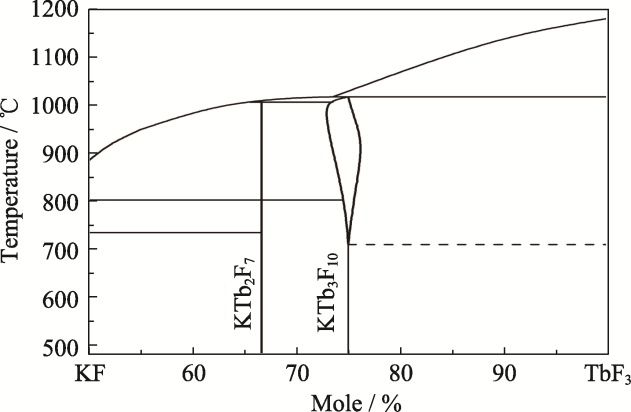
Fig. 1 Phase diagram of KF-TbF3 binary systems[23]
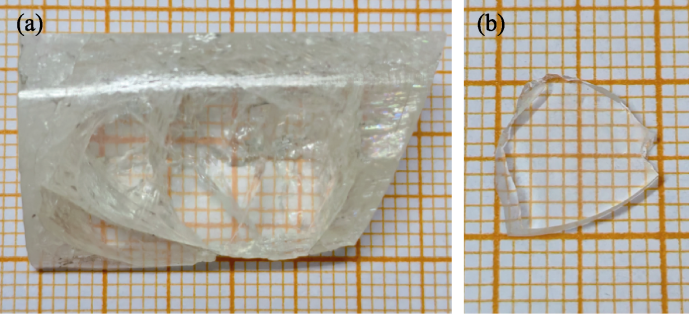
Fig. 2 Results of KTF crystal growth (a) KTF blank crystal sliced along the central axis; (b) Oriented (111) plane sample
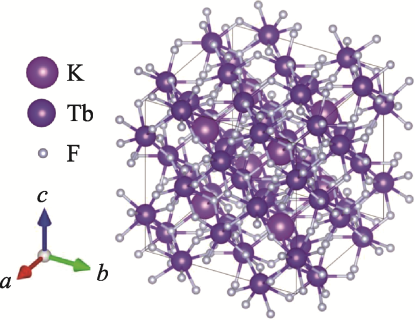
Fig. 3 Cell structure of KTF crystal[26]
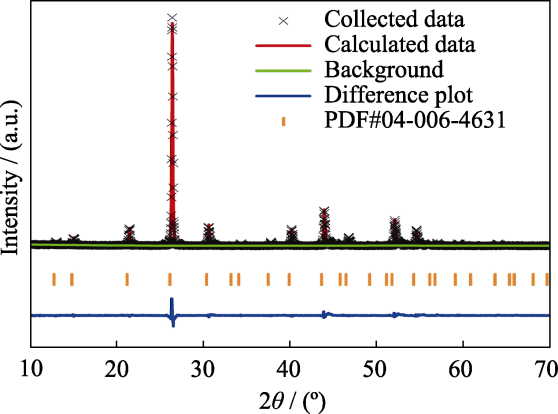
Fig. 4 XRD patterns and Rietveld refinement results of KTF single crystal powder
| Cell parameter | a/nm | V/nm3 | Density/(g·cm-3) | Rwp/% | Rp/% | χ2 |
|---|---|---|---|---|---|---|
| KTF single crystal | 1.1662(4) | 1.58591(16) | 5.478 | 11.05 | 7.48 | 1.41 |
| PDF#04-006-4631 | 1.168 | 1.59341 | 5.885 |
Table 1 Crystallographic data from structural refinement of KTF single crystal
| Cell parameter | a/nm | V/nm3 | Density/(g·cm-3) | Rwp/% | Rp/% | χ2 |
|---|---|---|---|---|---|---|
| KTF single crystal | 1.1662(4) | 1.58591(16) | 5.478 | 11.05 | 7.48 | 1.41 |
| PDF#04-006-4631 | 1.168 | 1.59341 | 5.885 |
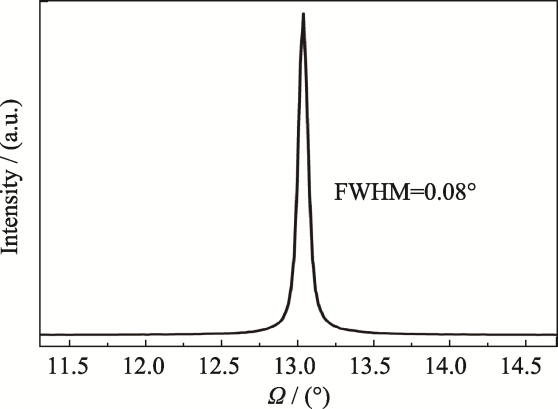
Fig. 5 X-ray rocking curve of (111) plane for KTF single crystal
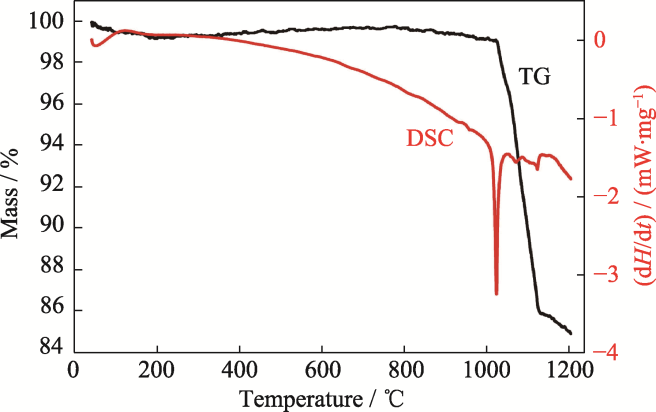
Fig. 6 TG-DSC thermal analysis curves of KTF single crystal
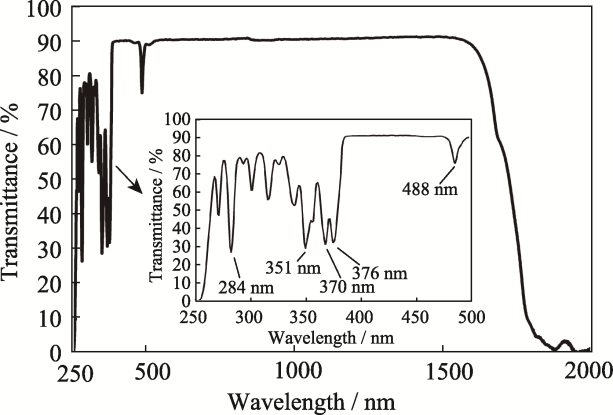
Fig. 7 UV-Vis-NIR transmission spectrum of KTF single crystal
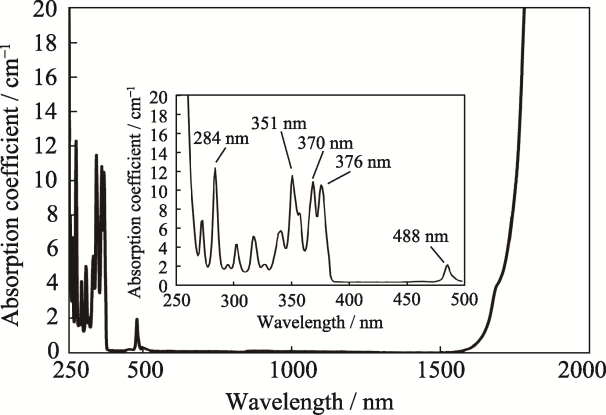
Fig. 8 Absorption spectrum of KTF single crystal
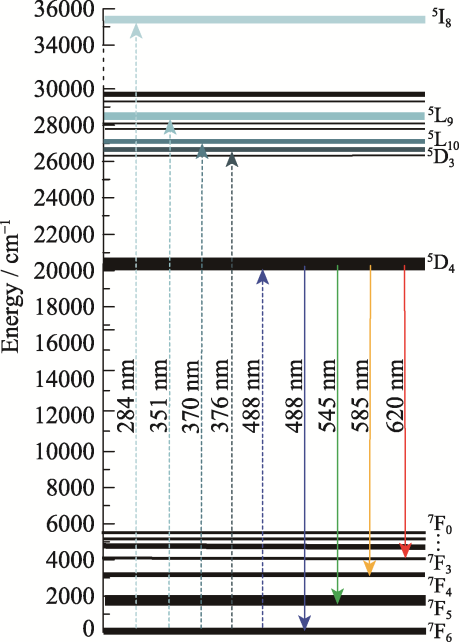
Fig. 9 Energy levels and characteristic transitions of Tb3+ ions
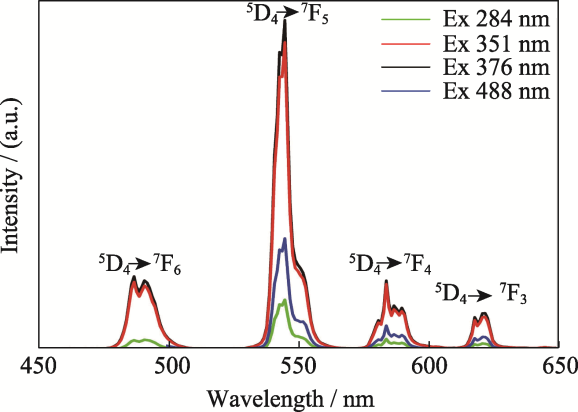
Fig. 10 Fluorescence emission spectra of Tb3+ in KTF crystal Colorful figure is available on website
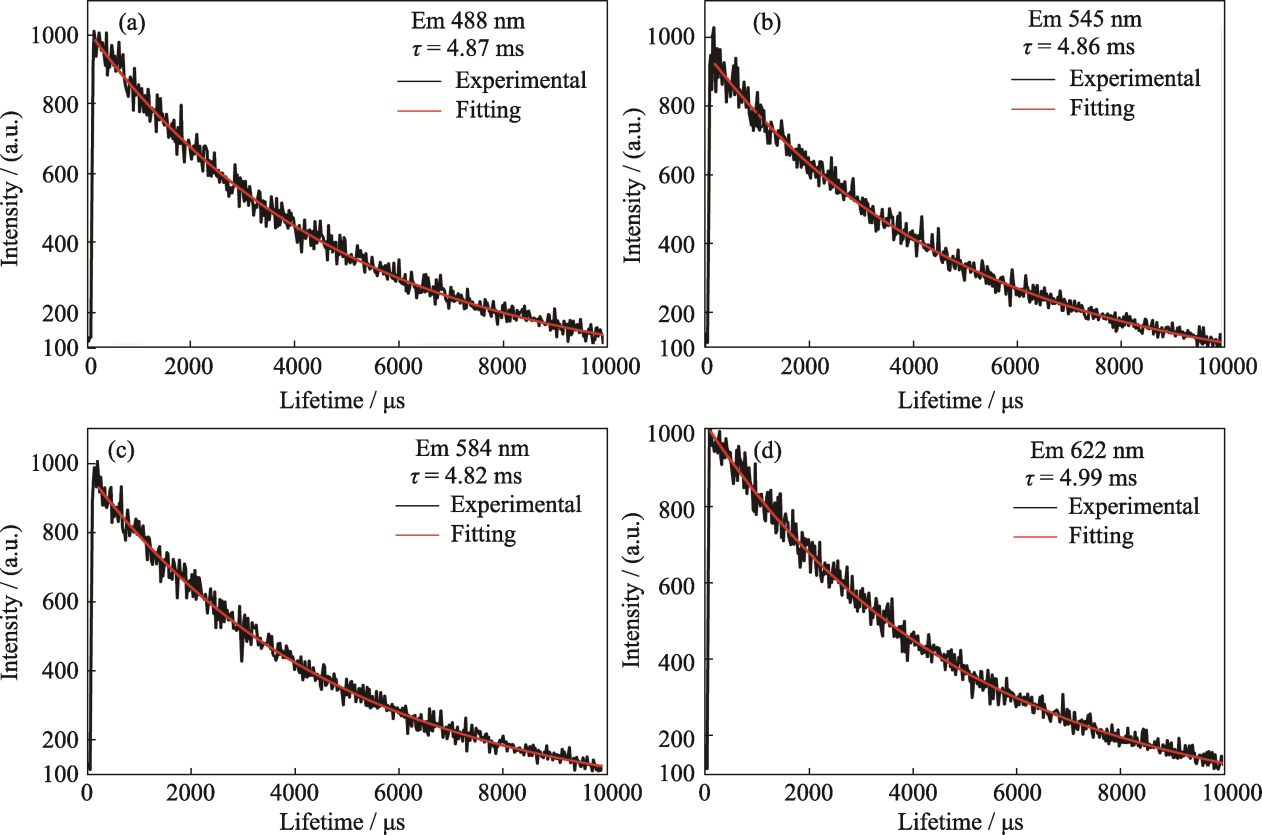
Fig. 11 Fluorescence decay curves of KTF crystal under 351 nm excitation at different emission wavelengths (a) 488 nm; (b) 545 nm; (c) 584 nm; (d) 622 nm. All curves were fitted using a single-exponential function
| Crystal | τexpt/ms | Ref. | Crystal | τexpt/ms | Ref. |
|---|---|---|---|---|---|
| KTb3F10 | 4.82-4.99 | This work | Tb: KY3F10 | 4.8 | [ |
| Tb0.81Ca0.19F2.81 | 6.9 | [ | Tb: Y2Mg2Al2Si2O12 | 0.58-1.72 | [ |
| Tb: LiYF4 | 4.9 | [ | Tb: SrGd2Al2O7 | 1.56-2.80 | [ |
| Tb: LiLuF4 | ~5.0 | [ |
Table 2 Energy level 5D4 lifetime (τexpt) of Tb3+ in different crystals
| Crystal | τexpt/ms | Ref. | Crystal | τexpt/ms | Ref. |
|---|---|---|---|---|---|
| KTb3F10 | 4.82-4.99 | This work | Tb: KY3F10 | 4.8 | [ |
| Tb0.81Ca0.19F2.81 | 6.9 | [ | Tb: Y2Mg2Al2Si2O12 | 0.58-1.72 | [ |
| Tb: LiYF4 | 4.9 | [ | Tb: SrGd2Al2O7 | 1.56-2.80 | [ |
| Tb: LiLuF4 | ~5.0 | [ |
| [1] | NING Y, CHEN Y, ZHANG J, et al. Brief review of development and techniques for high power semiconductor lasers. Acta Optica Sinica, 2021, 41(1): 191. |
| [2] | LIU X, GONG Q, HUANG C, et al. Crystal growth, property investigation, and the deactivation effect of Tb3+ in Dy3+/Tb3+ codoped LiYF4 crystals: promising crystals for all-solid-state yellow lasers. Crystal Growth & Design, 2024, 24(9): 3699. |
| [3] | ZHAO C, ZHANG P, LI S, et al. Development of rare-earth ion doped fluoride laser crystal. Journal of Synthetic Crystals, 2022, 51(Z1): 1573. |
| [4] | SOTTILE A, METZ P W. Deep red diode-pumped Pr3+:KY3F10 continuous-wave laser. Optics Letters, 2015, 40(9): 1992. |
| [5] | KRÄNKEL C, METZ P W, HUBER G. Continuous wave and wavelength tunable green Tb3+:CaF2 laser. Lasers Congress 2016, Boston, Massachusetts, 2016: AM3A.2. |
| [6] | LIU Z, XU X, JIANG Y, et al. Research progress of terbium-doped fluoride crystal visible light laser. Chinese Journal of Luminescence, 2024, 45(11): 1871. |
| [7] | BADTKE M, KALUSNIAK S, TANAKA H, et al. UV-laser-diode-pumped visible Tb3+: LiLuF4 lasers. Optics Letters, 2023, 48(13): 3379. |
| [8] | CASTELLANO-HERNÁNDEZ E, METZ P W, DEMESH M, et al. Efficient directly emitting high-power Tb3+:LiLuF4 laser operating at 587.5 nm in the yellow range. Optics Letters, 2018, 43(19): 4791. |
| [9] | FANG L, ZHOU X, ZHANG J, et al. Control of white light emission via co-doping of Dy3+ and Tb3+ ions in LiLuF4 single crystals under UV excitation. Journal of Materials Science: Materials in Electronics, 2020, 31(4): 3405. |
| [10] | LI X W, YANG Y, LU J, et al. Growth and properties of large size lithium terbium fluoride crystal. Journal of Synthetic Crystals, 2023, 52(7): 1352. |
| [11] | METZ P W, MARZAHL D T, MAJID A, et al. Efficient continuous wave laser operation of Tb3+ doped fluoride crystals in the green and yellow spectral regions. Laser & Photonics Reviews, 2016, 10(2): 335. |
| [12] | ZHANG P, LI S, YANG Y, et al. Growth and performance optimization of mid-infrared fluoride laser crystal. Journal of Synthetic Crystals, 2020, 49(8): 1369. |
| [13] | CASTELLANO-HERNÁNDEZ E, KALUSNIAK S, METZ P W, et al. Diode-pumped laser operation of Tb3+: LiLuF4 in the green and yellow spectral range. Laser & Photonics Reviews, 2020, 14(2): 1900229. |
| [14] | KANNARI F, ISHIKAWA T, TANAKA H, et al. 544-nm Tb3+ doped LiYF4 laser pumped by 488-nm InGaN laser diodes and high peak power operation with cavity-dumped Q-switching. Applied Optics, 2024, 64(1): 83. |
| [15] | LIU J, SHI Z, SONG Q, et al. Judd-Ofelt analysis and spectroscopic study of Tb:CaF2 and Tb/Pr:CaF2 co-doped single crystals. Optical Materials, 2020, 108: 110219. |
| [16] | METZ P W, MARZAHL D T, HUBER G, et al. Performance and wavelength tuning of green emitting terbium lasers. Optics Express, 2017, 25(5): 5716. |
| [17] | STEVENS K T, SCHLICHTING W, FOUNDOS G, et al. Promising materials for high power laser isolators. Laser Technik Journal, 2016, 13(3): 18. |
| [18] | JALALI A A, ROGERS E, STEVENS K. Characterization and extinction measurement of potassium terbium fluoride single crystal for high laser power applications. Optics Letters, 2017, 42(5): 899. |
| [19] | STAROBOR A V, MIRONOV E A, PALASHOV O V. Thermal lens in magneto-active fluoride crystals. Optical Materials, 2019, 98: 109469. |
| [20] | PUES P, BAUR F, SCHWUNG S, et al. Temperature and time-dependent luminescence of single crystals of KTb3F10. Journal of Luminescence, 2020, 227: 117523. |
| [21] | VALIEV U V, KARIMOV D N, MA C G, et al. Tb3+ ion optical and magneto-optical properties in the cubic crystals KTb3F10. Materials, 2022, 15(22): 7999. |
| [22] | KARIMOV D N, BUCHINSKAYA I I. Growth of KR3F10 (R = Tb-Er) crystals by the vertical directional crystallization technique. I: optimization of the melt composition for the growth of KTb3F10 and correction of the phase diagram of the KF-TbF3 system. Crystallography Reports, 2021, 66(3): 535. |
| [23] | KARIMOV D N, BUCHINSKAYA I I, ARKHAROVA N A, et al. Growth peculiarities and properties of KR3F10 (R = Y, Tb) single crystals. Crystals, 2021, 11(3): 285. |
| [24] | LIU G, WU H, HUANG C, et al. Control of melt composition and purity for growth of LiTbF4 crystals by the Bridgman method with a Pt crucible sealing technique. ACS Omega, 2025, 10(13): 13073. |
| [25] | Lawrence Livermore Laboratory. Potassium terbium fluoride crystal growth development for Faraday rotator discs fabrication. California: University of California, 1979: 33. |
| [26] | KARIMOV D N, BUCHINSKAYA I I, SOROKIN N I. The relationship between ionic conductivity and structural characteristics of melt-grown KR3F10 (R = Tb, Dy, Ho, Y) single crystals. Zeitschrift für Kristallographie-Crystalline Materials, 2022, 237(10/11/12): 429. |
| [27] | TOBY B H, VON DREELE R B. GSAS-II: the genesis of a modern open-source all purpose crystallography software package. Journal of Applied Crystallography, 2013, 46(2): 544. |
| [28] | NIU Z, YU B, XU F, et al. Color-tunable luminescence and temperature sensing in Ce3+/Tb3+ co-doped transparent oxyfluoride glass-ceramics containing Na1.5Y2.5F9 nanocrystals. Journal of Luminescence, 2022, 246: 118834. |
| [29] | TOCHITSKY S Y, PETUKHOV V O, GOROBETS V A, et al. Efficient continuous-wave frequency doubling of a tunable CO2 laser in AgGaSe2. Applied Optics, 1997, 36(9): 1882. |
| [30] | VASYLIEV V, VíLLORA E G, SUGAHARA Y, et al. Judd-Ofelt analysis and emission quantum efficiency of Tb-fluoride single crystals: LiTbF4 and Tb0.81Ca0.19F2.81. Journal of Applied Physics, 2013, 113(20): 203508. |
| [31] | CHEN H, UEHARA H, KAWASE H, et al. Efficient visible laser operation of Tb:LiYF4 and LiTbF4. Optics Express, 2020, 28(8): 10951. |
| [32] | GU X, HE Z, SUN X Y, et al. Preparation and luminescence properties of Tb3+ doped garnet Y2Mg2Al2Si2O12 luminescent materials. Luminescence, 2021, 36(3): 834. |
| [33] | CHAHAR S, DEVI R, DALAL M, et al. Color tunable nanocrystalline SrGd2Al2O7:Tb3+ phosphor for solid state lighting. Ceramics International, 2019, 45(1): 606. |
| [1] | QI Xuejun, ZHANG Jian, CHEN Lei, WANG Shaohan, LI Xiang, DU Yong, CHEN Junfeng. Macroscopic Defects of Large Bi12GeO20 Crystals Grown Using Vertical Bridgman Method [J]. Journal of Inorganic Materials, 2023, 38(3): 280-287. |
| [2] | QIAN Xinyu, WANG Wudi, SONG Qingsong, DONG Yongjun, XUE Yanyan, ZHANG Chenbo, WANG Qingguo, XU Xiaodong, TANG Huili, CAO Guixin, XU Jun. Luminescence Property and Judd-Ofelt Analysis of 0.6%Pr, x%La:CaF2 Crystals [J]. Journal of Inorganic Materials, 2023, 38(3): 357-362. |
| [3] | JIN Min, BAI Xudong, ZHAO Su, ZHANG Rulin, CHEN Yuqi, ZHOU Lina. Mechanical Property of SnSe Single Crystal Prepared via Vertical Bridgman Method [J]. Journal of Inorganic Materials, 2021, 36(3): 313-318. |
| [4] | PANG Si-Yuan, QIAN Xiao-Bo, WU Qing-Hui, YU Hao, XU Jia-Yue, SU Liang-Bi. Structure and Spectral Property of Sc Doped Nd:CaF2 Laser Crystals [J]. Journal of Inorganic Materials, 2018, 33(8): 873-876. |
| [5] | HE Yi-Feng, XUE Yan-Yan, LIU Wen-Qing, SU Liang-Bi, TANG Fei, WANG Jing-Ya. Structure and Property of Yb Doped Ca1-xRxF2+x (R=La, Gd) Laser Crystals [J]. Journal of Inorganic Materials, 2017, 32(8): 857-862. |
| [6] | XU Jia-Yue, WANG Jie, CHEN Wei, XIAO Xue-Feng, YANG Bo-Bo, WANG Zhan-Yong, LI Fei, XIE Hui-Dong. Synthesis, Growth and Scintillation Properties of Large Size Bi4Si3O12 Crystals [J]. Journal of Inorganic Materials, 2016, 31(10): 1147-1150. |
| [7] | XIANG Jun-Tao, DU Peng, LUO Lai-Hui, FANG Yi-Quan, ZHAO Xue-Yang, HU Xu-Bo, CHEN Hong-Bing. Growth and Characterization of Er3+-doped Relaxor-based Ferroelectric Crystal PMNT [J]. Journal of Inorganic Materials, 2015, 30(2): 135-140. |
| [8] | LI Jiang,WU Yu-Song,PAN Yu-Bai,AN Li-Qiong,ZHANG Jian,WANG Shi-Wei,GUO Jing-Kun. Fabrication and Laser Performance of 1.3at%Nd:YAG Transparent Ceramics [J]. Journal of Inorganic Materials, 2007, 22(5): 798-802. |
| [9] | LI Wan-Wan,SANG Wen-Bin,MIN Jia-Hua,YU Fang,ZHANG Bin,WANG Kun-Shu,CAO Ze-Chun. Optimization of Crucible Descending Rate during the Crystal Growth of CdZnTe by a Vertical Bridgman Method [J]. Journal of Inorganic Materials, 2004, 19(4): 723-732. |
| [10] | ZHANG Hai-Bin,SHEN Ding-Zhong,REN Guo-Hao,GONG Bo. Research Progress on the Numerical Simulation of Transport Process in Vertical Bridgman Crystal Growth [J]. Journal of Inorganic Materials, 2002, 17(5): 910-914. |
| Viewed | ||||||
|
Full text |
|
|||||
|
Abstract |
|
|||||
