
Journal of Inorganic Materials ›› 2026, Vol. 41 ›› Issue (7): 965-973.DOI: 10.15541/jim20250496
• RESEARCH ARTICLE • Previous Articles Next Articles
SHEN Xuesong1( ), XIE Kaifeng2,3, XUE Qiang3, ZHENG Guozhu3, XIAO Guoping2, CHEN Ting3(), CHEN Wenmiao1(), WANG Shaorong3
Received:2025-12-14
Revised:2026-02-26
Published:2026-07-20
Online:2026-04-03
Contact:
CHEN Ting, associate professor. E-mail: chenting@cumt.edu.cn;About author:SHEN Xuesong (1990-), male, PhD. E-mail: shenxuesong@nctifc.com
Supported by:CLC Number:
SHEN Xuesong, XIE Kaifeng, XUE Qiang, ZHENG Guozhu, XIAO Guoping, CHEN Ting, CHEN Wenmiao, WANG Shaorong. High-efficiency Construction and Performance Optimization of Surface-modified LSCF-GDC Multiphase Composite Air Electrodes[J]. Journal of Inorganic Materials, 2026, 41(7): 965-973.
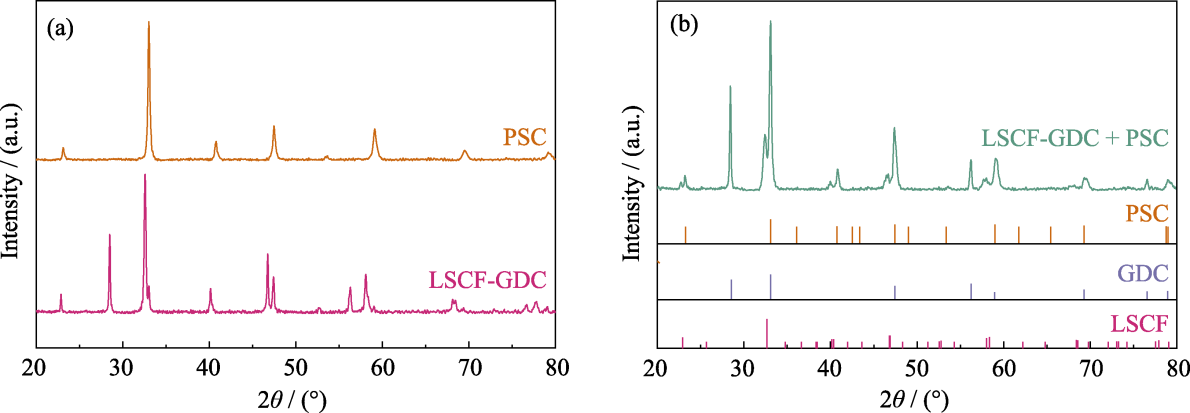
Fig. 1 XRD patterns of (a) PSC, LSCF-GDC, and (b) mixed LSCF-GDC+PSC powders after calcination
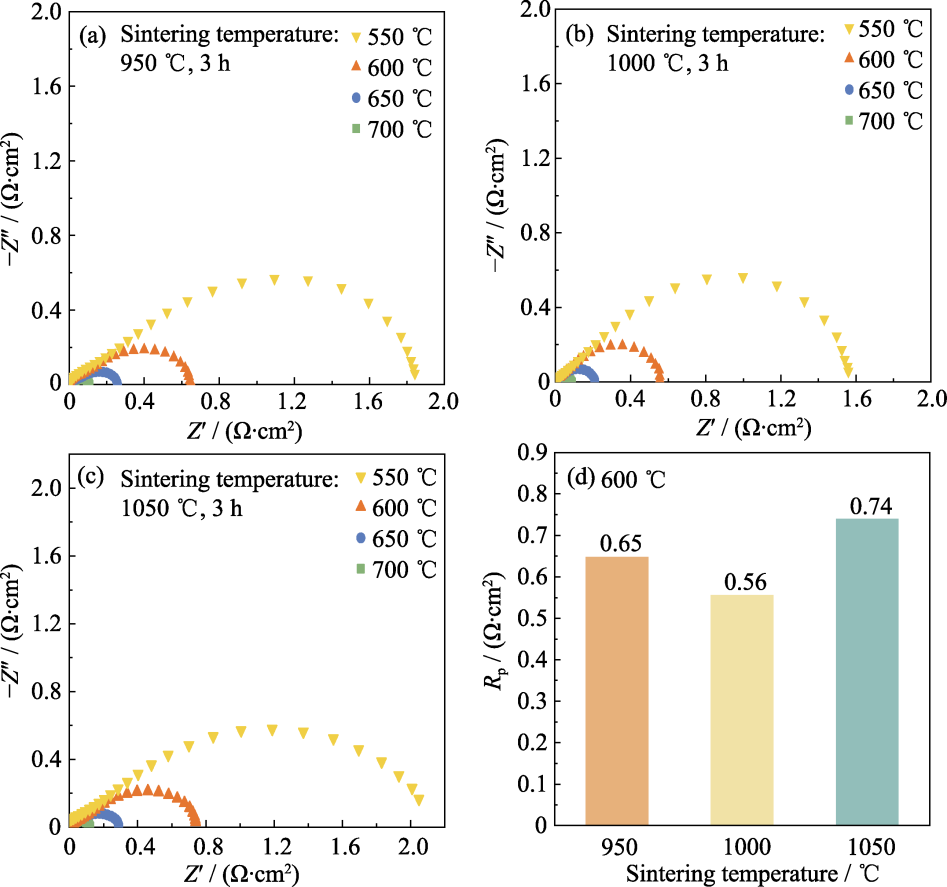
Fig. 2 EIS spectra of symmetrical cells at 550-700 ℃ with LSCF-GDC air electrode sintered at (a) 950, (b) 1000, and (c) 1050 ℃; (d) Rp at 600 ℃ for LSCF-GDC air electrode sintered at different temperatures
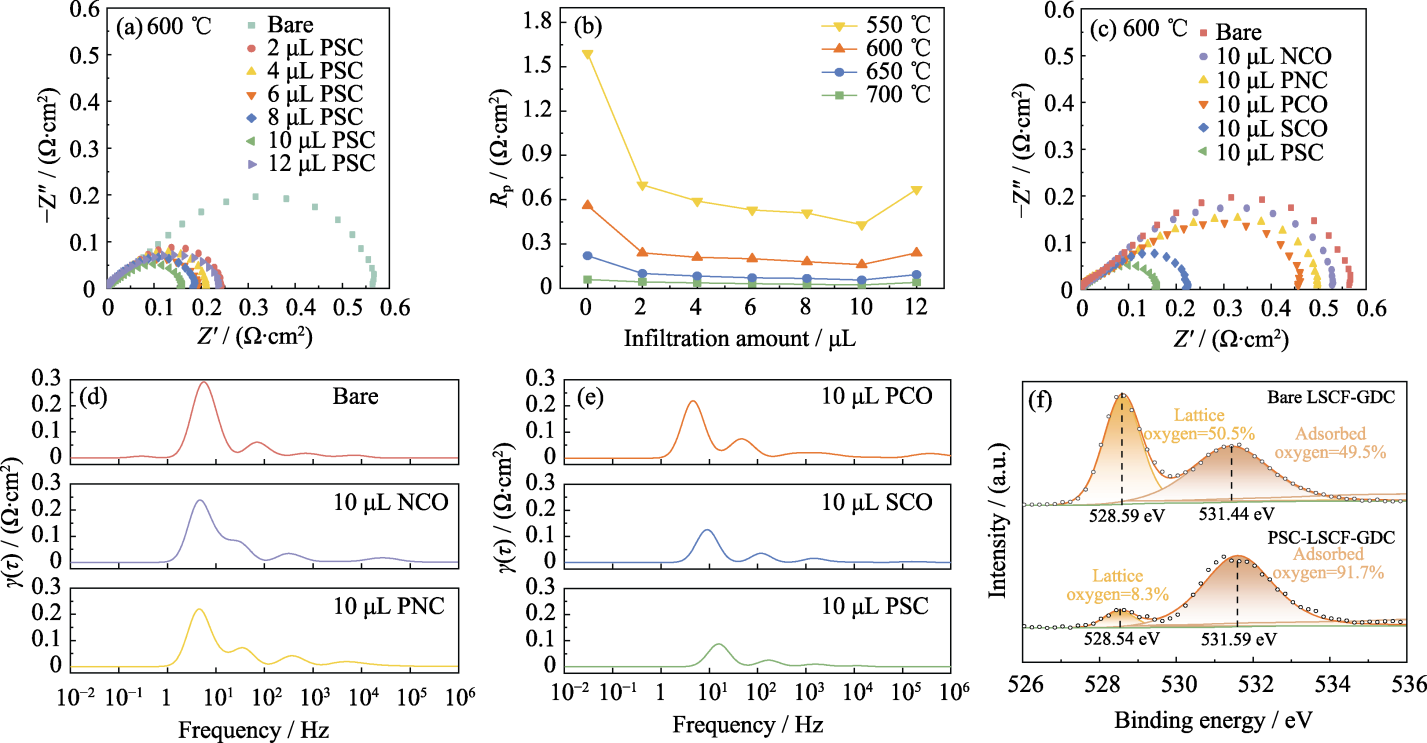
Fig. 3 (a) EIS spectra of LSCF-GDC air electrodes with different PSC infiltration amounts in an air environment at 600 ℃; (b) Rp of LSCF-GDC air electrodes measured at different temperatures and infiltration amounts; (c) EIS spectra of LSCF-GDC air electrodes modified with 10 µL of different infiltration solutions in an air environment at 600 ℃; (d, e) DRT analysis based on EIS spectra; (f) O1s XPS spectra of PSC-LSCF-GDC and bare LSCF-GDC air electrodes
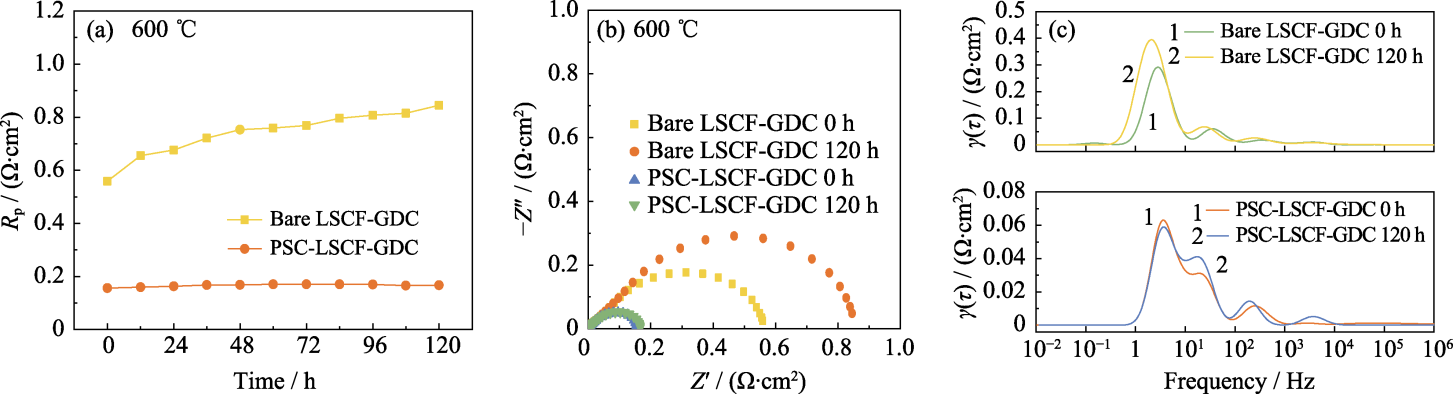
Fig. 4 (a) Rp varied with time of symmetric cells with PSC-LSCF-GDC and bare LSCF-GDC air electrodes measured at 600 ℃ in air environment; (b) EIS spectra and (c) DRT curves of symmetric cells with PSC-LSCF-GDC and bare LSCF-GDC air electrodes at 0 and 120 h
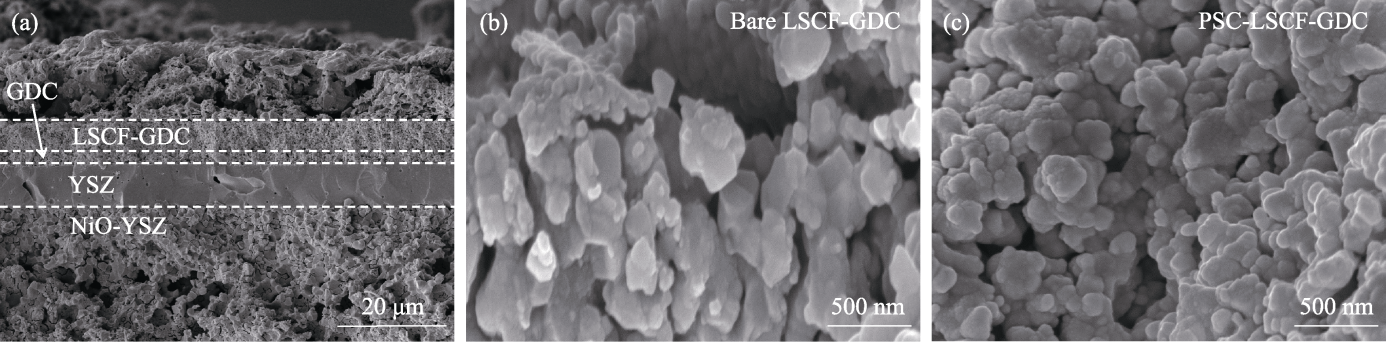
Fig. 5 (a) Cross-sectional SEM image of a single cell with the configuration NiO-SSZ/SSZ/GDC/LSCF-GDC; (b, c) SEM images of (b) bare LSCF-GDC and (c) PSC-LSCF-GDC air electrodes
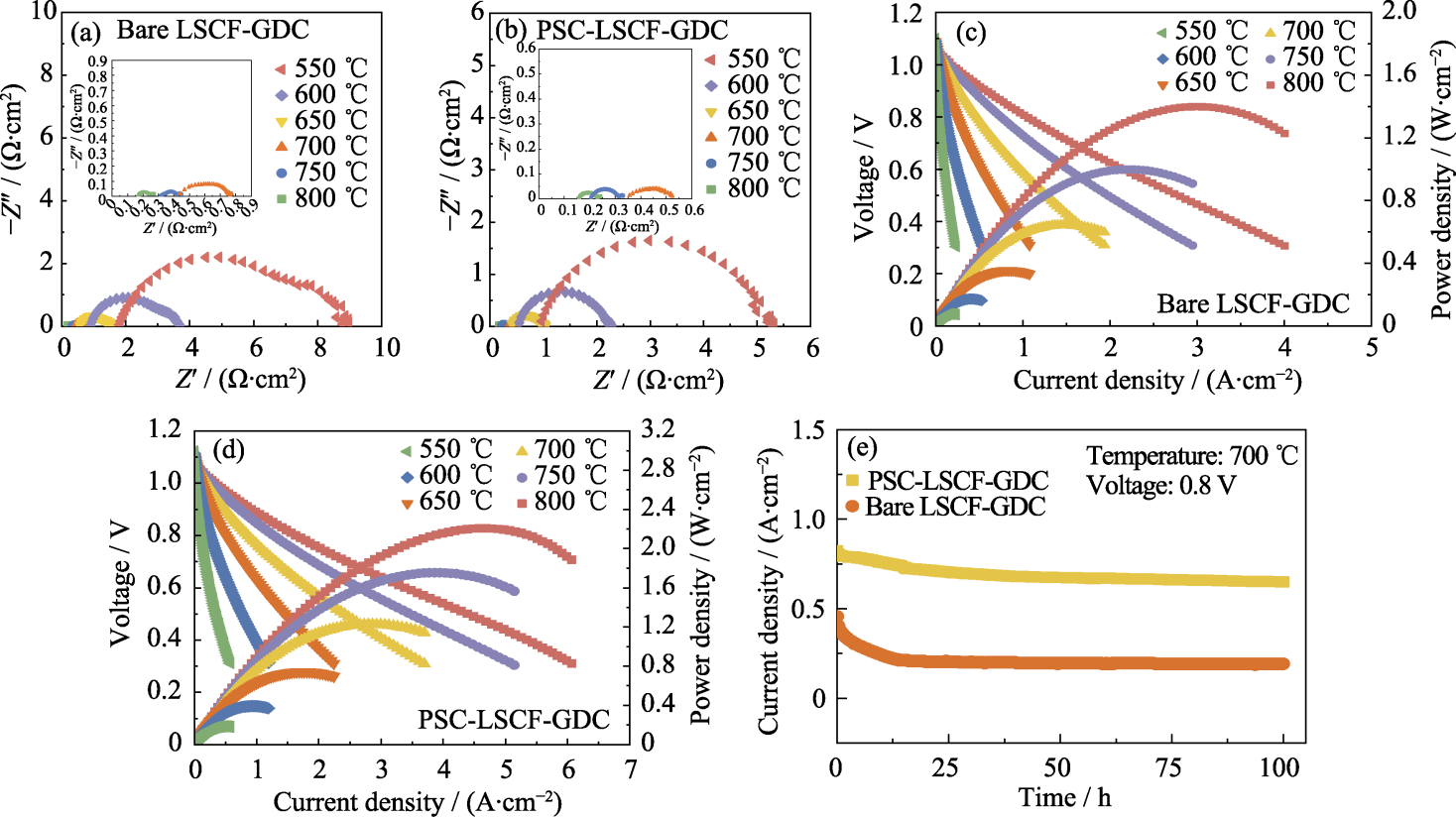
Fig. 6 (a, b) EIS spectra and (c, d) I-V-P curves of (a, c) bare LSCF-GDC and (b, d) PSC- LSCF-GDC single cells in FC mode at 550-800 ℃; (e) Stability test of single cells at 700 ℃
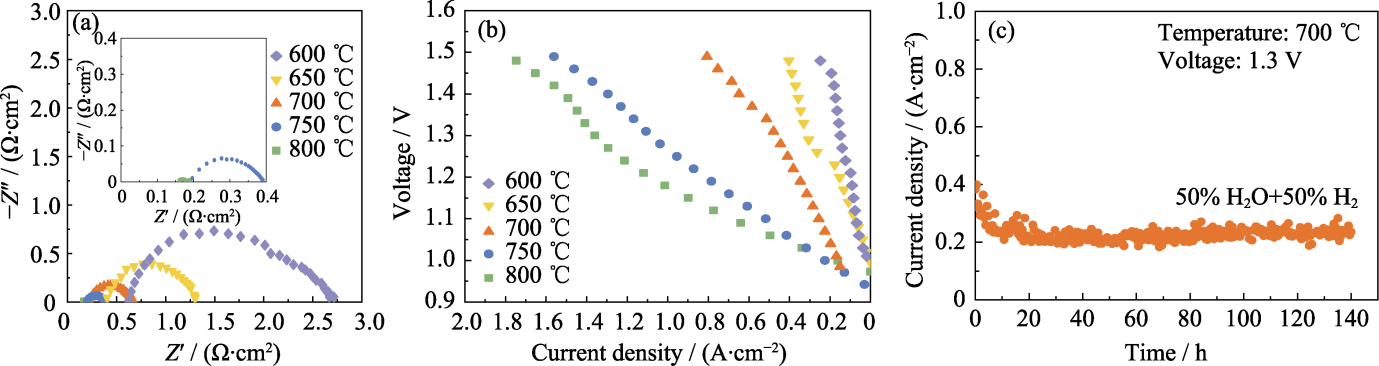
Fig. 7 (a) EIS spectra, (b) I-V curves and (c) stability test at 700 ℃ of the single cell with PSC-LSCF-GDC air electrode in EC mode under an atmosphere of 50% H2O+50% H2 at 600-800 ℃
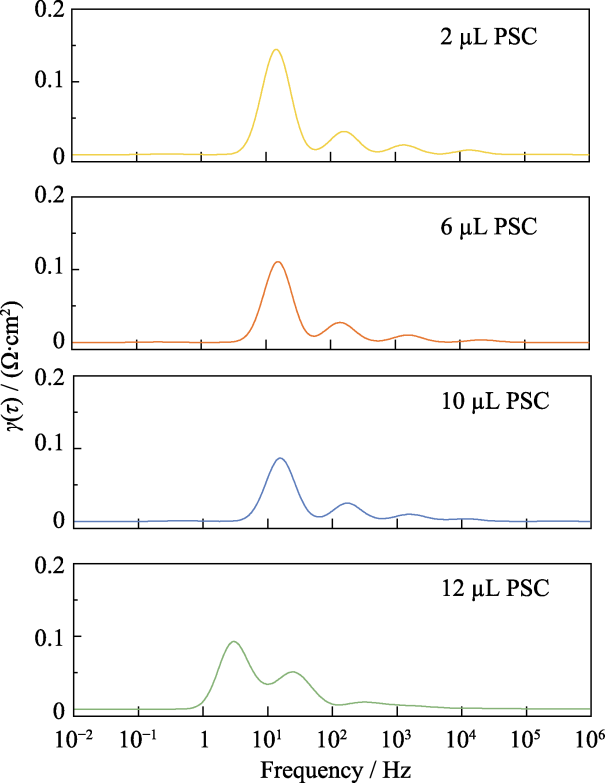
Fig. S1 DRT curves of LSCF-GDC air electrodes with different PSC infiltration amounts
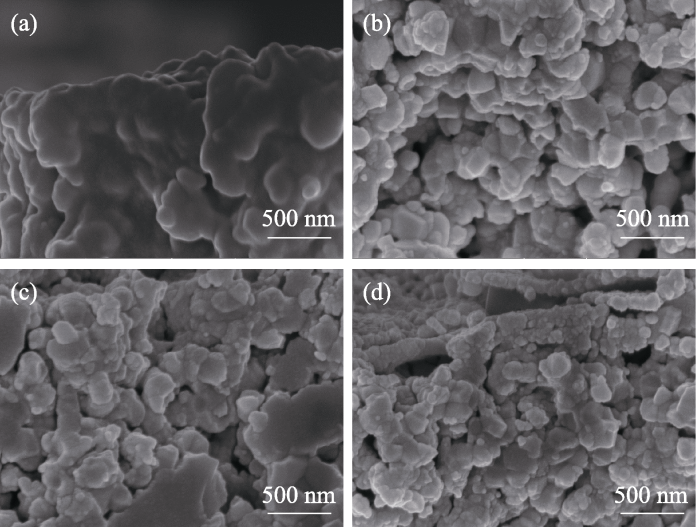
Fig. S2 SEM images of LSCF-GDC air electrodes infiltrated with (a) 2, (b) 6, (c) 10, and (d) 12 μL PSC catalyst solution

Fig. S3 Equivalent circuit diagram fitted with Rohm and Rp
| [1] |
XU Q D, GUO Z J, XIA L C, et al. A comprehensive review of solid oxide fuel cells operating on various promising alternative fuels. Energy Conversion and Management, 2022, 253: 115175.
DOI URL |
| [2] | SAMREEN A, ALI M S, HUZAIFA M, et al. Advancements in perovskite-based cathode materials for solid oxide fuel cells: a comprehensive review. The Chemical Record, 2024, 24(1): e202300247. |
| [3] |
DUBOIS A, RICOTE S, BRAUN R J. Benchmarking the expected stack manufacturing cost of next generation, intermediate- temperature protonic ceramic fuel cells with solid oxide fuel cell technology. Journal of Power Sources, 2017, 369: 65.
DOI URL |
| [4] |
YANG G M, SU C, SHI H G, et al. Toward reducing the operation temperature of solid oxide fuel cells: our past 15 years of efforts in cathode development. Energy & Fuels, 2020, 34(12): 15169.
DOI URL |
| [5] |
ZHANG Y, KNIBBE R, SUNARSO J, et al. Recent progress on advanced materials for solid-oxide fuel cells operating below 500 ℃. Advanced Materials, 2017, 29(48): 1700132.
DOI URL |
| [6] |
ZHOU Y C, ZHANG W L, KANE N, et al. An efficient bifunctional air electrode for reversible protonic ceramic electrochemical cells. Advanced Functional Materials, 2021, 31(40): 2105386.
DOI URL |
| [7] |
DUAN C C, KEE R, ZHU H Y, et al. Highly efficient reversible protonic ceramic electrochemical cells for power generation and fuel production. Nature Energy, 2019, 4(3): 230.
DOI |
| [8] |
CHOI S, YOO S, KIM J, et al. Highly efficient and robust cathode materials for low-temperature solid oxide fuel cells: PrBa0.5Sr0.5Co2-xFexO5+δ. Scientific Reports, 2013, 3: 2426.
DOI |
| [9] |
DUAN C C, TONG J H, SHANG M, et al. Readily processed protonic ceramic fuel cells with high performance at low temperatures. Science, 2015, 349(6254): 1321.
DOI PMID |
| [10] | 付梦雨, 金英敏, 李栋, 等. 浸渍Gd0.2Ce0.8O1.9对固体氧化物燃料电池La0.8Sr0.2Co0.2Fe0.8O3-δ阴极铬中毒影响的研究. 陶瓷学报, 2022, 43(1): 54. |
| [11] | 张璐, 宦道明, 夏长荣. 固体氧化物燃料电池氧化物修饰镧锶钴铁阴极研究进展. 陶瓷学报, 2022, 43(5): 799. |
| [12] |
YOON K J, BISWAS M, KIM H J, et al. Nano-tailoring of infiltrated catalysts for high-temperature solid oxide regenerative fuel cells. Nano Energy, 2017, 36: 9.
DOI URL |
| [13] |
REHMAN S U, SONG H S, KIM H S, et al. A dynamic infiltration technique to synthesize nanolayered cathodes for high performance and robust solid oxide fuel cells. Journal of Energy Chemistry, 2022, 70: 201.
DOI URL |
| [14] |
ZHANG X Y, WANG C X, LIU K, et al. Significantly enhanced stability and activity of a perovskite oxygen electrode for reversible protonic ceramic electrochemical cells by heterointerface engineering. Journal of Advanced Ceramics, 2025, 14(7): 9221108.
DOI URL |
| [15] |
SONG Y F, CHEN Y B, WANG W, et al. Self-assembled triple-conducting nanocomposite as a superior protonic ceramic fuel cell cathode. Joule, 2019, 3(11): 2842.
DOI URL |
| [16] |
SHIN J F, XU W, ZANELLA M, et al. Self-assembled dynamic perovskite composite cathodes for intermediate temperature solid oxide fuel cells. Nature Energy, 2017, 2(3): 16214.
DOI |
| [17] |
LIU T, HUANG S, ZHU S Y, et al. Preparation of cobalt-free composite cathode for efficient high-temperature hydrogen fuel cell via one-pot synthesis method. Journal of Inorganic Materials, 2025, 40(12): 1349.
DOI URL |
| [18] |
KIM J H, KIM J K, SEO H G, et al. Ex-solved Ag nanocatalysts on a Sr-free parent scaffold authorize a highly efficient route of oxygen reduction. Advanced Functional Materials, 2020, 30(27): 2001326.
DOI URL |
| [19] |
HU S M, LI J, ZENG Y, et al. A mini review of the recent progress of electrode materials for low-temperature solid oxide fuel cells. Physical Chemistry Chemical Physics, 2023, 25(8): 5926.
DOI PMID |
| [20] | 薛强, 郑国柱, 吴宇成, 等. 纳米技术在低温可逆固体氧化物电池空气极中的应用及研究进展. 硅酸盐学报, 2025, 53(11): 3404. |
| [21] |
WANG T P, LI Q N, LIU X C, et al. Nanofabrication technologies for low-temperature solid oxide cells: a comprehensive review of techniques, challenges, and future perspectives. Energy Reviews, 2025, 4(4): 100163.
DOI URL |
| [22] |
CHEN Y, CHOI Y M, YOO S, et al. A highly efficient multi-phase catalyst dramatically enhances the rate of oxygen reduction. Joule, 2018, 2(5): 938.
DOI URL |
| [23] |
ZENG D P, XU K, ZHU F, et al. Enhancing the oxygen reduction reaction activity and durability of a solid oxide fuel cell cathode by surface modification of a hybrid coating. International Journal of Hydrogen Energy, 2023, 48(62): 23992.
DOI URL |
| [24] | WU L, ZHENG H Y, YANG X, et al. Enhanced oxygen evolution rate and anti-interfacial delamination property of the SrCo0.9Ta0.1O3-δ@La0.6Sr0.4Co0.2Fe0.8O3-δ oxygen-electrode for solid oxide electrolysis cells. ACS Applied Materials & Interfaces, 2023, 15(45): 52673. |
| [25] |
SONG Z H, PAN H, WAN G C, et al. Enhancing durability of solid oxide cells for hydrogen production from seawater by designing nano-structured Sm0.5Sr0.5Co3-δ infiltrated air electrodes. International Journal of Hydrogen Energy, 2023, 48(70): 27095.
DOI URL |
| [26] |
CHEN S N, FENG W W, ZHAO Y, et al. Modified La0.6Sr0.4Co0.2Fe0.8O3-δ cathode with the infiltration of Bi0.8Ca0.2FeO3-δ for intermediate- temperature solid oxide fuel cells. Ceramics International, 2025, 51(4): 5234.
DOI URL |
| [27] | ZHANG L, XU Y S, XU K, et al. Improving the activity and stability of La0.6Sr0.4Co0.2Fe0.8O3-δ cathode through surface modification with an electro-catalyst. Small, 2025, 21(42): e05019. |
| [28] |
BIAN W J, WU W, WANG B M, et al. Revitalizing interface in protonic ceramic cells by acid etch. Nature, 2022, 604: 479.
DOI |
| [29] |
DAI H L, DU H Z, LIU Z, et al. Multi-element doped SrFeO3- based cathodes with balanced thermal expansion for proton- conducting solid oxide fuel cells. Journal of Advanced Ceramics, 2025, 14(10): 9221165.
DOI URL |
| [30] | 赵浩宇, 吕秋秋, 朱腾龙. 固体氧化物燃料电池电解质与阴极界面研究进展及展望. 硅酸盐学报, 2025, 53(12): 3790. |
| [31] | DING D, LI X X, LAI S Y, et al. Enhancing SOFC cathode performance by surface modification through infiltration. Energy & Environmental Science, 2014, 7(2): 552. |
| [32] |
YANG C H, LI J, YANG C C, et al. A highly active and robust air electrode for reversible protonic ceramic cells: advanced performance achieved by low-Lewis-acid-strength cation doping strategy. ACS Materials Letters, 2024, 6(8): 3540.
DOI URL |
| [33] |
WU L, SUN J Q, QI H Y, et al. Boosting steam tolerance and electrochemical performance of an La0.6Sr0.4Co0.2Fe0.8O3-δ-based air electrode for protonic ceramic electrochemical cells. Journal of Materials Chemistry A, 2024, 12: 25979.
DOI URL |
| [1] | LI Xuan, YE Kuicai, FENG Jiayin, QIU Jiajun, QIAN Wenhao, XING Min. Surface Modification of Titanium-based Dental Implants for Soft Tissue Sealing: A Review [J]. Journal of Inorganic Materials, 2026, 41(4): 432-444. |
| [2] | SUN Jing, LI Xiang, MAO Xiaojian, ZHANG Jian, WANG Shiwei. Effect of Lauric Acid Modifier on the Hydrolysis Resistance of Aluminum Nitride Powders [J]. Journal of Inorganic Materials, 2025, 40(7): 826-832. |
| [3] | CAI Heqing, HAN Lu, YANG Songsong, XUE Xinyu, ZHANG Kou, SUN Zhicheng, LIU Ruping, HU Kun, WEI Yan. Fe3O4-DMSA-PEI Magnetic Nanoparticles with Small Particle Size: Preparation and Gene Loading [J]. Journal of Inorganic Materials, 2024, 39(5): 517-524. |
| [4] | ZHOU Ganghuai, LIU Yao, SHI Yuan, LIU Shaojun. Slurry Preparation and Stereolithography for Activated Alumina Catalyst Carrier [J]. Journal of Inorganic Materials, 2022, 37(3): 297-302. |
| [5] | DONG Shaojie,WANG Xudong,SHEN Steve Guofang,WANG Xiaohong,LIN Kaili. Research Progress on Functional Modifications and Applications of Bioceramic Scaffolds [J]. Journal of Inorganic Materials, 2020, 35(8): 867-881. |
| [6] | LI Hao-Geng,GU Hong-Yu,ZHANG Yu-Zhi,SONG Li-Xin,WU Ling-Nan,QI Zhen-Yi,ZHANG Tao. Surface Protection of Polymer Materials from Atomic Oxygen: a Review [J]. Journal of Inorganic Materials, 2019, 34(7): 685-693. |
| [7] | WENG Xiao-Lin, LIU Pei-Pei, ZHANG Ya-Peng, LIU Jiang, LIU Mei-Lin. A Novel Porous Electronic Conducting Ceramics Loaded with Silver Nano Particles as Cathode for Zinc-Air Batteries [J]. Journal of Inorganic Materials, 2018, 33(8): 854-860. |
| [8] | SHI Zhang-Yu, LI Quan, TANG Song-Chao, QIAN Jun, PAN Yong-Kang, WEI Jie. Surface Modification on Property of Mesoporous Calcium Magnesium Silicate/Polyetheretherketone Composites [J]. Journal of Inorganic Materials, 2018, 33(1): 67-74. |
| [9] | CHEN Yu-Fang, LI Yu-Jie, ZHENG Chun-Man, XIE Kai, CHEN Zhong-Xue. Research Development on Lithium Rich Layered Oxide Cathode Materials [J]. Journal of Inorganic Materials, 2017, 32(8): 792-800. |
| [10] | LV Yu-Zhen, SUN Qian, LI Chao, SHAN Bing-Liang, QI Bo, LI Cheng-Rong. Solvothermal Synthesis and Morphological Control of TiO2 Nanorods Modified with Oleic Acid [J]. Journal of Inorganic Materials, 2017, 32(7): 719-724. |
| [11] | LV Zhi-Hui, HONG Tian-Zeng, NAI Xue-Ying, DONG Ya-Ping, LI Wu. Mechanism of Inorganic-organic Surface Modification of Anhydrous Calcium Sulfate Whisker [J]. Journal of Inorganic Materials, 2017, 32(1): 81-85. |
| [12] | LI Lei, ZHANG Qiao-Ling, FAN Hong-Lei, LIU You-Zhi, WEI Bing, FENG Yu-Jie. Titanium Dioxide Particles Modified by Salicylic Acid and Arginine and Their Photocatalytic Reaction on Oil-Water Interface [J]. Journal of Inorganic Materials, 2016, 31(4): 413-420. |
| [13] | MA Xin-Guo, YAN Jie, CHEN Zi-Meng, ZHU Lin, XU Guo-Wang, HUANG Chu-Yun, LV Hui. First-principles Calculation on Pt- and Au-modified Anatase TiO2(101) Surface [J]. Journal of Inorganic Materials, 2016, 31(3): 291-297. |
| [14] | LI Zhong, HONG Jian-He, HE Gang, Lü Lu. Effect of FePO4 Coating on Performance of Li1.2Mn0.54Ni0.13Co0.13O2 as Cathode Material for Li-ion Battery [J]. Journal of Inorganic Materials, 2015, 30(2): 129-134. |
| [15] | QIN Zhao-Lu, LI Ding-Hua, YANG Rong-Jie. Preparation of Ammonium Polyphosphate Coated with Aluminium Hydroxide and Its Application in Polypropylene as Flame Retardant [J]. Journal of Inorganic Materials, 2015, 30(12): 1267-1272. |
| Viewed | ||||||
|
Full text |
|
|||||
|
Abstract |
|
|||||
