无机材料学报 ›› 2026, Vol. 41 ›› Issue (10): 1453-1458.DOI: 10.15541/jim20250521
俞延强1,2( ), 熊巍2(), 陈良2, 周尧2, 李颖1(), 袁晖2
收稿日期:2025-12-31
修回日期:2026-01-29
出版日期:2026-10-20
网络出版日期:2026-04-03
通讯作者:
熊 巍, 副研究员. E-mail: xiongwei@mail.sic.ac.cn;作者简介:俞延强(1997-), 男, 硕士研究生. E-mail: yuyanqiang2023@163.com
基金资助:
YU Yanqiang1,2(), XIONG Wei2(), CHEN Liang2, ZHOU Yao2, LI Ying1(), YUAN Hui2
Received:2025-12-31
Revised:2026-01-29
Published:2026-10-20
Online:2026-04-03
Contact:
XIONG Wei, associate professor. E-mail: xiongwei@mail.sic.ac.cn;About author:YU Yanqiang (1997-), male, Master candidate. E-mail: yuyanqiang2023@163.com
Supported by:摘要:
硅酸铋(Bi12SiO20, BSO)晶体是一种宽带隙、高电阻率的非铁电立方半绝缘体, 凭借其线性电光效应、光电导特性、压电性能及光折变效应, 在诸多光电子领域展现出广阔的应用前景。目前, 采用坩埚下降法生长的BSO晶体中易形成散射颗粒缺陷, 严重制约其实际应用。本研究以坩埚下降法生长的BSO晶体为研究对象, 采用偏光显微镜、扫描电子显微镜-能量色散X射线光谱及分光光度计等表征手段, 系统分析了BSO晶体中散射颗粒的形貌、尺寸、空间分布及化学组成, 并结合晶体生长热力学与动力学过程, 探讨了散射颗粒的形成机制。结果表明, BSO晶体中的散射颗粒主要成分为金属铂, 其来源于高温下BSO熔体对铂金坩埚的腐蚀反应; 该类颗粒以棒状-H状过渡的线状缺陷存在, H状缺陷在纵向轮廓上呈连续的波峰-波谷锯齿状精细结构; 其形成与晶体生长环境相关, 主要分布在晶片中心区域, 且散射颗粒取向与晶体[100]生长方向基本一致。基于散射颗粒的本质与形成路径。本研究提出严格控制原料比、降低熔体生长温度等优化生长工艺参数的解决方案, 为制备大尺寸、低铂金散射颗粒、高光学均匀性的BSO晶体提供了依据。
中图分类号:
俞延强, 熊巍, 陈良, 周尧, 李颖, 袁晖. 坩埚下降法生长Bi12SiO20晶体中的散射颗粒研究[J]. 无机材料学报, 2026, 41(10): 1453-1458.
YU Yanqiang, XIONG Wei, CHEN Liang, ZHOU Yao, LI Ying, YUAN Hui. Scattering Particles in Bi12SiO20 Crystals Grown by the Vertical Bridgman Method[J]. Journal of Inorganic Materials, 2026, 41(10): 1453-1458.
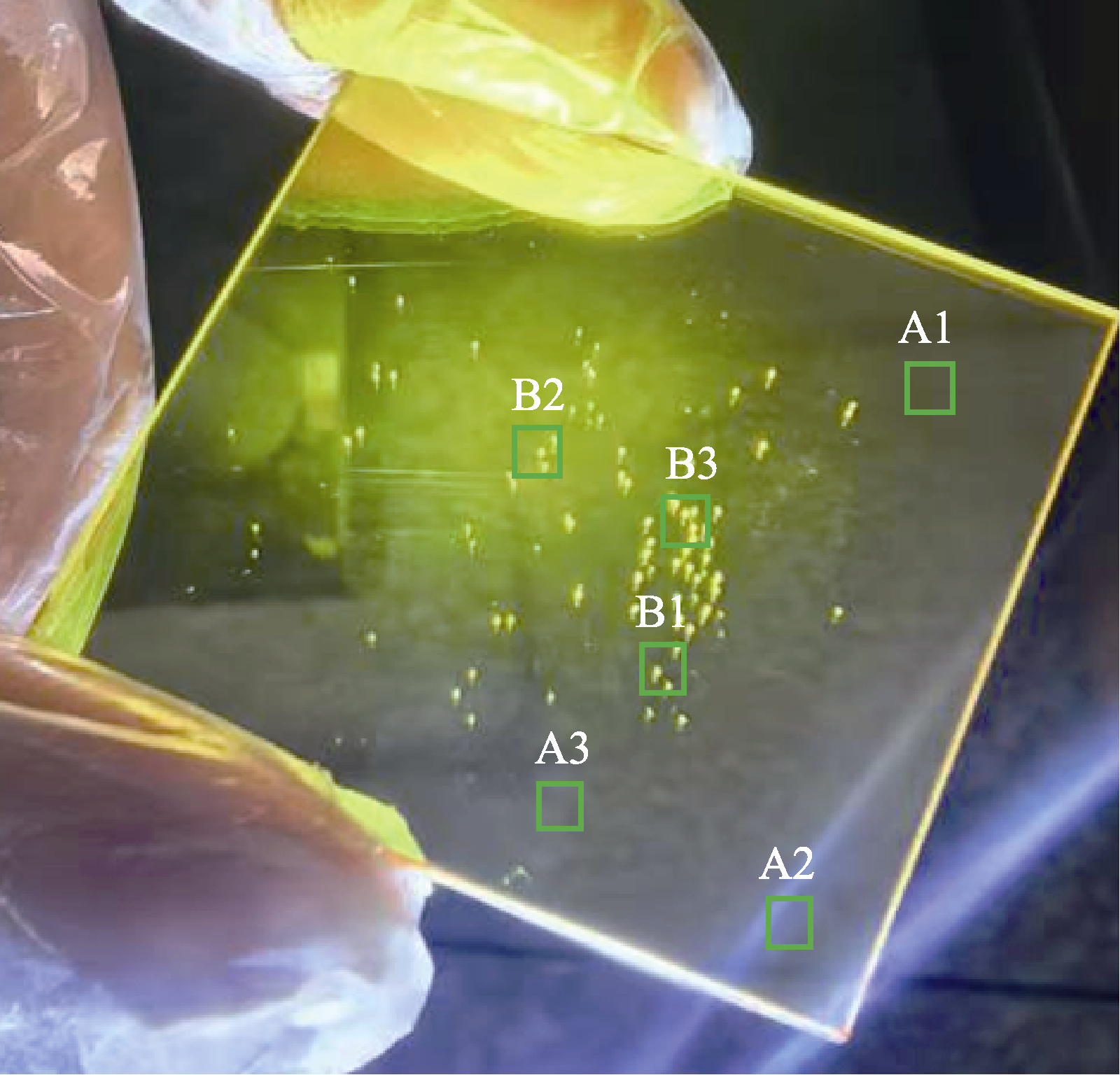
图1 强光下观测到的散射颗粒及透过测试区
Fig. 1 Scattering particles observed under intense light and transmission test areas
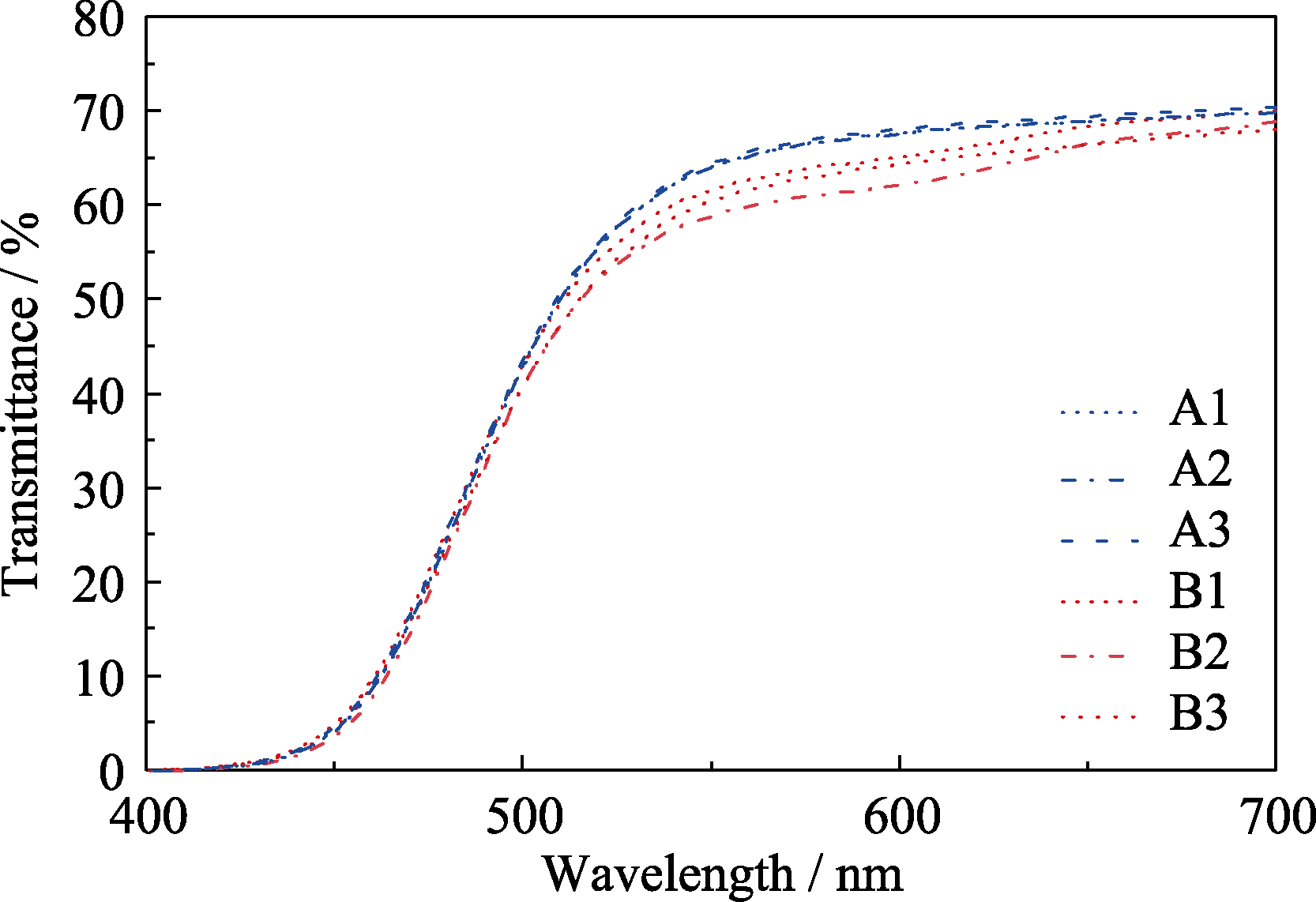
图2 图1中标记区域的透射光谱
Fig. 2 Transmission spectra of the labeled areas in Fig. 1 Colorful figure is available on website
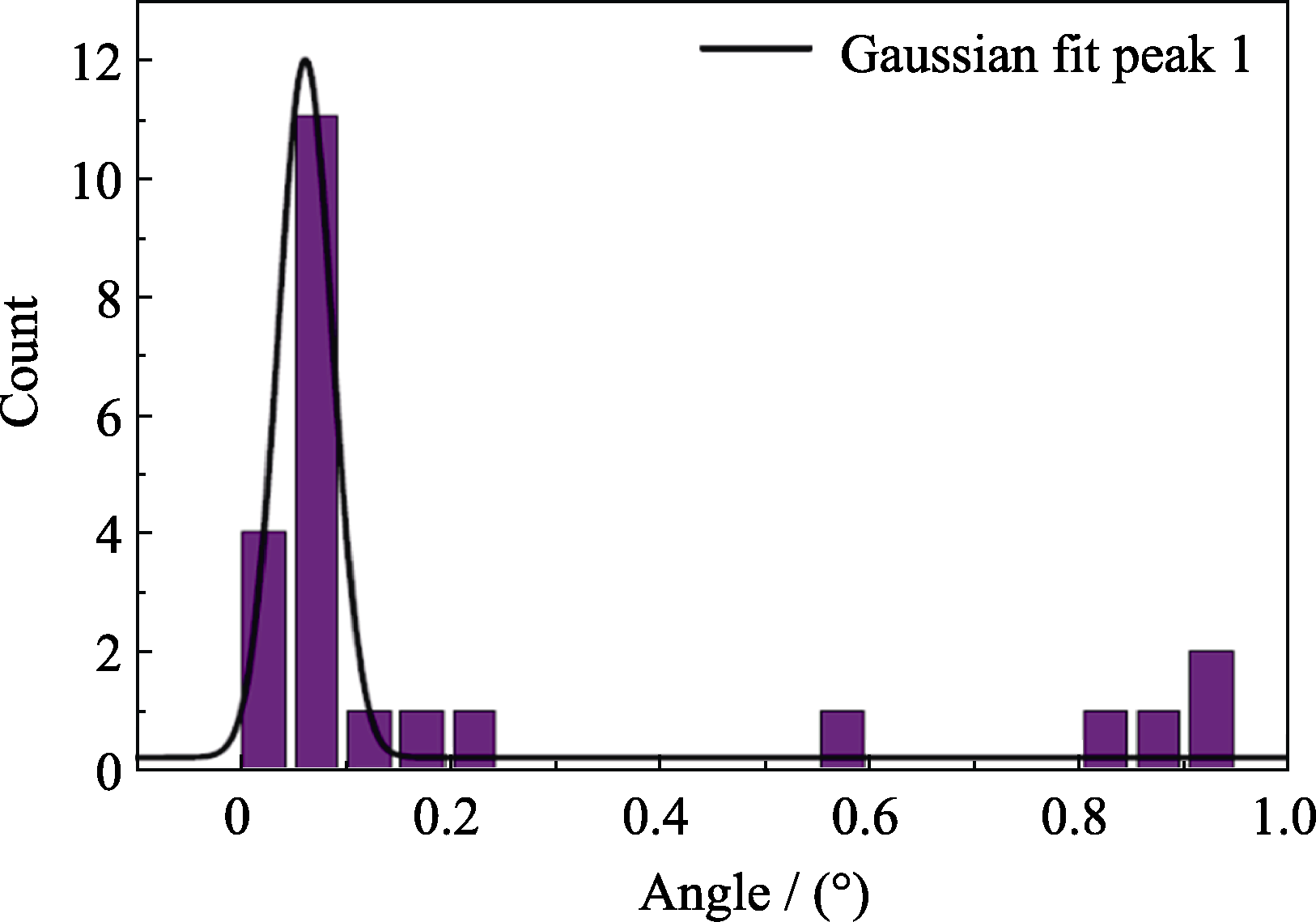
图3 散射颗粒取向与晶体[100]生长方向夹角分布的高斯拟合曲线
Fig. 3 Gaussian fitting curve of the angle distribution between the scattering particle orientation and the crystal growth direction [100]
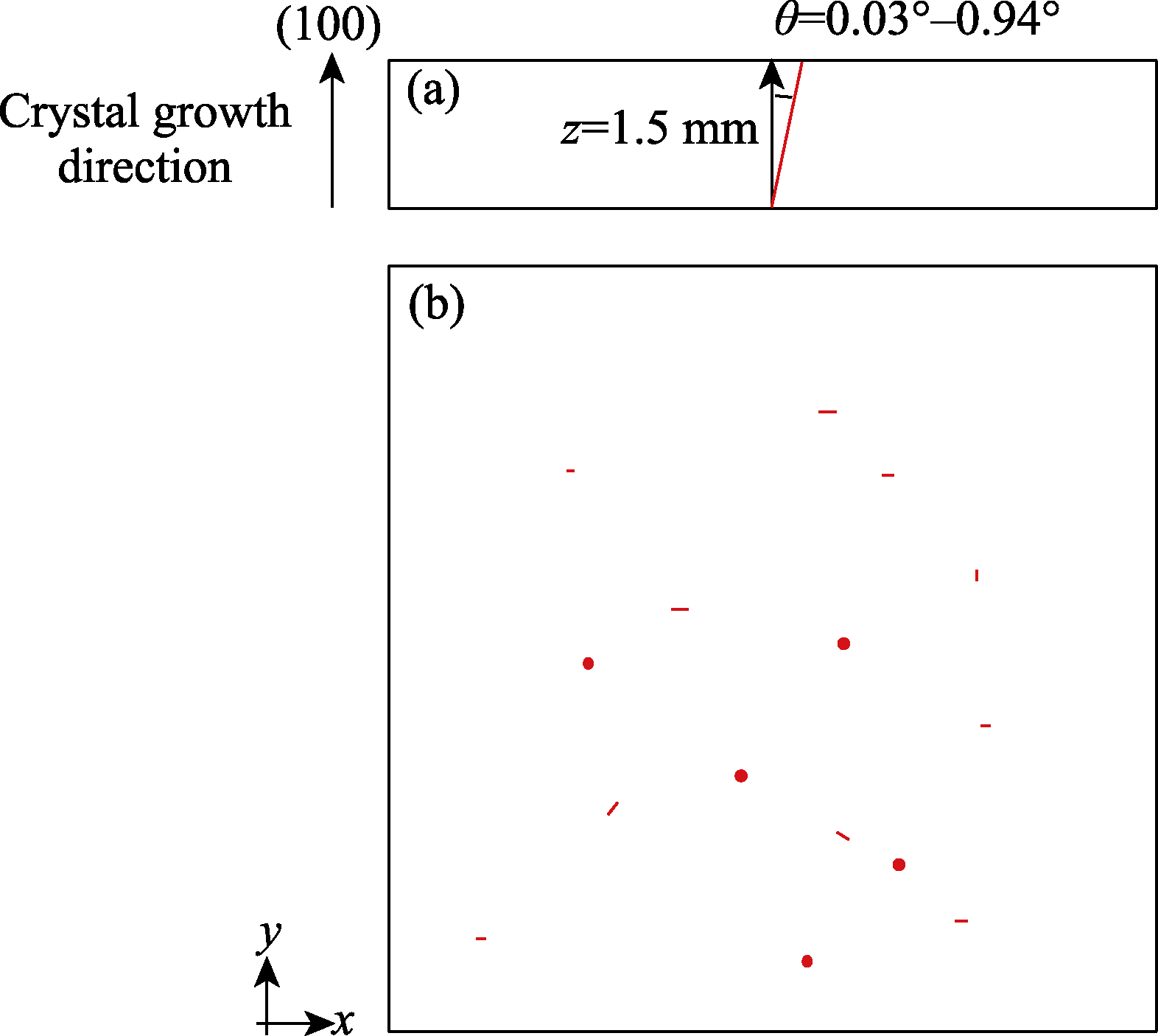
图4 BSO晶体中散射颗粒位置分布示意图
Fig. 4 Schematic diagram of the spatial position distribution of scattering particles in BSO crystal (a) Angle with the growth direction [100]; (b) Distribution in the x-y plane
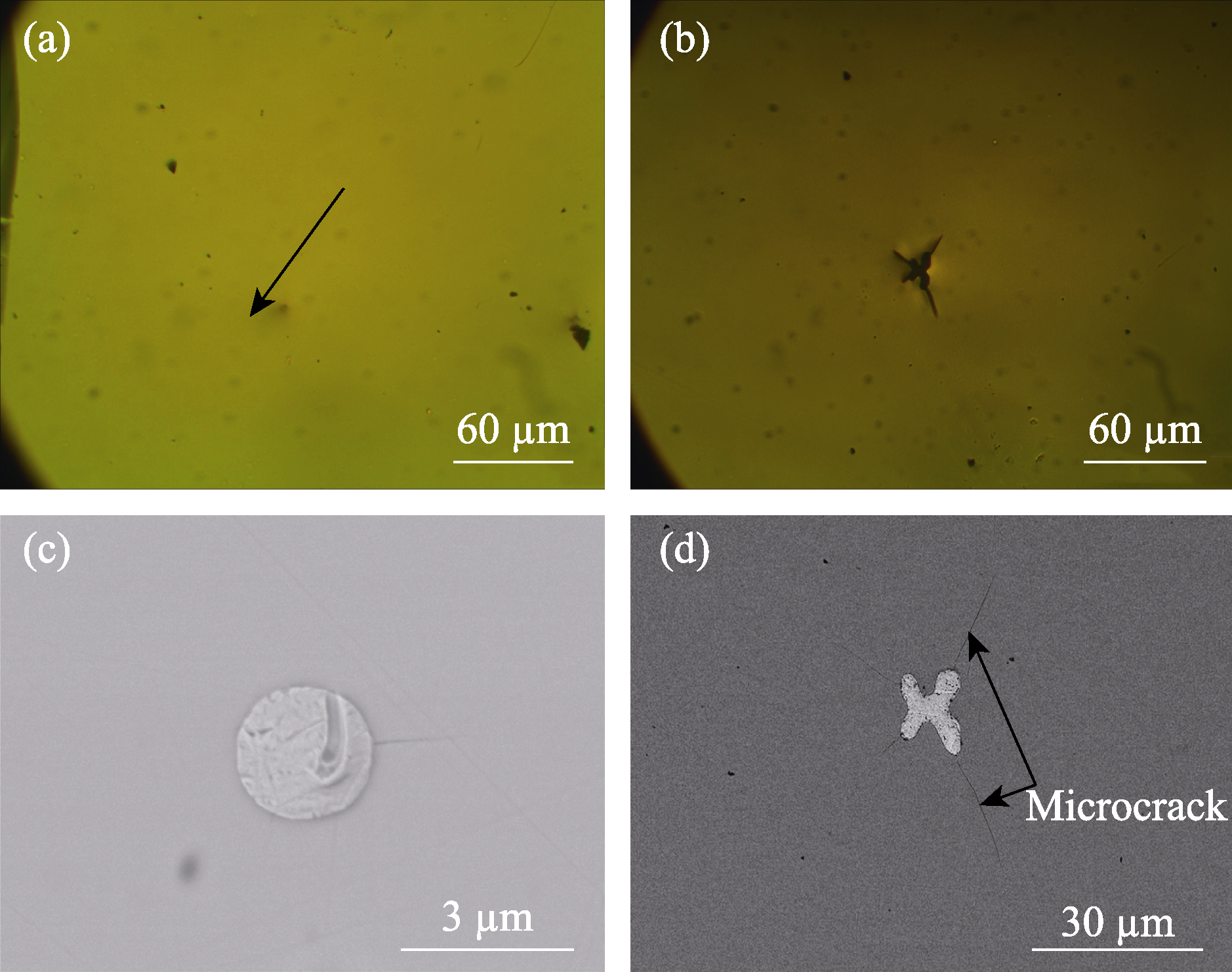
图5 BSO晶体腐蚀前散射颗粒在TPM与SEM下的形貌特征
Fig. 5 TPM and SEM images of scattering particles in BSO crystal before corrosion (a, c) Scattering particles on the A-side of the crystal; (b, d) Scattering particles on the B-side of the crystal
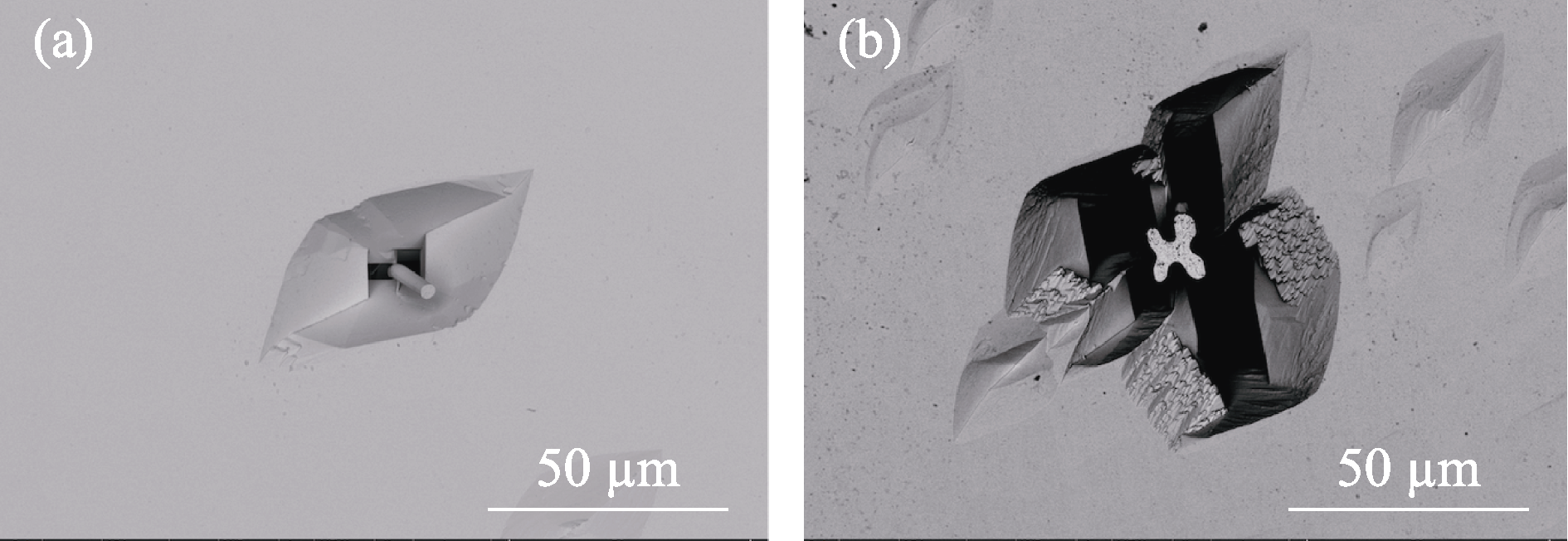
图6 硝酸腐蚀2 h后BSO晶体中散射颗粒的SEM照片
Fig. 6 SEM images of scattering particles in BSO crystal after 2 h HNO3 etching (a) Scattering particles on the A-side of the crystal; (b) Scattering particles on the B-side of the crystal
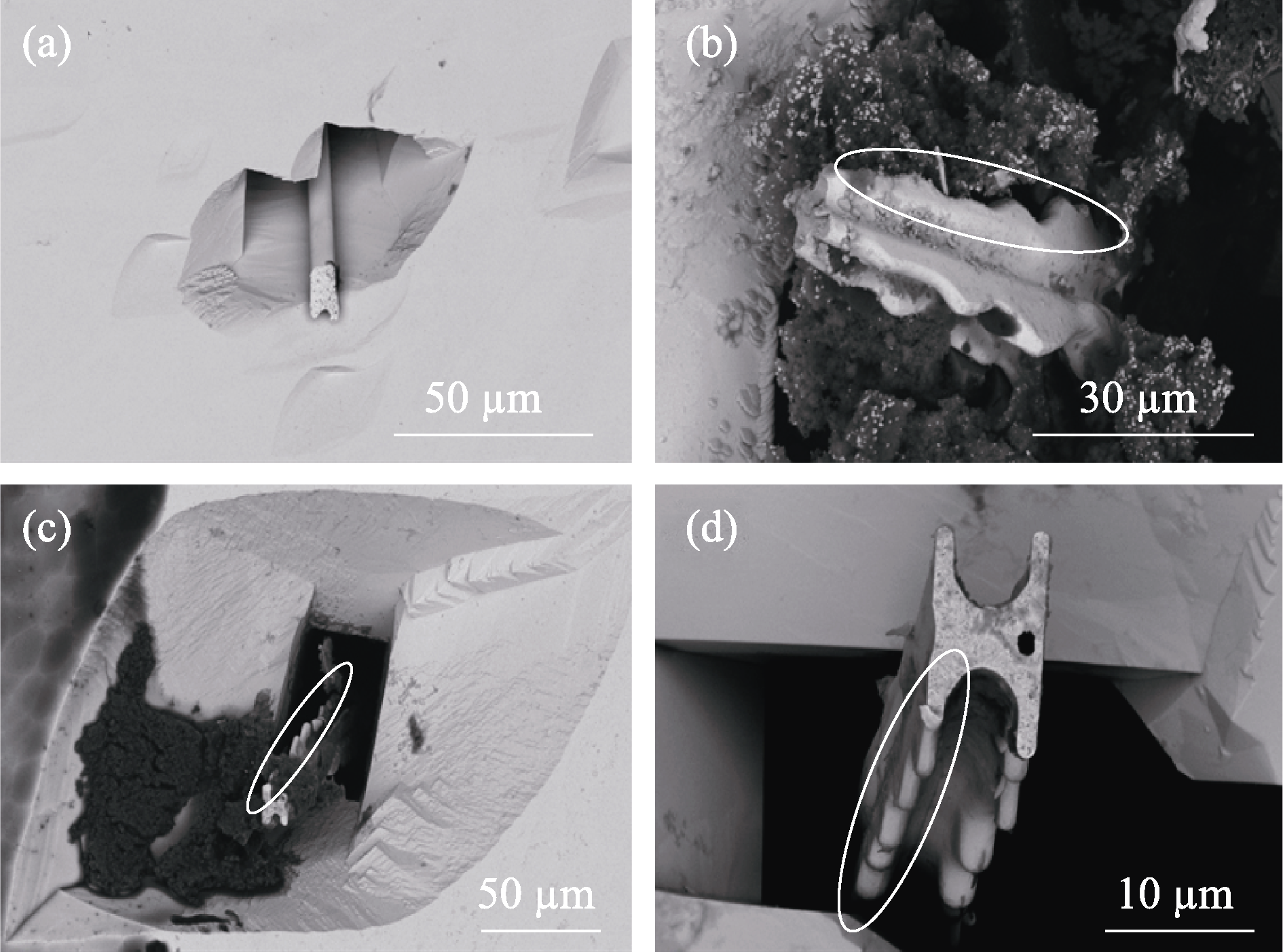
图7 硝酸腐蚀6 h后BSO晶体中散射颗粒的SEM照片
Fig. 7 SEM images of scattering particles in BSO crystal after 6 h HNO3 etching (a) Transition between cylindrical and H-shaped particles; (b-d) H-shaped scattering particles in the BSO crystal
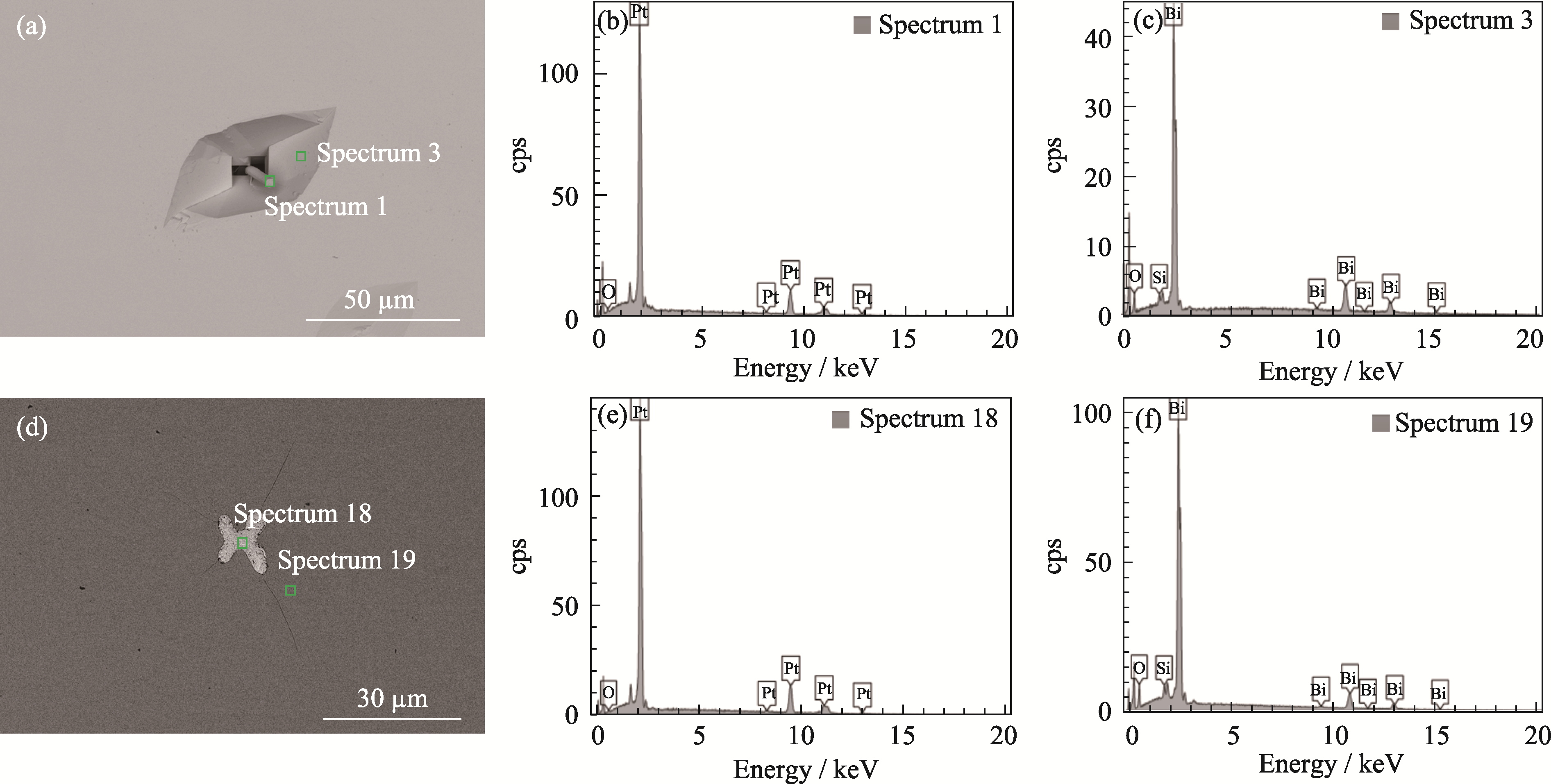
图8 BSO晶体中散射颗粒SEM照片(a, d)及EDS图谱(b, c, e, f)
Fig. 8 SEM images (a, d) and EDS spectra (b, c, e, f) of scattering particles in BSO crystal
| Spectrum | Pt/% (in atomic) | Bi/% (in atomic) | Si/% (in atomic) | O/% (in atomic) |
|---|---|---|---|---|
| 1 | 85.39 | - | - | 14.61 |
| 3 | - | 48.12 | 3.09 | 48.79 |
| 18 | 92.54 | - | - | 7.46 |
| 19 | - | 43.56 | 3.26 | 53.19 |
表1 BSO晶体中散射颗粒SEM-EDS成分分析
Table 1 SEM-EDS component analysis of the scattering particles in BSO crystal
| Spectrum | Pt/% (in atomic) | Bi/% (in atomic) | Si/% (in atomic) | O/% (in atomic) |
|---|---|---|---|---|
| 1 | 85.39 | - | - | 14.61 |
| 3 | - | 48.12 | 3.09 | 48.79 |
| 18 | 92.54 | - | - | 7.46 |
| 19 | - | 43.56 | 3.26 | 53.19 |
| [1] |
NEOV S, MARINOVA V, REEHUIS M, et al. Neutron-diffraction study of Bi12MO20 single crystals with sillenite structure (M=Si, Si0.995Mn0.005, Bi0.53Mn0.47). Applied Physics A, 2002, 74(Suppl. 1): S1016.
DOI URL |
| [2] |
MEL’NIKOVA T I, KUZ’MICHEVA G M, BOLOTINA N B, et al. Structural features of compounds of the sillenite family. Crystallography Reports, 2014, 59(3): 353.
DOI URL |
| [3] |
ISIK M, DELICE S, NASSER H, et al. Optical characteristics of Bi12SiO20 single crystals by spectroscopic ellipsometry. Materials Science in Semiconductor Processing, 2020, 120: 105286.
DOI URL |
| [4] |
CHEN C C, YANG C T, CHUNG W H, et al. Synthesis and characterization of Bi4Si3O12, Bi2SiO5, and Bi12SiO20 by controlled hydrothermal method and their photocatalytic activity. Journal of the Taiwan Institute of Chemical Engineers, 2017, 78: 157.
DOI URL |
| [5] |
MARINOVA V, LIN S H, PETROV S, et al. Graphene-based spatial light modulator operating at near infrared spectral range. Applied Surface Science, 2019, 472: 2.
DOI URL |
| [6] |
VIEIRA T A, YEPES I S V, SUAREZ R A B, et al. Optical reconstruction of non-diffracting beams via photorefractive holography. Applied Physics B, 2017, 123: 134.
DOI URL |
| [7] |
RESIDORI S, BORTOLOZZO U, HUIGNARD J P. Liquid crystal light valves as optically addressed liquid crystal spatial light modulators: optical wave mixing and sensing applications. Liquid Crystals Reviews, 2018, 6(1): 1.
DOI URL |
| [8] |
TSCHIERSCH R, BOGACZYK M, WAGNER H E. Systematic investigation of the barrier discharge operation in helium, nitrogen, and mixtures: discharge development, formation and decay of surface charges. Journal of Physics D: Applied Physics, 2014, 47: 365204.
DOI URL |
| [9] |
DUTTA V, SHARMA S, RAIZADA P, et al. Recent progress on bismuth-based Z-scheme semiconductor photocatalysts for energy and environmental applications. Journal of Environmental Chemical Engineering, 2020, 8(6): 104505.
DOI URL |
| [10] |
EFTIMOV T, DYANKOV G, KOLEV P, et al. A polarimetric fiber optic current sensor based on Bi12SiO20 crystal fluorescence. Optical Materials, 2022, 133: 112837.
DOI URL |
| [11] |
CHANG F, ZHAO S, LEI Y, et al. Jointly augmented photocatalytic NO removal by S-scheme Bi12SiO20/Ag2MoO4 heterojunctions with surface oxygen vacancies. Journal of Colloid and Interface Science, 2023, 649: 713.
DOI URL |
| [12] |
GAO J, ZHANG B, FENG Q, et al. Enhanced vibration measurement using differential dynamic holographic interferometry with dual photorefractive crystals. Optics and Laser Technology, 2025, 188: 113000.
DOI URL |
| [13] |
GOLUBOVIĆ A V, NIKOLIĆ S N, GAJIĆ R, et al. The growth and optical properties of Bi12SiO20 single crystals. Journal of the Serbian Chemical Society, 2002, 67(4): 279.
DOI URL |
| [14] |
RISCOB B, SHKIR M, GANESH V, et al. Synthesis, crystal growth and mechanical properties of bismuth silicon oxide (BSO) single crystal. Journal of Alloys and Compounds, 2014, 588: 242.
DOI URL |
| [15] |
XU X W, LIAO J Y, SHNE B F, et al. Bi12SiO20 single crystal growth by the Bridgman method. Journal of Crystal Growth, 1993, 133: 267.
DOI URL |
| [16] |
ZHANG Y, LIU Y, JIANG W, et al. Vertical Bridgman growth of Bi12SiO20 crystal with axial vibration. Journal of Crystal Growth, 2008, 310: 5432.
DOI URL |
| [17] |
TANGUAY A R, MROCZKOWSKI S, BARKER R C. The Czochralski growth of optical quality bismuth silicon oxide (Bi12SiO20). Journal of Crystal Growth, 1977, 42: 431.
DOI URL |
| [18] |
AGGARWAL M D, WANG W S, CHOI J, et al. Morphology and formation of the color core of Bi12SiO20 crystals grown by the Czochralski method. Journal of Crystal Growth, 1994, 137: 132.
DOI URL |
| [19] |
GOPALAKRISHNAN R, KRISHNAMURTHY D, ARIVUOLI D, et al. Microscopy observations of Cz-grown BSO (Bi12SiO20) crystals. Materials Chemistry and Physics, 1994, 37: 90.
DOI URL |
| [20] |
ZHANG A Q, XU J Y, FAN S J. Bridgman growth and platinum- related defects of Bi12SiO20 crystal. Chemistry Research, 2004, 15(3): 1.
DOI URL |
| [21] | YIN Z W, XUE Z L, HU G Q, et al. Studies on the macro-defects in BGO single crystals. Journal of Inorganic Materials, 1991, 6(4): 391. |
| [22] |
QI X J, ZHANG J, CHEN L, et al. Macroscopic defects of large Bi12GeO20 crystals grown using vertical Bridgman method. Journal of Inorganic Materials, 2023, 38(3): 280.
DOI URL |
| [23] |
SANZ O, HARO-PONIATOWSKI E, GONZALO J, et al. Influence of the melting conditions of heavy metal oxide glasses containing bismuth oxide on their optical absorption. Journal of Non-Crystalline Solids, 2006, 352: 761.
DOI URL |
| [24] |
DENISOV V M, PODKOPAEV O I, DENISOVA L T, et al. Contact interaction of the Bi12GeO20, Bi12SiO20, and Bi4Ge3O12 melts with noble metals. Russian Metallurgy (Metally), 2014, 2014(2): 97.
DOI URL |
| [25] |
DENISOV V M, ZHEREB V P, DENISOVA L T, et al. Contact interaction of Bi2O3-SiO2 melts with gold. Inorganic Materials, 2012, 48(2): 210.
DOI URL |
| [1] | 司会晨, 梁飞, 于浩海, 张怀金. 黄橙激光晶体材料与全固态激光器件研究进展[J]. 无机材料学报, 2026, 41(8): 1049-1068. |
| [2] | 刘宇霄, 梁飞. Dy:Y2SiO5和Dy,Tb:Y2SiO5单晶生长与黄光发射光谱性能[J]. 无机材料学报, 2026, 41(7): 930-938. |
| [3] | 徐锦涛, 高攀, 何唯一, 蒋圣楠, 潘秀红, 汤美波, 陈锟, 刘学超. 3C-SiC晶体制备研究进展[J]. 无机材料学报, 2026, 41(1): 1-11. |
| [4] | 李宪珂, 张超逸, 黄林, 孙鹏, 刘波, 徐军, 唐慧丽. 高质量铟掺杂氧化镓单晶浮区法生长研究[J]. 无机材料学报, 2024, 39(12): 1384-1390. |
| [5] | 蔡豪, 汪琦航, 邹朝勇. 镁离子调控无定形碳酸钙制备一水碳酸钙结晶过程[J]. 无机材料学报, 2024, 39(11): 1275-1282. |
| [6] | 郝永鑫, 秦娟, 孙军, 杨金凤, 李清连, 黄贵军, 许京军. 坩埚底角形状对提拉法生长同成分铌酸锂晶体的影响[J]. 无机材料学报, 2024, 39(10): 1167-1174. |
| [7] | 秦娟, 梁丹丹, 孙军, 杨金凤, 郝永鑫, 李清连, 张玲, 许京军. 提拉法生长平肩同成分铌酸锂晶体的研究[J]. 无机材料学报, 2023, 38(8): 978-986. |
| [8] | 林思琪, 李艾燃, 付晨光, 李荣斌, 金敏. Zintl相Mg3X2(X=Sb, Bi)基晶体生长及热电性能研究进展[J]. 无机材料学报, 2023, 38(3): 270-279. |
| [9] | 杨佳雪, 李雯, 王燕, 朱昭捷, 游振宇, 李坚富, 涂朝阳. Dy3+: Y3Al5O12晶体的光谱与黄色激光性能[J]. 无机材料学报, 2023, 38(3): 350-356. |
| [10] | 穆宏赫, 王鹏飞, 施宇峰, 张中晗, 武安华, 苏良碧. 热交换坩埚下降法制备大尺寸氟化铈晶体的热场设计与优化[J]. 无机材料学报, 2023, 38(3): 288-295. |
| [11] | 吴振, 李慧芳, 张中晗, 张振, 李阳, 蓝江河, 苏良碧, 武安华. 面向磁光应用的CeF3晶体生长与性能表征[J]. 无机材料学报, 2023, 38(3): 296-302. |
| [12] | 齐雪君, 张健, 陈雷, 王绍涵, 李翔, 杜勇, 陈俊锋. 坩埚下降法生长大尺寸Bi12GeO20晶体的宏观缺陷[J]. 无机材料学报, 2023, 38(3): 280-287. |
| [13] | 齐占国, 刘磊, 王守志, 王国栋, 俞娇仙, 王忠新, 段秀兰, 徐现刚, 张雷. GaN单晶的HVPE生长与掺杂进展[J]. 无机材料学报, 2023, 38(3): 243-255. |
| [14] | 张超逸, 唐慧丽, 李宪珂, 王庆国, 罗平, 吴锋, 张晨波, 薛艳艳, 徐军, 韩建峰, 逯占文. 新型GaN与ZnO衬底ScAlMgO4晶体的研究进展[J]. 无机材料学报, 2023, 38(3): 228-242. |
| [15] | 陈昆峰, 胡乾宇, 刘锋, 薛冬峰. 多尺度晶体材料的原位表征技术与计算模拟研究进展[J]. 无机材料学报, 2023, 38(3): 256-269. |
| 阅读次数 | ||||||
|
全文 |
|
|||||
|
摘要 |
|
|||||