
Journal of Inorganic Materials ›› 2026, Vol. 41 ›› Issue (6): 831-838.DOI: 10.15541/jim20250400
Special Issue: 【制备方法】3D打印(202606)
Previous Articles Next Articles
WANG Mengmeng1,2,3( ), TIAN Li2,3, ZHANG Junmin1, LI Qinggang1, YANG Jinshan2,3(), DONG Shaoming2,3,4()
Received:2025-10-13
Revised:2025-11-17
Published:2026-06-20
Online:2025-11-27
Contact:
YANG Jinshan, professor. E-mail: jyang@mail.sic.ac.cn;About author:WANG Mengmeng (1997-), female, PhD. E-mail: wangmm@szlab.ac.cn
Supported by:CLC Number:
WANG Mengmeng, TIAN Li, ZHANG Junmin, LI Qinggang, YANG Jinshan, DONG Shaoming. Highly Efficient EMI Shielding via 3D-printed CNT/SiC-SiO2 Architectures[J]. Journal of Inorganic Materials, 2026, 41(6): 831-838.
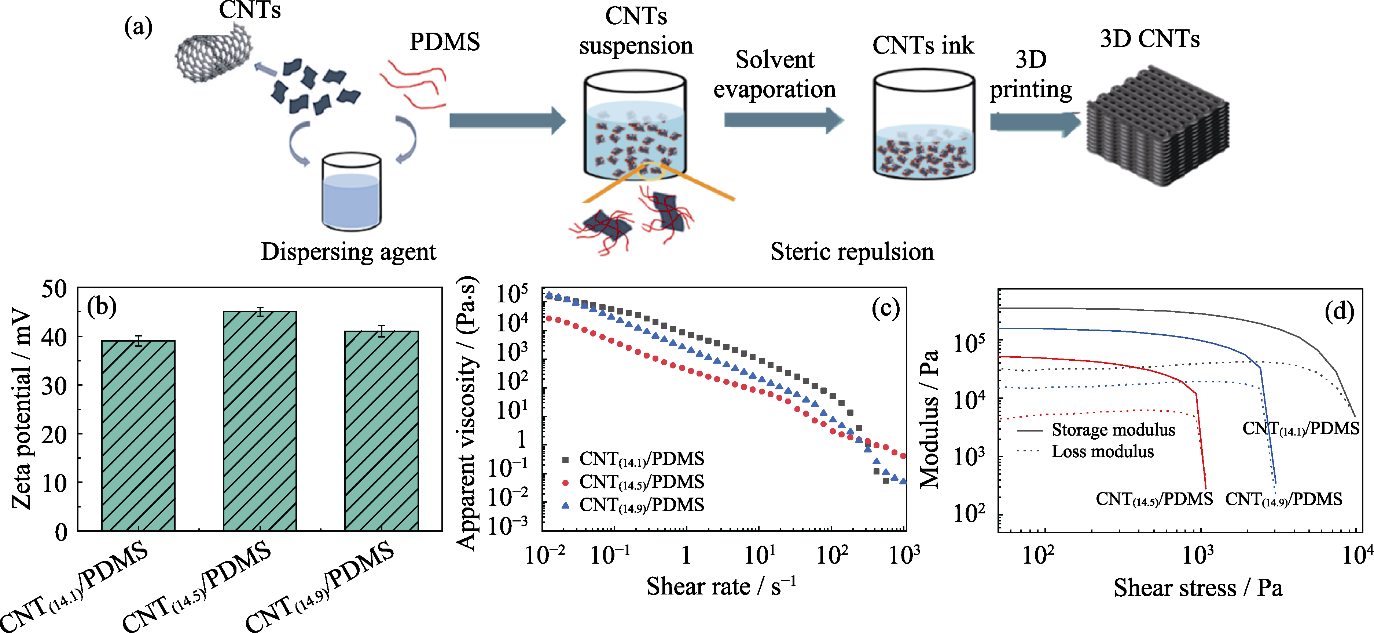
Fig. 1 (a) Schematic diagram of the preparation process; (b) Zeta potential, (c) apparent viscosity, (d) storage modulus and loss modulus of CNT/PDMS inks
| Sample | CNT/g | Ethanol/g | PDMS base agent/g | PDMS curing agent/g | CNT/% (in mass) |
|---|---|---|---|---|---|
| CNT(14.1)/PDMS | 1 | 0.2 | 5 | 0.5 | 14.1 |
| CNT(14.5)/PDMS | 1 | 0.4 | 5 | 0.5 | 14.5 |
| CNT(14.9)/PDMS | 1 | 0.6 | 5 | 0.5 | 14.9 |
Table 1 Composition ratio of CNT/PDMS in the composite ink
| Sample | CNT/g | Ethanol/g | PDMS base agent/g | PDMS curing agent/g | CNT/% (in mass) |
|---|---|---|---|---|---|
| CNT(14.1)/PDMS | 1 | 0.2 | 5 | 0.5 | 14.1 |
| CNT(14.5)/PDMS | 1 | 0.4 | 5 | 0.5 | 14.5 |
| CNT(14.9)/PDMS | 1 | 0.6 | 5 | 0.5 | 14.9 |
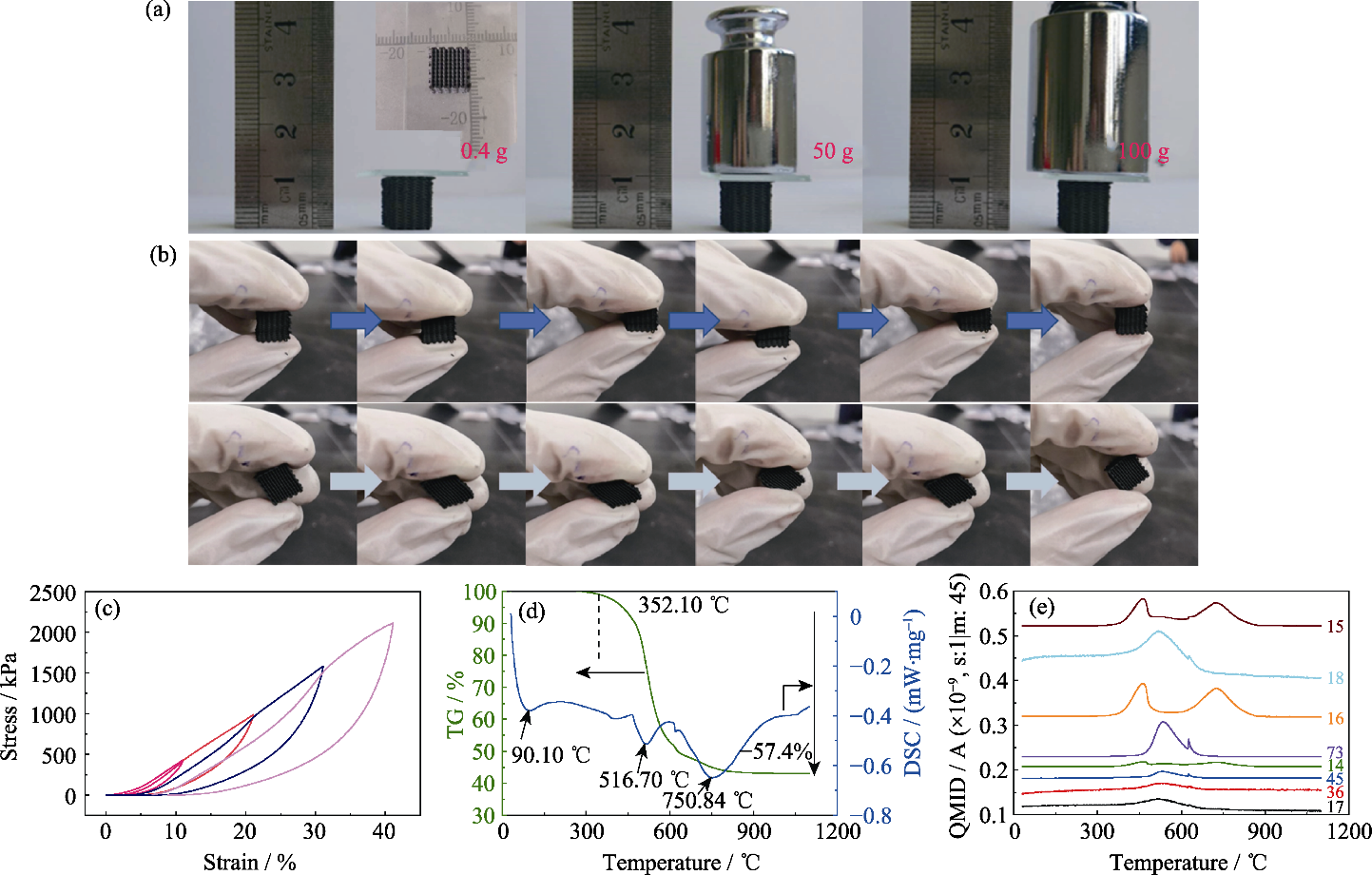
Fig. 2 (a) Mechanical compressive test diagram and (b) compress-release process in the direction of height and diagonal of bottom for CNT(14.5)/PDMS; (c) Compressive stress-strain curves under 10%-40% strain; (d) Thermal gravimetric analysis and differential scanning calorimetry curve; (e) Mass spectra of CNT(14.5)/PDMS
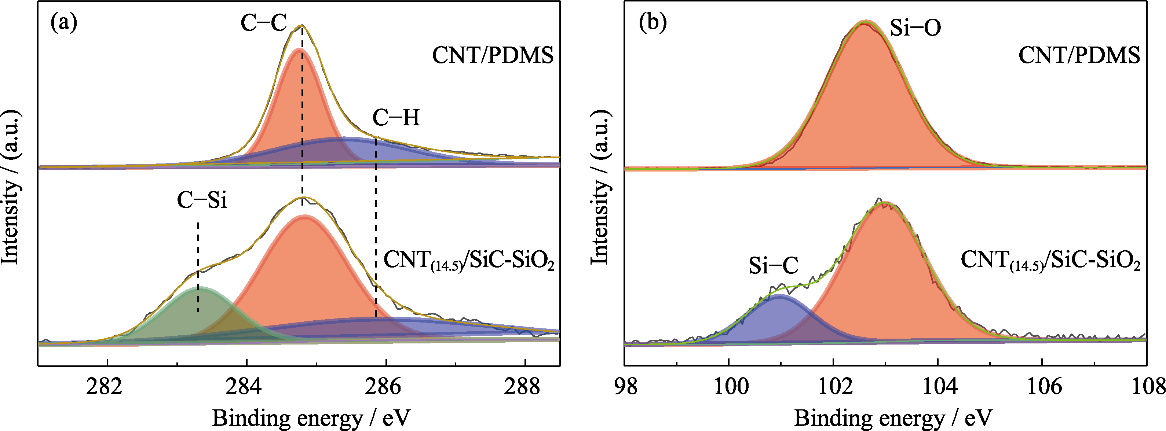
Fig. 3 XPS spectra of (a) C1s and (b) Si2p core level for CNT/PDMS before pyrolysis and CNT(14.5)/SiC-SiO2 after pyrolysis
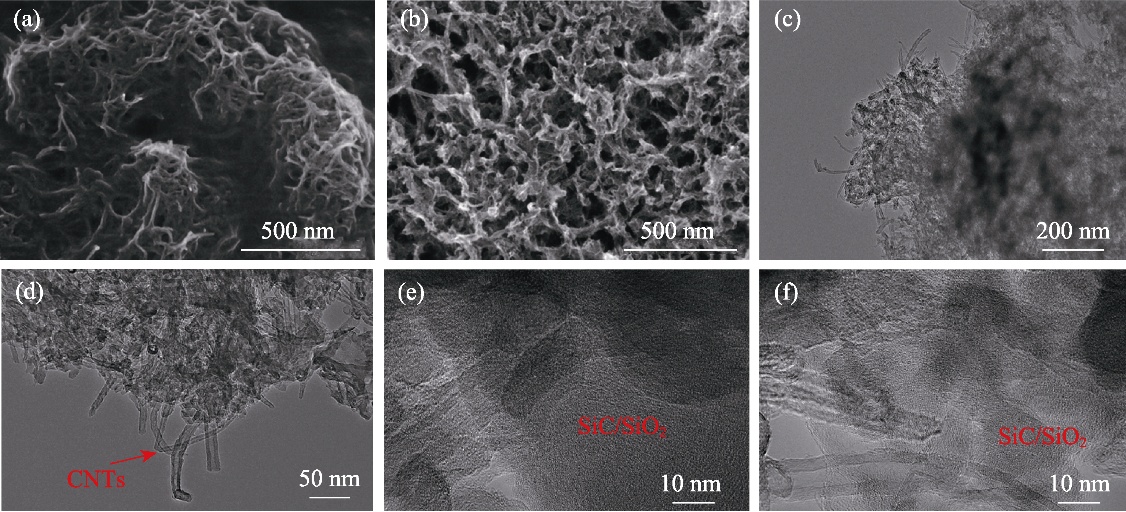
Fig. 4 (a, b) SEM images of 3D-printed (a) CNT(14.5)/PDMS and (b) CNT(14.5)/SiC-SiO2; (c-f) TEM images of 3D-printed CNT(14.5)/SiC-SiO2
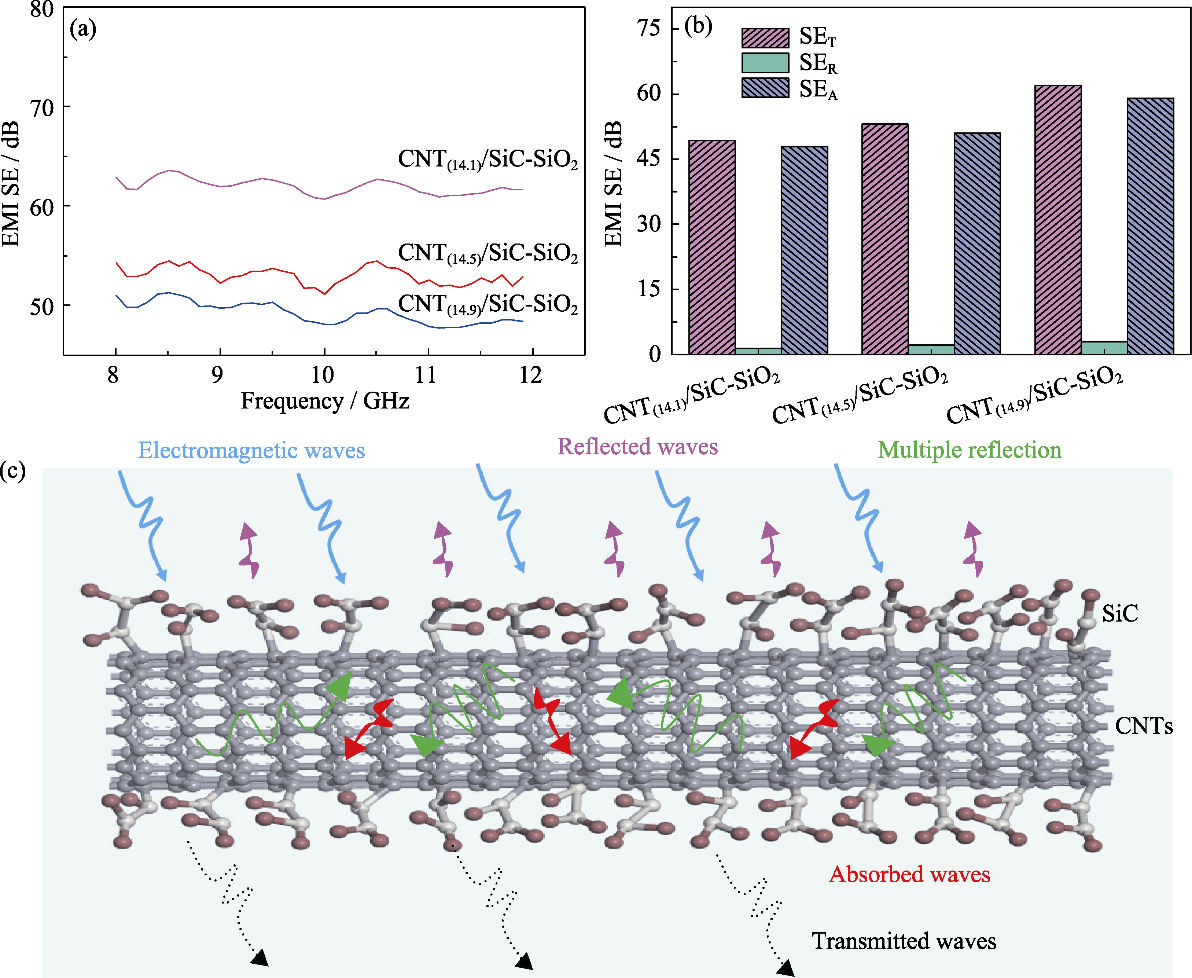
Fig. 5 (a) EMI shielding performance of CNT/SiC-SiO2; (b) Average SET, SER, and SEA, and (c) schematic illustration of the EMI shielding mechanism for CNT/SiC-SiO2
| [1] | WANG X X, CAO W Q, CAO M S, et al. Assembling nano- microarchitecture for electromagnetic absorbers and smart devices. Advanced Materials, 2020, 32(36): 2002112. |
| [2] | AKRAM S, ASHRAF M, JAVID A, et al. Recent advances in electromagnetic interference (EMI) shielding textiles: a comprehensive review. Synthetic Metals, 2023, 294: 117305. |
| [3] | ORASUGH J T, RAY S S. Functional and structural facts of effective electromagnetic interference shielding materials: a review. ACS Omega, 2023, 8(9): 8134. |
| [4] | HOU X, FENG X R, JIANG K, et al. Recent progress in smart electromagnetic interference shielding materials. Journal of Materials Science & Technology, 2024, 186: 256. |
| [5] | ISARI A A, GHAFFARHHAH A, HASHEMI S A, et al. Structural design for EMI shielding: from underlying mechanisms to common pitfalls. Advanced Materials, 2024, 36(24): 2310683. |
| [6] | WANG H, LI S, LIU M, et al. Review on shielding mechanism and structural design of electromagnetic interference shielding composites. Macromolecular Materials and Engineering, 2021, 306(6): 2100032. |
| [7] | ZHAO H, WANG J, HE M, et al. Electromagnetic interference shielding films: structure design and prospects. Small Methods, 2025, 9(5): 2401324. |
| [8] | YAO Y, JIN S, ZOU H, et al. Polymer-based lightweight materials for electromagnetic interference shielding: a review. Journal of Materials Science, 2021, 56(11): 6549. |
| [9] | WANG M, TIAN L, ZHANG Q, et al. Absorption-based electromagnetic interference shielding composites with sandwich structure by one-step electrodeposition method. Carbon, 2023, 202: 414. |
| [10] | WANG M, YOU X, LIAO C, et al. Ultrathin and flexible hybrid films decorated by copper nanoparticles with a sandwich-like structure for electromagnetic interference shielding. Materials Chemistry Frontiers, 2022, 6(16): 2256. |
| [11] | SATHISH K, RENGARAJ R, VENKATAKRISHNAN G R, et al. Polymeric materials for electromagnetic shielding-a review. Materials Today: Proceedings, 2021, 47: 4925. |
| [12] | XUE Z, CORDIER R, KNIGHT E, et al. Lightweight, flexible electromagnetic shielding composite films reinforced with recycled carbon fibers and carbon nanofillers. Advanced Engineering Materials, 2025, 27(22): e202501907. |
| [13] | CUI L, HAN X, WANG F, et al. A review on recent advances in carbon-based dielectric system for microwave absorption. Journal of Materials Science, 2021, 56(18): 10782. |
| [14] | AYANDA O S, MMUOEGBULAM A O, OKEZIE O, et al. Recent progress in carbon-based nanomaterials: critical review. Journal of Nanoparticle Research, 2024, 26(5): 106. |
| [15] | AL-SALEH M H. Influence of conductive network structure on the EMI shielding and electrical percolation of carbon nanotube/ polymer nanocomposites. Synthetic Metals, 2015, 205: 78. |
| [16] | KUMAR S. Investigating effect of CNT agglomeration in CNT/polymer nanocomposites using multiscale finite element method. Mechanics of Materials, 2023, 183: 104706. |
| [17] | WANG M, YANG J, YOU X, et al. Nanoinfiltration behavior of carbon nanotube based nanocomposites with enhanced mechanical and electrical properties. Journal of Materials Science & Technology, 2021, 71: 23. |
| [18] | PANDAYA K S, SHINDALKAR S S, KANDASUBRAMANIAN B. Breakthrough to the pragmatic evolution of direct ink writing: progression, challenges, and future. Progress in Additive Manufacturing, 2023, 8(6): 1303. |
| [19] | ZHAO Y, ZHU J, HE W, et al. 3D printing of unsupported multi-scale and large-span ceramic via near-infrared assisted direct ink writing. Nature Communications, 2023, 14: 2381. |
| [20] | CIDONIO G, COSTANTINI M, PIERINI F, et al. 3D printing of biphasic inks: beyond single-scale architectural control. Journal of Materials Chemistry C, 2021, 9(37): 12489. |
| [21] | XU X, TAN Y H, DING J, et al. 3D printing of next-generation electrochemical energy storage devices: from multiscale to multimaterial. Energy & Environmental Materials, 2022, 5(2): 427. |
| [22] | SHI Y, HU M, XING Y, et al. Temperature-dependent thermal and mechanical properties of flexible functional PDMS/paraffin composites. Materials & Design, 2020, 185: 108219. |
| [23] | REN Z, MUJIB S B, SINGH G. High-temperature properties and applications of Si-based polymer-derived ceramics: a review. Materials, 2021, 14(3): 614. |
| [24] | WANG M, TIAN L, YOU X, et al. Flexible, magnetic and sandwich-structural Fe2O3/CNT/Fe2O3 composite film with absorption-dominant EMI shielding performance. Journal of Materials Science & Technology, 2025, 227: 122. |
| [25] | ZHAO L, GAO L. Stability of multi-walled carbon nanotubes dispersion with copolymer in ethanol. Colloids and Surfaces A: Physicochemical and Engineering Aspects, 2003, 224: 127. |
| [26] | FU K, WANG Y, YAN C, et al. Graphene oxide-based electrode inks for 3D-printed lithium-ion batteries. Advanced Materials, 2016, 28(13): 2587. |
| [27] | COMPTON B G, LEWIS J A. 3D-printing of lightweight cellular composites. Advanced Materials, 2014, 26(34): 5930. |
| [28] | KIM J H, LEE S, WAJAHAT M, et al. Three-dimensional printing of highly conductive carbon nanotube microarchitectures with fluid ink. ACS Nano, 2016, 10(9): 8879. |
| [29] | FENG F, HAN Z, WEI B, et al. Increasing both the electromagnetic shielding and thermal conductive properties of three- dimensional graphene-CNT-SiC hybrid materials. New Carbon Materials, 2024, 39(6): 1178. |
| [30] | LIU H, ZHANG X, LI K, et al. Construction of core-shell structured SiC nanowires@carbon nanotubes hybrid conductive network for supercapacitors and electromagnetic interference shielding. Carbon, 2024, 228: 119411. |
| [31] | LIU Y, YANG F, GU H, et al. Flexible CNT-based composite films with amorphous SiBCN-inhibited ultrafine SiC grains for high- temperature electromagnetic shielding. Ceramics International, 2024, 50(21): 41057. |
| [32] | YANG Y, YOU X, OUYANG H, et al. Electromagnetic interference shielding properties of foamed SiCnws/SiC composites reinforced by in-situ grown carbon nanofibers. Journal of Alloys and Compounds, 2024, 1008: 176641. |
| [33] | XIA Y, ZHANG Z, LI K, et al. Lightweight and high-strength SiC/MWCNTs nanofibrous aerogel derived from RGO/MWCNTs aerogel for microwave absorption. Chemical Engineering Journal, 2024, 486: 50417. |
| [34] | YU S, GUO J, ZHANG G, et al. Improved broadband design of SiC/MWCNT absorbing materials through synergistic regulation of heterointerface structure and triple periodic minimal surface meta-structure. Carbon, 2024, 226: 119181. |
| [1] | YIN Jie, GENG Jiayi, WANG Kanglong, CHEN Zhongming, LIU Xuejian, HUANG Zhengren. Recent Advances in 3D Printing and Densification of SiC Ceramics [J]. Journal of Inorganic Materials, 2025, 40(3): 245-255. |
| [2] | SHI Zhe, LIU Weiye, ZHAI Dong, XIE Jianjun, ZHU Yufang. Akermanite Scaffolds for Bone Tissue Engineering: 3D Printing Using Polymer Precursor and Scaffold Properties [J]. Journal of Inorganic Materials, 2023, 38(7): 763-770. |
| [3] | YUAN Jingkun, XIONG Shufeng, CHEN Zhangwei. Research Trends and Challenges of Additive Manufacturing of Polymer-derived Ceramics [J]. Journal of Inorganic Materials, 2023, 38(5): 477-488. |
| [4] | WANG Lukai, FENG Junzong, JIANG Yonggang, LI Liangjun, FENG Jian. Direct-ink-writing 3D Printing of Ceramic-based Porous Structures: a Review [J]. Journal of Inorganic Materials, 2023, 38(10): 1133-1148. |
| [5] | SHI Jixiang, ZHAI Dong, ZHU Min, ZHU Yufang. Preparation and Characterization of Bioactive Glass-Manganese Dioxide Composite Scaffolds [J]. Journal of Inorganic Materials, 2022, 37(4): 427-435. |
| [6] | LI Qiaolei, GU Yue, YU Xuehua, ZHANG Chaowei, ZOU Mingke, LIANG Jingjing, LI Jinguo. Effect of Sintering Temperature on Surface Morphology and Roughness of 3D-printed Silicon Ceramic Cores [J]. Journal of Inorganic Materials, 2022, 37(3): 325-332. |
| [7] | ZHU Junyi, ZHANG Cheng, LUO Zhongqiang, CAO Jiwei, LIU Zhiyuan, WANG Pei, LIU Changyong, CHEN Zhangwei. Influence of Debinding Process on the Properties of Photopolymerization 3D Printed Cordierite Ceramics [J]. Journal of Inorganic Materials, 2022, 37(3): 317-324. |
| [8] | LI Qi, HUANG Yi, QIAN Bin, XU Beibei, CHEN Liying, XIAO Wenge, QIU Jianrong. Photo Curing and Pressureless Sintering of Orange-emitting Glass-ceramics [J]. Journal of Inorganic Materials, 2022, 37(3): 289-296. |
| [9] | YANG Yong, GUO Xiaotian, TANG Jie, CHANG Haotian, HUANG Zhengren, HU Xiulan. Research Progress and Prospects of Non-oxide Ceramic in Stereolithography Additive Manufacturing [J]. Journal of Inorganic Materials, 2022, 37(3): 267-277. |
| [10] | WU Zhongcao, HUAN Zhiguang, ZHU Yufang, WU Chengtie. 3D Printing and Characterization of Microsphere Hydroxyapatite Scaffolds [J]. Journal of Inorganic Materials, 2021, 36(6): 601-607. |
| [11] | ZHANG Li, YANG Xianfeng, XU Xiewen, GUO Jinyu, ZHOU Zhe, LIU Peng, XIE Zhipeng. 3D Printed Zirconia Ceramics via Fused Deposit Modeling and Its Mechanical Properties [J]. Journal of Inorganic Materials, 2021, 36(4): 436-442. |
| [12] | Zhi-Qiang SUN, Xiao-Bo YANG, Hua-Dong WANG, De-Li LI, Shu-Qin LI, Yi LÜ. Ceramic/Resin Composite Powders with Uniform Resin Layer Synthesized from SiO2 Spheres for 3D Technology [J]. Journal of Inorganic Materials, 2019, 34(5): 567-572. |
| [13] | Sheng-Yang FU, Bin YU, Hui-Feng DING, Guo-Dong SHI, Yu-Fang ZHU. Zirconia Incorporation in 3D Printed β-Ca2SiO4 Scaffolds on Their Physicochemical and Biological Property [J]. Journal of Inorganic Materials, 2019, 34(4): 444-454. |
| [14] | XIN Chen, QI Xin, ZHU Min, ZHAO Shi-Chang, ZHU Yu-Fang. Hydroxyapatite Whisker-reinforced Composite Scaffolds Through 3D Printing for Bone Repair [J]. Journal of Inorganic Materials, 2017, 32(8): 837-844. |
| Viewed | ||||||
|
Full text |
|
|||||
|
Abstract |
|
|||||
