
Journal of Inorganic Materials ›› 2026, Vol. 41 ›› Issue (7): 1011-1020.DOI: 10.15541/jim20250498
ZHOU Xue1( ), LIU Zhe2, REN Yan2, YU Jinshan1(), YANG Tianyue1, ZHAO Zhongqian1, WANG Honglei1, ZHOU Xingui1, GOU Yanzi1()
Received:2025-12-15
Revised:2026-02-23
Published:2026-07-20
Online:2026-02-28
Contact:
GOU Yanzi, associate professor. E-mail: y.gou2012@hotmail.com;About author:ZHOU Xue (2001-), female, Master candidate. E-mail: zhouxue23@nudt.edu.cn
Supported by:CLC Number:
ZHOU Xue, LIU Zhe, REN Yan, YU Jinshan, YANG Tianyue, ZHAO Zhongqian, WANG Honglei, ZHOU Xingui, GOU Yanzi. Quantitative Investigation of the Creep Resistance of Different SiC Fibers after Annealing at High Temperature[J]. Journal of Inorganic Materials, 2026, 41(7): 1011-1020.
| Fiber | Generation | C/Si ratio | Oxygen/ % (in mass) | Al/% (in mass) | Diameter/µm | Young's modulus/GPa | Tensile strength/GPa |
|---|---|---|---|---|---|---|---|
| F-1 | Second | 1.35 | 0.89 | - | 10.0 | 301 | 3.6 |
| F-2 | Third | 1.08 | 0.91 | - | 9.9 | 367 | 3.6 |
| F-3 | Third | 1.01 | 0.07 | <1.00 | 9.8 | 373 | 1.7 |
Table 1 Relevant parameters of SiC fibers employed in this work
| Fiber | Generation | C/Si ratio | Oxygen/ % (in mass) | Al/% (in mass) | Diameter/µm | Young's modulus/GPa | Tensile strength/GPa |
|---|---|---|---|---|---|---|---|
| F-1 | Second | 1.35 | 0.89 | - | 10.0 | 301 | 3.6 |
| F-2 | Third | 1.08 | 0.91 | - | 9.9 | 367 | 3.6 |
| F-3 | Third | 1.01 | 0.07 | <1.00 | 9.8 | 373 | 1.7 |
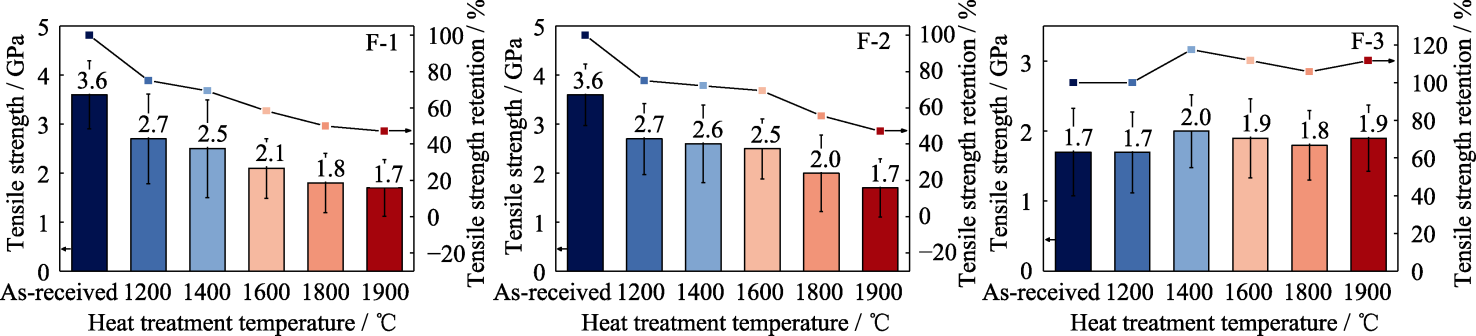
Fig. 1 Tensile strength and tensile strength retention of SiC fibers after heat treatment at different temperatures for 1 h
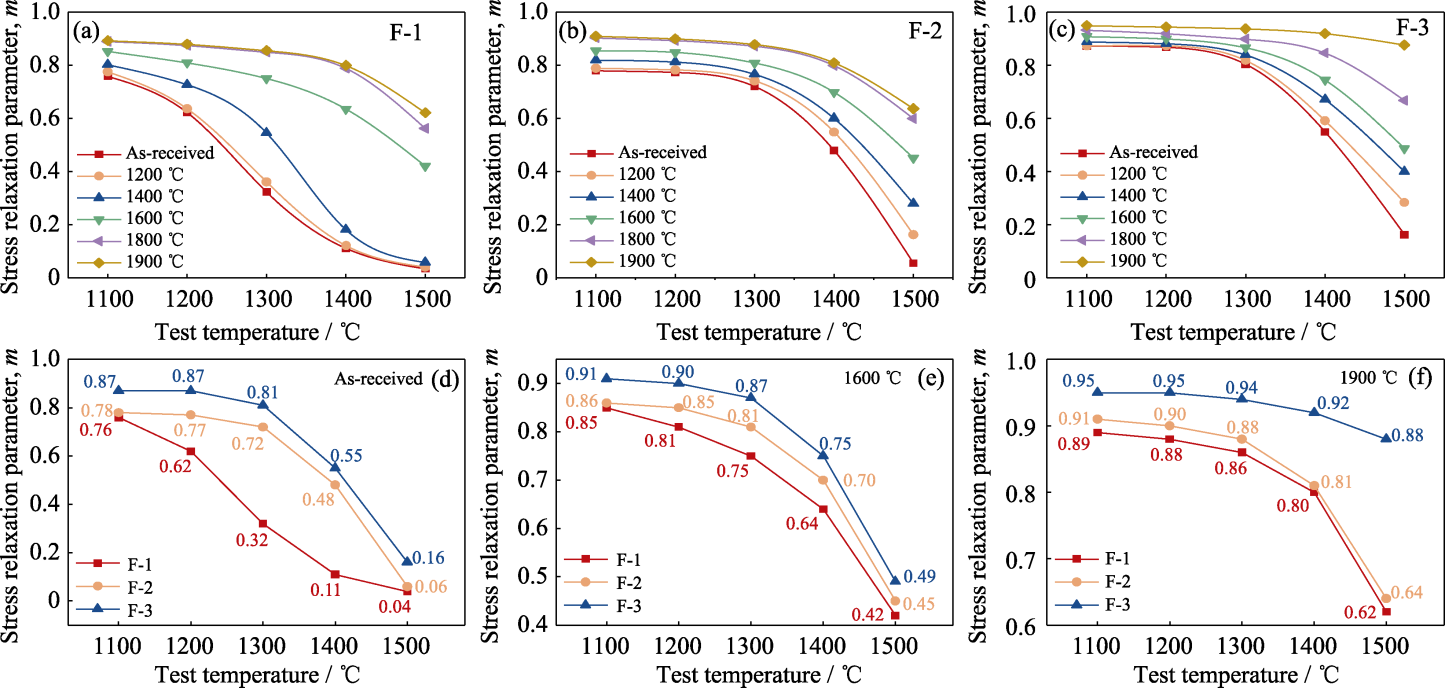
Fig. 2 (a-c) Variation of stress relaxation parameter (m) with BSR testing temperature for (a) F-1, (b) F-2 and (c) F-3 fibers after being annealed at different temperatures for 1 h; (d-f) Comparison of m values of (d) as-received three SiC fibers, and the three SiC fibers after heat treatment at (e) 1600 and (f) 1900 ℃ for 1 h
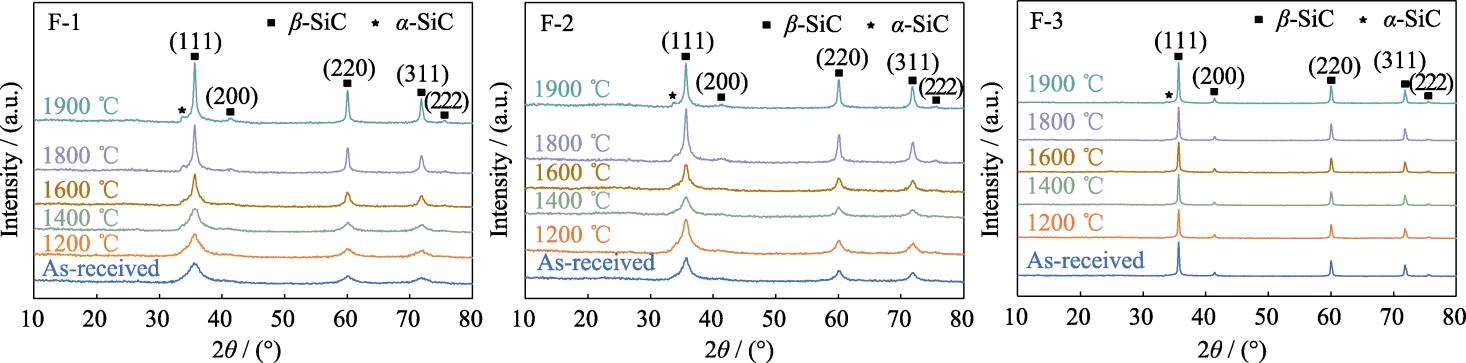
Fig. 3 XRD patterns of SiC fibers after being annealed at different temperatures for 1 h
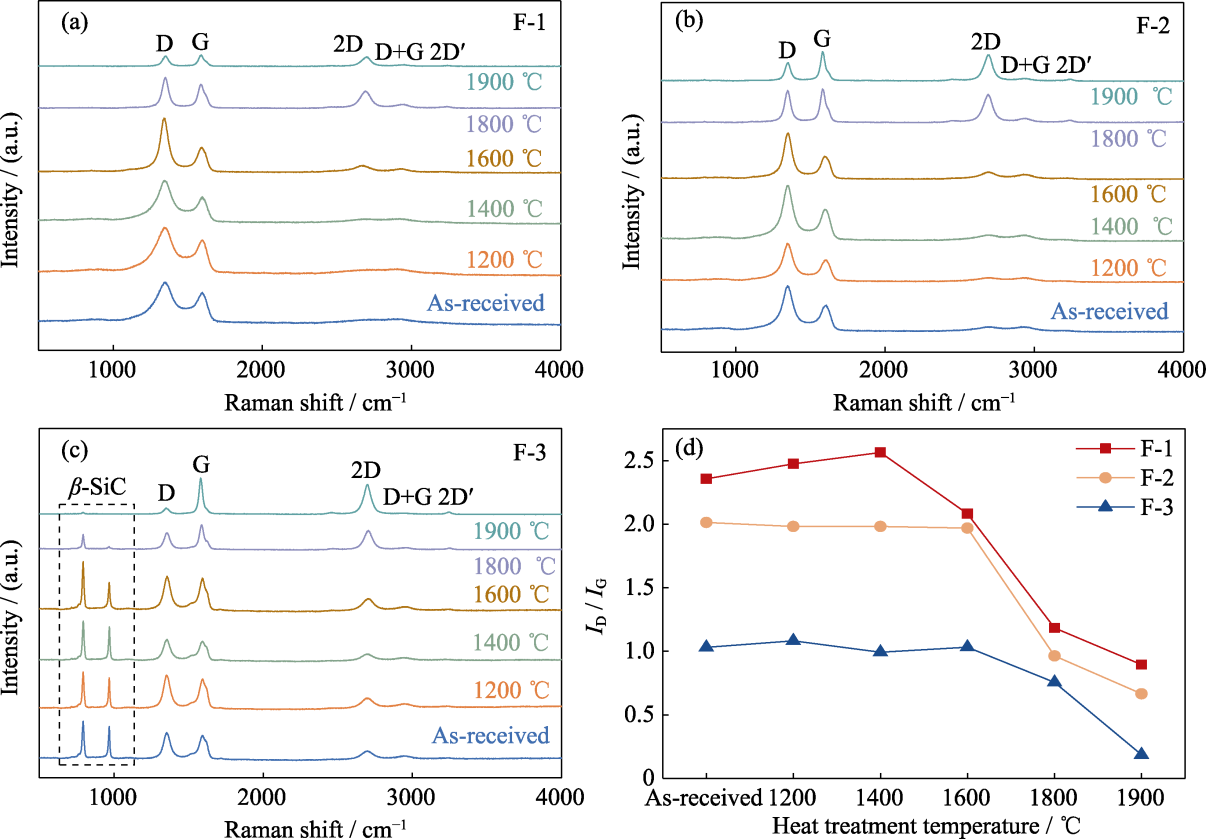
Fig. 4 (a-c) Raman spectra of (a) F-1, (b) F-2 and (c) F-3 fibers after being annealed at different temperatures; (d) ID/IG values
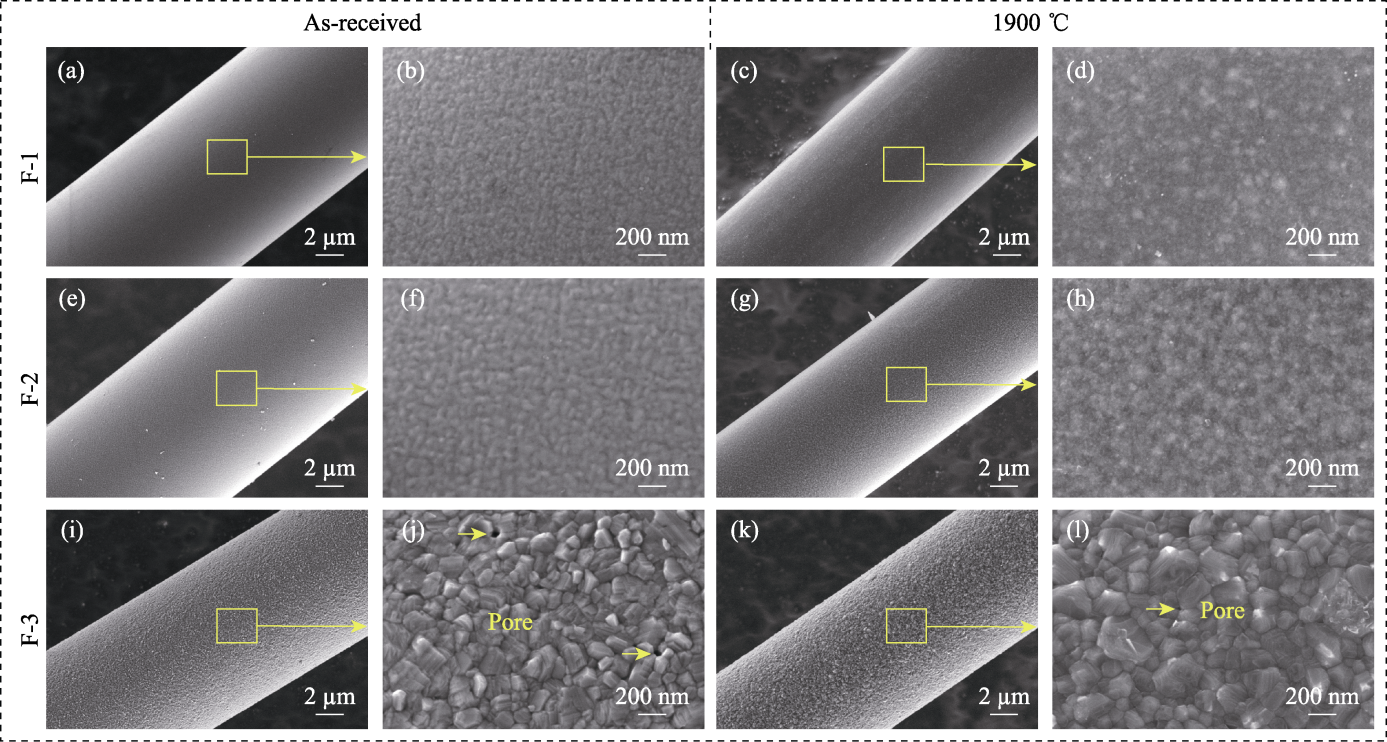
Fig. 5 SEM images of surfaces of (a-d) F-1, (e-h) F-2 and (i-l) F-3 fibers before and after heat treatment at 1900 ℃ for 1 h
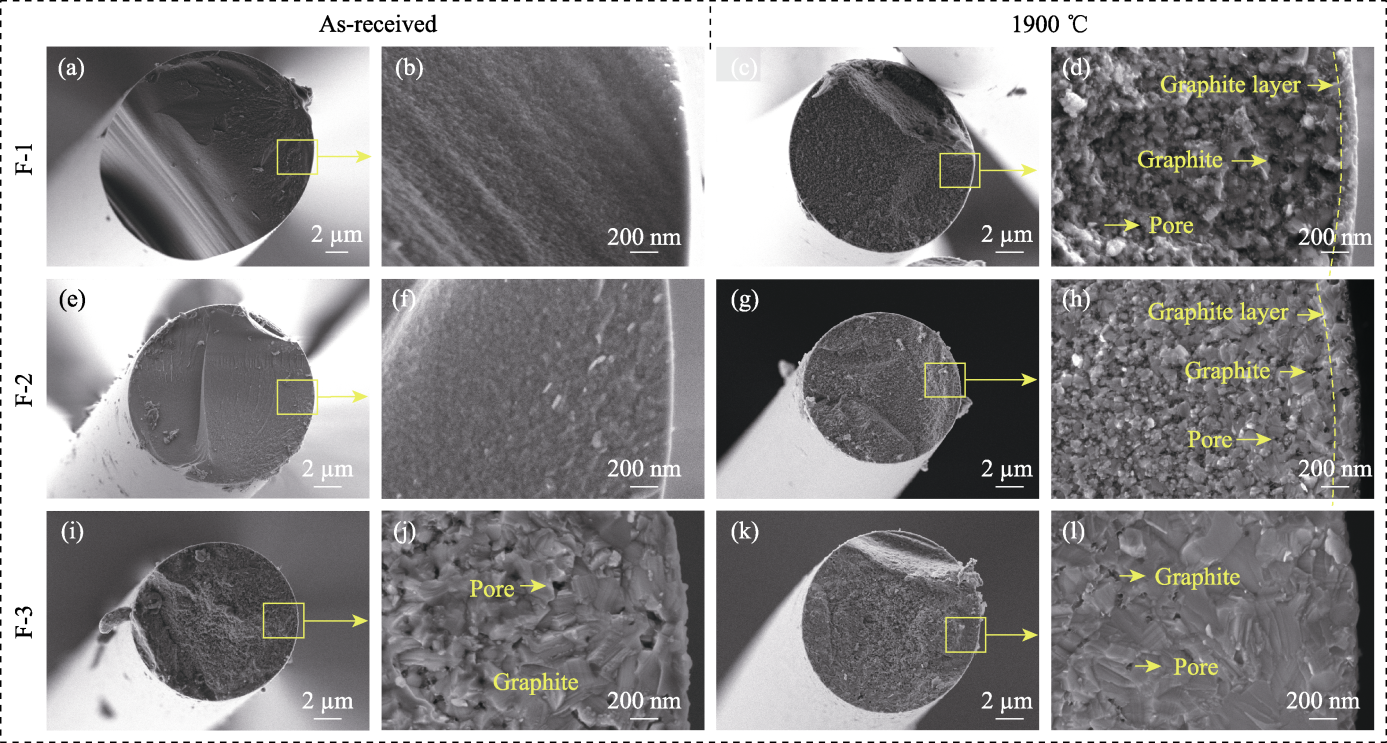
Fig. 6 SEM images of cross-sections of (a-d) F-1, (e-h) F-2 and (i-l) F-3 fibers before and after heat treatment at 1900 ℃ for 1 h
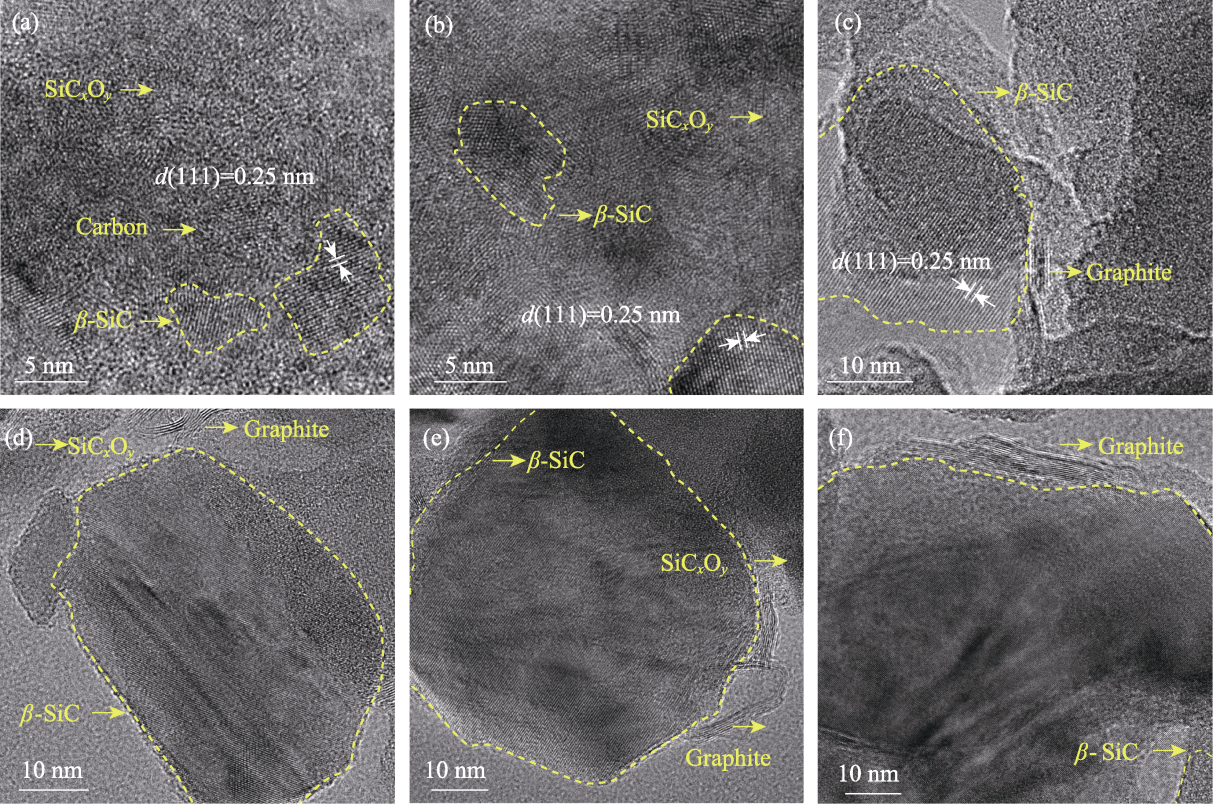
Fig. 7 HRTEM images of (a, d) F-1, (b, e) F-2 and (c, f) F-3 fibers (a-c) before and (d-f) after heat treatment at 1900 ℃ for 1 h
| Fiber | Heat treatment temperature/℃ | Growth rate of m value after BSR test/% | ||||
|---|---|---|---|---|---|---|
| 1100 ℃ | 1200 ℃ | 1300 ℃ | 1400 ℃ | 1500 ℃ | ||
| F-1 | 1200 | 2.2 | 2.2 | 11.7 | 8.9 | 17.1 |
| 1400 | 5.8 | 16.9 | 68.5 | 62.5 | 68.6 | |
| 1600 | 12.4 | 30.0 | 131.8 | 467.9 | 1102.9 | |
| 1800 | 17.3 | 40.4 | 162.3 | 604.5 | 1508.6 | |
| 1900 | 17.7 | 41.3 | 164.2 | 614.3 | 1677.1 | |
| F-2 | 1200 | 1.2 | 1.2 | 2.9 | 14.4 | 191.1 |
| 1400 | 5.1 | 5.0 | 6.4 | 25.2 | 400.0 | |
| 1600 | 9.6 | 9.7 | 12.2 | 45.6 | 707.1 | |
| 1800 | 15.9 | 15.5 | 21.1 | 66.7 | 971.4 | |
| 1900 | 16.7 | 16.3 | 21.9 | 68.8 | 1037.5 | |
| F-3 | 1200 | 0.1 | 0.6 | 1.7 | 7.6 | 74.2 |
| 1400 | 1.8 | 1.5 | 4.3 | 22.2 | 145.4 | |
| 1600 | 4.1 | 3.6 | 7.7 | 35.5 | 198.8 | |
| 1800 | 6.9 | 5.9 | 11.7 | 54.0 | 309.8 | |
| 1900 | 8.8 | 8.7 | 16.5 | 67.3 | 438.0 | |
Table S1 Growth rates of m values for heat-treated SiC fibers relative to as-received fibers after BSR test at different temperatures
| Fiber | Heat treatment temperature/℃ | Growth rate of m value after BSR test/% | ||||
|---|---|---|---|---|---|---|
| 1100 ℃ | 1200 ℃ | 1300 ℃ | 1400 ℃ | 1500 ℃ | ||
| F-1 | 1200 | 2.2 | 2.2 | 11.7 | 8.9 | 17.1 |
| 1400 | 5.8 | 16.9 | 68.5 | 62.5 | 68.6 | |
| 1600 | 12.4 | 30.0 | 131.8 | 467.9 | 1102.9 | |
| 1800 | 17.3 | 40.4 | 162.3 | 604.5 | 1508.6 | |
| 1900 | 17.7 | 41.3 | 164.2 | 614.3 | 1677.1 | |
| F-2 | 1200 | 1.2 | 1.2 | 2.9 | 14.4 | 191.1 |
| 1400 | 5.1 | 5.0 | 6.4 | 25.2 | 400.0 | |
| 1600 | 9.6 | 9.7 | 12.2 | 45.6 | 707.1 | |
| 1800 | 15.9 | 15.5 | 21.1 | 66.7 | 971.4 | |
| 1900 | 16.7 | 16.3 | 21.9 | 68.8 | 1037.5 | |
| F-3 | 1200 | 0.1 | 0.6 | 1.7 | 7.6 | 74.2 |
| 1400 | 1.8 | 1.5 | 4.3 | 22.2 | 145.4 | |
| 1600 | 4.1 | 3.6 | 7.7 | 35.5 | 198.8 | |
| 1800 | 6.9 | 5.9 | 11.7 | 54.0 | 309.8 | |
| 1900 | 8.8 | 8.7 | 16.5 | 67.3 | 438.0 | |
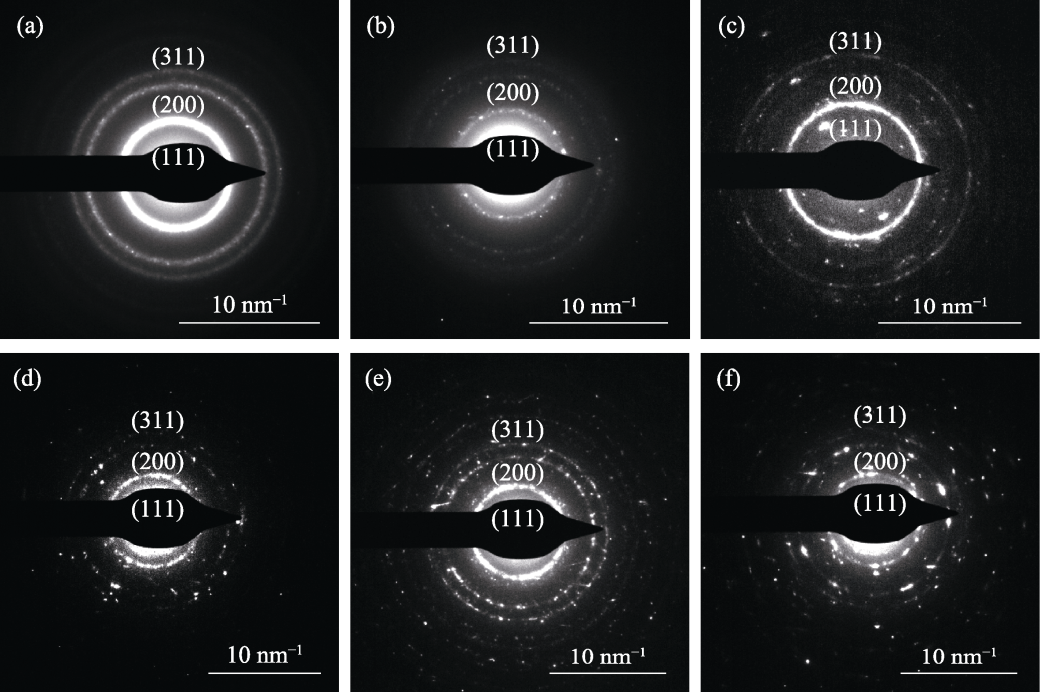
Fig. S1 SAED patterns of (a, d) F-1, (b, e) F-2 and (c, f) F-3 fibers (a-c) before and (d-f) after heat treatment at 1900 ℃ for 1 h
| [1] |
IVEKOVIĆ A, NOVAK S, DRAŽIĆ G, et al. Current status and prospects of SiCf/SiC for fusion structural applications. Journal of the European Ceramic Society, 2013, 33(10): 1577.
DOI URL |
| [2] |
PADTURE N P. Advanced structural ceramics in aerospace propulsion. Nature Materials, 2016, 15(8): 804.
DOI PMID |
| [3] | WANG P R, LIU F Q, WANG H, et al. A review of third generation SiC fibers and SiCf/SiC composites. Journal of Materials Science & Technology, 2019, 35(12): 2743. |
| [4] |
KATOH Y, SNEAD L L, HENAGER C H, et al. Current status and recent research achievements in SiC/SiC composites. Journal of Nuclear Materials, 2014, 455(1/2/3): 387.
DOI URL |
| [5] |
SONG J P, JIAO J, LIU H, et al. Effect of surface state of SiC fibers on their interfacial properties. Composites Communications, 2025, 53: 102232.
DOI URL |
| [6] |
SANTORO U, NOVITSKAYA E, KARANDIKAR K, et al. Phase stability of SiC/SiC fiber reinforced composites: the effect of processing on the formation of α and β phases. Materials Letters, 2019, 241: 123.
DOI URL |
| [7] |
SHI X G, LI M Y, MA W G, et al. Experimental study on thermal transport property of KD-Ⅱ SiC fiber. Journal of Inorganic Materials, 2018, 33(7): 756.
DOI URL |
| [8] |
DONG S M, KATOH Y, KOHYAMA A. Processing optimization and mechanical evaluation of hot pressed 2D Tyranno-SA/SiC composites. Journal of the European Ceramic Society, 2003, 23(8): 1223.
DOI URL |
| [9] |
BHATT R T, HALBIG M C. Creep properties of melt infiltrated SiC/SiC composites with Sylramic™-iBN and Hi-Nicalon™-S fibers. International Journal of Applied Ceramic Technology, 2022, 19(2): 1074.
DOI URL |
| [10] |
HUGUET-GARCIA J, JANKOWIAK A, MIRO S, et al. In situ characterization of ion-irradiation enhanced creep of third generation Tyranno SA 3 SiC fibers. Journal of Materials Research, 2015, 30(9): 1572.
DOI URL |
| [11] |
HOLMES J W, PARK Y H, JONES J W. Tensile creep and creep- recovery behavior of a SiC-fiber-Si3N4-matrix composite. Journal of the American Ceramic Society, 1993, 76(5): 1281.
DOI URL |
| [12] |
LAMOUROUX F, VALLÉS J L, STEEN M. Uniaxial tensile and creep behaviour of an alumina fibre-reinforced ceramic matrix composite: Ⅱ. Modelling of tertiary creep. Journal of the European Ceramic Society, 1994, 14(6): 539.
DOI URL |
| [13] |
ALMANSOUR A S, MORSCHER G N. Tensile creep behavior of SiCf/SiC ceramic matrix minicomposites. Journal of the European Ceramic Society, 2020, 40(15): 5132.
DOI URL |
| [14] |
YAJIMA S, OKAMURA K, HAYASHI J, et al. Synthesis of continuous sic fibers with high tensile strength. Journal of the American Ceramic Society, 1976, 59(7/8): 324.
DOI URL |
| [15] |
BODET R, LAMON J, JIA N Y, et al. Microstructural stability and creep behavior of Si-C-O (nicalon) fibers in carbon monoxide and argon environments. Journal of the American Ceramic Society, 1996, 79(10): 2673.
DOI URL |
| [16] |
VAHLAS C, MONTHIOUX M. On the thermal degradation of lox-M tyranno® fibres. Journal of the European Ceramic Society, 1995, 15(5): 445.
DOI URL |
| [17] |
WILSON M, OPILA E. A review of SiC fiber oxidation with a new study of Hi-Nicalon SiC fiber oxidation. Advanced Engineering Materials, 2016, 18(10): 1698.
DOI URL |
| [18] |
YOUNGBLOOD G E, LEWINSOHN C, JONES R H, et al. Tensile strength and fracture surface characterization of Hi-Nicalon™ SiC fibers. Journal of Nuclear Materials, 2001, 289(1/2): 1.
DOI URL |
| [19] |
TAKEDA M, SAEKI A, SAKAMOTO J I, et al. Effect of hydrogen atmosphere on pyrolysis of cured polycarbosilane fibers. Journal of the American Ceramic Society, 2000, 83(5): 1063.
DOI URL |
| [20] | TAKEDA M, SAKAMOTO J, IMAI Y, et al. Properties of stoichiometric silicon carbide fiber derived from polycarbosilane// WACHTMAN J B. Proceedings of the 18th annual conference on composites and advanced ceramic materials—A:ceramic engineering and science proceedings. Hoboken: John Wiley & Sons, Inc., 1994. |
| [21] |
BUNSELL A R, PIANT A. A review of the development of three generations of small diameter silicon carbide fibres. Journal of Materials Science, 2006, 41(3): 823.
DOI URL |
| [22] |
ISHIKAWA T, KOHTOKU Y, KUMAGAWA K, et al. High-strength alkali-resistant sintered SiC fibre stable to 2200 ℃. Nature, 1998, 391(6669): 773.
DOI |
| [23] |
GOU Y Z, WANG H, JIAN K, et al. Preparation and characterization of SiC fibers with diverse electrical resistivity through pyrolysis under reactive atmospheres. Journal of the European Ceramic Society, 2017, 37(2): 517.
DOI URL |
| [24] |
MORSCHER G N, DICARLO J A. A simple test for thermomechanical evaluation of ceramic fibers. Journal of the American Ceramic Society, 1992, 75(1): 136.
DOI URL |
| [25] |
SHA J J, PARK J S, HINOKI T, et al. Heat treatment effects on creep behavior of polycrystalline SiC fibers. Materials Characterization, 2006, 57(1): 6.
DOI URL |
| [26] |
SHA J J, PARK J S, HINOKI T, et al. Bend stress relaxation of advanced SiC-based fibers and its prediction to tensile creep. Mechanics of Materials, 2007, 39(2): 175.
DOI URL |
| [27] | GAN Y. The regulation of microscopic composition and microstructure of KD-S silicon carbide fibers and the research on these high-temperature creep resistance. Changsha: A Master’s dissertation in National University of Defense Technology, 2018. |
| [28] | SHA J J, NOZAWA T, PARK J S, et al. Effect of heat treatment on the tensile strength and creep resistance of advanced SiC fibers. Journal of Nuclear Materials, 2004, 329: 592. |
| [29] |
YUAN W, HU J B, ZHOU L, et al. Effect of argon atmosphere heat treatment on mechanical properties and microstructural evolution of Shicolon-II SiC fibers. Journal of Inorganic Materials, 2026, 41(1): 119.
DOI URL |
| [30] |
GOU Y Z, JIAN K, WANG H, et al. Fabrication of nearly stoichiometric polycrystalline SiC fibers with excellent high-temperature stability up to 1900 ℃. Journal of the American Ceramic Society, 2018, 101(5): 2050.
DOI URL |
| [31] |
WU S, GOU Y Z, XIANG Y, et al. Effect of long-time annealing at high temperature on the microstructure and mechanical properties of different types of SiC fibers. Composites Part A: Applied Science and Manufacturing, 2024, 185: 108291.
DOI URL |
| [32] |
ZHANG Y, CHEN T X, CHEN J H, et al. The effects of annealing atmosphere and intrinsic component on high temperature evolution behaviors of SiC fibers. Materials Science and Engineering: A, 2022, 848: 143363.
DOI URL |
| [33] |
WU S, GOU Y Z, WANG Y S, et al. Effect of heat treatment on composition, microstructure and mechanical property of domestic KD-SA SiC fibers. Journal of Inorganic Materials, 2023, 38(5): 569.
DOI |
| [34] |
ICHIKAWA H. Polymer-derived ceramic fibers. Annual Review of Materials Research, 2016, 46: 335.
DOI URL |
| [35] |
SHA J J, HINOKI T, KOHYAMA A. Microstructural characterization and fracture properties of SiC-based fibers annealed at elevated temperatures. Journal of Materials Science, 2007, 42(13): 5046.
DOI URL |
| [36] |
USUKAWA R, ISHIKAWA T. Effect of Al contained in polymer- derived SiC crystals on creating stable crystal grain boundaries. International Journal of Applied Ceramic Technology, 2021, 18(1): 6.
DOI URL |
| [37] |
ZHANG Y, WU C L, WANG Y D, et al. A detailed study of the microstructure and thermal stability of typical SiC fibers. Materials Characterization, 2018, 146: 91.
DOI URL |
| [38] |
ZHANG Y, CHEN J H, YAN D X, et al. Conversion of silicon carbide fibers to continuous graphene fibers by vacuum annealing. Carbon, 2021, 182: 435.
DOI URL |
| [39] | CHEN J, ZHAO Z Q, WU S, et al. Relationship of defects and mechanical performance of high-crystalline SiC fibers after ultra-high-temperature annealing. Journal of the American Ceramic Society, 2025, 108(12): e20540. |
| [1] | ZHOU Cui, LI Jie, SUN Luchao, SU Haijun, WANG Jingyang. Alumina-based Directionally Solidified Eutectic Ceramics: Microstructure, Control Strategies and Environmental Stability [J]. Journal of Inorganic Materials, 2026, 41(7): 899-914. |
| [2] | ZHAO Tongtong, DAI Jixiang, SU Cheng, SHI Yan, SHA Jianjun. Microstructure and Ablation Resistance of C/C Composites Modified by Hf-Si-based Coating-matrix Integrated Structure Fabricated by Reactive Melt Infiltration [J]. Journal of Inorganic Materials, 2026, 41(5): 583-594. |
| [3] | YUAN Wang, HU Jianbao, ZHOU Liang, KAN Yanmei, ZHANG Xiangyu, DONG Shaoming. Effect of Argon Atmosphere Heat Treatment on Mechanical Properties and Microstructural Evolution of Shicolon-II SiC Fibers [J]. Journal of Inorganic Materials, 2026, 41(1): 119-128. |
| [4] | HAN Weiwei, HUANG Dong, LI Tingsong, LI Jiang. Sm:LuAG/Nd:LuAG Composite Laser Ceramics with Cladding Structure: Fabrication and Properties [J]. Journal of Inorganic Materials, 2026, 41(1): 113-118. |
| [5] | CHEN Bin, REN Ke, WANG Yiguang. Evolution of Mechanical Properties of Mini-SiCf/SiC Composites at High Temperatures over a Long Period of Time [J]. Journal of Inorganic Materials, 2025, 40(9): 971-980. |
| [6] | ZHONG Weimin, ZHAO Ke, WANG Kewei, LIU Dianguang, LIU Jinling, AN Linan. Effect of Oscillatory Pressure Amplitude on Microstructures and Wear Resistance of Tungsten Carbide [J]. Journal of Inorganic Materials, 2025, 40(9): 964-970. |
| [7] | GOU Yanzi, KANG Weifeng, WANG Pengren. Influence of Sintering Conditions on Preparation of Nearly Stoichiometric SiC Fibers with Highly Crystalline Microstructure [J]. Journal of Inorganic Materials, 2025, 40(4): 405-414. |
| [8] | MU Haojie, ZHANG Yuanjiang, YU Bin, FU Xiumei, ZHOU Shibin, LI Xiaodong. Preparation and Properties of ZrO2 Doped Y2O3-MgO Nanocomposite Ceramics [J]. Journal of Inorganic Materials, 2025, 40(3): 281-289. |
| [9] | LI Wei, XU Zhiming, GOU Yanzi, YIN Senhu, YU Yiping, WANG Song. Preparation and Performance of Sintered SiC Fiber-bonded Ceramics [J]. Journal of Inorganic Materials, 2025, 40(2): 177-183. |
| [10] | ZHENG Yuanshun, YU Jian, YE Xianfeng, LIANG Dong, ZHU Wanting, NIE Xiaolei, WEI Ping, ZHAO Wenyu, ZHANG Qingjie. Boosting the Thermoelectric Performance of Full-Heusler Fe2VAl Alloy via Substituting Al Site with V [J]. Journal of Inorganic Materials, 2025, 40(12): 1425-1432. |
| [11] | CAO Luhan, MENG Jia, XUE Yudong, SHENG Xiaochen, CUI Yuanyuan, LE Jun, SONG Lixin. Effect of SiC Transition Layer on Bonding Properties of MoSi2-SABB Coating on SiC/SiC Ceramic Matrix Composites [J]. Journal of Inorganic Materials, 2025, 40(10): 1119-1128. |
| [12] | FAN Wugang, CAO Xiong, ZHOU Xiang, LI Ling, ZHAO Guannan, ZHANG Zhaoquan. Anticorrosion Performance of 8YSZ Ceramics in Simulated Aqueous Environment of Pressurized Water Reactor [J]. Journal of Inorganic Materials, 2024, 39(7): 803-809. |
| [13] | CHEN Qian, SU Haijun, JIANG Hao, SHEN Zhonglin, YU Minghui, ZHANG Zhuo. Progress of Ultra-high Temperature Oxide Ceramics: Laser Additive Manufacturing and Microstructure Evolution [J]. Journal of Inorganic Materials, 2024, 39(7): 741-753. |
| [14] | JIANG Lingyi, PANG Shengyang, YANG Chao, ZHANG Yue, HU Chenglong, TANG Sufang. Preparation and Oxidation Behaviors of C/SiC-BN Composites [J]. Journal of Inorganic Materials, 2024, 39(7): 779-786. |
| [15] | ZHAO Rida, TANG Sufang. Research Progress of Ceramic Matrix Composites Prepared by Improved Reactive Melt Infiltration through Ceramization of Porous Carbon Matrix [J]. Journal of Inorganic Materials, 2024, 39(6): 623-633. |
| Viewed | ||||||
|
Full text |
|
|||||
|
Abstract |
|
|||||
