
Journal of Inorganic Materials ›› 2026, Vol. 41 ›› Issue (5): 673-680.DOI: 10.15541/jim20250442
DONG Langping1( ), LI Shixuan1, YANG Shaoxing1, HOU Jingshan1, LIN Yandan4, ZHOU Pengcheng5, SUN Xuejiao3, SUN Yiyang3(), CHEN Daqin2, FANG Yongzheng1()
Received:2025-11-01
Revised:2025-12-06
Published:2026-05-20
Online:2025-12-19
Contact:
SUN Yiyang, professor. E-mail: yysun@mail.sic.ac.cn;About author:DONG Langping (1993-), female, associate professor. E-mail: lpdong@sit.edu.cn
Supported by:CLC Number:
DONG Langping, LI Shixuan, YANG Shaoxing, HOU Jingshan, LIN Yandan, ZHOU Pengcheng, SUN Xuejiao, SUN Yiyang, CHEN Daqin, FANG Yongzheng. Anomalous Fluorescence Thermal Quenching in a Red-emitting RbZnF3:Eu3+ Phosphor under Violet Excitation[J]. Journal of Inorganic Materials, 2026, 41(5): 673-680.
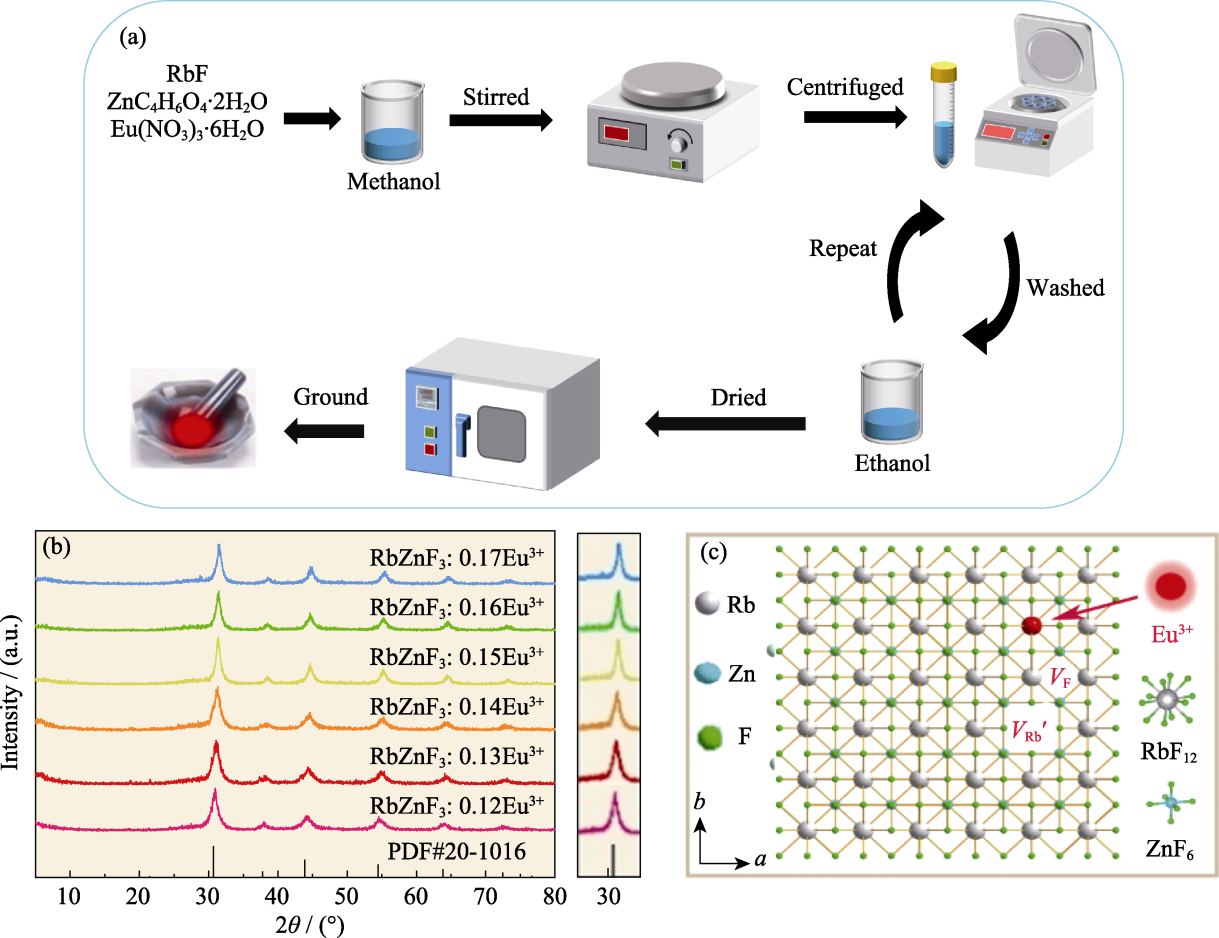
Fig. 1 Synthesis, phase identification and crystal structure of the RbZnF3:0.13Eu3+ phosphor (a) Schematic diagram of the synthesis process; (b) XRD patterns and enlarged areas at 2θ=25°-35° of the synthesized RbZnF3:xEu3+; (c) Schematic diagram of crystal structure and cation coordination of RbZnF3 matrix
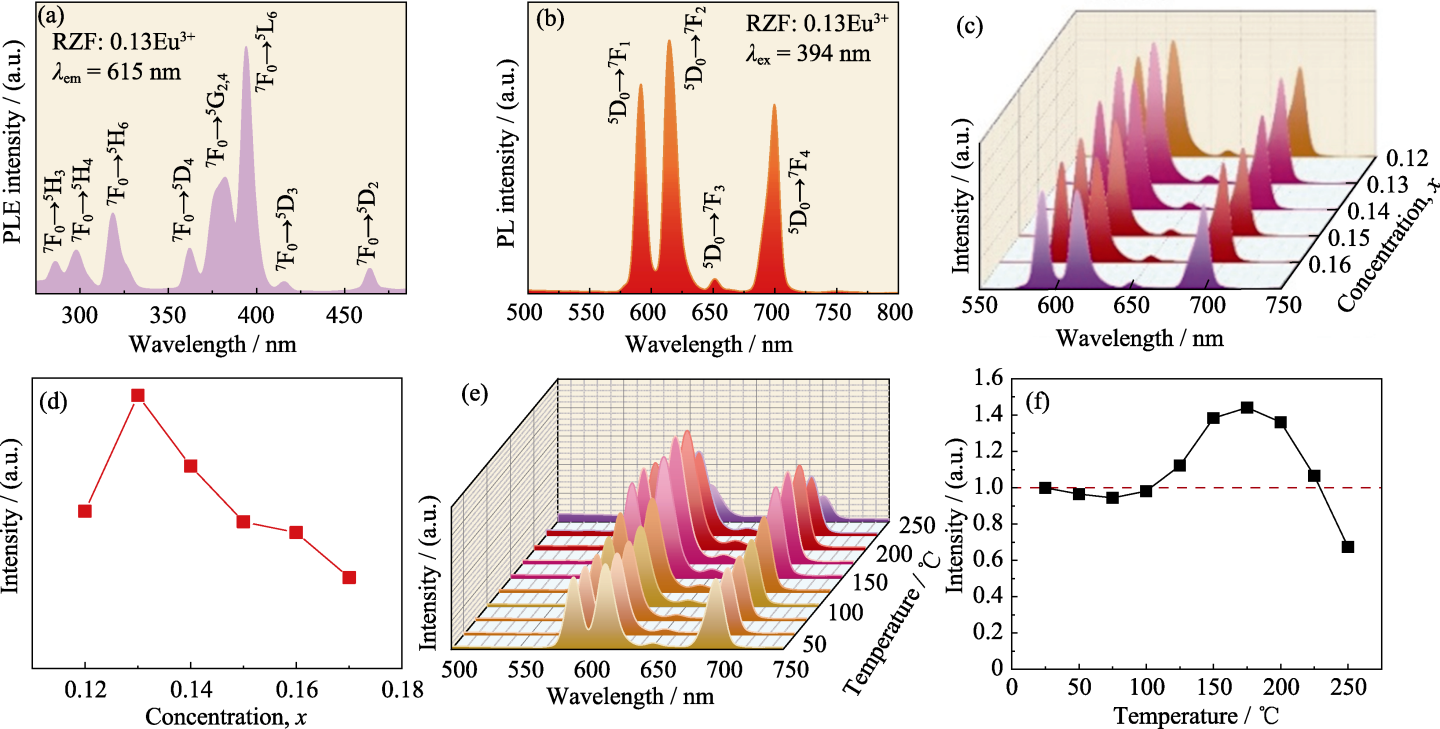
Fig. 2 Photoluminescence, concentration quenching and thermal quenching behavior of RbZnF3:0.13Eu3+ (a) Excitation and (b) emission spectra of RbZnF3:0.13Eu3+; (c) Emission spectra of RbZnF3:xEu3+ samples; (d) Relationship between concentration x and luminescence intensity; (e) Temperature-dependent emission spectra of RbZnF3:0.13Eu3+ sample; (f) Evolution trend of luminescence intensity with increasing temperature
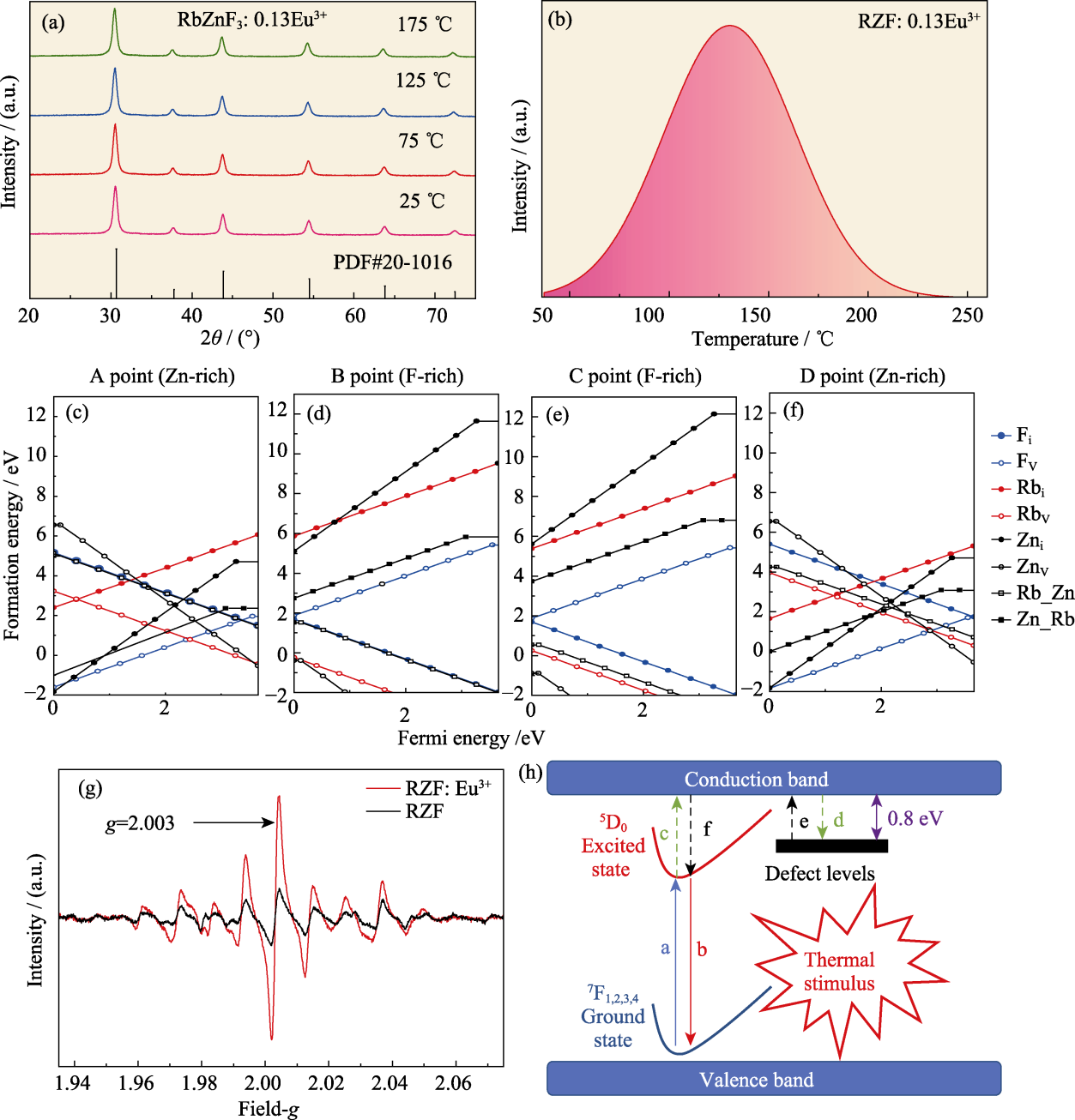
Fig. 3 Investigation of the anti-thermal quenching performance and mechanism in RbZnF3:0.13Eu3+ phosphor (a) Temperature-dependent XRD patterns of RbZnF3:0.13Eu3+ sample; (b) Thermoluminescence curve of RbZnF3:0.13Eu3+ sample at different temperatures; (c-f) Defect forming energy of various defects when the chemical composition is (c) A, (b) B, (c) C, and (d) D points; (g) EPR spectra for RZF and RZF:Eu3+; (h) Schematic illustration of the mechanism for the anti-thermal quenching in RZF:0.13Eu3+ phosphor. Colorful figures are available on website
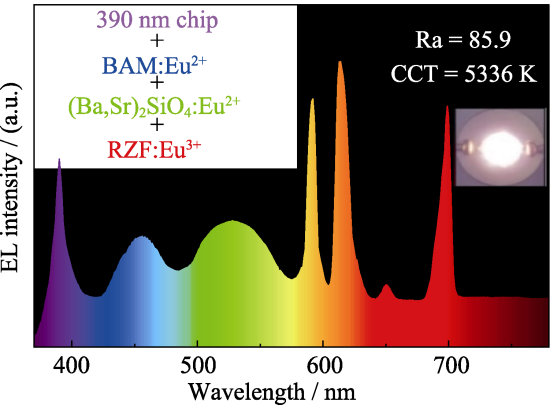
Fig. 4 Electroluminescence spectrum of WLED produced by 390 nm violet LED chip combining BAM:Eu2+ blue phosphor, (Ba, Sr)2SiO4:Eu2+ green phosphor and prepared RZF:0.13Eu3+ red phosphor Inset: a photo of the fabricated WLED when it is powered on
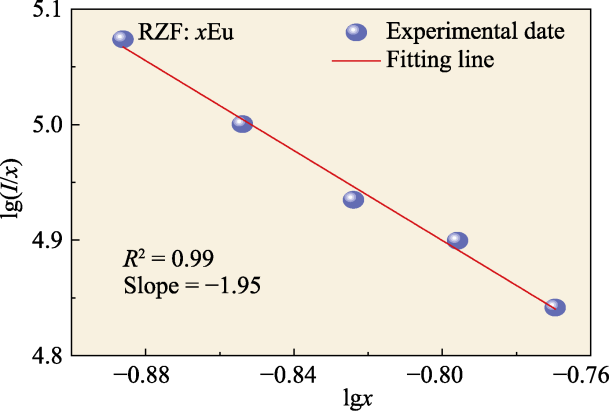
Fig. S1 Relationship of lg(I/x) versus lgx
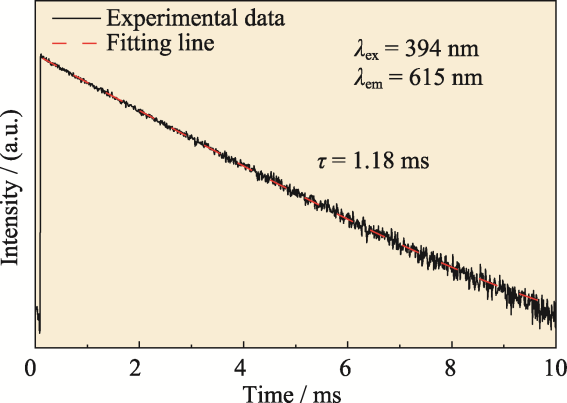
Fig. S2 Decay curve of RbZnF3:0.13Eu3+
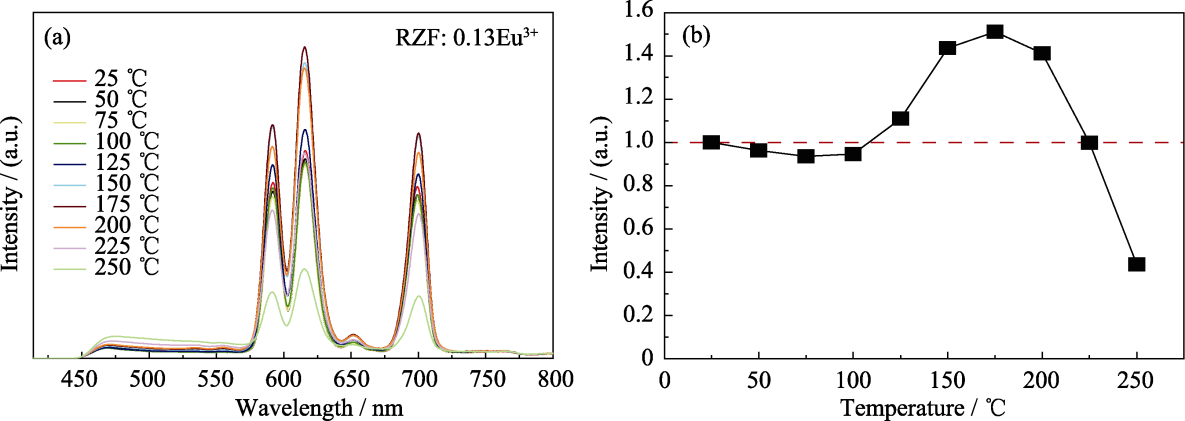
Fig. S3 Repeated testing of the thermal quenching process in RbZnF3:0.13Eu3+ (a) Thermal-dependent emission spectra of RbZnF3:0.13Eu3+; (b) Evolution of the luminescence intensity as a function of temperature during repeated testing
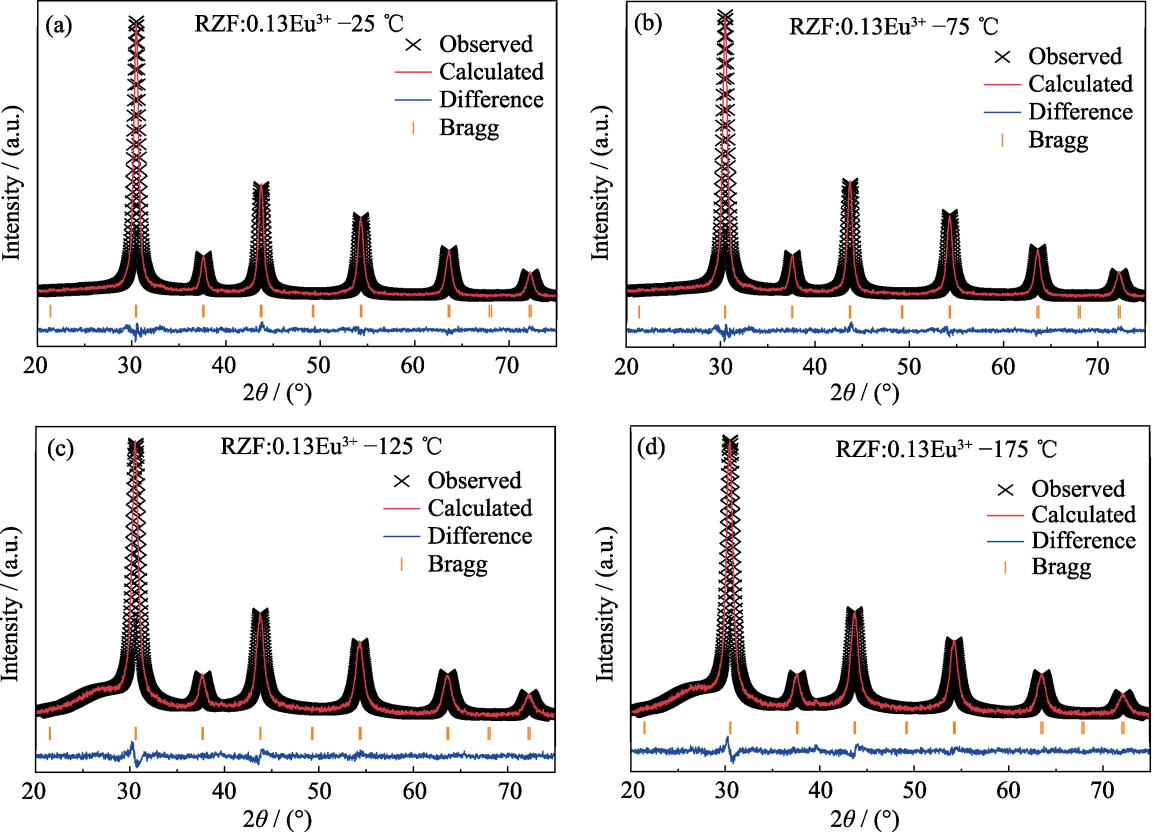
Fig. S4 Rietveld refinement patterns of RbZnF3:0.13Eu3+ sample at different temperatures
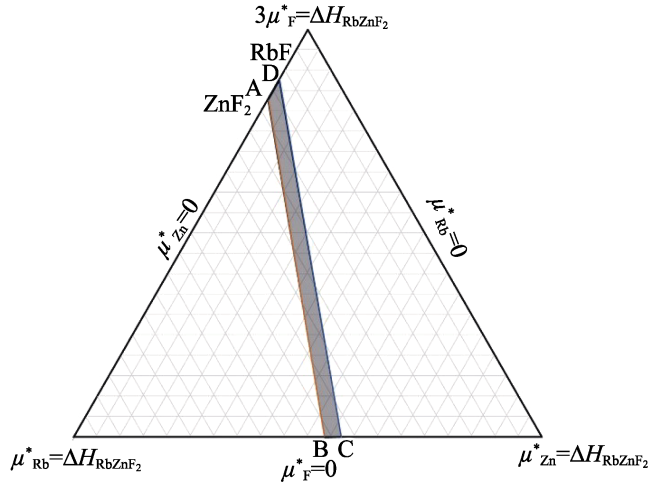
Fig. S5 Chemical potential and potential chemical composition distribution A and D are extreme composition points rich in Zn, while B and C are extreme composition points rich in F. RbZnF3 can only form within a closed area composed of points A, B, C, and D
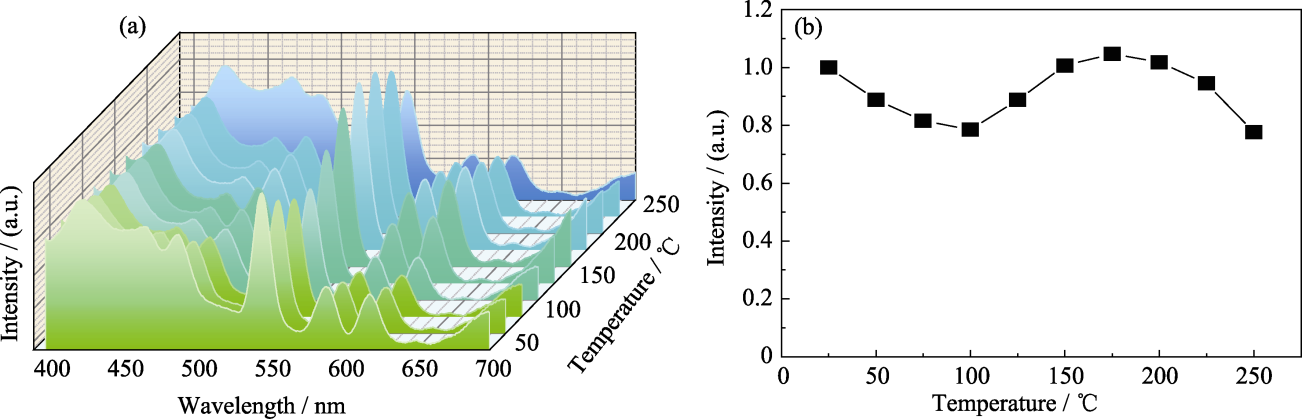
Fig. S6 Evaluation of the thermal quenching behavior in RbZnF3:Tb3+ (a) Temperature-dependent emission spectra of RbZnF3:Tb3+ sample; (b) Evolution trend of luminescence intensity with increasing temperature
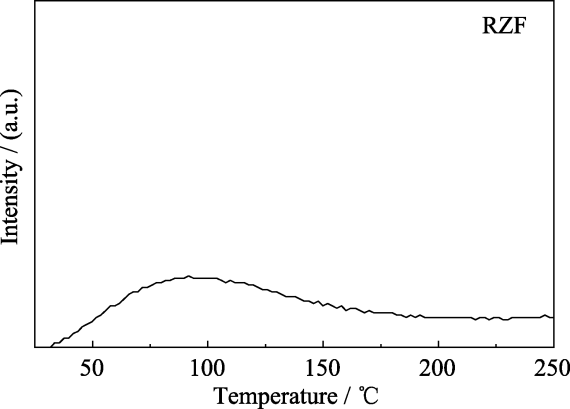
Fig. S7 TL curve of RbZnF3 matrix at different temperatures
| Temperature | 25 ℃ | 75 ℃ | 125 ℃ | 175 ℃ |
|---|---|---|---|---|
| Space group | Pm3m(221)-Cubic | |||
| a/Å | 4.1329 | 4.1330 | 4.1369 | 4.1406 |
| α/(º) | 90 | 90 | 90 | 90 |
| V/Å3 | 70.5935 | 70.6140 | 70.7987 | 70.9880 |
| Rwp | 2.67% | 2.69% | 2.29% | 2.33% |
| Rp | 2.11% | 2.13% | 1.86% | 1.89% |
Table S1 Variation of cell parameter of RbZnF3:0.13Eu3+ sample with the increase of temperature
| Temperature | 25 ℃ | 75 ℃ | 125 ℃ | 175 ℃ |
|---|---|---|---|---|
| Space group | Pm3m(221)-Cubic | |||
| a/Å | 4.1329 | 4.1330 | 4.1369 | 4.1406 |
| α/(º) | 90 | 90 | 90 | 90 |
| V/Å3 | 70.5935 | 70.6140 | 70.7987 | 70.9880 |
| Rwp | 2.67% | 2.69% | 2.29% | 2.33% |
| Rp | 2.11% | 2.13% | 1.86% | 1.89% |
| [3] | YUAN W, PANG R, WANG S, et al. Enhanced blue-light excited cyan-emitting persistent luminescence of BaLu2Al2Ga2SiO12:Ce3+, Bi3+ phosphors for AC-LEDs via defect modulation. Light: Science & Applications, 2022, 11: 184. |
| [4] | DONG L, ZHANG L, JIA Y, et al. Enhancing luminescence and controlling the Mn valence state of Gd3Ga5-x-δAlx-y+δO12:yMn phosphors by the design of the garnet structure. ACS Applied Materials & Interfaces, 2020, 12: 7334. |
| [5] | DONG L, ZHANG L, JIA Y, et al. Site occupation and luminescence of novel orange-red Ca3M2Ge3O12:Mn2+, Mn4+ (M = Al, Ga) phosphors. ACS Sustainable Chemistry & Engineering, 2020, 8: 3357. |
| [6] |
PAN X, MEI L, ZHUANG Y, et al. Anti-defect engineering toward high luminescent efficiency in whitlockite phosphors. Chemical Engineering Journal, 2022, 434: 134652.
DOI URL |
| [7] | DANG P, LI G, YUN X, et al. Thermally stable and highly efficient red-emitting Eu3+-doped Cs3GdGe3O9 phosphors for WLEDs: non-concentration quenching and negative thermal expansion. Light: Science & Applications, 2021, 10: 29. |
| [8] | SENDEN T, VAN DIJK-MOES R J A, MEIJERINK A. Quenching of the red Mn4+ luminescence in Mn4+-doped fluoride LED phosphors. Light: Science & Applications, 2018, 7: 8. |
| [9] | WEI Y, XING G, LIU K, et al. New strategy for designing orangish-red-emitting phosphor via oxygen-vacancy-induced electronic localization. Light: Science & Applications, 2019, 8: 15. |
| [10] |
DANG P, WANG W, LIAN H, et al. How to obtain anti- thermal-quenching inorganic luminescent materials for light- emitting diode applications. Advanced Optical Materials, 2022, 10: 2102287.
DOI URL |
| [11] |
LI H, CAI J, PANG R, et al. A strategy for developing thermal-quenching-resistant emission and super-long persistent luminescence in BaGa2O4:Bi3+. Journal of Materials Chemistry C, 2019, 7: 13088.
DOI URL |
| [12] |
WEI S, LYU Z, LU Z, et al. Moderate trap engineering for enhanced thermal stability and high efficiency in a Bi3+-doped phosphor. Chemistry of Materials, 2023, 35: 7125.
DOI URL |
| [13] | DAI P P, LI C, ZHANG X T, et al. A single Eu2+-activated high- color-rendering oxychloride white-light phosphor for white-light- emitting diodes. Light: Science & Applications, 2016, 5: e16024. |
| [14] |
QIAO J, NING L, MOLOKEEV M S, et al. Eu2+ site preferences in the mixed cation K2BaCa(PO4)2 and thermally stable luminescence. Journal of the American Chemical Society, 2018, 140: 9730.
DOI URL |
| [15] | PIAO S, WANG Y, ZHOU X, et al. Defect engineering in a Eu2+-doped β-Al2O3 structure blue phosphor and its controllable zero-thermal quenching luminescence. ACS Sustainable Chemistry & Engineering, 2021, 9: 7882. |
| [16] |
CHEN Y, YU B, GOU J, et al. Zero-thermal-quenching and photoluminescence tuning with the assistance of carriers from defect cluster traps. Journal of Materials Chemistry C, 2018, 6: 10687.
DOI URL |
| [17] |
FANG S, LANG T, HAN T, et al. Zero-thermal-quenching of Mn4+ far-red-emitting in LaAlO3 perovskite phosphor via energy compensation of electrons’ traps. Chemical Engineering Journal, 2020, 389: 124297.
DOI URL |
| [18] |
TYAGI N, KUMAR P S, NAGARAJAN R. Room temperature optical absorption and intrinsic photoluminescence in KZnF3. Chemical Physics Letters, 2010, 494: 284.
DOI URL |
| [19] |
WEI S, LI Z, LYU Z, et al. Energy transfer mediated single-phased white light emission in Bi3+-Eu3+ codoped Ba3YGa2O7.5 for WLED. Journal of Alloys and Compounds, 2022, 923: 166419.
DOI URL |
| [20] |
AN Z, LIU W, SONG Y, et al. Color-tunable Eu2+, Eu3+ co-doped Ca20Al26Mg3Si3O68 phosphor for w-LEDs. Journal of Materials Chemistry C, 2019, 7: 6978.
DOI URL |
| [21] |
LI R, CHEN Q, CUI R, et al. A novel high-brightness red phosphor Ca4Nb2O9:Eu3+ for WLEDs. Inorganic Chemistry Communications, 2024, 170: 113267.
DOI URL |
| [22] |
BLASSE G. Energy transfer in oxidic phosphors. Physics Letters A, 1968, 28: 444.
DOI URL |
| [23] |
TIAN Y, CHEN B, TIAN B, et al. Concentration-dependent luminescence and energy transfer of flower-like Y2(MoO4)3:Dy3+ phosphor. Journal of Alloys and Compounds, 2011, 509: 6096.
DOI URL |
| [24] | HUANG S, LOU L. Concentration dependence of sensitizer fluorescence intensity in energy transfer. Chinese Journal of Luminescence, 1990, 11: 1. |
| [25] |
LI J, LIU B, LIU G, et al. Red color Sr2NaMg2V3O12:Eu3+ phosphor with high thermal stability for w-LEDs. Journal of Rare Earths, 2023, 41: 1689.
DOI URL |
| [26] |
LI F, CUI R, YUAN G, et al. Preparation and characterization of a new orange-red phosphor Ba2LaTaO6:Eu3+ with abnormal thermal quenching. Journal of Rare Earths, 2023, 41: 1678.
DOI URL |
| [27] |
BAI Y, JIA Z, GAO J, et al. A novel red-emitting phosphor K2MgGeO4:Eu3+ for WLEDs: zero-thermal quenching induced by heterovalent substitution. Journal of Materials Chemistry C, 2022, 10: 15957.
DOI URL |
| [28] |
HA J, WANG Z, NOVITSKAYA E, et al. An integrated first principles and experimental investigation of the relationship between structural rigidity and quantum efficiency in phosphors for solid state lighting. Journal of Luminescence, 2016, 179: 297.
DOI URL |
| [29] |
LIU H, LIANG H, ZHANG W, et al. Improving the thermal stability and luminescent efficiency of (Ba,Sr)3SiO5:Eu2+ phosphors by structure, bandgap engineering and soft chemistry synthesis method. Chemical Engineering Journal, 2021, 410: 128367.
DOI URL |
| [30] |
SUN Z, SUN B, ZHANG X, et al. Superb thermal stability purple-blue phosphor through synergistic effect of emission compensation and nonradiative transition restriction of Eu2+. Materials Today Chemistry, 2022, 24: 100877.
DOI URL |
| [31] |
WANG Z, JIAO S, XU Y, et al. Effects of heat-treatment on photoluminescence properties of MgAl2O4:Eu3+ red phosphors synthesized by a solution combustion method. Journal of Luminescence, 2019, 211: 108.
DOI URL |
| [32] |
LI X, HE C, ZUO S, et al. Photocatalytic nitrogen fixation over fluoride/attapulgite nanocomposite: effect of upconversion and fluorine vacancy. Solar Energy, 2019, 191: 251.
DOI URL |
| [1] |
ZHONG C, XU Y, WU X, et al. High output power and high quantum efficiency in novel NIR phosphor MgAlGa0.7B0.3O4:Cr3+ with profound FWHM variation. Advanced Materials, 2024, 36: 2309500.
DOI URL |
| [2] |
KIM Y H, ARUNKUMAR P, KIM B Y, et al. A zero- thermal-quenching phosphor. Nature Materials, 2017, 16: 543.
DOI URL |
| [1] | SONG Kunjie, XIE Rongjun. Research Advances on Machine Learning-driven Development of Novel Luminescent Materials [J]. Journal of Inorganic Materials, 2026, 41(6): 689-703. |
| [2] | HU Yang, XIE Min, ZHANG Xiaoyi, LI Xiang, GUO Xinwei, JIANG Nan, ZHOU Wenhan, ZHANG Shengli, ZENG Haibo. Research Progress on Computational and Data-driven Environmental-friendly Luminescent Materials [J]. Journal of Inorganic Materials, 2026, 41(6): 704-722. |
| [3] | HONG Enliu, TU Xinchen, LI Ziqing, FANG Xiaosheng. Two-dimensional Perovskite Single Crystal Nanosheets: Floating Growth and Optoelectronic Performance [J]. Journal of Inorganic Materials, 2026, 41(6): 787-794. |
| [4] | ZHOU Zichun, ZHANG Xiang, MING Chen, SUN Yiyang. Database of Eu2+ and Ce3+ Doped Phosphors for Development of Violet-light Excited White LEDs [J]. Journal of Inorganic Materials, 2026, 41(3): 393-400. |
| [5] | JIANG Jun, YANG Gonglü, YANG Yufan, LI Yi, YUAN Ningyi, DING Jianning. Regulating Perovskite Film Crystallization via Organic Amine Salts for Enhanced Photoelectric Conversion Efficiency and Stability [J]. Journal of Inorganic Materials, 2026, 41(2): 186-192. |
| [6] | ZHU Wenjie, TANG Lu, LU Jichang, LIU Jiangping, LUO Yongming. Research Progress on Catalytic Oxidation of Volatile Organic Compounds by Perovskite Oxides [J]. Journal of Inorganic Materials, 2025, 40(7): 735-746. |
| [7] | JIANG Kun, LI Letian, ZHENG Mupeng, HU Yongming, PAN Qinxue, WU Chaofeng, WANG Ke. Research Progress on Low-temperature Sintering of PZT Ceramics [J]. Journal of Inorganic Materials, 2025, 40(6): 627-638. |
| [8] | QU Jifa, WANG Xu, ZHANG Weixuan, ZHANG Kangzhe, XIONG Yongheng, TAN Wenyi. Enhanced Sulfur-resistance for Solid Oxide Fuel Cells Anode via Doping Modification of NaYTiO4 [J]. Journal of Inorganic Materials, 2025, 40(5): 489-496. |
| [9] | FAN Xiaoxuan, ZHENG Yonggui, XU Lirong, YAO Zimin, CAO Shuo, WANG Kexin, WANG Jiwei. Organic Pollutant Fenton Degradation Driven by Self-activated Afterglow from Oxygen-vacancy-rich LiYScGeO4: Bi3+ Long Afterglow Phosphor [J]. Journal of Inorganic Materials, 2025, 40(5): 481-488. |
| [10] | YANG Hengqiang, ZHANG Xinyue, MA Yichu, ZHOU Qingjun. Iron-based Perovskite Material La0.25M0.75FeO3-δ (M=Ca, Sr, Ba): Preparation and Performance as Cathode for Solid Oxide Fuel Cells [J]. Journal of Inorganic Materials, 2025, 40(12): 1365-1372. |
| [11] | WANG Zhe, HAO Hongru, WU Zonghui, XU Lingling, LÜ Zhe, WEI Bo. Enhancing Cr-tolerance Ability of Double Perovskite Cathodes through Configuration Entropy Engineering [J]. Journal of Inorganic Materials, 2025, 40(12): 1341-1348. |
| [12] | HU Qinghao, LIU Xingchong, PENG Yongshan, HOU Mengjun, HE Tanggui, TANG Anmin. Effect of Acesulfame Potassium Modified SnO2 Electron Transport Layer on Performance of Perovskite Solar Cells [J]. Journal of Inorganic Materials, 2025, 40(11): 1261-1267. |
| [13] | XU Xiaoyu, ZHOU Liyang, FENG Xiaoying, WANG Hui, YAN Bin, XU Jie, GAO Feng. Microstructure and Properties of PIN-PZN-PZ-PT Piezoelectric Ceramics Designed by MPB Linear Rules [J]. Journal of Inorganic Materials, 2025, 40(11): 1285-1292. |
| [14] | LÜ Xinyi, XIANG Hengyang, ZENG Haibo. Long-range Ordered Films Boost Efficient Perovskite Quantum Dot Light-emitting Devices [J]. Journal of Inorganic Materials, 2025, 40(1): 111-112. |
| [15] | CHEN Jia, FAN Yiran, YAN Wenxin, HAN Yingchao. Polyacrylate-calcium (cerium) Nanocluster Fluorescent Probes for Quantitative Detection of Inorganic Phosphorus [J]. Journal of Inorganic Materials, 2024, 39(9): 1053-1062. |
| Viewed | ||||||
|
Full text |
|
|||||
|
Abstract |
|
|||||
