无机材料学报 ›› 2017, Vol. 32 ›› Issue (5): 449-458.DOI: 10.15541/jim20160380 CSTR: 32189.14.10.15541/jim20160380
• • 下一篇
何 飞1,2, 李 亚1,2, 骆 金1,2, 方旻翰1,2, 赫晓东1,2
收稿日期:2016-06-16
修回日期:2016-08-30
出版日期:2017-05-20
网络出版日期:2017-05-02
作者简介:何 飞(1978–), 男, 副教授. E-mail: hefei@hit.edu.cn
基金资助:HE Fei1,2, LI Ya1,2, LUO Jin1,2, FANG Min-Han1,2, HE Xiao-Dong1,2
Received:2016-06-16
Revised:2016-08-30
Published:2017-05-20
Online:2017-05-02
About author:HE Fei. E-mail: hefei@hit.edu.cn
摘要:
具有气凝胶结构特征的C/SiO2和C/SiC复合材料因其多样的结构存在形式和多孔、轻质、耐高温等特性, 在高温隔热、吸附、催化、储氢、光电等多种领域具有广泛的应用前景和研究价值。依据硅源与碳源的不同引入方式, 本文综述了采用共聚法、浸入法和聚合物先驱体热解法制备的具有气凝胶结构特征的C/SiO2和C/SiC复合材料的研究现状。借助碳材料与SiO2两者间的相对存在形式, 探讨了这三种工艺方法制备C/SiO2和C/SiC复合材料的工艺特点, 分析了材料所呈现的组织结构特征、合成机理和性能特点, 并对其潜在的应用前景进行了展望。硅与碳之间多样的复合方式使C/SiO2和C/SiC复合材料呈现出多样的材料特征和特性, 为相关研究开辟了新的方向。
中图分类号:
何 飞, 李 亚, 骆 金, 方旻翰, 赫晓东. 具有气凝胶结构特征的C/SiO2和C/SiC复合材料研究进展[J]. 无机材料学报, 2017, 32(5): 449-458.
HE Fei, LI Ya, LUO Jin, FANG Min-Han, HE Xiao-Dong. Development of SiO2/C and SiC/C Composites Featuring Aerogel Structures[J]. Journal of Inorganic Materials, 2017, 32(5): 449-458.
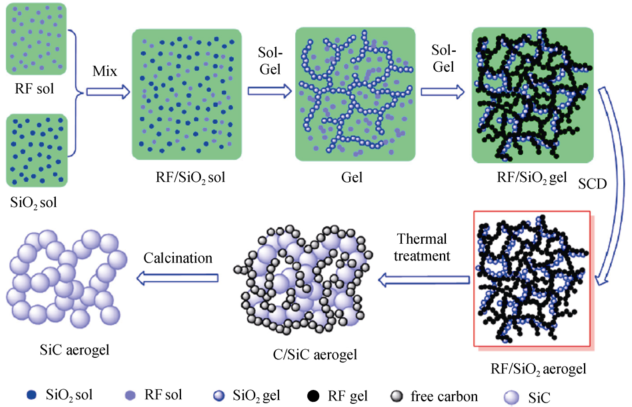
图1 RF-SiO2气凝胶的形成过程及其向SiC气凝胶的转变示意图[12]
Fig. 1 Formation of RF-SiO2 aerogel and its transformation to SiC aerogel[12]

图2 酸催化RF/SiO2凝胶的形成过程示意图[22]
Fig. 2 Formation of acidcatalyzed RF/SiO2 hybrid gels[22]
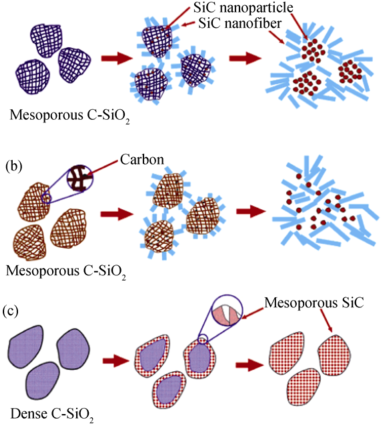
图3 SiC形成过程示意图[28]
Fig. 3 Schematic illustration of SiC formation[28]

图4 SiO2与C界面间SiC形成的过程示意图[45]
Fig. 4 Processes of formed silicon carbide at the interface between silica and carbon[45]
| Precursors | Temperature/ ℃ | Density/ (g•cm-3) | Ratio of porosity/ % | specific surface area/(m2•g-1) | Pore volume/ (cm3•g-1) | Average pore size/nm |
|---|---|---|---|---|---|---|
| PhTMS+TMOS (molar ratio=1:4)[ | as-prepared 1000 | 0.48 0.58 | - | 987 581 | - | 2.8 2.5 |
| TEOS+PDMS[ | 1200 | 0.30 | - | 198.04 | 0.684 | 5.6 |
| MDMS+TEOS (molar ratio=1:1)[ | as-prepared 800 | - | - | 425.5 275.0 | 1.87 - | 17.59 - |
| BTEE[ | as-prepared 1000 | - | - | 1022 69 | 0.53 0.02 | - |
| BTME[ | as-prepared 1000 | - | - | 867 735 | 0.74 0.36 | - |
| TEOS+TBOT+PDMS[ | as-prepared 400 600 800 1000 | - | - | 1.1 300.1 515.2 283.1 1.4 | 1.7 2.8 2.7 1.7 1.1 | - |
| BTEBP[ | 300 1300 1400 1500 | 0.264 0.260 0.265 0.266 | 83 91 91 91 | 1190 1050 818 796 | 0.916 0.802 0.703 0.639 | - |
| MTMS+GPYMS[ | as-prepared 1000 as-prepared 1000 | 0.31 0.61 0.18 0.49 | 78 - 87 - | 464 207 618 150 | 1.24 0.98 1.07 0.52 | 11 18 7 14 |
| PHMS[ | as-prepared 1000 | - | - | 227 180 | 1.37 1.09 | 52 24 |
| MTES[ | as-prepared 1000 | - | - | 727 168 | 1.47 0.80 | 8.0 18.5 |
| PDMS+TrEOS[ | as-prepared 1100 | - | 59-69 1.6 | 405-583 109 | - | 3.2-5.0 <2 |
| MDES+TrEOS[ | as-prepared 1000 | - | 88±2 50±1 | 0.45±0.02 0.31±0.02 | - |
表1 不同硅氧烷先驱体制备的SiCO结构参数比较
Table 1 Porous parameters of SiCO prepared by different siloxane precursors
| Precursors | Temperature/ ℃ | Density/ (g•cm-3) | Ratio of porosity/ % | specific surface area/(m2•g-1) | Pore volume/ (cm3•g-1) | Average pore size/nm |
|---|---|---|---|---|---|---|
| PhTMS+TMOS (molar ratio=1:4)[ | as-prepared 1000 | 0.48 0.58 | - | 987 581 | - | 2.8 2.5 |
| TEOS+PDMS[ | 1200 | 0.30 | - | 198.04 | 0.684 | 5.6 |
| MDMS+TEOS (molar ratio=1:1)[ | as-prepared 800 | - | - | 425.5 275.0 | 1.87 - | 17.59 - |
| BTEE[ | as-prepared 1000 | - | - | 1022 69 | 0.53 0.02 | - |
| BTME[ | as-prepared 1000 | - | - | 867 735 | 0.74 0.36 | - |
| TEOS+TBOT+PDMS[ | as-prepared 400 600 800 1000 | - | - | 1.1 300.1 515.2 283.1 1.4 | 1.7 2.8 2.7 1.7 1.1 | - |
| BTEBP[ | 300 1300 1400 1500 | 0.264 0.260 0.265 0.266 | 83 91 91 91 | 1190 1050 818 796 | 0.916 0.802 0.703 0.639 | - |
| MTMS+GPYMS[ | as-prepared 1000 as-prepared 1000 | 0.31 0.61 0.18 0.49 | 78 - 87 - | 464 207 618 150 | 1.24 0.98 1.07 0.52 | 11 18 7 14 |
| PHMS[ | as-prepared 1000 | - | - | 227 180 | 1.37 1.09 | 52 24 |
| MTES[ | as-prepared 1000 | - | - | 727 168 | 1.47 0.80 | 8.0 18.5 |
| PDMS+TrEOS[ | as-prepared 1100 | - | 59-69 1.6 | 405-583 109 | - | 3.2-5.0 <2 |
| MDES+TrEOS[ | as-prepared 1000 | - | 88±2 50±1 | 0.45±0.02 0.31±0.02 | - |

图5 多孔SiCO陶瓷的几何结构和热传递分析模型[66]
Fig. 5 Geometric structure and heat transfer analysis of macro-porous SiCO ceramics[66] (a) Cubic array of intersecting spherical structure; (b) Heat transfer in two contact spherical particles; (c) Heat transfer in sphere-gas-sphere structure
| Property | Value | Comments | Values for vitreous silica |
|---|---|---|---|
| Density/(g•cm-3) | 2.35 | 2.20 | |
| Coefficient of the thermal expansion/K-1 | 3.14×10⁻⁶ | Average of many samples on cooling between 1000℃ and 100℃; hot-pressed | 0.5 |
| Vickers hardness/(kg•mm-2) | 855 704 | 200 g load 1000 g load | 600-700 |
| Critical stress intensity factor /(MPa•m1/2) | 1.8 | 1000 g load | 1 |
| Fracture strength/MPa | 153±20 | 3-point bending of 0.74 mm diameter fibers | |
| 385±227 | 3-point bending of bars | ||
| Young's elastic modulus/GPa | 97.9 | 70 | |
| Index of refraction | 1.58 | At 0.5893 μm | 1.46 |
| Glass transition/℃ | 1350 | Viscosity of 1013 P | 1190 |
| Dielectric constant | 4.4 | 25℃, 10 to 107 Hz pyrolyzed to 1100℃ | 4 |
| Dielectric loss tangent | 0.1 | 25℃, 10 to 107 Hz pyrolyzed to 1100℃ | 10-4 |
| Electrical conductivity /(Ω·cm) -1 | 4×10-13 | 25℃, pyrolyzed to 1100℃ | ~10-22 |
表2 SiCO和玻璃态SiO2之间的物理特性
Table 2 Properties of SiCO glass and vitreous silica
| Property | Value | Comments | Values for vitreous silica |
|---|---|---|---|
| Density/(g•cm-3) | 2.35 | 2.20 | |
| Coefficient of the thermal expansion/K-1 | 3.14×10⁻⁶ | Average of many samples on cooling between 1000℃ and 100℃; hot-pressed | 0.5 |
| Vickers hardness/(kg•mm-2) | 855 704 | 200 g load 1000 g load | 600-700 |
| Critical stress intensity factor /(MPa•m1/2) | 1.8 | 1000 g load | 1 |
| Fracture strength/MPa | 153±20 | 3-point bending of 0.74 mm diameter fibers | |
| 385±227 | 3-point bending of bars | ||
| Young's elastic modulus/GPa | 97.9 | 70 | |
| Index of refraction | 1.58 | At 0.5893 μm | 1.46 |
| Glass transition/℃ | 1350 | Viscosity of 1013 P | 1190 |
| Dielectric constant | 4.4 | 25℃, 10 to 107 Hz pyrolyzed to 1100℃ | 4 |
| Dielectric loss tangent | 0.1 | 25℃, 10 to 107 Hz pyrolyzed to 1100℃ | 10-4 |
| Electrical conductivity /(Ω·cm) -1 | 4×10-13 | 25℃, pyrolyzed to 1100℃ | ~10-22 |
| [1] | WHITE R J, BRUN N, BUDARIN V L, et al.Always look on the “light” side of life: sustainable carbon aerogels. ChemSusChem, 2014, 7(3): 670-689. |
| [2] | HUSING N, SCHUBERT U.Aerogels-airy materials: chemistry, structure, and properties.Angewandte Chemie International Edition, 1998, 37(1/2): 22-45. |
| [3] | PIERRE A C, PAJONK G M.Chemistry of aerogels and their applications. Chemical Reviews, 2002, 102(11): 4243-4266. |
| [4] | RAO A V, BHAGAT S D, HIRASHIMA H, et al.Synthesis of flexible silica aerogels using methyltrimethoxysilane (MTMS) precursor. Journal of Colloid and Interface Science, 2006, 300(1): 279-285. |
| [5] | RANDALL J P, MEADOR M A B, JANA S C. Tailoring mechanical properties of aerogels for aerospace applications.ACS Applied Materials & Interfaces, 2011, 3(3): 613-626. |
| [6] | ANTONIETTI M, FECHLERN, FELLINGER T P. Carbon aerogels and monoliths: control of porosity and nanoarchitecture via Sol-Gel routes.Chemistry of Materials, 2013, 26(1): 196-210. |
| [7] | MALEKI H, DURAES L, PORTUGAL A.An overview on silica aerogels synthesis and different mechanical reinforcing strategies.Journal of Non-Crystalline Solids, 2014, 385(2): 55-74. |
| [8] | WANG Z, WANG D, QIAN Z, et al.Robust superhydrophobic bridged silsesquioxane aerogels with tunable performances and their applications.ACS Applied Materials & Interfaces, 2015, 7(3): 2016-2024. |
| [9] | LEE D, STEVENS P C, ZENG S Q, et al.Thermal characterization of carbon-opacified silica aerogels.Journal of Non-Crystalline Solids, 1995, 186(2): 285-290. |
| [10] | ZHOU X F, CUI S, LIU Y, et al.Adsorption capacity of hydrophobic SiO2 aerogel/activated carbon composite materials for TNT.Science China Technological Sciences, 2013, 56(7): 1767-1772. |
| [11] | KONG Y, ZHONG Y, SHEN X, et al.Synthesis and characterization of monolithic carbon/silicon carbide composite aerogels.Journal of Porous Materials, 2013, 20(4): 845-849. |
| [12] | KONG Y, SHEN X, CUI S, et al.Preparation of monolith SiC aerogel with high surface area and large pore volume and the structural evolution during the preparation.Ceramics International, 2014, 40(6): 8265-8271. |
| [13] | HASEGAWA G, KANAMORI K, NAKANISHI K, et al.A new route to monolithic macroporous SiC/C composites from biphenylene-bridged polysilsesquioxane gels.Chemistry of Materials, 2010, 22(8): 2541-2547. |
| [14] | ERMAKOVA M A, ERMAKOV D Y, KUVSHINOV G G, et al.Synthesis of high surface area silica gels using porous carbon matrices.Journal of Porous Materials, 2000, 7(4): 435-441. |
| [15] | YE L, JI Z H, HAN W J, et al.Synthesis and characterization of silica/carbon composite aerogels.Journal of the American Ceramic Society, 2010, 93(4): 1156-1163. |
| [16] | SCHAEFER D W, PEKALA R, BEAUCAGE G.Origin of porosity in resorcinol-formaldehyde aerogels.Journal of Non-Crystalline Solids, 1995, 186(2): 159-167. |
| [17] | TAMON H, KITAMURA T, OKAZAKI M.Preparation of silica aerogel from TEOS.Journal of Colloid and Interface Science, 1998, 197(2): 353-359. |
| [18] | DU A, ZHOU B, ZHANG Z, et al.A special material or a new state of matter: a review and reconsideration of the aerogel.Materials, 2013, 6(3): 941-968. |
| [19] | AGUADO-SERRANO J, ROJAS-CERVANTES M L, LOPEZ- PEINADO A J, et al. Silica/C composites prepared by the Sol-Gel method. Influence of the synthesis parameters on textural characteristics.Microporous and Mesoporous Materials, 2004, 74(74): 111-119. |
| [20] | LI X, CHEN X, SONG H.Synthesis of β-SiC nanostructures via the carbothermal reduction of resorcinol-formaldehyde/SiO2 hybrid aerogels.Journal of Materials Science, 2009, 44(17): 4661-4667. |
| [21] | XU H, ZHANG H, HUANG Y, et al.Porous carbon/silica composite monoliths derived from resorcinol-formaldehyde/TEOS.Journal of Non-Crystalline Solids, 2010, 356(20/21/22): 971-976. |
| [22] | CHEN K, BAO Z, DU A, et al.One-pot synthesis, characterization and properties of acid-catalyzed resorcinol/formaldehyde cross- linked silica aerogels and their conversion to hierarchical porous carbon monoliths.Journal of Sol-Gel Science and Technology, 2012, 62(3): 294-303. |
| [23] | CHEN K, BAO Z, DU A, et al.Synthesis of resorcinol-formaldehyde/ silica composite aerogels and their low-temperature conversion to mesoporous silicon carbide.Microporous and Mesoporous Materials, 2012, 149(1): 16-24. |
| [24] | KONG Y, ZHONG Y, SHEN X, et al.Facile synthesis of resorcinol-formaldehyde/silica composite aerogels and their transformation to monolithic carbon/silica and carbon/silicon carbide composite aerogels.Journal of Non-Crystalline Solids, 2012, 358(23): 3150-3155. |
| [25] | KONG Y, ZHONG Y, SHEN X, et al.Synthesis of monolithic mesoporous silicon carbide from resorcinol-formaldehyde/silica composites.Materials Letters, 2013, 99(20): 108-110. |
| [26] | KONG Y, ZHONG Y, SHEN X, et al.Effect of silica sources on nanostructures of resorcinol-formaldehyde/silica and carbon/silicon carbide composite aerogels.Microporous and Mesoporous Materials, 2014, 197(10): 77-82. |
| [27] | ZHMUD B V, SONNEFELD J.Aminopolysiloxane gels: production and properties.Journal of Non-crystalline Solids, 1996, 195(1/2): 16-27. |
| [28] | YAO J, WANG H, ZHANG X, et al.Role of pores in the carbothermal reduction of carbon-silica nanocomposites into silicon carbide nanostructures.The Journal of Physical Chemistry C, 2007, 111(2): 636-641. |
| [29] | KIM H J, KIM J H, KIM W I, et al.Nanoporous phloroglucinol- formaldehyde carbon aerogels for electrochemical use.Korean Journal of Chemical Engineering, 2005, 22(22): 740-744. |
| [30] | SONG L, FENG D, LEE H J, et al.Stabilizing surfactant templated cylindrical mesopores in polymer and carbon films through composite formation with silica reinforcement.The Journal of Physical Chemistry C, 2010, 114(21): 9618-9626. |
| [31] | MEECHOONUCK M, VAS-UMNUAY P, PAVARAJAM V.Synthesis of porous silicon nitride using silica/carbon composite derived from phenol-resorcinol-formaldehyde gel.Ceramics International, 2016, 42(9): 10879-10885. |
| [32] | ZHENG Y, ZHENG Y, LI Z, et al.Preparations of C/SiC composites and their use as supports for Ru catalyst in ammonia synthesis.Journal of Molecular Catalysis A: Chemical, 2009, 301(1/2): 79-83. |
| [33] | RAMAN V, BAHL O P, DHAWAN U.Synthesis of silicon carbide through the sol-gel process from different precursors.Journal of Materials Science, 1995, 30(10): 2686-2693. |
| [34] | LI X K, LIU L, ZHANG Y X, et al.Synthesis of nanometre silicon carbide whiskers from binary carbonaceous silica aerogels.Carbon, 2001, 39(2): 159-165. |
| [35] | PREISS H, BERGER L M, BRAUN M.Formation of black glasses and silicon carbide from binary carbonaceous/silica hydrogels.Carbon, 1995, 33(33): 1739-1746. |
| [36] | SERAJI M M, GHAFOORIAN N S, BAHRAMIAN A R, et al.Preparation and characterization of C/SiO2/SiC aerogels based on novolac/silica hybrid hyperporous materials.Journal of Non- Crystalline Solids, 2015, 425(1): 146-152. |
| [37] | KARNIB M, KABBANI A, HOALIL H, et al.Heavy metals removal using activated carbon, silica and silica activated carbon composite.Energy Procedia, 2014, 50(1): 113-120. |
| [38] | LU X, WANG P, ARDUINI-SCHUSTER M C, et al. Thermal transport in organic and opacified silica monolithic aerogels.Journal of Non-crystalline Solids, 1992, 145(1): 207-210. |
| [39] | LIU H, LI T, SHI Y, et al.Thermal insulation composite prepared from carbon foam and silica aerogel under ambient pressure.Journal of Materials Engineering and Performance, 2015, 24(10): 4054-4059. |
| [40] | PINCHUK O A, DUNDAR F, ATA A, et al.Improved thermal stability, properties, and electrocatalytic activity of Sol-Gel silica modified carbon supported Pt catalysts.International Journal of Hydrogen Energy, 2012, 37(3): 2111-2120. |
| [41] | MONER-GIRONA M, MARTINEZ E, ESTEVE J, et al.Micromechanical properties of carbon-silica aerogel composites.Applied Physics A, 2002, 74(1): 119-122. |
| [42] | LIU C, KOMARNENI S.Carbon-silica xerogel and aerogel composites.Journal of Porous Materials, 1995, 1(1): 75-84. |
| [43] | SPASSOVA I, STOEVA N, NICKOLOV R, et al.Impact of carbon on the surface and activity of silica-carbon supported copper catalysts for reduction of nitrogen oxides.Applied Surface Science, 2016, 369(1): 120-129. |
| [44] | WORSLEY M A, KUNTZ J D, SATCHER J H, et al.Synthesis and characterization of monolithic, high surface area SiO2/C and SiC/C composites.Journal of Materials Chemistry, 2010, 20(23): 4840-4844. |
| [45] | LEVENTIS N, SADEKAR A, CHANDRASEKARANn N, et al.Click synthesis of monolithic silicon carbide aerogels from polyacrylonitrile-coated 3D silica networks.Chemistry of Materials, 2010, 22(9): 2790-2803. |
| [46] | PANTONO C G, SINGH A K, ZHANGH. Silicon oxycarbide glasses.Journal of Sol-Gel Science and Technology, 1999, 14(1): 7-25. |
| [47] | LIU C, CHEN H Z, KOMARNENF S, et al.High surface area SiC/silicon oxycarbide glasses prepared from phenyltrimethoxysilane- tetramethoxysilane gels.Journal of Porous Materials, 1996, 2(3): 245-252. |
| [48] | SINGH A K, PANTANO C G.Porous silicon oxycarbide glasses.Journal of the American Ceramic Society, 1996, 79(10): 2696-2704. |
| [49] | ZHANG H, PANTANO C G.Synthesis and characterization of silicon oxycarbide glasses.Journal of the American Ceramic Society, 1990, 73(4): 958-963. |
| [50] | BABONNEAU F, THORNE K, MACKENZIE J D.Dimethyldiethoxysilane/tetraethoxysilane copolymers: precursors for the silicon-carbon-oxygen system.Chemistry of Materials, 1989, 1(5): 554-558. |
| [51] | FENG J, XIAO Y, JIANG Y, et al.Synthesis, structure, and properties of silicon oxycarbide aerogels derived from tetraethylortosilicate/polydimethylsiloxane.Ceramics International, 2015, 41(4): 5281-5286. |
| [52] | TOURY B, BLUM R, GOLETTO V, et al.Thermal stability of periodic mesoporous SiCO glasses.Journal of Sol-Gel Science and Technology, 2005, 33(1): 99-102. |
| [53] | TAMAYO A, TELLEZ L, PENA-ALONSO R, et al.Surface changes during pyrolytic conversion of hybrid materials to oxycarbide glasses.Journal of Materials Science, 2009, 44(1): 5743-5753. |
| [54] | ARAVIND P R, RATKE L, KOLBE M, et al.Gels dried under supercritical and ambient conditions: a comparative study and their subsequent conversion to silica-carbon composite aerogels. Journal of Sol-Gel Science and Technology, 2013, 67(3): 592-600. |
| [55] | PRADEEP V S, AYANA D G, GRACZYK-ZAJAC M, et al.High rate capability of SiOC ceramic aerogels with tailored porosity as anode materials for Li-ion batteries. Electrochimica Acta, 2015, 157(1): 41-45. |
| [56] | ARAVIND P R, SORARU G D.Porous silicon oxycarbide glasses from hybrid ambigels. Microporous and Mesoporous Materials, 2011, 142(2/3): 511-517. |
| [57] | TAMAYO A, RUBIO F, RUBIO J, et al.Surface and structural modification of nanostructured mesoporous silicon oxycarbide glasses obtained from preceramic hybrids aged in NH4OH.Journal of the American Ceramic Society, 2013, 96(1): 323-330. |
| [58] | PARMENTIER J, SORARU G D, BABONNEAU F.Influence of the microstructure on the high temperature behaviour of gel-derived SiOC glasses.Journal of the European Ceramic Society, 2001, 21(6): 817-824. |
| [59] | WEINBERGER M, PUCHEGGER S, FROSCHL T, et al.Sol- Gel Processing of a glycolated cyclic organosilane and its pyrolysis to silicon oxycarbide monoliths with multiscale porosity and large surface areas.Chemistry of Materials, 2010, 22(4): 1509-1520. |
| [60] | SORARU G D, MODENA S, GUADAGNINO E, et al.Chemical durability of silicon oxycarbide glasses.Journal of the American Ceramic Society, 2002, 85(6): 1529-1536. |
| [61] | BREQUEL H, PARMENTIER J, WALTER S, et al.Systematic structural characterization of the high-temperature behavior of nearly stoichiometric silicon oxycarbide glasses.Chemistry of Materials, 2004, 16(1): 2585-2598. |
| [62] | LATOURNERIE J, DEMPSEY P, HOURLIER‐BAHLOUL D, et al. Silicon oxycarbide glasses: Part 1-Thermochemical stability.Journal of the American Ceramic Society, 2006, 89(5): 1485-1491. |
| [63] | SORARU G D, DALLAPICCOLA E, D'ANDREA G. Mechanical characterization of Sol-Gel-derived silicon oxycarbide glasses.Journal of the American Ceramic Society, 1996, 79(8): 2074-2080. |
| [64] | RENLUND G M, PROCHAZKA S, DOREMUS R H.Silicon oxycarbide glasses: Part II. Structure and properties.Journal of Materials Research, 1991, 6(6): 2723-2734. |
| [65] | MOYSAN C, RIEDEL R, HARSHE R, et al.Mechanical characterization of a polysiloxane-derived SiOC glass.Journal of the European Ceramic Society, 2007, 27(1): 397-403. |
| [66] | QIU L, LI Y M, ZHENG X H, et al.Thermal-conductivity studies of macro-porous polymer-derived SiOC ceramics.International Journal of Thermophysics, 2014, 35(1): 76-89. |
| [1] | 陈明俊, 缪洪康, 肖英俊, 邓建波, 张翔, 赵九蓬, 李垚. 光-热双响应材料研究进展: 从设计策略到智能窗应用[J]. 无机材料学报, 2026, 41(6): 723-738. |
| [2] | 宋坤洁, 解荣军. 机器学习驱动新型发光材料的研究进展[J]. 无机材料学报, 2026, 41(6): 689-703. |
| [3] | 胡钰晴, 朱一新, 乐先浩, 万青. 钽酸锂晶圆减薄技术及其热释电红外探测器应用进展[J]. 无机材料学报, 2026, 41(6): 764-774. |
| [4] | 刘春帆, 陈科, 葛芳芳, 黄庆. 核用耐铅铋腐蚀涂层的研究进展[J]. 无机材料学报, 2026, 41(6): 775-786. |
| [5] | 胡扬, 谢敏, 张筱怡, 李想, 郭新伟, 姜南, 周文瀚, 张胜利, 曾海波. 计算与数据驱动环保型发光材料的研究进展[J]. 无机材料学报, 2026, 41(6): 704-722. |
| [6] | 洪恩柳, 涂欣晨, 李自清, 方晓生. 二维钙钛矿单晶纳米片的漂浮法制备及其光电探测性能[J]. 无机材料学报, 2026, 41(6): 787-794. |
| [7] | 王俊卜, 黄泽皑, 杨茗凯, 蒙颖, 周明炜, 周莹. 甲烷转化用抗积碳催化材料研究进展[J]. 无机材料学报, 2026, 41(6): 739-750. |
| [8] | 王金文, 杨振, 周欢, 夏丹, 杨磊. 可注射无机材料及其生物医学应用[J]. 无机材料学报, 2026, 41(6): 751-763. |
| [9] | 曹颖, 彭露, 夏双, 白菊, 张珽, 李铁. 聚氨酯-碳纳米管@碲化铋复合气凝胶的制备及传感性能[J]. 无机材料学报, 2026, 41(5): 619-627. |
| [10] | 李涵涛, 沈强, 罗国强, 王雪飞, 高明, 陈晨. 机械球磨法调控硅基负极材料结构与性能的研究进展[J]. 无机材料学报, 2026, 41(5): 561-572. |
| [11] | 解陈一, 缪花明, 张蔚然, 刘荣军, 王衍飞, 李端. 理论计算在高熵陶瓷领域的研究进展[J]. 无机材料学报, 2026, 41(5): 545-560. |
| [12] | 李璇, 叶奎材, 冯佳音, 邱家军, 钱文昊, 邢敏. 钛基牙种植体表面改性促进软组织封闭的研究进展[J]. 无机材料学报, 2026, 41(4): 432-444. |
| [13] | 彭德招, 李瑞, 王文鸿, 王梓瑞, 章志珍. 钠氯化物固态电解质研究进展[J]. 无机材料学报, 2026, 41(4): 409-420. |
| [14] | 陈坤, 姜勇刚, 冯军宗, 李良军, 胡艺洁, 冯坚. 锆酸镧多孔隔热材料研究进展[J]. 无机材料学报, 2026, 41(4): 421-431. |
| [15] | 韦连金, 齐志杰, 汪信, 朱俊武, 付永胜. 纳米金刚石改性及其在电催化氧还原反应中的应用[J]. 无机材料学报, 2026, 41(3): 273-288. |
| 阅读次数 | ||||||
|
全文 |
|
|||||
|
摘要 |
|
|||||