无机材料学报 ›› 2026, Vol. 41 ›› Issue (10): 1415-1424.DOI: 10.15541/jim20260075
何涛1,2( ), 王新刚2(), 王小飞2, 王铭2, 徐京城1, 吕松泽2, 陈悦2, 刘宸宇2, 蒋丹宇2
收稿日期:2026-02-13
修回日期:2026-05-06
出版日期:2026-10-20
网络出版日期:2026-05-08
通讯作者:
王新刚, 正高级工程师. E-mail: xgwang@mail.sic.ac.cn作者简介:何 涛(1999-), 男, 硕士研究生. E-mail: 15856489053@163.com
基金资助:
HE Tao1,2(), WANG Xingang2(), WANG Xiaofei2, WANG Ming2, XU Jingcheng1, LÜ Songze2, CHEN Yue2, LIU Chenyu2, JIANG Danyu2
Received:2026-02-13
Revised:2026-05-06
Published:2026-10-20
Online:2026-05-08
Contact:
WANG Xingang, professor. E-mail: xgwang@mail.sic.ac.cnAbout author:HE Tao (1999-), male, Master candidate. E-mail: 15856489053@163.com
Supported by:摘要:
连续碳化硅(SiC)陶瓷纤维是航空航天和先进核能领域用复合材料的增强体。高温拉伸性能是陶瓷纤维在极端环境应用的关键指标之一, 但关于SiC纤维原位高温拉伸性能的报道较少。本研究采用冷端夹持和热端夹持的原位高温拉伸测试方法, 系统研究了SiC纤维在室温至2000 ℃、不同气氛条件下的组分、微观结构与力学性能的关系。高温环境下的束丝拉伸强度受气氛影响, 在1200 ℃、空气气氛下, 纤维氧化导致拉伸强度从室温的1632 MPa衰减至417 MPa, 强度保留率为44.4%。而在氩气气氛中, 纤维在1200 ℃时的拉伸强度为843 MPa, 强度保留率高达89.7%。纤维在1400和1600 ℃氩气中的拉伸强度保留率分别为76.1%和63.5%。当温度达到1700 ℃及以上时, 由于β-SiC晶粒急剧粗化及纤维中部分非晶相分解形成气孔缺陷, 纤维拉伸强度显著下降, 纤维在2000 ℃时的强度仅为331 MPa, 强度保留率仅为22.5%。本研究揭示了SiC纤维在1600 ℃以下氩气中具有相对较高的强度保留率, 阐明了晶粒粗化、部分相分解和相变是1700 ℃以上高温力学性能演变的机制, 为国产SiC纤维高温工程应用提供了关键的基础数据支撑。
中图分类号:
何涛, 王新刚, 王小飞, 王铭, 徐京城, 吕松泽, 陈悦, 刘宸宇, 蒋丹宇. SiC纤维室温至2000 ℃的拉伸性能与微观结构演变[J]. 无机材料学报, 2026, 41(10): 1415-1424.
HE Tao, WANG Xingang, WANG Xiaofei, WANG Ming, XU Jingcheng, LÜ Songze, CHEN Yue, LIU Chenyu, JIANG Danyu. Tensile Properties and Microstructural Evolution of SiC Fibres from Room Temperature to 2000 ℃[J]. Journal of Inorganic Materials, 2026, 41(10): 1415-1424.
| Fibre | Filament diameter/ μm | Density/ (g·cm-3) | Linear density/ tex | Tensile strength/ GPa | Tensile modulus/ GPa | Fracture strain/ % |
|---|---|---|---|---|---|---|
| Cansas-III | 12±1 | 3.01 | 178 | 4.28 | 375 | 1.13 |
表1 Cansas-III碳化硅纤维束丝的基本性能
Table 1 Basic properties of Cansas-III silicon carbide fibre tows
| Fibre | Filament diameter/ μm | Density/ (g·cm-3) | Linear density/ tex | Tensile strength/ GPa | Tensile modulus/ GPa | Fracture strain/ % |
|---|---|---|---|---|---|---|
| Cansas-III | 12±1 | 3.01 | 178 | 4.28 | 375 | 1.13 |
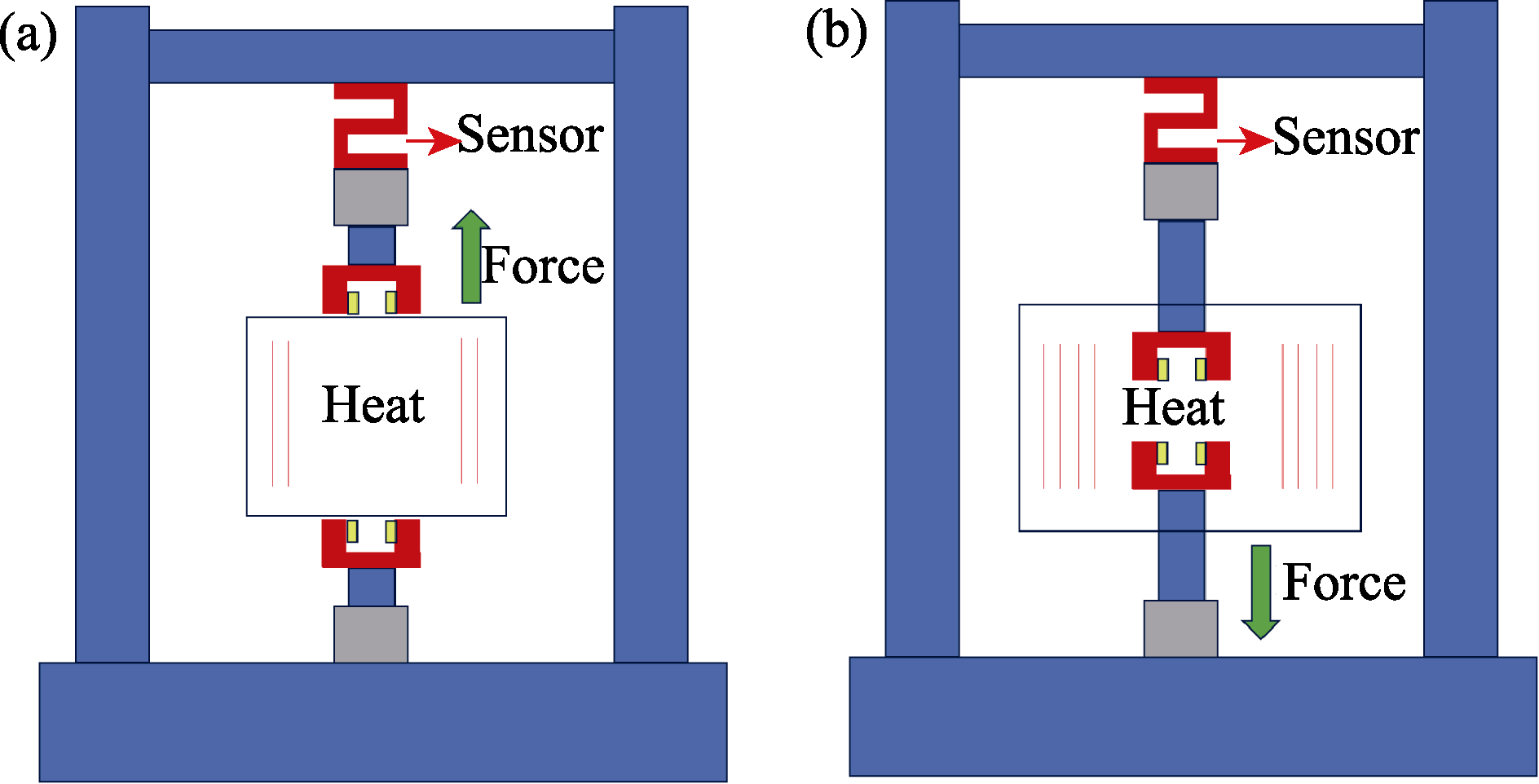
图1 纤维高温拉伸测试装置示意图
Fig. 1 Schematic diagrams of high-temperature tensile test apparatus for fibres (a) Cold-end clamping method; (b) Hot-end clamping method
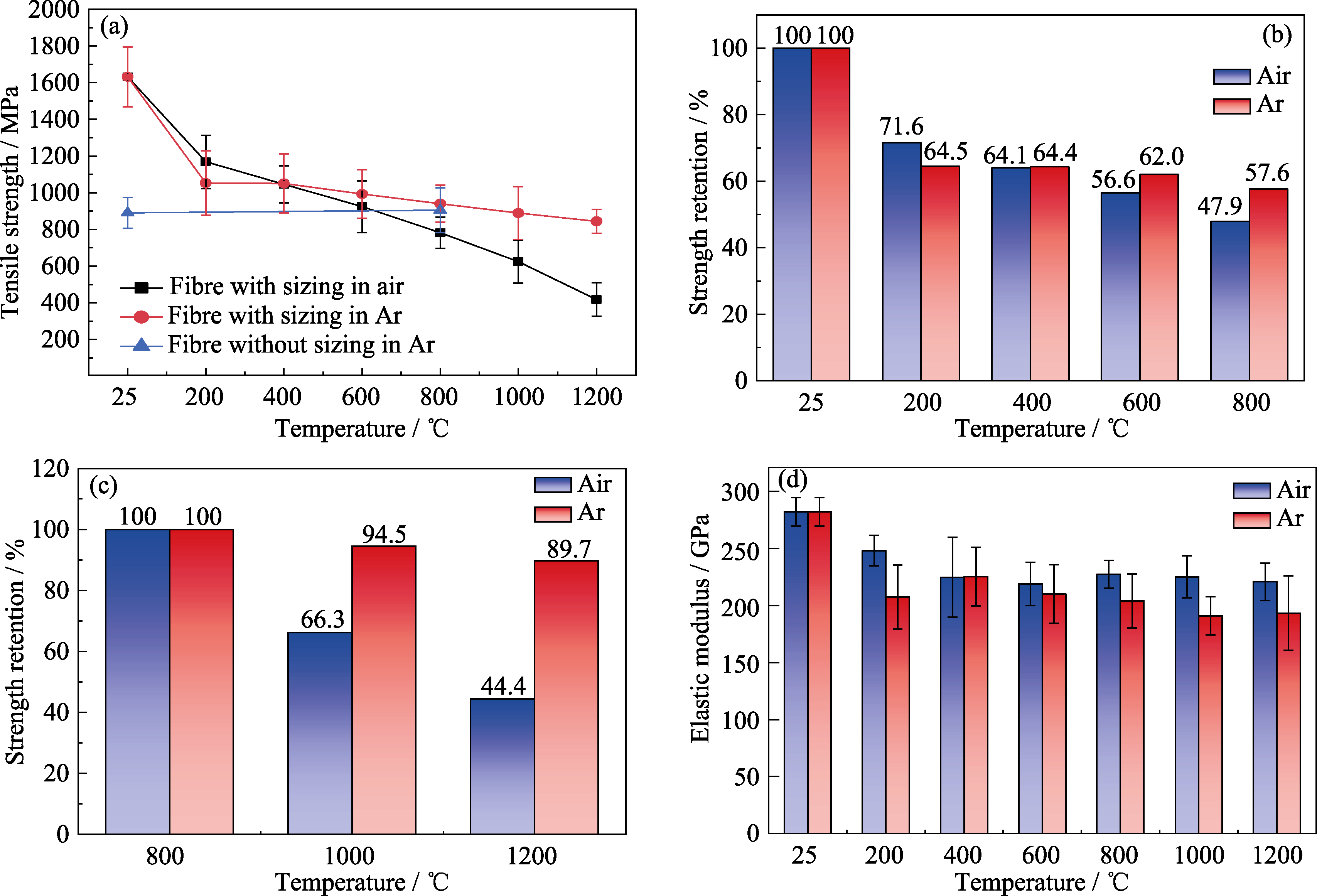
图2 SiC纤维束丝在不同温度下(25~1200 ℃)的拉伸性能
Fig. 2 Tensile properties of SiC fibre tows at different temperatures (25-1200 ℃) (a) Tensile strength; Tensile strength retention based on the strength at (b) room temperature (25 ℃) and (c) 800 ℃; (d) Elastic modulus
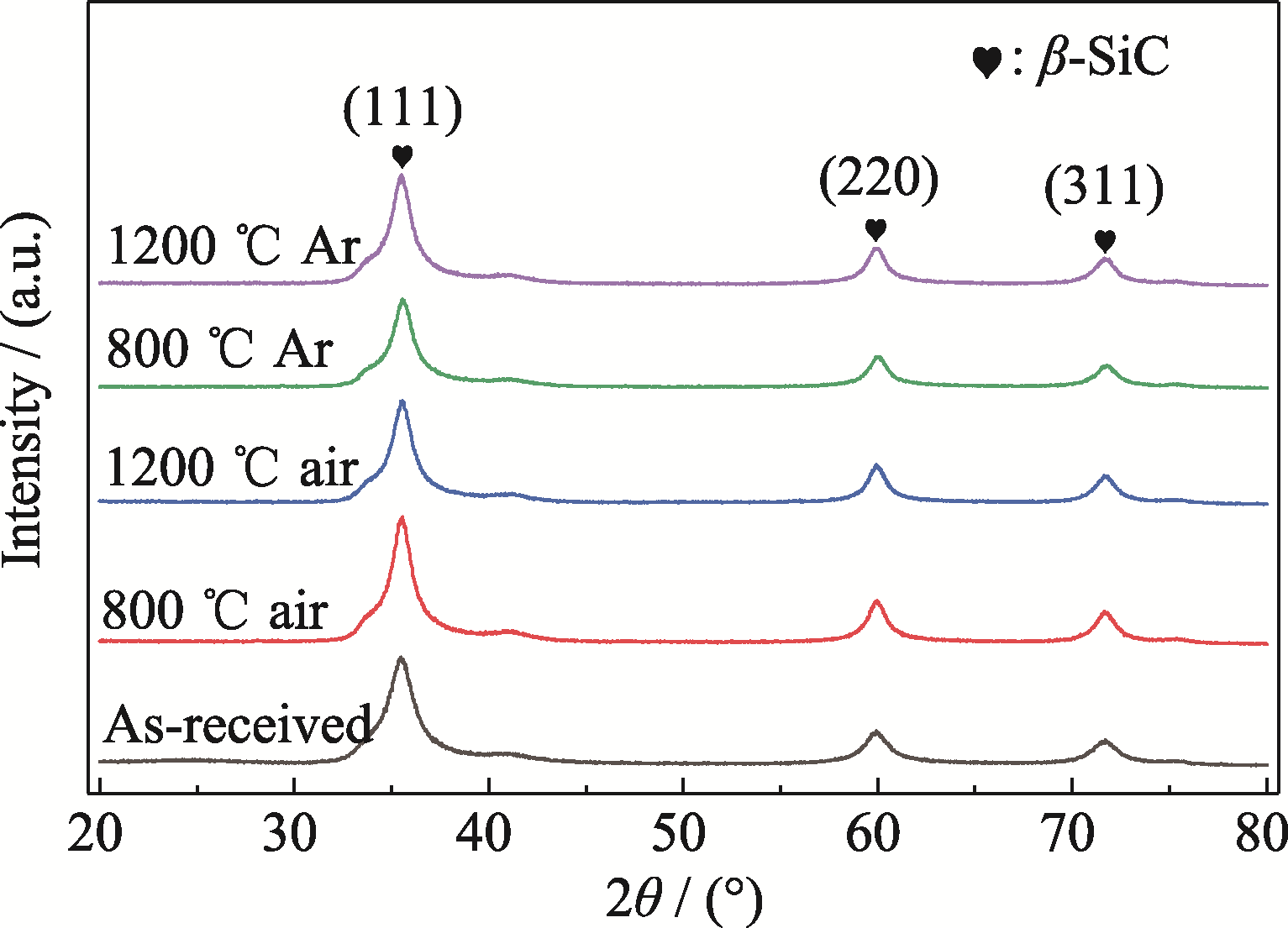
图3 原始SiC纤维及在不同温度、气氛下拉伸测试后的XRD图谱
Fig. 3 XRD patterns of as-received fibres before and after tensile test under different atmospheres and temperatures
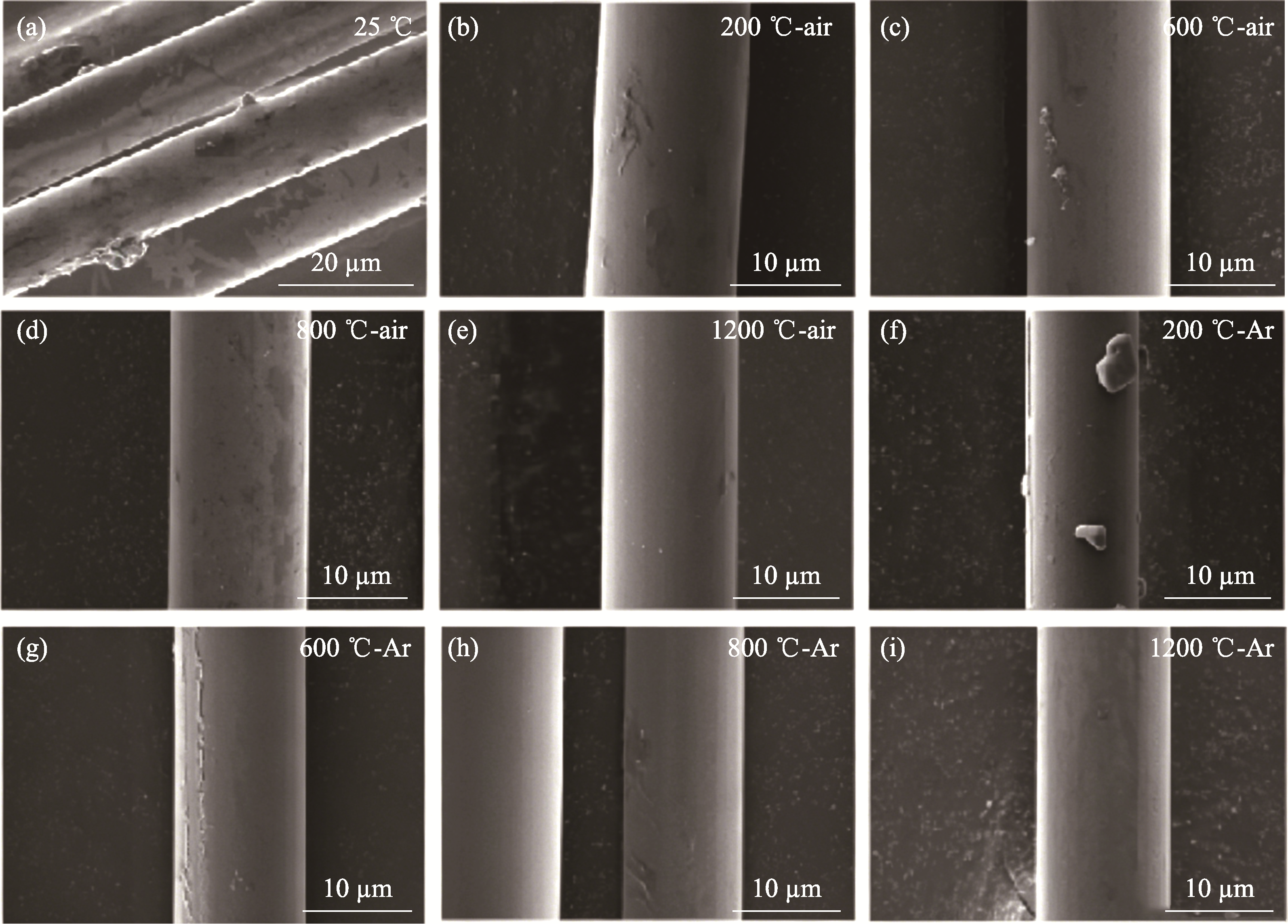
图4 不同温度和气氛下SiC纤维拉伸后的表面SEM照片
Fig. 4 SEM images of SiC fibres after tensile testing at different temperatures and atmospheres (a) As received; (b-e) Air: (b) 200, (c) 600, (d) 800 and (e) 1200 ℃; (f-i) Ar: (f) 200, (g) 600, (h) 800 and (i) 1200 ℃
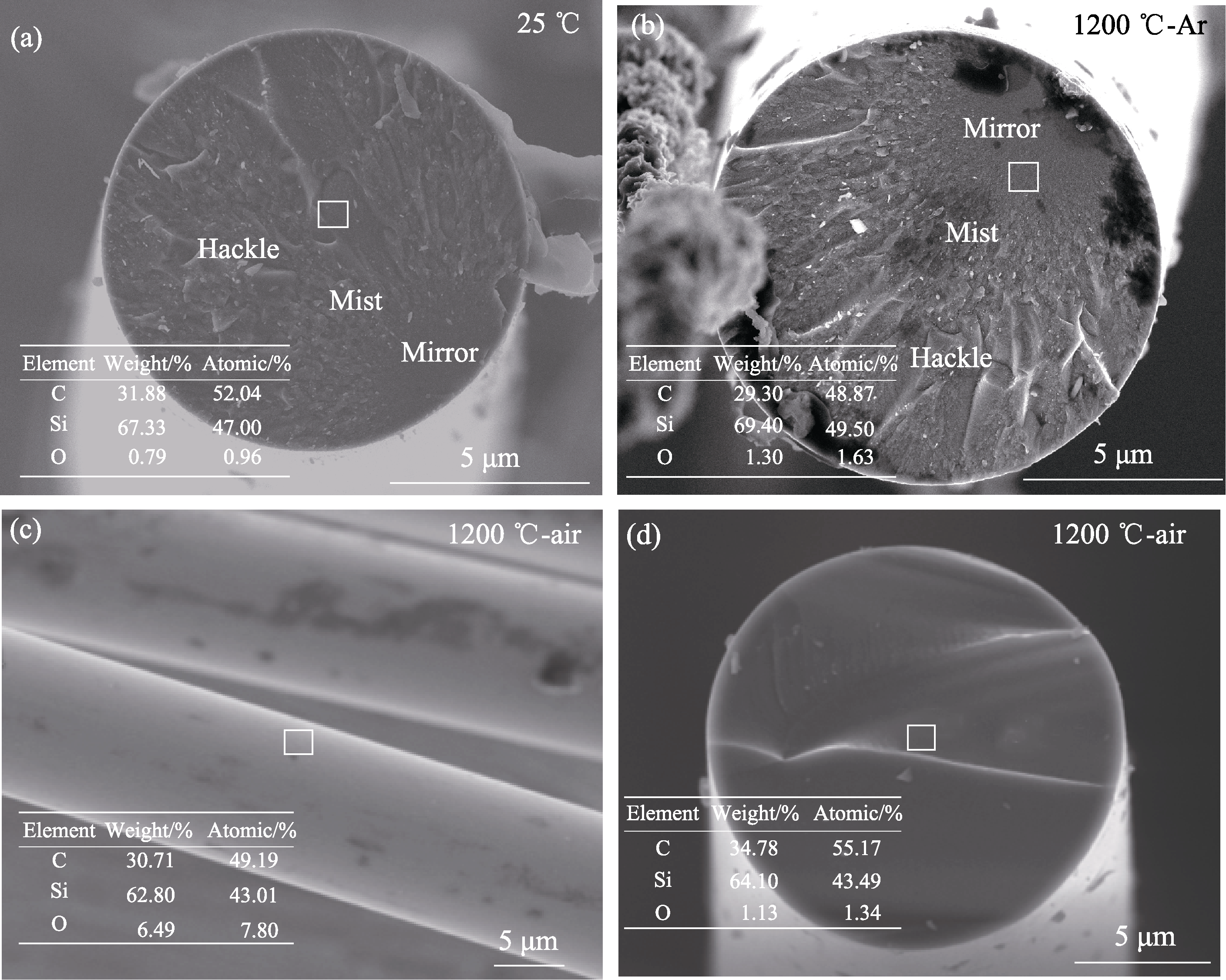
图5 纤维断口及表面SEM照片与EDS分析
Fig. 5 SEM images and EDS analysis of the fracture surface and surface of fibres (a, b) Fracture surface; (c) Surface; (d) Fracture surface from manual cutting
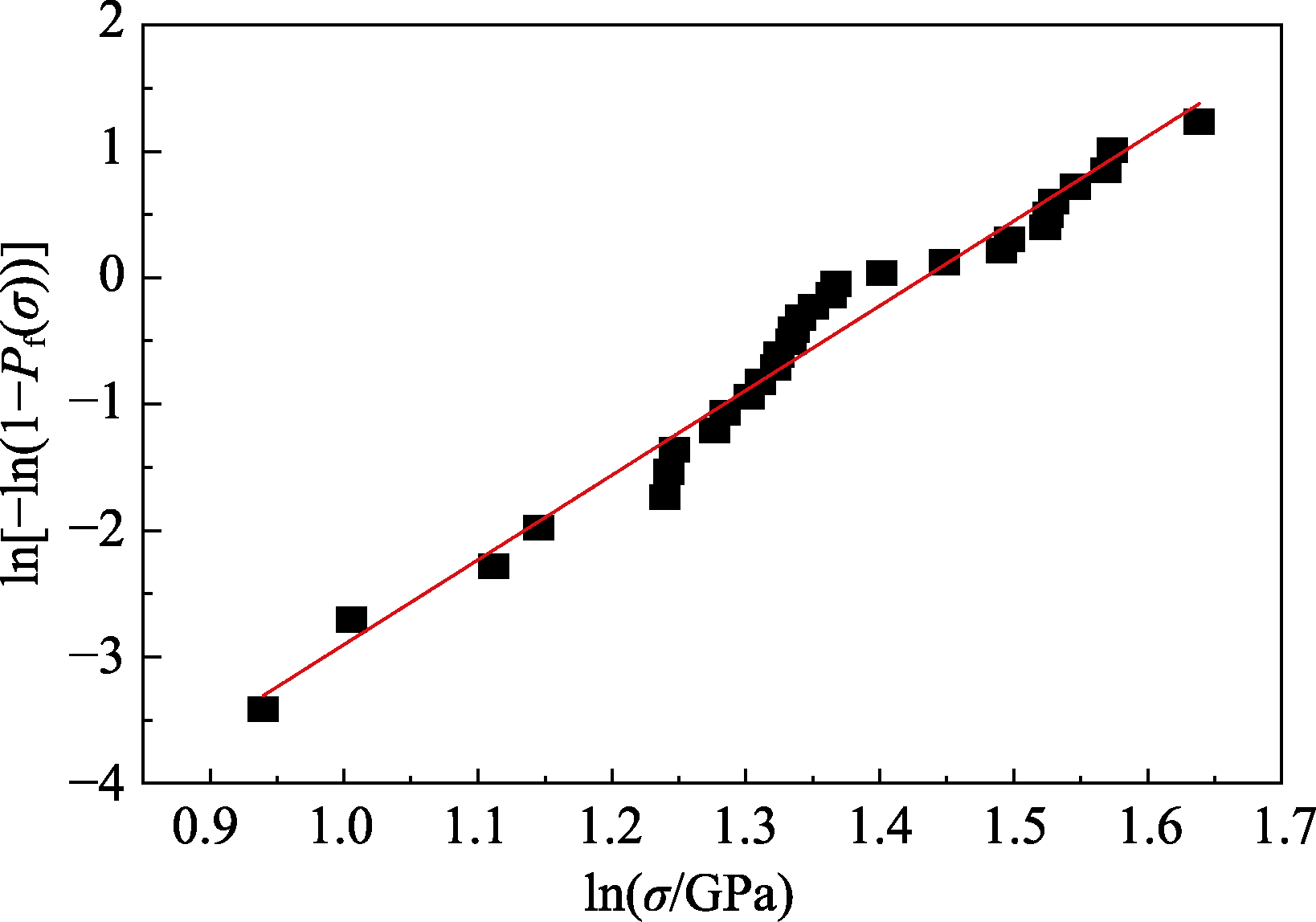
图6 SiC单丝Weibull参数拟合曲线
Fig. 6 Weibull parameter fitting curve of SiC single filaments
| Fibre | σ0,s/GPa | R2 | σ¯/GPa | σ¯s/GPa | |
|---|---|---|---|---|---|
| Cansas-III | 6.7 | 4.2 | 0.97 | 3.9 | 4.1 |
表2 纤维单丝拉伸试验得到的Weibull参数(ms、${{\sigma }_{0,s}}$)、决定系数(R2)、统计平均强度($\bar{\sigma }$)和算术平均强度(${{\bar{\sigma }}_{\mathbf{s}}}$)
Table 2 Weibull parameters (${{m}_{\mathbf{s}}}$, ${{\sigma }_{0,s}}$), coefficient of determination (R2), statistical average strength ($\bar{\sigma }$), and mean strength (${{\bar{\sigma }}_{\mathbf{s}}}$) obtained by single filament tensile test
| Fibre | σ0,s/GPa | R2 | σ¯/GPa | σ¯s/GPa | |
|---|---|---|---|---|---|
| Cansas-III | 6.7 | 4.2 | 0.97 | 3.9 | 4.1 |
| Fibre | ||||
|---|---|---|---|---|
| Cansas-III | 6.7 | 6.3 | 4.2 | 3.3 |
表3 SiC纤维单丝和束丝试验得到的Weibull参数结果对比
Table 3 Comparison of the Weibull parameters obtained from the tensile tests of SiC filaments and tows
| Fibre | ||||
|---|---|---|---|---|
| Cansas-III | 6.7 | 6.3 | 4.2 | 3.3 |
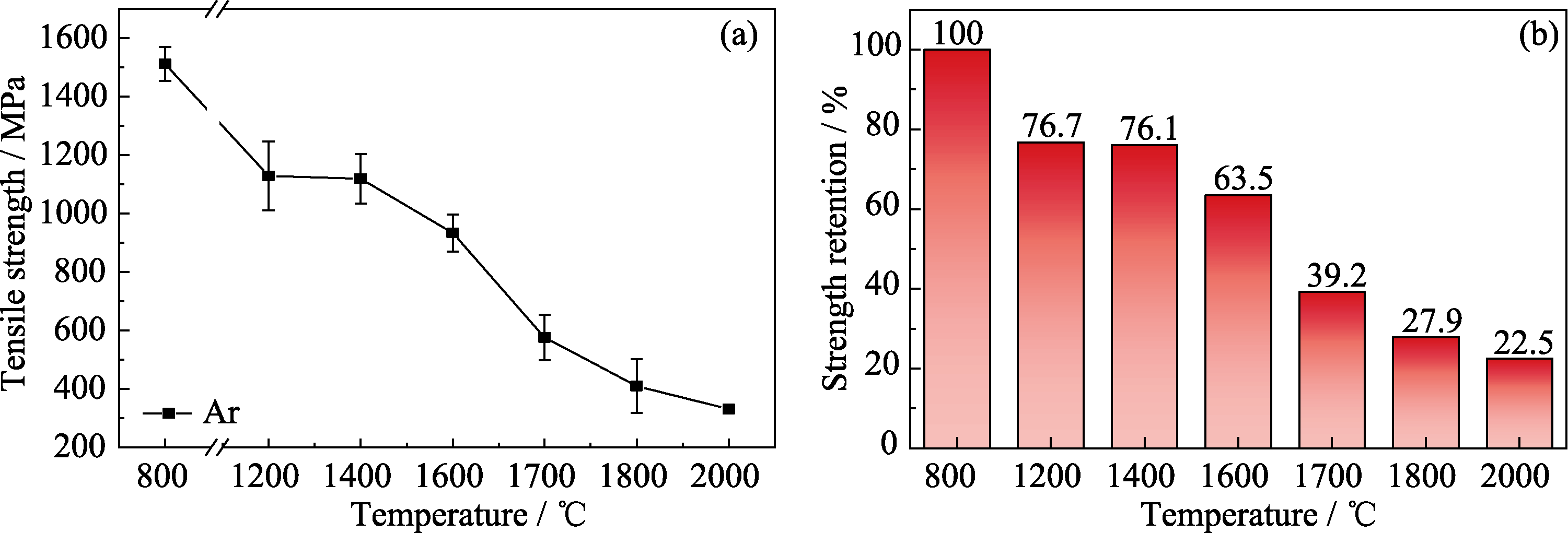
图7 采用热端夹持法在不同温度测试SiC纤维束丝的(a)拉伸强度和(b)强度保留率
Fig. 7 (a) Tensile strength and (b) strength retention of SiC fibre tows at different temperatures by hot-end gripped method
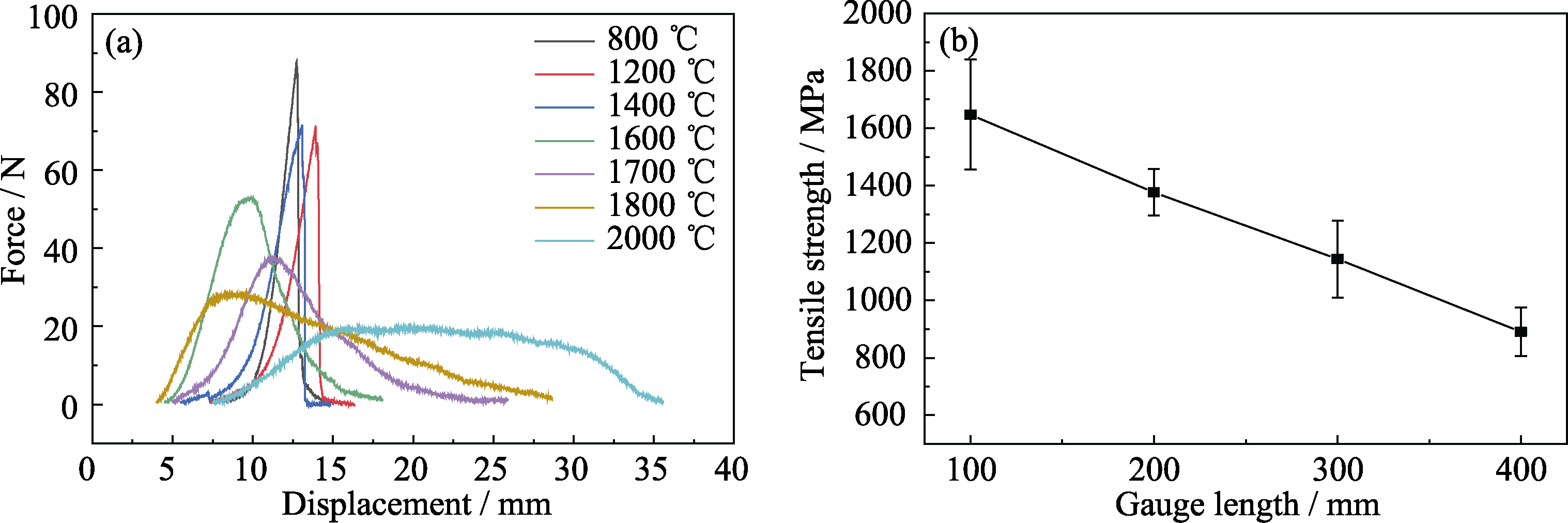
图8 (a) SiC纤维束丝不同温度下的载荷-位移曲线; (b)去除上浆剂的SiC纤维束丝不同标距下的室温拉伸强度
Fig. 8 (a) Force-displacement curves of SiC fibre tows at different temperatures; (b) Room-temperature tensile strength of sizing-removed fibre tows at different gauge lengths Colorful figures are available on website
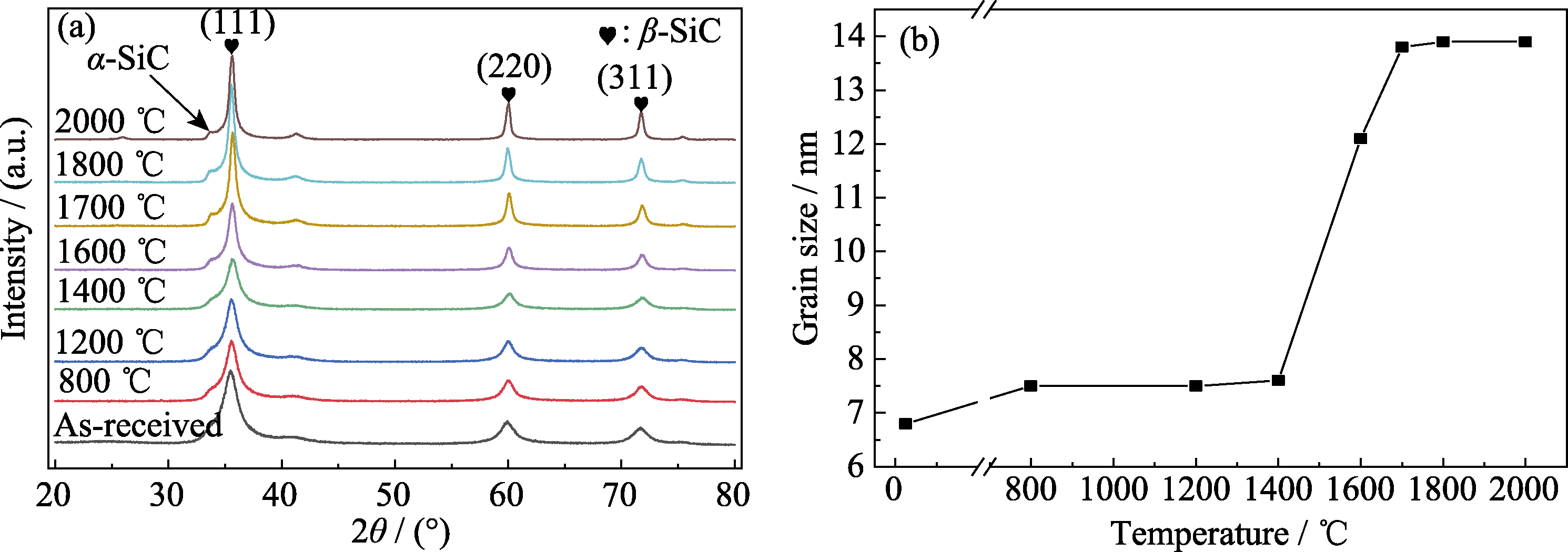
图9 采用热端夹持法在不同温度下拉伸测试后的SiC纤维(a) XRD图谱和(b)晶粒尺寸
Fig. 9 (a) XRD patterns and (b) grain size of SiC fibres after tensile test at different temperatures by hot-end gripped method
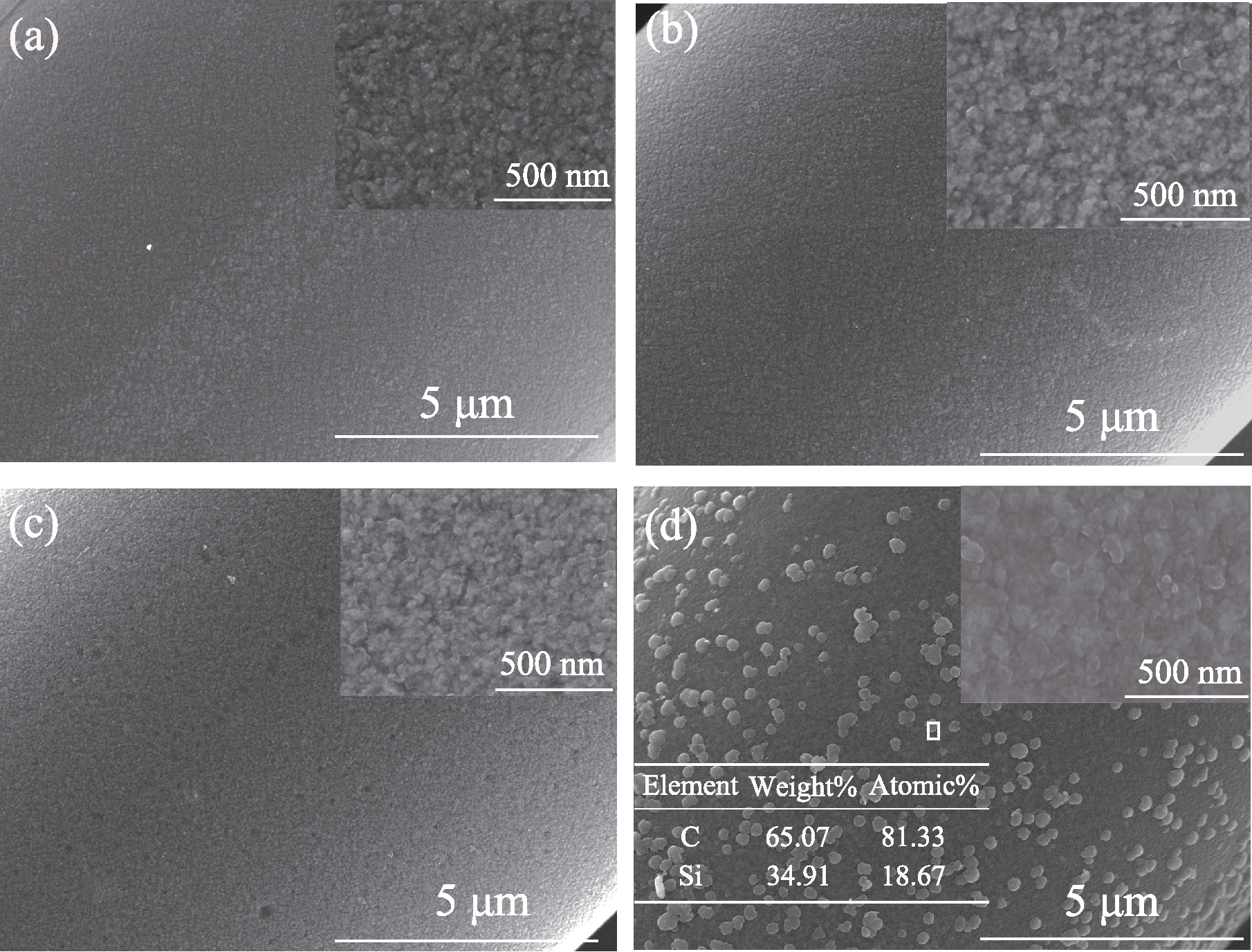
图10 热端夹持法在1400~2000 ℃下拉伸测试后的纤维表面SEM照片
Fig. 10 SEM images of SiC fibres after tensile test at 1400-2000 ℃ by hot-end gripped method (a) 1400 ℃; (b) 1700 ℃; (c) 1800 ℃; (d) 2000 ℃
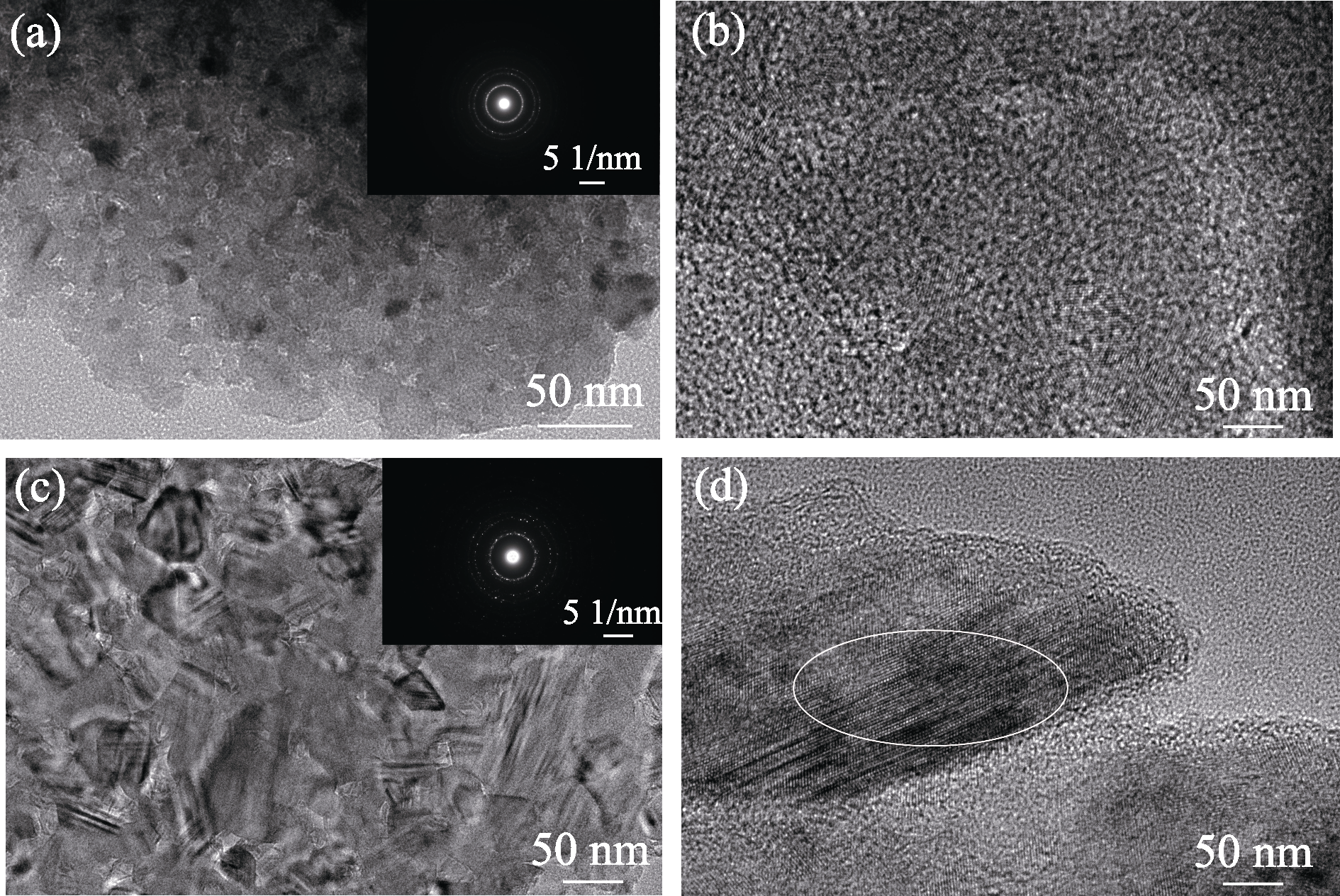
图11 SiC纤维经高温拉伸测试后的(a, c) TEM和(b, d)高分辨TEM照片
Fig. 11 (a, c) TEM and (b, d) high resolution TEM images of SiC fibres after high-temperature tensile test (a, b) 1200 ℃; (c, d) 2000 ℃
| [1] |
WANG X G, YANG Q Q, LIN G L, et al. High temperature tensile property of domestic 550-grade continuous alumina ceramic fiber. Journal of Inorganic Materials, 2022, 37(6): 629.
DOI |
| [2] |
WANG P R, GOU Y Z, WANG H. Third generation SiC fibers for nuclear applications. Journal of Inorganic Materials, 2020, 35(5): 525.
DOI |
| [3] |
WANG L Y, WANG S Q, CHEN G L, et al. Ceramic-based abradable sealing coatings for advanced aeroengines: materials design, structural strategies, and multifunctional performance. Extreme Materials, 2025, 1(4): 33.
DOI |
| [4] |
CHEN Z L, LAI X W, LIANG Y T, et al. Progress in the degradation of thermal and environmental barrier coating materials caused by calcium-magnesium-aluminum-silicate deposit. Extreme Materials, 2025, 1(1): 9.
DOI |
| [5] |
AN L, ARMSTRONG J N, HU Y, et al. High temperature ceramic thermal insulation material. Nano Research, 2022, 15(7): 6662.
DOI |
| [6] |
JIA C, XU Z, LUO D, et al. Flexible ceramic fibers: recent development in preparation and application. Advanced Fiber Materials, 2022, 4(4): 573.
DOI |
| [7] |
SAVINO R, CRISCUOLO L, DI MARTINO G D, et al. Aero-thermo-chemical characterization of ultra-high-temperature ceramics for aerospace applications. Journal of the European Ceramic Society, 2018, 38(8): 2937.
DOI URL |
| [8] |
ZHANG X S, CHEN Y J, HU J L. Recent advances in the development of aerospace materials. Progress in Aerospace Sciences, 2018, 97: 22.
DOI URL |
| [9] |
PADTURE N P. Advanced structural ceramics in aerospace propulsion. Nature Materials, 2016, 15(8): 804.
DOI PMID |
| [10] | 向宇, 余金山, 王洪磊, 等. 碳化硅纤维高温抗氧化性研究进展. 硅酸盐通报, 2022, 41(9): 3234. |
| [11] | 陈代荣, 韩伟健, 李思维, 等. 连续陶瓷纤维的制备、结构、性能和应用: 研究现状及发展方向. 现代技术陶瓷, 2018, 39(3): 151. |
| [12] |
GUO G D, YE F, CHENG L F, et al. Thermal stability of CVI and RMI SiC/SiC composites adopting Cansas 3303 SiC fibers. Journal of the European Ceramic Society, 2025, 45(3): 117004.
DOI URL |
| [13] |
ZHANG Y, CHEN T X, CHEN J H, et al. The effects of annealing atmosphere and intrinsic component on high temperature evolution behaviors of SiC fibers. Materials Science and Engineering: A, 2022, 848: 143363.
DOI URL |
| [14] |
GOU Y Z, YANG T Y, XIANG Y, et al. Long-time oxidation resistance of KD-SiC fibers with different composition and structure in air atmosphere. Ceramics International, 2024, 50(24): 52672.
DOI URL |
| [15] |
XIAO Y, MA C L, XU H, et al. Mechanical properties and microstructural evolution of Cansas-III SiC fibers after thermal exposure in different atmospheres. Ceramics International, 2022, 48(22): 32804.
DOI URL |
| [16] |
YOU B J, WANG X, LI B, et al. Microstructural evolution and phase transformation of Cansas 3303 SiC fibers during thermal shock at 1200 ℃. Ceramics International, 2024, 50(21): 42035.
DOI URL |
| [17] | 国防科学技术大学. 连续碳化硅纤维测试方法第2部分: 单纤维直径: GB/T 34520.2-2017. 北京: 中国标准出版社, 2017. |
| [18] | 山东工业陶瓷研究设计院有限公司. 精细陶瓷纤维单丝室温拉伸性能的测定: GB/T 43307-2023. 北京: 中国标准出版社, 2023. |
| [19] |
IKARASHI Y, OGASAWARA T, OKUIZUMI S I, et al. Direct comparison between monofilament and multifilament tow testing for evaluating the tensile strength distribution of SiC fibers. Journal of the European Ceramic Society, 2022, 42(5): 1928.
DOI URL |
| [20] | 国科学院上海硅酸盐研究所. 陶瓷纤维复丝高温拉伸性能试验方法: T/SCS 000027-2023. 上海: 上海市硅酸盐学会, 2023. |
| [21] |
REINDERS L, PFEIFER S, KRÖNER S, et al. Development of mullite fibers and novel zirconia-toughened mullite fibers for high temperature applications. Journal of the European Ceramic Society, 2021, 41(6): 3570.
DOI URL |
| [22] |
YANG R, ZHAO W Q, SUN S J, et al. Effect of thermal exposure on the microstructure and strength of an alumina-silica ceramic fiber. International Journal of Applied Ceramic Technology, 2023, 20(5): 3064.
DOI URL |
| [23] |
CHEN Y H, CHEN Z K, ZHANG R Q, et al. Structural evolution and mechanical properties of Cansas-III SiC fibers after thermal treatment up to 1700 ℃. Journal of the European Ceramic Society, 2021, 41(10): 5036.
DOI URL |
| [24] |
CAO S Y, WANG J, WANG H. High-temperature behavior and degradation mechanism of SiC fibers annealed in Ar and N2 atmospheres. Journal of Materials Science, 2016, 51(9): 4650.
DOI URL |
| [25] |
ZHANG Y, CHEN J H, YAN D X, et al. Conversion of silicon carbide fibers to continuous graphene fibers by vacuum annealing. Carbon, 2021, 182: 435.
DOI URL |
| [1] | 周雪, 刘喆, 任岩, 余金山, 杨天月, 赵钟倩, 王洪磊, 周新贵, 苟燕子. 不同SiC纤维高温退火后抗蠕变性能的定量研究[J]. 无机材料学报, 2026, 41(7): 1011-1020. |
| [2] | 赵彤彤, 代吉祥, 苏成, 师艳, 沙建军. 反应熔渗法制备Hf-Si基涂层-基体一体化改性C/C复合材料的微观结构及烧蚀性能[J]. 无机材料学报, 2026, 41(5): 583-594. |
| [3] | 隋金洋, 周大雨, 赵文瑾, 童祎, 王新朋. 工作气压对AlScN薄膜结构和电学性能的影响[J]. 无机材料学报, 2026, 41(4): 486-492. |
| [4] | 刘明扬, 王纯, 程鹏飞, 马雪寒, 高祥云, 由博杰, 赵录峰, 成来飞, 张毅. 化学气相渗透2D SiC/SiC窄带随机振动疲劳损伤与性能退化[J]. 无机材料学报, 2026, 41(3): 349-358. |
| [5] | 袁旺, 胡建宝, 周亮, 阚艳梅, 张翔宇, 董绍明. 氩气气氛热处理对Shicolon-II SiC纤维机械性能和微观结构演变的影响[J]. 无机材料学报, 2026, 41(1): 119-128. |
| [6] | 钟卫民, 赵科, 王珂玮, 刘佃光, 刘金铃, 安立楠. 振荡压力振幅对碳化钨微观结构和摩擦磨损性能的影响[J]. 无机材料学报, 2025, 40(9): 964-970. |
| [7] | 穆浩洁, 张源江, 喻彬, 付秀梅, 周世斌, 李晓东. ZrO2掺杂Y2O3-MgO纳米复相陶瓷的制备及性能研究[J]. 无机材料学报, 2025, 40(3): 281-289. |
| [8] | 范武刚, 曹雄, 周响, 李玲, 赵冠楠, 张兆泉. 8YSZ陶瓷在模拟压水堆水环境中的耐腐蚀性能[J]. 无机材料学报, 2024, 39(7): 803-809. |
| [9] | 姜灵毅, 庞生洋, 杨超, 张悦, 胡成龙, 汤素芳. C/SiC-BN复合材料的制备及氧化行为[J]. 无机材料学报, 2024, 39(7): 779-786. |
| [10] | 薛轶凡, 李玮洁, 张中伟, 庞旭, 刘愚. 碳纤维布表面PyC界面相微观结构及均匀性的工艺调控[J]. 无机材料学报, 2024, 39(4): 399-408. |
| [11] | 吴爽, 苟燕子, 王永寿, 宋曲之, 张庆雨, 王应德. 高温热处理对国产KD-SA型SiC纤维组成结构与力学性能的影响[J]. 无机材料学报, 2023, 38(5): 569-576. |
| [12] | 李建波, 田震, 蒋全伟, 于砺锋, 康慧君, 曹志强, 王同敏. 不同元素掺杂对CaTiO3微观结构及热电性能的影响[J]. 无机材料学报, 2023, 38(12): 1396-1404. |
| [13] | 吴东江, 赵紫渊, 于学鑫, 马广义, 由竹琳, 任冠辉, 牛方勇. Al2O3-TiCp复相陶瓷激光定向能量沉积直接增材制造[J]. 无机材料学报, 2023, 38(10): 1183-1192. |
| [14] | 王新刚, 杨青青, 林根连, 高巍, 秦福林, 李荣臻, 康庄, 王小飞, 蒋丹宇, 闫继娜. 国产550级连续氧化铝陶瓷纤维的高温拉伸性能研究[J]. 无机材料学报, 2022, 37(6): 629-635. |
| [15] | 吴西士, 朱云洲, 黄庆, 黄政仁. 树脂基多孔碳孔结构对Cf/SiC复合材料连接性能的影响[J]. 无机材料学报, 2022, 37(12): 1275-1280. |
| 阅读次数 | ||||||
|
全文 |
|
|||||
|
摘要 |
|
|||||