
Journal of Inorganic Materials ›› 2026, Vol. 41 ›› Issue (6): 814-822.DOI: 10.15541/jim20250519
Special Issue: 【能源环境】储能电池(202606); 【信息功能】MAX、MXene及其他二维材料(202606)
• RESEARCH ARTICLE • Previous Articles Next Articles
WANG Jiahui1( ), LIU Jingjing1, QIU Yi1, WANG Yongxia1(), CUI Xiangzhi2()
Received:2025-12-30
Revised:2026-02-05
Published:2026-06-20
Online:2026-02-06
Contact:
WANG Yongxia, associate professor. E-mail: wyx912@dhu.edu.cn;About author:WANG Jiahui (2001-), male, Master candidate. E-mail: 18962019813@163.com
Supported by:CLC Number:
WANG Jiahui, LIU Jingjing, QIU Yi, WANG Yongxia, CUI Xiangzhi. Bifunctional Oxygen Electrocatalytic Performance of Atomically Dispersed Fe Anchored on N-doped Graphene[J]. Journal of Inorganic Materials, 2026, 41(6): 814-822.
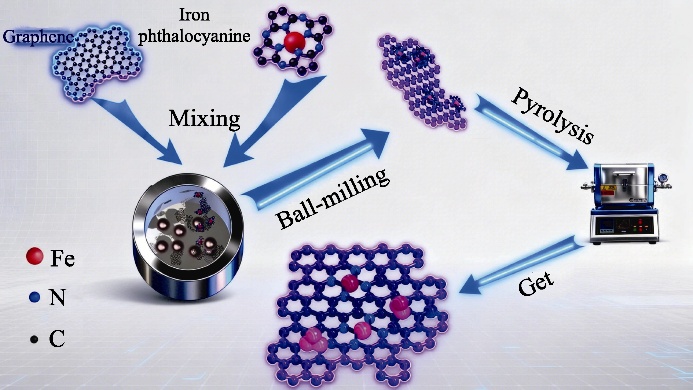
Fig. 1 Schematic diagram of the preparation process for Fe-N/Gra catalysts
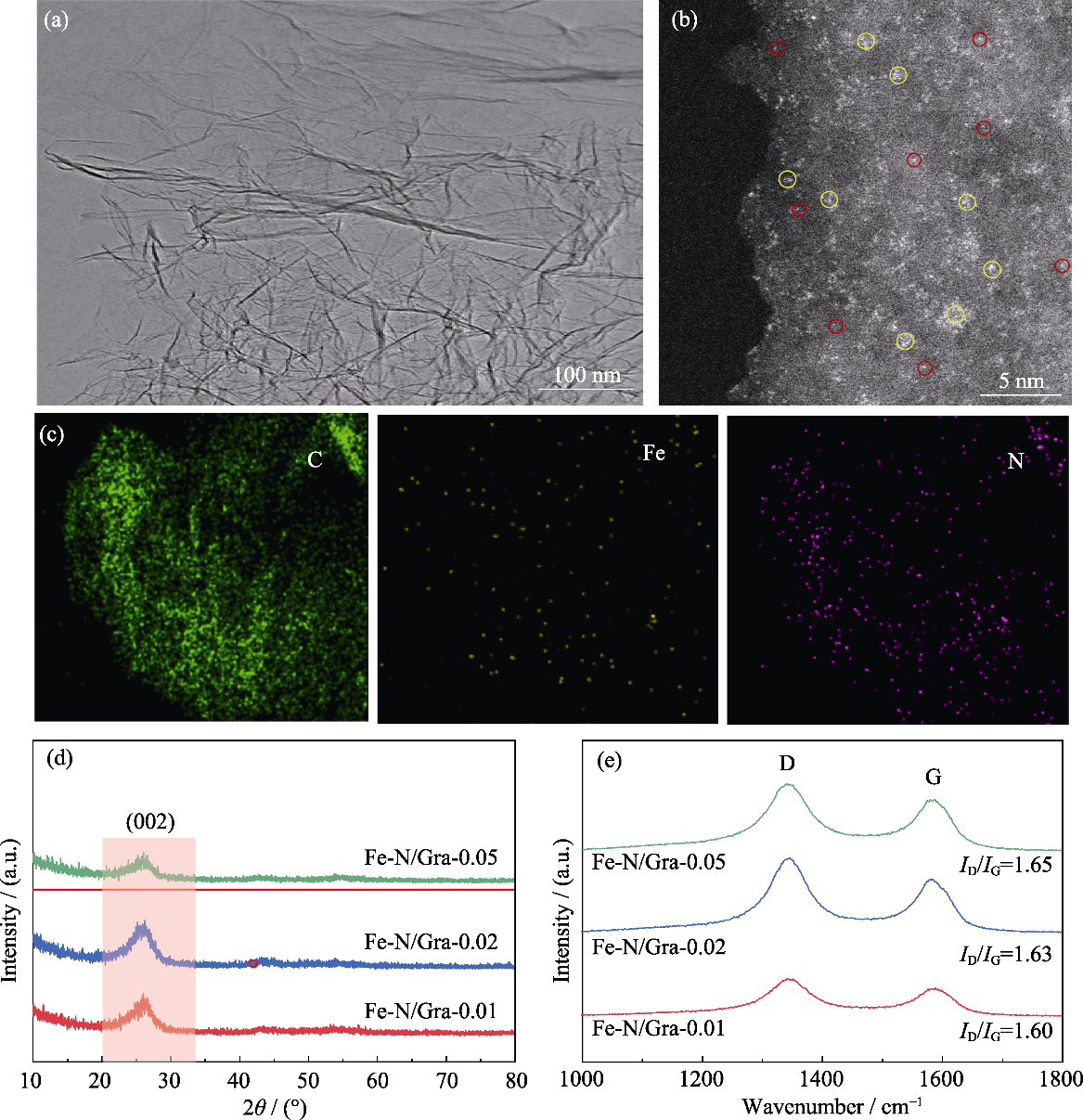
Fig. 2 Physical characterization of the synthesized Fe-N/Gra catalysts (a) TEM image of Fe-N/Gra-0.02; (b) AC-TEM image of Fe-N/Gra-0.02; (c) Elemental mappings of Fe-N/Gra-0.02; (d) XRD patterns and (e) Raman spectra of Fe-N/Gra catalysts with different Fe loadings after carbonization
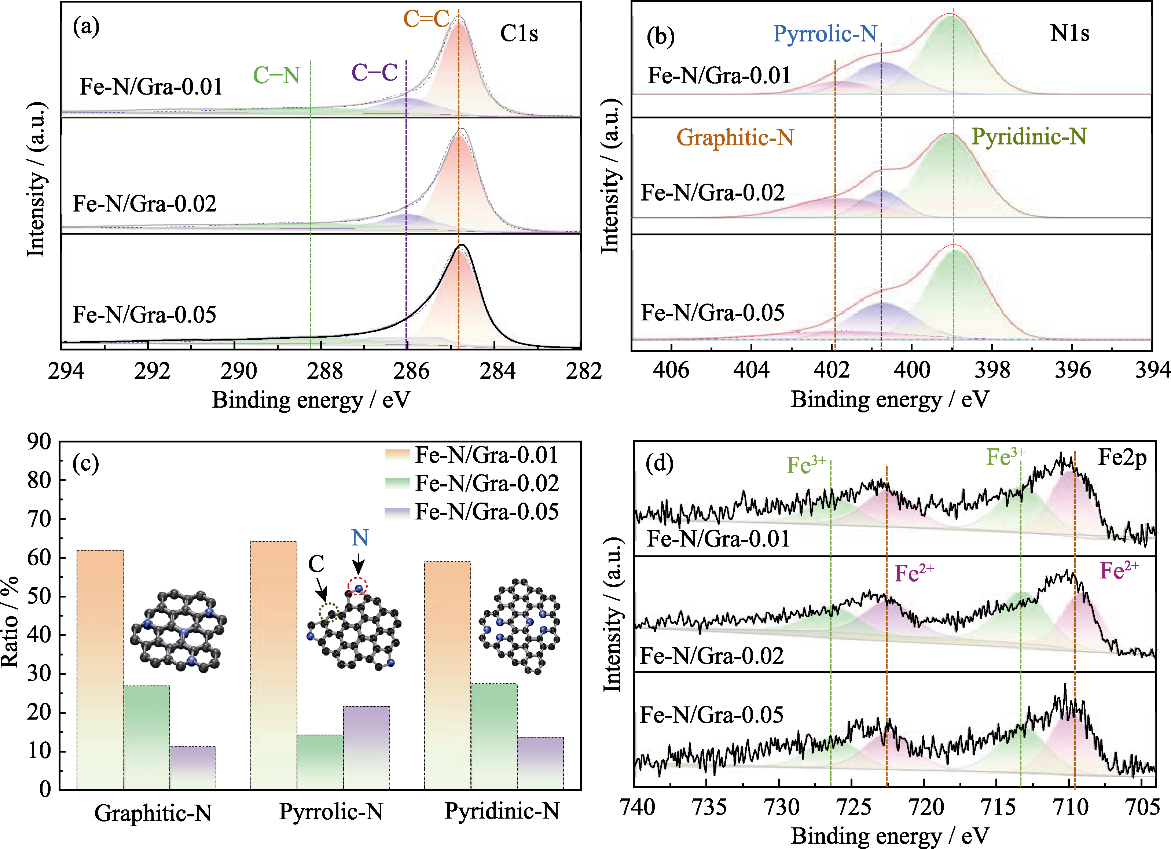
Fig. 3 XPS peak-fitting analyses of C, N, and Fe compositions in Fe-N/Gra catalysts (a, b, d) High-resolution XPS spectra of C1s, N1s, and Fe2p for Fe-N/Gra catalysts with different Fe loadings; (c) Comparison of the contents of pyridinic-N, pyrrolic-N, and graphitic-N for Fe-N/Gra catalysts with different Fe loadings. Colorful figures are available on website
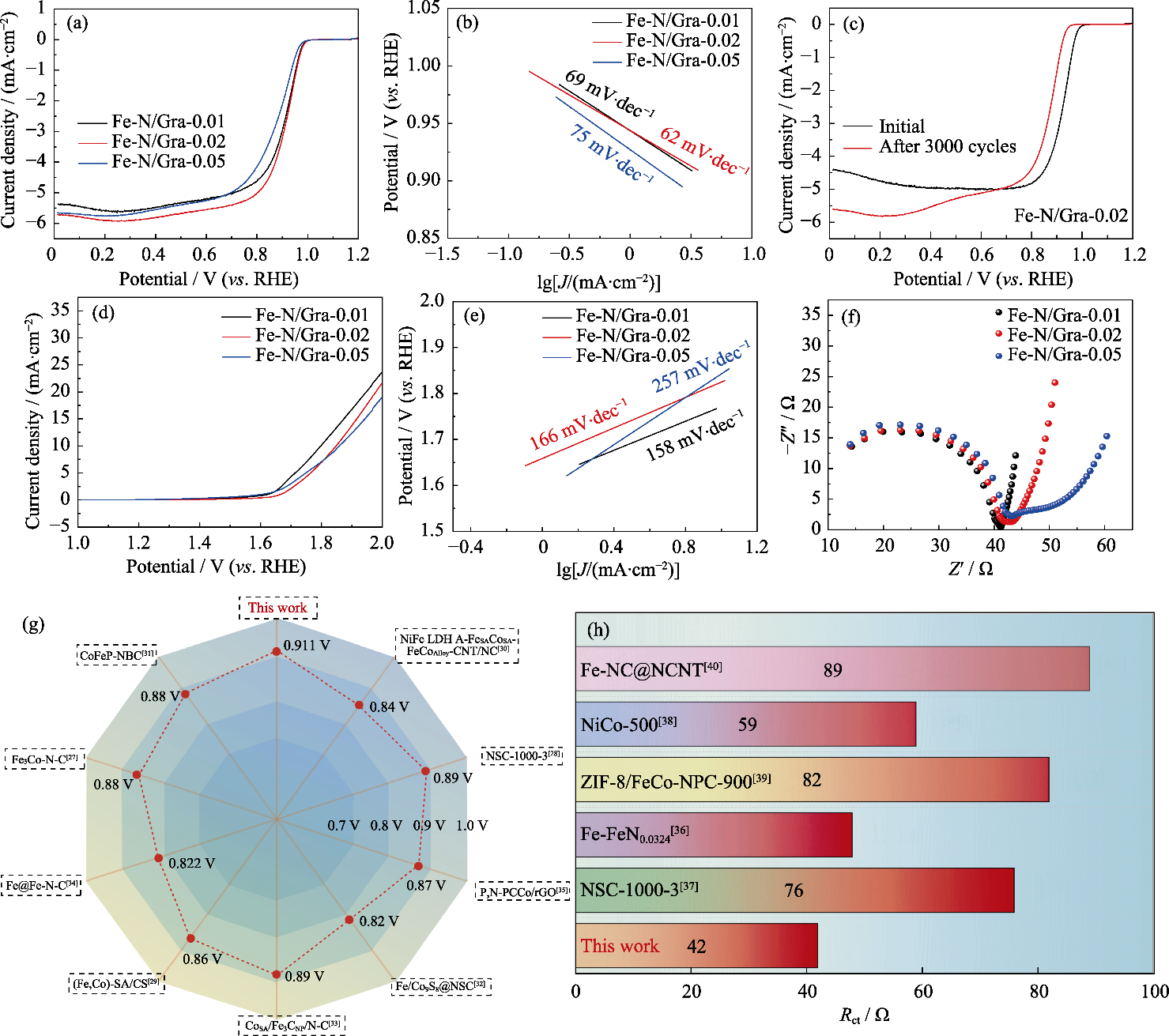
Fig. 4 Electrochemical performance characterization of Fe-N/Gra catalysts (0.1 mol·L-1 KOH) (a) LSV curves of Fe-N/Gra catalysts with different Fe loadings in O2-saturated 0.1 mol/L KOH electrolyte at a rotation speed of 1600 r/min; (b) Tafel slopes derived from ORR; (c) LSV curves of Fe-N/Gra-0.02 before and after 3000 cycles; (d) OER curves of Fe-N/Gra catalysts with different Fe loadings; (e) Tafel slopes derived from OER; (f) EIS spectra of Fe-N/Gra catalysts with different Fe loadings; (g) Comparative graph of half-wave potentials for different catalysts and the catalyst in this study[27-35]; (h) Comparison of charge transfer resistance for different catalysts[36-40]. Colorful figures are available on website
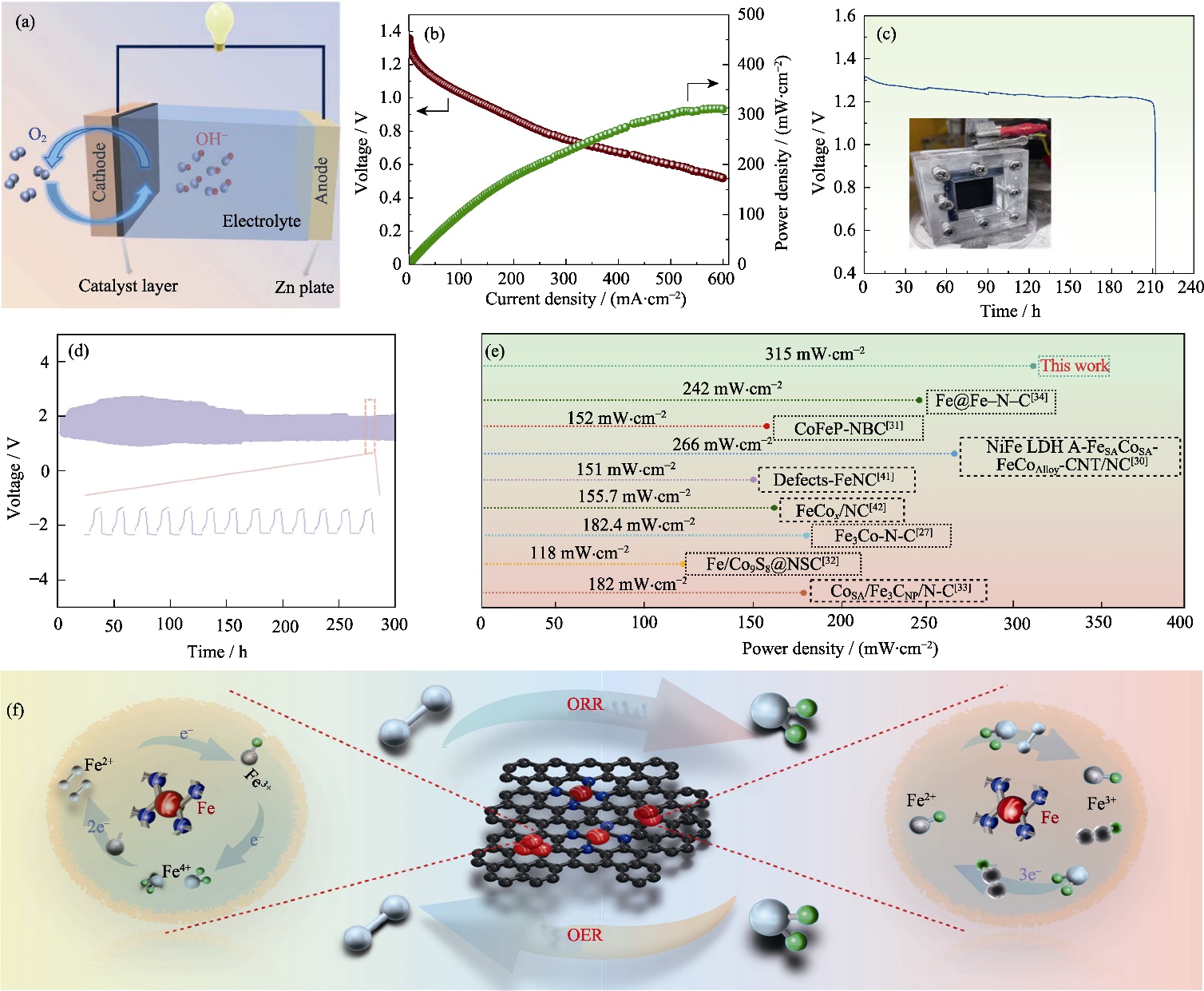
Fig. 5 Performance tests of Zn-air battery and schematic illustration of reaction mechanism (a) Schematic diagram of self-assembled Zn-air battery; (b) Polarization curves of the Zn-air battery assembled with Fe-N/Gra-0.02; (c) Discharge performance test of Fe-N/Gra-0.02 at a current density of 10 mA·cm-2; (d) Long-term charge-discharge cycling stability test; (e) Comparative bar chart of apparent current density for different electrocatalysts[27,30 -34,41 -42]; (f) Schematic diagram of valence state changes for Fe2+ and Fe3+ in battery reactions
| [1] | ZHANG W W, WANG Y, LI Y C, et al. First-principles calculations insight into non-noble-metal bifunctional electrocatalysts for zinc-air batteries. Applied Energy, 2025, 391: 125925. |
| [2] | WENG X L, LIU P P, ZHANG Y P, et al. A novel porous electronic conducting ceramics loaded with silver nano particles as cathode for zinc-air batteries. Journal of Inorganic Materials, 2018, 33(8): 854. |
| [3] | MA L T, N doped 2D porous carbon bifunctional catalyst for zinc-air battery. Journal of Inorganic Materials, 2019, 34(1): 103. |
| [4] | LV Q, LI M P, LI X D, et al. Introducing hydroxyl groups to tailor the d-band center of Ir atom through side anchoring for boosted ORR and HER. Journal of Energy Chemistry, 2024, 90(3): 144. |
| [5] | 张铭, 马林昊, 彭铠, 等. ORR/OER高效二维双功能电催化剂Cu2@C2N的第一性原理研究. 北京工业大学学报, 2025, 51(10): 1153. |
| [6] | HUANG H H, LI W, HU C C, et al. Role of bonding filling on HER/OER/ORR multifunctional catalytic activity in transition- metals-doped PdPX (X=S, Se, Te). Rare Metals, 2024, 43(10): 5126. |
| [7] | 刘扬, 张靖佳, 王红霞, 等. M(M=Fe,Co,Mn)-N-C催化剂用于燃料电池的氧化还原反应. 电池工业, 2021, 25(6): 308. |
| [8] | FAN Z C, WAN H, YU H, et al. Rational design of Fe-M-N-C based dual-atom catalysts for oxygen reduction electrocatalysis. Chinese Journal of Catalysis, 2023, 54(11): 56. |
| [9] | 张小玉, 薛冬萍, 杜宇, 等. MOF衍生碳基电催化剂限域催化O2还原和CO2还原反应. 高等学校化学学报, 2022, 43(3): 12. |
| [10] | 张洁兰, 邱晨曦, 陈丹, 等. 氮掺杂Pt-Co合金催化剂的制备及其氧还原性能. 工业催化, 2023, 31(6): 34. |
| [11] | CHANG W J, ZHOU X H, SUN Y S N, et al. Effect of support materials and loading levels on the CO oxidation performance of Sn-CuMnOx catalysts. Journal of Environmental Chemical Engineering, 2025, 13(6): 119151. |
| [12] | LIU L, ZHAO X Y, DING G F, et al. Fe3N sites anchored reduced graphene oxide activate peroxymonosulfate via singlet oxygen dominated process: performance and mechanisms. Chemical Engineering Journal, 2023, 470: 143820. |
| [13] | WU Y, CHEN J L, LIU J, et al. Iron phthalocyanine coupled with Co-Nx sites in carbon nanostraws for Zn-air batteries. Chemical Engineering Journal, 2025, 503: 158343. |
| [14] | CHEN K J, LIU K, AN P D, et al. Iron phthalocyanine with coordination induced electronic localization to boost oxygen reduction reaction. Nature Communications, 2020, 11: 4173. |
| [15] | CHEN J R, WANG M J, CHEN L H, et al. Intrinsic defect-rich carbon-supported iron phthalocyanine as beyond-Pt oxygen reduction catalysts for zinc-air batteries. Advanced Energy and Sustainability Research, 2024, 5: 2300498. |
| [16] | ZHANG H, ZHANG Z K, ZHANG C, et al. Highly dispersed ultrasmall iron phthalocyanine molecule clusters confined by mesopore-rich N-doped hollow carbon nanospheres for efficient oxygen reduction reaction and Zn-air battery. Chemical Engineering Journal, 2023, 469: 143996. |
| [17] | TING Y C, CHENG C C, LIN S H, et al. Synergistic Fe and Co binary single atoms based air cathodes for high performance and ultra-stable Zn-air batteries. Energy Storage Materials, 2024, 67: 103286. |
| [18] | SHU X X, CHEN Q W, YANG M M, et al. Tuning Co-catalytic sites in hierarchical porous N-doped carbon for high-performance rechargeable and flexible Zn-air battery. Advanced Energy Materials, 2023, 13: 2202871. |
| [19] | TAO S H, XIANG S M, YU Q Y, et al. Regulating electron region of central Fe atom in iron phthalocyanine by N, S-doped carbon nanofibers as efficient oxygen reduction catalysts for high- performance Zn-air battery. Carbon, 2024, 220: 118893. |
| [20] | GAO M, LIU J, YE G. et al. Molecular iron phthalocyanine catalysts on morphology-engineered graphene towards the oxygen reduction reaction. Science China Materials, 2023, 66(10): 2774. |
| [21] | 樊聪聪, 郭岩琪, 杜灿, 等. 多孔石墨烯基酞菁铁复合物的制备及其电催化氧还原性能研究. 辽宁化工, 2020, 49(5): 3. |
| [22] | LI Y P, LI Z F, SUN C Z, et al. Closely packed planar polyphthalocyanine iron/hierarchical three-dimensional graphene as an oxygen electrocatalyst for the ORR and OER, and zinc-air batteries. Sustainable Energy & Fuels, 2021, 5(20): 5216. |
| [23] | 王延杰. 双功能金属氧化物催化剂的制备与电化学性能测试. 桂林: 桂林理工大学硕士学位论文, 2024. |
| [24] | 闫雪绒. 新型燃料电池催化剂的制备及电化学性能测试研究. 太原: 山西大学硕士学位论文, 2023. |
| [25] | 朱广奇. 单原子ORR催化剂M-N-C的设计及制备技术研究. 天津: 天津大学硕士学位论文, 2019. |
| [26] | JI X X, WANG H F, HU P J. First principles study of Fenton reaction catalyzed by FeOCl: reaction mechanism and location of active site. Rare Metals, 2019, 38(8): 783. |
| [27] | DU Y, CHEN W, SHI Z, et al. In situ alloying strategy constructed Fe3Co-N-C electrocatalysts with designed 1D/3D hierarchical networks for rechargeable zinc-air battery. InfoMat, 2025, 7(9): e70032. |
| [28] | LI W M, ZHONG M X, CHEN X J, et al. Hierarchical amorphous bimetallic sulfide nanosheets supported on Co-C nanofibers to synergistically boost water electrolysis. Science China Materials, 2023, 66(6): 2235. |
| [29] | JOSE V, HU H, EDISON E, et al. Modulation of single atomic Co and Fe sites on hollow carbon nanospheres as oxygen electrodes for rechargeable Zn-air batteries. Small Methods, 2020, 5: 2000751. |
| [30] | HONG W X, WANG W H, CHANG Y H, et al. A Ni-Fe layered double hydroxide anchored FeCo nanoalloys and Fe-Co dual single-atom electrocatalysts for rechargeable and flexible zinc-air and aluminum-air batteries. Nano Energy, 2024, 121: 109236. |
| [31] | ZHANG P X, LIU S L, ZHOU J J, et al. Co-adjusting d-band center of Fe to accelerate proton coupling for efficient oxygen electrocatalysis. Small, 2024, 20: 2307662. |
| [32] | LEI X F, LI W J, SUN K J, et al. Fe doped Co9S8 nanoparticles embedded in N, S co-doped porous carbon as an efficient bifunctional electrocatalyst for rechargeable Zn-air batteries. Electrochimica Acta, 2024, 476: 143767. |
| [33] | LAI C X, ZHANG L, CHEN W X, et al. MOF-derived Co single atoms anchored on Fe3C-decorated carbon nanosheets for stable zinc-air batteries. Journal of Materials Chemistry A, 2025, 13(46): 39944. |
| [34] | AHMED Z, AKULA S, KOZLOVA J, et al. Hybrid high- performance oxygen reduction reaction Fe-N-C electrocatalyst for anion exchange membrane fuel cells. International Journal of Hydrogen Energy, 2024, 62: 849. |
| [35] | ZHAO W H, GONG J, YAN Y, et al. Metal-organic-framework- derived Co nanoparticles embedded in P, N-dual-doped porous carbon/rGO catalyst for water splitting and oxygen reduction. ChemNanoMat, 2024, 8(9): 2400073. |
| [36] | LI Y Y, WU X M, YE X, et al. Efficient electrocatalyst with multi Fe-based phase interfaces for oxygen reduction reaction in metal-air batteries. Journal of Power Sources, 2025, 662: 238723. |
| [37] | ZHANG L Y, CUI C X, LI J. Carbon materials co-doped with nitrogen and sulfur for highly efficient catalytic activity in oxygen reduction and evolution. International Journal of Electrochemical Science, 2024, 19(5): 100516. |
| [38] | LI M Q, XIANG Y, LI P, et al. Binary metal sulfide nanoparticles as a bifunctional electrocatalyst for durable Zn-air batteries. ACS Applied Nano Materials, 2025, 8(7): 3575. |
| [39] | QU X X, LI S X, WU Y P, et al. Dual-metal ORR catalyst with amorphous porous structure for high-performance zinc-air batteries. Journal of Alloys and Compounds, 2025, 1032: 181201. |
| [40] | SHEN Y, HE S Q, ZHUANG Y Y, et al. Polypyrrole template- assisted synthesis of tubular Fe-NC nanostructure-based electrocatalysts for efficient oxygen reduction reaction in rechargeable zinc-air battery. ACS Applied Nano Materials, 2023, 6(18): 16873. |
| [41] | YANG K Z, XU C, GUO P P, et al. Creating defects in the active site of Fe-N-C catalyst promotes catalytic performance for oxygen reduction reaction. ChemNanoMat, 2023, 9(8): e202300138. |
| [42] | WANG J Y, ZHANG T N, HE S, et al. FeCo5/nitrogen doped carbon as an efficient bifunctional oxygen electrocatalyst for Zn-air batteries. Journal of Electroanalytical Chemistry, 2024, 965: 118369. |
| [43] | ZHANG Y D, HE Y, LI J, et al. Understanding the mechanism of Fe-N-C catalyst oxygen reduction reaction performance enhancement: the impact of iron valence state and nitrogen content. ACS Applied Materials & Interfaces, 2025, 17(12): 18275. |
| [44] | ZHANG Y M, XIAO Q, WANG J, et al. Electrocatalysis- dependent dynamic surface reconstruction of redox couples for bifunctional electrocatalysts. Applied Catalysis B: Environment and Energy, 2025, 376: 125468. |
| [1] | WEI Lianjin, QI Zhijie, WANG Xin, ZHU Junwu, FU Yongsheng. Modification of Nanodiamond and Its Application in Electrocatalytic Oxygen Reduction Reaction [J]. Journal of Inorganic Materials, 2026, 41(3): 273-288. |
| [2] | LI Xueru, MA Zhejie, GUO Yujie, LI Ping. Influence of Support Characteristics on Coverage of Ionomer and Oxygen Reduction Performance for Pt/C Catalysts [J]. Journal of Inorganic Materials, 2025, 40(12): 1395-1404. |
| [3] | HU Xuemin, ZHANG Xingjian, JIANG Zhihao, HUANG Liwen, DING Kaining, ZHANG Shengli. First-principles Study on Oxygen Evolution Reaction Activity of CoPS3 Quantum Dots Edge States Modified with Oxygen [J]. Journal of Inorganic Materials, 2025, 40(11): 1229-1236. |
| [4] | LIU Lei, GUO Ruihua, WANG Li, WANG Yan, ZHANG Guofang, GUAN Lili. Oxygen Reduction Reaction on Pt3Co High-index Facets by Density Functional Theory [J]. Journal of Inorganic Materials, 2025, 40(1): 39-46. |
| [5] | LI Jiaqi, LI Xiaosong, LI Xuanhe, ZHU Xiaobing, ZHU Aimin. Transition Metal-doped Manganese Oxide: Synthesis by Warm Plasma and Electrocatalytic Performance for Oxygen Evolution Reaction [J]. Journal of Inorganic Materials, 2024, 39(7): 835-844. |
| [6] | YUE Quanxin, GUO Ruihua, WANG Ruifen, AN Shengli, ZHANG Guofang, GUAN Lili. 3D Core-shell Structured NiMoO4@CoFe-LDH Nanorods: Performance of Efficient Oxygen Evolution Reaction and Overall Water Splitting [J]. Journal of Inorganic Materials, 2024, 39(11): 1254-1264. |
| [7] | YANG Daihui, SUN Tian, TIAN Hexin, SHI Xiaofei, MA Dongwei. Iron-nitrogen-codoped Mesoporous Carbon: Facile Synthesis and Catalytic Performance of Oxygen Reduction Reaction [J]. Journal of Inorganic Materials, 2023, 38(11): 1309-1315. |
| [8] | SUN Lian, GU Quanchao, YANG Yaping, WANG Honglei, YU Jinshan, ZHOU Xingui. Two-dimensional Transition Metal Dichalcogenides for Electrocatalytic Oxygen Reduction Reaction [J]. Journal of Inorganic Materials, 2022, 37(7): 697-709. |
| [9] | WANG Peng, JIN Zunlong, CHEN Ningguang, LIU Yonghao. Theoretical Investigation of Mo Doped α-MnO2 Electrocatalytic Oxygen Evolution Reaction [J]. Journal of Inorganic Materials, 2022, 37(5): 541-546. |
| [10] | JIANG Lili, XU Shuaishuai, XIA Baokai, CHEN Sheng, ZHU Junwu. Defect Engineering of Graphene Hybrid Catalysts for Oxygen Reduction Reactions [J]. Journal of Inorganic Materials, 2022, 37(2): 215-222. |
| [11] | FU Yongsheng, BI Min, LI Chun, SUN Jingwen, WANG Xin, ZHU Junwu. Research Progress on Non-noble Metal/Nitrogen-doped Carbon Composite Materials in Electrocatalytic Oxygen Evolution Reaction [J]. Journal of Inorganic Materials, 2022, 37(2): 163-172. |
| [12] | LIU Ziruo, LIU Wei, HAO Ce, HU Jinwen, SHI Yantao. Honeycomb-like Carbon-supported Fe Single Atom Catalyst: Preparation and Electrocatalytic Performance in Oxygen Reduction Reaction [J]. Journal of Inorganic Materials, 2021, 36(9): 943-949. |
| [13] | HAO Ce, LIU Ziruo, LIU Wei, SHI Yantao. Research Progress of Carbon-supported Metal Single Atom Catalysts for Oxygen Reduction Reaction [J]. Journal of Inorganic Materials, 2021, 36(8): 820-834. |
| [14] | ZHU Yong, GU Jun, YU Tao, HE Haitong, YAO Rui. Synthesis and Property of Platinum-cobalt Alloy Nano Catalyst [J]. Journal of Inorganic Materials, 2021, 36(3): 299-305. |
| [15] | DING Sheng, NING Kai, YUAN Binxia, PAN Weiguo, YIN Shibin, LIU Jianfeng. Durability of Fe-N/C Catalysts with Different Nanostructures for Electrochemical Oxygen Reduction in Alkaline Solution [J]. Journal of Inorganic Materials, 2020, 35(8): 953-958. |
| Viewed | ||||||
|
Full text |
|
|||||
|
Abstract |
|
|||||
