
Journal of Inorganic Materials ›› 2026, Vol. 41 ›› Issue (6): 795-804.DOI: 10.15541/jim20250459
Special Issue: 【信息功能】忆阻器材料与器件(202606)
• RESEARCH ARTICLE • Previous Articles Next Articles
SUN Li1( ), XU Yongshan2, GAO Yihua1()
Received:2025-11-18
Revised:2025-12-31
Published:2026-06-20
Online:2026-01-22
Contact:
GAO Yihua, professor. E-mail: gaoyihua@hust.edu.cnAbout author:SUN Li (1994-), female, PhD. E-mail: Sunl_qdu@163.com
Supported by:CLC Number:
SUN Li, XU Yongshan, GAO Yihua. Photonic-detection and Bionic-synapse of Graphene/Bi2O2Se/Graphene Bi-heterojunction Device[J]. Journal of Inorganic Materials, 2026, 41(6): 795-804.
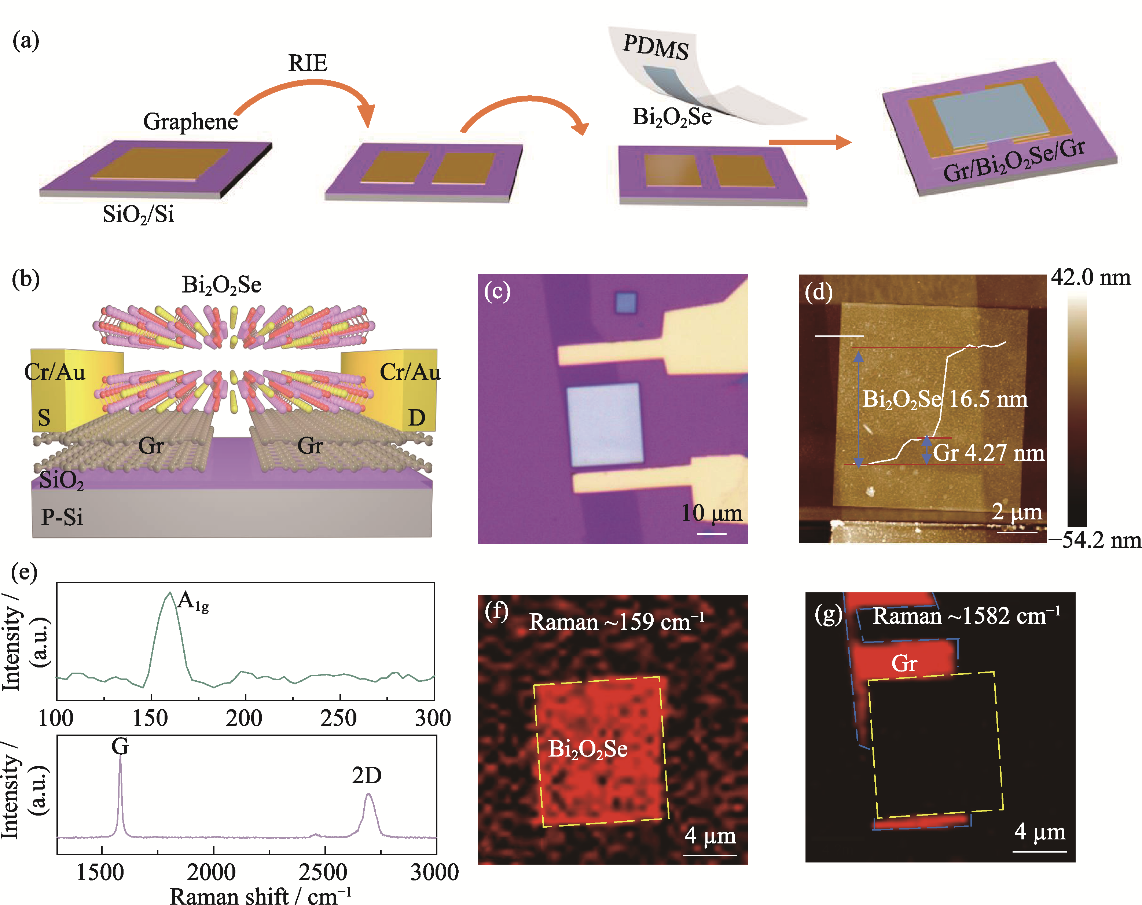
Fig. 1 Characterization of Gr/Bi2O2Se/Gr bi-heterostructure device (a) Schematic diagram of device fabrication; (b) Schematic diagram of the structure; (c) Optical microscope image; (d) AFM image and edge height profile; (e) Raman spectra; (f, g) Raman mapping images of (f) Bi2O2Se and (g) graphene
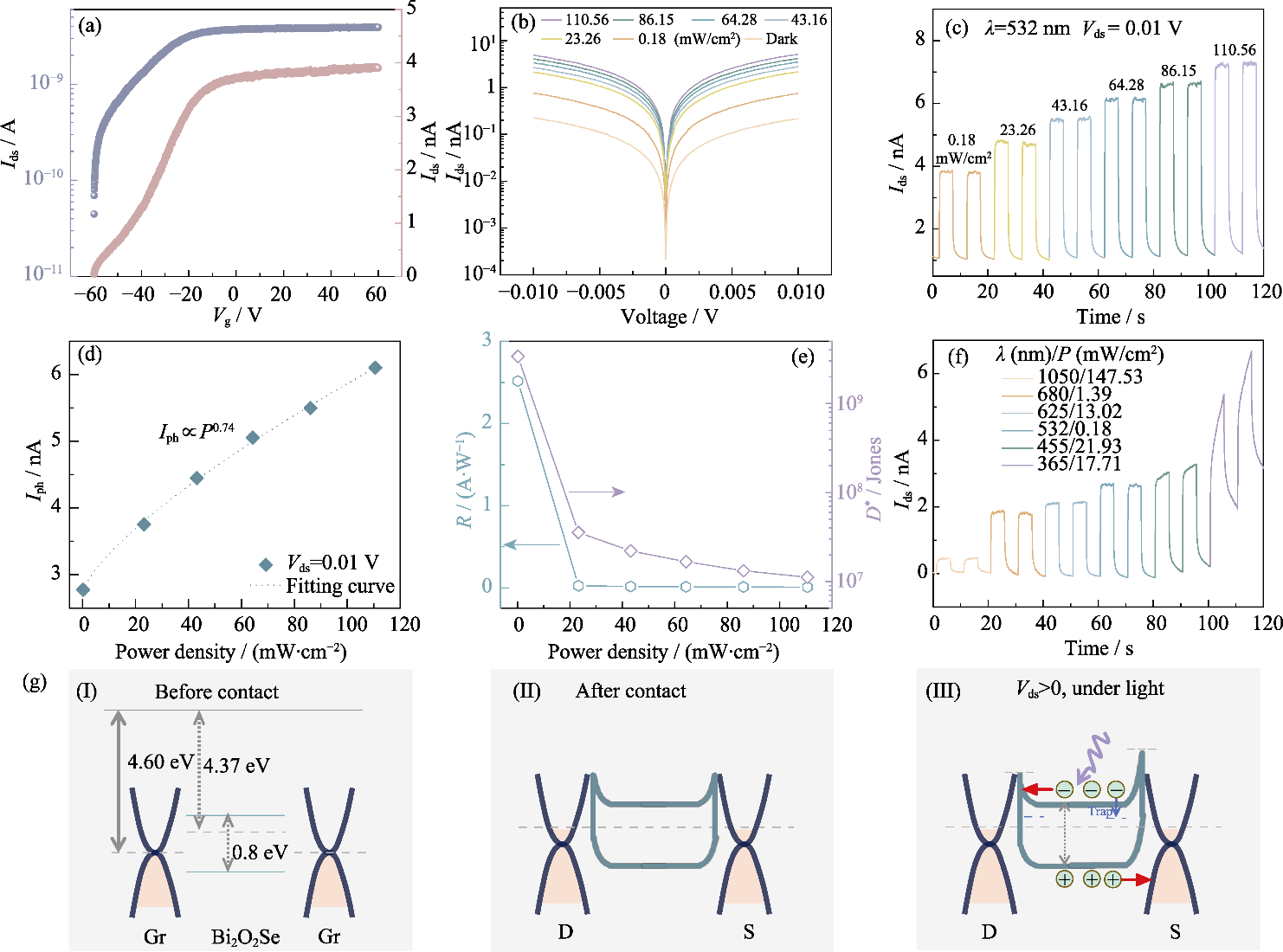
Fig. 2 Performance of Gr/Bi2O2Se/Gr bi-heterojunction device (a) Output characteristic curves; (b) Transfer characteristic curves; (c) Photocurrent versus light power density curves; (d) Relationship curve between photocurrent and power density; (e) Responsivity and detectivity; (f) Transient current responses under different illumination wavelengths; (g) Schematic diagrams of the energy bands. Colorful figures are available on website
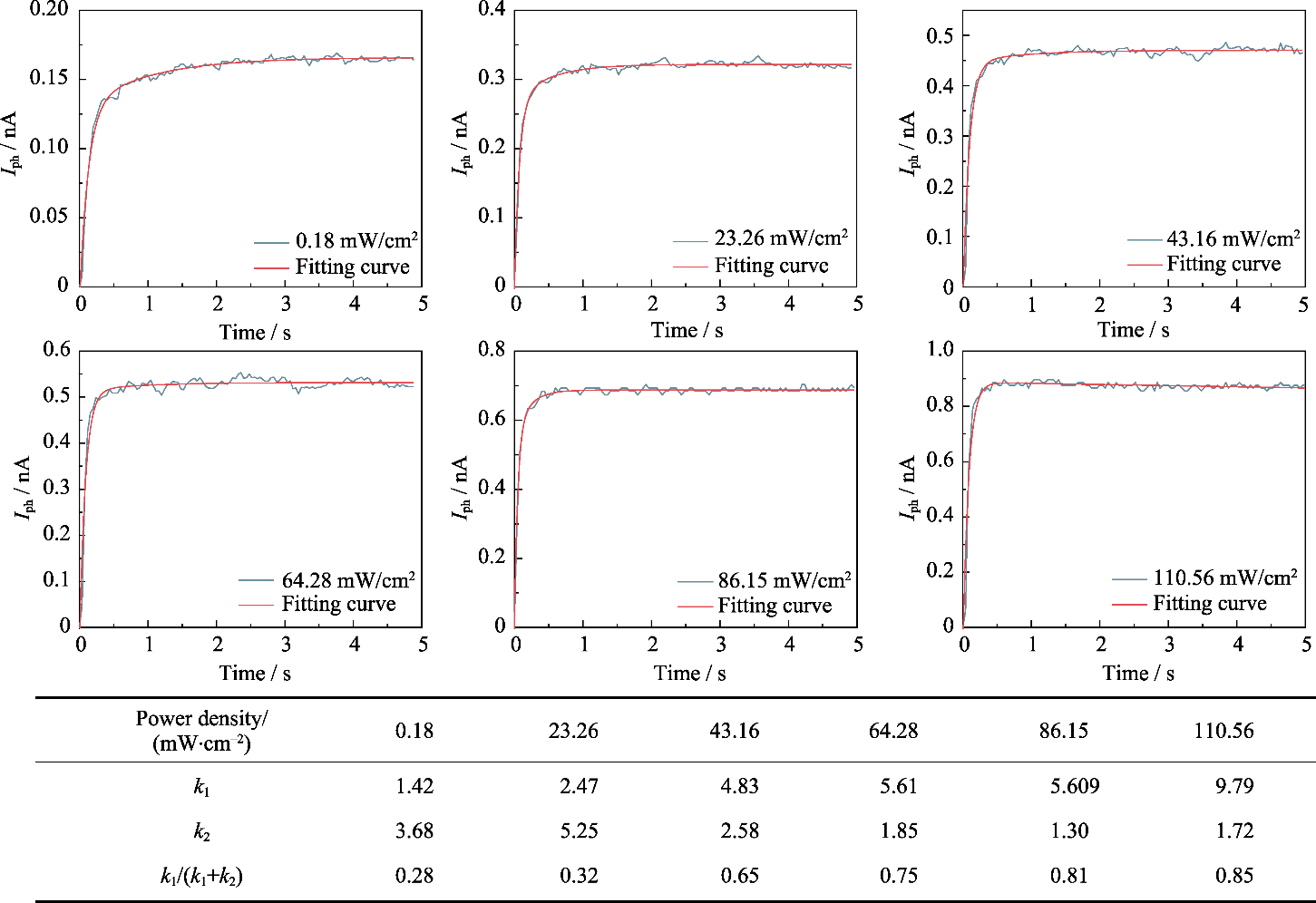
Fig. 3 Light current transient response curves and fitting curves under different light power densities Colorful figures are available on website
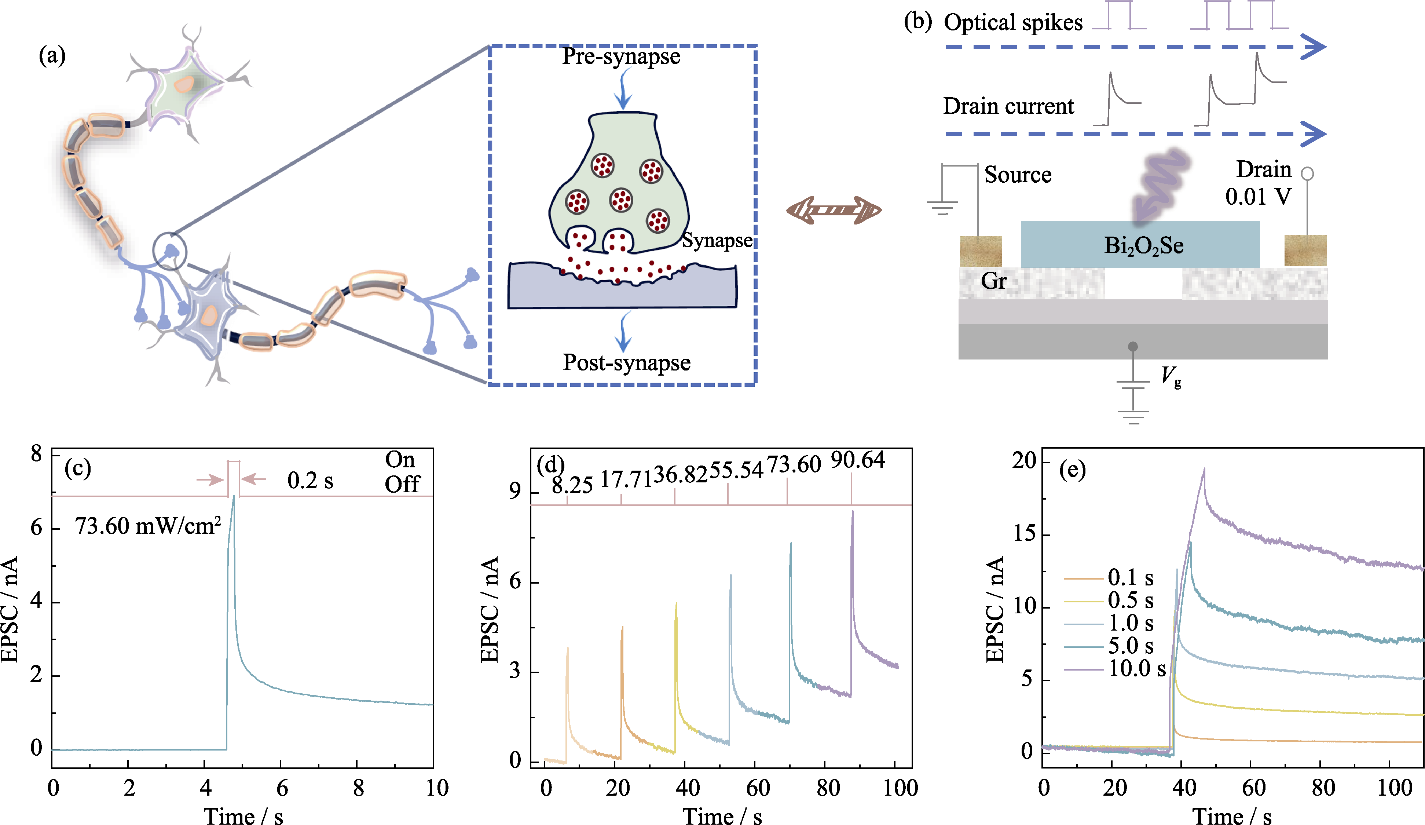
Fig. 4 Light-regulated synaptic performance of Gr/Bi2O2Se/Gr bi-heterojunction device (a) Schematic diagram of a biological synapse; (b) Schematic diagram of the device working principle; (c) EPSC response of the device under one light pulse; (d) Light intensity dependent EPSC response; (e) EPSC responses under different light pulse durations
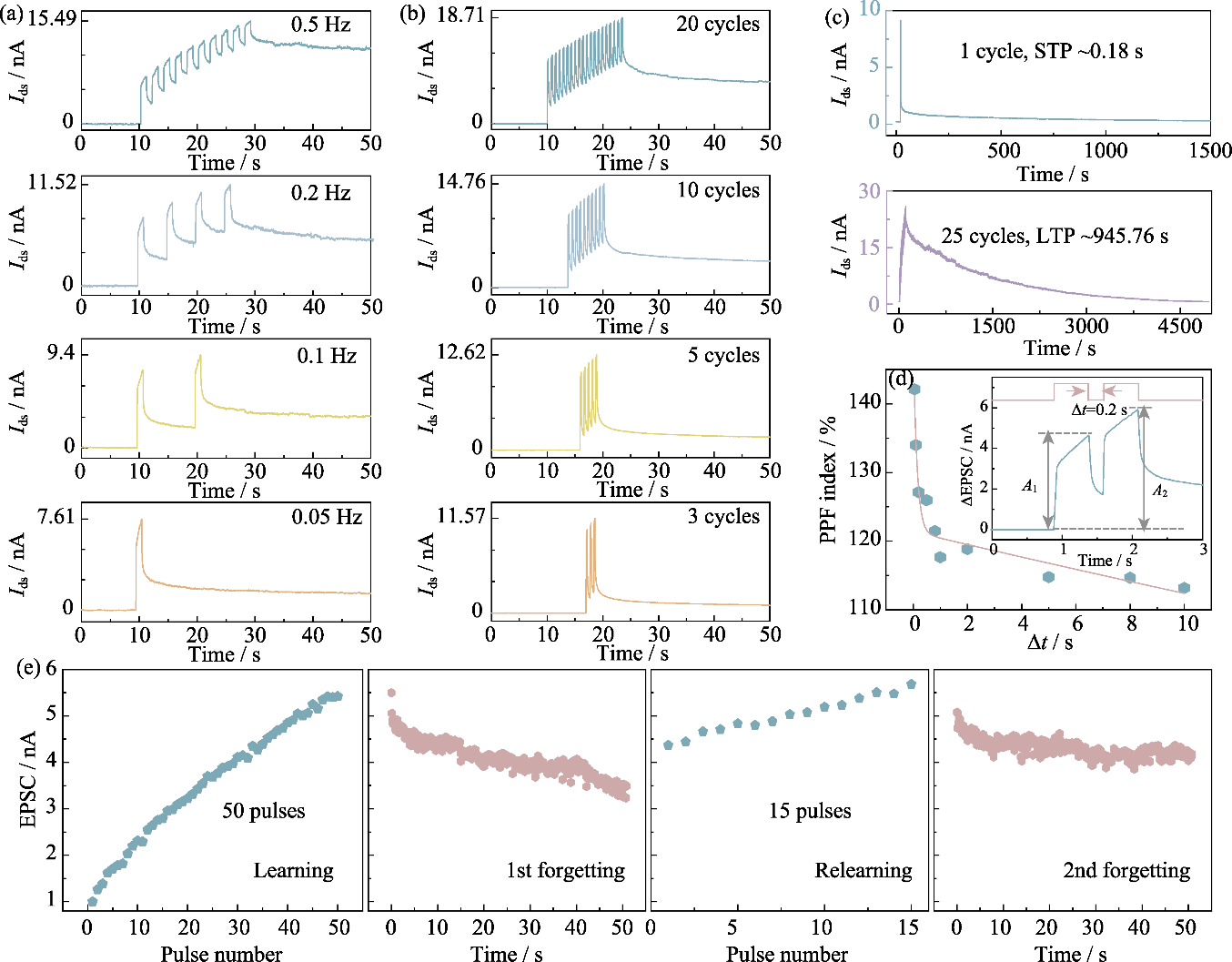
Fig. 5 Synaptic plasticity of Gr/Bi2O2Se/Gr bi-heterojunction device (a) EPSC responses of the device under different light pulse frequencies; (b) Transition from short-term plasticity to long-term plasticity with the increase of light pulse number; (c) Photocurrent decay characteristics; (d) Relationship between paired-pulse facilitation (PPF) index and inter-pulse interval (Δt), with inset showing the excitatory postsynaptic current triggered by a pair of light pulses with a duration of 0.5 s and an interval of 0.2 s; (e) “Learning-forgetting-relearning” behavior of the device
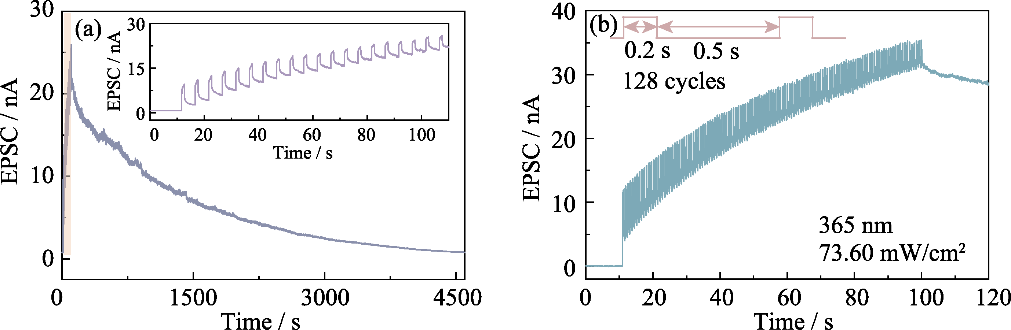
Fig. 6 Retention behavior of Gr/Bi2O2Se/Gr device after (a) 25 and (b) 128 light pulses
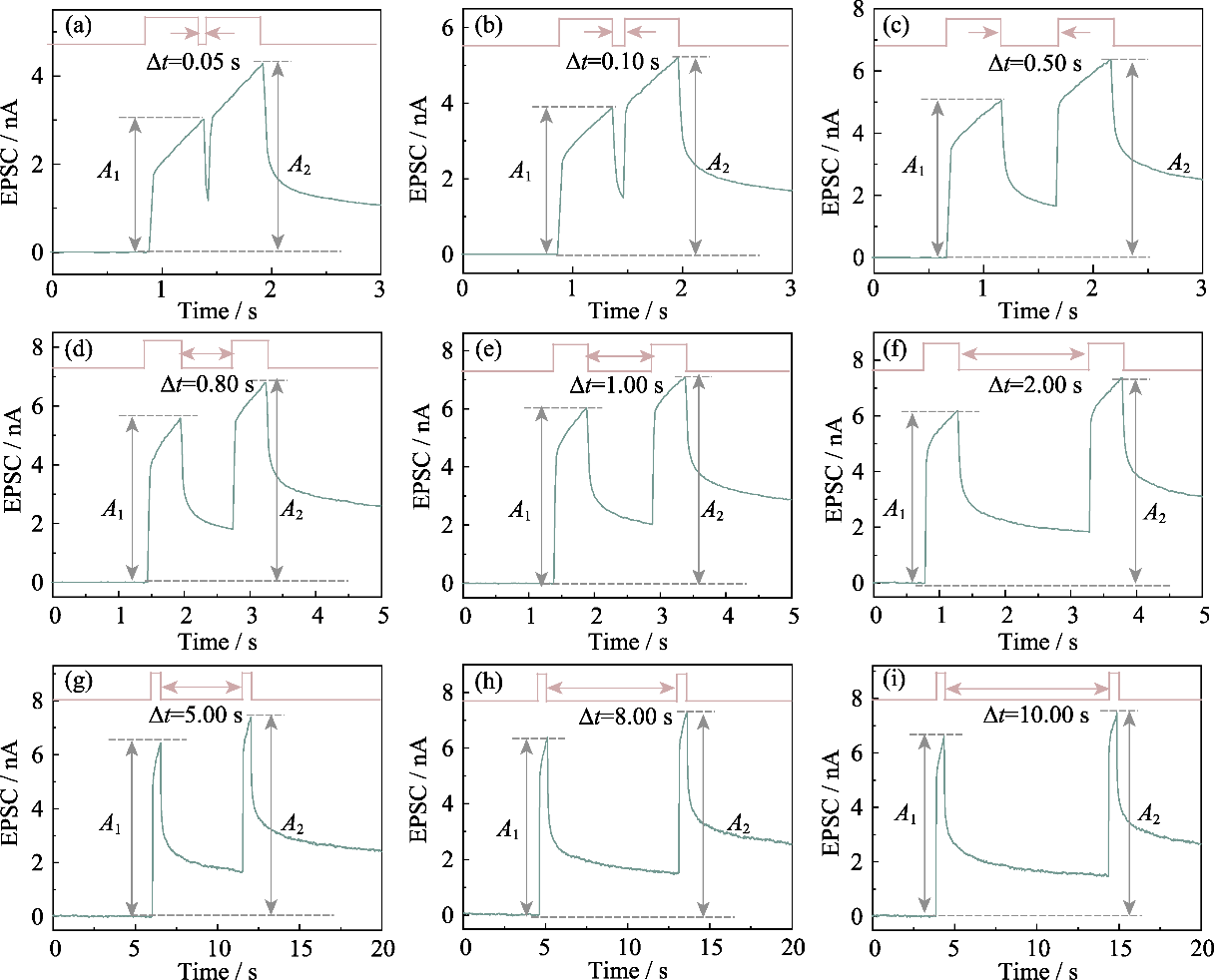
Fig. 7 Stimulated PPF behavior of Gr/Bi2O2Se/Gr bi-heterojunction device A pair of light stimuli with a duration of 0.50 s and inter-pulse intervals of (a) 0.05, (b) 0.10, (c) 0.50, (d) 0.80, (e) 1.00, (f) 2.00, (g) 5.00, (h) 8.00 and (i) 10.00 s
| Device | Voltage/V | Wavelength/nm | EPSC/nA | PPF/% | Ref. |
|---|---|---|---|---|---|
| MoS2/h-BN/α-In2Se3 | 1 | 405 | 0.3 | 240 | [ |
| MoS2/SnSe2 | 1 | 400 | 0.3 | 1.25 | [ |
| Bi2O2Se-Vse | 0 | 532 | 0.3 | 133 | [ |
| c-PtTe2/PtSe2 | 1 | 625 | 15 | 1.25 | [ |
| Te/SnS2 | 2 | 532 | 0.1 | 187 | [ |
| p-WSe2/n-Ta2NiS5 | -1 | 1064 | 0.01 | 23 | [ |
| Ph-BTBT-10 2DMC | -1 | 365 | 0.15 | 248 | [ |
| Gr/Bi2O2Se/Gr | 0.01 | 365 | 6.91 | 142.1 | This work |
Table 1 Properties comparison between the Gr/Bi2O2Se/Gr device and other reported synapse
| Device | Voltage/V | Wavelength/nm | EPSC/nA | PPF/% | Ref. |
|---|---|---|---|---|---|
| MoS2/h-BN/α-In2Se3 | 1 | 405 | 0.3 | 240 | [ |
| MoS2/SnSe2 | 1 | 400 | 0.3 | 1.25 | [ |
| Bi2O2Se-Vse | 0 | 532 | 0.3 | 133 | [ |
| c-PtTe2/PtSe2 | 1 | 625 | 15 | 1.25 | [ |
| Te/SnS2 | 2 | 532 | 0.1 | 187 | [ |
| p-WSe2/n-Ta2NiS5 | -1 | 1064 | 0.01 | 23 | [ |
| Ph-BTBT-10 2DMC | -1 | 365 | 0.15 | 248 | [ |
| Gr/Bi2O2Se/Gr | 0.01 | 365 | 6.91 | 142.1 | This work |
| [1] | NOVOSELOV K S, GEIM A K, MOROZOV S V, et al. Electric field effect in atomically thin carbon films. Science, 2004, 306(5696): 666. |
| [2] | KIM K S, KWON J, RYU H, et al. The future of two-dimensional semiconductors beyond Moore’s law. Nature Nanotechnology, 2024, 19(7): 895. |
| [3] | AKINWANDE D, HUYGHEBAERT C, WANG C H, et al. Graphene and two-dimensional materials for silicon technology. Nature, 2019, 573(7775): 507. |
| [4] | XING R, ZHANG X, FAN X, et al. Coupling strategies of multi-physical fields in 2D materials-based photodetectors. Advanced Materials, 2025, 37(16): 2501833. |
| [5] | BA K, WANG J L, HAN M K. Perspectives for infrared properties and applications of MXene. Journal of Inorganic Materials, 2024, 39(2): 162. |
| [6] | WANG S, LIU X, XU M, et al. Two-dimensional devices and integration towards the silicon lines. Nature Materials, 2022, 21(11): 1225. |
| [7] | DAS S, SEBASTIAN A, POP E, et al. Transistors based on two-dimensional materials for future integrated circuits. Nature Electronics, 2021, 4(11): 786. |
| [8] | LIU Y, DUAN X, SHIN H J, et al. Promises and prospects of two-dimensional transistors. Nature, 2021, 591(7848): 43. |
| [9] | TAN C, YU M, TANG J, et al. 2D fin field-effect transistors integrated with epitaxial high-k gate oxide. Nature, 2023, 616(7955): 66. |
| [10] | WYSS K M, LUONG D X, TOUR J M. Large-scale syntheses of 2D materials: flash joule heating and other methods. Advanced Materials, 2022, 34(8): 2106970. |
| [11] | LI L, SHEN G Z. 2D MXenes based flexible photodetectors: progress and prospects. Journal of Inorganic Materials, 2024, 39(2): 186. |
| [12] | LI S, LIU X, YANG H, et al. Two-dimensional perovskite oxide as a photoactive high-κ gate dielectric. Nature Electronics, 2024, 7(3): 216. |
| [13] | ZHANG Q, HOU L, SHAUTSOVA V, et al. Ultrathin all-2D lateral diodes using top and bottom contacted laterally spaced graphene electrodes to WS2 semiconductor monolayers. ACS Applied Materials & Interfaces, 2023, 15(14): 18012. |
| [14] | TAN C, YIN S, CHEN J, et al. Broken-gap PtS2/WSe2 van der Waals heterojunction with ultrahigh reverse rectification and fast photoresponse. ACS Nano, 2021, 15(5): 8328. |
| [15] | WU F, XIA H, SUN H, et al. AsP/InSe van der Waals tunneling heterojunctions with ultrahigh reverse rectification ratio and high photosensitivity. Advanced Functional Materials, 2019, 29(12): 1900314. |
| [16] | LIU X, QU D, LI H M, et al. Modulation of quantum tunneling via a vertical two-dimensional black phosphorus and molybdenum disulfide p-n junction. ACS Nano, 2017, 11(9): 9143. |
| [17] | LI J, WANG Z, WEN Y, et al. High-performance near-infrared photodetector based on ultrathin Bi2O2Se nanosheets. Advanced Functional Materials, 2018, 28(10): 1706437. |
| [18] | WANG W, MENG Y, ZHANG Y, et al. High electron mobility and quantum oscillations in non-encapsulated ultrathin semiconducting Bi2O2Se. Nature Nanotechnology, 2017, 12: 530. |
| [19] | YIN J, TAN Z, HONG H, et al. Ultrafast and highly sensitive infrared photodetectors based on two-dimensional oxyselenide crystals. Nature Communications, 2018, 9: 3311. |
| [20] | ZHANG Z, LI T, WU Y, et al. Truly concomitant and independently expressed short-and long-term plasticity in a Bi2O2Se-based three-terminal memristor. Advanced Materials, 2019, 31(3): 1805769. |
| [21] | LUO P, ZHUGE F, WANG F, et al. PbSe quantum dots sensitized high-mobility Bi2O2Se nanosheets for high-performance and broadband photodetection beyond 2 μm. ACS Nano, 2019, 13(8): 9028. |
| [22] | FAKIH I, DURNAN O, MAHVASH F, et al. Selective ion sensing with high resolution large area graphene field effect transistor arrays. Nature Communications, 2020, 11: 3226. |
| [23] | WANG W, MENG Y, WANG W, et al. Highly efficient full van der Waals 1D p-Te/2D n-Bi2O2Se heterodiodes with nanoscale ultra-photosensitive channels. Advanced Functional Materials, 2022, 32(30): 2203003. |
| [24] | LIU W, LV J, PENG L, et al. Graphene charge-injection photodetectors. Nature Electronics, 2022, 5(5): 281. |
| [25] | SHIN J, YOO H. Photogating effect-driven photodetectors and their emerging applications. Nanomaterials, 2023, 13(5): 882. |
| [26] | TSAI T H, LIANG Z Y, LIN Y C, et al. Photogating WS2 photodetectors using embedded WSe2 charge puddles. ACS nano, 2020, 14(4): 4559. |
| [27] | 张世斌, 孔光临, 徐艳月, 等. 微量硼掺杂非晶硅的瞬态光电导衰退及其光致变化. 物理学报, 2002, 51(1): 111. |
| [28] | HAN J, FANG C, YU M, et al. A high-performance Schottky photodiode with asymmetric metal contacts constructed on 2D Bi2O2Se. Advanced Electronic Materials, 2022, 8(7): 2100987. |
| [29] | LIU J, HAO Q, GAN H, et al. Selectively modulated photoresponse in type-I heterojunction for ultrasensitive self-powered photodetectors. Laser & Photonics Reviews, 2022, 16(11): 2200338. |
| [30] | YANG J L, WANG L J, RUAN S Y, et al. Highly weak-light sensitive and dual-band switchable photodetector based on CuI/Si unilateral heterojunction. Journal of Inorganic Materials, 2024, 39(9): 1063. |
| [31] | LIU C H, CHANG Y C, NORRIS T B, et al. Graphene photodetectors with ultra-broadband and high responsivity at room temperature. Nature nanotechnology, 2014, 9(4): 273. |
| [32] | SUN L, XU Y, HUO G, et al. Multifunctional neuromorphic optoelectronic computing using all 2D floating-gate transistors. Nano Energy, 2025, 143: 111311. |
| [33] | GAO W, ZHANG S, ZHANG F, et al. 2D WS2 based asymmetric Schottky photodetector with high performance. Advanced Electronic Materials, 2021, 7(7): 2000964. |
| [34] | CHEN J, ZHANG Z, FENG J, et al. 2D InSe self-powered Schottky photodetector with the same metal in asymmetric contacts. Advanced Materials Interfaces, 2022, 9(35): 2200075. |
| [35] | HUANG W, HANG P, WANG Y, et al. Zero-power optoelectronic synaptic devices. Nano Energy, 2020, 73: 104790. |
| [36] | HAO Z, WANG H, JIANG S, et al. Retina-inspired self-powered artificial optoelectronic synapses with selective detection in organic asymmetric heterojunctions. Advanced Science, 2022, 9(7): 2103494. |
| [37] | WANG J Y, WAN C J, WAN Q. Dual-gate IGZO-based neuromorphic transistors with stacked Al2O3/chitosan gate dielectrics. Journal of Inorganic Materials, 2023, 38(4): 445. |
| [38] | WANG X, ZONG Y, LIU D, et al. Advanced optoelectronic devices for neuromorphic analog based on low-dimensional semiconductors. Advanced Functional Materials, 2023, 33(15): 2213894. |
| [39] | ZHANG H S, DONG X M, ZHANG Z C, et al. Co-assembled perylene/graphene oxide photosensitive heterobilayer for efficient neuromorphics. Nature Communications, 2022, 13: 4996. |
| [40] | WANG W X, GAO S, LI Y, et al. Artificial optoelectronic synapses based on TiNxO2-x/MoS2 heterojunction for neuromorphic computing and visual system. Advanced Functional Materials, 2021, 31(34): 2101201. |
| [41] | HUANG W, HANG P, XIA X, et al. Two-terminal self-rectifying optoelectronic synaptic devices with largest-dynamic-range updates. Applied Materials Today, 2023, 30: 101728. |
| [42] | HE J, CHEN K, HUANG C, et al. Explicit gain equations for single crystalline photoconductors. ACS Nano, 2020, 14(3): 3405. |
| [43] | LI X, CHEN F, WANG X, et al. Emulation of optical and electrical synaptic functions in MoS2/SnSe2 van der Waals heterojunction memtransistors. Japanese Journal of Applied Physics, 2024, 63(5): 056502. |
| [44] | REN X, HE X, DUAN Z, et al. Self-powered and broadband optical synapse device based on Se-vacancy Bi2O2Se for artificial vision system application. ACS Photonics, 2024, 11(11): 4990. |
| [45] | HAN S S, SHIN J C, GHANIPOUR A, et al. High mobility transistors and flexible optical synapses enabled by wafer-scale chemical transformation of Pt-based 2D layers. ACS Applied Materials & Interfaces, 2024, 16(28): 36599. |
| [46] | ZHANG Y, TANG Y, LIU K, et al. Optoelectronic synapse based on Te/SnS2 heterostructure with integrated sensing-memory- computing for neuromorphic visual system. Advanced Optical Materials, 2025, 13(26): e01371. |
| [47] | HOU P, TAN S, ZHENG S. Design and implementation of an infrared artificial visual neural synapse based on a p-WSe2/ n-Ta2NiS5 van der Waals heterojunction. Journal of Materials Chemistry C, 2024, 12(41): 16722. |
| [48] | DONG M, ZHANG Y, ZHU J, et al. All-in-one 2D molecular crystal optoelectronic synapse for polarization-sensitive neuromorphic visual system. Advanced Materials, 2024, 36(40): 2409550. |
| [1] | WANG Jiahui, LIU Jingjing, QIU Yi, WANG Yongxia, CUI Xiangzhi. Bifunctional Oxygen Electrocatalytic Performance of Atomically Dispersed Fe Anchored on N-doped Graphene [J]. Journal of Inorganic Materials, 2026, 41(6): 814-822. |
| [2] | QIN Ying, YAO Zhuo, ZHENG Lijun, BAO Shuo, LI Peng, GUO Shiqi. Sulfur-doped Graphene/Conductive Polymer Composites: Preparation and Performance as Electrode of Flexible Supercapacitor [J]. Journal of Inorganic Materials, 2026, 41(5): 604-610. |
| [3] | CHENG Aopeng, WANG Yuewen, XU Wentao, LIU Quanwei, ZHANG Haitao, ZHOU Youfu. Fabrication of Graphene-reinforced Alumina Ceramic Composites via Adsorption-precipitation Self-assembly Combined with Spark Plasma Sintering [J]. Journal of Inorganic Materials, 2026, 41(4): 536-544. |
| [4] | ZHU Kaihuang, YANG Shijie, LI Xinge, SONG Guanqing, SHI Gansheng, WANG Yan, REN Xiaomeng, LU Yao, XU Xinhong, SUN Jing. Graphene Oxide Modified UiO-66 Based Metal Organic Framework Gel: Preparation and Efficient Toluene Adsorption Performance [J]. Journal of Inorganic Materials, 2026, 41(4): 519-526. |
| [5] | FAN Yuzhu, WANG Yuan, WANG Linyan, XIANG Meiling, YAN Yuting, LI Benhui, LI Min, WEN Zhidong, WANG Haichao, CHEN Yongfu, QIU Huidong, ZHAO Bo, ZHOU Chengyu. Graphene Oxide-based Adsorbents for Pb(II) Removing in Water: Progresses on Synthesis, Performance and Mechanism [J]. Journal of Inorganic Materials, 2026, 41(1): 12-26. |
| [6] | YANG Mingkai, HUANG Zeai, ZHOU Yunxiao, LIU Tong, ZHANG Kuikui, TAN Hao, LIU Mengying, ZHAN Junjie, CHEN Guoxing, ZHOU Ying. Co-production of Few-layer Graphene and Hydrogen from Methane Pyrolysis Based on Cu and Metal Oxide-KCl Molten Medium [J]. Journal of Inorganic Materials, 2025, 40(5): 473-480. |
| [7] | GAO Chenguang, SUN Xiaoliang, CHEN Jun, LI Daxin, CHEN Qingqing, JIA Dechang, ZHOU Yu. SiBCN-rGO Ceramic Fibers Based on Wet Spinning Technology: Microstructure, Mechanical and Microwave-absorbing Properties [J]. Journal of Inorganic Materials, 2025, 40(3): 290-296. |
| [8] | WANG Yue, WANG Xin, YU Xianli. Room-temperature Ferromagnetic All-carbon Films Based on Reduced Graphene Oxide [J]. Journal of Inorganic Materials, 2025, 40(3): 305-313. |
| [9] | LI Honglan, ZHANG Junmiao, SONG Erhong, YANG Xinglin. Mo/S Co-doped Graphene for Ammonia Synthesis: a Density Functional Theory Study [J]. Journal of Inorganic Materials, 2024, 39(5): 561-568. |
| [10] | SUN Chuan, HE Pengfei, HU Zhenfeng, WANG Rong, XING Yue, ZHANG Zhibin, LI Jinglong, WAN Chunlei, LIANG Xiubing. SiC-based Ceramic Materials Incorporating GNPs Array: Preparation and Mechanical Characterization [J]. Journal of Inorganic Materials, 2024, 39(3): 267-273. |
| [11] | WAN Hujie, XIAO Xu. Terahertz Electromagnetic Shielding and Absorbing of MXenes and Their Composites [J]. Journal of Inorganic Materials, 2024, 39(2): 129-144. |
| [12] | WANG Yanli, QIAN Xinyi, SHEN Chunyin, ZHAN Liang. Graphene Based Mesoporous Manganese-Cerium Oxides Catalysts: Preparation and Low-temperature Catalytic Reduction of NO [J]. Journal of Inorganic Materials, 2024, 39(1): 81-89. |
| [13] | YANG Pingjun, LI Tiehu, LI Hao, DANG Alei. Effect of Graphene on Graphitization, Electrical and Mechanical Properties of Epoxy Resin Carbon Foam [J]. Journal of Inorganic Materials, 2024, 39(1): 107-112. |
| [14] | DONG Yiman, TAN Zhan’ao. Research Progress of Recombination Layers in Two-terminal Tandem Solar Cells Based on Wide Bandgap Perovskite [J]. Journal of Inorganic Materials, 2023, 38(9): 1031-1043. |
| [15] | CHEN Saisai, PANG Yali, WANG Jiaona, GONG Yan, WANG Rui, LUAN Xiaowan, LI Xin. Preparation and Properties of Green-yellow Reversible Electro-thermochromic Fabric [J]. Journal of Inorganic Materials, 2022, 37(9): 954-960. |
| Viewed | ||||||
|
Full text |
|
|||||
|
Abstract |
|
|||||
