无机材料学报 ›› 2026, Vol. 41 ›› Issue (7): 939-946.DOI: 10.15541/jim20260018 CSTR: 32189.14.10.15541/jim20260018
刘今霄1,2( ), 刘镇汉1,2, 陈星宇1,2, 周钲洋1,2, 仇鹏飞1,2, 张家伟1,2(), 史迅1,2()
收稿日期:2026-01-13
修回日期:2026-03-14
出版日期:2026-07-20
网络出版日期:2026-03-18
通讯作者:
张家伟, 研究员. E-mail: jiaweizhang@mail.sic.ac.cn;作者简介:刘今霄(2000-), 女, 硕士研究生. E-mail: liujinxiao23@mails.ucas.ac.cn
基金资助:
LIU Jinxiao1,2(), LIU Zhenhan1,2, CHEN Xingyu1,2, ZHOU Zhengyang1,2, QIU Pengfei1,2, ZHANG Jiawei1,2(), SHI Xun1,2()
Received:2026-01-13
Revised:2026-03-14
Published:2026-07-20
Online:2026-03-18
Contact:
ZHANG Jiawei, professor. E-mail: jiaweizhang@mail.sic.ac.cn;About author:LIU Jinxiao (2000-), female, Master candidate. E-mail: liujinxiao23@mails.ucas.ac.cn
Supported by:摘要:
Ag2S0.4Te0.6作为一种具有良好塑性及热电性能的无机半导体材料, 在可穿戴电子设备领域具有潜在的应用价值。近期研究表明, 优化制备工艺(如退火处理)可显著提升其塑性, 而该性能与材料的相结构密切相关。本研究收集了退火前后Ag2S0.4Te0.6粉末样品在110 ~700 K温度范围内的高分辨率同步辐射粉末X射线衍射数据, 结合Rietveld结构精修、高分辨透射电子显微镜以及原子对分布函数技术, 详细分析了退火工艺对粉末样品的相组成与结构演变行为的影响。结果表明, 退火前Ag2S0.4Te0.6粉末样品主要为非晶态, 仅含有少量结晶性很差的单斜相。在升温过程中, 材料逐渐结晶并首先出现单斜相, 随后转变为体心立方(bcc)与面心立方(fcc)共存的混合相; 降至室温后, 样品依然保持以bcc相为主的立方结晶/非晶混合态。退火处理后, Ag2S0.4Te0.6粉末样品在室温下即为立方结晶与少量非晶混合态, 且在升温过程中未观察到明显的相变行为。此外, 退火未对Ag2S0.4Te0.6块体样品的热电性能产生明显影响。本研究为进一步理解退火改善Ag2S0.4Te0.6材料的塑性提供了结构依据。
中图分类号:
刘今霄, 刘镇汉, 陈星宇, 周钲洋, 仇鹏飞, 张家伟, 史迅. 制备工艺对塑性热电材料Ag2S0.4Te0.6结构与性能的影响[J]. 无机材料学报, 2026, 41(7): 939-946.
LIU Jinxiao, LIU Zhenhan, CHEN Xingyu, ZHOU Zhengyang, QIU Pengfei, ZHANG Jiawei, SHI Xun. Influence of Preparation Processes on the Structure and Properties of the Ductile Thermoelectric Material Ag2S0.4Te0.6[J]. Journal of Inorganic Materials, 2026, 41(7): 939-946.
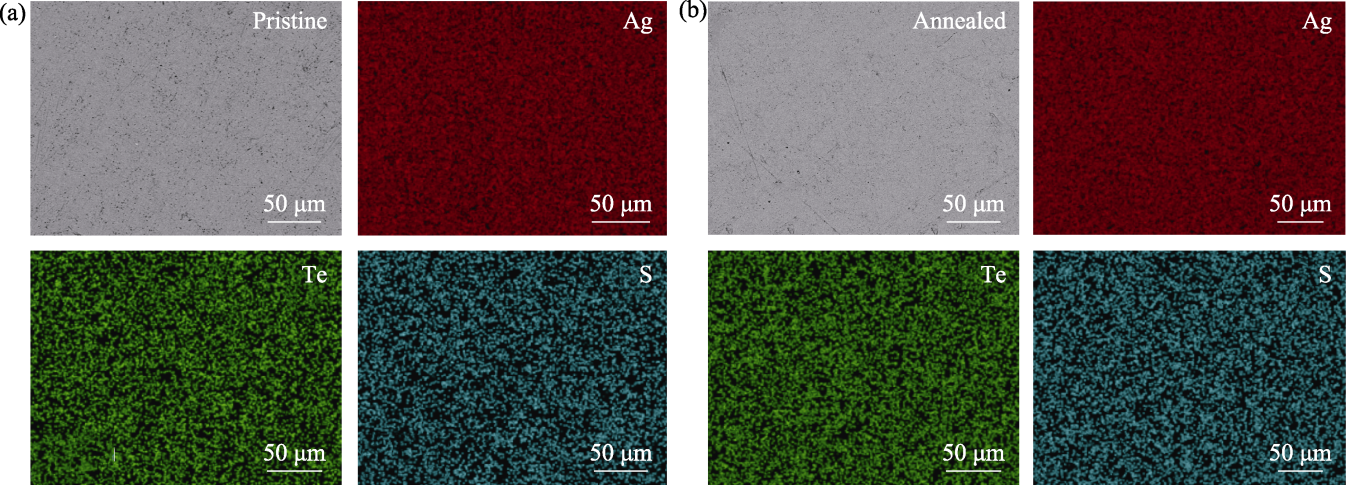
图1 (a)退火前和(b)退火后Ag2S0.4Te0.6块体样品的BSE图像, 以及Ag、Te和S的EDS元素分布图
Fig. 1 BSE images of (a) pristine and (b) annealed Ag2S0.4Te0.6 bulk samples, along with EDS elemental distribution mappings of Ag, Te and S
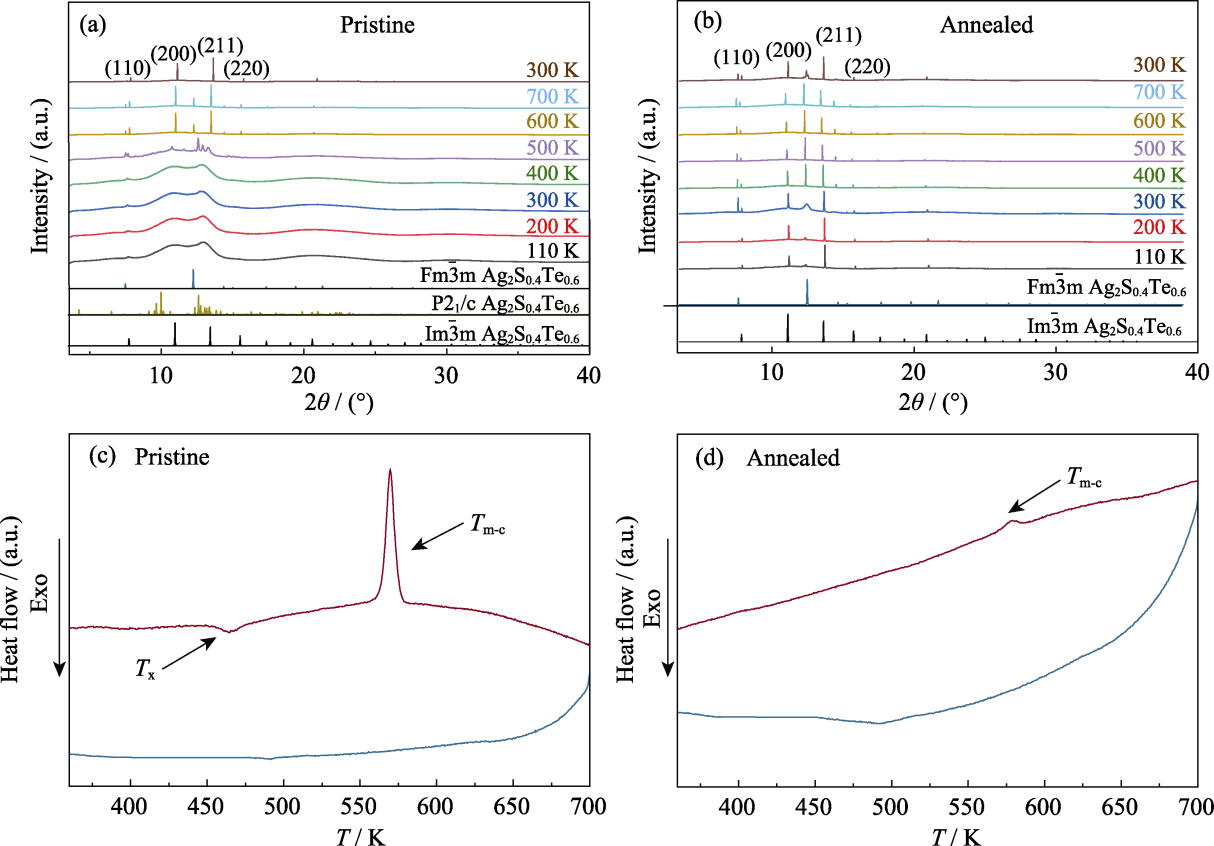
图2 (a, c)退火前和(b, d)退火后Ag2S0.4Te0.6粉末样品的(a, b) SPXRD图谱(λ=0.490027(0) Å)和(c, d) DSC曲线
Fig. 2 (a, b) SPXRD patterns (λ=0.490027(0) Å) and (c, d) DSC curves of (a, c) pristine and (b, d) annealed Ag2S0.4Te0.6 powder samples
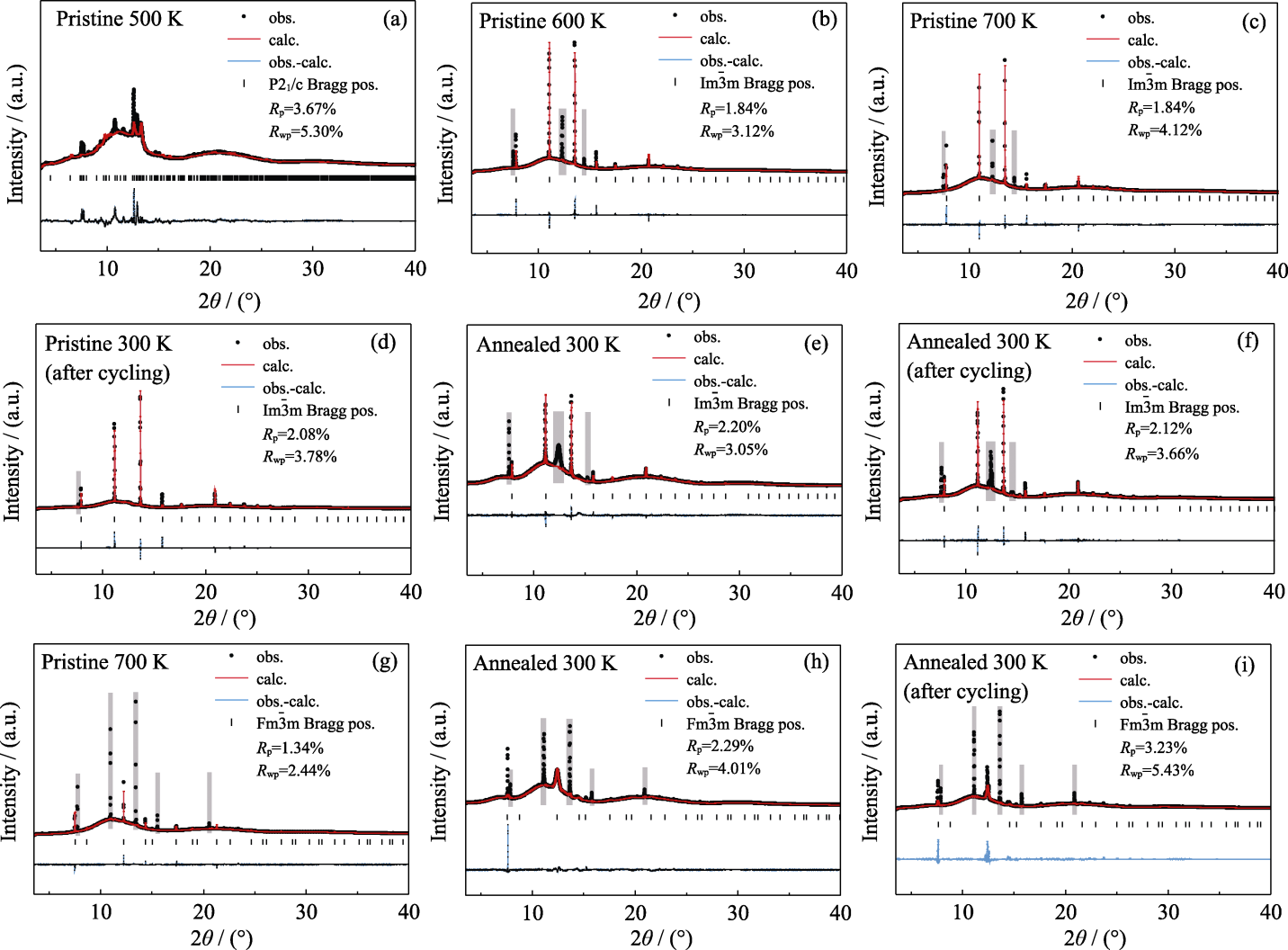
图3 以(a)单斜Ag2Te、(b~f) bcc Ag2Te和(g~i) fcc Ag2Te为模型, 样品SPXRD数据的Rietveld精修
Fig. 3 Rietveld refinement of SPXRD data of samples using (a) monoclinic Ag2Te, (b-f) bcc Ag2Te, and (g-i) fcc Ag2Te as models
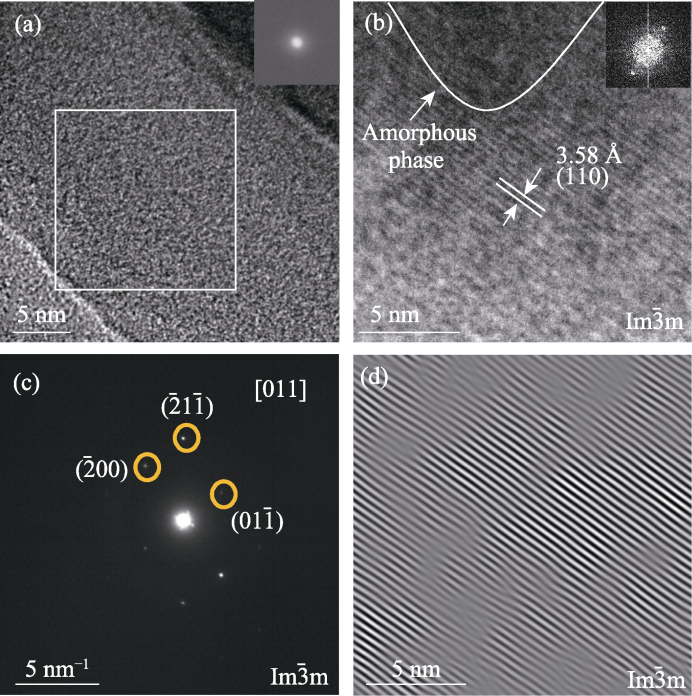
图4 (a)退火前Ag2S0.4Te0.6粉末样品的非晶区HRTEM照片(插图为白色方框区域对应的快速傅里叶变换(FFT)图像); (b)退火后Ag2S0.4Te0.6粉末样品的HRTEM照片(展示了bcc相结晶基质与非晶区, 插图为对应结晶区的FFT图像); (c, d)图(b)结晶区对应的(c) SAED图案及(d) IFFT图像
Fig. 4 (a) HRTEM image of amorphous region in the pristine Ag2S0.4Te0.6 powder sample with inset showing the fast Fourier transform (FFT) image corresponding to area marked by the white square; (b) HRTEM image of the annealed Ag2S0.4Te0.6 powder sample showing a crystalline matrix with a bcc structure embedded in an amorphous region with inset showing the FFT image of the crystalline area; (c) SAED pattern and (d) IFFT image corresponding to the crystalline region marked in panel Fig. (b)
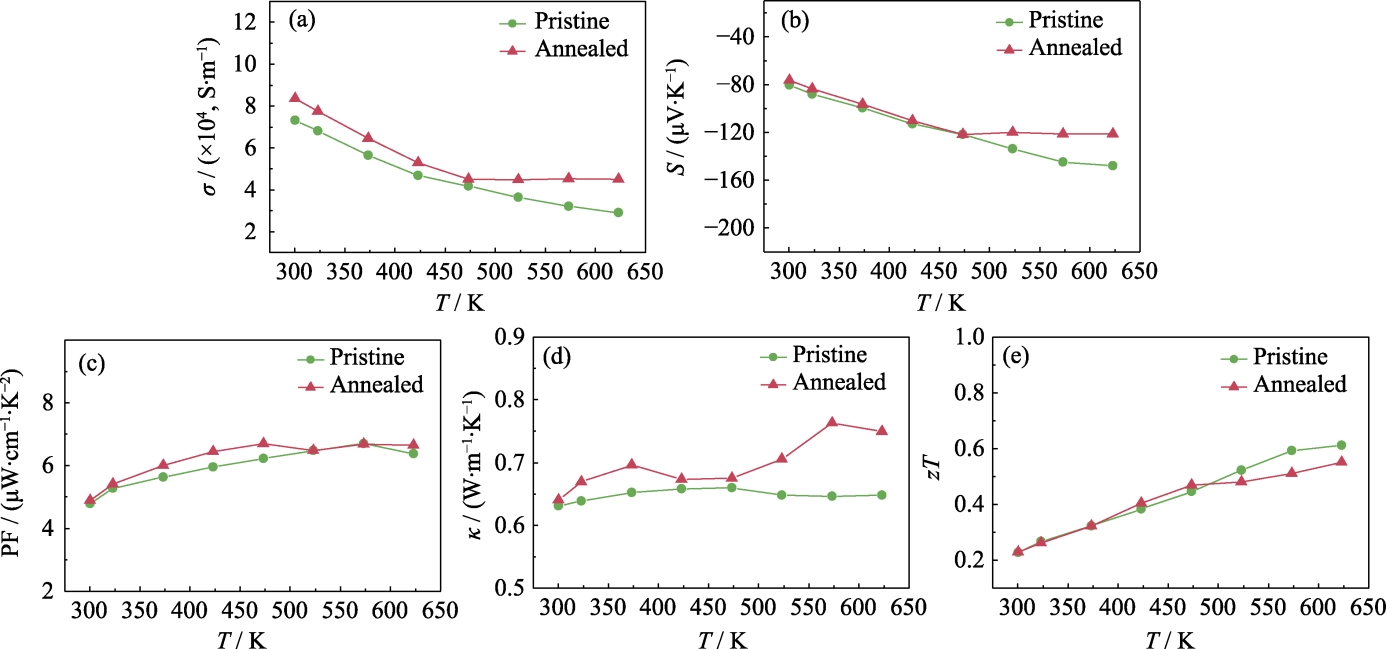
图5 退火前后Ag2S0.4Te0.6块体样品的(a)电导率、(b) Seebeck系数、(c)功率因子、(d)总热导率及(e)热电优值zT随温度的变化曲线
Fig. 5 Temperature-dependent curves of (a) electrical conductivity, (b) Seebeck coefficient, (c) power factor, (d) total thermal conductivity, and (e) thermoelectric figure of merit zT for pristine and annealed Ag2S0.4Te0.6 bulk sample
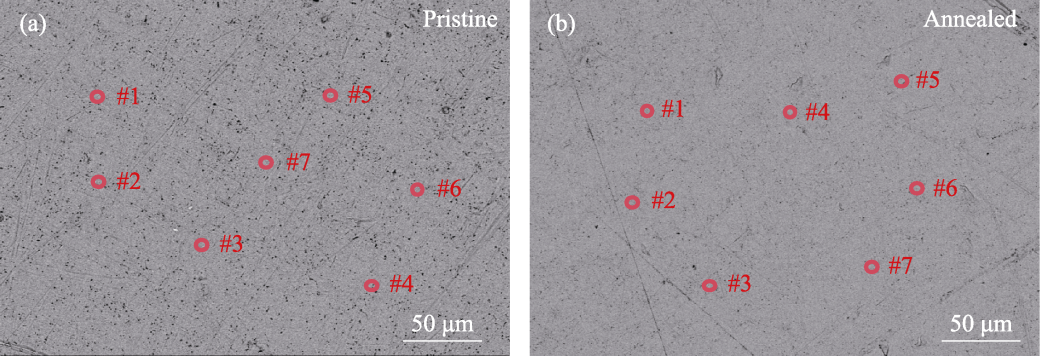
图S1 (a)退火前及(b)退火后Ag2S0.4Te0.6块体样品的BSE图像
Fig. S1 BSE images of the (a) pristine and (b) annealed Ag2S0.4Te0.6 bulk samples Red circles indicate the selected regions for EDS point analysis
| Point | #1 | #2 | #3 | #4 | #5 | #6 | #7 | Average |
|---|---|---|---|---|---|---|---|---|
| Ag/% | 67.5 | 67.5 | 67.4 | 67.0 | 67.8 | 67.1 | 67.4 | 67.4 |
| Te/% | 19.5 | 19.7 | 19.7 | 19.6 | 19.6 | 19.3 | 19.4 | 19.5 |
| S/% | 13.0 | 12.8 | 12.9 | 13.3 | 12.6 | 13.6 | 13.2 | 13.1 |
表S1 退火前块体样品指定检测点处元素分布的原子百分比
Table S1 Atomic percentages of the element distribution at the designated detection points in the pristine bulk sample
| Point | #1 | #2 | #3 | #4 | #5 | #6 | #7 | Average |
|---|---|---|---|---|---|---|---|---|
| Ag/% | 67.5 | 67.5 | 67.4 | 67.0 | 67.8 | 67.1 | 67.4 | 67.4 |
| Te/% | 19.5 | 19.7 | 19.7 | 19.6 | 19.6 | 19.3 | 19.4 | 19.5 |
| S/% | 13.0 | 12.8 | 12.9 | 13.3 | 12.6 | 13.6 | 13.2 | 13.1 |
| Point | #1 | #2 | #3 | #4 | #5 | #6 | #7 | Average | |
|---|---|---|---|---|---|---|---|---|---|
| Ag/% | 67.5 | 68.0 | 67.4 | 68.2 | 67.9 | 67.4 | 67.4 | 67.7 | |
| Te/% | 19.5 | 19.3 | 19.7 | 19.0 | 19.5 | 19.8 | 19.9 | 19.5 | |
| S/% | 13.0 | 12.7 | 12.9 | 12.8 | 12.6 | 12.8 | 12.7 | 12.8 | |
表S2 退火后块体样品指定检测点处元素分布的原子百分比
Table S2 Atomic percentages of the element distribution at the designated detection points in the annealed bulk sample
| Point | #1 | #2 | #3 | #4 | #5 | #6 | #7 | Average | |
|---|---|---|---|---|---|---|---|---|---|
| Ag/% | 67.5 | 68.0 | 67.4 | 68.2 | 67.9 | 67.4 | 67.4 | 67.7 | |
| Te/% | 19.5 | 19.3 | 19.7 | 19.0 | 19.5 | 19.8 | 19.9 | 19.5 | |
| S/% | 13.0 | 12.7 | 12.9 | 12.8 | 12.6 | 12.8 | 12.7 | 12.8 | |
| Temperature | 600 K (pristine) | 700 K (pristine) | 300 K (pristine, after cycling) | 300 K (annealed) | 300 K (annealed, after cycling) | |
|---|---|---|---|---|---|---|
| No. of points | 30052 | 30052 | 30057 | 30062 | 30059 | |
| No. of reflections | 52 | 53 | 51 | 52 | 52 | |
| No. of parameters | 15 | 16 | 16 | 16 | 16 | |
| Rp/% | 1.84 | 1.84 | 2.08 | 2.20 | 2.12 | |
| Rwp/% | 3.12 | 4.12 | 3.78 | 3.05 | 3.66 | |
| GOF | 4.54 | 5.02 | 5.48 | 2.20 | 2.98 | |
| a=b=c/Å | 5.1031(8) | 5.1263(13) | 5.0481(6) | 5.0420(2) | 5.0536(10) | |
| Volume/Å3 | 132.8930(4) | 134.7170(6) | 128.6440(3) | 128.1770(9) | 129.0650(4) | |
| Uiso/Å2 | Ag1 | 0.2084(6) | 0.2077(7) | 0.1917(18) | 0.1861(18) | 0.1892(13) |
| Te1 | 0.1068(7) | 0.1102(13) | 0.0887(7) | 0.0944(15) | 0.0955(9) | |
| S1 | 0.1068(7) | 0.1102(13) | 0.0887(7) | 0.0944(15) | 0.0955(9) | |
| Occupancy | Ag1 | 0.3333 | 0.3333 | 0.3522(15) | 0.3333 | 0.3461(12) |
| Te1 | 0.6 | 0.6 | 0.6(6) | 0.6 | 0.6 | |
| S1 | 0.4 | 0.4 | 0.3999(6) | 0.4 | 0.4 | |
表S3 SPXRD数据bcc Ag2Te相的Rietveld精修
Table S3 Rietveld refinement of SPXRD data for the bcc Ag2Te phase
| Temperature | 600 K (pristine) | 700 K (pristine) | 300 K (pristine, after cycling) | 300 K (annealed) | 300 K (annealed, after cycling) | |
|---|---|---|---|---|---|---|
| No. of points | 30052 | 30052 | 30057 | 30062 | 30059 | |
| No. of reflections | 52 | 53 | 51 | 52 | 52 | |
| No. of parameters | 15 | 16 | 16 | 16 | 16 | |
| Rp/% | 1.84 | 1.84 | 2.08 | 2.20 | 2.12 | |
| Rwp/% | 3.12 | 4.12 | 3.78 | 3.05 | 3.66 | |
| GOF | 4.54 | 5.02 | 5.48 | 2.20 | 2.98 | |
| a=b=c/Å | 5.1031(8) | 5.1263(13) | 5.0481(6) | 5.0420(2) | 5.0536(10) | |
| Volume/Å3 | 132.8930(4) | 134.7170(6) | 128.6440(3) | 128.1770(9) | 129.0650(4) | |
| Uiso/Å2 | Ag1 | 0.2084(6) | 0.2077(7) | 0.1917(18) | 0.1861(18) | 0.1892(13) |
| Te1 | 0.1068(7) | 0.1102(13) | 0.0887(7) | 0.0944(15) | 0.0955(9) | |
| S1 | 0.1068(7) | 0.1102(13) | 0.0887(7) | 0.0944(15) | 0.0955(9) | |
| Occupancy | Ag1 | 0.3333 | 0.3333 | 0.3522(15) | 0.3333 | 0.3461(12) |
| Te1 | 0.6 | 0.6 | 0.6(6) | 0.6 | 0.6 | |
| S1 | 0.4 | 0.4 | 0.3999(6) | 0.4 | 0.4 | |
| Temperature | 700 K (pristine) | 300 K (annealed) | 300 K (annealed, after cycling) | |
|---|---|---|---|---|
| No. of points | 30052 | 30062 | 30059 | |
| No. of reflections | 58 | 62 | 58 | |
| No. of parameters | 17 | 17 | 16 | |
| Rp/% | 1.34 | 2.29 | 3.23 | |
| Rwp/% | 2.44 | 4.01 | 5.43 | |
| GOF | 2.87 | 3.13 | 4.42 | |
| a=b=c/Å | 6.4927(14) | 6.4140(4) | 6.3978(6) | |
| Volume/Å3 | 273.6970(10) | 263.9000(3) | 261.8700(4) | |
| Uiso/Å2 | Ag1 | 0.0546(4) | 0.0547(3) | 0.0550(4) |
| Ag2 | 0.1926(4) | 0.1800(3) | 0.1795(4) | |
| Te1 | 0.1795(2) | 0.1752(3) | 0.1750(7) | |
| S1 | 0.1795(2) | 0.1752(3) | 0.1750(7) | |
| Occupancy | Ag1 | 0.1345(6) | 0.1330(2) | 0.1435(3) |
| Ag2 | 0.0703(6) | 0.0766(2) | 0.0613(3) | |
| Te1 | 0.6050(7) | 0.6060(3) | 0.6094(4) | |
| S1 | 0.3950(7) | 0.3940(3) | 0.3906(4) | |
表S4 SPXRD数据fcc Ag2Te相的Rietveld精修
Table S4 Rietveld refinement of the SPXRD data for the fcc Ag2Te phase
| Temperature | 700 K (pristine) | 300 K (annealed) | 300 K (annealed, after cycling) | |
|---|---|---|---|---|
| No. of points | 30052 | 30062 | 30059 | |
| No. of reflections | 58 | 62 | 58 | |
| No. of parameters | 17 | 17 | 16 | |
| Rp/% | 1.34 | 2.29 | 3.23 | |
| Rwp/% | 2.44 | 4.01 | 5.43 | |
| GOF | 2.87 | 3.13 | 4.42 | |
| a=b=c/Å | 6.4927(14) | 6.4140(4) | 6.3978(6) | |
| Volume/Å3 | 273.6970(10) | 263.9000(3) | 261.8700(4) | |
| Uiso/Å2 | Ag1 | 0.0546(4) | 0.0547(3) | 0.0550(4) |
| Ag2 | 0.1926(4) | 0.1800(3) | 0.1795(4) | |
| Te1 | 0.1795(2) | 0.1752(3) | 0.1750(7) | |
| S1 | 0.1795(2) | 0.1752(3) | 0.1750(7) | |
| Occupancy | Ag1 | 0.1345(6) | 0.1330(2) | 0.1435(3) |
| Ag2 | 0.0703(6) | 0.0766(2) | 0.0613(3) | |
| Te1 | 0.6050(7) | 0.6060(3) | 0.6094(4) | |
| S1 | 0.3950(7) | 0.3940(3) | 0.3906(4) | |
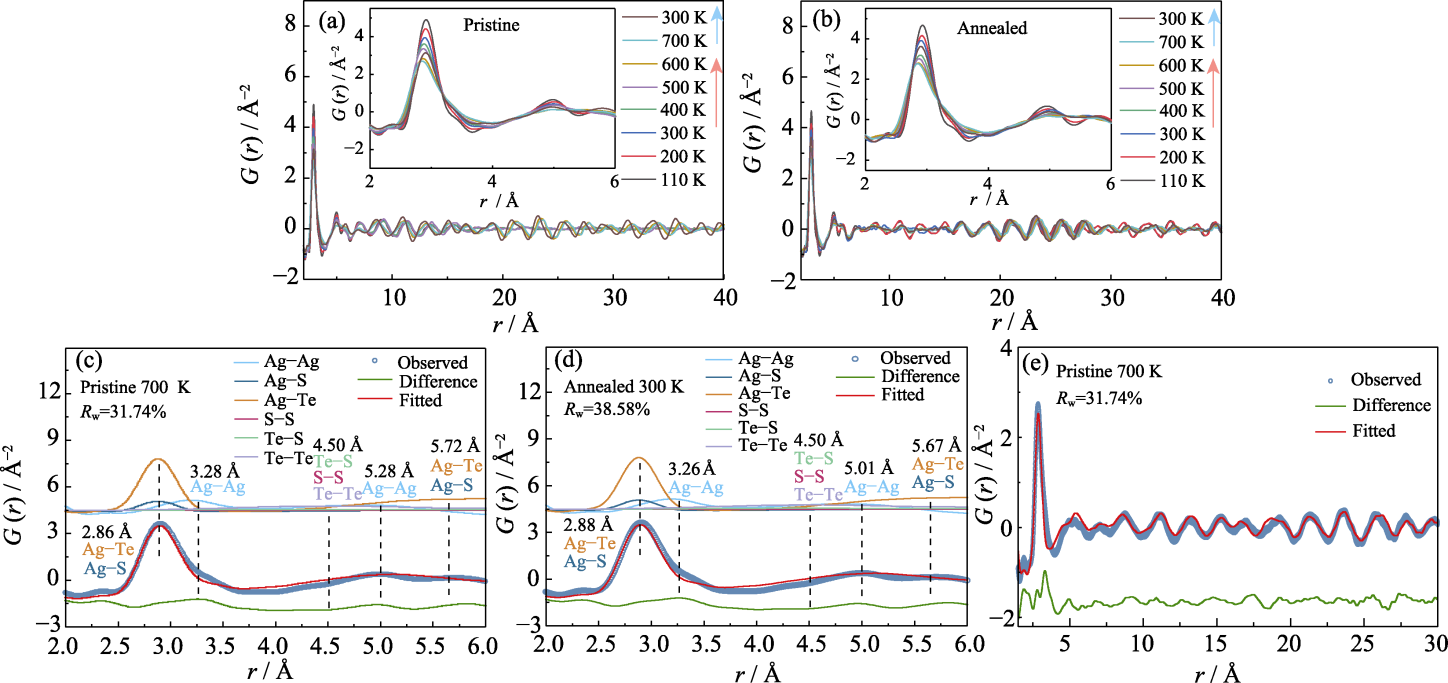
图S2 (a)退火前和(b)退火后粉末样品在2~40 Å范围内不同温度下的PDF图谱(插图为2~6 Å短程范围内的PDF图谱);(c)退火前700 K和(d)退火后300 K粉末样品在2~6 Å范围内由Im$\bar{3}$m和Fm$\bar{3}$m空间群平均结构拟合的同步辐射X射线PDF图谱, 以及不同原子对的PDF数据; (e) Ag2S0.4Te0.6退火前700 K在2~30 Å范围内的同步辐射X射线PDF图谱
Fig. S2 (a, b) PDF spectra at different temperatures for (a) pristine and (b) annealed powder samples in the range of 2-40 Å with inset showing the PDF spectra in the short range of 2-6 Å; (c, d) Synchrotron radiation X-ray PDF spectra of (c) pristine powder at 700 K and (d) annealed powder at 300 K in the range of 2-6 Å fitted with average structures from the Im$\bar{3}$m and Fm$\bar{3}$m space groups, together with partial PDF data for different atomic pairs; (e) Synchrotron radiation X-ray PDF spectra for pristine Ag2S0.4Te0.6 at 700 K in the range of 2-30 Å Blue circles are fitted using the average structures of the Im¯3m and Fm¯3m space groups, with the fitting model displayed as a red line and the difference curve as a green line (with offset shown below the data and fit)
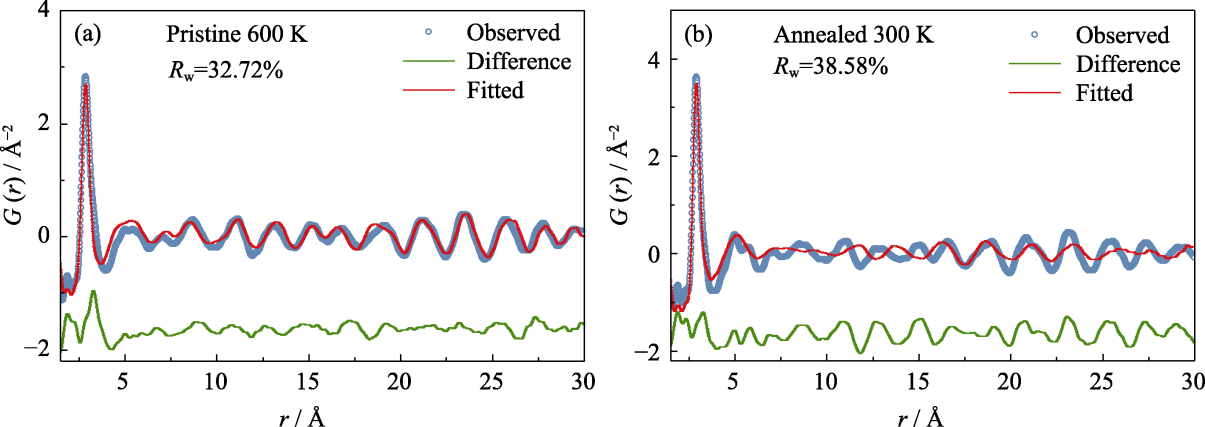
图S3 (a)退火前600 K及(b)退火后300 K Ag2S0.4Te0.6粉末的同步辐射X射线PDF图谱
Fig. S3 Synchrotron radiation X-ray PDF patterns of Ag2S0.4Te0.6 powder (a) before annealing at 600 K and (b) after annealing at 300 K
| [1] | LIM H R, KIM H S, QAZI R, et al. Advanced soft materials, sensor integrations, and applications of wearable flexible hybrid electronics in healthcare, energy, and environment. Advanced Materials, 2020, 32(15): e1901924. |
| [2] |
GUO C F, DING L M. Integration of soft electronics and biotissues. The Innovation, 2021, 2(1): 100074.
DOI URL |
| [3] | MENG B, TANG W, TOO Z H, et al. A transparent single-friction-surface triboelectric generator and self-powered touch sensor. Energy & Environmental Science, 2013, 6(11): 3235. |
| [4] |
BOLAND C S, KHAN U, RYAN G, et al. Sensitive electromechanical sensors using viscoelastic graphene-polymer nanocomposites. Science, 2016, 354(6317): 1257.
PMID |
| [5] |
YANG Q Y, YANG S Q, QIU P F, et al. Flexible thermoelectrics based on ductile semiconductors. Science, 2022, 377(6608): 854.
DOI PMID |
| [6] |
HOU C Y, ZHU M F. Semiconductors flex thermoelectric power. Science, 2022, 377(6608): 815.
DOI PMID |
| [7] |
PERUMAL S, ROYCHOWDHURY S, BISWAS K. Reduction of thermal conductivity through nanostructuring enhances the thermoelectric figure of merit in Ge1-xBixTe. Inorganic Chemistry Frontiers, 2016, 3(1): 125.
DOI URL |
| [8] |
PERUMAL S, SAMANTA M, GHOSH T, et al. Realization of high thermoelectric figure of merit in GeTe by complementary co-doping of Bi and In. Joule, 2019, 3(10): 2565.
DOI URL |
| [9] | BU Z L, ZHANG X Y, SHAN B, et al. Realizing a 14% single-leg thermoelectric efficiency in GeTe alloys. Science Advances, 2021, 7(19): eabf2738. |
| [10] |
JIANG Y L, DONG J F, ZHUANG H L, et al. Evolution of defect structures leading to high ZT in GeTe-based thermoelectric materials. Nature Communications, 2022, 13: 6087.
DOI PMID |
| [11] |
XING T, ZHU C X, SONG Q F, et al. Ultralow lattice thermal conductivity and superhigh thermoelectric figure-of-merit in (Mg, Bi) Co-doped GeTe. Advanced Materials, 2021, 33(17): 2008773.
DOI URL |
| [12] | WANG J, LI J B, YU H Y, et al. Enhanced thermoelectric performance in n-type SrTiO3/SiGe composite. ACS Applied Materials & Interfaces, 2020, 12(2): 2687. |
| [13] |
BASU R, SINGH A. High temperature Si-Ge alloy towards thermoelectric applications: a comprehensive review. Materials Today Physics, 2021, 21: 100468.
DOI URL |
| [14] |
CHEN H B, ZHANG Z W, LIANG J S, et al. Phonon relaxation effect by regeneration of nano-inclusions in SiGe for ultralow thermal conductivity and enhanced thermoelectric performance. Materials Today Physics, 2024, 43: 101405.
DOI URL |
| [15] | JIANG Z X, LI E L, SHI R Z, et al. Effective nonstoichiometric strategy combined post-annealing process for boosting thermoelectric properties in n-type PbTe. ACS Applied Materials & Interfaces, 2024, 16(15): 19048. |
| [16] |
MA B P, LI Y Q, ZHU L J, et al. Modulation doping promoted ultrahigh electron mobility and enhanced thermoelectric performance in PbTe. Chemical Engineering Journal, 2024, 488: 150647.
DOI URL |
| [17] | CAO Y, BAI H, LI Z, et al. Zn-induced defect complexity for the high thermoelectric performance of n-type PbTe compounds. ACS Applied Materials & Interfaces, 2021, 13(36): 43134. |
| [18] |
CAO T Y, SHI X L, CHEN Z G. Advances in the design and assembly of flexible thermoelectric device. Progress in Materials Science, 2023, 131: 101003.
DOI URL |
| [19] |
JUNG S J, SHIN J, LIM S S, et al. Porous organic filler for high efficiency of flexible thermoelectric generator. Nano Energy, 2021, 81: 105604.
DOI URL |
| [20] |
ZHANG Q, SUN Y M, QIN Y K, et al. Two soluble polymers with lower ionization potentials: doping and thermoelectric properties. Journal of Materials Chemistry A, 2016, 4(4): 1432.
DOI URL |
| [21] |
AÏCH R B, BLOUIN N, BOUCHARD A, et al. Electrical and thermoelectric properties of poly(2,7-carbazole) derivatives. Chemistry of Materials, 2009, 21(4): 751.
DOI URL |
| [22] |
SHI X, CHEN H Y, HAO F, et al. Room-temperature ductile inorganic semiconductor. Nature Materials, 2018, 17(5): 421.
DOI PMID |
| [23] |
ZHAO P, XUE W H, ZHANG Y, et al. Plasticity in single- crystalline Mg3Bi2 thermoelectric material. Nature, 2024, 631: 777.
DOI |
| [24] |
LI A R, WANG Y C, LI Y Z, et al. High performance magnesium- based plastic semiconductors for flexible thermoelectrics. Nature Communications, 2024, 15: 5108.
DOI |
| [25] |
HU H P, WANG Y C, FU C G, et al. Achieving metal-like malleability and ductility in Ag2Te1-xSx inorganic thermoelectric semiconductors with high mobility. The Innovation, 2022, 3(6): 100341.
DOI URL |
| [26] |
YANG S Q, GAO Z Q, QIU P F, et al. Ductile Ag20S7Te3 with excellent shape-conformability and high thermoelectric performance. Advanced Materials, 2021, 33(10): 2007681.
DOI URL |
| [27] |
WEI T R, JIN M, WANG Y C, et al. Exceptional plasticity in the bulk single-crystalline van der Waals semiconductor InSe. Science, 369(6503): 542.
DOI URL |
| [28] |
DENG T T, GAO Z Q, QIU P F, et al. High thermoelectric power factors in plastic/ductile bulk SnSe2-based crystals. Advanced Materials, 2024, 36(5): 2304219.
DOI URL |
| [29] |
KUMAR V, CHANDRA S, SANTOSH R. electronic, First-principles calculations of the structural, elastic and optical properties of LiGaS2 and LiGaSe2 semiconductors under different pressures. Journal of Electronic Materials, 2018, 47: 1223.
DOI URL |
| [30] |
ZHANG J, LIU G H, CUI W, et al. Plastic deformation in silicon nitride ceramics via bond switching at coherent interfaces. Science, 2022, 378(6618): 371.
DOI URL |
| [31] |
LI X C, MENG Y, LI W P, et al. Multislip-enabled morphing of all-inorganic perovskites. Nature Materials, 2023, 22(10): 1175.
DOI PMID |
| [32] |
WU Y J, ZHANG Y, WANG X Y, et al. Twisted-layer boron nitride ceramic with high deformability and strength. Nature, 2024, 626: 779.
DOI |
| [33] | LUO J, CHEN J, GAO Z Q, et al. Ductile inorganic ferromagnetic semiconductor. Advanced Materials, 2026, 38(4): e14083. |
| [34] | LV S Y, LIU X Y, LI X H, et al. Electrochemical peeling few-layer SnSe2 for high-performance ultrafast photonics. ACS Applied Materials & Interfaces, 2020, 12(38): 43049. |
| [35] | LIANG J S, WANG T, QIU P F, et al. Flexible thermoelectrics: from silver chalcogenides to full-inorganic devices. Energy & Environmental Science, 2019, 12(10): 2983. |
| [36] |
CHEN H Y, SHAO C L, HUANG S J, et al. High-entropy cubic pseudo-ternary Ag2(S, Se, Te) materials with excellent ductility and thermoelectric performance. Advanced Energy Materials, 2024, 14(10): 2303473.
DOI URL |
| [37] |
CHANG Y, LI Z L, LUO P F, et al. Room-temperature cubic Ag2S1-2xSexTex with promising ductility and thermoelectric properties enabled by entropy engineering. Advanced Functional Materials, 2024, 34(12): 2310016.
DOI URL |
| [38] | HE S Y, LI Y B, LIU L, et al. Semiconductor glass with superior flexibility and high room temperature thermoelectric performance. Science Advances, 2020, 6(15): eaaz8423. |
| [39] |
WANG Y C, LI A R, HU H P, et al. Reversible room temperature brittle-plastic transition in Ag2Te0.6S0.4 inorganic thermoelectric semiconductor. Advanced Functional Materials, 2023, 33(26): 2300189.
DOI URL |
| [40] |
WANG Y C, LI A R, HONG Y R, et al. Iterative sublattice amorphization facilitates exceptional processability in inorganic semiconductors. Nature Materials, 2025, 24: 1545.
DOI |
| [41] | KATO K, HIROSE R, TAKEMOTO M, et al. The RIKEN materials science beamline at SPring-8:towards visualization of electrostatic interaction. AIP Conference Proceedings, 2010, 1234(1): 875. |
| [42] | PETŘÍČEK V, DUŠEK M, PALATINUS L. Crystallographic computing system JANA2006: general features. Zeitschrift fur Kristallographie-Crystalline Materials, 2014, 229(5): 345. |
| [43] |
THOMPSON P, COX D E, HASTINGS J B. Rietveld refinement of Debye-Scherrer synchrotron X-ray data from Al2O3. Journal of Applied Crystallography, 1987, 20(2): 79.
DOI URL |
| [44] |
TUCKER M G, KEEN D A, DOVE M T, et al. RMCProfile: reverse Monte Carlo for polycrystalline materials. Journal of Physics: Condensed Matter, 2007, 19(33): 335218.
DOI URL |
| [45] | FARROW C L, JUHAS P, LIU J W, et al. PDFfit2 and PDFgui: computer programs for studying nanostructure in crystals. Journal of Physics: Condensed Matter, 2007, 19(33): 335219. |
| [46] |
LI Z L, ZHANG J Y, LIN C, et al. Origin of ductility in amorphous Ag2S0.4Te0.6. Applied Physics Letters, 2022, 120(7): 073905.
DOI URL |
| [47] | ZHONG S L, BAI H, LUO H, et al. Nature of thermal hysteresis of thermoelectric properties in Ag2TexS1-x compounds. ACS Applied Materials & Interfaces, 2024, 16(1): 1148. |
| [1] | 刘雷敏, 罗红心, 何玉梅, 金利民, 李永杰, 刘静雯, 魏玉全, 孙安乐, 陈忠明, 刘学建, 殷杰, 黄政仁. 先进光源装置用碳化硅反射镜性能研究[J]. 无机材料学报, 2026, 41(6): 805-813. |
| [2] | 乔君毅, 李涛, 董鑫吉, 杨涵戈, 林天全. 铜集流体晶面调控诱导锌均匀沉积的长循环水系锌碘电池[J]. 无机材料学报, 2026, 41(6): 823-830. |
| [3] | 李廷松, 王文丽, 刘强, 王雁斌, 周真真, 胡辰, 李江. Cr3+掺杂浓度对YAGG:Ce3+,Cr3+发光陶瓷余辉性能的影响[J]. 无机材料学报, 2025, 40(9): 1037-1044. |
| [4] | 程俊, 张家伟, 仇鹏飞, 陈立东, 史迅. P掺杂β-FeSi2材料的制备与热电输运性能[J]. 无机材料学报, 2024, 39(8): 895-902. |
| [5] | 陈浩, 樊文浩, 安德成, 陈少平. 能带优化和载流子调控改善SnTe的热电性能[J]. 无机材料学报, 2024, 39(3): 306-312. |
| [6] | 刘松, 张发强, 罗进, 刘志甫. 0.9BaTiO3-0.1Bi(Mg1/2Ti1/2)O3铁电薄膜制备及储能特性[J]. 无机材料学报, 2024, 39(3): 291-298. |
| [7] | 田震, 蒋全伟, 李建波, 于砺锋, 康慧君, 王同敏. 热变形协同优化BiSbSe1.50Te1.50材料电热输运[J]. 无机材料学报, 2024, 39(12): 1316-1324. |
| [8] | 张哲, 孙婷婷, 王连军, 江莞. 不同维度Ag2Se构筑柔性热电薄膜的性能优化与器件集成研究[J]. 无机材料学报, 2024, 39(11): 1221-1227. |
| [9] | 孟雨婷, 王雪梅, 章淑娴, 陈志炜, 裴艳中. Bi2Te3基热电材料的单带和双带传输特性转变[J]. 无机材料学报, 2024, 39(11): 1283-1291. |
| [10] | 苏浩健, 周敏, 李来风. 多元素掺杂优化SnTe的热电性能[J]. 无机材料学报, 2024, 39(10): 1159-1166. |
| [11] | 肖娅妮, 吕嘉南, 李振明, 刘铭扬, 刘伟, 任志刚, 刘弘景, 杨东旺, 鄢永高. Bi2Te3基热电材料的湿热稳定性研究[J]. 无机材料学报, 2023, 38(7): 800-806. |
| [12] | 张守超, 陈洪雨, 刘洪飞, 杨羽, 李欣, 刘德峰. 6H-SiC中子辐照肿胀高温回复及光学特性研究[J]. 无机材料学报, 2023, 38(6): 678-686. |
| [13] | 贺丹琪, 魏明旭, 刘蕤之, 汤志鑫, 翟鹏程, 赵文俞. 一步法制备重费米子YbAl3热电材料及其性能提升[J]. 无机材料学报, 2023, 38(5): 577-582. |
| [14] | 俞瑞仙, 王国栋, 王守志, 胡小波, 徐现刚, 张雷. 高温退火对PVT法生长的AlN晶体质量的影响[J]. 无机材料学报, 2023, 38(3): 343-349. |
| [15] | 上官丽, 聂晓双, 叶奎材, 崔苑苑, 乔玉琴. 氧化钛涂层润湿性对免疫成骨性能的影响规律[J]. 无机材料学报, 2023, 38(12): 1457-1565. |
| 阅读次数 | ||||||
|
全文 |
|
|||||
|
摘要 |
|
|||||