无机材料学报 ›› 2026, Vol. 41 ›› Issue (5): 673-680.DOI: 10.15541/jim20250442
• 研究快报 • 上一篇
董浪平1( ), 李施璇1, 杨少星1, 侯京山1, 林燕丹4, 周鹏程5, 孙雪娇3, 孙宜阳3(), 陈大钦2, 房永征1()
收稿日期:2025-11-01
修回日期:2025-12-06
出版日期:2026-05-20
网络出版日期:2025-12-19
通讯作者:
孙宜阳, 研究员. E-mail: yysun@mail.sic.ac.cn;作者简介:董浪平(1993-), 女, 副教授. E-mail: lpdong@sit.edu.cn
DONG Langping1(), LI Shixuan1, YANG Shaoxing1, HOU Jingshan1, LIN Yandan4, ZHOU Pengcheng5, SUN Xuejiao3, SUN Yiyang3(), CHEN Daqin2, FANG Yongzheng1()
Received:2025-11-01
Revised:2025-12-06
Published:2026-05-20
Online:2025-12-19
Contact:
SUN Yiyang, professor. E-mail: yysun@mail.sic.ac.cn;About author:DONG Langping (1993-), female, associate professor. E-mail: lpdong@sit.edu.cn
Supported by:摘要:
热猝灭是荧光材料在固态照明器件中应用时面临的关键挑战。本研究报道了一种具有抗热猝灭行为的钙钛矿型荧光粉RbZnF3:Eu3+。在紫光激发下, 该荧光粉发出明亮的红光。随着温度升高, 其发光强度先增大(175 ℃, 即抗热猝灭), 随后下降; 当温度高于200 ℃时, 发光强度低于室温值。通过全面表征发现, 抗热猝灭行为主要源于缺陷能级的存在。第一性原理计算表明, Rb空位和F空位可能是形成这些缺陷能级的主要原因。本研究还利用RbZnF3:Eu3+荧光粉制备了白光发光二极管(LED), 验证了其潜在应用价值。
中图分类号:
董浪平, 李施璇, 杨少星, 侯京山, 林燕丹, 周鹏程, 孙雪娇, 孙宜阳, 陈大钦, 房永征. 一种可被紫光激发的红色荧光粉RbZnF3:Eu3+ 中的异常热猝灭现象[J]. 无机材料学报, 2026, 41(5): 673-680.
DONG Langping, LI Shixuan, YANG Shaoxing, HOU Jingshan, LIN Yandan, ZHOU Pengcheng, SUN Xuejiao, SUN Yiyang, CHEN Daqin, FANG Yongzheng. Anomalous Fluorescence Thermal Quenching in a Red-emitting RbZnF3:Eu3+ Phosphor under Violet Excitation[J]. Journal of Inorganic Materials, 2026, 41(5): 673-680.
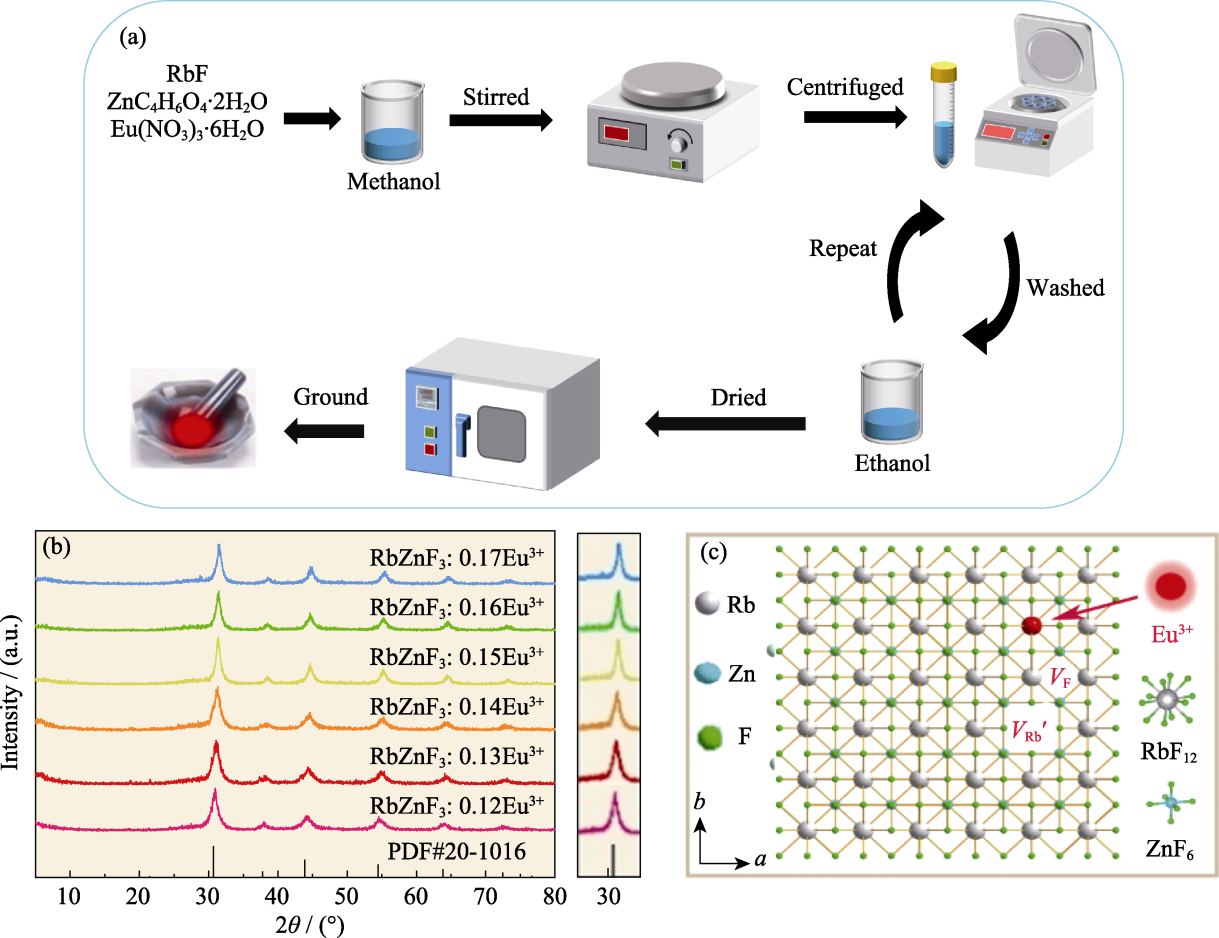
Fig. 1 Synthesis, phase identification and crystal structure of the RbZnF3:0.13Eu3+ phosphor (a) Schematic diagram of the synthesis process; (b) XRD patterns and enlarged areas at 2θ=25°-35° of the synthesized RbZnF3:xEu3+; (c) Schematic diagram of crystal structure and cation coordination of RbZnF3 matrix
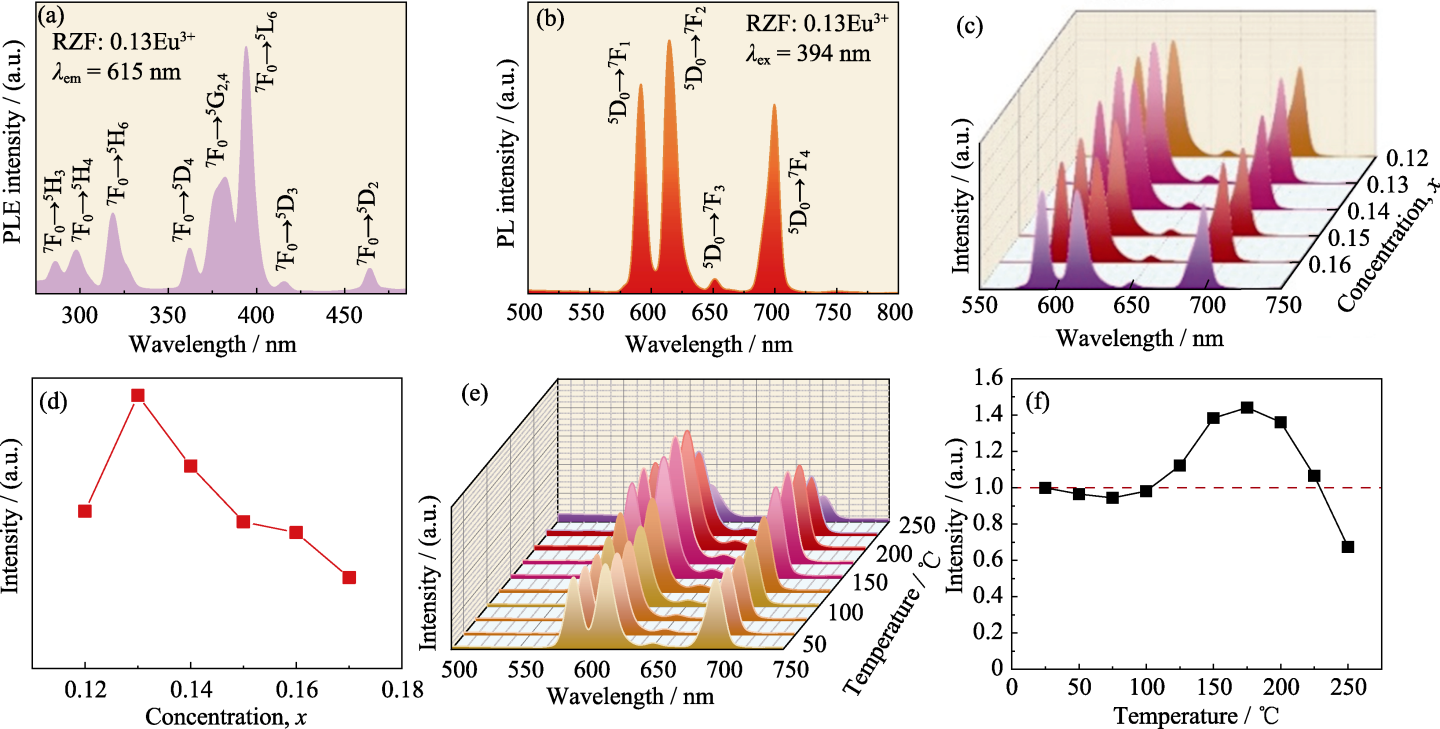
Fig. 2 Photoluminescence, concentration quenching and thermal quenching behavior of RbZnF3:0.13Eu3+ (a) Excitation and (b) emission spectra of RbZnF3:0.13Eu3+; (c) Emission spectra of RbZnF3:xEu3+ samples; (d) Relationship between concentration x and luminescence intensity; (e) Temperature-dependent emission spectra of RbZnF3:0.13Eu3+ sample; (f) Evolution trend of luminescence intensity with increasing temperature
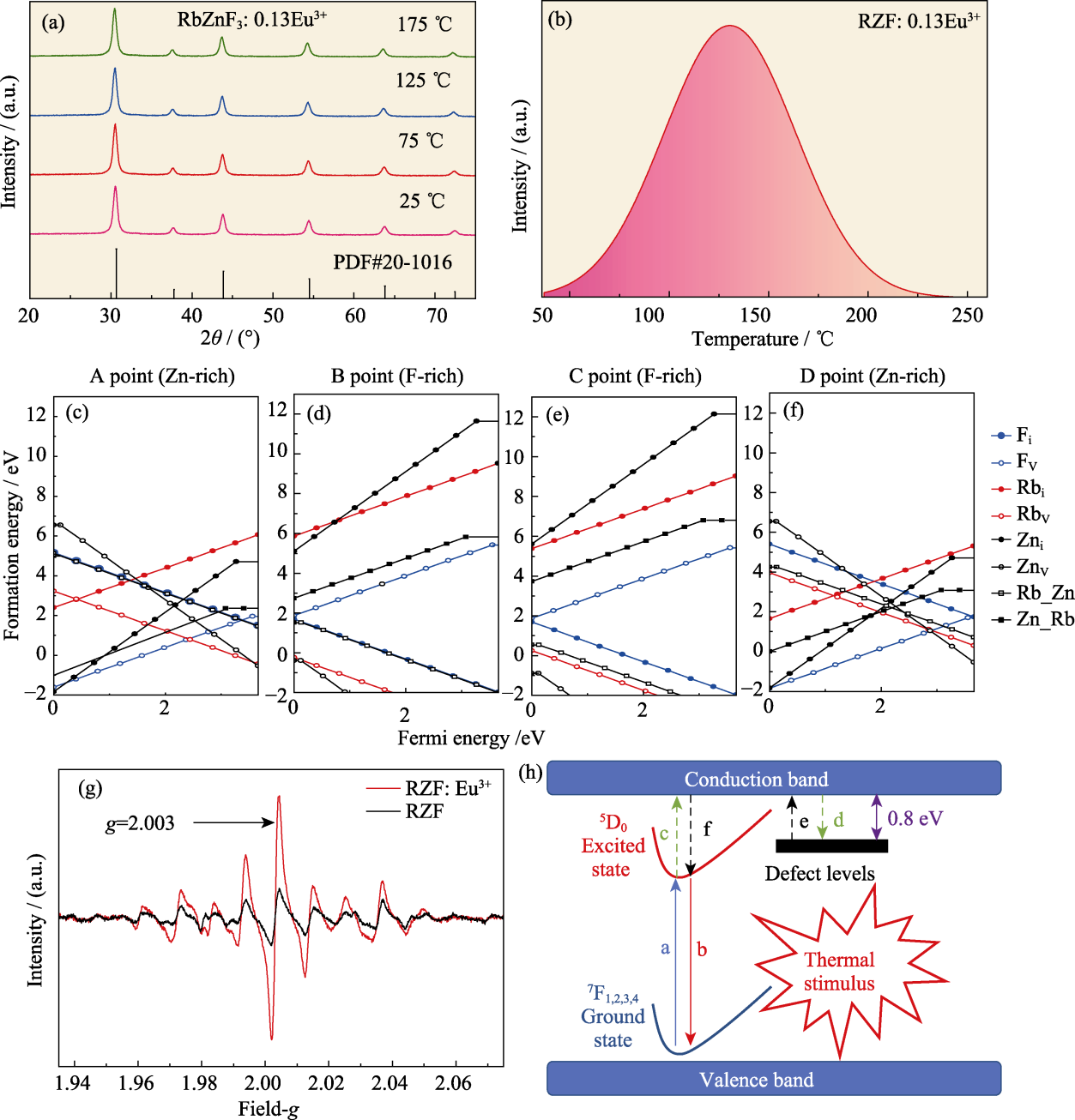
Fig. 3 Investigation of the anti-thermal quenching performance and mechanism in RbZnF3:0.13Eu3+ phosphor (a) Temperature-dependent XRD patterns of RbZnF3:0.13Eu3+ sample; (b) Thermoluminescence curve of RbZnF3:0.13Eu3+ sample at different temperatures; (c-f) Defect forming energy of various defects when the chemical composition is (c) A, (b) B, (c) C, and (d) D points; (g) EPR spectra for RZF and RZF:Eu3+; (h) Schematic illustration of the mechanism for the anti-thermal quenching in RZF:0.13Eu3+ phosphor. Colorful figures are available on website
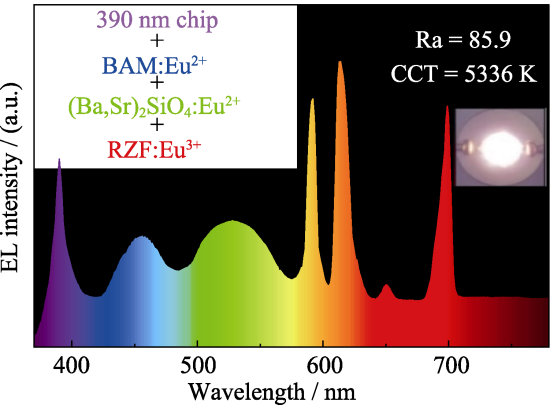
Fig. 4 Electroluminescence spectrum of WLED produced by 390 nm violet LED chip combining BAM:Eu2+ blue phosphor, (Ba, Sr)2SiO4:Eu2+ green phosphor and prepared RZF:0.13Eu3+ red phosphor Inset: a photo of the fabricated WLED when it is powered on
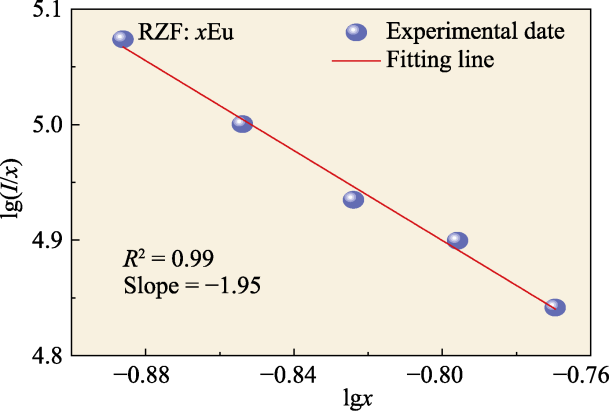
Fig. S1 Relationship of lg(I/x) versus lgx
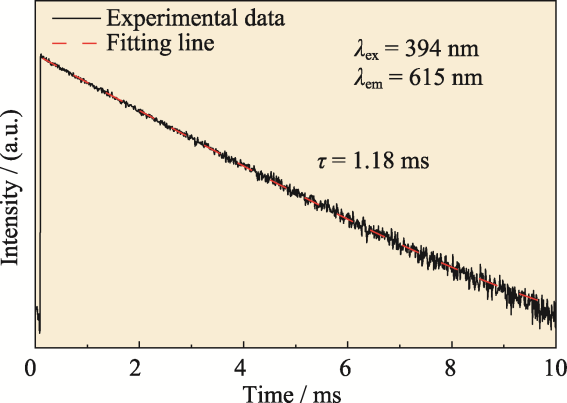
Fig. S2 Decay curve of RbZnF3:0.13Eu3+
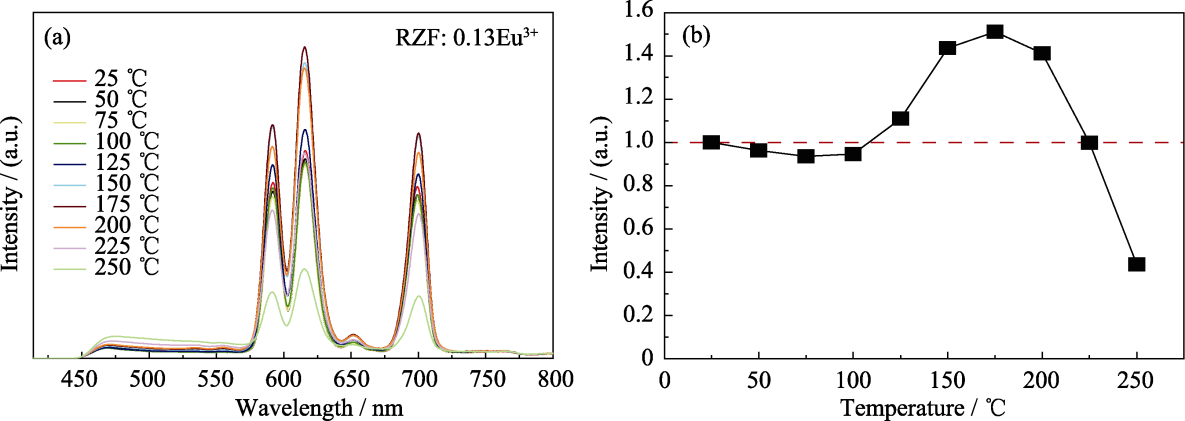
Fig. S3 Repeated testing of the thermal quenching process in RbZnF3:0.13Eu3+ (a) Thermal-dependent emission spectra of RbZnF3:0.13Eu3+; (b) Evolution of the luminescence intensity as a function of temperature during repeated testing
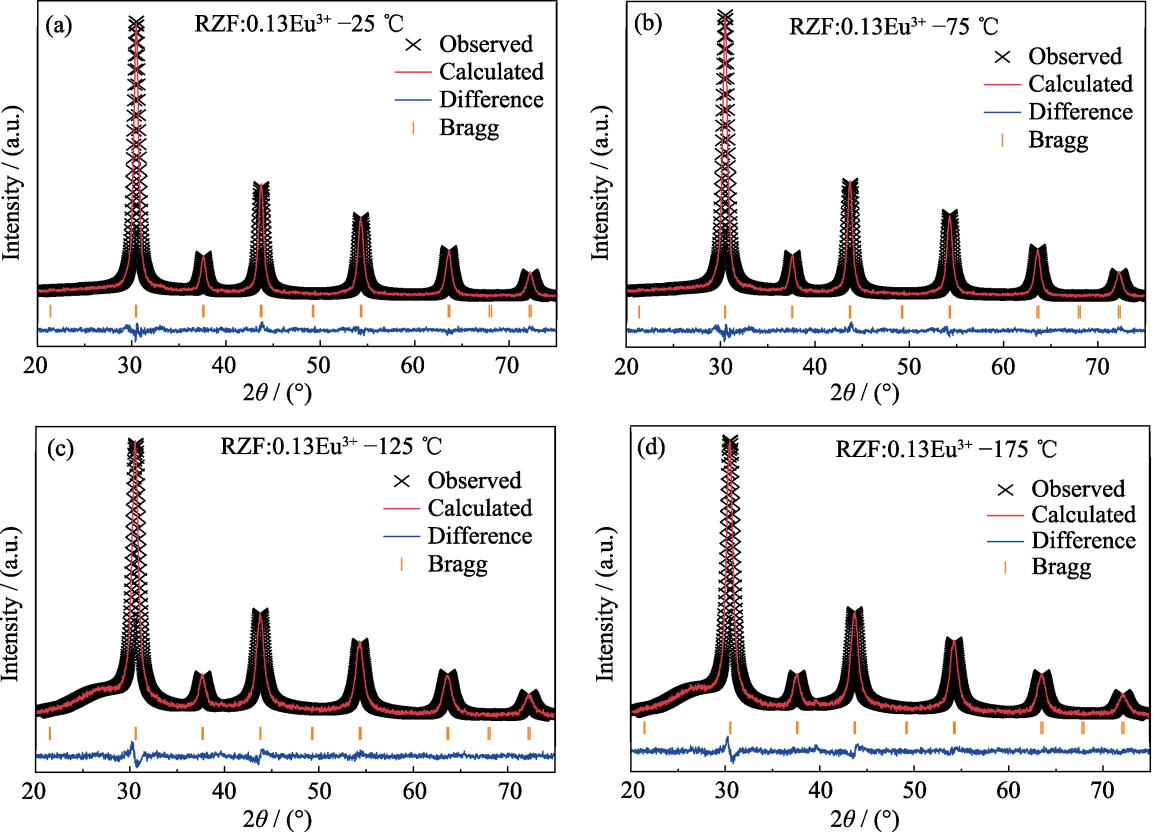
Fig. S4 Rietveld refinement patterns of RbZnF3:0.13Eu3+ sample at different temperatures
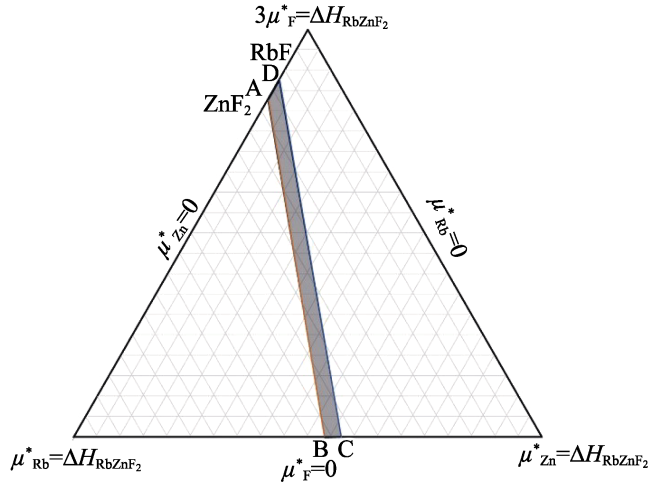
Fig. S5 Chemical potential and potential chemical composition distribution A and D are extreme composition points rich in Zn, while B and C are extreme composition points rich in F. RbZnF3 can only form within a closed area composed of points A, B, C, and D
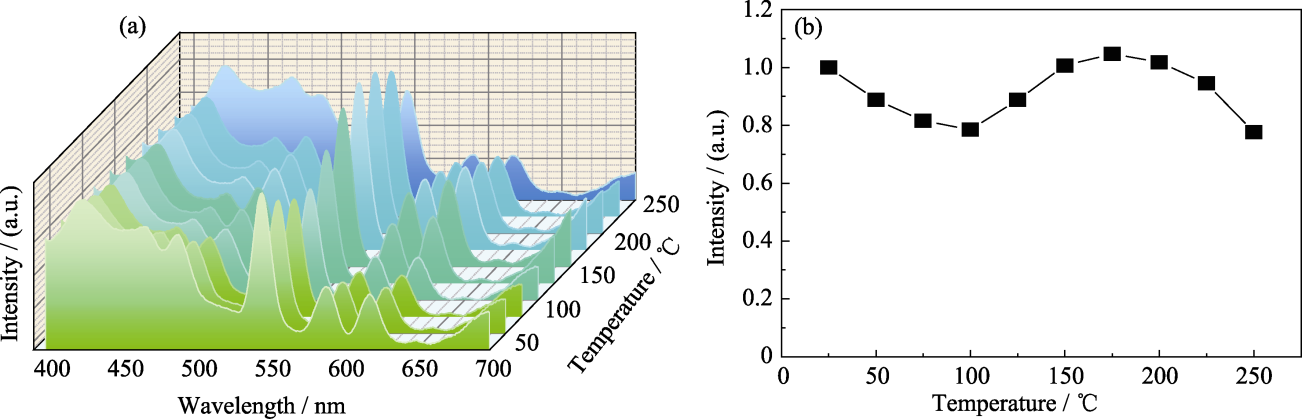
Fig. S6 Evaluation of the thermal quenching behavior in RbZnF3:Tb3+ (a) Temperature-dependent emission spectra of RbZnF3:Tb3+ sample; (b) Evolution trend of luminescence intensity with increasing temperature
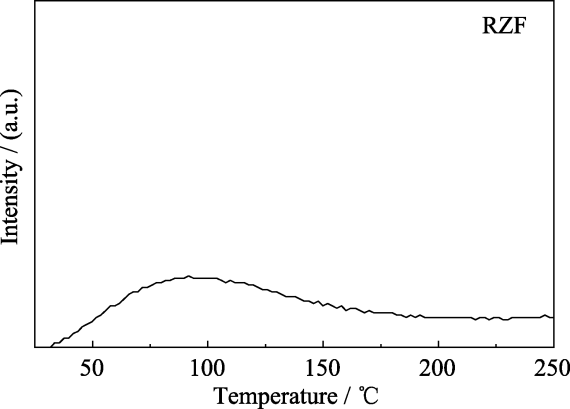
Fig. S7 TL curve of RbZnF3 matrix at different temperatures
| Temperature | 25 ℃ | 75 ℃ | 125 ℃ | 175 ℃ |
|---|---|---|---|---|
| Space group | Pm3m(221)-Cubic | |||
| a/Å | 4.1329 | 4.1330 | 4.1369 | 4.1406 |
| α/(º) | 90 | 90 | 90 | 90 |
| V/Å3 | 70.5935 | 70.6140 | 70.7987 | 70.9880 |
| Rwp | 2.67% | 2.69% | 2.29% | 2.33% |
| Rp | 2.11% | 2.13% | 1.86% | 1.89% |
Table S1 Variation of cell parameter of RbZnF3:0.13Eu3+ sample with the increase of temperature
| Temperature | 25 ℃ | 75 ℃ | 125 ℃ | 175 ℃ |
|---|---|---|---|---|
| Space group | Pm3m(221)-Cubic | |||
| a/Å | 4.1329 | 4.1330 | 4.1369 | 4.1406 |
| α/(º) | 90 | 90 | 90 | 90 |
| V/Å3 | 70.5935 | 70.6140 | 70.7987 | 70.9880 |
| Rwp | 2.67% | 2.69% | 2.29% | 2.33% |
| Rp | 2.11% | 2.13% | 1.86% | 1.89% |
| [3] | YUAN W, PANG R, WANG S, et al. Enhanced blue-light excited cyan-emitting persistent luminescence of BaLu2Al2Ga2SiO12:Ce3+, Bi3+ phosphors for AC-LEDs via defect modulation. Light: Science & Applications, 2022, 11: 184. |
| [4] | DONG L, ZHANG L, JIA Y, et al. Enhancing luminescence and controlling the Mn valence state of Gd3Ga5-x-δAlx-y+δO12:yMn phosphors by the design of the garnet structure. ACS Applied Materials & Interfaces, 2020, 12: 7334. |
| [5] | DONG L, ZHANG L, JIA Y, et al. Site occupation and luminescence of novel orange-red Ca3M2Ge3O12:Mn2+, Mn4+ (M = Al, Ga) phosphors. ACS Sustainable Chemistry & Engineering, 2020, 8: 3357. |
| [6] |
PAN X, MEI L, ZHUANG Y, et al. Anti-defect engineering toward high luminescent efficiency in whitlockite phosphors. Chemical Engineering Journal, 2022, 434: 134652.
DOI URL |
| [7] | DANG P, LI G, YUN X, et al. Thermally stable and highly efficient red-emitting Eu3+-doped Cs3GdGe3O9 phosphors for WLEDs: non-concentration quenching and negative thermal expansion. Light: Science & Applications, 2021, 10: 29. |
| [8] | SENDEN T, VAN DIJK-MOES R J A, MEIJERINK A. Quenching of the red Mn4+ luminescence in Mn4+-doped fluoride LED phosphors. Light: Science & Applications, 2018, 7: 8. |
| [9] | WEI Y, XING G, LIU K, et al. New strategy for designing orangish-red-emitting phosphor via oxygen-vacancy-induced electronic localization. Light: Science & Applications, 2019, 8: 15. |
| [10] |
DANG P, WANG W, LIAN H, et al. How to obtain anti- thermal-quenching inorganic luminescent materials for light- emitting diode applications. Advanced Optical Materials, 2022, 10: 2102287.
DOI URL |
| [11] |
LI H, CAI J, PANG R, et al. A strategy for developing thermal-quenching-resistant emission and super-long persistent luminescence in BaGa2O4:Bi3+. Journal of Materials Chemistry C, 2019, 7: 13088.
DOI URL |
| [12] |
WEI S, LYU Z, LU Z, et al. Moderate trap engineering for enhanced thermal stability and high efficiency in a Bi3+-doped phosphor. Chemistry of Materials, 2023, 35: 7125.
DOI URL |
| [13] | DAI P P, LI C, ZHANG X T, et al. A single Eu2+-activated high- color-rendering oxychloride white-light phosphor for white-light- emitting diodes. Light: Science & Applications, 2016, 5: e16024. |
| [14] |
QIAO J, NING L, MOLOKEEV M S, et al. Eu2+ site preferences in the mixed cation K2BaCa(PO4)2 and thermally stable luminescence. Journal of the American Chemical Society, 2018, 140: 9730.
DOI URL |
| [15] | PIAO S, WANG Y, ZHOU X, et al. Defect engineering in a Eu2+-doped β-Al2O3 structure blue phosphor and its controllable zero-thermal quenching luminescence. ACS Sustainable Chemistry & Engineering, 2021, 9: 7882. |
| [16] |
CHEN Y, YU B, GOU J, et al. Zero-thermal-quenching and photoluminescence tuning with the assistance of carriers from defect cluster traps. Journal of Materials Chemistry C, 2018, 6: 10687.
DOI URL |
| [17] |
FANG S, LANG T, HAN T, et al. Zero-thermal-quenching of Mn4+ far-red-emitting in LaAlO3 perovskite phosphor via energy compensation of electrons’ traps. Chemical Engineering Journal, 2020, 389: 124297.
DOI URL |
| [18] |
TYAGI N, KUMAR P S, NAGARAJAN R. Room temperature optical absorption and intrinsic photoluminescence in KZnF3. Chemical Physics Letters, 2010, 494: 284.
DOI URL |
| [19] |
WEI S, LI Z, LYU Z, et al. Energy transfer mediated single-phased white light emission in Bi3+-Eu3+ codoped Ba3YGa2O7.5 for WLED. Journal of Alloys and Compounds, 2022, 923: 166419.
DOI URL |
| [20] |
AN Z, LIU W, SONG Y, et al. Color-tunable Eu2+, Eu3+ co-doped Ca20Al26Mg3Si3O68 phosphor for w-LEDs. Journal of Materials Chemistry C, 2019, 7: 6978.
DOI URL |
| [21] |
LI R, CHEN Q, CUI R, et al. A novel high-brightness red phosphor Ca4Nb2O9:Eu3+ for WLEDs. Inorganic Chemistry Communications, 2024, 170: 113267.
DOI URL |
| [22] |
BLASSE G. Energy transfer in oxidic phosphors. Physics Letters A, 1968, 28: 444.
DOI URL |
| [23] |
TIAN Y, CHEN B, TIAN B, et al. Concentration-dependent luminescence and energy transfer of flower-like Y2(MoO4)3:Dy3+ phosphor. Journal of Alloys and Compounds, 2011, 509: 6096.
DOI URL |
| [24] | HUANG S, LOU L. Concentration dependence of sensitizer fluorescence intensity in energy transfer. Chinese Journal of Luminescence, 1990, 11: 1. |
| [25] |
LI J, LIU B, LIU G, et al. Red color Sr2NaMg2V3O12:Eu3+ phosphor with high thermal stability for w-LEDs. Journal of Rare Earths, 2023, 41: 1689.
DOI URL |
| [26] |
LI F, CUI R, YUAN G, et al. Preparation and characterization of a new orange-red phosphor Ba2LaTaO6:Eu3+ with abnormal thermal quenching. Journal of Rare Earths, 2023, 41: 1678.
DOI URL |
| [27] |
BAI Y, JIA Z, GAO J, et al. A novel red-emitting phosphor K2MgGeO4:Eu3+ for WLEDs: zero-thermal quenching induced by heterovalent substitution. Journal of Materials Chemistry C, 2022, 10: 15957.
DOI URL |
| [28] |
HA J, WANG Z, NOVITSKAYA E, et al. An integrated first principles and experimental investigation of the relationship between structural rigidity and quantum efficiency in phosphors for solid state lighting. Journal of Luminescence, 2016, 179: 297.
DOI URL |
| [29] |
LIU H, LIANG H, ZHANG W, et al. Improving the thermal stability and luminescent efficiency of (Ba,Sr)3SiO5:Eu2+ phosphors by structure, bandgap engineering and soft chemistry synthesis method. Chemical Engineering Journal, 2021, 410: 128367.
DOI URL |
| [30] |
SUN Z, SUN B, ZHANG X, et al. Superb thermal stability purple-blue phosphor through synergistic effect of emission compensation and nonradiative transition restriction of Eu2+. Materials Today Chemistry, 2022, 24: 100877.
DOI URL |
| [31] |
WANG Z, JIAO S, XU Y, et al. Effects of heat-treatment on photoluminescence properties of MgAl2O4:Eu3+ red phosphors synthesized by a solution combustion method. Journal of Luminescence, 2019, 211: 108.
DOI URL |
| [32] |
LI X, HE C, ZUO S, et al. Photocatalytic nitrogen fixation over fluoride/attapulgite nanocomposite: effect of upconversion and fluorine vacancy. Solar Energy, 2019, 191: 251.
DOI URL |
| [1] |
ZHONG C, XU Y, WU X, et al. High output power and high quantum efficiency in novel NIR phosphor MgAlGa0.7B0.3O4:Cr3+ with profound FWHM variation. Advanced Materials, 2024, 36: 2309500.
DOI URL |
| [2] |
KIM Y H, ARUNKUMAR P, KIM B Y, et al. A zero- thermal-quenching phosphor. Nature Materials, 2017, 16: 543.
DOI URL |
| [1] | 宋坤洁, 解荣军. 机器学习驱动新型发光材料的研究进展[J]. 无机材料学报, 2026, 41(6): 689-703. |
| [2] | 胡扬, 谢敏, 张筱怡, 李想, 郭新伟, 姜南, 周文瀚, 张胜利, 曾海波. 计算与数据驱动环保型发光材料的研究进展[J]. 无机材料学报, 2026, 41(6): 704-722. |
| [3] | 洪恩柳, 涂欣晨, 李自清, 方晓生. 二维钙钛矿单晶纳米片的漂浮法制备及其光电探测性能[J]. 无机材料学报, 2026, 41(6): 787-794. |
| [4] | 周子淳, 张翔, 明辰, 孙宜阳. 面向紫光激发白光LED的Eu2+/Ce3+掺杂荧光粉数据库[J]. 无机材料学报, 2026, 41(3): 393-400. |
| [5] | 蒋君, 杨攻旅, 杨雨帆, 李毅, 袁宁一, 丁建宁. 有机胺盐调控钙钛矿薄膜结晶提升太阳能电池光电转换效率和稳定性[J]. 无机材料学报, 2026, 41(2): 186-192. |
| [6] | 朱文杰, 唐璐, 陆继长, 刘江平, 罗永明. 钙钛矿型氧化物催化氧化挥发性有机化合物的研究进展[J]. 无机材料学报, 2025, 40(7): 735-746. |
| [7] | 何国强, 张恺恒, 王震涛, 包健, 席兆琛, 方振, 王昌昊, 王威, 王鑫, 姜佳沛, 李祥坤, 周迪. Ba(Nd1/2Nb1/2)O3: 一种被低估的K40微波介质陶瓷[J]. 无机材料学报, 2025, 40(6): 639-646. |
| [8] | 姜昆, 李乐天, 郑木鹏, 胡永明, 潘勤学, 吴超峰, 王轲. PZT陶瓷的低温烧结研究进展[J]. 无机材料学报, 2025, 40(6): 627-638. |
| [9] | 渠吉发, 王旭, 张维轩, 张康喆, 熊永恒, 谭文轶. 掺杂改性NaYTiO4增强固体氧化物燃料电池阳极抗硫中毒性能[J]. 无机材料学报, 2025, 40(5): 489-496. |
| [10] | 范小暄, 郑永炅, 徐丽荣, 姚子敏, 曹硕, 王可心, 王绩伟. 基于富氧空位LiYScGeO4: Bi3+长余辉光催化剂的自激活余辉驱动有机污染物芬顿降解[J]. 无机材料学报, 2025, 40(5): 481-488. |
| [11] | 杨恒强, 张馨月, 马义初, 周青军. 铁基钙钛矿La0.25M0.75FeO3-δ (M=Ba, Sr, Ca)的制备及其作为固体氧化物燃料电池阴极材料的性能研究[J]. 无机材料学报, 2025, 40(12): 1365-1372. |
| [12] | 王哲, 郝鸿儒, 吴宗辉, 徐玲玲, 吕喆, 魏波. 构型熵工程增强双钙钛矿型氧电极抗Cr中毒能力[J]. 无机材料学报, 2025, 40(12): 1341-1348. |
| [13] | 胡清豪, 刘兴翀, 彭永珊, 侯孟君, 何堂贵, 汤安民. 安赛蜜修饰SnO2电子传输层对钙钛矿太阳能电池性能的影响[J]. 无机材料学报, 2025, 40(11): 1261-1267. |
| [14] | 许晓宇, 周黎阳, 冯晓颖, 王挥, 阎彬, 许杰, 高峰. 基于MPB线性规则设计的PIN-PZN-PZ-PT压电陶瓷结构与性能研究[J]. 无机材料学报, 2025, 40(11): 1285-1292. |
| [15] | 吕昕怿, 相恒阳, 曾海波. 长程有序助力钙钛矿QLED高性能化[J]. 无机材料学报, 2025, 40(1): 111-112. |
| 阅读次数 | ||||||
|
全文 |
|
|||||
|
摘要 |
|
|||||