无机材料学报 ›› 2026, Vol. 41 ›› Issue (7): 947-954.DOI: 10.15541/jim20250410 CSTR: 32189.14.10.15541/jim20250410
彭裕超1( ), 董源1, 董顺1(), 夏莲森1, 胡佩涛1, 张幸红1, 周延春2
收稿日期:2025-10-21
修回日期:2025-12-17
出版日期:2026-07-20
网络出版日期:2025-12-19
通讯作者:
董 顺, 教授. E-mail: dongshun@hit.edu.cn作者简介:彭裕超(1999-), 男, 博士研究生. E-mail: pycuchao@stu.hit.edu.cn
基金资助:
PENG Yuchao1(), DONG Yuan1, DONG Shun1(), XIA Liansen1, HU Peitao1, ZHANG Xinghong1, ZHOU Yanchun2
Received:2025-10-21
Revised:2025-12-17
Published:2026-07-20
Online:2025-12-19
Contact:
DONG Shun, professor. E-mail: dongshun@hit.edu.cnAbout author:PENG Yuchao (1999-), male, PhD candidate. E-mail: pycuchao@stu.hit.edu.cn
Supported by:摘要:
多主元碳氮化物超高温陶瓷(UHTCs)与传统体系相比具有更优异的高温稳定性及耐烧蚀性能, 但该类材料存在的本征脆性问题限制了其广泛应用。本研究通过引入第二相SiC颗粒(SiCp), 采用机械合金化/原位氮化法结合放电等离子烧结技术制备了(Ti,Zr,Hf,Ta,Cr)(C,N)-SiC复相陶瓷, 并系统研究了SiCp引入量对材料力学性能和耐烧蚀性能的影响规律。结果表明, 引入SiCp有效提升了材料的力学性能, 当SiCp的体积分数为20%时, 材料的断裂韧性达到(5.18±0.24) MPa·m1/2, 相比(Ti,Zr,Hf,Ta,Cr)(C,N)陶瓷提升了31.5%, 其断裂韧性提升可归因于引入SiCp所诱导的裂纹偏转与分叉等增韧机制。进一步对材料进行2100 ℃/120 s氧-乙炔焰流考核, 结果表明, 引入SiCp还有效提升了材料的耐烧蚀性能。当SiCp体积分数为20%时, 材料的耐烧蚀性能最佳, 其质量烧蚀率与线烧蚀率达到-0.92 mg/s和-1.17 μm/s, 优于多数已报道的传统UHTCs。其耐烧蚀性能的提升可归因于高熔点复合氧化物骨架对低熔点SiO2流动相的钉扎作用, 以及两者协同形成的多元致密氧化物保护膜对氧扩散的抑制作用。上述结果表明, 引入适量SiCp可有效解决多主元碳氮化物UHTCs本征脆性难题, 协同提升材料力学与耐烧蚀性能, 相关成果可为新一代高性能热防护材料研制提供理论基础与数据支撑。
中图分类号:
彭裕超, 董源, 董顺, 夏莲森, 胡佩涛, 张幸红, 周延春. SiC颗粒含量对(Ti,Zr,Hf,Ta,Cr)(C,N)-SiC陶瓷力学性能及耐烧蚀性能的影响[J]. 无机材料学报, 2026, 41(7): 947-954.
PENG Yuchao, DONG Yuan, DONG Shun, XIA Liansen, HU Peitao, ZHANG Xinghong, ZHOU Yanchun. Effect of SiC Particle Content on Mechanical Properties and Ablation Resistance of (Ti,Zr,Hf,Ta,Cr)(C,N)-SiC Ceramics[J]. Journal of Inorganic Materials, 2026, 41(7): 947-954.
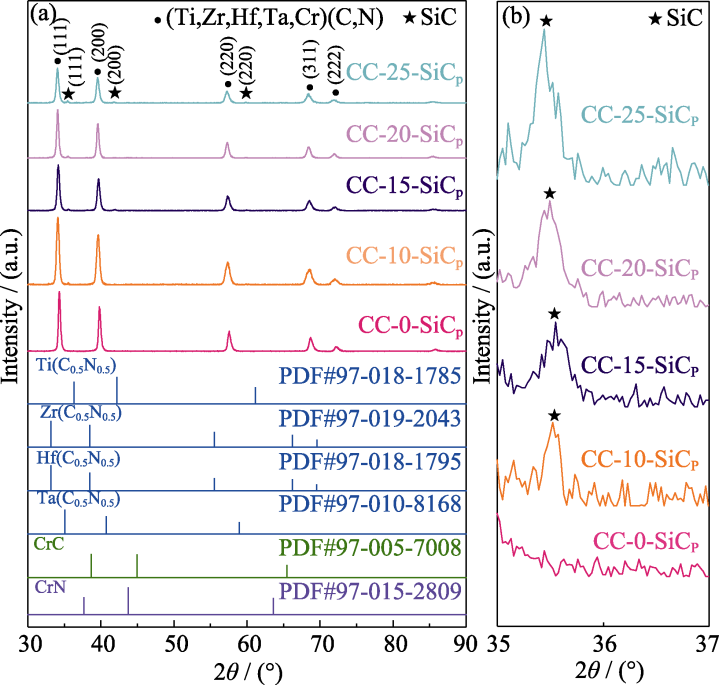
图1 不同SiCp含量的(Ti,Zr,Hf,Ta,Cr)(C,N)-SiC复相陶瓷的XRD图谱
Fig. 1 XRD patterns of (Ti,Zr,Hf,Ta,Cr)(C,N)-SiC ceramics with various SiCp contents (a) Overall XRD patterns; (b) Enlarged view in the range of 2θ=35o-37o
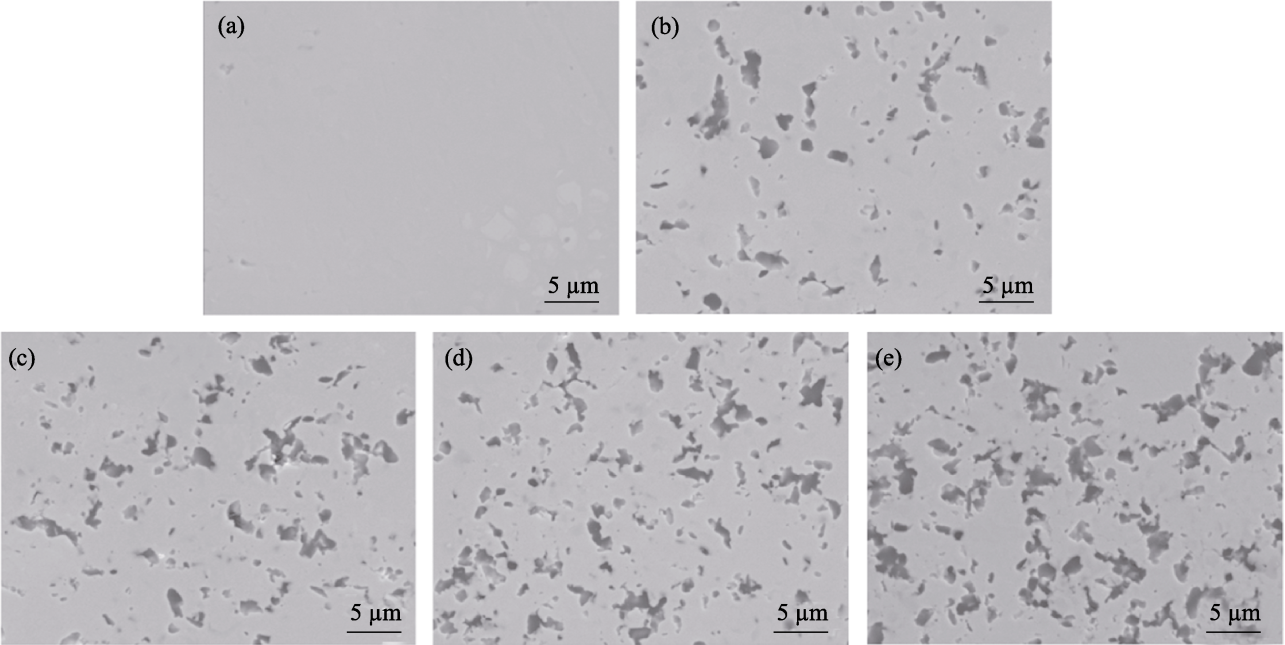
图2 不同SiCp含量的(Ti,Zr,Hf,Ta,Cr)(C,N)-SiC复相陶瓷的抛光表面SEM照片
Fig. 2 SEM images of the polished surfaces of (Ti,Zr,Hf,Ta,Cr)(C,N)-SiC ceramics with various SiCp contents (a) CC-0-SiCp; (b) CC-10-SiCp; (c) CC-15-SiCp; (d) CC-20-SiCp; (e) CC-25-SiCp
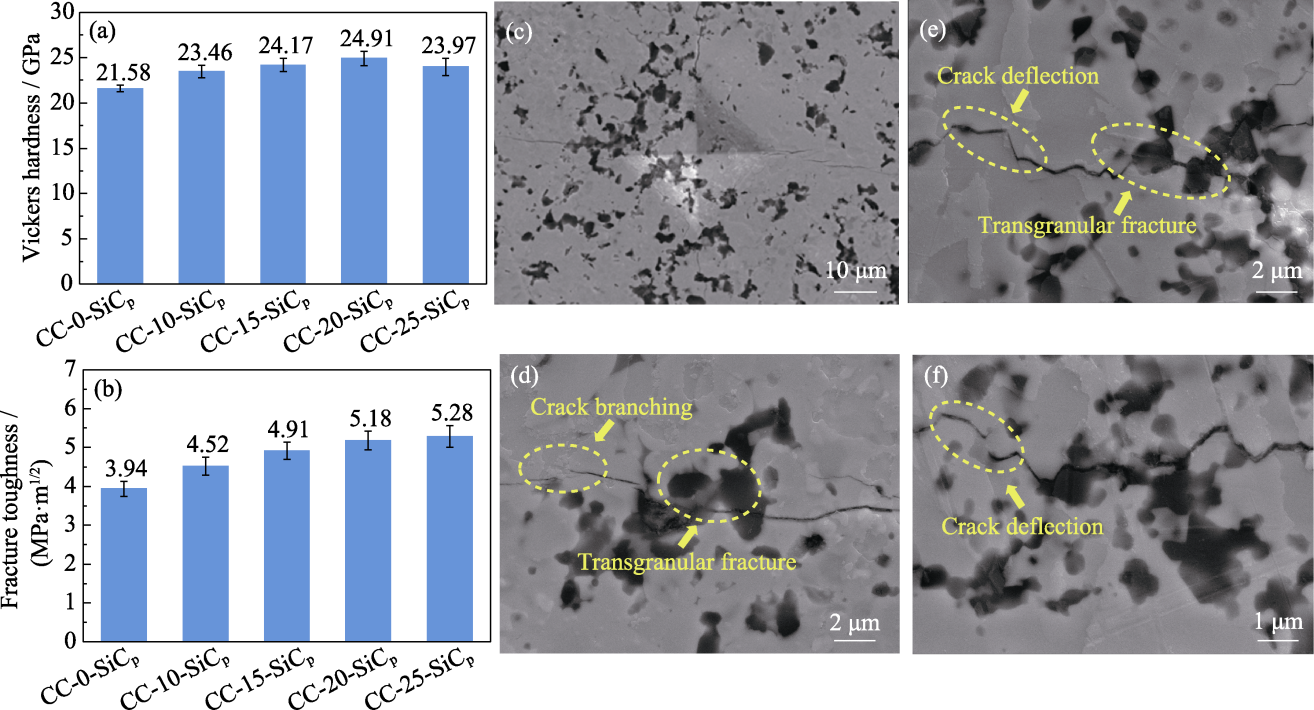
图3 不同SiCp含量的(Ti,Zr,Hf,Ta,Cr)(C,N)-SiC复相陶瓷的力学性能及CC-20-SiCp的压痕形貌、裂纹扩展SEM照片
Fig. 3 Mechanical properties of (Ti,Zr,Hf,Ta,Cr)(C,N)-SiC ceramics with various SiCp contents and SEM images of indentation morphology and crack propagation in CC-20-SiCp (a) Vickers hardness; (b) Fracture toughness; (c) Indentation morphology; (d-f) Crack propagation paths
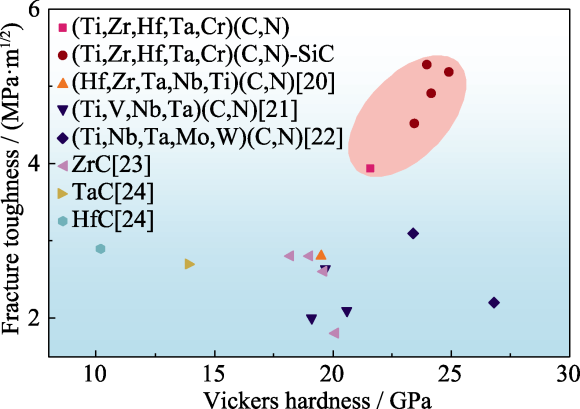
图4 本工作与部分文献报道的UHTCs的力学性能对比图[20-24]
Fig. 4 Comparison of mechanical properties of the UHTCs between this work and selected references[20-24]
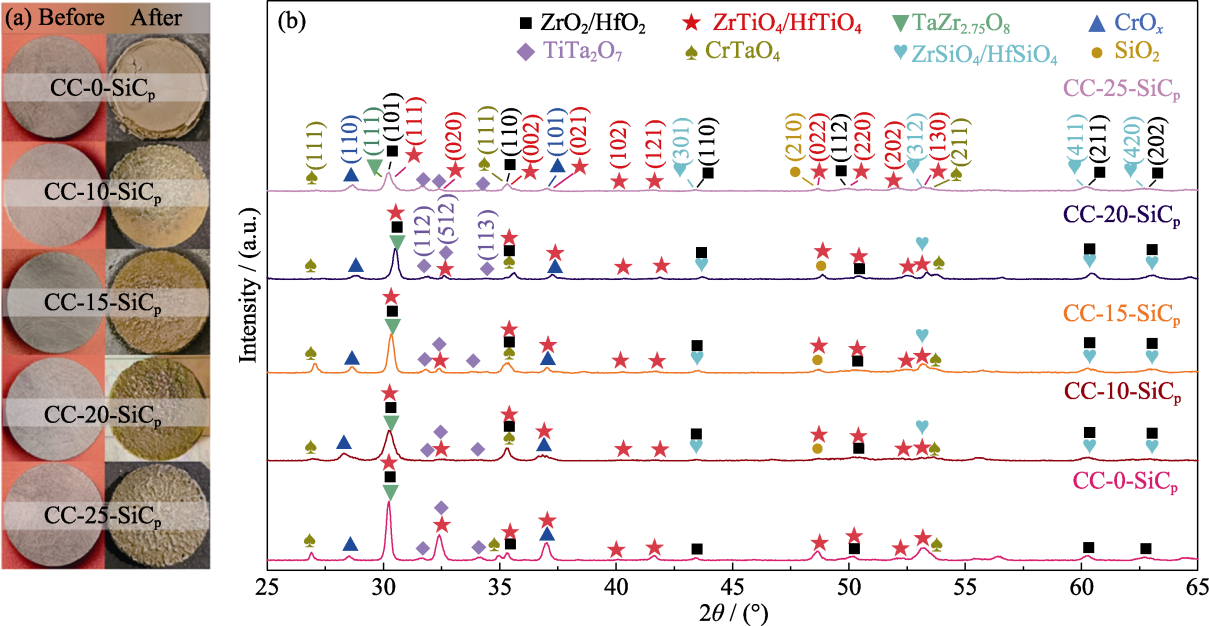
图5 不同SiCp含量的(Ti,Zr,Hf,Ta,Cr)(C,N)-SiC复相陶瓷(a)烧蚀前后的宏观形貌及(b)烧蚀后的XRD图谱
Fig. 5 (a) Macroscopic morphologies before and after ablation tests and (b) XRD patterns after ablation tests of (Ti,Zr,Hf,Ta,Cr)(C,N)-SiC ceramics with various SiCp contents
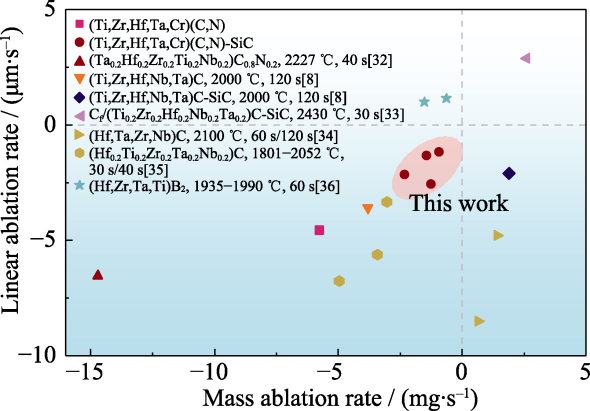
图6 本工作与部分文献报道的UHTCs的烧蚀性能对比图[8,32 -36]
Fig. 6 Comparison of ablation performance of the UHTCs between this work and selected references[8,32 -36]
| Sample | Measured density/(g·cm-3) | Theoretical density/(g·cm-3) | Relative density/% |
|---|---|---|---|
| CC-0-SiCp | 8.67 | 8.92 | 97.2 |
| CC-10-SiCp | 8.17 | 8.35 | 97.8 |
| CC-15-SiCp | 7.92 | 8.06 | 98.3 |
| CC-20-SiCp | 7.69 | 7.78 | 98.8 |
| CC-25-SiCp | 7.30 | 7.49 | 97.5 |
表S1 不同SiCp含量的(Ti,Zr,Hf,Ta,Cr)(C,N)-SiC复相陶瓷的实际密度、理论密度和相对致密度
Table S1 Measured densities, theoretical densities, and relative densities of (Ti,Zr,Hf,Ta,Cr)(C,N)-SiC ceramics with various SiCp contents
| Sample | Measured density/(g·cm-3) | Theoretical density/(g·cm-3) | Relative density/% |
|---|---|---|---|
| CC-0-SiCp | 8.67 | 8.92 | 97.2 |
| CC-10-SiCp | 8.17 | 8.35 | 97.8 |
| CC-15-SiCp | 7.92 | 8.06 | 98.3 |
| CC-20-SiCp | 7.69 | 7.78 | 98.8 |
| CC-25-SiCp | 7.30 | 7.49 | 97.5 |
| Material system | Fracture toughness/(MPa·m1/2) | Vickers hardness/GPa | Reference |
|---|---|---|---|
| (Hf,Zr,Ta,Nb,Ti)(C,N) | 2.8 | 19.5 | [ |
| (Ti,V,Nb,Ta)(C,N) | 2.64 | 19.7 | [ |
| (Ti,V,Nb,Ta)(C,N) | 2.1 | 20.6 | [ |
| (Ti,V,Nb,Ta)(C,N) | 2 | 19.1 | [ |
| (Ti,Nb,Ta,Mo,W)(C,N) | 3.1 | 23.4 | [ |
| (Ti,Nb,Ta,Mo,W)(C,N) | 2.2 | 26.8 | [ |
| ZrC | 2.8 | 18.2 | [ |
| ZrC | 2.8 | 19 | [ |
| ZrC | 2.6 | 19.6 | [ |
| ZrC | 1.8 | 20.1 | [ |
| TaC | 2.7 | 13.9 | [ |
| HfC | 2.9 | 10.2 | [ |
表S2 本工作与部分文献报道的UHTCs的力学性能数据汇总
Table S2 Summary of the mechanical properties data of the UHTCs in this work and those reported in selected references
| Material system | Fracture toughness/(MPa·m1/2) | Vickers hardness/GPa | Reference |
|---|---|---|---|
| (Hf,Zr,Ta,Nb,Ti)(C,N) | 2.8 | 19.5 | [ |
| (Ti,V,Nb,Ta)(C,N) | 2.64 | 19.7 | [ |
| (Ti,V,Nb,Ta)(C,N) | 2.1 | 20.6 | [ |
| (Ti,V,Nb,Ta)(C,N) | 2 | 19.1 | [ |
| (Ti,Nb,Ta,Mo,W)(C,N) | 3.1 | 23.4 | [ |
| (Ti,Nb,Ta,Mo,W)(C,N) | 2.2 | 26.8 | [ |
| ZrC | 2.8 | 18.2 | [ |
| ZrC | 2.8 | 19 | [ |
| ZrC | 2.6 | 19.6 | [ |
| ZrC | 1.8 | 20.1 | [ |
| TaC | 2.7 | 13.9 | [ |
| HfC | 2.9 | 10.2 | [ |
| Sample | Mass ablation rate/(mg·s-1) | Linear ablative rate/(μm·s-1) |
|---|---|---|
| CC-0-SiCp | -5.75 | -4.58 |
| CC-10-SiCp | -2.33 | -2.17 |
| CC-15-SiCp | -1.42 | -1.33 |
| CC-20-SiCp | -0.92 | -1.17 |
| CC-25-SiCp | -1.25 | -2.58 |
表S3 不同SiCp含量的(Ti,Zr,Hf,Ta,Cr)(C,N)-SiC复相陶瓷的质量烧蚀率和线烧蚀率
Table S3 Mass ablation rates and linear ablative rates of (Ti,Zr,Hf,Ta,Cr)(C,N)-SiC ceramics with various SiCp contents
| Sample | Mass ablation rate/(mg·s-1) | Linear ablative rate/(μm·s-1) |
|---|---|---|
| CC-0-SiCp | -5.75 | -4.58 |
| CC-10-SiCp | -2.33 | -2.17 |
| CC-15-SiCp | -1.42 | -1.33 |
| CC-20-SiCp | -0.92 | -1.17 |
| CC-25-SiCp | -1.25 | -2.58 |
| Material system | Temperature/℃ | Time/s | Mass ablation rate/(mg·s-1) | Linear ablative rate/(μm·s-1) | Reference |
|---|---|---|---|---|---|
| (Ta0.2Hf0.2Zr0.2Ti0.2Nb0.2)C0.8N0.2 | 2227 | 40 | -14.7 | -6.54 | [ |
| (Ti,Zr,Hf,Nb,Ta)C | 2000 | 120 | -3.8 | -3.6 | [ |
| (Ti,Zr,Hf,Nb,Ta)C-SiC | 2000 | 120 | 1.9 | -2.1 | [ |
| Cf/(Ti0.2Zr0.2Hf0.2Nb0.2Ta0.2)C-SiC | 2430 | 30 | 2.6 | 2.89 | [ |
| (Hf,Ta,Zr,Nb)C | 2100 | 60 | 0.66 | -8.5 | [ |
| (Hf,Ta,Zr,Nb)C | 2100 | 120 | 1.41 | -4.8 | [ |
| (Hf0.2Ti0.2Zr0.2Ta0.2Nb0.2)C | 1801 | 30 | -3.03 | -3.33 | [ |
| (Hf0.2Ti0.2Zr0.2Ta0.2Nb0.2)C | 1952 | 30 | -3.4 | -5.63 | [ |
| (Hf0.2Ti0.2Zr0.2Ta0.2Nb0.2)C | 2052 | 40 | -4.95 | -6.75 | [ |
| (Hf,Zr,Ta,Ti)B2 | 1935 | 30 | -1.52 | 0.96 | [ |
| (Hf,Zr,Ta,Ti)B2 | 1990 | 60 | -0.63 | 1.14 | [ |
表S4 本工作与部分文献报道的UHTCs的烧蚀性能数据汇总
Table S4 Summary of the ablation performance data of the UHTCs in this work and those reported in selected references
| Material system | Temperature/℃ | Time/s | Mass ablation rate/(mg·s-1) | Linear ablative rate/(μm·s-1) | Reference |
|---|---|---|---|---|---|
| (Ta0.2Hf0.2Zr0.2Ti0.2Nb0.2)C0.8N0.2 | 2227 | 40 | -14.7 | -6.54 | [ |
| (Ti,Zr,Hf,Nb,Ta)C | 2000 | 120 | -3.8 | -3.6 | [ |
| (Ti,Zr,Hf,Nb,Ta)C-SiC | 2000 | 120 | 1.9 | -2.1 | [ |
| Cf/(Ti0.2Zr0.2Hf0.2Nb0.2Ta0.2)C-SiC | 2430 | 30 | 2.6 | 2.89 | [ |
| (Hf,Ta,Zr,Nb)C | 2100 | 60 | 0.66 | -8.5 | [ |
| (Hf,Ta,Zr,Nb)C | 2100 | 120 | 1.41 | -4.8 | [ |
| (Hf0.2Ti0.2Zr0.2Ta0.2Nb0.2)C | 1801 | 30 | -3.03 | -3.33 | [ |
| (Hf0.2Ti0.2Zr0.2Ta0.2Nb0.2)C | 1952 | 30 | -3.4 | -5.63 | [ |
| (Hf0.2Ti0.2Zr0.2Ta0.2Nb0.2)C | 2052 | 40 | -4.95 | -6.75 | [ |
| (Hf,Zr,Ta,Ti)B2 | 1935 | 30 | -1.52 | 0.96 | [ |
| (Hf,Zr,Ta,Ti)B2 | 1990 | 60 | -0.63 | 1.14 | [ |
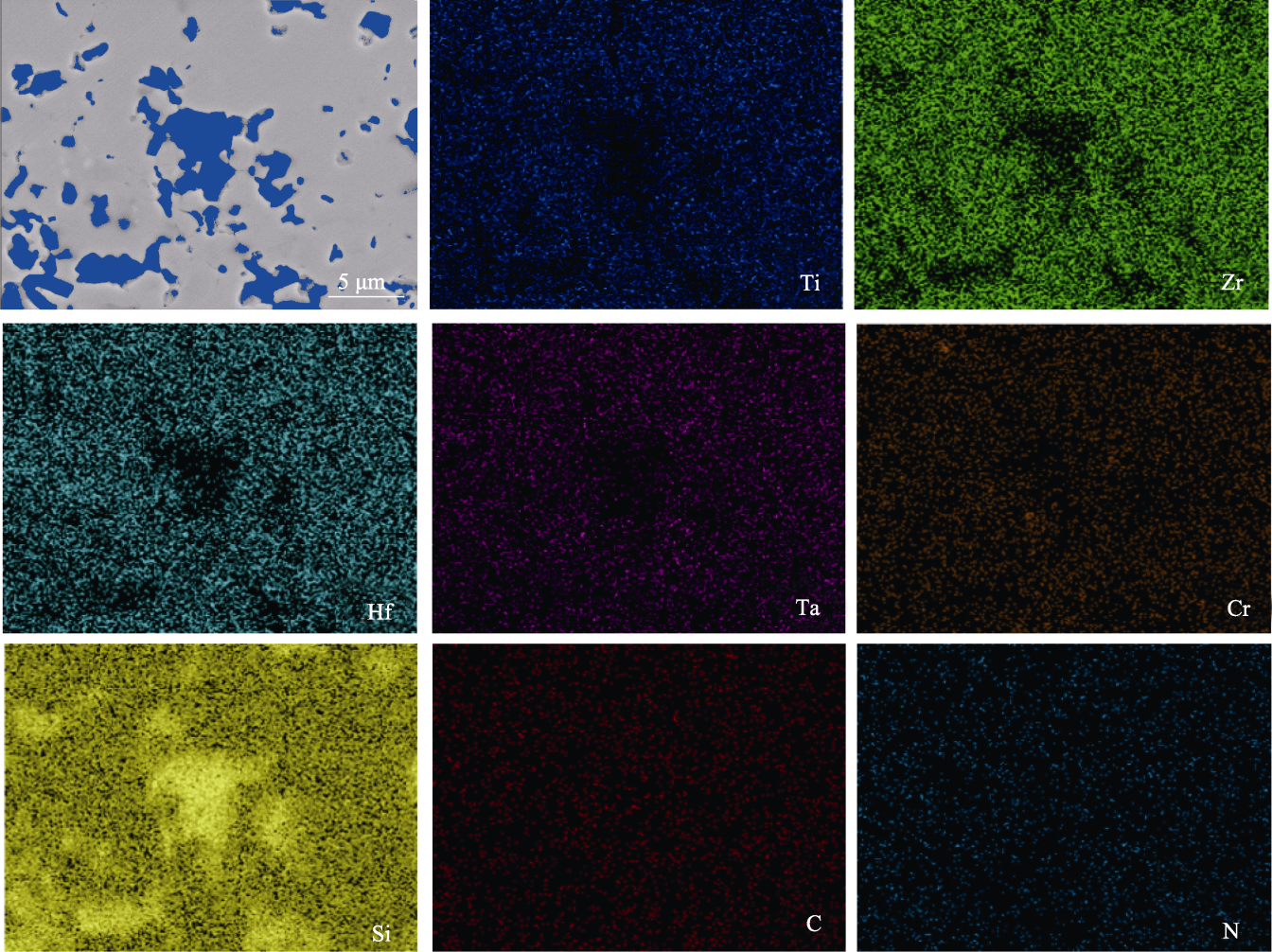
图S1 CC-20-SiCp的抛光表面SEM照片及EDS元素分布图
Fig. S1 SEM image and corresponding EDS element mappings of the polished surfaces for CC-20-SiCp
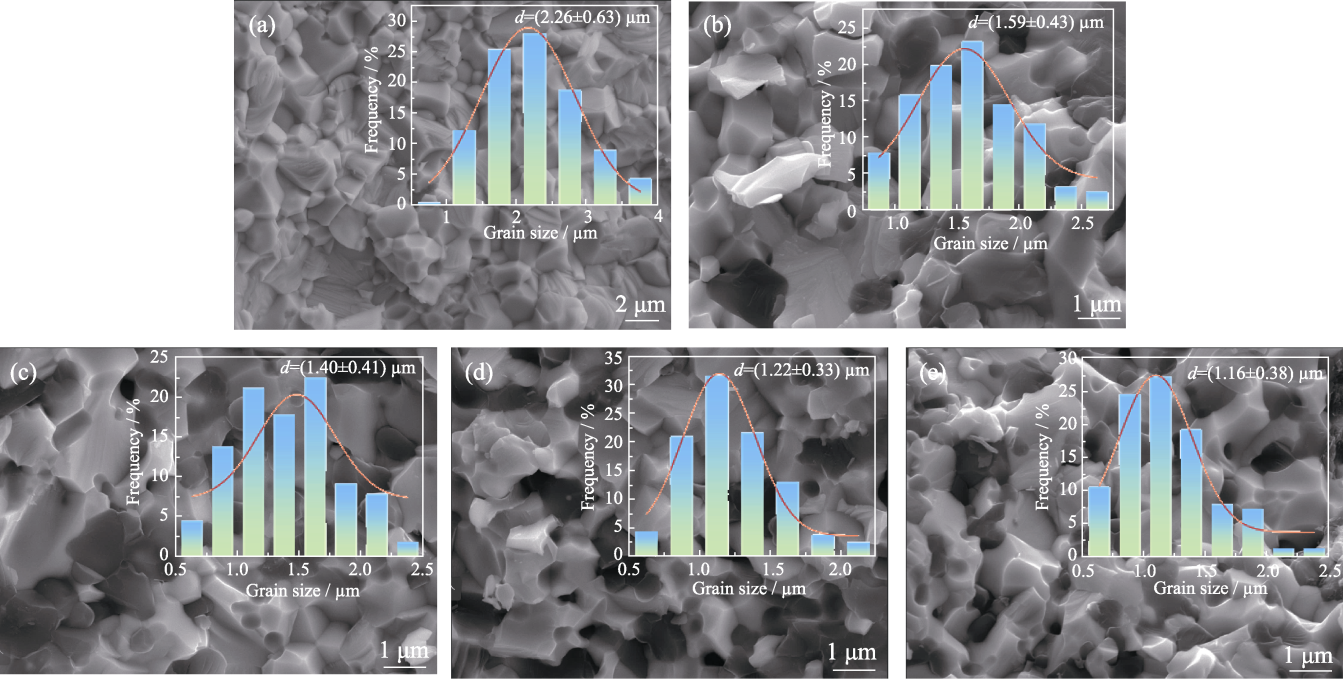
图S2 不同SiCp含量的(Ti,Zr,Hf,Ta,Cr)(C,N)-SiC复相陶瓷的断口SEM照片及晶粒尺寸分布图
Fig. S2 SEM images of fractured surfaces and grain size distributions of (Ti,Zr,Hf,Ta,Cr)(C,N)-SiC ceramics with various SiCp contents (a) CC-0-SiCp; (b) CC-10-SiCp; (c) CC-15-SiCp; (d) CC-20-SiCp; (e) CC-25-SiCp
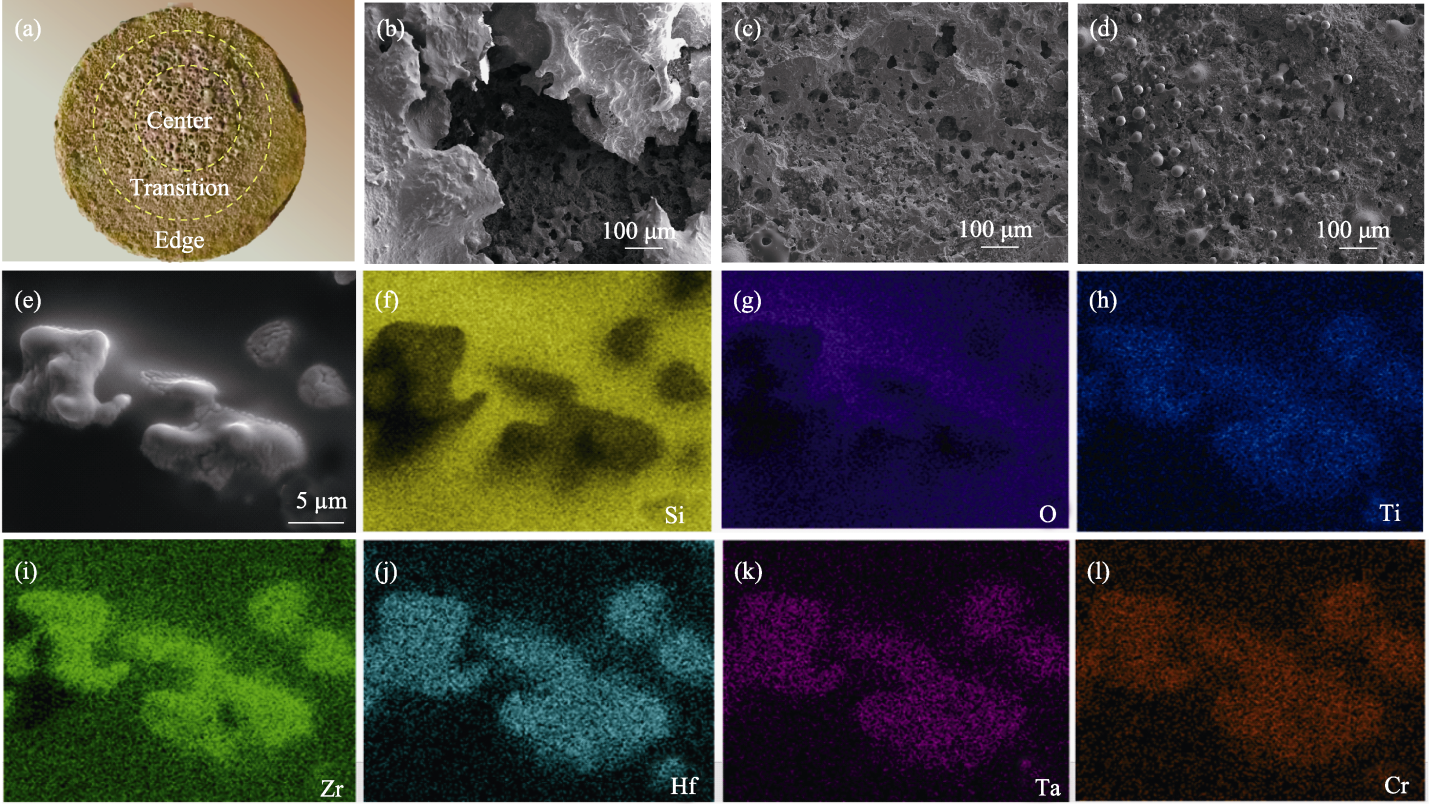
图S3 CC-20-SiCp烧蚀后的表面宏观形貌、表面SEM照片及其EDS元素分布图
Fig. S3 Macroscopic morphology, SEM images and corresponding EDS element mappings of the surface microstructure for CC-20-SiCp after ablation tests (a) Macroscopic morphology; (b-d) SEM images of (b) central region, (c) transitional region, and (d) edge region;(e) Magnified SEM image of transitional region; (f-l) EDS element mappings
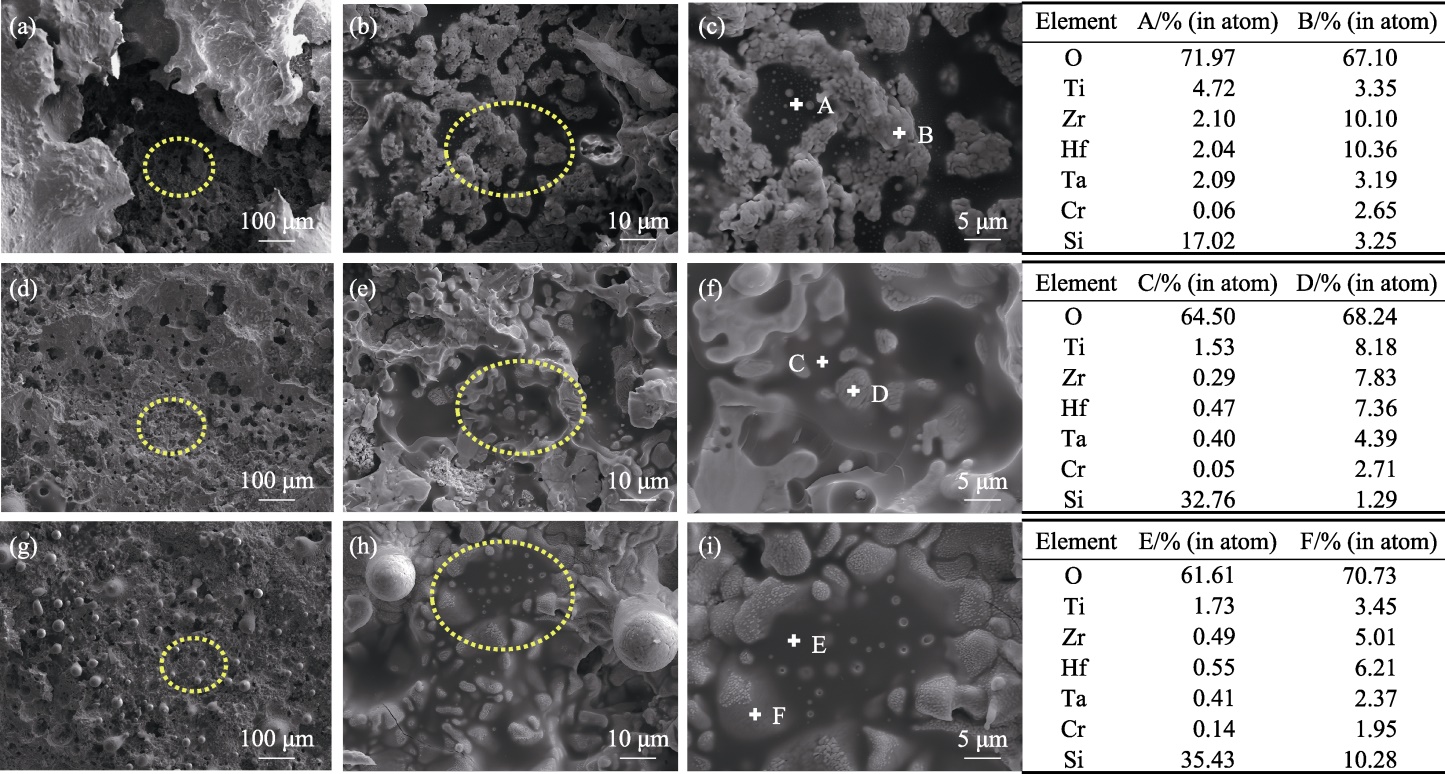
图S4 CC-20-SiCp经过2100 ℃/120 s氧-乙炔焰流考核后表面各区域的微观形貌SEM照片及其EDS元素点分析结果
Fig. S4 SEM images and EDS point analysis results of various surface regions on CC-20-SiCp after oxyacetylene ablation testing at 2100 ℃ for 120 s (a-c) Central region; (d-f) Transitional region; (g-i) Edge region
| [1] |
XIANG H M, XING Y, DAI F Z, et al. High-entropy ceramics: present status, challenges, and a look forward. Journal of Advanced Ceramics, 2021, 10(3): 385.
DOI |
| [2] |
OSES C, TOHER C, CURTAROLO S. High-entropy ceramics. Nature Reviews Materials, 2020, 5(4): 295.
DOI |
| [3] | LIU G A, FANG C, LI M L, et al. Breaking conventional understanding: superior oxidation resistance of a novel Ta and Mo containing high-entropy transition metal diboride. Journal of Materials Science & Technology, 2026, 252: 313. |
| [4] |
ZHANG P, LIU X J, HE G Y, et al. Novel high-entropy ultra-high temperature ceramics with enhanced ablation resistance. Rare Metals, 2024, 43(12): 6559.
DOI URL |
| [5] |
CHEN S, WANG T, WANG X L, et al. Structural origin of enhanced storage energy performance and robust mechanical property in A-site disordered high-entropy ceramics. Rare Metals, 2025, 44(1): 551.
DOI URL |
| [6] | CAO Z N, SUN J L, MENG L T, et al. Progress in densification and toughening of high entropy carbide ceramics. Journal of Materials Science & Technology, 2023, 161: 10. |
| [7] |
LU K, LIU J X, WEI X F, et al. Microstructures and mechanical properties of high-entropy (Ti0.2Zr0.2Hf0.2Nb0.2Ta0.2)C ceramics with the addition of SiC secondary phase. Journal of the European Ceramic Society, 2020, 40(5): 1839.
DOI URL |
| [8] |
GUO W J, HU J, YE Y C, et al. Ablation behavior of (TiZrHfNbTa)C high-entropy ceramics with the addition of SiC secondary under an oxyacetylene flame. Ceramics International, 2022, 48(9): 12790.
DOI URL |
| [9] | 杜百合. ZrB2基超高温陶瓷的力学性能与热响应行为研究. 哈尔滨: 哈尔滨工业大学博士学位论文, 2021. |
| [10] | 罗嗣春. (Ti0.2Zr0.2Nb0.2Ta0.2Mo0.2)Cx基高熵碳化物陶瓷的制备与性能研究. 广州: 广东工业大学博士学位论文, 2022. |
| [11] |
EVANS A G, CHARLES E A. Fracture toughness determinations by indentation. Journal of the American Ceramic Society, 1976, 59(7/8): 371.
DOI URL |
| [12] |
LI J C, ZHANG Y L, ZHAO Y X, et al. A novel (Hf1/3Zr1/3Ti1/3)C medium-entropy carbide coating with excellent long-life ablation resistance applied above 2100 ℃. Composites Part B: Engineering, 2023, 251: 110467.
DOI URL |
| [13] |
XIE F, YIN J, XIONG X, et al. High-temperature oxidation and ablation behavior of (Zr1/3Hf1/3Ti1/3)C ceramic. Journal of the European Ceramic Society, 2024, 44(16): 116784.
DOI URL |
| [14] | 王皓轩. 高熵碳化物基陶瓷的抗氧化和抗烧蚀性能研究. 西安: 西北工业大学博士学位论文, 2021. |
| [15] | 吕学文. 碳化硅纳米颗粒增韧碳化硅陶瓷的制备及力学性能研究. 哈尔滨: 哈尔滨工业大学硕士学位论文, 2021. |
| [16] |
SONG W Y, LU Y J, YANG L T, et al. Enhancement of densification and mechanical property of (Hf0.2Zr0.2Ti0.2Nb0.2Ta0.2)N high-entropy bulk ceramic via silicon carbide addition. Journal of Advanced Ceramics, 2025, 14(1): 9221004.
DOI URL |
| [17] | 魏红康, 张玉军, 邓翔宇. SiCp/B4C复合陶瓷的热压烧结及组织性能. 中国陶瓷, 2010, 46(9): 14. |
| [18] |
LIU J X, HUANG X, ZHANG G J. Pressureless sintering of hafnium carbide-silicon carbide ceramics. Journal of the American Ceramic Society, 2013, 96(6): 1751.
DOI URL |
| [19] |
GOGOTSI Y G. Particulate silicon nitride-based composites. Journal of Materials Science, 1994, 29(10): 2541.
DOI URL |
| [20] |
WEN T Q, YE B L, NGUYEN M C, et al. Thermophysical and mechanical properties of novel high-entropy metal nitride-carbides. Journal of the American Ceramic Society, 2020, 103(11): 6475.
DOI URL |
| [21] |
HAN X Q, LIN N, LI A Q, et al. Microstructure and characterization of (Ti, V, Nb, Ta)(C, N) high-entropy ceramic. Ceramics International, 2021, 47(24): 35105.
DOI URL |
| [22] |
ZHOU Y Z, LUO S C, GUO W M, et al. Preparation of high-entropy (Ti, Nb, Ta, Mo, W)(C, N) ceramics via carbothermal reduction nitridation using different carbon source. Journal of the European Ceramic Society, 2024, 44(3): 1404.
DOI URL |
| [23] | 项铭禹. ZrC陶瓷及其复合材料的制备过程与机理研究. 武汉: 武汉理工大学博士学位论文, 2018. |
| [24] |
CEDILLOS-BARRAZA O, GRASSO S, AL NASIRI N, et al. Sintering behaviour, solid solution formation and characterisation of TaC, HfC and TaC-HfC fabricated by spark plasma sintering. Journal of the European Ceramic Society, 2016, 36(7): 1539.
DOI URL |
| [25] |
ZHANG S, WANG X H, ZHANG C, et al. Microstructure, elastic/mechanical and thermal properties of CrTaO4: a new thermal barrier material? Journal of Advanced Ceramics, 2024, 13(3): 373.
DOI URL |
| [26] |
YE Z M, ZENG Y, XIONG X, et al. Elucidating the role of preferential oxidation during ablation: insights on the design and optimization of multicomponent ultra-high temperature ceramics. Journal of Advanced Ceramics, 2022, 11(12): 1956.
DOI |
| [27] | 彭峥. 超高温碳氮化铪陶瓷及其复合材料设计制备与抗烧蚀性能. 长沙: 中南大学博士学位论文, 2022. |
| [28] | 谢冯旻煜. 多元超高温碳化物陶瓷氧化和烧蚀性能研究. 长沙: 中南大学硕士学位论文, 2023. |
| [29] |
YANG L Y, DONG S, CUI T Y, et al. Novel gradient ZrB2- MoSi2-SiC dense layer with enhanced emissivity and long-term oxidation resistance at ultra-high temperatures. Rare Metals, 2025, 44(3): 2043.
DOI URL |
| [30] | 李夏菲. 防隔热一体化C/C-SiCO多孔陶瓷复合材料的制备与性能研究. 长沙: 国防科技大学博士学位论文, 2019. |
| [31] | 伦惠林. 多元单相碳化物与含硼碳化物陶瓷的制备和抗氧化性能. 长沙: 中南大学博士学位论文, 2022. |
| [32] |
WANG Y C, WANG X C, LI S W, et al. Improved oxidation resistance of (Zr-Nb-Hf-Ta)(C,N) high entropy carbonitrides. Corrosion Science, 2023, 225: 111583.
DOI URL |
| [33] |
CAI F Y, NI D W, CHEN B W, et al. Fabrication and properties of Cf/(Ti0.2Zr0.2Hf0.2Nb0.2Ta0.2)C-SiC high-entropy ceramic matrix composites via precursor infiltration and pyrolysis. Journal of the European Ceramic Society, 2021, 41(12): 5863.
DOI URL |
| [34] | WANG Y C, ZHANG B H, ZHANG C Y, et al. Ablation behaviour of (Hf-Ta-Zr-Nb)C high entropy carbide ceramic at temperatures above 2100 ℃. Journal of Materials Science & Technology, 2022, 113: 40. |
| [35] |
CHEN Z Z, WANG H X, LI C R, et al. Oxyacetylene ablation of (Hf0.2Ti0.2Zr0.2Ta0.2Nb0.2)C at 1350-2050 ℃. Journal of the European Ceramic Society, 2023, 43(6): 2700.
DOI URL |
| [36] |
LV J S, LI W, LI T, et al. Ablation behavior of high-entropy boride (Hf-Zr-Ta-Ti)B2 coating fabricated via supersonic atmospheric plasma spraying for carbon/carbon composites. Composites Part B: Engineering, 2024, 270: 111137.
DOI URL |
| [1] | 余飞宇, 王文清, 张学勤, 何汝杰. 基于增材制造陶瓷点阵的双相网络互穿复合材料的研究进展与挑战[J]. 无机材料学报, 2026, 41(7): 849-866. |
| [2] | 高科丰, 何昕昕, 刘增乾, 张哲峰. 多尺度类贝壳珍珠质层状与梯度结构仿生陶瓷-树脂复合材料[J]. 无机材料学报, 2026, 41(5): 573-582. |
| [3] | 石金瑜, 雷一明, 王晨旭, 张洁, 王京阳. 不同化学计量碳化钛的离子辐照损伤行为研究[J]. 无机材料学报, 2026, 41(3): 322-330. |
| [4] | 郑晨, 王湘宁, 苑贺楠, 杨嘉伟, 李传建, 王华栋. 氧化铝纤维增强二氧化硅复合材料力学性能失效研究[J]. 无机材料学报, 2026, 41(3): 331-339. |
| [5] | 张韵铂, 王兵, 李威, 宋曲之, 杜贻昂, 王应德. BNNS/聚硼氮烷杂化先驱体转化BN纤维中的纳米片尺寸效应[J]. 无机材料学报, 2026, 41(3): 359-369. |
| [6] | 袁旺, 胡建宝, 周亮, 阚艳梅, 张翔宇, 董绍明. 氩气气氛热处理对Shicolon-II SiC纤维机械性能和微观结构演变的影响[J]. 无机材料学报, 2026, 41(1): 119-128. |
| [7] | 张永恒, 陈继新. 镱铝硅酸盐玻璃和SiC改性h-BN基复合材料的制备与性能研究[J]. 无机材料学报, 2026, 41(1): 37-44. |
| [8] | 陈义, 邱海鹏, 陈明伟, 徐昊, 崔恒. SiC/SiC复合材料基体硼改性方法及其力学性能研究[J]. 无机材料学报, 2025, 40(5): 504-510. |
| [9] | 崔宁, 张玉新, 王鲁杰, 李彤阳, 于源, 汤华国, 乔竹辉. (TiVNbMoW)Cx高熵陶瓷的单相形成过程与碳空位调控[J]. 无机材料学报, 2025, 40(5): 511-520. |
| [10] | 李紫薇, 弓伟露, 崔海峰, 叶丽, 韩伟健, 赵彤. 前驱体法制备(Zr, Hf, Nb, Ta, W)C-SiC复相陶瓷及性能研究[J]. 无机材料学报, 2025, 40(3): 271-280. |
| [11] | 高晨光, 孙晓亮, 陈君, 李达鑫, 陈庆庆, 贾德昌, 周玉. 基于湿法纺丝技术的SiBCN-rGO陶瓷纤维的组织结构、力学和吸波性能[J]. 无机材料学报, 2025, 40(3): 290-296. |
| [12] | 穆浩洁, 张源江, 喻彬, 付秀梅, 周世斌, 李晓东. ZrO2掺杂Y2O3-MgO纳米复相陶瓷的制备及性能研究[J]. 无机材料学报, 2025, 40(3): 281-289. |
| [13] | 李伟, 许志明, 苟燕子, 尹森虎, 余艺平, 王松. SiC纤维烧结陶瓷的制备及其性能研究[J]. 无机材料学报, 2025, 40(2): 177-183. |
| [14] | 范武刚, 曹雄, 周响, 李玲, 赵冠楠, 张兆泉. 8YSZ陶瓷在模拟压水堆水环境中的耐腐蚀性能[J]. 无机材料学报, 2024, 39(7): 803-809. |
| [15] | 王伟明, 王为得, 粟毅, 马青松, 姚冬旭, 曾宇平. 以非氧化物为烧结助剂制备高导热氮化硅陶瓷的研究进展[J]. 无机材料学报, 2024, 39(6): 634-646. |
| 阅读次数 | ||||||
|
全文 |
|
|||||
|
摘要 |
|
|||||