
Journal of Inorganic Materials ›› 2026, Vol. 41 ›› Issue (10): 1533-1540.DOI: 10.15541/jim20260081
• RESEARCH LETTER • Previous Articles
GAO Zhixin1,2( ), FU Shuai1,2, BAO Yiwang1,2, LÜ Kuilin1,2(), LIU Xiaogen1,2()
Received:2026-02-27
Revised:2026-04-30
Published:2026-10-20
Online:2026-05-08
Contact:
Lü Kuilin, senior engineer. E-mail: lvkuilin@ctc.ac.cn;About author:GAO Zhixin (1998-), female, PhD. E-mail: gaozhixin0705@foxmail.com
Supported by:CLC Number:
GAO Zhixin, FU Shuai, BAO Yiwang, LÜ Kuilin, LIU Xiaogen. Thermal Corrosion Behavior and Mechanism of RE2Ti2O7 Ceramics in V2O5 and Na2SO4+V2O5 Molten Salts[J]. Journal of Inorganic Materials, 2026, 41(10): 1533-1540.
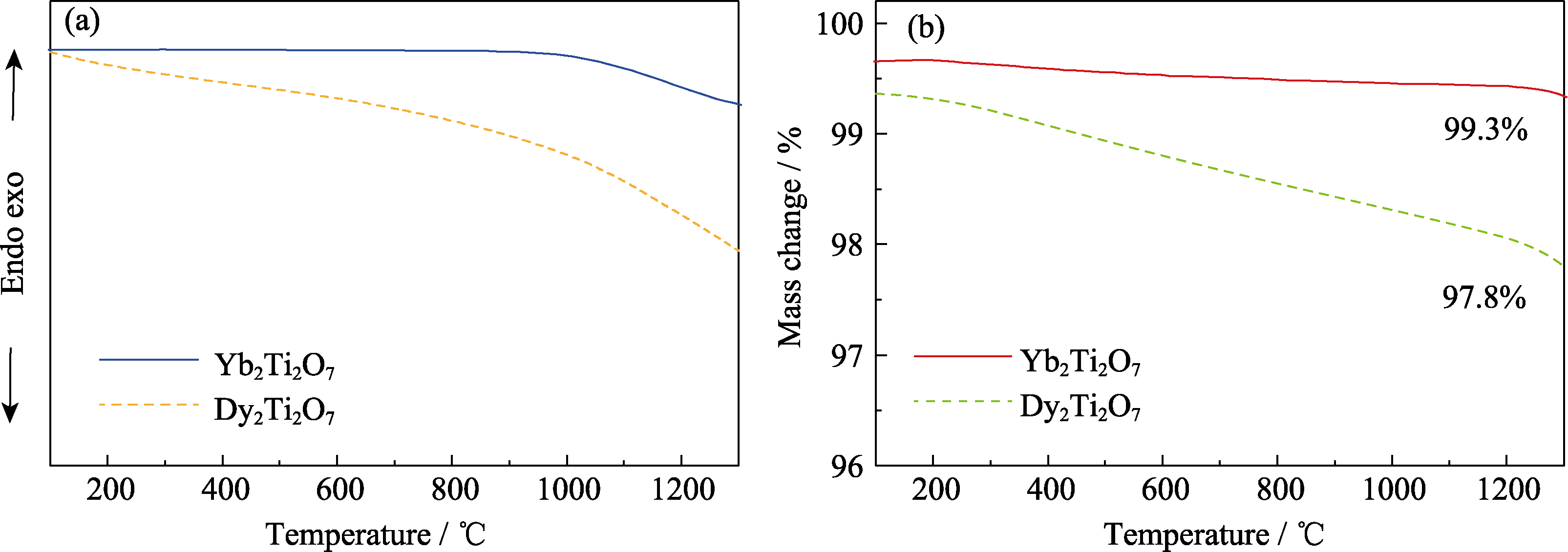
Fig. 1 (a) DSC and (b) TG curves of RE2Ti2O7 samples in the temperature range of 100-1300 ℃
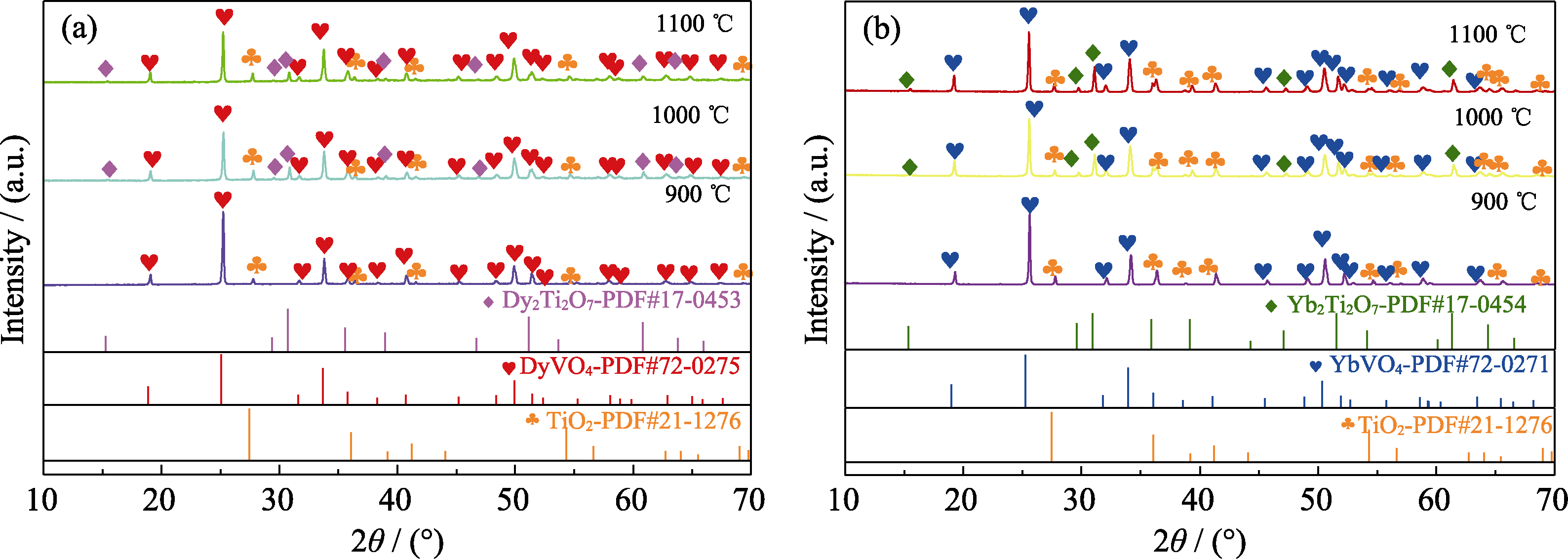
Fig. 2 XRD patterns of V2O5 salt and RE2Ti2O7 samples after 10 h exposure at 900, 1000, and 1100 ℃ (a) Dy2Ti2O7; (b) Yb2Ti2O7
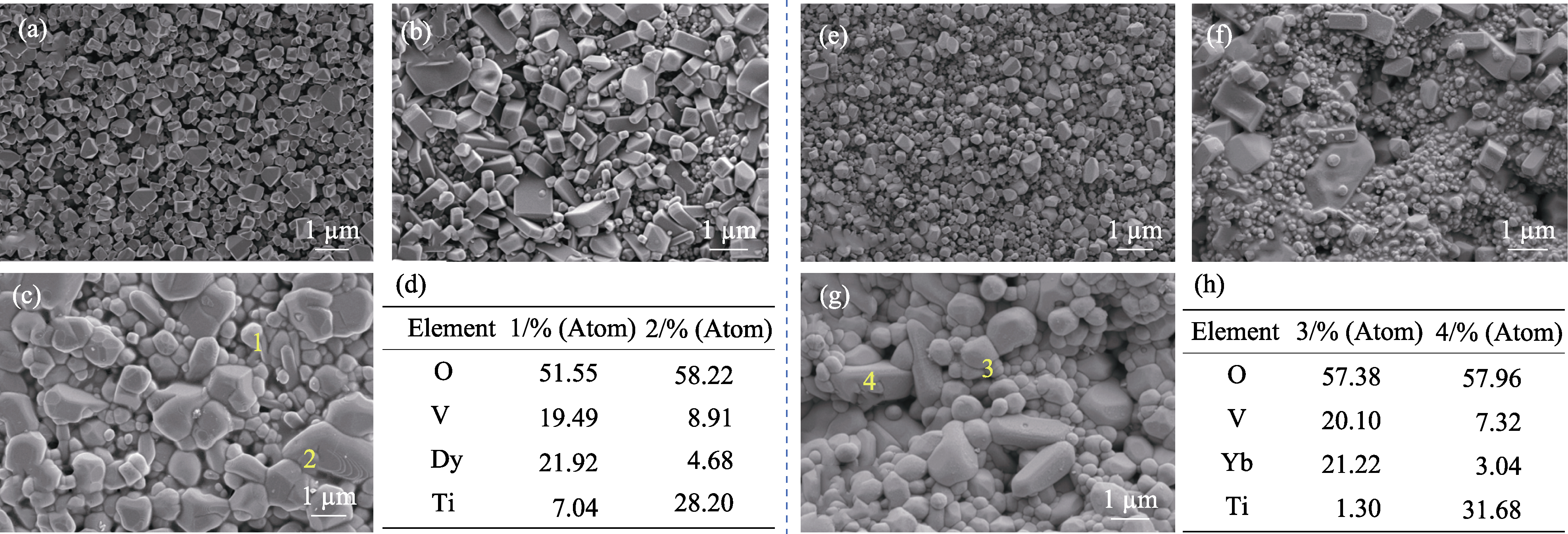
Fig. 3 (a-c, e-g) SEM images and corresponding (d, h) elemental distributions at marked points of RE2Ti2O7+V2O5 after 10 h exposure at 900, 1000, and 1100 ℃ (a-d) Dy2Ti2O7; (e-h) Yb2Ti2O7
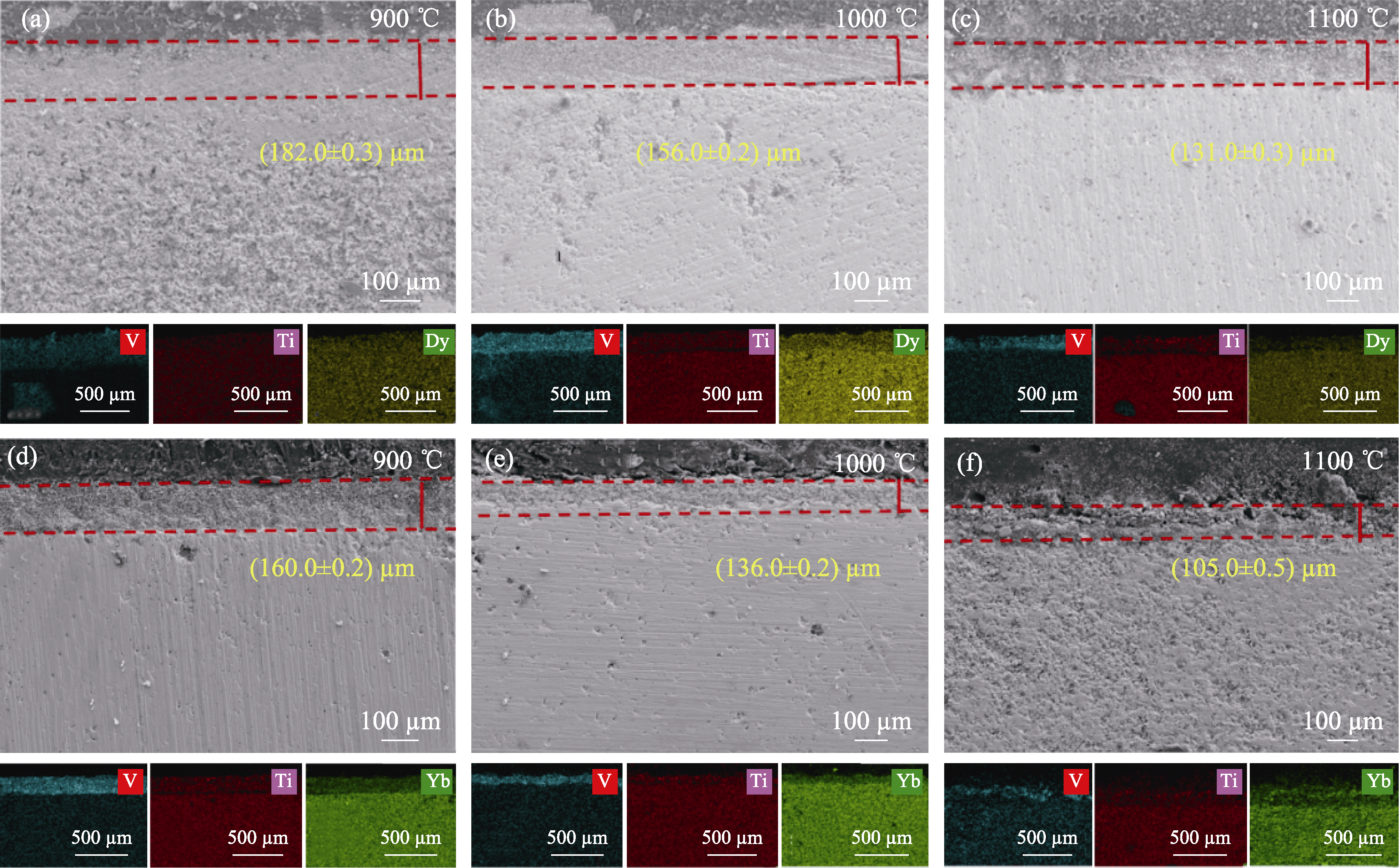
Fig. 4 SEM cross-sectional images of RE2Ti2O7+V2O5 after 10 h exposure at 900, 1000, and 1100 ℃ (a-c) Dy2Ti2O7; (d-f) Yb2Ti2O7
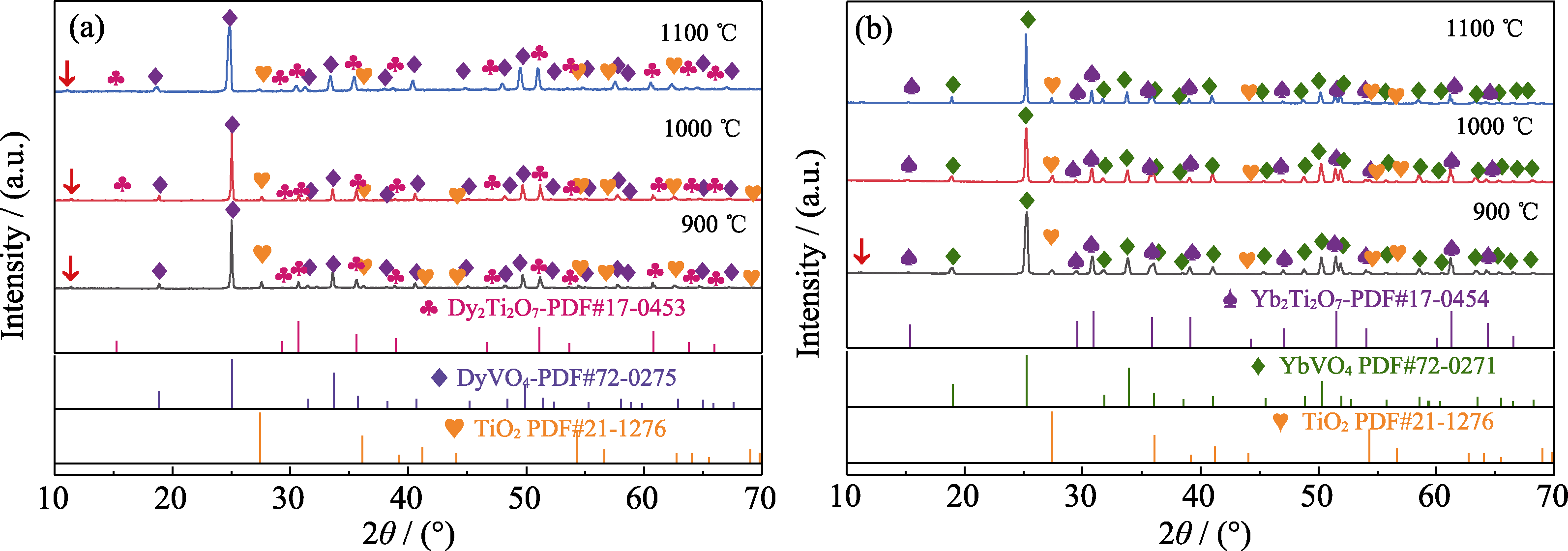
Fig. 5 XRD patterns of 50% Na2SO4 + 50% V2O5 and RE2Ti2O7 ceramics after 10 h exposure at different temperatures (a) Dy2Ti2O7; (b) Yb2Ti2O7
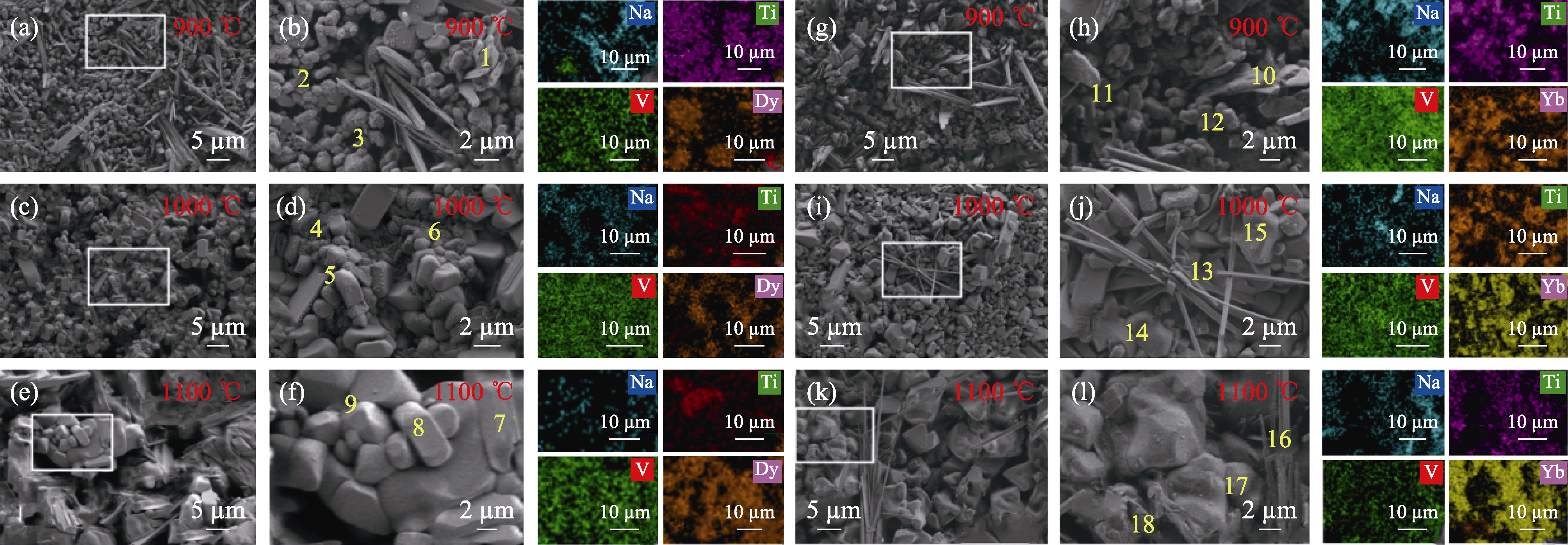
Fig. 6 (a-f) SEM images and elemental distributions of Dy2Ti2O7 reacting with 50% V2O5+50% Na2SO4 salt for 10 h at different temperatures; (g-l) SEM images and elemental distributions of Yb2Ti2O7 reacting with 50% V2O5+50% Na2SO4 salt for 10 h at different temperatures (a, b, g, h) 900 ℃; (c, d, i, j) 1000 ℃; (e, f, k, l) 1100 ℃
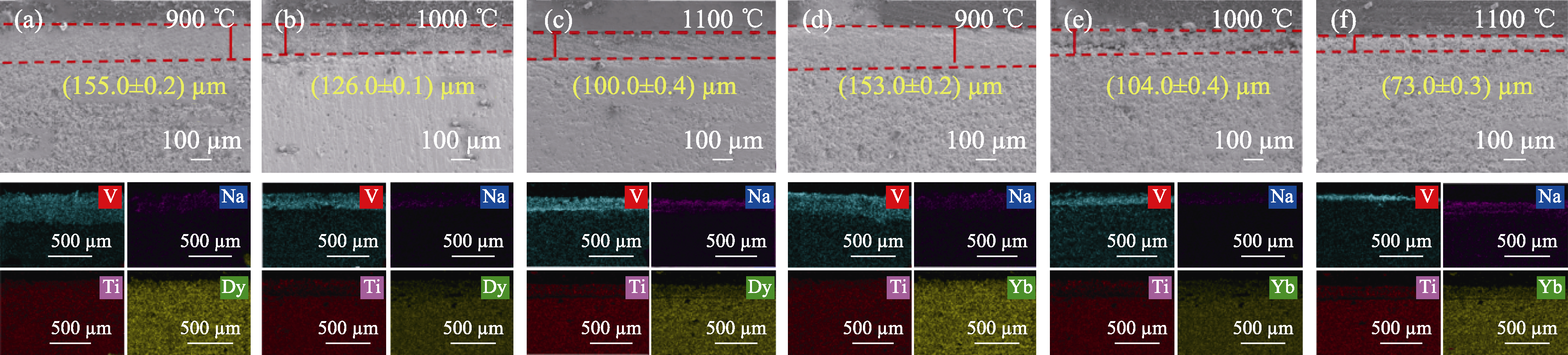
Fig. 7 SEM cross-sectional images and elemental distributions of RE2Ti2O7 and 50% Na2SO4+50% V2O5 reacted for 10 h at 900, 1000, and 1100 ℃ (a-c) Dy2Ti2O7; (d-f) Yb2Ti2O7
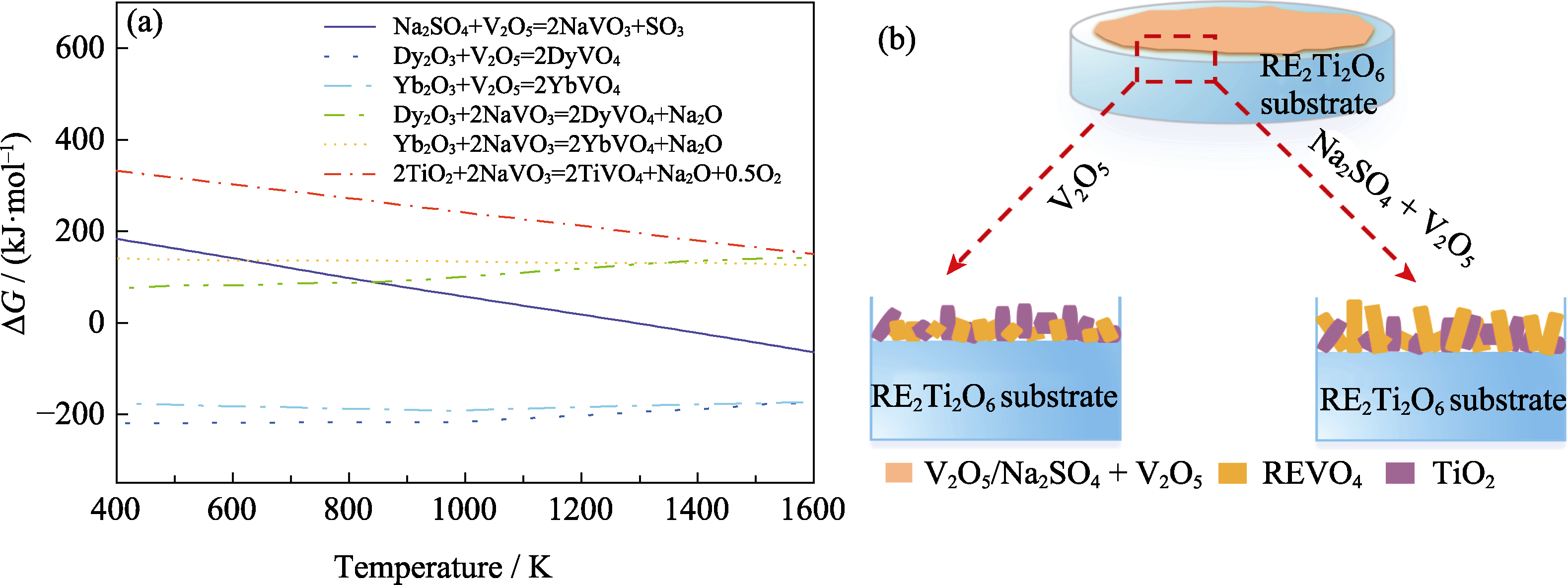
Fig. 8 (a) Gibbs free energy between various compounds; (b) Schematic diagram of the reaction between RE2Ti2O7 and V2O5/50% Na2SO4+50% V2O5
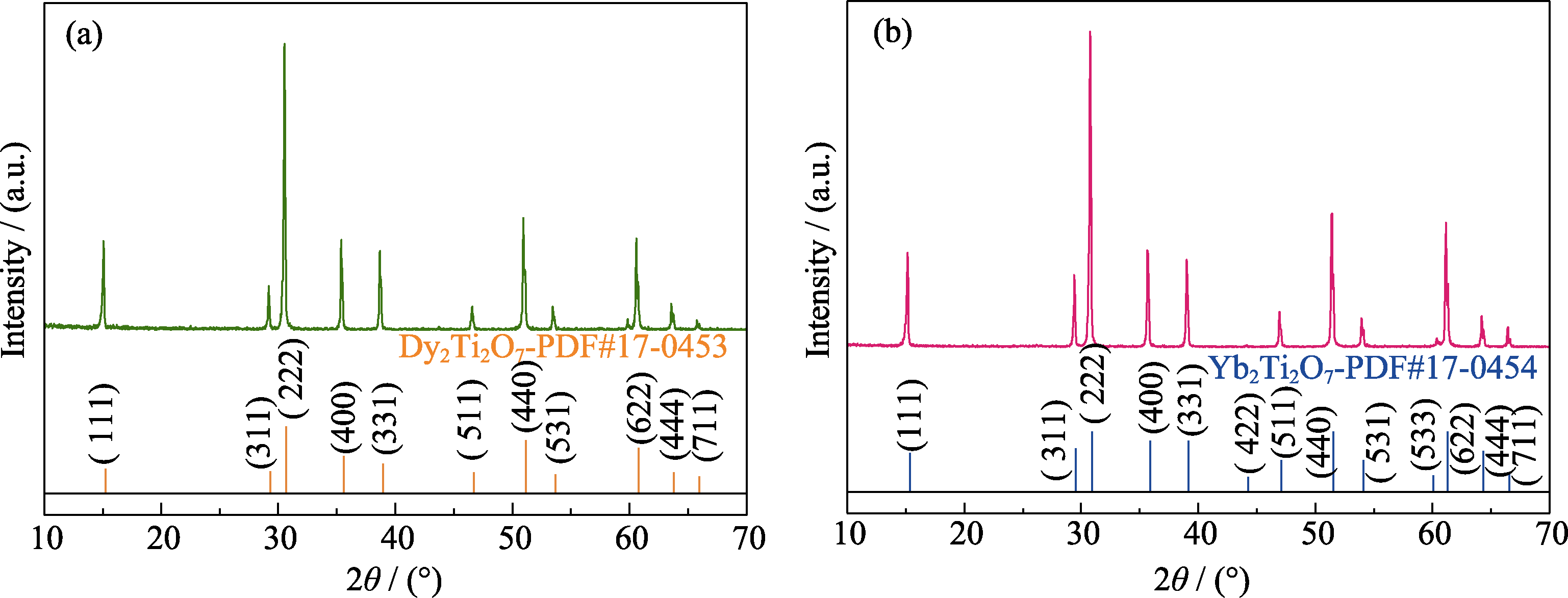
Fig. S1 XRD patterns of RE2Ti2O7 samples (a) Dy2Ti2O7; (b) Yb2Ti2O7
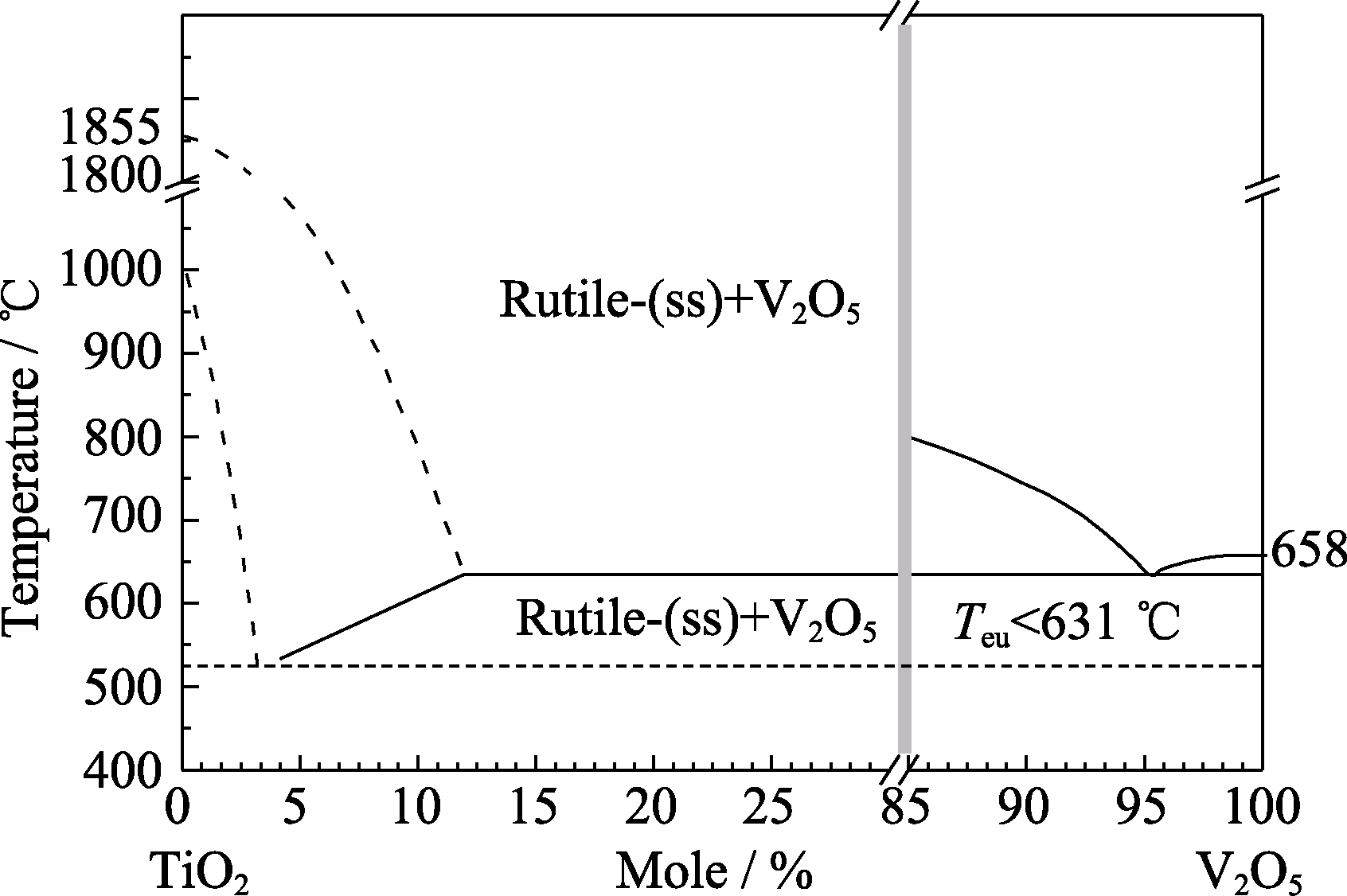
Fig. S2 Phase diagram of TiO2 and V2O5 at high temperatures[22]
| Temperature/℃ | Point | Product | Composition/(%, in atom) | |||||
|---|---|---|---|---|---|---|---|---|
| O | S | Na | V | Ti | Dy | |||
| 900 | 1 | Na salt | 57.16±0.15 | 0.36±0.05 | 24.12±0.11 | 13.56±0.05 | 4.65±0.12 | 0.15±0.01 |
| 2 | DyVO4 | 51.69±0.13 | 0.83±0.02 | 3.80±0.10 | 22.90±0.25 | 1.90±0.13 | 19.59±0.31 | |
| 3 | TiO2 | 57.65±0.16 | 0.68±0.04 | 8.69±0.10 | 1.91±0.11 | 30.85±0.28 | 0.23±0.08 | |
| 1000 | 4 | Na salt | 62.02±0.12 | 0.32±0.06 | 25.63±0.19 | 6.39±0.13 | 1.16±0.02 | 4.48±0.11 |
| 5 | DyVO4 | 59.64±0.11 | / | 1.70±0.02 | 20.71±0.14 | 0.79±0.06 | 17.15±0.12 | |
| 6 | TiO2 | 64.12±0.13 | 0.63±0.05 | 0.14±0.01 | 0.58±0.08 | 34.16±0.23 | 0.37±0.04 | |
| 1100 | 7 | Na salt | 62.02±0.14 | 0.41±0.07 | 23.18±0.25 | 7.48±0.11 | 3.46±0.09 | 3.45±0.11 |
| 8 | DyVO4 | 58.41±0.04 | 0.43±0.05 | / | 23.25±0.21 | 0.38±0.03 | 17.54±0.12 | |
| 9 | TiO2 | 52.49±0.05 | 0.20±0.01 | 0.29±0.01 | 1.99±0.03 | 33.45±0.25 | 1.16±0.04 | |
Table S1 Elemental mapping of SEM image marked points showing the reaction between Dy2Ti2O7 and 50% V2O5+50% Na2SO4 salt at different temperatures in Fig. 6(b, d, f)
| Temperature/℃ | Point | Product | Composition/(%, in atom) | |||||
|---|---|---|---|---|---|---|---|---|
| O | S | Na | V | Ti | Dy | |||
| 900 | 1 | Na salt | 57.16±0.15 | 0.36±0.05 | 24.12±0.11 | 13.56±0.05 | 4.65±0.12 | 0.15±0.01 |
| 2 | DyVO4 | 51.69±0.13 | 0.83±0.02 | 3.80±0.10 | 22.90±0.25 | 1.90±0.13 | 19.59±0.31 | |
| 3 | TiO2 | 57.65±0.16 | 0.68±0.04 | 8.69±0.10 | 1.91±0.11 | 30.85±0.28 | 0.23±0.08 | |
| 1000 | 4 | Na salt | 62.02±0.12 | 0.32±0.06 | 25.63±0.19 | 6.39±0.13 | 1.16±0.02 | 4.48±0.11 |
| 5 | DyVO4 | 59.64±0.11 | / | 1.70±0.02 | 20.71±0.14 | 0.79±0.06 | 17.15±0.12 | |
| 6 | TiO2 | 64.12±0.13 | 0.63±0.05 | 0.14±0.01 | 0.58±0.08 | 34.16±0.23 | 0.37±0.04 | |
| 1100 | 7 | Na salt | 62.02±0.14 | 0.41±0.07 | 23.18±0.25 | 7.48±0.11 | 3.46±0.09 | 3.45±0.11 |
| 8 | DyVO4 | 58.41±0.04 | 0.43±0.05 | / | 23.25±0.21 | 0.38±0.03 | 17.54±0.12 | |
| 9 | TiO2 | 52.49±0.05 | 0.20±0.01 | 0.29±0.01 | 1.99±0.03 | 33.45±0.25 | 1.16±0.04 | |
| Temperature/℃ | Point | Product | Composition/(%, in atom) | |||||
|---|---|---|---|---|---|---|---|---|
| O | S | Na | V | Ti | Yb | |||
| 900 | 10 | Na salt | 61.89±0.36 | 0.31±0.02 | 23.64±0.15 | 13.97±0.16 | 0.19±0.02 | / |
| 11 | YbVO4 | 56.97±0.23 | 0.52±0.08 | 1.16±0.15 | 24.50±0.14 | 0.80±0.05 | 16.05±0.15 | |
| 12 | TiO2 | 63.68±0.33 | 0.40±0.03 | 2.67±0.13 | 3.55±0.11 | 28.21±0.23 | 1.48±0.09 | |
| 1000 | 13 | Na salt | 59.42±0.35 | 0.89±0.07 | 17.24±0.14 | 16.05±0.22 | 2.23±0.09 | 4.17±0.14 |
| 14 | YbVO4 | 50.18±0.28 | 0.92±0.09 | 2.75±0.12 | 21.12±0.16 | 2.40±0.07 | 19.46±0.22 | |
| 15 | TiO2 | 63.11±0.31 | 0.69±0.04 | 2.59±0.08 | 3.57±0.10 | 28.24±0.24 | 1.84±0.21 | |
| 1100 | 16 | Na salt | 68.34±0.36 | 0.43±0.05 | 15.71±0.21 | 4.78±0.23 | 6.66±0.14 | 4.02±0.17 |
| 17 | YbVO4 | 69.69±0.38 | 0.65±0.01 | / | 14.91±0.18 | 0.69±0.03 | 14.06±0.20 | |
| 18 | TiO2 | 66.53±0.34 | 0.44±0.03 | 2.12±0.10 | 1.51±0.12 | 25.23±0.24 | 1.36±0.08 | |
Table S2 Elemental mapping of SEM image marked points showing the reaction between Yb2Ti2O7 and 50% V2O5+50% Na2SO4 salt at different temperatures in Fig. 6(h, j, l)
| Temperature/℃ | Point | Product | Composition/(%, in atom) | |||||
|---|---|---|---|---|---|---|---|---|
| O | S | Na | V | Ti | Yb | |||
| 900 | 10 | Na salt | 61.89±0.36 | 0.31±0.02 | 23.64±0.15 | 13.97±0.16 | 0.19±0.02 | / |
| 11 | YbVO4 | 56.97±0.23 | 0.52±0.08 | 1.16±0.15 | 24.50±0.14 | 0.80±0.05 | 16.05±0.15 | |
| 12 | TiO2 | 63.68±0.33 | 0.40±0.03 | 2.67±0.13 | 3.55±0.11 | 28.21±0.23 | 1.48±0.09 | |
| 1000 | 13 | Na salt | 59.42±0.35 | 0.89±0.07 | 17.24±0.14 | 16.05±0.22 | 2.23±0.09 | 4.17±0.14 |
| 14 | YbVO4 | 50.18±0.28 | 0.92±0.09 | 2.75±0.12 | 21.12±0.16 | 2.40±0.07 | 19.46±0.22 | |
| 15 | TiO2 | 63.11±0.31 | 0.69±0.04 | 2.59±0.08 | 3.57±0.10 | 28.24±0.24 | 1.84±0.21 | |
| 1100 | 16 | Na salt | 68.34±0.36 | 0.43±0.05 | 15.71±0.21 | 4.78±0.23 | 6.66±0.14 | 4.02±0.17 |
| 17 | YbVO4 | 69.69±0.38 | 0.65±0.01 | / | 14.91±0.18 | 0.69±0.03 | 14.06±0.20 | |
| 18 | TiO2 | 66.53±0.34 | 0.44±0.03 | 2.12±0.10 | 1.51±0.12 | 25.23±0.24 | 1.36±0.08 | |
| [1] |
GUO Y, SONG W, GUO L, et al. Molten-volcanic-ash-phobic thermal barrier coating based on biomimetic structure. Advanced Science, 2023, 10: 2205156.
DOI URL |
| [2] |
ZHOU Y, ZHOU Y, WU P, et al. Thermal properties of Y1-xMgxTaO4-x/2 ceramics via anion sublattice adjustment. Rare Metals, 2020, 39: 545.
DOI URL |
| [3] |
JIANG C, FENG M, YU C, et al. Thermal cycling behavior of nanostructured and conventional yttria-stabilized zirconia thermal barrier coatings via air plasma spray. Rare Metals, 2023, 42: 3859.
DOI URL |
| [4] |
FU S, JIA Z J, WAN D T, et al. Synthesis, microstructure and thermophysical properties of (La0.2Y0.2Sm0.2Eu0.2Gd0.2)2Zr2O7 high-entropy oxide ceramic. Ceramics International, 2024, 50: 5510.
DOI URL |
| [5] |
HUANG L, LIU M J, YANG G J, et al. Treelike PS-PVD coating: hierarchical branching by shading and sintering. Acta Materialia, 2024, 280: 120321.
DOI URL |
| [6] |
LI J, TONG Z, YANG Q, et al. Non-destructive evaluation of defects in thermal barrier coating system using combined electromagnetic and thermographic signals. Nature Communications, 2025, 16: 8697.
DOI |
| [7] |
HABIBI M H, GUO S M. The hot corrosion behavior of plasma sprayed zirconia coatings stabilized with yttria, ceria, and titania in sodium sulfate and vanadium oxide. Materials & Corrosion, 2015, 66: 270.
DOI URL |
| [8] |
FANG Y, CUI X, JIN G, et al. Microstructural evolution and hot corrosion behavior of La0.8Ba0.2TiO3-δYSZ double-layer thermal barrier coatings in Na2SO4 + V2O5 molten salt at 900 ℃. Surface and Coatings Technology, 2020, 399: 126175.
DOI URL |
| [9] | GUO L, YAN Z, YU J, et al.Hot corrosion behavior of TiO2 doped, Yb2O3 stabilized zirconia exposed to V2O5 + Na2SO4 molten salt at700-1000 ℃. Ceramics International, 2018, 44: 261. |
| [10] |
SINGH Y, KUMAR V, SHARMA S K, et al. Investigations of thermal conductivity in nano-crystalline Gd2Ti2O7 pyrochlore. Journal of Alloys and Compounds, 2024, 990: 174249.
DOI URL |
| [11] |
GAO Z, FU S, ZHANG L, et al. Thermodynamic characterization of RE2Ti2O7 (RE = Ho, Er, Tm and Yb) ceramics as thermal barrier coating materials. Materials Today Physics, 2025, 57: 101801.
DOI URL |
| [12] |
GAO Z, FU S, ZHANG X Y, et al. Investigation of the mechanical and thermal properties of RE2Ti2O7 (RE = Y, Dy, Sm) ceramics with a pyrochlore structure. Journal of the European Ceramic Society. 2025, 45: 117661.
DOI URL |
| [13] |
GAO Z, FU S, ZHANG L, et al. Study on CMAS corrosion resistance and wettability of rare-earth titanate ceramics at 1350 ℃. Applied Materials Today, 2026, 48: 103041.
DOI URL |
| [14] |
TAN Z Y, PAN T T, NIE M, et al. Exceptional hot corrosion resistance behavior and mechanism of double layered Zr6Ta2O17/ YSZ thermal barrier coatings exposed to Na2SO4-V2O5 salt. Corrosion Science, 2025, 246: 112761.
DOI URL |
| [15] |
WANG J, WANG Y, CHEN M, et al. Degradation of CeO2 and TiO2 co-stabilized ZrO2 by the V2O5 molten salts and Na2SO4 + V2O5 molten salts. Surface and Coatings Technology, 2022, 437: 128352.
DOI URL |
| [16] |
DONG H, REN Y, WANG D, et al. Hot corrosion behaviors of SrZrO3 ceramic co-doped with Y2O3 and Yb2O3 in molten Na2SO4, V2O5, and Na2SO4+V2O5 salts mixture. Journal of the European Ceramic Society, 2014, 34: 3917.
DOI URL |
| [17] |
GU S, ZHANG S, JIA Y, et al. Evaluation of hot corrosion behavior of SrHfO3 ceramic in the presence of molten sulfate and vanadate salt. Journal of Alloys and Compounds, 2017, 728: 10.
DOI URL |
| [18] |
WANG J, CHEN L, CHEN M, et al. Phase and microstructure evolution of Sc2O3-CeO2-ZrO2 ceramics in Na2SO4+V2O5 molten salts. Ceramics International, 2021, 47: 22965.
DOI URL |
| [19] |
SINGH P, PANDIT N, KESHRI A K. Plasma-sprayed GNP/CNT reinforced lanthanum-cerate coatings: hot corrosion assessment in Na2SO4-V2O5 environment. Surface and Coatings Technology, 2024, 481: 130676.
DOI URL |
| [20] |
YOKOKAWA H, SAKAI N, KAWADA T, et al. Chemical potential diagrams for rare earth-transition metal-oxygen systems: I, Ln-V-O and Ln-Mn-O System. Journal of the American Ceramic Society, 1990, 73: 649.
DOI URL |
| [21] |
LI S, LIU Z G, OUYANG J H. Growth of YbVO4 crystals evolved from hot corrosion reactions of Yb2Zr2O7 against V2O5 and Na2SO4+V2O5. Applied Surface Science, 2013, 276: 653.
DOI URL |
| [22] |
HABEL D, GOERKE O, TOVAR M, et al. Phase relations in the system TiO2-V2Ox under oxidizing and reducing conditions. Journal of Phase Equilibria and Diffusion, 2008, 29: 482.
DOI URL |
| [23] |
CAI J, WEI J, ZU Z, et al. Comparative hot corrosion performance of arc ion plated NiCoCrAlYSiHf coating in Na2SO4/NaCl/V2O5- media via high-current pulsed electron beam. Materials Characterization, 2022, 191: 112074.
DOI URL |
| [24] |
LI Z, LI X, ZHAO S, et al. Degradation of atmospheric plasma sprayed Gd4Al2O9 coating attacked by molten Na2SO4+V2O5 salt mixture at 700-950 ℃. Ceramics International, 2024, 50: 12701.
DOI URL |
| [25] |
GUO L, ZHANG C, HE Q, et al. Corrosion products evolution and hot corrosion mechanisms of REPO4 (RE= Gd, Nd, La) in the presence of V2O5 + Na2SO4 molten salt. Journal of the European Ceramic Society, 2019, 39: 1496.
DOI URL |
| [26] |
VENU D M, SREEDHAR G. Role of low-K Gd2Ti2O7 addition on the oxidation and hot corrosion behavior of DySZ thermal barrier coatings. Journal of Alloys and Compounds, 2025, 1049: 185231.
DOI URL |
| [27] |
LI Y, SUN Z, HE L, et al. Thermal corrosion behavior of Yb4Hf3O12 exposed to Na2SO4+V2O5 molten salt. Journal of Alloys and Compounds, 2024, 1008: 176501.
DOI URL |
| [28] |
YIN Q, SHEN K H, WANG Y, et al. Research progress of rare earth zirconate thermal barrier coating ceramic materials. Materials Today Communications, 2025, 42: 111579.
DOI URL |
| [29] |
SONG D, SONG T, PAIK U, et al. Hot corrosion behavior in thermal barrier coatings with heterogeneous splat boundary. Corrosion Science, 2020, 163: 108225.
DOI URL |
| [30] |
LI B, WU J, HE X, et al. Sc-doped Gd2Zr2O7 coating on YSZ thermal barrier coatings to resist CMAS + molten salt attack. Ceramics International, 2022, 48: 11662.
DOI URL |
| [31] | LANG N A. Lange’s handbook of chemistry. 16th ed. New York: McGraw-Hill Education, 2013. |
| [32] |
KIM J, SONG D, LU G, et al. Hot corrosion behavior of Yb2O3-Gd2O3-Y2O3 co-stabilized zirconia-based thermal barrier coatings covered with a Lewis neutral layer. Surface and Coatings Technology, 2021, 428: 127911.
DOI URL |
| [33] |
SHAMSIPOOR A, FARVIZI M, RAZAVI M, et al. Hot corrosion behavior of thermal barrier coating on Cr2AlC and CoNiCrAlY substrates at 950 ℃ in presence of Na2SO4+V2O5 molten salts. Surfaces and Interfaces, 2020, 21: 100679.
DOI URL |
| [1] | XU Mingyi, XIONG Ying, WANG Bo, ZHANG Yixin, CHEN Wenbo, CAO Xueqiang. Fabrication and Properties of Magnetoplumbite-type Rare-earth Hexaaluminate Thermal Barrier Coating Materials [J]. Journal of Inorganic Materials, 2026, 41(8): 1103-1109. |
| [2] | WANG Junbu, HUANG Zeai, YANG Mingkai, MENG Ying, ZHOU Mingwei, ZHOU Ying. Research Progress on Anti-coking Catalytic Materials for Methane Conversion [J]. Journal of Inorganic Materials, 2026, 41(6): 739-750. |
| [3] | WANG Yuhe, LUO Yixiu, GUO Huiming, ZHANG Guangheng, ZHANG Siyan, SUN Luchao, WANG Jiemin, WANG Jingyang. First-principles Investigation of Elastic and Thermophysical Properties of High-entropy Rare-earth Oxide Thermal Barrier Coating Materials [J]. Journal of Inorganic Materials, 2026, 41(4): 445-454. |
| [4] | WU Boyu, ZHANG Shengen, ZHANG Shengyang, LIU Bo, ZHANG Bolin. Effect of CeO2 on Low-temperature Denitrification Performance of MnOx Catalysts and Its Mechanism [J]. Journal of Inorganic Materials, 2026, 41(1): 87-95. |
| [5] | LIU Jiangping, GUAN Xin, TANG Zhenjie, ZHU Wenjie, LUO Yongming. Research Progress on Catalytic Oxidation of Nitrogen-containing Volatile Organic Compounds [J]. Journal of Inorganic Materials, 2025, 40(9): 933-943. |
| [6] | ZHANG Ruiyang, WANG Yi, OU Bowen, ZHOU Ying. α-Ni(OH)2 Surface Hydroxyls Synergize Ni3+ Sites for Catalytic Formaldehyde Oxidation [J]. Journal of Inorganic Materials, 2023, 38(10): 1216-1222. |
| [7] | AN Wenran, HUANG Jingqi, LU Xiangrong, JIANG Jianing, DENG Longhui, CAO Xueqiang. Effect of Heat-treatment Temperature on Thermal and Mechanical Properties of LaMgAl11O19 Coating [J]. Journal of Inorganic Materials, 2022, 37(9): 925-932. |
| [8] | WEI Hailang, CAO Xueqiang, DENG Longhui, JIANG Jianing. Thermodynamic Properties and Thermal Cycling Lifetimes of LaMeAl11O19/YSZ Thermal Barrier Coatings [J]. Journal of Inorganic Materials, 2022, 37(12): 1259-1266. |
| [9] | GAO Wa, XIONG Yujie, WU Congping, ZHOU Yong, ZOU Zhigang. Recent Progress on Photocatalytic CO2 Reduction with Ultrathin Nanostructures [J]. Journal of Inorganic Materials, 2022, 37(1): 3-14. |
| [10] | ZHENG Yanning, JI Junrong, LIANG Xueling, LAI Zhengjie, CHENG Qifan, LIAO Dankui. Performance of Nitrogen-doped Hollow Carbon Spheres as Oxidase Mimic [J]. Journal of Inorganic Materials, 2021, 36(5): 527-534. |
| [11] | ZHU Jiatong, LOU Zhihao, ZHANG Ping, ZHAO Jia, MENG Xuanyu, XU Jie, GAO Feng. Preparation and Thermal Properties of Rare Earth Tantalates (RETaO4) High-Entropy Ceramics [J]. Journal of Inorganic Materials, 2021, 36(4): 411-417. |
| [12] | JI Xiaojuan,YU Yueguang,LU Xiaoliang. Effects of Impurities on Properties of YSZ Thermal Barrier Coatings [J]. Journal of Inorganic Materials, 2020, 35(6): 669-674. |
| [13] | XU Yun-Qing,WANG Hai-Zeng. Sodium Magnesium Fluoride Particles of Different Morphologies: Prepared by EDTA-assisted Hydrothermal Method [J]. Journal of Inorganic Materials, 2019, 34(9): 933-937. |
| [14] | Bo-Le MA, Wen MA, Wei HUANG, Yu BAI, Rui-Ling JIA, Hong-Ying DONG. Thermophysical Property of Single-phase Strontium Zirconate Co-doped with Double Rare-earth Oxides as a Thermal Barrier Coating Material [J]. Journal of Inorganic Materials, 2019, 34(4): 394-400. |
| [15] | WANG Lin, DING Kun-Ying, LIN Xiao-Ping, LI Ze, ZHENG Run-Guo, YANG Lian-Wei. Defect Evolution and Microcracks of 8YSZ Double-layer Thermal Barrier Coatings by Water Immersion Ultrasound Macroscopic Detection [J]. Journal of Inorganic Materials, 2019, 34(12): 1265-1271. |
| Viewed | ||||||
|
Full text |
|
|||||
|
Abstract |
|
|||||
