
Journal of Inorganic Materials ›› 2026, Vol. 41 ›› Issue (7): 1001-1010.DOI: 10.15541/jim20260017
• DATA PAPER • Previous Articles Next Articles
ZUO Zhiping1,2( ), GUO Chun1,2, ZHOU Zhiyong1()
Received:2026-01-12
Revised:2026-02-27
Published:2026-07-20
Online:2026-03-02
Contact:
ZHOU Zhiyong, professor. E-mail: zyzhou@mail.sic.ac.cnAbout author:ZUO Zhiping (2001-), male, PhD candidate. E-mail: zuozhiping23@mails.ucas.ac.cn
Supported by:CLC Number:
ZUO Zhiping, GUO Chun, ZHOU Zhiyong. Machine Learning-assisted Design of High-temperature BSPT-based Piezoelectric Ceramics with Enhanced Dual Properties[J]. Journal of Inorganic Materials, 2026, 41(7): 1001-1010.
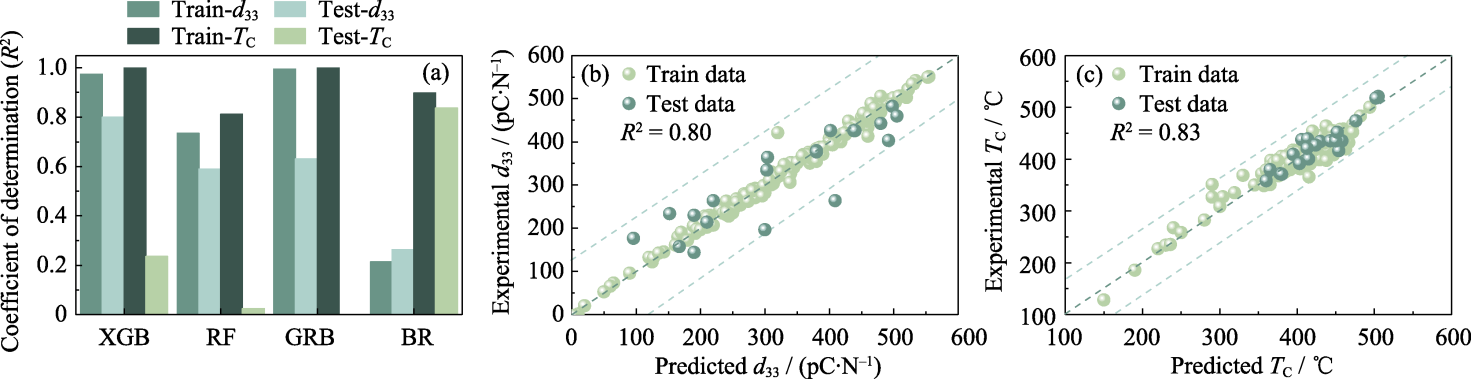
Fig. 1 (a) Results of model evaluations; (b) Performance of the XGB model on the d33 dataset; (c) Performance of the BR model on the TC dataset Colorful figures are available on website
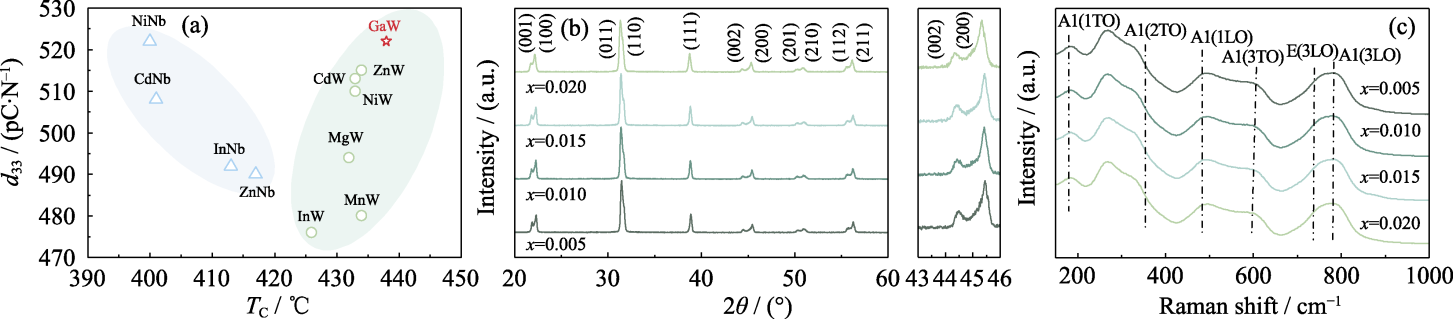
Fig. 2 (a) Predicted results of the machine learning model; (b) XRD patterns of the BSPTGW1000x ceramics and enlarged patterns in the 2θ range of 43°-46°; (c) Room temperature Raman spectra of the BSPTGW1000x ceramics
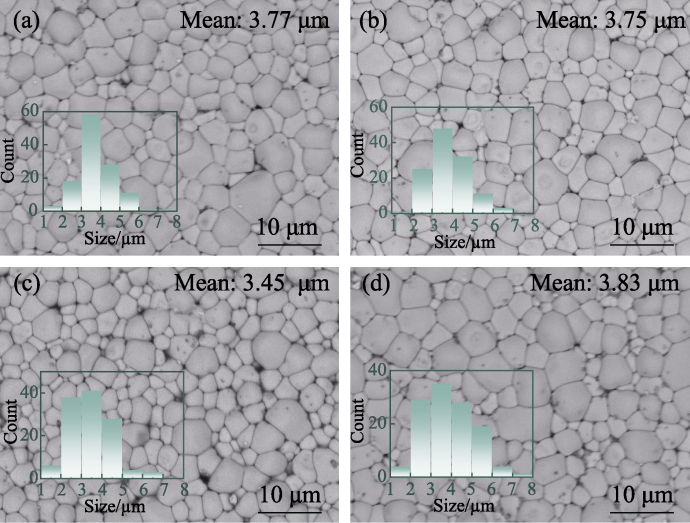
Fig. 3 SEM images of (a) BSPTGW05, (b) BSPTGW10, (c) BSPTGW15, and (d) BSPTGW20
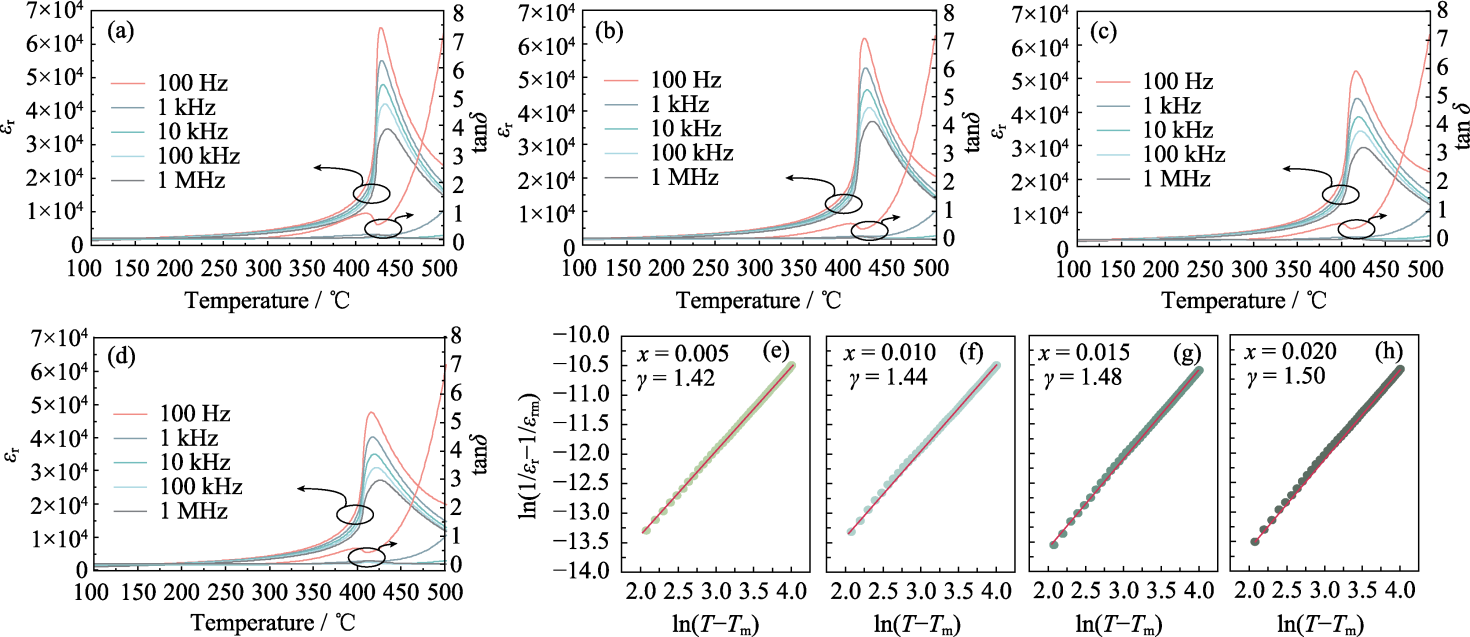
Fig. 4 (a-d) Temperature dependence of the dielectric constant for (a) BSPTGW05, (b) BSPTGW10, (c) BSPTGW15, and (d) BSPTGW20; (e-h) Line fitted by the Curie-Weiss relationship of BSPTGW1000x ceramics Colorful figures are available on website
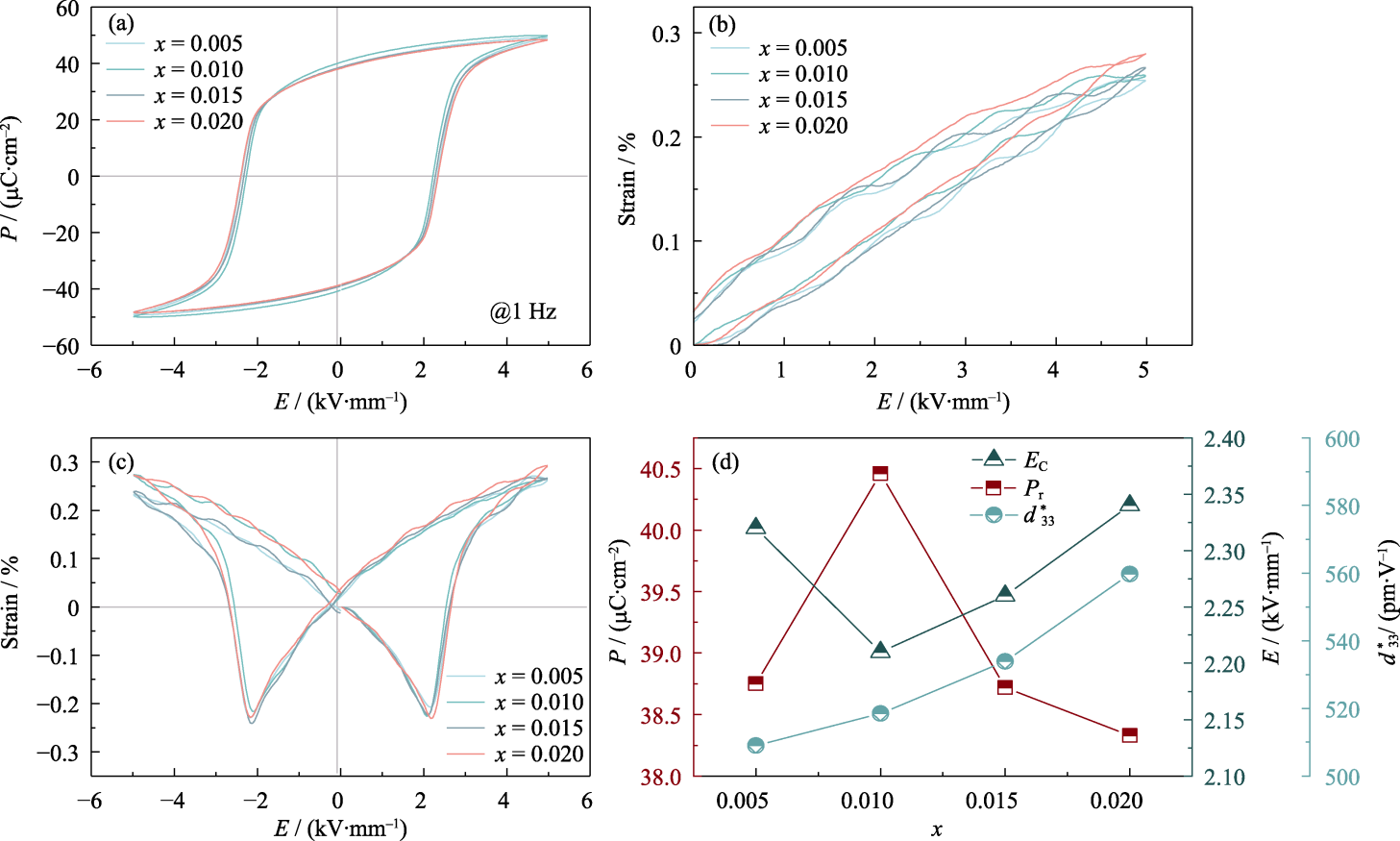
Fig. 5 (a) Hysteresis loops, (b) unipolar strain curves, (c) bipolar strain curves, and (d) the Pr, EC, and d33* for BSPTGW1000x ceramics Colorful figures are available on website
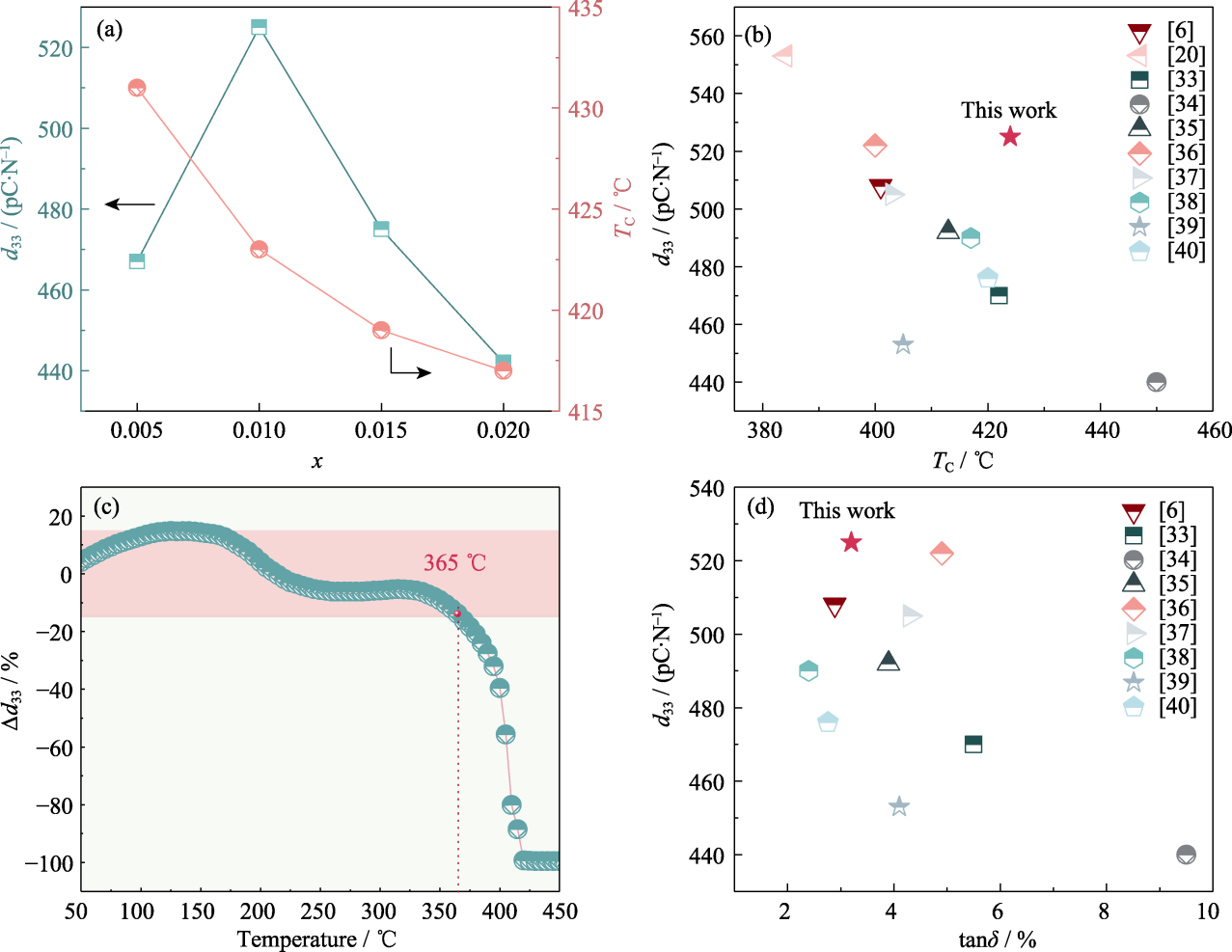
Fig. 6 (a) d33 and TC of BSPTGW1000x ceramics; (b) Comparison of d33 and TC between BSPTGW10 ceramic and previously reported piezoelectric ceramics; (c) Rate of change of in-situ d33 of BSPTGW10 ceramic; (d) Comparison of d33 and tanδ between BSPTGW10 ceramic and previously reported piezoelectric ceramics
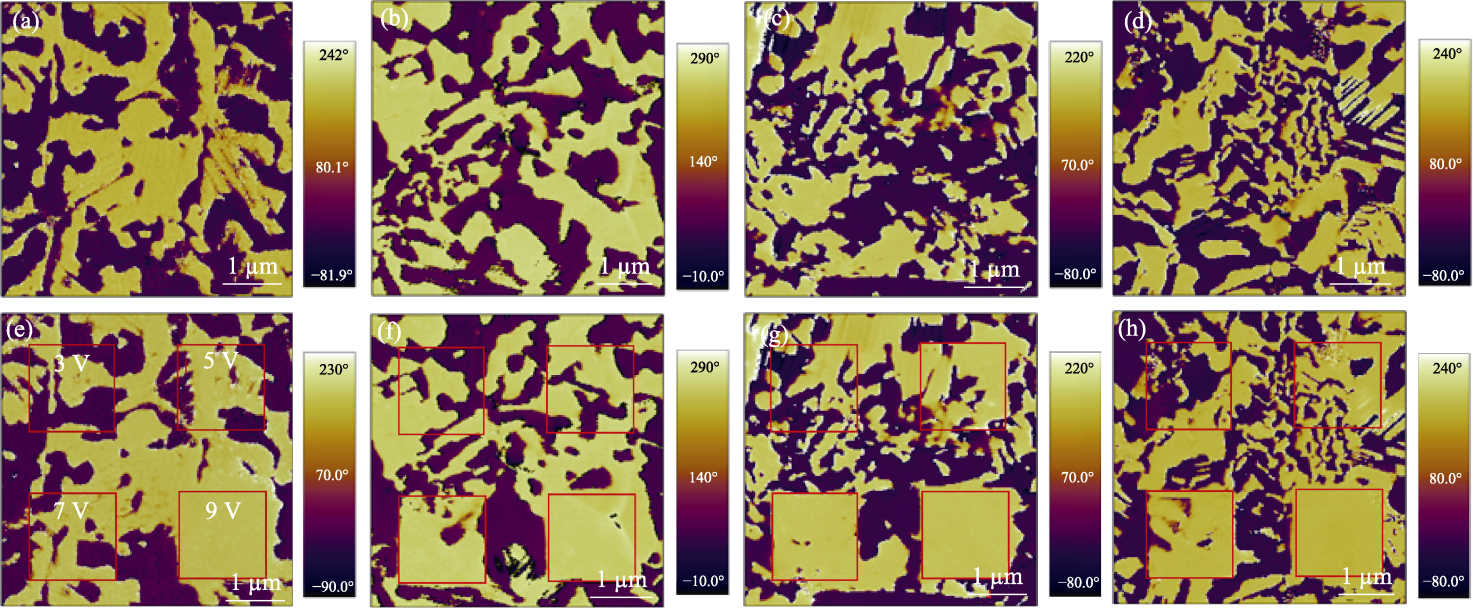
Fig. 7 (a-d) PFM images of BSPTGW1000x ceramics; (e-h) “Domain writing” of BSPTGW1000x ceramics (a, e) x=0.005; (b, f) x=0.010; (c, g) x=0.015; (d, h) x=0.020. Applied voltages for the four parts in Figs. (e-h) were 3, 5, 7, and 9 V, respectively. Colorful figures are available on website
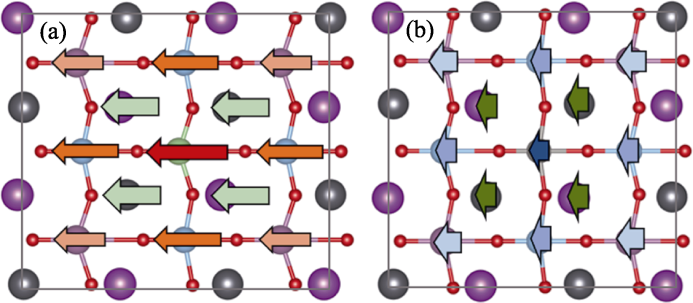
Fig. 8 Schematic diagram illustrating the influence of (a) Ga and (b) W element doping on lattice distortion
| Feature | Description |
|---|---|
| RCS12_A | Shannon's (1976) ionic radii 12 of A-site element |
| RC_A | Covalent radii of A-site element |
| RP_A | Pseudopotential core radii of A-site element |
| Rdce_A | Core electron distance of A-site element |
| Rdve_A | Valence electron distance of A-site element |
| Ven_A | Valence electron number of A-site element |
| Ne/IR_A | Ratio of electron number to ionic radii (A-site) |
| CNE_C/IR_A | Ratio of charge nuclear effective (Clementi) to ionic radii (A-site) |
| CNE_S/IR_A | Ratio of nuclear charge effective (Slater) to ionic radii (A-site) |
| VEC/Z_A | Ratio of valence electron number to nuclear charge (A-site) |
| Val/IR_A | Ratio of oxidation state to ionic radii (A-site) |
| CNE_C_A | Charge nuclear effective (Clementi) of A-site element |
| CNE_S_A | Nuclear charge effective (Slater) of A-site element |
| Valence_A | Oxidation state of A-site element |
| AN_A | Atomic number of A-site element |
| AW_A | Atomic weight of A-site element |
| AV_A | Atomic volume of A-site element |
| AR_A | Atomic radius of A-site element |
| IP_A | Ionic polarizability of A-site element |
| Electrons_A | Electron number of A-site element |
| ENA_A | Electronegativity (Alfred-Rochow) of A-site element |
| ENMB_A | Electronegativity (Martynov & Batsanov) of A-site element |
| ENP_A | Electronegativity (Pauling) of A-site element |
| EA_A | Electron affinity of A-site element |
| RVdw_A | Van der Waals radius of A-site element |
| I1_A | First ionization energy of A-site element |
| I2_A | Second ionization energy of A-site element |
| I3_A | Third ionization energy of A-site element |
| OF_A | Octahedral factor calculated by Shannon's ionic radii (A-site) |
| RCS6_B | Shannon's (1976) ionic radii 6 of B-site element |
| RC_B | Covalent radii of B-site element |
| RP_B | Pseudopotential core radii of B-site element |
| Rdce_B | Core electron distance of B-site element |
| Rdve_B | Valence electron distance of B-site element |
| Ven_B | Valence electron number of B-site element |
| Ne/IR_B | Ratio of electron number to ionic radii (B-site) |
| CNE_C/IR_B | Ratio of charge nuclear effective (Clementi) to ionic radii (B-site) |
| CNE_S/IR_B | Ratio of nuclear charge effective (Slater) to ionic radii (B-site) |
| VEC/Z_B | Ratio of valence electron number to nuclear charge (B-site) |
| Val/IR_B | Ratio of oxidation state to ionic radii (B-site) |
| CNE_C_B | Charge nuclear effective (Clementi) of B-site element |
| CNE_S_B | Nuclear charge effective (Slater) of B-site element |
| Valence_B | Oxidation state of B-site element |
| AN_B | Atomic number of B-site element |
| AW_B | Atomic weight of B-site element |
| AV_B | Atomic volume of B-site element |
| AR_B | Atomic radius of B-site element |
| IP_B | Ionic polarizability of B-site element |
| Electrons_B | Electron number of B-site element |
| ENA_B | Electronegativity (Alfred-Rochow) of B-site element |
| ENMB_B | Electronegativity (Martynov & Batsanov) of B-site element |
| ENP_B | Electronegativity (Pauling) of B-site element |
| EA_B | Electron affinity of B-site element |
| RVdw_B | Van der Waals radius of B-site element |
| I1_B | First ionization energy of B-site element |
| I2_B | Second ionization energy of B-site element |
| I3_B | Third ionization energy of B-site element |
| OF_B | Octahedral factor calculated by Shannon's ionic radii (B-site) |
| t | Tolerance_factor |
Table S1 Abbreviations and detailed meanings of all features
| Feature | Description |
|---|---|
| RCS12_A | Shannon's (1976) ionic radii 12 of A-site element |
| RC_A | Covalent radii of A-site element |
| RP_A | Pseudopotential core radii of A-site element |
| Rdce_A | Core electron distance of A-site element |
| Rdve_A | Valence electron distance of A-site element |
| Ven_A | Valence electron number of A-site element |
| Ne/IR_A | Ratio of electron number to ionic radii (A-site) |
| CNE_C/IR_A | Ratio of charge nuclear effective (Clementi) to ionic radii (A-site) |
| CNE_S/IR_A | Ratio of nuclear charge effective (Slater) to ionic radii (A-site) |
| VEC/Z_A | Ratio of valence electron number to nuclear charge (A-site) |
| Val/IR_A | Ratio of oxidation state to ionic radii (A-site) |
| CNE_C_A | Charge nuclear effective (Clementi) of A-site element |
| CNE_S_A | Nuclear charge effective (Slater) of A-site element |
| Valence_A | Oxidation state of A-site element |
| AN_A | Atomic number of A-site element |
| AW_A | Atomic weight of A-site element |
| AV_A | Atomic volume of A-site element |
| AR_A | Atomic radius of A-site element |
| IP_A | Ionic polarizability of A-site element |
| Electrons_A | Electron number of A-site element |
| ENA_A | Electronegativity (Alfred-Rochow) of A-site element |
| ENMB_A | Electronegativity (Martynov & Batsanov) of A-site element |
| ENP_A | Electronegativity (Pauling) of A-site element |
| EA_A | Electron affinity of A-site element |
| RVdw_A | Van der Waals radius of A-site element |
| I1_A | First ionization energy of A-site element |
| I2_A | Second ionization energy of A-site element |
| I3_A | Third ionization energy of A-site element |
| OF_A | Octahedral factor calculated by Shannon's ionic radii (A-site) |
| RCS6_B | Shannon's (1976) ionic radii 6 of B-site element |
| RC_B | Covalent radii of B-site element |
| RP_B | Pseudopotential core radii of B-site element |
| Rdce_B | Core electron distance of B-site element |
| Rdve_B | Valence electron distance of B-site element |
| Ven_B | Valence electron number of B-site element |
| Ne/IR_B | Ratio of electron number to ionic radii (B-site) |
| CNE_C/IR_B | Ratio of charge nuclear effective (Clementi) to ionic radii (B-site) |
| CNE_S/IR_B | Ratio of nuclear charge effective (Slater) to ionic radii (B-site) |
| VEC/Z_B | Ratio of valence electron number to nuclear charge (B-site) |
| Val/IR_B | Ratio of oxidation state to ionic radii (B-site) |
| CNE_C_B | Charge nuclear effective (Clementi) of B-site element |
| CNE_S_B | Nuclear charge effective (Slater) of B-site element |
| Valence_B | Oxidation state of B-site element |
| AN_B | Atomic number of B-site element |
| AW_B | Atomic weight of B-site element |
| AV_B | Atomic volume of B-site element |
| AR_B | Atomic radius of B-site element |
| IP_B | Ionic polarizability of B-site element |
| Electrons_B | Electron number of B-site element |
| ENA_B | Electronegativity (Alfred-Rochow) of B-site element |
| ENMB_B | Electronegativity (Martynov & Batsanov) of B-site element |
| ENP_B | Electronegativity (Pauling) of B-site element |
| EA_B | Electron affinity of B-site element |
| RVdw_B | Van der Waals radius of B-site element |
| I1_B | First ionization energy of B-site element |
| I2_B | Second ionization energy of B-site element |
| I3_B | Third ionization energy of B-site element |
| OF_B | Octahedral factor calculated by Shannon's ionic radii (B-site) |
| t | Tolerance_factor |
| Ionic size & geometric descriptors | Ionic size & geometric descriptors | ||
|---|---|---|---|
| RCS12_A | RCS12_B | Valence_A | Valence_B |
| RC_A | RC_B | CNE_C_A | CNE_C_B |
| RP_A | RP_B | CNE_S_A | CNE_S_B |
| AR_A | AR_B | Rdce_A | Rdce_B |
| RVdw_A | RVdw_B | Rdve_A | Rdve_B |
| Electronic & bonding descriptors | Derived ratios & perovskite structural factors | ||
| Ven_A | Ven_B | Ne/IR_A | |
| Electrons_A | Electrons_B | CNE_C/IR_A | |
| IP_A | IP_B | CNE_S/IR_A | |
| ENA_A | ENA_B | VEC/Z_A | |
| ENMB_A | ENMB_B | Val/IR_A | |
| ENP_A | ENP_B | Ne/IR_B | |
| EA_A | EA_B | CNE_C/IR_B | |
| I1_A | I1_B | CNE_S/IR_B | |
| I2_A | I2_B | VEC/Z_B | |
| I3_A | I3_B | Val/IR_B | |
| AN_A | AN_B | OF_A | |
| AW_A | AW_B | OF_B | |
| AV_A | AV_B | t | |
Table S2 Classification of input descriptors used in the machine learning model
| Ionic size & geometric descriptors | Ionic size & geometric descriptors | ||
|---|---|---|---|
| RCS12_A | RCS12_B | Valence_A | Valence_B |
| RC_A | RC_B | CNE_C_A | CNE_C_B |
| RP_A | RP_B | CNE_S_A | CNE_S_B |
| AR_A | AR_B | Rdce_A | Rdce_B |
| RVdw_A | RVdw_B | Rdve_A | Rdve_B |
| Electronic & bonding descriptors | Derived ratios & perovskite structural factors | ||
| Ven_A | Ven_B | Ne/IR_A | |
| Electrons_A | Electrons_B | CNE_C/IR_A | |
| IP_A | IP_B | CNE_S/IR_A | |
| ENA_A | ENA_B | VEC/Z_A | |
| ENMB_A | ENMB_B | Val/IR_A | |
| ENP_A | ENP_B | Ne/IR_B | |
| EA_A | EA_B | CNE_C/IR_B | |
| I1_A | I1_B | CNE_S/IR_B | |
| I2_A | I2_B | VEC/Z_B | |
| I3_A | I3_B | Val/IR_B | |
| AN_A | AN_B | OF_A | |
| AW_A | AW_B | OF_B | |
| AV_A | AV_B | t | |
| Material | Pr/(μC·cm-2) | S/% @5kV/mm | εr | SεrPr |
|---|---|---|---|---|
| BSPTGW05 | 38.75 | 0.255 | 1344 | 13280.40 |
| BSPTGW10 | 40.46 | 0.259 | 1386 | 14524.09 |
| BSPTGW15 | 38.72 | 0.268 | 1332 | 13822.11 |
| BSPTGW20 | 38.33 | 0.278 | 1290 | 13795.35 |
Table S3 Correlation between polarization, electrostrain and dielectric response
| Material | Pr/(μC·cm-2) | S/% @5kV/mm | εr | SεrPr |
|---|---|---|---|---|
| BSPTGW05 | 38.75 | 0.255 | 1344 | 13280.40 |
| BSPTGW10 | 40.46 | 0.259 | 1386 | 14524.09 |
| BSPTGW15 | 38.72 | 0.268 | 1332 | 13822.11 |
| BSPTGW20 | 38.33 | 0.278 | 1290 | 13795.35 |
| Material | Manufacturer | d33/(pC·N-1) | TC/℃ | tanδ/% |
|---|---|---|---|---|
| C-64 | Fuji Ceramics Corporation | 435 | 345 | 1.5 |
| C-602 | Fuji Ceramics Corporation | 310 | 360 | 1.3 |
| C-82 | Fuji Ceramics Corporation | 600 | 195 | 1.9 |
| K-350 | Piezo Technologies | 390 | 360 | 2 |
| K-500 | Piezo Technologies | 580 | 240 | 2 |
| K-600 | Piezo Technologies | 650 | 220 | 2 |
| BSPTGW10 | SICCAS | 525 | 423 | 3.2 |
Table S4 Comparison of BSPTGW10 ceramics with representative commercial piezoelectric material (data for commercial materials are taken from manufacturer datasheets)
| Material | Manufacturer | d33/(pC·N-1) | TC/℃ | tanδ/% |
|---|---|---|---|---|
| C-64 | Fuji Ceramics Corporation | 435 | 345 | 1.5 |
| C-602 | Fuji Ceramics Corporation | 310 | 360 | 1.3 |
| C-82 | Fuji Ceramics Corporation | 600 | 195 | 1.9 |
| K-350 | Piezo Technologies | 390 | 360 | 2 |
| K-500 | Piezo Technologies | 580 | 240 | 2 |
| K-600 | Piezo Technologies | 650 | 220 | 2 |
| BSPTGW10 | SICCAS | 525 | 423 | 3.2 |
| Model | Central atom | 〈λ〉 | σ2/(°)2 |
|---|---|---|---|
| Host | Sc | 1.0596 | 157.75 |
| Ti | 1.0235 | 72.34 | |
| Ga@Sc | Sc | 1.1030 | 659.40 |
| Ti | 1.0335 | 94.96 | |
| Ga | 1.1061 | 661.66 | |
| Ga@Ti | Sc | 1.1146 | 655.33 |
| Ti | 1.0446 | 121.69 | |
| Ga | 1.0849 | 672.50 | |
| W@Sc | Sc | 1.0291 | 89.55 |
| Ti | 1.0223 | 65.38 | |
| W | 1.0212 | 62.90 | |
| W@Ti | Sc | 1.0290 | 85.88 |
| Ti | 1.0172 | 55.95 | |
| W | 1.0183 | 58.70 |
Table S5 Quantitative octahedral distortion metrics for different substitution models
| Model | Central atom | 〈λ〉 | σ2/(°)2 |
|---|---|---|---|
| Host | Sc | 1.0596 | 157.75 |
| Ti | 1.0235 | 72.34 | |
| Ga@Sc | Sc | 1.1030 | 659.40 |
| Ti | 1.0335 | 94.96 | |
| Ga | 1.1061 | 661.66 | |
| Ga@Ti | Sc | 1.1146 | 655.33 |
| Ti | 1.0446 | 121.69 | |
| Ga | 1.0849 | 672.50 | |
| W@Sc | Sc | 1.0291 | 89.55 |
| Ti | 1.0223 | 65.38 | |
| W | 1.0212 | 62.90 | |
| W@Ti | Sc | 1.0290 | 85.88 |
| Ti | 1.0172 | 55.95 | |
| W | 1.0183 | 58.70 |
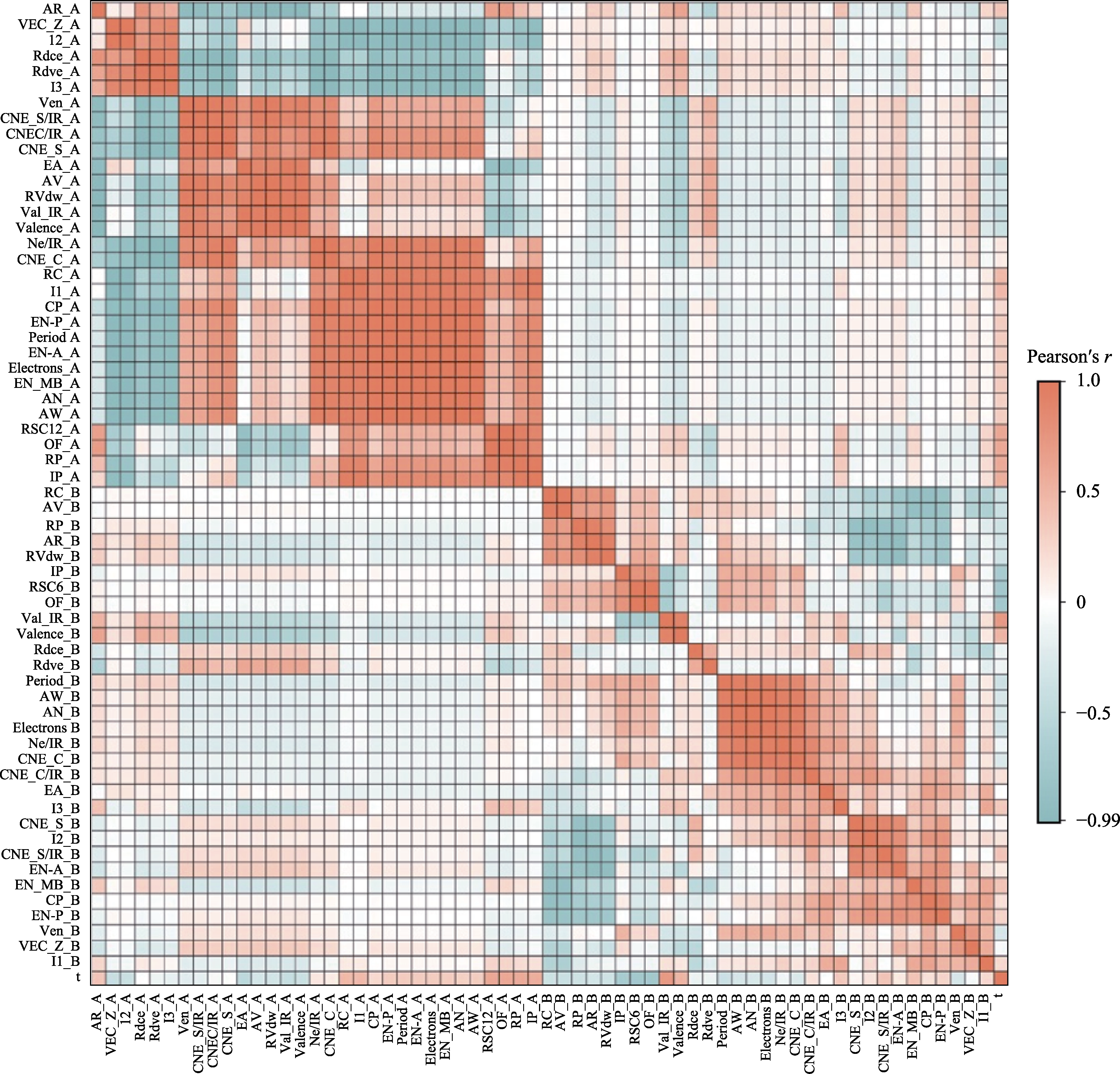
Fig. S1 Pearson correlation calculation results of all features
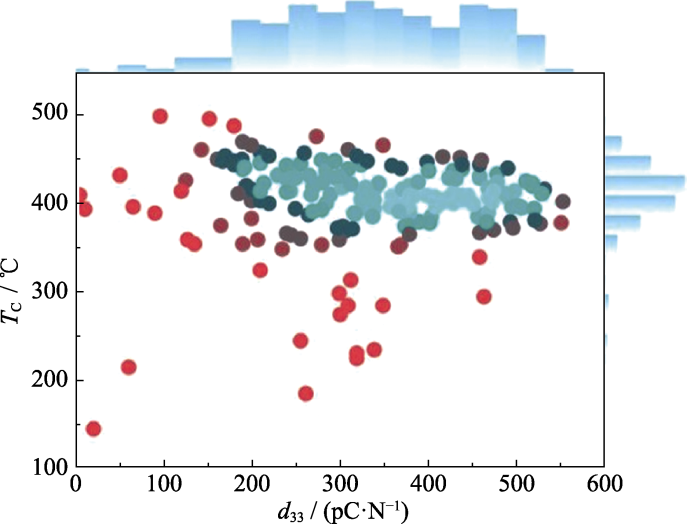
Fig. S2 Distribution of target properties (d33 and TC) in the training dataset
| [1] |
GAO X, YANG J, WU J, et al. Piezoelectric actuators and motors: materials, designs, and applications. Advanced Materials Technologies, 2020, 5(1): 1900716.
DOI URL |
| [2] |
PALATNIKOV M N, SANDLER V A, SIDOROV N V, et al. Conditions of application of LiNbO3 based piezoelectric resonators at high temperatures. Physics Letters A, 2020, 384(14): 126289.
DOI URL |
| [3] |
EITEL R E, RANDALL C A, SHROUT T R, et al. New high temperature morphotropic phase boundary piezoelectrics based on Bi(Me)O3-PbTiO3 ceramics. Japanese Journal of Applied Physics, 2001, 40(10R): 5999.
DOI |
| [4] |
LEE H J, ZHANG S, BAR-COHEN Y, et al. High temperature, high power piezoelectric composite transducers. Sensors, 2014, 14(8): 14526.
DOI PMID |
| [5] | LI Q, SHI W, JIANG Y, et al. Effect of Y-doping on the piezoelectric properties of (1-x)BiScO3-xPbTiO3 high-temperature piezoelectric ceramics. 2009 18th IEEE International Symposium on the Applications of Ferroelectrics, IEEE, 2009: 1-4. |
| [6] |
LAN Z, CHEN K, HE X, et al. Phase evolution and thermal stability of high Curie temperature BiScO3-PbTiO3-Pb(Cd1/3Nb2/3)O3 ceramics near MPB. Journal of Applied Physics, 2019, 126(23): 234103.
DOI URL |
| [7] | YANG C, XU X, ALI W, et al. Piezoelectricity in excess of 800 pC/N over 400 ℃ in BiScO3-PbTiO3-CaTiO3 ceramics. ACS Applied Materials & Interfaces, 2021, 13(28): 33253. |
| [8] |
WANG H, ZHU Y, LI J, et al. Machine learning-accelerated exploration on element doping-triggering material performance improvement for energy conversion and storage applications. Journal of Materials Chemistry A, 2025, 13(23): 17197.
DOI URL |
| [9] |
LING C. A review of the recent progress in battery informatics. npj Computational Materials, 2022, 8: 33.
DOI |
| [10] |
VALIZADEH A, SAHARA R, SOUISSI M. Alloys innovation through machine learning: a statistical literature review. Science and Technology of Advanced Materials: Methods, 2024, 4(1): 2326305.
DOI URL |
| [11] |
MANNODI-KANAKKITHODI A, CHAN M K Y. Computational data-driven materials discovery. Trends in Chemistry, 2021, 3(2): 79.
DOI URL |
| [12] |
LIU Y, WU J, WANG Z, et al. Predicting creep rupture life of Ni- based single crystal superalloys using divide-and-conquer approach based machine learning. Acta Materialia, 2020, 195: 454.
DOI URL |
| [13] | LIU Y, YANG Z, ZOU X, et al. Data quantity governance for machine learning in materials science. National Science Review, 2023, 10(7): nwad125. |
| [14] |
SAPKAL S, KANDASUBRAMANIAN B, DIXIT P, et al. Machine learning aided accelerated prediction and experimental validation of functional properties of K1-xNaxNbO3-based piezoelectric ceramics. Materials Today Energy, 2023, 37: 101402.
DOI URL |
| [15] |
HE J, YU C, HOU Y, et al. Accelerated discovery of high- performance piezocatalyst in BaTiO3-based ceramics via machine learning. Nano Energy, 2022, 97: 107218.
DOI URL |
| [16] |
LIU Y, GUO B, ZOU X, et al. Machine learning assisted materials design and discovery for rechargeable batterie. Energy Storage Materials, 2020, 31: 434.
DOI URL |
| [17] |
PANG D, LONG X, TAILOR H. A lead-reduced ferrolectric solid solution with high curie temperature: BiScO3-Pb(Zn1/3Nb2/3)O3- PbTiO3. Ceramics International, 2014, 40(8): 12953.
DOI URL |
| [18] |
BUSH A A, KAMENTSEV K E, LAVRENT’EV A M, et al. Dielectric and piezoelectric properties of (1-2x)BiScO3·xPbTiO3·xPbMg1/3Nb2/3O3 (0.30≤x≤0.46) solid solutions. Inorganic Materials, 2011, 47(7): 779.
DOI URL |
| [19] |
WANG D, JIANG Z, YANG B, et al. Enhanced electrical properties of novel Pb(Ni1/3Nb2/3)O3-BiScO3-PbTiO3 ternary system near morphotropic phase boundary. Japanese Journal of Applied Physics, 2013, 52(10R): 101101.
DOI |
| [20] |
ZHANG S, YU Y, WU J, et al. Enhanced piezoelectric performance of BiScO3-PbTiO3 ceramics modified by 0.03Pb(Sb1/2Nb1/2)O3. Journal of Alloys and Compounds, 2018, 731: 1140.
DOI URL |
| [21] |
RYU J, PRIYA S, SAKAKI C, et al. High power piezoelectric characteristics of BiScO3-PbTiO3-Pb(Mn1/3Nb2/3)O3. Japanese Journal of Applied Physics, 2002, 41(10R): 6040.
DOI URL |
| [22] |
ZHANG S, WANG X, LI L. Raman spectra and phase transition in (1-x)BiScO3-xPbTiO3 nanopowders. Ferroelectrics, 2013, 450(1): 28.
DOI URL |
| [23] |
DONG Y, ZHAO K, ZHOU Z, et al. High piezoelectricity with broad temperature insensitivity in BiScO3-PbTiO3-based piezoceramics. Journal of the American Ceramic Society, 2022, 105(11): 6898.
DOI URL |
| [24] |
WU N N, HOU Y D, WANG C, et al. Effect of sintering temperature on dielectric relaxation and Raman scattering of 0.65Pb(Mg1/3Nb2/3)O3-0.35PbTiO3 system. Journal of Applied Physics, 2009, 105(8): 084107.
DOI URL |
| [25] |
MARTIRENA H T, BURFOOT J C. Grain-size and pressure effects on the dielectric and piezoelectric properties of hot-pressed PZT-5. Ferroelectrics, 1974, 7(1): 151.
DOI URL |
| [26] |
YU T, ZHAO H, DUAN X, et al. Phase transition and relaxor nature of BaTiO3 ceramics induced by Li/Ga co-doping. Materials Chemistry and Physics, 2022, 290: 126566.
DOI URL |
| [27] | KRÖLL E, DEVECIOGLU L, SALAK A N, et al. Weakly-coupled barium titanate stannate-based relaxors as energy storage materials. Journal of the American Ceramic Society, 2025, 108(6): e20413. |
| [28] |
MALA D, SINGH C B, SINGH A K. Doping-induced relaxor ferroelectricity and site engineering in Ba1-xPr2x/3Ti1-y(Mo1/2Nb1/2)yO3 ceramics for enhanced permittivity and energy storage performance. ACS Omega, 2025, 10(38): 43779.
DOI URL |
| [29] |
QIN Y, LIU W, DING Y, et al. Enhanced electromechanical response in Dy3+-doped PNN-PZT relaxor ferroelectrics. Nanoscale, 2025, 17(17): 10685.
DOI URL |
| [30] |
XIAO A, XIE X, HE L, et al. Enhanced piezoelectric properties in a single-phase region of Sm-modified lead-free (Ba,Ca)(Zr,Ti)O3 ceramics. Materials, 2022, 15(21): 7839.
DOI URL |
| [31] |
JO W, DITTMER R, ACOSTA M, et al. Giant electric-field- induced strains in lead-free ceramics for actuator applications- status and perspective. Journal of Electroceramics, 2012, 29(1): 71.
DOI URL |
| [32] |
LEE D S, JEONG S J, KIM M S, et al. Electric field induced polarization and strain of Bi-based ceramic composites. Journal of Applied Physics, 2012, 112(12): 124109.
DOI URL |
| [33] |
ZHAO T L, FEI C, PU K, et al. Structure evolution and enhanced electrical performance for BiScO3-Bi(Ni1/2Zr1/2)O3-PbTiO3 solid solutions near the morphotropic phase boundary. Journal of Alloys and Compounds, 2021, 873: 159844.
DOI URL |
| [34] |
BERGANZA E, PASCUAL-GONZÁLEZ C, AMORÍN H, et al. Point defect engineering of high temperature piezoelectric BiScO3-PbTiO3 for high power operation. Journal of the European Ceramic Society, 2016, 36(16): 4039.
DOI URL |
| [35] |
ZHAO H, HOU Y, YU X, et al. Ultra-broad temperature insensitive ceramics with large piezoelectricity by morphotropic phase boundary design. Acta Materialia, 2019, 181: 238.
DOI URL |
| [36] |
ZHAO T L, FEI C, DAI X, et al. Structure and enhanced piezoelectric performance of BiScO3-PbTiO3-Pb(Ni1/3Nb2/3)O3 ternary high temperature piezoelectric ceramics. Journal of Alloys and Compounds, 2019, 806: 11.
DOI URL |
| [37] |
ZHAO T L, CHEN J, WANG C M, et al. Ferroelectric, piezoelectric, and dielectric properties of BiScO3-PbTiO3-Pb(Cd1/3Nb2/3)O3 ternary high temperature piezoelectric ceramics. Journal of Applied Physics, 2013, 114(2): 027014.
DOI URL |
| [38] |
YAO Z, LIU H, HAO H, et al. Structure, electrical properties, and depoling mechanism of BiScO3-PbTiO3-Pb(Zn1/3Nb2/3)O3 high- temperature piezoelectric ceramics. Journal of Applied Physics, 2011, 109(1): 014105.
DOI URL |
| [39] |
YAO Z, LIU H, LIU Y, et al. Morphotropic phase boundary in Pb(Sc1/2Nb1/2)O3-BiScO3-PbTiO3 high temperature piezoelectrics. Materials Letters, 2008, 62(29): 4449.
DOI URL |
| [40] |
DAI Z, LIU W, LIN D, et al. Electrical properties of zirconium- modified BiScO3-PbTiO3 piezoelectric ceramics at re-designed phase boundary. Materials Letters, 2018, 215: 46.
DOI URL |
| [41] |
PARK S E, SHROUT T R. Characteristics of relaxor-based piezoelectric single crystals for ultrasonic transducer. IEEE Transactions on Ultrasonics, Ferroelectrics, and Frequency Control, 1997, 44(5): 1140.
DOI URL |
| [42] | LIU W, ZHENG T, ZHANG F, et al. Achieving high piezoelectricity and excellent temperature stability in Pb(Zr,Ti)O3-based ceramics via low-temperature sintering. ACS Applied Materials & Interfaces, 2022, 14(45): 51113. |
| [43] |
XING J, MO M, CHENG Y, et al. Decoding the piezo- contributions of potassium sodium niobate ceramics. Journal of Physical Chemistry C, 2024, 128(1): 658.
DOI URL |
| [44] |
DAMJANOVIC D. Contributions to the piezoelectric effect in ferroelectric single crystals and ceramics. Journal of the American Ceramic Society, 2005, 88(10): 2663.
DOI URL |
| [45] |
TAN P, HUANG X, WANG Y, et al. Deciphering the atomistic mechanism underlying highly tunable piezoelectric properties in perovskite ferroelectrics via transition metal doping. Nature Communications, 2024, 15: 10619.
DOI |
| [46] |
WANG X, HUAN Y, JI S, et al. Ultra-high piezoelectric performance by rational tuning of heterovalent-ion doping in lead- free piezoelectric ceramics. Nano Energy, 2022, 101: 107580.
DOI URL |
| [47] |
SMÅBRÅTEN D R. Domain wall mobility and roughening in doped ferroelectric hexagonal manganites. Physical Review Research, 2020, 2(3): 033159.
DOI URL |
| [48] |
KUAMR R, ASOKAN K, PATNAIK S, et al. Evolution of microstructure and relaxor ferroelectric properties in (LazBa1-z)(Ti0.80Sn0.20)O3. Journal of Alloys and Compounds, 2016, 687: 197.
DOI URL |
| [49] |
LV X, ZHU J, XIAO D, et al. Emerging new phase boundary in potassium sodium-niobate based ceramics. Chemical Society Reviews, 2020, 49(3): 671.
DOI PMID |
| [50] |
FU Y, JIANG X, Li X, et al. Cation engineering in two- dimensional Ruddlesden-Popper lead iodide perovskites with mixed large A-site cations in the cage. Journal of the American Chemical Society, 2020, 142(8): 4008.
DOI URL |
| [51] |
ZOU J, WEI T, SONG M, et al. Unveiling the origin of ultrahigh piezoelectricity in Sb doped KNN based piezoceramics. Advanced Functional Materials, 2025, 35(28): 2425080.
DOI URL |
| [52] |
ZOU J, SONG M, ZHOU X, et al. Enhancing piezoelectric coefficient and thermal stability in lead-free piezoceramics: insights at the atomic-scale. Nature Communications, 2024, 15: 8591.
DOI PMID |
| [1] | HU Yang, XIE Min, ZHANG Xiaoyi, LI Xiang, GUO Xinwei, JIANG Nan, ZHOU Wenhan, ZHANG Shengli, ZENG Haibo. Research Progress on Computational and Data-driven Environmental-friendly Luminescent Materials [J]. Journal of Inorganic Materials, 2026, 41(6): 704-722. |
| [2] | SONG Kunjie, XIE Rongjun. Research Advances on Machine Learning-driven Development of Novel Luminescent Materials [J]. Journal of Inorganic Materials, 2026, 41(6): 689-703. |
| [3] | XIE Chenyi, MIAO Huaming, ZHANG Weiran, LIU Rongjun, WANG Yanfei, LI Duan. Research Progress on Theoretical Calculation in the Field of High-entropy Ceramics [J]. Journal of Inorganic Materials, 2026, 41(5): 545-560. |
| [4] | ZHOU Yangyang, ZHANG Yanyan, YU Ziyi, FU Zhengqian, XU Fangfang, LIANG Ruihong, ZHOU Zhiyong. Enhancement of Piezoelectric Properties in CaBi4Ti4O15-based Ceramics through Bi3+ Self-doping Strategy [J]. Journal of Inorganic Materials, 2025, 40(6): 719-728. |
| [5] | HUANG Jianfeng, LIANG Ruihong, ZHOU Zhiyong. Effects of W/Cr Co-doping on the Crystal Structure and Electric Properties of CaBi2Nb2O9 Piezoceramics [J]. Journal of Inorganic Materials, 2024, 39(8): 887-894. |
| [6] | JIAO Zhixiang, JIA Fanhao, WANG Yongchen, CHEN Jianguo, REN Wei, CHENG Jinrong. Curie Temperature Prediction of BiFeO3-PbTiO3-BaTiO3 Solid Solution Based on Machine Learning [J]. Journal of Inorganic Materials, 2022, 37(12): 1321-1328. |
| [7] | SHI Siqi, SUN Shiyu, MA Shuchang, ZOU Xinxin, QIAN Quan, LIU Yue. Detection Method on Data Accuracy Incorporating Materials Domain Knowledge [J]. Journal of Inorganic Materials, 2022, 37(12): 1311-1320. |
| [8] | ZHANG Ruihong, WEI Xin, LU Zhanhui, AI Yuejie. Training Model for Predicting Adsorption Energy of Metal Ions Based on Machine Learning [J]. Journal of Inorganic Materials, 2021, 36(11): 1178-1184. |
| [9] | MENG Yanran, WANG Xinger, YANG Jian, XU Han, YUE Feng. Research on Machine Learning Based Model for Predicting the Impact Status of Laminated Glass [J]. Journal of Inorganic Materials, 2021, 36(1): 61-68. |
| Viewed | ||||||
|
Full text |
|
|||||
|
Abstract |
|
|||||
