
Journal of Inorganic Materials ›› 2026, Vol. 41 ›› Issue (7): 923-929.DOI: 10.15541/jim20250452
• RESEARCH ARTICLE • Previous Articles Next Articles
SHANG Sen1,2( ), JIANG Linwen1(), DONG Hao2, DAI Rui2, WU Jian2, ZHUO Xueshi2, ZHANG Jungui2, ZHANG Xiaofeng2()
Received:2025-11-09
Revised:2026-01-19
Published:2026-07-20
Online:2026-02-05
Contact:
JIANG Linwen, associate professor. E-mail: jianglinwen@nbu.edu.cn;About author:SHANG Sen (2000-), male, Master candidate. E-mail: 2356800464@qq.com
Supported by:CLC Number:
SHANG Sen, JIANG Linwen, DONG Hao, DAI Rui, WU Jian, ZHUO Xueshi, ZHANG Jungui, ZHANG Xiaofeng. CMAS Corrosion Resistance of Al-modified Si-HfO2/YbDS/GYYZO Thermal/Environmental Barrier Coating[J]. Journal of Inorganic Materials, 2026, 41(7): 923-929.
| Parameter | Si-HfO2 | YbDS | GYYZO |
|---|---|---|---|
| Spray distance/mm | 300 | 350 | 280 |
| Current/A | 650 | 700 | 630 |
| Ar/(L•min-1) | 40 | 40 | 50 |
| H2/(L•min-1) | 5 | 12 | 8 |
| Feeding rate/(r•min-1) | 2.5 | 2.8 | 3 |
| Chamber pressure/mbar | 40 | 50 | 60 |
| Carrier gas/(L•min-1) | 3 | 2.5 | 2.5 |
Table 1 PS-PVD spraying parameters
| Parameter | Si-HfO2 | YbDS | GYYZO |
|---|---|---|---|
| Spray distance/mm | 300 | 350 | 280 |
| Current/A | 650 | 700 | 630 |
| Ar/(L•min-1) | 40 | 40 | 50 |
| H2/(L•min-1) | 5 | 12 | 8 |
| Feeding rate/(r•min-1) | 2.5 | 2.8 | 3 |
| Chamber pressure/mbar | 40 | 50 | 60 |
| Carrier gas/(L•min-1) | 3 | 2.5 | 2.5 |
| Oxide | CaO | MgO | Al2O3 | SiO2 | Fe2O3+Na2O+K2O+ZrO2 |
|---|---|---|---|---|---|
| Mole/% | 34.91 | 4.44 | 10.58 | 46.20 | 3.87 |
Table 2 Compositions of CMAS
| Oxide | CaO | MgO | Al2O3 | SiO2 | Fe2O3+Na2O+K2O+ZrO2 |
|---|---|---|---|---|---|
| Mole/% | 34.91 | 4.44 | 10.58 | 46.20 | 3.87 |
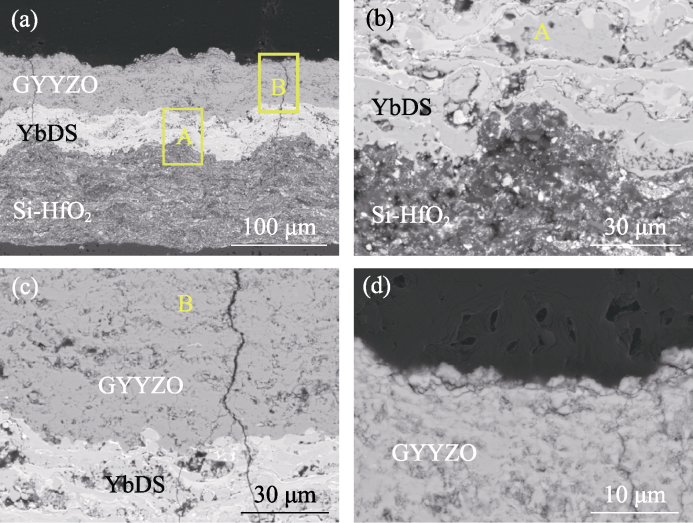
Fig. 1 Cross-sectional morphologies of GYYZO coating (a) Cross-sectional view of Si-HfO2/Yb2Si2O7/GYYZO coating system; (b) Interface between Si-HfO2 and Yb2Si2O7 layers; (c) Interface between Yb2Si2O7 and GYYZO layers; (d) High-magnification view of GYYZO layer
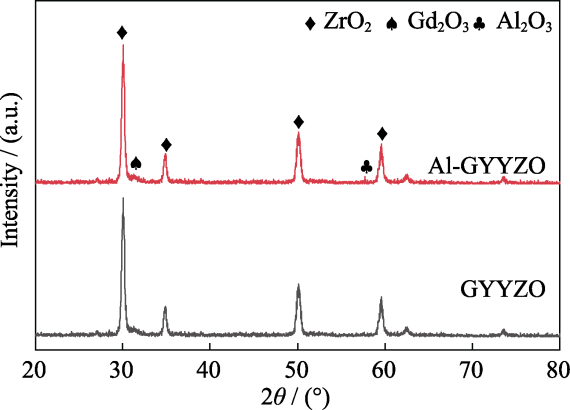
Fig. 2 XRD patterns of GYYZO and Al-GYYZO coatings
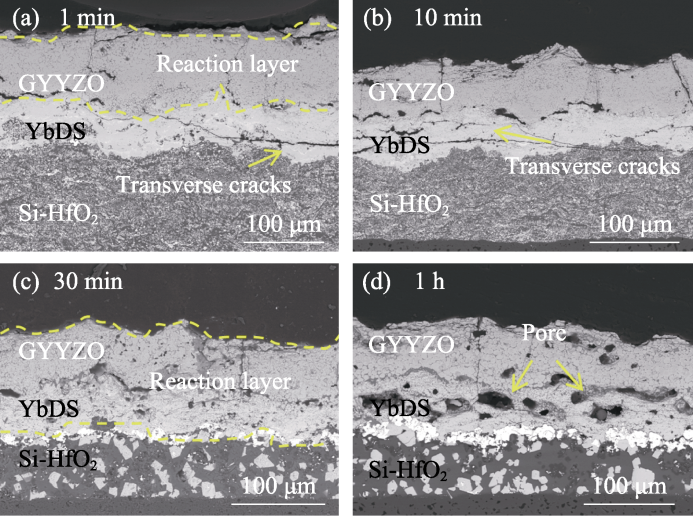
Fig. 3 Cross-sectional morphologies of GYYZO coating after CMAS corrosion at 1500 ℃ for different time (a) 1 min; (b) 10 min; (c) 30 min; (d) 1 h
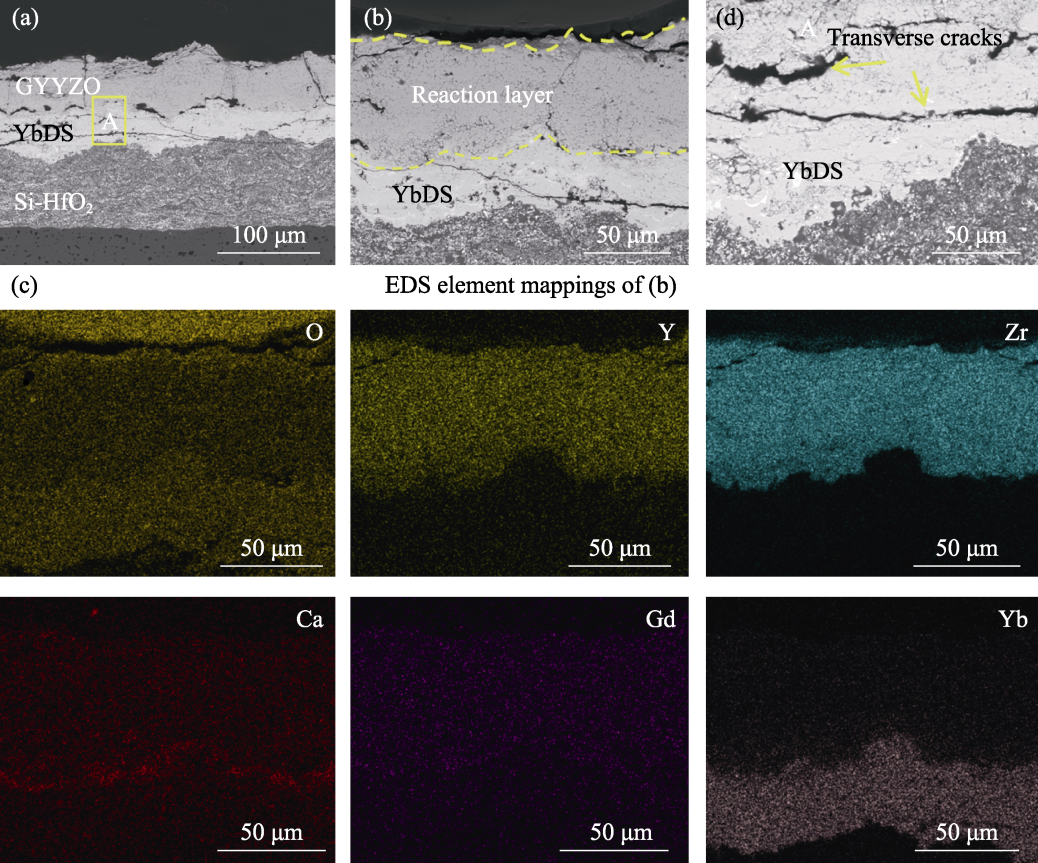
Fig. 4 Cross-sectional morphologies of GYYZO coating after CMAS corrosion at 1500 ℃ for 10 min (a) Cross-sectional morphology; (b) Reaction layer; (c) EDS elemental mappings of Fig. (b); (d) Transverse cracks in the intermediate layer
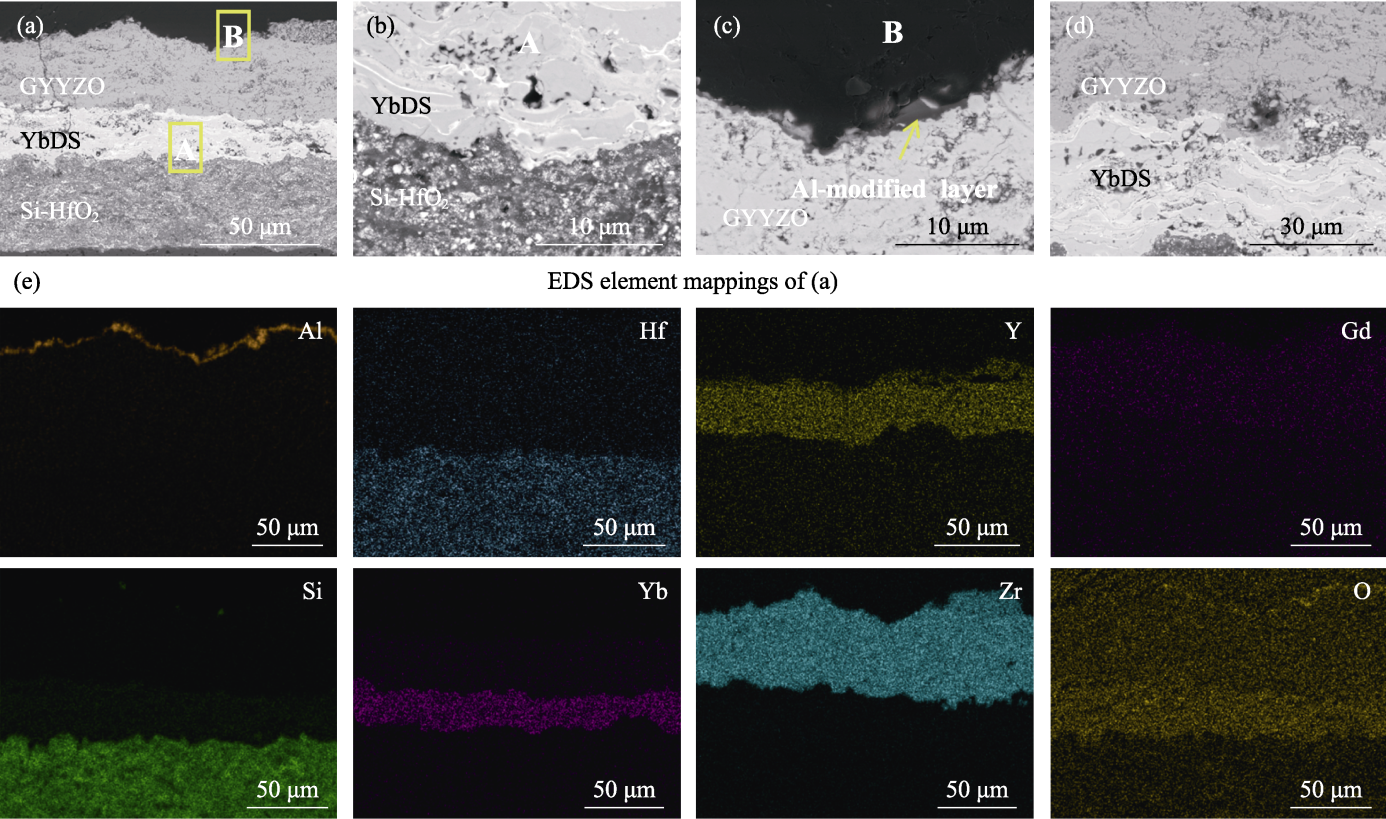
Fig. 5 Cross-sectional morphologies of Al-GYYZO coating (a) As-sprayed cross-section; (b) Interface between bond coat and interlayer; (c) Al-modified layer; (d) Interface between GYYZO and interlayer; (e) EDS elemental mappings of Fig. (a)
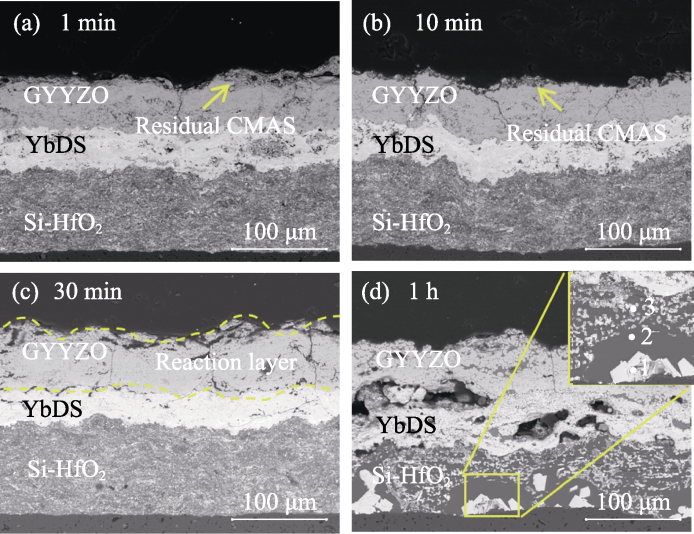
Fig. 6 Cross-sectional morphologies of Al-GYYZO coating after CMAS corrosion at 1500 ℃ for different time (a) 1 min; (b) 10 min; (c) 30 min; (d) 1 h
| Element | Content/% (in atom) | ||
|---|---|---|---|
| Spot 1 | Spot 2 | Spot 3 | |
| Si | 20.85 | 99.04 | 27.10 |
| Hf | 17.58 | 0.91 | 18.84 |
| O | 61.58 | 0.05 | 52.28 |
| Ca | 0 | 0 | 0.20 |
| Mg | 0 | 0 | 0.17 |
| Al | 0 | 0 | 1.41 |
Table 3 EDS elemental compositions of the marked spots in Fig. 6(d)
| Element | Content/% (in atom) | ||
|---|---|---|---|
| Spot 1 | Spot 2 | Spot 3 | |
| Si | 20.85 | 99.04 | 27.10 |
| Hf | 17.58 | 0.91 | 18.84 |
| O | 61.58 | 0.05 | 52.28 |
| Ca | 0 | 0 | 0.20 |
| Mg | 0 | 0 | 0.17 |
| Al | 0 | 0 | 1.41 |
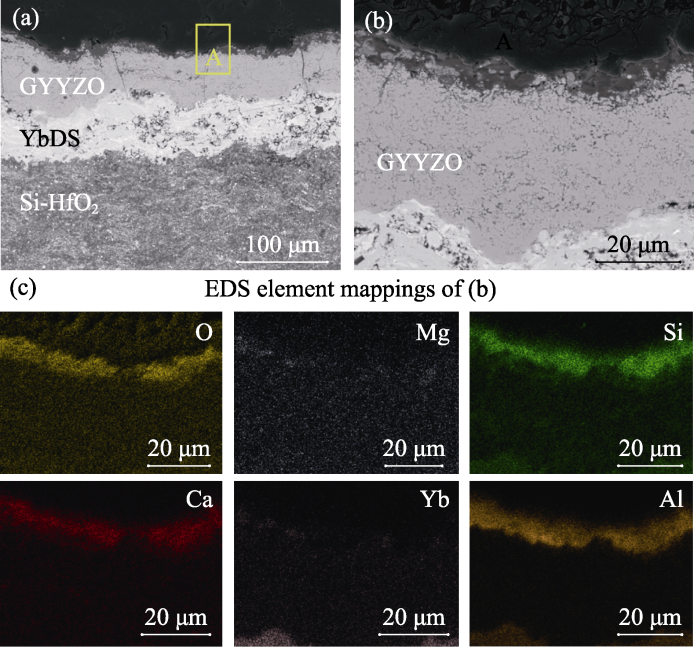
Fig. 7 Cross-sectional morphologies of Al-GYYZO coating after CMAS corrosion at 1500 ℃ for 10 min (a) Cross-sectional morphology; (b) Reaction layer; (c) EDS elemental mappings of Fig. (b)
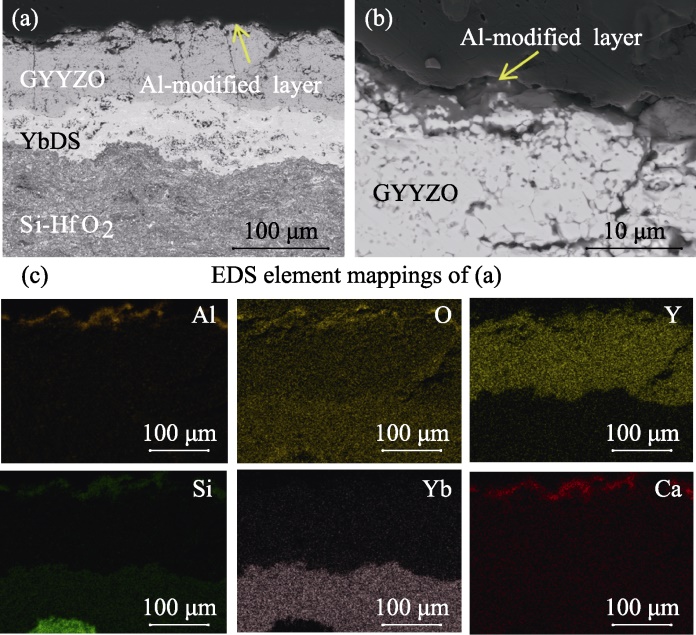
Fig. 8 Cross-sectional morphologies of Al-GYYZO coating after CMAS corrosion at 1500 ℃ for 30 min (a) Cross-sectional morphology; (b) Reaction layer; (c) EDS elemental mappings of Fig. (a)
| [1] |
CHENG H C, WANG Y L, LIU H F, et al. Microstructure evolution and thermochemical interaction of dysprosia stabilized zirconia with CMAS attack. Materials Characterization, 2025, 227: 115331.
DOI URL |
| [2] |
GODBOLE E P, HEWAGE N, POERSCHKE D L. Spreading and reaction behavior of CMAS-type silicate melts with multiphase Y and Gd aluminate-zirconate T/EBC materials. Journal of the European Ceramic Society, 2023, 43(14): 6416.
DOI URL |
| [3] |
DENG L W, WANG Y, ZHANG X D. Enhancing the anti-CMAS corrosion performance of EBCs via adding SiC to Yb2Si2O7 top ceramic layer: a novel SiC-Yb2Si2O7/Si EBCs strategy. Journal of the European Ceramic Society, 2026, 46(3): 117847.
DOI URL |
| [4] |
FAN D, ZHONG X, WANG Y W, et al. Corrosion behavior and mechanism of aluminum-rich CMAS on rare-earth silicate environmental barrier coatings. Journal of Inorganic Materials, 2023, 38(5): 544.
DOI URL |
| [5] |
YAN S Q, WU J, TAN X, et al. Microstructural evolution and corrosion mechanism of thermal/environmental barrier coatings against molten calcium-magnesium-alumino-silicate. Surface and Coatings Technology, 2024, 478: 130433.
DOI URL |
| [6] |
WU Y M, ZHONG X, HONG D, et al. Corrosion behaviors of Lu4Hf3O12 thermal/environmental barrier coatings to molten CMAS attack at 1300-1500 ℃. Applied Surface Science, 2024, 676: 161020.
DOI URL |
| [7] |
WANG Y Q, WANG F L, MAO J K, et al. Reliability analysis of thermal barrier coatings under CMAS deposition and penetration. Surface and Coatings Technology, 2024, 489: 131139.
DOI URL |
| [8] |
ZHANG G H, SHI J Y, SHEN H Y, et al. Synergistic mechanism of Gd3+ and Yb3+ on crystallization behavior of CMAS corrosion products. Journal of Inorganic Materials, 2026, 41(1): 27.
DOI URL |
| [9] |
WANG H D, ZHUO X S, ZHANG J G, et al. Strengthening of CMAS corrosion resistance of thermal barrier coatings by surface Al-Ce modification. Surface and Coatings Technology, 2025, 510: 132168.
DOI URL |
| [10] |
SONG J B, ZHANG X F, DENG C M, et al. Research of in situ modified PS-PVD thermal barrier coating against CMAS (CaO-MgO-Al2O3-SiO2) corrosion. Ceramics International, 2016, 42(2): 3163.
DOI URL |
| [11] | 玉郅云, 郭凯森, 程一凡, 等. Y2O3添加对Al2O3陶瓷/CMAS界面致密反应层生长行为的影响研究. 装备制造技术, 2025(8): 60. |
| [12] |
LIANG R H, ZHONG X, HONG D, et al. High-temperature water vapor corrosion behaviors of environmental barrier coatings with Yb2O3-modified silicon bond layer. Journal of Inorganic Materials, 2025, 40(4): 425.
DOI URL |
| [13] |
FAN W K, YANG X, LI H H, et al. Pressureless sintering of (Y0.2Gd0.2Er0.2Yb0.2Lu0.2)2Zr2O7 high-entropy ceramic and its high temperature CMAS corrosion resistance. Journal of Inorganic Materials, 2025, 40(2): 159.
DOI URL |
| [14] |
LIU Y C, WANG S G, YANG T F, et al. Solid particle erosion of an environmental barrier coating and chemically vapor infiltrated SiC/SiC for aeroengine. Ceramics International, 2024, 50(20): 39993.
DOI URL |
| [15] |
LV H Z, GE M, ZHANG H F, et al. Microstructure, thermophysical properties and oxidation resistance of SiCf/SiC-YSi2-Si composite fabricated through reactive melt infiltration. Journal of the European Ceramic Society, 2023, 43(14): 5950.
DOI URL |
| [16] |
WANG S, ZHENG T, QIN Y, et al. Influence of annealing on the CMAS corrosion behaviour of ytterbium disilicate environmental barrier coatings: a Raman imaging study. Corrosion Science, 2024, 240: 112450.
DOI URL |
| [17] |
ZHANG Y H, SUN Y N, TAN X, et al. High temperature stability and sintering resistance of Gd2O3-Yb2O3-Y2O3-ZrO2 (GYYZO) coating. Surface and Coatings Technology, 2023, 459: 129405.
DOI URL |
| [18] | SHI T J, ZHAO T, GUO Y Q, et al. Microstructural optimization of Gd2O3-Yb2O3-Y2O3 co-stabilized ZrO2/YSZ coatings with enhanced thermal shock resistance. Materials & Design, 2025, 254: 114142. |
| [19] |
SHI T J, BAI B T, PENG H R, et al. Improved thermal shock resistance of GYYZO-YSZ double ceramic layer TBCs induced by induction plasma spheroidization. Surface and Coatings Technology, 2024, 477: 130372.
DOI URL |
| [20] | LI J, ZHOU C, WANG J M, et al. Exploration on intrinsic corrosion resistance of β-Lu2Si2O7 against calcium-magnesium- aluminosilicate (CMAS) at 1500 ℃ via grain boundary engineering. Materials & Design, 2025, 253: 113965. |
| [21] |
TURCER L R, KRAUSE A R, GARCES H F, et al. Environmental-barrier coating ceramics for resistance against attack by molten calcia-magnesia-aluminosilicate (CMAS) glass: part II, β-Yb2Si2O7 and β-Sc2Si2O7. Journal of the European Ceramic Society, 2018, 38(11): 3914.
DOI URL |
| [22] |
WU J, WANG Z F, ZHUO X S, et al. Enhancing CMAS corrosion resistance of PS-PVD Si/Yb2Si2O7 EBCs via Al-modification. Journal of the European Ceramic Society, 2023, 43(8): 3727.
DOI URL |
| [23] |
ZHANG X F, ZHOU K S, LIU M, et al. CMAS corrosion and thermal cycle of Al-modified PS-PVD environmental barrier coating. Ceramics International, 2018, 44(13): 15959.
DOI URL |
| [24] |
DONG L, WEI X W, LIU M J, et al. Boosting corrosion resistance of environmental barrier coatings through surface aluminum modification against molten salts. Corrosion Science, 2025, 244: 112646.
DOI URL |
| [25] |
ZHANG X, ZHANG H F, ZHANG N N, et al. Oxidation behavior of AlCoCrFeNi bond coating in the YSZ-TBCs produced by APS and PS-PVD method. Ceramics International, 2024, 50(10): 17190.
DOI URL |
| [26] |
DONG L, LIU M J, ZHANG X F, et al. Infiltration thermodynamics in wrinkle-pores of thermal sprayed coatings. Applied Surface Science, 2021, 543: 148847.
DOI URL |
| [27] |
CHENG B, ZHENG G B, HOU D, et al. Formation mechanisms of columnar/dense structure for Gd2Zr2O7 ceramics coatings with superior CMAS corrosion resistance. Corrosion Science, 2025, 257: 113348.
DOI URL |
| [28] |
LIU R X, LIANG W P, MIAO Q, et al. Revealing the oxidation growth mechanism and crack evolution law of novel Si-HfO2/ Yb2Si2O7/Yb2SiO5 environmental barrier coatings during thermal cycling. Journal of Advanced Ceramics, 2024, 13(10): 1677.
DOI URL |
| [29] |
ANTON R, LEISNER V, WATERMEYER P, et al. Hafnia-doped silicon bond Coats manufactured by PVD for SiC/SiC CMCs. Acta Materialia, 2020, 183: 471.
DOI URL |
| [1] | ZHANG Guangheng, SHI Jinyu, SHEN Hongyu, ZHANG Jie, WANG Jingyang. Synergistic Mechanism of Gd3+ and Yb3+ on Crystallization Behavior of CMAS Corrosion Products [J]. Journal of Inorganic Materials, 2026, 41(1): 27-36. |
| [2] | FAN Wenkai, YANG Xiao, LI Honghua, LI Yong, LI Jiangtao. Pressureless Sintering of (Y0.2Gd0.2Er0.2Yb0.2Lu0.2)2Zr2O7 High-entropy Ceramic and Its High Temperature CMAS Corrosion Resistance [J]. Journal of Inorganic Materials, 2025, 40(2): 159-167. |
| [3] | LI Liuyuan, HUANG Kaiming, ZHAO Xiuyi, LIU Huichao, WANG Chao. Influence of RE-Si-Al-O Glass Phase on Microstructure and CMAS Corrosion Resistance of High Entropy Rare Earth Disilicates [J]. Journal of Inorganic Materials, 2024, 39(7): 793-802. |
| [4] | LI Jie, LUO Zhixin, CUI Yang, ZHANG Guangheng, SUN Luchao, WANG Jingyang. CMAS Corrosion Resistance of Y3Al5O12/Al2O3 Ceramic Coating Deposited by Atmospheric Plasma Spraying [J]. Journal of Inorganic Materials, 2024, 39(6): 671-680. |
| [5] | FAN Dong, ZHONG Xin, WANG Yawen, ZHANG Zhenzhong, NIU Yaran, LI Qilian, ZHANG Le, ZHENG Xuebin. Corrosion Behavior and Mechanism of Aluminum-rich CMAS on Rare-earth Silicate Environmental Barrier Coatings: [J]. Journal of Inorganic Materials, 2023, 38(5): 544-552. |
| [6] | FAN Jia-Feng,ZHANG Xiao-Feng,ZHOU Ke-Song,LIU Min,DENG Chang-Guang,DENG Chun-Ming,NIU Shao-Peng,DENG Zi-Qian. Influence of Al-modification on CMAS Corrosion Resistance of PS-PVD 7YSZ Thermal Barrier Coatings [J]. Journal of Inorganic Materials, 2019, 34(9): 938-946. |
| [7] | ZHANG Xiao-Feng, ZHOU Ke-Song, SONG Jin-Bing, DENG Chun-Ming, NIU Shao-Peng, DENG Zi-Qian. Deposition and CMAS Corrosion Mechanism of 7YSZ Thermal Barrier Coatings Prepared by Plasma Spray-Physical Vapor Deposition [J]. Journal of Inorganic Materials, 2015, 30(3): 287-293. |
| Viewed | ||||||
|
Full text |
|
|||||
|
Abstract |
|
|||||
